
A complete issue · 24 pages · 1913
Judge — December 20, 1913
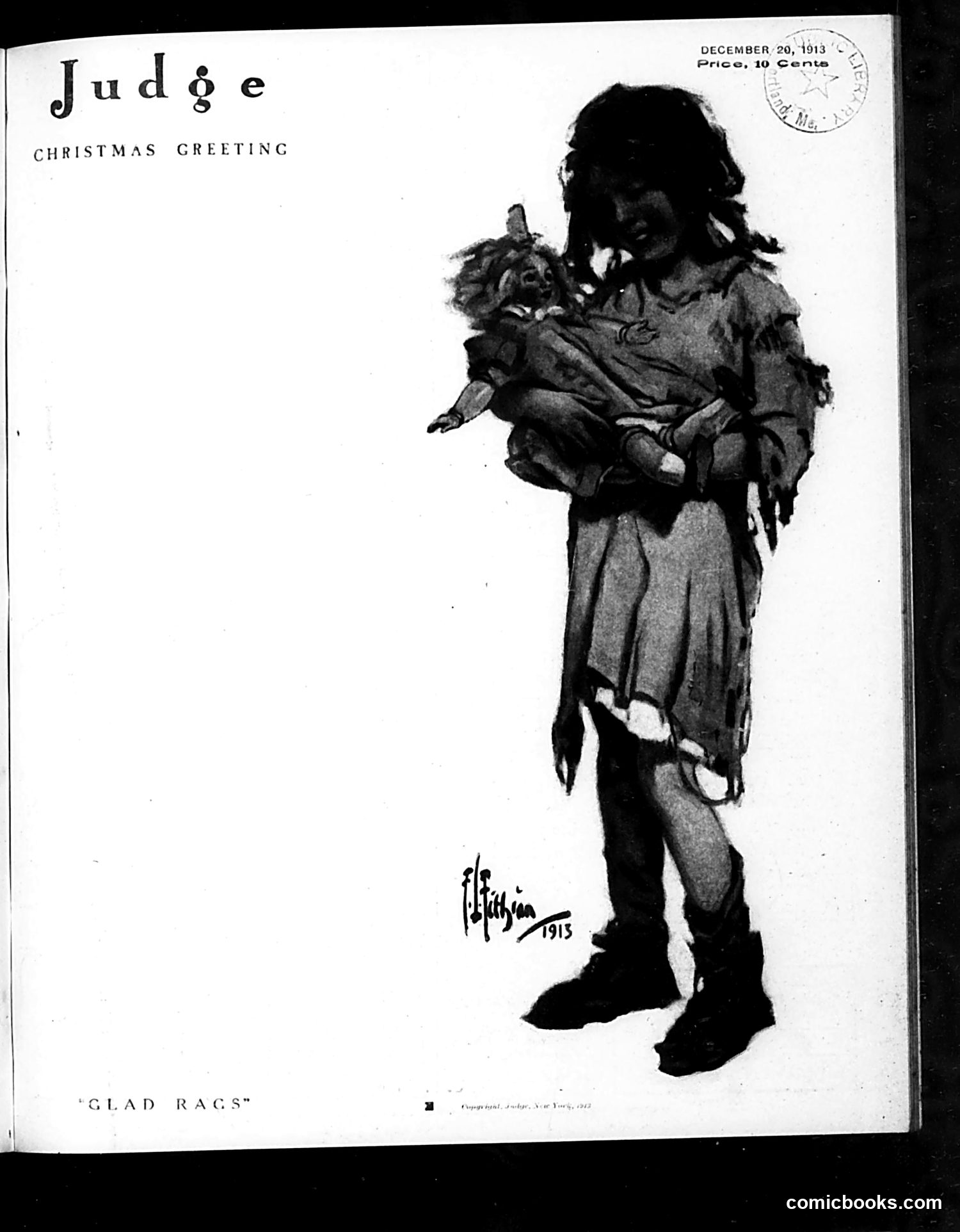
This Christmas greeting illustrates a ragged, barefoot child holding a doll, captioned "Glad Rags"—a period slang term for fine clothing. The satire is social commentary: the child is dressed in tattered, worn garments despite holding what appears to be a toy, creating ironic contrast between the title's suggestion of finery and the poverty depicted. The image critiques holiday inequality and the gap between wealthy and poor during the 1913 season. The artist (signed, likely 1915) uses the visual pun of "glad rags" (festive dress) contrasted with actual rags to highlight how some children experienced Christmas in poverty rather than celebration. It's a sardonic holiday commentary on class disparity in early 20th-century America.
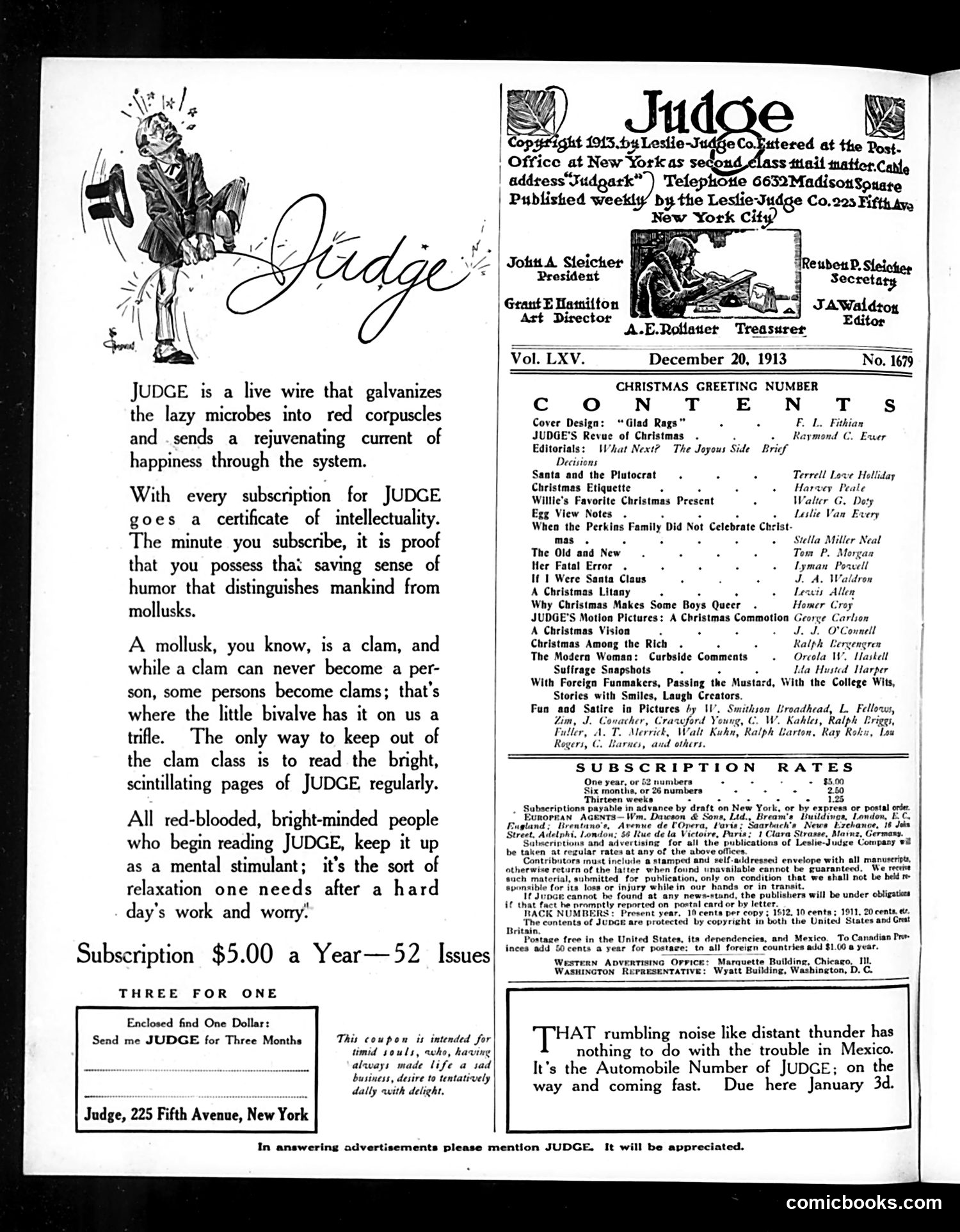
This page is primarily **promotional material** for Judge magazine itself rather than political commentary. The left side features an **illustrated mascot character** (labeled "Judge") depicted as a jester or comic figure striking an energetic pose, accompanied by marketing copy describing the magazine as a source of humor and intellectual stimulation. The text humorously equates reading Judge with avoiding becoming a "mollusk" or "clam"—using the metaphor that regular exposure to the magazine's wit prevents mental stagnation. The right side contains a **table of contents** for this Christmas greeting issue and subscription information ($5/year for 52 issues). At the bottom, an advertisement mentions "the Automobile Number of JUDGE" arriving January 3rd. This is largely **advertising copy** promoting the magazine's value as entertainment and social commentary.
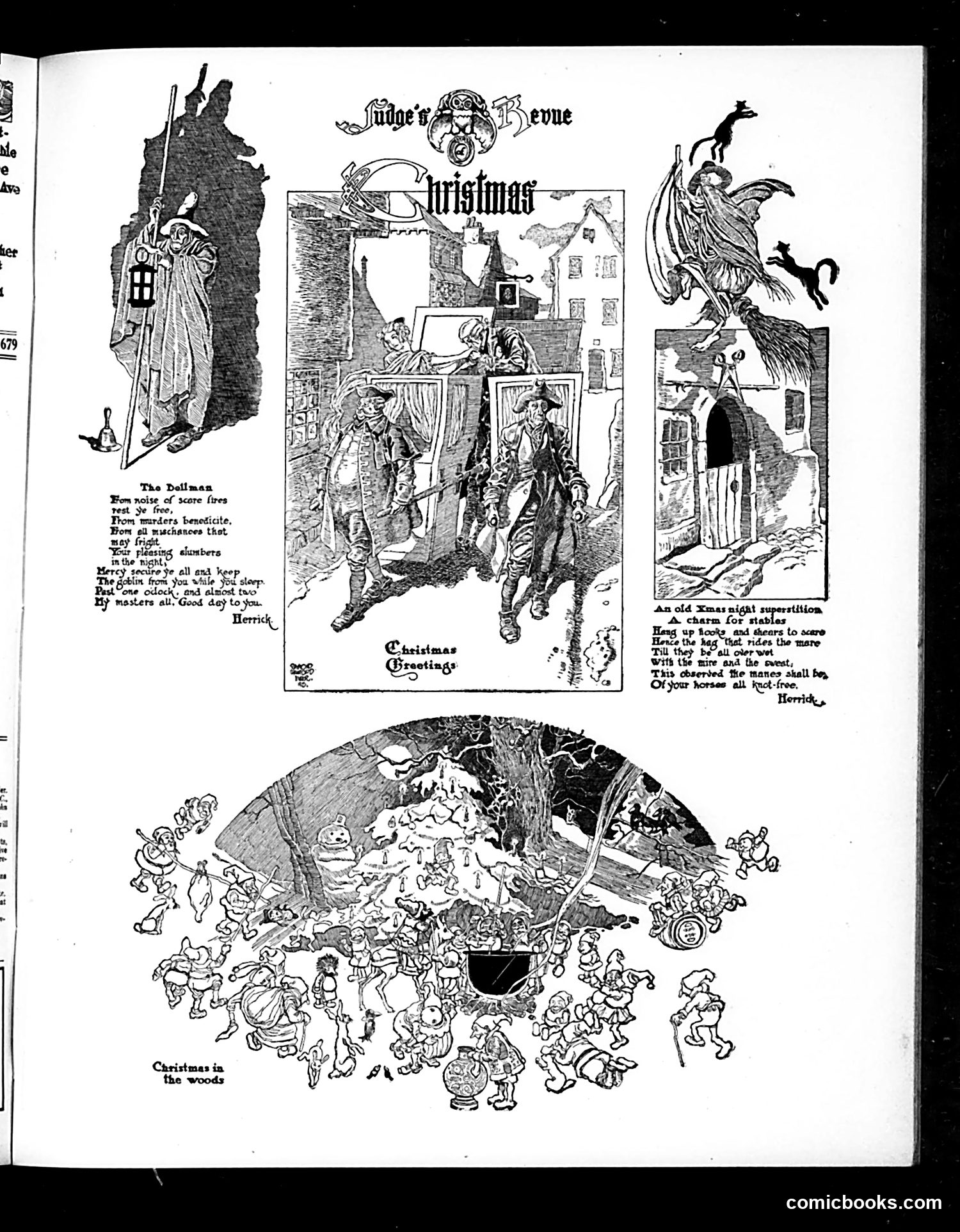
This page presents three illustrated Christmas vignettes by artist Herrick. The top left shows "The Bellman" — a figure on a castle tower ringing bells, referencing Dickens's *A Christmas Carol* and the tradition of Christmas bell-ringing. The center illustration depicts "Christmas Greetings" with figures in period dress, likely representing Victorian Christmas hospitality customs. The right panel shows "An old Xmas night superstition" about horseshoes and charms for stable protection — reflecting rural folk beliefs about preventing harm to livestock during winter. The bottom illustration, "Christmas in the woods," appears to show a festive forest gathering with numerous figures celebrating. Overall, this is thematic Christmas content celebrating literary references, folklore, and holiday traditions rather than political satire. The page functions as seasonal entertainment for *Judge*'s readers.
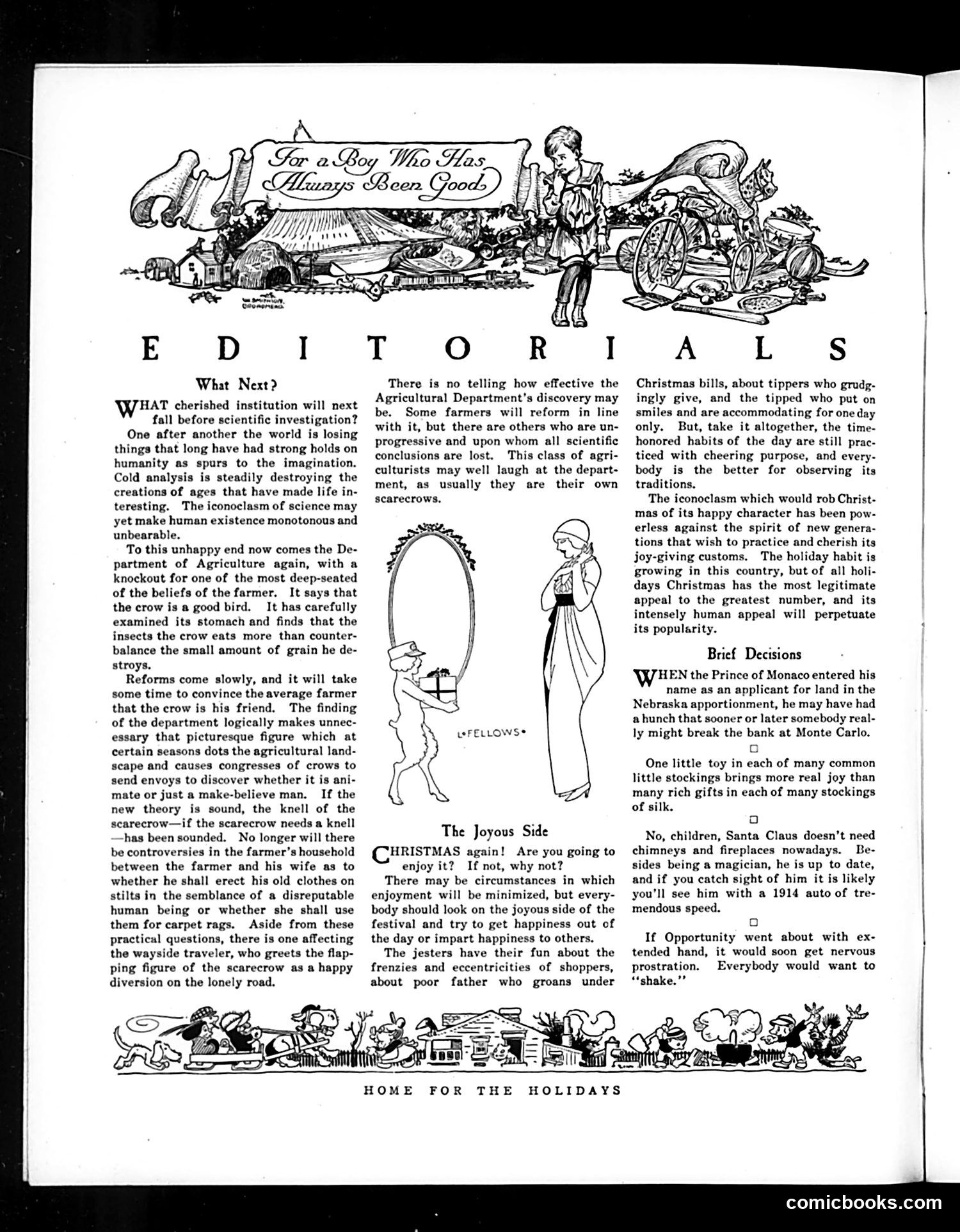
This editorial page from Judge magazine contains three distinct sections: 1. **"What Next?" column**: Critiques the Department of Agriculture's discovery that crows eat grain. The writer sarcastically questions whether farmers will reform based on this "scientific investigation," suggesting agricultural institutions move slowly and that farmers already know crows are problematic. 2. **"The Joyous Side" column**: Argues Christmas should be celebrated despite life's hardships, encouraging people to find happiness in the holiday's "intensely human appeal." 3. **"Brief Decisions" section**: Contains three brief satirical items, including a joke about the Prince of Monaco applying for a Nebraska land apportionment, and commentary about Santa Claus needing modern transportation (a 1914 automobile) rather than traditional chimneys. The page exemplifies Judge's characteristic blend of agricultural commentary, holiday sentiment, and light political satire.
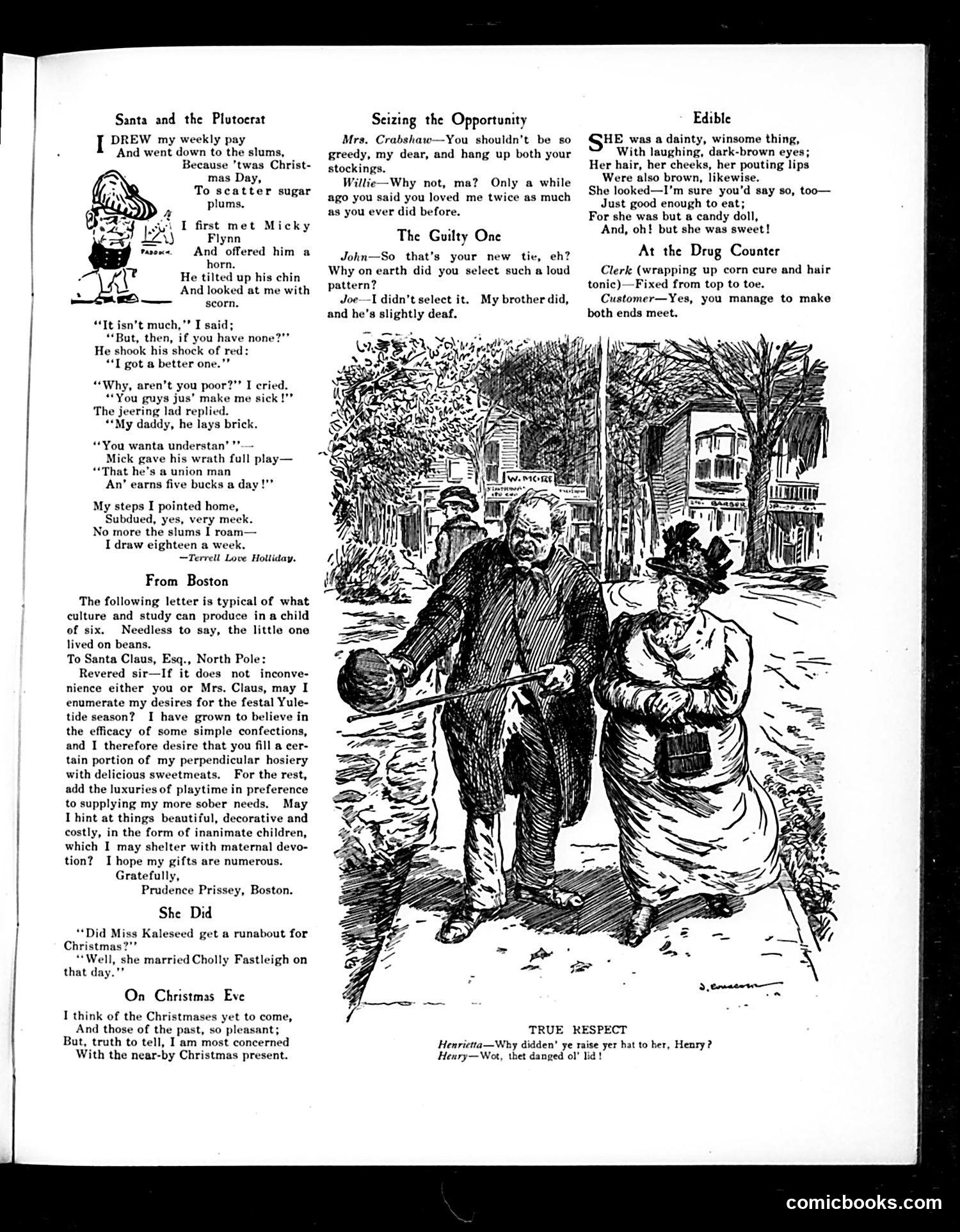
The page contains several short humorous pieces rather than a single political cartoon. The main illustration labeled "TRUE RESPECT" depicts an interaction between what appears to be a working-class man and woman in an urban slum setting, with the caption joking about a man not raising his hat to a woman—suggesting he's too rough or uncouth for such courtesy. The surrounding text includes domestic humor pieces like "The Guilty One" (about a loud necktie), "Edible" (describing a sweet girl), and "She Did" (about a Christmas elopement). There's also a letter from Boston to Santa Claus written by a cultured child requesting "handmade children" and luxuries rather than commercial toys—satirizing upper-class pretension and conspicuous consumption among the wealthy.
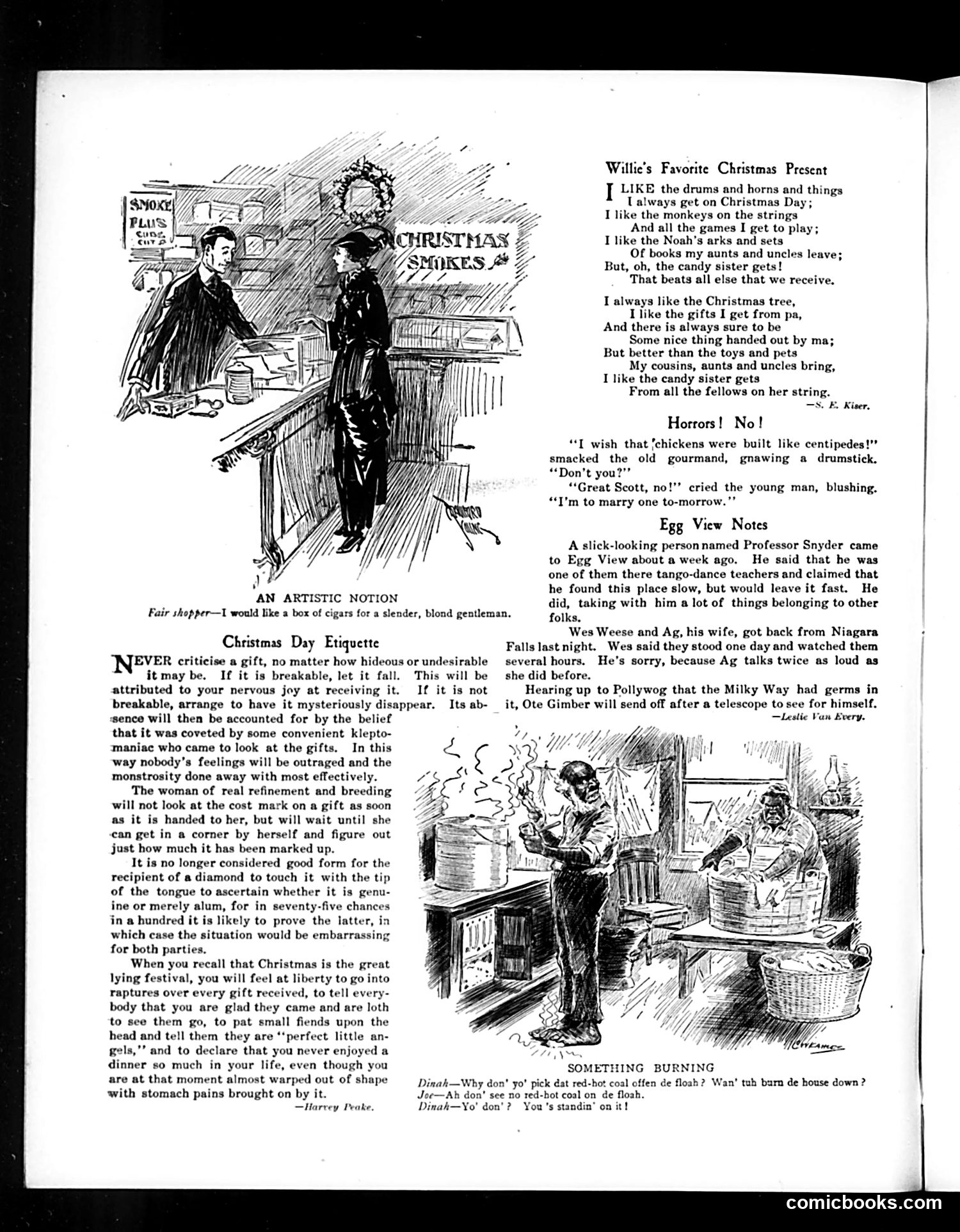
This page contains three distinct pieces of Christmas-themed satirical content: **"Christmas Day Etiquette"** mocks upper-class social pretense by offering absurd "rules" for gift-receiving: praising hideous gifts, pretending breakables broke from "joy," and conveniently losing unwanted presents to imaginary thieves. It satirizes the hypocrisy of wealthy society—people secretly checking price tags while publicly feigning delight. The humor targets the dishonesty embedded in polite society's Christmas rituals. **"Willie's Favorite Christmas Present"** is a children's poem about a boy's preference for his sister's candy (given by suitors) over his own toys—a gentle joke about sibling jealousy and courtship. **"Horrors! No!"** plays on a misunderstanding: an old man wishes chickens had many legs (like centipedes) for more drumsticks; a young man thinks he's insulting his fiancée, whom he's about to marry. The remaining items are brief humorous anecdotes ("Egg View Notes," "Something Burning") featuring rural or working-class characters in dialect, typical of period humor using stereotypical speech patterns.
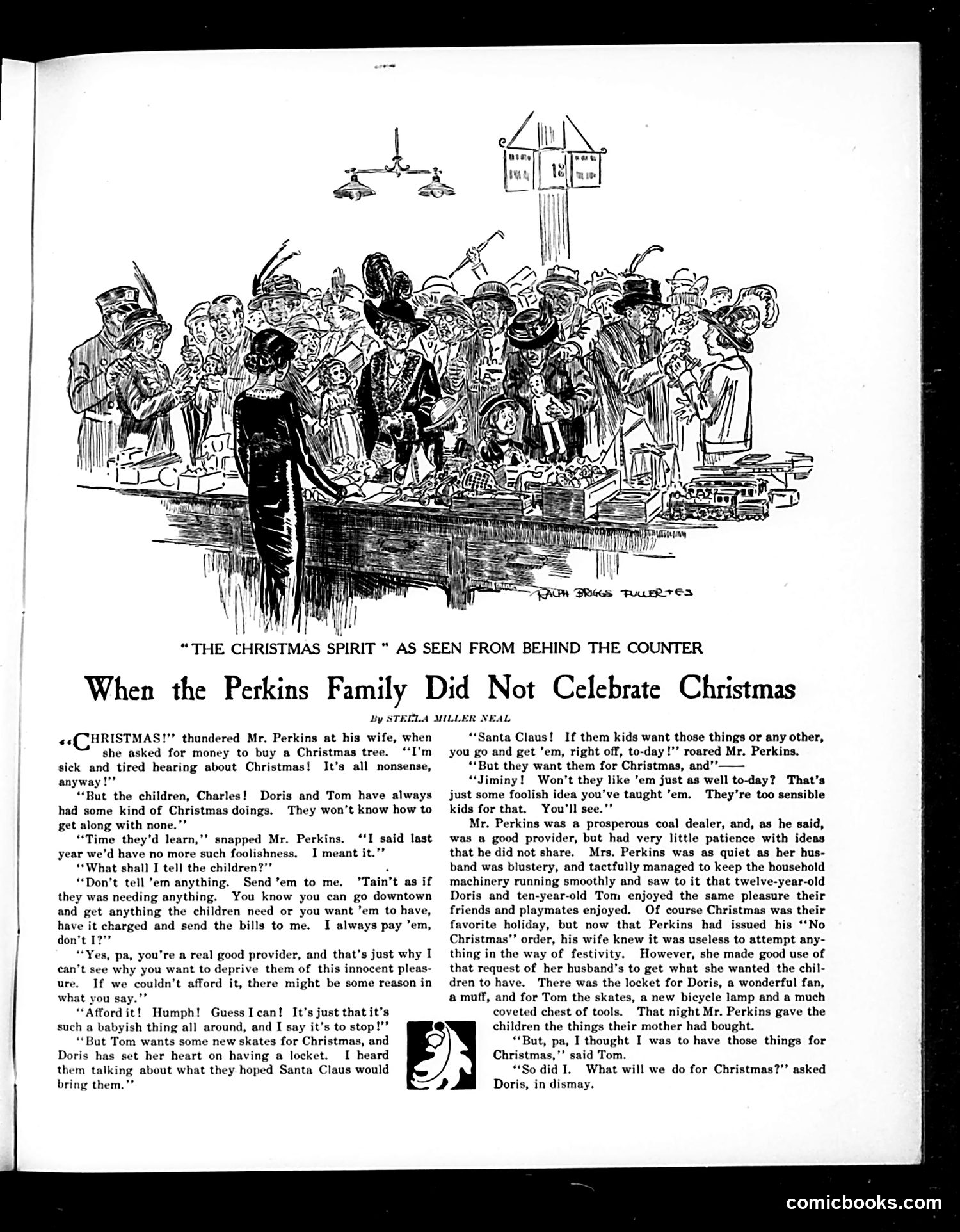
This satirical story critiques a particular type of wealthy miser—a successful coal dealer named Perkins who refuses Christmas celebration on principle, calling it "babyish" and "nonsense," despite having ample means. The satire targets his hypocrisy: Perkins claims he can't afford Christmas festivities, yet openly admits he's prosperous and always pays children's bills immediately. His real objection is ideological—a dismissal of sentimental tradition. However, his wife circumvents his edict by purchasing the desired gifts (skates, locket, tools) anyway, which Perkins then gives the children outside the Christmas context. The joke's sting lies in the children's response: receiving the exact gifts they wanted, they still feel robbed of Christmas itself. The gifts' meaning depends on *when* and *how* they're given, not merely their material value. Perkins's rationalist materialism—"Won't they like 'em just as well to-day?"—fails to recognize that Christmas's "spirit" resides in tradition and anticipation, not purchase price. The cartoon illustrates this disconnect between commerce and sentiment, mocking wealthy philistines who mistake financial provision for parental understanding.
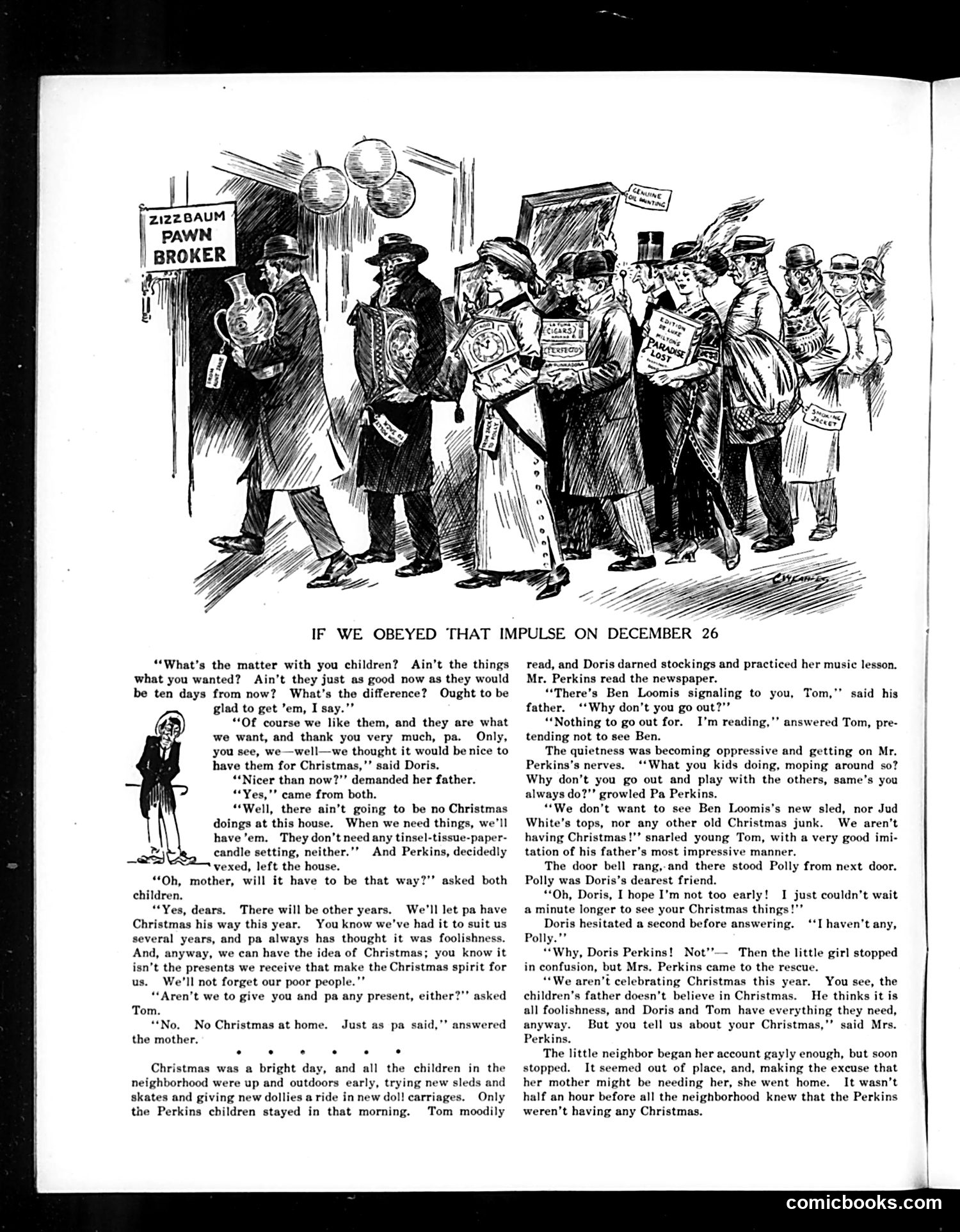
This cartoon satirizes a miserly father, Mr. Perkins, who refuses to observe Christmas properly because he views gift-giving as wasteful foolishness. The top panel depicts him as a "Pawn Broker"—a figure of commerce and stinginess—surrounded by what appears to be people hawking materialistic goods, contrasting his mercenary worldview with Christmas spirit. The accompanying story shows Perkins denying his children Christmas celebrations, giving them presents early instead and forbidding festive "tinsel" decorations. His children comply sadly while neighbors celebrate openly. The satire's point: by rejecting Christmas sentiment, Perkins becomes a social embarrassment and actually *creates* misery rather than preventing it. The title suggests the cartoon warns against adopting such cynical, utilitarian attitudes year-round. The message critiques Gilded Age materialism while defending Christmas as having spiritual, not merely commercial, value.
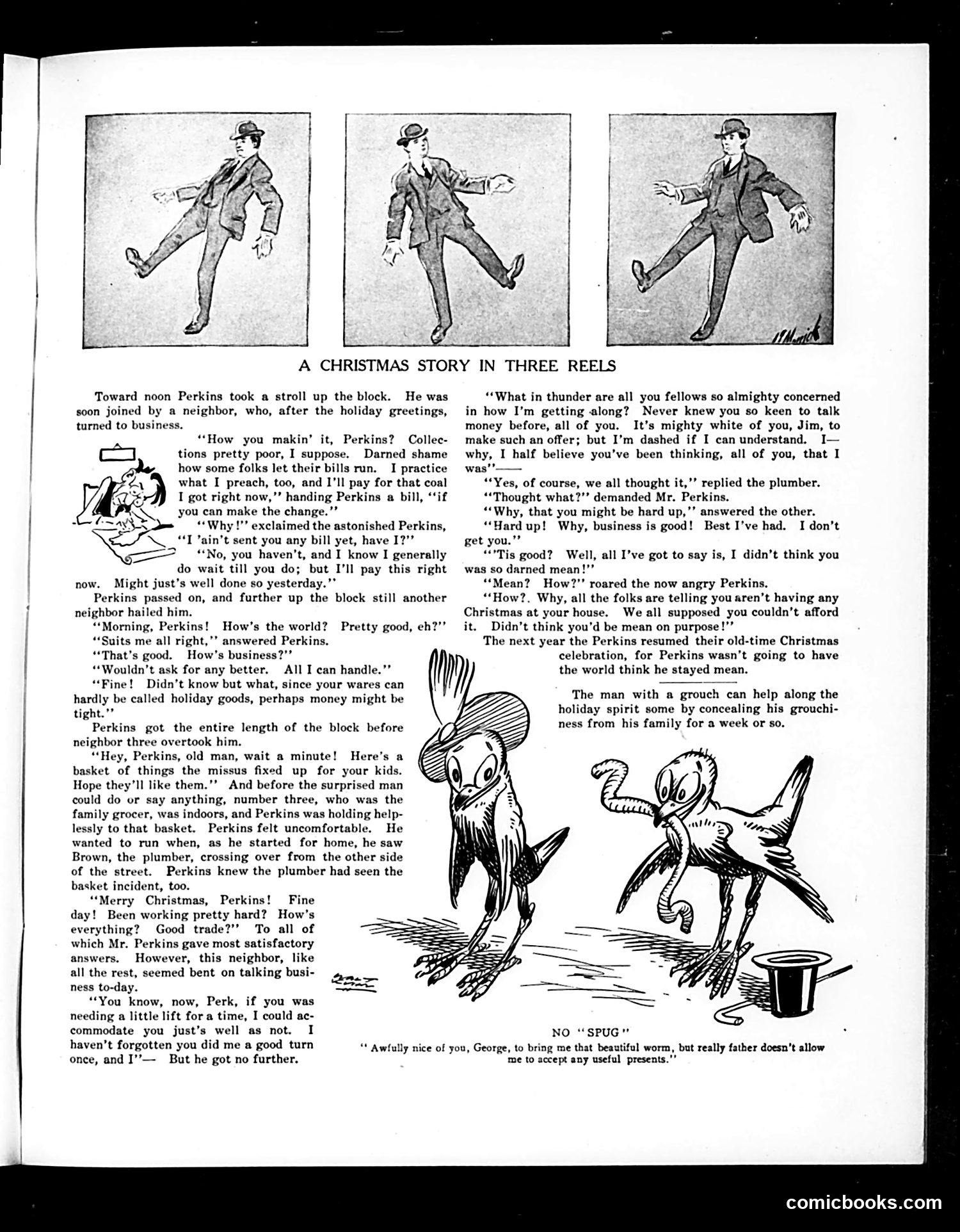
This satirical story mocks middle-class social anxiety and keeping up appearances. Perkins, apparently a tradesman or merchant, is approached repeatedly by neighbors on Christmas—each offering help, gifts, or payment, ostensibly out of generosity. Perkins initially welcomes this until he realizes the ugly truth: his neighbors have been *gossiping* that he's poor and struggling, so they're offering charity out of pity disguised as goodwill. Perkins is humiliated and angry—not grateful. The satire's point: these "kind" gestures are actually insulting assumptions about his financial status, driven by neighborhood gossip rather than genuine concern. The moral emphasizes that people will perform cheerfulness publicly to avoid being labeled "mean" or poor, even when it requires pretense. The cartoon critiques how Christmas charity can wound pride and how community judgment pressures conformity to expected prosperity.
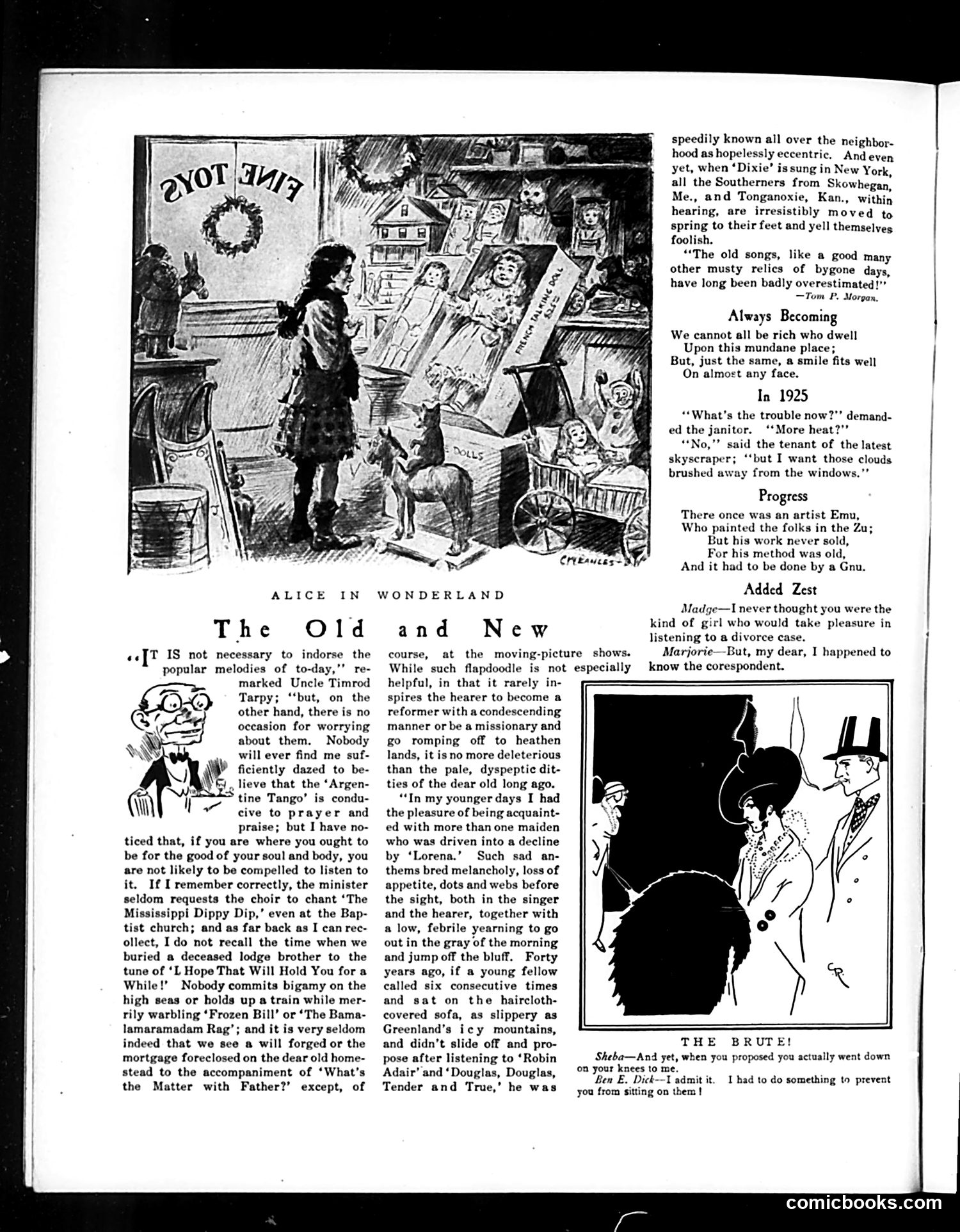
This page satirizes generational attitudes toward modern popular music (1920s era). Uncle Timrod Tarpy, a conservative figure, argues that contemporary "popular melodies" like the "Argentine Tango" and "The Bamalamaramadam Rag" are harmless—they don't corrupt morality since people only encounter them in appropriate places. He contrasts this with older sentimental songs like "Lorena," which allegedly drove young women to genuine despair and decline. The satire works both ways: mocking both the older generation's nostalgia for "musty relics" and their exaggerated claims about music's moral influence. The brief jokes below (about a janitor, an artist emu, and a divorce case) are typical Judge filler content. The page captures Jazz Age anxieties about modern culture's supposed dangers—a concern the author deflates as overwrought.
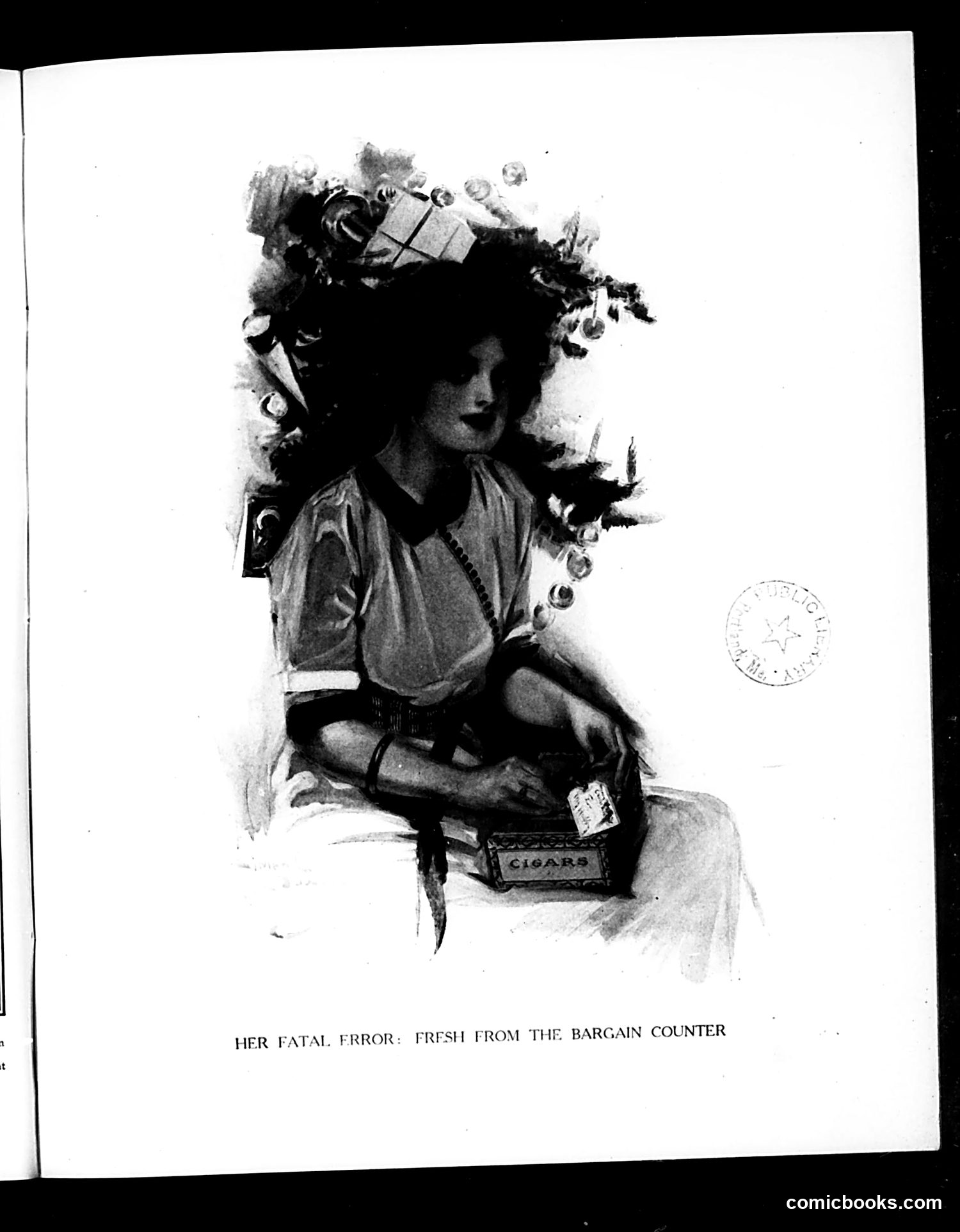
This is a satirical illustration from *Judge* magazine depicting a fashionably dressed woman with an elaborate, ornate hat adorned with decorative elements. She holds a cigar box labeled "CIGARS." The caption "Her Fatal Error: Fresh from the Bargain Counter" suggests satire about consumer culture and cheap bargains. The joke appears to criticize women who purchase inexpensive, low-quality goods—possibly counterfeit cigars or fraudulent products—from discount retailers, viewing this as a foolish mistake. The elaborate hat contrasts with the cheap cigar box, likely mocking women who present an appearance of wealth or refinement while actually purchasing inferior merchandise. This reflects early 20th-century attitudes about consumption, class performance, and women's shopping habits, positioning bargain-hunting as morally or socially problematic.
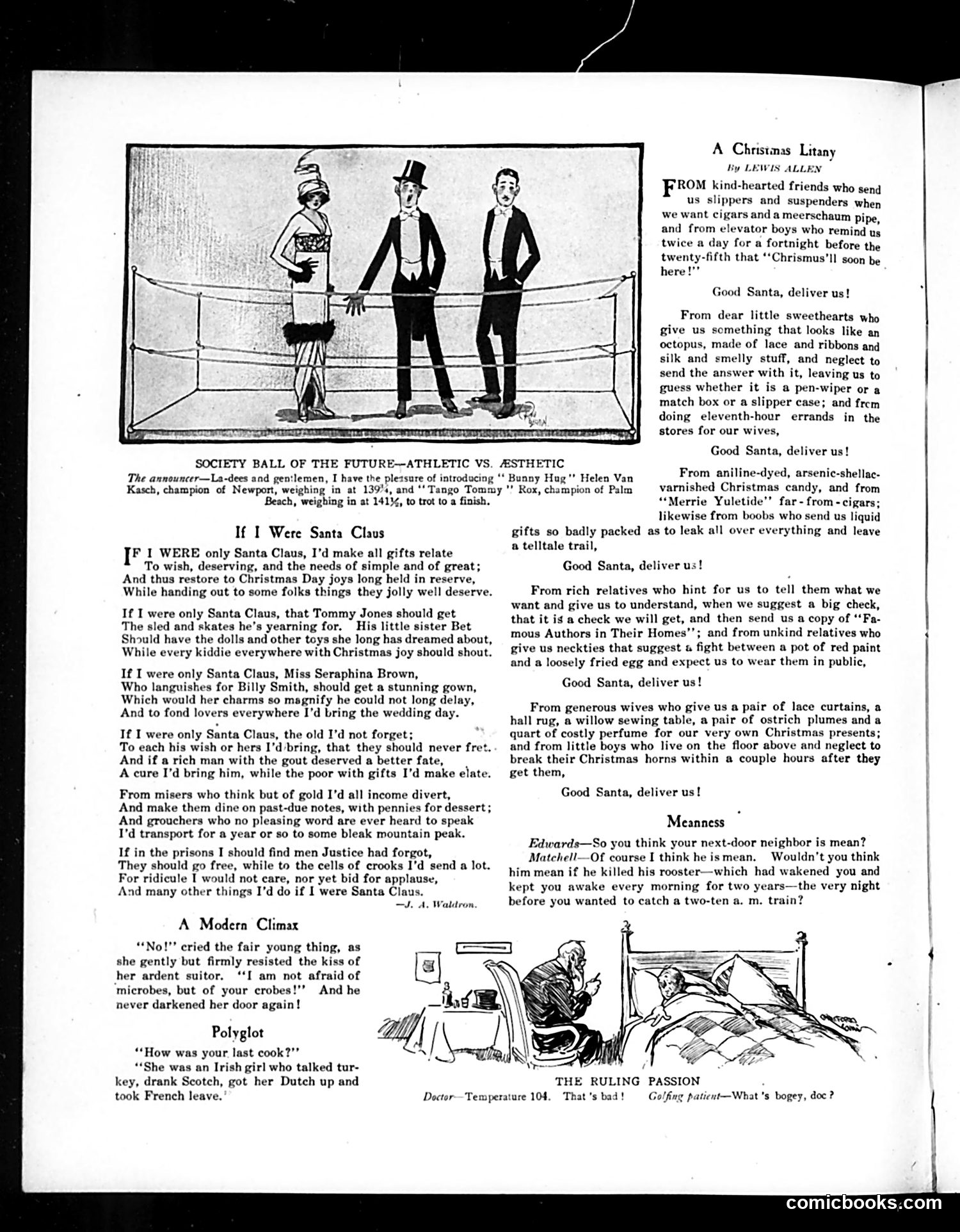
This page contains humorous satirical pieces reflecting early 20th-century social complaints: **"If I Were Santa Claus"** (poem by J.A. Waldron): A fantasy about redistributing justice through gift-giving. The speaker would reward the deserving poor, punish misers by forcing them to eat overdue bills, and transport chronic complainers to remote mountains. The satire targets social inequality and moral failings—suggesting Santa could fix what society's actual systems fail to address. **"A Christmas Litany"** (by Lewis Allen): A mock prayer listing humorous holiday frustrations: unwanted gifts (slippers instead of cigars), cheap perfume from wives, poorly-packed liquor bottles, stingy wealthy relatives, and loud neighbor children. The repeated refrain "Good Santa, deliver us!" parodies religious litanies while satirizing consumer culture and holiday commercialism's disappointments. The cartoons at top and bottom appear unrelated vignettes about modern courtship and medical situations, using contemporary social anxieties for comedic effect.
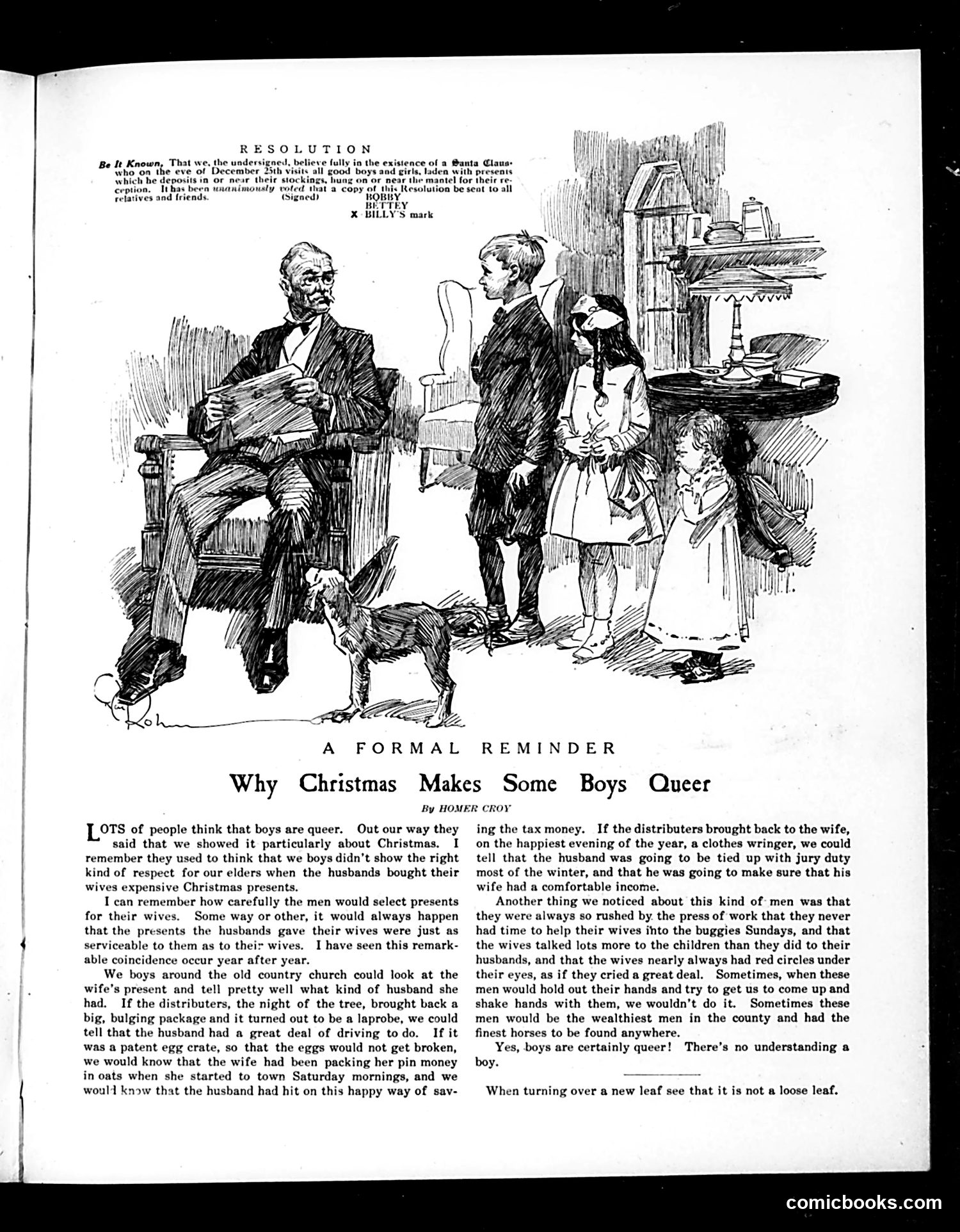
This satirical article by Homer Croy critiques selfish husbands who disguise their own interests as Christmas gifts for wives. The illustration shows a stern man reading a "Resolution" about Santa Claus to children and adults—suggesting how ideals of generosity are preached but not practiced. Croy's ironic argument: boys are "queer" (odd) because they recognize the hypocrisy. When husbands give wives "serviceable" gifts—egg crates, lap robes, clothes wringers—these ostensibly benefit the wives but actually serve the husbands' convenience (easier farm work, tax avoidance, household labor). The boys notice these wives look exhausted with "red circles under their eyes" and receive no gentlemanly attention, yet wealthy husbands are praised as upstanding. The satire targets masculine selfishness masquerading as generosity and the economic burden wives bear. Boys who refuse handshakes with such men aren't "queer"—they're morally perceptive. The article mocks early 20th-century gender dynamics where wives' labor subsidized household economies under the pretense of gift-giving.
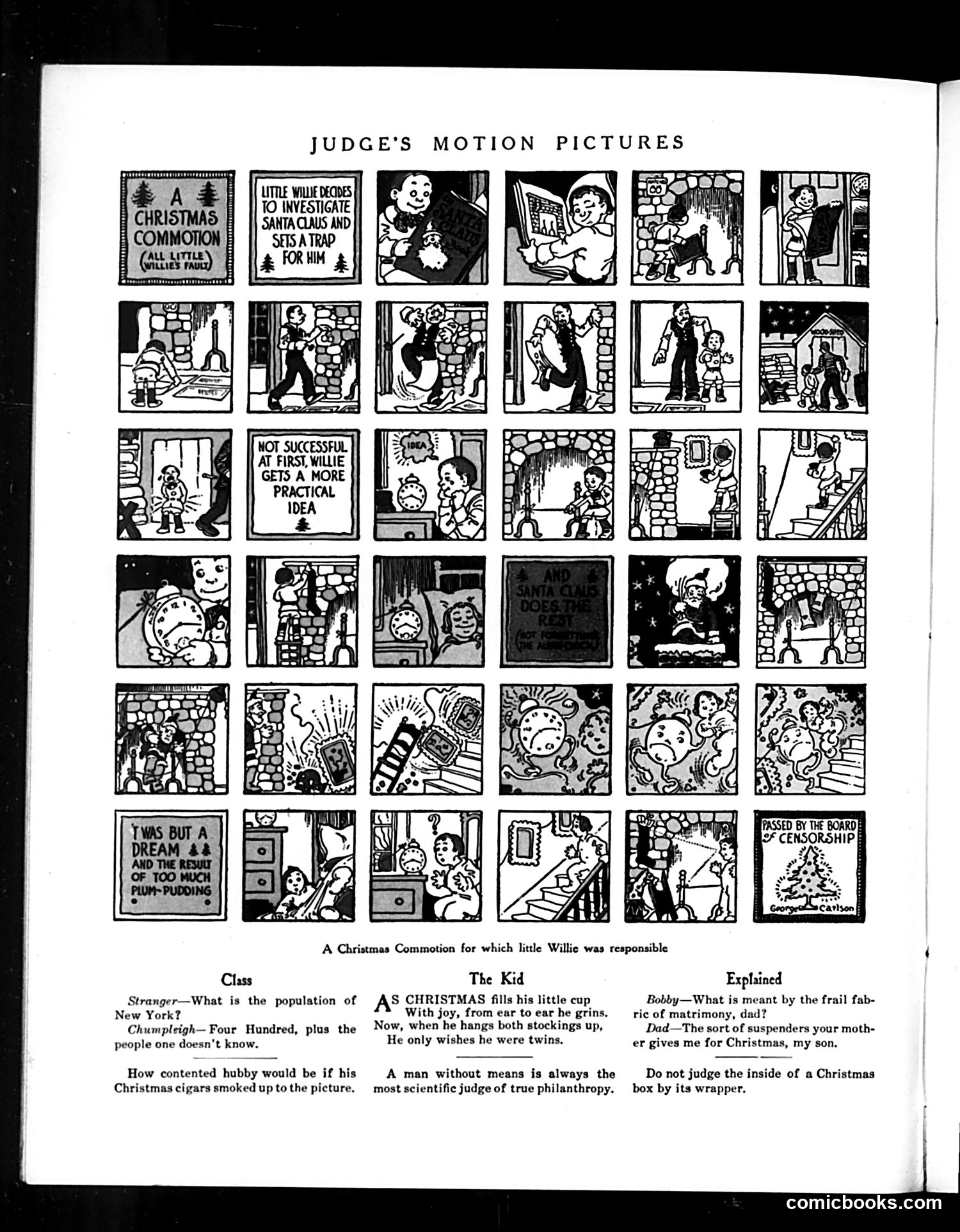
This page presents a comic strip narrative about "little Willie," a mischievous child whose Christmas antics cause household chaos. The strip sequence shows Willie investigating Santa Claus, setting traps, and creating general disruption—culminating in family comedy. The accompanying text offers satirical commentary on upper-class New York society and domestic life. "The Class" section mocks the "Four Hundred" (the social elite), while "The Kid" romanticizes childhood innocence. "Explained" provides family humor through double-entendres: "frail fabric of matrimony" (marriage), and a joke about fathers receiving practical suspenders as Christmas gifts—suggesting marital disillusionment. The recurring theme critiques materialism and false appearances: "Do not judge the inside of a Christmas box by its wrapper" warns against valuing surface presentation over substance. Overall, the page satirizes wealth, marriage, and Christmas commercialism through domestic comedy.
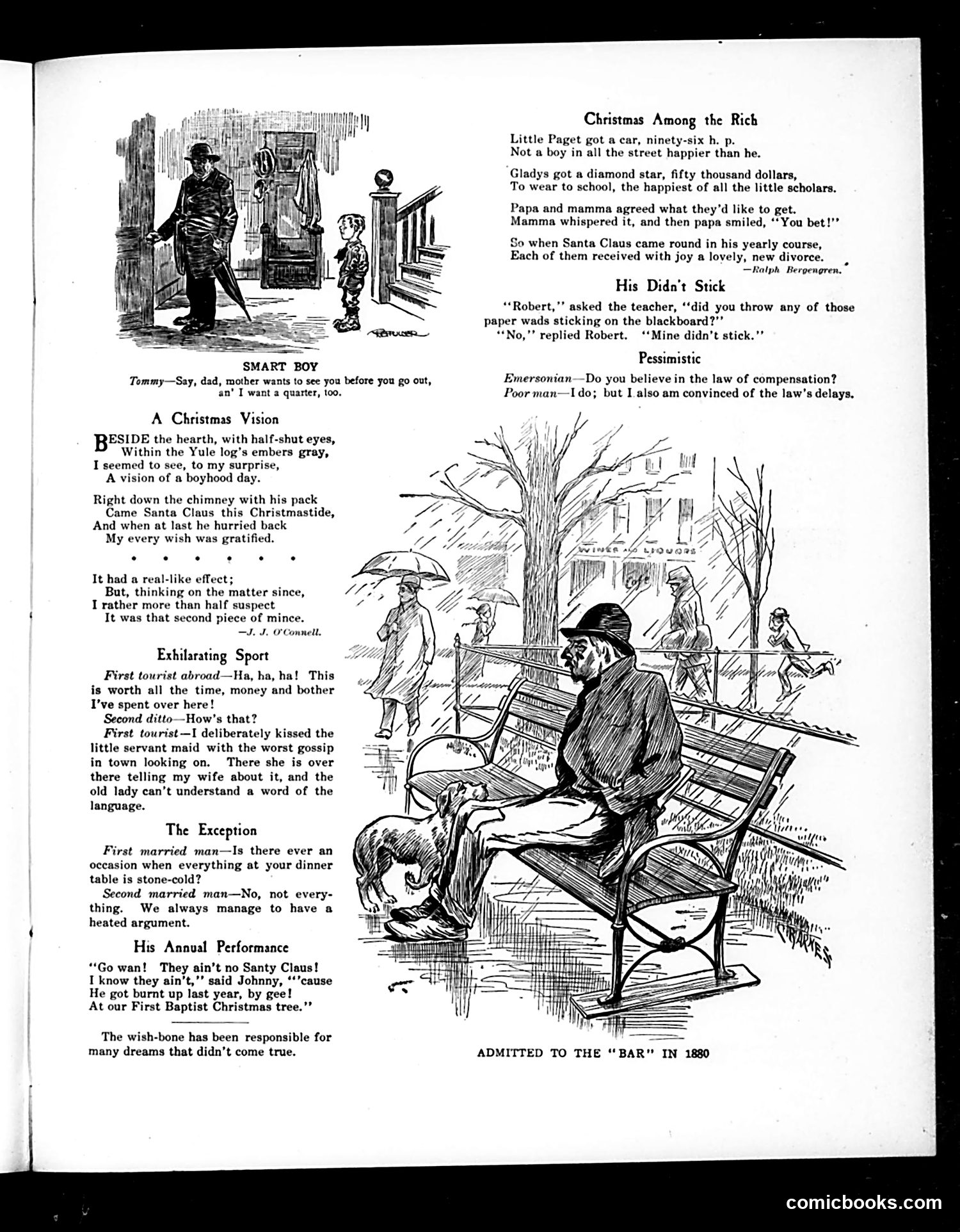
This page from Judge contains several interconnected satirical pieces mocking American society circa 1880s: **"Christmas Among the Rich"** ridicules wealthy families' hollow materialism—children receive extravagant gifts (a 96-horsepower car, a $50,000 diamond star), yet parents' greatest wish is divorce. The satire suggests wealth breeds moral emptiness. **"Smart Boy"** and other brief jokes mock domestic life: a boy extorts money from his father, a teacher questions whether thrown paper stuck (implying the student is incompetent), and a tourist deliberately engineers a scandal to amuse himself. **"Exhilarating Sport"** sarcastically describes a tourist kissing a servant maid specifically so gossip reaches his wife, creating marital conflict—framed as entertainment. **"His Annual Performance"** references a child burned in a church Christmas fire, presenting dark humor about the unreliability of Santa and wishful thinking. Overall, the page satirizes American materialism, marital dysfunction, dishonesty, and the gap between pretense and reality among the wealthy and middle classes—typical Judge content criticizing social hypocrisy.
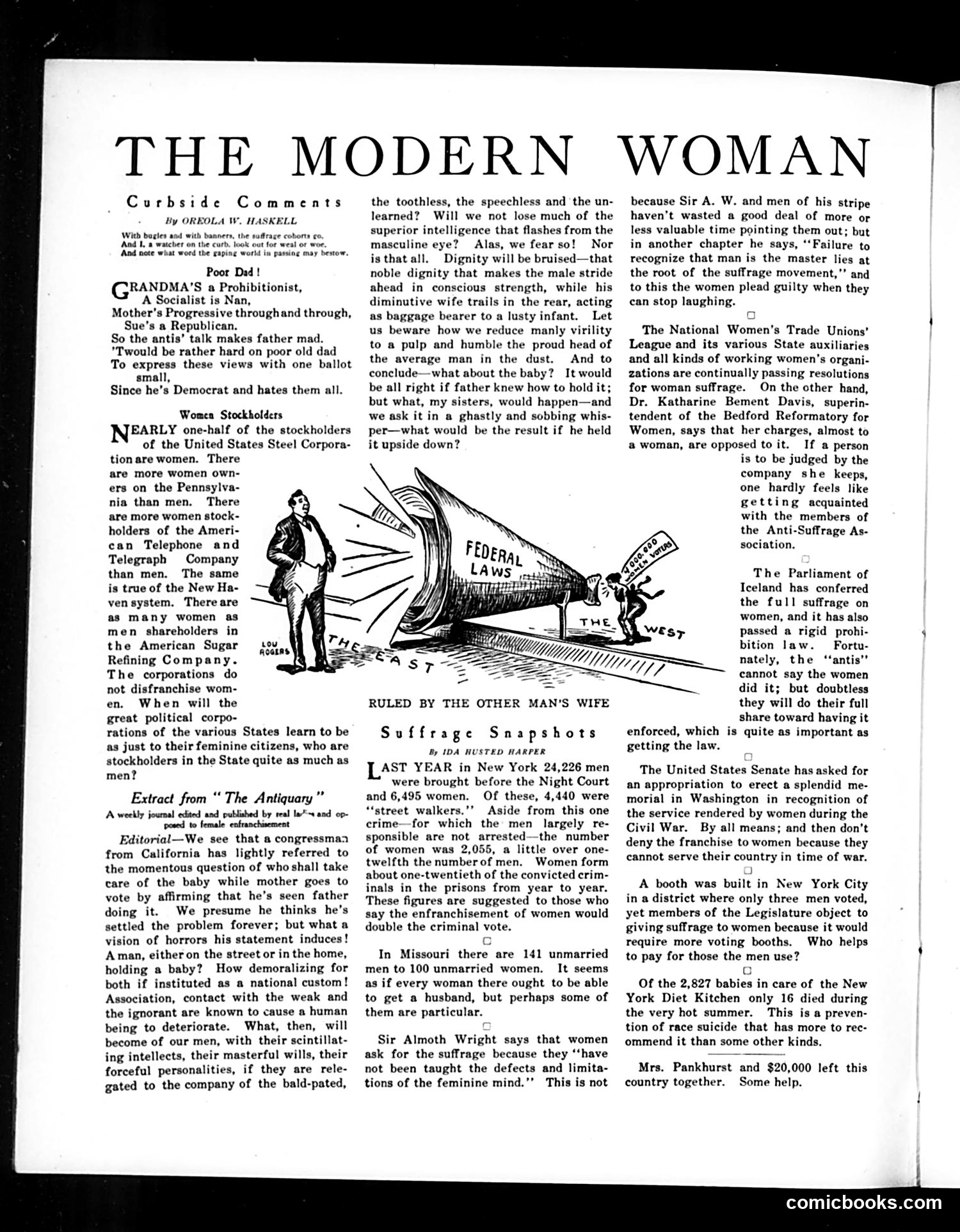
This page satirizes opposition to women's suffrage through mock-serious arguments. The central cartoon shows federal laws being overwhelmed by "the West" (representing women's suffrage momentum), with the caption suggesting men fear women voters will dominate politics. The page collects anti-suffrage arguments to ridicule them: a congressman's worry that men holding babies while women vote would "deteriorate" masculine intellect; claims that enfranchising women would "double the criminal vote" (countered by statistics showing women commit far fewer crimes); and Sir Almoth Wright's argument that women lack understanding of their own limitations. The "Women Stockholders" section uses irony: if corporations trust women as shareholders with financial power, why don't governments trust them as voters? The "Poor Dad" poem mocks families divided by conflicting political ideologies among women (Prohibitionist grandma, Socialist grandmother, Progressive mother, Republican daughter), suggesting women already engage in serious politics regardless of voting rights. Overall, Judge presents anti-suffrage logic as absurd, revealing the hypocrisy and paternalism underlying opposition to women's enfranchisement.
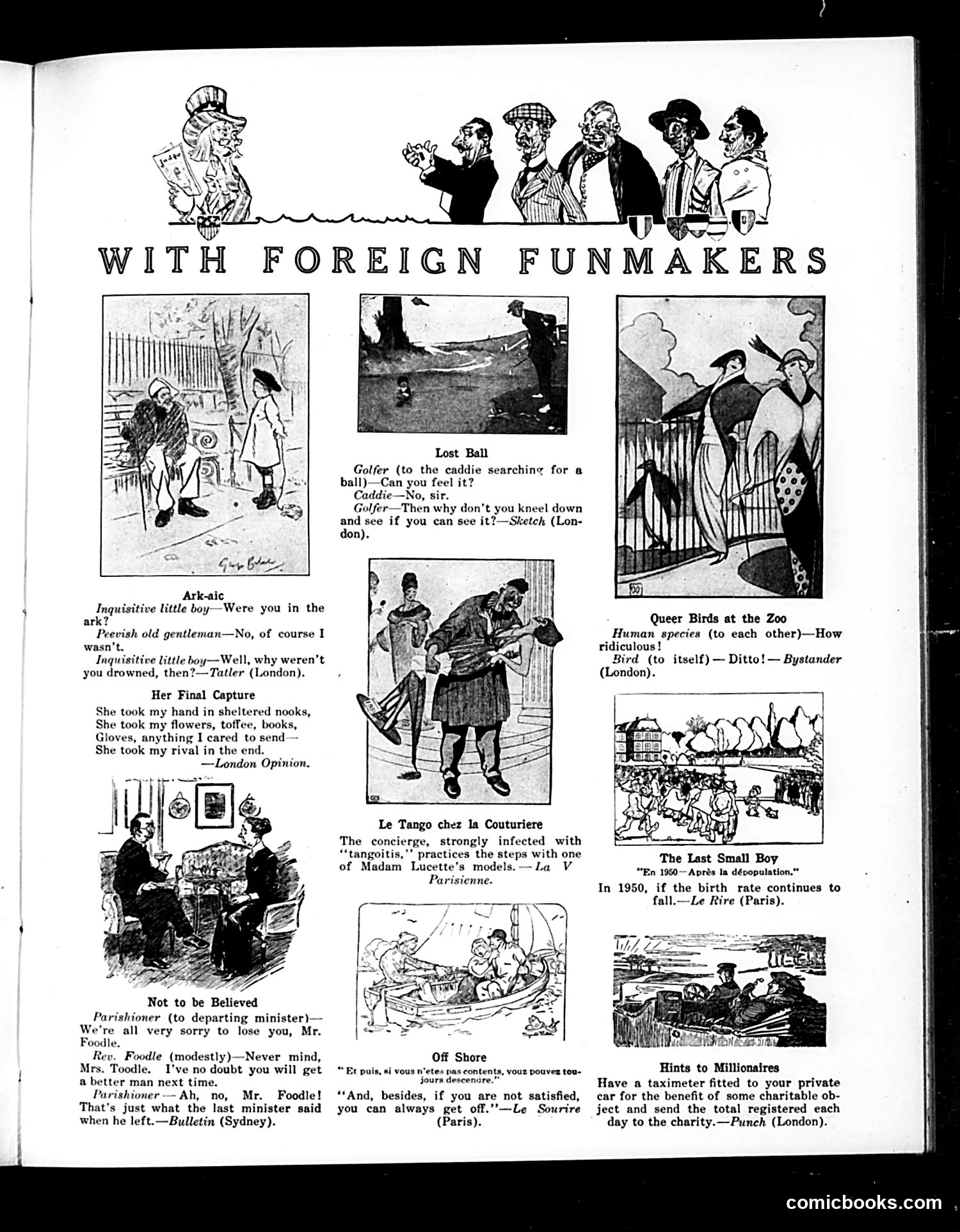
This page collects humorous cartoons and jokes reprinted from British and French publications, unified by the theme of poking fun at human behavior and social conventions. The jokes satirize various targets: a golfer's illogical instruction to his caddie; an old man's suspicious exclusion from Noah's ark; a woman's manipulative courtship tactics; clerical hypocrisy (a departing minister fishing for compliments); and upper-class absurdities (a tango-obsessed concierge, zoo visitors who mock animal behavior while being equally ridiculous themselves). The French contributions mock declining birth rates and offer tongue-in-cheek advice about fitting taximeters to charity cars—likely critiquing wealthy donors' desire for public recognition of their generosity. The "Last Small Boy" cartoon appears to reference anxieties about demographic decline in early 20th-century Europe. Overall, the page uses gentle social observation humor typical of Judge's satirical approach to modern life's pretensions and contradictions.
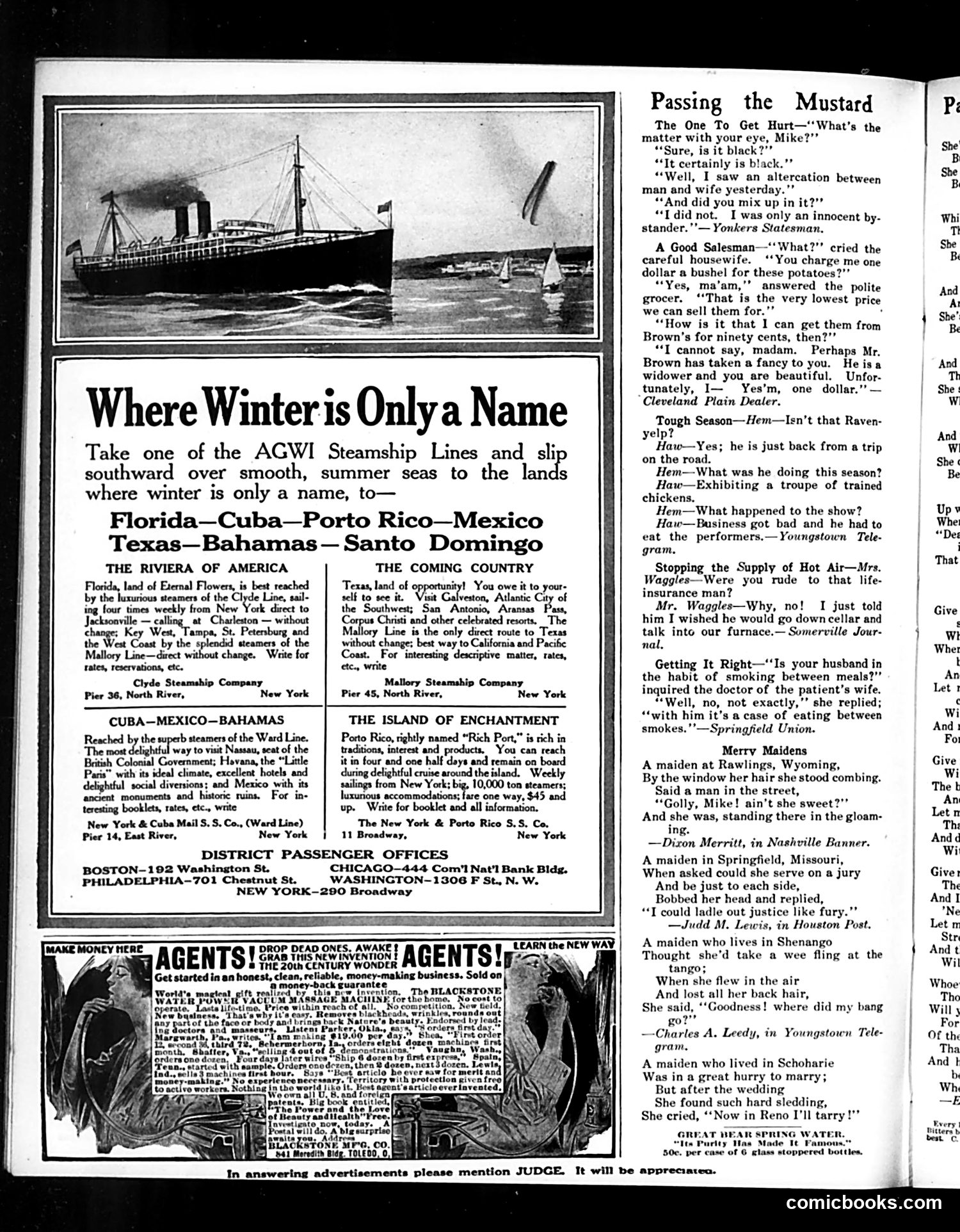
This page is primarily **travel advertising** for American steamship lines, not political satire. The dominant content promotes luxury cruises to warm-weather destinations (Florida, Cuba, Puerto Rico, Mexico, Texas, Bahamas) as winter escapes for wealthy travelers. The copy emphasizes comfort and "smooth summer seas." The right column contains brief **humorous anecdotes** unrelated to the advertisements—jokes about a man getting a black eye from a domestic dispute, grocery price haggling, and a failed circus act with trained chickens. These are generic comic relief, not political commentary. The lower section advertises a "20th Century Wonder" business opportunity (likely a vacuum cleaner or similar household device), using typical hard-sell language about guaranteed profits. The page reflects early 20th-century American leisure culture and advertising conventions, with no identifiable political figures or satirical targets visible.
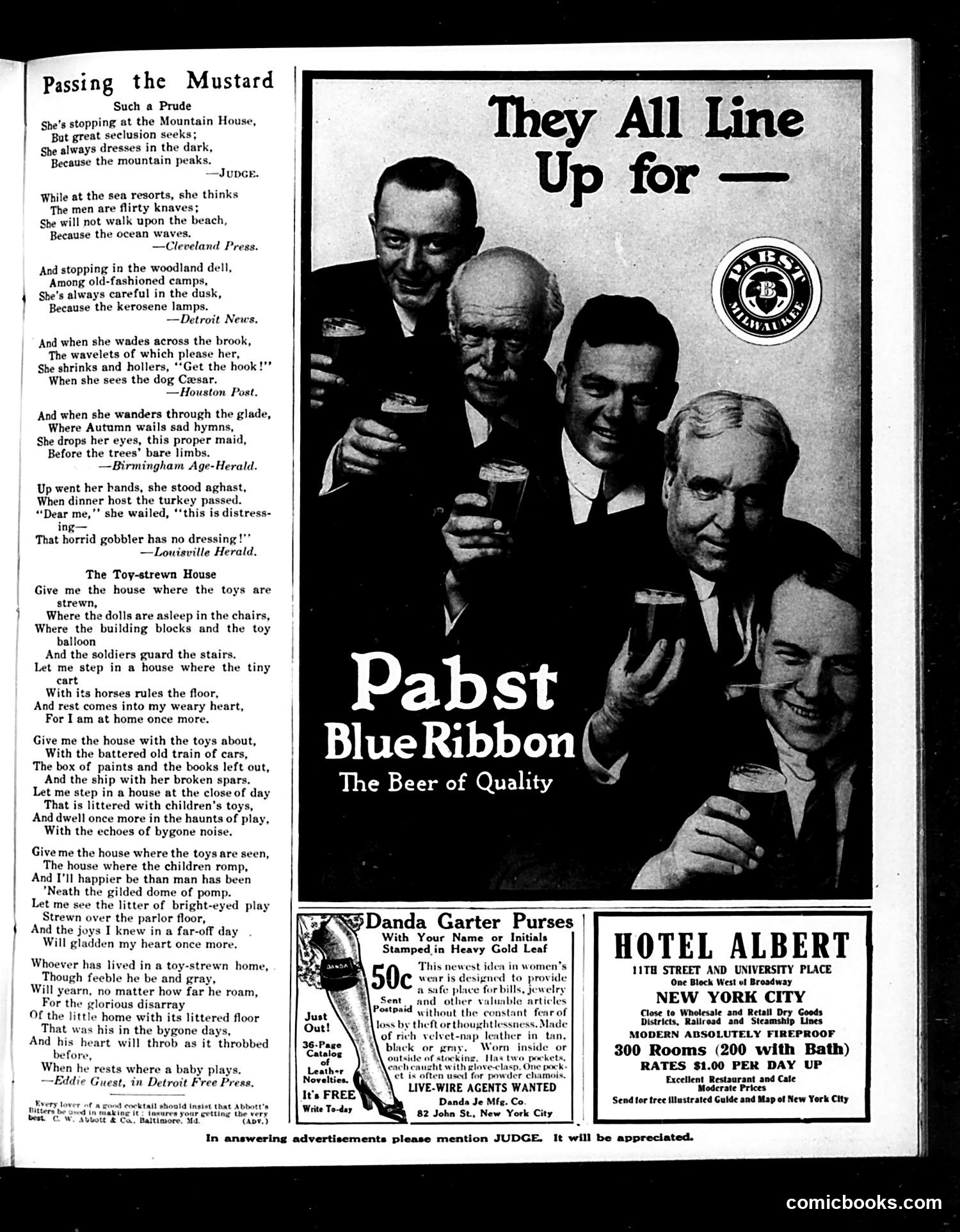
This page contains two distinct sections: **Left side: Humorous poetry about an excessively prudish woman.** Multiple newspaper columnists (Judge, Cleveland Press, Detroit News, etc.) mock a woman so obsessed with modesty that she finds innuendo in innocent things: she won't look at "mountain peaks," "ocean waves," "kerosene lamps," tree "bare limbs," or a turkey without "dressing." The jokes play on double meanings—she interprets ordinary words as sexual references. This satirizes Victorian-era prudishness and rigid social conventions around proper female behavior. **Right side: Advertisements** for Pabst Blue Ribbon beer (showing five men raising glasses), Danda garter purses, and Hotel Albert in New York City. These are straightforward period advertisements with no satirical content. **Bottom: A sentimental poem** by Eddie Guest celebrating toy-filled homes and childhood memories—unrelated to the satire above. The page's humor targets outdated sexual prudishness as ridiculous and laughable for modern (1910s-era) readers.
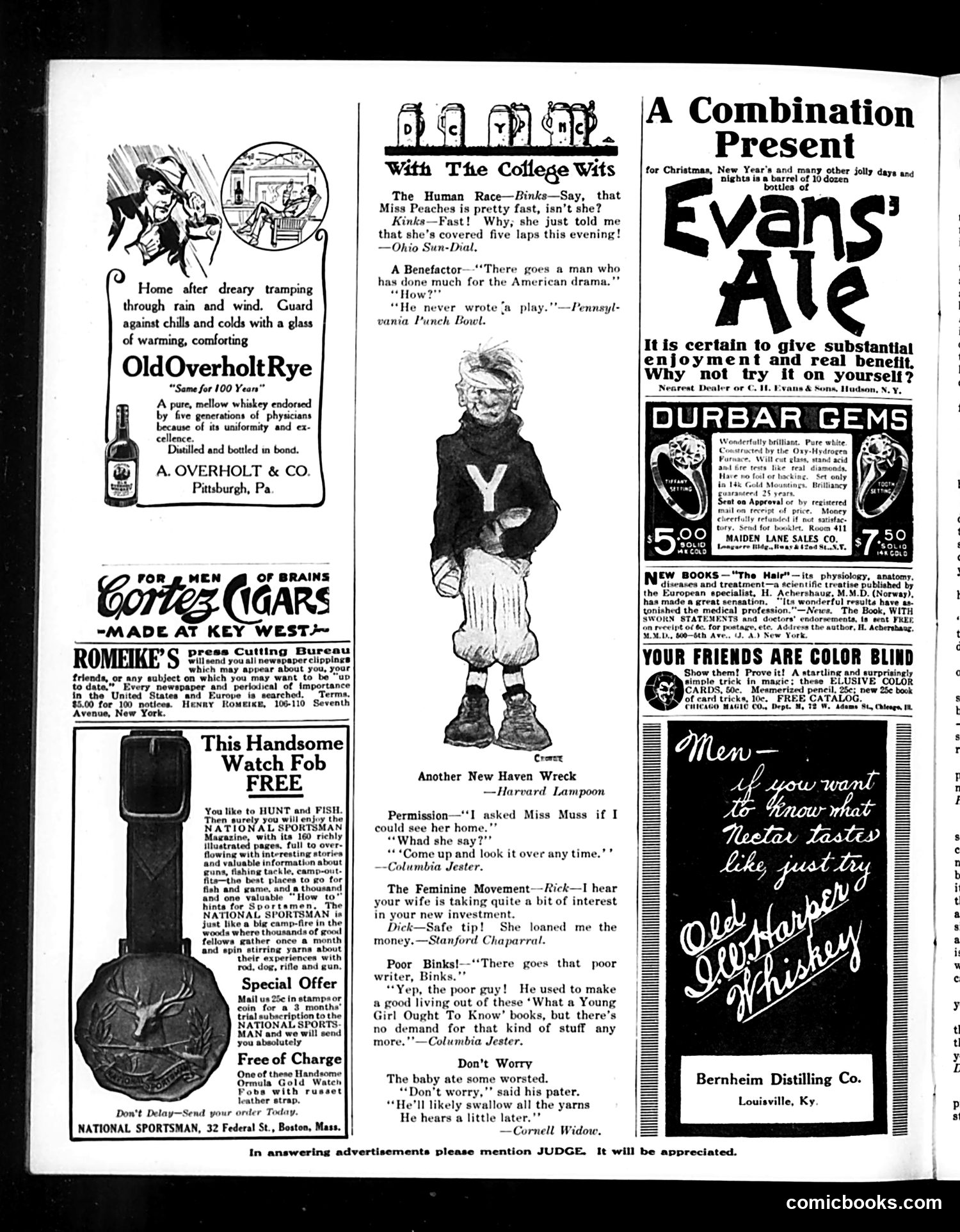
This page is primarily **advertising with brief humor snippets**, typical of Judge magazine's format. The small jokes scattered throughout are wordplay and observational humor: - **"Miss Peaches"** joke: Plays on "fast" — she's covered "five laps" (presumably dancing/socializing), not driving fast. - **"Poor writer" joke**: References the commercial success of instructional books like "What a Young Girl Ought To Know" (popular self-help guides of the era), now outdated. - **"Baby ate worsted"** joke: Puns on "worsted" (yarn) and "yarns" (tall tales), predicting the child will become a liar. The advertisements dominate: Old Overholt Rye whiskey, Cortez cigars, watch fobs, press clipping services, and **Evans' Ale** (a beer product). The final ad for **Bernheim Distilling Co.** whiskey appears at page's bottom. This reflects **Prohibition-era advertising paradox** — Judge published alcohol ads despite looming (or current) Prohibition. The humor and ads together represent early 1900s sensibilities: rapid social change, gender roles, and commercial messaging.
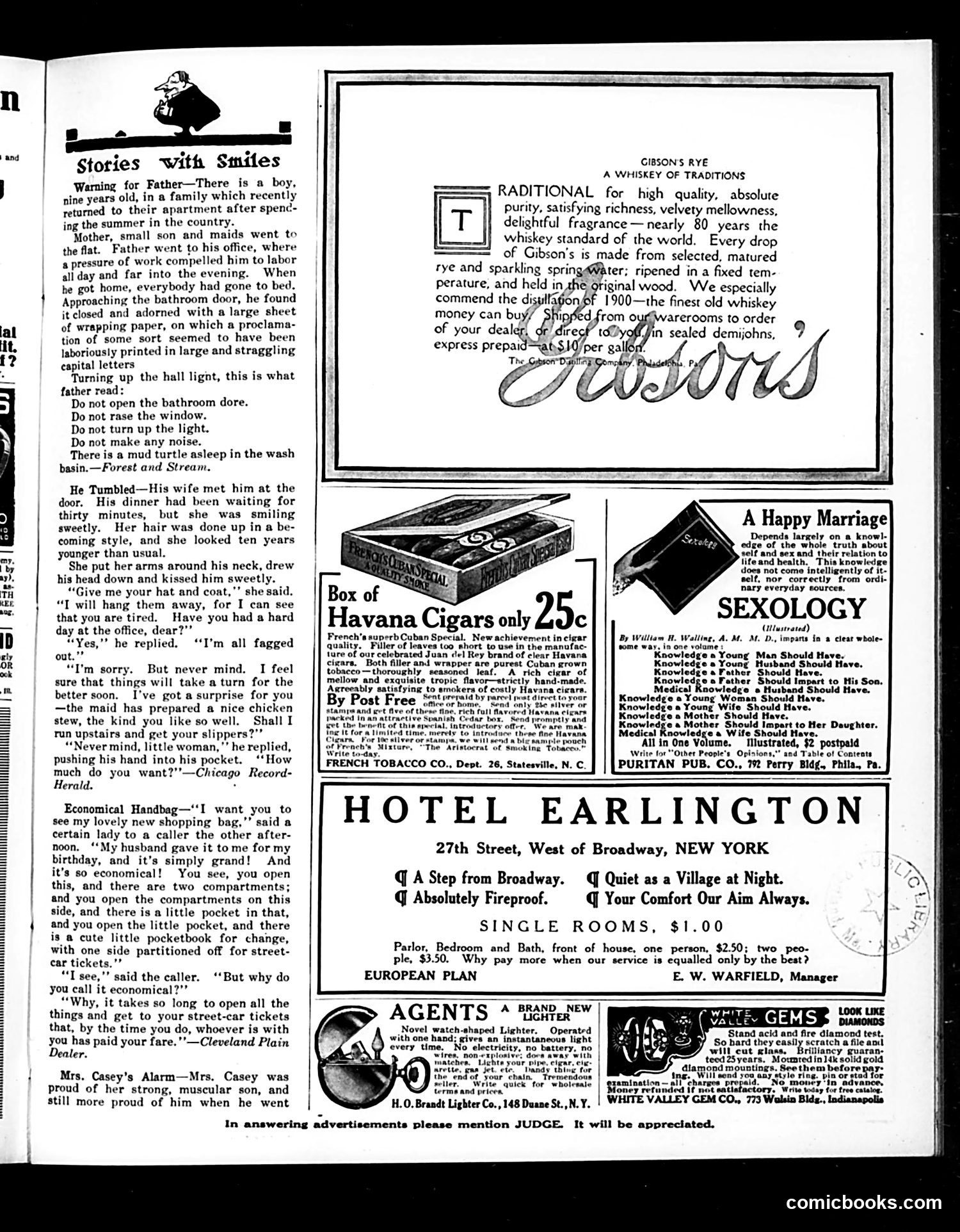
This page consists primarily of **advertising and light humor pieces** rather than political satire. **"Stories with Smiles"** presents three brief domestic comedies: a boy's warning note protecting a sleeping turtle from his tired father; a wife's sudden sweetness masking a request for money; and a joke about an economical shopping bag so complicated it delays payment. These reflect early 20th-century middle-class domestic life. The advertisements—for Gibson's Rye whiskey, Havana cigars, Hotel Earlington, lighter mechanisms, and gems—dominate the page and represent the magazine's revenue source. The "Happy Marriage" article appears to be educational content about sexual knowledge, typical of the era's cautious approach to such topics. **No political cartoons or caricatures appear on this page.** The humor is domestic and consumer-oriented, reflecting Judge's role as both satirical magazine and advertising vehicle for affluent readers.
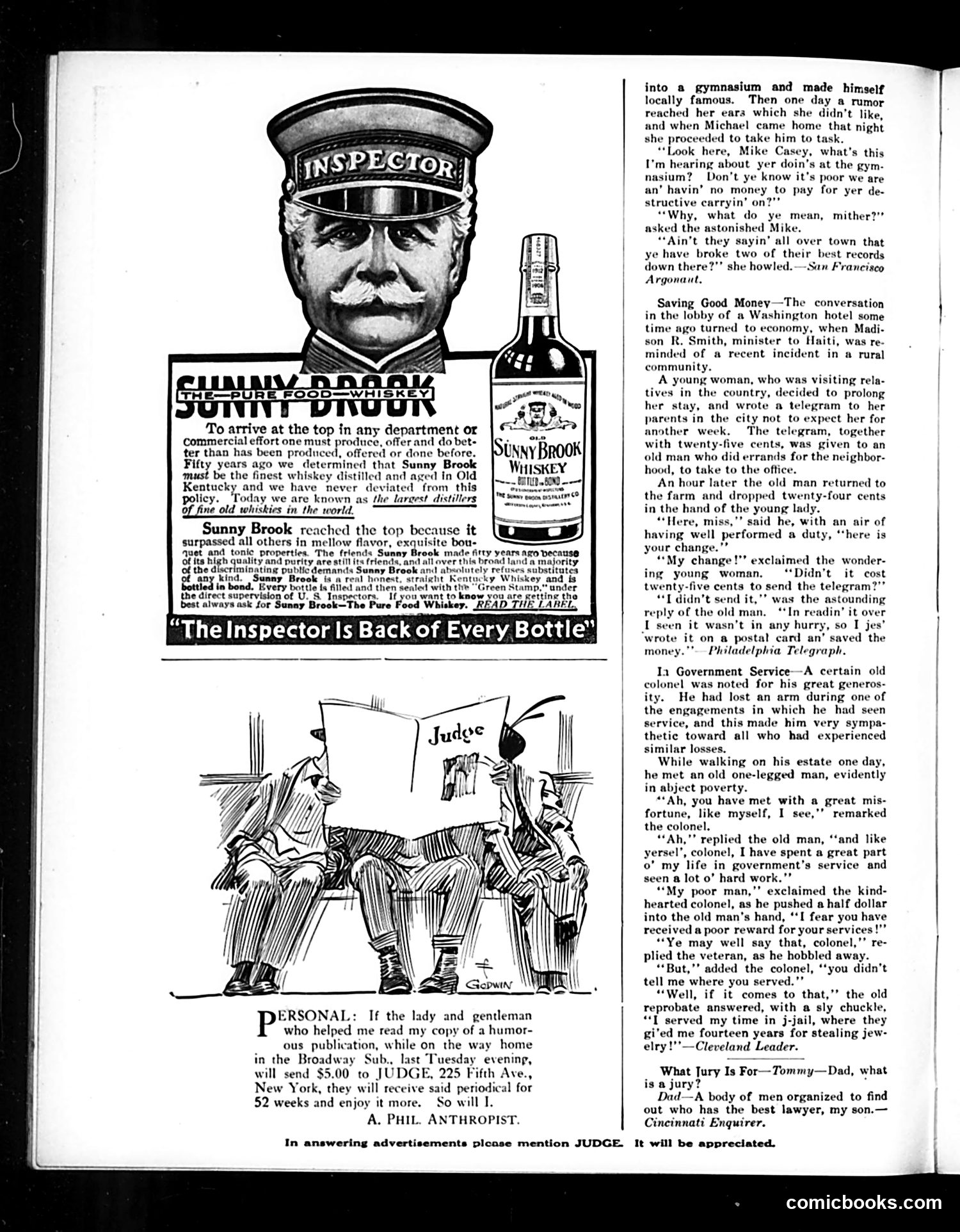
This page contains **Sunny Brook Whiskey advertising** (dominant) and several **humorous anecdotes** typical of Judge's "departments." The main cartoon depicts a judge figure surrounded by supplicants, though its specific satirical point is unclear without caption context. The text anecdotes mock working-class characters through ethnic stereotyping and dialect humor: 1. **"Mike Casey" story**: An Irish immigrant's wife scolds him for "breaking records" at a gymnasium, misunderstanding the phrase as destructive behavior rather than athletic achievement—humor derived from immigrant malapropism. 2. **"Saving Good Money"**: Rural postal worker economizes by sending a telegram via postcard instead, treating the medium as interchangeable—mocking rural unsophistication. 3. **"Government Service"**: A one-legged war veteran's story (incomplete on this page). These represent typical Judge-era humor: condescending portrayals of immigrants, rural Americans, and working-class figures as comically ignorant. The ethnic dialect and class-based humor reflects early 20th-century attitudes now considered offensive stereotyping.
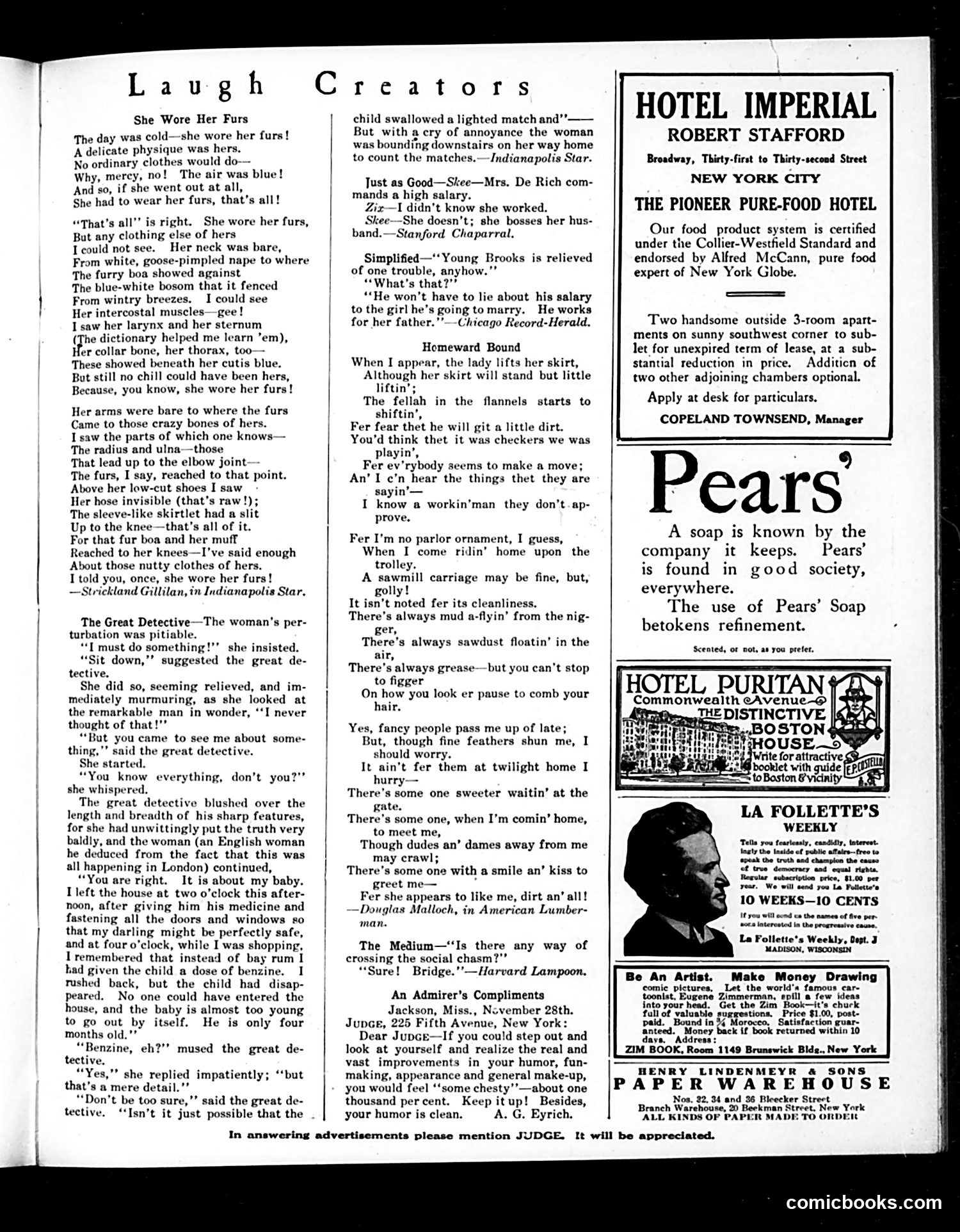
This page contains **humorous short pieces and advertisements** rather than political cartoons. The content satirizes early 20th-century American social attitudes: **"She Wore Her Furs"** mocks fashion hypocrisy: a woman wears only a fur boa and muff as outerwear while exposing nearly her entire body, claiming the furs keep her warm. The joke targets women's illogical fashion choices and pretense. **"The Great Detective"** parodies mystery stories: a woman consults a brilliant detective about her missing four-month-old baby, but the "profound" revelation is simply that she accidentally gave the child benzine instead of bay rum—she rushes home to count matches. This deflates detective fiction's grandiosity. **Other brief jokes** mock working-class life, class anxiety, and marital dynamics typical of period humor. The advertisements (Hotel Imperial, Pears Soap, Hotel Puritan) occupy significant space, indicating this was a commercially-driven publication. The overall tone reflects *Judge's* satirical approach to contemporary American society, particularly gender relations and class distinctions.
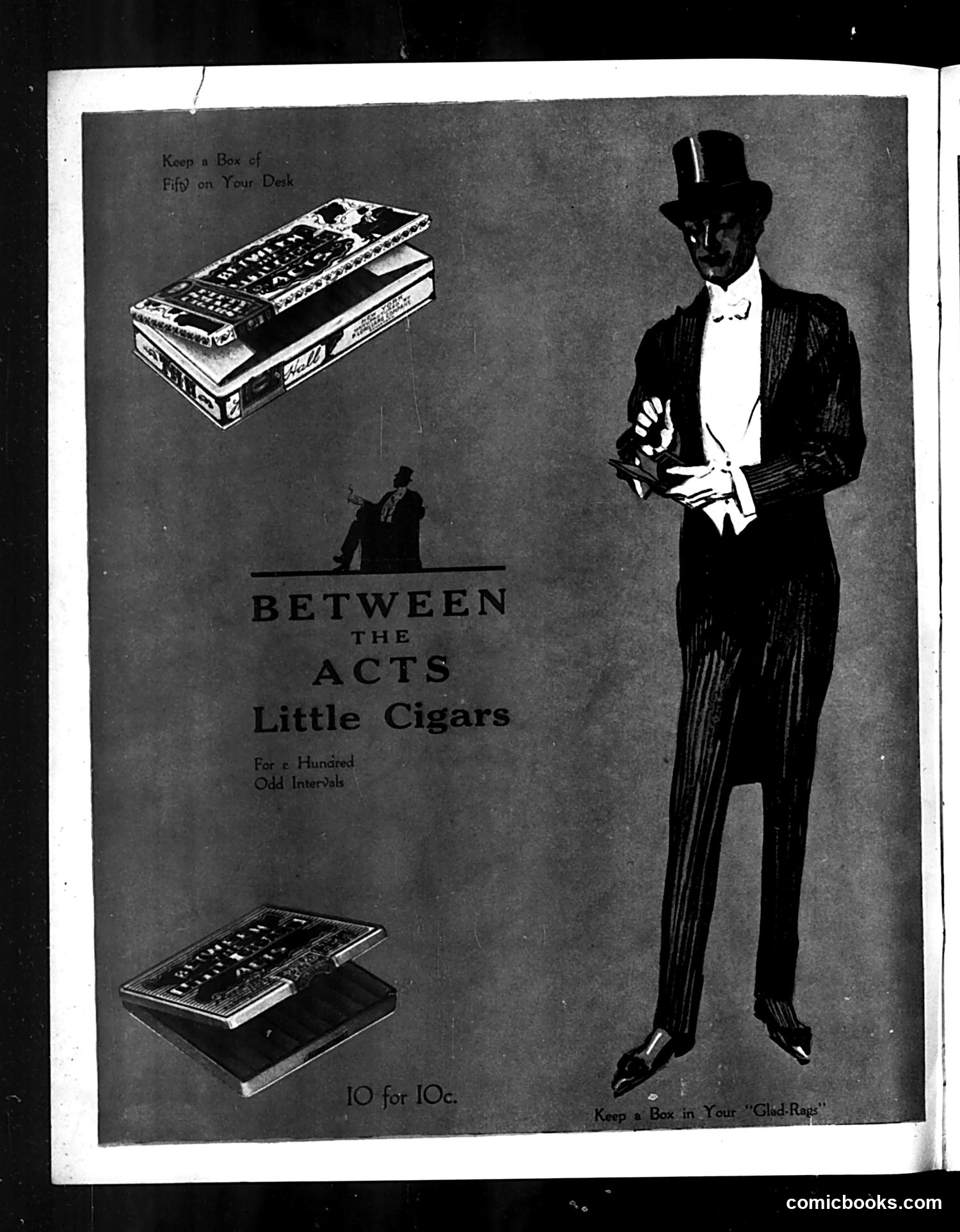
This is an advertisement, not editorial content or political satire. It promotes "Between the Acts Little Cigars" to be kept at one's desk or in a "Glad-Rags" (slang for evening clothes). The imagery uses a well-dressed man in formal attire—top hat, tuxedo, white shirt—as an aspirational figure. The cigar boxes shown appear decorative and compact, marketed as convenient for office or social settings. The phrase "For a Hundred Odd Intervals" suggests these small cigars fill brief moments throughout the day. The ad appeals to masculinity and sophistication, positioning the product as an accessory for refined gentlemen. The price "10 for 10c" emphasizes affordability. This represents early 20th-century advertising conventions before modern health warnings about tobacco products.