
Judge, 1913-12-20 · page 22 of 24
Judge — December 20, 1913 — page 22: what you’re looking at
What you’re looking at
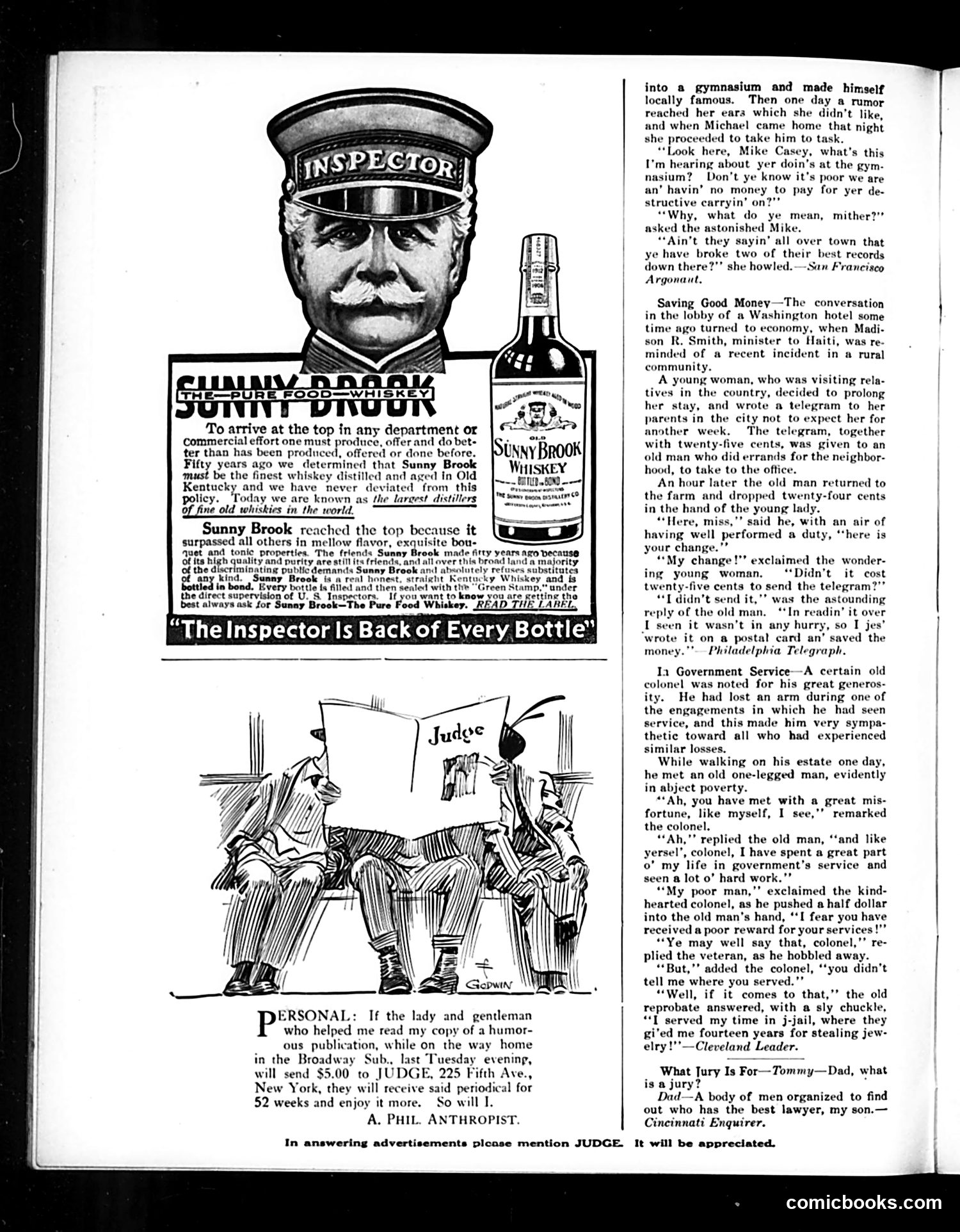
This page contains **Sunny Brook Whiskey advertising** (dominant) and several **humorous anecdotes** typical of Judge's "departments." The main cartoon depicts a judge figure surrounded by supplicants, though its specific satirical point is unclear without caption context. The text anecdotes mock working-class characters through ethnic stereotyping and dialect humor: 1. **"Mike Casey" story**: An Irish immigrant's wife scolds him for "breaking records" at a gymnasium, misunderstanding the phrase as destructive behavior rather than athletic achievement—humor derived from immigrant malapropism. 2. **"Saving Good Money"**: Rural postal worker economizes by sending a telegram via postcard instead, treating the medium as interchangeable—mocking rural unsophistication. 3. **"Government Service"**: A one-legged war veteran's story (incomplete on this page). These represent typical Judge-era humor: condescending portrayals of immigrants, rural Americans, and working-class figures as comically ignorant. The ethnic dialect and class-based humor reflects early 20th-century attitudes now considered offensive stereotyping.
📄 Transcribed text from this page (OCR, searchable)
Machine-transcribed from the original scan — historical spelling and the odd misread are preserved.
To arrive at the top in any department or Commercial effort one must produce, offer and do bet- ter than has been produced, offered or done before. Fifty years ago we determined that Sunny Brook must be the finest whiskey distilled and aged in Old Kentucky and we have never deviated from this policy. ‘Today we are known as the lareest distillers of fine old whiskies in the world. Sunny Brook reached the top because it surpassed all others in mellow flavor, exquisite bou- quet and tonic properties. The friends Sunny Brook made fitty years ago pecause of ft high quality and purity are stillits friends, and all over this broad land a majority of the discriminating public demands Sunny Brook ot is a real honest, straight entucky Whiskey and is any kind. ¥ Broo! bottled in bond. Every bottle Is filled and then sealed with the “Green Stamp,” under the direct supervision of U.S. Inspectors. If you want to know you are getting the best always ask for Sunny Brook—The Pure Food Whiskey. READ 7 LARE. tely refuses substitutes ‘wrote i ERSONAL: If the lady and gentleman who helped me read my copy of a humor- ous publication, while on the v home in the Broadway Sub., last Tuesday evening, will send 10 to JUDGE, 225 Fifth Ave., New York, they will receive said periodical for 52 weeks and enjoy it more. So will I. A. PHIL. ANTHROPIST. In answering advertisements plcase mention JUDGE. It will be appreciated. into a gymnasium and made himself locally famous. Then one day a rumor reached her ears which she didn’t like, and when Michael came home that night she proceeded to take him to task. “Look here, Mike Casey, what's this I'm hearing about yer doin’s at the gym. nasium? Don't ye know it's poor we are an’ havin’ no money to pay for yer de- structive carryin’ on?" “Why, what do ye mean, mither?”’ asked the astonished Mike. “Ain't they sayin’ all over town that ye have broke two of their best records down there?"’ she howled. n Francisco Argonaut. Saving Good Money—The conversation in the lobby of a Washington hotel some time ago turned to economy, when Madi- son R. Smith, minister to Haiti, was re- minded of a recent incident in a rural community. A young woman, who was visiting rela- tives in the country, decided to prolong her stay, and wrote a telegram to her parents in the city not to expect her for another week. The telegram, together with twenty-five cents, was given to an old man who did errands for the neighbor- hood, to take to the office. An hour later the old man returned to the farm and dropped twenty-four cents in the hand of the young lady. “Here, miss,”’ said he, with an air of having well performed a duty, “here is your change.’” “My change!’’ exclaimed the wonder- ing young woman. “Didn't it cost twenty-five cents to send the telegram?” “didn’t send it,"’ was the astounding reply of the old man. ‘In readin’ it over I seen it wasn’t in any hurry, so I jes’ on a postal card an’ saved the Philadelphia Telegraph. mone Ia Government Service—A certain old colonel was noted for his great generos- ity. He had lost an arm during one of the engagements in which he had seen service, and this made him very sympa- thetic toward all who had experienced similar losses. While walking on his estate one day, he met an old one-legged man, evidently in abject poverty. ‘Ah, you have met with a great mis- fortune, like myself, I see,'’ remarked the colonel, “‘Ah,"’ replied the old man, ‘‘and like yersel’, colonel, I have spent a great part o’ my life in government's service and seen a lot o’ hard work."’ “‘My poor man,"’ exclaimed the kind- hearted colonel, as he pushed a half dollar into the old man’s hand, “'I fear you h: received a poor reward for your services “Ye may well say that, colonel,’ re- plied the veteran, as he hobbled away. “*But,’’ added the colonel, ‘‘you didn't tell me where you served."” “Well, it comes to that,’’ the old reprobate answered, with a sly chuckle, “IL served my time in j-jail, where they gi’ed me fourteen years for stealing jew- elry !""—Cleveland Leader. What Jury Is For—Tommy—Dad, what is a jury? . Dad—A body of men organized to find out who has the best lawyer, my son.— Cincinnati Enquirer. comicbooks.com