
A complete issue · 26 pages · 1913
Judge — November 22, 1913
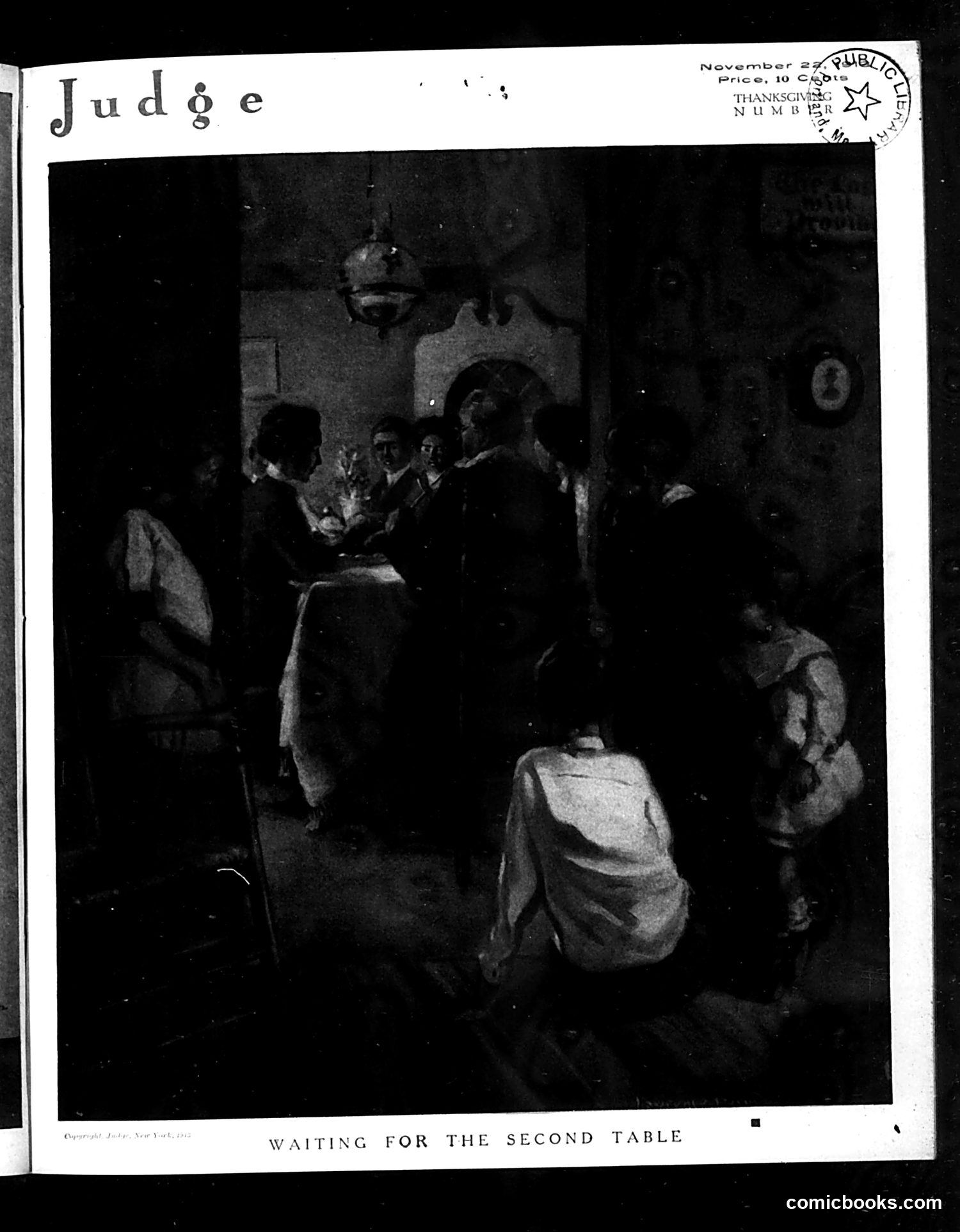
The page shows a black and white photograph titled "WAITING FOR THE SECOND TABLE," dated November 27 (Thanksgiving issue, based on the stamp). The image depicts a group of people—men, women, and children—crowded together in what appears to be a modest interior space, waiting. This is satirizing the common Thanksgiving custom where large family gatherings required seating in shifts: the main table for adults and honored guests, with children and less prominent family members eating at a "second table" afterward. The satire likely targets either the social hierarchies reflected in this seating arrangement or, given Judge's era, possibly comments on immigration and working-class families observing American holiday customs. The cramped, somewhat uncomfortable positioning emphasizes the indignity of being relegated to secondary status during a celebration meant to unite families.
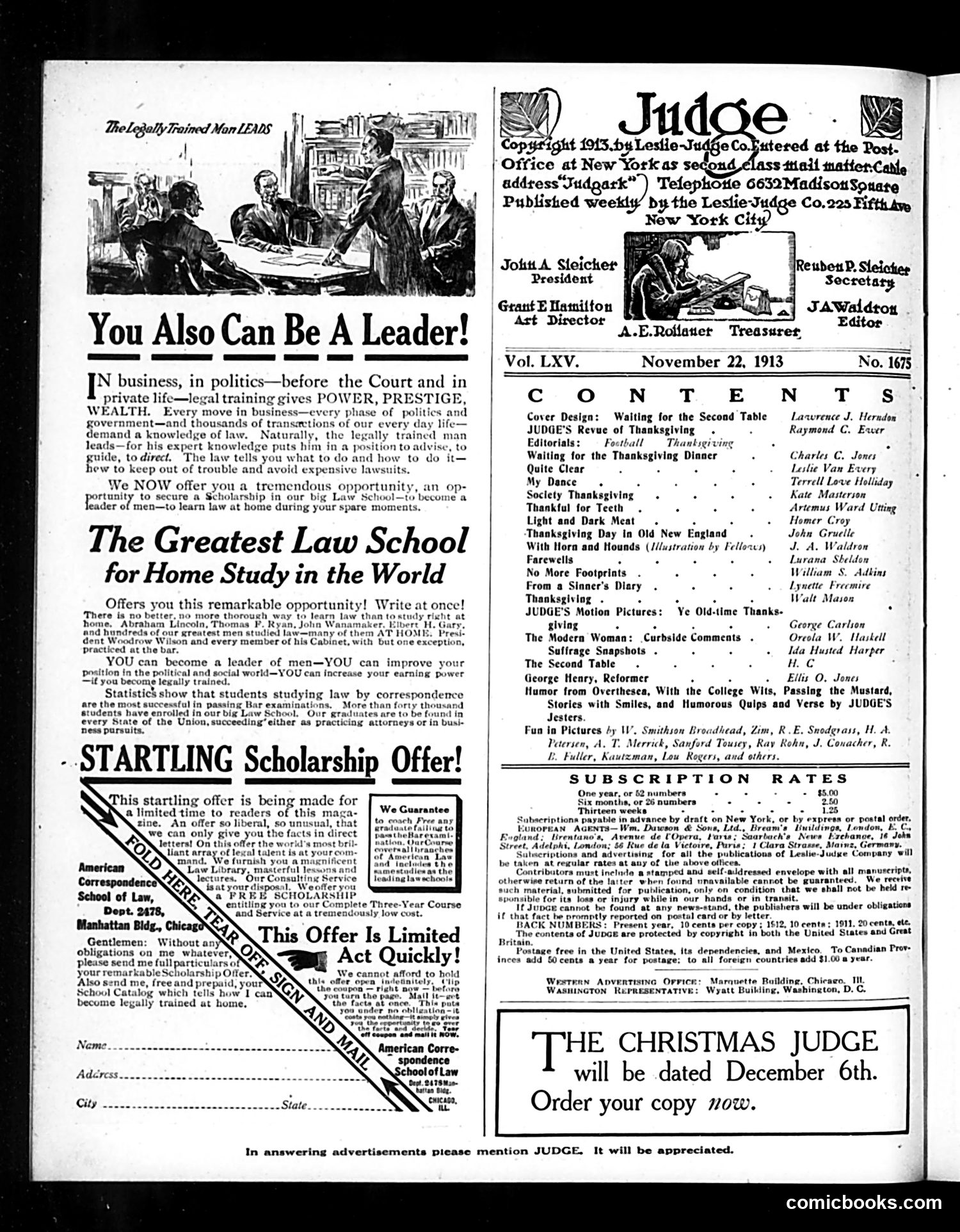
This page is primarily **advertising and administrative content** rather than political satire. The main cartoon at top left, titled "You Also Can Be A Leader!," depicts a courtroom or business scene, though the specific figures and reference remain unclear from the image quality. The page predominantly features advertisements—most notably a "startling scholarship offer" from the American Correspondence School of Law in Chicago, promoting home-study legal education as a path to power and prestige in business and politics. The substantial advertising presence and subscription rate tables (ranging $5-20 for various subscription lengths) indicate this was Judge's business/revenue section rather than its editorial or satirical content pages.
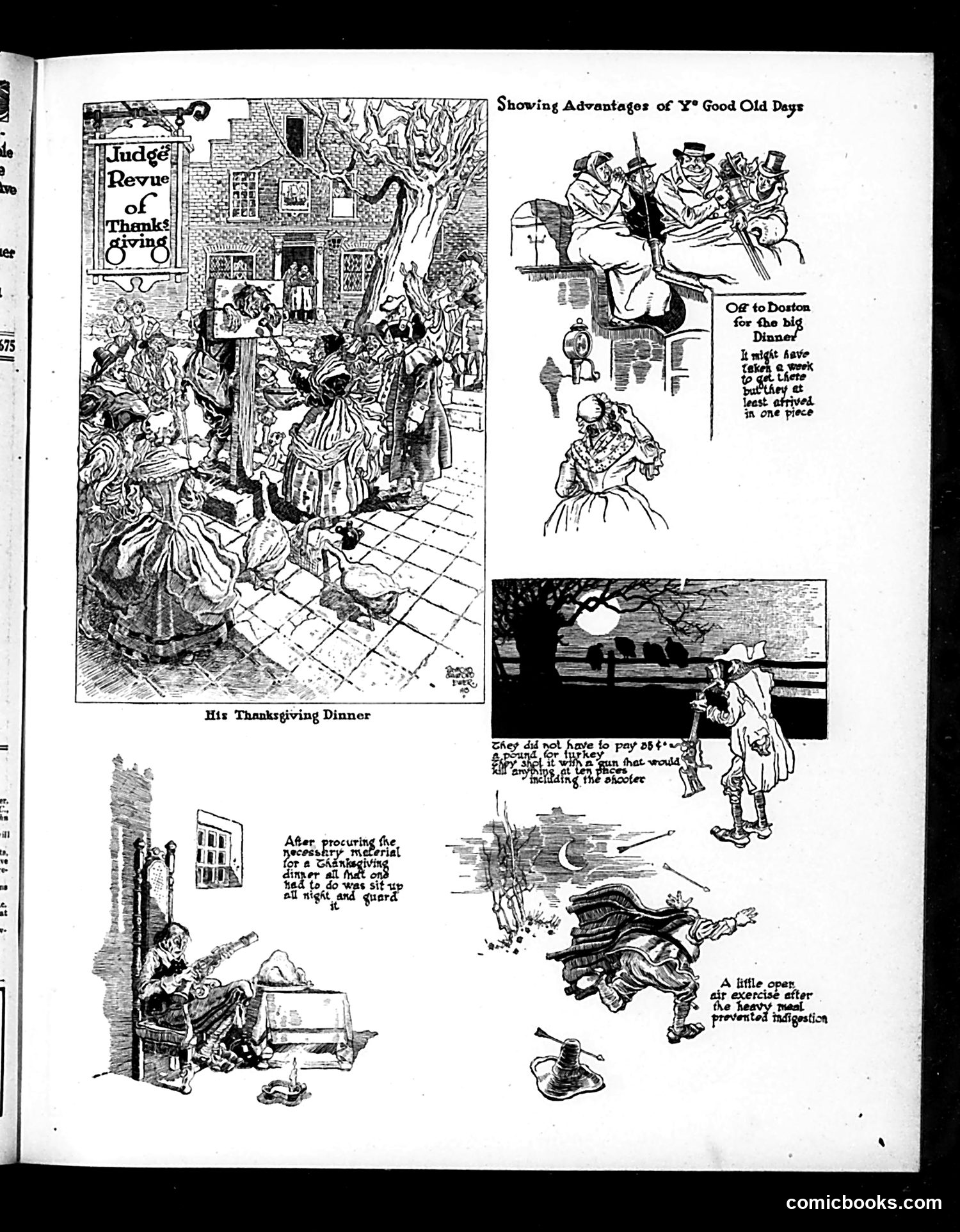
This page satirizes old-fashioned holiday traditions through a "Judge's Revue of Thanksgiving." The main cartoon titled "His Thanksgiving Dinner" depicts an elaborate, chaotic colonial-era feast scene, contrasting elaborate past customs with modern times. The smaller vignettes labeled "Showing Advantages of Y' Good Old Days" mock nostalgic romanticism about the past through humorous exaggeration. They depict impractical historical elements: traveling to Boston for dinner by horseback (taking a week), standing guard all night over food, and a figure hunched over from "heavy pans preventing indigestion." The satire targets readers who idealize "the good old days," suggesting historical life was actually inconvenient and burdensome compared to modern conveniences. The tone is lighthearted ridicule of nostalgia.
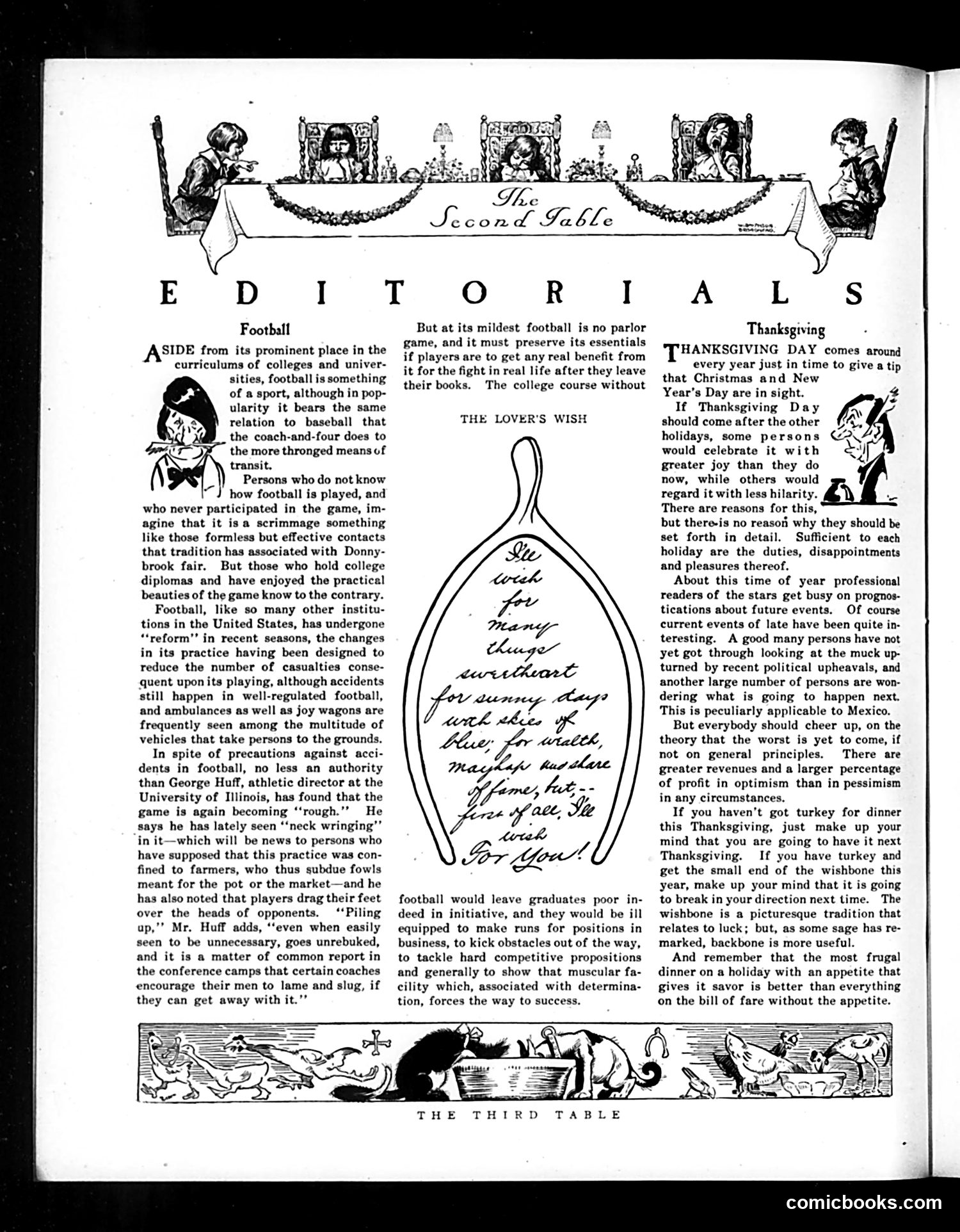
This page contains three editorials with period illustrations rather than political cartoons. The content addresses: **"Football"** - Discusses college football's place in university curricula, noting reforms to reduce injuries and "rough" play. References George Huff, athletic director at the University of Illinois, who apparently advocated subduing fowl on farms. The piece critiques coaches encouraging brutality. **"The Lover's Wish"** - A decorative illustration of a wishbone with handwritten text expressing romantic sentiments. **"Thanksgiving"** - Argues for better observance of Thanksgiving, suggesting it deserves equal prominence to Christmas and New Year's, and offers practical holiday advice about budgeting. The page appears primarily editorial rather than satirical, reflecting early 20th-century concerns about sports brutality and holiday commercialization.
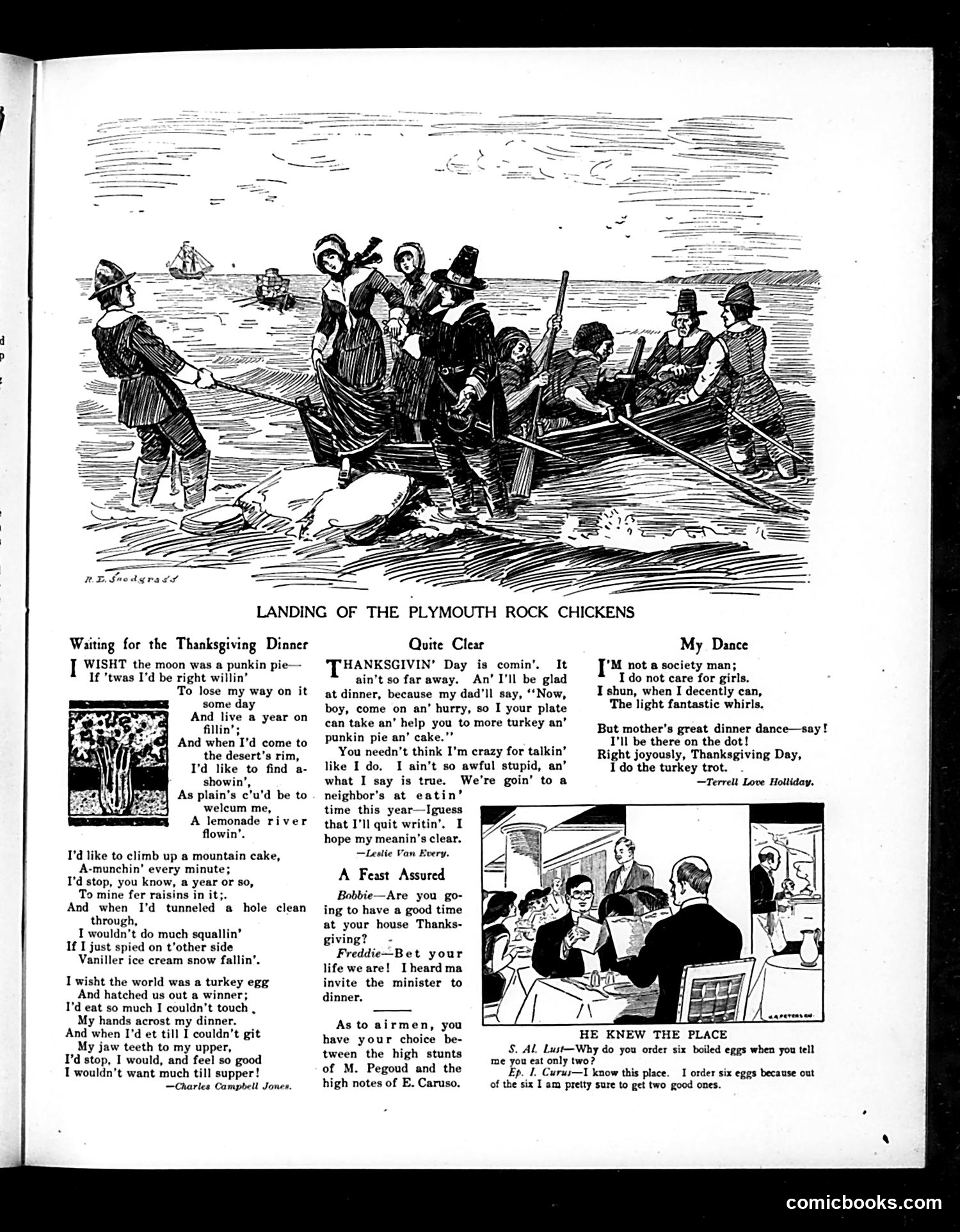
**Main Content:** A satirical engraving titled "Landing of the Plymouth Rock Chickens" depicts Pilgrims arriving by boat with a large chicken, parodying the historical Mayflower landing. **Surrounding Material:** The page features Thanksgiving-themed humorous poetry and prose pieces, including "Waiting for the Thanksgiving Dinner," "Quite Clear," and "My Dance." These appear to be lighthearted domestic comedy about holiday anticipation and family dinner traditions. **A Feast Assured:** A cartoon dialogue between characters discussing a Thanksgiving dinner invitation, with mentions of "airmen" and references to "M. Pegoud and the high notes of E. Caruso" (likely early aviation pioneers and opera singers). **The Satire:** The overall humor combines nostalgic American mythology (Plymouth Rock landing) with contemporary holiday anxieties and social observations about class, food, and entertainment expectations during Thanksgiving.
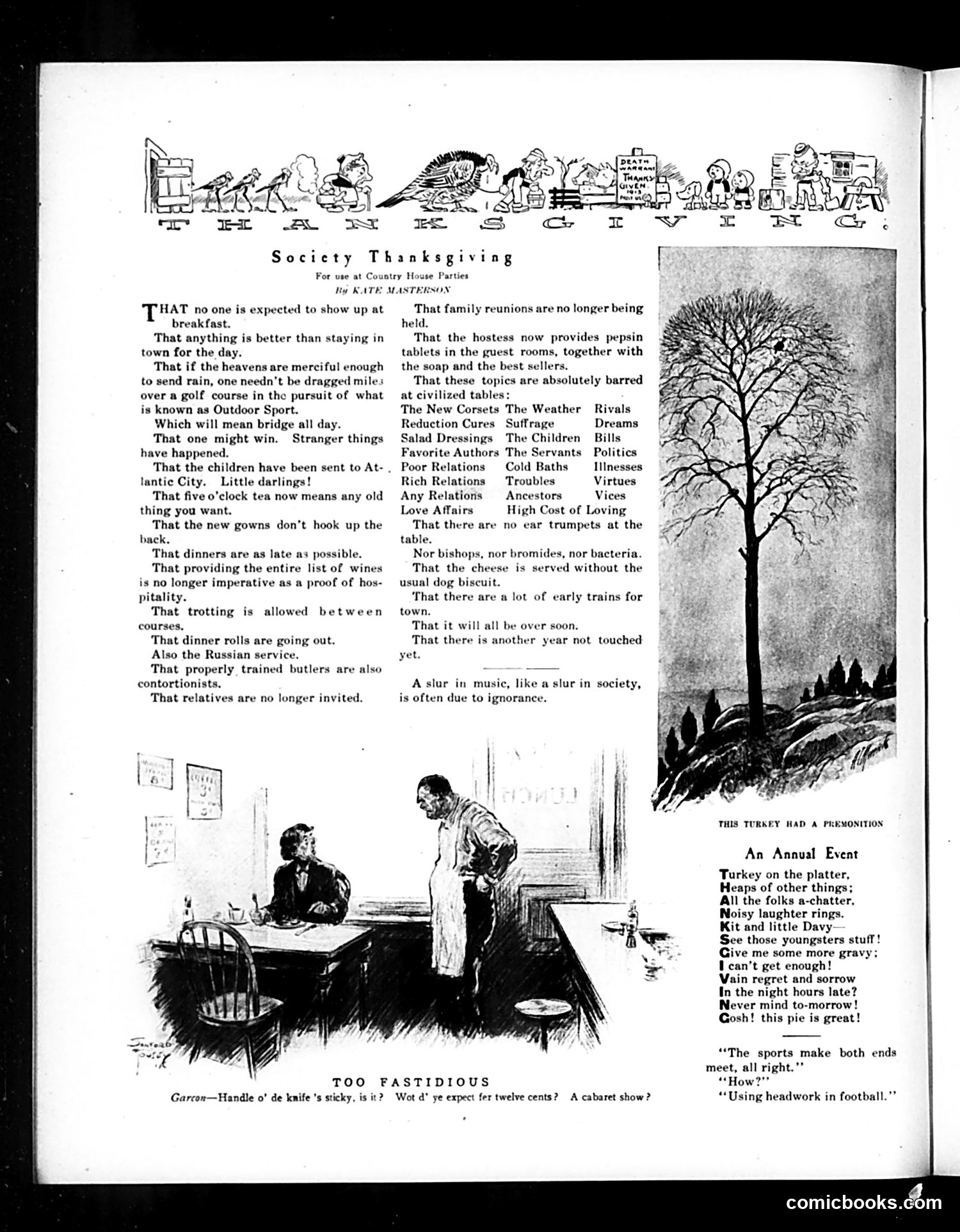
This satirical piece by Kate Masterson mocks the pretensions of wealthy country-house holiday gatherings. The humor centers on the gap between refined expectations and actual behavior among the upper class. The list catalogs hypocritical "modern" etiquette: guests skip breakfast, children are shipped away (called "little darlings" sarcastically), and servants must be impossibly skilled contortionists. Notably, "relatives are no longer invited"—a jab at the dissolution of traditional family bonds among the affluent. The forbidden dinner topics (suffrage, servants, cold baths, illnesses, vices) satirize how polite society censors genuine discussion. The pepsin tablets in guest rooms mock guests' overindulgence and digestive distress. The accompanying cartoons reinforce the theme: "Too Fastidious" shows a waiter defending cheap service, while "An Annual Event" presents Thanksgiving excess—overeating and immediate regret—as annual ritual. Overall, the page ridicules wealthy Americans' simultaneous pursuit of sophistication and comfort, their dysfunctional family dynamics, and the hollow nature of their social conventions.
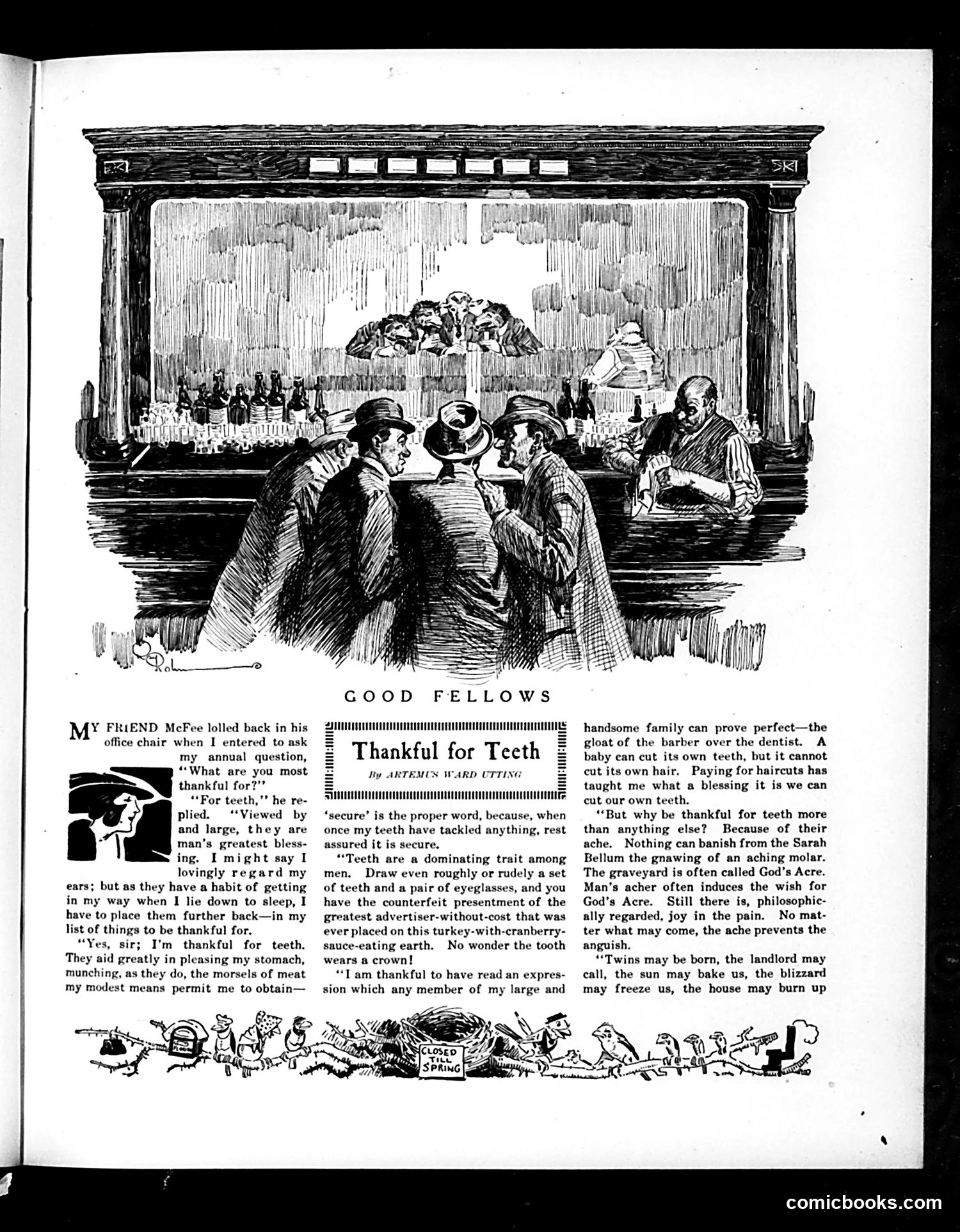
This is a humorous essay-style piece, not political satire. A character named McFee explains why he's most grateful for teeth, using absurdist logic typical of early 20th-century humor writing. The joke relies on increasingly ridiculous reasoning: teeth are useful for eating, they're a recognizable feature (useful for caricature), dentists are worse than barbers, and most oddly—toothaches are actually *good* because they distract from worse suffering like losing your home or family crises. The final section lists genuine hardships (eviction, weather, fire) against which a mere toothache seems trivial by comparison. The satire targets not teeth themselves but rather the human tendency to rationalize gratitude for small comforts while enduring larger misfortunes. The theatrical stage illustration above reinforces the performative, exaggerated tone of McFee's monologue.
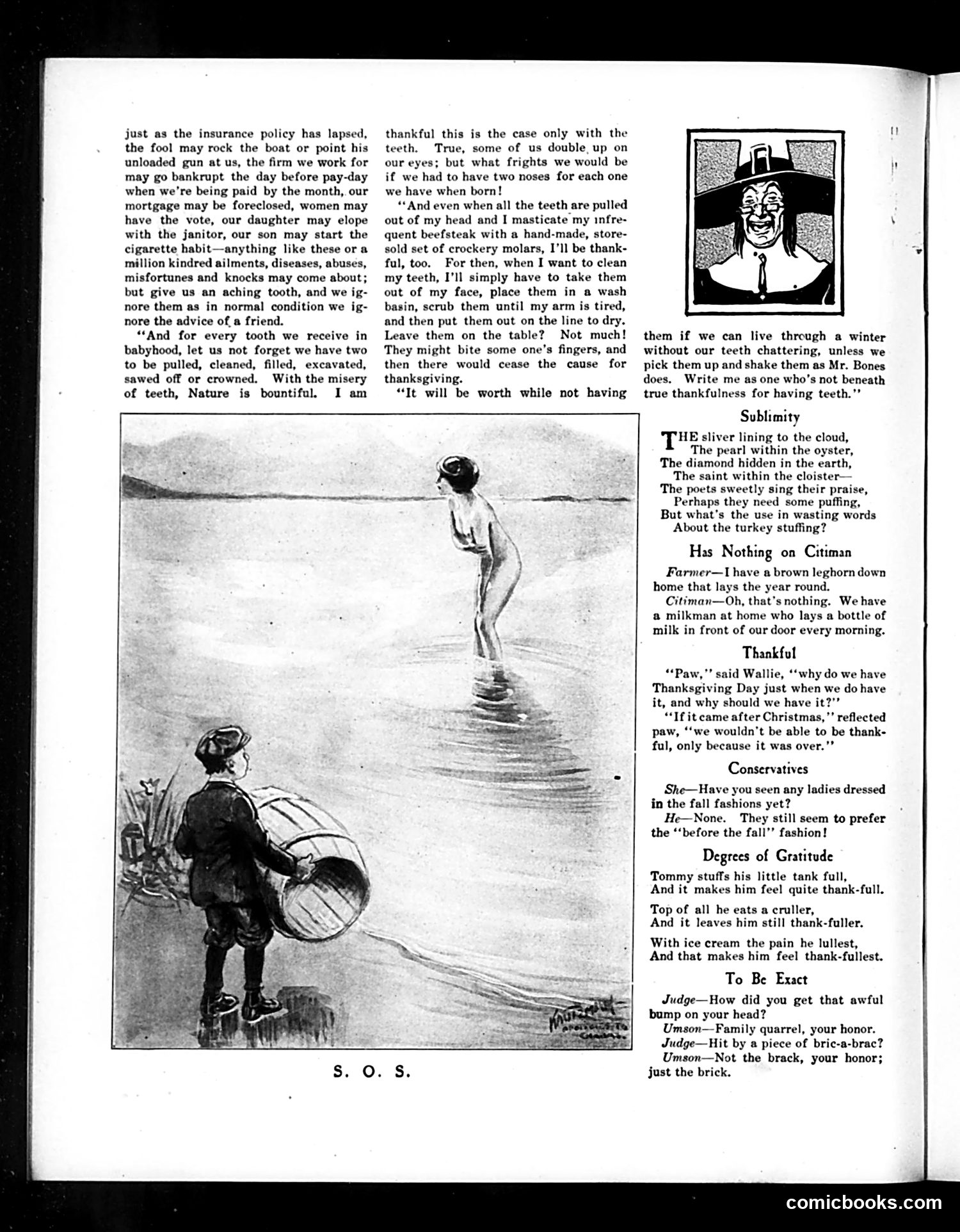
This page collects several short humorous pieces themed around gratitude, likely for a Thanksgiving issue. **Main Cartoon ("S.O.S."):** Depicts a distressed figure in water signaling for help while another person on shore holds a bucket. The "S.O.S." caption suggests maritime distress—the joke appears to be a visual pun or commentary on helplessness, though the specific satirical point isn't entirely clear from image alone. **Text Pieces:** Rather than political satire, these are lighthearted domestic humor and wordplay: - A lengthy meditation on dental problems as something to be grateful for (perverse gratitude) - A pun about "fall fashions" (women preferring pre-fall styles) - A farmer/city-dweller joke about egg-laying versus milk delivery - Puns on "thankful" with escalating desserts - A courtroom joke playing on "brick" versus "bric-a-brac" The page emphasizes gentle, everyday humor over sharp political commentary—typical lighter fare for Judge magazine's variety editorial approach.
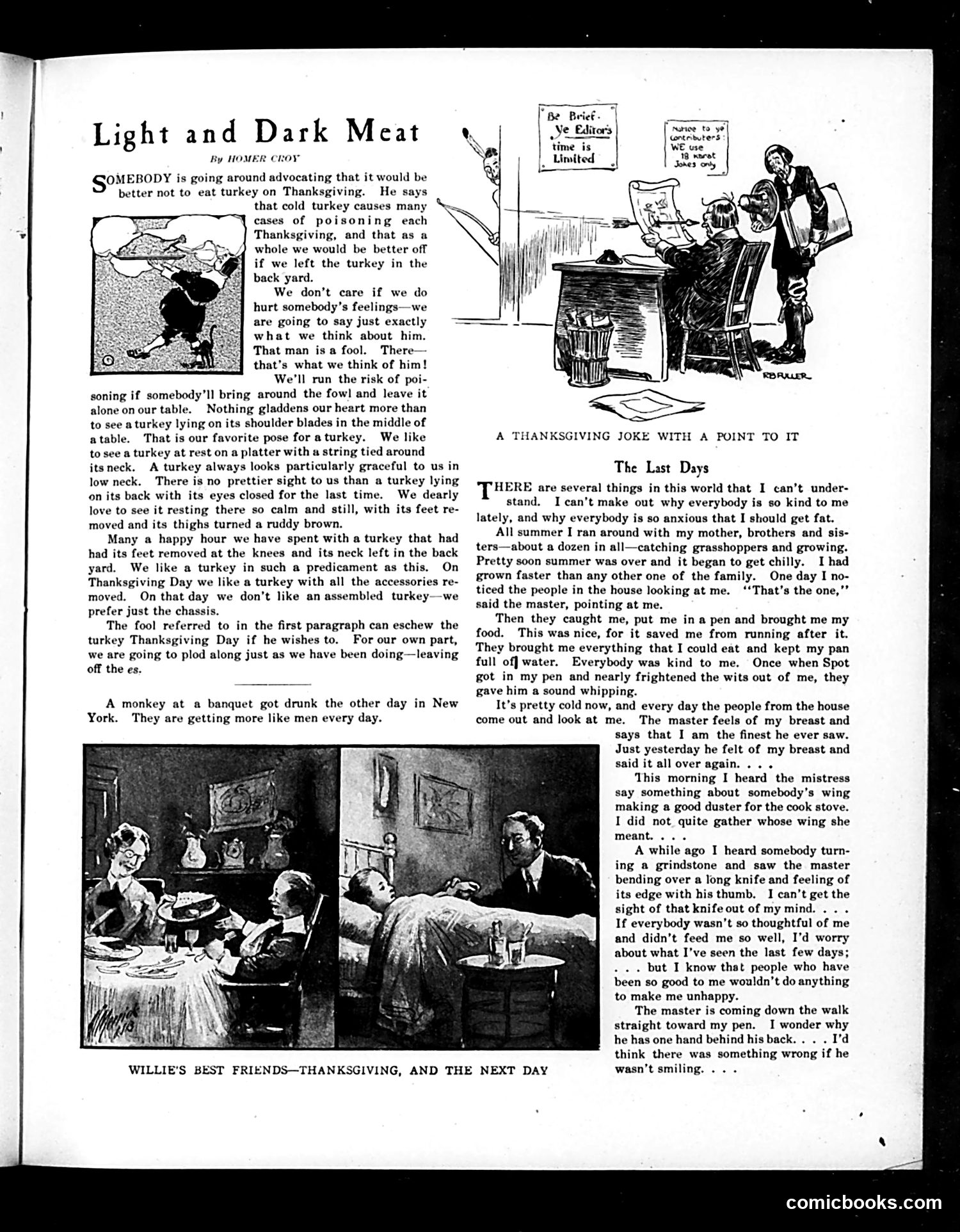
**"Light and Dark Meat"** (top): A humorous defense of eating turkey at Thanksgiving, mocking someone who warned against it due to food poisoning risks. The author dismissively calls this person a "fool" and celebrates turkey in various culinary states—particularly enjoying it disassembled ("just the chassis"). The joke concludes with a quip about a drunken monkey becoming "more like men every day," a common period trope about animal behavior mimicking human degeneracy. **"The Last Days"** (right): A darker piece written from a turkey's perspective. The bird describes being selected, fattened, and pampered by the household—then gradually realizes the horrifying truth through observed details: the master sharpening a knife, talk of using its wing as a duster. The tragic irony is that the turkey's kindness was merely preparation for slaughter. It's sentimental satire on human hypocrisy and the fate awaiting Thanksgiving poultry. Both pieces use humor to explore attitudes toward holiday meat consumption, balancing celebration with darker implications.
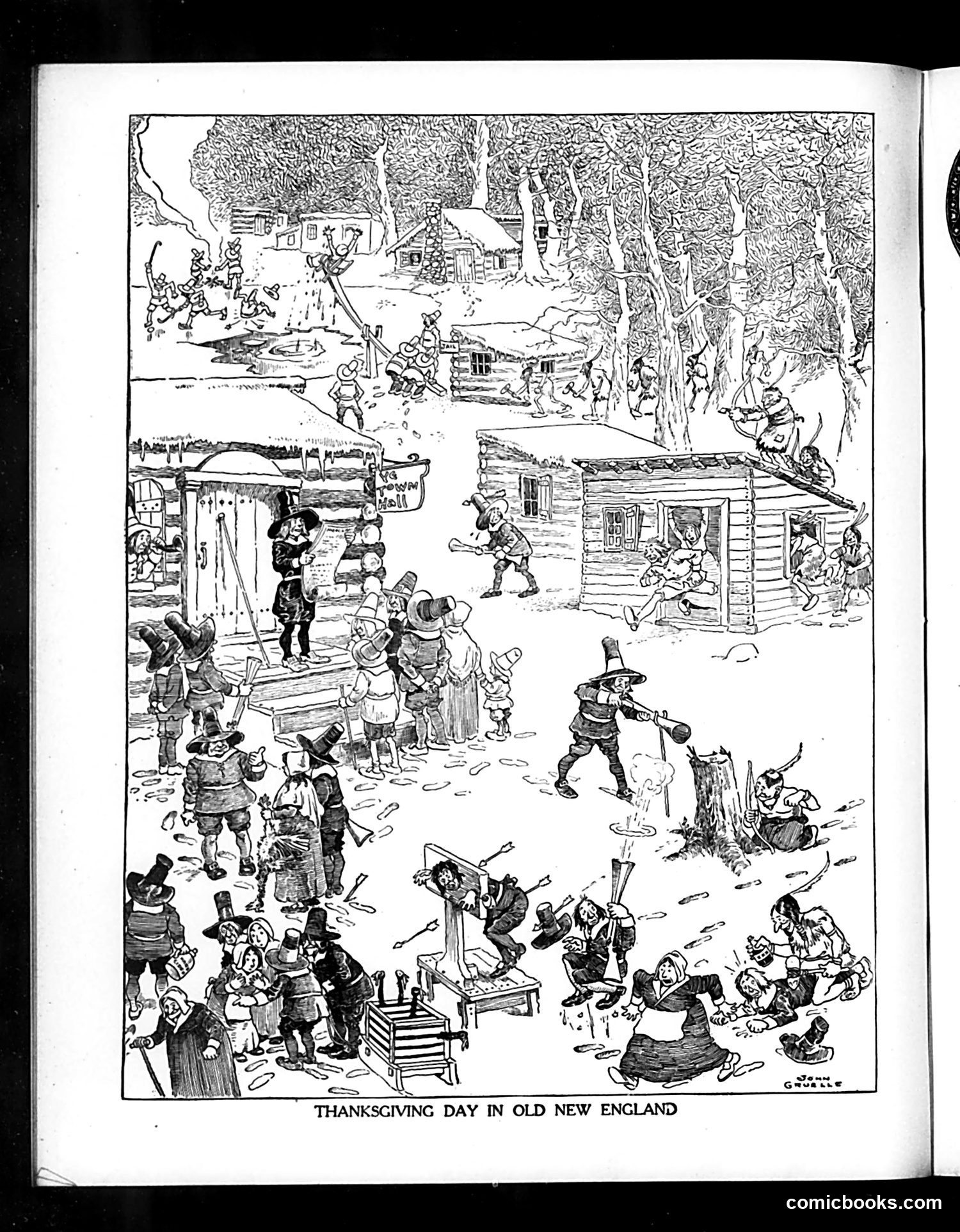
This is a nostalgic illustration depicting a Thanksgiving celebration in colonial New England. The scene shows a rustic settlement with log cabins, settlers in period dress, and various activities—cooking, games, and socializing around a central gathering space. The cartoon appears to be celebrating American colonial heritage and the traditional origins of Thanksgiving. Rather than political satire, it's a sentimental historical illustration idealizing early American frontier life. The detailed scene includes families, children playing, and communal food preparation, emphasizing themes of community, tradition, and simplicity. The signature appears to be "Gould" in the lower right. This type of nostalgic content was common in Judge magazine as Americans sought to romanticize their historical past, particularly during periods of social change.
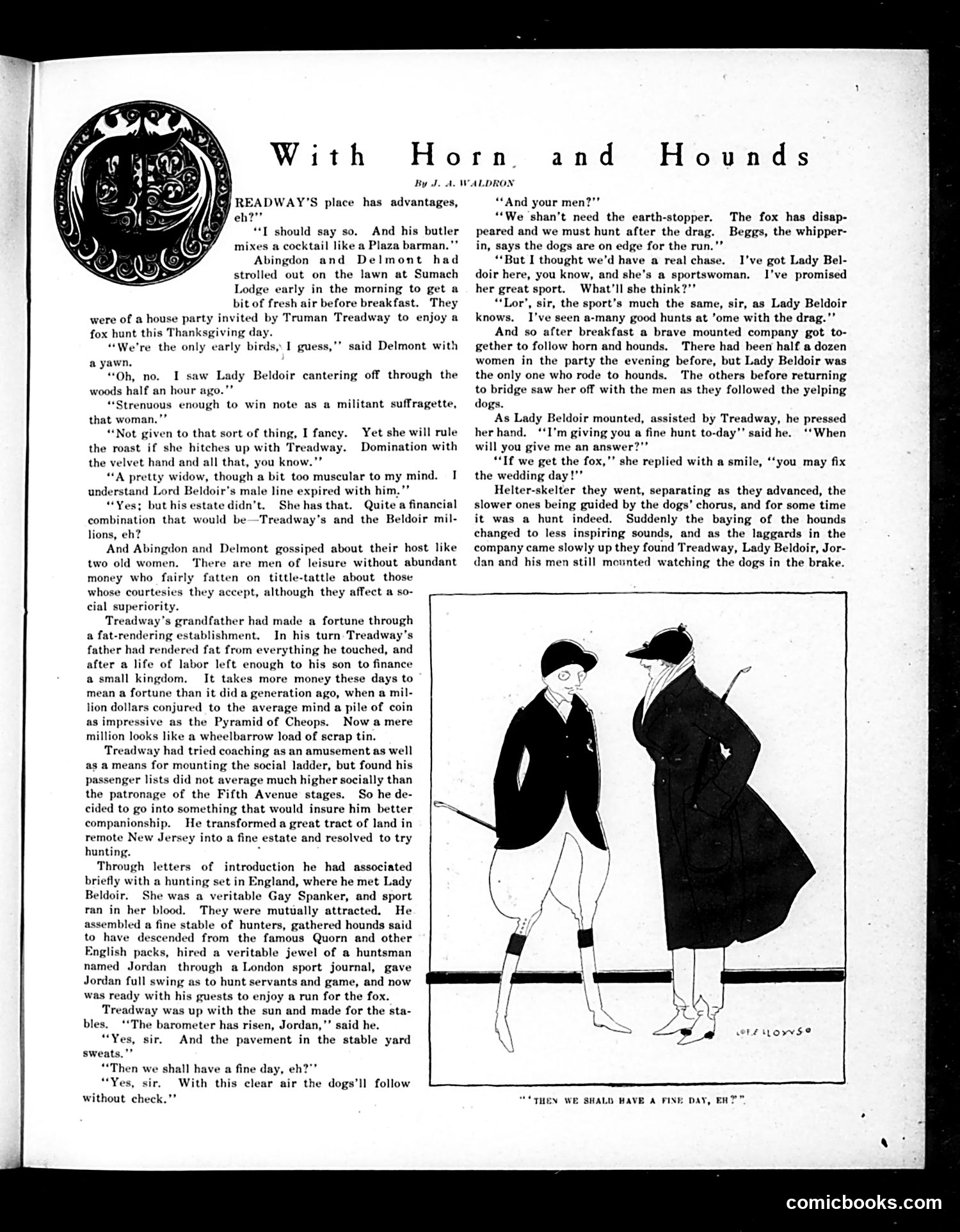
This story satirizes the leisure-class pretensions of the American wealthy circa early 1900s. Truman Treadway, a nouveau-riche industrialist descended from a "fat-rendering establishment" fortune, attempts social climbing by hosting an elaborate fox hunt on his New Jersey estate. The satire targets his transparent social desperation: having failed at coaching (where even passengers snubbed him), he now buys respectability through hunting. The narrative mocks the gossiping male guests and, notably, Lady Beldoir—a wealthy widow characterized as unusually "muscular" and militant enough for suffragette comparison. The cartoon depicts her athletic independence: she's the *only* woman participating in the hunt itself, conditioning her marriage answer to catching the fox. The humor lies in exposing how old-money Europeans (Lady Beldoir) and leisure-class pretenders navigate social hierarchies through ritualized sporting activities—institutions that legitimize wealth while masking its vulgar origins.
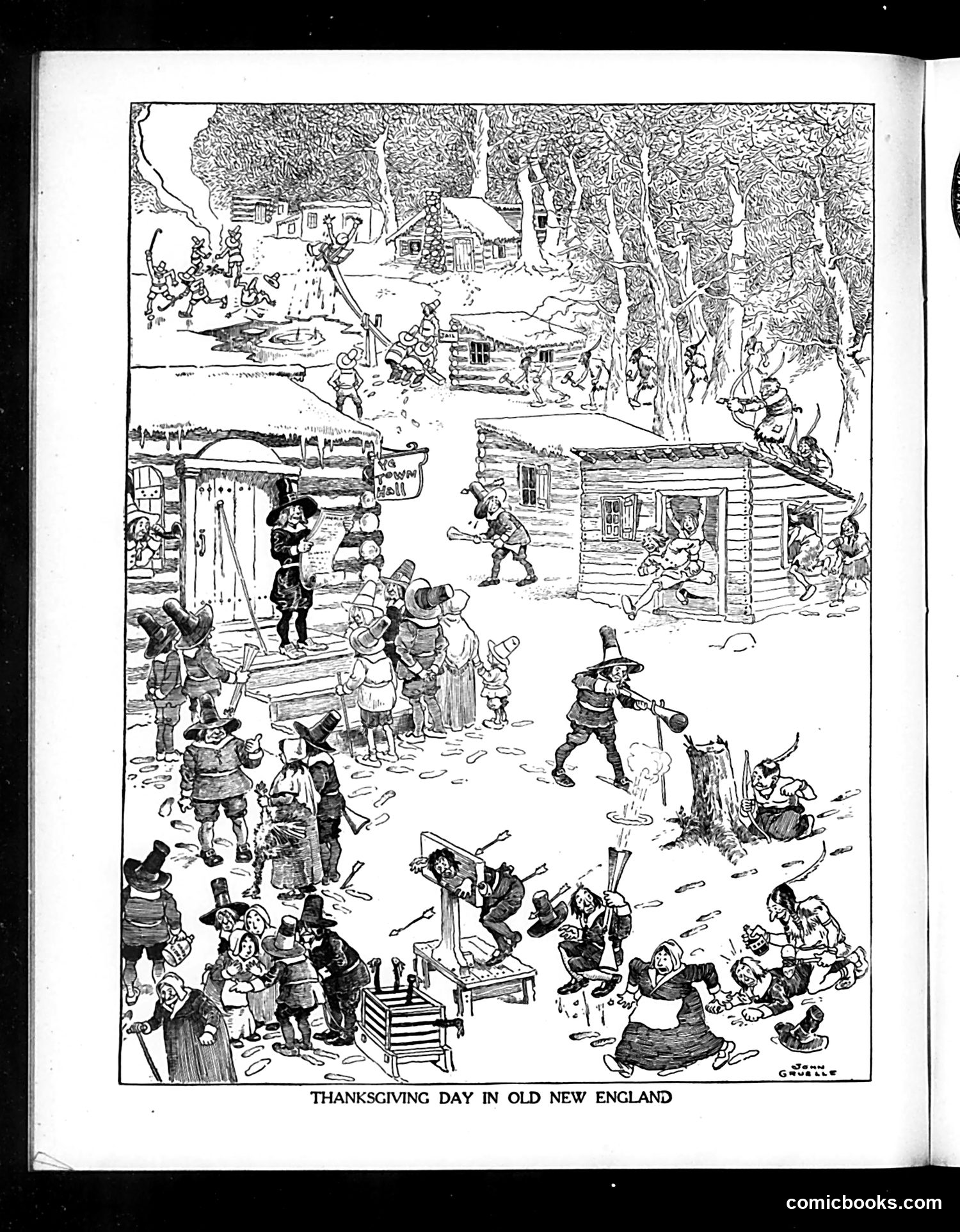
This is a nostalgic illustration depicting a Thanksgiving celebration in colonial New England. The detailed engraving shows: - Log cabins and rustic buildings nestled among tall trees - Numerous settlers and their families engaged in festive activities - Games, meals, and gatherings scattered throughout the settlement - Period-appropriate clothing and architecture The cartoon appears to romanticize early American colonial life, presenting Thanksgiving as a wholesome, communal frontier tradition. It emphasizes themes of community, family gatherings, and outdoor celebration in a wilderness setting. The illustration uses fine crosshatching typical of late 19th/early 20th-century engravings. Rather than political satire, this appears to be a sentimental illustration celebrating American historical heritage and the Thanksgiving tradition's historical roots in colonial America—likely appealing to contemporary readers' nostalgia for "simpler times."
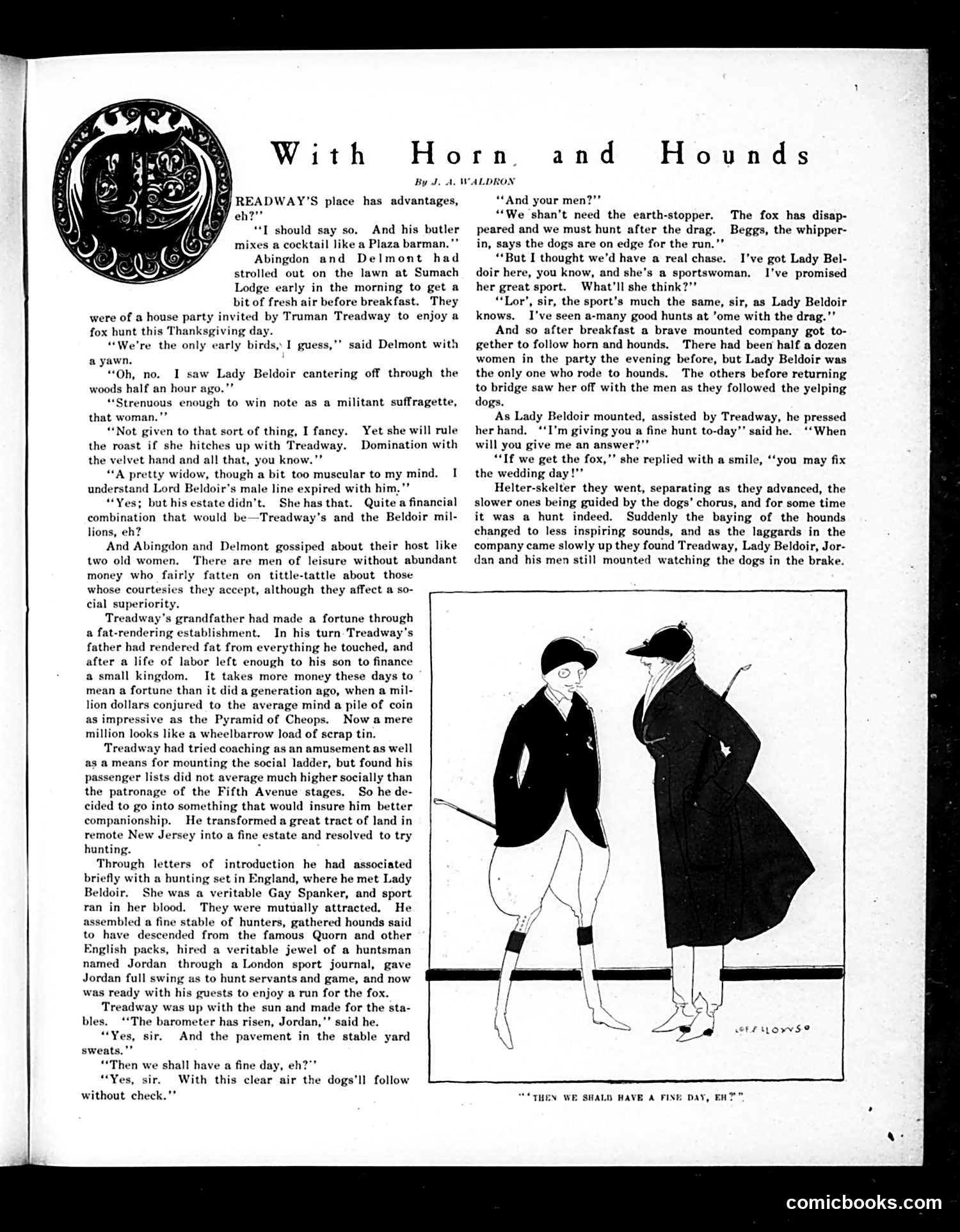
This story satirizes the social climbing of newly wealthy Americans in the early 20th century. Truman Treadway, whose family made a fortune in fat-rendering (a deliberately unglamorous source of wealth), is using fox hunting and estate ownership to gain social respectability and access to the upper classes. The accompanying illustration shows a woman (Lady Beldoir, a wealthy widow) conversing with a man before the hunt. The satire targets how Treadway pursues Lady Beldoir for marriage, hoping to combine their fortunes and gain legitimacy through association with old money and titled nobility. Lady Beldoir's participation in hunting—unusual for women at the time—suggests modern, independent wealth. The gossiping male characters exemplify how leisure-class men of modest means survive by trading in social gossip and observing their betters' affairs, highlighting the pretense and social anxiety of Gilded Age wealth.
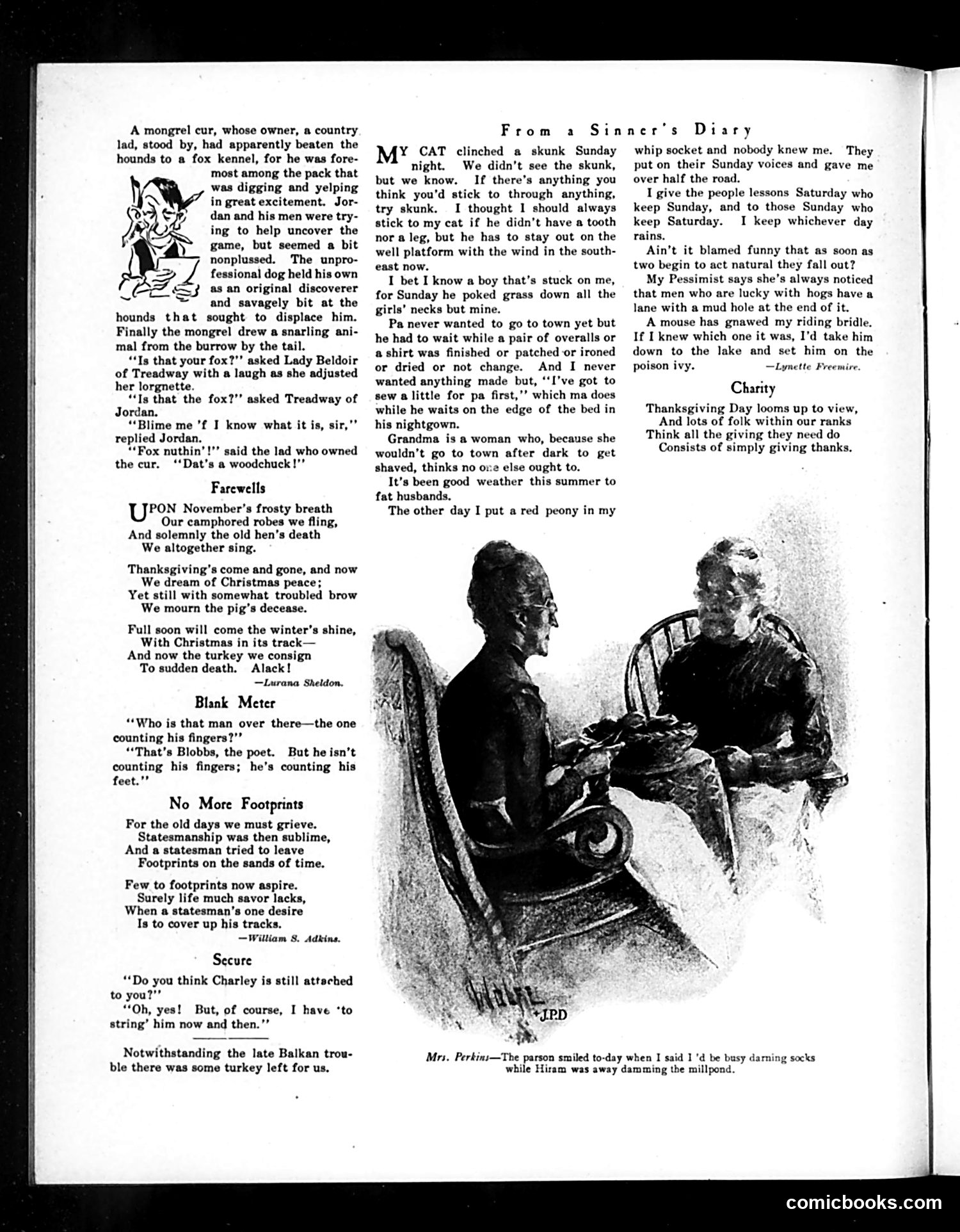
This page from *Judge* contains several short humor pieces typical of early 20th-century American satirical magazines: **"My Cat"** and **"From a Sinner's Diary"** are diary-style pieces using rural/country life observations for gentle social satire. The humor relies on everyday frustrations (a cat sprayed by a skunk, waiting for clothes to be mended, hypocritical churchgoers) presented with folksy cynicism. **"Farewells"** is a poem mourning seasonal slaughter of farm animals—poking fun at overly sentimental attitudes toward livestock death. **"No More Footprints"** criticizes modern politicians for covering up scandals rather than leaving noble legacies ("footprints on the sands of time"). **Other brief jokes** satirize poets, romantic relationships, and charitable hypocrisy. The illustration shows a Thanksgiving scene with two women and a turkey, accompanying text about giving thanks versus actual generosity—the joke being that people substitute verbal thanks for actual charitable action. The overall tone is lighthearted social commentary on manners, morality, and rural American life.
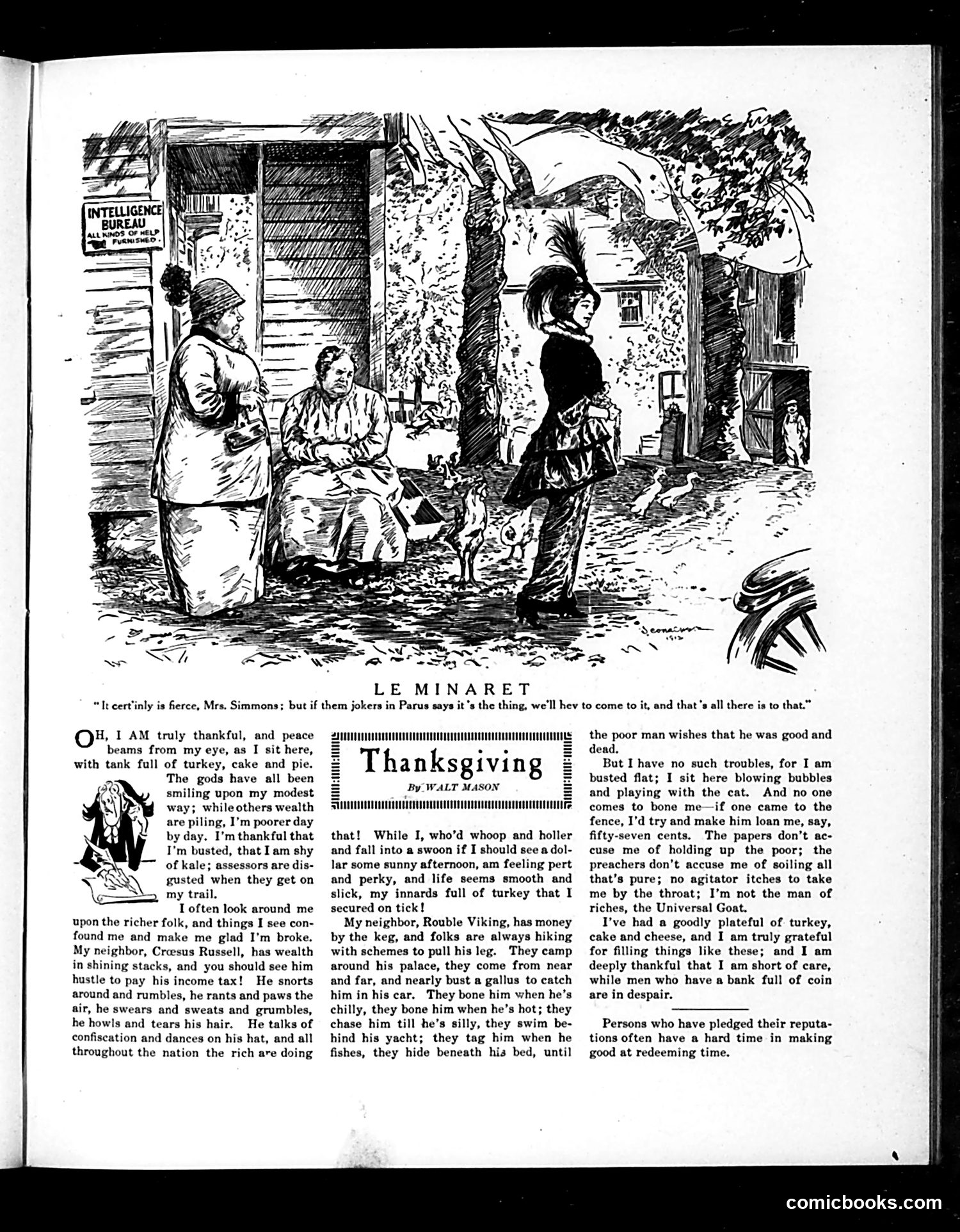
This is a humorous poem satirizing wealth and poverty during the early 20th century, likely commenting on income taxation and class anxiety. The narrator—a poor man—ironically expresses gratitude for his poverty. He contrasts himself with wealthy neighbors like "Croesus Russell" and "Rouble Viking," who suffer constant harassment: tax collectors, fortune-seekers, social climbers, and people trying to exploit them. The wealthy man is miserable, besieged on all sides. The poor man, by contrast, enjoys peace and simple pleasures (turkey obtained "on tick"—on credit). No one targets him for money or schemes; he faces no social pressure. The satire targets wealthy industrialists and the nouveau riche, suggesting their fortunes bring stress rather than happiness. It also likely references contemporary debates about progressive taxation and the burdens placed on the rich. The poem's conclusion—that reputation pledges are hard to redeem—hints at broader social instability.
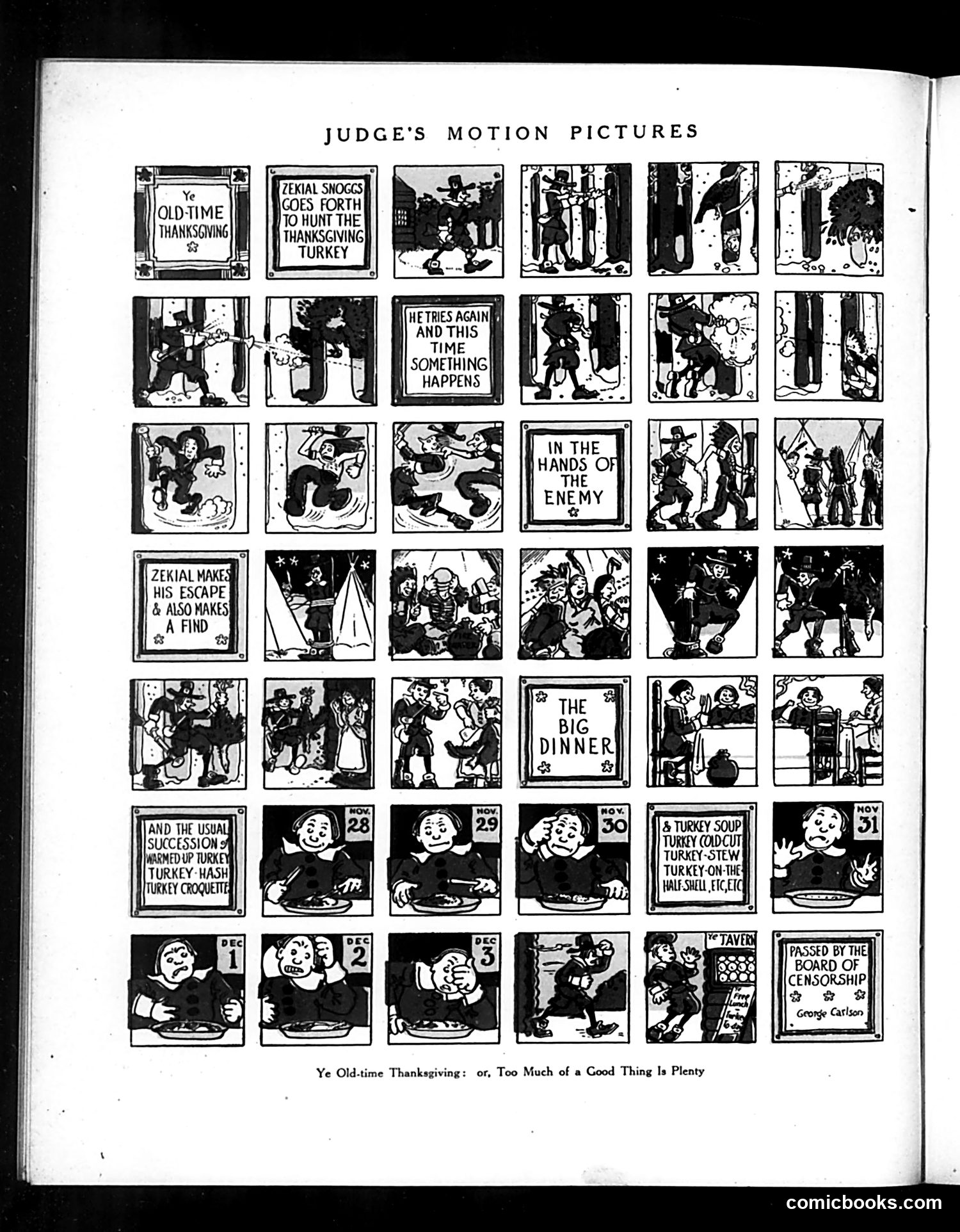
This is a comic strip by George Carlson satirizing Thanksgiving excess through the character Zekial (likely a rustic or immigrant figure, given the dialect spelling). The narrative follows him hunting a turkey, capturing it, and then facing an absurd succession of turkey-based dishes: turkey soup, hash, stew, croquettes, and variations—culminating in a commentary on overindulgence. The satire targets American Thanksgiving culture's gluttony and repetitiveness. By showing the same ingredient endlessly reprocessed into different forms, Carlson mocks both the holiday's excess and the era's limited culinary imagination. The subtitle—"Too Much of a Good Thing Is Plenty"—makes the moral explicit. The bottom notation confirms Judge magazine's editorial review standards of the period. This reflects early 20th-century satirical humor about immigrant or working-class characters and their relationship to American holiday traditions.
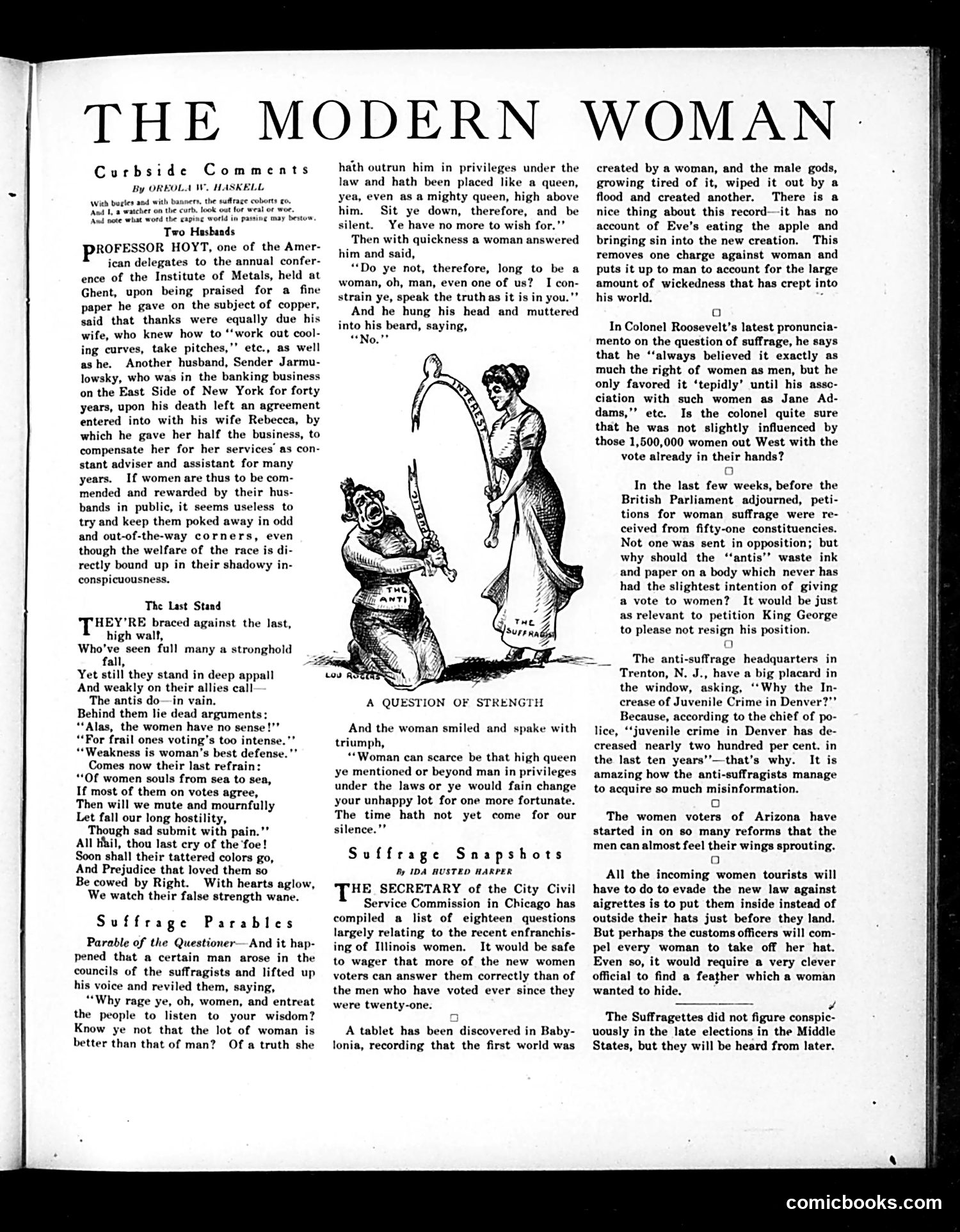
This page lampoons **anti-suffrage arguments** (the "antis") as they face inevitable defeat. The cartoons mock male opponents of women's voting rights. **Key elements:** - **"Two Husbands"** praises men who publicly credit wives as intellectual/business partners, arguing that if women merit such recognition, denying them votes is hypocritical. - **"The Last Stand"** depicts anti-suffragists as a doomed fortress. Their final argument—that women already enjoy such legal privileges they needn't vote—is turned against them: if women truly have such power, men *would want* those privileges themselves, yet they don't. - **"Suffrage Snapshots"** (by Ida Husted Harper, a real suffrage advocate) includes trivia about women's competence and a Babylonian myth crediting a woman with creation—sarcastically noting this account *doesn't* blame women for sin (unlike the Adam/Eve story), thus removing "one charge against woman." The satire's point: anti-suffrage logic is contradictory and crumbling.
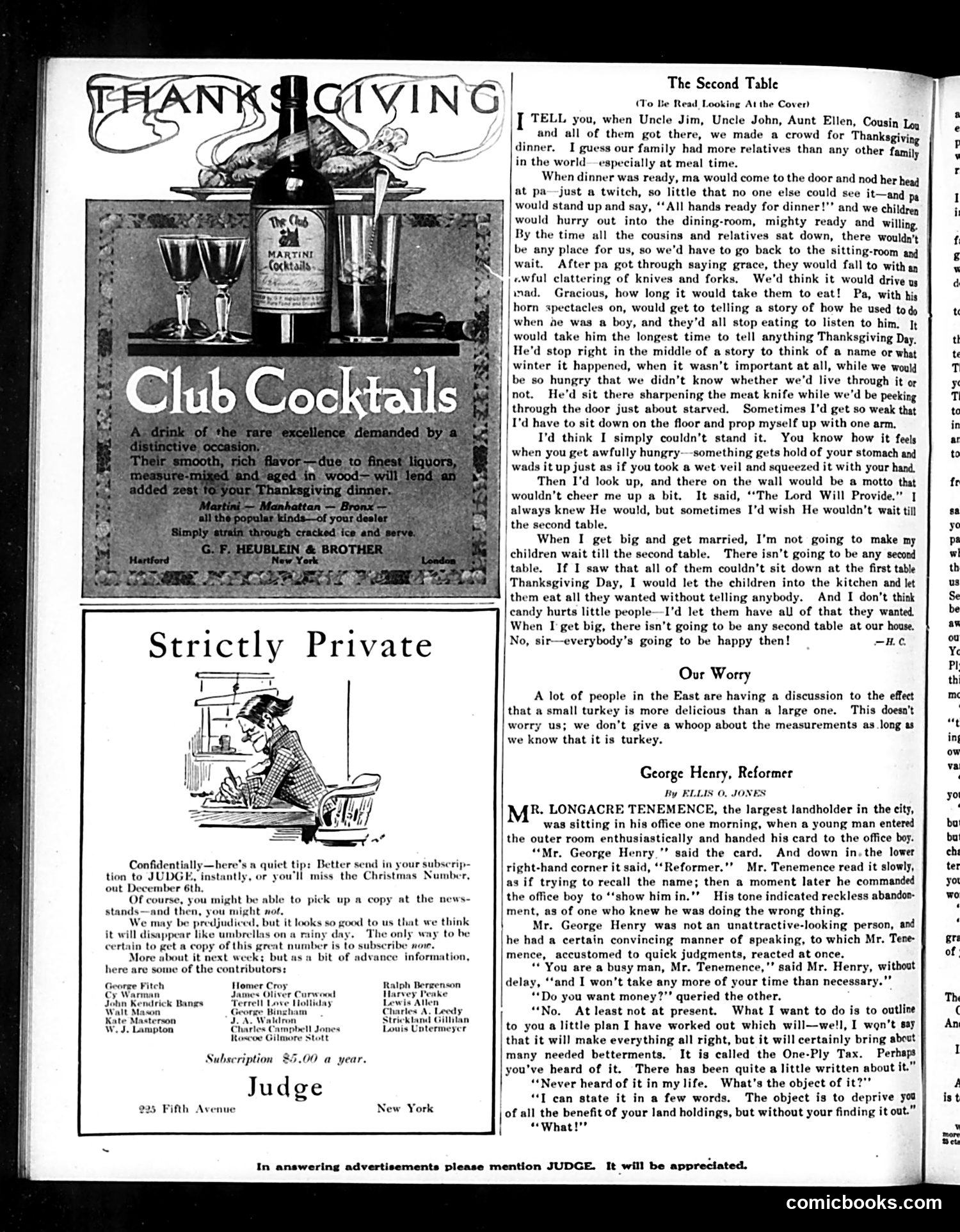
This page contains two distinct pieces. The left side is primarily **advertising** for Judge magazine's Christmas issue, listing contributors and subscription information. The right side features **"The Second Table,"** a humorous nostalgic story about childhood Thanksgiving dinners. The narrator recalls being a child forced to eat at a "second table" after adult relatives finished at the main table. While parents and relatives enjoyed leisurely meals with stories and conversation, the hungry children waited in the sitting room, ravenous and frustrated. The satire critiques **class hierarchy within families**—children relegated to inferior seating, yet the narrator vows equality for their own future children. It's gentle domestic humor rather than political satire, reflecting early-20th-century family dynamics and generational attitudes toward children's treatment at formal meals.
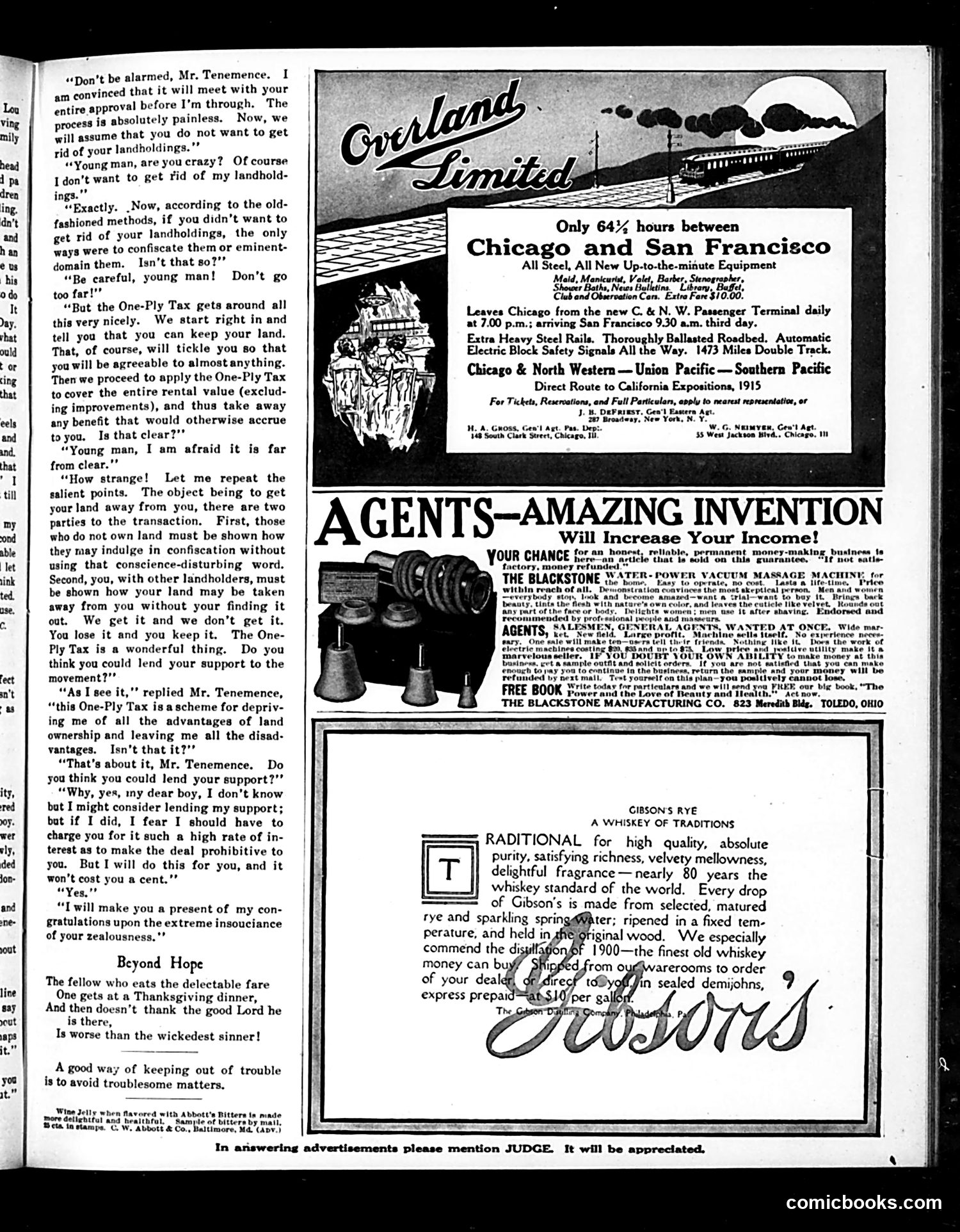
## Main Cartoon/Dialogue The dialogue satirizes a proposed "One-Ply Tax" scheme targeting landowners. A young man pitches Mr. Tenemence on a taxation method that ostensibly lets him keep his land while actually confiscating its rental value through taxation. The satire exposes how the scheme uses deceptive language ("confiscation" vs. "taxation") and false reassurance to dispossess landowners of economic benefit while leaving them technically owning worthless property. This appears to critique progressive taxation or land-value schemes popular in early 20th-century reform movements. ## Advertisements The page includes three period ads: the **Overland Limited** train (Chicago-San Francisco service), a **Blackstone Manufacturing vacuum massage machine** promising income for agents, and **Gibson's Rye whiskey** emphasizing tradition and quality. ## Overall Context This is primarily editorial/satirical content paired with commercial advertising—typical Judge magazine format. The tax satire reflects contemporary debates over property taxation and wealth redistribution during the Progressive Era.
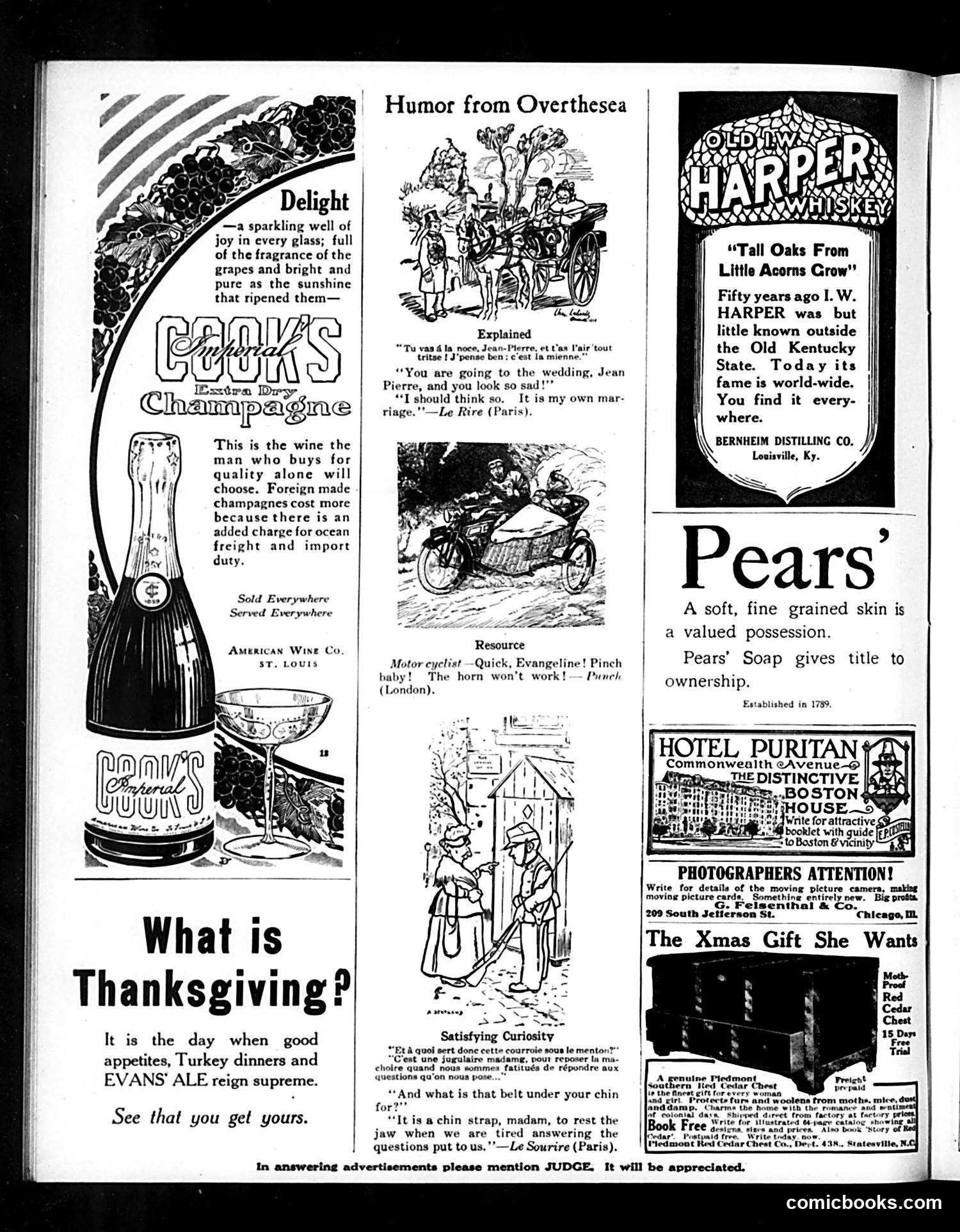
This page is primarily **advertising**, not editorial content. The cartoons shown are reprinted "Humor from Overthesea"—European jokes translated for American readers. The three brief cartoons mock common human situations: 1. **"You are going to the wedding"** (from *Le Rire*, Paris): A man dreads attending his own wedding, suggesting reluctance about marriage itself. 2. **"Motor cyclist Quick, Evangeline!"** (London): A motorcyclist's horn fails at a critical moment—slapstick humor about mechanical failure. 3. **"Satisfying Curiosity"** (from *Le Sourire*, Paris): A chin strap allows officials to rest their jaws from answering endless public questions—satirizing bureaucratic annoyance. These are light, universal jokes requiring no specific historical knowledge. The remainder consists of period advertisements for champagne, ale, whiskey, soap, hotels, and photography equipment—typical of Judge magazine's revenue model.
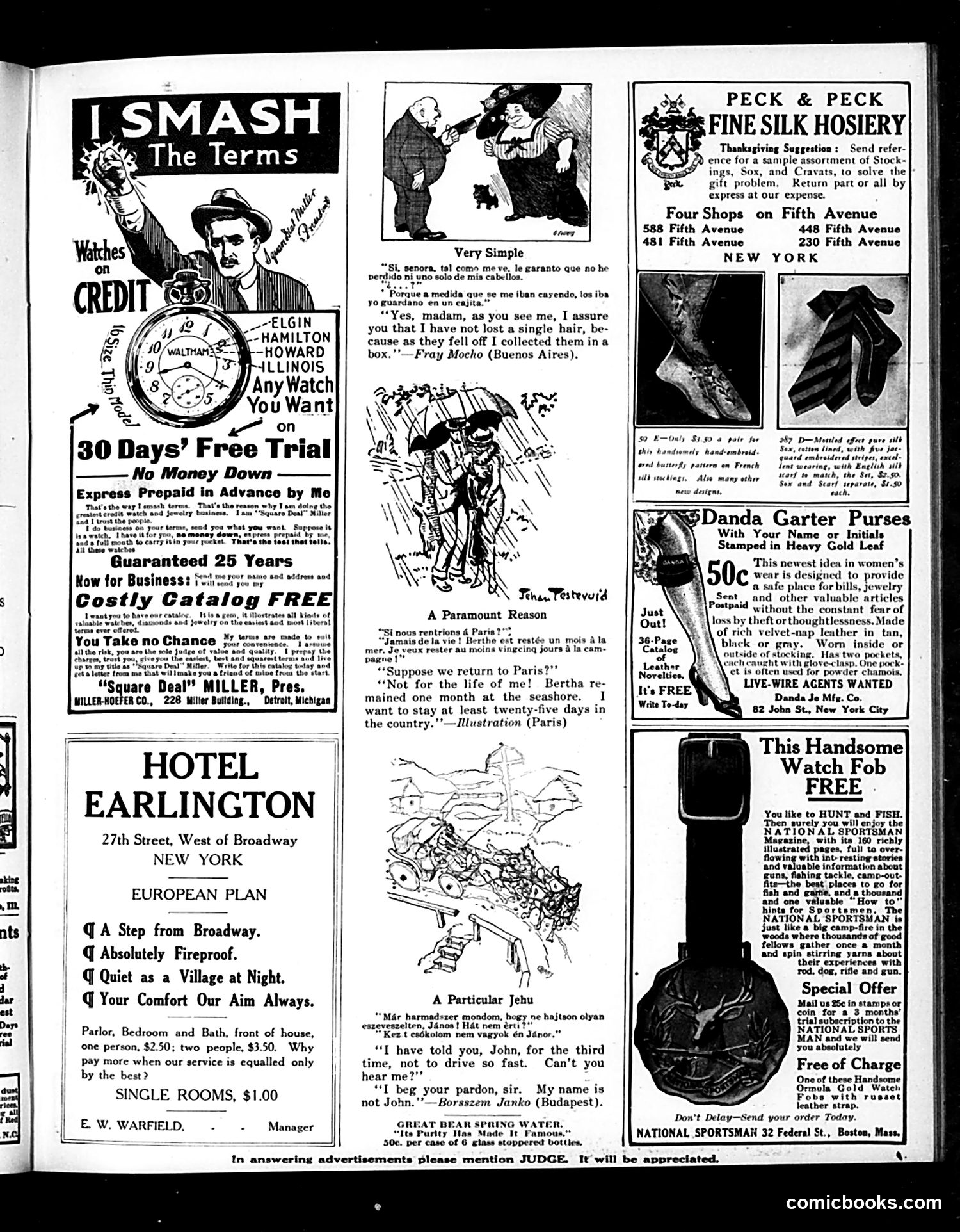
This page is primarily **advertisements and humor columns**, not political cartoons. The content includes: **Humorous Anecdotes**: Three brief, translated jokes from international publications (Buenos Aires, Paris, Budapest) about everyday situations—a man claiming he saved his fallen hair, a woman refusing to leave the seaside, and a coachman's name confusion. These illustrate *Judge's* practice of reprinting amusing foreign stories for American readers. **Advertisements**: Dominant content includes watches sold on credit, the Hotel Arlington, Peck & Peck hosiery, Danda garter purses, and a "National Sportsman" magazine watch fob offer. **Cultural Context**: The magazine appeals to urban, middle-class readers with disposable income through mail-order goods. The translated humor suggests *Judge's* cosmopolitan readership and interest in international wit. No significant political satire or caricature appears on this page—it's a typical early-20th-century magazine mix of advertising and light humor columns.
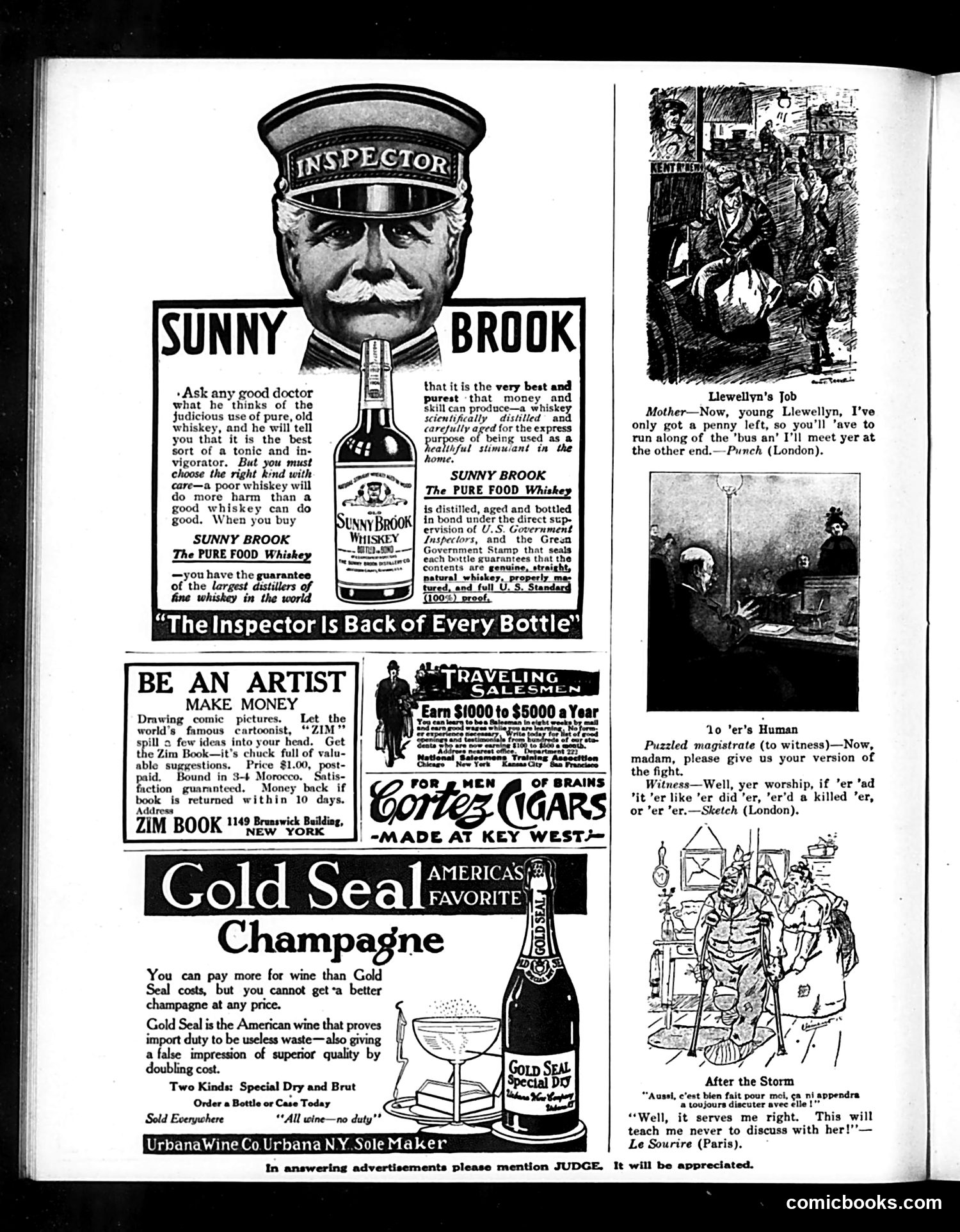
This Judge magazine page is primarily **advertising**, not political satire. The dominant content features three liquor advertisements (Sunny Brook whiskey, Gold Seal champagne) and various mail-order ads (art instruction, cartooning books, traveling salesman jobs). The small comics scattered throughout are reprinted from other publications—British humor magazines *Punch* and *Sketch*, plus French *Le Sourire*. These depict working-class domestic life: a mother sending her son on an errand with minimal money; a magistrate confused by a woman's unclear testimony about a fight; and a Frenchman regretting an argument with his wife. The "Inspector" imagery on the whiskey ad refers to **government food safety regulation**—the Pure Food and Drug Act (1906)—which advertisers invoked to assure consumers of product legitimacy during an era of widespread food adulteration and patent medicine fraud. The page reflects early 20th-century consumer culture and working-class humor, with no apparent political agenda beyond commercial promotion.
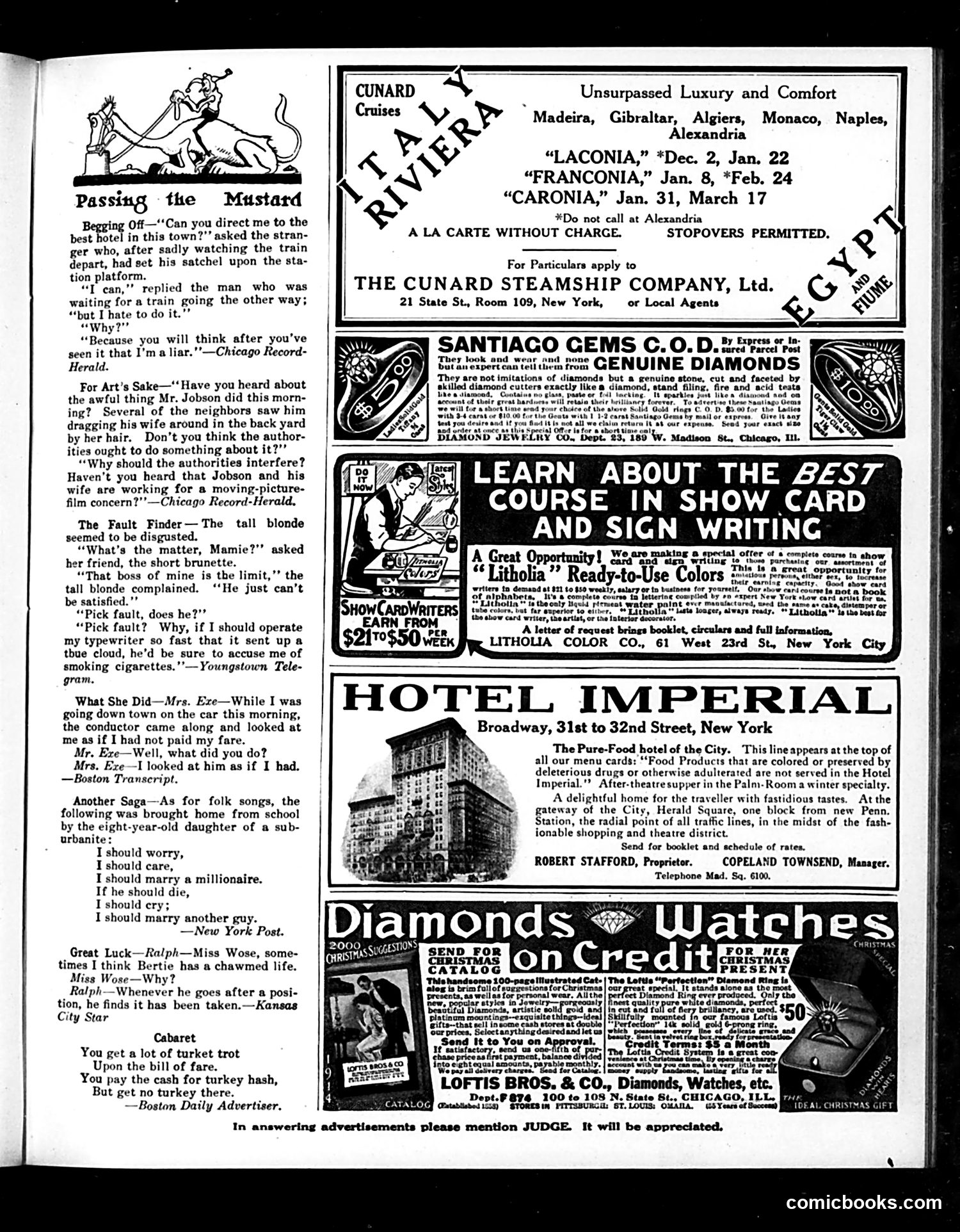
This page consists primarily of **short humor pieces and advertisements** rather than political cartoons. The content reflects early 20th-century American life and concerns: **The Jokes:** - "Passing the Mustard": A traveler asks directions; the local refuses because the hotel is so bad the local fears being called a liar - "For Art's Sake": A neighbor's concern about wife-beating is dismissed because the couple is filming for a moving picture - "The Fault Finder": A boss who nitpicks constantly - Various other brief anecdotes about everyday frustrations **Social Context:** These pieces mock workplace dynamics, domestic relations, and small urban irritations. The moving-picture reference shows early cinema's growing presence. The "cabaret" joke satirizes restaurants charging for turkey hash without actual turkey—food quality deception was apparently a common complaint. **Advertisements:** The page features luxury cruise lines, diamonds, hotels, and a "show card writing" course—typical consumer goods targeting Judge's middle-class readership. No significant political satire is evident; this appears to be a humor and lifestyle magazine page.
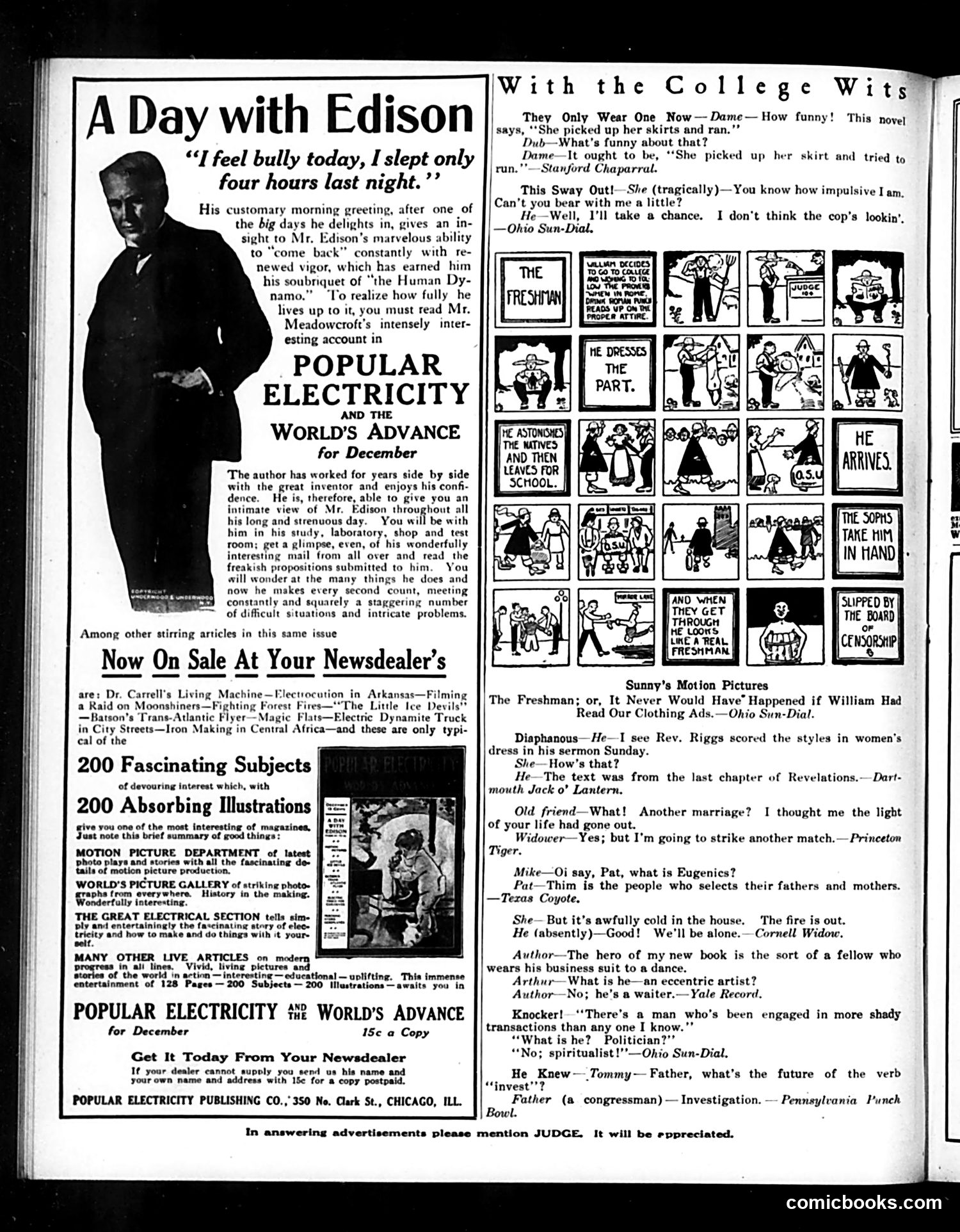
This page is primarily **advertising for Popular Electricity magazine**, featuring Thomas Edison as the draw. The main article promises an intimate profile of Edison by someone who worked alongside him, emphasizing Edison's legendary work ethic (sleeping only four hours, calling himself "the Human Dynamo"). The right side contains **college humor** from various university publications—brief jokes about fashion, courtship, and wordplay. These satirize undergraduate life: a girl wearing only one skirt instead of multiple layers (dating fashion); a young man's impulsiveness in romance; religious wordplay about a sermon on "Revelations" and women's revealing dress; and Irish-immigrant dialect humor about "Eugenics." The cartoon strip "The Freshman" depicts a college newcomer's misadventures, likely a serialized feature. **Context we'd miss:** This reflects 1910s attitudes toward technology worship (Edison as national hero), gender/fashion transitions (fewer restrictive skirts), and casual ethnic stereotyping considered acceptable in period humor.
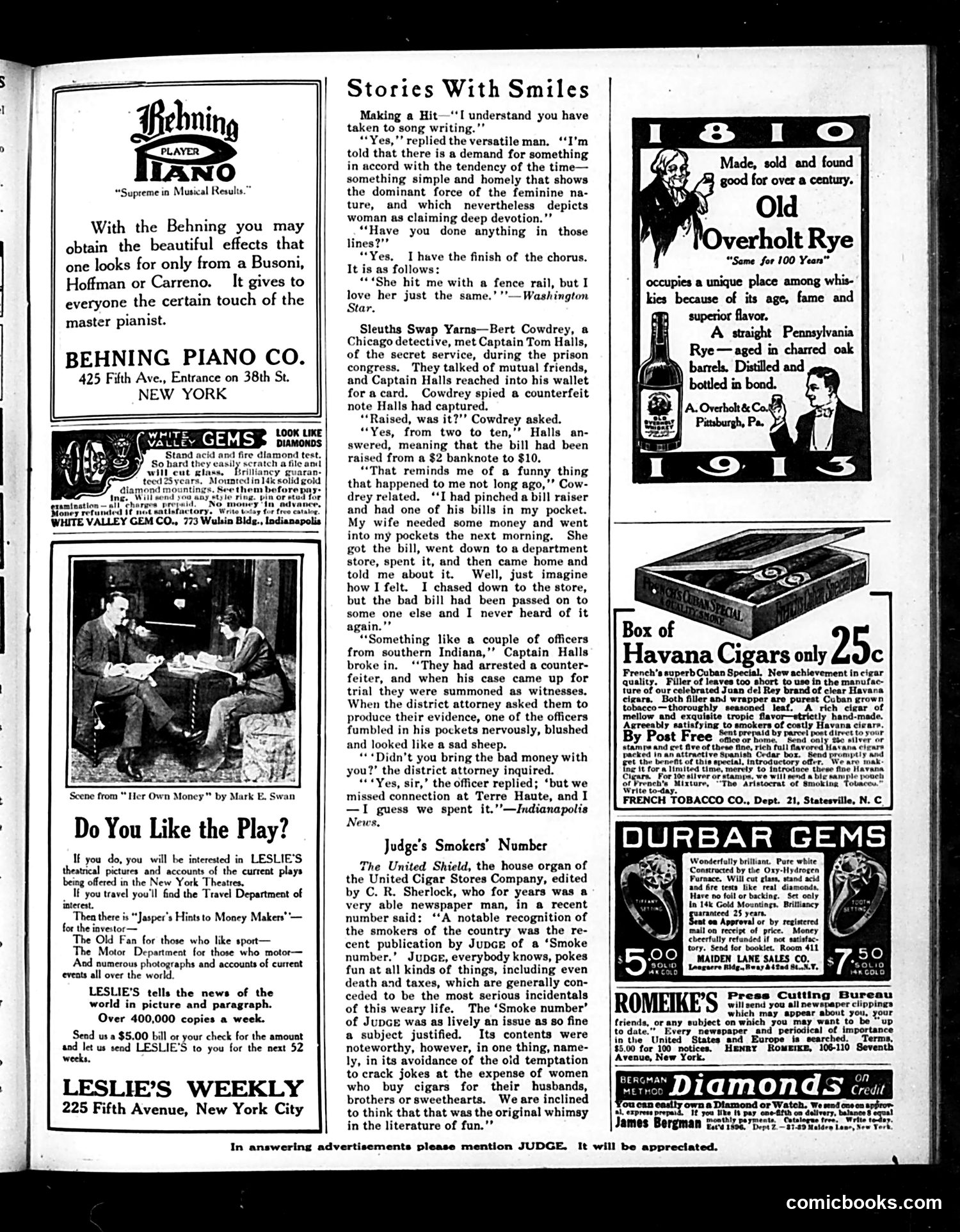
This page is primarily advertising and short humorous anecdotes rather than political satire. The "Stories With Smiles" section contains three brief jokes: one about a songwriter penning absurdly contradictory lyrics ("She hit me with a fence rail, but I love her"), and two anecdotes about detectives swapping stories about counterfeit money mishaps—one involves a detective's wife accidentally spending fake currency he'd confiscated, the other about officers who lost counterfeit evidence by spending it themselves before trial. These are gentle domestic humor and workplace comedy with no apparent political content. The page also includes advertisements for pianos, gems, cigars, and Leslie's Weekly magazine. A brief mention notes Judge magazine's recent "Smokers' Number" issue, but provides no satirical commentary beyond acknowledging its publication.
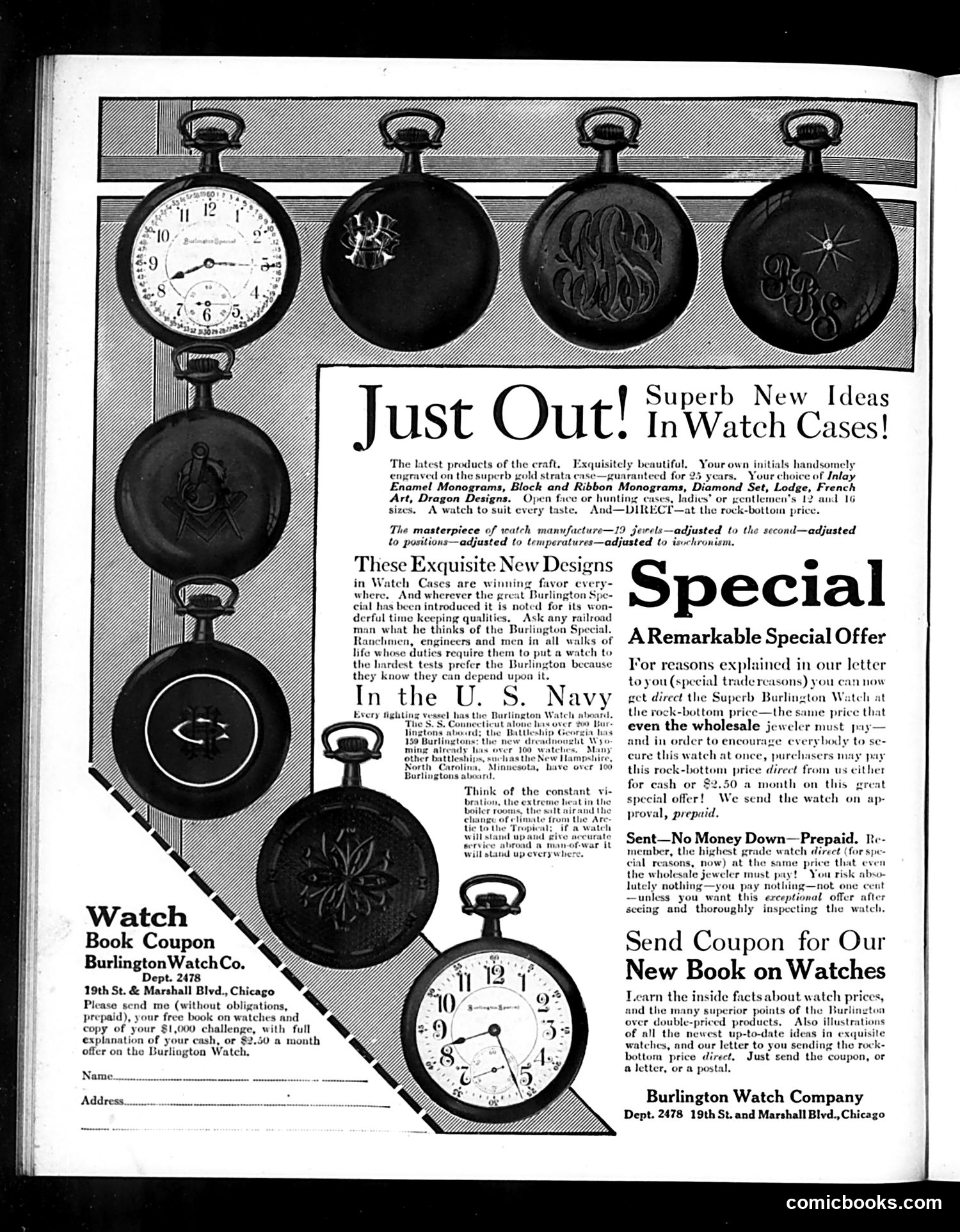
This page is **primarily an advertisement**, not political satire. It promotes Burlington Watch Company's pocket watches through product imagery and marketing copy. The page displays various watch case designs with decorative engravings (monograms, initials, artistic patterns). The text emphasizes that these watches are used by the U.S. Navy and preferred by "ranchmen, engineers and men in all walks of life" — suggesting reliability and durability for working professionals. The "special offer" is the main sales pitch: customers can purchase directly from the company at wholesale prices, paying either cash or $2.50 monthly, with the watch sent prepaid on approval. This bypasses retail jewelers and positions Burlington as offering exceptional value. The included coupon advertises a free informational book about watches and the company's "$1,000 challenge" (unclear what this entails from this page alone). There is **no discernible political cartoon or satire** present — this is straightforward early 20th-century direct-mail advertising masquerading as magazine content.