
Judge, 1913-11-22 · page 17 of 26
Judge — November 22, 1913 — page 17: what you’re looking at
What you’re looking at
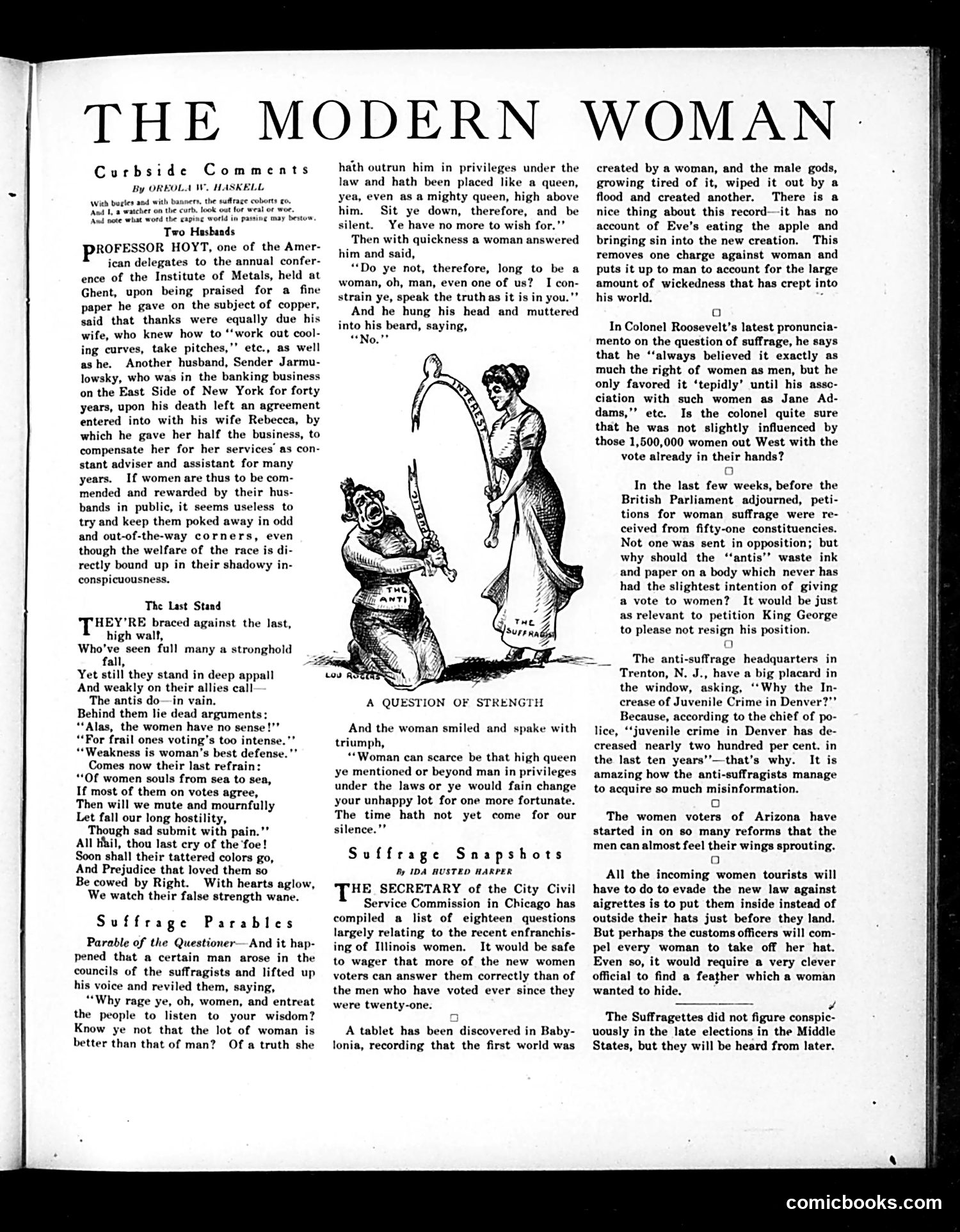
This page lampoons **anti-suffrage arguments** (the "antis") as they face inevitable defeat. The cartoons mock male opponents of women's voting rights. **Key elements:** - **"Two Husbands"** praises men who publicly credit wives as intellectual/business partners, arguing that if women merit such recognition, denying them votes is hypocritical. - **"The Last Stand"** depicts anti-suffragists as a doomed fortress. Their final argument—that women already enjoy such legal privileges they needn't vote—is turned against them: if women truly have such power, men *would want* those privileges themselves, yet they don't. - **"Suffrage Snapshots"** (by Ida Husted Harper, a real suffrage advocate) includes trivia about women's competence and a Babylonian myth crediting a woman with creation—sarcastically noting this account *doesn't* blame women for sin (unlike the Adam/Eve story), thus removing "one charge against woman." The satire's point: anti-suffrage logic is contradictory and crumbling.
📄 Transcribed text from this page (OCR, searchable)
Machine-transcribed from the original scan — historical spelling and the odd misread are preserved.
THE MODERN WOMAN Curbside Comments With bugles and And 1, a watcher on the cu And note what word the « oi Two Husbands ROFESSOR HOYT, one of the Amer- ican delegates to the annual confer- ence of the Institute of Metals, held at Ghent, upon being praised for a fine paper he gave on the subject of copper, said that thanks were equally due his wife, who knew how to ‘‘work out cool- ing curves, take pitches,’’ etc., as well ashe. Another husband, Sender Jarmu- lowsky, who was in the banking business on the East Side of New York for forty years, upon his death left an agreement entered into with his wife Rebecca, by which he gave her half the business, to compensate her for her services’ as con- stant adviser and assistant for many If women are thus to be com- and rewarded by their hus- bands in public, it seems useless to try and keep them poked away in odd and out-of-the-way corners, even though the welfare of the race is di- rectly bound up in their shadowy in- conspicuousness. The Last Stand HEY’RE braced against the last, high wall, Who've seen full many a stronghold fall, Yet still they stand in deep appall And weakly on their allies call The antis do—in vain. Behind them lie dead arguments: “Alas, the women have no sense !’’ ‘For frail ones voting’s too intense."’ “Weakness is woman’s best defense."’ Comes now their last refrain: ‘Of women souls from sea to sea, If most of them on votes agree, Then will we mute and mournfully Let fall our long hostility, Though sad submit with pain.’’ All Hkil, thou last cry of the ‘foe! Soon shall their tattered colors go, And Prejudice that loved them so Be cowed by Right. With hearts aglow, We watch their false strength wane. Suffrage Parables Parable of the Questioner—And it hap- pened that a certain man arose in the councils of the suffragists and lifted up his voice and reviled them, saying, “Why rage ye, oh, women, and entreat the people to listen to your wisdom? Know ye not that the lot of woman is better than that of man? Of a truth she hath outrun him in privileges under the law and hath been placed like a queen, yea, even as a mighty queen, high above him. Sit ye down, therefore, and be silent. Ye have no more to wish for.”” Then with quickness a woman answered him and said, “Do ye not, therefore, long to be a woman, oh, man, even one of us? I con- strain ye, speak the truthas it is in you."” And he hung his head and muttered into his beard, saying, A QUESTION OF STRENGTH And the woman smiled and spake with triumph, **Woman can scarce be that high queen ye mentioned or beyond man in privileges under the laws or ye would fain change your unhappy lot for one more fortunate. The time hath not yet come for our silence.” Suffrage Snapshots By IDA HUSTED HARPER THE SECRETARY of the City Civil Service Commission in Chicago has compiled a list of eighteen questions largely relating to the recent enfranchis- ing of Illinois women. It would be safe to wager that more of the new women voters can answer them correctly than of the men who have voted ever since they were twenty-one. A tablet has been discovered in Baby- lonia, recording that the first world was created by a woman, and the male gods, growing tired of it, wiped it out by a flood and created another. There is a nice thing about this record—it has no account of Eve’s eating the apple and bringing sin into the new creation. This removes one charge against woman and puts it up to man to account for the large amount of wickedness that has crept into his world. < a In Colonel Roosevelt’s latest pronuncia- mento on the question of suffrage, he says that he ‘‘always believed it exactly as much the right of women as men, but he only favored it ‘tepidly’ until his asso- ciation with such women as Jane Ad- dams,”’ etc. Is the colonel quite sure that he was not slightly influenced by those 1,500,000 women out West with the vote already in their hands? is] In the last few weeks, before the British Parliament adjourned, peti- tions for woman suffrage were re- ceived from fifty-one constituencies. Not one was sent in opposition; but why should the ‘‘antis’’ waste ink and paper on a body which never has had the slightest intention of giving a vote to women? It would be just as relevant to petition King George to please not resign his position. a The anti-suffrage headquarters in Trenton, N. J., have a big placard in the window, asking, ‘‘Why the In- crease of Juvenile Crime in Denver?”’ Because, according to the chief of po- lice, ‘‘juvenile crime in Denver has de- creased nearly two hundred per cent. in the last ten years’’—that’s why. It is amazing how the anti-suffragists manage to acquire so much misinformation. is) The women voters of Arizona have started in on so many reforms that the men can almost feel their wings sprouting. is] All the incoming women tourists will have to do to evade the new law against aigrettes is to put them inside instead of outside their hats just before they land. But perhaps the customs officers will com- pel every woman to take off her hat. Even so, it would require a very clever official to find a feather which a woman wanted to hide. are 4 The Suffragettes did not figure conspic- uously in the late elections in the Middle States, but they will be heard from later. comicbooks.com