
A complete issue · 24 pages · 1913
Judge — September 20, 1913
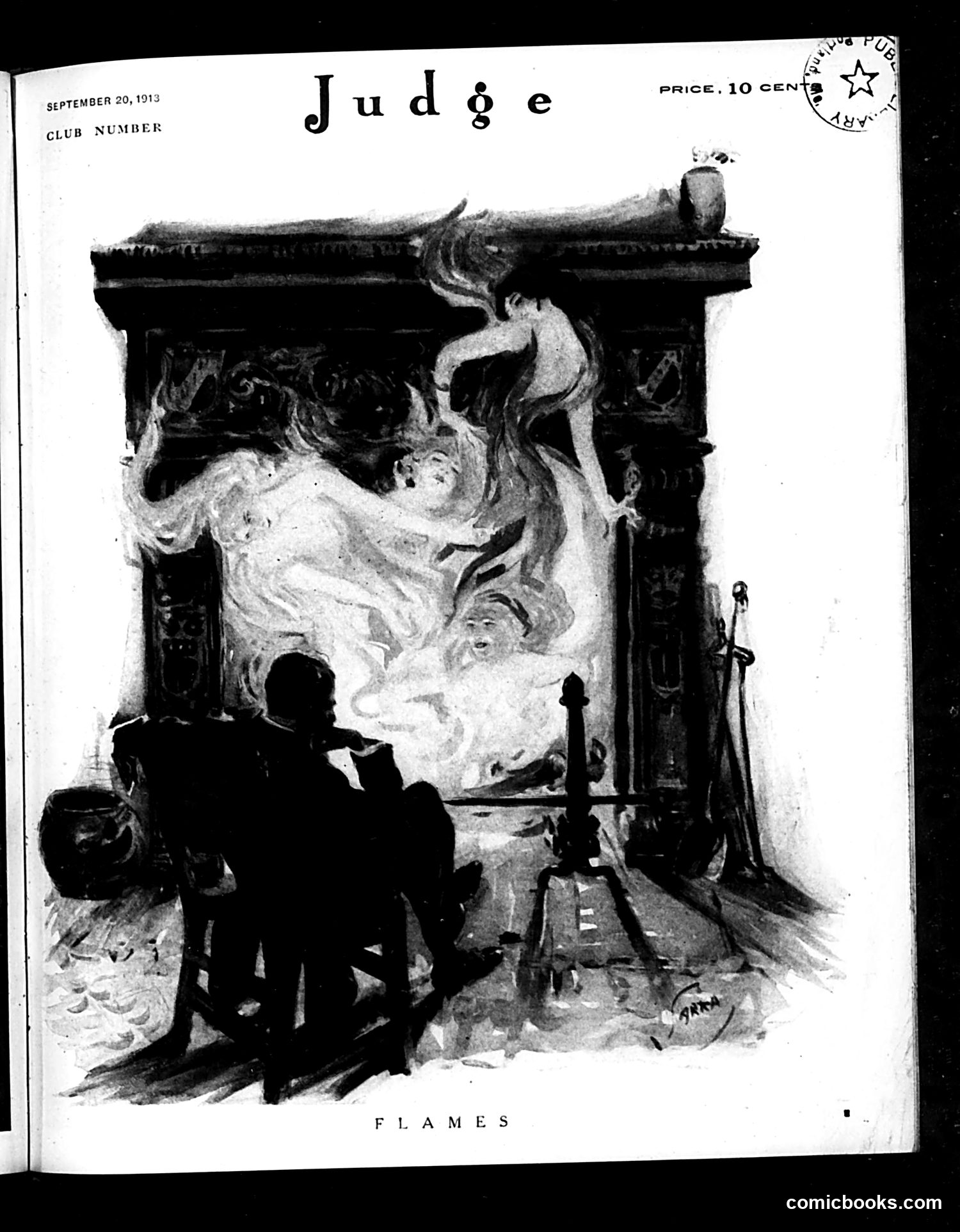
This illustration depicts a figure in silhouette viewing a fireplace mantel where mythological or allegorical figures appear to emerge from flames. The caption "FLAMES" suggests commentary on a heated contemporary issue. The imagery—classical female figures rising from fire—likely references passion, desire, or chaos. Without additional context from the magazine's surrounding articles, the specific political or social target remains unclear. However, the composition suggests Judge is satirizing either: - A public figure's scandalous behavior or romantic entanglements - A social movement perceived as dangerous or destabilizing - Contemporary debates about morality or social propriety The silhouetted observer represents the public witnessing these "flames"—whatever controversy or scandal the cartoonist intended to mock.
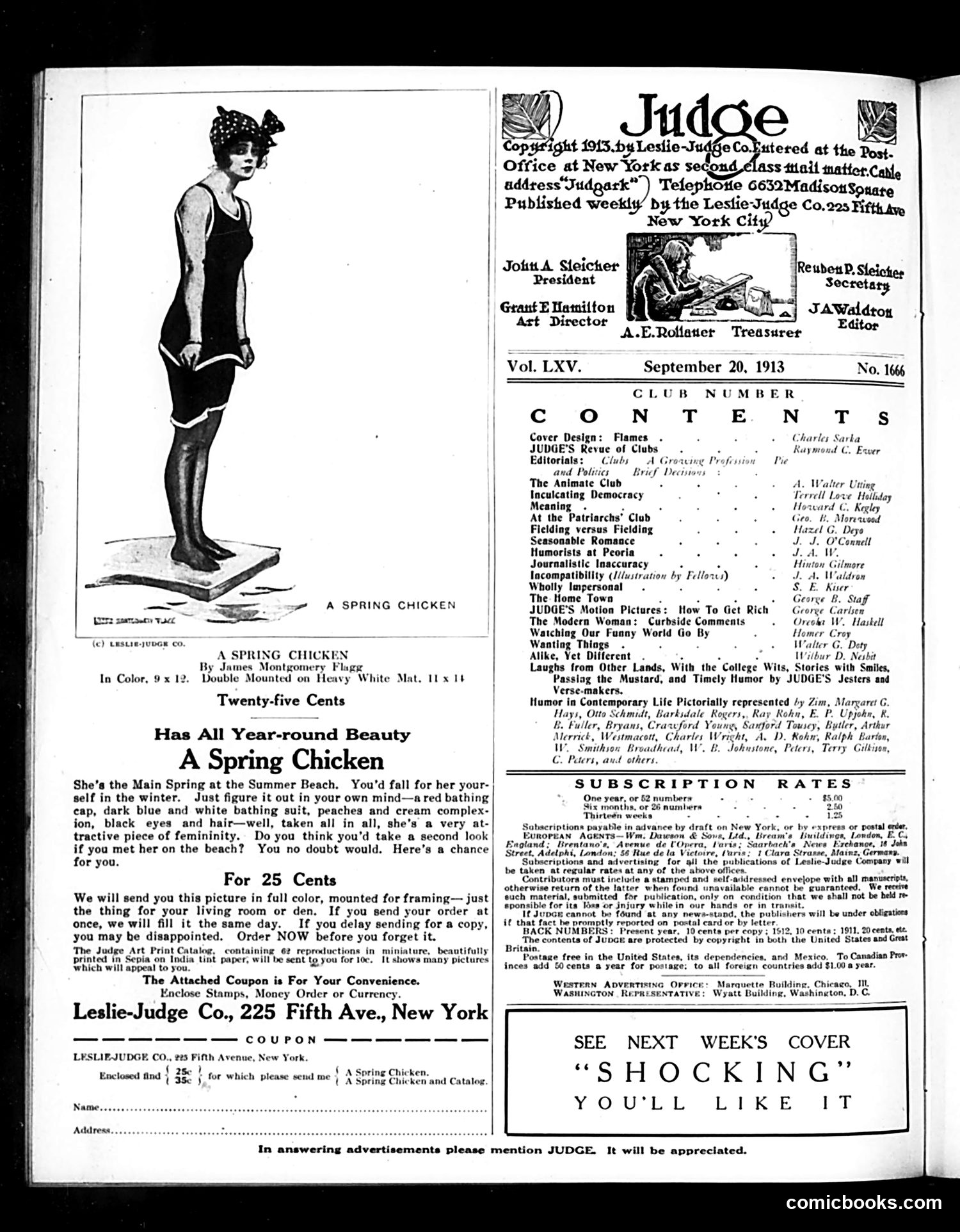
This page is primarily **advertising and table of contents** rather than political satire. The dominant feature is an advertisement for "A Spring Chicken," a colored illustration (9x12 inches) depicting a young woman in a bathing suit, offered for 25 cents by Leslie-Judge Co. The ad emphasizes the image's appeal as "Main Spring at the Summer Beach" — using "spring chicken" (slang for an attractive young woman) as both literal and suggestive wordplay. The accompanying coupon allows mail-order purchase. The right page shows the magazine's masthead, contents listing, and subscription rates. There is **no apparent political cartoon or satirical commentary** on this spread — it represents typical early-20th-century magazine advertising targeting male readers through glamorized female imagery.
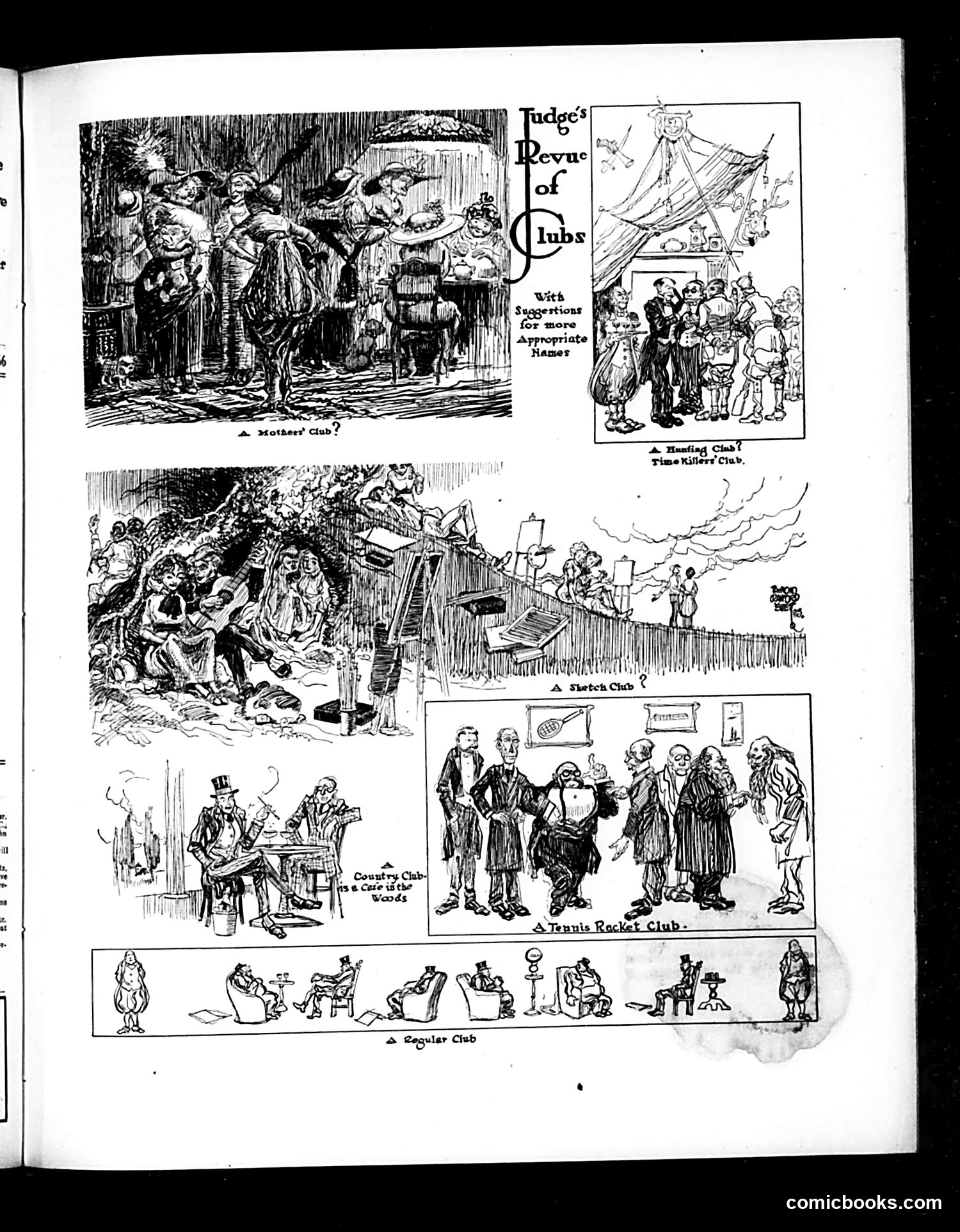
This satirical page critiques various social clubs of the era with humorous illustrations. The title suggests a "judge's review" evaluating different club types. The cartoons depict: - **"A Mothers' Club"** - showing chaotic domestic scenes - **"A Hunting Club" and "Time-Killers' Club"** - figures engaged in leisure activities - **"A Sketch Club"** - artists at work - **"A Country Club—A Care in the Woods"** - gentlemen in rural settings - **"A Tennis Racket Club"** - formally dressed men (the title puns on "racket," meaning both the sport and shady dealings) - **"A Regular Club"** - a strip showing various club members in different poses The satire mocks the pretensions and actual activities of exclusive clubs, suggesting members often engage in idle time-wasting rather than meaningful pursuits. The "Tennis Racket Club" particularly suggests corruption or dubious dealings masquerading as legitimate leisure.
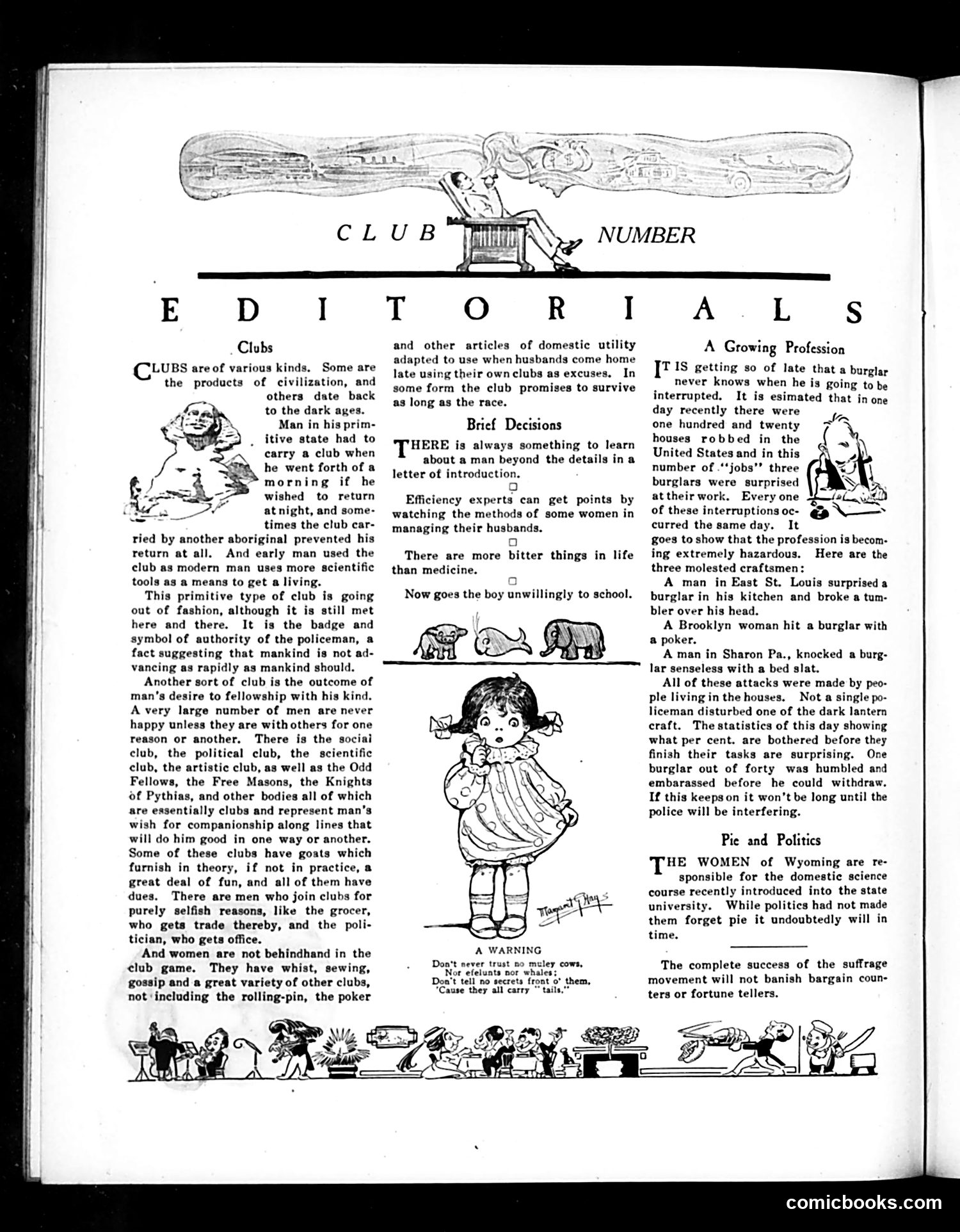
This page contains three distinct pieces of social commentary: 1. **"Clubs"** (left column): Satirizes men's clubs as outdated institutions. The text mocks how clubs—from primitive indigenous groups to modern fraternal organizations (Masons, Knights of Pythias)—persist despite limited practical value, suggesting they're ultimately about male social bonding rather than genuine utility. 2. **"A Growing Profession"** (right column): Dark humor about burglary's increasing frequency and organization. The piece notes recent burglaries across the U.S., suggesting the profession is becoming dangerously professionalized and efficient, with statistics implying police efforts are inadequate. 3. **"Pie and Politics"** (bottom right): Brief commentary linking Wyoming's introduction of domestic science courses at university to women's suffrage movement, suggesting political engagement and domestic education are interconnected concerns. The illustrations are decorative rather than caricatural.
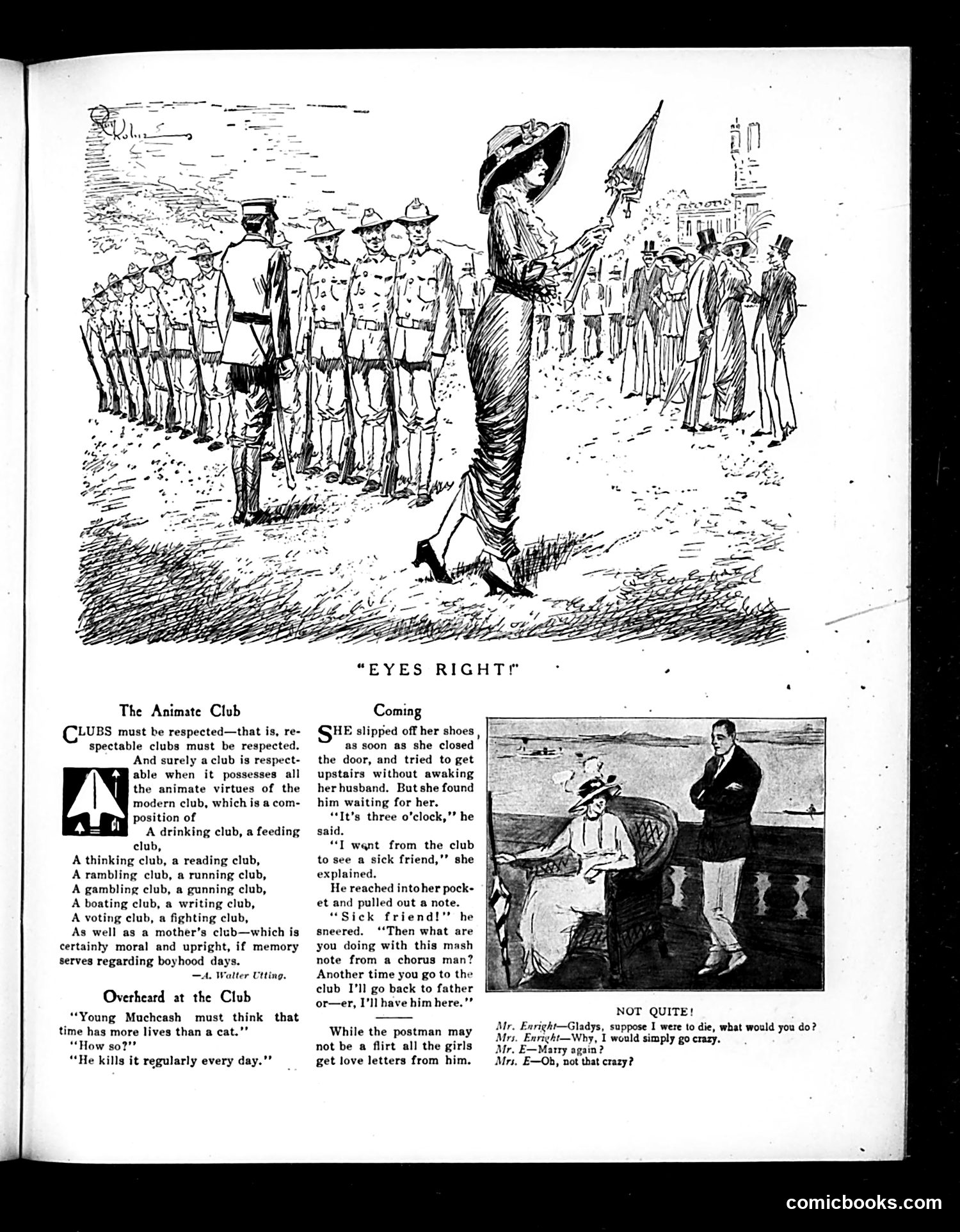
**Main Cartoon ("Eyes Right!"):** A woman in fashionable dress commands soldiers' attention at what appears to be a military inspection or parade. The satire likely mocks how women distract military personnel, a common theme in early 20th-century humor about gender relations and military discipline. **"The Animate Club":** This section humorously lists various club types (drinking, reading, rambling, etc.), suggesting club culture was proliferating. The tone is gently mocking of social club proliferation. **"Coming" story:** A wife sneaks out to visit a sick friend against her husband's wishes, then receives a note from her husband that comically threatens to leave. The humor plays on marital conflict and domestic control. **"Not Quite!" dialogue:** A man questions whether he'd remarry if his wife died, ending with her dismissal of his answer as "not quite" — typical domestic comedy of the era.
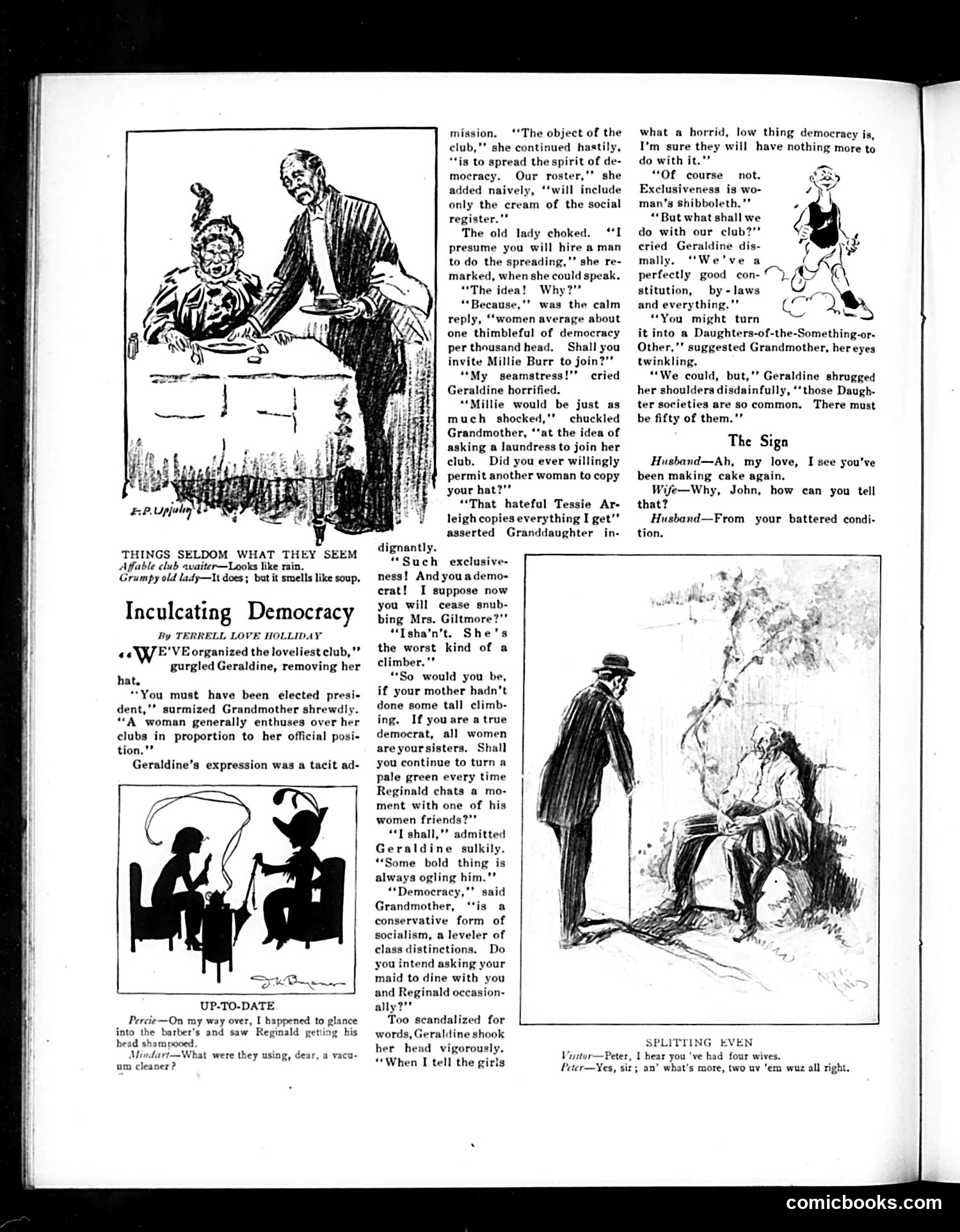
This satire mocks the hypocrisy of wealthy women claiming to support democratic ideals while maintaining rigid class prejudices. Geraldine announces her exclusive social club aims to "spread the spirit of democracy," but her roster will include "only the cream of the social register"—contradicting itself immediately. Her grandmother systematically exposes this contradiction by asking if Geraldine will invite her seamstress Millie Burr, permit a laundress to join, stop snubbing Mrs. Giltmore (a social climber), or invite her own maid to dinner. Each question reveals Geraldine's actual snobbery. The joke: women claim democratic principles but practice rigid class exclusion. "Democracy" becomes merely fashionable rhetoric masking social gatekeeping. The grandmother's final definition—"democracy is a conservative form of socialism, a leveler of class distinctions"—underscores how Geraldine's club embodies the opposite of what she claims to represent.
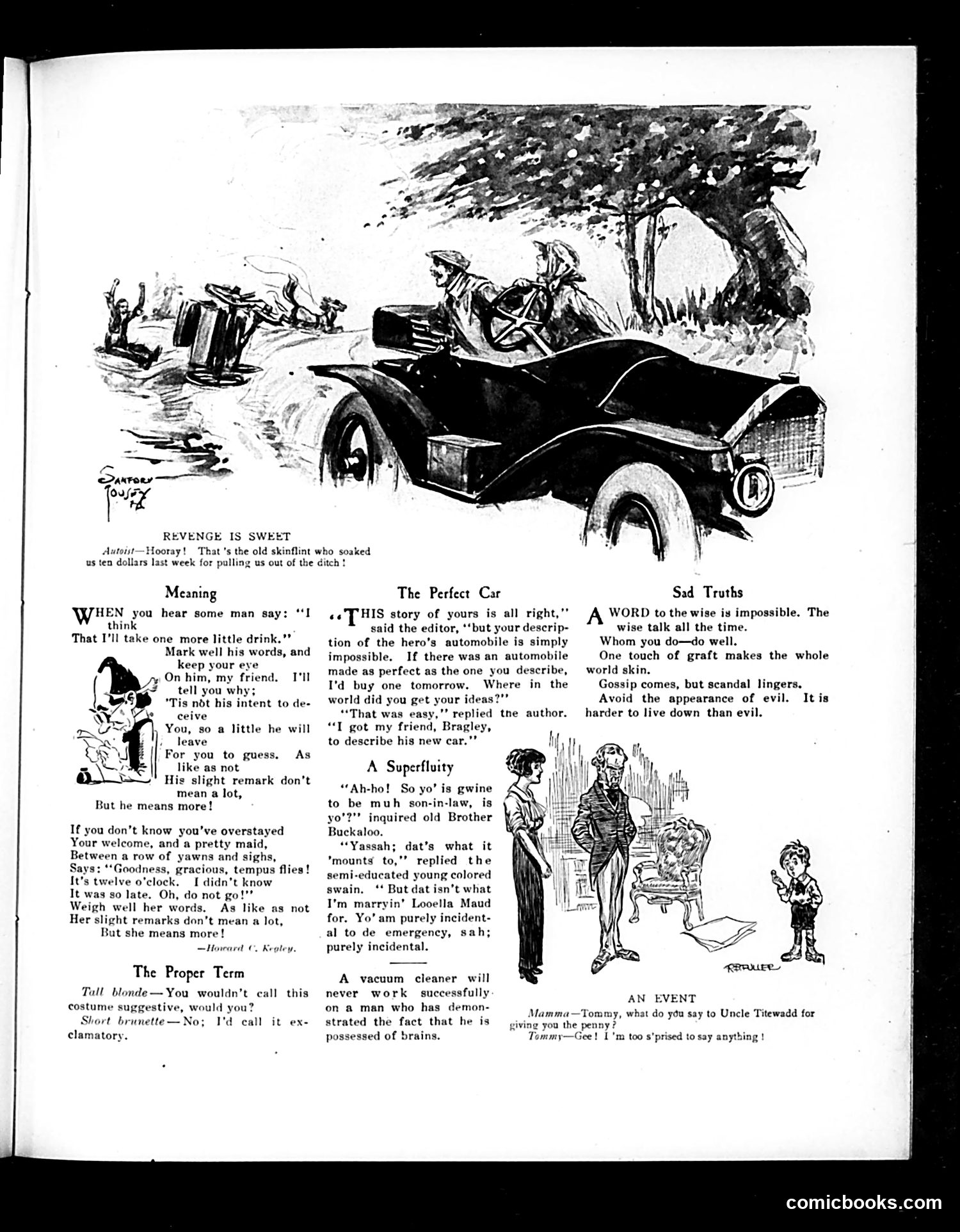
The main cartoon depicts an early automobile driver gleefully spotting the "old skinflint" who charged them ten dollars to pull their car from a ditch the previous week. The joke is situational irony: now the roles are reversed—the wealthy man's expensive car has apparently broken down or gotten stuck, presenting an opportunity for revenge (or at least schadenfreude). This reflects early 20th-century class tensions and the novelty of automobiles as status symbols. The wealthy are portrayed as miserly and exploitative toward working people, and the working class takes satisfaction in seeing their misfortune. The cartoon satirizes both the absurd expense of early car ownership and the resentment between social classes during the automobile era. The page contains additional brief humor pieces on miscommunication, vanity, and social pretension typical of *Judge* magazine's satirical content.
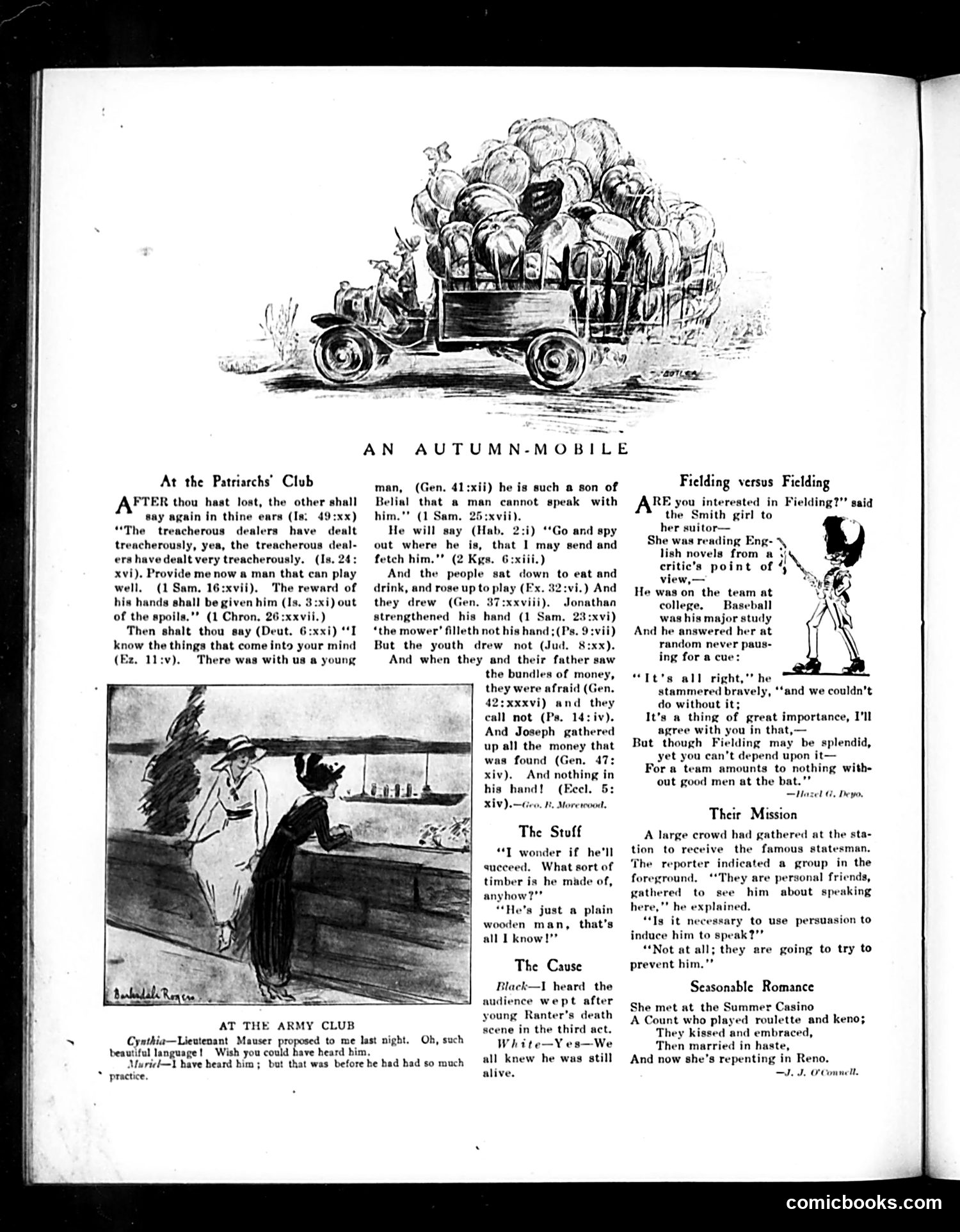
**The Main Cartoon ("An Autumn-Mobile"):** Shows a comically overloaded vehicle piled high with autumn produce, satirizing the excess and frivolity of wealthy leisure activities. The biblical epigraphs (referencing treachery, loss, and emptiness) suggest mockery of materialism masquerading as substance. **"At the Army Club":** A brief joke about Lieutenant Mauser's flowery proposal language—humor based on military men affecting romantic eloquence after drinking. **"Fielding versus Fielding":** A pun comparing Henry Fielding (the 18th-century novelist the girl is reading critically) with "Fielding" as a baseball position. The suitor misunderstands her literary question as sports talk, creating comedic miscommunication. **Minor Pieces:** Include satirical vignettes about a wooden theatrical performer, a politician surrounded by friends trying to *prevent* him from speaking publicly, and a cautionary romance tale about a woman who married a gambling count and now regrets it in Reno (then America's divorce capital). The page combines social satire with wordplay typical of early-20th-century American humor magazines.
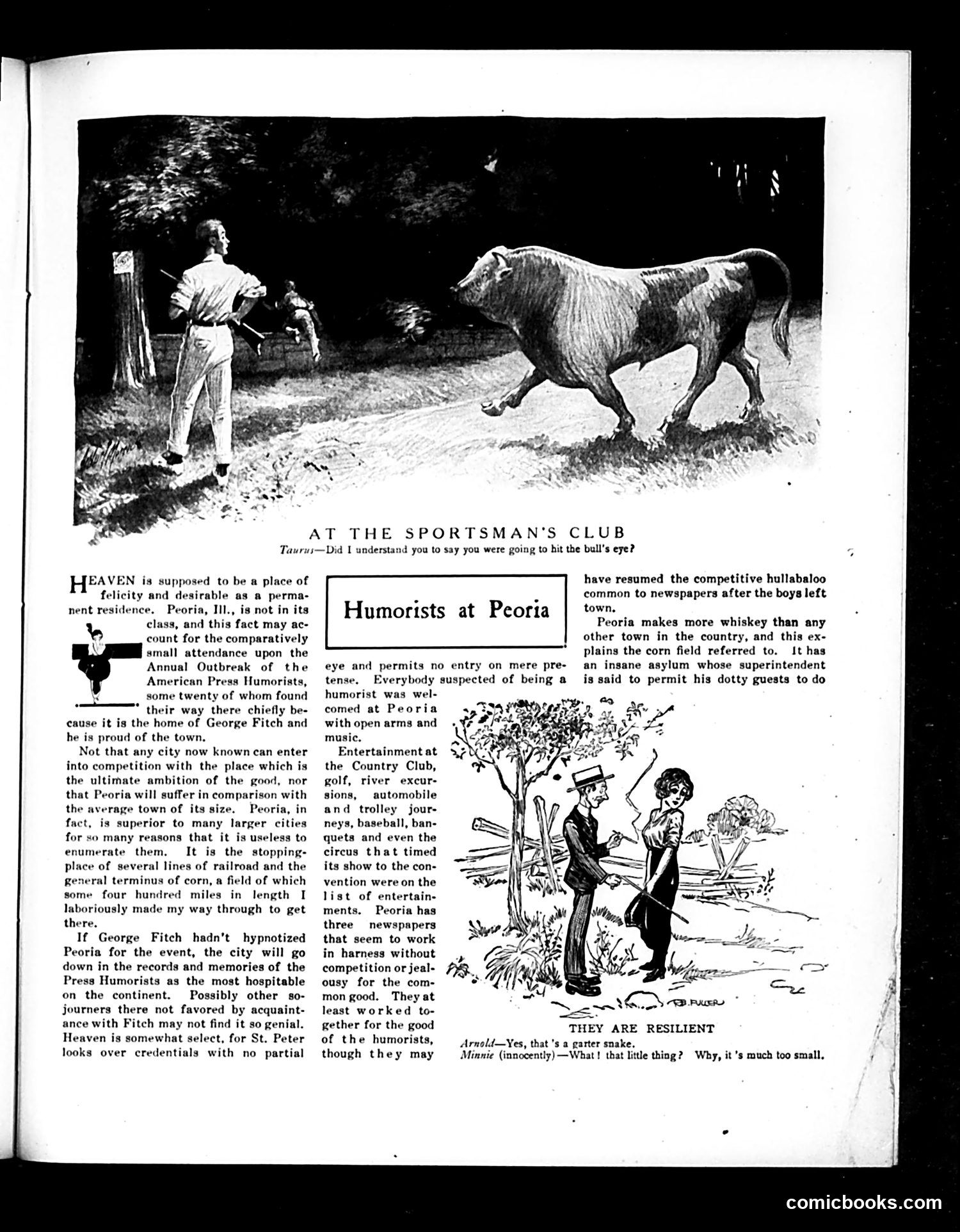
This page satirizes the American Press Humorists' convention held in Peoria, Illinois, home of writer George Fitch. The main article praises Peoria's hospitality while backhanded-ly insulting the city—Heaven is "select," but Peoria isn't in that class; it's "superior to many larger cities" yet still inferior to actual Heaven. The satire targets Peoria's defining characteristics: it's a railroad hub and corn-processing center (for whiskey distilleries). The text jokes that the city has an insane asylum whose superintendent allows patients unusual freedoms—a dark jab at local eccentricity. The cartoons are unrelated humor: the top shows a man and charging bull at a "Sportsman's Club" (missing his target), and below, two people discuss a garter snake, with the woman innocently remarking it's "much too small"—likely a double entendre about male inadequacy.
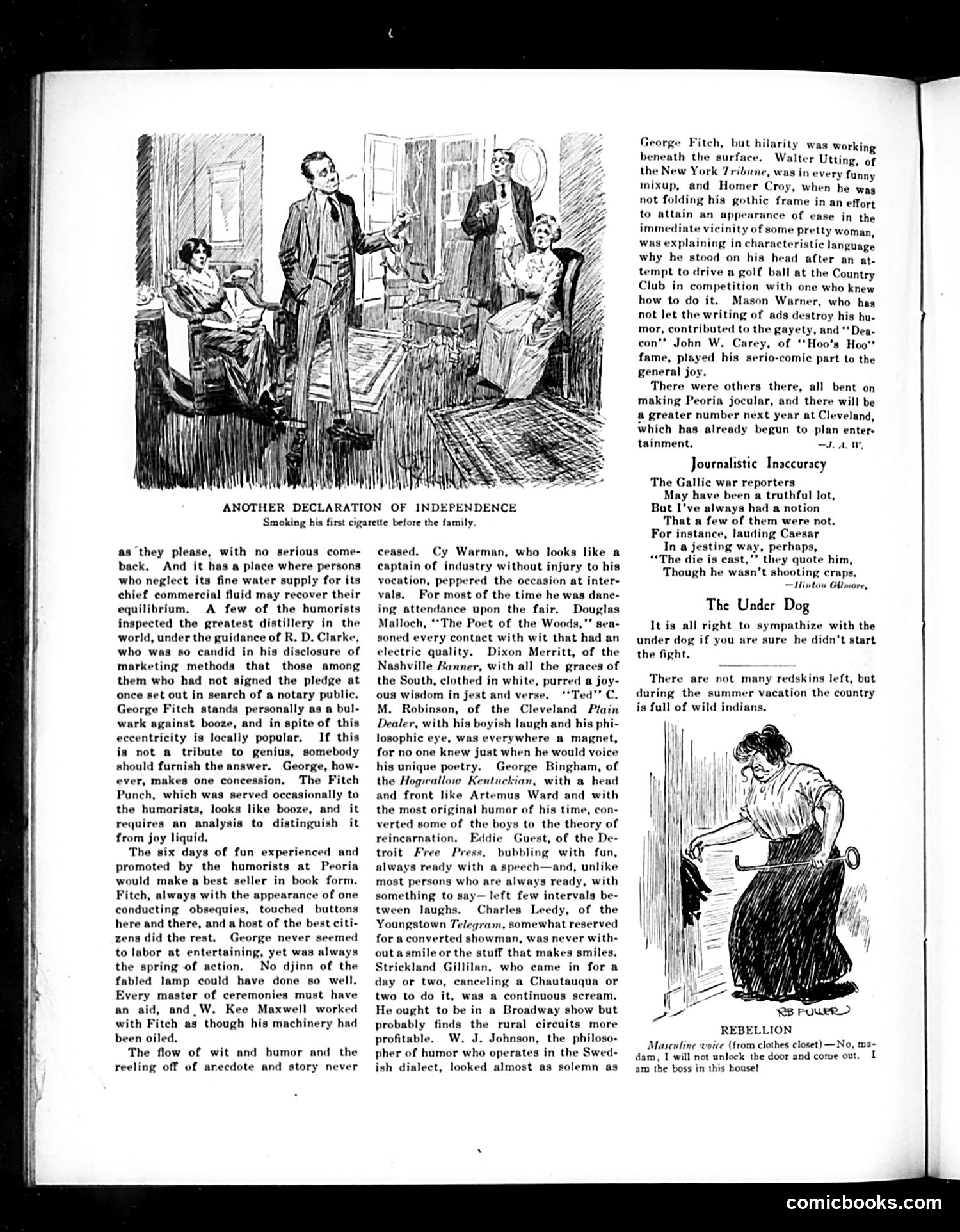
The main cartoon depicts a young man smoking his first cigarette before his family—a domestic scene of mild rebellion. The title's reference to the Declaration of Independence sarcastically equates this personal act with revolutionary defiance, treating a teenager's first smoke as if it were a serious political statement. The accompanying text describes a gathering of American humorists and journalists in Peoria, Illinois, celebrating their freedom to indulge in various vices—particularly alcohol and tobacco—without serious consequences. The satire mocks both their self-importance and the era's tensions around Prohibition-era restrictions. The piece names various newspaper writers and columnists (George Fitch, Eddie Guest, Charles Leedy, among others) whom modern readers wouldn't recognize, but the joke targets intellectual elites claiming personal liberty while society debated moral regulation. The humor plays on the contrast between momentous historical declarations and trivial domestic acts of nonconformity.
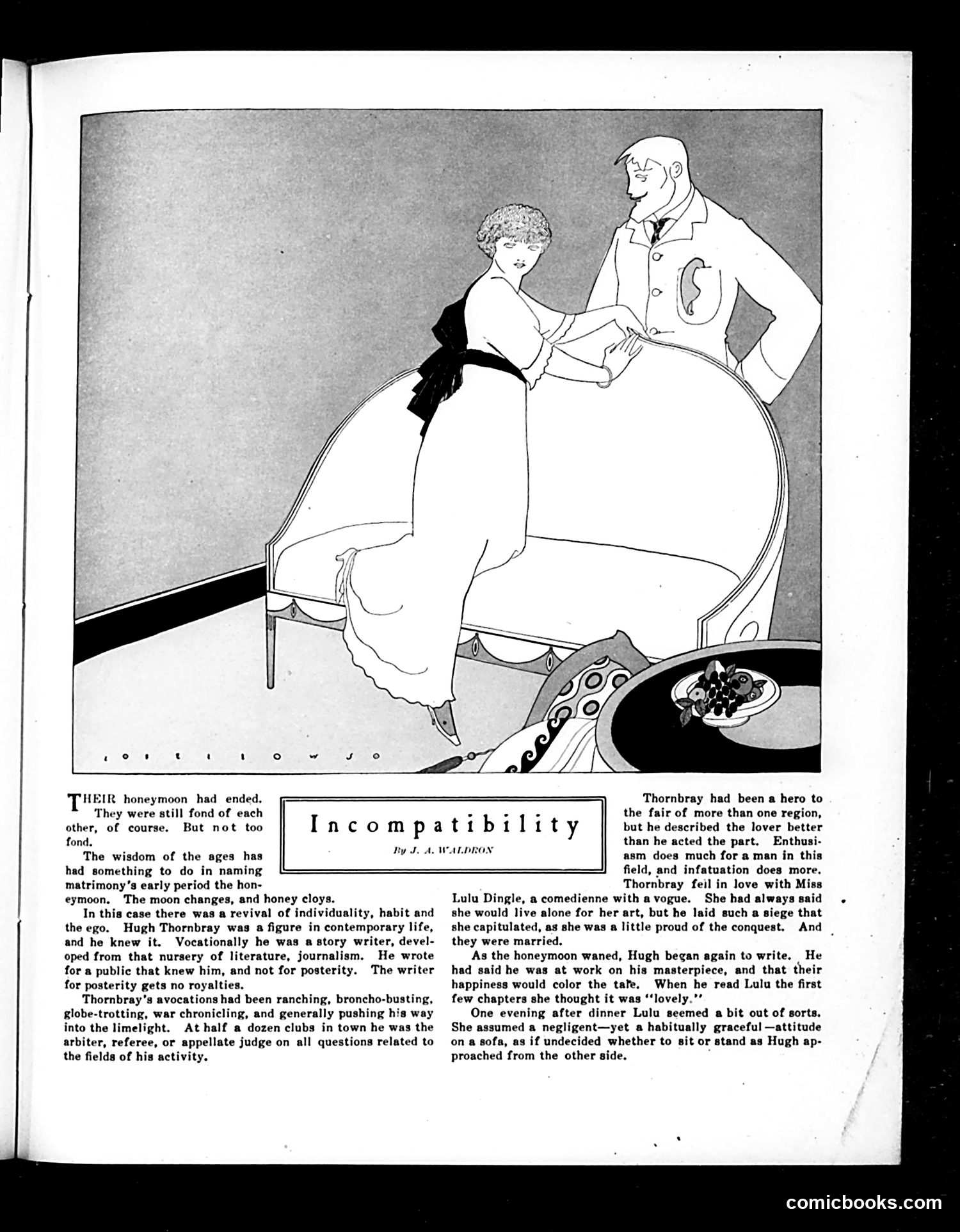
This story satirizes the decline of romantic passion after marriage. Hugh Thornbray is a successful, self-important writer and man-about-town—an arbiter of taste at exclusive clubs. Lulu Dingle is a comedienne actress who initially resisted marriage for her career but was won over by his pursuit. The satire centers on how quickly their honeymoon fades. Rather than sustaining romance, Hugh returns to his literary ambitions, reading his "masterpiece" to Lulu (who politely calls it "lovely"). Lulu, bored and disconnected, adopts an affected pose on the sofa—physically distant despite being together. The cartoon above illustrates this emotional distance: though still together, they sit apart on opposite sides of a large chair, embodying the title's theme. The story suggests that marriage to a self-absorbed public figure and aspiring serious writer cannot sustain the enthusiasm needed for marital happiness. The incompatibility stems from conflicting egos and diverging interests post-honeymoon.
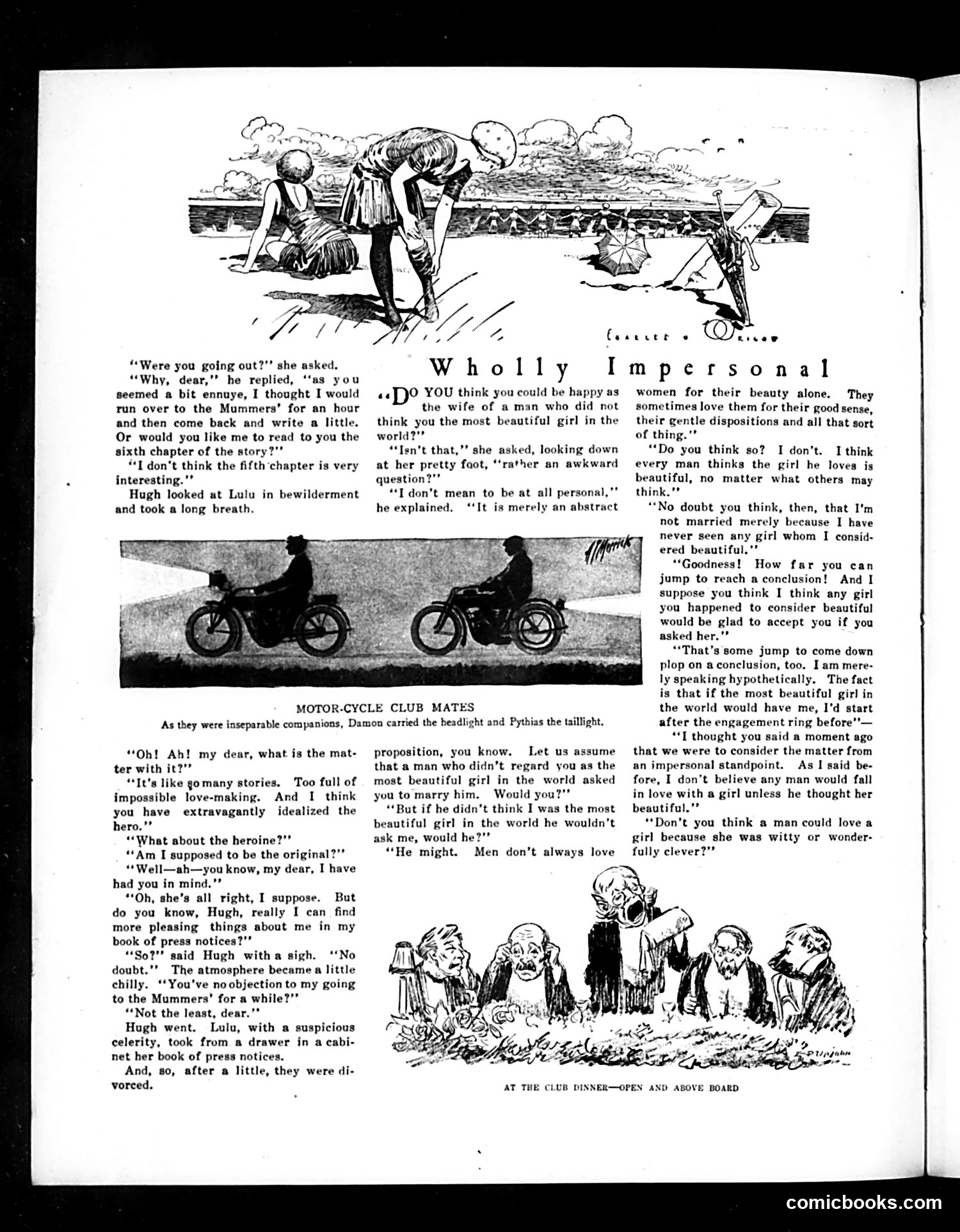
This page satirizes the gap between what men claim to value rationally in women versus what they actually desire. Hugh, a writer, attempts a philosophical argument with his wife Lulu about beauty being "merely an abstract proposition" — claiming men don't need to find women beautiful to love them. Lulu systematically dismantles his logic, exposing his hypocrisy: he based his own love on considering *her* the most beautiful girl in the world. The final punchline — that Hugh later leaves and they divorce — undercuts his pretense of impersonality. The accompanying "Motor-Cycle Club Mates" cartoon uses Damon and Pythias (ancient symbols of friendship) to mock male bonding. The satire targets male pseudo-intellectualism: Hugh's abstract reasoning masks wounded vanity and romantic delusion, revealing that men's supposedly rational arguments about love are rationalizations for deeply personal, beauty-focused desires.
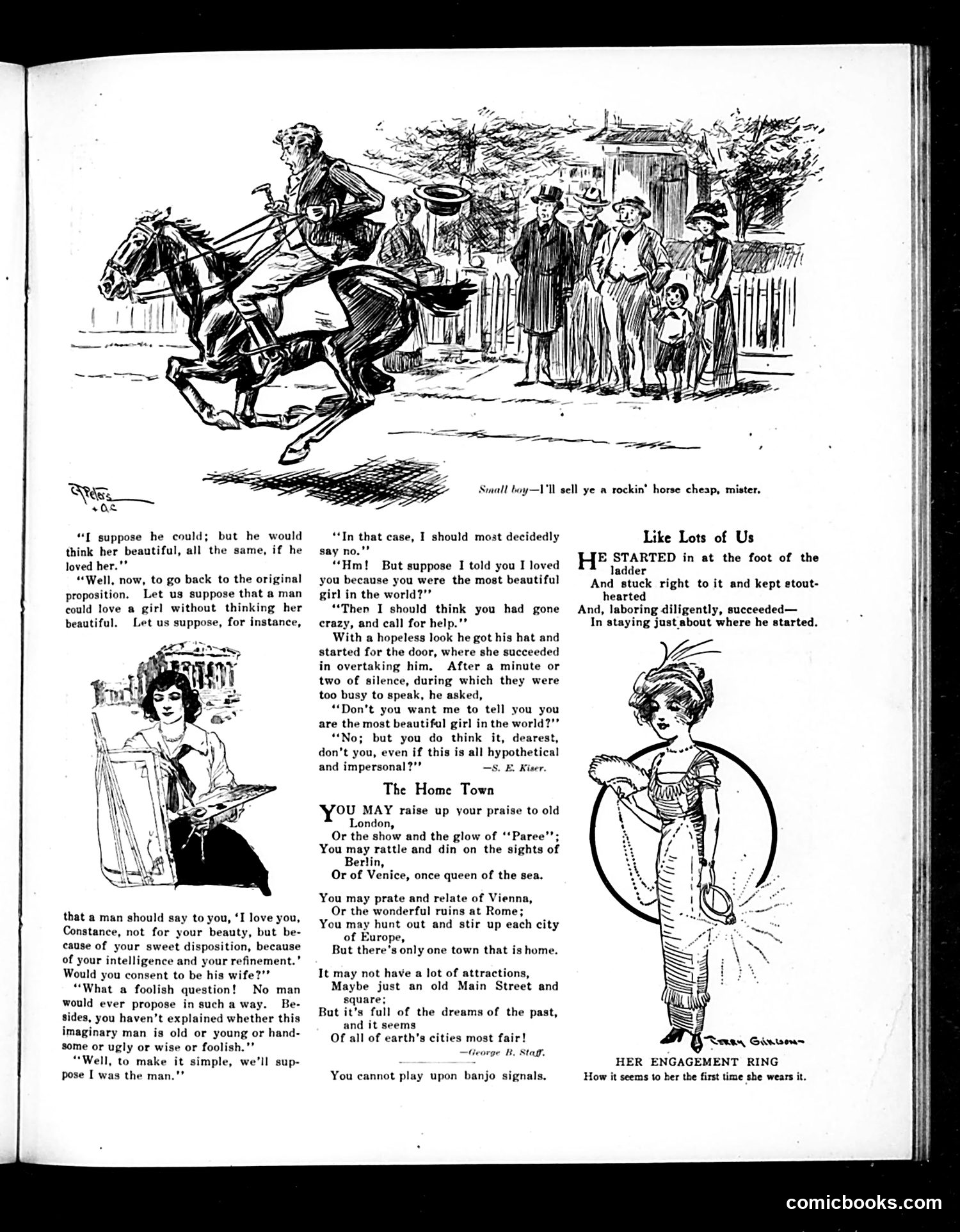
This page contains three distinct pieces of early 20th-century humor: **Top cartoon**: A man on horseback passes a woman and child on a country road—likely depicting a traveling salesman or peddler offering a "rockin' horse cheap." **Main dialogue piece**: A courtship debate about whether a man can love a woman without finding her beautiful. The woman plays coy, rejecting both compliments and their absence, ultimately admitting she wants reassurance of her beauty despite claiming it's "hypothetical." This satirizes the contradictory expectations placed on women in courtship—they shouldn't value beauty alone, yet want constant validation of their attractiveness. **"The Home Town" poem**: Sentimental verse praising one's hometown over famous European cities, reflecting early 20th-century American nostalgia and small-town values. **"Like Lots of Us" vignette**: A brief satirical comment on social mobility—a man works hard climbing "the ladder" but ends up exactly where he started, mocking the hollow promise of American upward mobility. The overall page reflects genteel, domestic satire typical of Judge's era.
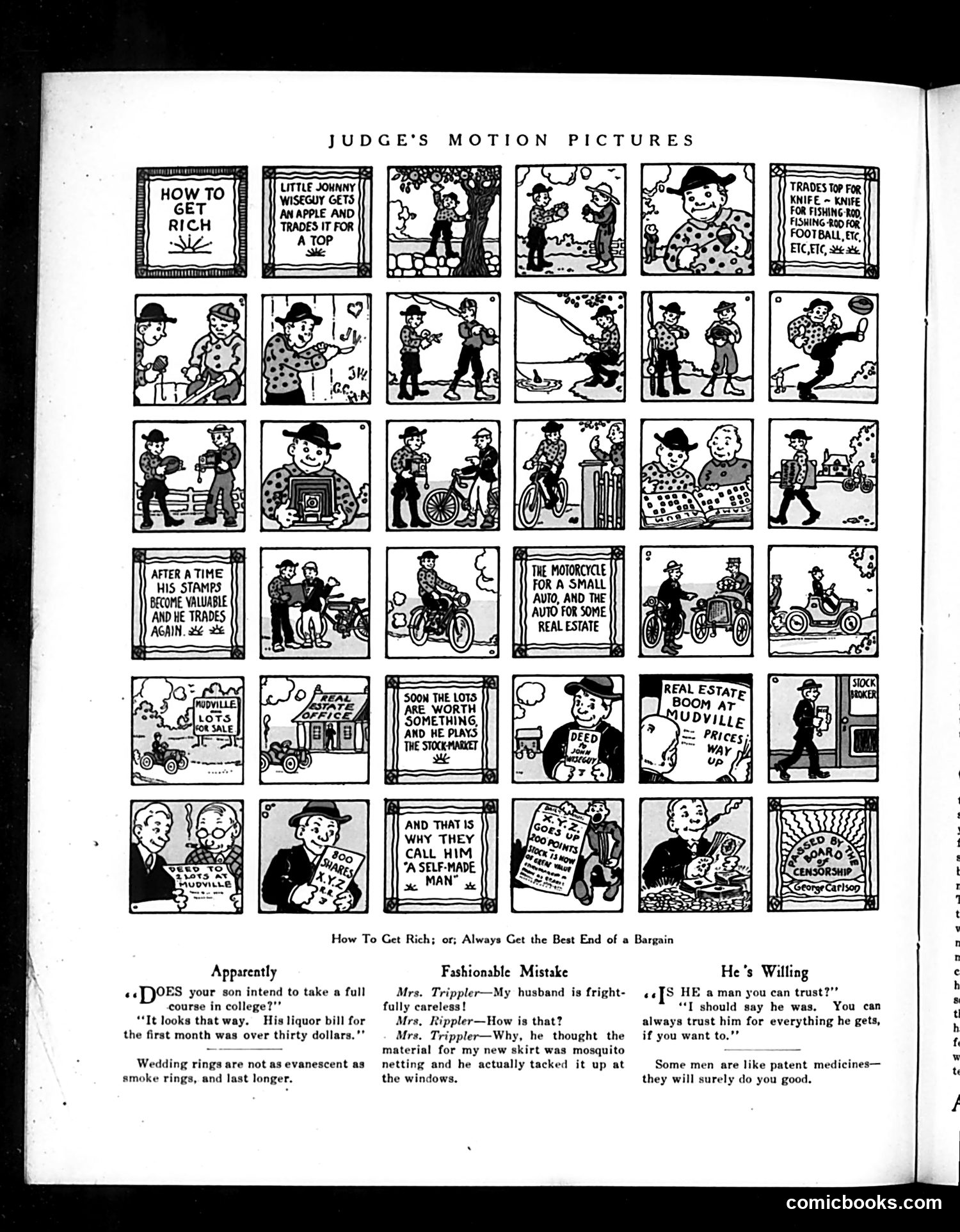
This page presents a comic strip narrative titled "How to Get Rich; or; Always Get the Best End of a Bargain"—satirizing American get-rich-quick schemes of the early 20th century. The strip follows a protagonist who accumulates wealth through speculative trading: trading stamps for an apple, then trading progressively upward through motorcycles, automobiles, and real estate. The satire culminates when he trades all these holdings into the stock market, becoming wealthy enough to be called a "self-made man." The humor targets both excessive materialism and the era's fascination with speculation and financial manipulation. The accompanying jokes mock marital foolishness (a husband mistaking dress fabric for mosquito netting) and blind trust in unreliable men. The strip reflects Progressive-era skepticism toward rapid wealth accumulation and loose financial practices, presenting such "success" as ultimately arbitrary and dependent on luck rather than merit.
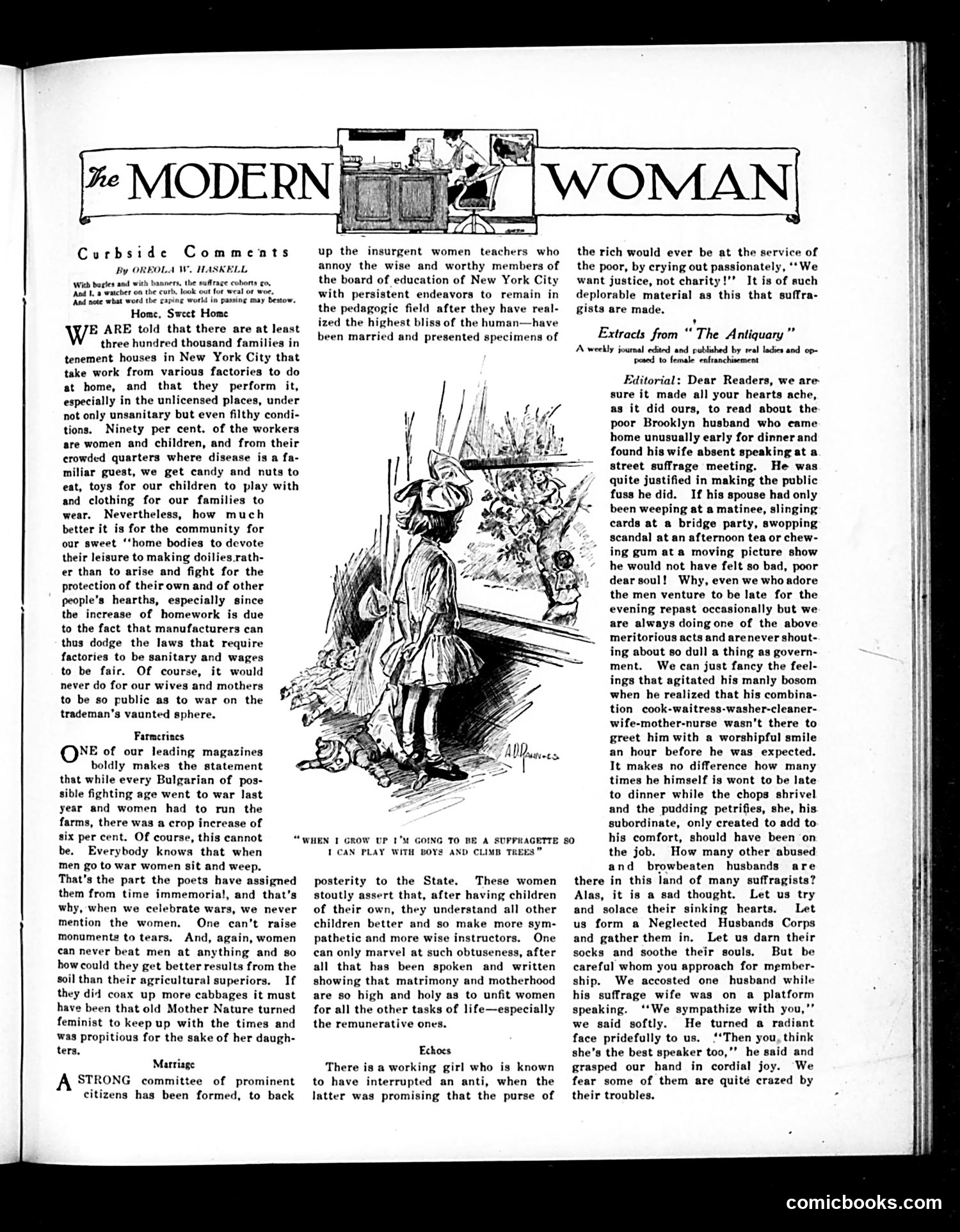
This page satirizes early 20th-century opposition to women's rights through mock-serious arguments against female independence. **The main cartoon** depicts a suffragette at a street corner, captioned "When I grow up I'm going to be a suffragette so I can play with boys and climb trees"—mocking women's activism by reducing it to childish rebellion against traditional constraints. **The "Curbside Comments" essays** use bitter irony to critique anti-suffrage positions: - **"Home, Sweet Home"** attacks the hypocrisy of confining women to domestic labor while benefiting from their sweatshop work - **"Farmerines"** sarcastically dismisses Bulgarian women's agricultural success during wartime, insisting women are inherently incapable - **"Marriage"** ridicules New York's board of education for firing married women teachers, mocking the notion that motherhood disqualifies women from work **The opposing editorial** from "The Antiquary" reinforces these attitudes, framing a suffragist wife's public speaking as a betrayal. Judge presents both perspectives to mock anti-suffrage ideology through exaggeration and contradiction.
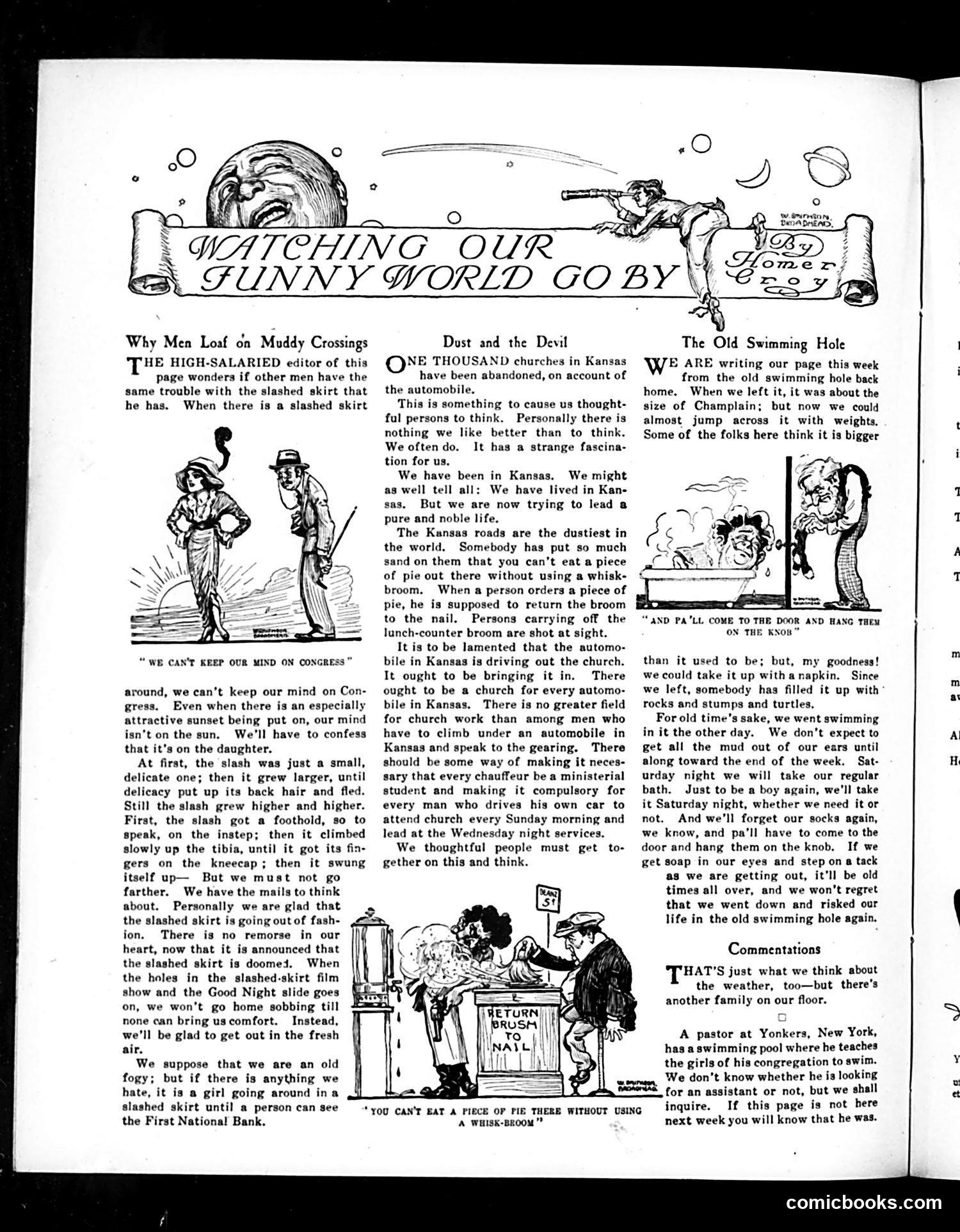
This *Judge* magazine page satirizes early-1900s American social anxieties through three humor columns: **"Why Men Loaf on Muddy Crossings"** mocks the distraction caused by women's newly fashionable "slashed skirts"—dresses with slits revealing the leg. The editor claims such skirts prevent men from concentrating on serious matters like Congress, using exaggerated anatomy descriptions that were risqué for the era. **"Dust and the Devil"** critiques how automobiles are emptying Kansas churches. The satire suggests cars distract farmers from religion while creating dusty roads so severe that eating pie requires a whisk-broom. The author ironically proposes making all drivers ministerial students. **"The Old Swimming Hole"** nostalgically contrasts childhood memories of a grand swimming hole with its current diminished state, clogged with "rocks and stumps and turtles." All three pieces reflect period concerns: changing sexual mores, rapid technological disruption of rural life, and romanticized nostalgia for pre-modern America.
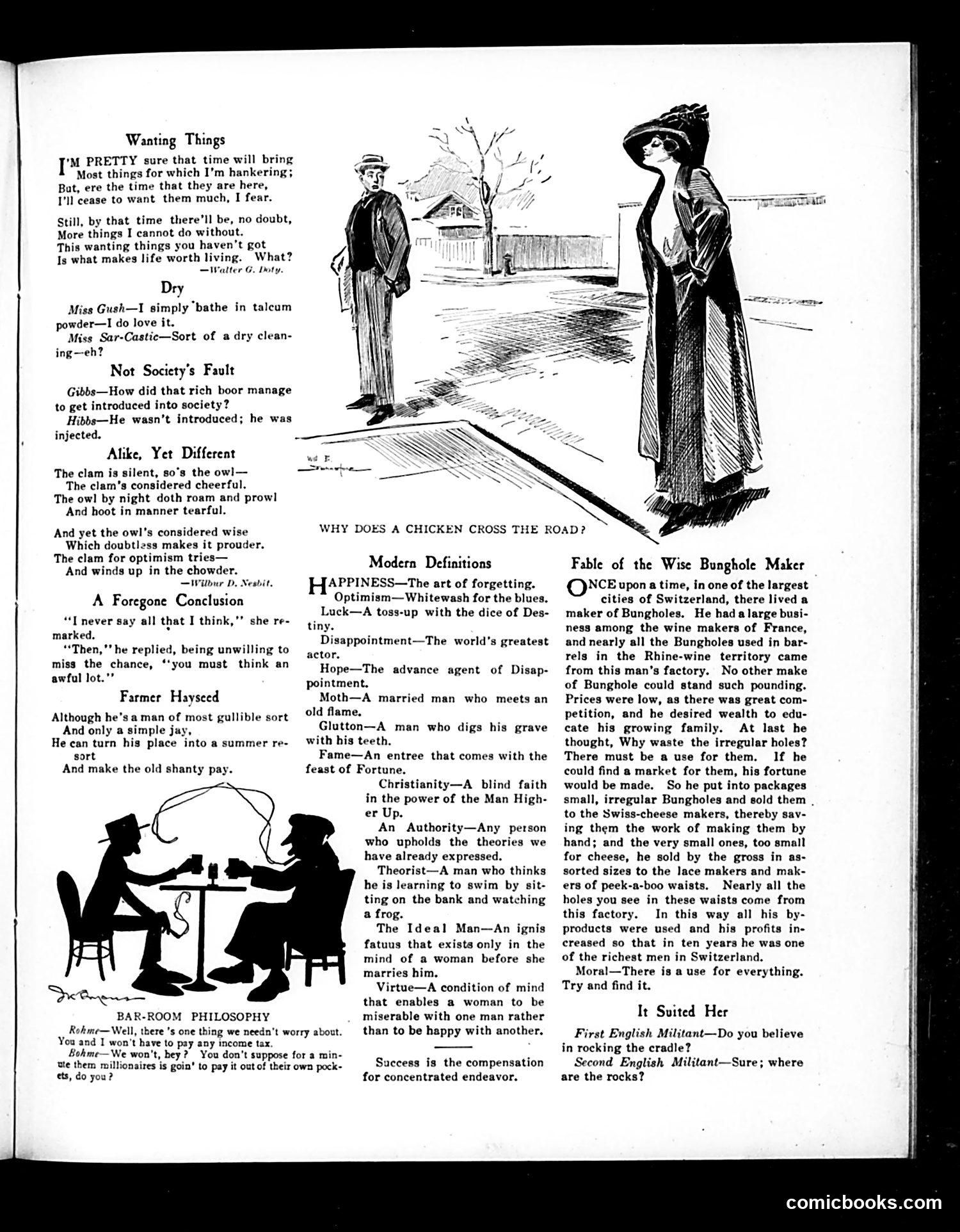
This page from Judge magazine contains several short satirical pieces typical of early 20th-century American humor: **The cartoons and jokes** mock social pretension and human nature. "Not Society's Fault" jokes that a wealthy man was "injected" into society rather than properly introduced—satirizing how money can force entry into exclusive circles. "Alike, Yet Different" uses animal metaphors to suggest that optimism leads to ruin (the clam ends up in chowder). "A Foregone Conclusion" is a flirtation joke about a woman's mysterious inner thoughts. **"Modern Definitions"** parodies self-help philosophy by offering cynical redefinitions: "Happiness" is forgetting; "The Ideal Man" exists only before marriage. This mocks contemporary optimism and relationship ideals. **The "Bunghole Maker" fable** is a business success story where a Swiss manufacturer finds profitable uses for manufacturing waste, turning scraps into products for lace-makers and garment manufacturers. The moral—"There is a use for everything"—celebrates resourceful capitalism and waste reduction. **The bar-room exchange** jokes about millionaires avoiding income taxes, suggesting wealthy tax evasion was a recognized social problem.
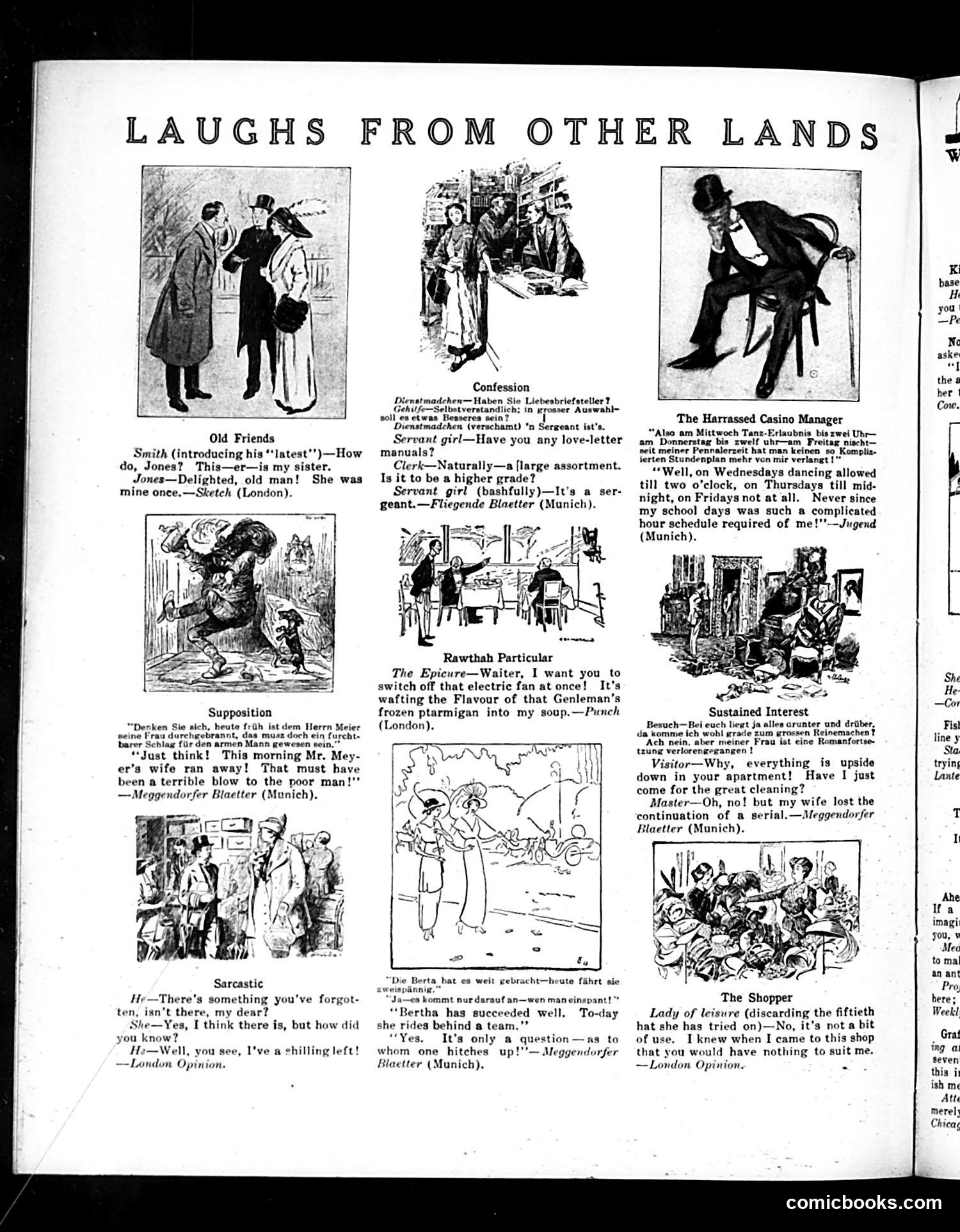
This page collects international humor reprinted from European satirical magazines (Punch, Sketch, Fliegende Blätter, etc.). Each cartoon presents a brief comedic scenario: **"Old Friends"** plays on infidelity—a man introduces his sister, and his friend reveals he once dated her. **"Supposition"** and **"Sarcastic"** are domestic humor: a wife's desertion, and a husband catching his wife in a forgetfulness she can't explain. **"The Epicure"** mocks pretentious fine dining—complaining that a fan disrupts the aroma of his frozen ptarmigan soup. **"Rawthah Particular"** continues the food snobbery theme with absurdly refined complaints. The German-sourced jokes involve servant girls seeking love-letter templates (class humor), casino managers overwhelmed by dance-permit schedules, and a wife's lost serial novel causing domestic chaos. **"The Shopper"** satirizes indecisive, wealthy leisure-class women—she knew nothing would suit her before entering. The humor reflects early-20th-century attitudes: marital discord, class distinctions, and gentle mockery of pretension and materialism.
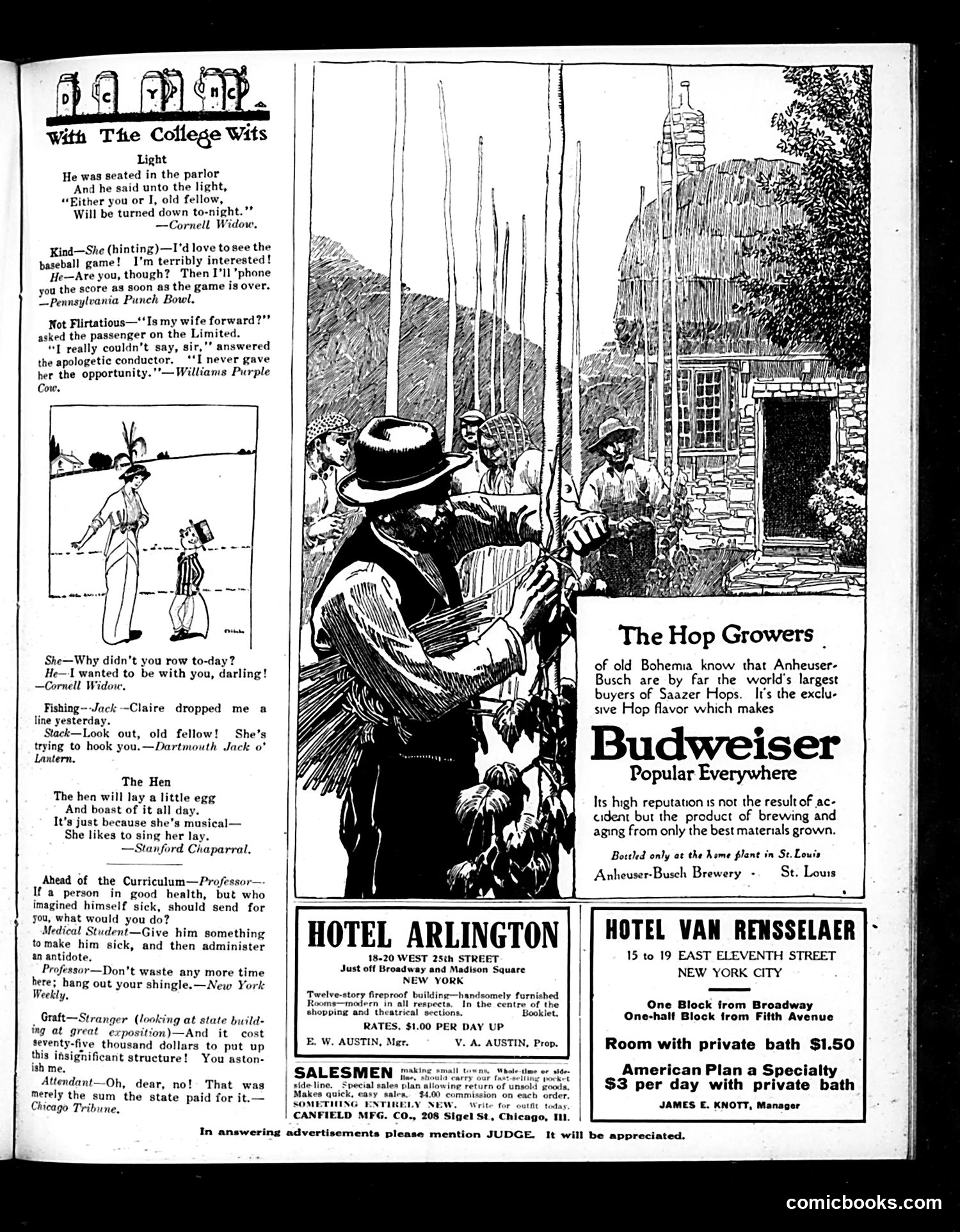
This page from **Judge** (a satirical weekly) contains mostly **short humorous quips** from college publications, plus **period advertisements**. ## The Humor Section ("With The College Wits") These are brief, mostly mild jokes about courtship and daily life: - Young men making excuses to see girlfriends - A play on "lay" (the hen's egg vs. a song) - Puns about fishing/flirting ("hook you") - A medical student joke about faking illness The "Graft" item is the sharpest satire—it mocks **state government corruption**, suggesting officials inflate building costs to pocket the difference. ## Advertisements The page features hotel and brewery ads typical of early 20th-century **Judge** content: - **Budweiser** emphasizes German hops (appealing to Bohemian/German-American readers) - Two modest New York hotels offering rooms at $1–$3/day **Overall**: This is a lighthearted entertainment page with gentle college humor and commercial ads—nothing politically charged by modern standards.
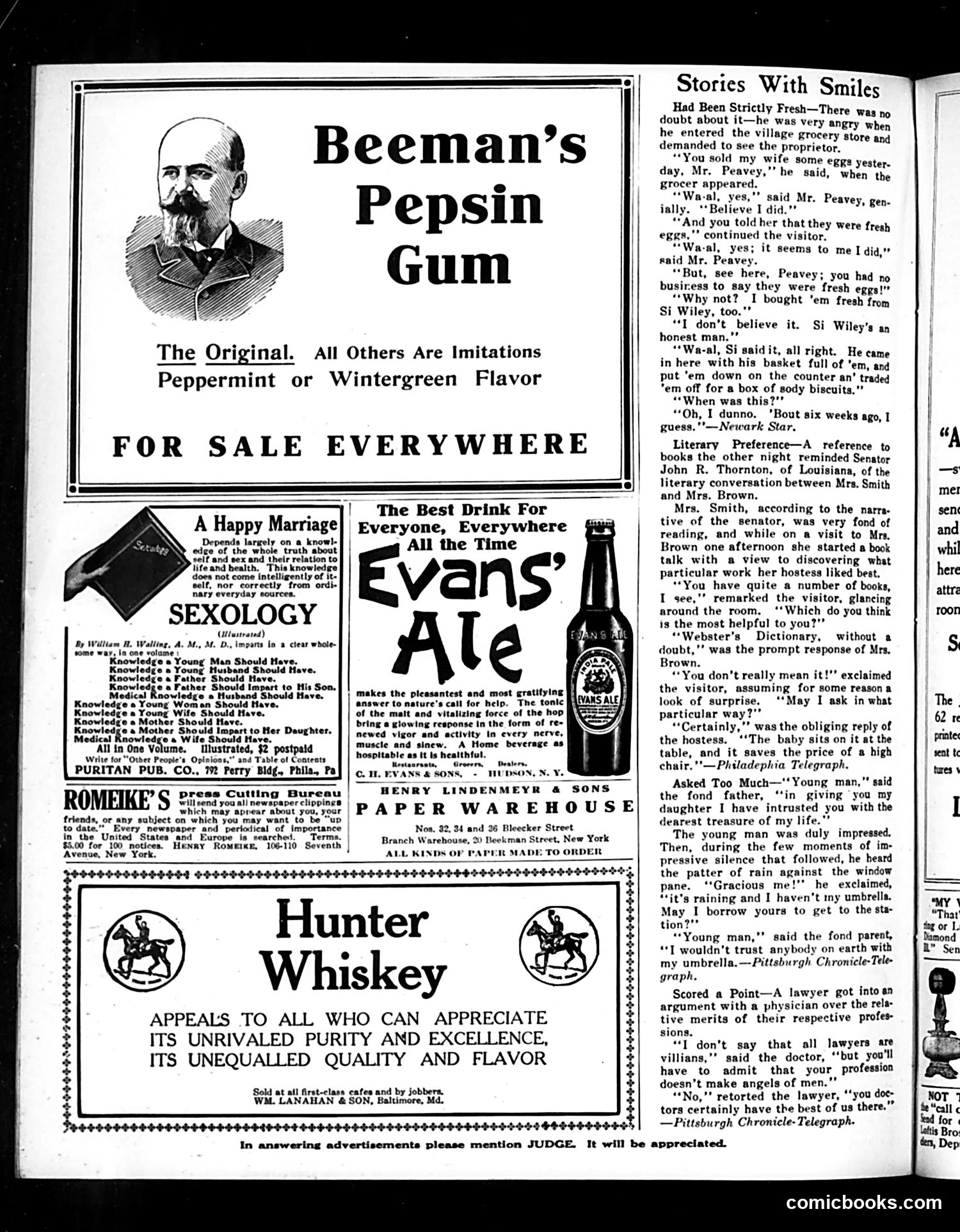
This page is primarily **advertising**, featuring vintage product endorsements typical of early 20th-century magazines: Beeman's Pepsin Gum, Evans' Ale, Hunter Whiskey, and other goods. The satirical content appears in the right column under "Stories With Smiles"—short humorous anecdotes rather than political cartoons: 1. **"Had Been Strictly Fresh"**: A grocer's customer discovers eggs sold as "fresh" were actually six weeks old, purchased secondhand from another source. The joke satirizes dishonest retail practices and false advertising. 2. **"Literary Preference"**: A society caller asks a hostess which book she finds most helpful; the hostess replies "Webster's Dictionary"—because her baby sits on it. This mocks pretentious literary discussion while poking fun at how people use books practically rather than intellectually. 3. **"Asked Too Much"**: Partially visible, appears to involve a father and suitor. These are mild social satires about everyday hypocrisy and absurdity, not political commentary. The page reflects Judge's lighter humor section.
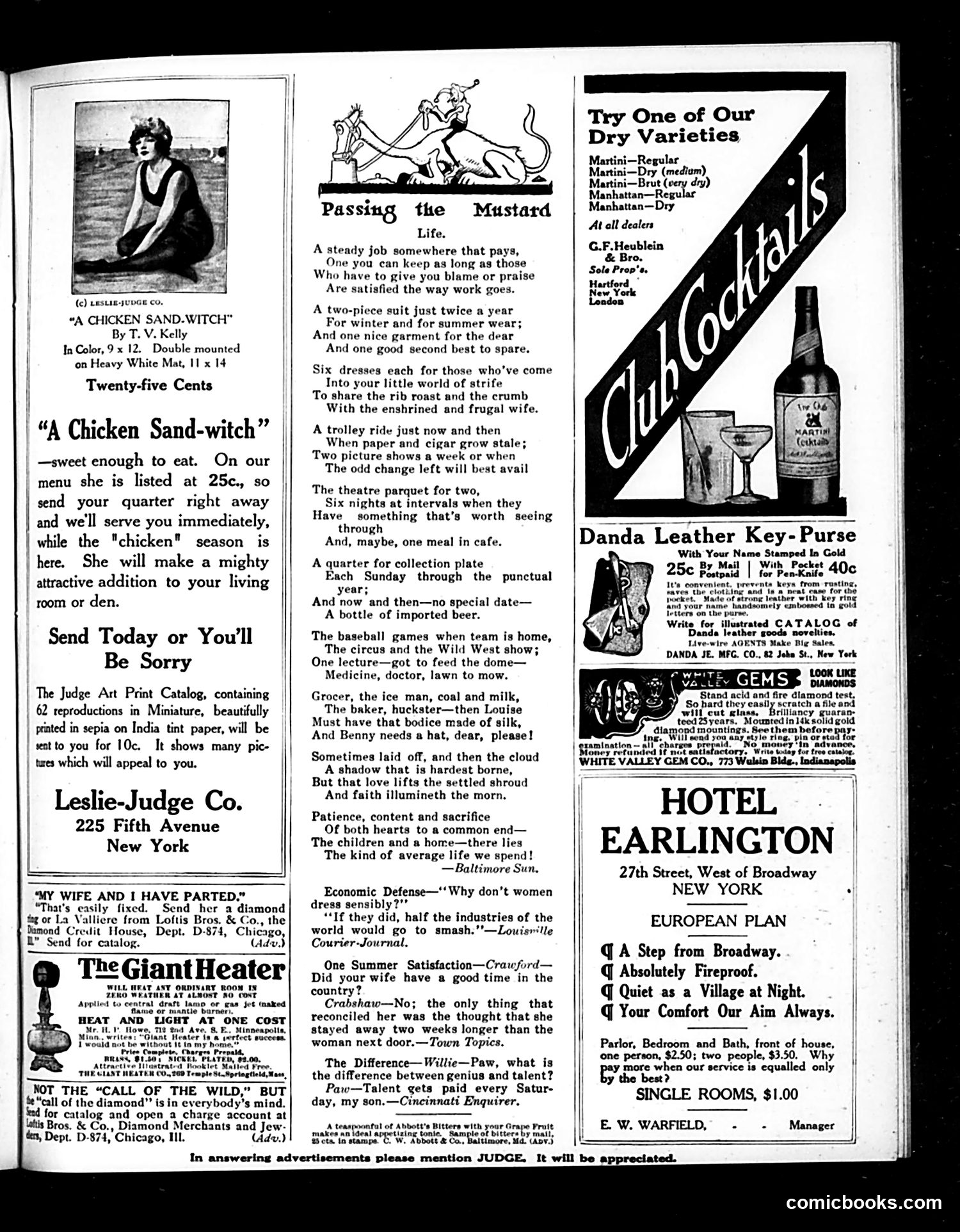
This page is primarily **advertisements and light humor pieces** rather than political satire. The main illustrated content shows "A Chicken Sand-Witch"—a T.V. Kelly drawing advertising prints for sale. The title is a visual pun: the image depicts an attractive woman in a provocative pose, marketed as "sweet enough to eat" at 25 cents. This represents the era's casual objectification of women through double entendre. The remainder consists of humorous observations on daily life ("Passing the Mustard"), quips about marriage and economics, and numerous advertisements (liquor, heaters, diamonds, leather goods). One joke mocks women's fashion choices, suggesting they deliberately dress impractically to sustain industries. The social context: this reflects 1910s-era attitudes toward gender, consumerism, and courtship. There is no identifiable political content—it's entertainment and commerce aimed at middle-class readers.
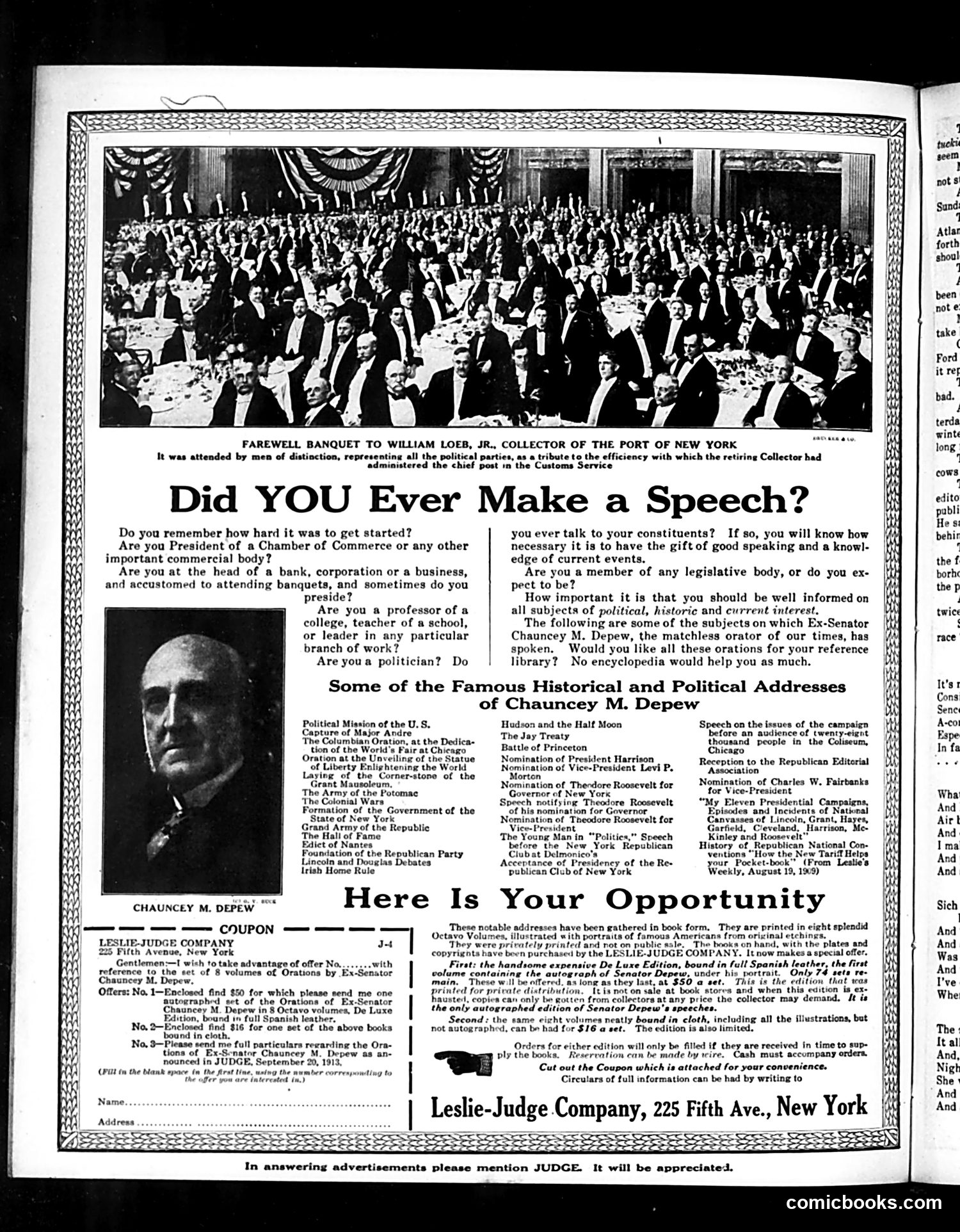
This page is primarily an advertisement for collected speeches by **Chauncey M. Depew**, a prominent Republican politician and orator of the late 19th/early 20th century. The top photograph shows a farewell banquet for **William Loeb Jr.**, retiring Collector of the Port of New York—a politically significant federal customs position. The main content frames Depew's speeches as essential reference material for business leaders, politicians, and public speakers seeking to improve their oratory and political knowledge. The advertisement lists his famous addresses on topics like Lincoln, Grant, the Republican Party, and U.S. political history, positioning these collected works as valuable alternatives to encyclopedias. The satire is subtle: the page suggests that Depew's speeches are so comprehensive and authoritative they constitute a complete education in American political history and rhetoric—flattery typical of early 20th-century Judge magazine's coverage of Republican establishment figures. The coupon offers collectors' editions ranging from $16-$50.
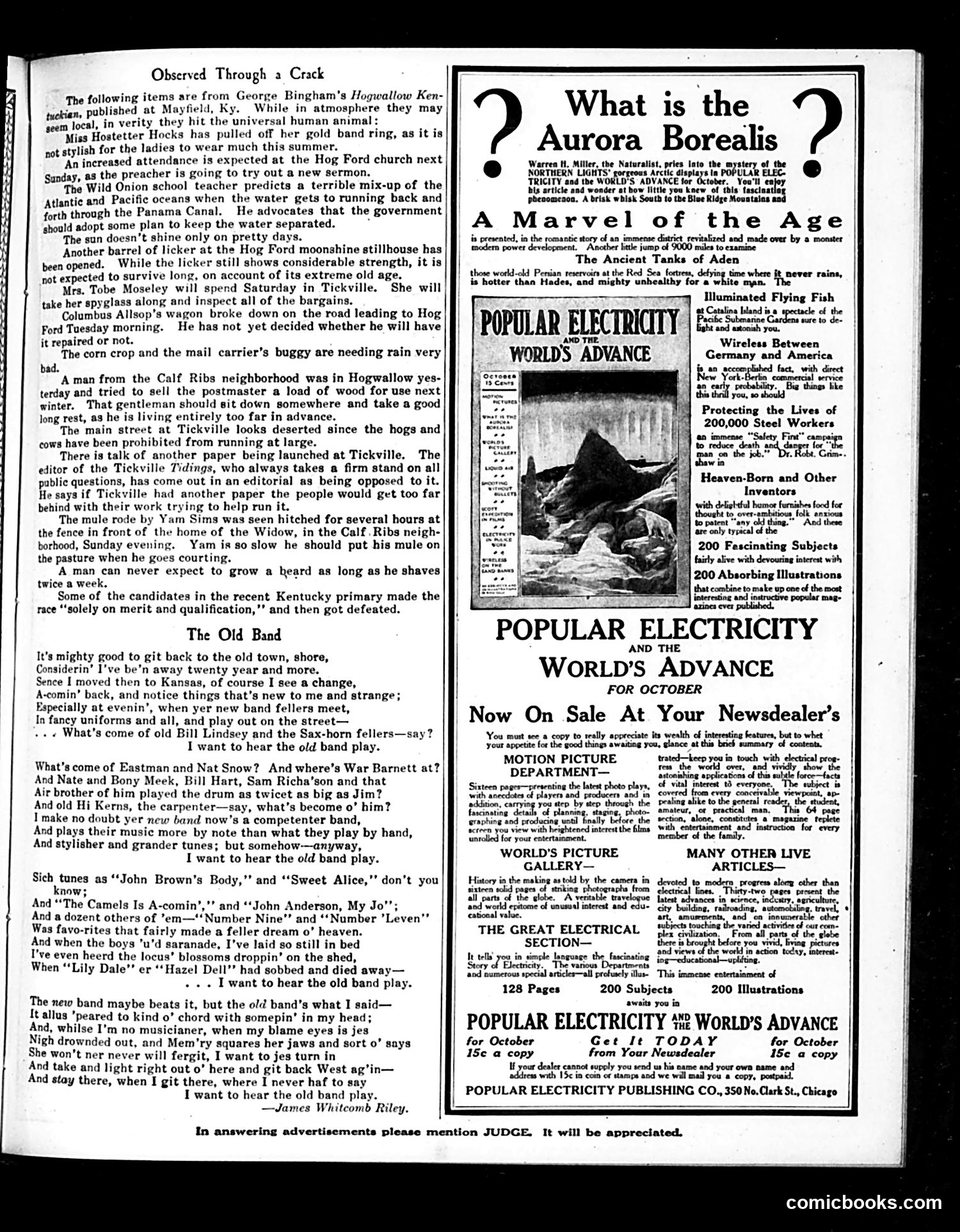
This page from *Judge* magazine contains two distinct sections: **"Observed Through a Crack"** (left column) is a humor piece satirizing rural Kentucky life through fictional news items from "Hogwallow Kenkum." The jokes mock small-town ignorance and absurdity—a teacher worried the Panama Canal will mix the Atlantic and Pacific oceans, a man trying to sell firewood to someone already planning ahead, prohibition on livestock in town. The satire targets rural backwardness and simple-minded logic common to American regional humor of the era. **"The Old Band"** (poem below) is nostalgic verse about someone returning to their hometown after twenty years, lamenting that the new brass band, though technically skilled and formally dressed, lacks the charm of the old amateur musicians who played by ear. It's sentimental commentary on modernization and loss of community character. The right side is entirely **advertising** for *Popular Electricity* magazine. No political figures or cartoons appear on this page.
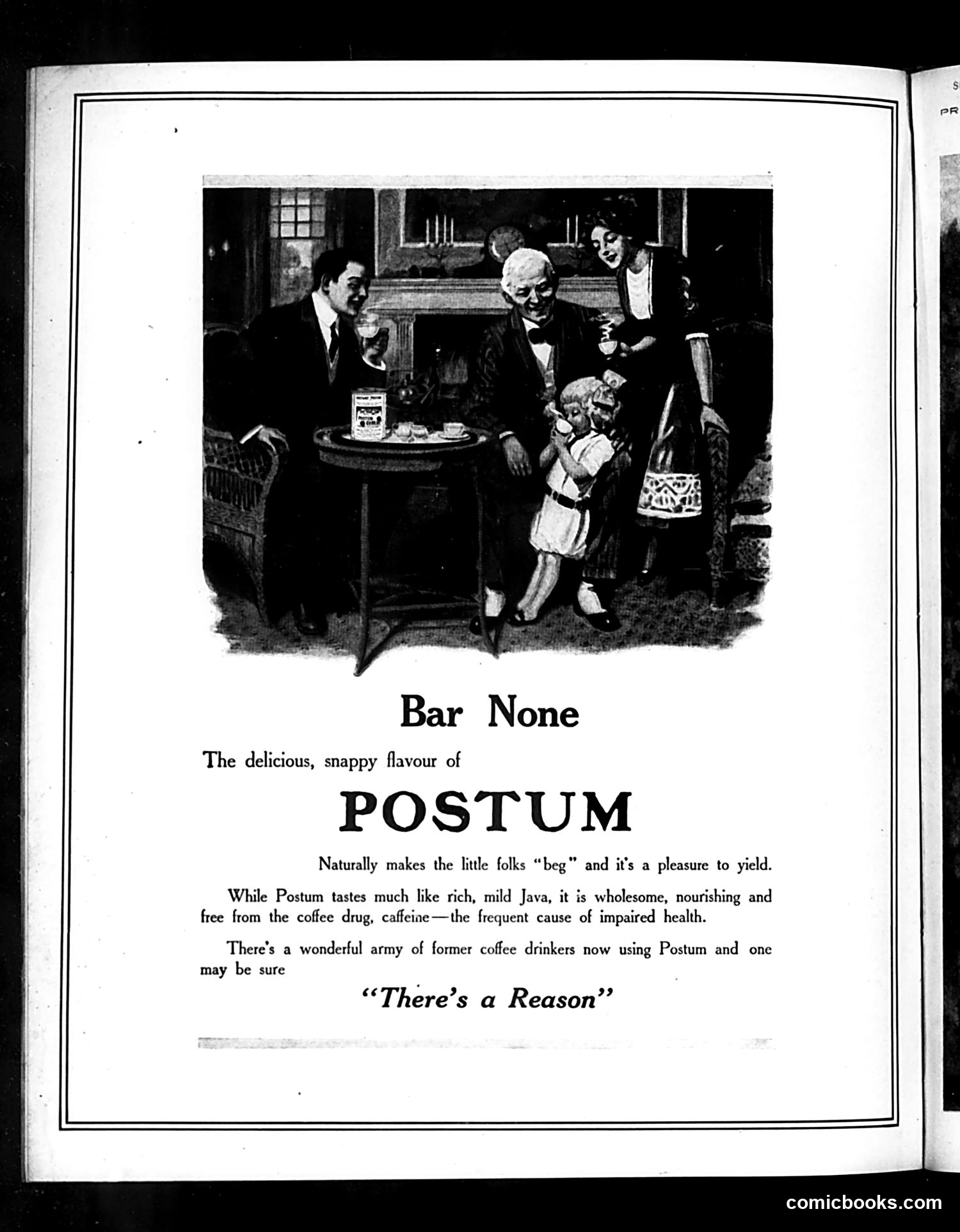
This is a **commercial advertisement**, not political satire. It promotes Postum, a caffeine-free coffee substitute popular in the early 20th century. The illustration shows a domestic scene where children beg an elderly gentleman (presumably a grandfather figure) for Postum. The ad's pitch: Postum tastes like real coffee but is healthier—free from caffeine, which the ad claims causes "impaired health." The phrase "There's a Reason" references Postum's actual advertising slogan. The ad targets health-conscious parents by suggesting children naturally crave Postum and that switching from coffee to this substitute represents responsible parenting and wellness. This reflects Progressive Era concerns about caffeine's effects and the era's marketing of patent medicines and health foods as moral improvements.