
Judge, 1913-09-20 · page 10 of 24
Judge — September 20, 1913 — page 10: what you’re looking at
What you’re looking at
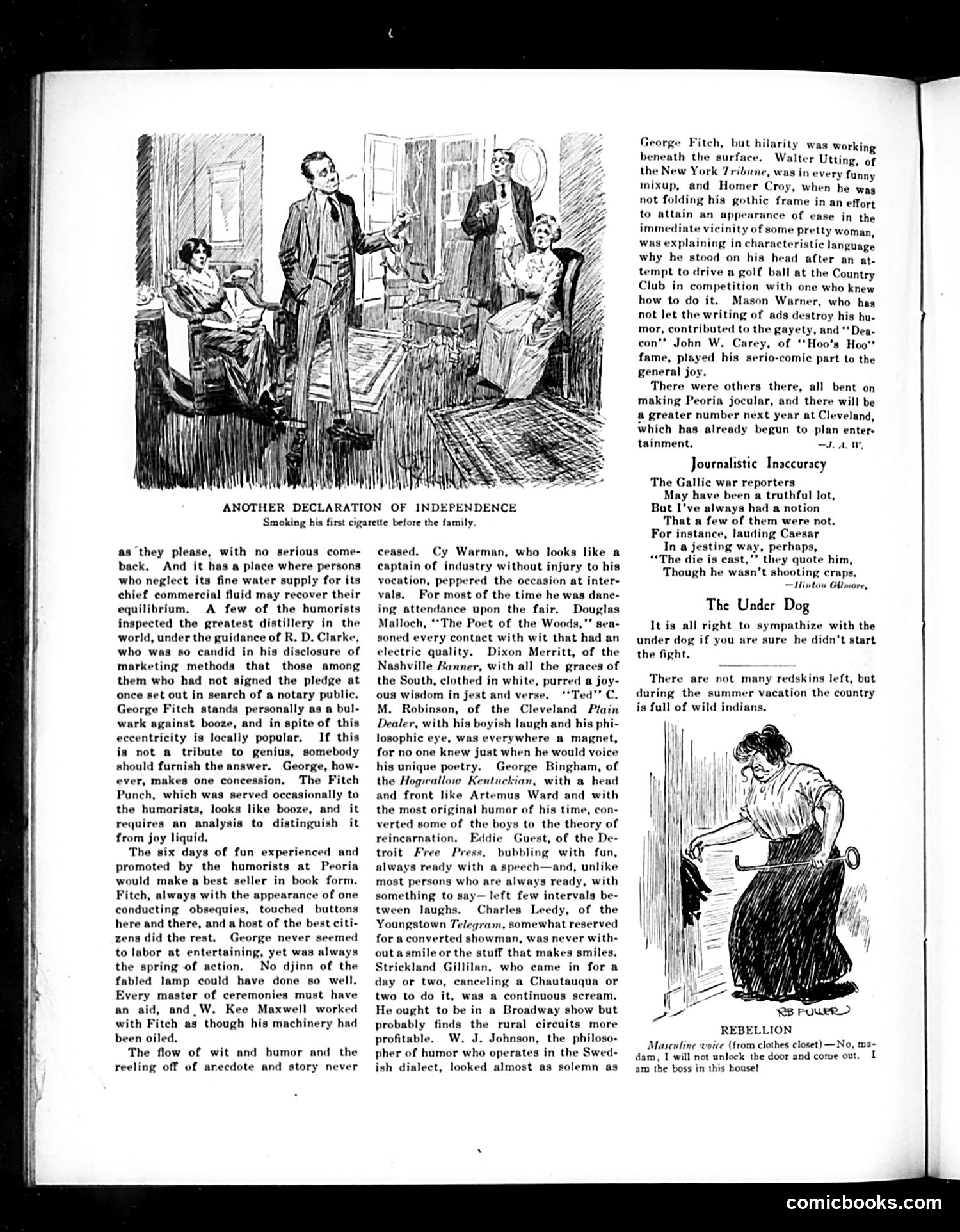
The main cartoon depicts a young man smoking his first cigarette before his family—a domestic scene of mild rebellion. The title's reference to the Declaration of Independence sarcastically equates this personal act with revolutionary defiance, treating a teenager's first smoke as if it were a serious political statement. The accompanying text describes a gathering of American humorists and journalists in Peoria, Illinois, celebrating their freedom to indulge in various vices—particularly alcohol and tobacco—without serious consequences. The satire mocks both their self-importance and the era's tensions around Prohibition-era restrictions. The piece names various newspaper writers and columnists (George Fitch, Eddie Guest, Charles Leedy, among others) whom modern readers wouldn't recognize, but the joke targets intellectual elites claiming personal liberty while society debated moral regulation. The humor plays on the contrast between momentous historical declarations and trivial domestic acts of nonconformity.
📄 Transcribed text from this page (OCR, searchable)
Machine-transcribed from the original scan — historical spelling and the odd misread are preserved.
ANOTHER DECLARATION OF INDEPENDENCE Smoking his first cigarette before the family. as ‘they please, with no serious come- back. And it has a place where persons who neglect its fine water supply for i chief commercial fluid may recover their equilibrium. A few of the humorists inspected the greatest distillery in the world, under the guidance of R. D. Clarke, who was so candid in his disclosure of marketing methods that those among them who had not signed the pledge at once set out in search of a notary public. George Fitch stands personally as a bul- wark against booze, and in spite of this eccentricity is locally popular. If this is not a tribute to genius, somebody should furnish the answer. George, how- ever, makes one concession. The Fitch Punch, which was served occasionally to the humorists, looks like booze, and it requires an analysis to distinguish it from joy liquid. The six days of fun experienced and promoted by the humorists at Peoria would make a best seller in book form. Fitch, always with the appearance of one conducting obsequies, touched buttons here and there, and a host of the best citi- zens did the rest. George never seemed to labor at entertaining, yet was always the spring of action. No djinn of the fabled lamp could have done so well. Every master of ceremonies must have an aid, and |W. Kee Maxwell worked with Fitch as though his machinery had been oiled. The flow of wit and humor and the reeling off of anecdote and story never ceased. Cy Warman, who looks like a captain of industry without injury to his vocation, peppered the occasion at inter- vals, For most of the time he was danc- ing attendance upon the fair. Douglas Malloch, ‘*The Poet of the Woods," sea- soned every contact with wit that had an electric quality. Dixon Merritt, of the Nashville Banner, with all the graces of the South, clothed in white, purred a joy- ous wisdom in jest and verse. ‘*Ted’’ C. M. Robinson, of the Cleveland Plain Dealer, with his boyish laugh and his phi- losophic eye, was everywhere a magnet, for no one knew just when he would voice his unique poetry. George Bingham, of the Hogwallow Kentuckian, with a head and front like Artemus Ward and with the most original humor of his time, con- verted some of the boys to the theory of reincarnation. Eddie Guest, of the De- troit Free Press, bubbling with fun, always ready with a speech—and, unlike most persons who are always ready, with something to say—left few intervals be- tween laughs, harles Leedy, of the Youngstown Telegram, somewhat reserved for a converted showman, was never with- out a smile or the stuff that makes smiles. Strickland Gillilan, who came in for a day or two, canceling a Chautauqua or two to do it, was a continuous scream. He ought to be in a Broadway show but probably finds the rural circuits more profitable. W. J. Johnson, the philoso- pher of humor who operates in the Swed- ish dialect, looked almost as solemn as George Fitch, but hilarity was working beneath the surface. Walter Utting, of the New York Tribune, was in every fonny mixup, and Homer Croy, when he was not folding his gothic frame in an effort to attain an appearance of ease in the immediate vicinity of some pretty woman, was explaining in characteristic language why he stood on his head after an at- tempt to drive a golf ball at the Country Club in competition with one who knew how to do it. Mason Warner, who has not let the writing of ads destroy his hu- mor, contributed to the gayety, and ‘*Dea- con’? John W. Carey, of ‘*Hoo’s Hoo” fame, played his serio-comic part to the general joy. There were others there, all bent on making Peoria jocular, and there will be a greater number next year at Cleveland, which has already begun to plan enter. tainment. J. AW, Journalistic Inaccuracy The Gallic war reporters May have been a truthful lot, But I’ve always had a notion That a few of them were not. For instance, lauding Caesar In a jesting way, perhaps, “The die is cast,’’ they quote him, Though he wasn't shooting craps, —Hinton Gilmore, The Under Dog It is all right to sympathize with the under dog if you are sure he didn’t start the fight. There are not many redskins left, but during the summer vacation the country is full of wild indians, We. ee a MI pg | Lyn) My / W/L ‘ i REBELLION Masculine voice (from clothes closet) — No, ma- dam, I will not unlock the door and come out. I am the boss in this house! comicbooks.com