
Judge, 1913-09-20 · page 13 of 24
Judge — September 20, 1913 — page 13: what you’re looking at
What you’re looking at
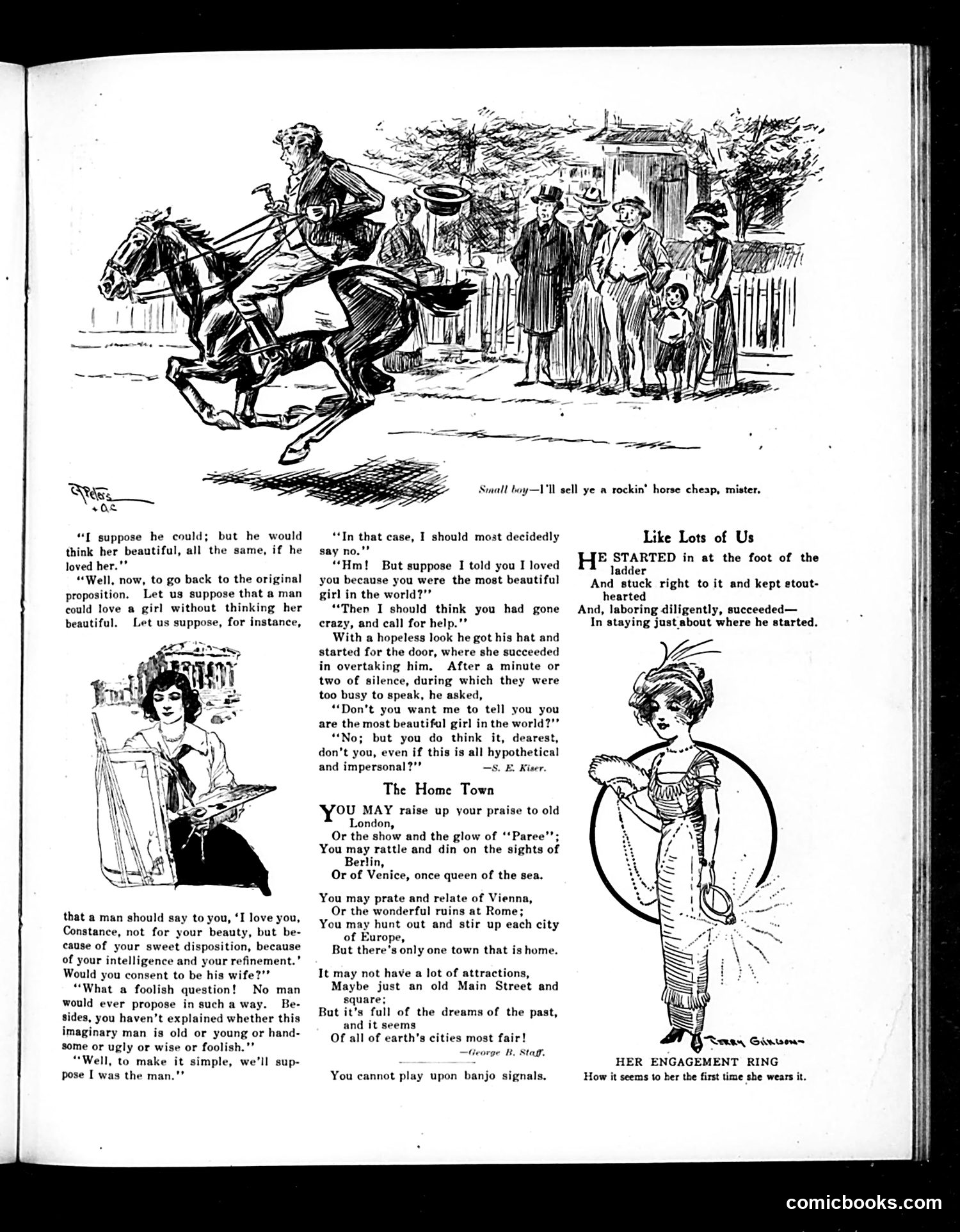
This page contains three distinct pieces of early 20th-century humor: **Top cartoon**: A man on horseback passes a woman and child on a country road—likely depicting a traveling salesman or peddler offering a "rockin' horse cheap." **Main dialogue piece**: A courtship debate about whether a man can love a woman without finding her beautiful. The woman plays coy, rejecting both compliments and their absence, ultimately admitting she wants reassurance of her beauty despite claiming it's "hypothetical." This satirizes the contradictory expectations placed on women in courtship—they shouldn't value beauty alone, yet want constant validation of their attractiveness. **"The Home Town" poem**: Sentimental verse praising one's hometown over famous European cities, reflecting early 20th-century American nostalgia and small-town values. **"Like Lots of Us" vignette**: A brief satirical comment on social mobility—a man works hard climbing "the ladder" but ends up exactly where he started, mocking the hollow promise of American upward mobility. The overall page reflects genteel, domestic satire typical of Judge's era.
📄 Transcribed text from this page (OCR, searchable)
Machine-transcribed from the original scan — historical spelling and the odd misread are preserved.
+08 “[ suppose he could; but he would think her beautiful, all the same, if he loved her."* “Well, now, to go back to the original proposition. Let us suppose that a man could love a girl without thinking her beautiful. Let us suppose, for instance, that a man should say to you, ‘I love you, Constance, not for your beauty, but be- cause of your sweet disposition, because of your intelligence and your refinement.’ Would you consent to be his wife?” “What a foolish question! No man would ever propose in such a way. Be- sides, you haven’t explained whether this imaginary man is old or young or hand- some or ugly or wise or foolish.’” “Well, to make it simple, we'll sup- pose I was the man."" Small boy—V'll sell ye a rockin’ horse cheap, mister, “In that case, I should most decidedly say no.’” “Hm! But suppose I told you I loved you because you were the most beautiful girl in the world?” “Then I should think you had gone crazy, and call for help.’” With a hopeless look he got his hat and started for the door, where she succeeded in overtaking him, After a minute or two of silence, during which they were too busy to speak, he asked, “Don't you want me to tell you you are the most beautiful girl in the world?”’ “No; but you do think it, dearest, don’t you, even if this is all hypothetical and impersonal ?’” —S. E. Kiser. The Home Town you MAY raise up your praise to old London, Or the show and the glow of ‘‘Paree’’; You may rattle and din on the sights of Berlin, Or of Venice, once queen of the sea. You may prate and relate of Vienna, Or the wonderful ruins at Rome; You may hunt out and stir up each city of Europe, But there's only one town that is home. It may not have a lot of attractions, Maybe just an old Main Street and square; But it’s full of the dreams of the past, and it seems Of all of earth's cities most fair! George B. Stall You cannot play upon banjo signals. Like Lots of Us E STARTED in at the foot of the ladder And stuck right to it and kept etout- hearted And, ring diligently, succeeded— In staying just. about where he started. F\Nennn Ginvous HER ENGAGEMENT RING How it seems to her the first time she wears it. comicbooks.com