
Judge, 1913-09-20 · page 17 of 24
Judge — September 20, 1913 — page 17: what you’re looking at
What you’re looking at
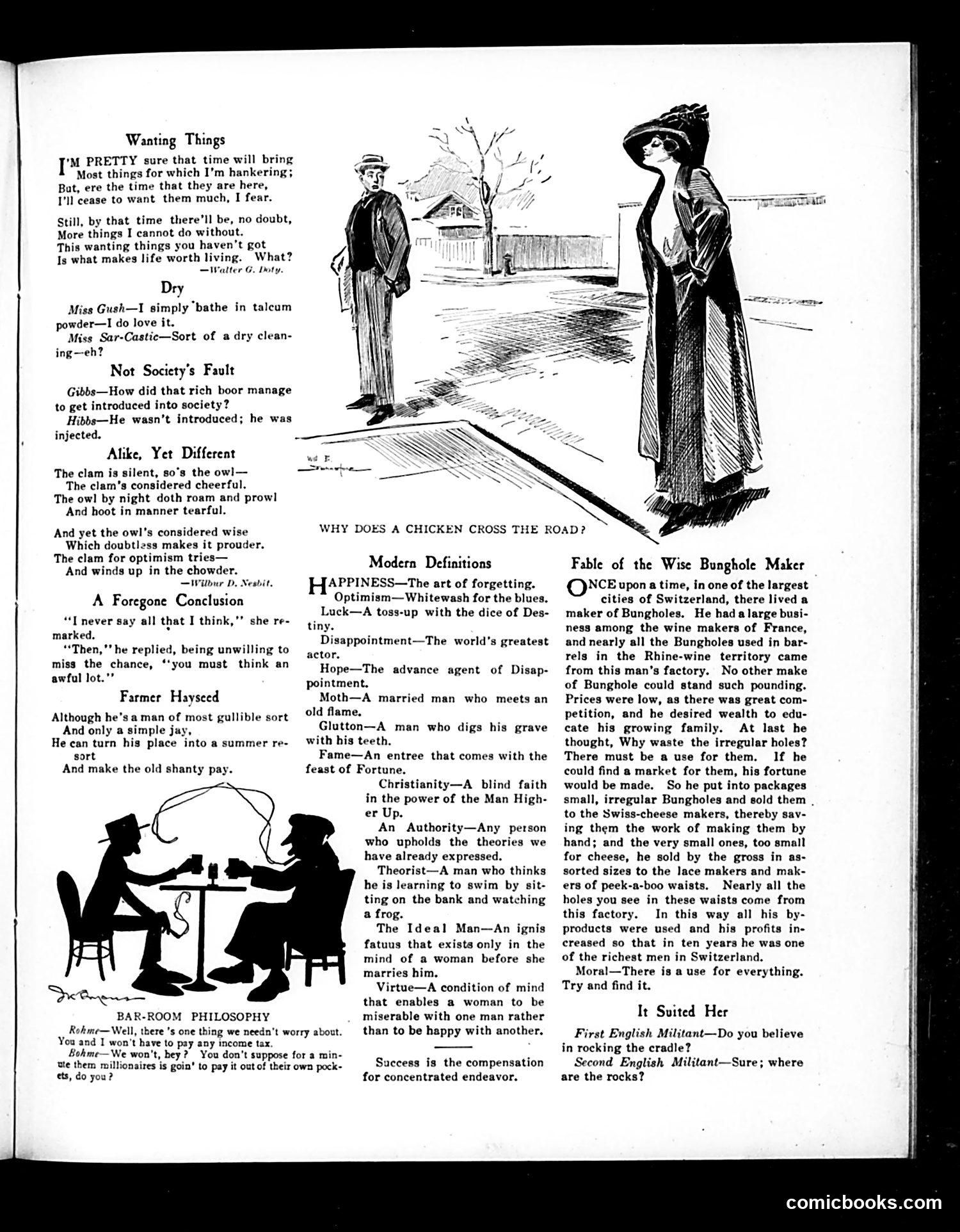
This page from Judge magazine contains several short satirical pieces typical of early 20th-century American humor: **The cartoons and jokes** mock social pretension and human nature. "Not Society's Fault" jokes that a wealthy man was "injected" into society rather than properly introduced—satirizing how money can force entry into exclusive circles. "Alike, Yet Different" uses animal metaphors to suggest that optimism leads to ruin (the clam ends up in chowder). "A Foregone Conclusion" is a flirtation joke about a woman's mysterious inner thoughts. **"Modern Definitions"** parodies self-help philosophy by offering cynical redefinitions: "Happiness" is forgetting; "The Ideal Man" exists only before marriage. This mocks contemporary optimism and relationship ideals. **The "Bunghole Maker" fable** is a business success story where a Swiss manufacturer finds profitable uses for manufacturing waste, turning scraps into products for lace-makers and garment manufacturers. The moral—"There is a use for everything"—celebrates resourceful capitalism and waste reduction. **The bar-room exchange** jokes about millionaires avoiding income taxes, suggesting wealthy tax evasion was a recognized social problem.
📄 Transcribed text from this page (OCR, searchable)
Machine-transcribed from the original scan — historical spelling and the odd misread are preserved.
Wanting Things I™ PRETTY sure that time will bring Most things for which I’m hankering; But, ere the time that they are here, I'll cease to want them much, I fear. Still, by that time there'll be, no doubt, More things I cannot do without. This wanting things you haven't got Is what makes life worth living. —Walter G. Doty. Dry Miss Gush—I simply “bathe in talcum powder—I do love it. Miss Sar-Castic—Sort of a dry clean- ing—eh? Not Society's Fault Gibbs—How did that rich boor manage to get introduced into society? Hibbs—He wasn’t introduced; he was injected. Alike, Yet Different The clam is silent, so’s the owl— The clam’s considered cheerful. The owl by night doth roam and prow! And hoot in manner tearful. And yet the owl's considered wise Which doubtless makes it prouder. The clam for optimism tries— And winds up in the chowder. Wilbur D. Nesbit. A Foregone Conclusion “IT never say all that I think,’’ she re- marked. . “Then,” he replied, being unwilling to miss the chance, ‘‘you must think an awful lot."" Farmer Hayseed Although he’s a man of most gullible sort And only a simple jay, He can turn his place into a summer re- sort And make the old shanty pay. Se Onrg BAR-ROOM PHILOSOPHY Rohme—Well, there 's one thing we needn't worry about. You and I won't have to pay any income tax Bohme—We won't, hey ? ets, do you? What? You don’t suppose for a min- Ute them millionaires is goin’ to pay it out of their own pock- WHY DOES A CHICKEN CROSS THE ROAD? Modern Definitions H4PPINESS—The art of forgetting. Optimism—Whitewash for the blues. Luck—A toss-up with the dice of Des- tiny. Disappointment—The world’s greatest actor. Hope—The advance agent of Disap- pointment. Moth—A married man who meets an old flame, Glutton—A man who digs his grave with his teeth. Fame—An entree that comes with the feast of Fortune. Christianity—A blind faith in the power of the Man High- er Up. An Authority—Any person who upholds the theories we have already expressed. Theorist—A man who thinks he is learning to swim by sit- ting on the bank and watching a frog. The Ideal Man—An ignis fatuus that exists only in the mind of a woman before she marries him, Virtue—A condition of mind that enables a woman to be miserable with one man rather than to be happy with another, Success is the compensation for concentrated endeavor. Fable of the Wise Bunghole Maker ONCE upon a time, in one of the largest cities of Switzerland, there lived a maker of Bungholes. He had a large busi- ness among the wine makers of France, and nearly all the Bungholes used in bar- rels in the Rhine-wine territory came from this man’s factory. No other make of Bunghole could stand such pounding. Prices were low, as there was great com- petition, and he desired wealth to edu- cate his growing family. At last he thought, Why waste the irregular holes? There must be a use for them. If he could find a market for them, his fortune would be made. So he put into packages small, irregular Bungholes and sold them | to the Swiss-cheese makers, thereby sav- ing them the work of making them by hand; and the very small ones, too small for cheese, he sold by the gross in as- sorted sizes to the lace makers and mak- ers of peek-a-boo waists. Nearly all the holes you see in these waists come from this factory. In this way all his by- products were used and his profits in- creased so that in ten years he was one of the richest men in Switzerland. Moral—There is a use for everything. Try and find it. It Suited Her First English Militant—Do you believe in rocking the cradle? Second English Militant—Sure; where are the rocks? comicbooks.com