
A complete issue · 24 pages · 1913
Judge — April 12, 1913
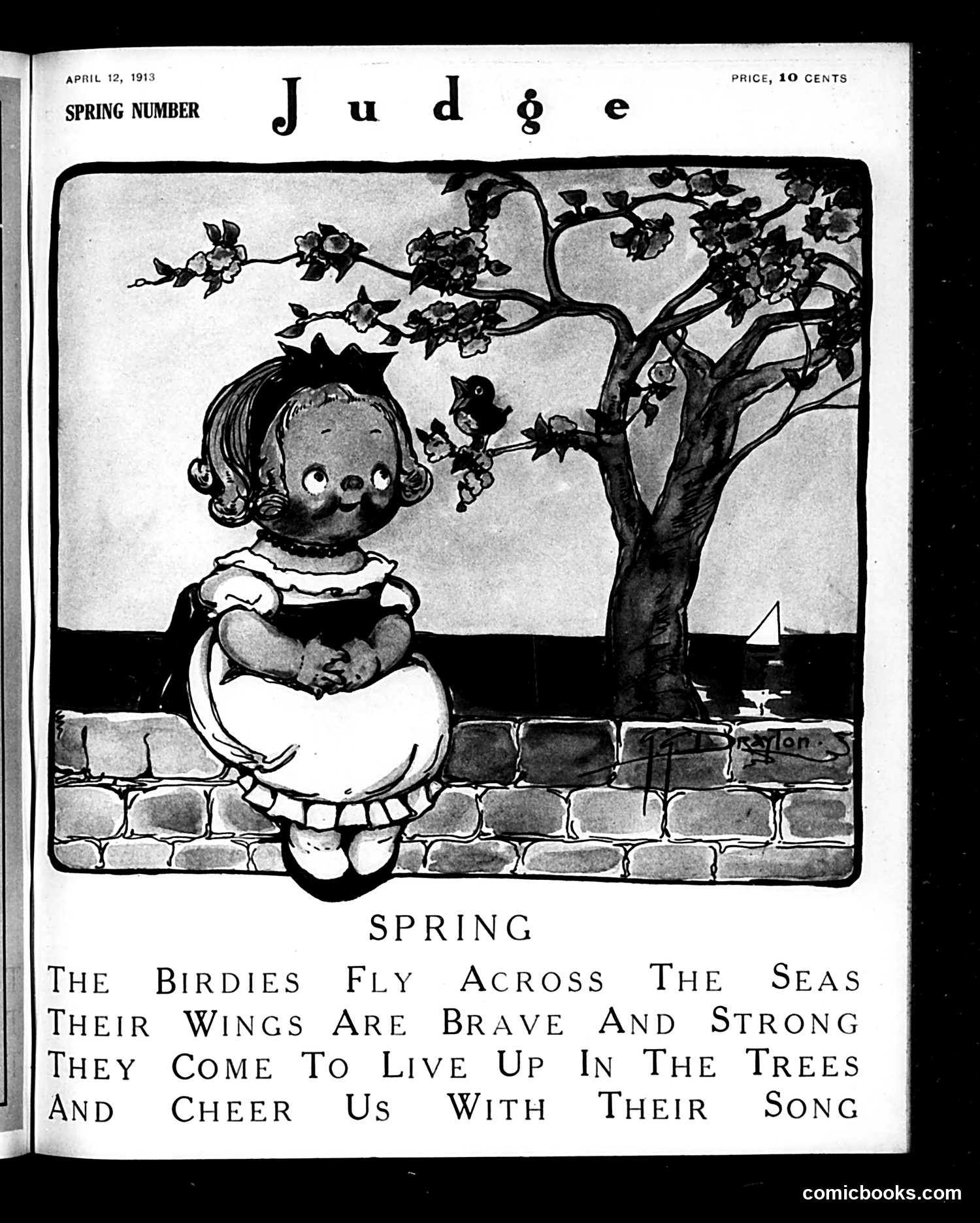
This is a straightforward seasonal illustration rather than political satire. It depicts a cherubic child sitting on a brick wall beside a blooming tree, accompanying a poem celebrating spring's arrival. The text is purely celebratory: "The birdies fly across the seas / Their wings are brave and strong / They come to live up in the trees / And cheer us with their song." The image uses idealized, sentimental imagery typical of early 20th-century children's literature—the round-faced child, pastoral setting, and anthropomorphized nature. There is no apparent political commentary or satirical intent. This appears to be Judge magazine's seasonal cover feature, demonstrating the publication's broader range beyond purely satirical content.
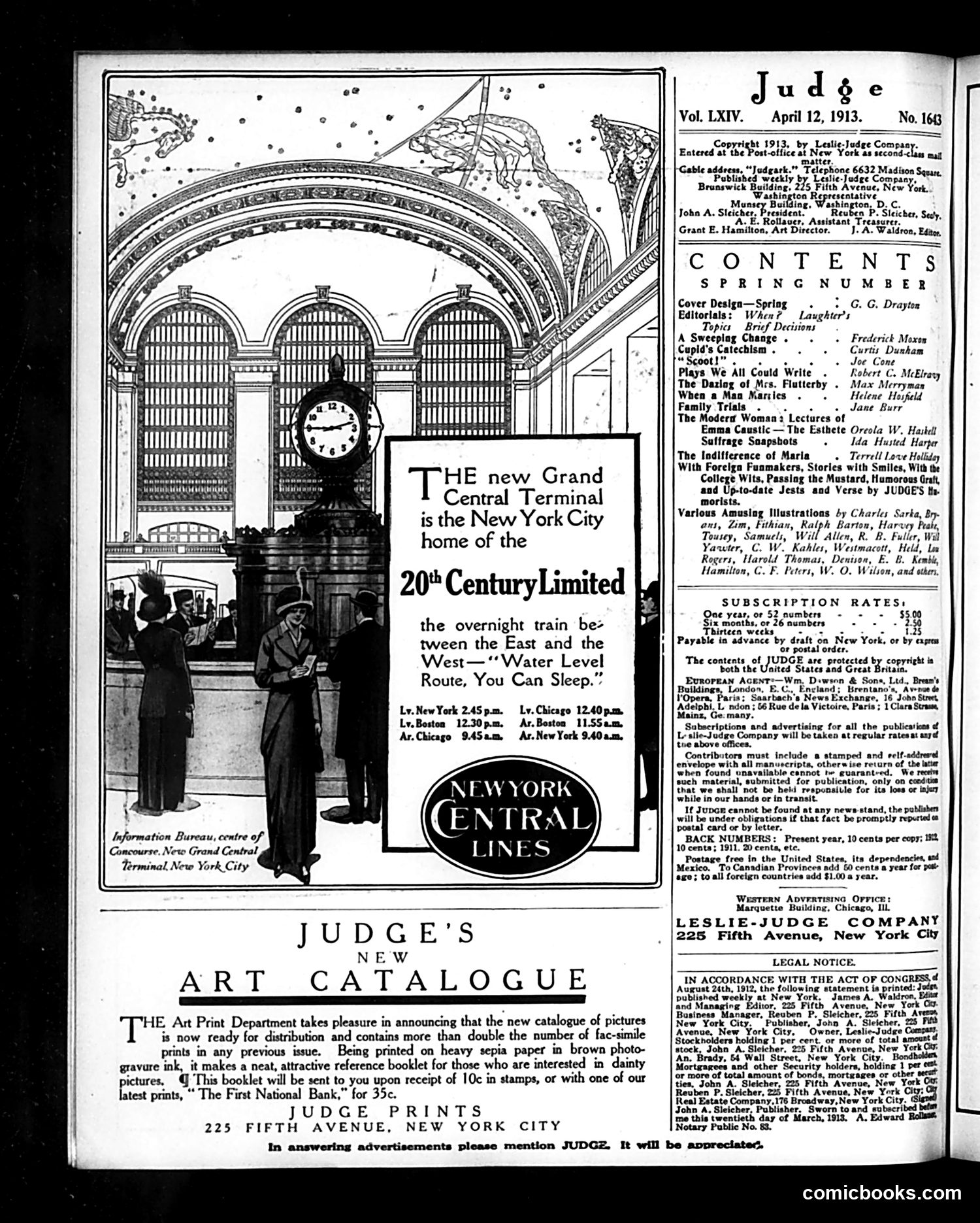
This page is primarily **advertising and magazine content** rather than political satire. The dominant feature is an advertisement for the "20th Century Limited" train operated by New York Central Lines, depicting Grand Central Terminal's interior with its iconic clock and arched windows. The ad emphasizes overnight travel between New York and Chicago with sleeping accommodations. Below that is an announcement for **Judge's New Art Catalogue**, promoting art prints available from their print department at 225 Fifth Avenue. The right side contains the magazine's **table of contents**, listing various articles and illustrations, along with **subscription rates** and **legal notices**. There is **no significant political cartoon or satire visible** on this particular page—it functions primarily as a commercial and informational section of the magazine.

This page is **not a cartoon or satirical content** — it's a straightforward advertisement from the Hamburg-American Line shipping company. The ad promotes a cruise departing April 30th aboard the S.S. "Victoria-Luise," billed as "the largest steamer sailing in the Caribbean." It offers a 16-day trip to the Panama Canal, Havana, and Jamaica for $145 and up. The ad's key selling point is urgency: "Now is the time to see the Canal before the water is turned in, when the wonderful engineering detail will be lost to view." This references the Panama Canal's imminent opening (August 1914), making this advertisement likely from spring 1914—a "last chance" to view the canal before it became operational and filled with water.
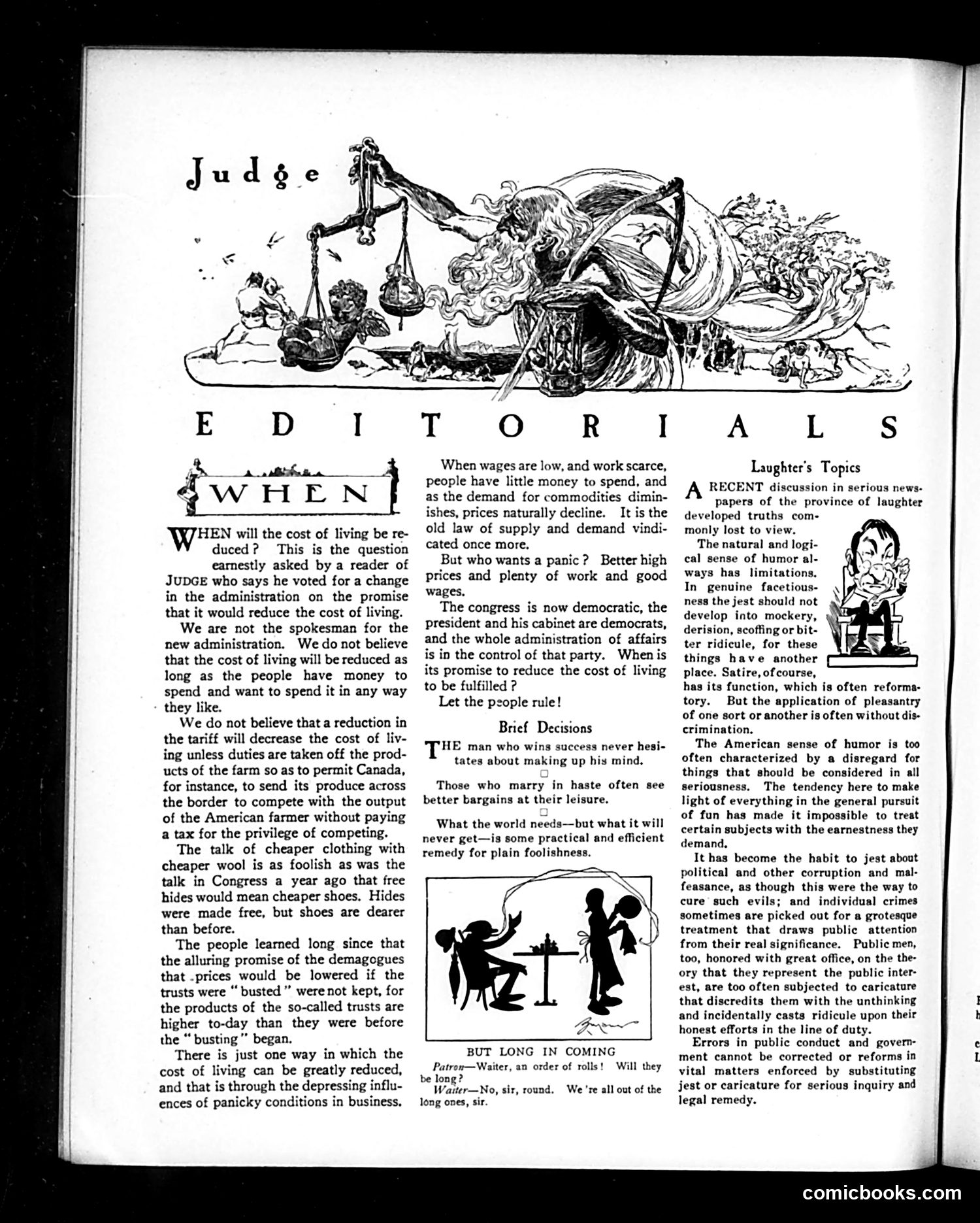
This page satirizes Democratic economic promises. The main editorial "When" mocks the Democratic administration's pledge to reduce living costs. Judge argues that tariff reductions won't help farmers, and that cheaper clothing/wool claims are hollow—trusts still charge high prices regardless of policy promises. The illustration shows Lady Justice holding scales unevenly weighted, satirizing the imbalance between rhetoric and reality. "Brief Decisions" contains cynical aphorisms about human nature and decision-making. "Laughter's Topics" defends political satire's purpose, arguing that humor's role is to critique corruption and misconduct—essential when serious treatment fails. Judge positions itself as performing a public service through ridicule. The overall message: Democratic cost-of-living promises are deceptive populism.
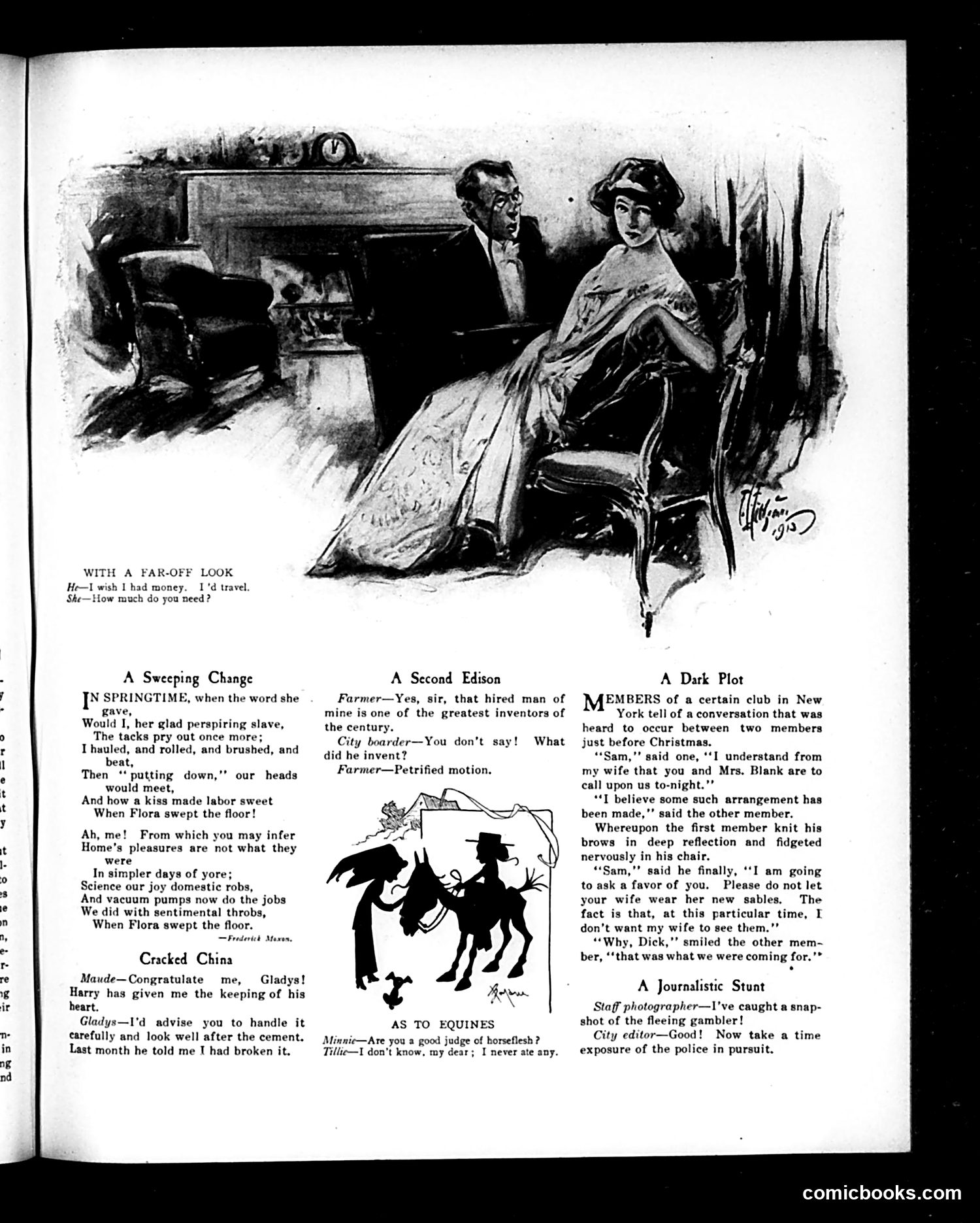
This page from *Judge* magazine contains several brief satirical pieces and illustrations typical of early 20th-century humor. The main illustration at top shows a wealthy woman in an elegant gown speaking with a man, captioned "WITH A FAR-OFF LOOK"—a domestic comedy about travel aspirations. The text pieces include: - **"In Springtime"**: A poem mocking how servants' working conditions haven't improved despite modern conveniences - **"A Second Edison"**: A dialogue joke about a farmer claiming to have invented something - **"A Dark Plot"**: A humorous anecdote about club members scheming to prevent a friend from seeing his wife's new sables (furs) - **"As to Equines"**: A brief exchange about judging horses - **"A Journalistic Stunt"**: A quip about a photographer and police pursuit The humor relies on wordplay, domestic situations, and class-based comedy typical of the era.
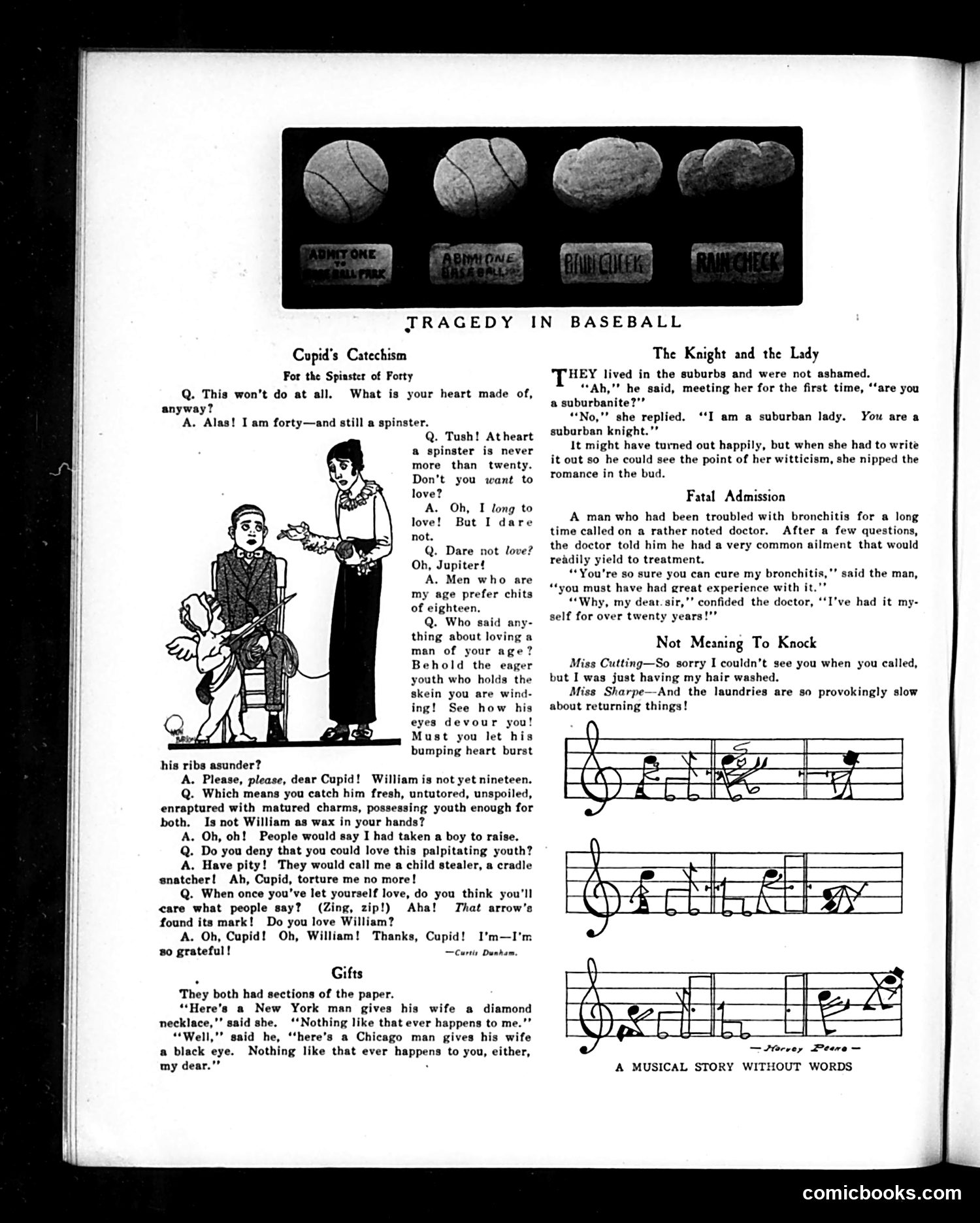
This page contains three unrelated satirical pieces typical of early-20th-century humor magazines: **"Cupid's Catechism"** mocks a 40-year-old unmarried woman's romantic dilemma. The joke: she refuses a 19-year-old suitor because society would judge her as a "cradle snatcher," yet she's desperate for love. Cupid's arrow eventually wins out, satirizing women's constrained choices and social hypocrisy about age and marriage. **"The Knight and the Lady"** ridicules suburban pretension—a couple tries to seem witty about their suburban status, but the woman ruins the moment by needing to write down her joke's punchline, killing the romance. It mocks both suburban affectation and female intellectual awkwardness. **The remaining jokes** include a doctor admitting he can't cure bronchitis because he's had it 20 years himself (mocking medical incompetence), and a couple comparing spouses' gifts—diamond necklace versus black eye—a dark joke about domestic violence presented as comedic. The musical notation section offers a "story without words," typical of Judge's varied content format.
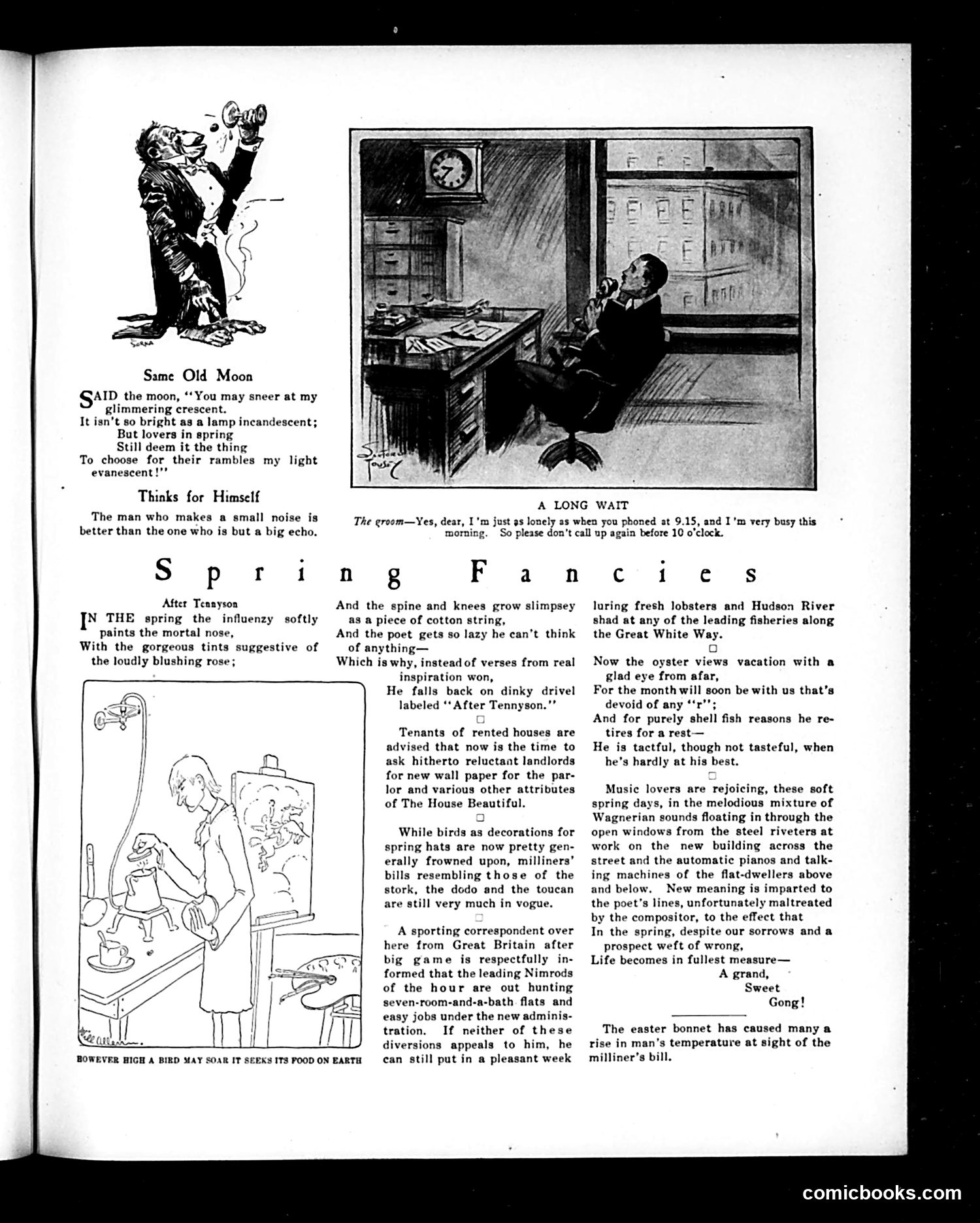
This page contains several spring-themed satirical pieces typical of Judge's humor circa early 1900s. **"Same Old Moon"** mocks romantic poetry by having the moon defend its appeal to lovers despite being dimmer than electric lights—a jab at both sentimental verse and technological progress. **"After Tennyson"** satirizes lazy poets who, afflicted by spring influenza, resort to derivative imitations rather than original work. It's a direct critique of uninspired literary hack work. **"A Long Wait"** cartoon shows a groom avoiding his fiancée's phone calls, claiming busyness—social commentary on modern courtship etiquette and male avoidance. The **"Spring Fancies"** section offers lighthearted social observations: expensive Easter bonnets bankrupting men, fashionable bird-adorned hats, wealthy New Yorkers hunting apartments rather than game, and the jarring contrast between Wagner's music and construction noise in apartment buildings. Overall, these pieces blend nostalgia for romanticized spring with contemporary urban complaints about modern life's absurdities.
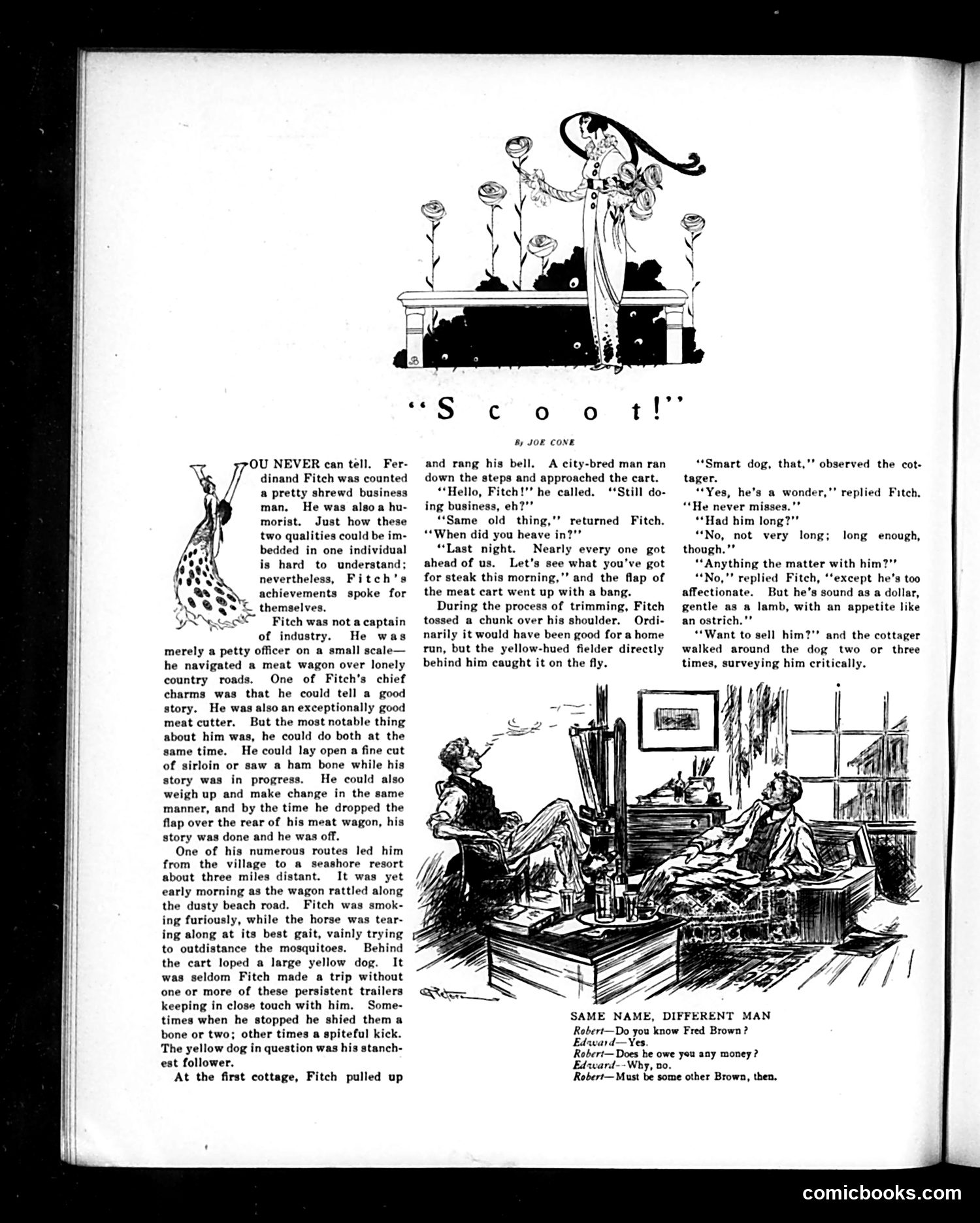
This is a humorous short story illustrated with sketches rather than a political cartoon. It depicts Ferdinand Fitch, a meat wagon driver characterized as both shrewd and witty—a seemingly contradictory combination. The narrative follows Fitch on his regular route to a seaside resort, accompanied by his loyal yellow dog. When a city-bred customer admires the dog's athleticism after it catches a piece of meat mid-air, he inquires about purchasing it. The story appears to set up a comedic transaction or misunderstanding. The accompanying dialogue snippet ("Same Name, Different Man") is an unrelated joke about mistaken identity among people sharing common names. The satire gently mocks rural commerce and the character types of small-town America—the shrewd tradesman, the curious tourist, and the faithful stray dog.
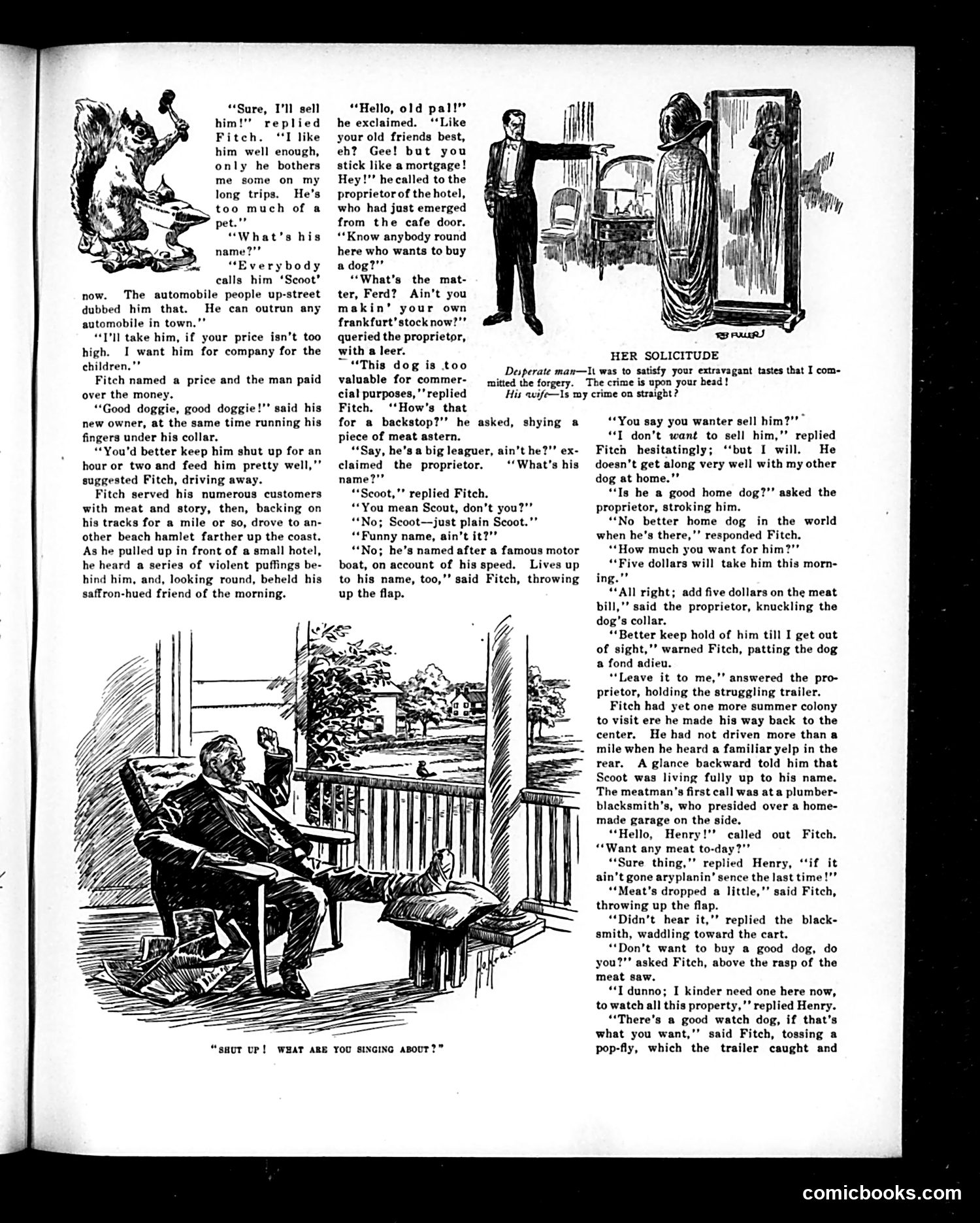
This is a humorous story about "Fitch," a traveling meat salesman who repeatedly sells the same dog—nicknamed "Scoot" because it runs fast—to different customers along his route, then retrieves it afterward. The satire mocks: **The Scheme:** Fitch exploits the dog's loyalty and speed, selling it as a "good home dog" to isolated customers (a hotel proprietor, a blacksmith), pocketing the money, then letting the dog escape back to him. **The Targets:** Gullible rural customers who accept thin excuses ("doesn't get along with my other dog"), and Fitch's dishonest entrepreneurship—a proto-con artist using charm and misdirection. **The Joke:** The dog's repeated returns expose Fitch's fraud. The cartoon satirizes small-town commerce and the trust locals place in traveling salesmen, who were historically unreliable figures in American folklore. The secondary cartoon "Her Solicitude" shows a woman indifferent to her husband's confession of committing forgery—she only cares if her hat is straight, satirizing shallow materialism.
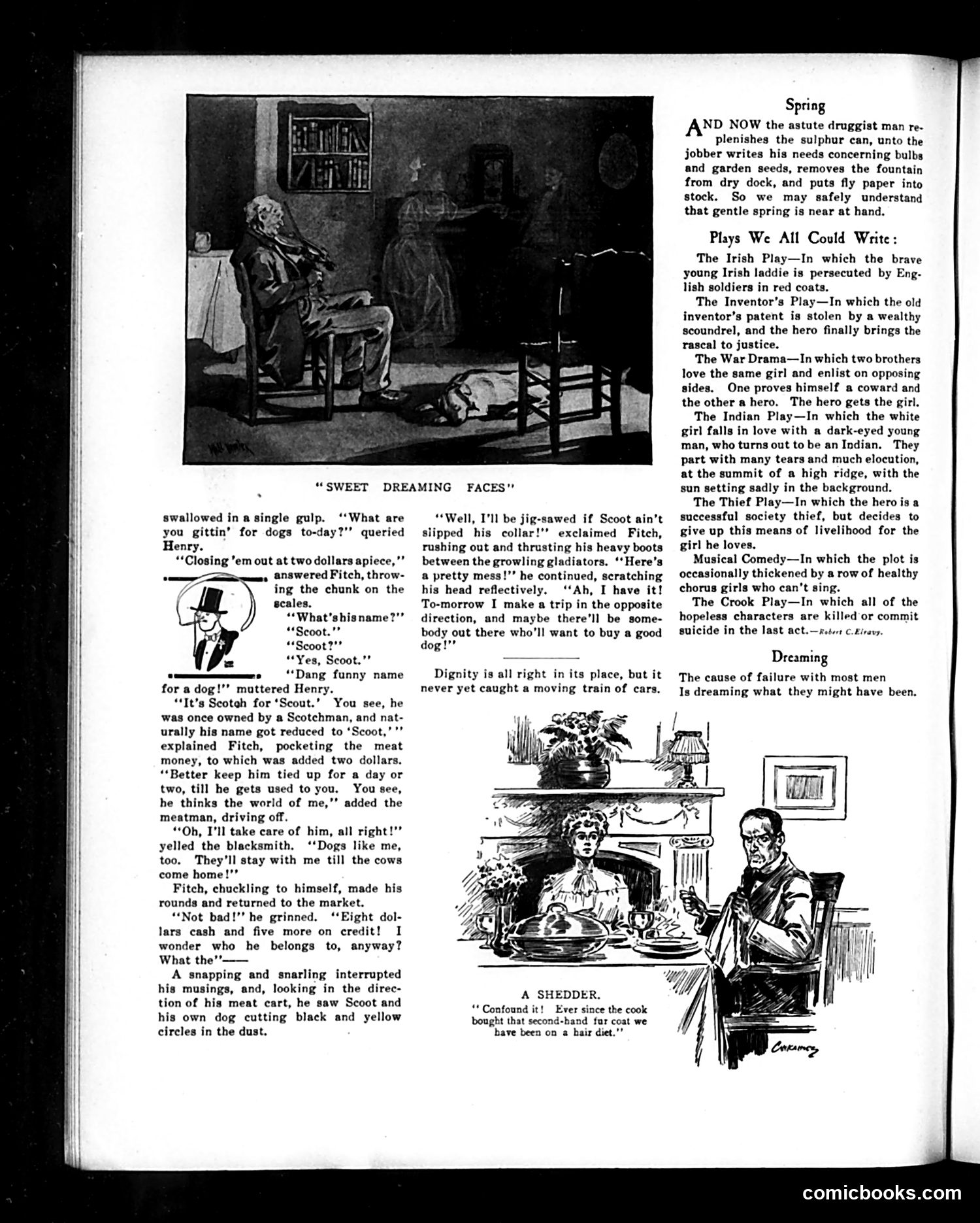
This story depicts a con game: a meatman named Fitch sells a dog named "Scoot" to a blacksmith named Henry for two dollars, claiming the dog is well-trained and loyal to him. After Henry takes the dog home, Fitch's own dog fights with Scoot—revealing the dog is aggressive and untrained. Fitch then plans to sell the same dog again to someone else in the opposite direction. The satire mocks dishonest salesmanship and small-time fraud. The joke is that Fitch has duped Henry, and plans to repeat the con with other unsuspecting buyers, passing off an uncontrollable animal as a valuable pet. The cartoon illustrates how dignity and reputation mean nothing compared to making a quick profit through deception—a commentary on unethical business practices of the era.
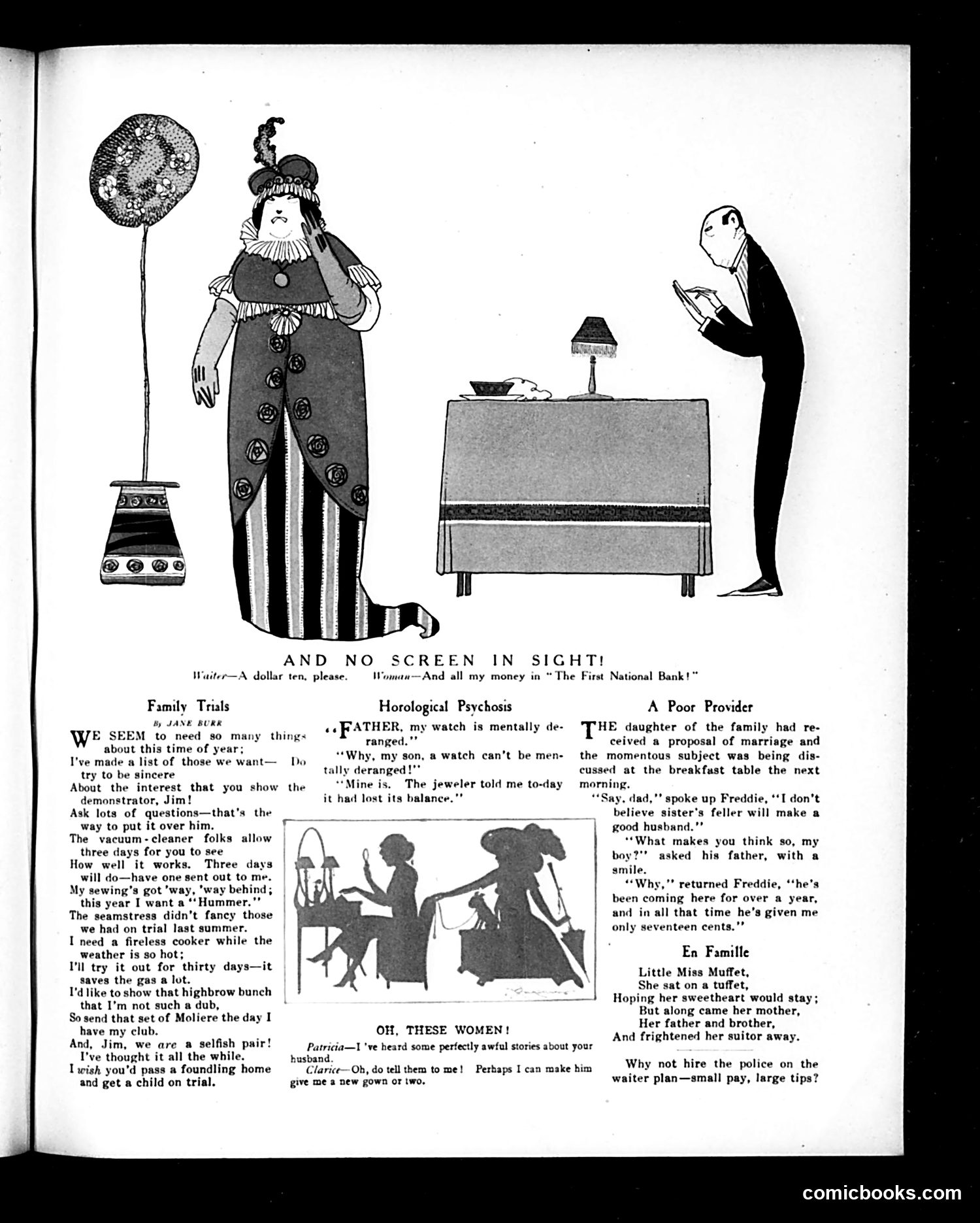
This Judge magazine page contains three satirical pieces about early 20th-century consumer culture and family life: **"Family Trials"** mocks wives who treat consumer goods like rentals. The wife pressures her husband Jim to request "trial" versions of vacuum cleaners, sewing machines, and cookware from salesmen, then keep them without purchasing. The joke: she then hypocritically suggests adopting a child "on trial"—exposing the absurdity of treating everything, even human welfare, as disposable consumer experiments. **"Horological Psychosis"** is a brief pun about a watch that's "mentally deranged" because it "lost its balance"—wordplay on psychological and mechanical terminology. **"A Poor Provider"** shows a father-son conversation where young Freddie concludes the suitor is a poor provider because he's only given him 17 cents in over a year—satirizing both stingy courtship behavior and children's mercenary thinking. The page satirizes materialism, consumer culture's pervasiveness, and gender dynamics in early 20th-century marriage markets.
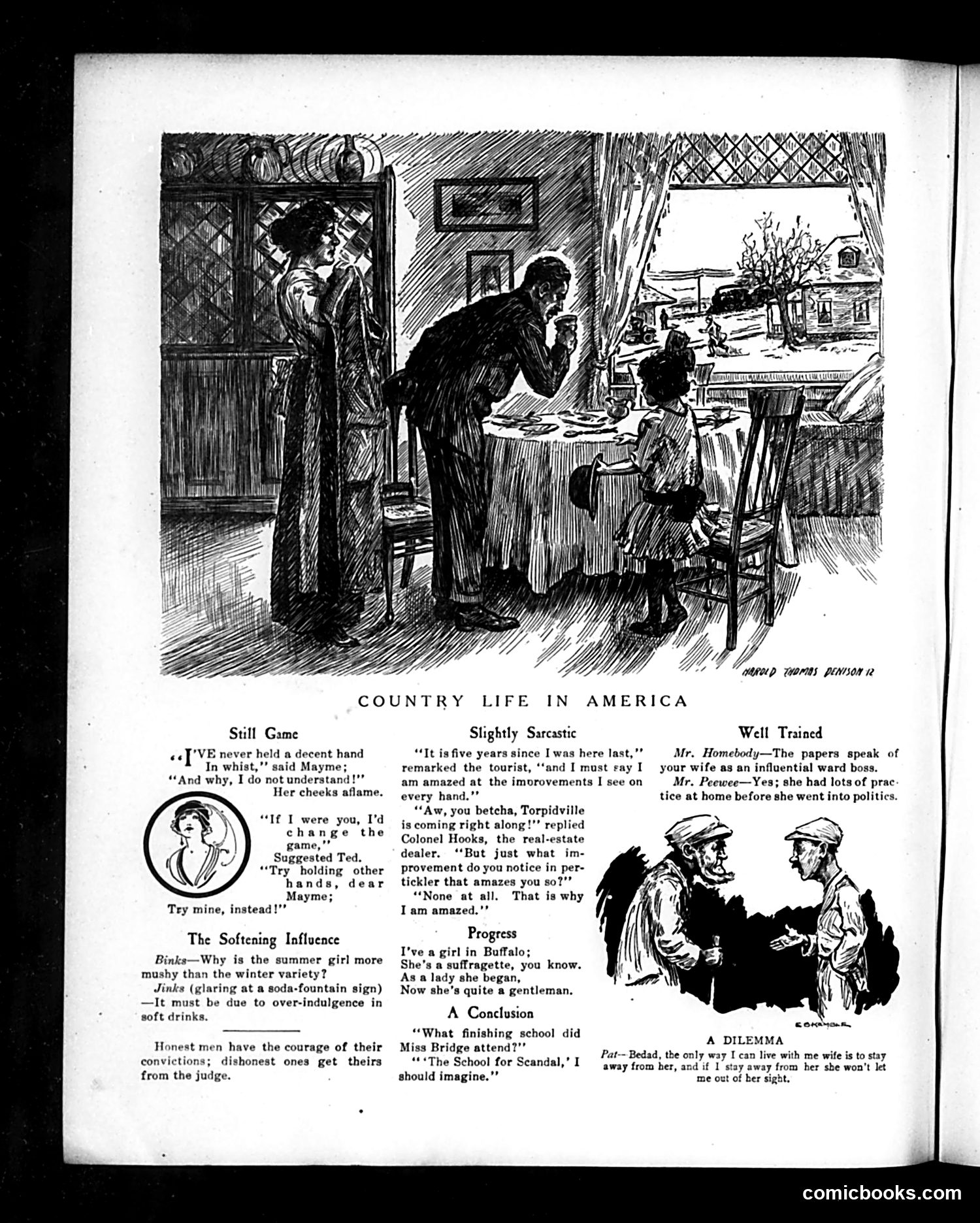
This page collects six brief satirical jokes mocking rural American life and social conventions of the era (likely early 1900s). **Key items:** - **"Still Game"**: Flirtation joke where a young woman (Mayme) complains about poor luck at whist card games; a suitor (Ted) suggestively proposes she try "holding other hands"—his own. - **"Well Trained"**: Mocks women's political involvement, suggesting a wife has become a powerful "ward boss" through domestic practice, implying women should stay home. - **"Progress"**: Satirizes the suffragette movement, joking that an activist woman has become "quite a gentleman" rather than remaining a "lady." - **"Slightly Sarcastic"**: A real-estate developer boasts of improvements to his town, then admits there are none—absurdist humor. - **"A Dilemma"**: Irish immigrant (Pat) trapped in impossible marital logic. The overall tone is conservative, mocking women's expanding social roles, suffrage activism, and modernization while celebrating traditional gender roles.
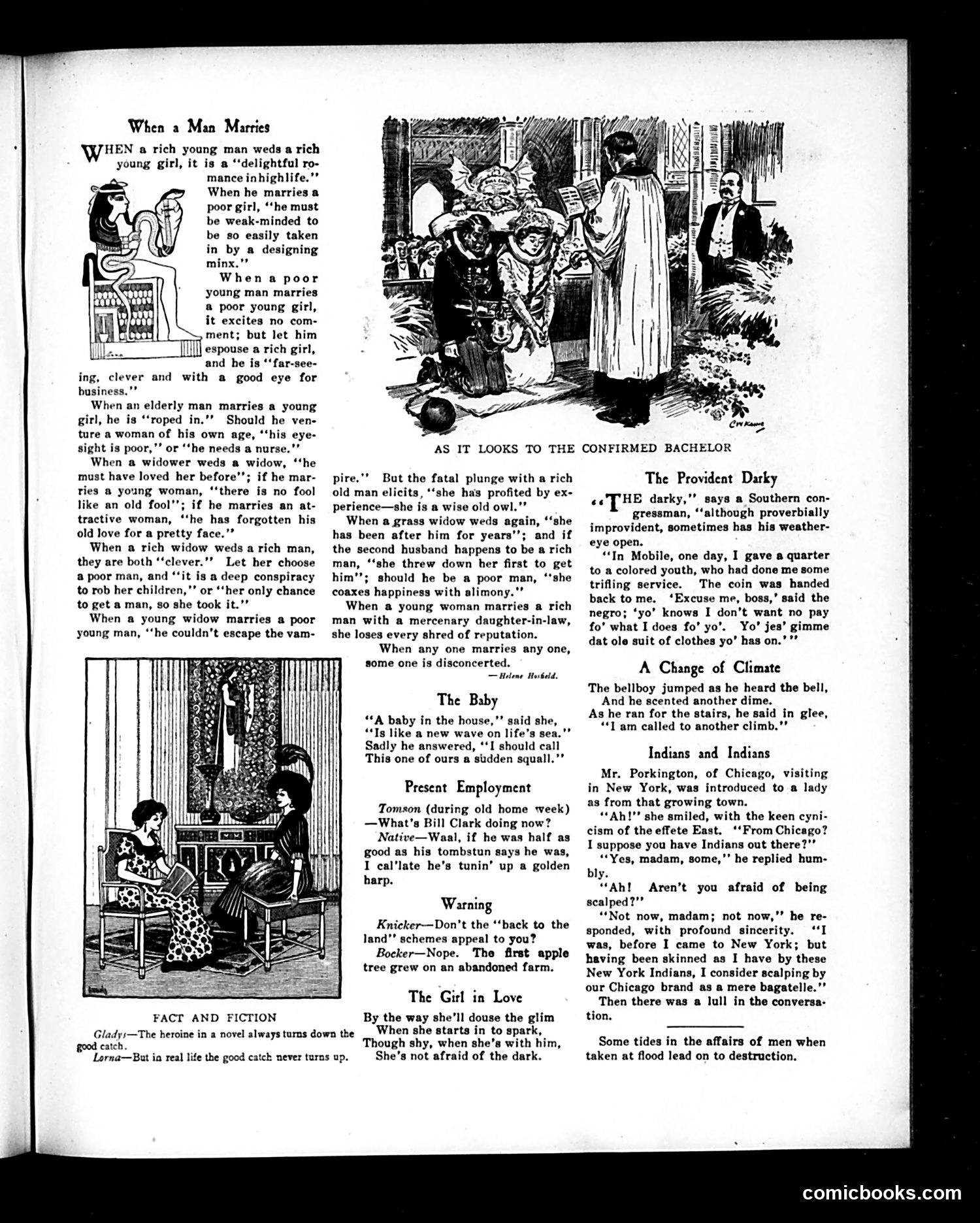
This page contains multiple satirical pieces mocking social hypocrisy about marriage and class. The main feature, "When a Man Marries," systematically exposes how society judges identical marriages differently based on wealth and gender. A rich man marrying a poor woman is "weak-minded," but a poor man marrying a rich woman is "clever"—the same act receives opposite moral judgment depending on who benefits financially. The cartoon titled "As It Looks to the Confirmed Bachelor" illustrates this double standard visually, showing marriage from a skeptical perspective. Other pieces include light humor: "Present Employment" jokes about a dead man's tombstone exaggerating his virtues; "Indians and Indians" presents an ethnic joke where a Chicago businessman claims New York society (the "Indians") has "skinned" him financially—treating aggressive capitalism as barbarism. The overall message: American society applies inconsistent moral standards to marriage based on wealth and gender, revealing that respectability is merely a mask for financial interest.
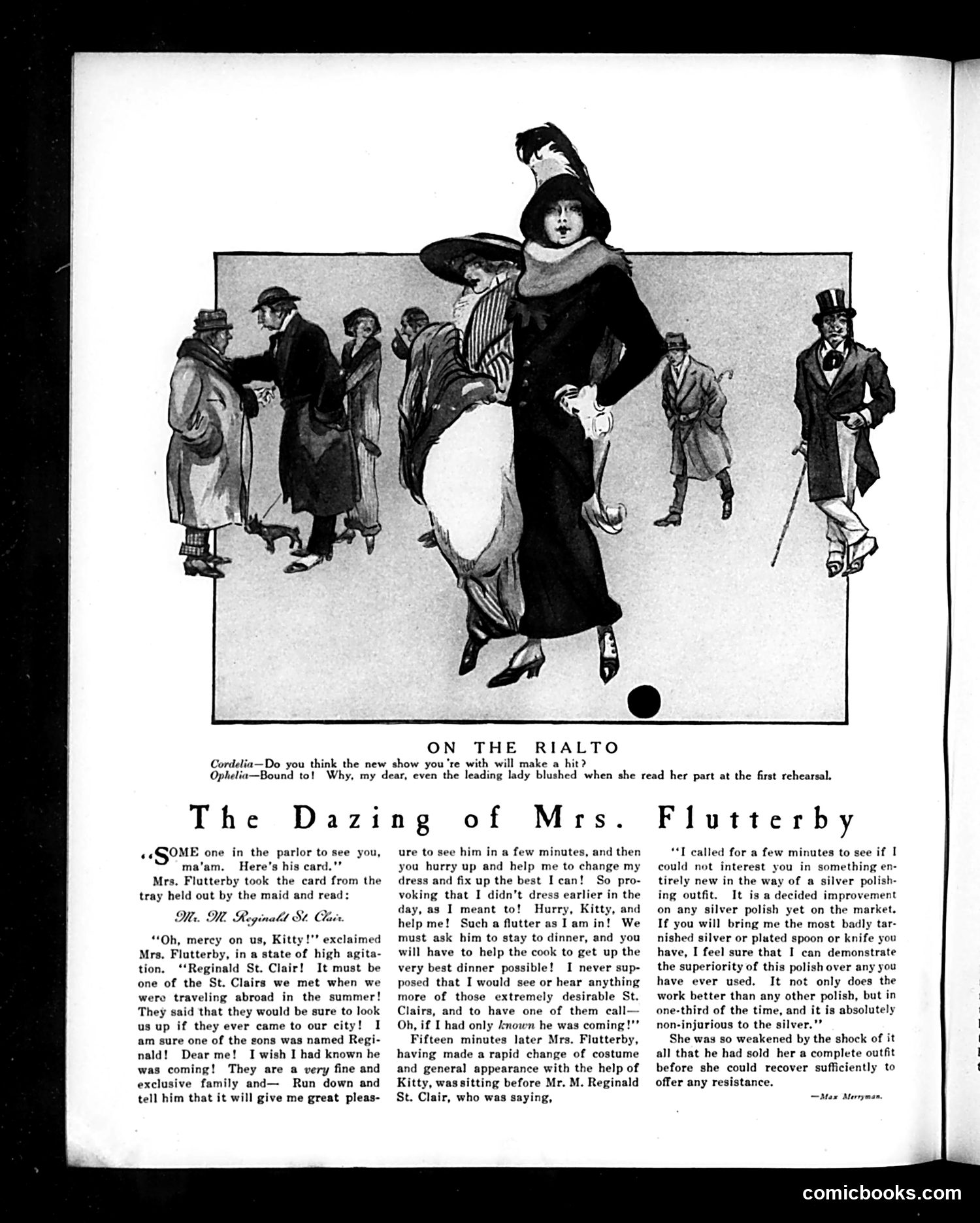
This is a satirical story about social pretension and gullibility. Mrs. Flutterby receives a calling card from "Mr. M. Reginald St. Clair" and assumes he's a distinguished family member she met abroad. She frantically prepares herself and her household, planning an elaborate dinner in his honor. The joke: he's actually a silver-polish salesman making routine sales calls. The satire targets upper-class women who are so impressed by aristocratic-sounding names and social anxiety about entertaining that they become easy marks for con artists. Mrs. Flutterby is so flustered and weakened by embarrassment that she doesn't resist his sales pitch and buys his entire product line. The cartoon illustrations above show fashionable people of the era, likely representing the social pretensions being mocked. The humor relies on the gap between Mrs. Flutterby's expectations and reality.
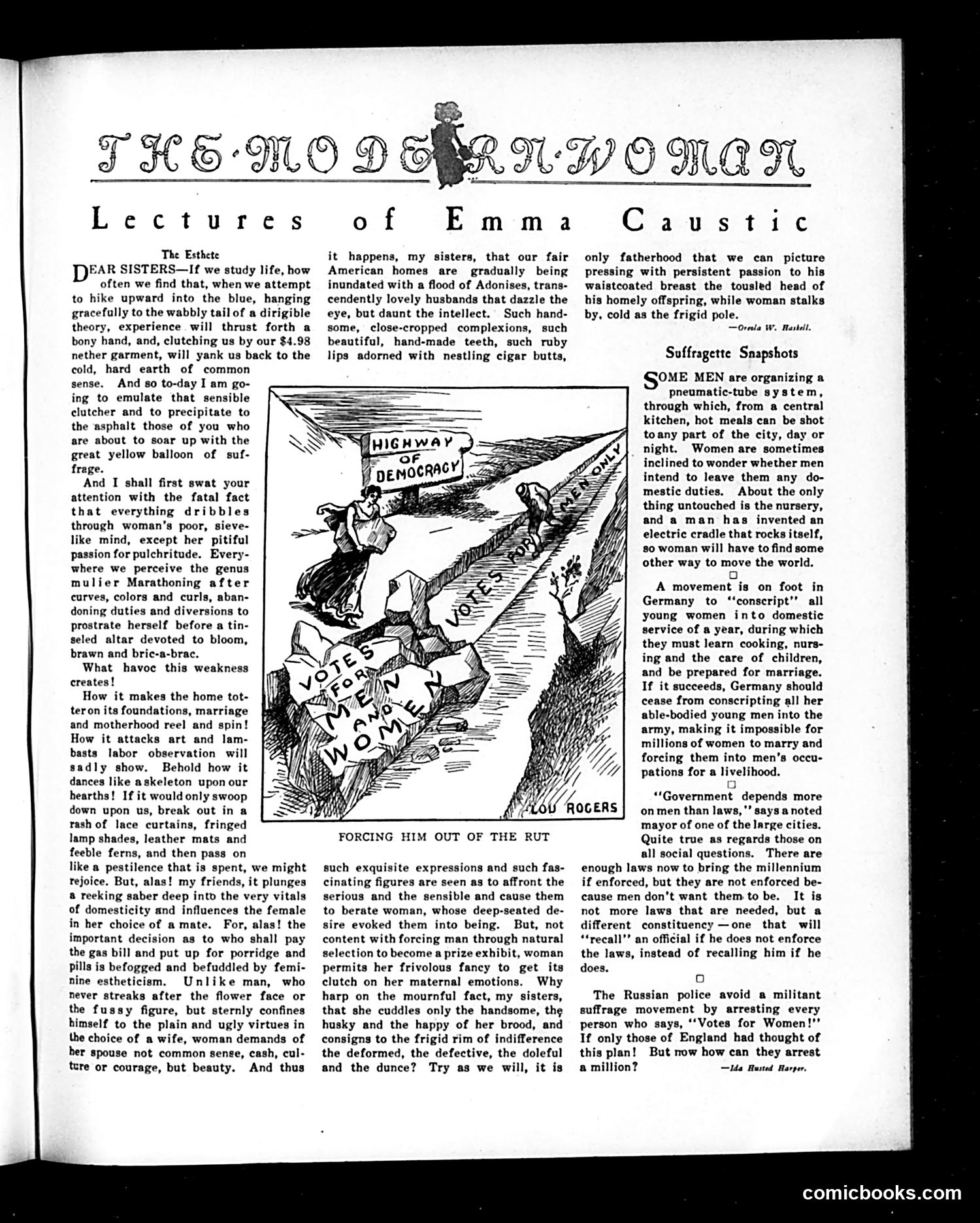
This page contains two distinct pieces satirizing women's suffrage and feminism from the early 20th century. **"The Esthete" (main lecture text with cartoon):** An anti-suffrage argument claims women lack intellectual capacity, caring only about physical beauty. The speaker argues this superficiality corrupts marriage, motherhood, and even natural selection—women choose handsome but dim husbands and favor attractive children over homely ones. The cartoon shows a woman pushing a man labeled "VOTES FOR WOMEN" off the "HIGHWAY OF DEMOCRACY," suggesting suffrage will derail progress. **"Suffragette Snapshots":** Satirical commentary mocking women's liberation. It describes labor-saving inventions (pneumatic meal tubes, electric cradles) that supposedly eliminate women's domestic roles, sarcastically asking what purpose women will serve if freed from household work. Both pieces use the suffrage debate as a vehicle for misogynistic arguments: women are vain, intellectually inferior, and naturally suited only to domestic servitude. The satire assumes readers will find these claims amusing rather than objectionable.
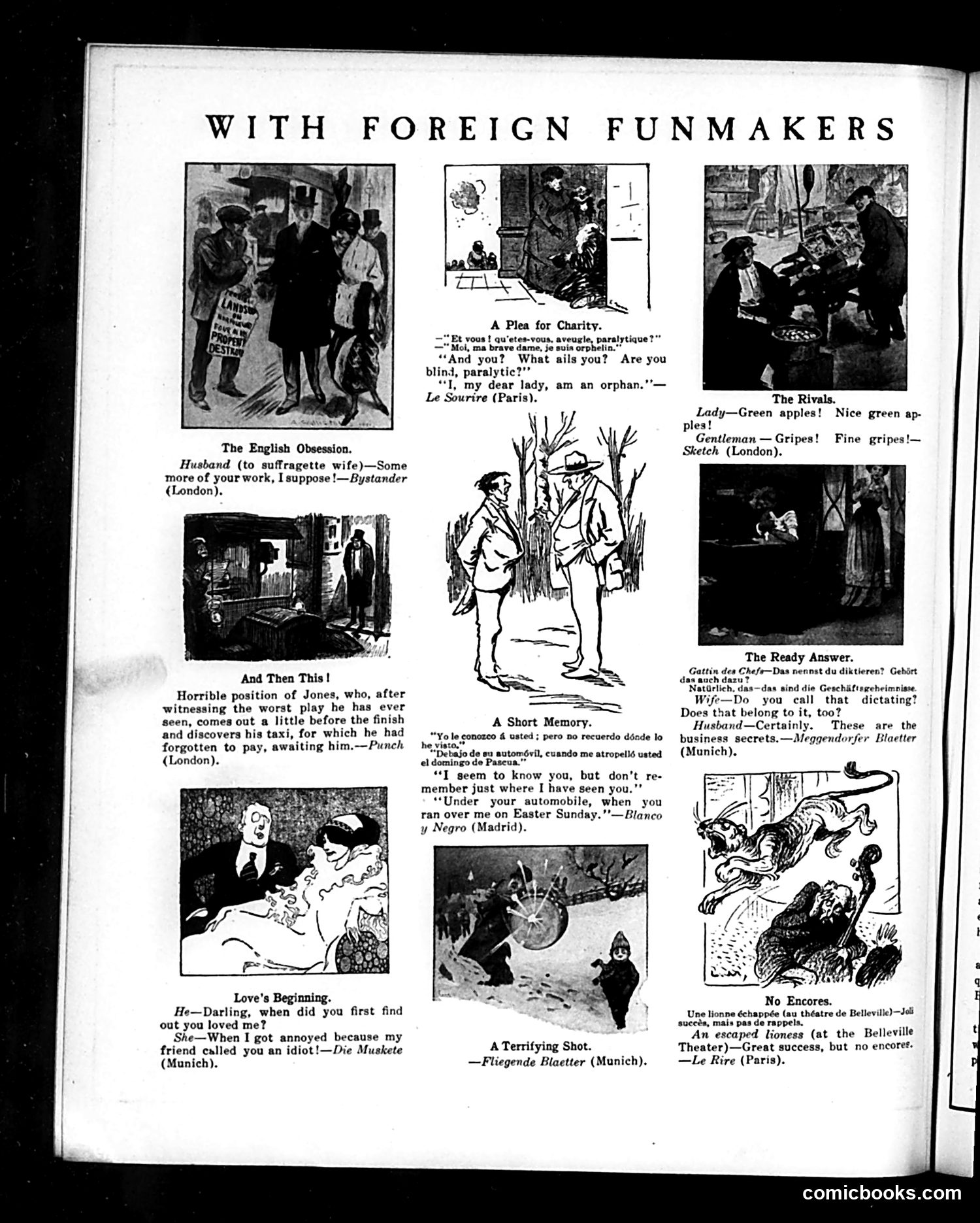
This page collects satirical cartoons and jokes from European magazines (Paris, London, Munich, Madrid), presenting them to American readers. Key themes include: **Social commentary**: "The English Obsession" mocks suffragettes (women's voting rights activists), portraying a husband dismissing his wife's political activism. This reflects anti-suffrage sentiment of the era. **Everyday absurdities**: Several jokes play on modern inconveniences—a theater-goer's forgotten taxi fare, a hit-and-run victim who encounters the driver again. **Gender dynamics**: "Love's Beginning" jokes about female logic; "The Ready Answer" depicts a husband keeping "business secrets" from dictation, implying marital deception or infidelity. **Physical comedy**: Cartoons feature slapstick and visual gags (the lion escape, dogs attacking). The page demonstrates how Judge presented "continental" European humor as exotic entertainment for American audiences, while the suffragette cartoon reveals the publication's conservative political stance.
This is an advertisement for an art contest, not a political cartoon. Judge magazine is soliciting paintings on the subject of "Dangerous Servants"—a moral allegory about three addictive substances: **tobacco, alcohol, and coffee**. The competition offers substantial prize money ($2,000 and two $500 prizes) for skillfully executed paintings depicting how these drugs enslave men. The text presents a temperance message: these substances appear harmless or even beneficial initially, but become "tyrannous and cruel masters" through habit, ultimately causing physical and mental breakdown. This reflects early 20th-century Progressive-era concerns about drug addiction and social reform. The personification of substances as "servants" that become masters is a common anti-drug metaphor of the period. Artists are invited to visualize this cautionary tale for the magazine's educated, reform-minded readership.
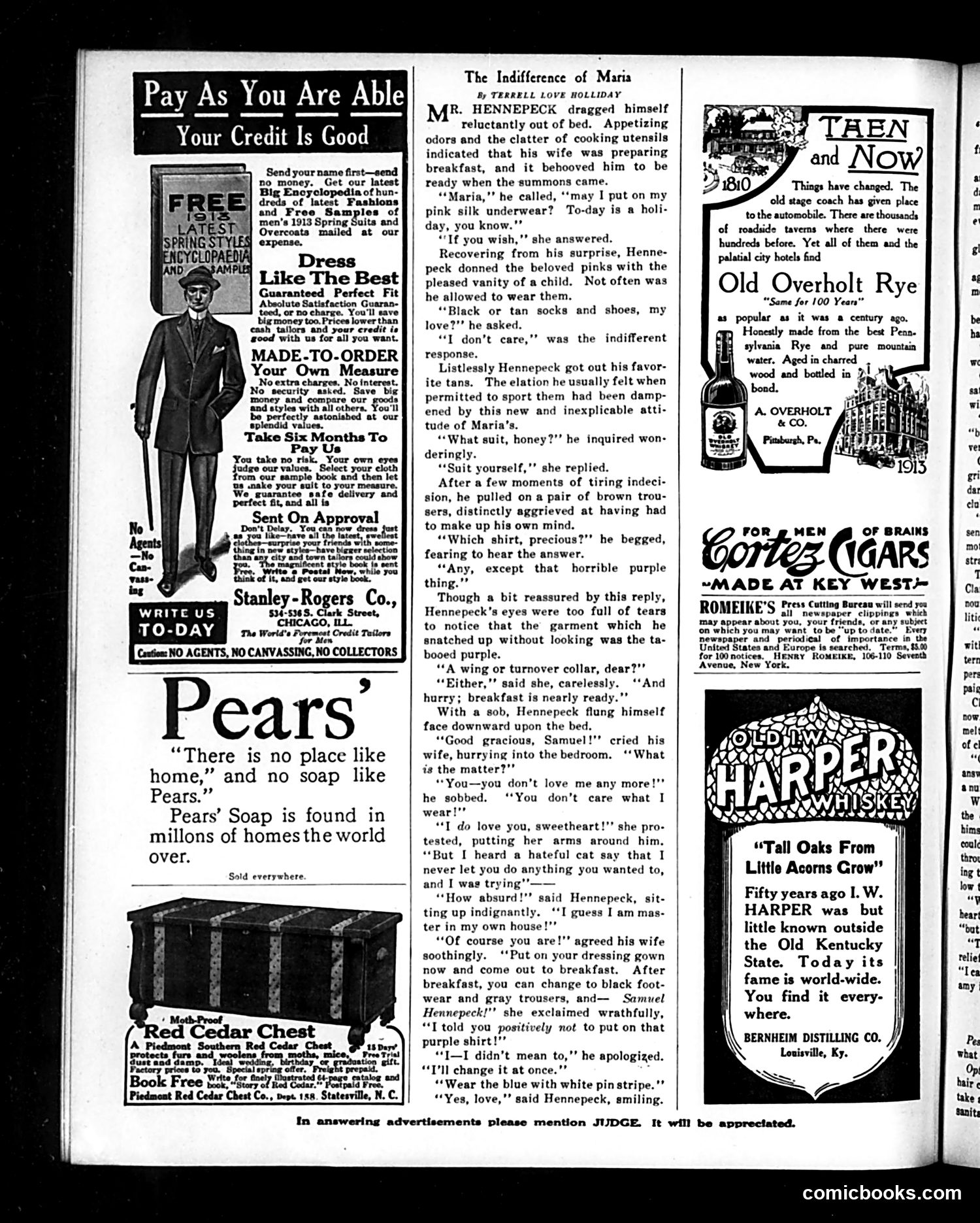
This short story satirizes the "henpecked husband" archetype popular in early 20th-century humor. Mr. Hennepeck is a timid, submissive man who constantly seeks his wife Maria's approval on trivial decisions (what underwear, socks, and shirt to wear). The joke's irony: when Maria suddenly becomes *indifferent*—giving him freedom to choose—Hennepeck emotionally collapses, claiming she no longer loves him. He's so accustomed to her domination that autonomy distresses him. The satirical point cuts both ways: it mocks both nagging wives and weak husbands overly dependent on female direction. The resolution reinforces the stereotype: Maria resumes control (ordering him to wear the blue shirt), and Hennepeck smiles contentedly—suggesting he *prefers* being dominated. This reflects early 1900s gender anxieties about marriage roles and male authority, presented through exaggerated domestic comedy.
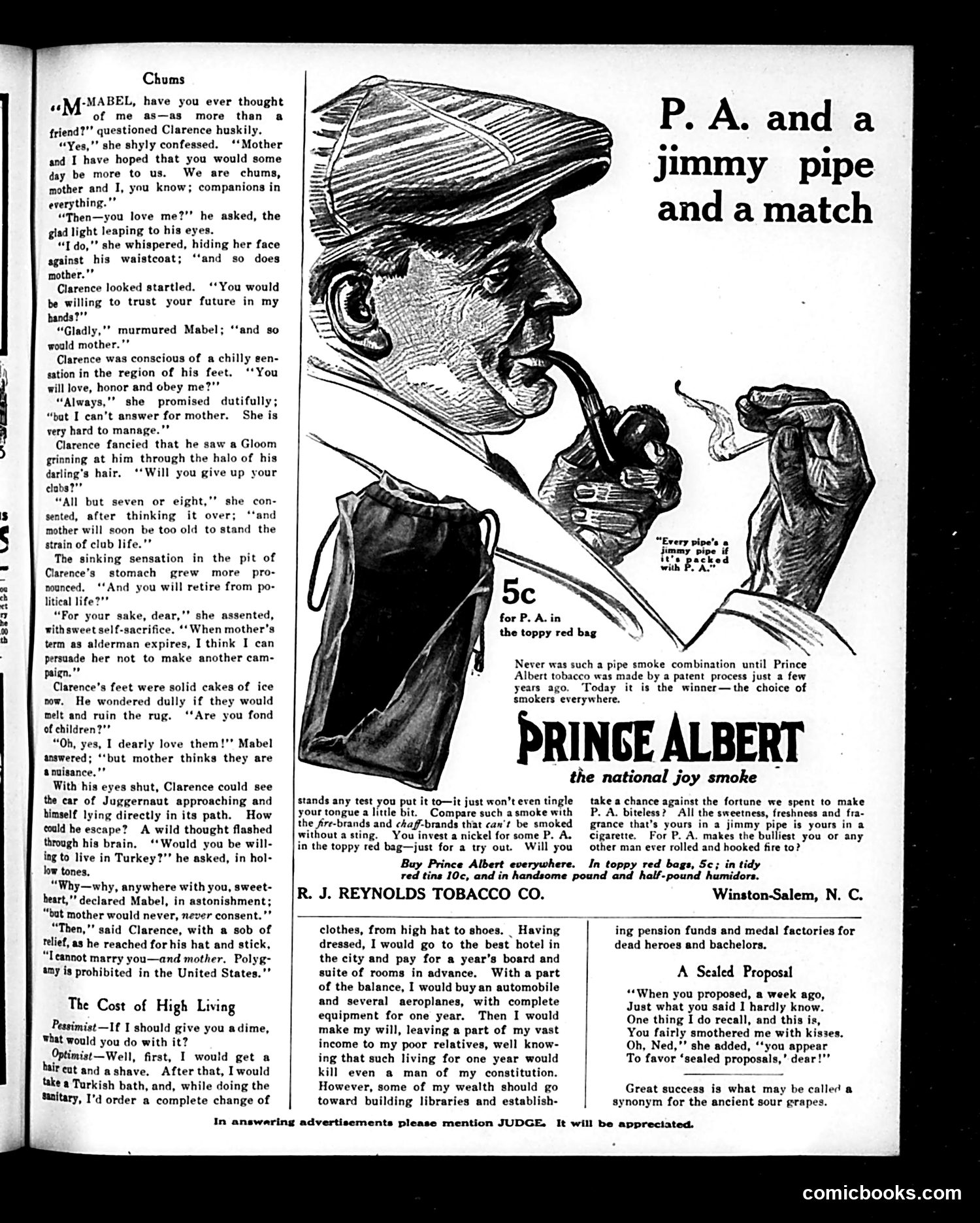
This page contains **two distinct elements**: a short satirical story and a tobacco advertisement. **"Chums" Story (left):** A comic dialogue mocking modern independent women. Clarence proposes to Mabel, expecting a traditional wife, but discovers she and her mother are politically active—the mother is an alderman—and both belong to multiple clubs. Each condition he requests (obey him, leave politics, retire from clubs), Mabel agrees to only after consulting "mother." The joke's punchline: unable to accept marrying both women, Clarence escapes by invoking laws against polygamy. The satire targets anxieties about women's suffrage and independence; the mother-in-law becomes a humorous stand-in for loss of male authority. **Prince Albert Tobacco Ad (right):** A straightforward cigarette advertisement claiming the tobacco is "biteless" and superior to competing brands. Features illustrations of a pipe smoker's hands. **Historical context:** This reflects early 20th-century anxiety about women entering politics and public life, presented as comedic threat to traditional marriage.
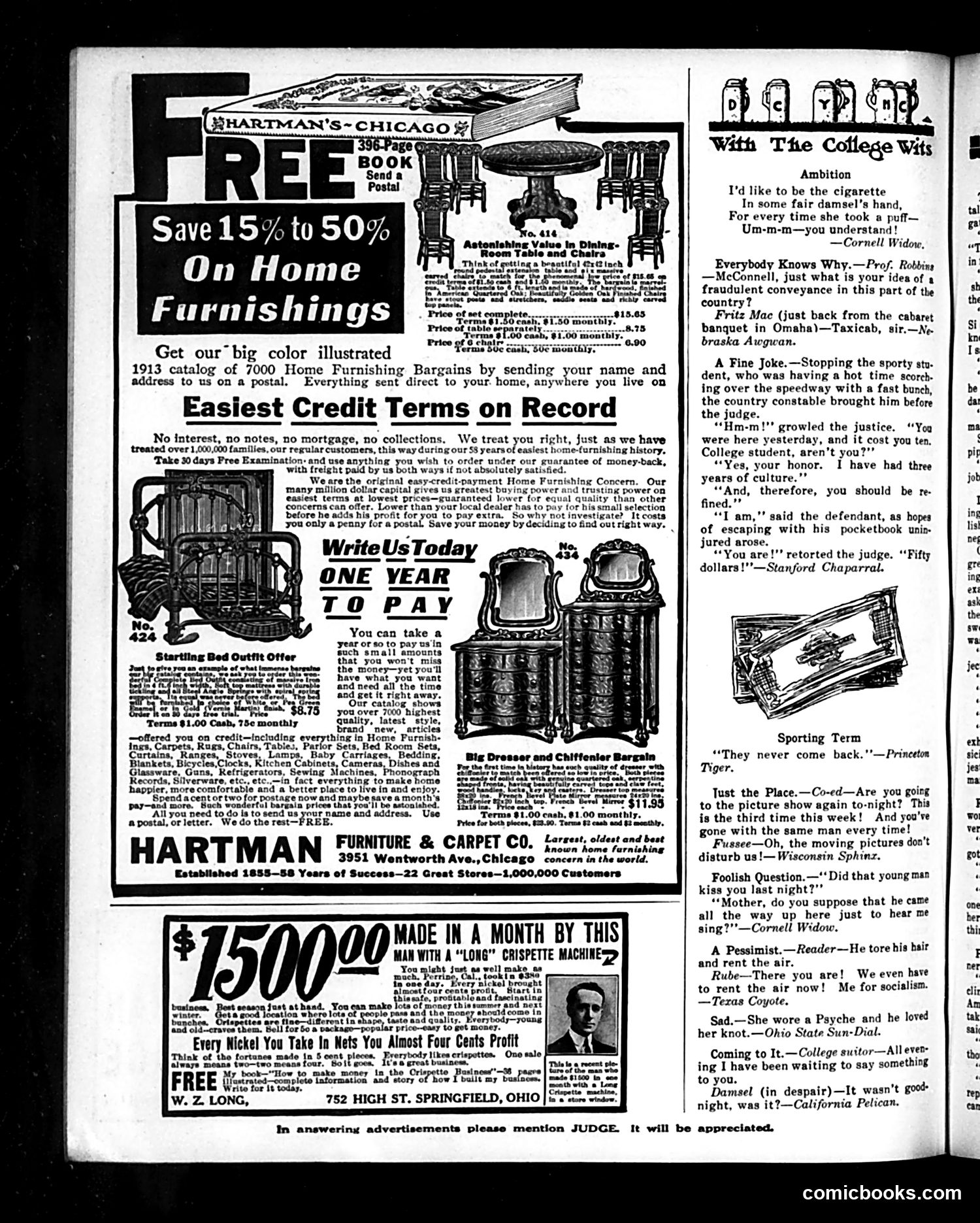
This page is primarily **advertising**, not satire or editorial content. The dominant features are three major advertisements: 1. **Hartman Furniture & Carpet Co.** (top, largest): Promotes easy credit terms for home furnishings—"One Year to Pay" with small monthly installments. The appeal targets working-class customers seeking affordable furniture without interest or mortgages. 2. **Crispette Machine** (bottom): A get-rich-quick scheme promising "$1,500 made in a month" by selling fried snacks. The small print acknowledges skepticism but claims high profit margins. The right column contains **"With The College Wits"**—a humor section with short jokes about college students, mostly involving romantic/sexual innuendo (the cigarette joke), misconduct, and foolish behavior. These are light, formulaic gags typical of early 1900s college humor. The page reflects early-20th-century consumer culture: installment buying as economic innovation, entrepreneurial dreams, and college life as comedic subject matter.
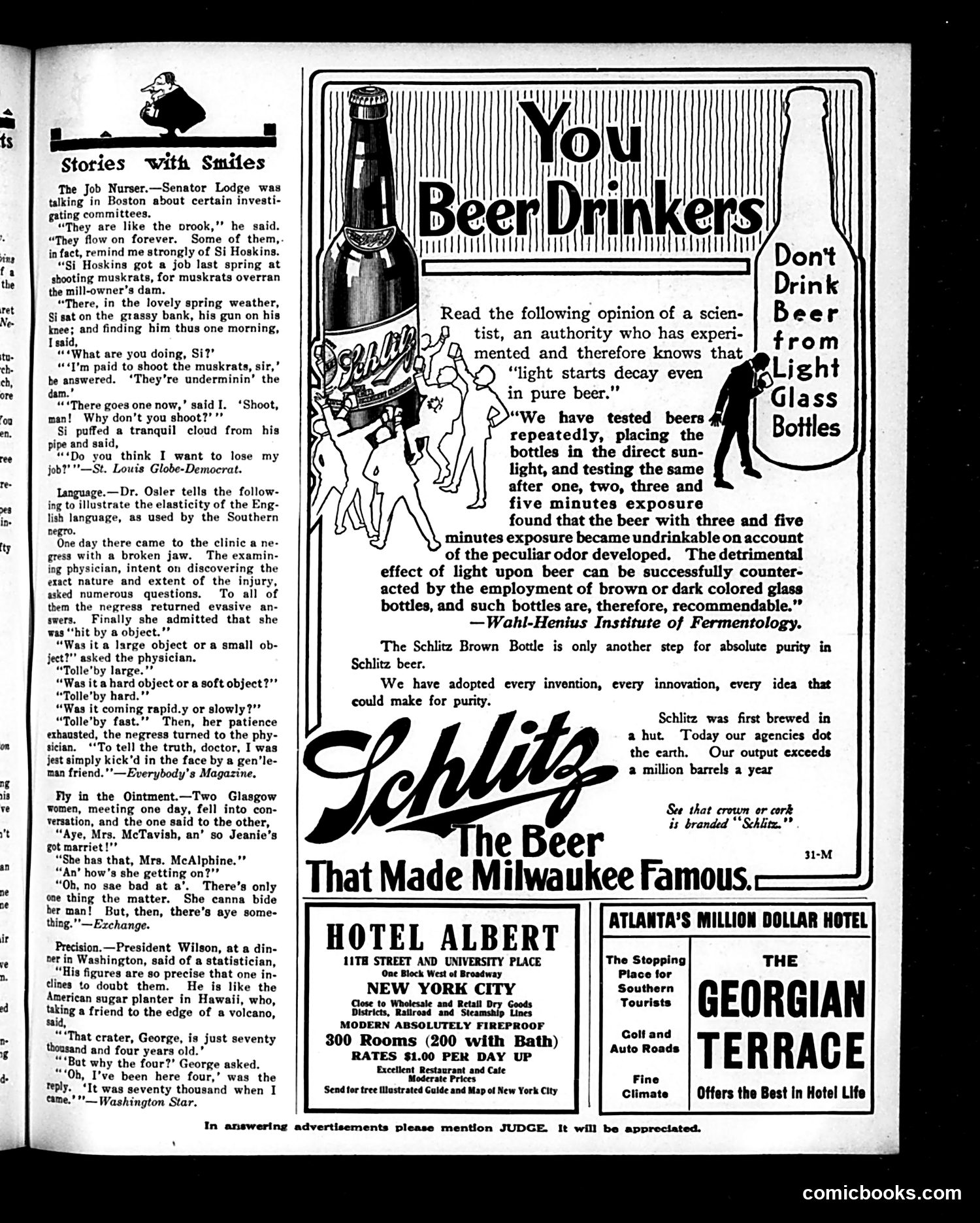
This page from Judge contains several humor pieces and advertisements typical of the era. **The humor sections** ("Stories with Smiles") are short anecdotes illustrating linguistic or bureaucratic absurdities. Senator Lodge's muskrat story satirizes endless investigating committees that never accomplish their goals. Dr. Osler's anecdote mocks Southern dialect and medical examination procedures. The Scottish women's dialogue is ethnic humor playing on working-class Scottish speech patterns. **The dominant advertising content** is a Schlitz beer advertisement promoting brown bottles to prevent light damage to beer—presented as scientific fact from the Wahl-Henius Institute. This directly addresses a real concern: early refrigeration and electric lighting made "skunky" beer (damaged by light exposure) a consumer problem. Schlitz positioned their brown bottles as the solution, claiming purity and innovation. **Minor advertisements** promote Hotel Albert (NYC) and The Georgian Terrace (Atlanta). The page reflects early 20th-century concerns: bureaucratic inefficiency, class/ethnic stereotyping in humor, and emerging consumer product competition around technology and quality assurance.
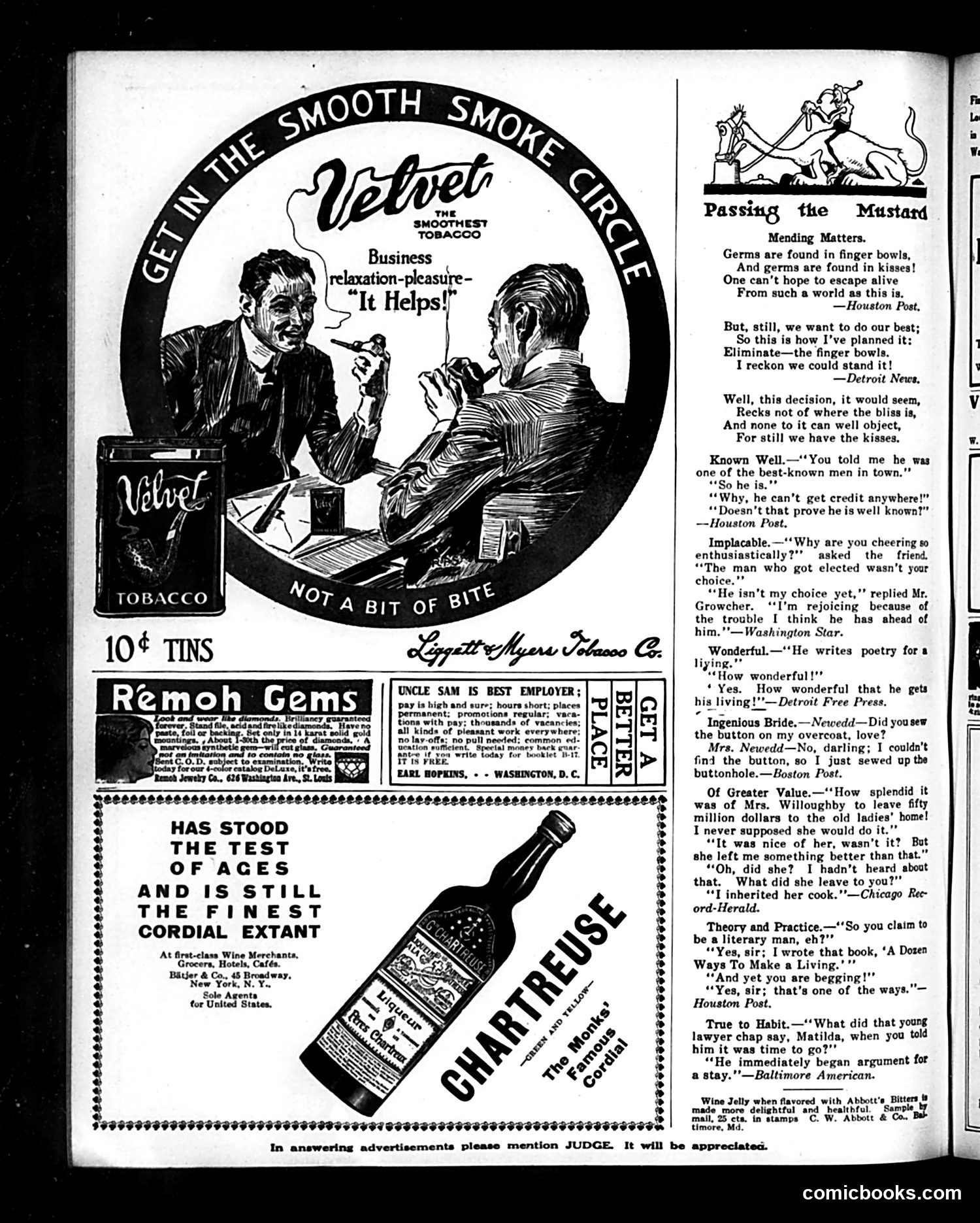
This page is primarily **advertising and humor content** rather than political cartoons. The main featured advertisement is for **Velvet Tobacco** (10¢ tins), depicting two businessmen in a circular frame with the slogan "Business relaxation-pleasure—It Helps!" and "Not a Bit of Bite." This reflects early 20th-century marketing that positioned smoking as a sophisticated business and leisure activity. Below are advertisements for diamond rings, Uncle Sam employment information, and Chartreuse liqueur. The right column contains **short humor pieces** ("Passing the Mustard" section)—brief jokes on domestic life, politics, and social situations. These appear to be general comedy pieces rather than satirical commentary on specific events or figures. The overall page reflects period attitudes: casual acceptance of tobacco/alcohol advertising, domestic humor centered on wives and husbands, and light political jokes without targeting specific individuals or policies.
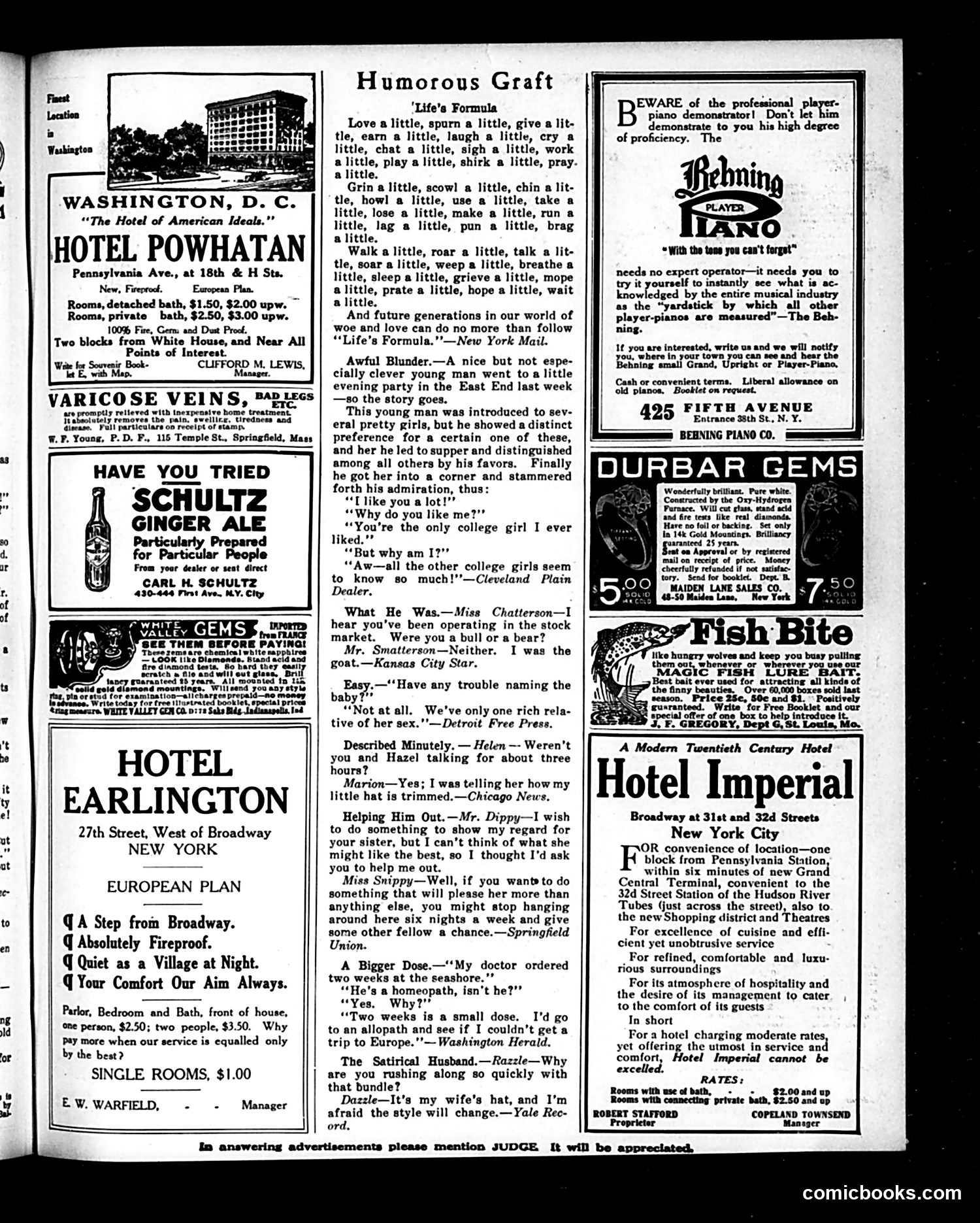
This page is primarily **advertising and humor pieces**, not political cartoons. The content includes: **Main Features:** - Hotel advertisements (Powhatan, Earlington, Imperial) targeting wealthy travelers - Product ads (ginger ale, gems, piano player) - A section titled "Humorous Graft" with *Life's Formula*—a satirical poem mocking the endless cycle of human existence through repetitive "a little" phrases **The Jokes:** The humor section contains light social satire about courtship and manners: - A young man awkwardly compliments a college girl by saying she's the only educated one he liked - Stock market humor (being the "goat" rather than bull/bear) - Marital/dating comedy about women's preoccupations and persistent suitors **Context for Today:** This represents *Judge* magazine's lighter content—social commentary on dating, class consciousness, and everyday foolishness rather than hard political satire. The ads reflect early 20th-century hotel culture and consumer products aimed at the middle-to-upper class. The humor is genteel and assumes familiarity with parlor society conventions.
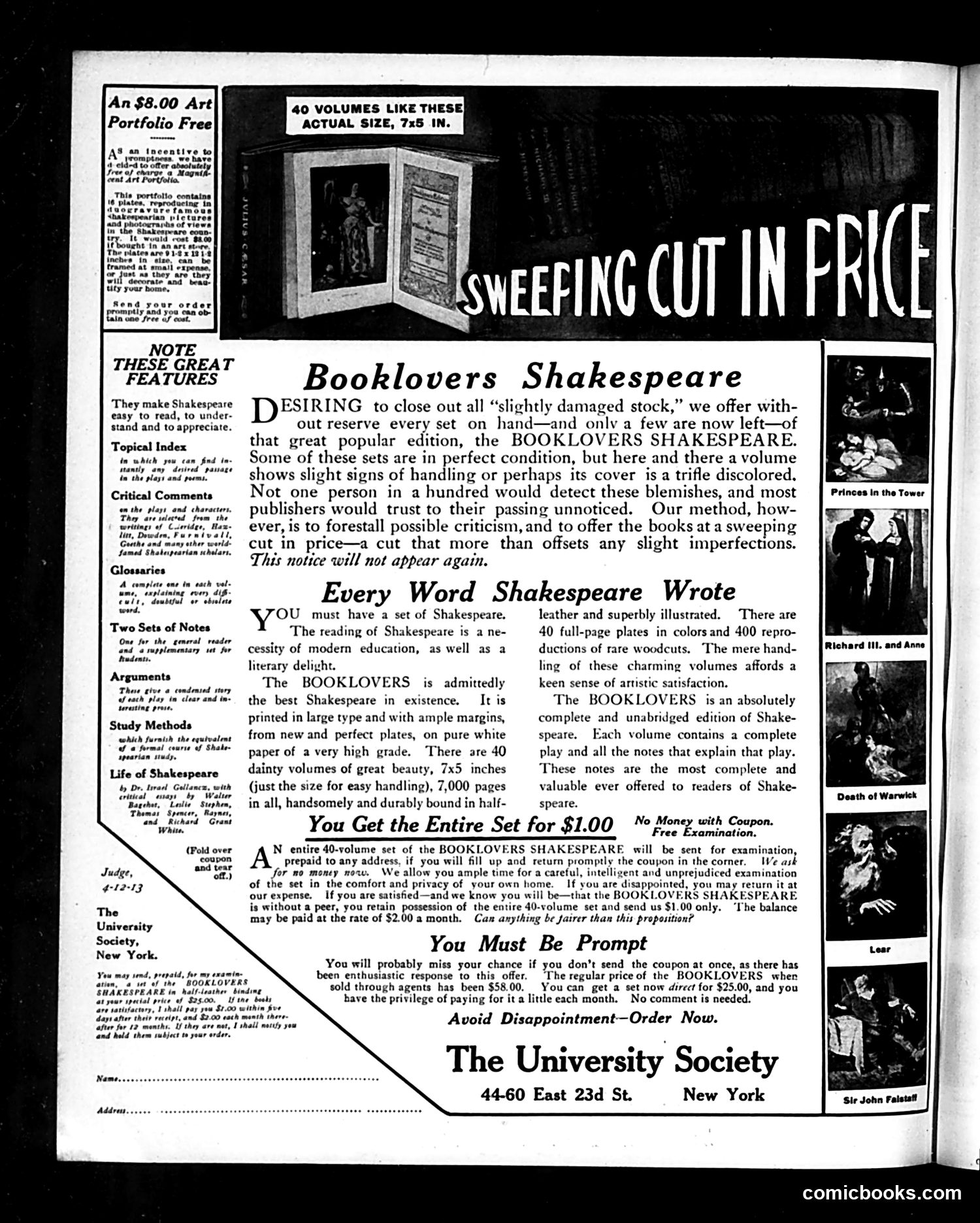
This is primarily a **direct-mail advertisement**, not political satire. It promotes the "Booklovers Shakespeare"—a 40-volume illustrated edition of Shakespeare's complete works. The page uses a common early 20th-century marketing tactic: claiming "slightly damaged stock" requires clearance at drastically reduced prices ($1.00 versus the regular $25-$58 retail). The "sweeping cut in price" headline emphasizes the discount. The small theatrical photographs on the right (Princess in the Tower, Richard III and Anne, Death of Warwick, Lear, Sir John Falstaff) illustrate scenes from various plays, serving as visual marketing. The appeal targets educated middle-class readers: Shakespeare is framed as a necessity for "modern education" and "literary delight." The offer includes free examination with a coupon before payment. There is **no political satire** visible here—this is straightforward advertising using period-appropriate sales psychology: urgency ("miss your chance"), social aspiration, and the perception of getting premium goods cheaply.