
Judge, 1913-04-12 · page 8 of 24
Judge — April 12, 1913 — page 8: what you’re looking at
What you’re looking at
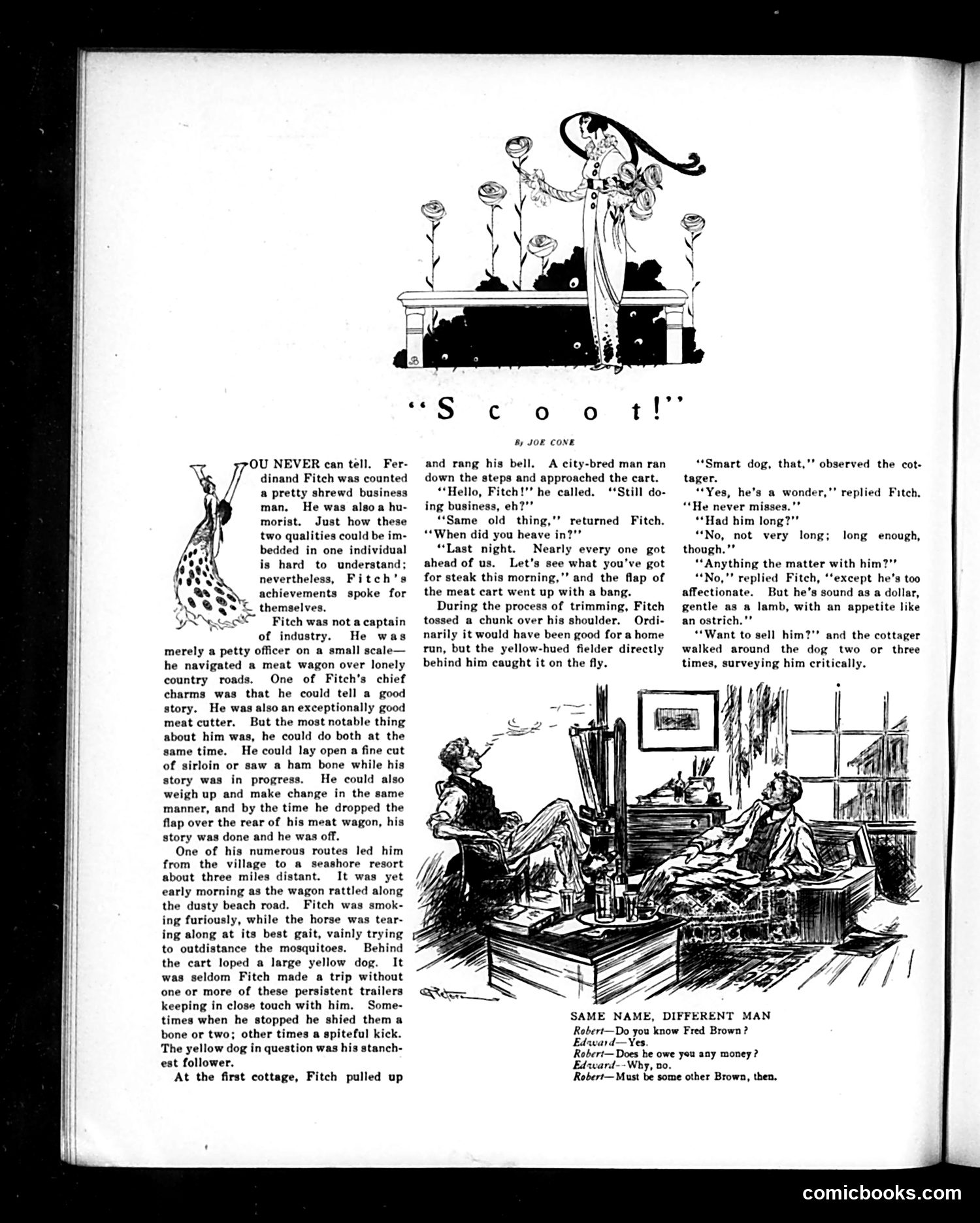
This is a humorous short story illustrated with sketches rather than a political cartoon. It depicts Ferdinand Fitch, a meat wagon driver characterized as both shrewd and witty—a seemingly contradictory combination. The narrative follows Fitch on his regular route to a seaside resort, accompanied by his loyal yellow dog. When a city-bred customer admires the dog's athleticism after it catches a piece of meat mid-air, he inquires about purchasing it. The story appears to set up a comedic transaction or misunderstanding. The accompanying dialogue snippet ("Same Name, Different Man") is an unrelated joke about mistaken identity among people sharing common names. The satire gently mocks rural commerce and the character types of small-town America—the shrewd tradesman, the curious tourist, and the faithful stray dog.
📄 Transcribed text from this page (OCR, searchable)
Machine-transcribed from the original scan — historical spelling and the odd misread are preserved.
OU NEVER can tell. Fer- dinand Fitch was counted a pretty shrewd business man. He was also a hu- morist. Just how these two qualities could be im- bedded in one individual is hard to understand; nevertheless, Fitch's achievements spoke for < themselves. © Fitch was not a captain of industry. He was merely a petty officer on a small scale— he navigated a meat wagon over lonely country roads. One of Fitch's chief charms was that he could tell a good story. He was also an exceptionally good meat cutter. But the most notable thing about him was, he could do both at the same time. He could lay open a fine cut of sirloin or saw a ham bone while his story was in progress. He could also weigh up and make change in the same manner, and by the time he dropped the flap over the rear of his meat wagon, his story was done and he was off. One of his numerous routes led him from the village to a seashore resort about three miles distant. It was yet early morning as the wagon rattled along the dusty beach road. Fitch was smok- ing furiously, while the horse was tear- ing along at its best gait, vainly trying to outdistance the mosquitoes. Behind the cart loped a large yellow dog. It was seldom Fitch made a trip without one or more of these persistent trailers keeping in close touch with him. Some- times when he stopped he shied them a bone or two; other times a spiteful kick. The yellow dog in question was his stanch- est follower. At the first cottage, Fitch pulled up fo} By JOR CONE and rang his bell. A city-bred man ran down the steps and approached the cart. “Hello, Fitch!" he called. ‘*Still do- ing business, eh?’’ “Same old thing,"’ returned Fitch. “‘When did you heave in?” “Last night. Nearly every one got ahead of us. Let's see what you've got for steak this morning,"’ and the flap of the meat cart went up with a bang. During the process of trimming, Fitch tossed a chunk over his shoulder. Ordi- narily it would have been good for a home run, but the yellow-hued fielder directly behind him caught it on the fly. “‘Smart dog, that,”’ observed the cot- tager. “*Yes, he’s a wonder,"’ replied Fitch. ‘He never misse **Had him long? “No, not very though.’” “Anything the matter with him?” “No,” replied Fitch, ‘except he’s too affectionate. But he’s sound as a dollar, gentle as a lamb, with an appetite like an ostrich."” **Want to sell him?"’ and the cottager walked around the dog two or three times, surveying him critically. long; long enough, SAME NAME, DIFFERENT MAN Robert—Do you know Fred Brown? -Why, no. Robert—Must be some other Brown, then. comicbooks.com