
Judge, 1913-04-12 · page 4 of 24
Judge — April 12, 1913 — page 4: what you’re looking at
What you’re looking at
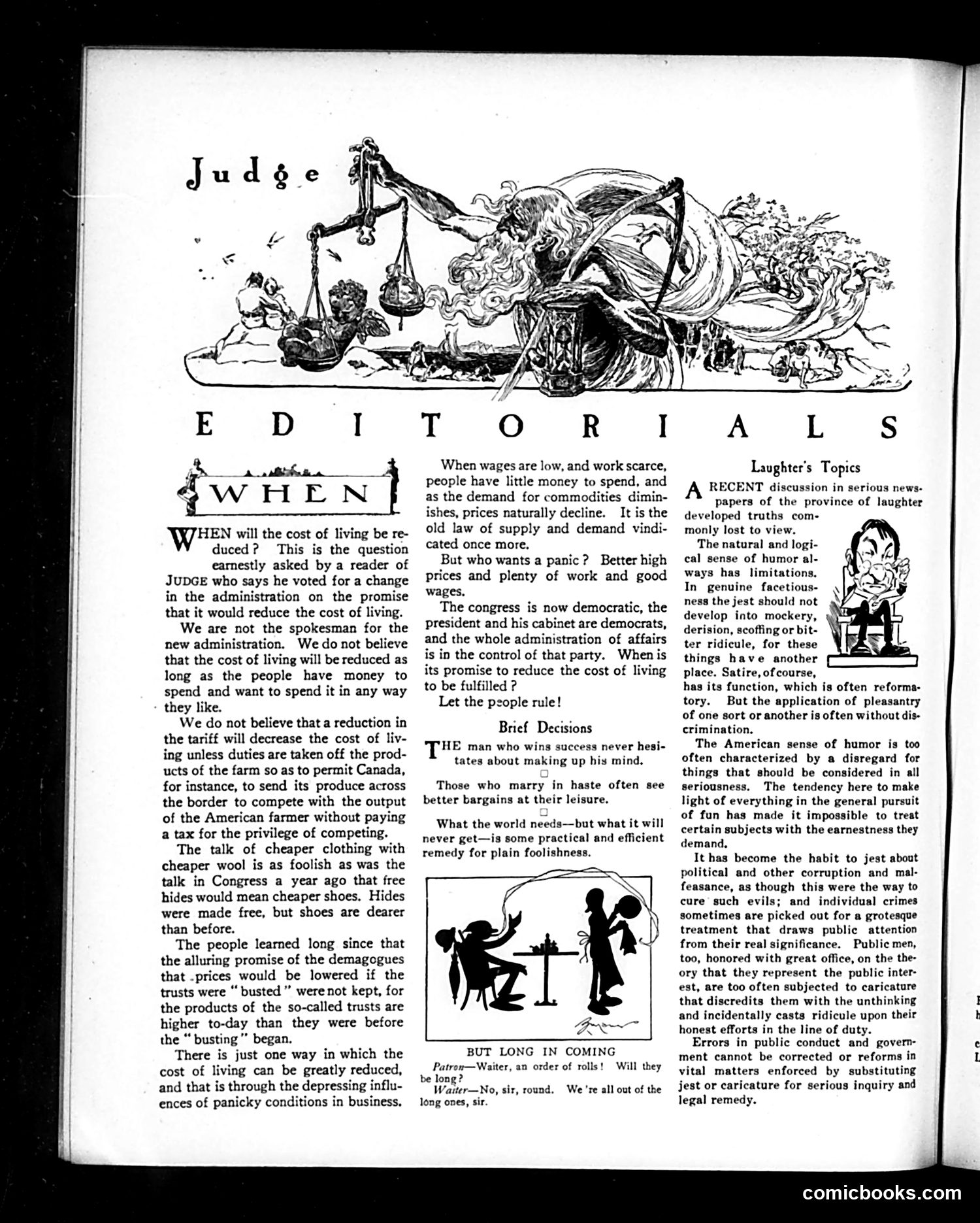
This page satirizes Democratic economic promises. The main editorial "When" mocks the Democratic administration's pledge to reduce living costs. Judge argues that tariff reductions won't help farmers, and that cheaper clothing/wool claims are hollow—trusts still charge high prices regardless of policy promises. The illustration shows Lady Justice holding scales unevenly weighted, satirizing the imbalance between rhetoric and reality. "Brief Decisions" contains cynical aphorisms about human nature and decision-making. "Laughter's Topics" defends political satire's purpose, arguing that humor's role is to critique corruption and misconduct—essential when serious treatment fails. Judge positions itself as performing a public service through ridicule. The overall message: Democratic cost-of-living promises are deceptive populism.
📄 Transcribed text from this page (OCR, searchable)
Machine-transcribed from the original scan — historical spelling and the odd misread are preserved.
'HEN will the cost of living be re- duced? This is the question earnestly asked by a reader of JUDGE who says he voted for a change in the administration on the promise that it would reduce the cost of living. We are not the spokesman for the new administration. We do not believe that the cost of living will be reduced as long as the people have money to spend and want to spend it in any way they like. We do not believe that a reduction in the tariff will decrease the cost of liv- ing unless duties are taken off the prod- ucts of the farm so as to permit Canada, for instance, to send its produce across the border to compete with the output of the American farmer without paying a tax for the privilege of competing. The talk of cheaper clothing with cheaper wool is as foolish as was the talk in Congress a year ago that free hides would mean cheaper shoes. Hides were made free, but shoes are dearer than before. The people learned long since that the alluring promise of the demagogues that prices would be lowered if the trusts were “ busted” were not kept, for the products of the so-called trusts are higher to-day than they were before the “ busting” began. There is just one way in which the cost of living can be greatly reduced, and that is through the depressing influ- ences of panicky conditions in business. When wages are low, and work scarce, people have little money to spend, and as the demand for commodities dimin- ishes, prices naturally decline. It is the old law of supply and demand vindi- cated once more. But who wants a panic? Better high prices and plenty of work and good wages. The congress is now democratic, the president and his cabinet are democrats, and the whole administration of affairs is in the control of that party. When is its promise to reduce the cost of living to be fulfilled ? Let the people rule! Brief Decisions HE man who wins success never hesi- tates about making up his mind. Those who marry in haste often see better bargains at their leisure. What the world needs—but what it will never get—is some practical and efficient remedy for plain foolishness. BUT LONG IN COMING Patron—Waiter, an order of rolls! be long? Waiter—No, sir, round. long ones, sir. Will they We 're all out of the Laughter’s Topics RECENT discussion in serious news- papers of the province of laughter developed truths com- monly lost to view. The natural and logi- cal sense of humor al- ways has limitations, In genuine facetious- ness the jest should not develop into mockery, derision, scoffing or bit- ter ridicule, for these things have another place. Satire, ofcourse, has its function, which is often reforma- tory. But the application of pleasantry of one sort or another is often without dis- crimination, The American sense of humor is too often characterized by a disregard for things that should be considered in all seriousness. The tendency here to make light of everything in the general pursuit of fun has made it impossible to treat certain subjects with the earnestness they demand, It has become the habit to jest about political and other corruption and mal- feasance, as though this were the way to cure such evils; and individual crimes sometimes are picked out for a grotesque treatment that draws public attention from their real significance. Public men, too, honored with great office, on the the- ory that they represent the public inter- est, are too often subjected to caricature that discredits them with the unthinking and incidentally casts ridicule upon their honest efforts in the line of duty. Errors in public conduct and govern ment cannot be corrected or reforms in vital matters enforced by substituting jest or caricature for serious inquiry and legal remedy. comicbooks.com