
Judge, 1913-04-12 · page 13 of 24
Judge — April 12, 1913 — page 13: what you’re looking at
What you’re looking at
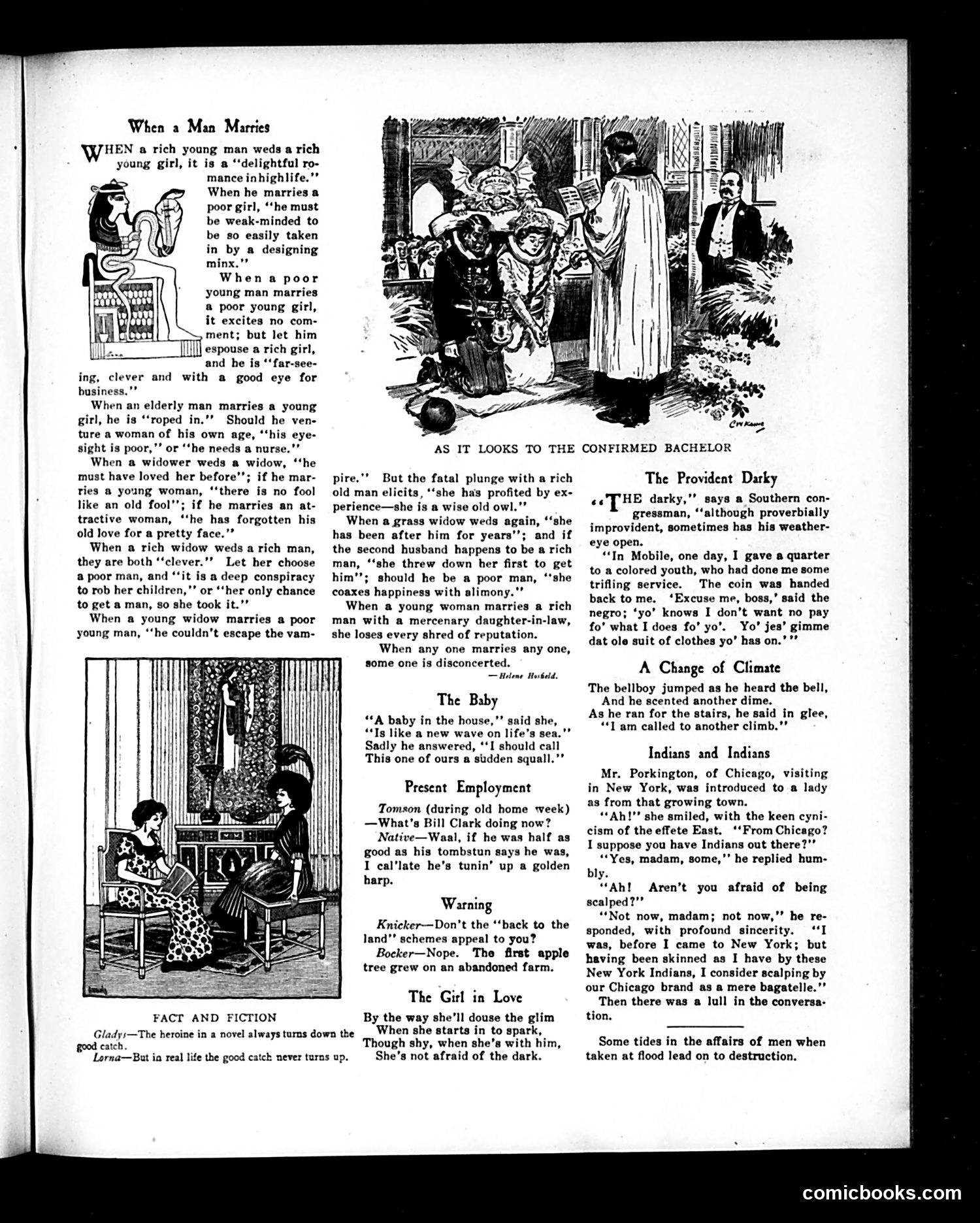
This page contains multiple satirical pieces mocking social hypocrisy about marriage and class. The main feature, "When a Man Marries," systematically exposes how society judges identical marriages differently based on wealth and gender. A rich man marrying a poor woman is "weak-minded," but a poor man marrying a rich woman is "clever"—the same act receives opposite moral judgment depending on who benefits financially. The cartoon titled "As It Looks to the Confirmed Bachelor" illustrates this double standard visually, showing marriage from a skeptical perspective. Other pieces include light humor: "Present Employment" jokes about a dead man's tombstone exaggerating his virtues; "Indians and Indians" presents an ethnic joke where a Chicago businessman claims New York society (the "Indians") has "skinned" him financially—treating aggressive capitalism as barbarism. The overall message: American society applies inconsistent moral standards to marriage based on wealth and gender, revealing that respectability is merely a mask for financial interest.
📄 Transcribed text from this page (OCR, searchable)
Machine-transcribed from the original scan — historical spelling and the odd misread are preserved.
When a Man Marries WHEN a rich young man weds a rich young girl, it is a “delightful ro- mance inhighlife.”” When he marries a poor girl, ‘‘he must be weak-minded to be so easily taken in by a designing When a poor young man marries @ poor young girl, it excites no com- ment; but let him espouse a rich girl, and he is ‘‘far-see- ing, clever and with a good eye for business.’’ When an elderly man marries a young girl, he is “roped in.’? Should he ven- ture a woman of his own age, ‘‘his eye- sight is poor,’’ or ‘‘he needs a nurse.”” When a widower weds a widow, ‘‘he must have loved her before’’; if he mar- ties a young woman, ‘‘there is no fool like an old fool’’; if he marries an at- tractive woman, ‘‘he has forgotten his old love for a pretty face.’” When a rich widow weds a rich man, they are both ‘‘clever.’? Let her choose a poor man, and ‘‘it is a deep conspiracy to rob her children,’’ or ‘‘her only chance to get a man, so she took it.’” When a young widow marries a poor young man, ‘‘he couldn’t escape the vam- FACT AND FICTION AS IT LOOKS TO THE CONFIRMED BACHELOR pire.’ But the fatal plunge with a rich old man elicits, ‘‘she has profited by ex- perience—she is a wise old owl.’” When a grass widow weds again, ‘‘she has been after him for years’; and if the second husband happens to be a rich man, ‘‘she threw down her first to get him"; should he be a poor man, ‘‘she coaxes happiness with alimony."” When a young woman marries a rich man with a mercenary daughter-in-law, she loses every shred of reputation. When any one marries any one, some one is disconcerted. Helene Hesbeid. The Baby “A baby in the house,” said she, “Is like a new wave on life’s sea. Sadly he answered, ‘I should call This one of ours a sudden squall.’” Present Employment Tomson (during old home week) —What’s Bill Clark doing now? Native—Waal, if he was half as good as his tombstun says he was, I cal’late he’s tunin’ up a golden harp. Warning Knicker—Don’t the ‘‘back to the land’’ schemes appeal to you? Bocker—Nope. The first apple tree grew on an abandoned farm. The Girl in Love By the way she'll douse the glim When she starts in to spark, Gladys—The heroine in a novel always turns down the good catch. Lorna—But ia real life the good catch never turns up. Though shy, when she’s with him, She's not afraid of the dark. The Provident Darky «eT HE darky,’’ says a Southern con- gressman, ‘‘although proverbially improvident, sometimes has his weather- eye open. “‘In Mobile, one day, I gave a quarter to a colored youth, who had done me some trifling service. The coin was handed back to me. ‘Excuse me, boss,’ said the negro; ‘yo’ knows I don’t want no pay fo’ what I does fo’ yo’. Yo’ jes’ gimme dat ole suit of clothes yo’ has on.’”” A Change of Climate The bellboy jumped as he heard the bell, And he scented another dime. As he ran for the stairs, he said in glee, “*1_ am called to another climb."’ Indians and Indians Mr. Porkington, of Chicago, visiting in New York, was introduced to a lady as from that growing town. “‘Ah!”’ she smiled, with the keen cyni- cism of the effete East. ‘‘From Chicago? I suppose you have Indians out there?” **Yes, madam, some,’’ he replied hum- bly. “Ah! scalped?”” “Not now, madam; not now,” he re- sponded, with profound sincerity. ‘‘I was, before I came to New York; but having been skinned as I have by these New York Indians, I consider scalping by our Chicago brand as a mere bagatelle.”” Then there was a lull in the conversa- tion. Aren’t you afraid of being Some tides in the affairs of men when taken at flood lead on to destruction. comicbooks.com