
A complete issue · 24 pages · 1912
Judge — April 20, 1912
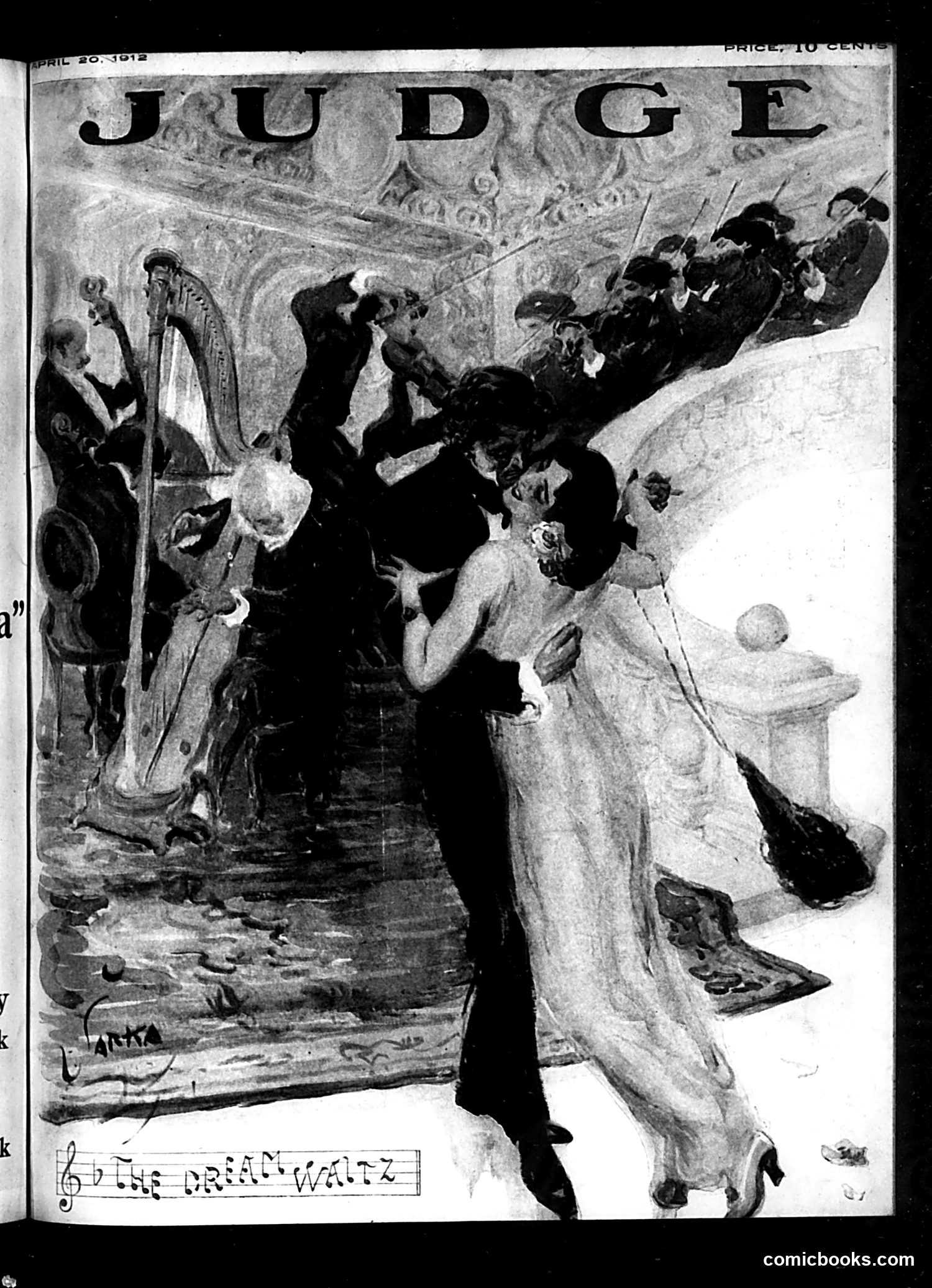
This appears to be a satirical cartoon from Judge magazine (dated April 26, 1912, based on the header). The image depicts figures in formal dress engaged in what the musical notation identifies as "The Dream Waltz." The central figure in white appears to be waltzing or dreaming, surrounded by formally-dressed men in dark clothing who seem to be observing or participating in some social/political gathering. The ornate architectural setting suggests an official or governmental venue. Without clearer identification of the specific figures, the exact political reference is unclear, but the composition suggests commentary on contemporary politics or high society. The "dream waltz" title implies the scene represents either fantasy, wishful thinking, or satirical commentary on political dealings of the 1912 era.
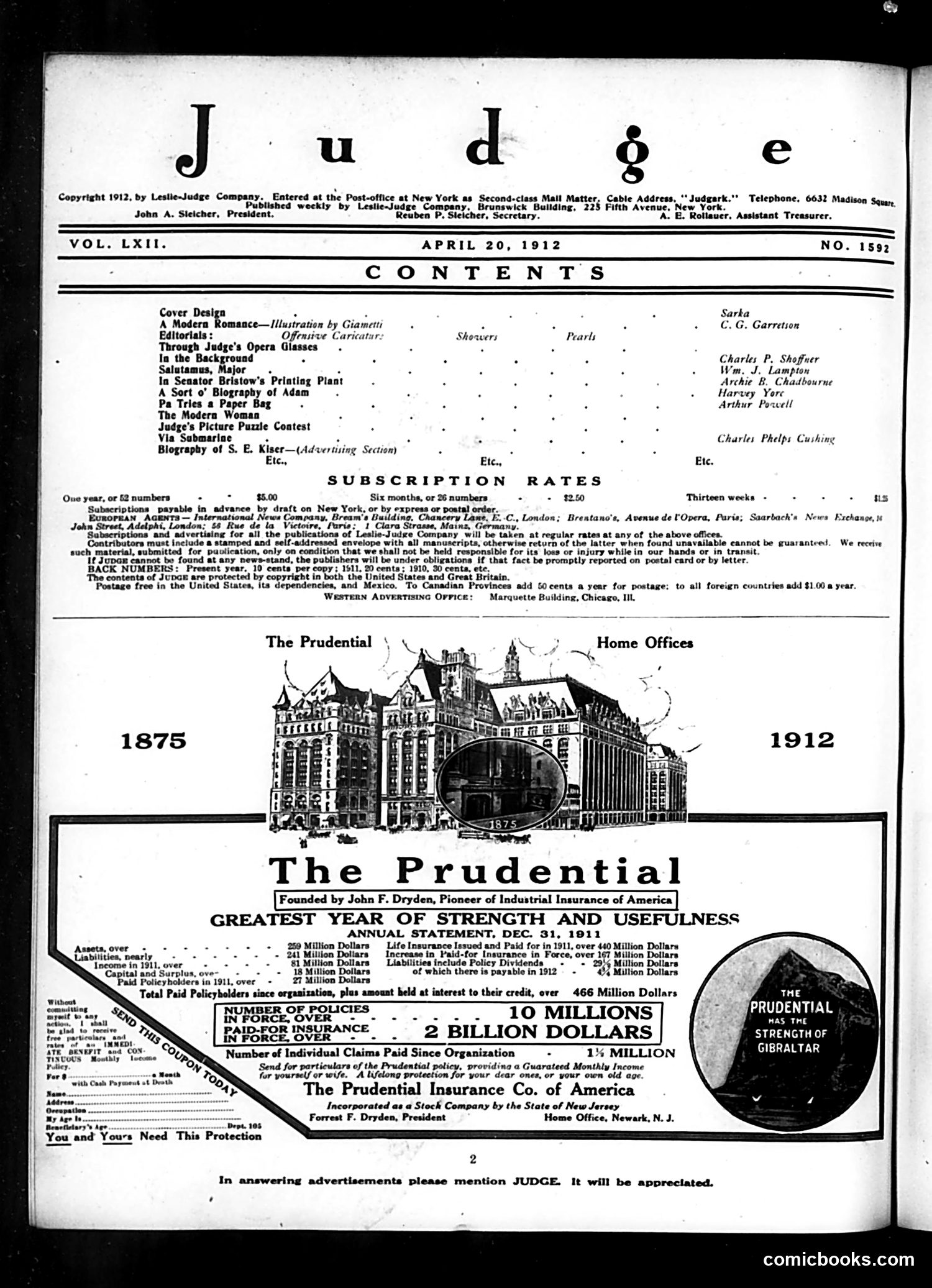
This page is primarily **advertising rather than editorial content**. It features a full-page advertisement for The Prudential Insurance Company, founded by John F. Dryden. The ad emphasizes the company's growth and stability between 1875 and 1912, displaying their home offices building and highlighting financial statistics: 10 million policies in force, 2 billion dollars in force, and 1.5 million in claims paid. The visual comparison between the 1875 building and 1912 structure symbolizes corporate expansion and success during the Gilded Age. The circular seal referencing "Gibraltar" suggests strength and permanence—common insurance marketing imagery. This represents how Judge's revenue came substantially from paid advertising rather than purely satirical editorial material, reflecting the magazine's business model circa 1912.
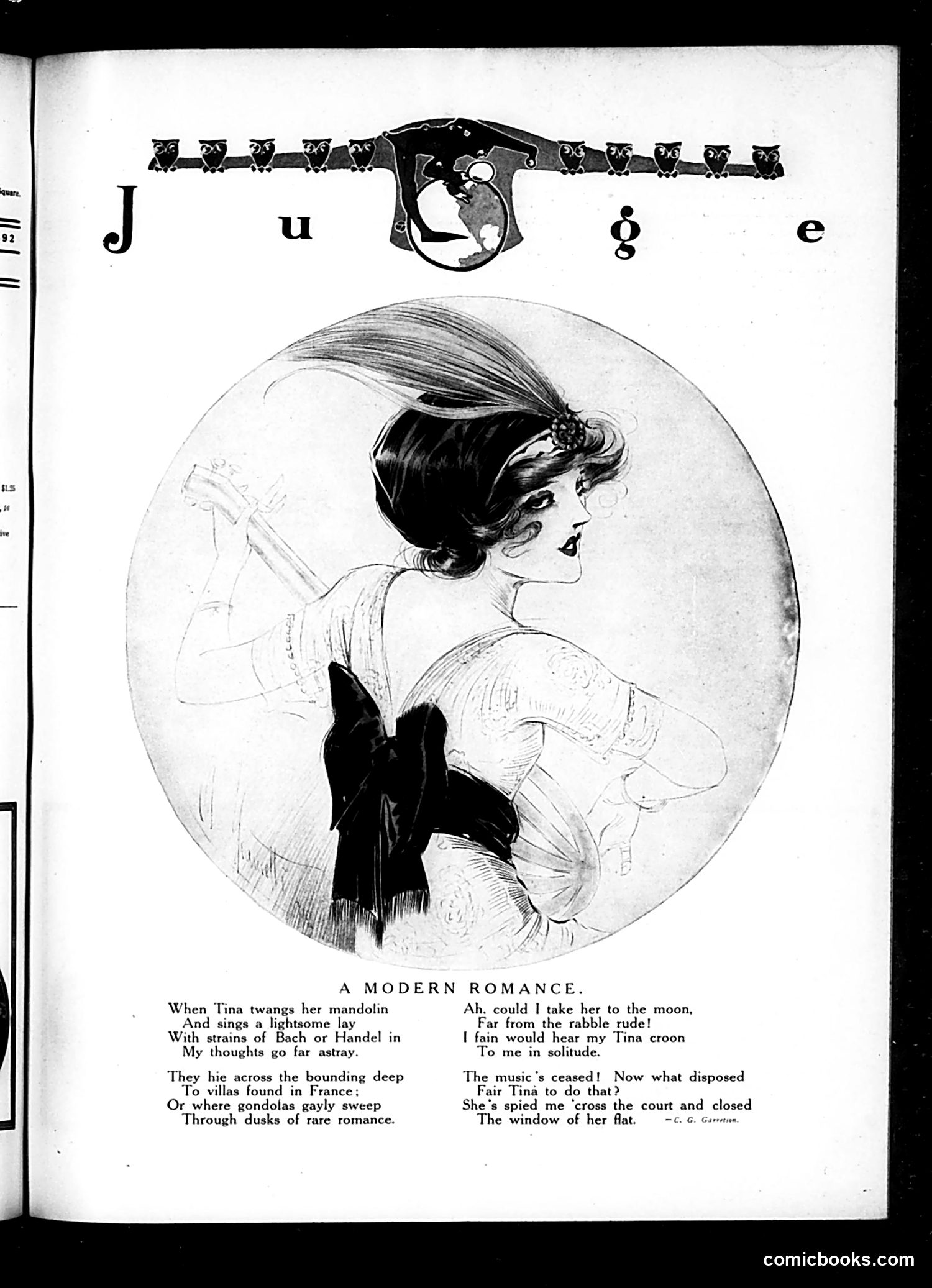
This page presents a romantic illustration titled "A Modern Romance" featuring a woman in profile within a circular frame, accompanied by whimsical poetry. The poem humorously contrasts idealized romantic notions with mundane reality. The satire targets early 20th-century romantic idealism: the narrator imagines sweeping Tina away to moonlit villas in France with classical music, but the punchline deflates this fantasy—she simply closes her apartment window and leaves him standing outside. The illustration's art nouveau style and the decorative owl header reflect Judge's typical aesthetic. The joke mocks both sentimental male romanticism and modern women's practical rejection of overwrought courtship, presenting contemporary relationships as prosaic rather than poetic. This reflects evolving gender dynamics of the era.
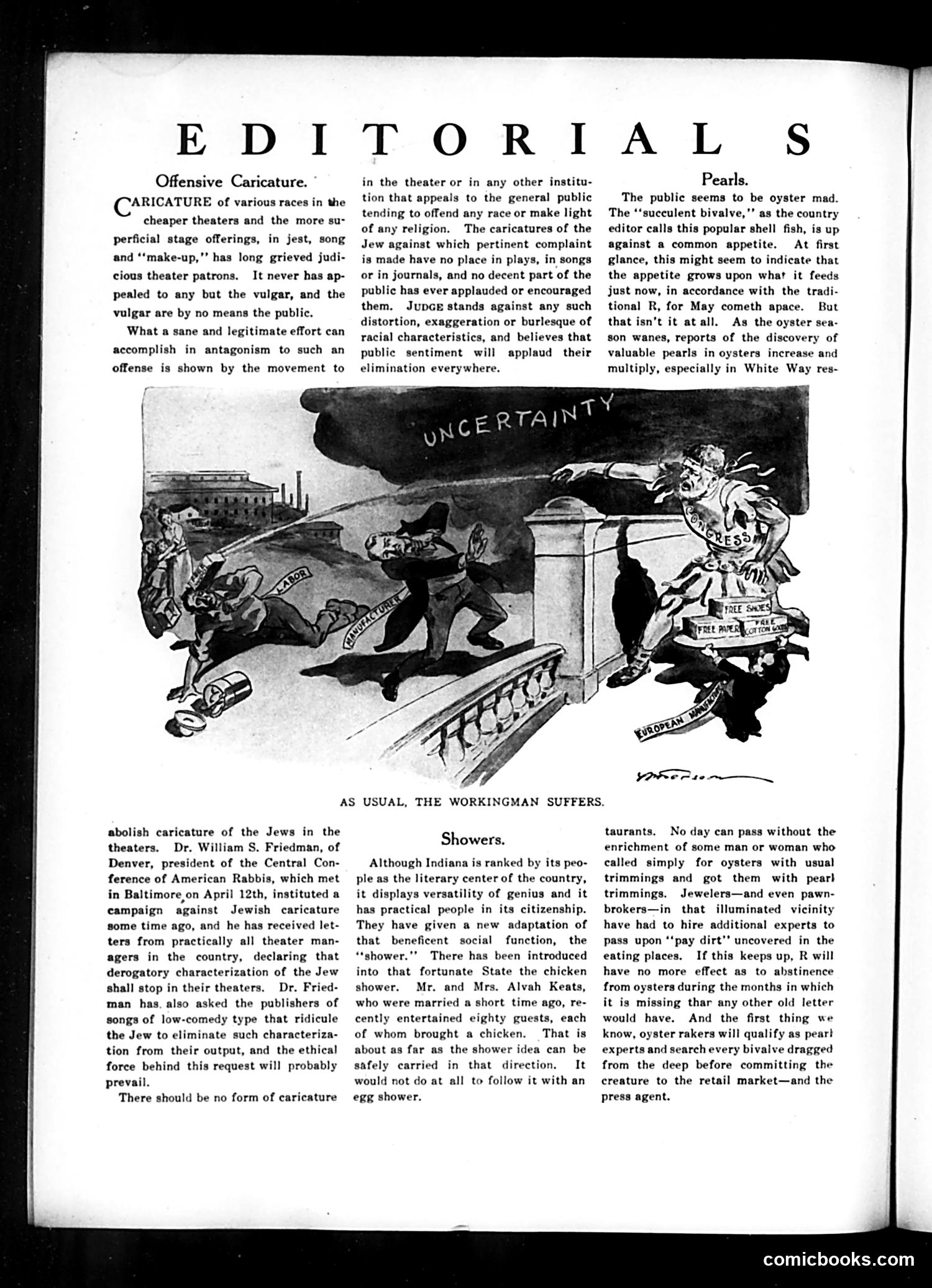
This Judge magazine page addresses theatrical caricature, particularly offensive racial portrayals. The editorial criticizes plays and performances that mock various ethnic groups—especially Jews—arguing such caricatures appeal only to "the vulgar" and lack legitimacy. The cartoon "As Usual, The Workingman Suffers" depicts a figure labeled "Uncertainty" looming over workers amid chaos. It satirizes how working-class people bear the consequences of larger social and economic turmoil. The text references Dr. William S. Friedman's 1912 campaign against Jewish caricatures in theater. The section on "Showers" humorously discusses a new social trend (chicken showers—gift-giving events), contrasting frivolous upper-class entertainment with practical working-class concerns. The overall message: stop dehumanizing ethnic minorities through theater while ordinary workers struggle.
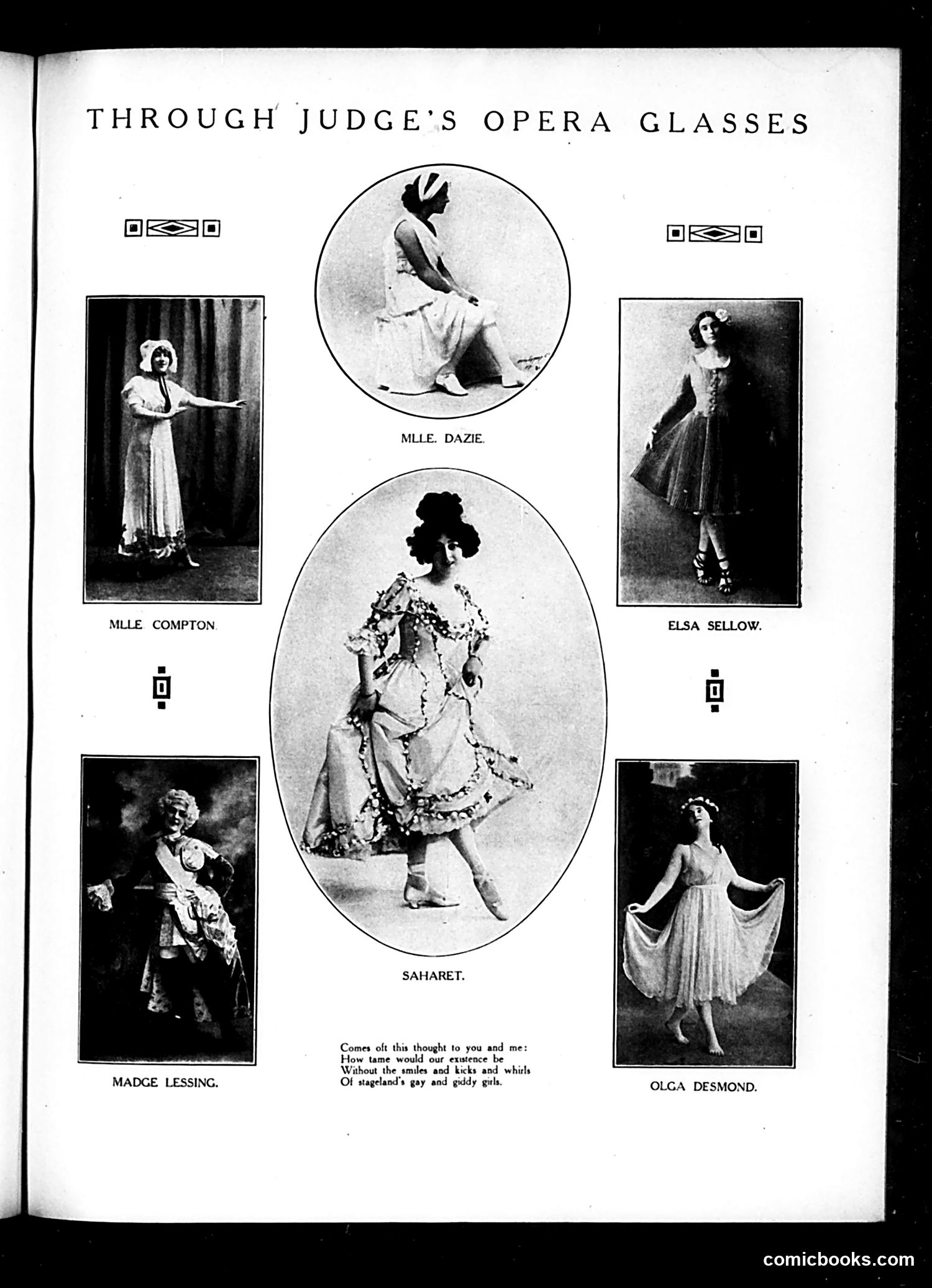
This page from *Judge* magazine features photographs of five female performers labeled "Through Judge's Opera Glasses" — a theatrical review format. The central larger image is labeled "Saharet," surrounded by four smaller photographs of "Mlle. Compton," "Mlle. Dazie," "Elsa Sellow," "Madge Lessing," and "Olga Desmond." The accompanying verse suggests satirical commentary on theatrical entertainers, joking about how "our esteem" depends on "smiles and kicks and whirls / Of stageland's gay and giddy girls." This appears to be light satire mocking the superficiality of stage entertainment and public admiration for performers based on physical performance rather than talent. The "opera glasses" framing device positions readers as voyeuristic theater-goers evaluating female performers. The specific performers are unclear without additional historical context.
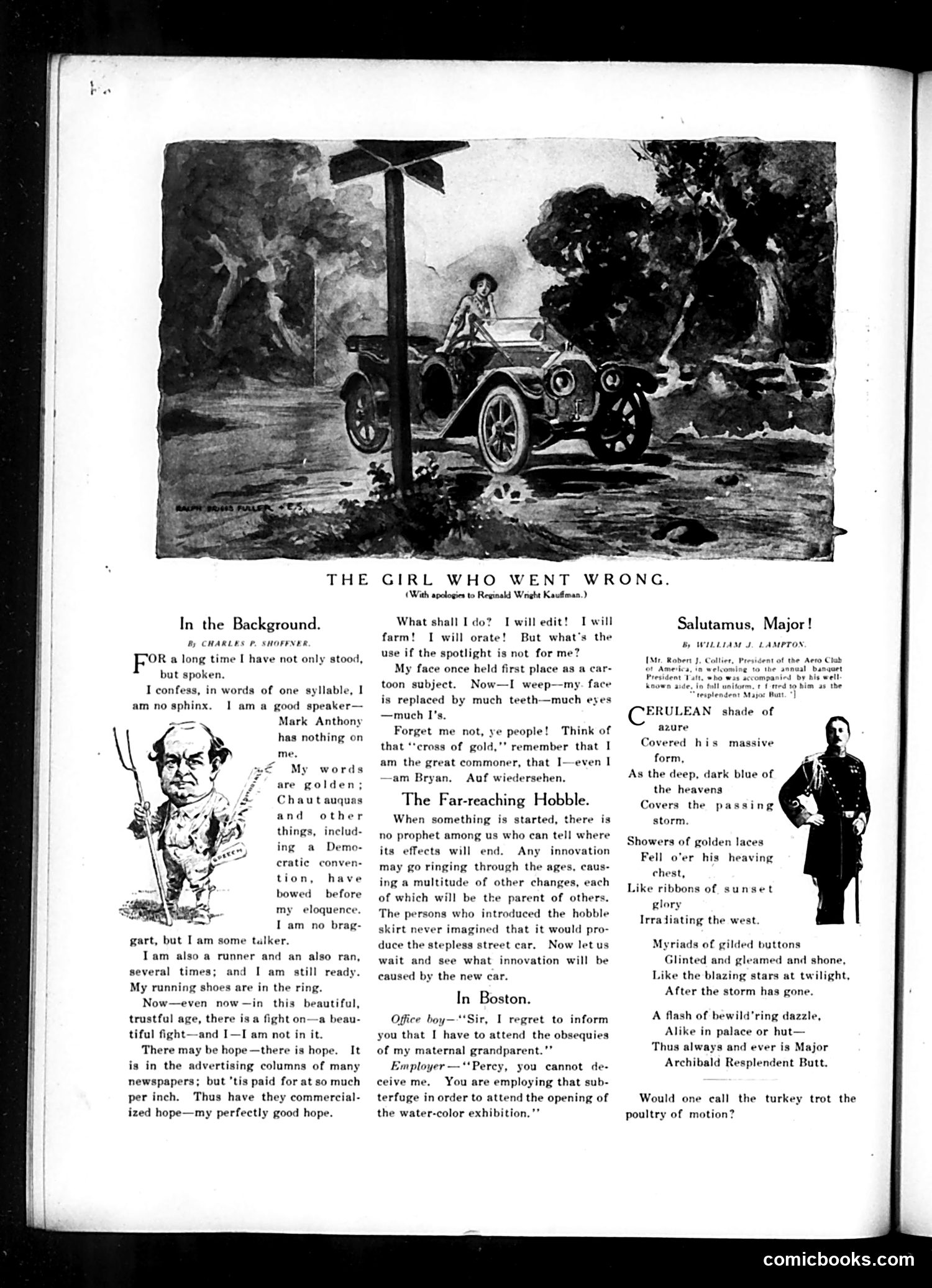
This page satirizes **William Jennings Bryan**, the three-time Democratic presidential candidate and populist orator. The opening section's speaker—boasting of golden words, a "cross of gold" (Bryan's famous 1896 speech), and being "the great commoner"—is Bryan lamenting his political irrelevance. The joke: his face, once prominent in political cartoons, has been replaced by images of teeth and eyes (likely mocking his exaggerated expressions in caricature). The other brief pieces mock contemporary absurdities: the "hobble skirt" fashion trend's unexpected consequence (stepless streetcars), and an office boy's transparent excuse about attending a water-color exhibition rather than a funeral. A poem celebrating "Major Archibald Resplendent Butt" (a real military figure) rounds out the page with mock-heroic flattery. The overall tone: Bryan's political obsolescence, fashion's unintended consequences, and gentle mockery of authority figures and social pretense.
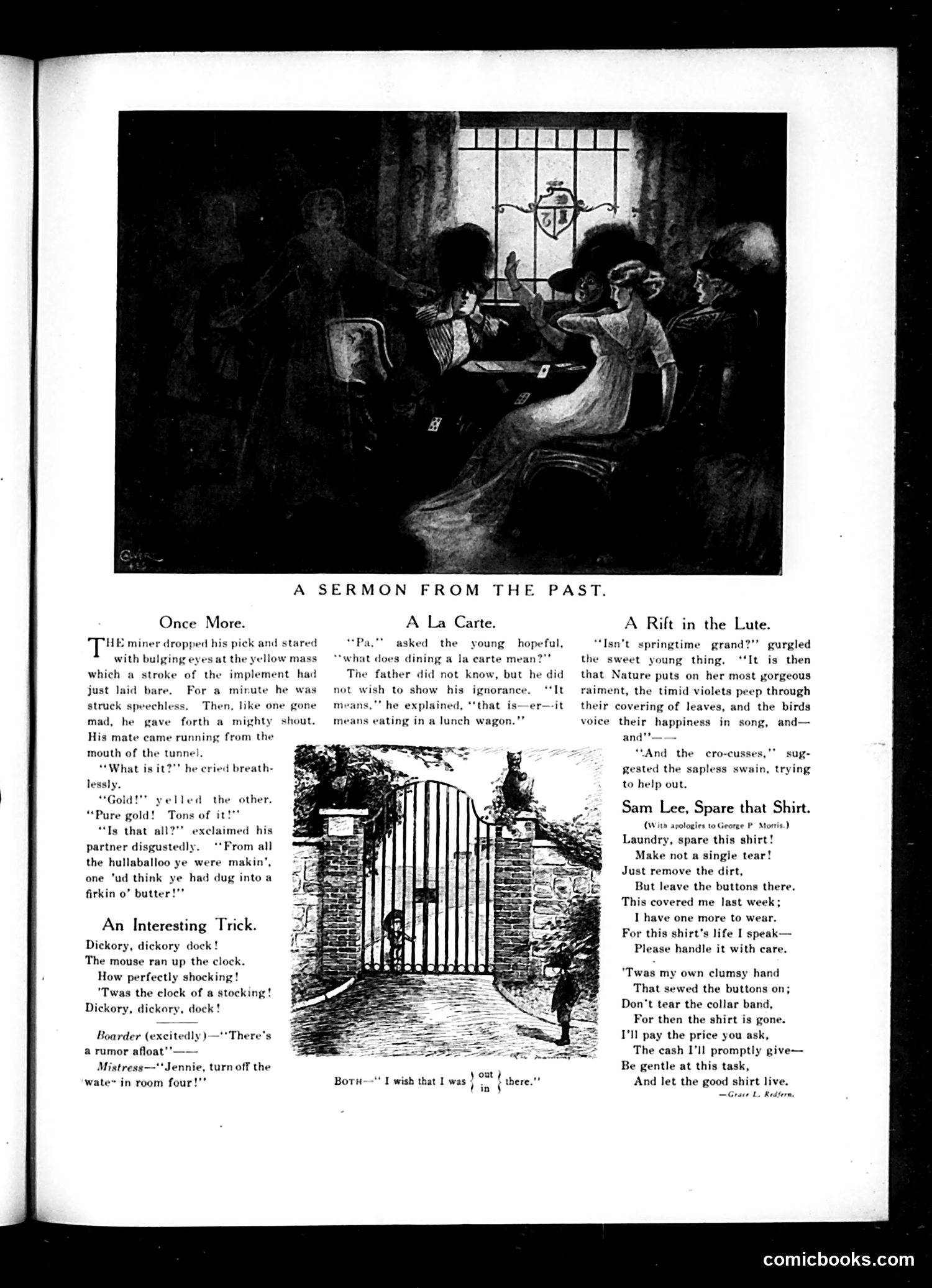
This page contains four brief humorous anecdotes typical of Judge's satirical humor: 1. **"Once More"**: A miner's underwhelming gold discovery—his partner expected butter, deflating the excitement. 2. **"An Interesting Trick"**: A nursery rhyme joke: a mouse ran up a clock belonging to a stocking (playing on "hickory dickory dock"). 3. **"A La Carte"**: A father, ignorant about dining terminology, incorrectly defines "à la carte" as eating in a lunch wagon—satirizing pretense and working-class confusion about upper-class dining. 4. **"A Rift in the Lute"**: A poem (credited to Grace Le Redfern, referencing George P. Morris) humorously pleading with a laundry to preserve a worn shirt with clumsily-sewn buttons—depicting the poor's desperate attempt to maintain minimal clothing. The page satirizes everyday working-class life, ignorance, and modest circumstances through light comedy rather than political commentary.
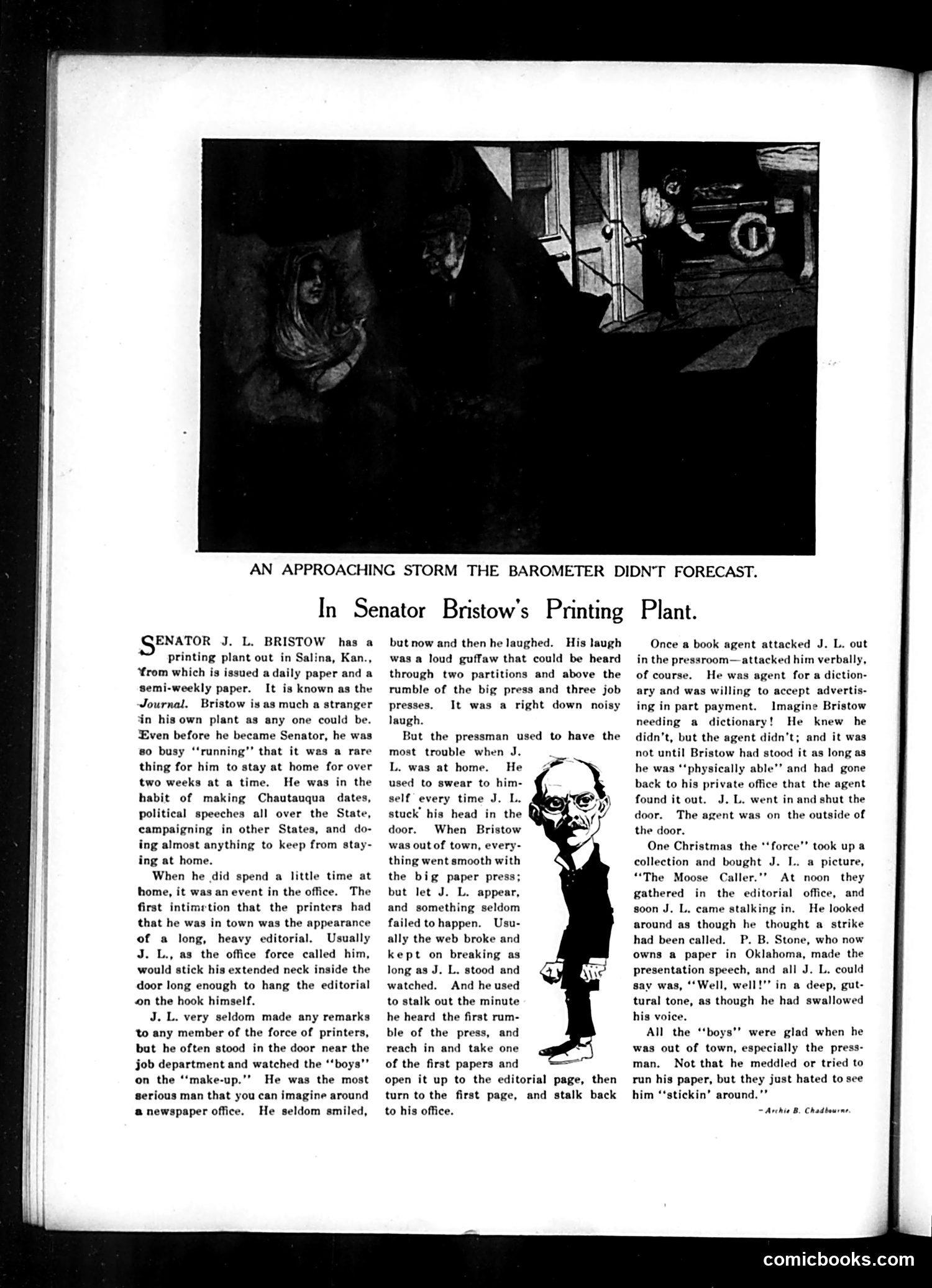
This article from Judge satirizes **Senator Joseph L. Bristow** of Kansas, a politician who owned a newspaper (the *Journal*) in Salina but was perpetually absent due to his political career. The humor lies in depicting him as a comically aloof, humorless boss who rarely visited his own printing plant. The satire targets several things: his obsessive politicking that kept him away from home; his stern, joyless demeanor around employees (a "loud guffaw" being his only laugh); and his disruptive presence—the running joke being that mechanical problems mysteriously occurred whenever he appeared in the pressroom. The anecdotes (the dictionary agent, the Christmas gift) illustrate how remote and severe he seemed to his staff. The "force" (employees) actually **preferred** his absence. The satire suggests Bristow embodied a particular American political type: the career politician so consumed by ambition that he's a stranger in his own enterprise, and so grimly serious he brings tension wherever he goes.
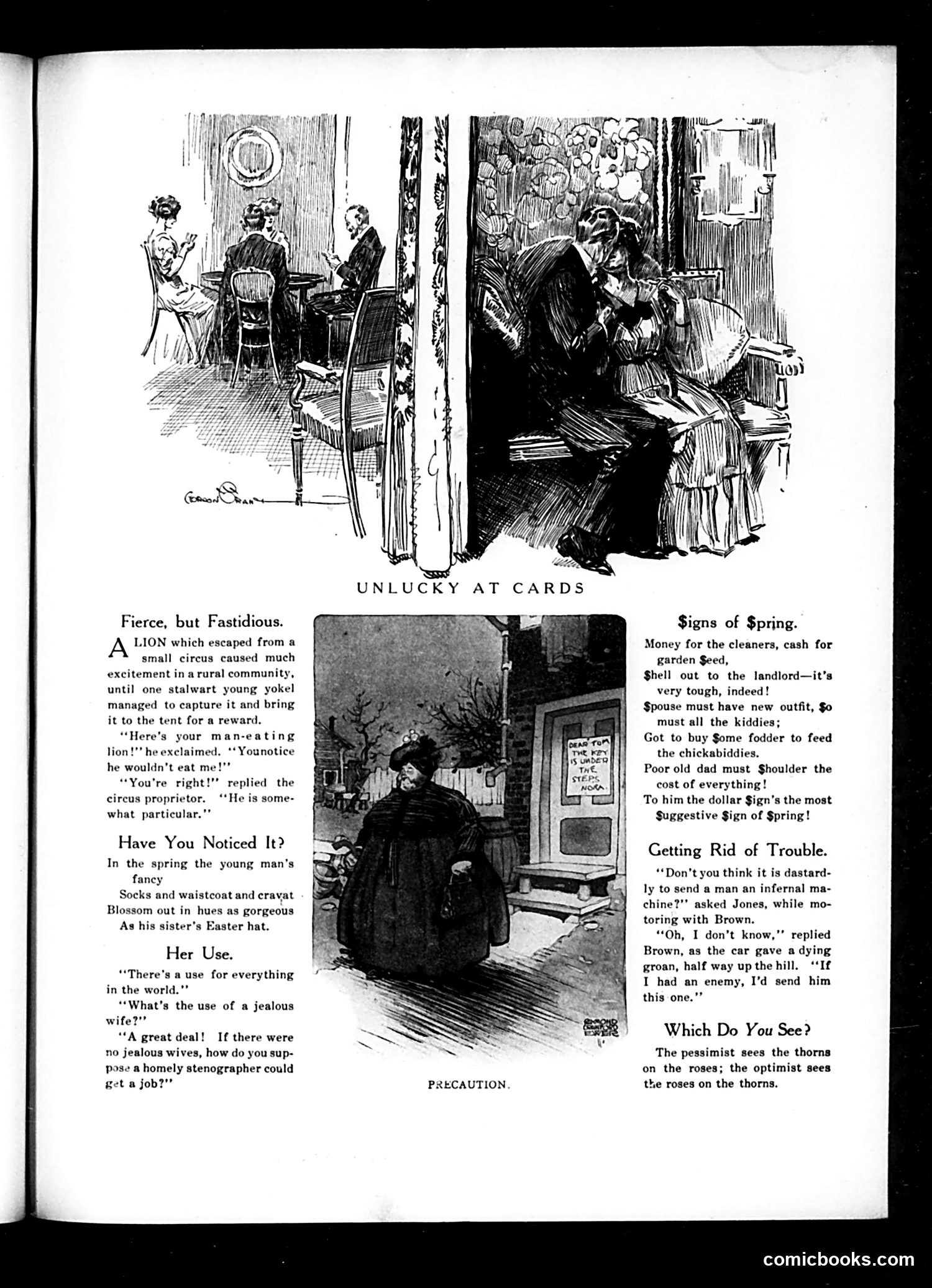
This page contains several humorous short pieces typical of early 20th-century satirical magazines: **"Unlucky at Cards"** (top cartoon): Shows a man losing at cards while his wife watches disapprovingly—a commentary on gambling and marital discord. **"Fierce, but Fastidious"**: A joke about a circus lion that escaped but was captured. The humor lies in the proprietor's deadpan observation that the lion "wouldn't eat" the captor because it was "somewhat particular"—implying the yokel was too unpalatable even for a man-eating beast. **"Signs of Spring"**: Satirizes spring's financial burden on fathers, who must pay for cleaning, seeds, new clothes for the family, and animal feed—all symbolized by the dollar sign. **"Her Use"**: Dark humor about jealous wives being beneficial because homely stenographers need jealous wives' insecurity to secure employment. **"Which Do You See?"**: A pessimist/optimist contrast—typical moralizing content. The page is primarily light domestic humor and social satire aimed at middle-class readers, without obvious political content.
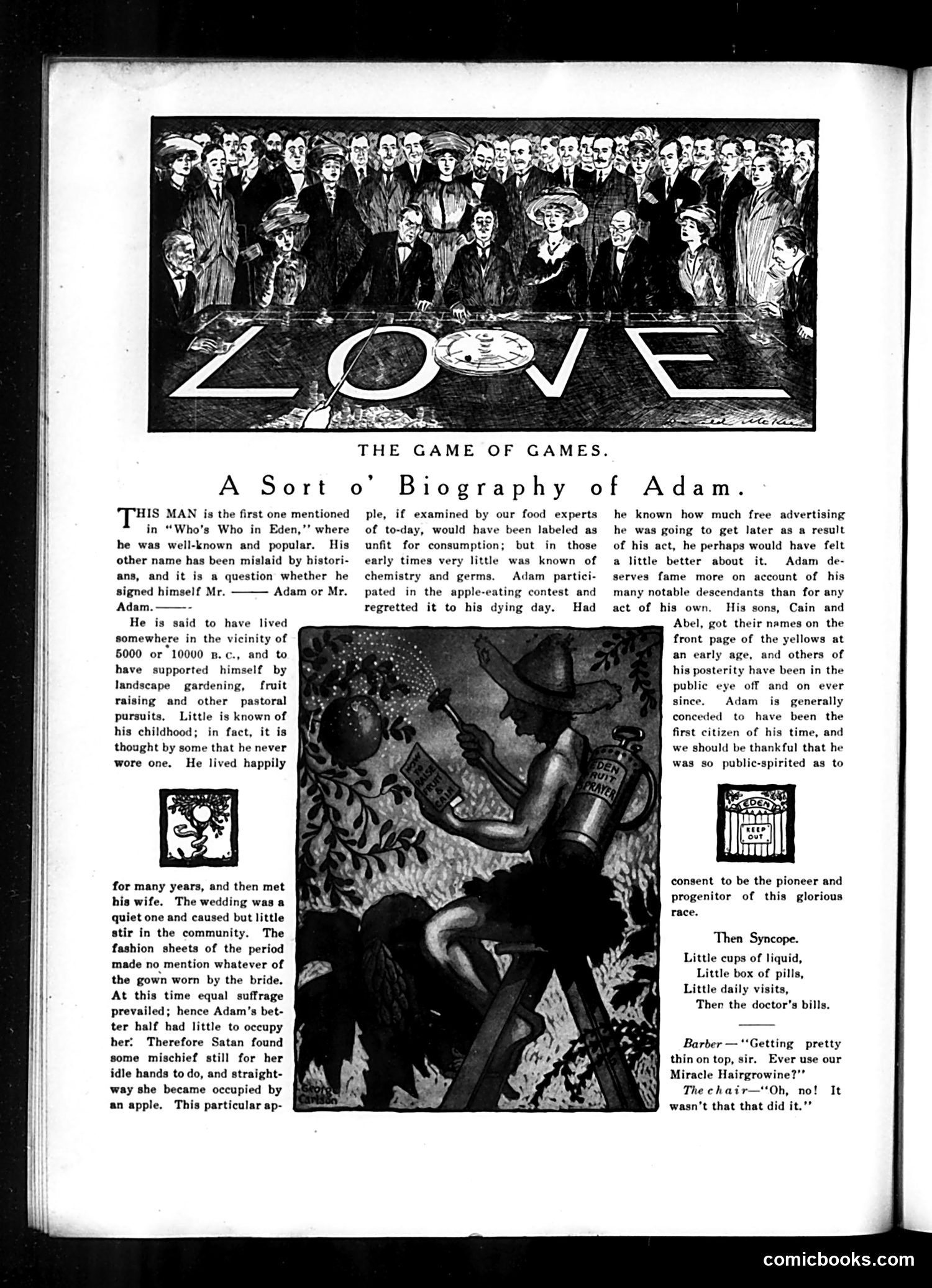
This is a humorous biographical piece satirizing Adam from the Bible, presented as a "Who's Who in Eden" entry. The satire targets several turn-of-the-century concerns: **The main jokes:** - Adam's identity is uncertain (Mr. Adam or Mr. Adam?) — mocking overly formal biographical pretense - He's credited with being history's first "public-spirited" citizen merely for existing and reproducing - His wife had "equal suffrage" but nothing to do, implying women's suffrage advocates would create idle mischief — a dig at women's rights movements - The apple incident gets Adam "free advertising," satirizing modern publicity obsession **The companion cartoons** mock contemporary vices: the "Syncope" poem jokes about patent medicines and doctor visits (medical quackery), while the barber dialogue ridicules dubious hair-growth products. The page satirizes both biblical literalism and modern commercial hucksterism, suggesting that even humanity's origin story gets distorted by contemporary advertising and media sensationalism.
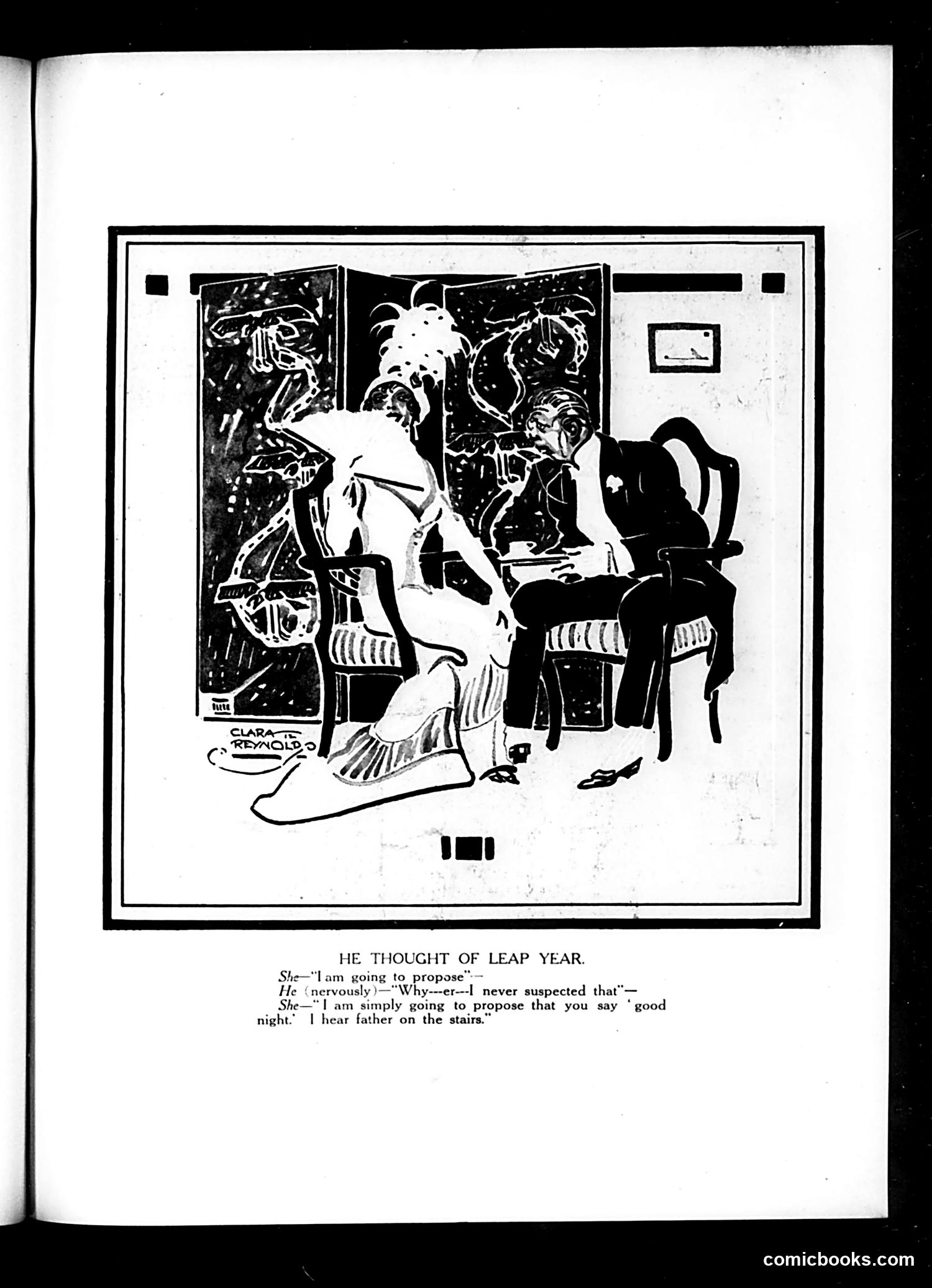
This cartoon plays on the tradition that during leap years, women were permitted to propose to men—reversing traditional gender roles. The joke pivots on misunderstanding: the man nervously assumes the woman will propose marriage, but she clarifies she's merely proposing he say goodnight before her father catches them together. The humor relies on: - The man's anxious reaction to a woman taking initiative - The subverted expectation (marriage proposal vs. innocent goodbye) - The threat of parental discovery, suggesting impropriety in their alone time This reflects early 20th-century social anxieties about changing gender norms and courtship conventions, while the leap-year premise was a recognized (if tongue-in-cheek) cultural trope allowing women temporary social permission to pursue men romantically.
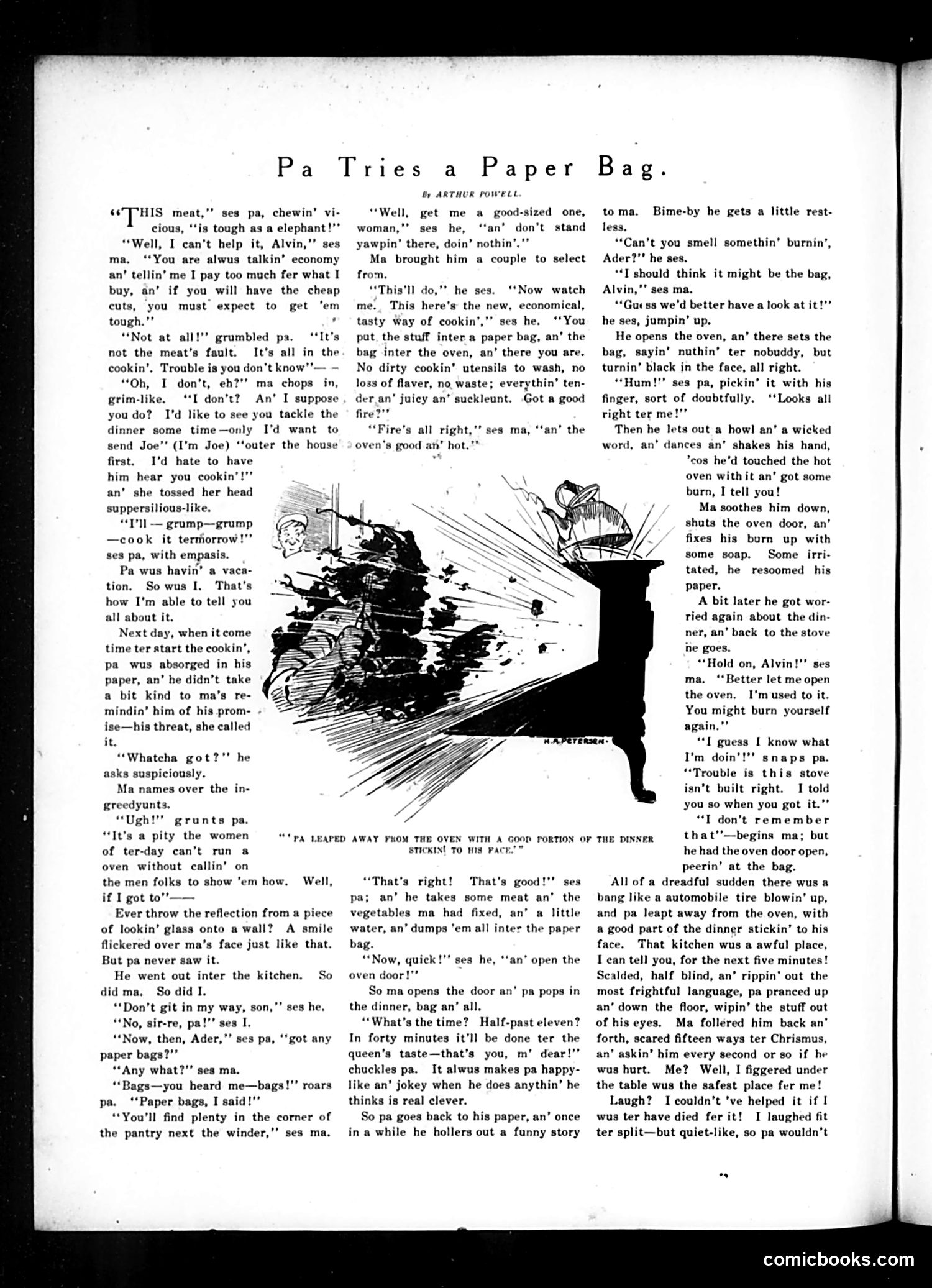
This is a humorous domestic story about cooking economy during a period of financial constraint. The narrative follows "Pa" attempting to cook dinner using a paper bag as an economical cooking method—likely referencing Depression-era or wartime food rationing practices when families sought ways to reduce waste and costs. The central illustration shows Pa emerging from an oven with his clothing and face blackened, having set the paper bag (and dinner) on fire. The story's humor derives from the clash between thrifty intentions and domestic disaster: Pa's well-meaning effort to save money by using the paper bag backfires literally, leaving him burned and the dinner ruined. The satire gently mocks both penny-pinching household economy and the incompetence of men attempting unfamiliar kitchen tasks.
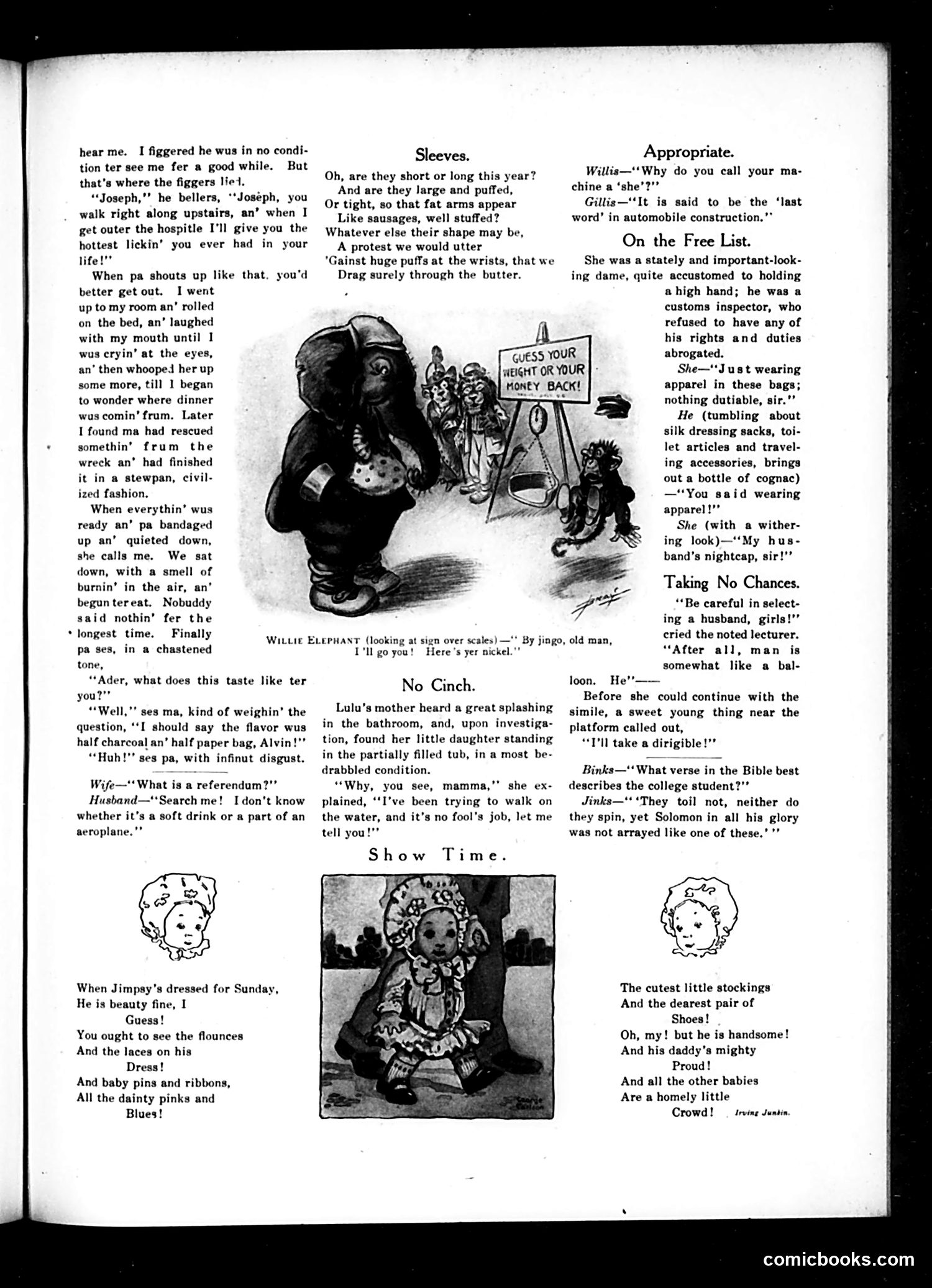
This page contains several humorous vignettes mocking early 20th-century social conventions and fashions: **"Sleeves"** satirizes women's fashion obsession with sleeve styles—particularly the "huge puffs at the wrists" that drag through butter, suggesting the impracticality of exaggerated fashion trends. **"Willie Elephant"** shows an elephant at a carnival weight-guessing game, playing on the era's popular amusement park attractions and the absurdity of weighing large animals. **"No Cinch"** depicts a child attempting to walk on bathwater after hearing about Jesus walking on water—innocent childhood logic meeting religious instruction. **"On the Free List"** satirizes customs inspection, where a woman claims silk items are her husband's "nightcap" (a drinking joke) to avoid duty taxes. **"Taking No Chances"** mocks women's desperation regarding marriage, with a young woman choosing a dirigible over a human husband—commentary on courtship anxiety. **"Show Time"** is sentimental verse about a well-dressed child, likely gentle satire of parental pride. The overall tone reflects Judge's satirical perspective on American consumer culture, fashion vanity, and gender relations circa 1910s-1920s.
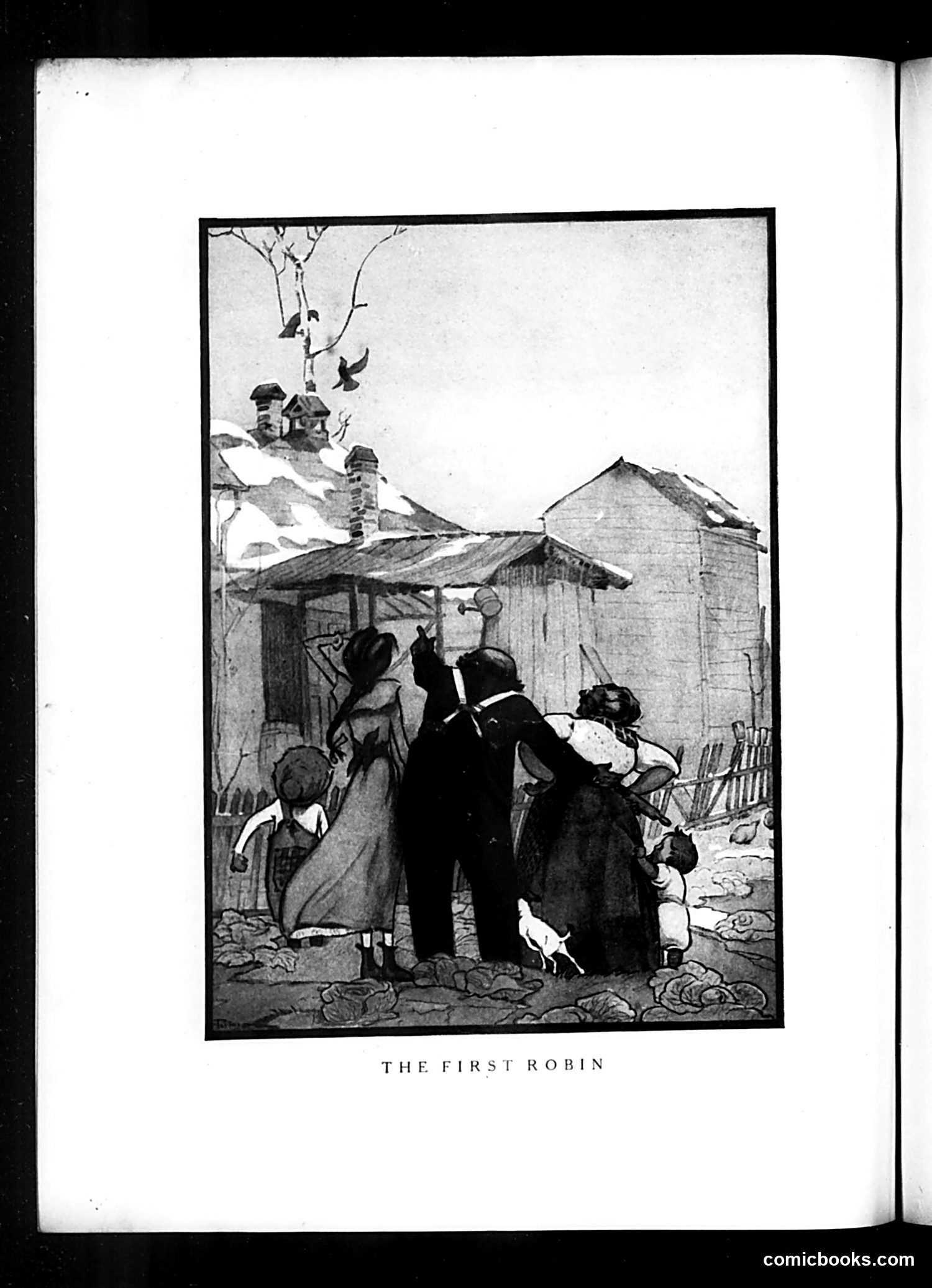
This illustration from *Judge* magazine depicts an early spring scene with figures observing the season's first robin—a traditional American symbol of spring's arrival. The image shows what appears to be a working-class family or group outside modest rural dwellings, pointing upward at a bird in a bare tree. The caption "The First Robin" references the folk custom of celebrating winter's end by spotting the first robin of the season. Without additional context or visible satirical elements in the image itself, the piece appears to be a straightforward seasonal illustration rather than overt political satire. The exact commentary or joke intended remains unclear from the image alone, though *Judge* typically employed such pastoral scenes to comment on contemporary social or economic conditions.
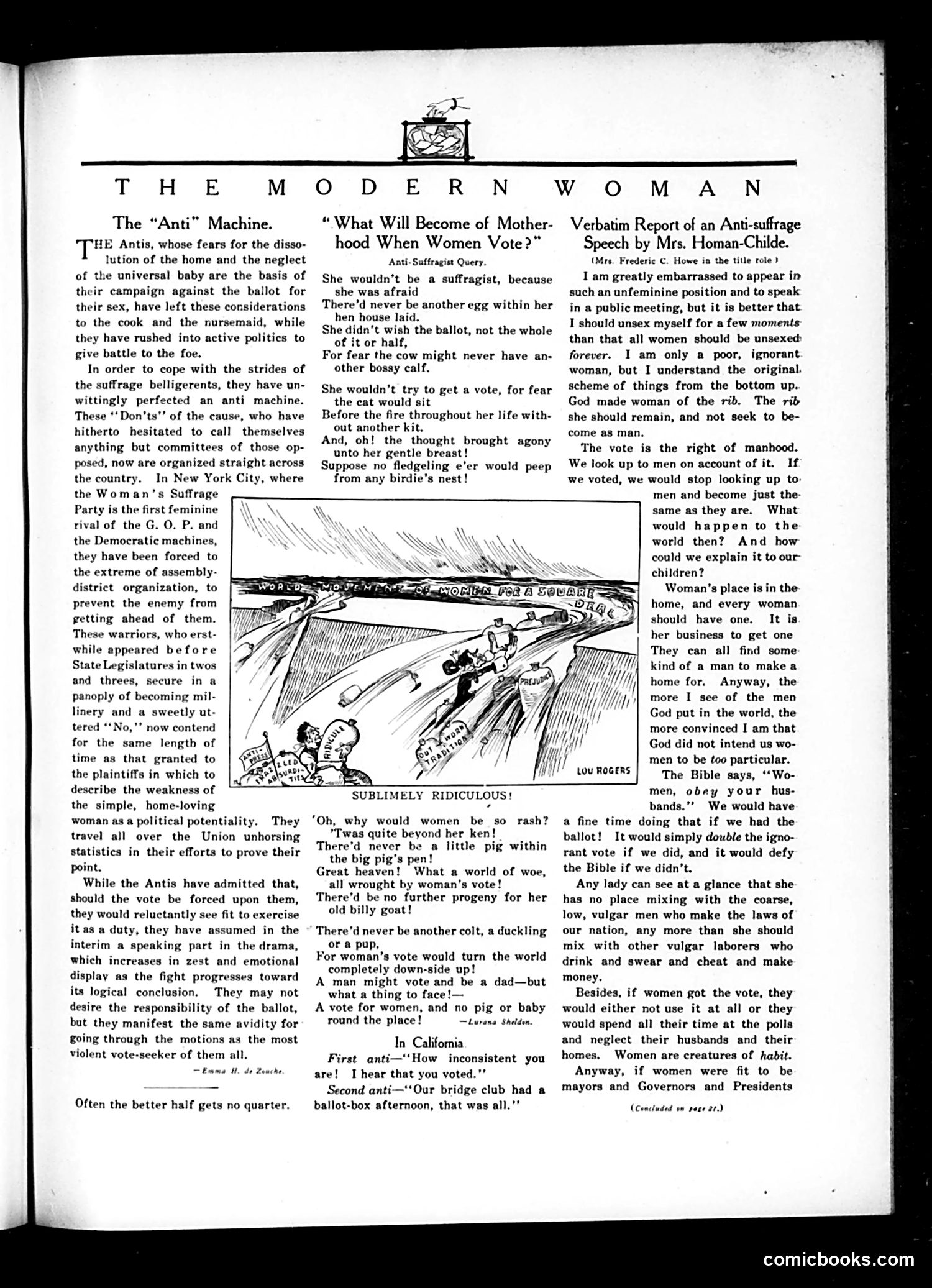
This 1910s Judge magazine page satirizes anti-suffrage women opposing voting rights. The cartoon depicts absurdist anti-suffragist arguments: that women voting would stop hens laying eggs, cows producing calves, and birds nesting—reducing motherhood to livestock reproduction. The text mocks the "Anti Machine," organized anti-suffrage campaigns that ironically adopted the same political machinery (assembly-district organization) they claimed to oppose. It highlights the hypocrisy: these women abandoned home duties to actively campaign politically while arguing women shouldn't vote because their place is the home. The featured speaker, "Mrs. Homan-Childe" (likely a fictional composite), typifies the opposition: she claims voting would "unsex" women and destroy their moral authority over men, yet she's publicly speaking—contradicting her own argument. Judge's satirical point: anti-suffragists revealed their arguments were illogical and their activism hypocritical. The more they organized politically, the weaker their claims that women shouldn't participate in politics.
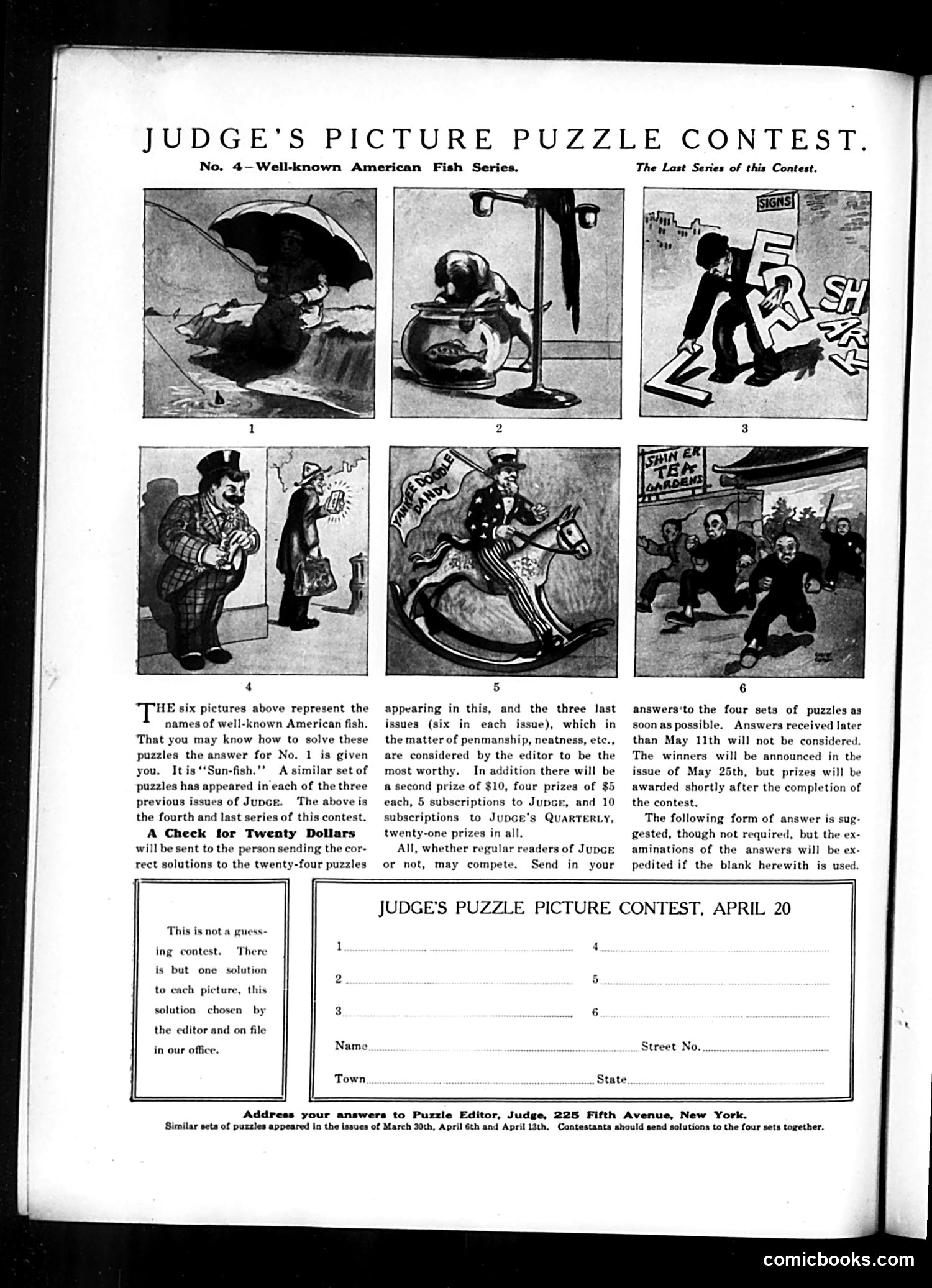
This page presents the fourth and final installment of Judge magazine's picture puzzle contest, themed around "Well-known American Fish Series." Contestants must identify six American fish species from visual puns or illustrations. Picture #1, revealed as "Sun-fish," demonstrates the format. The contest spans four issues (March 30 through April 20), with 24 total puzzles to solve. Winners are selected based on penmanship and neatness, not just correctness—emphasizing this as a skill-testing exercise rather than pure guessing. Prizes include $20 for first place, plus additional cash and magazine subscriptions. The humor lies in the visual wordplay representing fish names through illustrated scenarios, typical of early 20th-century puzzle entertainment. This was popular recreational content for Judge's readers, blending education with amusement in a contest format designed to drive repeated readership across multiple issues.
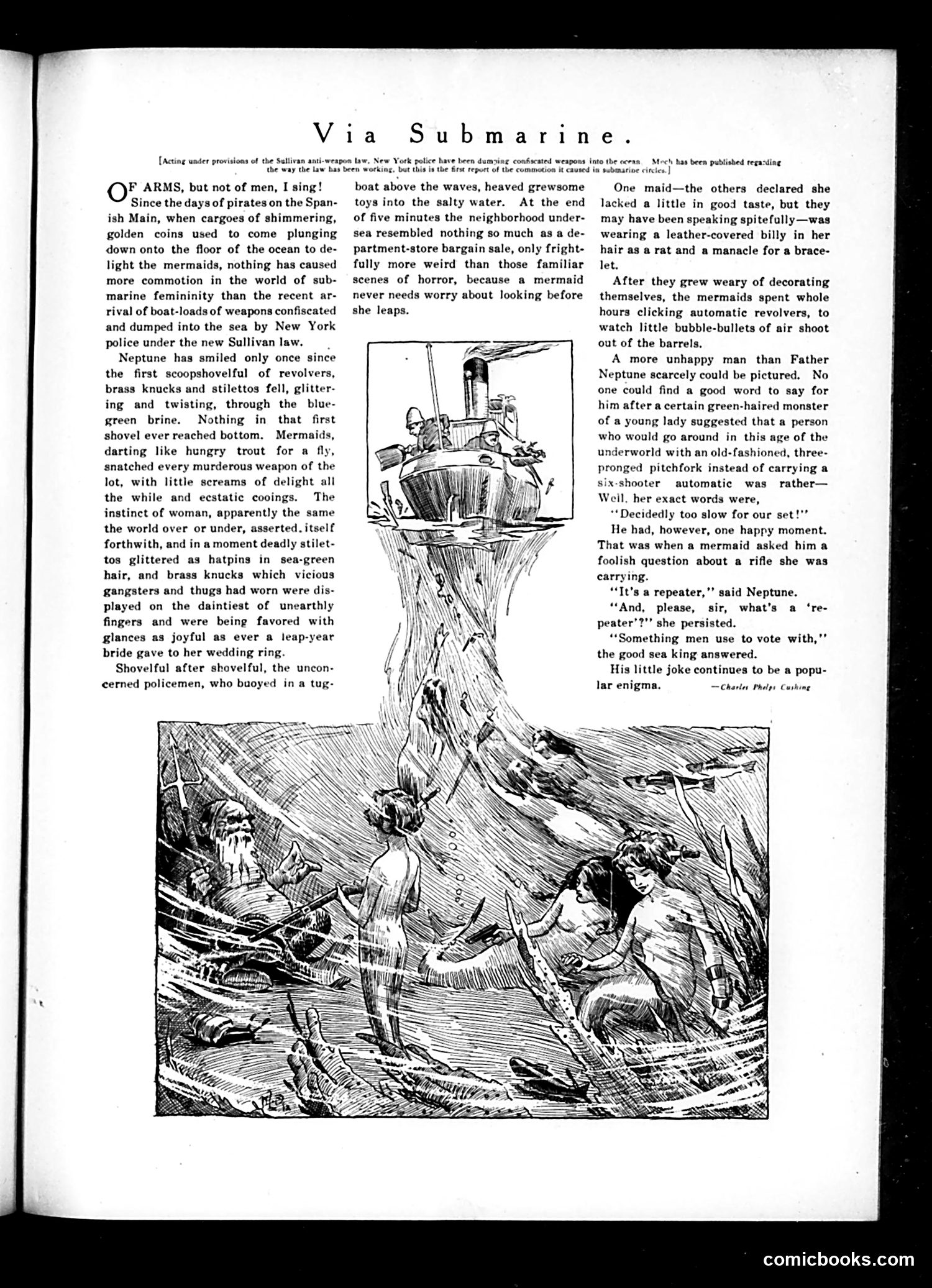
This Judge magazine piece satirizes New York's new Sullivan Law (enacted 1911), which mandated the confiscation and destruction of illegal firearms and weapons. The joke: police are dumping confiscated guns, brass knuckles, and stilettos into the ocean—where mermaids gleefully retrieve them as fashion accessories and toys. The satire works on multiple levels: 1. **Gender mockery**: Mermaids are portrayed as inherently attracted to weapons as decorative items (stilettos as hatpins, brass knuckles as bracelets)—a dig at women's materialism. 2. **Law enforcement futility**: Dumping weapons in the ocean rather than properly destroying them suggests the police are ineffectual, not actually solving the crime problem. 3. **Political jab**: Neptune's final joke—calling a "repeater" (rifle) something "men use to vote with"—mocks the contemporary debate over voting rights and gun ownership as male prerogatives. The cartoon ridicules both the Sullivan Law's implementation and contemporary anxieties about women, weapons, and political power.
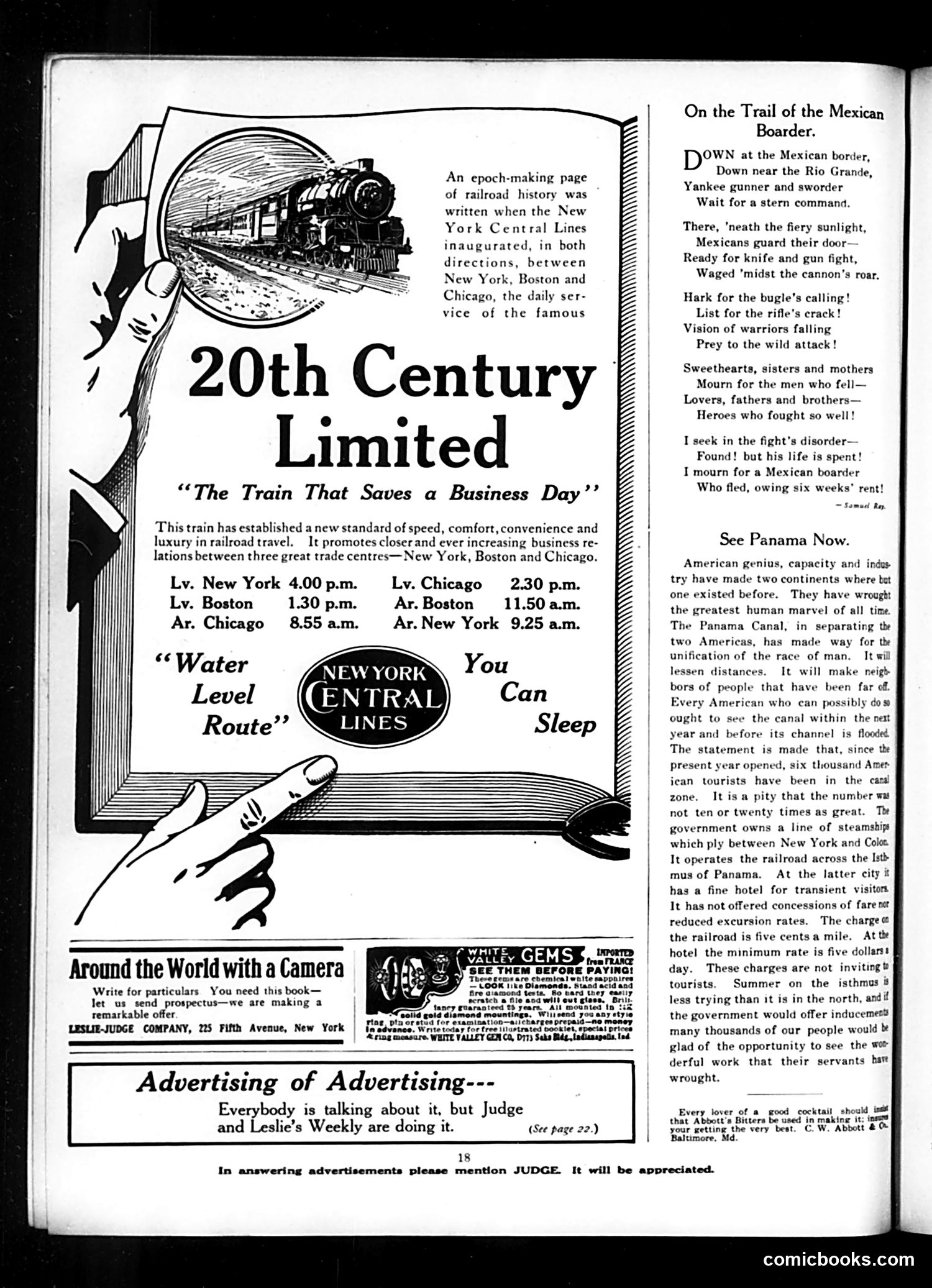
This page contains multiple elements: a **New York Central Lines railroad advertisement** for the "20th Century Limited" train; a **poem titled "On the Trail of the Mexican Border"**; and promotional content about the Panama Canal. The poem appears to be satirical commentary on the Mexican border conflicts of the early 1910s (likely referencing the Mexican Revolution era tensions). It contrasts romantic, heroic language about warfare with a bathetic final couplet: a soldier dies, but the speaker mourns that "a Mexican boarder / Who fled, owing six weeks' rent!" This undercuts the preceding patriotic sentiment with mundane financial complaint—a typical Judge magazine technique of deflating grandiose rhetoric through unexpected practicality. The railroad and Panama Canal advertisements celebrate American technological progress and commercial expansion, reflecting early 20th-century American confidence in industrial achievement and imperial reach.
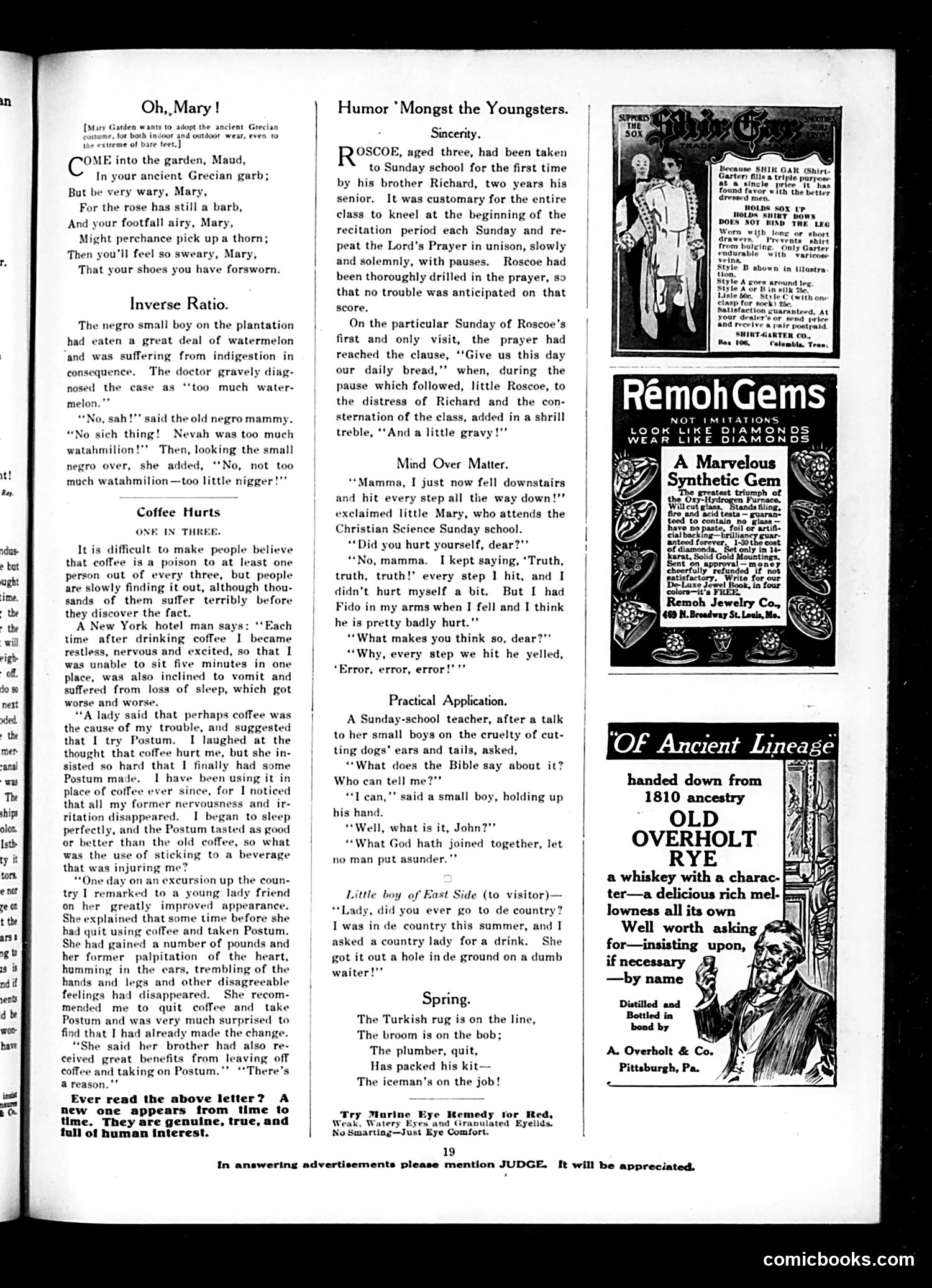
This page contains humor pieces and advertisements typical of early 20th-century Judge magazine. **"Oh, Mary!" poem:** Satirizes a fashionable movement (referenced in the subtitle) where wealthy New York society women adopted ancient Greek costume, including going barefoot. The joke mocks this impractical trend by pointing out the obvious problem: Greek sandals might look elegant, but bare feet encounter thorns and dirt—undermining the romanticized aesthetic. **Racist humor pieces:** "Inverse Ratio" and other sections contain period dialect humor targeting Black Americans, reflecting the deeply racist conventions of early Judge. These are presented as "humorous" observations but represent offensive stereotyping typical of that era. **"Coffee Hurts" advertisement:** Promotes Postum (a caffeine-free grain beverage) through testimonials claiming coffee causes nervousness and health problems—positioning Postum as a healthier alternative. **Children's humor:** Brief anecdotes about Sunday school children, including one about Christian Science beliefs. The page reflects Judge's mix of satirical commentary on fashion trends, period-appropriate (but offensive) ethnic humor, patent medicine advertising, and light children's anecdotes.
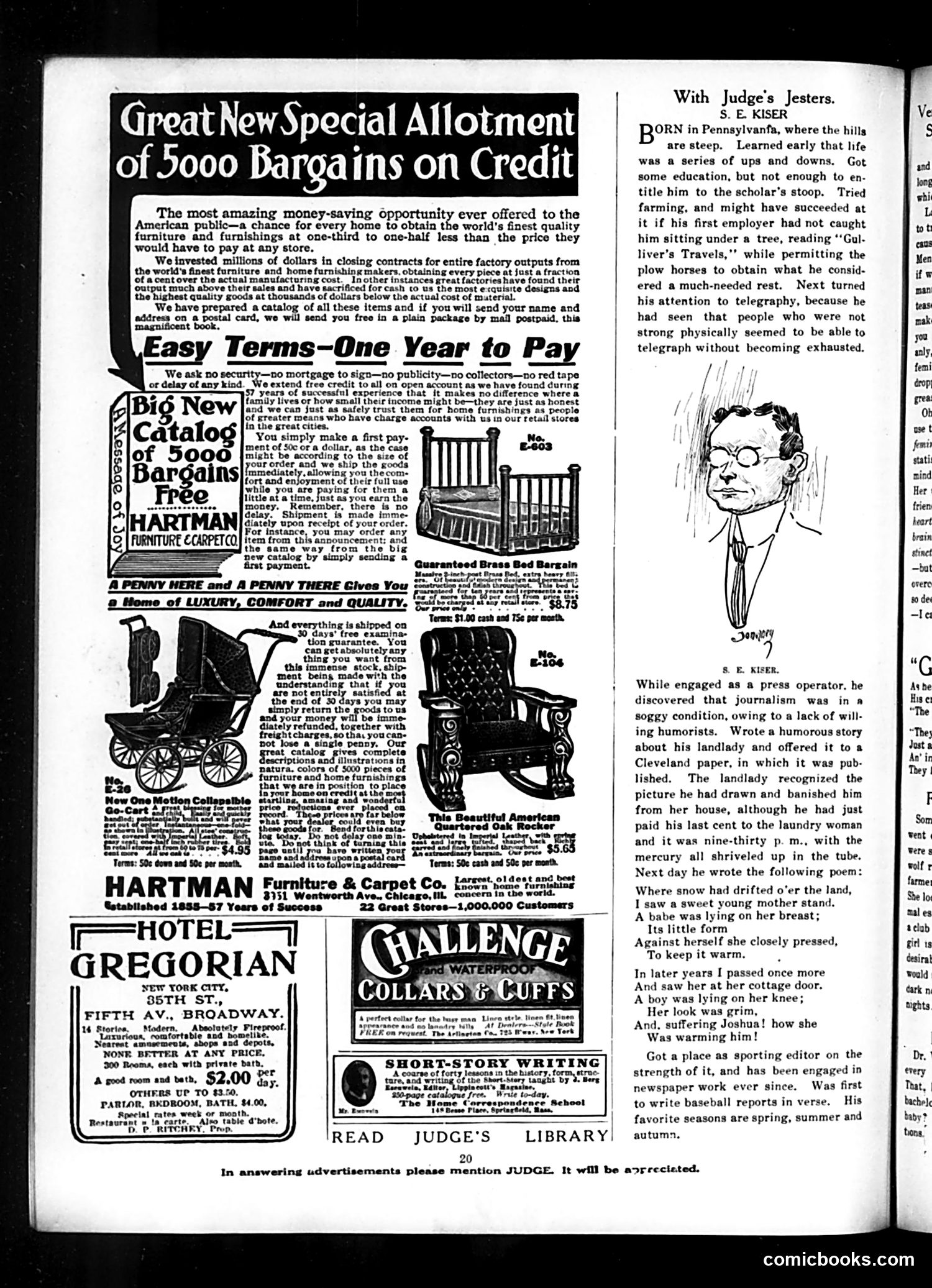
This page is dominated by **furniture/credit advertising** rather than editorial cartoons. However, it includes a biographical sketch titled "With Judge's Jesters" about S. E. Kiser, featuring a simple portrait illustration of a bespectacled man. The text describes Kiser's career trajectory: a Pennsylvania farm boy who tried farming, then telegraph work, then became a press operator who discovered journalism. The anecdote depicts him writing a humorous newspaper story about his landlady, who—recognizing herself in his drawings—evicted him late at night, despite his poverty. He responded by writing a poem about her. **The satirical point** appears to be typical Judge magazine humor: mocking struggling young writers and the precarious circumstances of would-be humorists trying to break into journalism. The humor relies on the contrast between artistic ambition and harsh economic reality—a relatable theme for Judge's educated, middle-class readership. The surrounding **full-page furniture advertisements** (Hartman Furniture & Carpet Co., Hotel Gregorian, collars/cuffs) represent the magazine's primary revenue source.
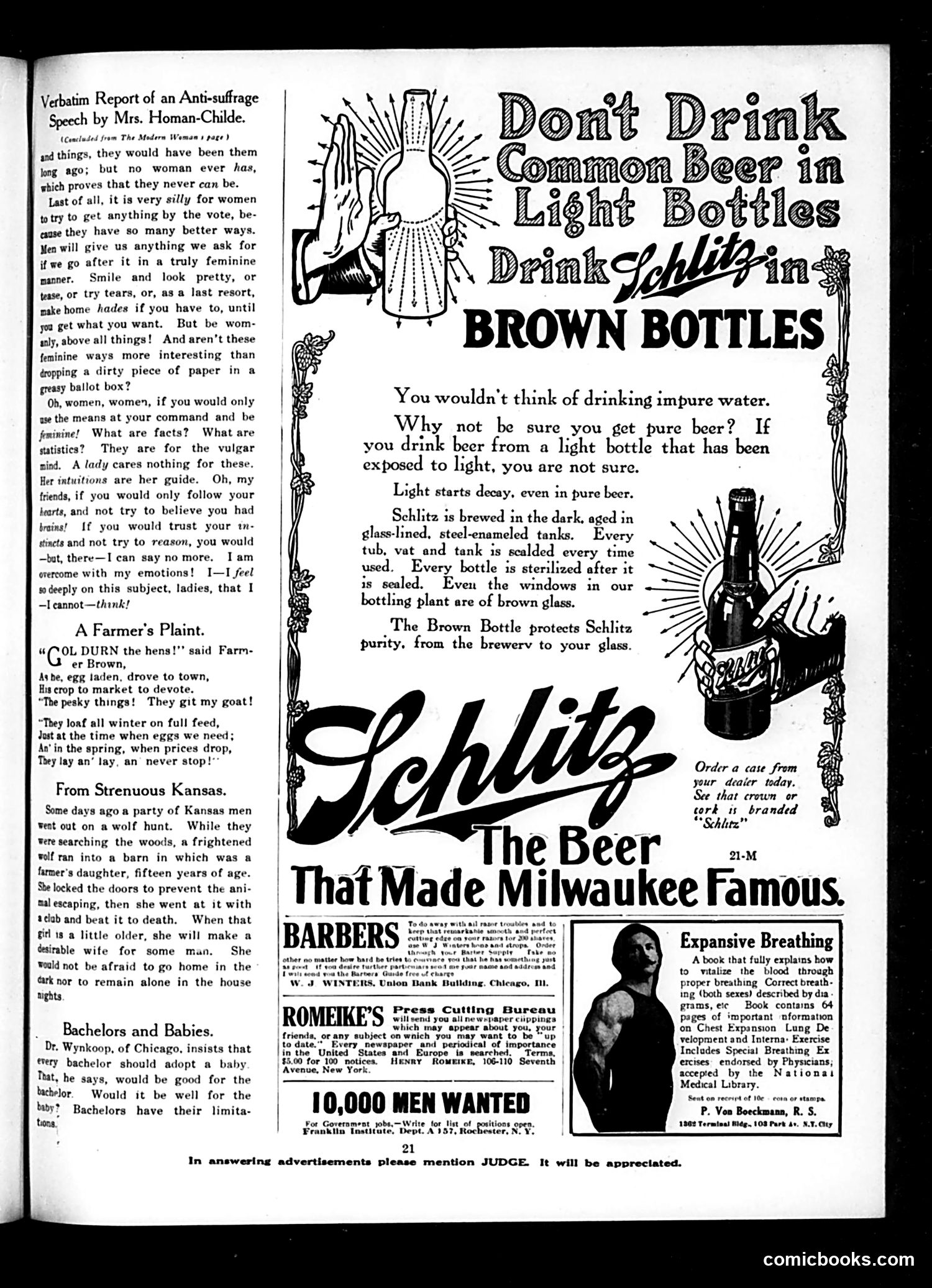
This page combines **anti-suffrage satire** with period advertising. ## The Anti-Suffrage Speech The main text satirizes Mrs. Homan-Childe's anti-women's-suffrage argument. She claims women shouldn't vote because: they've never accomplished anything independently; voting is "unfeminine"; and women can manipulate men through charm, tears, or domestic sabotage instead. The satire is cutting—Judge presents her reasoning as absurdly circular and her appeals to "intuition" over facts as intellectually bankrupt. The piece mocks anti-suffrage logic by letting the argument speak for itself. ## Supporting Content Brief anecdotes reinforce the satire: a Kansas farm girl fearlessly kills a wolf (contradicting claims of female weakness), and a farmer complains hens won't lay eggs on schedule (mocking male complaints about women). ## Advertising The dominant Schlitz beer advertisement emphasizes purity and brown bottles protecting beer from light damage—standard early-20th-century marketing. Other ads offer miscellaneous services (press clipping bureau, government jobs, breathing exercises). The page reflects Judge's pro-suffrage stance through satirical demolition of anti-suffrage arguments.
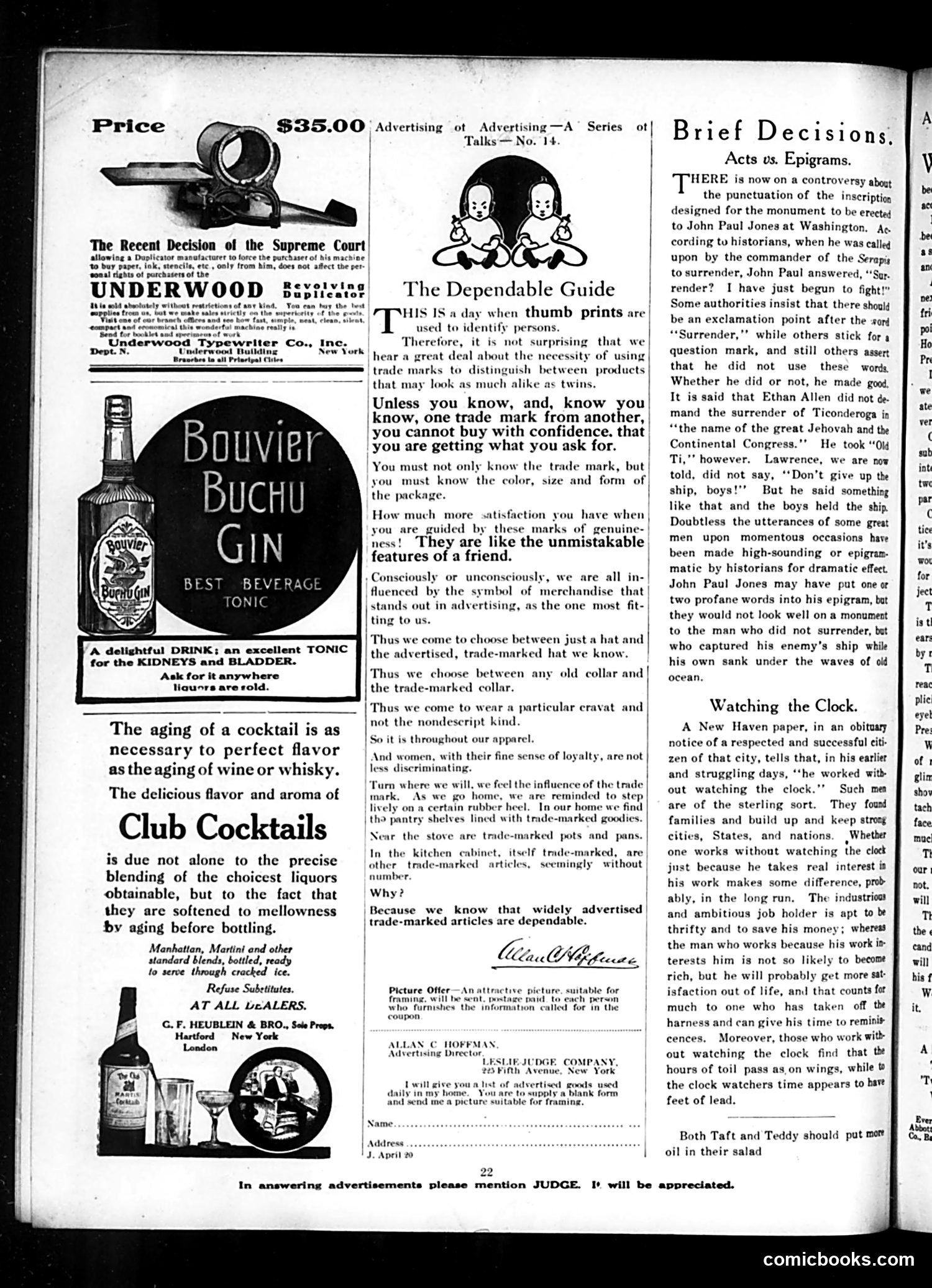
This page is primarily **advertising** with one notable article about trademark recognition. The main editorial content is "Advertising—A Series of Talks, No. 14," which argues that **trade marks ensure product quality and consumer confidence**. The piece uses everyday examples (rubber heels, kitchen goods, collars, cravats) to show how branded merchandise influences purchasing decisions. This reflects early 20th-century advertising philosophy: widely advertised trade-marked goods are "dependable." The "Brief Decisions" column presents a minor historical debate: the **punctuation of John Paul Jones's famous declaration at the Battle of Flamborough Head** (1779). The controversy centers whether "Surrender?" should end with an exclamation point or question mark—a light satire on how historians obsess over trivial details while missing the larger point: Jones fought effectively regardless of his exact words. The advertisements (Underwood duplicators, Bouvier Buchu Gin, Club Cocktails) represent typical Judge-era marketing, emphasizing quality and brand loyalty during Prohibition-era America.
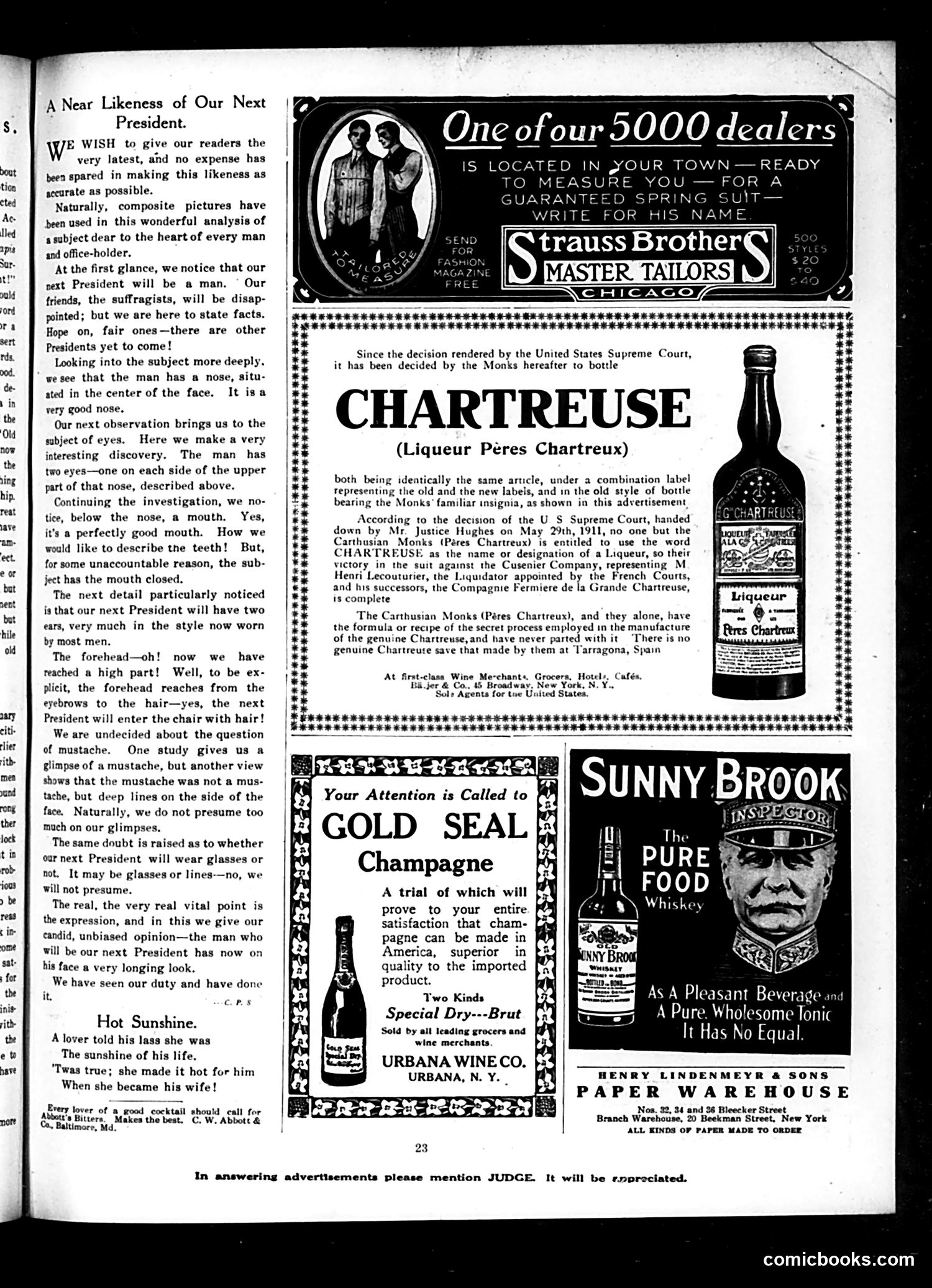
This is satirical commentary on an upcoming U.S. presidential election (likely 1912, given the suffrage reference). Judge magazine mocks the inability to identify who the next president will be by presenting an absurdly literal, feature-by-feature "analysis" of a composite portrait—noting only obvious physical attributes (a nose, two eyes, a mouth, ears, hair) without revealing any actual identity. The satire targets political uncertainty and the superficiality of election discourse. The jab at suffragists ("Hope on, fair ones") reflects the era's gender politics, while the final observation—that the mysterious future president displays "a very longing look"—suggests aspiration or ambition without substance. The page is primarily advertisements (Strauss Brothers tailors, Chartreuse liqueur, Gold Seal Champagne, Sunny Brook whiskey), typical of Judge's revenue model. The "Hot Sunshine" poem below is unrelated filler content.
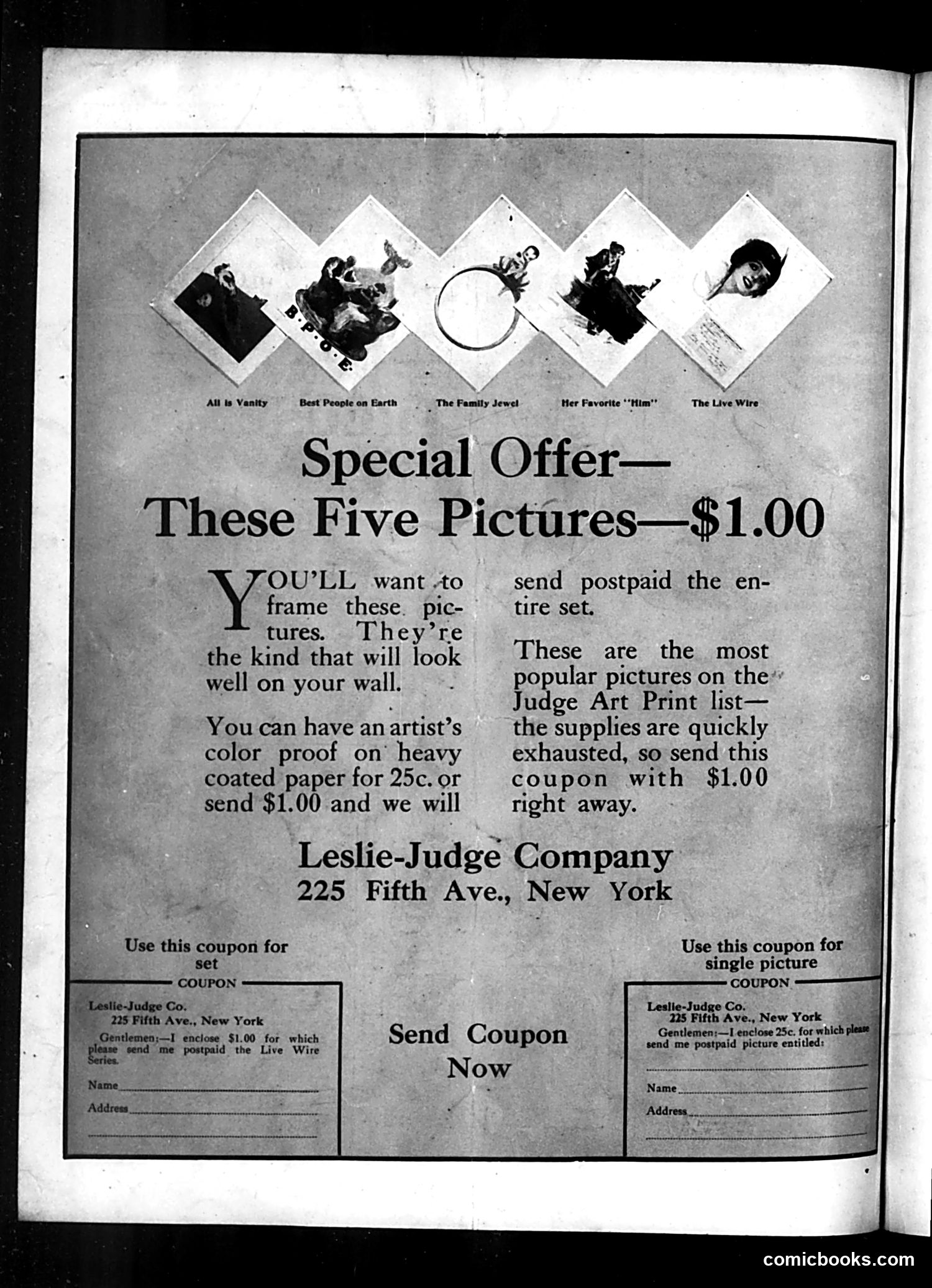
This page is primarily a **commercial advertisement**, not a political cartoon. It's a mail-order promotion from Leslie-Judge Company advertising five popular art prints from *Judge* magazine's catalog for $1.00 total (or 25¢ for a color proof). The five pictures shown are titled: "All is Vanity," "Best People on Earth," "The Family Jewel," "Her Favorite 'Him,'" and "The Live Wire." These appear to be generic satirical or humorous domestic/social commentary prints typical of *Judge* magazine's style—likely depicting contemporary middle-class life, romantic relationships, and social pretension. The advertisement emphasizes these are the "most popular pictures on the Judge Art Print list" and notes supplies are "quickly exhausted," using typical early-20th-century mail-order sales tactics. It includes tear-out coupons for customers to order either the full set or individual prints. There is no identifiable political satire on this page—it's simply a retail catalog page.