
Judge, 1912-04-20 · page 8 of 24
Judge — April 20, 1912 — page 8: what you’re looking at
What you’re looking at
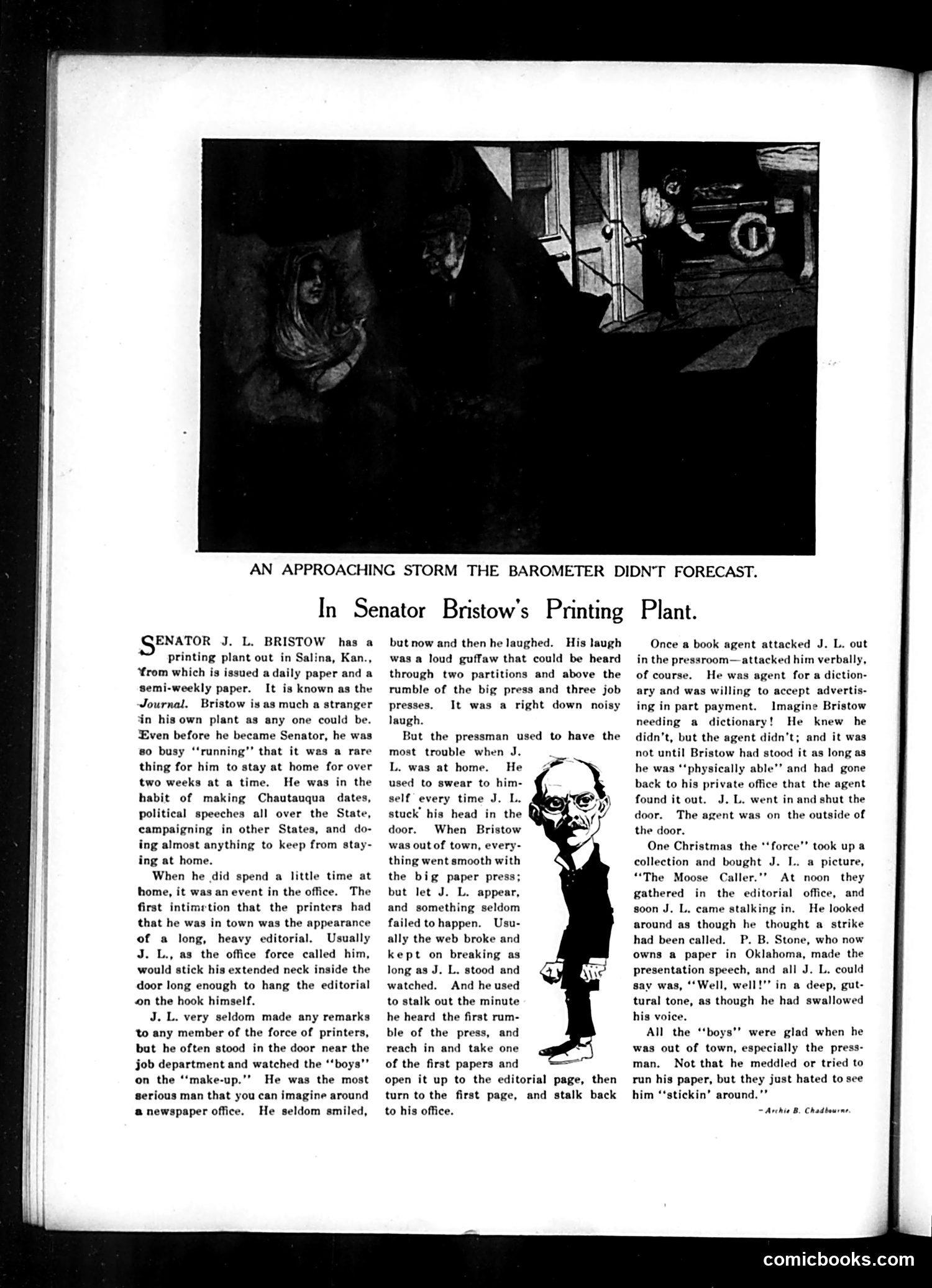
This article from Judge satirizes **Senator Joseph L. Bristow** of Kansas, a politician who owned a newspaper (the *Journal*) in Salina but was perpetually absent due to his political career. The humor lies in depicting him as a comically aloof, humorless boss who rarely visited his own printing plant. The satire targets several things: his obsessive politicking that kept him away from home; his stern, joyless demeanor around employees (a "loud guffaw" being his only laugh); and his disruptive presence—the running joke being that mechanical problems mysteriously occurred whenever he appeared in the pressroom. The anecdotes (the dictionary agent, the Christmas gift) illustrate how remote and severe he seemed to his staff. The "force" (employees) actually **preferred** his absence. The satire suggests Bristow embodied a particular American political type: the career politician so consumed by ambition that he's a stranger in his own enterprise, and so grimly serious he brings tension wherever he goes.
📄 Transcribed text from this page (OCR, searchable)
Machine-transcribed from the original scan — historical spelling and the odd misread are preserved.
AN APPROACHING STORM THE BAROMETER DIDN'T FORECAST. In Senator Bristow's Printing Plant. ENATOR J. L. BRISTOW has a printing plant out in Salina, Kan., from which is issued adaily paper and a semi-weekly paper. It is known as the Journal. Bristow is as much a stranger ‘in his own plant as any one could be. Even before he became Senator, he was so busy ‘‘running’’ that it wes a rare thing for him to stay at home for over two weeks at a time. He was in the habit of making Chautauqua dates, political speeches all over the State, campaigning in other States, and do- ing almost anything to keep from stay- ing at home. When he did spend a little time at home, it was an event in the office. The first intimetion that the printers had that he was in town was the appearance of a long, heavy editorial. Usually J. L., as the office force called him, would stick his extended neck inside the door long enough to hang the editorial on the hook himself. J. L. very seldom made any remarks to any member of the force of printers, but he often stood in the door near the job department and watched the ‘‘boys"’ on the ‘‘make-up."’ He was the most serious man that you can imagine around a@ newspaper office. He seldom smiled, but now and then he laughed. His laugh was a loud guffaw that could be heard through two partitions and above the rumble of the big press and three job presses. It was a right down noisy laugh. But the pressman used to have the most trouble when J. L. was at home. He 3 used to swear to him- self every time J. L. eo stuck’ his head in the i) door. When Bristow was out of town, every- } thing went smooth with the big paper press; but let J. L. appear, and something seldom failed tohappen. Usu- ally the web broke and kept on breaking as long as J. L. stood and watched. And he used to stalk out the minute he heard the first rum- ble of the press, and reach in and take one of the first papers and open it up to the editorial page, then turn to the first page, and stalk back to his office. Once a book agent attacked J. L. out in the pressroom—attacked him verbally, of course. He was agent for a dict! ary and was willing to accept adverti ing in part payment. Imagine Bristow needing a dictionary! He knew he didn’t, but the agent didn’t; and it was not until Bristow had stood it as long as he was ‘‘physically able’’ and had gone back to his private office that the agent found it out. J. L. went in and shut the door. The agent was on the outside of the door. One Christmas the ‘‘force’’ took up a collection and bought J. L. a picture, “The Caller."". At noon they gathered in the editorial office, and soon J. L, came stalking in. He looked around as though he thought a strike had been called. P. B. Stone, who now owns a paper in Oklahoma, made the presentation speech, and all J. L. could say was, ‘‘Well, well!’’ in a deep, gut- tural tone, as though he had swallowed his voice. All the ‘‘boys’’ were glad when he was out of town, especially the press- man. Not that he meddled or tried to run his paper, but they just hated to see him ‘‘stickin’ around.’’ ~ Archie B. Chadbourne Moose comicbooks.com