
A complete issue · 24 pages · 1911
Judge — November 25, 1911
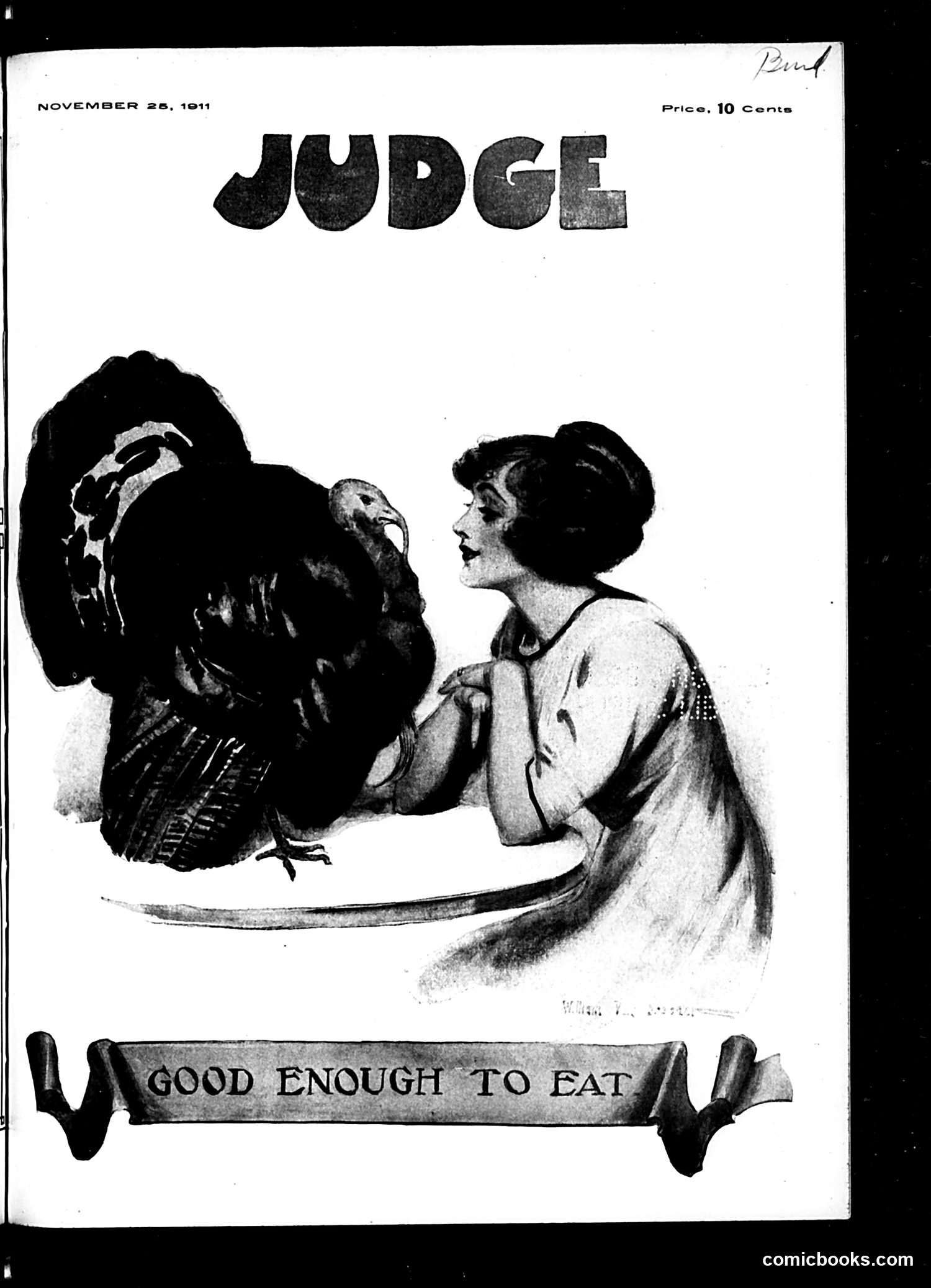
This cover depicts a woman admiring a large turkey with the caption "Good Enough to Eat." This is a Thanksgiving-themed illustration, typical of Judge's seasonal content. The image is straightforward holiday satire rather than political commentary. The woman's expression and body language suggest desire or appreciation for the plump bird, playing on the double meaning of the phrase—both literal (the turkey as food) and suggestive. This type of mild, flirtatious humor was characteristic of Judge's style during the early 1900s. The cover price of 10 cents and the "Printed" notation in the corner are standard publishing details of the era. Without additional text on this page, the primary content appears to be this single illustration marking the approach of Thanksgiving.
This page is primarily **advertising rather than political satire**. It's a Thanksgiving-themed issue (indicated by "Thanksgiving Number" in the contents) featuring commercial advertisements for consumer products: Blatz beer, Pears' soap, Hotel Rudolf, Gold Seal champagne, a Christmas trunk, Parker toothpaste, and P.B. ale. The editorial contents listed (articles on turkey, Thanksgiving dinners, bird lovers, etc.) appear light and lifestyle-focused rather than satirical commentary on current events. The only identifiable figure is the **cover design credited to James Montgomery Flagg**, a well-known illustrator of the era, but the cover itself isn't visible in this section of the page. This represents Judge functioning primarily as a vehicle for upscale consumer advertising during the 1911 holiday season.
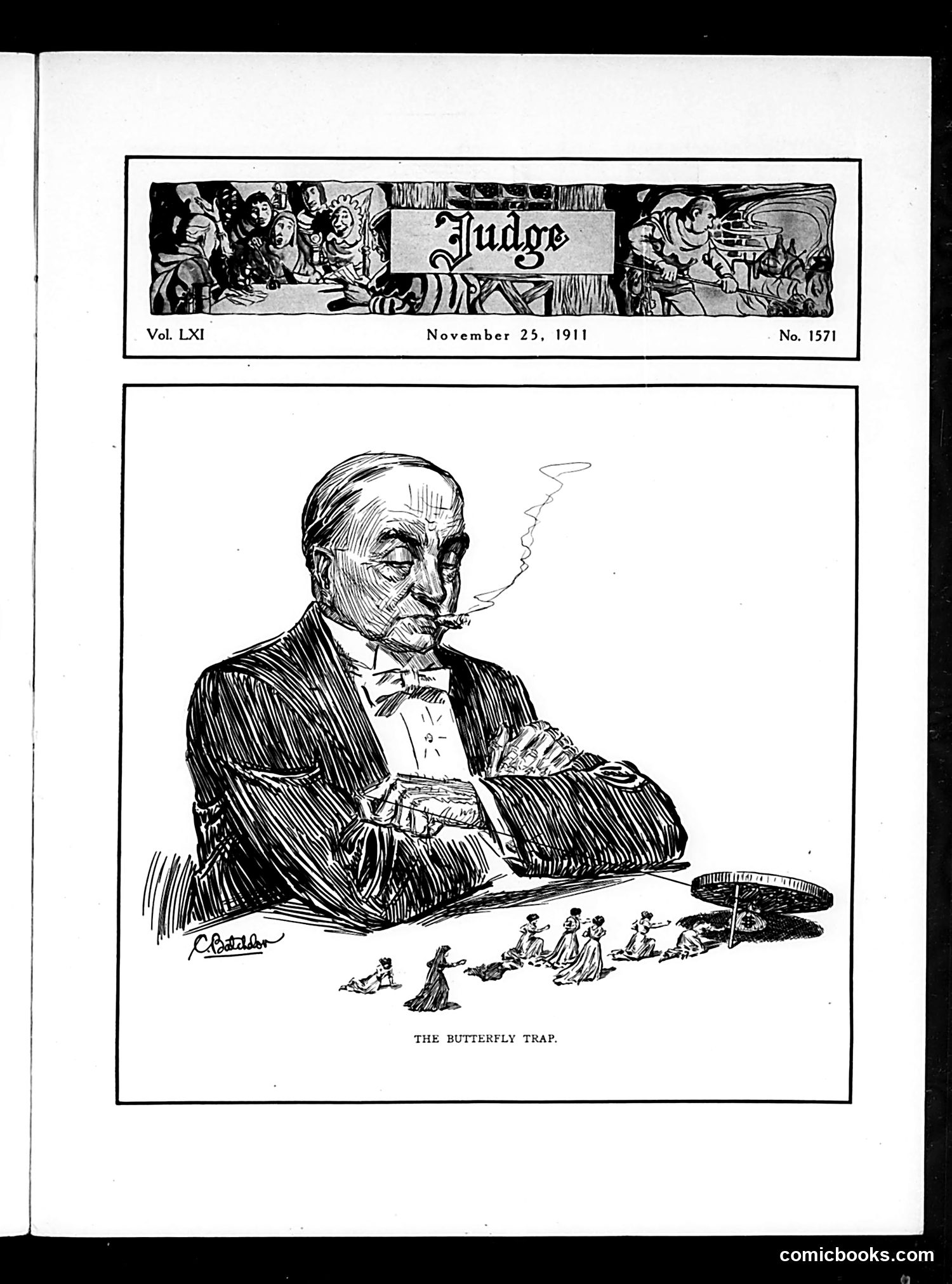
This political cartoon depicts a large, stern-faced gentleman in formal dress smoking a cigar, with tiny human figures trapped in what appears to be a butterfly net or trap at his feet. The title "The Butterfly Trap" suggests entrapment or manipulation. Without additional context from the issue, the specific identity of the figure and the political situation referenced is unclear. However, the imagery implies satire about a powerful person (likely a wealthy industrialist, politician, or government official) using their influence to "trap" or control common citizens or political opponents. The diminished size of the human figures emphasizes the power imbalance being criticized. The cartoon's style and composition are typical of Judge's early 20th-century political commentary.
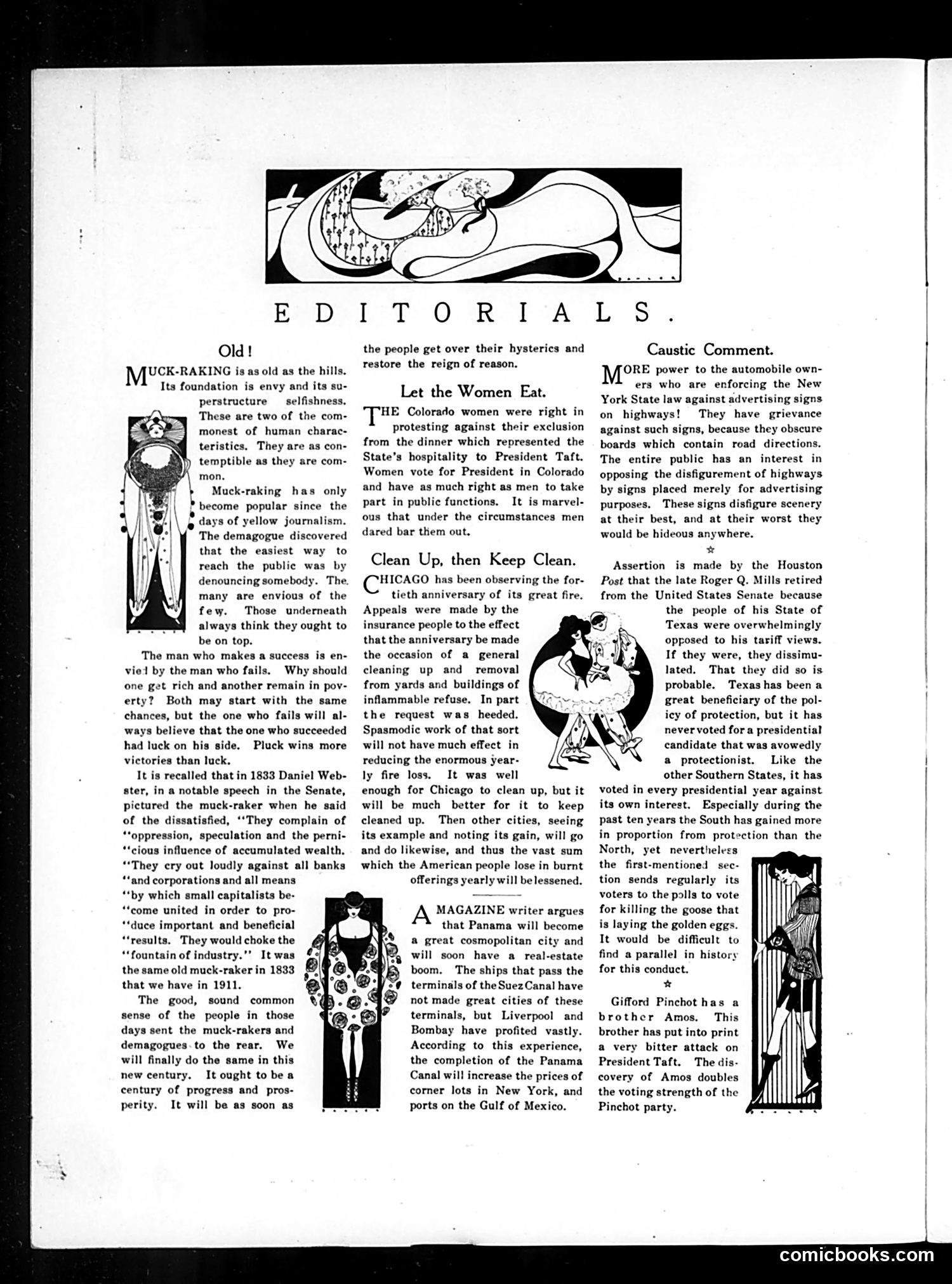
This page contains four separate editorials with accompanying illustrations, typical of Judge magazine's satirical commentary. **"Muck-Raking"** critiques sensationalist journalism's decline, arguing that while muckraking once served democracy by exposing corruption, it has become an outdated practice. **"Let the Women Eat"** defends Colorado women's protest against exclusion from a dinner honoring President Taft, asserting women deserve equal public participation rights. **"Clean Up, then Keep Clean"** praises Chicago's post-fire reconstruction efforts and encourages other cities to adopt similar civic improvement practices. **"Caustic Comment"** supports New York's automobile advertising sign restrictions, arguing they preserve scenic highways from commercial disfigurement. The page uses decorative Art Deco-style female figures to frame sections, typical of Judge's visual style during this era.
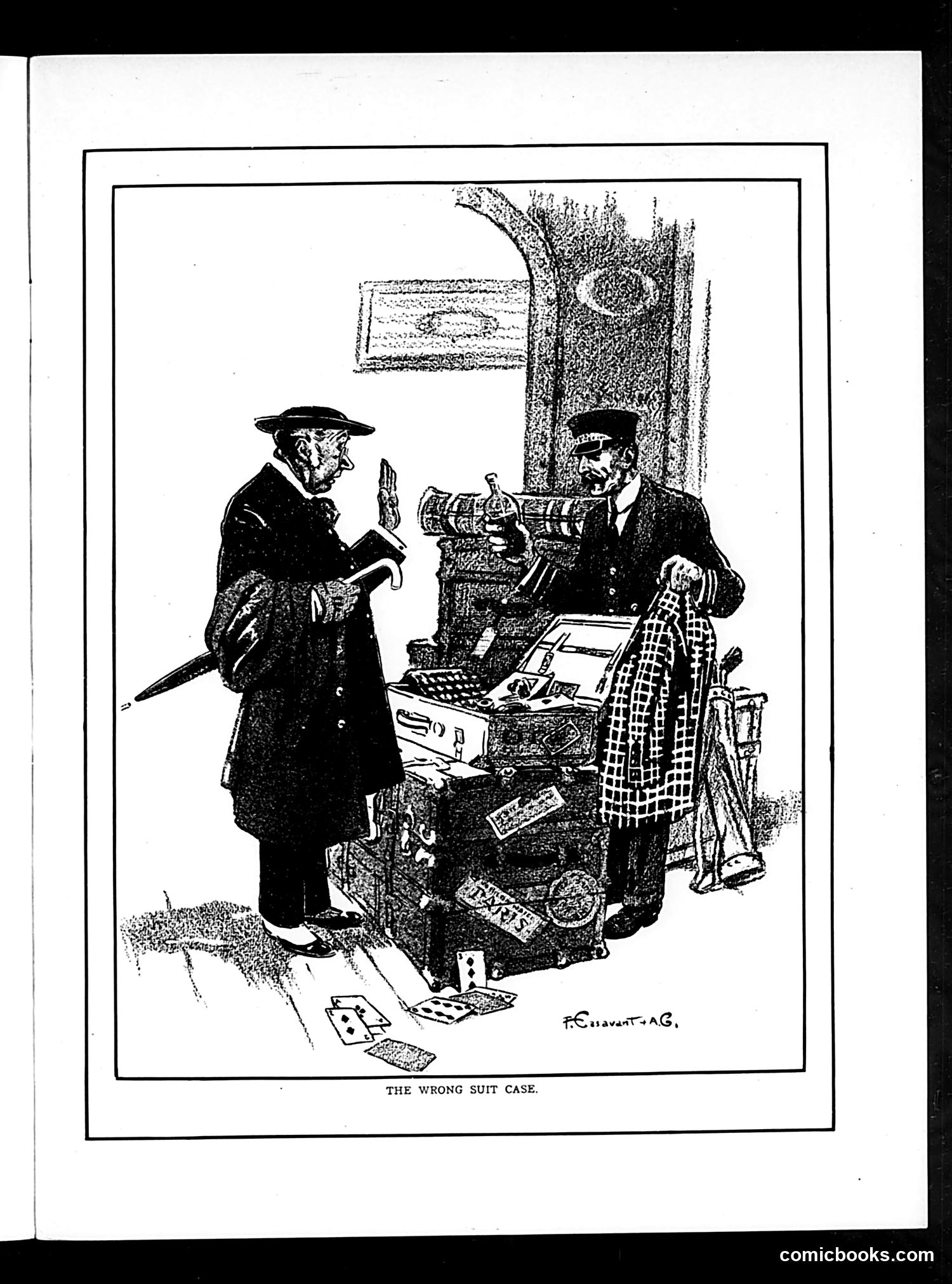
This cartoon depicts two men examining a suitcase filled with what appears to be legal documents or papers. The man on the left holds a hammer, suggesting he's attempting to break it open or has just done so. Playing cards are scattered on the floor, and a telescope or similar instrument sits on the case. The title "The Wrong Suit Case" implies a case of mistaken identity or mixed-up luggage. Given the legal documents visible and the comedic setup, this likely satirizes either a legal mix-up or confusion involving contracts, cases, or official papers—possibly referencing a contemporary court case or business scandal from Judge magazine's era. The scattered cards suggest gambling or dishonest dealings may be involved in the satire.
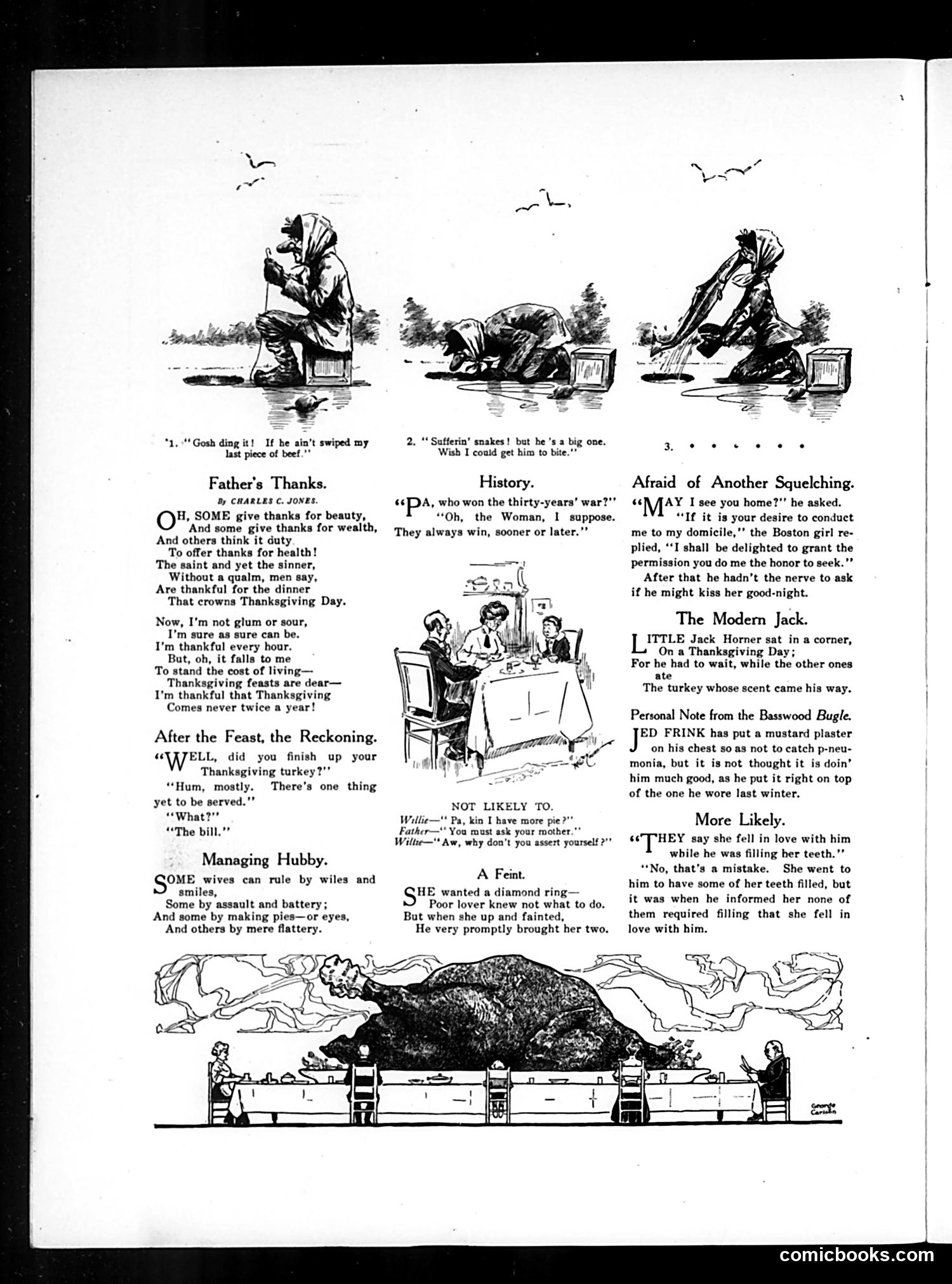
This Thanksgiving-themed page from *Judge* contains multiple brief satirical pieces mocking domestic life and gender relations in early 20th-century America. **Key Satirical Points:** The cartoons and jokes ridicule husbands' financial burdens (cost of holiday feasts), wives' dominance in relationships ("Woman always wins"), and awkward courtship dynamics. One piece mocks a Boston woman's affected, overly formal speech. Another depicts a poor man buying two diamond rings when his date faints—suggesting women manipulate men through emotional displays. The humor targets: - **Marital economics**: Men resent the expense of celebrations - **Gender power dynamics**: Despite nominal male authority, women actually control households - **Class pretension**: The Boston girl's pompous language - **Dating manipulation**: Women using vulnerability strategically The large turkey illustration at page bottom anchors the Thanksgiving context throughout. Overall, the satire reflects anxieties about shifting gender roles and marital power, common Judge themes of this era.
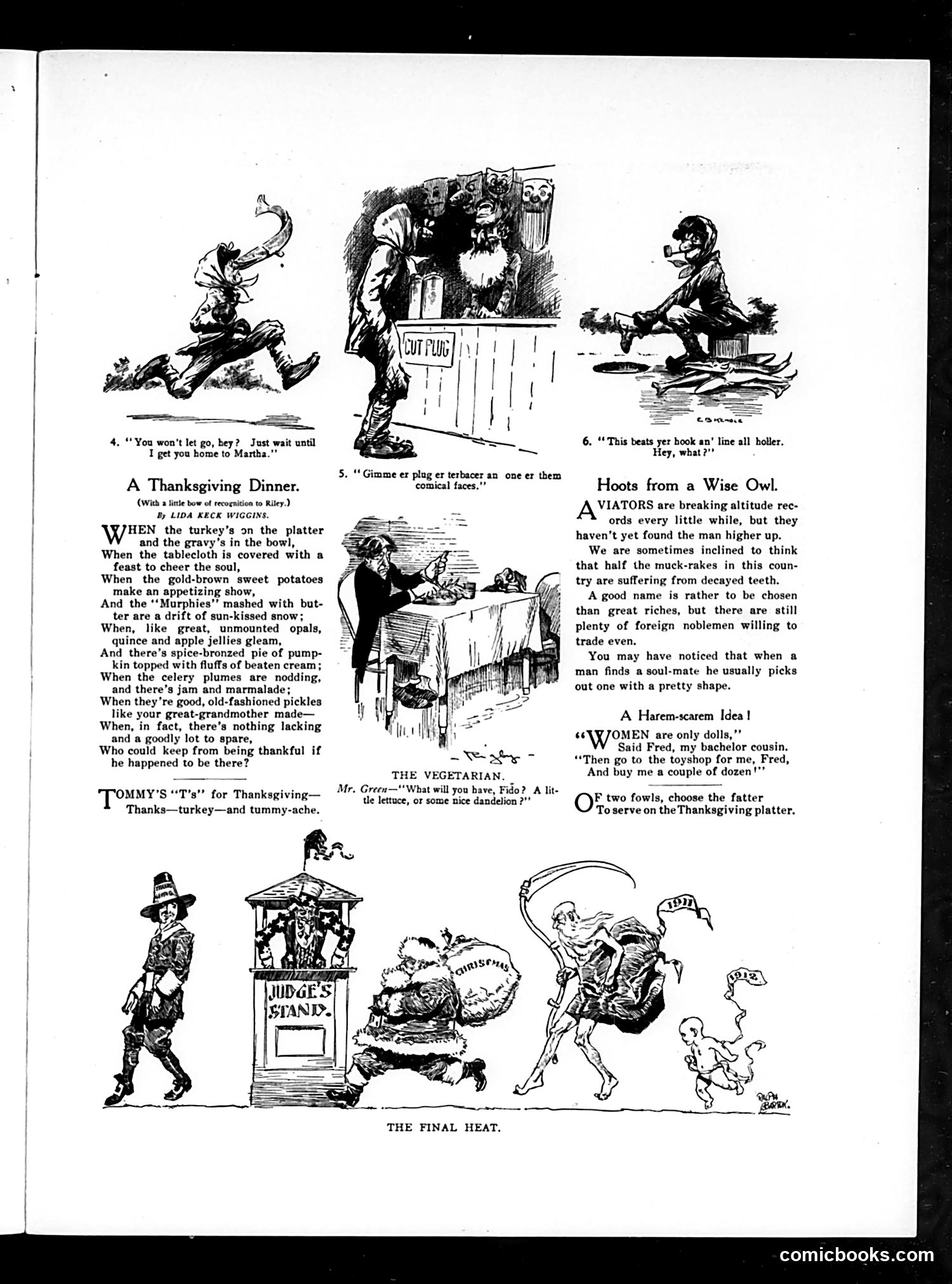
This page from *Judge* magazine contains multiple short satirical pieces typical of early 20th-century American humor: **"A Thanksgiving Dinner"** is a nostalgic poem celebrating traditional holiday abundance—turkey, sweet potatoes, pies—with an ironic twist: young Tommy's reward is indigestion ("tummy-ache"). **"The Vegetarian"** mocks vegetarianism by showing a man offering his dog lettuce instead of meat, suggesting the practice is absurd and unnatural. **"Hoots from a Wise Owl"** offers cynical social commentary: aviators break altitude records but haven't found anyone morally superior; "muck-rakes" (investigative journalists exposing corruption) supposedly have poor dental health; men choose women based on appearance rather than character. **"A Harem-scarem Idea"** is a sexist joke treating women as interchangeable dolls to be purchased. **"The Final Heat"** (bottom cartoon) is unclear without additional context but appears to depict some kind of competition or chase sequence. The humor reflects period attitudes toward women, immigrants, dietary choices, and social reform.
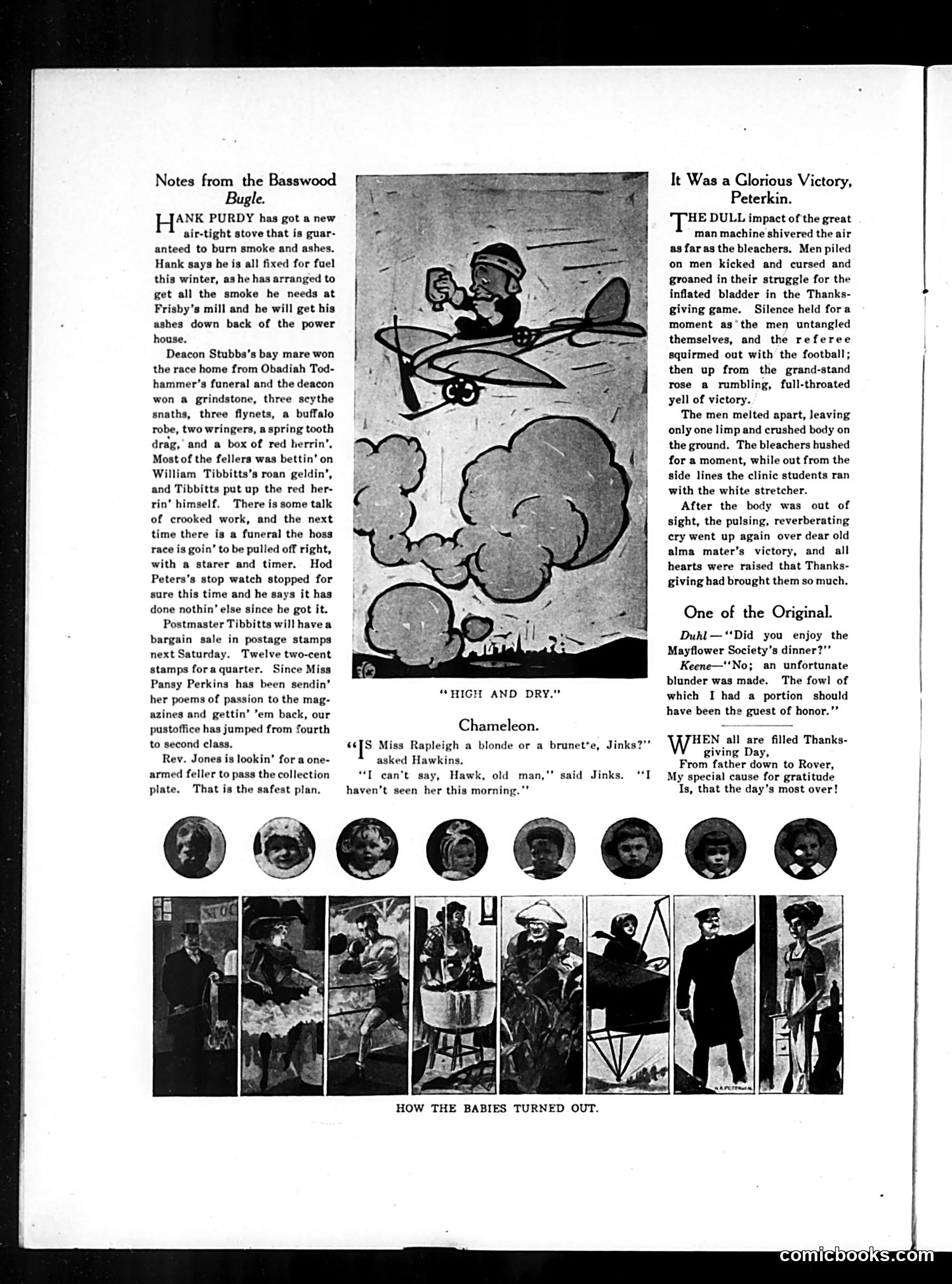
This page contains three satirical pieces typical of Judge magazine's rural and social humor: **"Notes from the Basswood Bugle"**: Humorous anecdotes from a small town, mocking rural life—incompetent stove-building, a horse race at a funeral (suggesting rural priorities), and a postmaster offering discount stamps because mail volume increased when a local woman started submitting rejection-slip poetry to magazines. **"It Was a Glorious Victory, Peterkin"**: Social satire on college football culture. The story describes brutal violence during a Thanksgiving game where a player is severely injured, yet spectators celebrate the victory—critiquing how institutions prioritize winning over player safety and human welfare. **"One of the Original"**: A joke about the Mayflower Society (exclusive descendants club) where someone mistakenly serves fowl that "should have been the guest of honor"—mocking pretentious genealogical snobbery. The remaining items are brief jokes and illustrations about Thanksgiving traditions and baby photos.
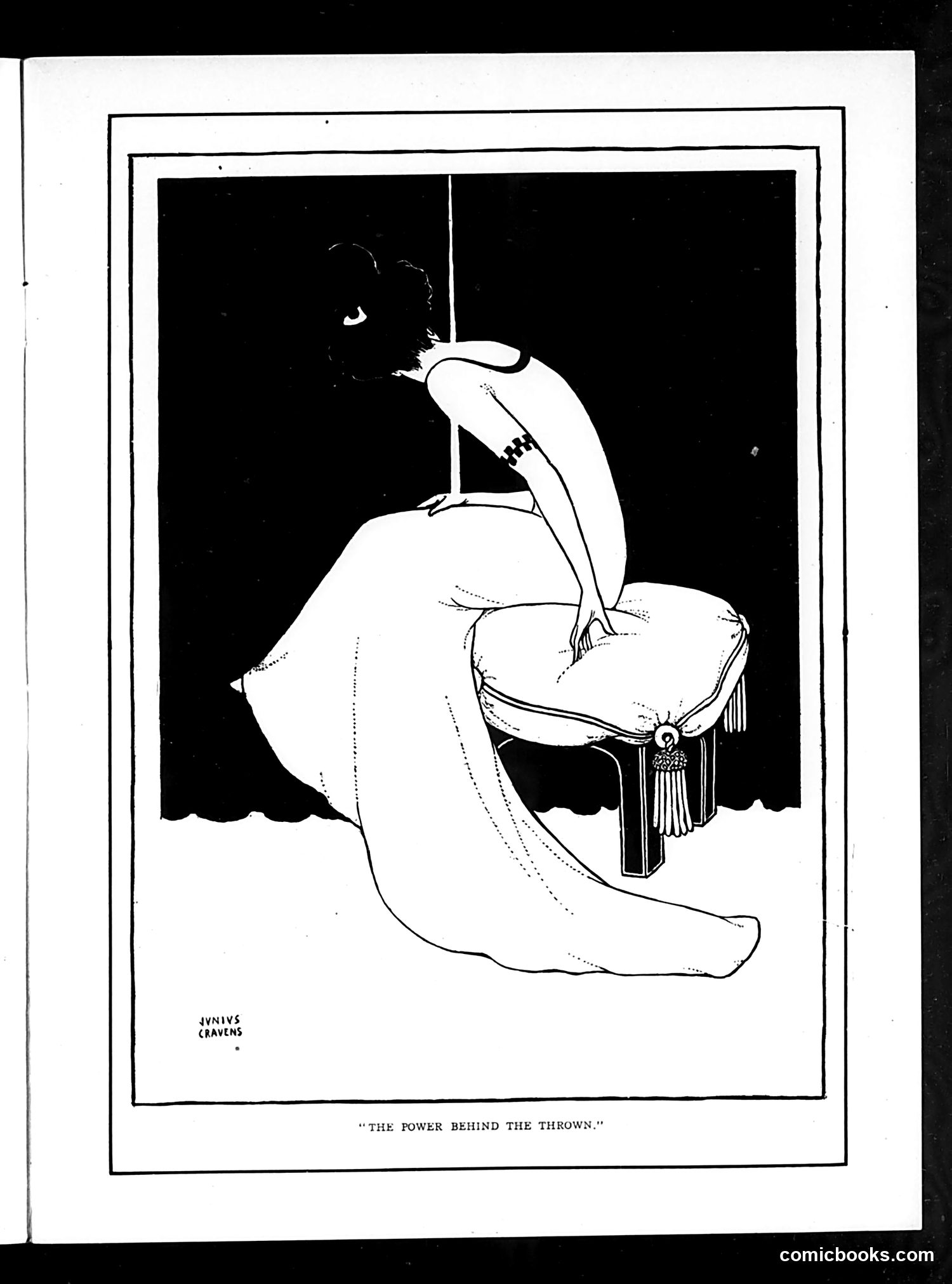
This cartoon depicts a woman in classical drapery sitting on an ornate stool, gazing at a man's silhouetted head in darkness. The title's pun on "throne/thrown" suggests commentary on feminine influence over male authority figures. The image likely satirizes the concept of women wielding political or social power indirectly through men—a common Judge magazine theme addressing evolving gender dynamics. The woman's posed, classical appearance and the man's shadowed anonymity reinforce the idea of hidden female influence. Artist Cravens signed the work. Without additional context about specific historical figures or events from when this appeared, the cartoon appears to be general social satire about gender relations and power dynamics rather than commentary on particular political figures.
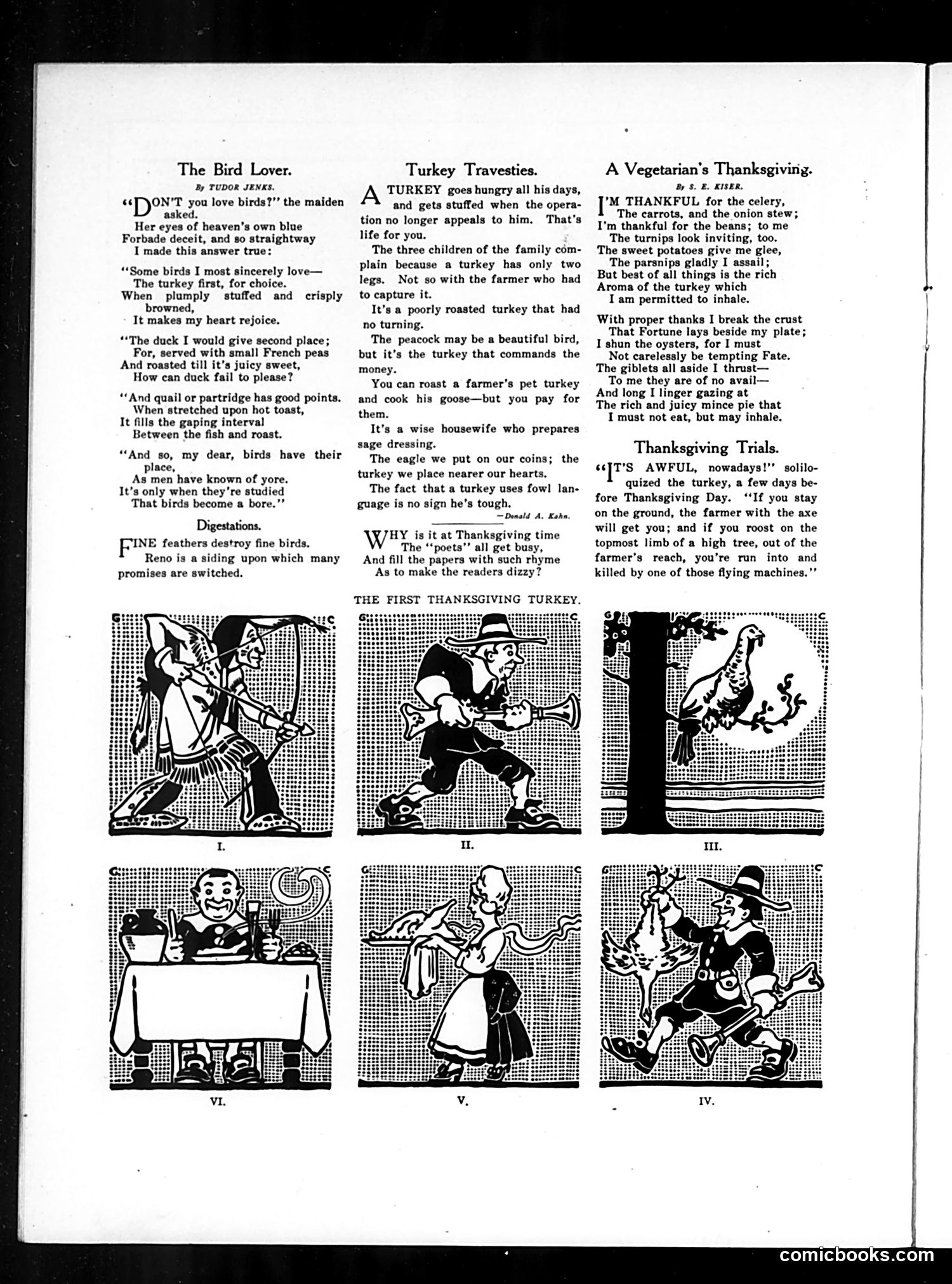
This page from *Judge* magazine contains humorous Thanksgiving-themed content from the early 20th century. The satire centers on attitudes toward turkeys and holiday food traditions. **"The Bird Lover"** is a courtship poem where a suitor claims to love birds—but reveals he means eating them (turkey, duck, quail, partridge). The joke plays on the double meaning of "love," suggesting romantic sentiment masks appetite. **"Turkey Travesties"** offers witty aphorisms about turkeys' fate: they're fed all year, then killed and roasted. One quip contrasts the eagle on coins with the turkey "nearer our hearts"—meaning on dinner plates. **"A Vegetarian's Thanksgiving"** mocks vegetarians who claim moral superiority while still enjoying turkey's *aroma*—suggesting they want the benefit without the principle. **"The First Thanksgiving Turkey"** comic strip (illustrations I-VI) appears to depict a turkey's misadventures, though specific details are unclear from the image. The overall theme: early 1900s Americans found vegetarianism or squeamishness about eating meat hypocritical and amusing.
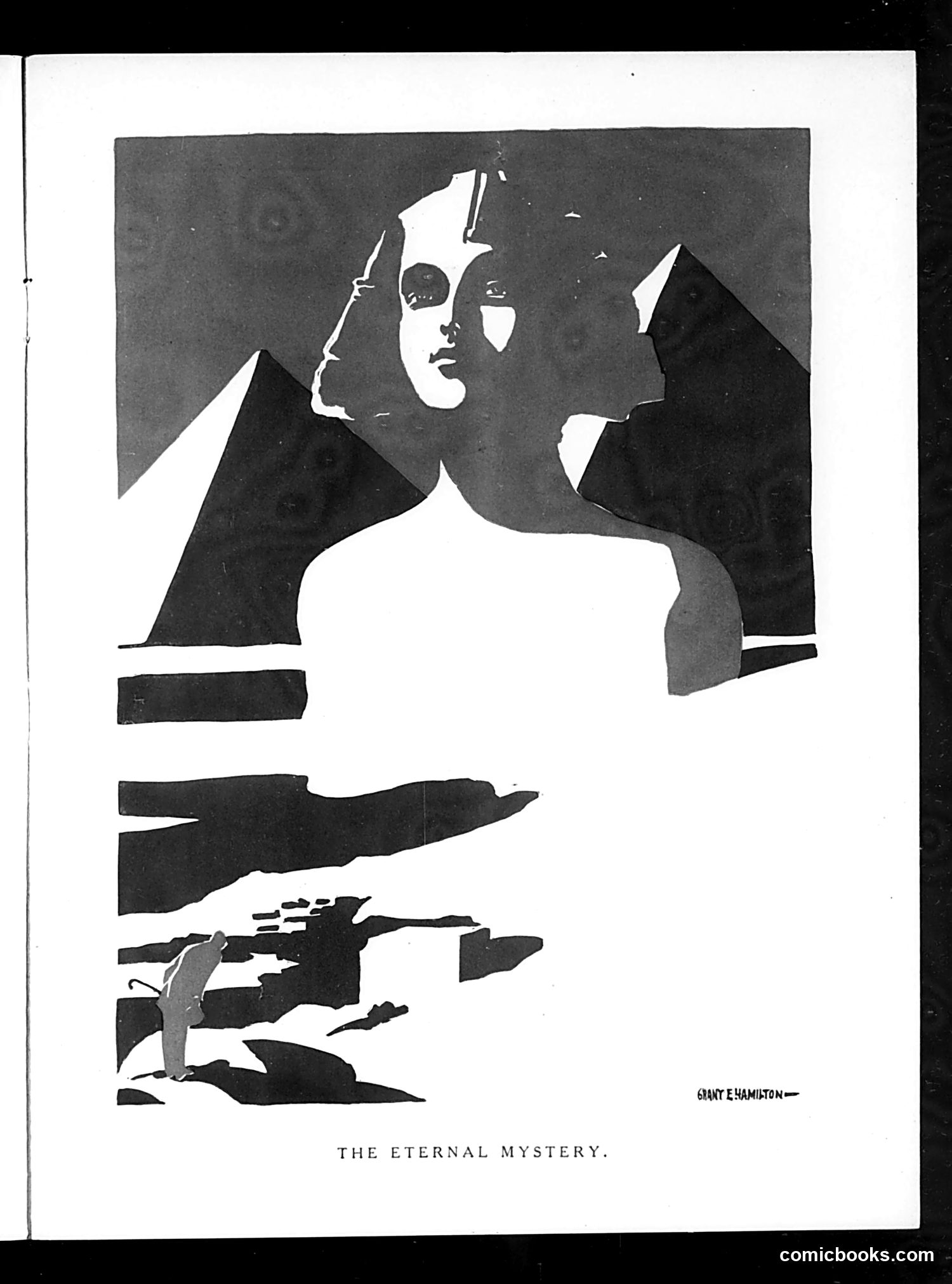
This artwork presents a stylized silhouette composition featuring a woman's profile at the top, surrounded by dark angular forms suggesting wings or dramatic drapery. Below her are fragmented silhouettes of figures and landscapes in various poses. The title "The Eternal Mystery" likely references the satirical magazine's frequent commentary on women's roles and the cultural fascination with feminine enigma—a common theme in early-to-mid 20th century satirical publications. The fragmented, abstract composition below suggests confusion or chaos, possibly commenting on society's inability to understand or rationally explain women's behavior or nature. Without additional context about the specific issue date, the precise satirical target remains unclear, though the artwork employs the surrealist-influenced style common to Judge's artistic commentary.
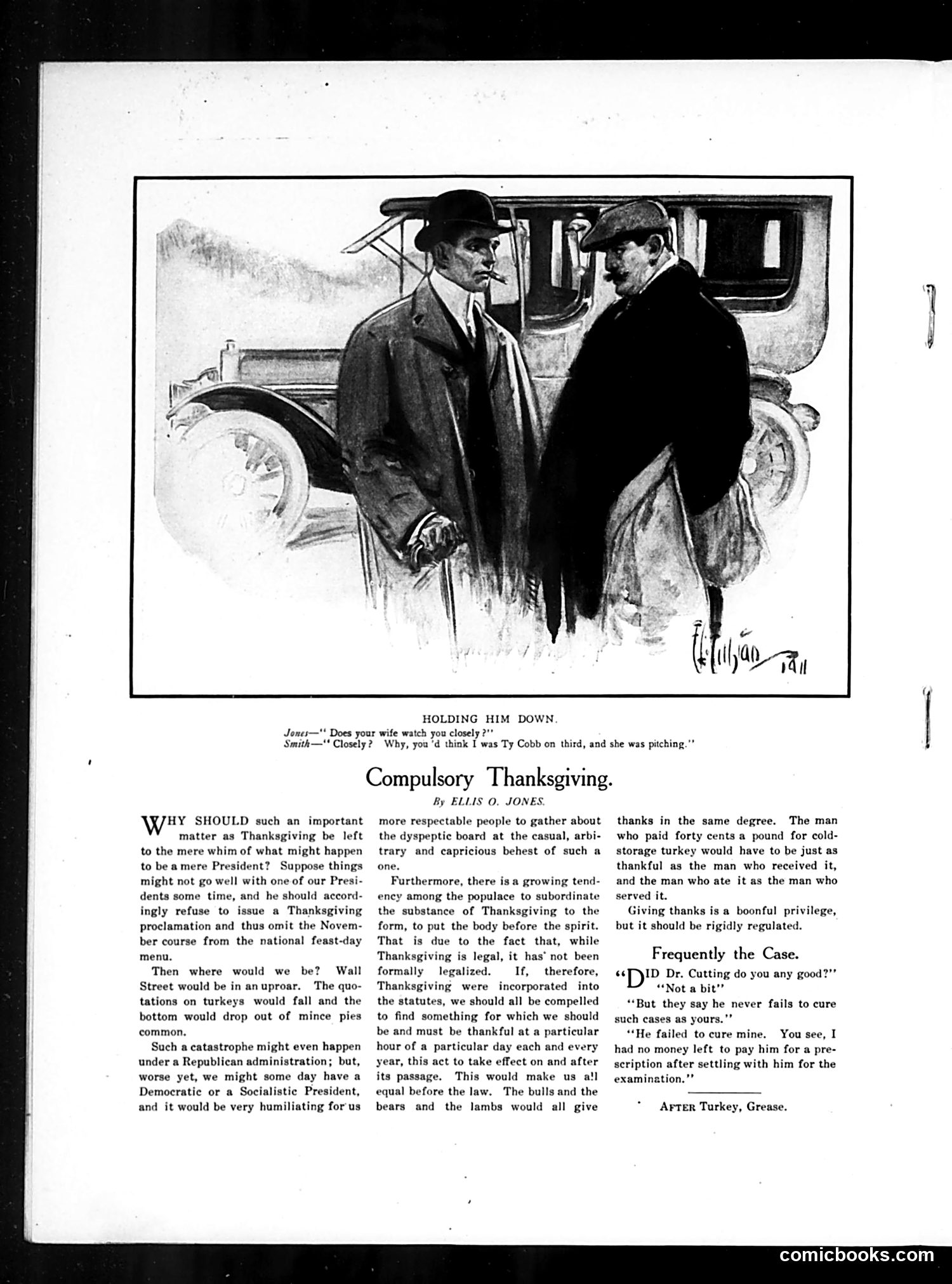
This 1911 *Judge* page satirizes two distinct topics: **"Compulsory Thanksgiving"** (main article): Ellis O. Jones ridicules the idea of making Thanksgiving mandatory by law. He uses absurdist logic—if a President refuses to issue a Thanksgiving proclamation, Wall Street turkeys would crash. He then mocks the impulse toward compulsory gratitude, suggesting that legally mandating everyone be equally thankful at a set hour would be bureaucratic overreach. The satire targets both government overreach and shallow materialism (cold-storage turkeys vs. genuine gratitude). **"Holding Him Down"** (cartoon above): Two men stand by a car; one warns the other about his wife's jealousy, jokingly comparing himself to baseball player Ty Cobb on third base—implying marital surveillance. **"Frequently the Case"** (bottom snippet): A doctor fails to cure a patient because the patient exhausted his money paying the doctor's examination fee—satirizing medical costs and the contradiction of unaffordable healthcare.
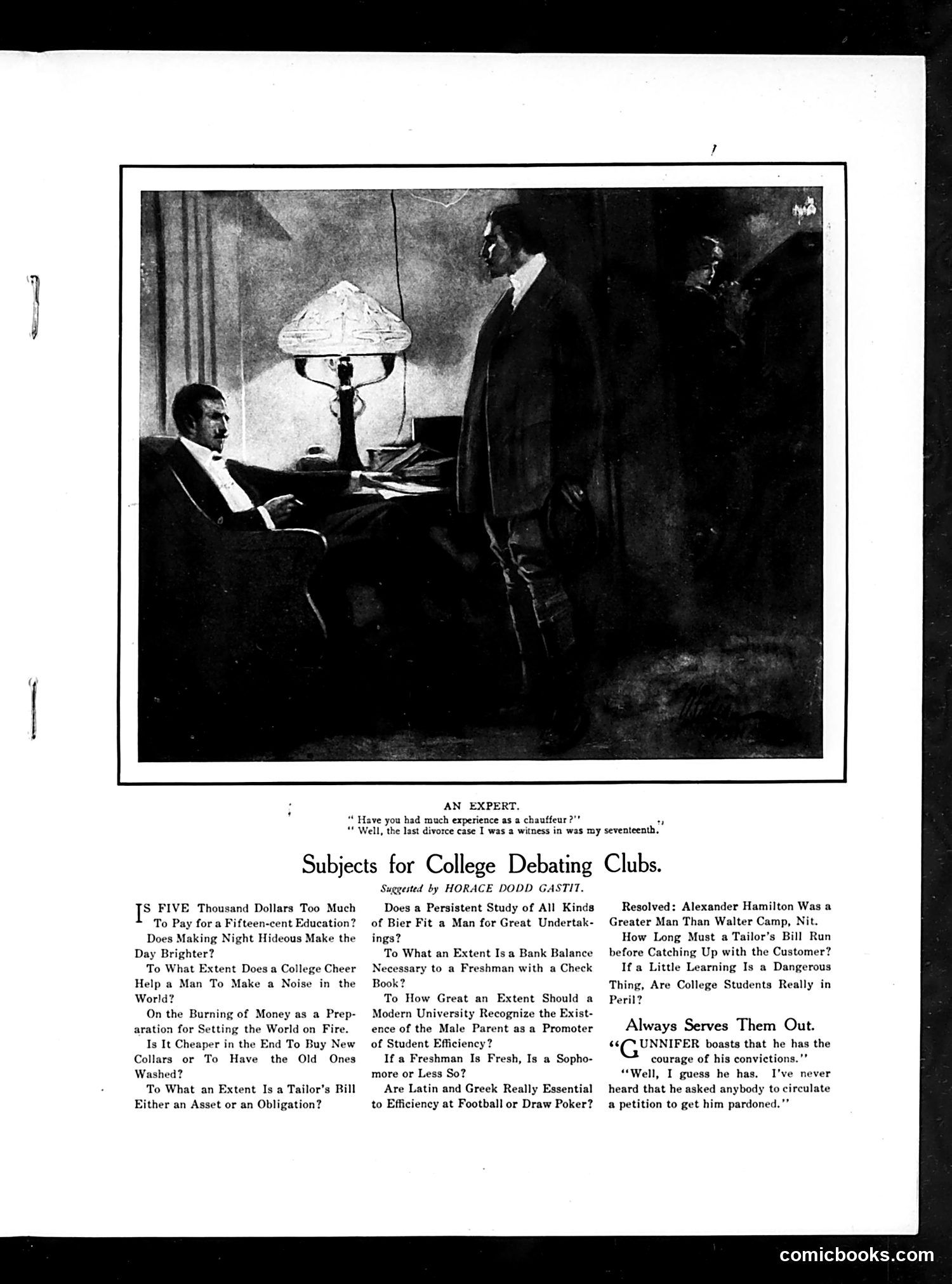
**The Main Cartoon ("An Expert"):** A man applying as a chauffeur claims experience because he was a witness in seventeen divorce cases. The joke mocks both divorce's prevalence in society and the absurd logic of citing courtroom attendance as job qualification. **"Subjects for College Debating Clubs":** This satirizes college debate topics as trivial and absurd—arguing whether $5,000 is too much for education, whether college cheers help success, or if Latin is necessary for football efficiency. The satire suggests college debates waste time on pointless questions rather than substantive issues. **"Always Serves Them Out":** A brief joke where someone boasts of having "courage of his convictions," but the punchline reveals he actually asks others to petition for his pardon—exposing his cowardice and hypocrisy. Overall, the page mocks pretentiousness, frivolous higher education, divorce culture, and false bravado—typical Judge magazine targets of upper-class American foibles.
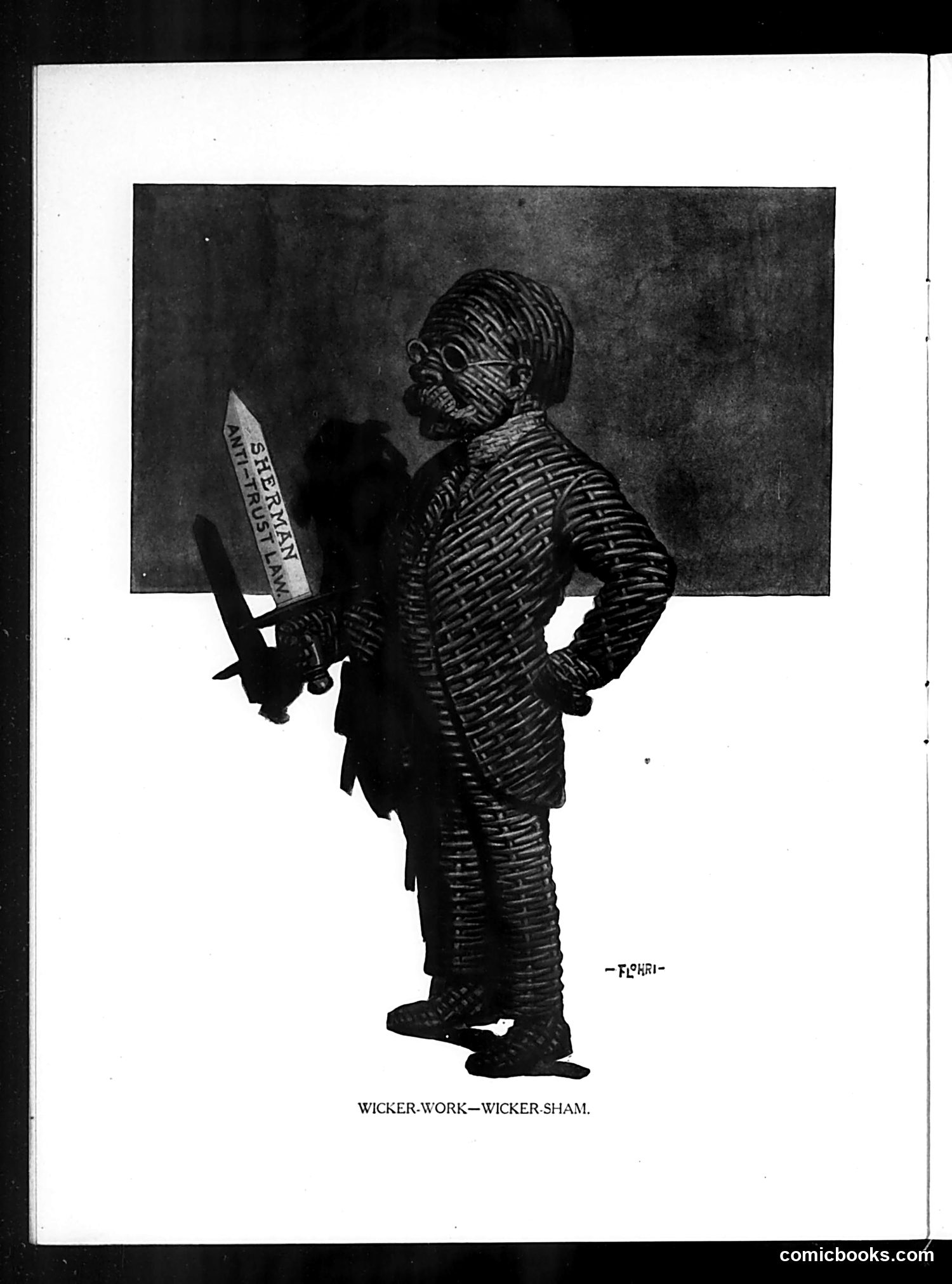
This appears to be a political cartoon from *Judge* magazine satirizing someone through the metaphor of "wicker-work" versus "wicker-sham" (fake wickerwork). The figure is depicted as a skeletal or death's-head character dressed in wicker-like armor or clothing, holding a sword labeled with text (possibly identifying the target). The pose—hand on hip, confrontational stance—suggests mockery of pretension or false strength. The "wicker-sham" title implies the subject presents a false or flimsy exterior despite appearing substantial. Without clearer text identification on the sword or additional context, I cannot definitively identify which political or public figure is being caricatured. The skeletal imagery suggests either death-related commentary or an accusation of being hollow/fraudulent beneath surface appearance.
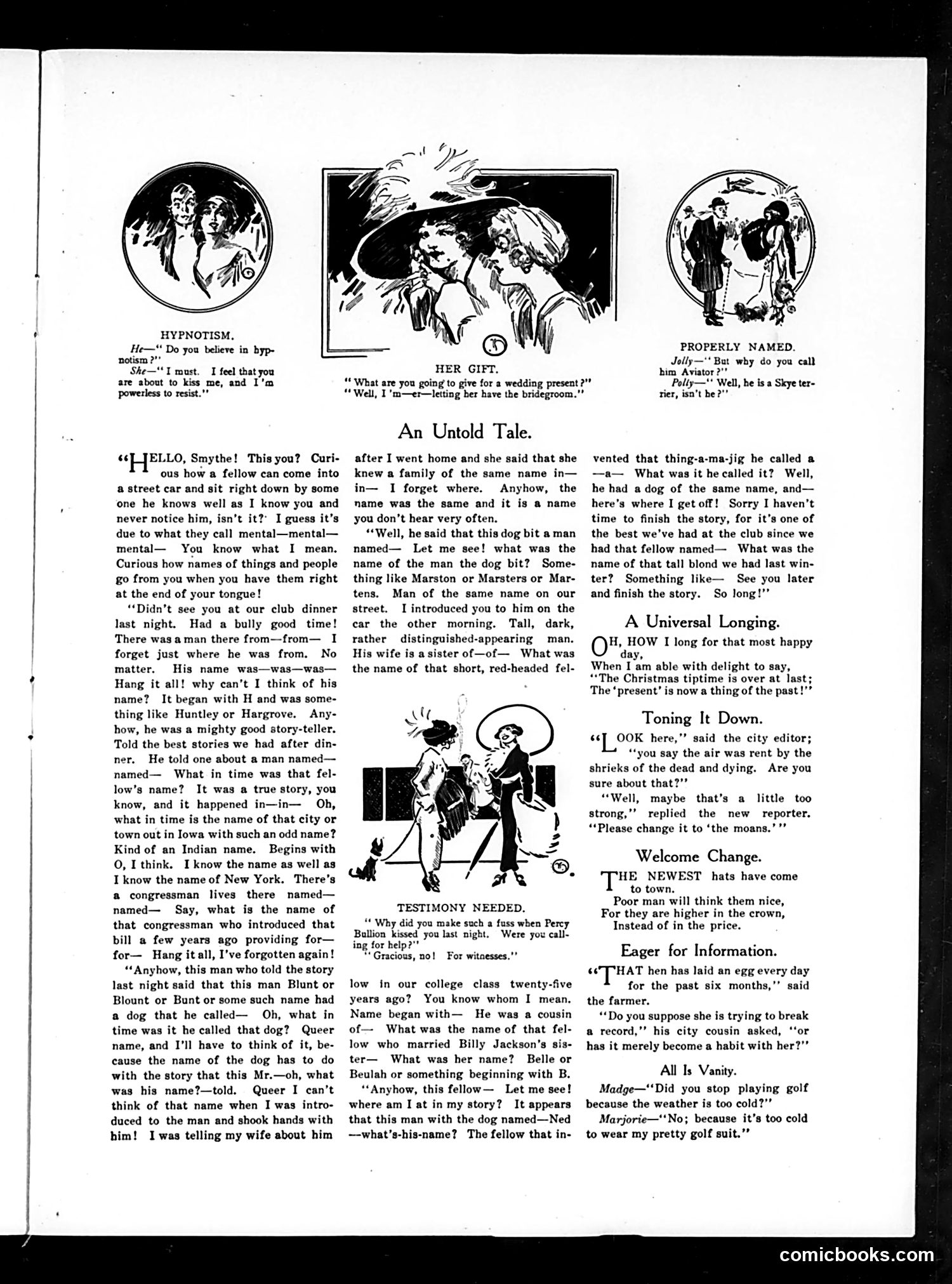
This page satirizes **absent-mindedness and social awkwardness** in early 20th-century America through several short humor pieces: **Main Story ("An Untold Tale")**: A garrulous man encounters someone he knows but cannot remember basic facts—the friend's name, where a dinner guest was from, the dog's name, the man the dog bit. The humor lies in his verbose, stream-of-consciousness rambling that goes nowhere, interrupted constantly by "what was it called?" The story never concludes because he gives up mid-narrative. This mocks social pretension and the inability to maintain coherent conversation. **Side Comics**: - "Hypnotism" jokes about kissing - "Her Gift" presents a woman offering her bridegroom as a wedding present—cynical marital humor - "Properly Named" makes a pun: calling a Skye terrier "Aviator" because it's a "Skye" terrier - "Testimony Needed" jokes about wanting witnesses to a kiss The overall tone reflects turn-of-the-century satirical humor targeting bourgeois social behavior and memory lapses.
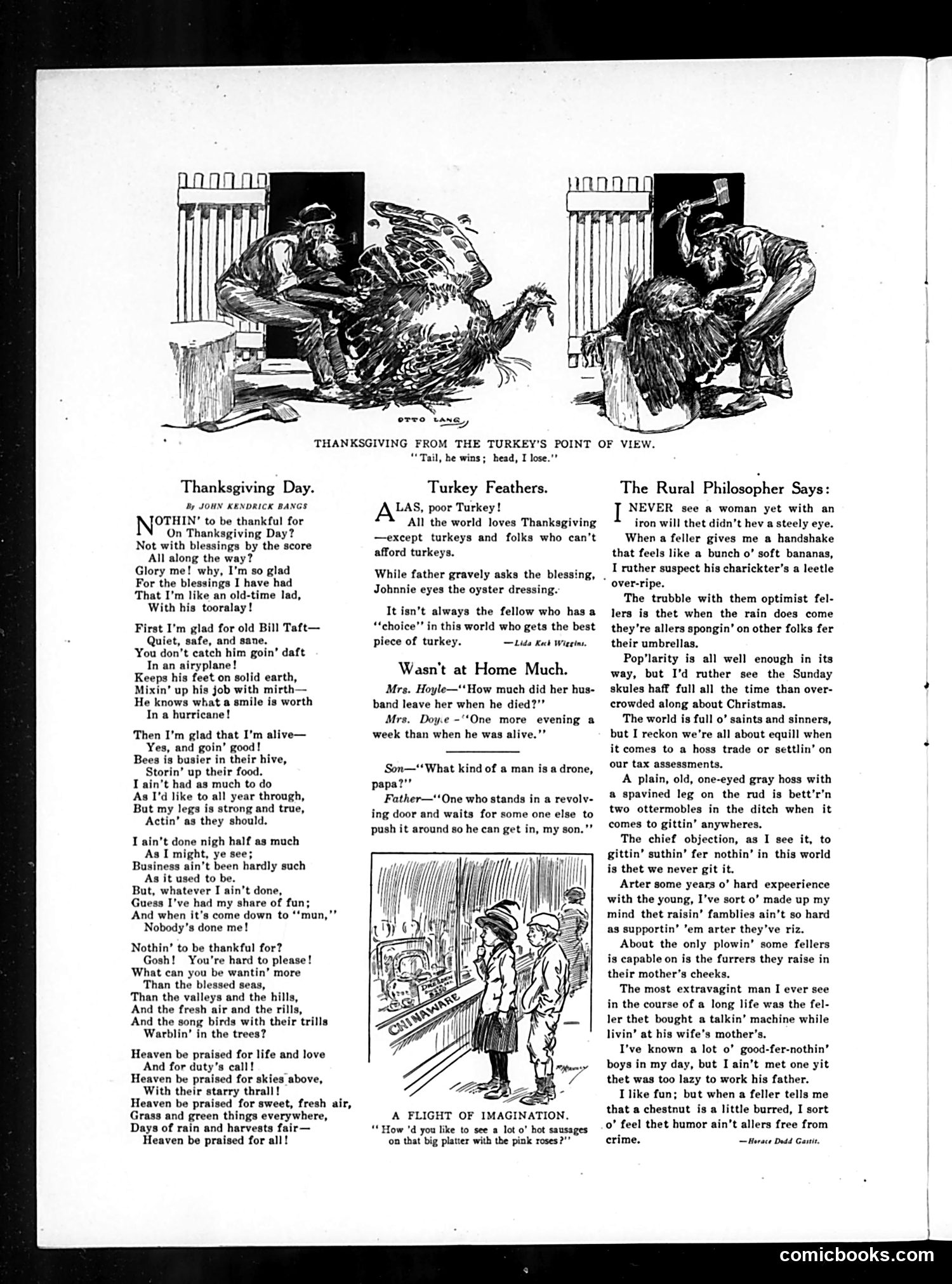
This Thanksgiving-themed Judge page from the early 1900s contains three main pieces: **"Thanksgiving from the Turkey's Point of View"** presents a darkly comic dual illustration: the turkey loses either way—if "tail, he wins; head, I lose"—a reference to the coin-flip game where one person calls heads or tails. **The poem "Thanksgiving Day"** by John Kendrick Bangs celebrates gratitude, notably praising President William Howard Taft for being grounded and sensible (contrasting with fears about new aviation technology, then exotic and dangerous). **"The Rural Philosopher Says"** offers folk wisdom in rural dialect, offering satirical observations about human nature—women with steely eyes, insincere handshakes, overly optimistic borrowers, and the challenges of raising families. The cartoons and text collectively satirize both the holiday's contrasts (celebration versus the turkey's fate) and contemporary anxieties about modern life, technology, and changing social values.
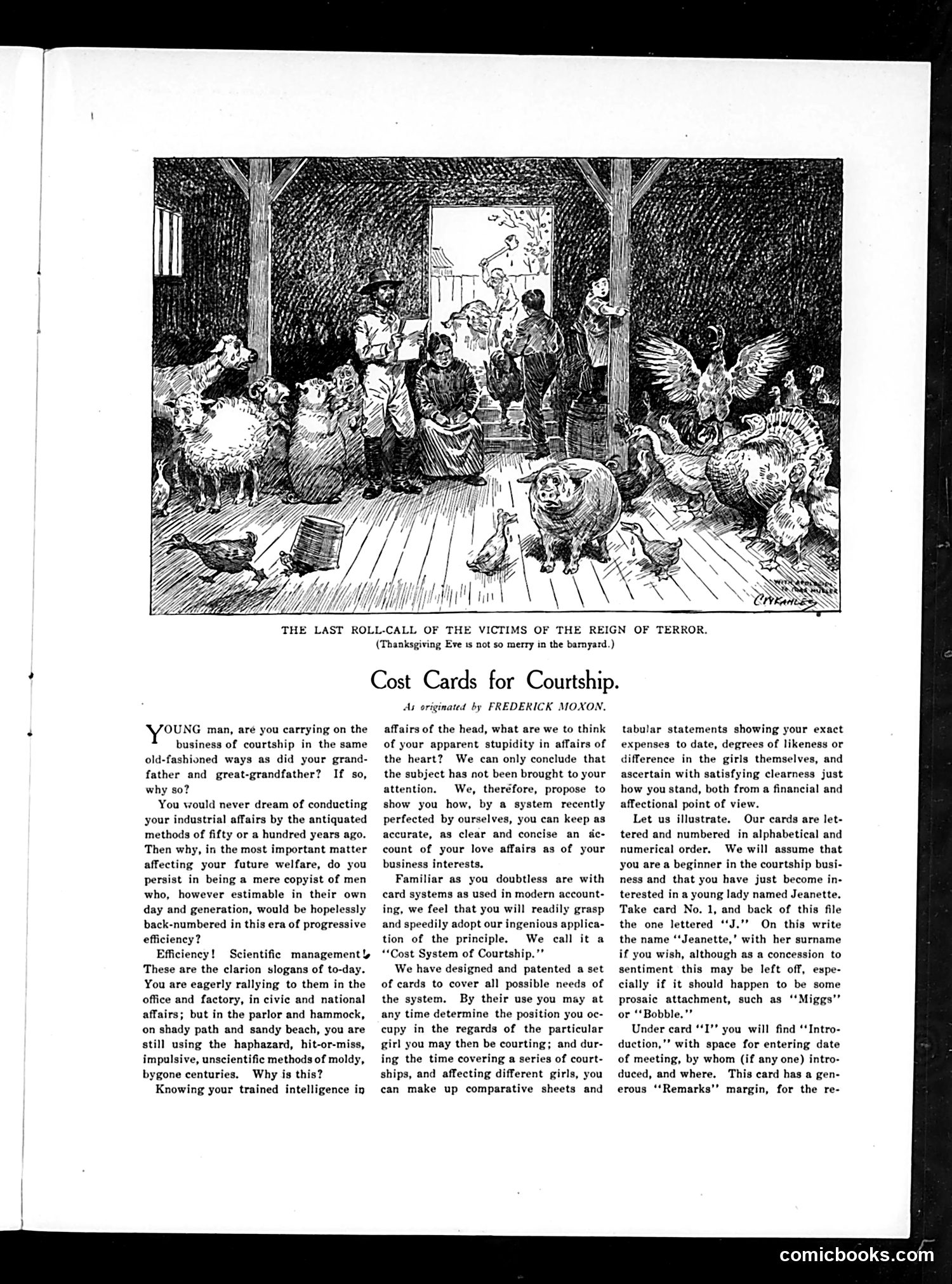
The top illustration satirizes the French Reign of Terror by depicting farm animals (turkeys, chickens, geese) as "victims" awaiting slaughter on Thanksgiving Eve—a dark political cartoon equating the guillotine's victims to holiday poultry. The article below is a humorous satire on turn-of-the-century "scientific management" craze. It mocks young men for applying modern business efficiency systems to courtship, proposing absurd "Cost Cards for Courtship"—filing systems to track romantic relationships with the same numerical precision as accounting ledgers. The author Frederick Moxon satirizes how industrial-age rationality was being applied to inherently emotional human matters, suggesting courtship should be managed like inventory or expenses, complete with comparative analysis sheets for multiple girlfriends. The joke targets both excessive systematization and romantic callousness disguised as modernity.
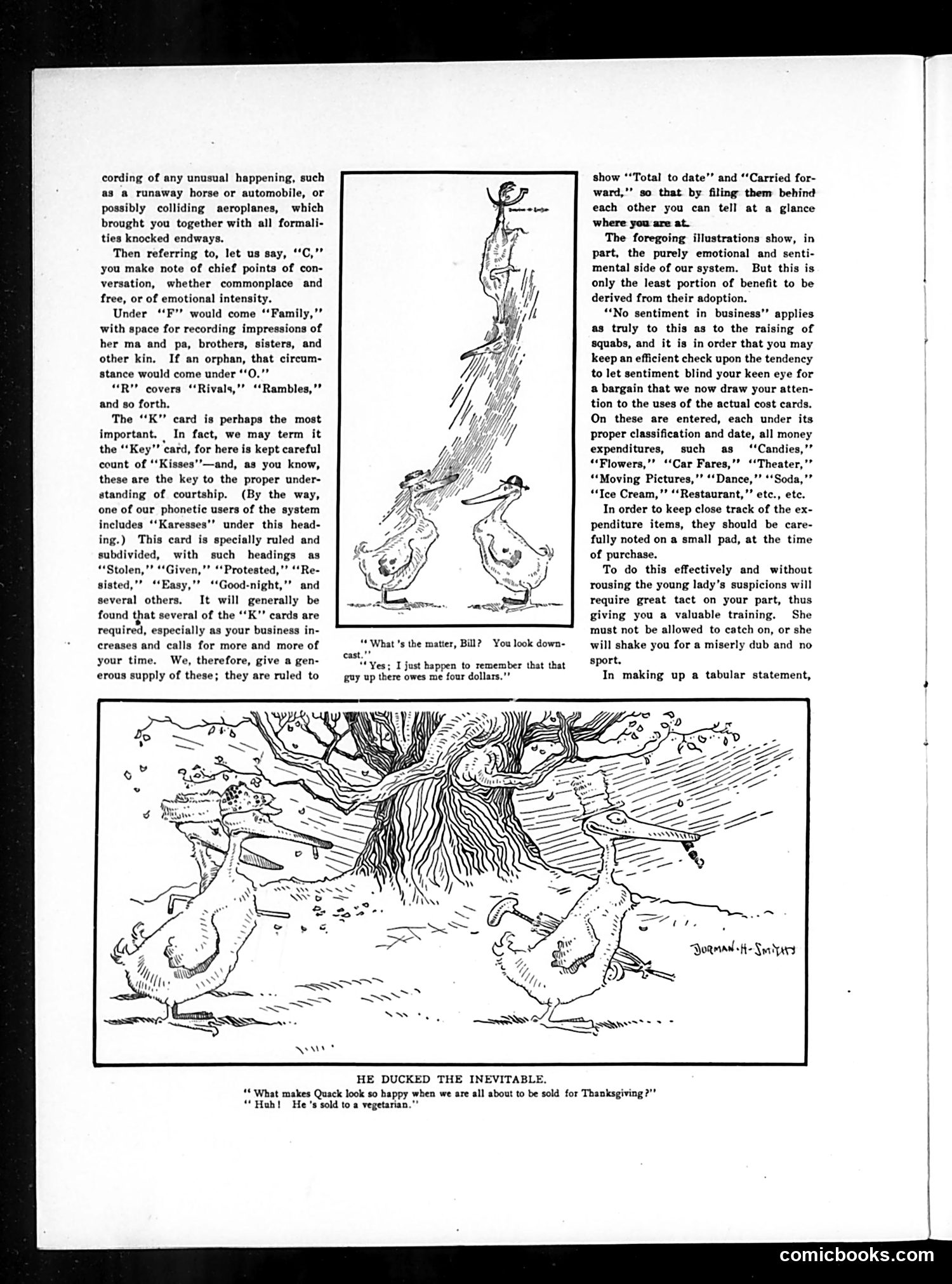
This Judge magazine page satirizes the obsessive documentation of courtship in the early 20th century. The main text humorously describes a elaborate "card system" for tracking dates—with separate cards for "Conversation," "Family," "Rivals," and crucially, a "Key" card meticulously recording types of kisses ("Stolen," "Given," "Protested," "Resisted," "Good-night"). The satire targets men who treat romance like a business ledger, even tracking every penny spent on dates (candies, flowers, theater) to ensure they're not being exploited by mercenary women. The advice to hide this note-taking suggests the absurdity: romantic interest requires deception about one's calculating nature. The bottom cartoon about "Quack" being happy because he's "sold to a vegetarian" (rather than eaten for Thanksgiving) is a separate pun unrelated to the courtship theme above it. The humor lies in mechanizing human emotion into spreadsheets—a critique of masculine emotional detachment masked as pragmatism.
This is primarily an **advertising page** from Judge magazine, not a political cartoon. The main content consists of three advertisements: 1. **Remington Typewriter** (center): A straightforward business machine ad emphasizing leadership and reliability—appeals to office workers. 2. **Grape-Nuts Cereal** (left): A testimonial from a "literary man" claiming the food aids mental clarity and sustained thinking—reflecting early 1900s marketing linking nutrition to brain function, a common claim of the era. 3. **Remon Gems** (lower right): Appears to be jewelry or gemstones advertising mail-order purchases. The small anecdotes ("Thanksgiving Offerings") are light humor pieces typical of Judge's satirical content—gentle social commentary rather than sharp political satire. The opening text discusses "courtship accounting," a humorous concept treating romantic encounters as bookkeeping transactions. The page reflects early 20th-century consumer culture and advertising strategies targeting office workers and intellectual professionals.
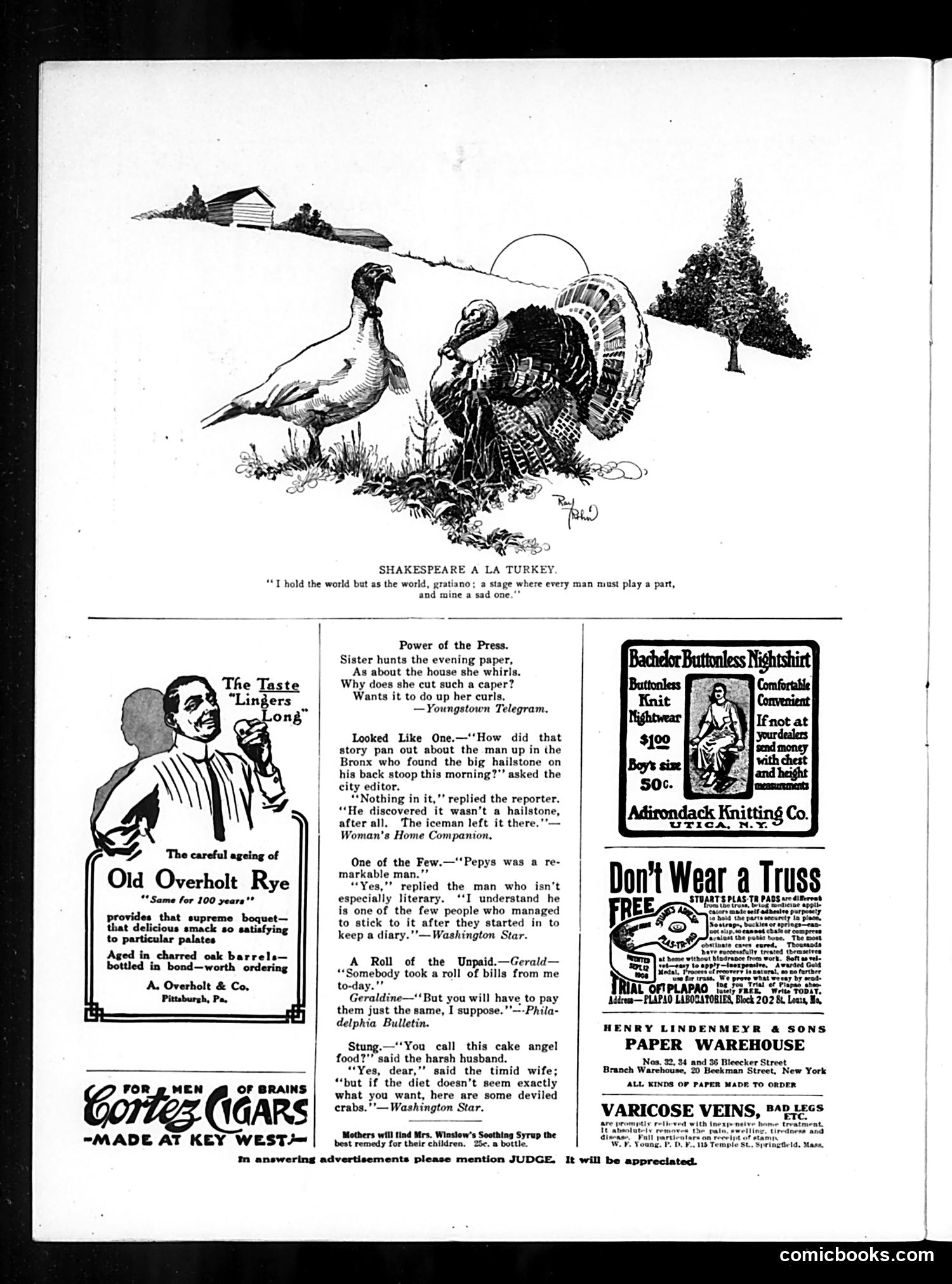
The top illustration shows two wild turkeys in a natural setting, captioned with a Shakespeare quote about "the world" being "a stage where every man must play a part, and mine a sad one." This is a visual pun: the turkeys literally embody the "stage" metaphor through their elaborate displays and posturing—the male turkey's dramatic tail fan mirrors theatrical performance. The joke suggests that humans, like turkeys engaged in their natural displays, are fundamentally performers playing roles, which darkly echoes the Shakespearean sentiment about life's sad theatre. The remainder of the page consists primarily of advertisements and humorous short anecdotes (jokes about newspapers, ice delivery, diary-keeping, and food), typical of Judge magazine's mixed editorial format. None of these secondary items appear satirically significant.
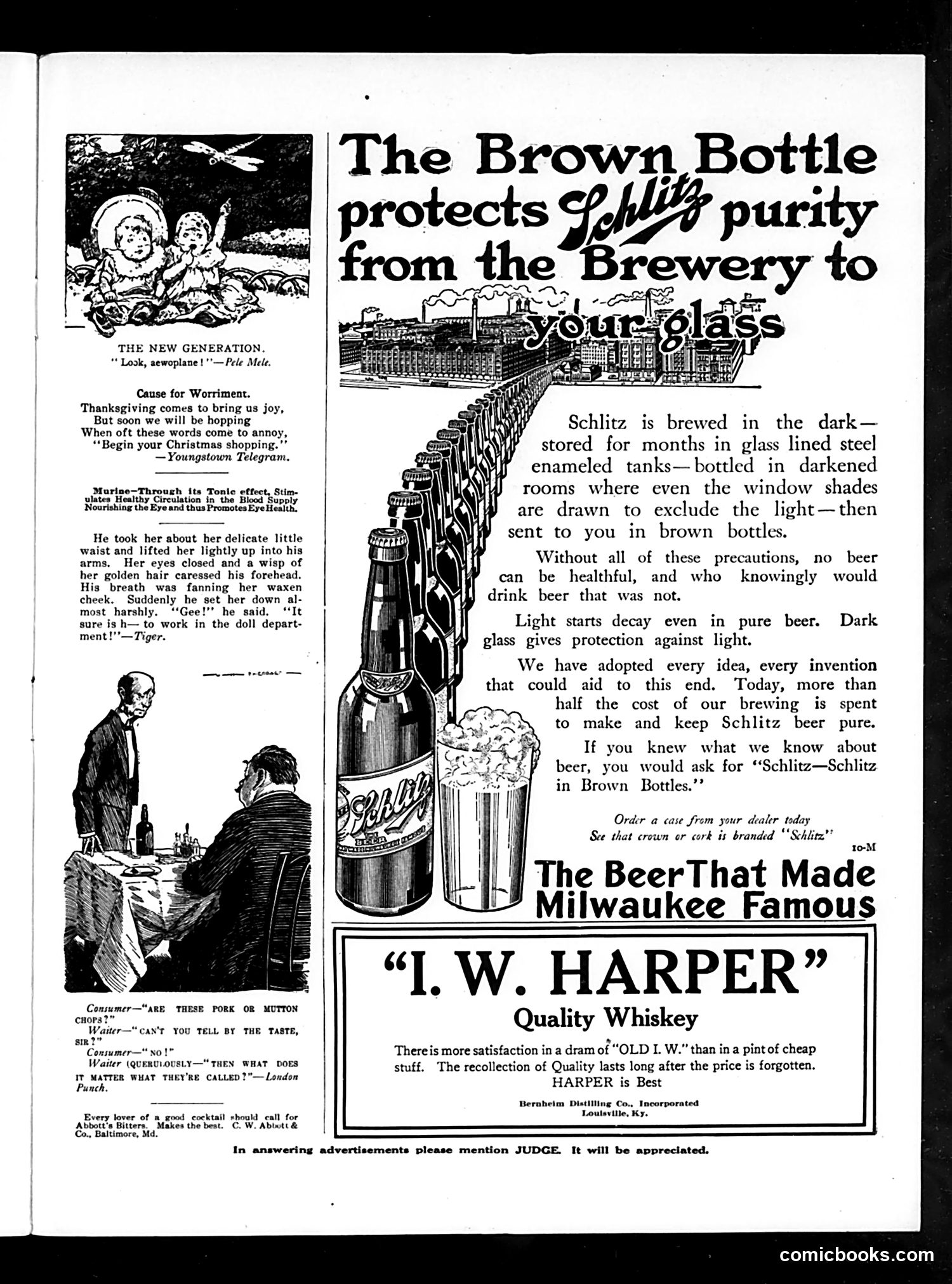
This page combines **advertisements with satirical cartoons**, typical of Judge magazine's format. The **Schlitz beer ad** dominates the right side, emphasizing the brown bottle's protection of beer purity from light damage—a genuine concern in pre-refrigeration brewing. The detailed explanation of darkened storage and bottling reflects early 20th-century brewing science marketing. The **left side cartoons** offer social satire: 1. "The New Generation" depicts children excited about an airplane, with a poem lamenting upcoming Christmas shopping season—poking fun at commercialism replacing holiday spirit. 2. "Cause for Worriment" shows a young man struggling with a doll department job, suggesting dissatisfaction with retail work (possibly commenting on masculine dignity or wage labor's indignities). 3. The bottom dialogue jokes about indistinguishable meat at restaurants—a consumer trust issue, likely satirizing restaurant quality or dishonesty. The **I.W. Harper whiskey ad** at bottom-right emphasizes quality over price, a luxury goods appeal. Overall, the page blends product advertising with mild social commentary on commercialism, consumer concerns, and changing modern life.
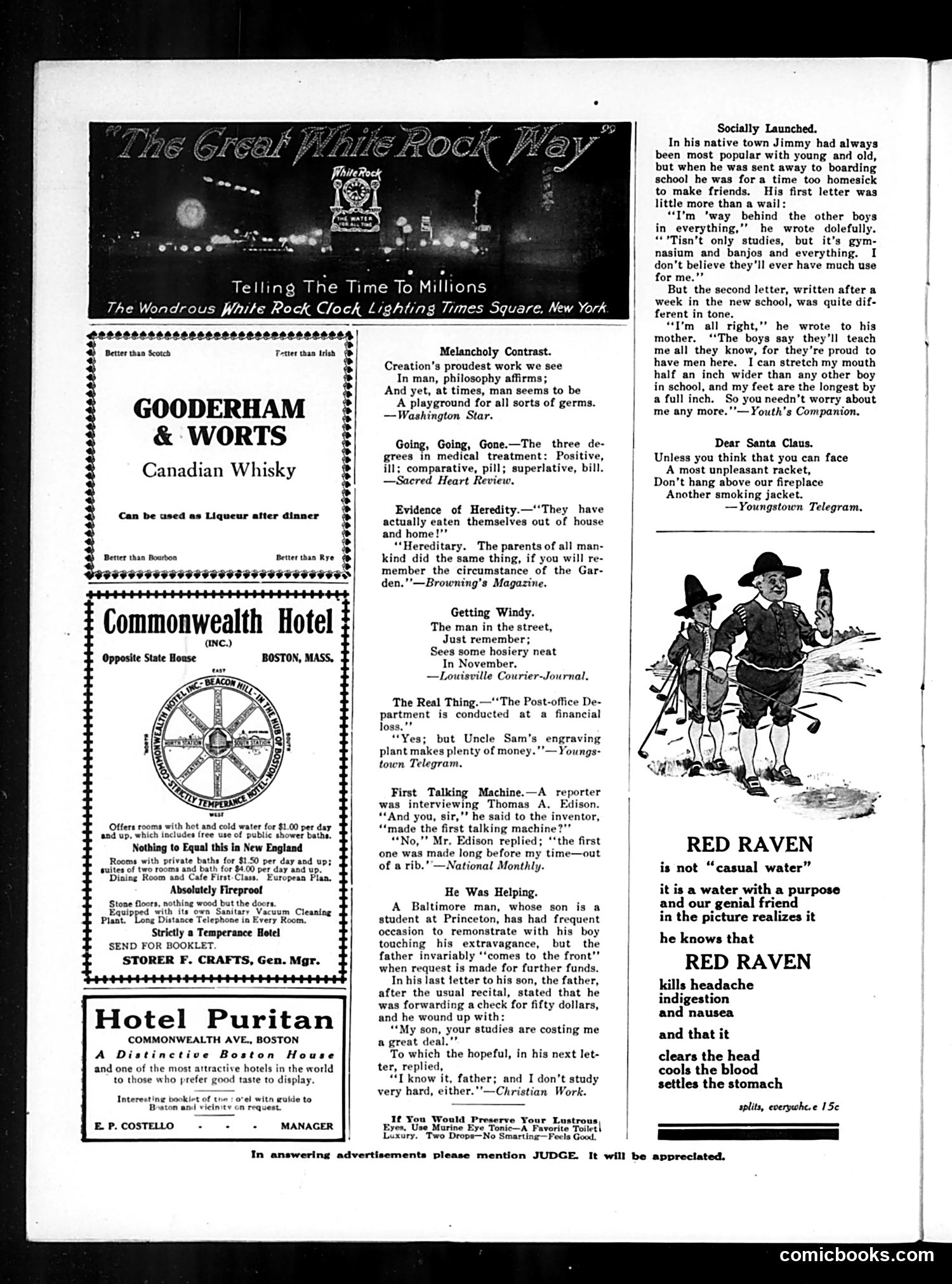
This page is primarily **advertisements and short humorous anecdotes** rather than political cartoons. The main visual element is an illustration of two men in winter clothing walking together, accompanying a Red Raven (beverage) advertisement—unrelated to the text content. The "Socially Launched" story concerns a homesick boarding school boy who quickly adapts socially. It's gentle domestic humor about fitting in at school. The other brief anecdotes mock various targets: medical treatment ineffectiveness, hereditary behavior (referencing Adam and Eve), the Post Office's financial losses contrasted with profitable government engraving, Edison's lack of credit for inventing the "talking machine," and a father's complaint about his son's expensive education while the son admits he doesn't study hard. These are typical early 20th-century *Judge* fare: lighthearted social commentary on education, family dynamics, government inefficiency, and technology—not sharp political satire, but rather mild domestic and institutional humor for middle-class readers.
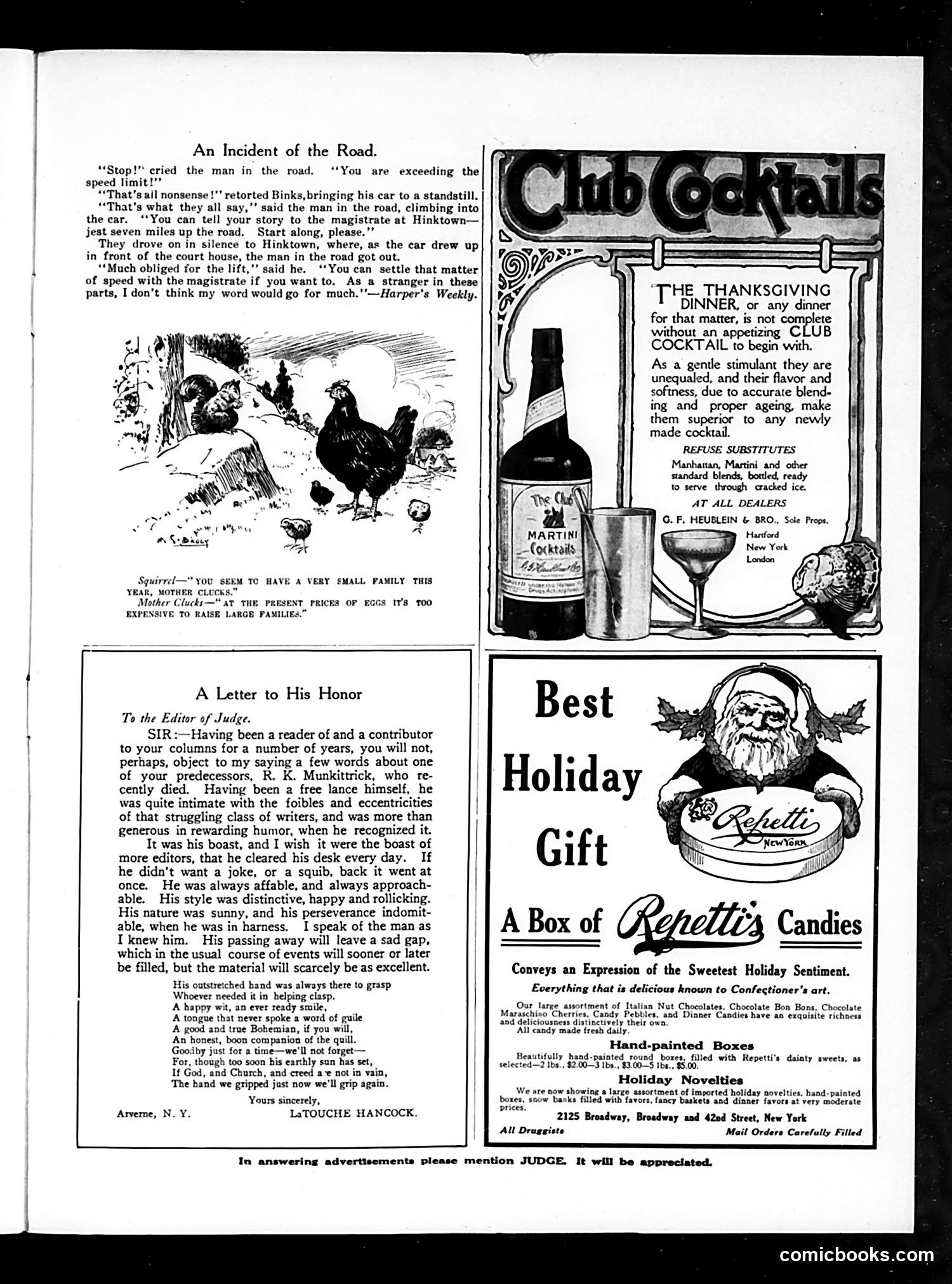
This page mixes humor, tribute, and advertising typical of early 20th-century satirical magazines. **"An Incident of the Road"** satirizes speed-limit enforcement. A motorist stopped for speeding is tricked by the officer, who hitches a ride to town, then reveals he's actually just a hitchhiker—leaving the driver to face the magistrate alone. The joke mocks both reckless drivers and the absurdity of rural traffic enforcement. **The animal cartoons** about squirrels and chickens use creatures to comment on economic hardship: a mother hen notes eggs are too expensive to raise large families—likely referencing post-WWI inflation and cost-of-living concerns affecting actual families. **"A Letter to His Honor"** is an obituary tribute to R.K. Munkittrick, a former Judge editor who died recently. It praises his generosity to struggling writers and his distinctive editorial style. The remaining content is advertising for Club Cocktails, Repetti's candies, and holiday gifts—standard magazine filler aimed at holiday shoppers.
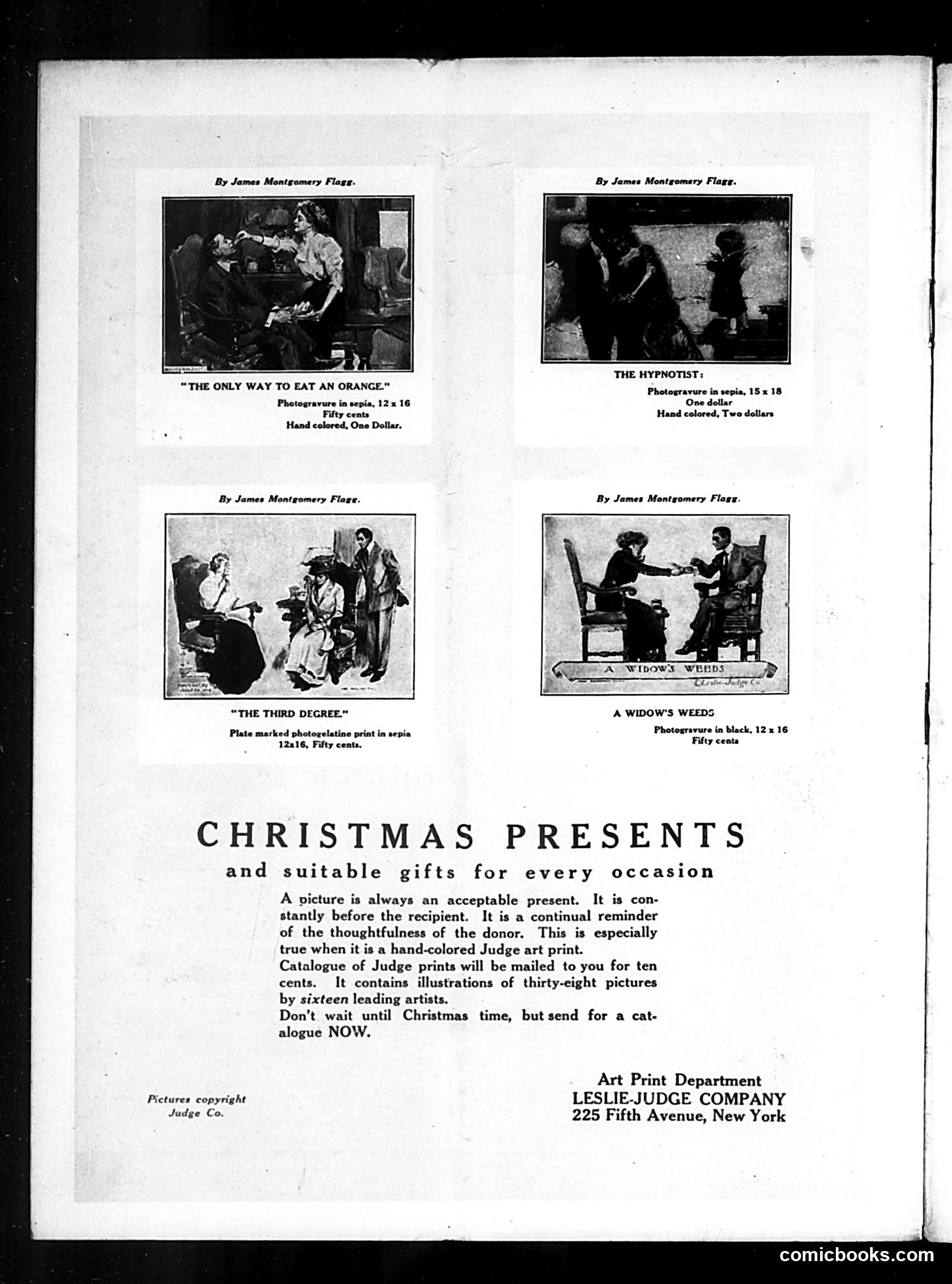
This is primarily an **advertisement page**, not satirical content. It showcases four artworks by James Montgomery Flagg—a prominent illustrator of the era—to promote Judge magazine's art print catalog as Christmas gifts. The four illustrated pieces appear to be genre scenes depicting social situations: "The Only Way to Eat an Orange" (domestic comedy), "The Hypnotist" (likely a satirical scene about mesmerism's popularity), "The Third Degree" (appears to reference interrogation or social pressure), and "A Widow's Weeds" (domestic drama). The ad's appeal emphasizes that pictures serve as thoughtful, permanent reminders of the donor's consideration—a common marketing pitch for art prints as gifts. It encourages readers to order the full catalog "NOW" rather than waiting for Christmas shopping season. The page reflects early 20th-century commercial illustration and Judge's dual role as satirical publication and art vendor.