
Judge, 1911-11-25 · page 16 of 24
Judge — November 25, 1911 — page 16: what you’re looking at
What you’re looking at
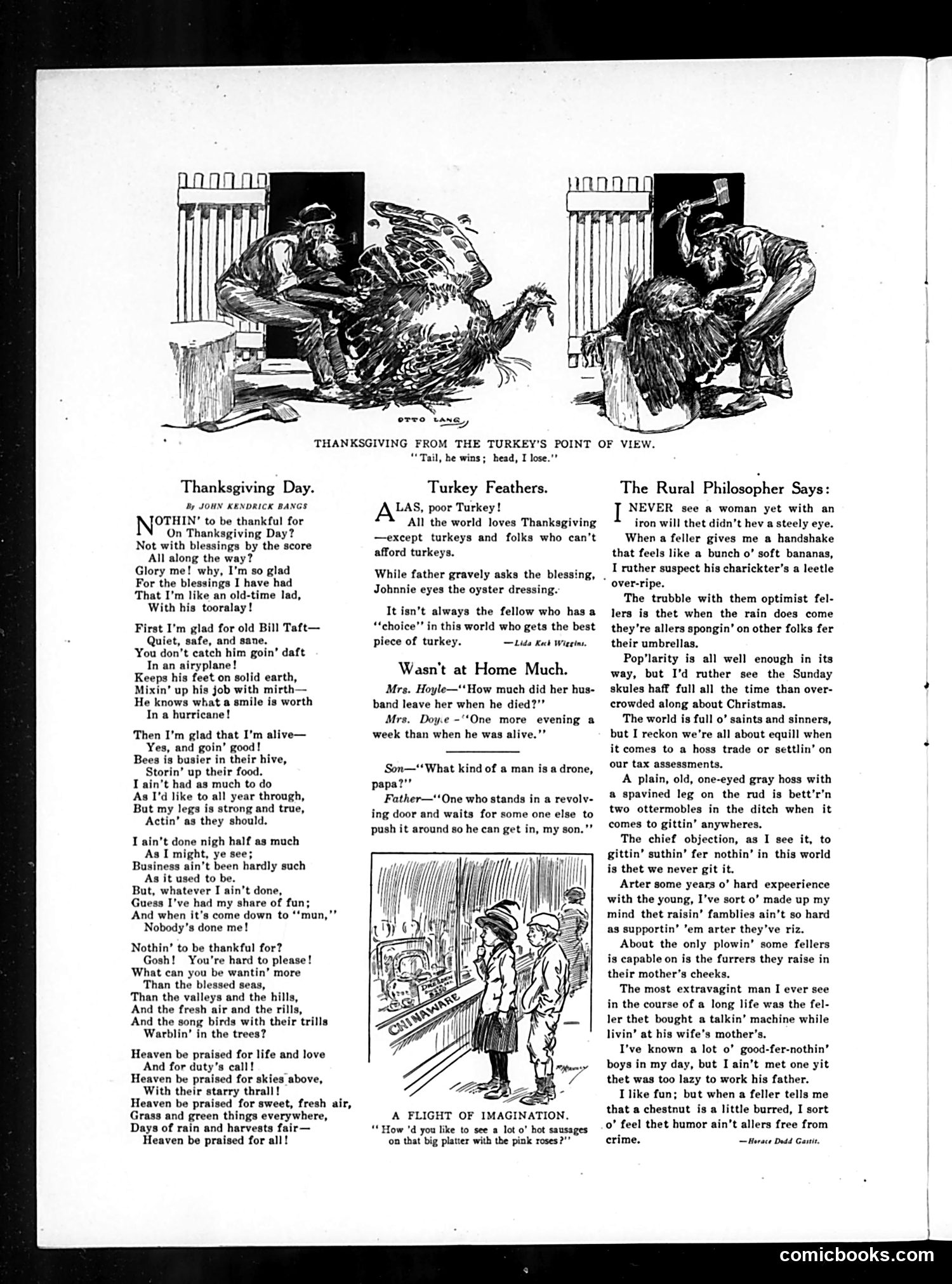
This Thanksgiving-themed Judge page from the early 1900s contains three main pieces: **"Thanksgiving from the Turkey's Point of View"** presents a darkly comic dual illustration: the turkey loses either way—if "tail, he wins; head, I lose"—a reference to the coin-flip game where one person calls heads or tails. **The poem "Thanksgiving Day"** by John Kendrick Bangs celebrates gratitude, notably praising President William Howard Taft for being grounded and sensible (contrasting with fears about new aviation technology, then exotic and dangerous). **"The Rural Philosopher Says"** offers folk wisdom in rural dialect, offering satirical observations about human nature—women with steely eyes, insincere handshakes, overly optimistic borrowers, and the challenges of raising families. The cartoons and text collectively satirize both the holiday's contrasts (celebration versus the turkey's fate) and contemporary anxieties about modern life, technology, and changing social values.
📄 Transcribed text from this page (OCR, searchable)
Machine-transcribed from the original scan — historical spelling and the odd misread are preserved.
= THANKSGIVING FROM THE TURKEY'S POINT OF VIEW. “Tail, he wins; head, I lose."* Turkey Feathers. Als. poor Turkey! All the world loves Thanksgiving —except turkeys and folks who can’t afford turkeys. Thanksgiving Day. By JOUN KENDRICK BANGS OTHIN’ to be thankful for On Thanksgiving Day? Not with blessings by the score All along the way? Glory me! why, I'm so glad For the blessings I have had That I’m like an old-time lad, With his tooralay! First I’m glad for old Bill Taft— Quiet, safe, and sane. You don’t catch him goin’ daft In an airyplane! Keeps his feet on solid earth, Mixin’ up his job with mirth— He knows what a smile is worth In a hurricane! Johnnie eyes the oyster dressing. It isn’t always the fellow who has a ““choice’’ in this world who gets the best piece of turkey. Wasn't at Home Much. Mrs. Hoyle—'*How much did her hus- band leave her when he died?” Mrs. Doy.e -“‘One more evening a week than when he was alive,” Lida Keb Wigsins, Then I’m glad that I’m alive— Yes, and goin’ good! Bees is busier in their hive, Storin’ up their food. Tain’t had as much to do As I'd like to all year through, But my legs is strong and true, Actin’ as they should. Son—What kind of a man is a drone, papa?” Father—'‘One who stands in a revolv- ing door and waits for some one else to push it around so he can get in, my son."” I ain't done nigh half as much As I might, ye see; 7 Business ain't been hardly such / iis hi | As it used to be. Hh | But, whatever I ain’t done, i 1 | | la \iF Ree a ian, | And when it’s come down to ‘‘mun,"” CN Nobody’s done me! Nothin’ to be thankful for? Gosh! You're hard to please! What can you be wantin’ more Than the blessed seas, Than the valleys and the hills, And the fresh air and the rills, And the song birds with their trills Warblin’ in the trees? Heaven be praised for life and love And for duty’s call! Heaven be praised for skies above, With their starry thrall! Heaven be praised for sweet, fresh air, Grass and green things everywhere, Days of rain and harvests fair— Heaven be praised for all! A FLIGHT OF IMAGINATION. “How 'd you like to see a lot o” hot sausages on that big platter with the pink roses ?"” While father gravely asks the blessing, . The Rural Philosopher Says: I NEVER see a woman yet with an iron will thet didn’t hev a steely eye. When a feller gives me a handshake that feels like a bunch o’ soft bananas, I ruther suspect his charickter’s a leetle over-ripe. The trubble with them optimist fel- lers is thet when the rain does come they’re allers spongin’ on other folks fer their umbrellas. Pop’larity is all well enough in its way, but I’d ruther see the Sunday skules haff full all the time than over- crowded along about Christmas. The world is full o’ saints and sinners, but I reckon we're all about equill when it comes to a hoss trade or settlin’ on our tax assessments. A plain, old, one-eyed gray hoss with a spavined leg on the rud is bett’r’n two ottermobles in the ditch when it comes to gittin’ anywheres. The chief objection, as I see it, to gittin’ suthin’ fer nothin’ in this world is thet we never git it. Arter some years o’ hard expeerience with the young, I’ve sort o’ made up my mind thet raisin’ famblies ain't so hard as supportin’ ’em arter they've riz. About the only plowin’ some fellers is capable on is the furrers they raise in their mother’s cheeks. The most extravagint man I ever see in the course of a long life was the fel- ler thet bought a talkin’ machine while livin’ at his wife’s mother’s. I've known a lot o’ good-fer-nothin’ boys in my day, but I ain’t met one yit thet was too lazy to work his father. I like fun; but when a feller tells me that a chestnut is a little burred, I sort o’ feel thet humor ain’t allers free from crime. Horace Dodd Gastit, comicbooks.com