
Judge, 1911-11-25 · page 4 of 24
Judge — November 25, 1911 — page 4: what you’re looking at
What you’re looking at
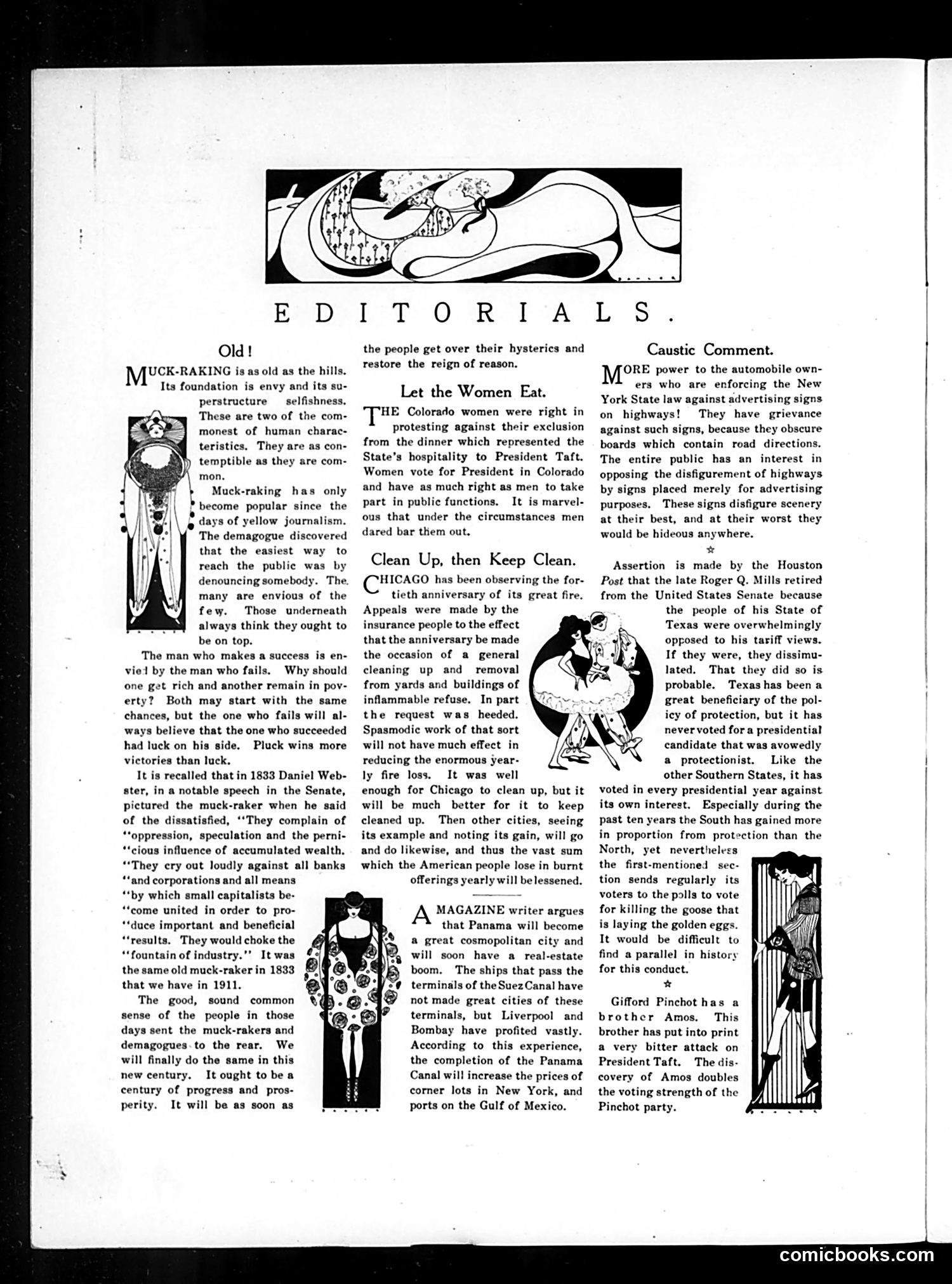
This page contains four separate editorials with accompanying illustrations, typical of Judge magazine's satirical commentary. **"Muck-Raking"** critiques sensationalist journalism's decline, arguing that while muckraking once served democracy by exposing corruption, it has become an outdated practice. **"Let the Women Eat"** defends Colorado women's protest against exclusion from a dinner honoring President Taft, asserting women deserve equal public participation rights. **"Clean Up, then Keep Clean"** praises Chicago's post-fire reconstruction efforts and encourages other cities to adopt similar civic improvement practices. **"Caustic Comment"** supports New York's automobile advertising sign restrictions, arguing they preserve scenic highways from commercial disfigurement. The page uses decorative Art Deco-style female figures to frame sections, typical of Judge's visual style during this era.
📄 Transcribed text from this page (OCR, searchable)
Machine-transcribed from the original scan — historical spelling and the odd misread are preserved.
Old! UCK-RAKING is as old as the hills. Its foundation is envy and its su- perstructure selfishness. These are two of the com- monest of human cha teristics, They are as con- temptible as they are com- mon. Muck-raking has only \ f become popular since the \ 9 days of yellow journalism. The demagogue discovered that the easiest way to reach the public was by denouncing somebody. The. many are envious of the few. Those underneath always think they ought to be on top. The man who makes a success is en- vied by the man who fails. Why should one get rich and another remain in pov- Both may start with the same chances, but the one who fails will al- ways believe that the one who succeeded had luck on his side. Pluck wins more victories than luck. It is recalled that in 1833 Daniel Web- ster, in a notable speech in the Senate, pictured the muck-raker when he said of the dissatisfied, ‘‘They complain of “oppression, speculation and the perni- “*‘cious influence of accumulated wealth. “They cry out loudly aj “*and corporations and all means “‘by which small capitalists be- “come united in order to pro- *‘duce important and beneficial “results. They would choke the “fountain of industry.”’ It was the same old muck-raker in 1833 that we have in 1911. The good, sound common sense of the people in those days sent the muck-rakers and demagogues-to the rear, We will finally do the same in this new century. It ought to be a century of progress and pros- perity. It will be as soon as EM DEL TOR 1A LS the people get over their hysterics and restore the reign of reason. Let the Women Eat. 'HE Colorado women were right in protesting against their exclusion from the dinner which represented the State’s hospitality to President Taft. Women vote for President in Colorado and have as much right as men to take part in public functions. It is marvel- ous that under the circumstances men dared bar them out. Clean Up, then Keep Clean. HICAGO has been observing the for- tieth anniversary of its great fire. Appeals were made by the insurance people to the effect that the anniversary be made the occasion of a general cleaning up and removal from yards and buildings of inflammable refuse. In part the request was heeded. Spasmodic work of that sort will not have much effect in reducing the enormous year- ly fire loss. It was well enough for Chicago to clean up, but it will be much better for it to keep cleaned up. Then other cities, seeing its example and noting its gain, will go and do likewise, and thus the vast sum which the American people lose in burnt offerings yearly will be lessened. MAGAZINE writer argues that Panama will become @ great cosmopolitan city and will soon have a real-estate boom. The ships that pass the terminals of the SuezCanal have not made great cities of these terminals, but Liverpool and Bombay have profited vastly. According to this experience, the completion of the Panama Canal will increase the prices of corner lots in New York, and ports on the Gulf of Mexico. Caustic Comment. Mer. power to the automobile own- ers who are enforcing the New York State law against advertising signs on highways! They have grievance against such signs, because they obscure boards which contain road directions. The entire public has an interest in opposing the disfigurement of highways by signs placed merely for advertising purposes, These signs disfigure scenery at their best, and at their worst they would be hideous anywhere. * Assertion is made by the Houston Post that the late Roger Q. Mills retired from the United States Senate because the people of his State of Texas were overwhelmingly opposed to his tariff views. If they were, they dissimu- lated. That they did so is probable. Texas has been a great beneficiary of the pol- icy of protection, but it has never voted for a presidential candidate that was avowedly a protectionist. Like the other Southern States, it has voted in every presidential year against its own interest. Especially during the past ten years the South has gained more in proportion from protection than the North, yet nevertheless the first-mentioned sec- tion sends regularly its voters to the polls to vote for killing the goose that is laying the golden eggs. It would be difficult to find a parallel in history for this conduct. * Gifford Pinchot has a brother Amos. This brother has put into print a very bitter attack on President Taft. The dis- covery of Amos doubles the voting strength of the Pinchot party. comicbooks.com