
A complete issue · 24 pages · 1911
Judge — November 18, 1911
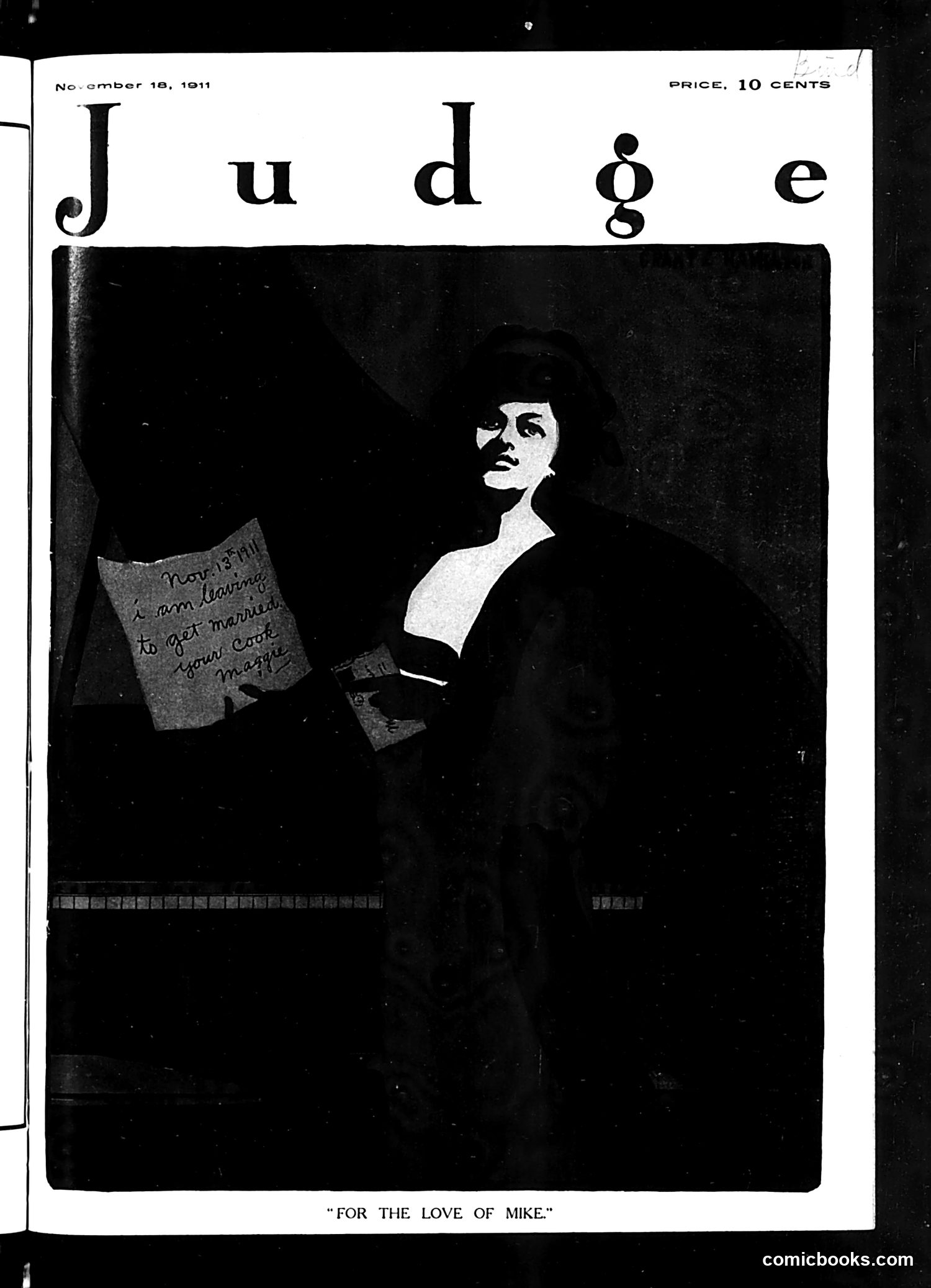
This appears to be a dramatic illustration rather than political satire. The image shows a figure in dark clothing holding what appears to be a handwritten note, gazing upward with an emotional expression. The note's text is partially legible but unclear in reproduction. The caption "For the Love of Mike" suggests a romantic or sentimental narrative—likely satirizing melodramatic theatrical conventions popular in 1911. The phrase itself was a common exclamation of the era. Without clearer text on the note or additional context, the specific joke or reference remains unclear, though it likely comments on overwrought romantic behavior or theatrical productions of that period. The 10-cent price indicates this is a standard Judge magazine cover or feature.
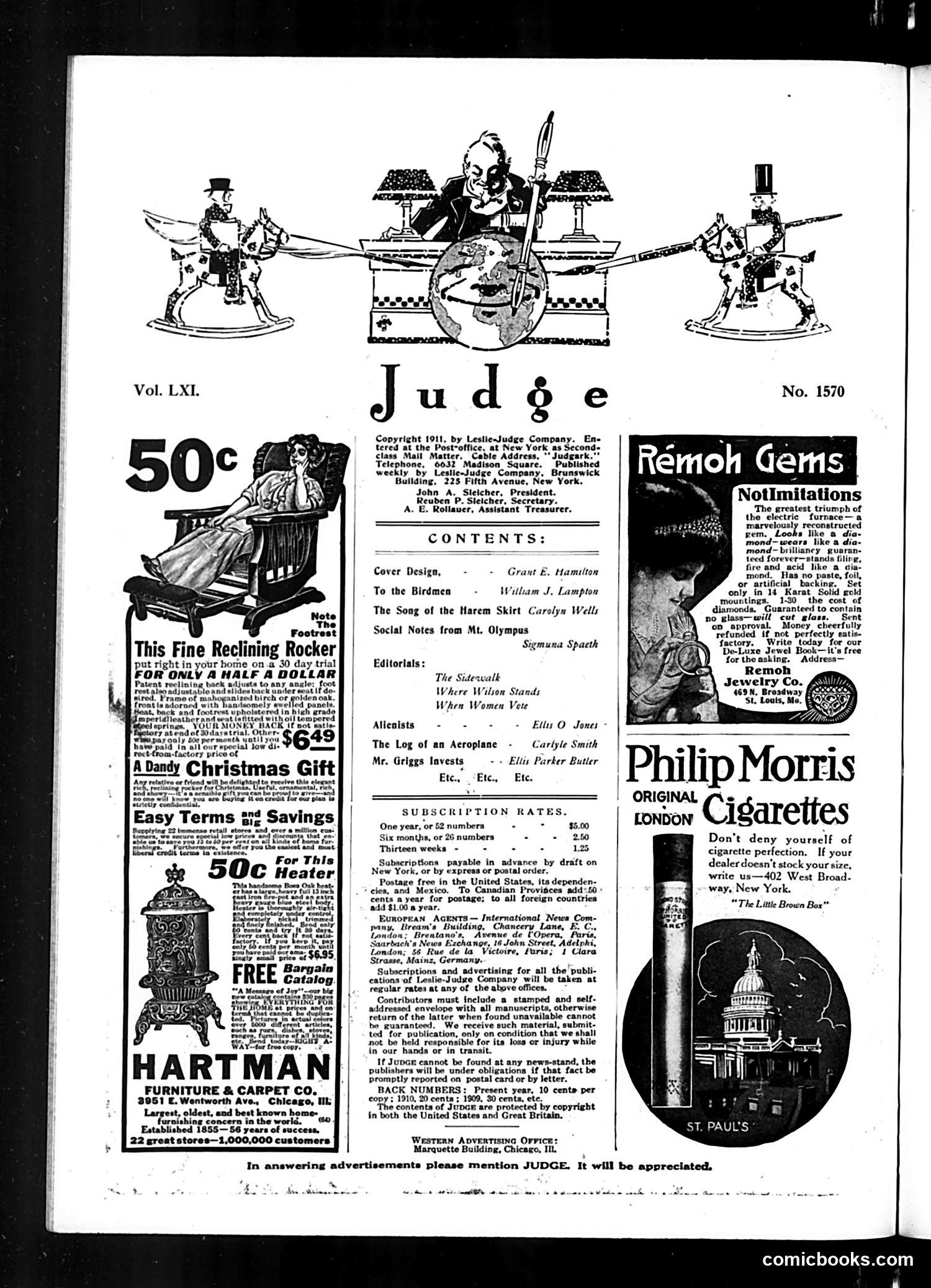
This is primarily an **advertising page** rather than editorial content. The masthead shows Judge's typical satirical design with costumed performers, but the page is dominated by product advertisements for the era: - A reclining rocker ("A Dandy Christmas Gift") - A decorative heater - Hartman steel ranges - Remoh jewelry - Philip Morris cigarettes The **contents section** lists articles including "The Sidewalk," "Where Women Vote," and pieces by contributors like Carolyn Wells, but the actual text of these pieces doesn't appear on this page. This represents typical early-1900s magazine economics: substantial advertising revenue subsidized editorial content. The advertisements reflect contemporary consumer goods and gift-buying (Christmas season suggested by the rocker's copy).
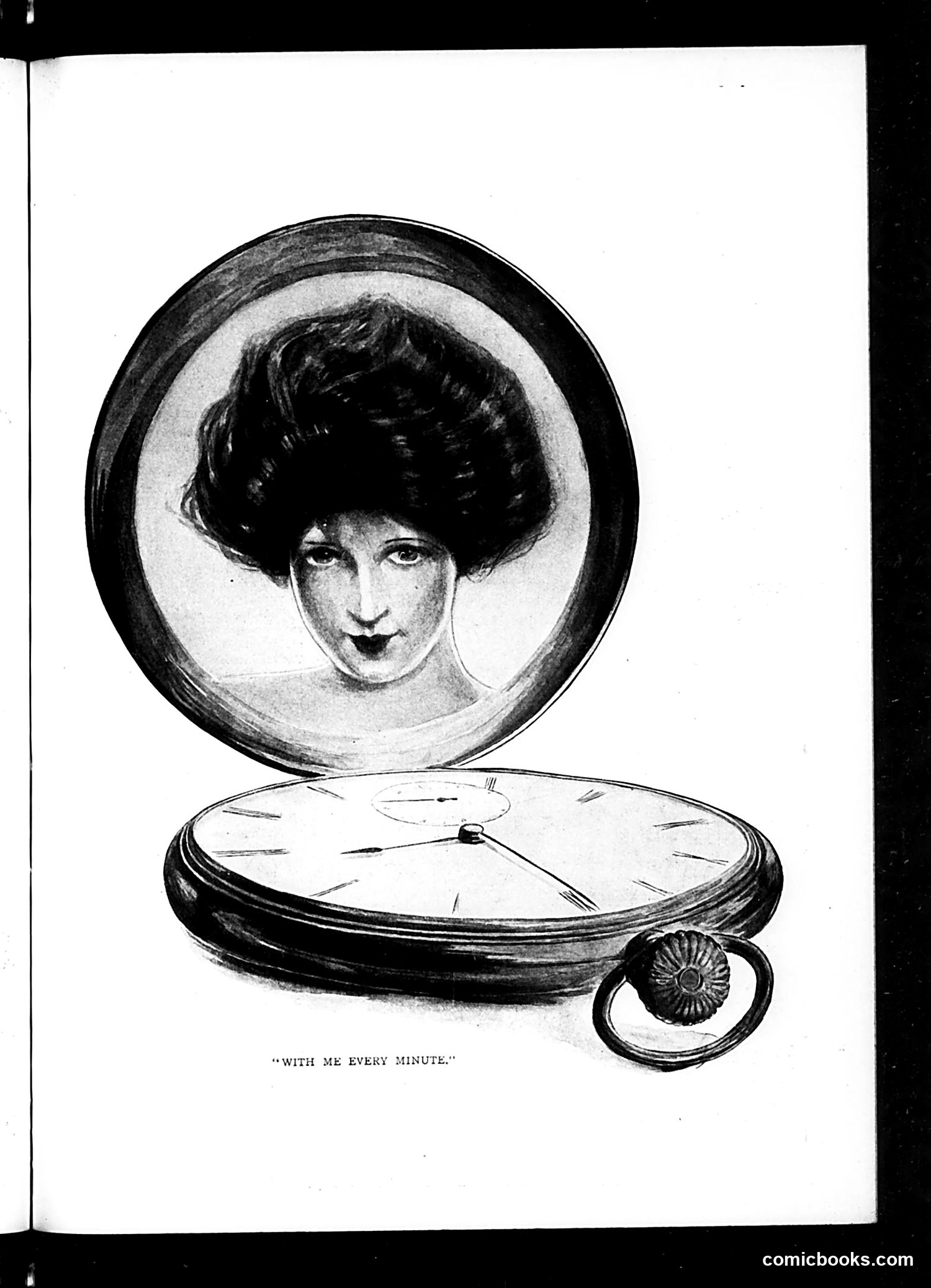
This appears to be a vintage advertisement or illustration from Judge magazine, likely early 20th century. The image shows a woman's face emerging from a pocket watch, with the caption "WITH ME EVERY MINUTE." This is almost certainly an advertisement for a pocket watch or timepiece, using the common advertising trope of the era: a woman's face as the product's appeal. The wordplay suggests the watch keeps the owner constantly connected to a beloved woman—a sentimental marketing angle typical of the period. The illustration style and the woman's fashionable Gibson Girl-era hairstyle confirm an Edwardian or early 1910s date. Rather than political satire, this represents commercial advertising that exploited romantic sentiment to sell luxury goods to affluent male consumers.
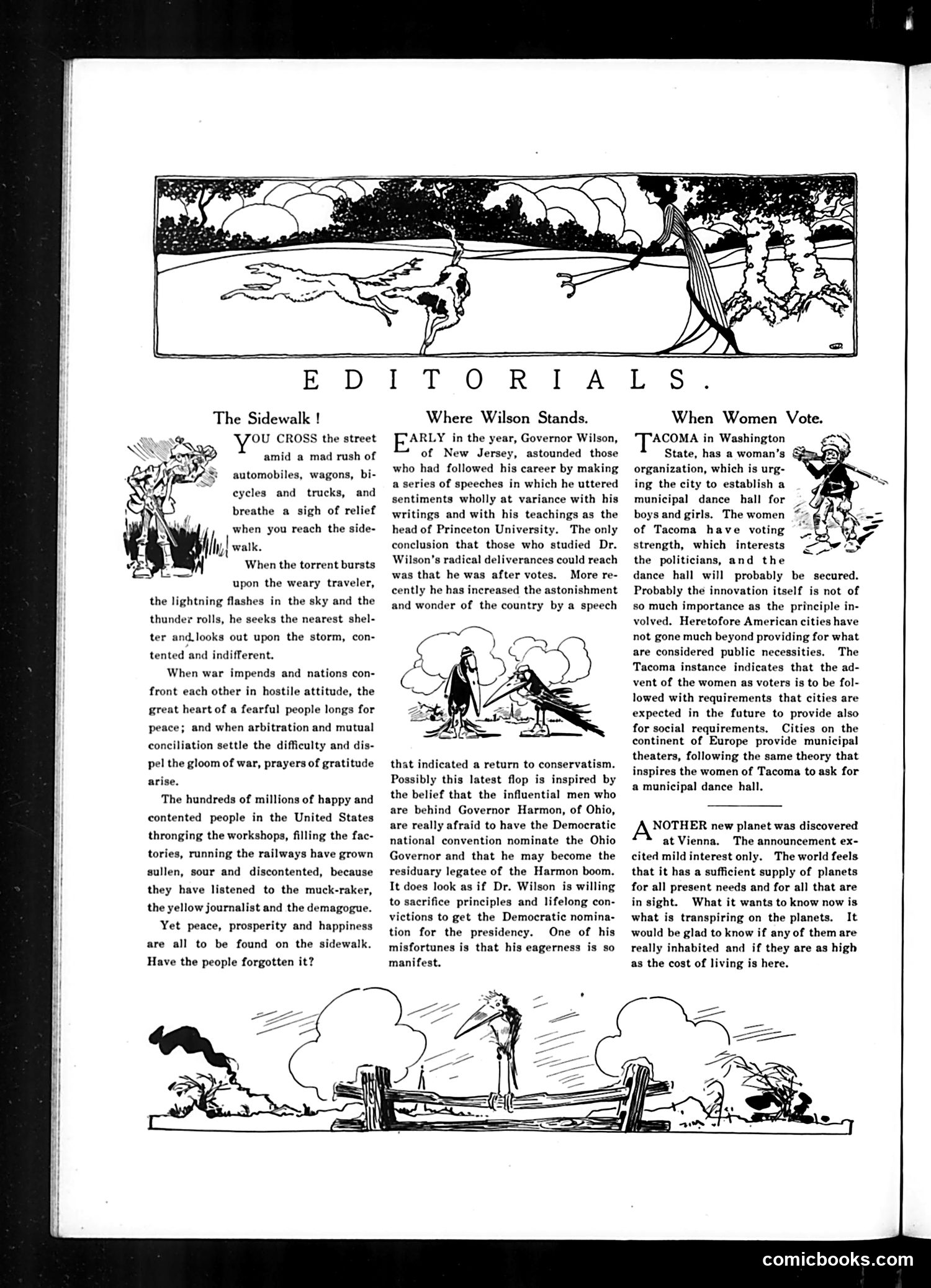
This page contains three editorials with accompanying illustrations. "The Sidewalk" criticizes people seeking shelter during storms rather than enjoying peaceful walks. "Where Wilson Stands" discusses Governor Wilson of New Jersey (likely Woodrow Wilson) and his speeches at Princeton, noting his apparent shift from radical positions. It suggests Democratic leaders fear his nomination might return the party to conservative principles associated with the "Harmon boom" (referring to Ohio Governor James Harmon). "When Women Vote" addresses women's voting rights in Tacoma, suggesting American cities should provide public amenities and social facilities to accommodate female voters, following European municipal precedents. The final brief editorial announces a planet discovery near Vienna.
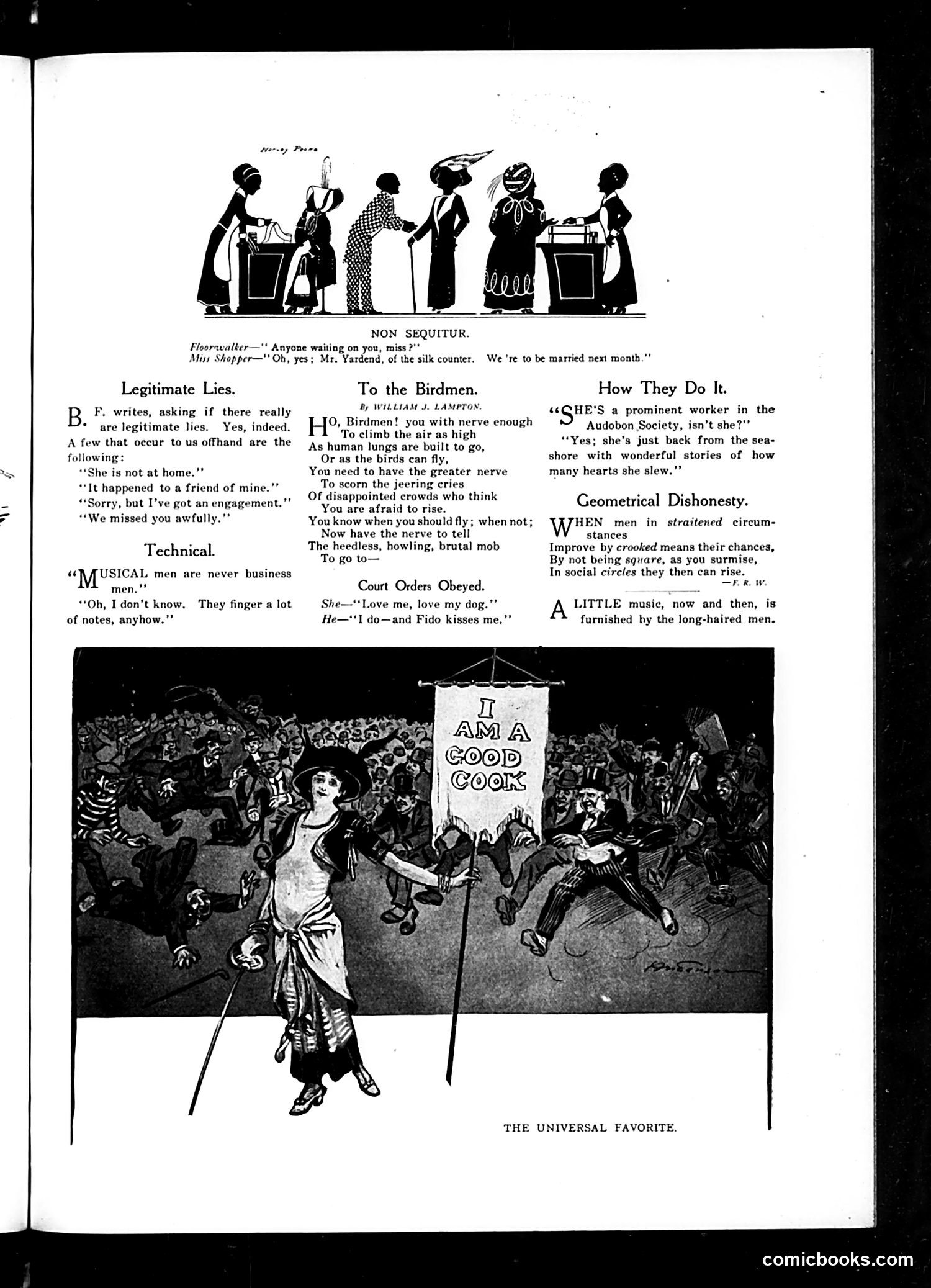
This page contains several humor pieces and illustrations typical of early 20th-century satirical magazines: **Top illustration**: A silhouette scene depicting women shopping or at a counter, with dialogue about marriage and engagements—social comedy about courtship. **Text sections**: Short humorous pieces including "Legitimate Lies" (excuses people make), "Technical" (a joke about musicians being poor businessmen), "To the Birdmen" (poem mocking early aviators), and "How They Do It" (commentary on Audubon Society members and their exaggerated stories). **Large bottom illustration**: "The Universal Favorite"—depicts a woman holding a banner reading "I AM A GOOD COOK" while surrounded by eager men. This satirizes how cooking ability was considered women's most valued trait in matrimonial markets, presented as universal male desire. The page reflects period attitudes about gender roles, courtship, and women's domestic value.
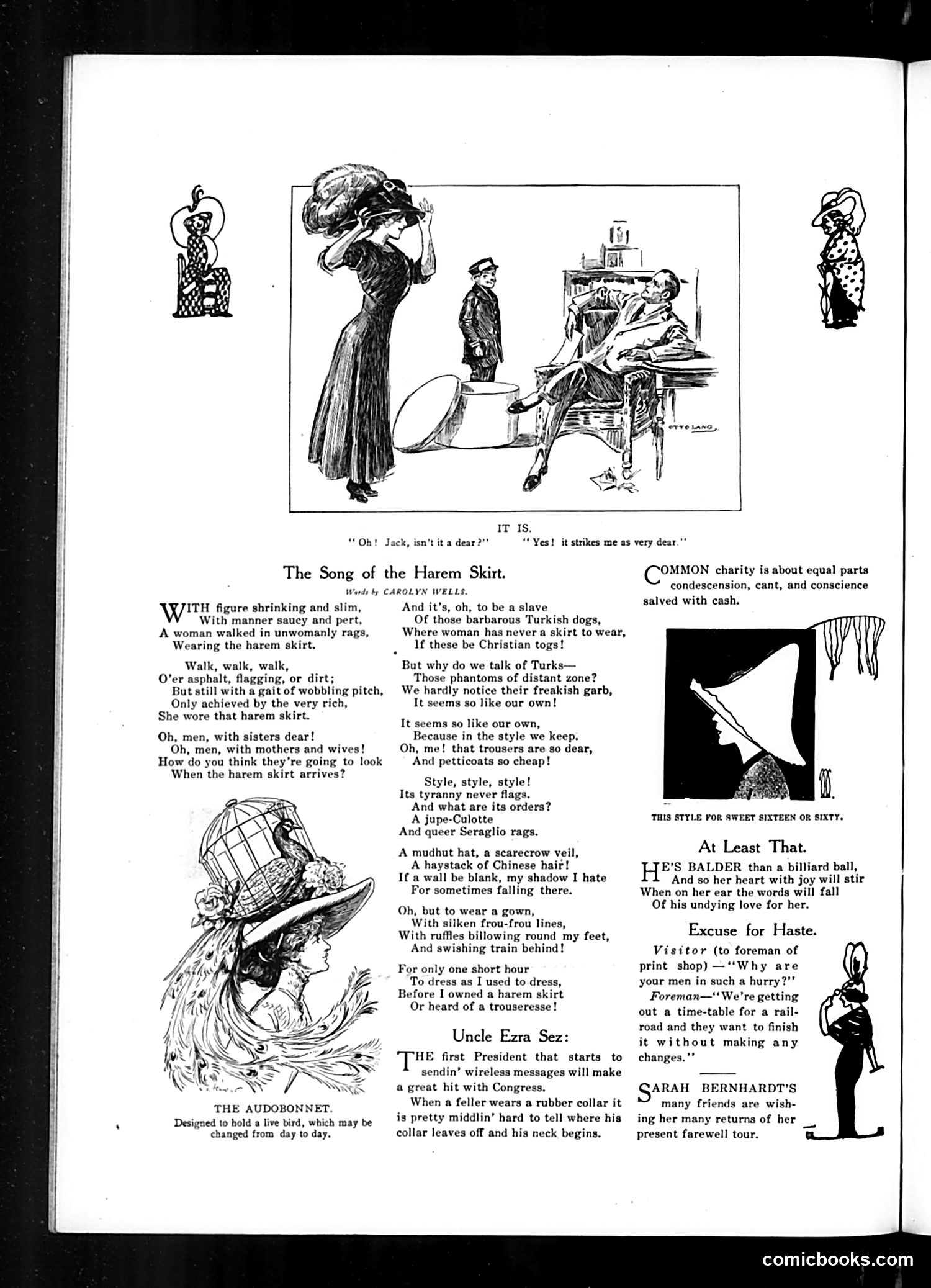
This page satirizes the early 1910s fashion trend of "harem skirts"—loose, baggy trousers gathered at the ankles, inspired by Middle Eastern and Asian clothing. The main poem mocks women adopting this style as absurd and impractical, suggesting it makes them waddle unnaturally despite their attempts at elegance. The satire works on multiple levels: it criticizes blind fashion conformity ("Style, style, style! / Its tyranny never flags"), highlights the hypocrisy of Western women adopting "barbarous Turkish" dress while deeming non-Western clothing scandalous, and expresses anxiety about changing gender norms and women's liberation (references to "trouseresse" suggest alarm at women wearing pants). The accompanying cartoons and jokes (the Audobonnet hat, quips about baldness and Sarah Bernhardt's farewell tour) are typical Judge magazine filler—topical humor about contemporary fashions, celebrity gossip, and social observation. The overall message reflects conservative resistance to women's fashion modernization and social change.
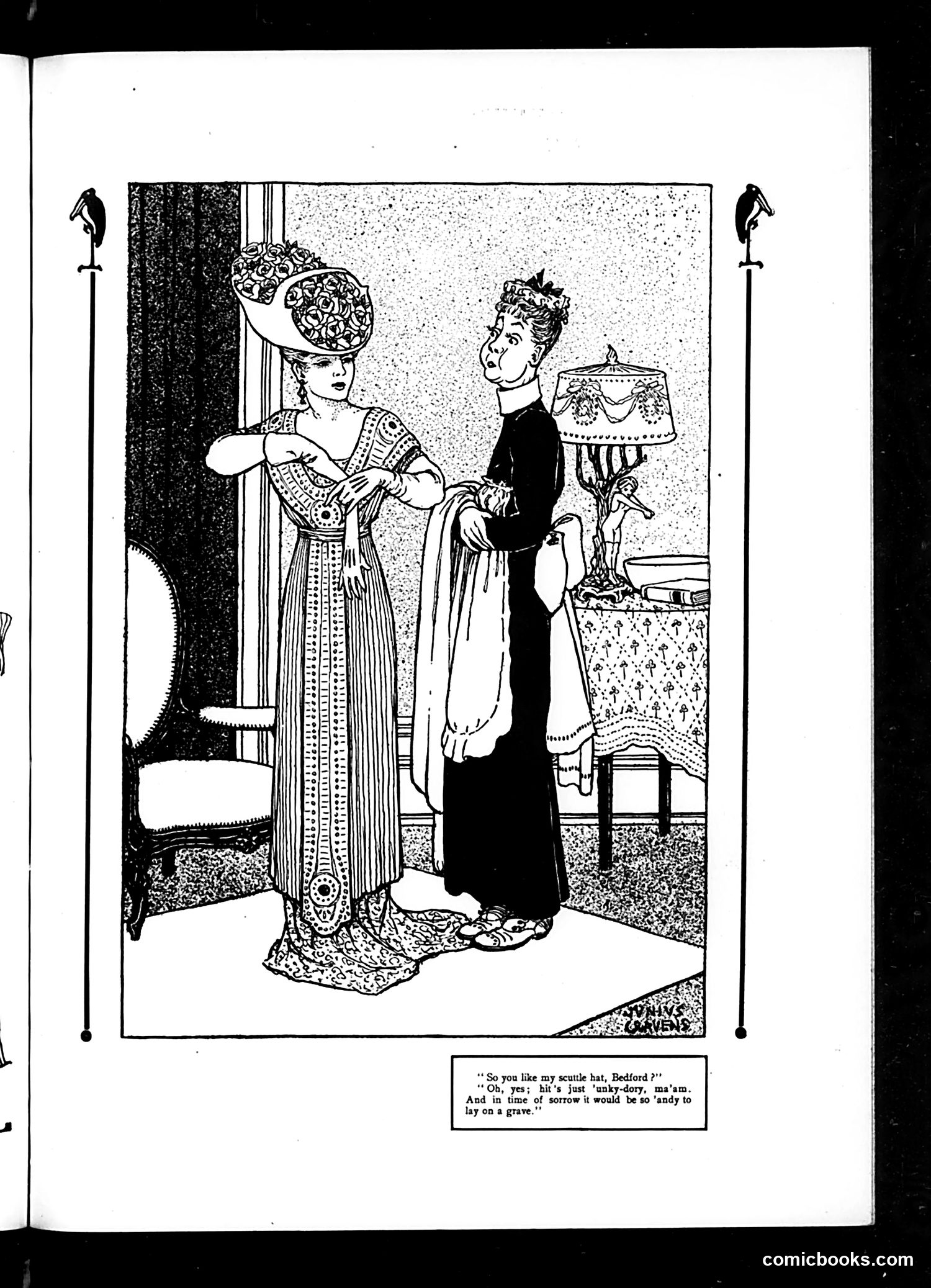
This illustration satirizes early 1900s fashion, specifically the oversized "scuttle hat" (a large, boat-shaped hat popular among wealthy women). The cartoon depicts a society lady proudly showing her enormous hat to a maid or servant named Bedford. The humor lies in the maid's deadpan response: she appreciates the hat's practicality—it's so large it could literally be used as a coffin lid to place on a grave. This is dark, cynical humor typical of Judge magazine's social commentary. The joke mocks both the absurd excess of upper-class women's fashion and suggests the maid's grim resignation to hardship and death—a class-conscious jab at wealth inequality and the servant class's bleak prospects.
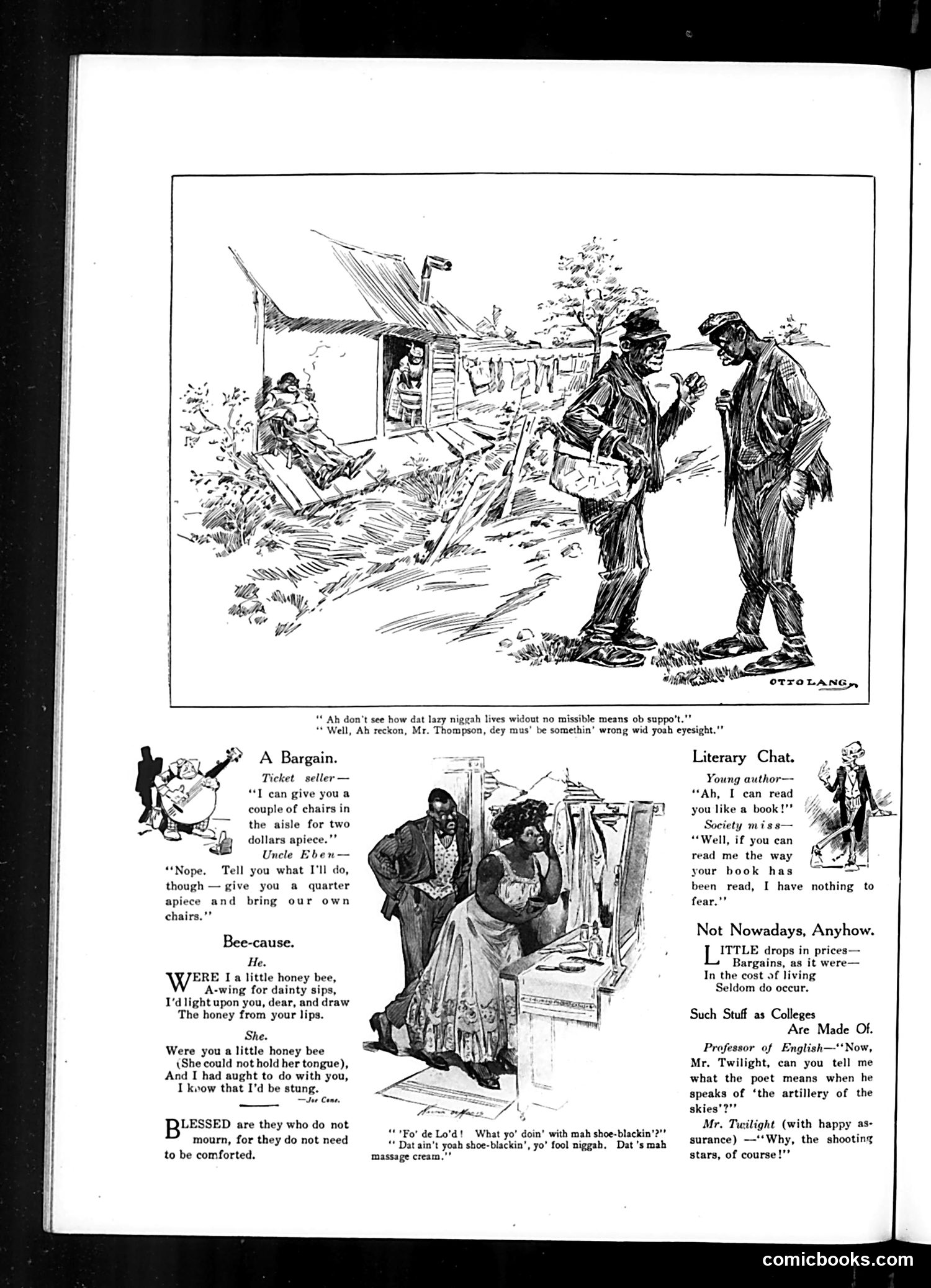
This page contains multiple satirical sketches typical of early Judge magazine humor: **Top cartoon**: Two men discuss a third person's means of support, rendered in dialect caricature stereotyping African Americans—reflecting the racist humor common in American satirical publications of this era. **"A Bargain"**: Uncle Eben (a stock character representing an African American) negotiates theater seating, turning the tables on a ticket seller by offering less money but bringing his own chairs—a joke about shrewd negotiation. **"Bee-cause"**: A flirtation poem where a woman threatens to "sting" a man's romantic advances—typical romantic wordplay humor. **"Literary Chat"**: A young author confidently reads a society woman "like a book," but she quips his book is so poorly read (unread/ignored) she has nothing to fear—mocking struggling writers. **"Such Stuff as Colleges Are Made Of"**: A student hilariously misinterprets "artillery of the skies" as "shooting stars" rather than thunder—poking fun at student ignorance and pedantic education. The page exemplifies Judge's mix of social satire, romantic humor, and educational mockery, though marred by period racist caricature.
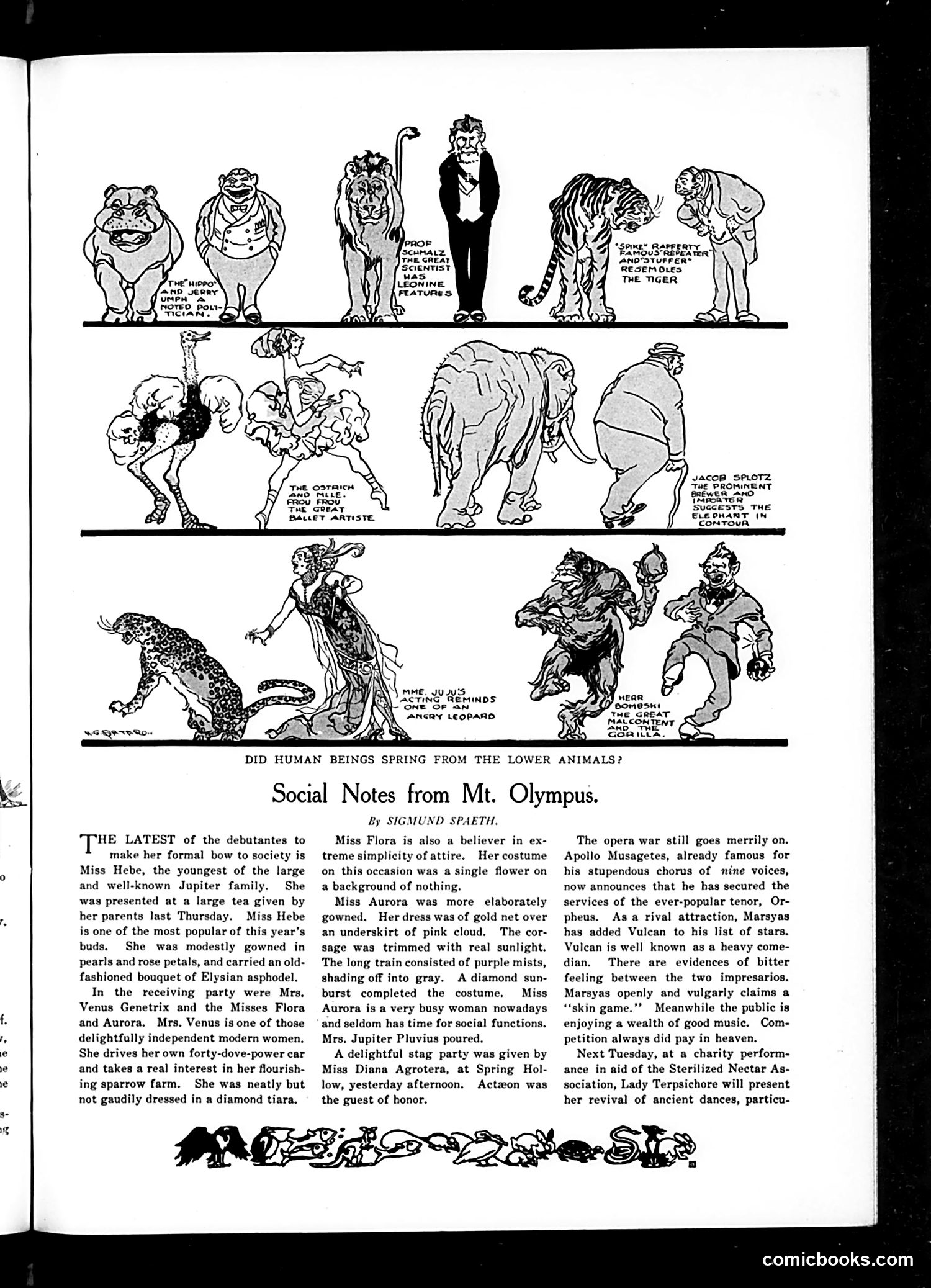
This page contains two distinct satirical pieces: **Top Section:** A cartoon titled "Did Human Beings Spring from the Lower Animals?" uses animal caricatures to mock prominent people of the era through exaggerated physical comparisons. The text labels identify figures as "Prof. Huxley" (the great scientist), "Comet Bafferty" (a famous eater/performer), and others, comparing their features to hippos, lions, ostriches, elephants, and leopards. This satirizes contemporary debates about evolution and Darwin's theories by suggesting certain individuals resemble animals. **Bottom Section:** "Social Notes from Mt. Olympus" is a humorous gossip column by Sigmund Spaeth that reimagines Greek and Roman mythology as high society. It treats classical gods (Jupiter, Venus, Apollo, Mars) as contemporary wealthy socialites attending debutante balls and opera competitions. The satire mocks both pretentious society pages and operatic rivalries of the period, using mythological names as thin disguises for real cultural figures and their disputes. Together, both pieces lampoon contemporary society, scientific debates, and entertainment world drama through absurdist humor.
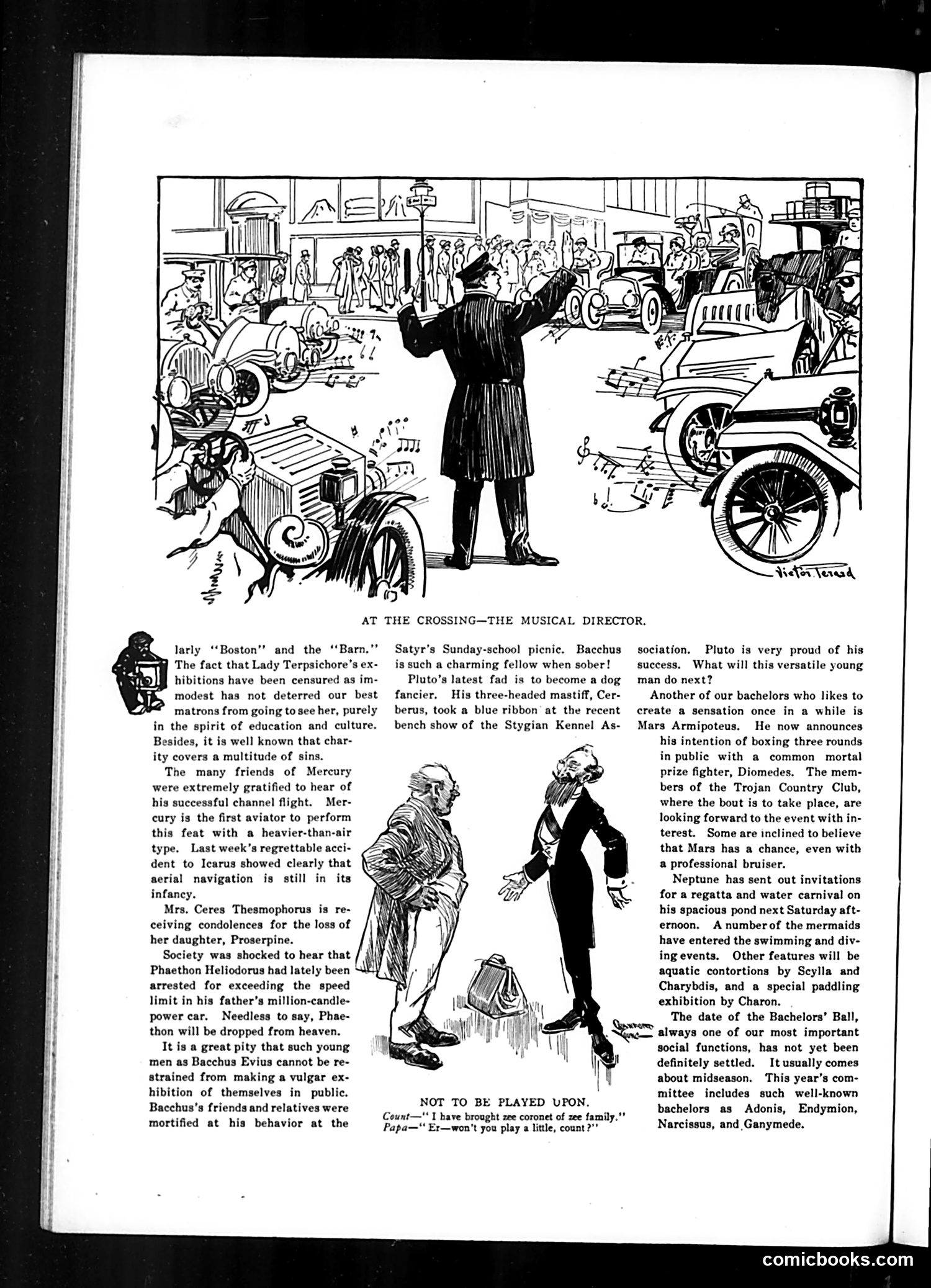
This page satirizes high society's hypocritical behavior by recasting contemporary scandals using classical mythology. The top cartoon shows a traffic conductor (musical director) orchestrating chaos at a crossing—likely mocking modern urban disorder. The text column presents fake "society gossip" where mythological figures engage in contemporary activities: Lady Terpsichore (dance) performs indecent exhibitions that respectable matrons attend under the guise of "education"; Mercury accomplishes aviation feats; Phaethon is arrested for speeding; Bacchus behaves vulgarly in public; Mars announces a boxing match with a mortal; Pluto shows off his prize-winning dog. The satire works by treating gods and mythological characters as modern socialites, exposing how the wealthy excuse scandal through claims of culture while condemning similar behavior in others. The jokes target society's double standards, fascination with celebrity transgression, and pretentious moralizing.
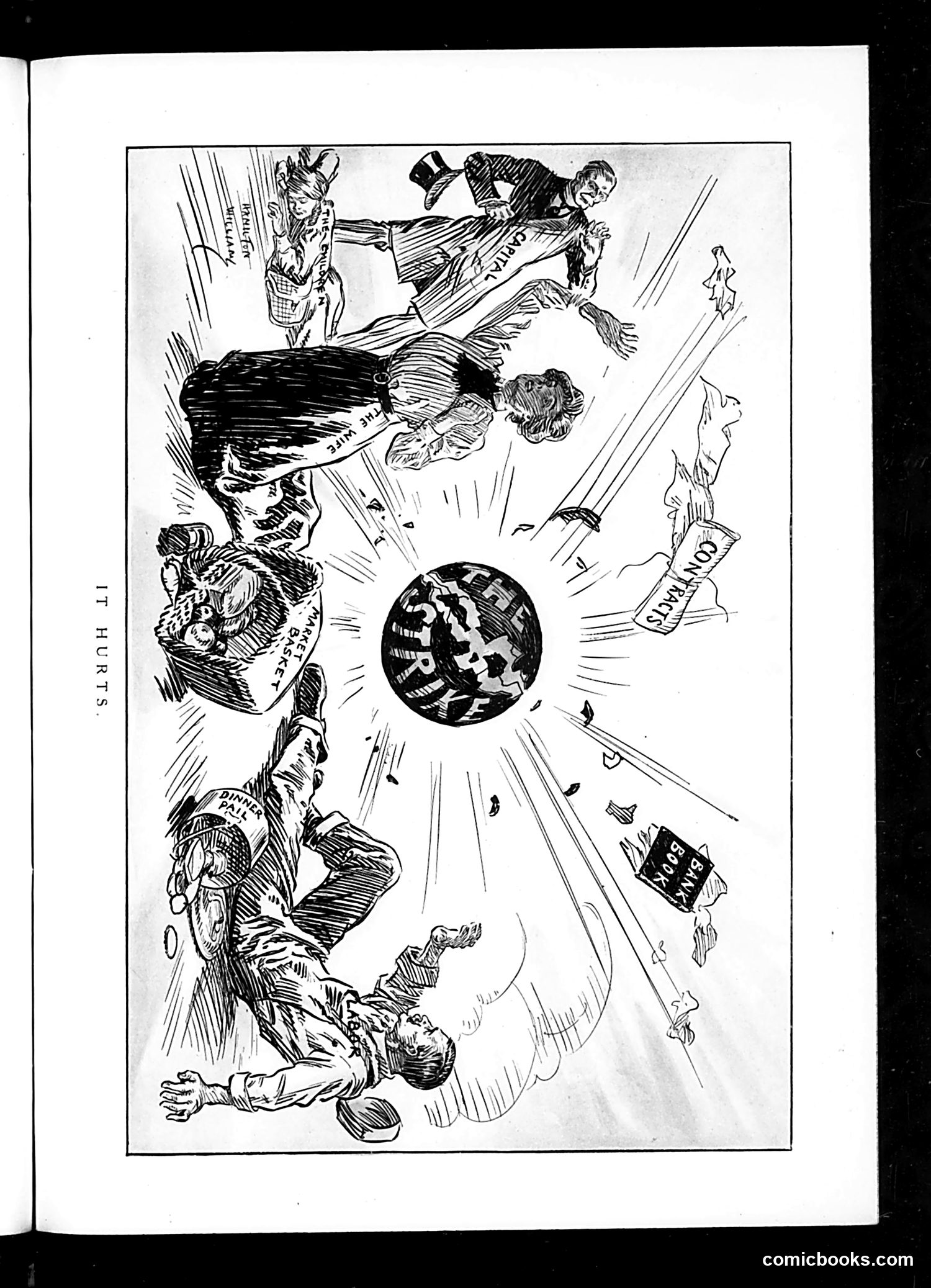
This political cartoon depicts various figures orbiting a globe, appearing to be in distress or falling. The title "It Hurts" suggests commentary on global suffering or crisis. The cartoon likely satirizes international tensions or economic hardship affecting multiple nations simultaneously—a common Judge magazine theme during periods of economic downturn or geopolitical conflict. The figures appear to represent different countries or national leaders experiencing shared pain from a central source (the globe itself). However, without clearer dates or labels identifying specific figures and the historical moment, I cannot definitively specify which crisis, war, or economic event this references. The style suggests early-to-mid 20th century. The satirical intent is clear—mocking how global problems affect various nations—but the precise political context requires additional information to identify accurately.
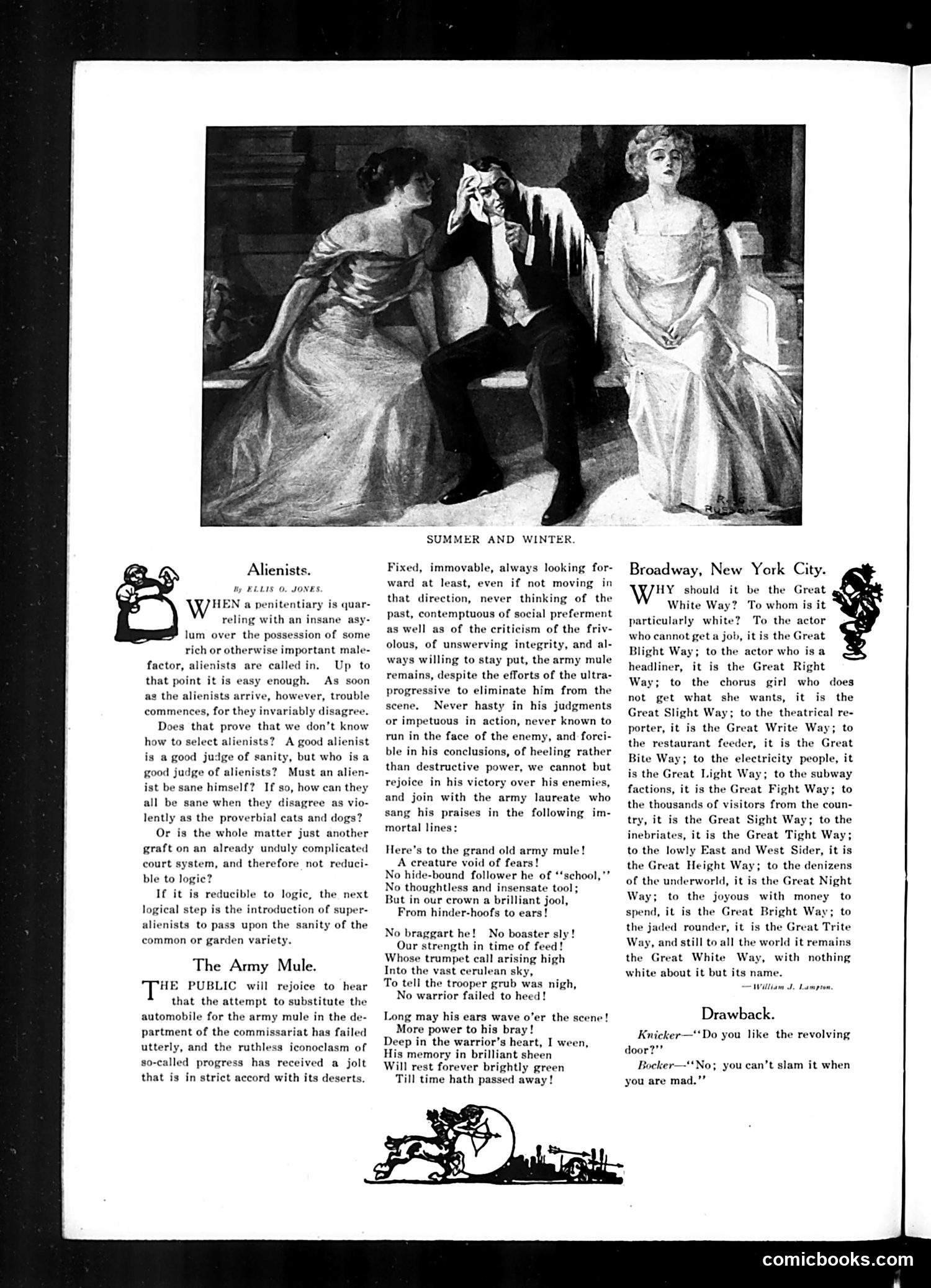
This page from *Judge* contains three separate satirical pieces: **"Alienists"** mocks psychiatric experts called to testify in insanity cases. The author (Ellis O. Jones) ridicules their constant disagreement, suggesting the entire profession is a "graft"—a scam exploiting the court system. The satire implies: if alienists disagree so violently, who judges the judges? It's a critique of expert testimony's unreliability in early 20th-century legal proceedings. **"The Army Mule"** celebrates the mule's superiority over newly introduced automobiles for military supply transport. Written as mock-heroic verse, it praises the mule's steadiness, loyalty, and reliability—contrasting with "progress" and mechanical innovation. This reflects conservative skepticism about replacing proven methods with untested technology. **"Broadway, New York City"** is a punny essay playing on "Great White Way" (Broadway's nickname). Each social group experiences the street differently: struggling actors see a "Blight Way," chorus girls a "Slight Way," drunks a "Tight Way," etc. The joke: everyone calls it the "Great White Way," yet "nothing white about it but its name."
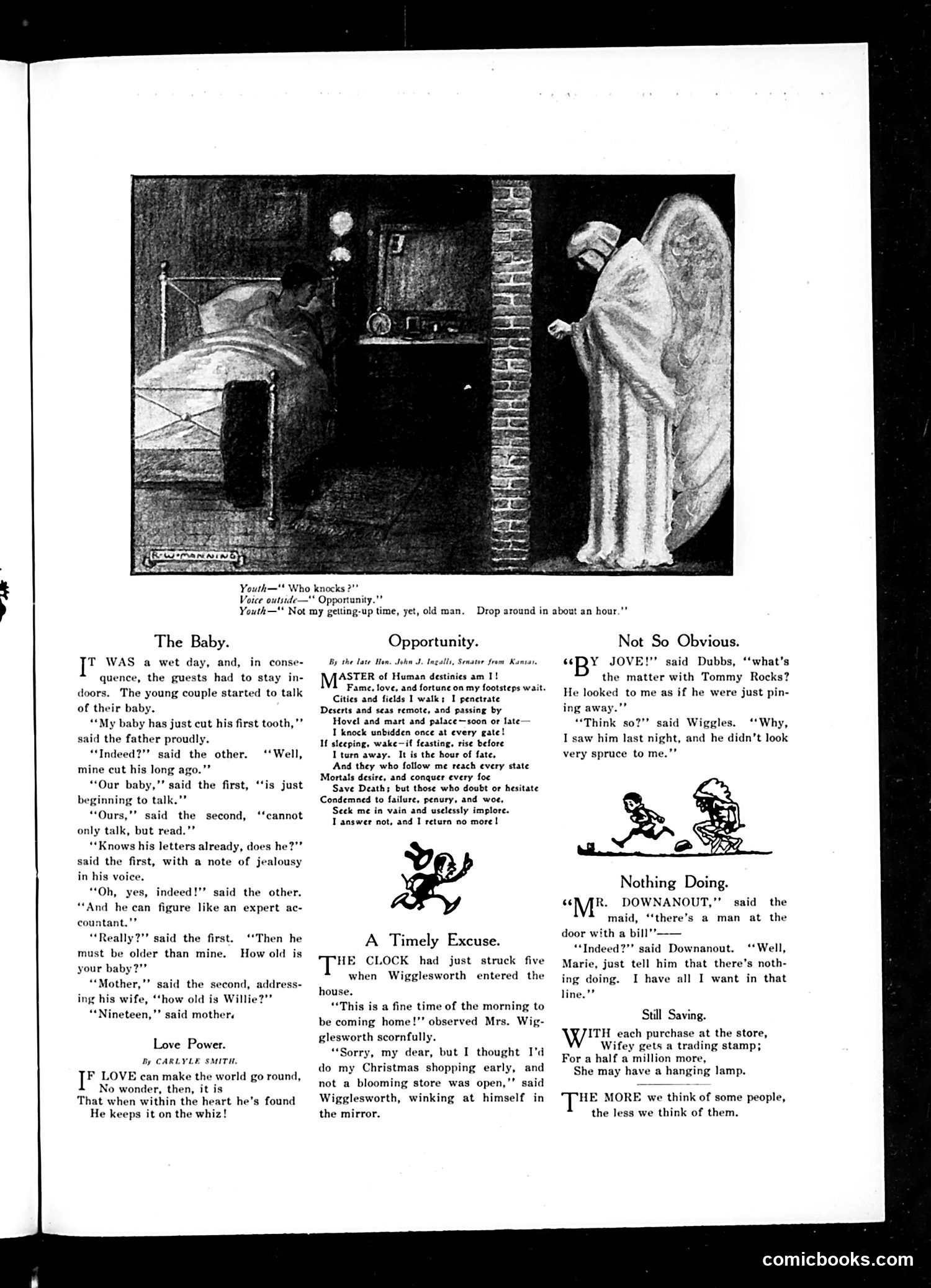
This page contains several brief satirical pieces typical of early 20th-century American humor: **"Opportunity"** presents the central satire: a personified "Opportunity" knocks at a youth's door, but the lazy young man refuses to answer, claiming it's not his "getting-up time." The accompanying poem (attributed to Senator John J. Ingalls) emphasizes that Opportunity visits only once—those who hesitate lose it forever. The joke mocks youthful laziness and missed chances. **"The Baby"** satirizes competitive parenting through one-upmanship: two fathers boast about their infants' accomplishments, each claim escalating absurdly until the second father casually reveals his "baby" is actually nineteen years old—exposing the ridiculousness of the entire conversation. **Other brief sketches** mock marital excuses ("A Timely Excuse"), social awkwardness ("Not So Obvious"), and domestic economy (the wife collecting trading stamps). The page is primarily humor and social commentary rather than political satire, targeting universal subjects like procrastination, parental pride, and household finances.
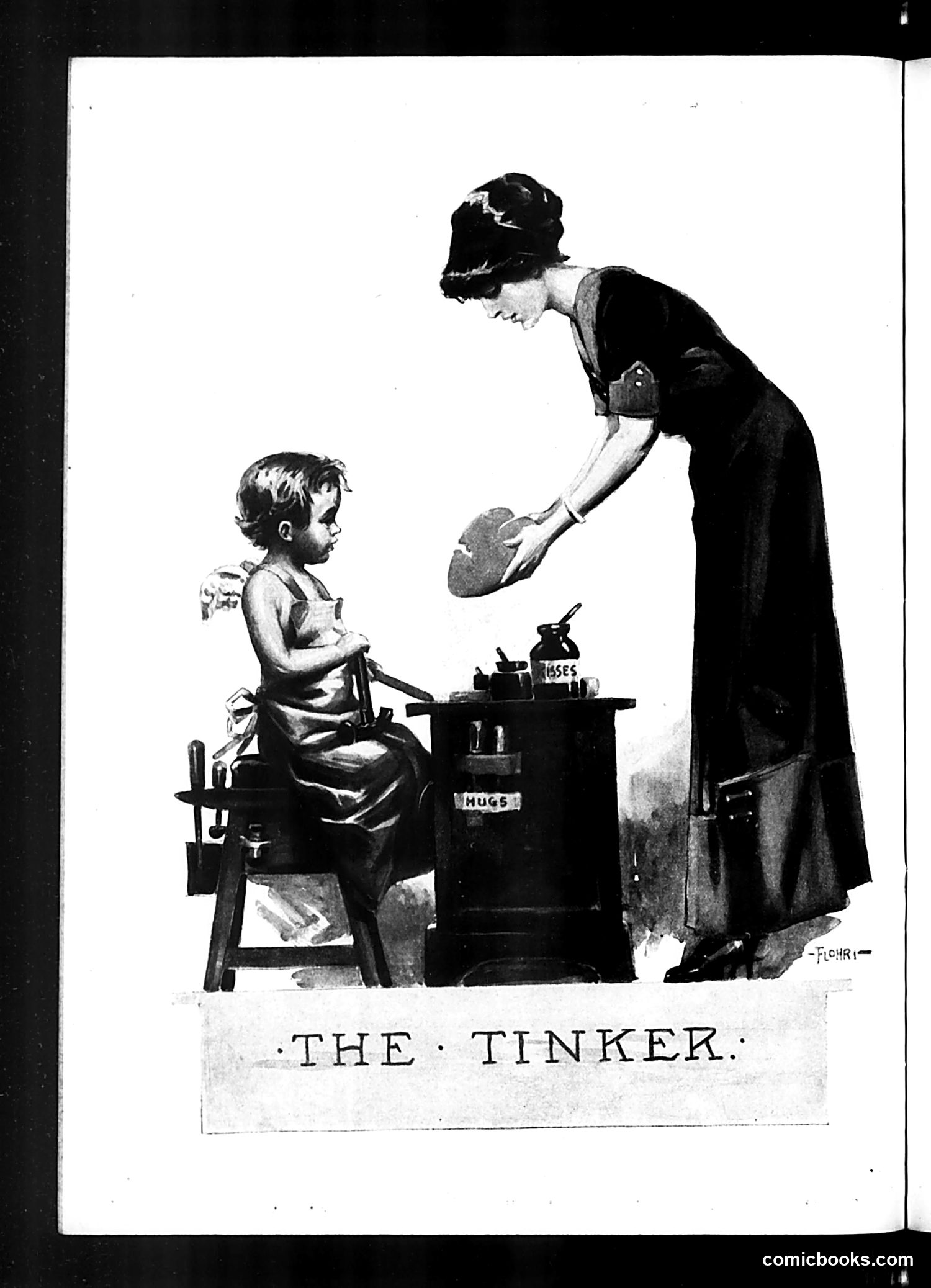
This illustration depicts a woman offering a cup or vessel to a young child sitting at a small table with domestic items labeled "MUGS" and "DISHES." The title "The Tinker" references an itinerant tradesperson who repaired metal household goods. The satire likely comments on domestic labor, women's work, or economic hardship. The woman's elegant dress contrasts with the humble mending task, suggesting either social commentary on reduced circumstances or irony about women taking on traditionally male skilled trades during economic difficulty (possibly referencing wartime or Depression-era conditions). The artist signature appears to read "Flohr." Without the magazine's date, the specific historical context remains unclear, though the style suggests early-to-mid twentieth century.
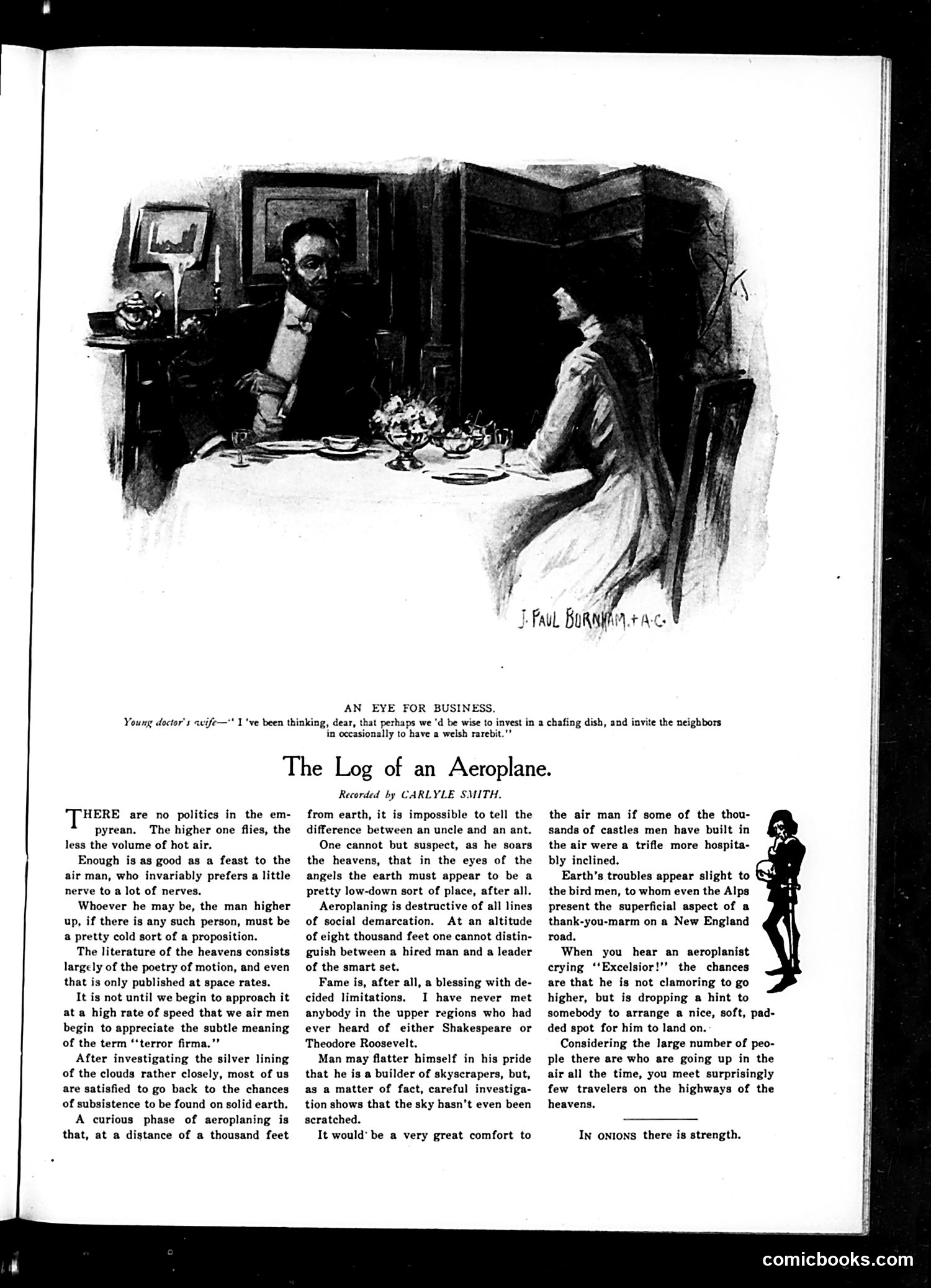
This page contains two satirical pieces from *Judge* magazine: **"An Eye for Business"** (top cartoon): A young doctor's wife suggests investing in a chafing dish to host Welsh rarebit dinners for neighbors—a modest, practical entertainment idea. The satire mocks either her business acumen or the doctor's likely dismissal of such a "small" investment. **"The Log of an Aeroplane"** (main text): A humorous essay by Carlyle Smith about early aviation, written as philosophical observations from a pilot's perspective. The satire operates on multiple levels: - **Social commentary**: Flying reveals that class distinctions disappear at altitude—a hired man and society leader appear identical from above, and even famous figures like Shakespeare and Theodore Roosevelt are forgotten. - **Deflating human pretension**: Men's "castles in the air" and grand achievements (skyscrapers) seem trivial from above; the sky remains essentially "unscratchable." - **Aviation-era humor**: References to "terra firma" (solid ground), the desire for a soft landing spot, and the contradiction between crying "Excelsior!" (go higher) while actually wanting to descend safely. The piece celebrates aviation's perspective while gently mocking human ego and ambition.
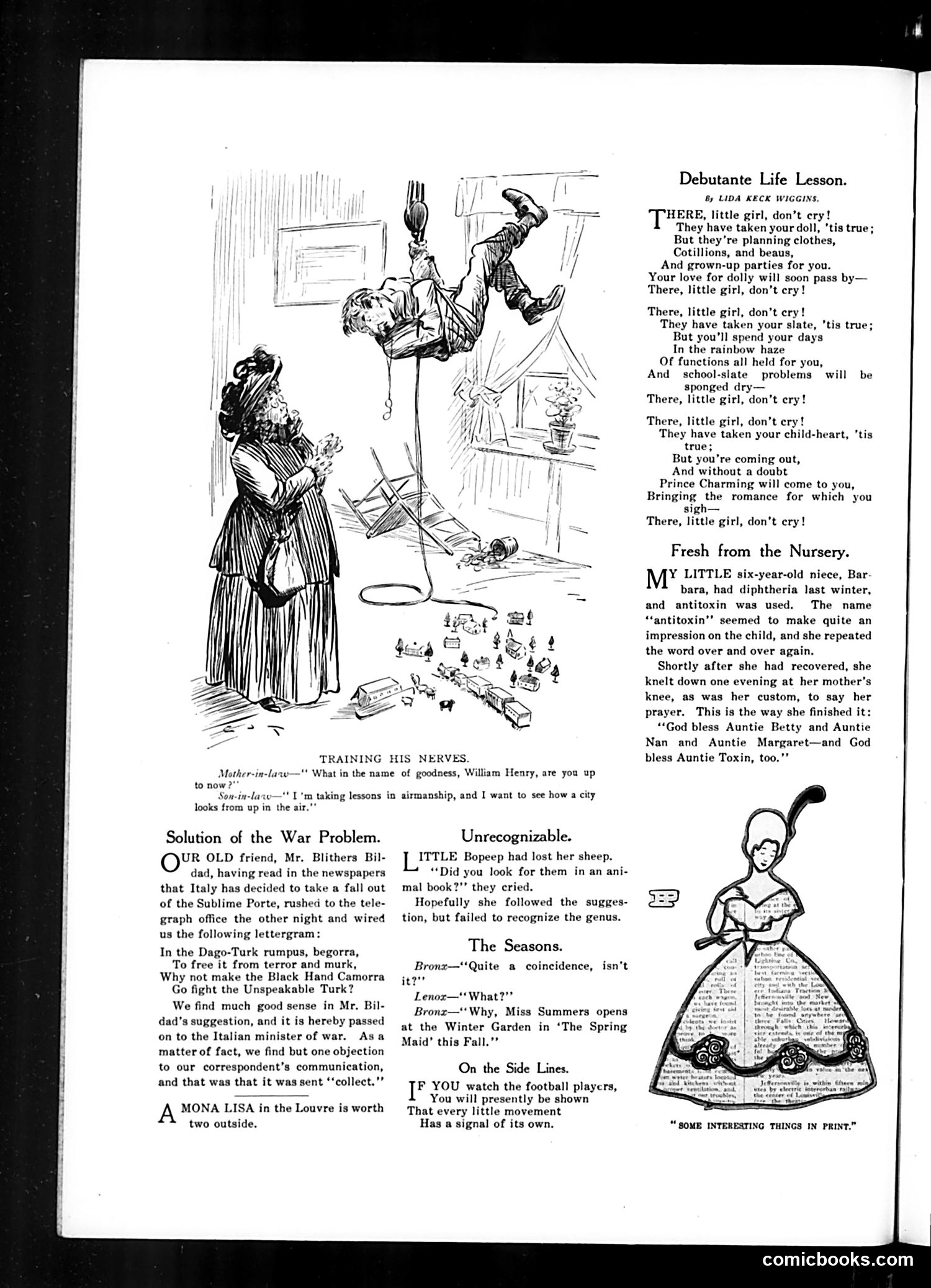
This Judge magazine page contains several short humorous pieces: **"Training His Nerves"**: A son-in-law practices "airmanship" (early aviation) by hanging from a rope while his mother-in-law watches—the joke being that he's deliberately terrifying himself, perhaps to impress or escape her. **"Solution of the War Problem"**: A satirical suggestion that Italy should send the Black Hand (a real Italian criminal organization/secret society) to fight the Ottoman Empire ("the Unspeakable Turk") during the Italo-Turkish War. The humor lies in the absurdity of proposing criminals solve diplomatic problems, plus mocking the correspondent for sending a collect telegram. **Other brief items**: A pun about the Mona Lisa's value, a children's logic joke about Little Bo-Peep, a coincidence about an actress's stage name, and a poem about debutantes losing childhood innocence to society balls. The "Fresh from the Nursery" anecdote humorously depicts a child mishearing "antitoxin" as "Auntie Toxin." The overall tone is light domestic and social satire typical of early 20th-century American humor magazines.
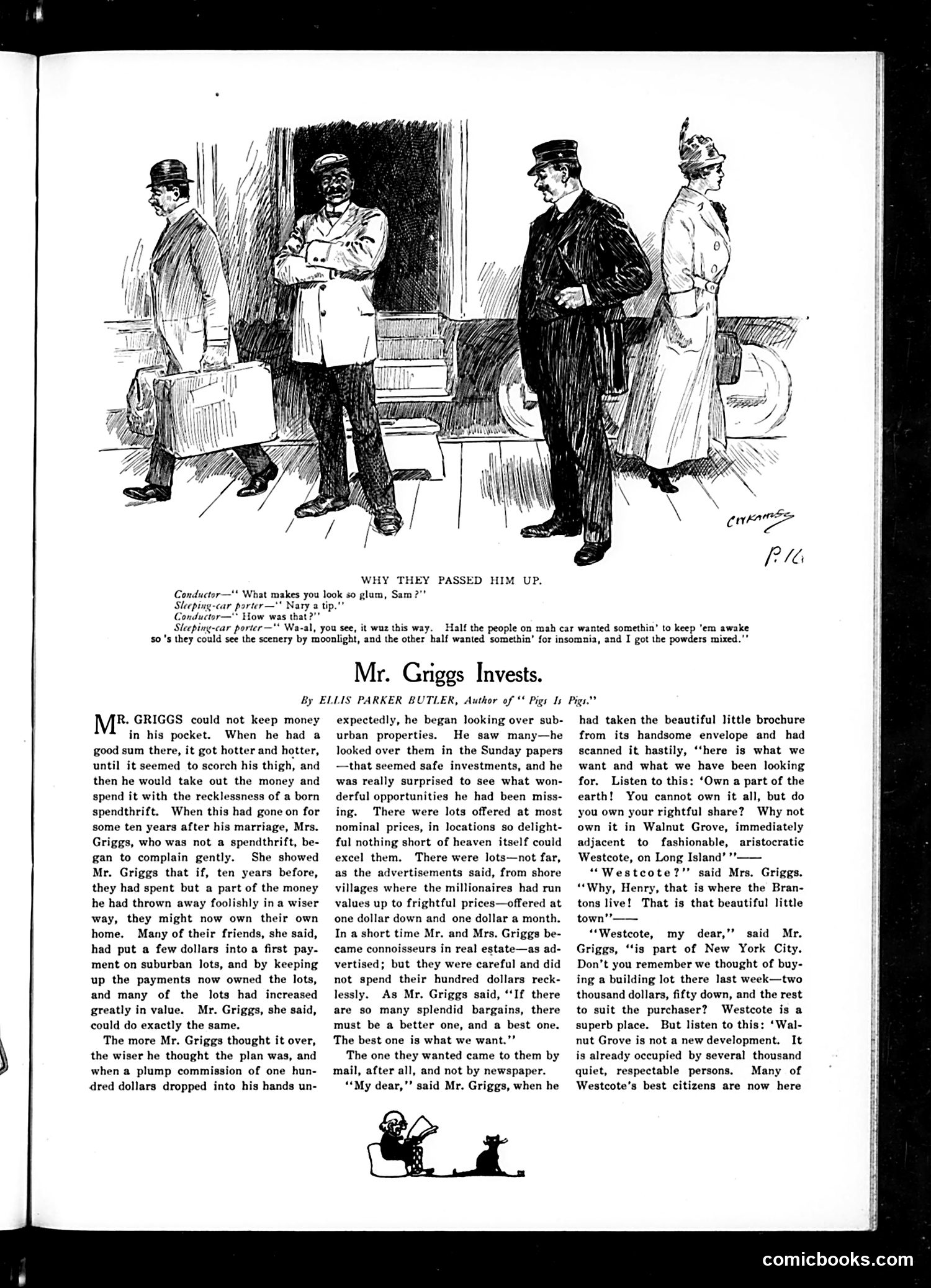
This page contains two separate satirical pieces: **Top cartoon:** "Why They Passed Him Up" mocks a sleeping-car porter who mixed up medications—some passengers wanted stimulants to see moonlight scenery, others wanted sleep aids for insomnia. The joke is his incompetence cost him tips. **Main story:** "Mr. Griggs Invests" by Ellis Parker Butler satirizes real estate speculation and gullible investors. After years of frivolous spending, Mr. Griggs finally saves money and becomes obsessed with purchasing suburban land. He receives promotional mail for "Walnut Grove," near the fashionable area of Westcote on Long Island. The text mocks both his susceptibility to advertising hyperbole ("nominal prices," lavish descriptions) and his analysis paralysis—endlessly seeking the "best" bargain rather than acting. The satire targets early 20th-century real estate marketing schemes that preyed on middle-class aspirations for property ownership through misleading advertisements and aggressive direct mail campaigns.
This page contains a satirical story about real estate fraud, a common scheme in early 20th-century America. Mr. and Mrs. Griggs are persuaded by a salesman (Mr. Griggs, appearing to be a con artist) to purchase a "plot" in a development called Walnut Grove on Long Island for $75—suspiciously cheap compared to nearby lots selling for $800-$1,000. The salesman uses classic fraud tactics: urgency ("bargains don't remain idle"), vague promises (maintenance included, marble structures coming), and appeals to status (wealthy families moving in). Mrs. Griggs pressures her husband into sending money immediately without verification. When Mr. Griggs casually mentions his purchase to his friend Branton, the punchline becomes clear: Branton's skeptical reaction suggests the development doesn't exist or is a scam. The satire mocks both the gullibility of middle-class buyers and predatory land-sale schemes that were rampant in the era.
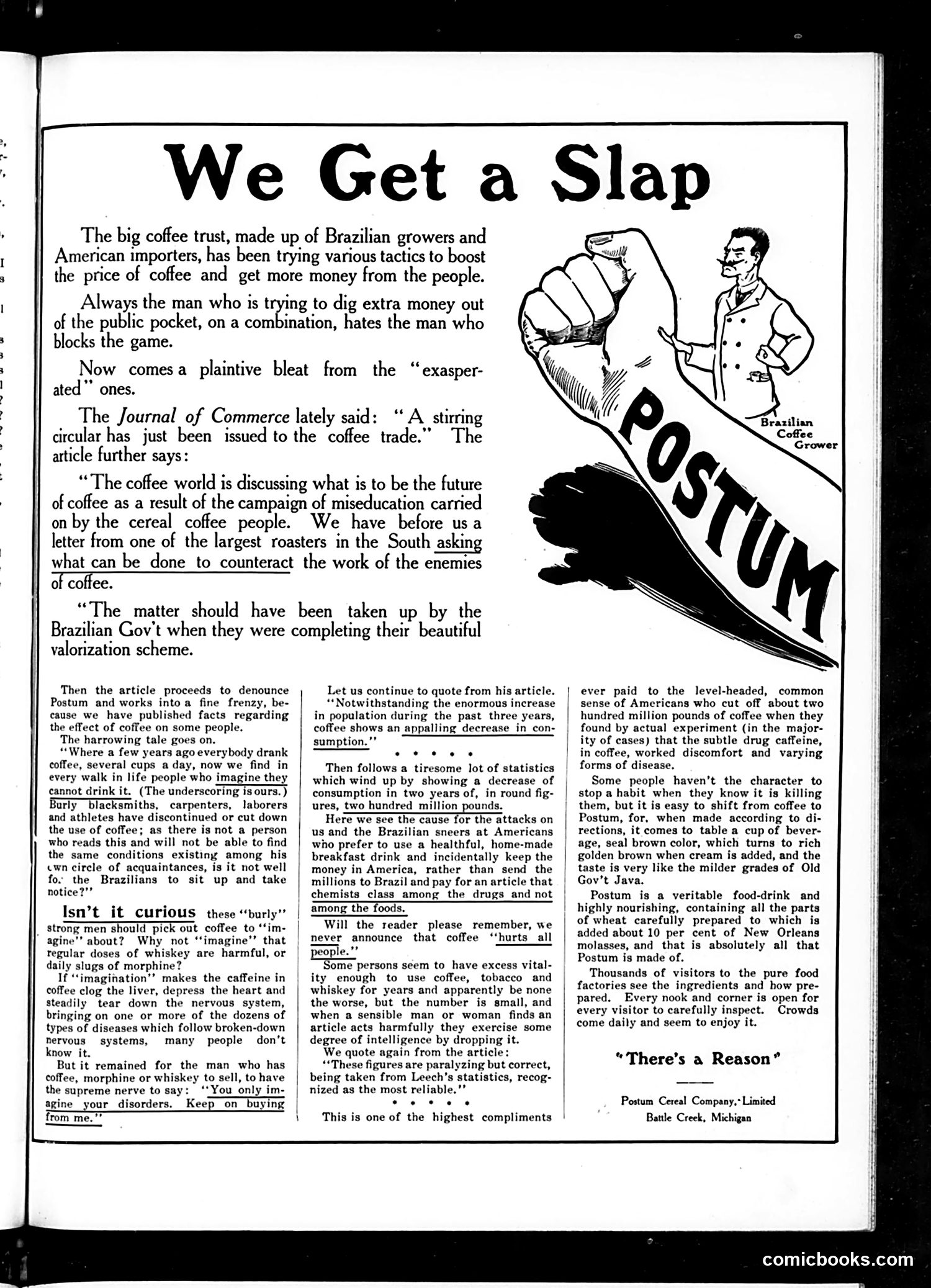
This page ridicules the **coffee trust**—a cartel of Brazilian growers and American importers trying to maintain high coffee prices. The illustration shows a Brazilian coffee grower being rebuffed by the public (represented by a giant fist labeled "POSTUM"). The satire targets the industry's defensive response to **Postum**, a caffeine-free cereal-based beverage marketed as a healthful alternative. Rather than acknowledge legitimate health concerns about coffee's effects (nervousness, heart strain, liver damage), the coffee trade dismisses critics as merely "imagining" problems—a self-serving denial. Judge mocks this hypocrisy: the industry won't admit coffee can harm people, yet they ironically acknowledge declining consumption and blame a "campaign of miseducation" by competitors. The underlying point: American consumers are choosing Postum because they've genuinely experienced coffee's negative effects, not from propaganda. The coffee trust receives a deserved "slap" from an informed public voting with their wallets.
This page is primarily **advertisements and brief humor pieces** rather than political cartoons. The ads promote consumer products typical of 1910: Chiclets gum (emphasizing refinement for "people of refinement"), Pabst Blue Ribbon beer (stressing cleanliness and mechanized production), and Sunny Brook whiskey (marketed as a "pure food" tonic). The humor pieces are mild social observations: a joke about a young man rescuing a widow and needing rescue himself (playing on marriage anxiety); a gallant beggar who claims his profession uniquely permits addressing beautiful women; and satirical takes on education, legal advice, and women's identity (the "Seven Ages of Woman" joke tracks name changes through marriage). **Modern relevance**: These snippets reveal 1910 attitudes—anxiety about courtship, assumptions about women's identity tied to marital status, and marketing that presents mass-produced goods as markers of "refinement" and class status. The ads notably emphasize *purity* and *cleanliness*, reflecting Progressive Era consumer concerns.
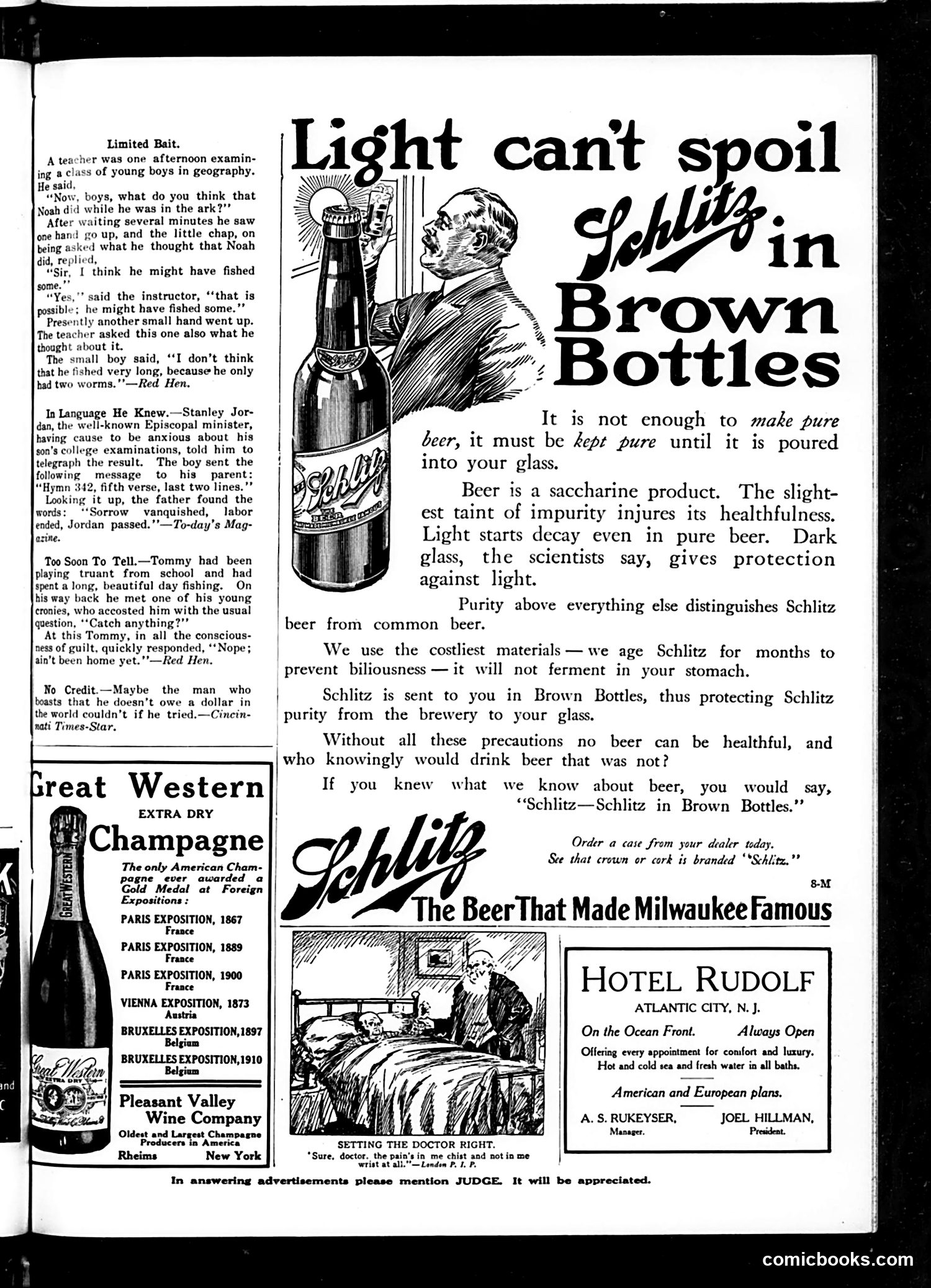
This page contains primarily **advertisements and short humorous anecdotes** rather than political cartoons. The main content includes: **Humor pieces** (top left): Brief jokes about schoolchildren—one about Noah fishing in the ark with only two worms, another about a boy lying to his parents about truancy. These are gentle, domestic humor typical of the era. **Major advertisement**: A large **Schlitz beer ad** (center-right) emphasizing that brown bottles protect beer from light degradation, claiming scientific superiority and purity. This reflects early 20th-century advertising that used pseudo-scientific health claims to market beer as wholesome. **Supporting ads**: Great Western Champagne listing international exposition awards, and Hotel Rudolf in Atlantic City. **Historical context**: The page reflects a pre-Prohibition era when beer was marketed as a health product. The scientific-sounding purity arguments were common advertising strategies before modern food/beverage regulation. No clear political satire or caricature is evident on this page—it's primarily commercial content with light domestic humor.
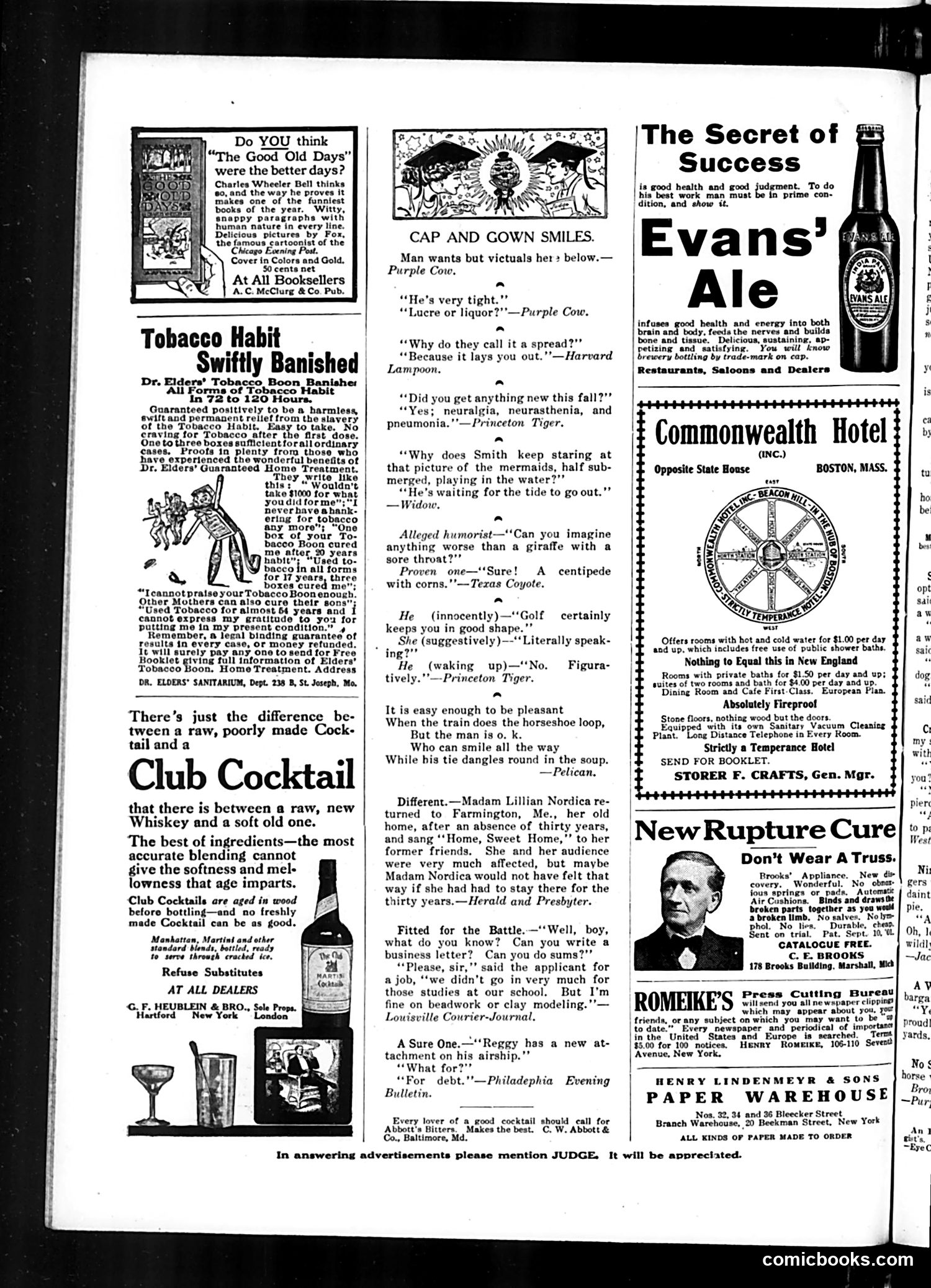
This page is primarily **advertising and humor** rather than political satire. It contains: **Advertisements** for consumer products (tobacco cessation, cocktails, ale, hotels, a rupture cure) typical of early 20th-century magazines. **"Cap and Gown Smiles"** section: A collection of brief jokes attributed to college publications (Harvard Lampoon, Princeton Tiger, etc.). These are genteel, mostly mild humor about college life, romance, and social situations—examples include jokes about getting drunk, golf, mermaids, and a humorous anecdote about opera singer Lillian Nordica returning to her hometown. **Notable content**: The page includes a "New Rupture Cure" advertisement featuring a man's photograph, promoting a non-surgical treatment. The humor is **nostalgic and collegiate** rather than sharp political commentary. These were the sorts of gentle, upper-class jokes Judge's educated readership would recognize and appreciate. Nothing here requires specialized historical knowledge beyond understanding early 1900s social conventions.
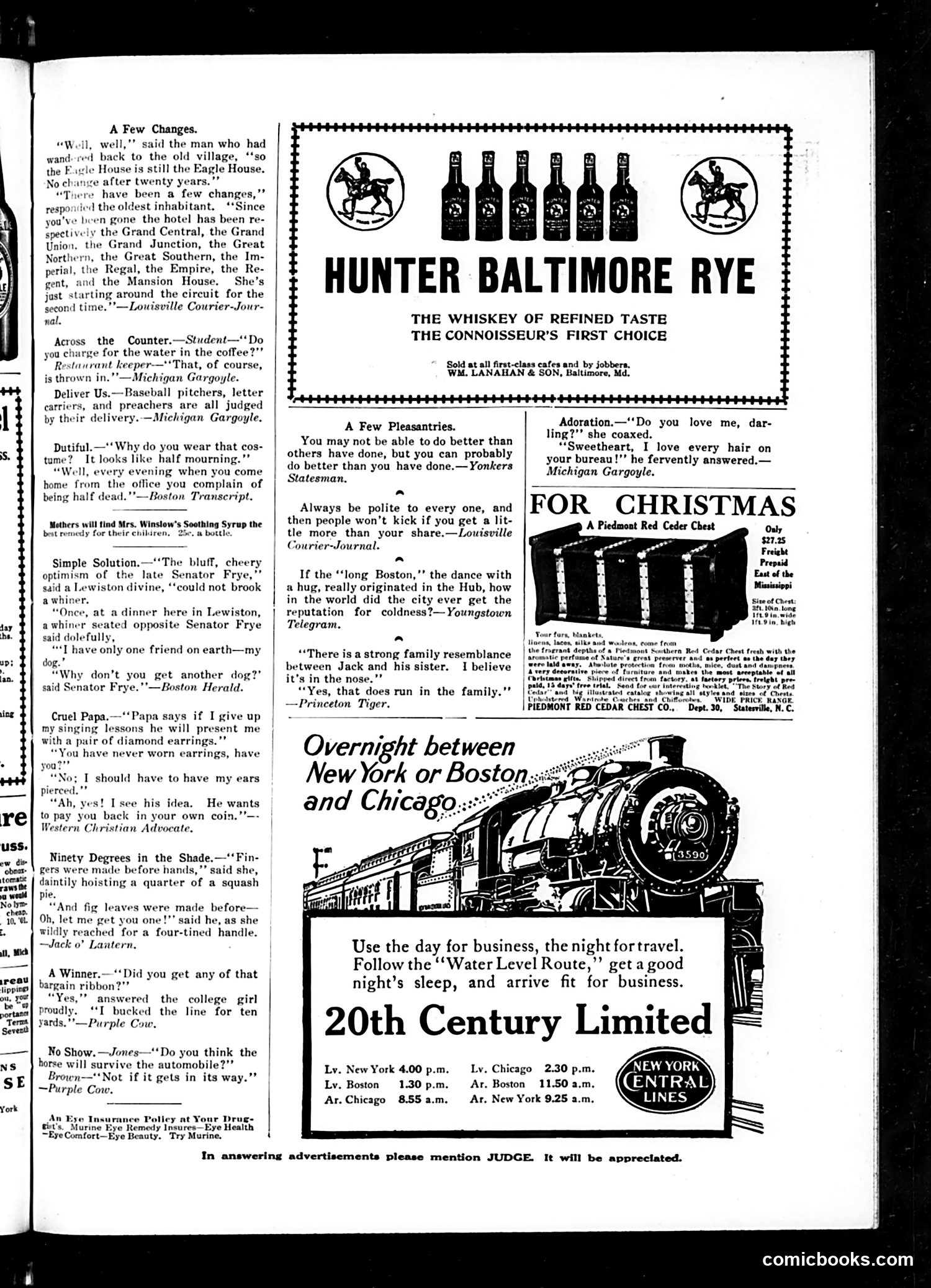
This page is primarily **advertising and humor columns** rather than political cartoons. The content consists of: **Humor Pieces**: Brief, attributed jokes from various sources (Louisville Courier-Journal, Michigan Gargoyle, Boston Herald, etc.) about everyday topics—hotel renaming, restaurant charges, baseball pitchers, and romantic mishaps. These are gentle satirical observations on American life rather than political commentary. **Advertisements**: The major visual elements are ads for Hunter Baltimore Rye whiskey, a Piedmont Red Cedar chest, and the 20th Century Limited train service between New York, Boston, and Chicago. **Historical Context**: The train advertisement's emphasis on the "Water Level Route" and overnight travel suggests early 20th-century competition between rail services. The humor reflects period concerns (automobiles replacing horses, women's fashion, courtship customs). No specific political figures or events are caricatured. This is a typical Judge page mixing light social satire with consumer advertising.
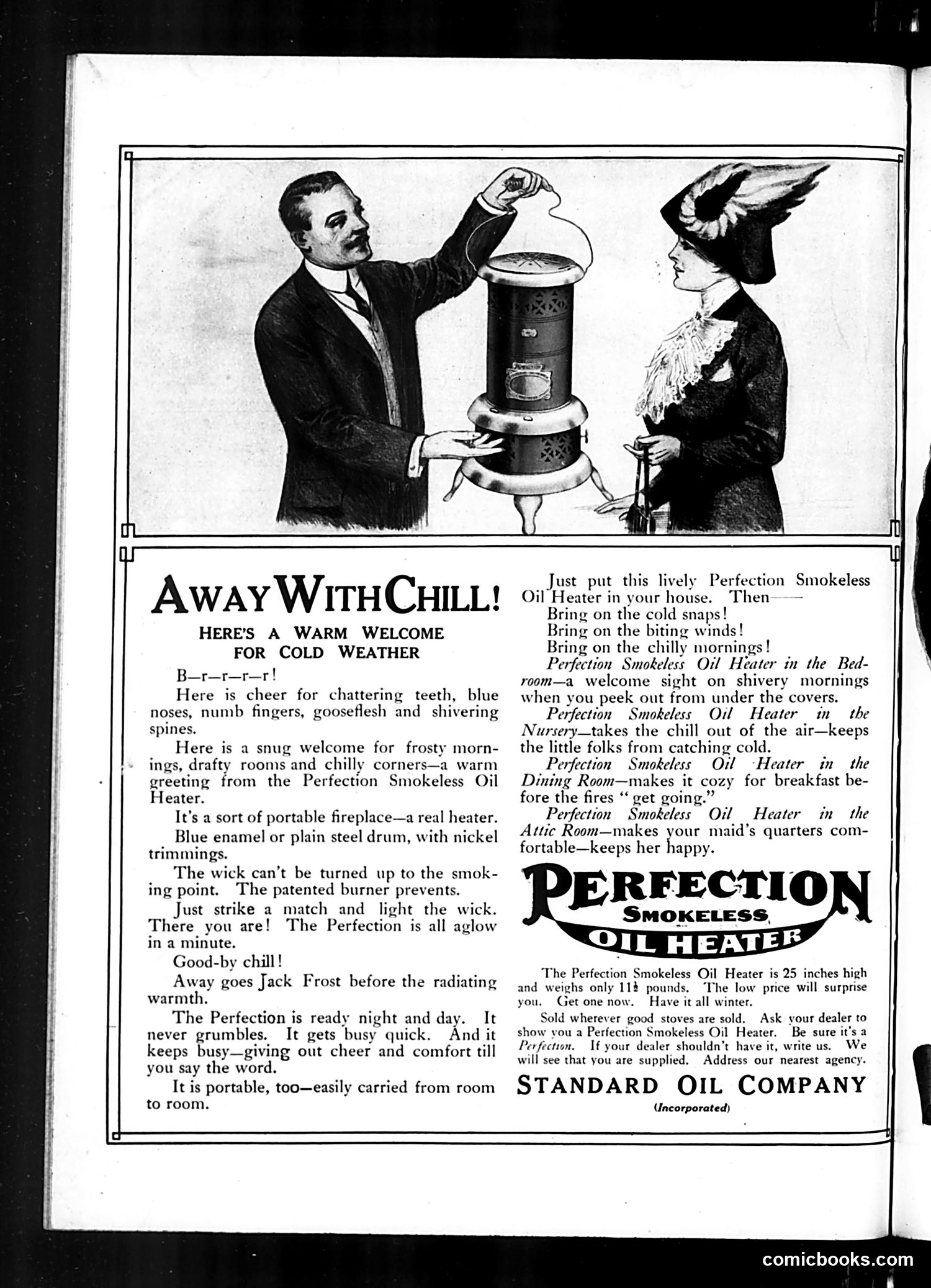
This page is **entirely an advertisement**, not editorial content or satire. It promotes the Perfection Smokeless Oil Heater, made by Standard Oil Company. The illustration shows a man demonstrating the heater to a woman, establishing a sales pitch rather than satirical commentary. The playful headline "Away With Chill!" personifies cold weather as an unwelcome guest ("Jack Frost") that the product defeats. The ad emphasizes practical benefits for early 20th-century domestic life: portable heating for bedrooms, nurseries, dining rooms, and servants' quarters—addressing the era's reliance on individual room heaters before central heating. The "smokeless" feature was a significant selling point, as oil heaters commonly produced offensive odors and fumes. While *Judge* magazine typically featured satire, this page represents the magazine's primary revenue source: paid advertising. The tone is humorous but purely promotional—no political or social satire is evident.