
Judge, 1911-11-18 · page 17 of 24
Judge — November 18, 1911 — page 17: what you’re looking at
What you’re looking at
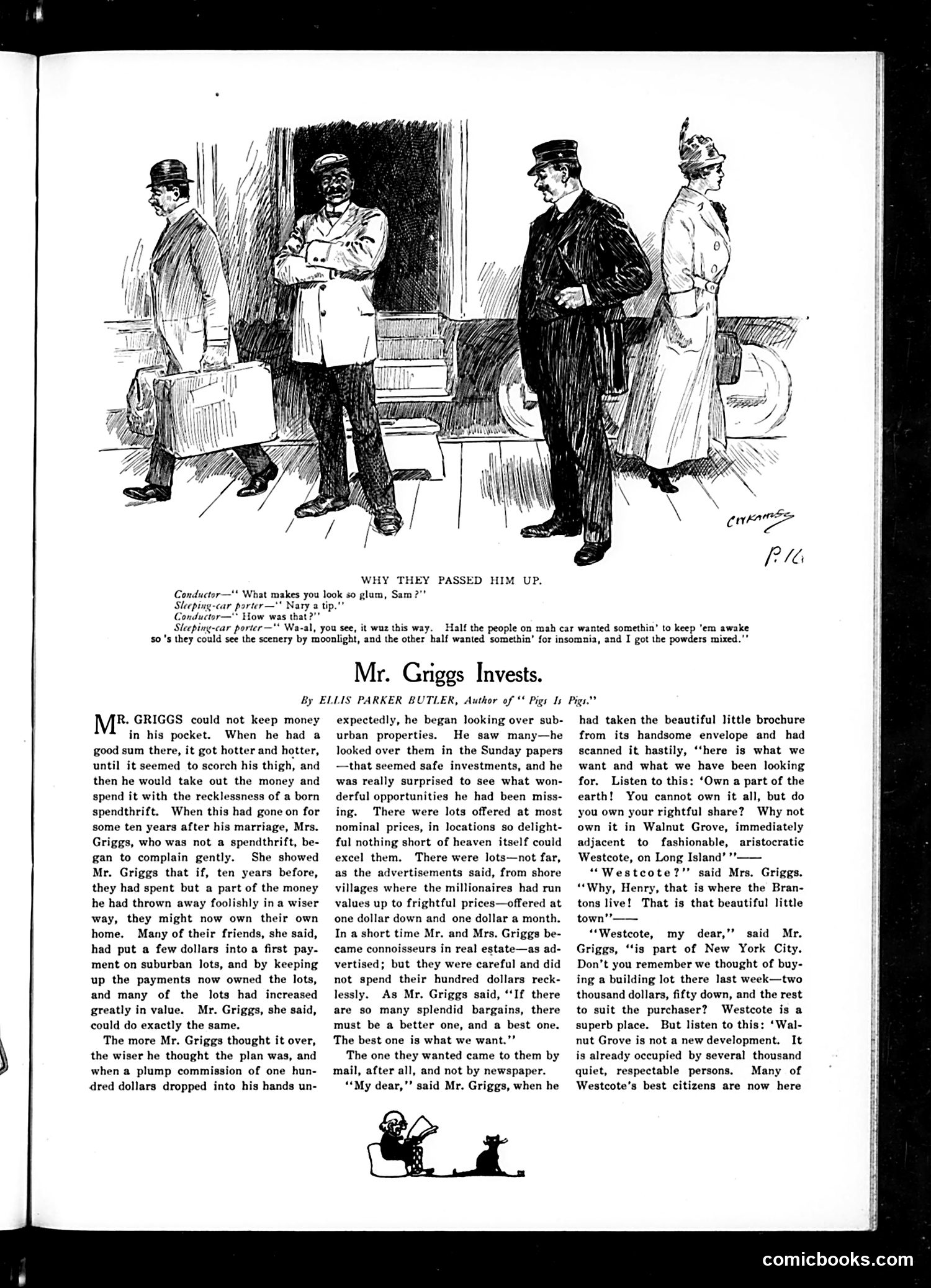
This page contains two separate satirical pieces: **Top cartoon:** "Why They Passed Him Up" mocks a sleeping-car porter who mixed up medications—some passengers wanted stimulants to see moonlight scenery, others wanted sleep aids for insomnia. The joke is his incompetence cost him tips. **Main story:** "Mr. Griggs Invests" by Ellis Parker Butler satirizes real estate speculation and gullible investors. After years of frivolous spending, Mr. Griggs finally saves money and becomes obsessed with purchasing suburban land. He receives promotional mail for "Walnut Grove," near the fashionable area of Westcote on Long Island. The text mocks both his susceptibility to advertising hyperbole ("nominal prices," lavish descriptions) and his analysis paralysis—endlessly seeking the "best" bargain rather than acting. The satire targets early 20th-century real estate marketing schemes that preyed on middle-class aspirations for property ownership through misleading advertisements and aggressive direct mail campaigns.
📄 Transcribed text from this page (OCR, searchable)
Machine-transcribed from the original scan — historical spelling and the odd misread are preserved.
WHY THEY PASSED HIM UP. Conductor—'* What makes you look so glum, Sam?" Sleeping-car porter—" Nary a tip.” Conductor—* How was that?"" Sleeping-car porter—"* Wa-al, you see, it wuz this way. Half the people on mah car wanted somethin’ to keep ‘em awake so 's they could see the scenery by moonlight, and the other half wanted somethin’ for insomnia, and I got the powders mixed.”* ME® GRIGGS could not keep money in his pocket. When he had a good sum there, it got hotter and hotter, until it seemed to scorch his thigh, and then he would take out the money and spend it with the recklessness of a born spendthrift. When this had gone on for some ten years after his marriage, Mrs. Griggs, who was not a spendthrift, be- gan to complain gently. She showed Mr. Griggs that if, ten years before, they had spent but a part of the money he had thrown away foolishly in a wiser way, they might now own their own home. Many of their friends, she said, had put a few dollars into a first pay- ment on suburban lots, and by keeping up the payments now owned the lots, and many of the lots had increased greatly in value. Mr. Griggs, she said, could do exactly the same. The more Mr. Griggs thought it over, the wiser he thought the plan was, and when a plump commission of one hun- dred dollars dropped into his hands un- Mr. Griggs Invests. By ELLIS PARKER BUTLER, Author of ** Pigs Is Pigs.’? expectedly, he began looking over sub- urban properties. He saw many—he looked over them in the Sunday papers —that seemed safe investments, and he was really surprised to see what won- derful opportunities he had been miss- ing. There were lots offered at most nominal prices, in locations so delight- ful nothing short of heaven itself could excel them. There were lots—not far, as the advertisements said, from shore villages where the millionaires had run values up to frightful prices—offered at one dollar down and one dollar a month, In a short time Mr. and Mrs. Griggs be- came connoisseurs in real estate—as ad- vertised; but they were careful and did not spend their hundred dollars reck- lessly. As Mr. Griggs said, ‘‘If there are so many splendid bargains, there must be a better one, and a best one. The best one is what we want.”” The one they wanted came to them by mail, after all, and not by newspaper. “My dear,”’ said Mr. Griggs, when he had taken the beautiful little brochure from its handsome envelope and had scanned it hastily, ‘‘here is what we want and what we have been looking for. Listen to this: ‘Own a part of the earth! You cannot own it all, but do you own your rightful share? Why not own it in Walnut Grove, immediately adjacent to fashionable, aristocratic Westcote, on Long Island’ ’’—— ““Westcote?” said Mrs. Griggs. “Why, Henry, that is where the Bran- tons live! That is that beautiful little town’”’, “‘Westcote, my dear,’’ said Mr. Griggs, “tis part of New York City. Don’t you remember we thought of buy- ing a building lot there last week—two thousand dollars, fifty down, and the rest to suit the purchaser? Westcote is a superb place. But listen to this: ‘Wal- nut Grove is not a new development. It is already occupied by several thousand quiet, respectable persons. Many of Westcote’s best citizens are now here comicbooks.com