
Judge, 1911-11-18 · page 15 of 24
Judge — November 18, 1911 — page 15: what you’re looking at
What you’re looking at
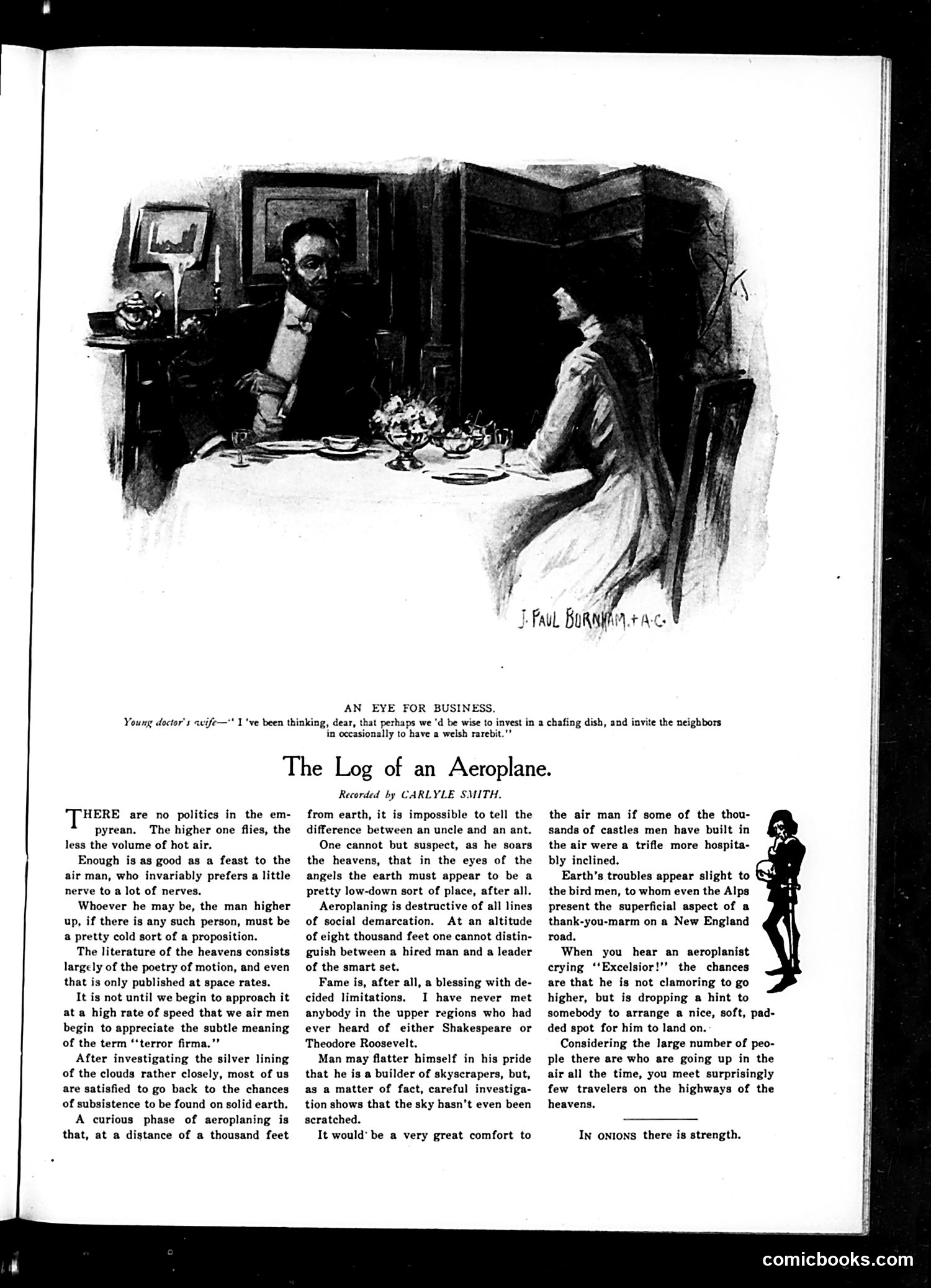
This page contains two satirical pieces from *Judge* magazine: **"An Eye for Business"** (top cartoon): A young doctor's wife suggests investing in a chafing dish to host Welsh rarebit dinners for neighbors—a modest, practical entertainment idea. The satire mocks either her business acumen or the doctor's likely dismissal of such a "small" investment. **"The Log of an Aeroplane"** (main text): A humorous essay by Carlyle Smith about early aviation, written as philosophical observations from a pilot's perspective. The satire operates on multiple levels: - **Social commentary**: Flying reveals that class distinctions disappear at altitude—a hired man and society leader appear identical from above, and even famous figures like Shakespeare and Theodore Roosevelt are forgotten. - **Deflating human pretension**: Men's "castles in the air" and grand achievements (skyscrapers) seem trivial from above; the sky remains essentially "unscratchable." - **Aviation-era humor**: References to "terra firma" (solid ground), the desire for a soft landing spot, and the contradiction between crying "Excelsior!" (go higher) while actually wanting to descend safely. The piece celebrates aviation's perspective while gently mocking human ego and ambition.
📄 Transcribed text from this page (OCR, searchable)
Machine-transcribed from the original scan — historical spelling and the odd misread are preserved.
AN EYE FOR BUSINESS. Young doctor's avife—‘' I've been thinking, dear, that perhaps we 'd be wise to invest in a chafing dish, and invite the neighbors in occasionally to have a welsh rarebit.'’ The Log of an Aeroplane. “THERE are no politics in the em- pyrean, The higher one flies, the less the volume of hot air. Enough is as good as a feast to the air man, who invariably prefers a little nerve to a lot of nerves. Whoever he may be, the man higher up, if there is any such person, must be a pretty cold sort of a proposition. The literature of the heavens consists largely of the poetry of motion, and even that is only published at space rates. It is not until we begin to approach it at a high rate of speed that we air men begin to appreciate the subtle meaning of the term “‘terror firma.”” After investigating the silver lining of the clouds rather closely, most of us are satisfied to go back to the chances of subsistence to be found on solid earth. A curious phase of aeroplaning is that, at a distance of a thousand feet Recorded by CARLYLE SMITH. from earth, it is impossible to tell the difference between an uncle and an ant. One cannot but suspect, as he soars the heavens, that in the eyes of the angels the earth must appear to be a pretty low-down sort of place, after all. Aeroplaning is destructive of all lines of social demarcation. At an altitude of eight thousand feet one cannot distin- guish between a hired man and a leader of the smart set. Fame is, after all, a blessing with de- cided limitations. I have never met anybody in the upper regions who had ever heard of either Shakespeare or Theodore Roosevelt. Man may flatter himself in his pride that he is a builder of skyscrapers, but, as a matter of fact, careful investiga- tion shows that the sky hasn’t even been scratched. It would’ be a very great comfort to the air man if some of the thou- sands of castles men have built in the air were a trifle more hospita- bly inclined. Earth’s troubles appear slight to the bird men, to whom even the Alps present the superficial aspect of a thank-you-marm on a New England road, When you hear an aeroplanist erying ‘‘Excelsior!’’ the chances are that he is not clamoring to go higher, but is dropping a hint to somebody to arrange a nice, soft, pad- ded spot for him to land on. Considering the large number of peo- ple there are who are going up in the air all the time, you meet surprisingly few travelers on the highways of the heavens. In onions there is strength. comicbooks.com