
A complete issue · 24 pages · 1911
Judge — November 11, 1911
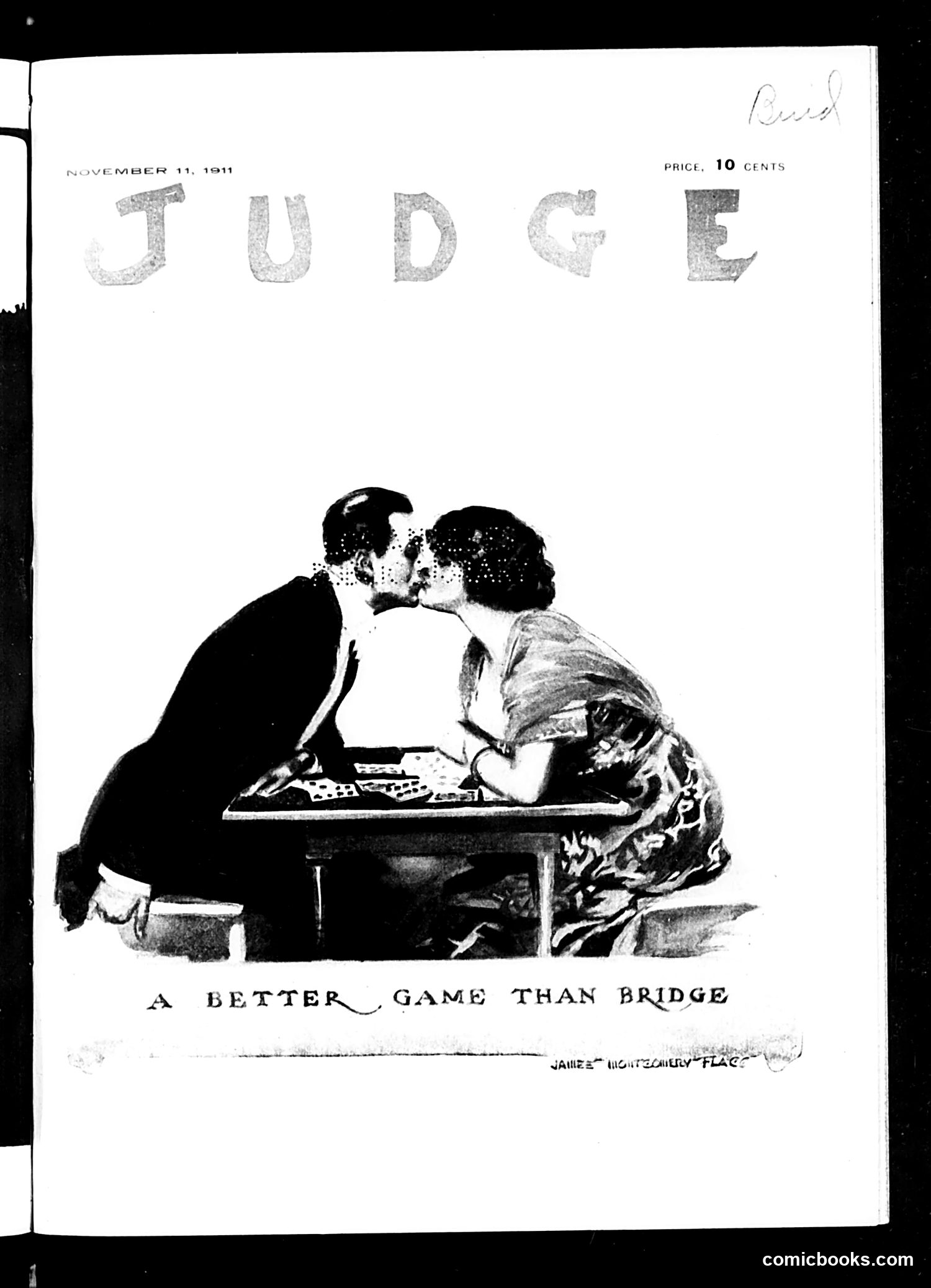
This cover depicts two men leaning across a table toward each other in what appears to be a card game, with the caption "A Better Game Than Bridge." The satire contrasts bridge—a fashionable parlor card game of the era—with what appears to be a more engaging or worthwhile activity. Without additional context identifying the specific figures, the cartoon likely comments on contemporary social preferences or perhaps critiques the leisure activities of the wealthy or elite classes during this period. The title suggests the unnamed "game" depicted is superior to bridge, though the specific social or political commentary remains unclear without identification of the men portrayed. The piece reflects Judge's typical satirical approach to upper-class social customs and entertainments.
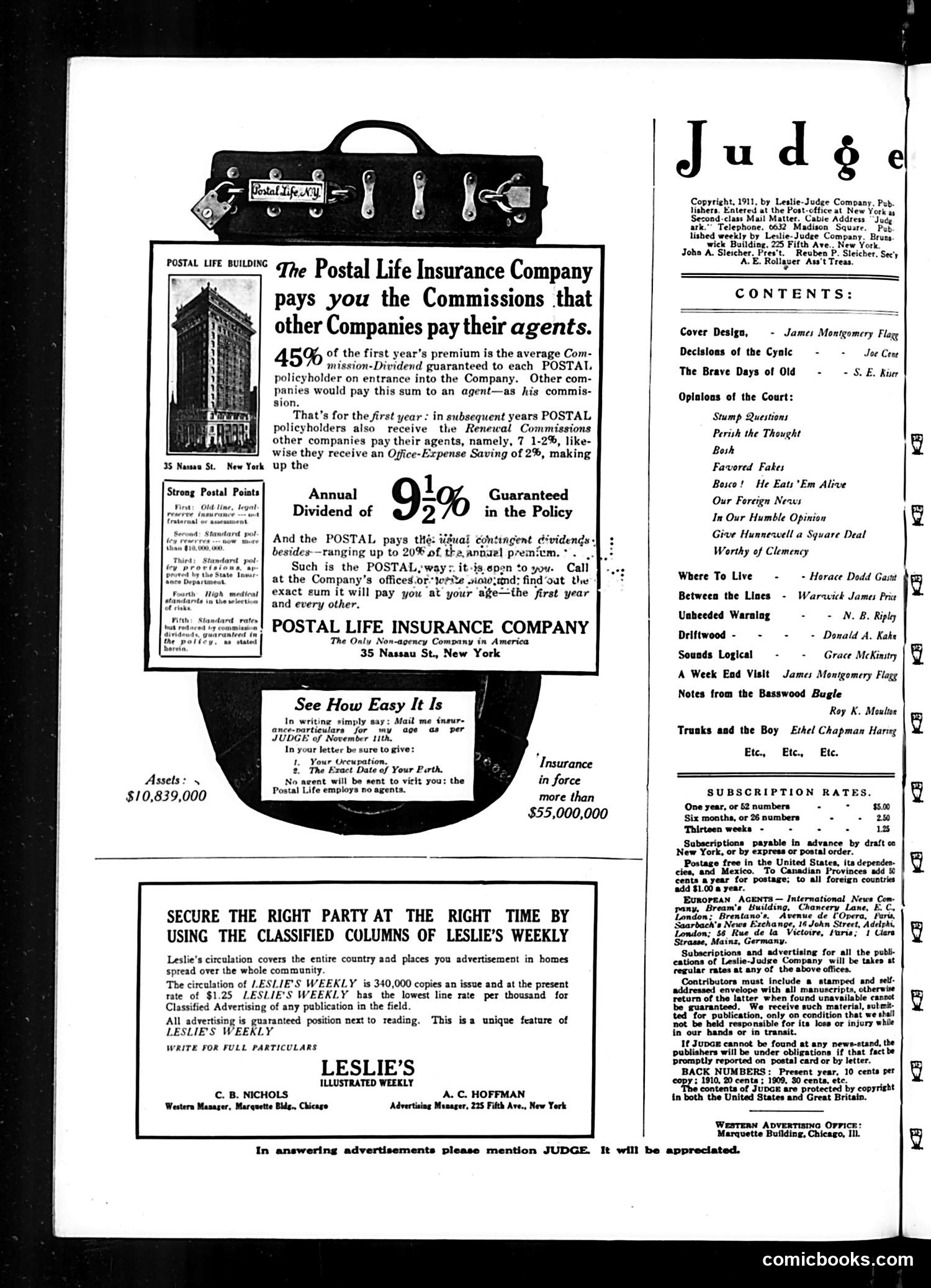
This page is **primarily advertising**, not editorial content or political satire. The dominant feature is a large advertisement for the Postal Life Insurance Company, which occupies roughly two-thirds of the page. The ad uses a toolbox illustration as a visual metaphor, promoting insurance commissions (9½% annual dividend guaranteed) to policyholders. Below this is a separate advertisement for Leslie's Weekly magazine, emphasizing its classified advertising reach across the country. The right side contains the magazine's table of contents and subscription information, listing stories and columns with authors. **No significant political cartoons or satire appear on this page.** It represents typical early 20th-century magazine advertising and administrative content rather than the satirical commentary Judge was known for.
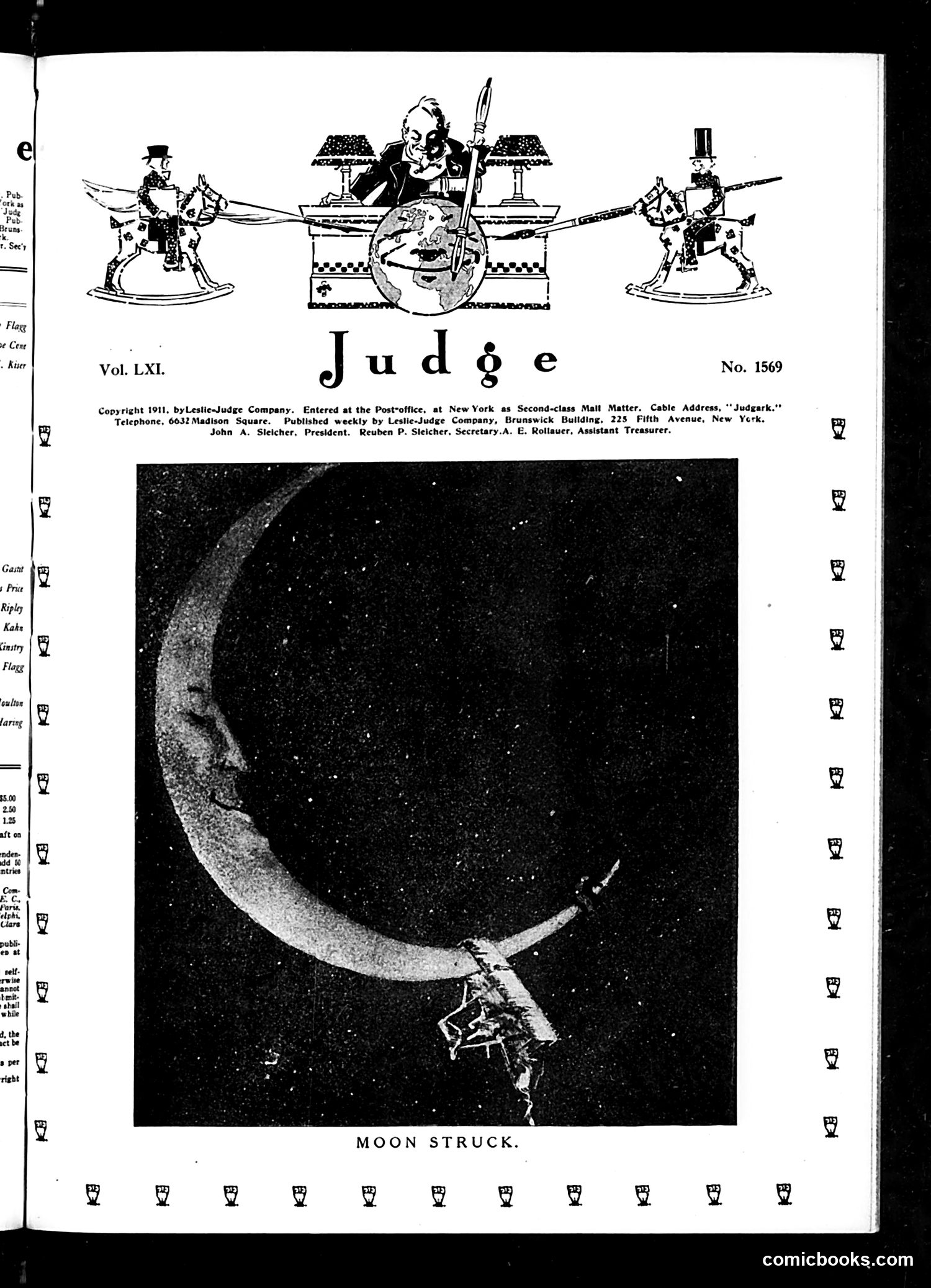
This satirical illustration depicts a figure being struck by or falling from a crescent moon against a starry night sky. The caption "MOON STRUCK" is the operative pun—a period term meaning both literally hit by the moon and figuratively driven mad or foolish. The ornate header shows a caricatured figure at a desk, flanked by decorative rocking horses, suggesting editorial commentary or artistic commentary. The specific identity of the central figure is unclear from the image alone. The satire likely mocks someone or something contemporary to 1911—possibly a political figure, scientific claim, or cultural phenomenon—by suggesting they've been rendered ridiculous or delusional. Without additional context, the precise target remains uncertain, though the whimsical astronomical imagery suggests absurdist commentary typical of Judge's satirical style.
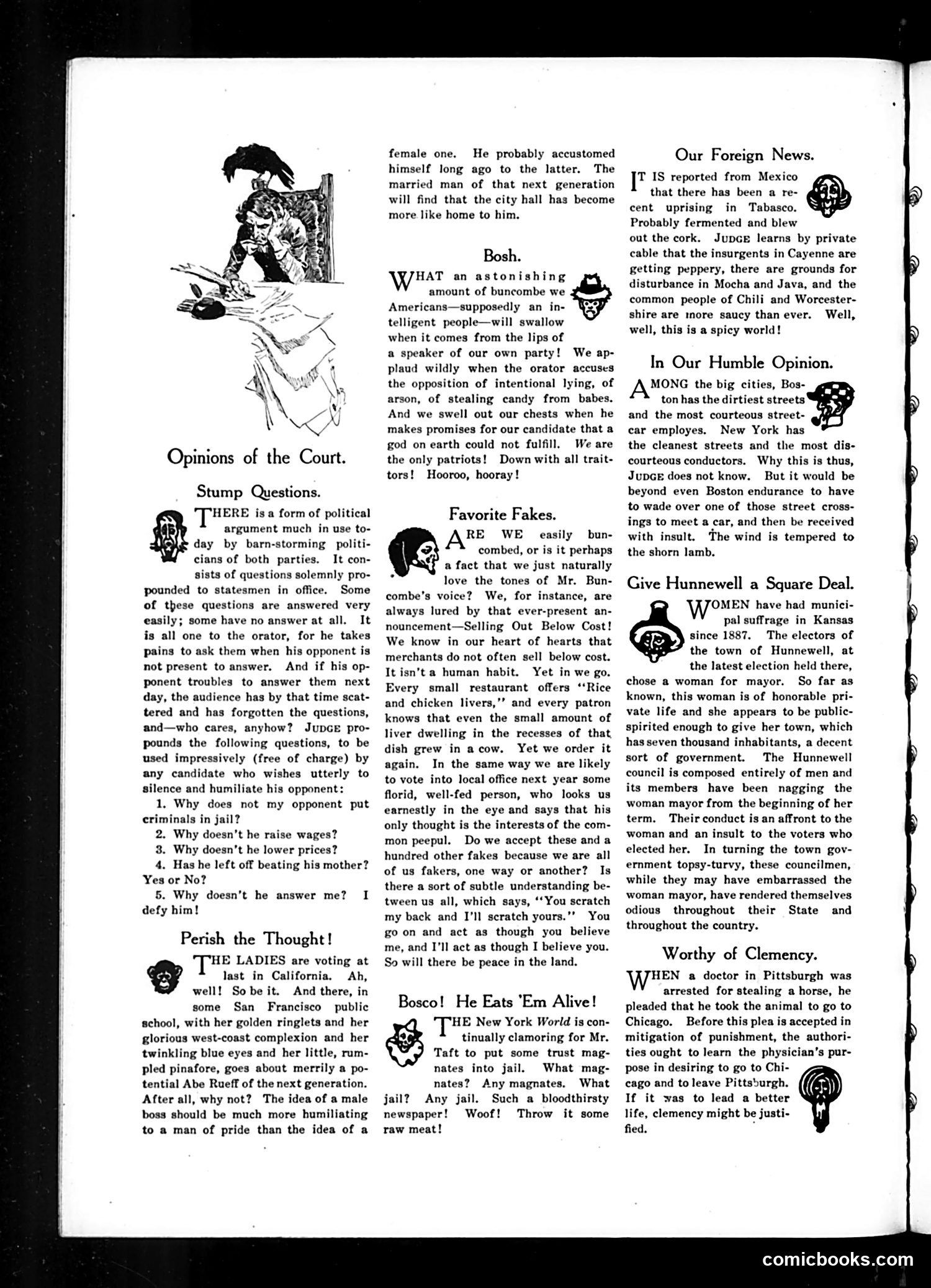
The main cartoon depicts a disheveled figure labeled "Bosh," criticized for spreading political nonsense. The accompanying article "Opinions of the Court" satirizes the tactic of "stump questions"—deliberately difficult or unanswerable questions posed by politicians to opponents during campaigns, designed to embarrass rather than inform. Other sections mock political deception ("Favorite Fakes"), defend a woman running for mayor in Hunnewell, Kansas, and criticize a doctor who stole a horse. The overall theme attacks political dishonesty, empty campaign rhetoric, and hypocrisy among public figures. This reflects Judge's role as a satirical commentary on American politics and social issues, using humor to expose fraud and absurdity in public discourse.
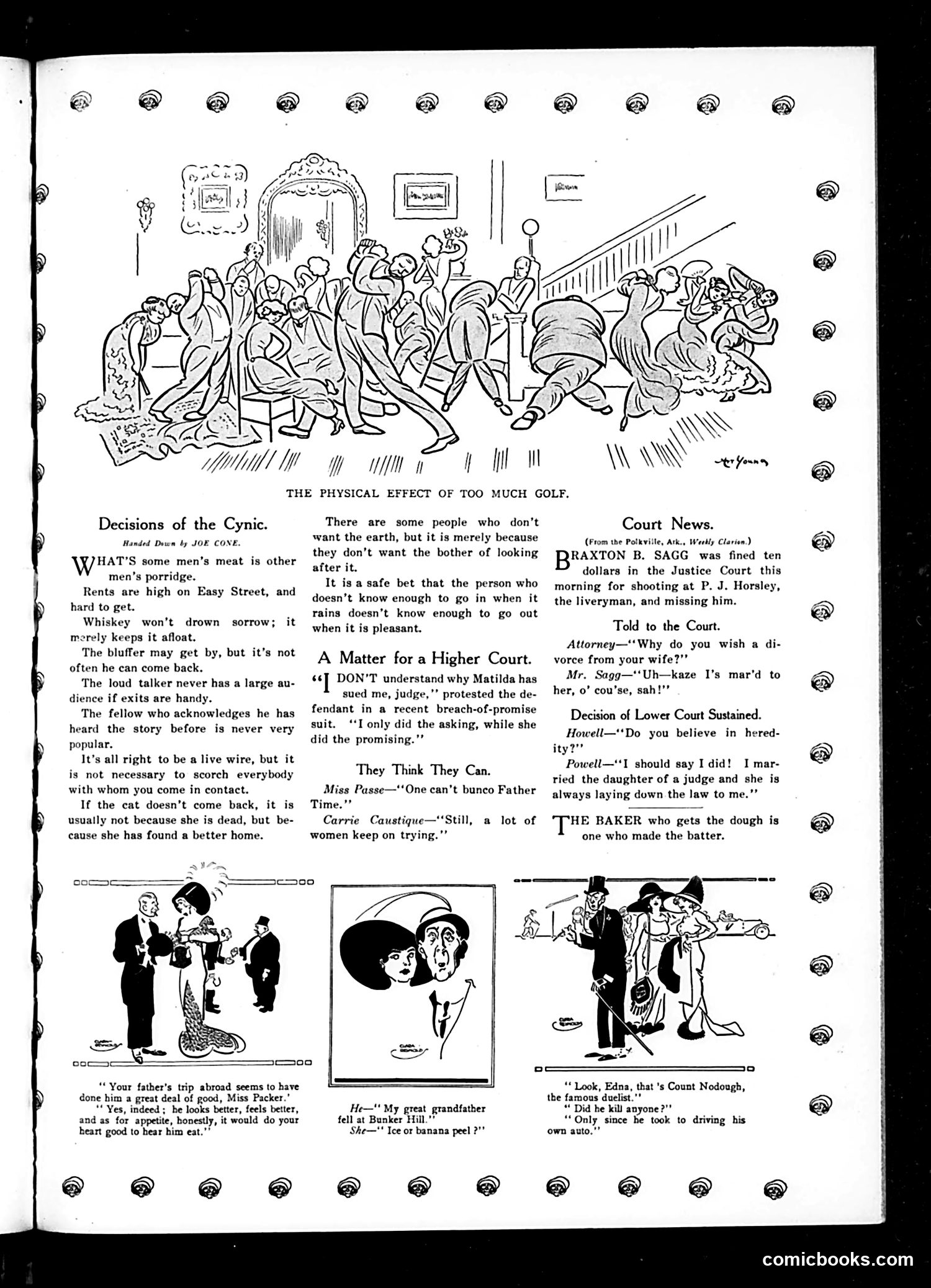
This page contains humorous commentary and cartoons typical of Judge's satirical style. **Top cartoon** depicts the physical chaos of excessive golf playing—people sprawled about in exhaustion, establishing the running joke about golf's popularity and its toll. **"Decisions of the Cynic"** offers sardonic observations on marriage, social climbing, and human behavior—standard cynical humor of the era. **"Court News"** section parodies legal proceedings with witty exchanges between attorneys and judges, mocking courthouse absurdities. **Lower cartoons** feature domestic and social situations: a father's overseas trip, family conversations about ancestry ("Bunker Hill"), and driving culture references. The humor relies on recognizable middle-class scenarios and period-specific concerns about inheritance, travel, and automobiles—all popular satirical targets in early 20th-century American magazines.
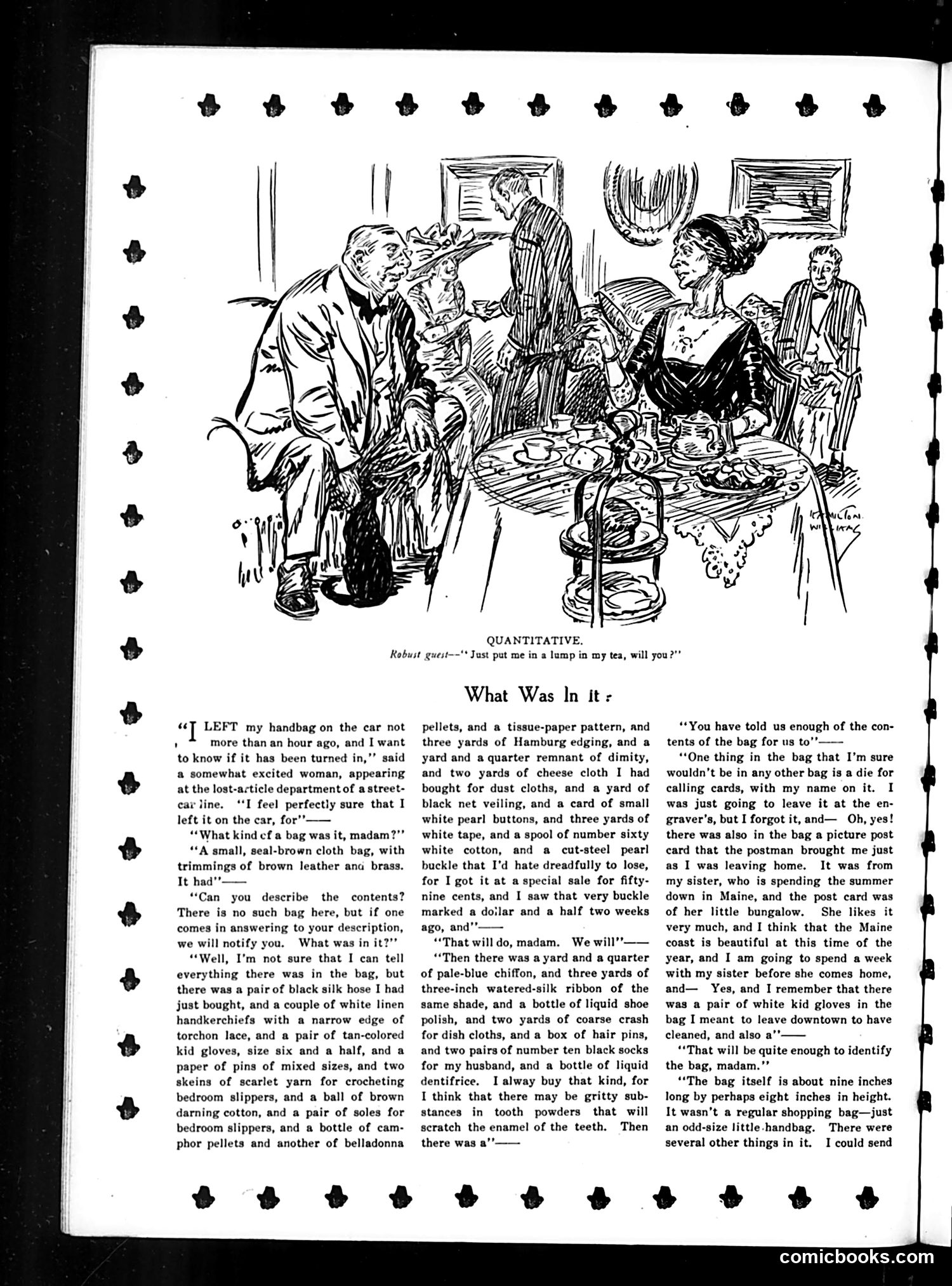
This page contains two distinct pieces of satire about early 20th-century social behavior. **Top Cartoon ("Quantitative"):** A crude visual joke about a rude dinner guest asking the hostess to "put me in a lump in my tea"—a deliberate misunderstanding of proper phrasing, suggesting boorish behavior at a formal gathering. **Main Story ("What Was In It"):** The satire targets a verbose, absent-minded woman reporting a lost handbag to a lost-and-found department. Her exhaustive, rambling inventory—listing every mundane item from socks to tooth powder to a postcard from Maine—ridicules the tendency of some people (especially women of means) to provide excessive, tedious detail when unnecessary. The clerk's repeatedly polite attempts to interrupt are met with "and also a..." continuations. The humor lies in the contrast between the triviality of her possessions and her elaborate cataloguing, satirizing both excessive chattiness and perhaps the materialism of the leisured class. Both pieces use familiar social situations to mock character flaws: rudeness and compulsive over-explanation.
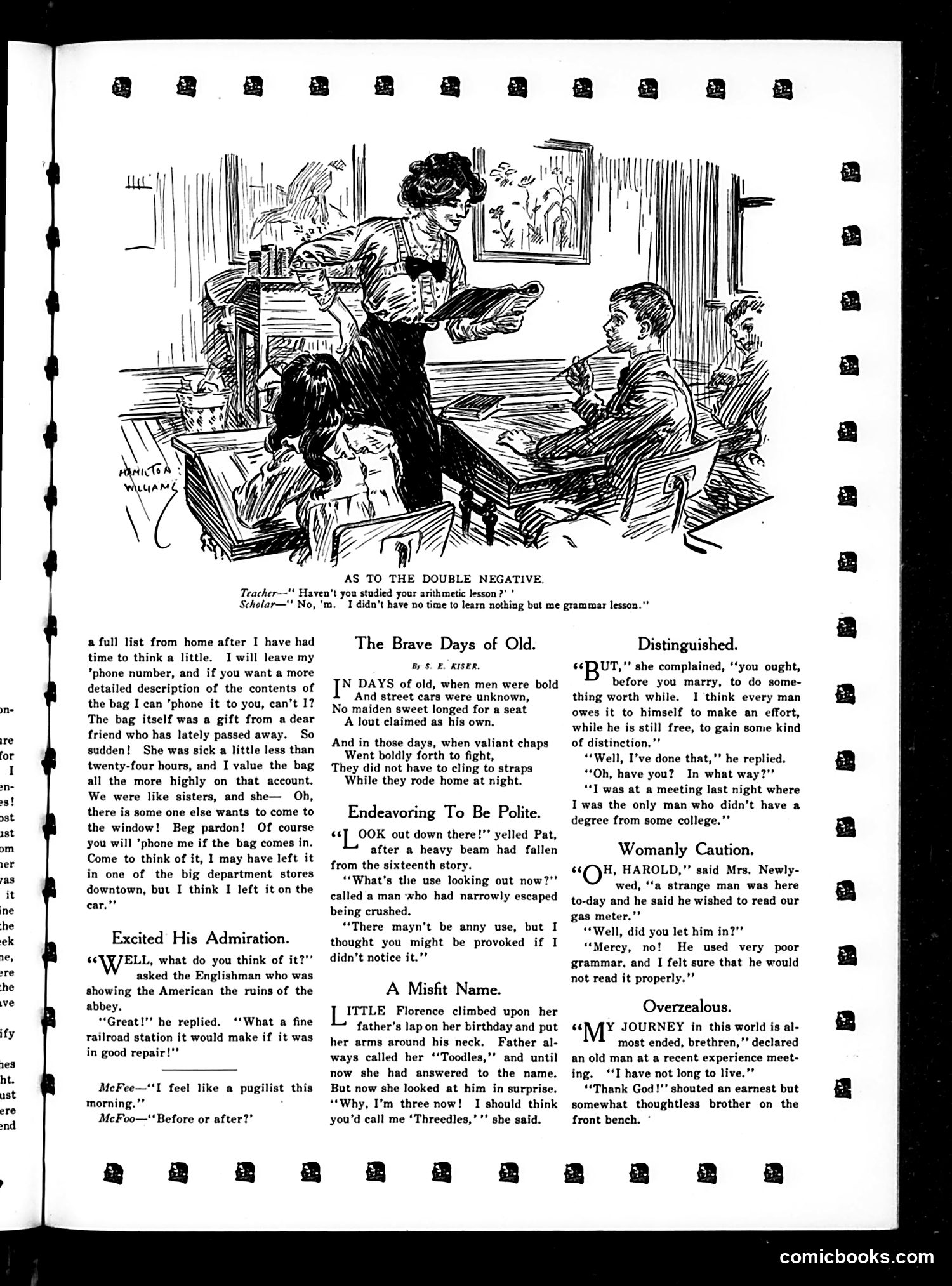
This page contains multiple short humorous pieces typical of early 20th-century American satire: **Main Cartoon** ("As to the Double Negative"): A classroom scene mocking a student's poor grammar. The humor relies on the irony that the scholar claims to have "no time to learn nothing"—a double negative that contradicts his excuse. **Short Humor Pieces** include social satire on contemporary manners: an Englishman's pride in abbey ruins versus an American's utilitarian perspective (mocking American materialism); wordplay about boxing; a child's literal interpretation of age ("Threedles"); and commentary on class anxiety through a woman refusing a meter-reader due to his poor grammar. **"The Brave Days of Old"** nostalgically contrasts past chivalry with modern urban inconvenience (streetcars requiring men to hold straps rather than offer seats). The overall tone satirizes American society's pretensions, class consciousness, and linguistic anxieties—common Judge targets. The page reflects period concerns about immigration, education standards, and proper behavior.
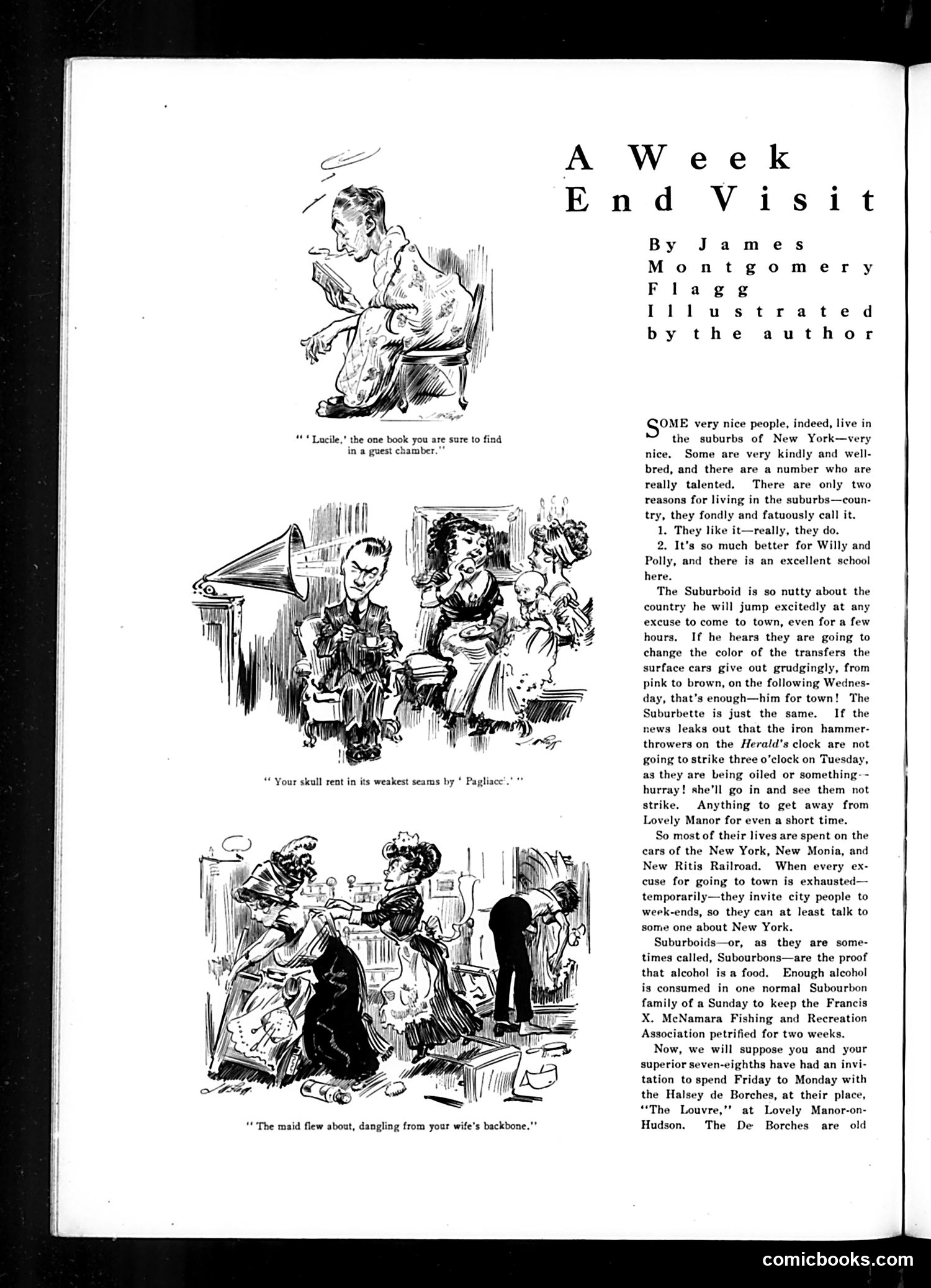
This satirical piece mocks suburban New Yorkers ("Suburboids" or "Subourbons") who claim to love country living but constantly seek excuses to visit the city. The humor targets their contradictions: they enthusiastically abandon their suburban homes for trivial reasons—a streetcar color change or delayed clock strikers—yet hypocritically invite city guests to weekend visits so they can discuss New York. The accompanying illustrations show chaotic domestic scenes, likely depicting the frantic disorder of suburban entertaining. Flagg sarcastically notes these suburbs exist for children's welfare, while mocking their heavy alcohol consumption as proof "alcohol is a food." The piece opens by referencing "Lucile" (likely a popular book of the era) as typical guest-chamber reading—satirizing suburban pretension and conformity.
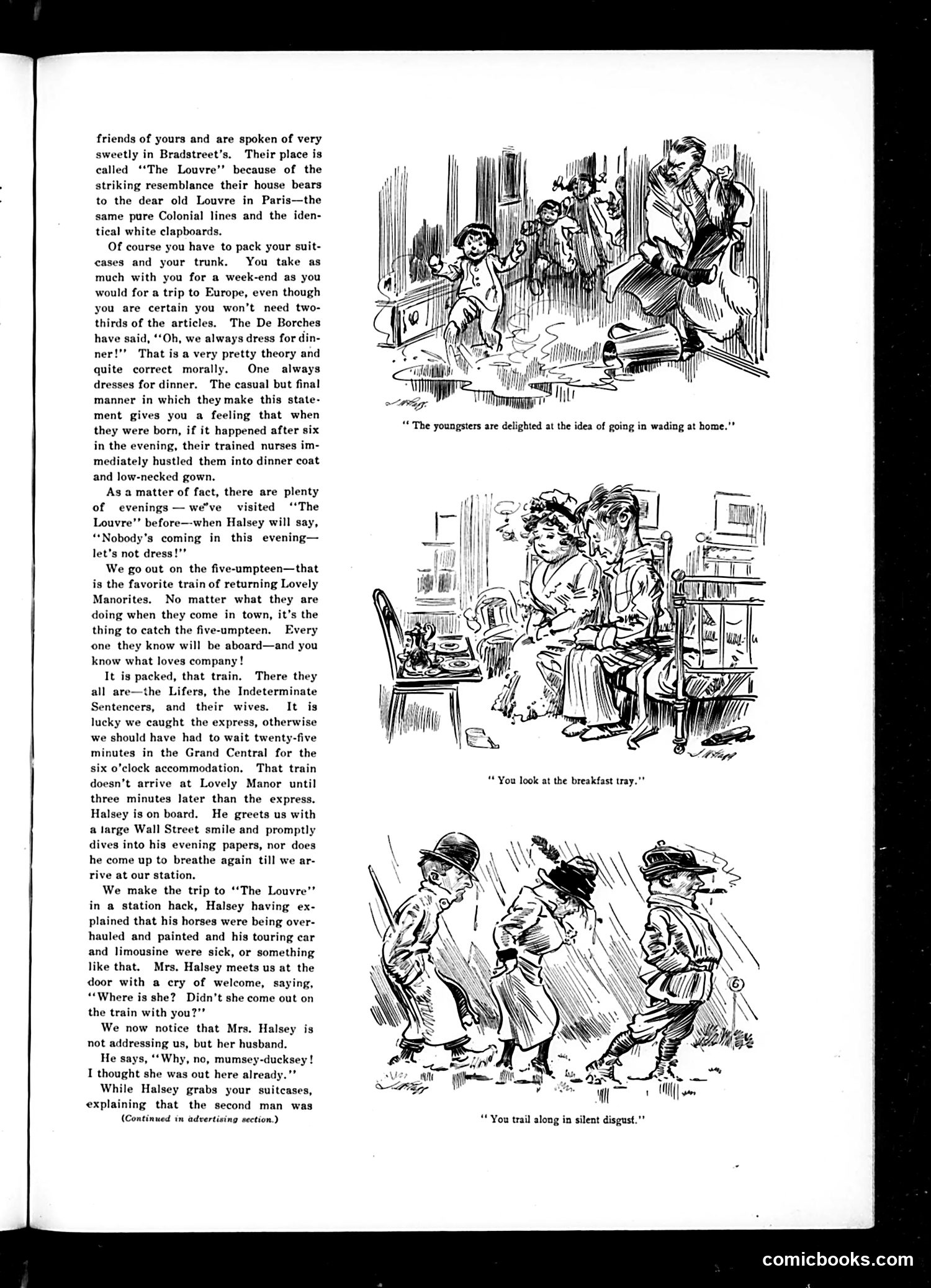
This is satirical commentary on wealthy suburban life, specifically the pretensions of the "Lovely Manor" set—affluent commuters living in what appears to be suburban New York. The text mocks: 1. **Social climbing**: Residents who name their homes after famous landmarks ("The Louvre") to appear cultured despite living in modest Colonial houses with "white clapboards." 2. **Performative formality**: The De Borches' insistence on dressing for dinner every night, presented as affectation rather than genuine refinement. 3. **Suburban conformity**: The "five-umpteen" commuter train where everyone wealthy arrives together; nicknames like "Lifers" and "Indeterminate Sentencers" suggest these people are trapped in repetitive routines. 4. **Marital dynamics**: The final cartoon panels show a wife being forgotten/ignored—she's absent but her husband doesn't notice, reflecting period attitudes about women's invisibility in family hierarchies. The overall satire targets nouveau-riche pretension and the hollow conformity of suburban wealthy life.
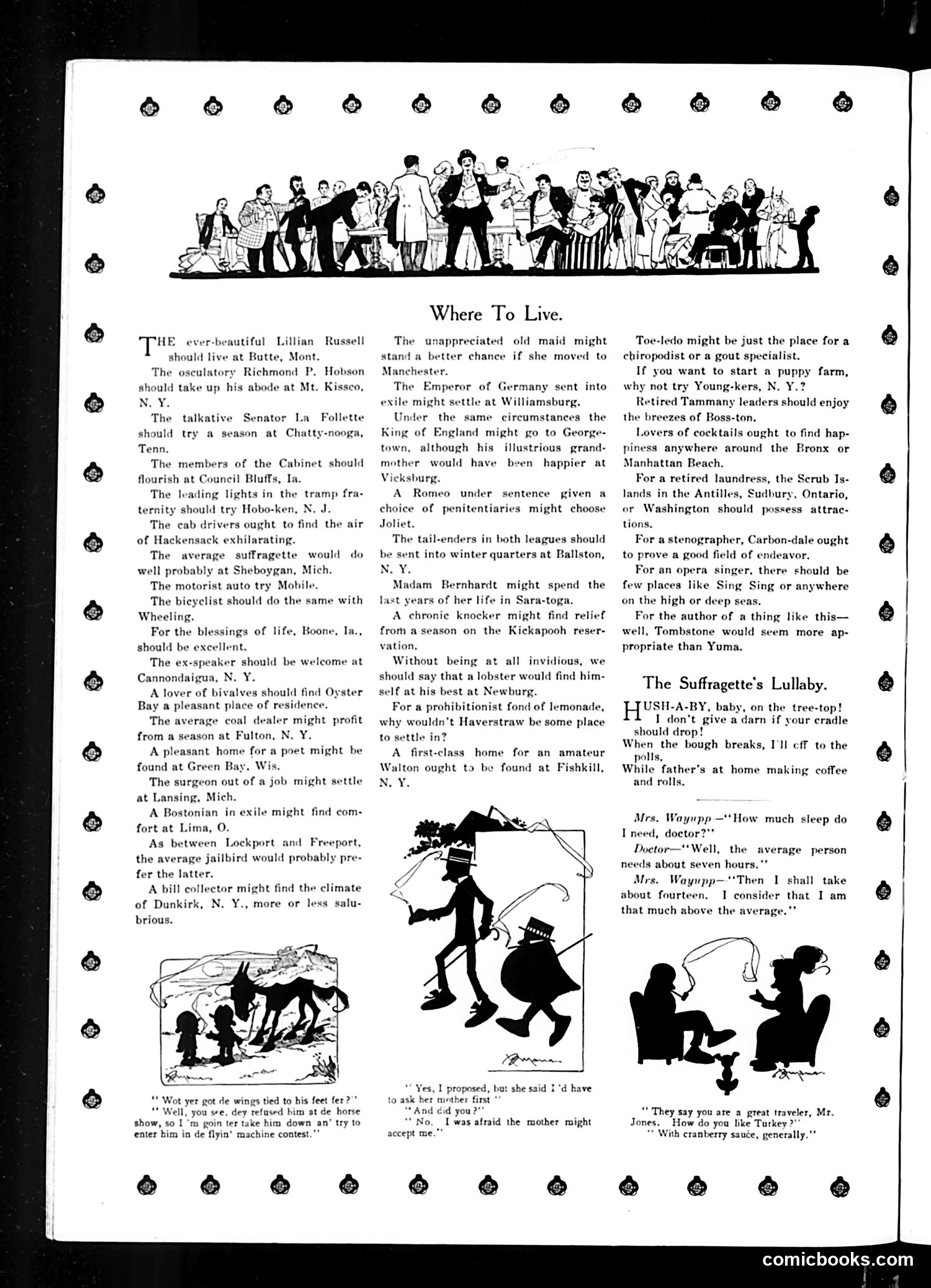
This page satirizes contemporary public figures and social types through mock advice assigning them humorous residences based on puns or stereotypes. **"Where to Live" section**: The humor derives from matching names with place names — Lillian Russell (famous actress) to "Butte," Senator La Follette to "Chatty-nooga," the King of England to "George-town," etc. These are pun-based jokes exploiting phonetic similarities. **The suffragette references** reflect early 1900s women's voting rights debates, mocking female activists' "unwomanly" priorities. **"The Suffragette's Lullaby"** satirizes working-class suffragettes, implying they neglect domestic duties (childcare, cooking) for political activism — a common anti-suffrage argument of the era. **Bottom cartoons** appear to mock courtship customs and male vanity. The overall tone treats contemporary social movements and celebrities as absurd subjects for humorous ridicule.
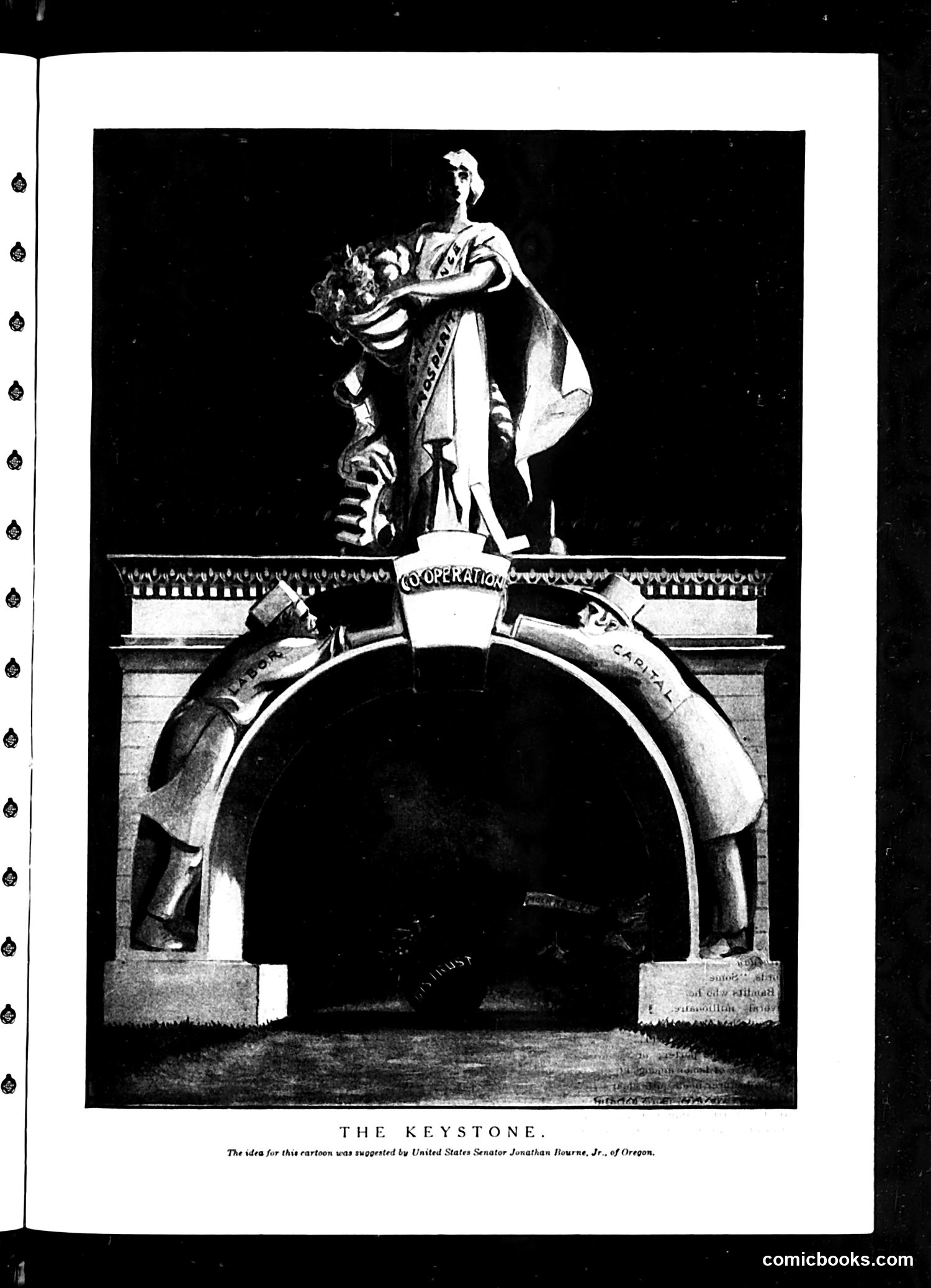
This architectural allegory depicts a classical female figure (likely representing a principle or institution) standing atop an arch labeled "Operation." The arch itself appears to be a structural metaphor—the "keystone" being the central wedge that holds an arch together. The cartoon was suggested by Senator Jonathan Bourne Jr. of Oregon, indicating it addresses a political issue of his concern. The classical female figure and architectural framing suggest the cartoon critiques the structural integrity or stability of some governmental "operation" or policy. The figure's dramatic pose and the emphasis on the keystone suggest the cartoon warns that removing or compromising a key supporting element could cause collapse. Without additional context about Bourne's specific legislative interests or the magazine's date, the exact political target remains unclear, though the architectural metaphor suggests concerns about governmental stability or institutional foundations.
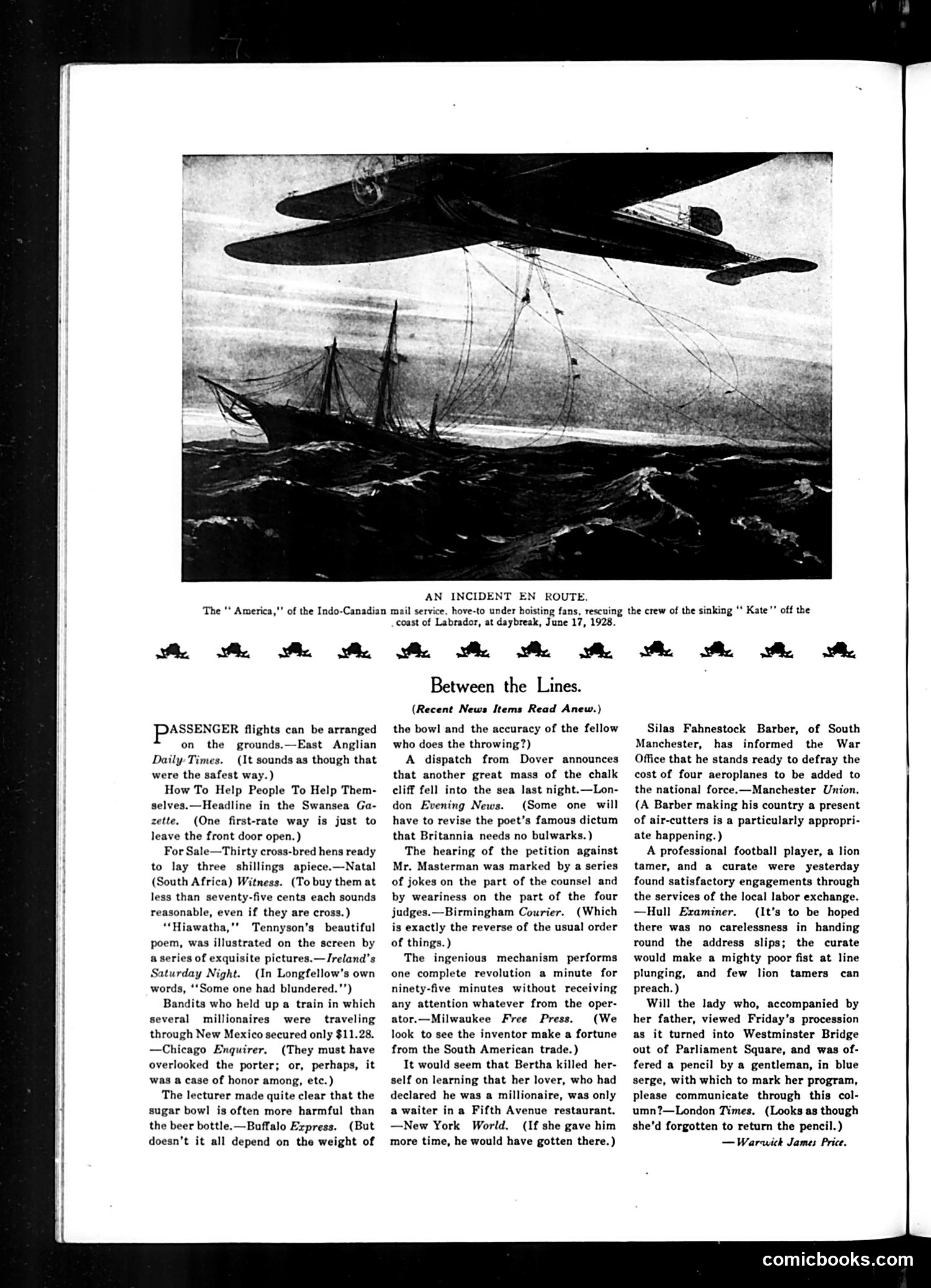
This page from Judge combines a dramatic news photograph with a satirical humor column titled "Between the Lines." **The Photograph:** Shows the SS *America* rescuing the crew of the sinking ship *Kate* off Labrador's coast in June 1928—a genuine maritime rescue story presented as documentary journalism. **The Satire:** "Between the Lines" is a humor column that reprints odd newspaper headlines and fragments, then adds sardonic one-line commentaries exposing the absurdity or unintended meanings in the original text. Examples include: - A train robbery yielding only $11.28 (the joke: robbers forgot to steal from the porter) - A sugar bowl being more harmful than beer (the joke: depends on throwing accuracy) - Chalk cliffs collapsing into the sea (the joke: contradicts the poem "Britannia needs no bulwarks") The humor relies on readers catching double meanings and logical inconsistencies in earnest news reporting. The column's wit was typical of Judge's sophisticated, urbane satire aimed at educated readers who enjoyed wordplay and ironic commentary on contemporary events.
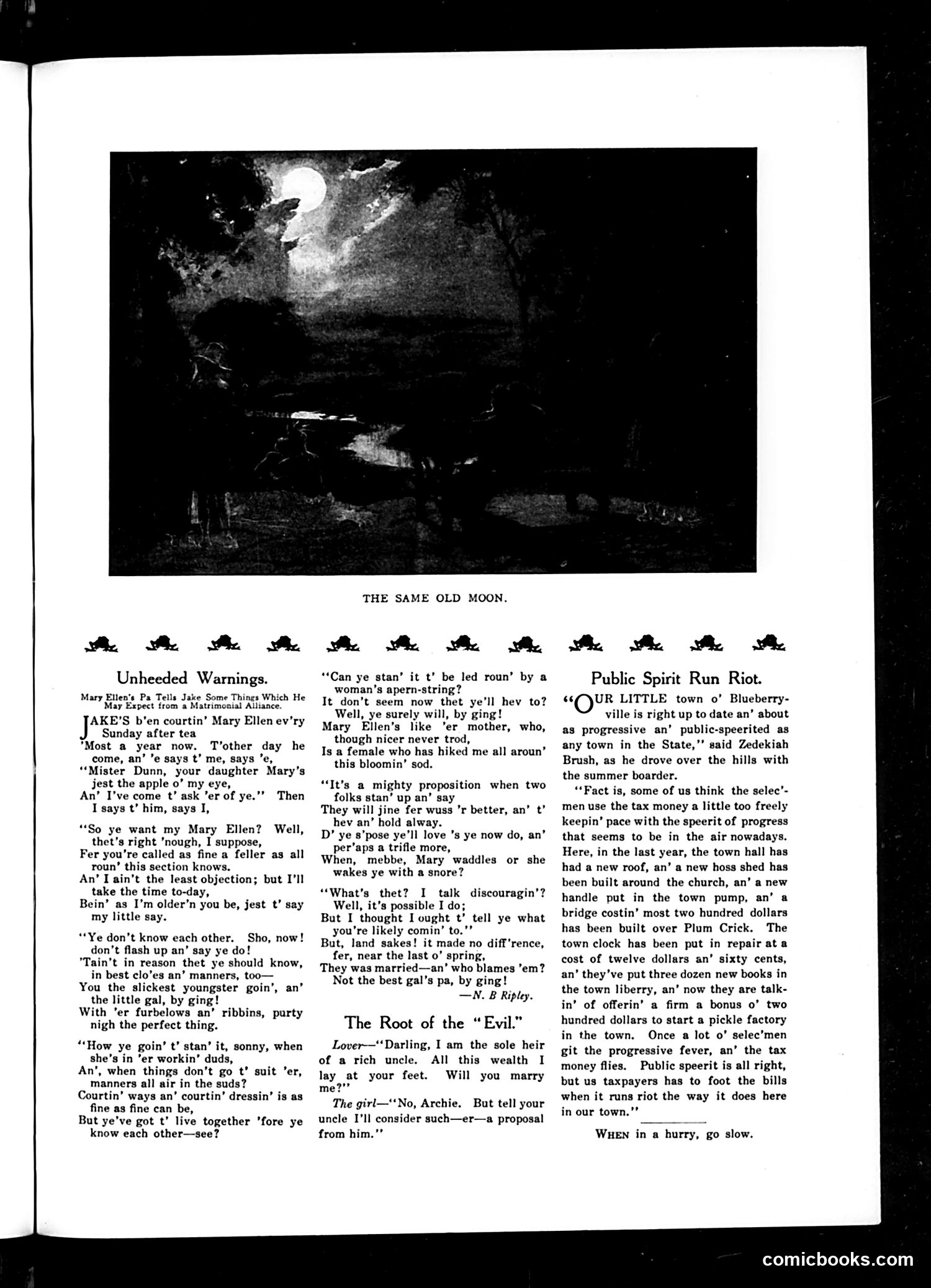
This Judge magazine page contains three separate humor pieces in rural American dialect: **"Unheeded Warnings"** depicts a father warning his daughter's suitor that courtship differs drastically from marriage. He cautions that the young man hasn't seen Mary Ellen in work clothes, without ribbons and finery, or witnessed her potential to nag—yet the couple marries anyway. The satire mocks the naïveté of young lovers who ignore practical wisdom. **"The Root of the 'Evil'"** is a brief joke where a wealthy suitor proposes to a woman, but she rejects him while asking him to relay the proposal to his rich uncle instead—satirizing gold-digging and mercenary romance. **"Public Spirit Run Riot"** features a town resident complaining that civic improvements (new town hall roof, bridge repair, library books, potential pickle factory subsidy) have consumed tax money excessively. The satire critiques how "public spirit" enthusiasm for progress can financially burden taxpayers through wasteful municipal spending. All three pieces employ rural vernacular humor typical of late 19th/early 20th-century American satire.
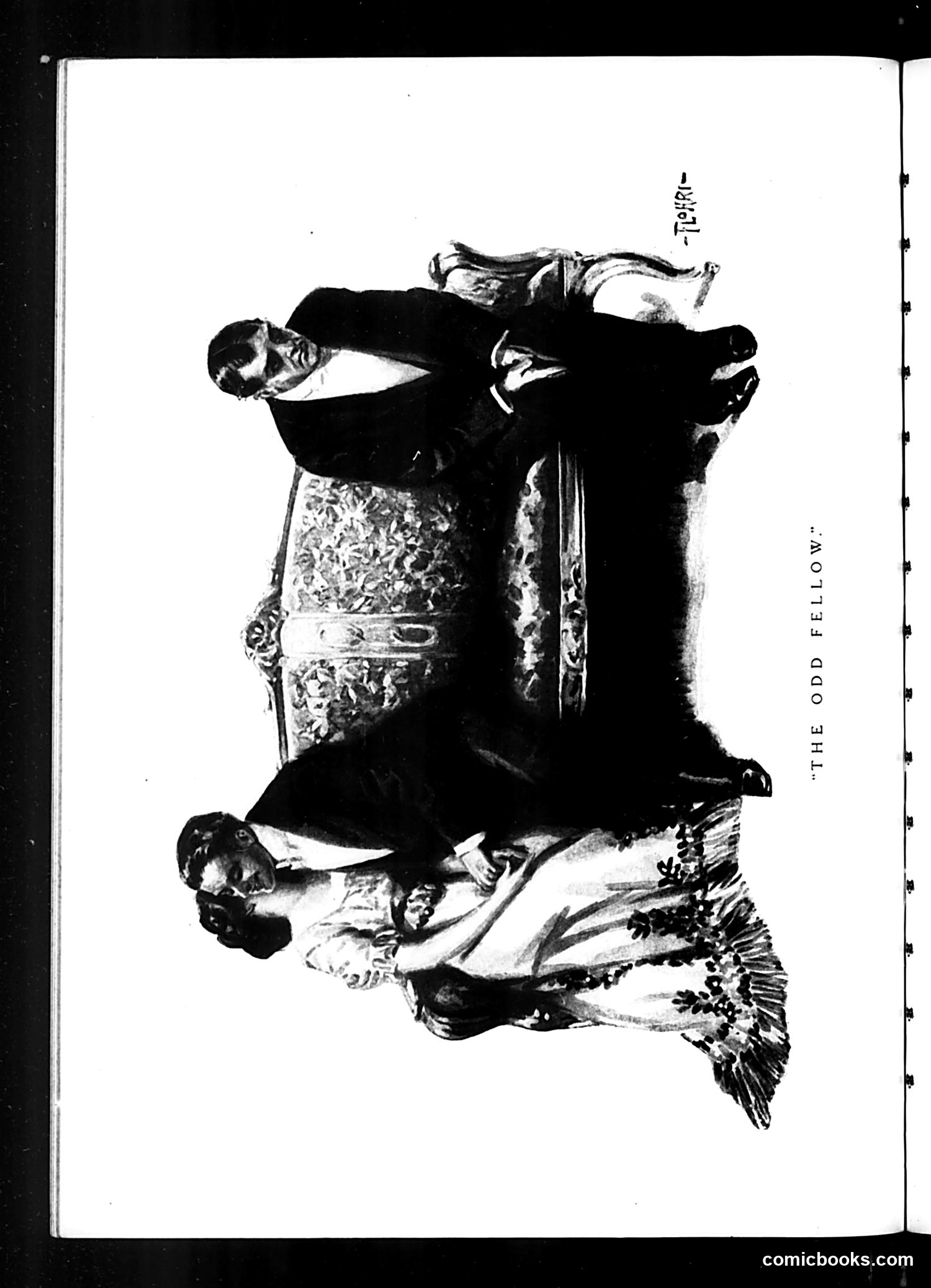
This appears to be a title page or illustration for a piece called "The Odd Fellow" from *Judge* magazine. The image shows a man in formal attire (top hat and dark coat) positioned upside-down, with an ornately decorated vest or waistcoat visible. Below him is a woman in an elaborate dress with ruffled details. The inversion and awkward positioning suggests physical comedy or slapstick humor. The "odd fellow" title combined with the surreal upside-down composition likely plays on the concept of someone acting strangely or unconventionally. Without additional context about the publication date or accompanying article text, the specific satirical target remains unclear, though the formal dress suggests commentary on upper-class or society figures.
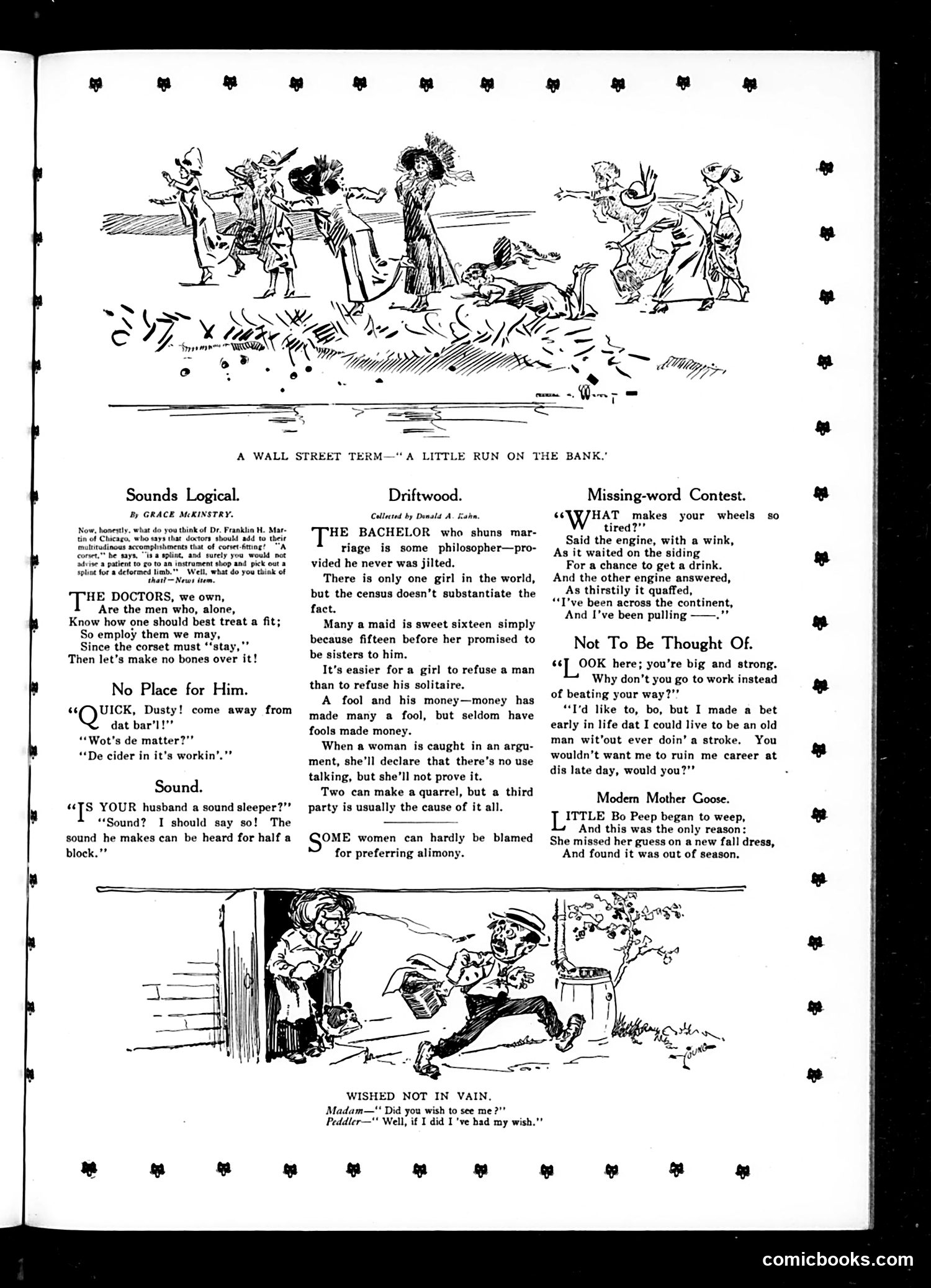
The top cartoon depicts a financial panic—a "run on the bank"—showing people in distress around what appears to be a collapsed financial institution. This references Wall Street banking crises, a recurring anxiety in early 20th-century America before federal banking regulations. The text sections are humor pieces targeting social conventions: - **"Sounds Logical"** mocks doctors recommending corsets despite health concerns—satirizing blind professional authority. - **"No Place for Him"** jokes about cider fermenting in a bar, suggesting the bartender fears the cider will ferment/explode. - **"Driftwood"** offers cynical observations on bachelor philosophy, women's marriage tactics, and financial foolishness. - **"Missing-word Contest"** is a reader participation game about tired locomotive engines. - **"Not To Be Thought Of"** satirizes a vagrant's absurd life commitment to avoiding work. - **"Modern Mother Goose"** parodies nursery rhymes with contemporary problems (fashion seasons). The overall page reflects Judge's blend of financial satire, gender commentary, and gentle mockery of American social pretensions.
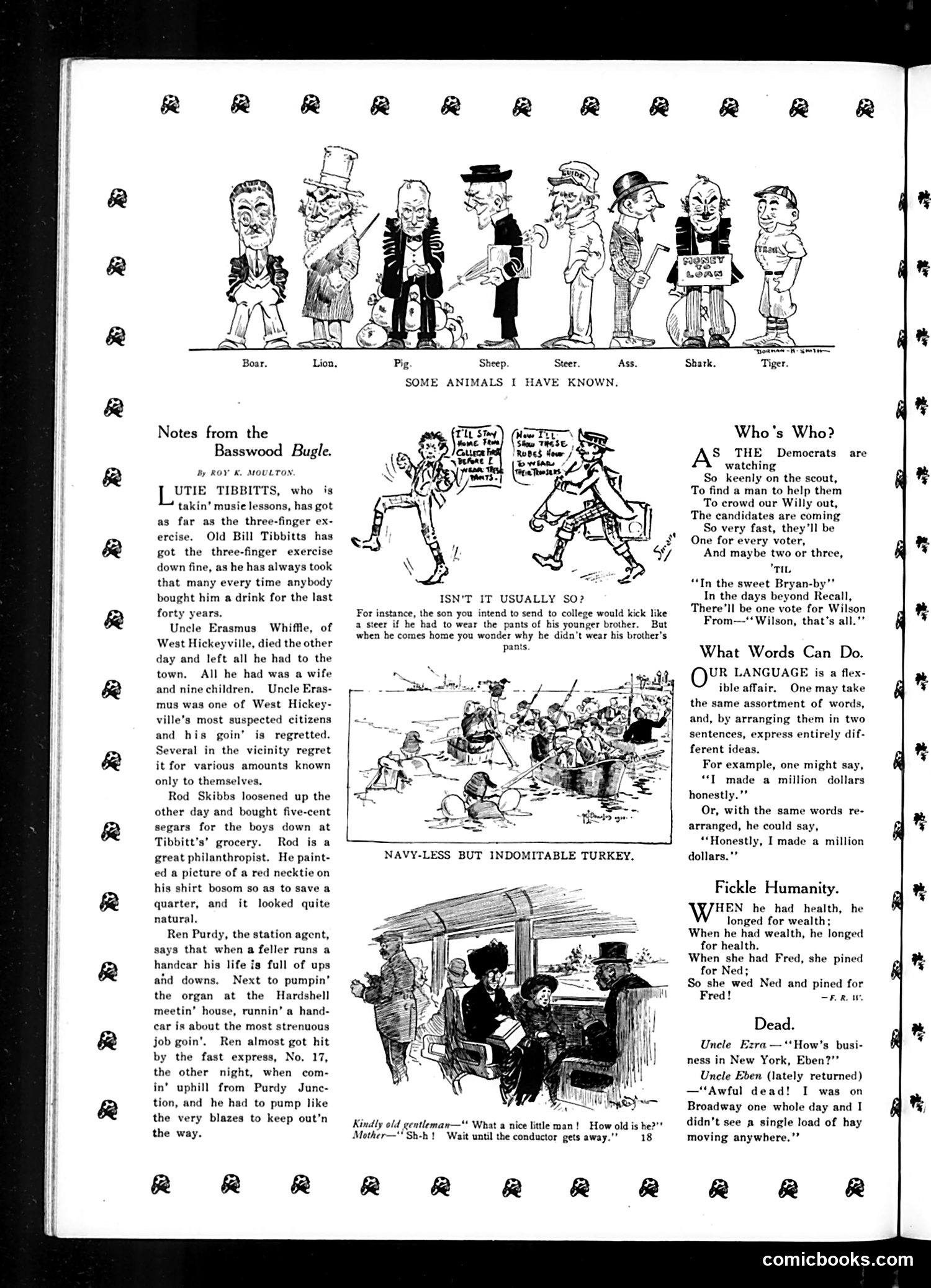
This page from *Judge* contains rural humor and political satire typical of early 20th-century American magazines. **"Some Animals I Have Known"** presents caricatured political figures as animals—likely representing contemporary politicians or public figures, though the specific identities aren't labeled clearly enough to identify with certainty from the image alone. **"Who's Who?"** satirizes the 1912 Democratic presidential race, referencing "Willy" (William Howard Taft, the Republican incumbent), multiple Democratic candidates competing to challenge him, and William Jennings Bryan. The joke suggests Wilson will receive only one vote—from himself—mocking the crowded Democratic field. **"Notes from the Basswood Bugle"** and other sections provide small-town humor about local characters and their foibles—exaggerated rural stereotypes meant to amuse urban readers. The remaining items—"What Words Can Do," "Fickle Humanity," and "Dead"—are brief joke columns exploiting wordplay and human nature observations, typical of *Judge's* miscellaneous content format. The overall tone is lighthearted political and social commentary aimed at middle-class readers.
This is a humorous short story, not a political cartoon, satirizing the tension between *mothers' propriety* and *boys' practical resistance* to swimming rules. The story mocks the absurdity of enforced "suitable garments" at public bathing areas. A women's bird-watching club ("Bright Eyes") posted rules requiring proper swimwear, creating bureaucratic chaos. The new public bathhouse, meant to solve the problem, operates only at inconvenient hours with a single communal towel and no lockers—making compliance impossible. The satire targets *turn-of-the-century prudishness* about undressing, the *inefficiency of public institutions*, and the *gap between adult rules and children's reality*. Bud and his friends are caught between mothers demanding decency and a system designed to fail them. The humor lies in recognizing that no regulation—whether a mother's threat or an official sign—can override nature, physics, and human behavior.
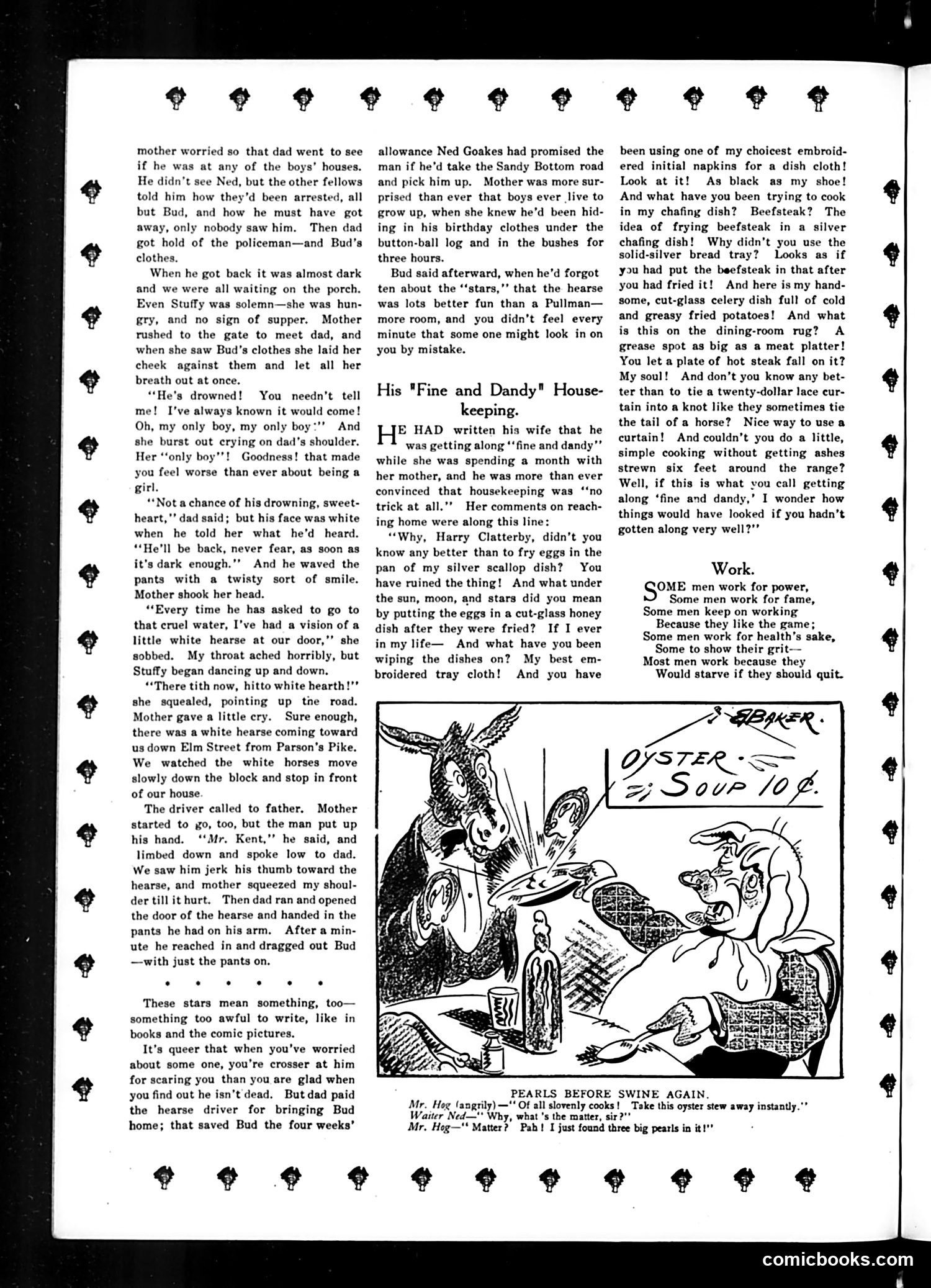
This page contains two humorous domestic stories from *Judge* magazine, a satirical publication. **Top Story**: A boy named Bud goes swimming and hides from his friends to avoid arrest. His mother, seeing a white hearse arrive at their house, believes he's drowned. The "stars" (censored text) indicate something scandalous—likely that Bud was caught naked or in compromising circumstances. The hearse driver was bribed by another boy's father to fake Bud's death as a prank. The joke satirizes maternal anxiety and the chaos boys cause their families. **Bottom Story & Cartoon**: Harry Clatterby, left alone, claims housekeeping is "no trick at all," but has spectacularly failed: he fried eggs in his wife's silver dish, served them in a honey dish, and wiped dishes with her embroidered linens. The cartoon (captioned "Pearls Before Swine Again") shows him serving oyster soup to pigs—visualizing the waste of fine things on the incompetent. Both satirize gender roles: women's domestic expertise versus men's comical incompetence at household management.
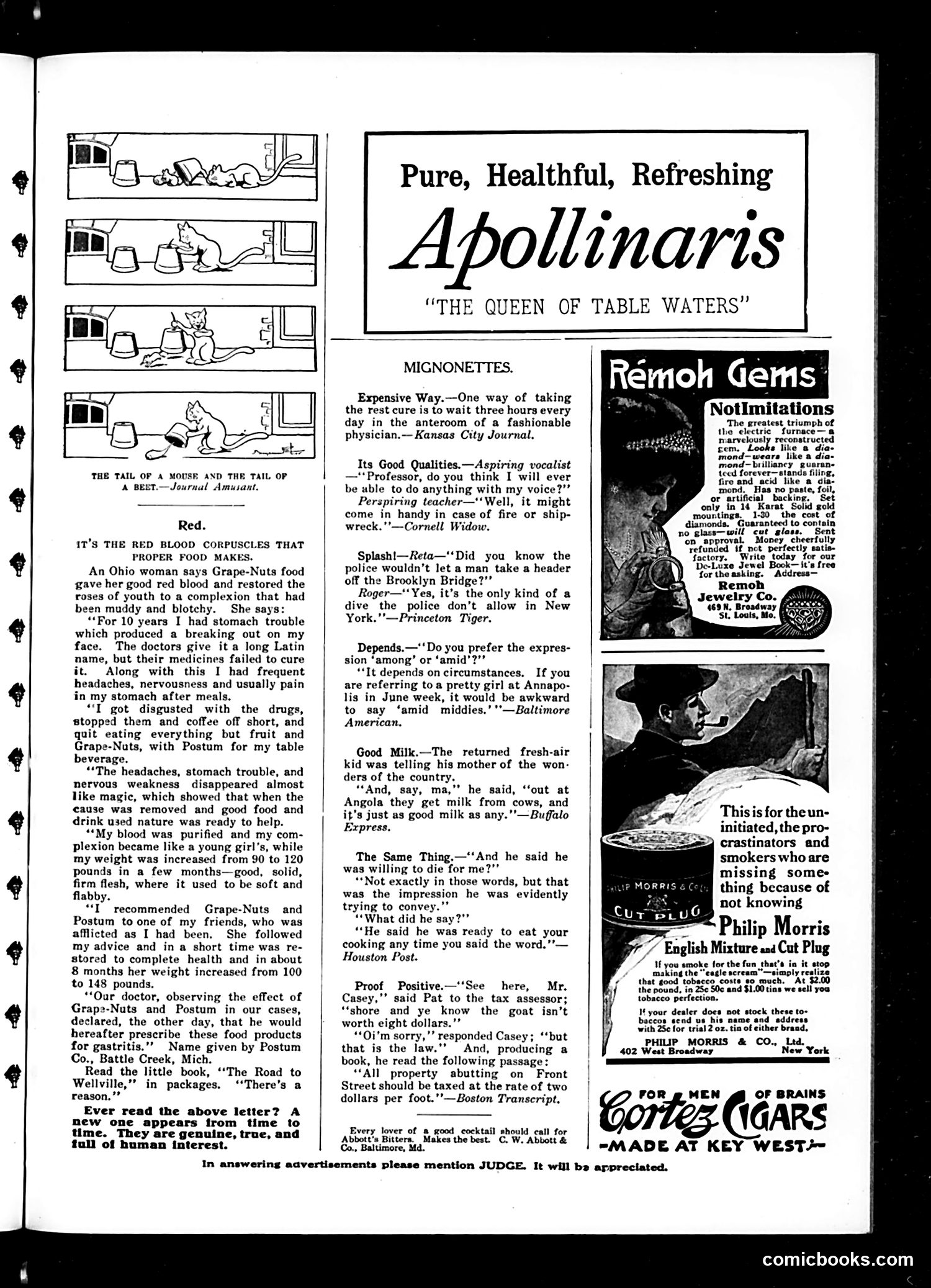
This is primarily an **advertising and humor page** from Judge magazine, not a political cartoon. The content consists of: **Main elements:** - A large **Apollinaris water advertisement** ("The Queen of Table Waters") - A **Grape-Nuts cereal testimonial** featuring a woman's health transformation story - A section titled **"Mignonettes"** — a series of brief humorous anecdotes on various topics **The humor/satire:** The "Mignonettes" are short jokes about everyday situations: a woman waiting in a doctor's anteroom, a singing student with a terrible voice, police prohibiting bridge jumpers, romantic ambiguity, a rural child discovering cows produce milk, and a tax assessor citing absurd property laws. These are gentle, topical social observations rather than sharp political satire. **For modern readers:** This reflects early 20th-century American magazine culture, mixing advertisements with light domestic humor. The testimonial format and health claims about Grape-Nuts are notably similar to modern wellness marketing.
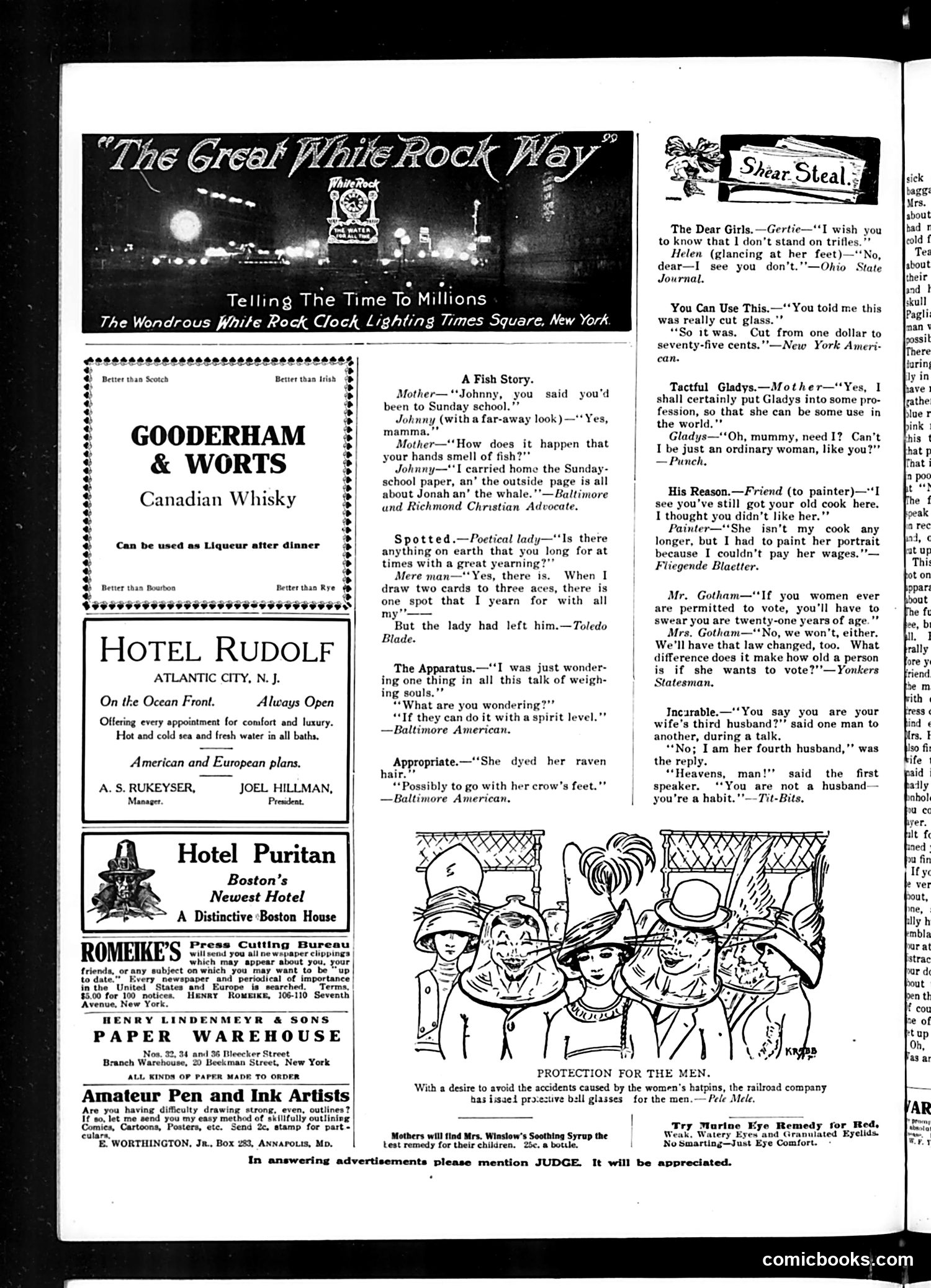
This page is primarily **advertisements and humor filler** rather than political satire. The masthead features "The Great White Rock Way," promoting the White Rock Clock in Times Square—a contemporary advertisement. The bulk of the page contains **short humorous anecdotes** typical of Judge's "Shear Steal" section, reprinting jokes from other publications. These include: - A joke about a boy smelling like fish after Sunday school (playing on Jonah and the whale) - Gender-based humor about women's voting rights and vanity - A cartoon titled "Protection for the Men" depicting men in protective goggles against women's **hatpins**—a genuine 1910s-era social concern, as large decorative pins worn in women's hats posed physical danger to others in crowded spaces The remaining content consists of hotel and business advertisements (Hotel Rudolf, Hotel Puritan, Gooderham & Worts whisky). **Historical context**: The hatpin reference reflects actual early-20th-century anxieties about this fashion accessory; newspapers periodically warned of its dangers.
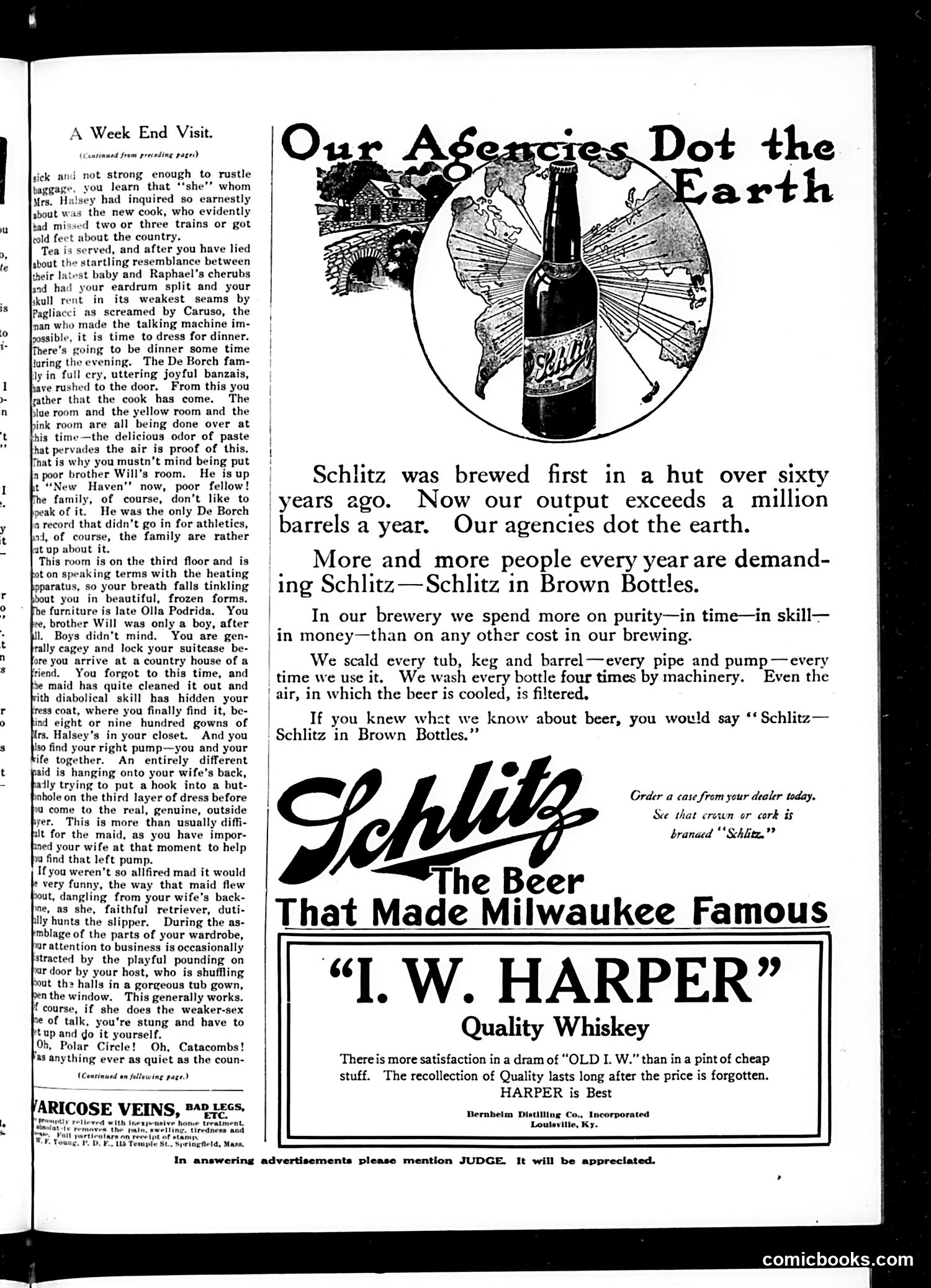
This page contains a humorous short story titled "A Week End Visit" (continued from a previous page) alongside advertisements. ## The Story The narrative depicts a guest's awkward weekend at a country house. Key points of satire include: social pretense (the host family's embarrassment about a relative "Will" who didn't pursue athletics), domestic chaos (a missing cook, freezing guest room, lost formal wear), and servant incompetence (a maid who hides the guest's dress coat among hundreds of gowns). The humor targets upper-class weekend hospitality conventions and the complications of maintaining appearances. ## Advertisements The page features two major ads: - **Schlitz Beer**: Claims superiority through cleanliness and purity standards - **I.W. Harper Whiskey**: Emphasizes quality over price Both ads use the common advertising language of the era, asserting product superiority. This appears to be from the Prohibition period or shortly before, given the prominent alcohol advertising in what was a mainstream satirical magazine.
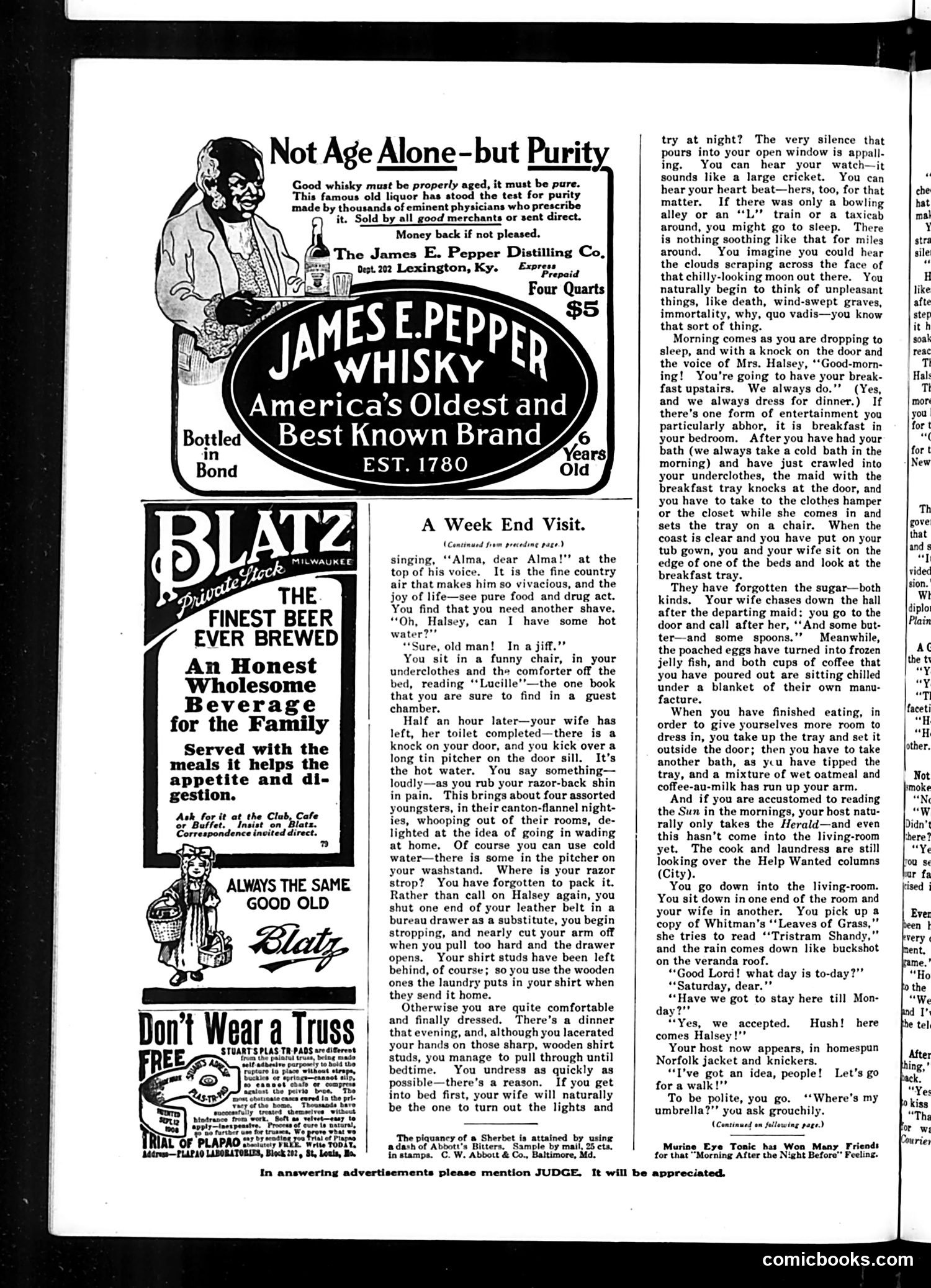
This page features a serialized humorous story mocking the uncomfortable reality of visiting country relatives. The unnamed narrator describes a weekend stay at the home of people named Halsey, exposing the gap between rural hospitality's promises and its awkward reality. The satire targets the pretensions of country living: the Halsey household presents itself as refined ("we always dress for dinner") yet proves thoroughly uncomfortable—forgotten razor strops, wooden shirt studs, frozen breakfast trays, and most pointedly, unbearable silence preventing sleep. The narrator's anxiety spirals into morbid thoughts about death and immortality, highlighting the psychological toll of forced country quiet on an urban sensibility. The humor lies in the detailed, relatable frustrations: minor domestic disasters accumulate into a portrait of civility masking discomfort. This mocks both rural affectation and the urban visitor's inability to adapt—a classic Judge satirical approach to class and cultural friction.
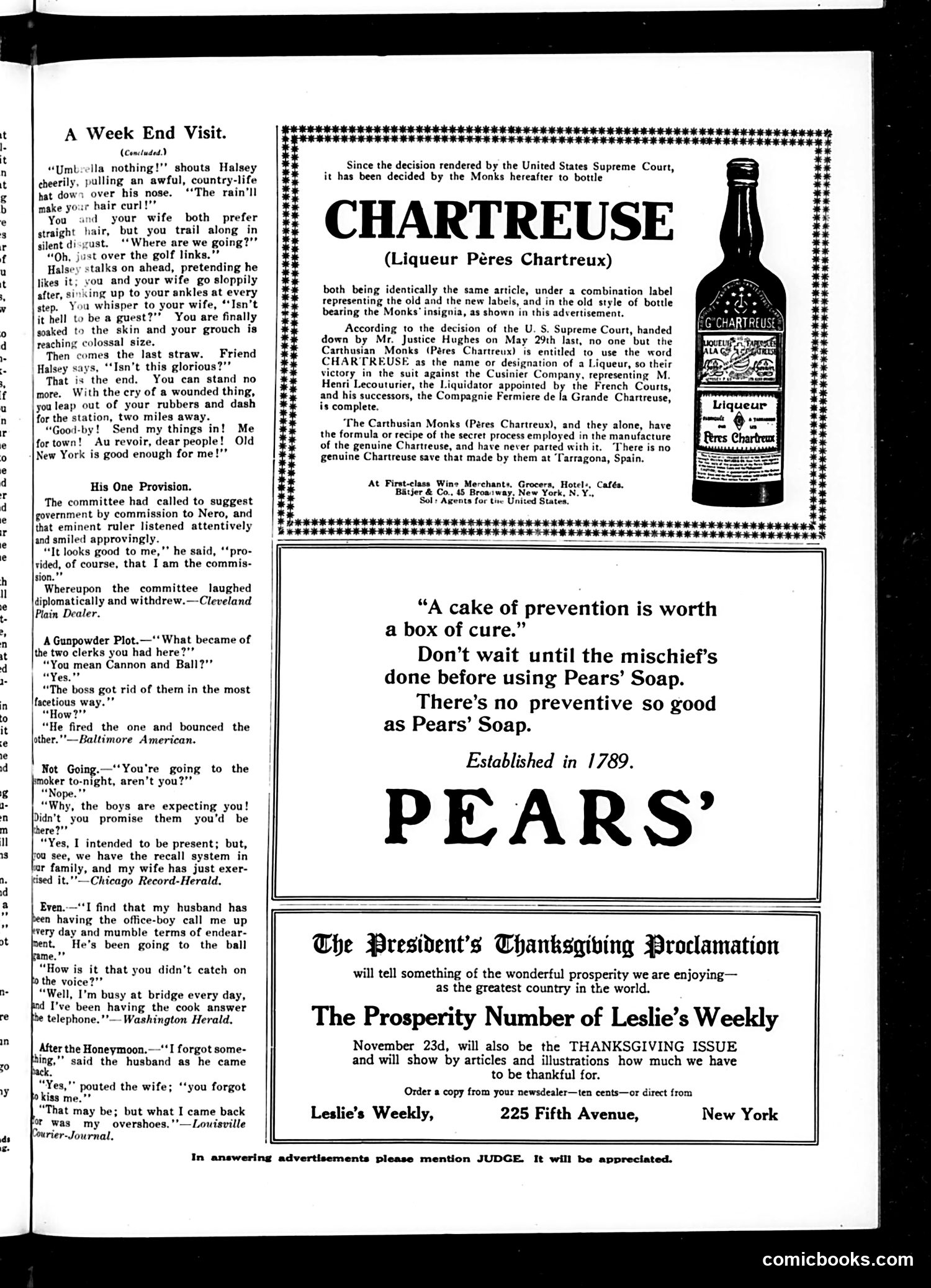
This page contains **humor columns and advertisements** rather than political cartoons. The left column features brief **anecdotal jokes** mocking everyday domestic situations: a husband complains about a weekend visit involving rain and golf; another joke plays on the phrase "Gunpowder Plot" (the 1605 assassination attempt) as wordplay about firing office employees named "Cannon and Ball." These are light social satire about marriage, office life, and social obligations—typical of Judge's humor. The main advertisement announces a **Supreme Court decision** (Justice Hughes, May 29) protecting the Carthusian Monks' exclusive right to produce and label "Chartreuse" liqueur, preventing imitators from using the name. **Pears' Soap** and **Leslie's Weekly** advertisements round out the page—standard period marketing with no satirical content. The page is primarily **commercial** rather than politically pointed, representing Judge's blend of light domestic humor and advertising revenue.
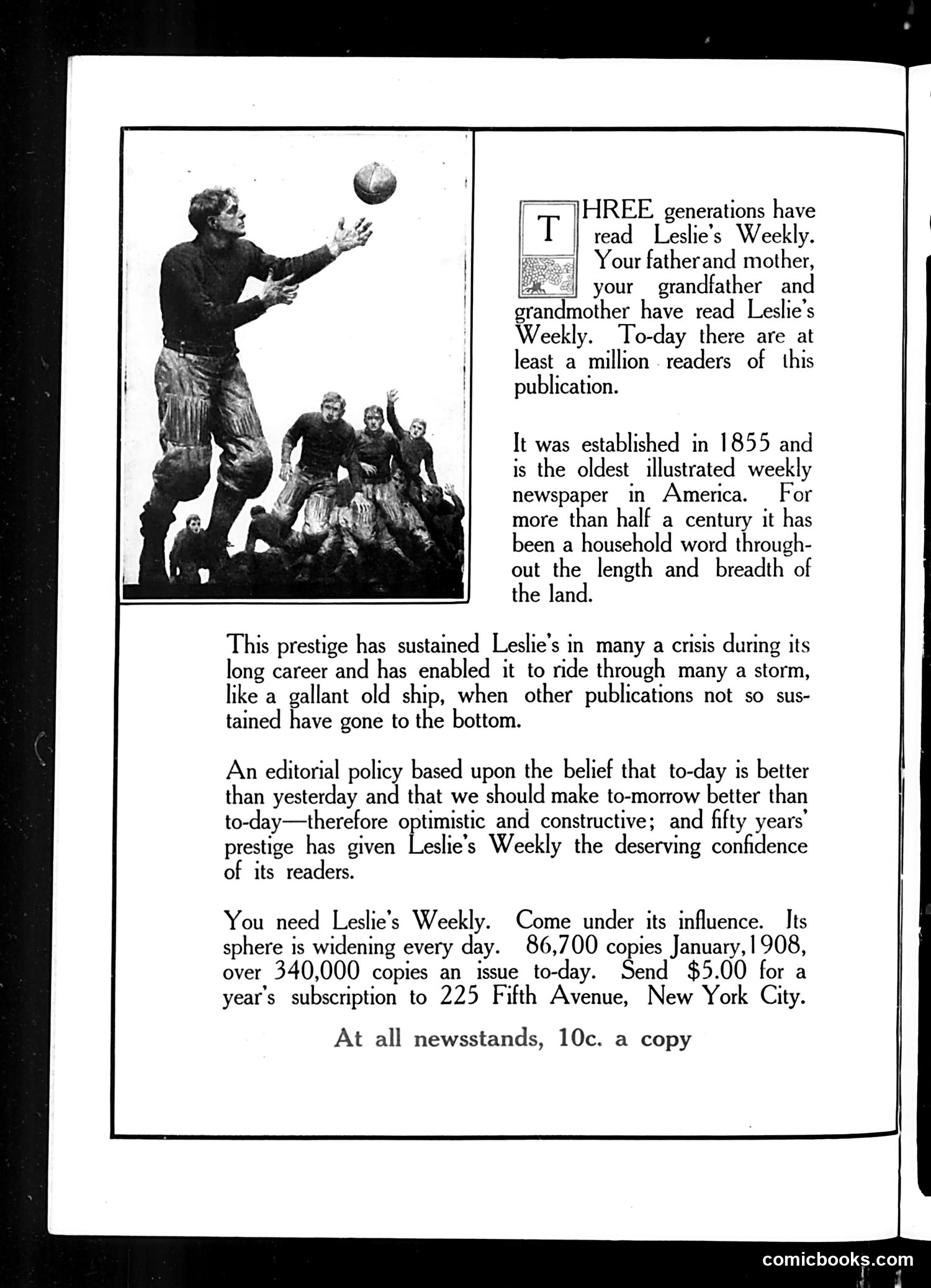
This is **advertising copy**, not political satire. The page promotes *Leslie's Weekly*, America's oldest illustrated newspaper (founded 1855), to potential subscribers. The image shows a man catching a ball, surrounded by children—likely symbolizing the publication's broad, multi-generational appeal. The text emphasizes Leslie's longevity and stability: it has survived crises that destroyed competitors, positioning it as a trustworthy institution with "fifty years' prestige." The editorial philosophy stressed is explicitly **optimistic and constructive**—a progressive stance typical of early 1900s American publications. The circulation figures (340,000 copies) and subscription cost ($5 yearly, or 10¢ per copy) are presented to demonstrate the magazine's success and accessibility. The "three generations" opening is a direct appeal to family loyalty and tradition—suggesting readers should maintain their family's subscription habit.