
Judge, 1911-11-11 · page 9 of 24
Judge — November 11, 1911 — page 9: what you’re looking at
What you’re looking at
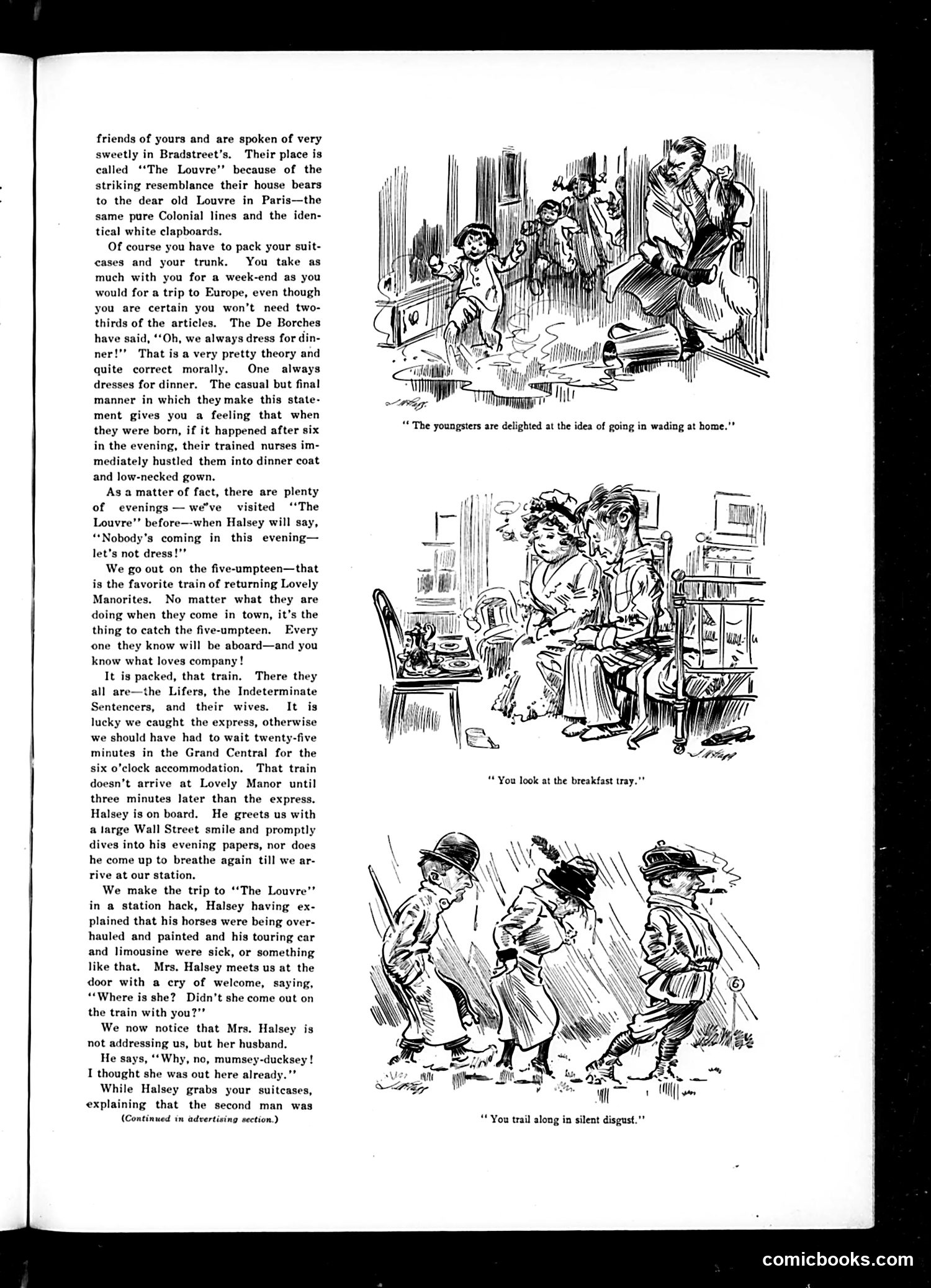
This is satirical commentary on wealthy suburban life, specifically the pretensions of the "Lovely Manor" set—affluent commuters living in what appears to be suburban New York. The text mocks: 1. **Social climbing**: Residents who name their homes after famous landmarks ("The Louvre") to appear cultured despite living in modest Colonial houses with "white clapboards." 2. **Performative formality**: The De Borches' insistence on dressing for dinner every night, presented as affectation rather than genuine refinement. 3. **Suburban conformity**: The "five-umpteen" commuter train where everyone wealthy arrives together; nicknames like "Lifers" and "Indeterminate Sentencers" suggest these people are trapped in repetitive routines. 4. **Marital dynamics**: The final cartoon panels show a wife being forgotten/ignored—she's absent but her husband doesn't notice, reflecting period attitudes about women's invisibility in family hierarchies. The overall satire targets nouveau-riche pretension and the hollow conformity of suburban wealthy life.
📄 Transcribed text from this page (OCR, searchable)
Machine-transcribed from the original scan — historical spelling and the odd misread are preserved.
friends of yours and are spoken of very sweetly in Bradstreet’s. Their place is called ‘‘The Louvre’’ because of the striking resemblance their house bears to the dear old Louvre in Paris—the same pure Colonial lines and the iden- tical white clapboards. Of course you have to pack your suit- cases and your trunk. You take as much with you for a week-end as you would for a trip to Europe, even though you are certain you won’t need two- thirds of the articles. The De Borches have said, “Oh, we always dress for din- ner!’? That is a very pretty theory and quite correct morally. One always dresses for dinner. The casual but final manner in which they make this state- ment gives you a feeling that when they were born, if it happened after six in the evening, their trained nurses im- mediately hustled them into dinner coat and low-necked gown. As a matter of fact, there are plenty of evenings — we’ve visited ‘‘The Louvre”? before—when Halsey will say, “‘Nobody’s coming in this evening— let's not dress!’’ We go out on the five-umpteen—that is the favorite train of returning Lovely Manorites. No matter what they are doing when they come in town, it’s the thing to catch the five-umpteen. Every ‘one they know will be aboard—and you know what loves company! It is packed, that train. There they all are—the Lifers, the Indeterminate Sentencers, and their wives. It is lucky we caught the express, otherwise we should have had to wait twenty-five minutes in the Grand Central for the six o’clock accommodation, That train doesn’t arrive at Lovely Manor until three minutes later than the express. Halsey is on board. He greets us with a large Wall Street smile and promptly dives into his evening papers, nor does he come up to breathe again till we ar- rive at our station. We make the trip to ‘‘The Louvre’ in a station hack, Halsey having ex- plained that his horses were being over- hauled and painted and his touring car and limousine were sick, or something like that. Mrs. Halsey meets us at the door with a cry of welcome, saying, ‘Where is she? Didn’t she come out on the train with you?” We now notice that Mrs. Halsey is not addressing us, but her husband. He says, ‘‘Why, no, mumsey-ducksey ! I thought she was out here already.”’ While Halsey grabs your suitcases, explaining that the second man was (Continued in advertising section.) we fi re tt ag Se as a an “You trail along in silent disgust."” comicbooks.com