
A complete issue · 24 pages · 1911
Judge — October 28, 1911
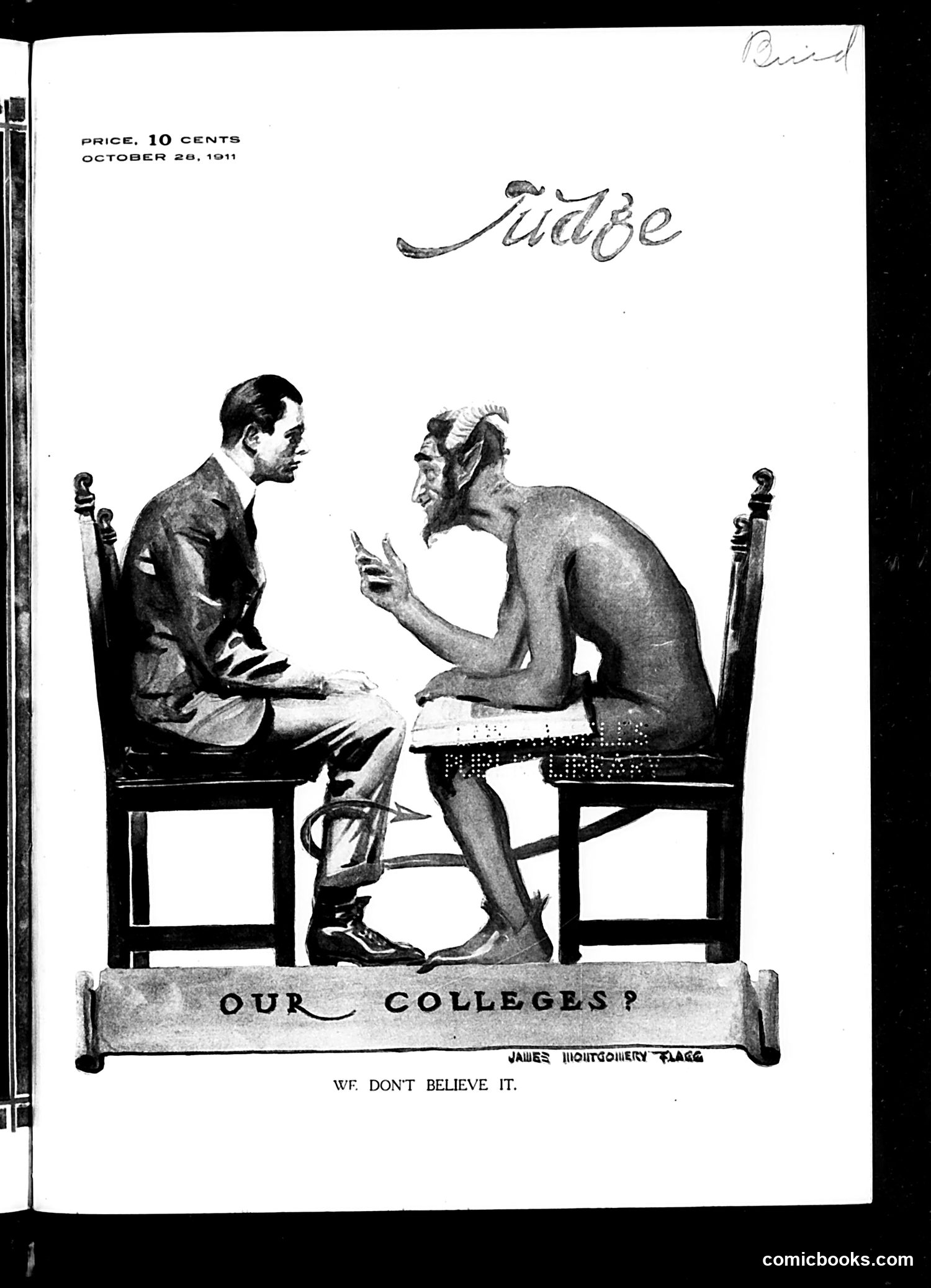
This cartoon by James Montgomery Flagg critiques college education through visual satire. It depicts a well-dressed gentleman interviewing a primitive, ape-like figure labeled as representing "our colleges." The exaggerated contrast suggests that American colleges are producing uneducated or intellectually underdeveloped graduates—or failing to educate students adequately. The caption "WE DON'T BELIEVE IT" appears sarcastic, likely responding to claims about college quality or reform efforts of that era. This reflects early 20th-century debates about higher education's value and effectiveness. The visual language—comparing college output to something barely civilized—was a common satirical trope of the period, though by modern standards the imagery is offensive.
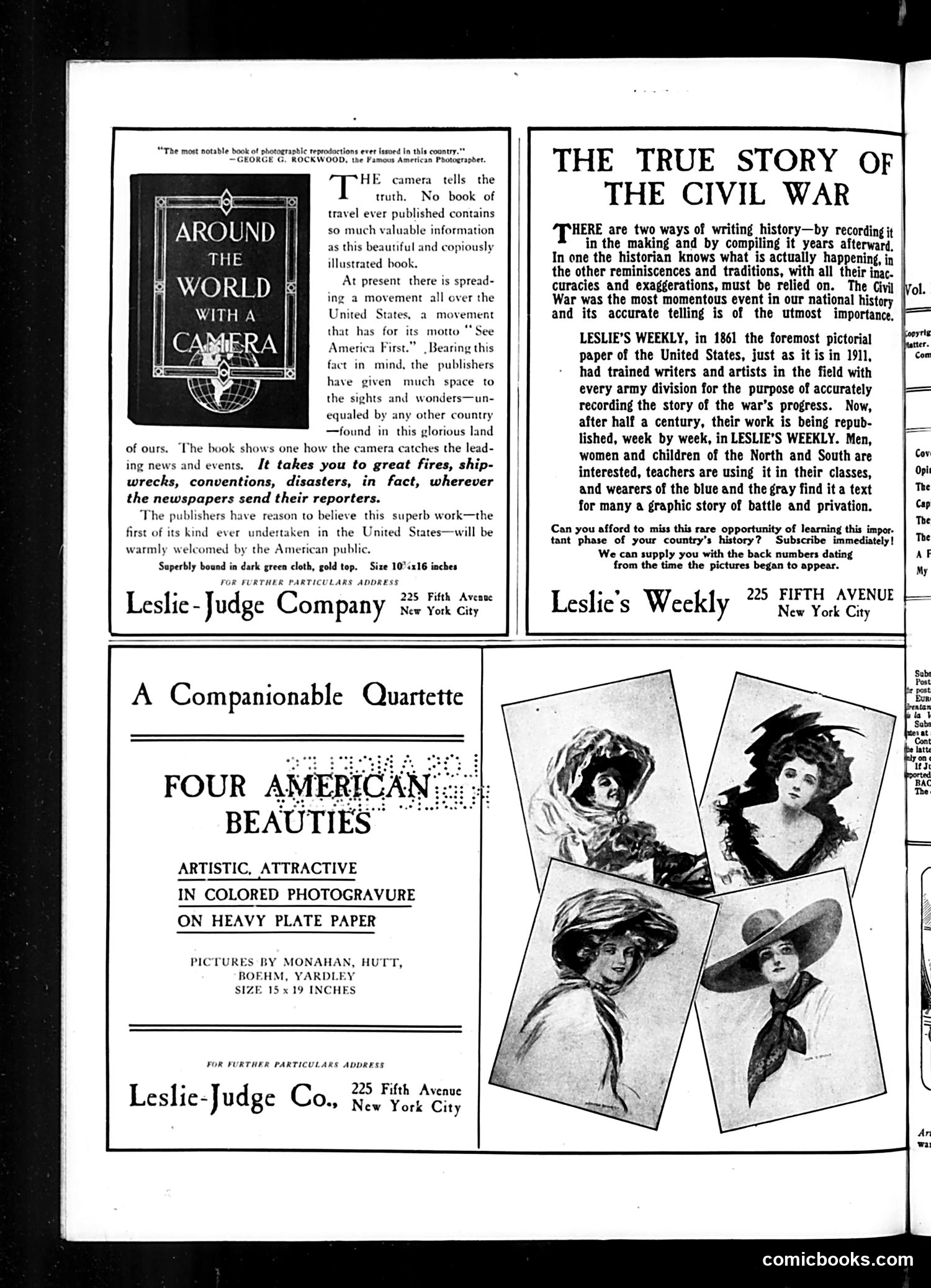
This page contains **three advertisements rather than political cartoons or satire**. The top left advertises "Around the World with a Camera," a travel book emphasizing photography's documentary power. The top right promotes Leslie's Weekly's Civil War coverage, highlighting how the magazine employed field artists and writers during the 1861-1865 conflict to create accurate pictorial records—work now being republished for educational purposes. The bottom advertisement showcases "Four American Beauties," photogravure portraits by various artists (Monahan, Hutt, Boehm, Yardley), presented as artistic images of unnamed women in fashionable hats and clothing. All three ads are from Leslie-Judge Company, a New York publisher. **There is no political satire or cartoon content on this page.**
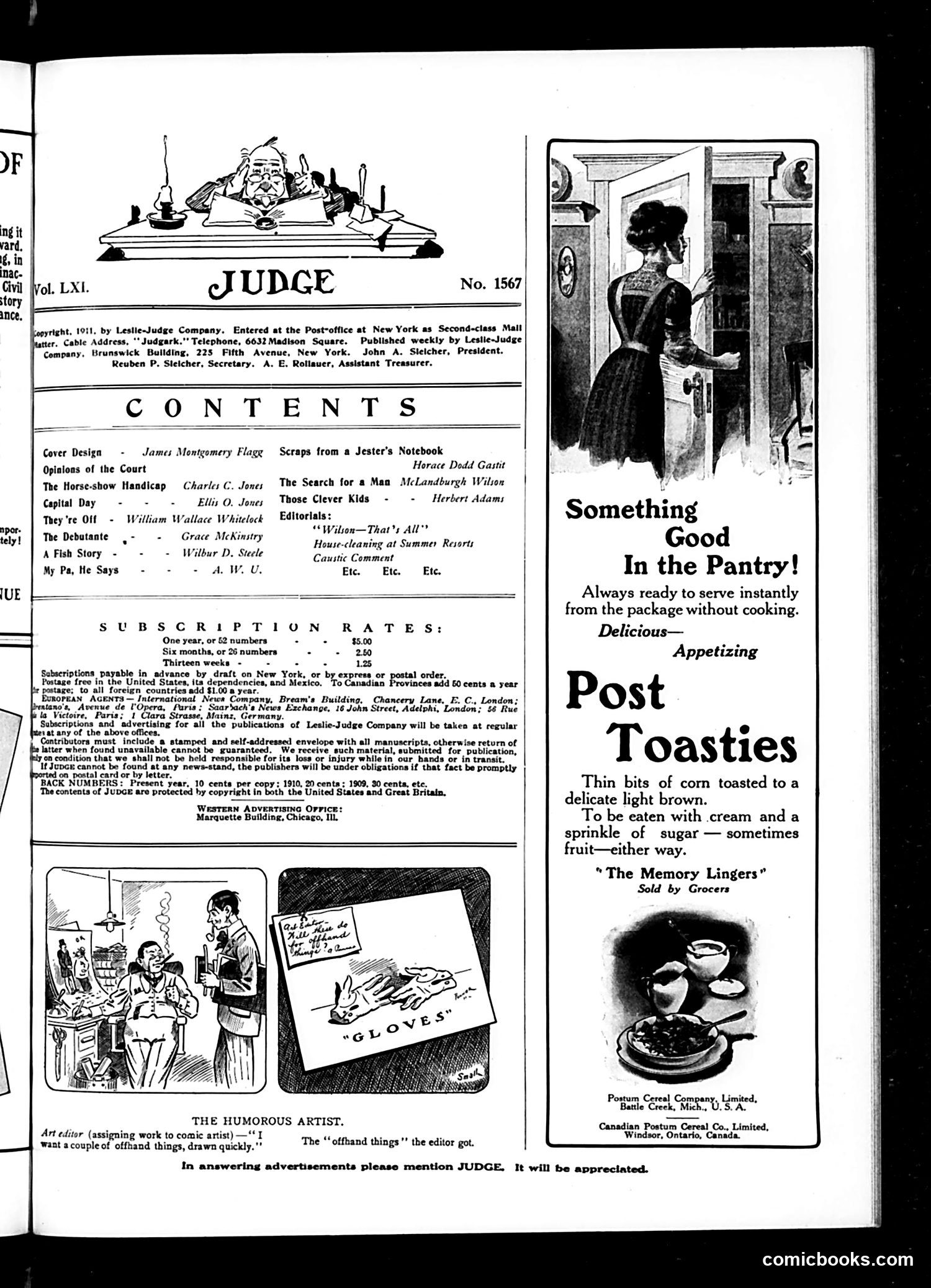
This is primarily a contents and advertising page from Judge magazine (Vol. LXI, No. 1567, 1911). The left side lists article titles and authors; the right side features advertisements. The small cartoon at bottom left, titled "The Humorous Artist," shows an editor rejecting an artist's work, saying "I want offhand things" the artist drew "quickly." This is an inside joke about magazine production—editors preferring quick, spontaneous sketches over labored artwork. The main right-side content consists entirely of product advertisements, particularly Post Toasties cereal and related food items. There is no political satire on this page; it functions as a standard magazine contents/advertising spread typical of early 20th-century publications.
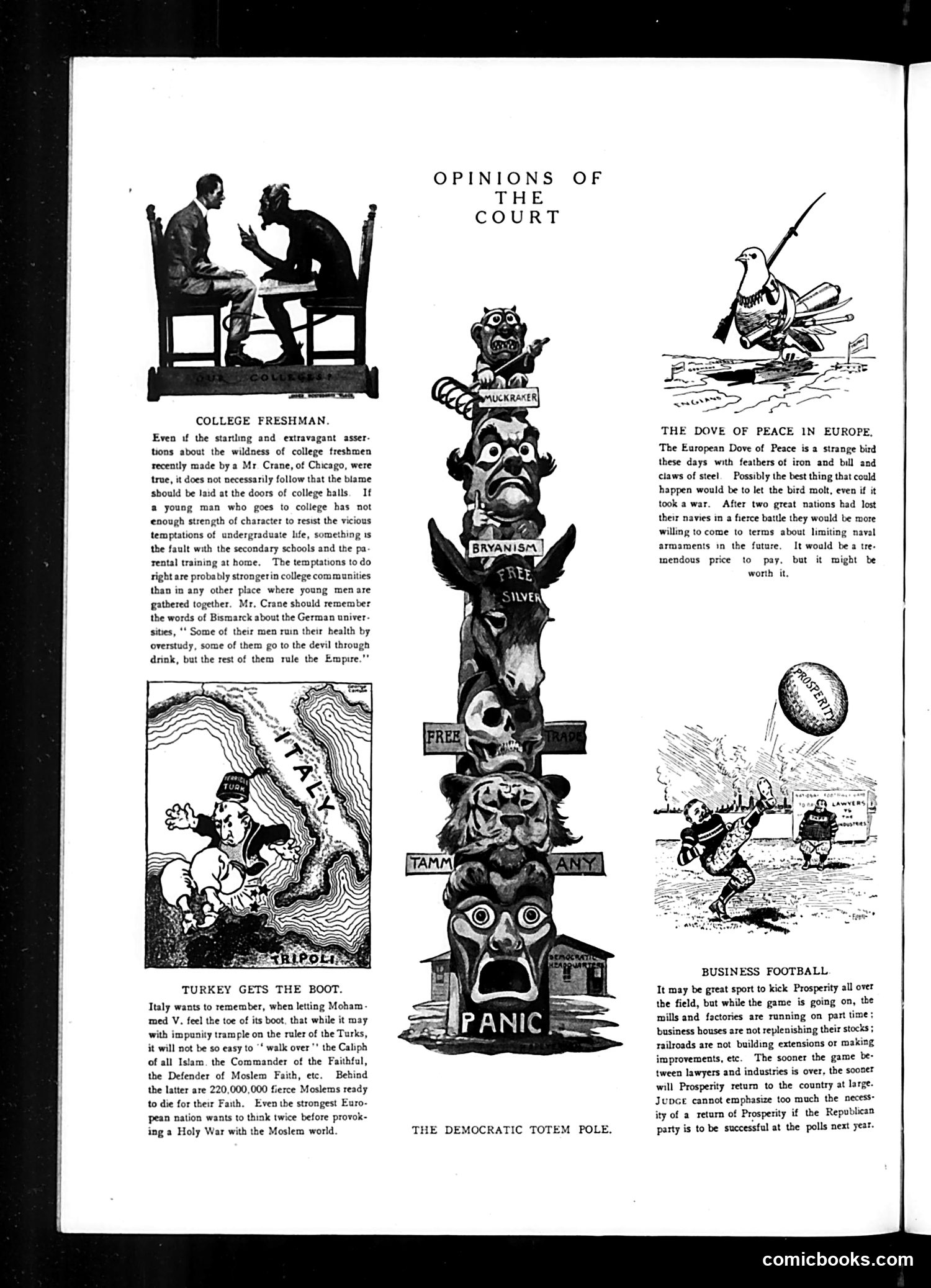
This page presents four political cartoons satirizing early 20th-century events: **"College Freshman"** mocks the rowdy behavior of college freshmen, referencing German university traditions. **"Turkey Gets the Boot"** comments on Italy's military actions against the Ottoman Empire, depicting Turkey being expelled. The text references the Italo-Turkish War and mentions 220,000 losses for the Ottoman Faith. **"The Democratic Totem Pole"** stacks grotesque faces representing Democratic Party chaos and internal conflict, with labels including "Bryanism" and "Panic"—likely referencing William Jennings Bryan and economic crises. **"The Dove of Peace in Europe"** and **"Business Football"** mock post-war European instability and the notion that business will revive once political turmoil ends. The cartoons reflect Judge magazine's conservative Republican perspective criticizing Democratic leadership and international instability.
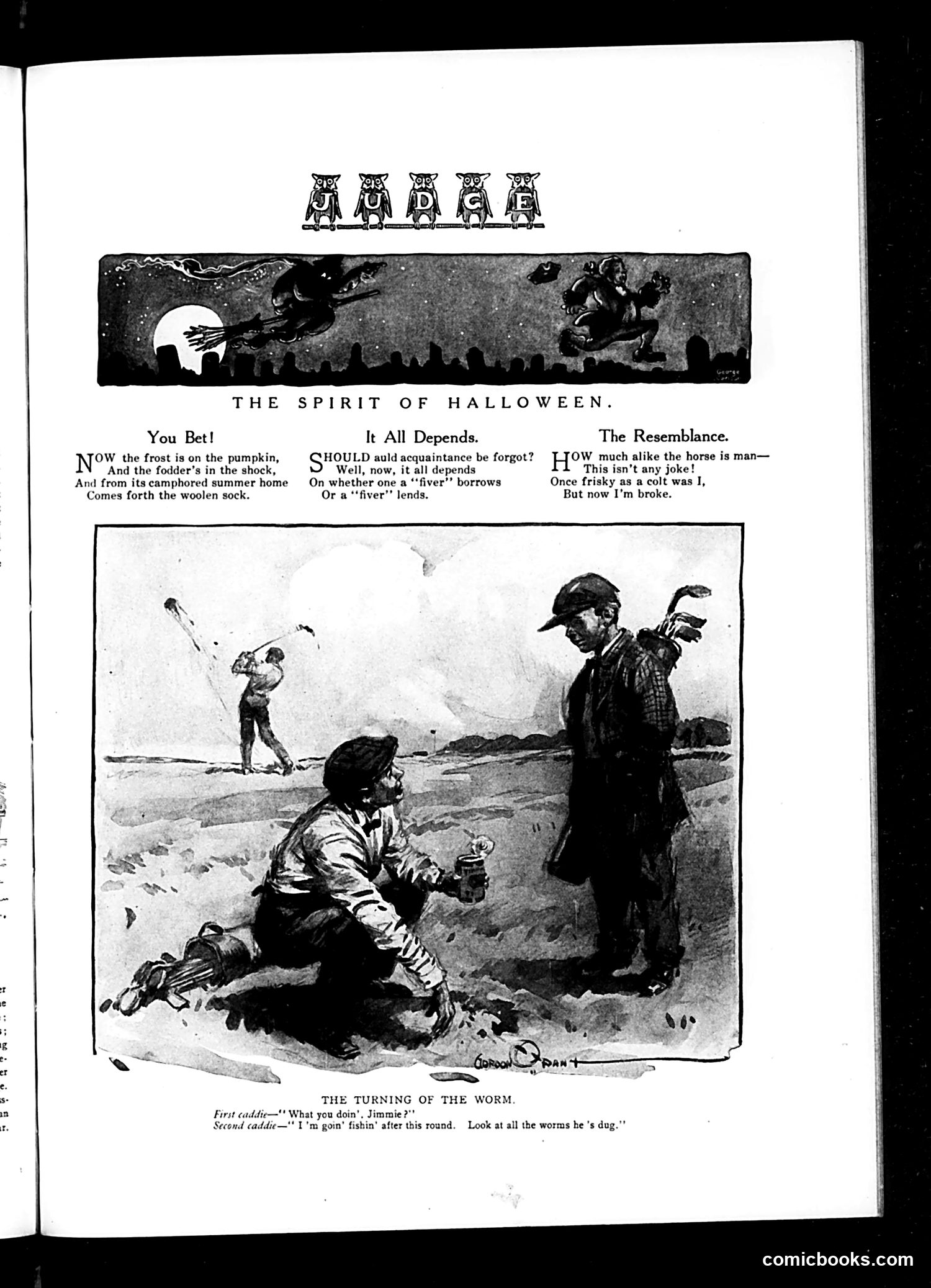
This Halloween-themed page contains three short humorous poems and an illustration titled "The Turning of the Worm." The illustration depicts two golfers on a course with a caddy. The caption explains the joke: the first caddy asks "What you doin', Jimmie?" and the second replies "I'm goin' fishin' after this round. Look at all the worms he's dug." The humor plays on the phrase "turning of the worm"—typically meaning a reversal of fortune. Here it's literal: a golfer's repeated digging (with his golf club) has unearthed worms, which the caddy plans to collect for fishing. It's gentle, punny satire typical of Judge's light humor, with no apparent political content—simply exploiting the double meaning of a common expression for comedic effect.
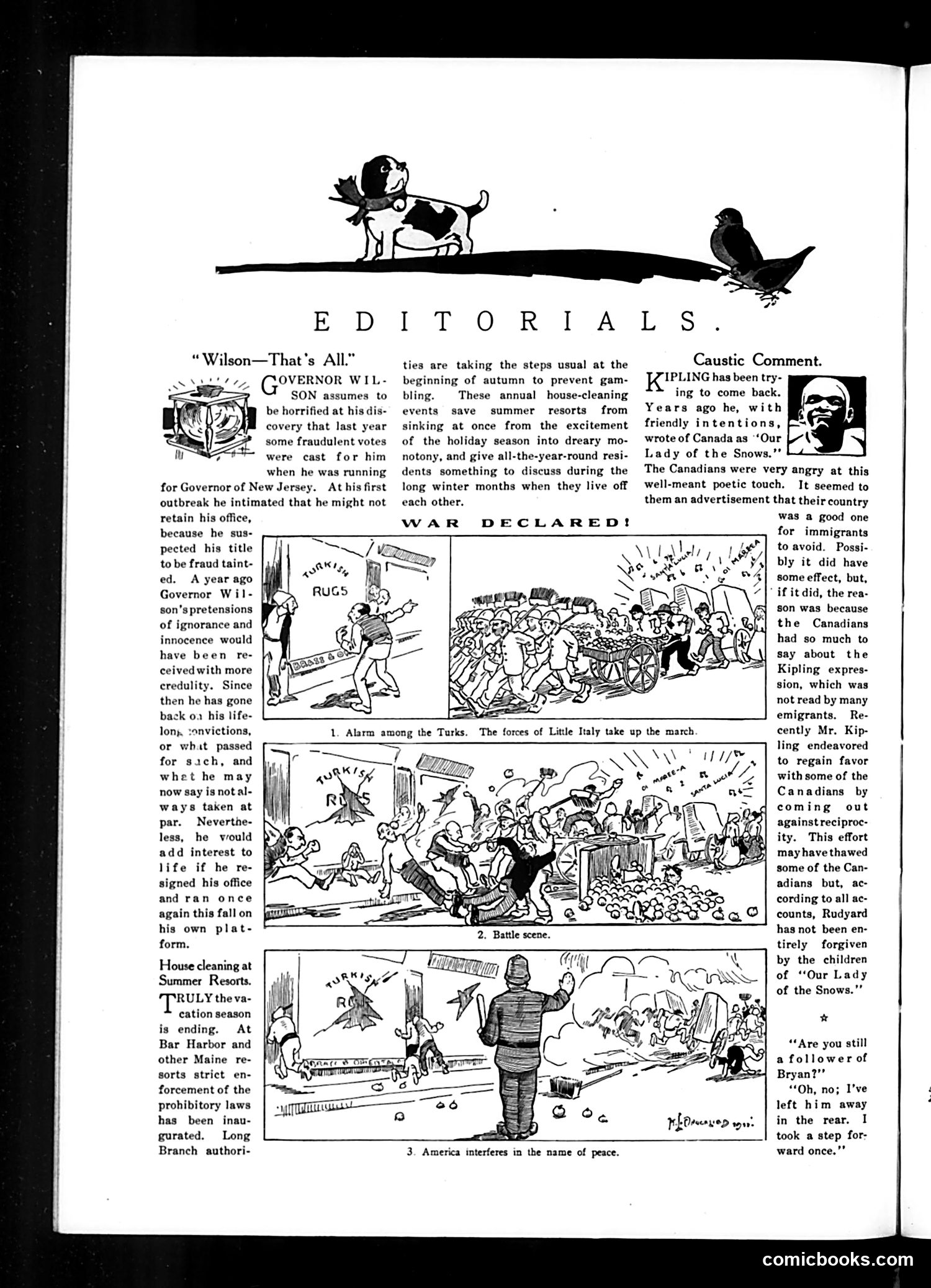
This page contains political commentary and satirical cartoons from an era when Woodrow Wilson was Governor of New Jersey (before his presidency). **"Wilson—That's All"**: Mocks Wilson's claimed shock at discovering fraudulent votes cast for him during his gubernatorial campaign. The editorial suggests his outrage rings hollow given his political history and argues his credibility has eroded, proposing he resign and run again on his own platform for authenticity. **"War Declared"**: Criticizes Rudyard Kipling's attempted reconciliation with Canada after his earlier poem "Our Lady of the Snows" offended Canadians. The piece notes Kipling's recent opposition to Canadian-American reciprocity was likely an unsuccessful attempt to restore favor. **"House Cleaning at Summer Resorts"**: Reports on Maine resort towns enforcing prohibition laws as the vacation season ends. **The three cartoons** (labeled "Alarm among the Turks," "Battle scene," and "America interferes in the name of peace") appear to reference international conflict, likely the Balkan Wars or similar early-20th-century tensions, though specific context isn't entirely clear from the page alone.
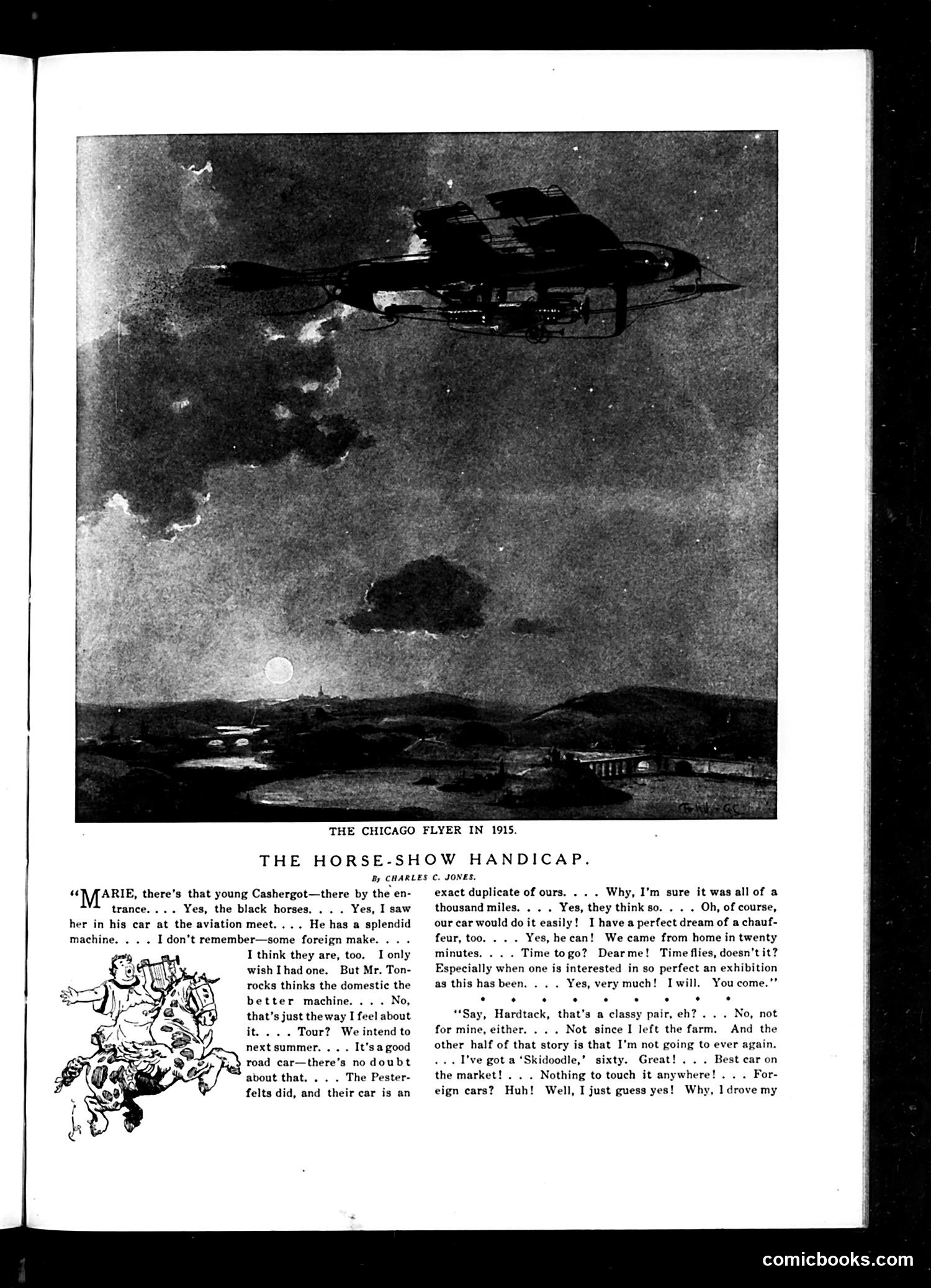
This satirical piece mocks upper-class pretension at a 1915 horse show. The cartoon contrasts two couples: wealthy socialites obsessing over imported automobiles and foreign travel, versus working-class visitors with modest vehicles. The satire targets: **The wealthy:** Marie and her companions endlessly discuss luxury cars, chauffeurs, and European automobiles, performatively displaying status through consumption and boasting about speed records and vacations. **The working-class:** "Hardtack" and his companion represent ordinary people who've abandoned farm life for modest American cars (a "Skidoodle"), content with practical transportation rather than status symbols. The "handicap" title suggests the wealthy are handicapped by their own snobbery and materialism—they're trapped in competitive conspicuous consumption at a mere horse show. The humor exposes how both classes are preoccupied with automobiles, but the wealthy's pretentiousness is presented as ridiculous compared to working-class straightforwardness.
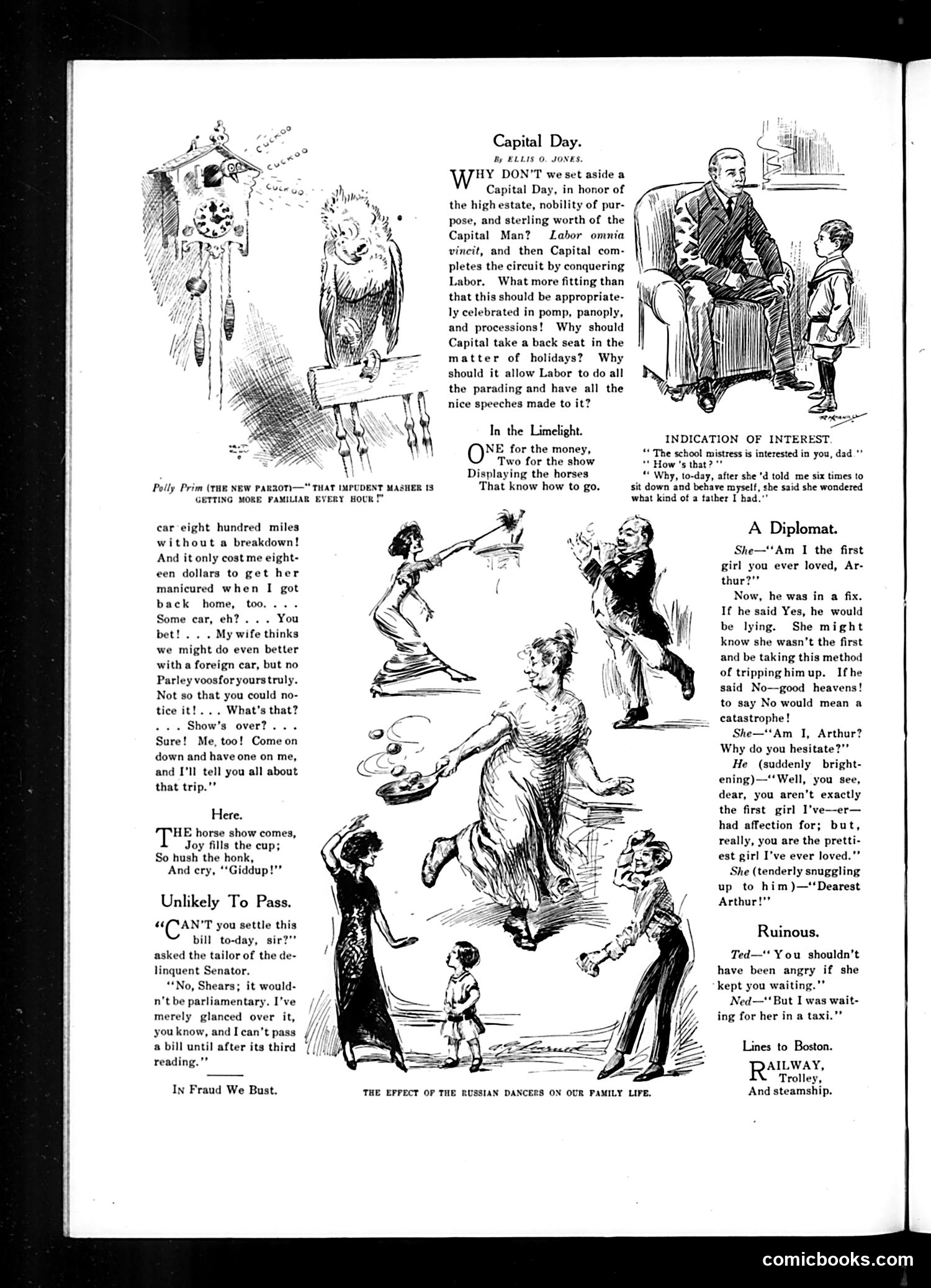
**Main Piece ("Capital Day")**: Ellis O. Jones ironically proposes a holiday honoring "Capital" (wealthy business interests) parallel to Labor Day. The satire mocks how capitalists dominated public celebration and political discourse—Labor had parades and speeches, yet Capital wielded actual power. The Latin phrase *Labor omnia vincit* ("Labor conquers all") is inverted: Capital, not Labor, truly dominates. **"The Effect of Russian Dancers"**: A large central cartoon depicts Russian ballet dancers causing chaos in American family life—children imitating their movements, adults distracted. This reflects early 1900s anxiety about exotic foreign influences (Russian Imperial Ballet tours were sensation events) corrupting traditional American domesticity. **Minor pieces**: Include humor about automobiles, horse shows, parliamentary procedure (a Senator's excuse for not paying bills), and romantic diplomacy—all typical Judge magazine light satire of the era.
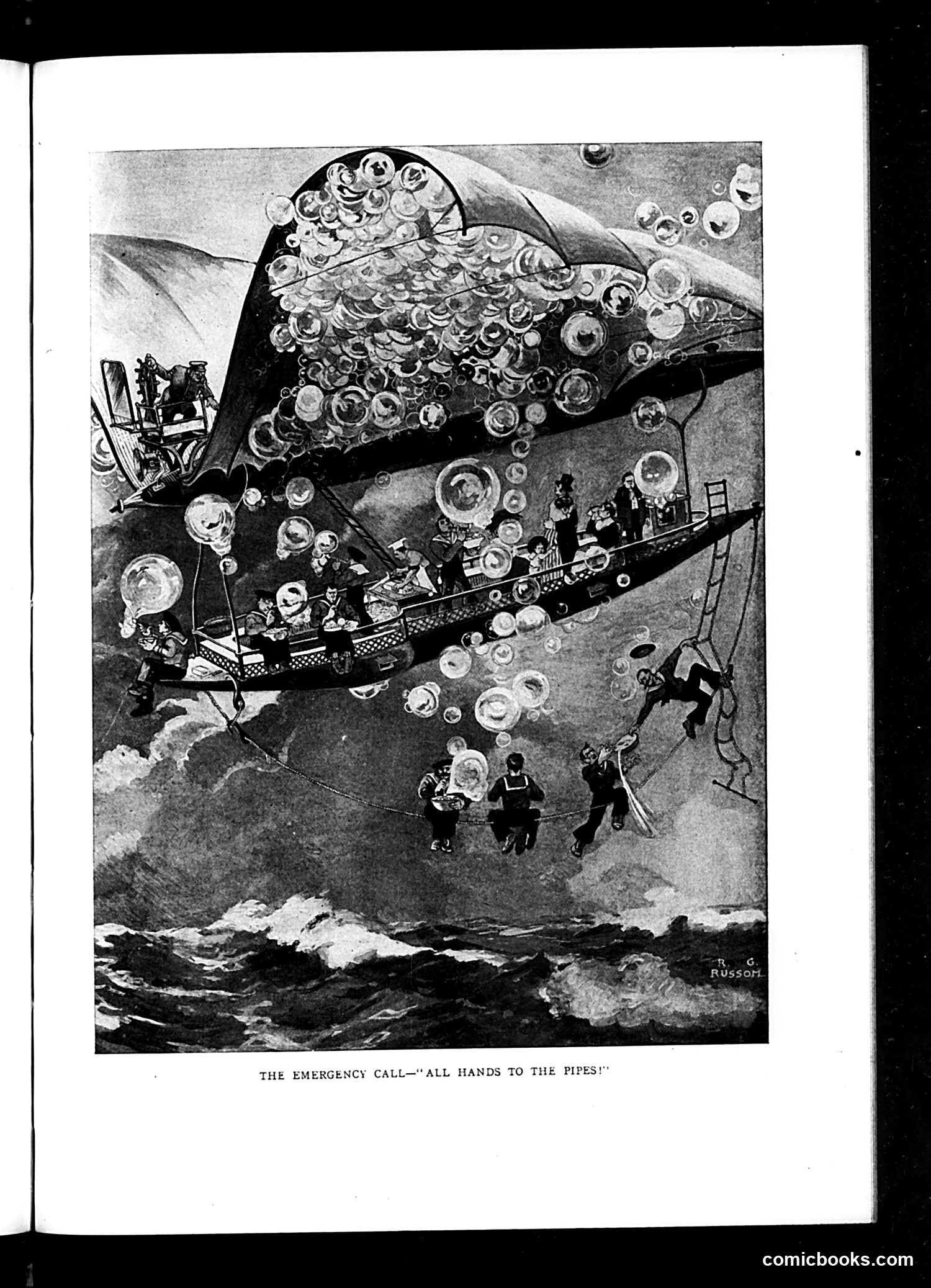
This satirical illustration depicts an underwater or fantastical scene where figures are frantically responding to an emergency call to "all hands to the pipes." The image shows what appears to be a large pipe or vessel with numerous bubble-like circular objects emerging from it, while small human figures below are actively engaged in some kind of urgent response or labor. The satire likely critiques industrial labor conditions or a specific workplace emergency, with the "pipes" representing either literal industrial infrastructure or metaphorically representing a system requiring all available workers. The frantic activity and numerous figures suggest commentary on mass mobilization, labor exploitation, or crisis management in industrial society—common targets of Judge magazine's satirical content during the early-to-mid twentieth century. Without additional context, the specific historical event referenced remains unclear.
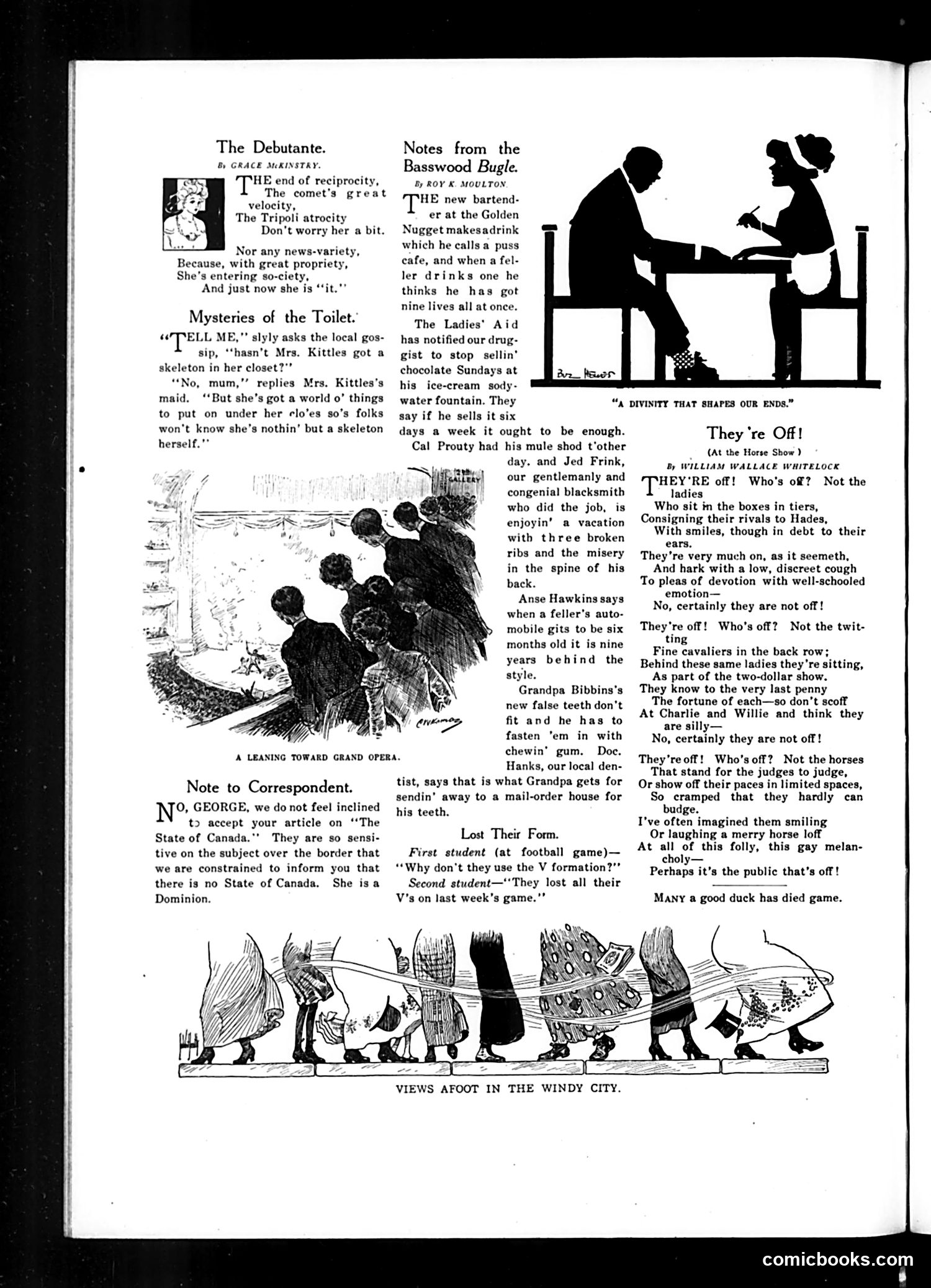
This page contains several satirical pieces typical of early 20th-century American humor: **"The Debutante"** mocks a young woman entering society who is oblivious to major news (reciprocity trade issues, a comet, the Tripoli conflict) because she's preoccupied with her social debut. **"Mysteries of the Toilet"** is a servant-gossip exchange where a maid suggests her employer wears extensive undergarments to create the illusion of having a figure—a joke about fashion, body image, and class pretension. **"They're Off!"** satirizes the horse show as a social event where the actual horses are incidental. Ladies in boxes scrutinize rivals while smiling insincerely; male spectators calculate women's fortunes; horses are cramped and uncomfortable. The poem concludes that perhaps the *public* is "off" (foolish) for participating in this theatrical vanity. The rural humor pieces ("Basswood Bugle," "Lost Their Form") use small-town dialect for gentle jokes about local characters and events. The overall tone: urban sophistication mocking itself and rural simplicity with gentle mockery.
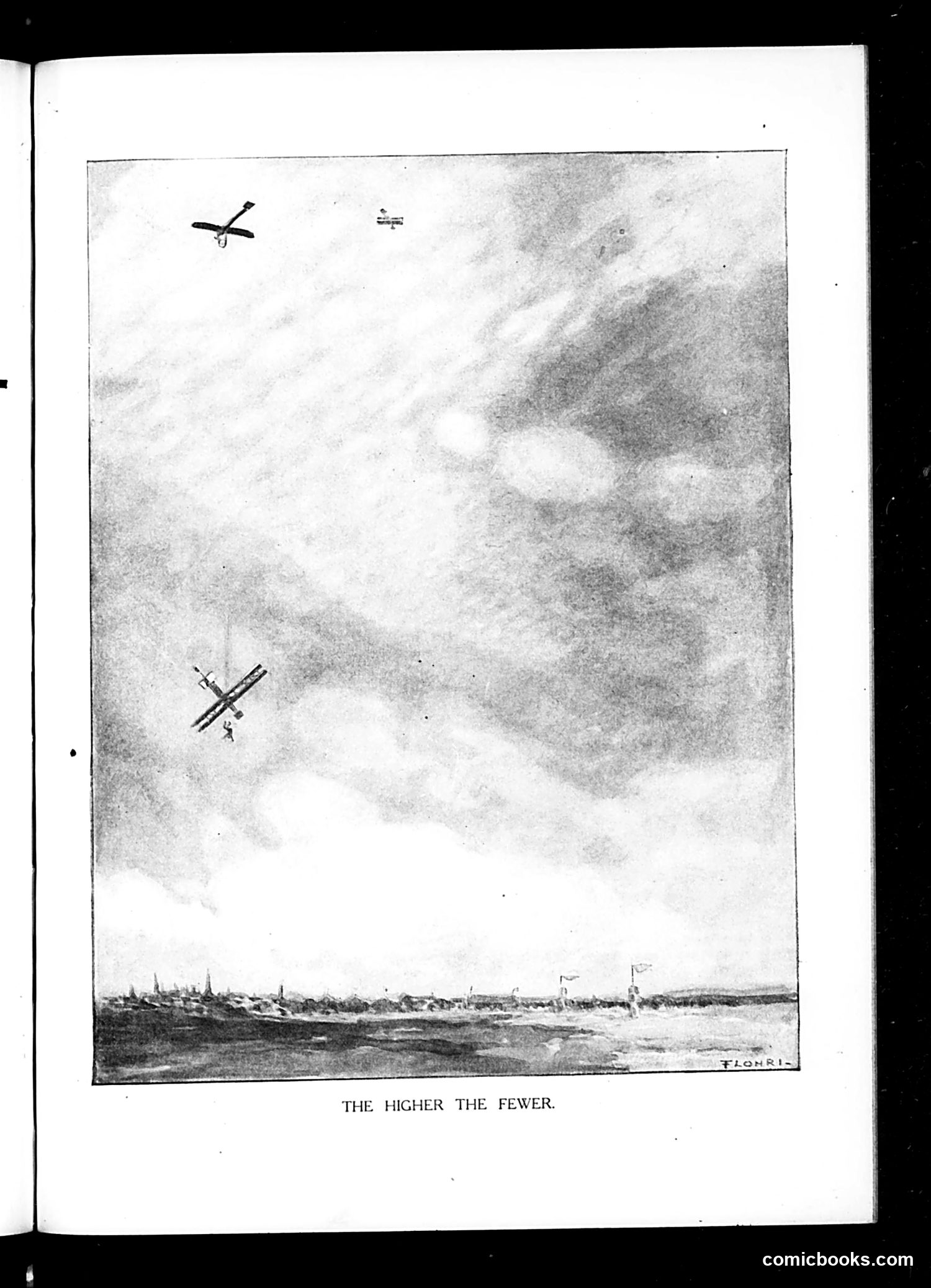
This political cartoon depicts two early aircraft flying at different altitudes above a cityscape. The caption "THE HIGHER THE FEWER" appears to be a darkly satirical commentary on aviation safety or combat during the early 20th century—likely referencing World War I aerial warfare. The phrase suggests that as pilots fly higher into the sky, fewer of them survive or return. This is satirical commentary on the dangers of early aviation and the high casualty rates among pilots, particularly combat aviators. The contrast between the peaceful civilian landscape below and the precarious aircraft above emphasizes the lethal nature of early flight. The signature appears to read "FLONRI" (or similar), identifying the cartoonist.
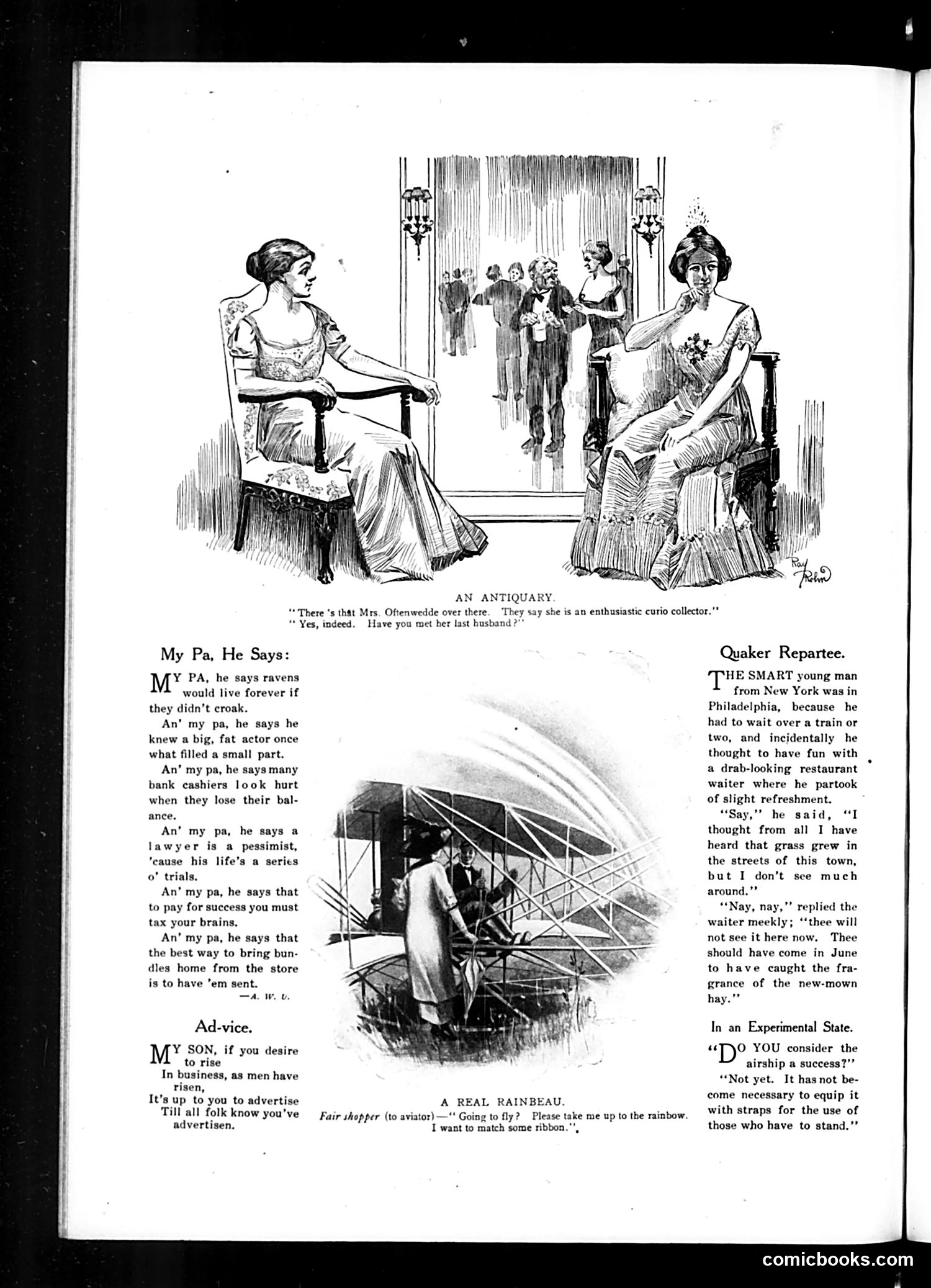
This page contains several satirical pieces typical of early 20th-century American humor: **"An Antiquary"** (top): Two women discuss a third, Mrs. Oftenwedde, described as an "enthusiastic curio collector." The joke's sting lies in the question "Have you met her last husband?"—implying she's been married multiple times, treating husbands like collectible curiosities rather than lasting relationships. This mocks both serial divorce and women who accumulate possessions obsessively. **"My Pa, He Says"** and **"Ad-vice"**: Folksy aphorisms and puns offering homespun wisdom about success, business, and human nature—common filler content in Judge. **"A Real Rainbeau"**: A woman asks an aviator to fly her to a rainbow to match ribbon colors. The pun on "rainbow/beau" plays on contemporary fascination with aviation as a novelty. **"Quaker Repartee"**: A New York businessman mocks Philadelphia's supposedly rustic character ("grass in streets"), but a Quaker waiter delivers a clever comeback about visiting in June for "new-mown hay"—implying the city's dullness rather than its rusticity.
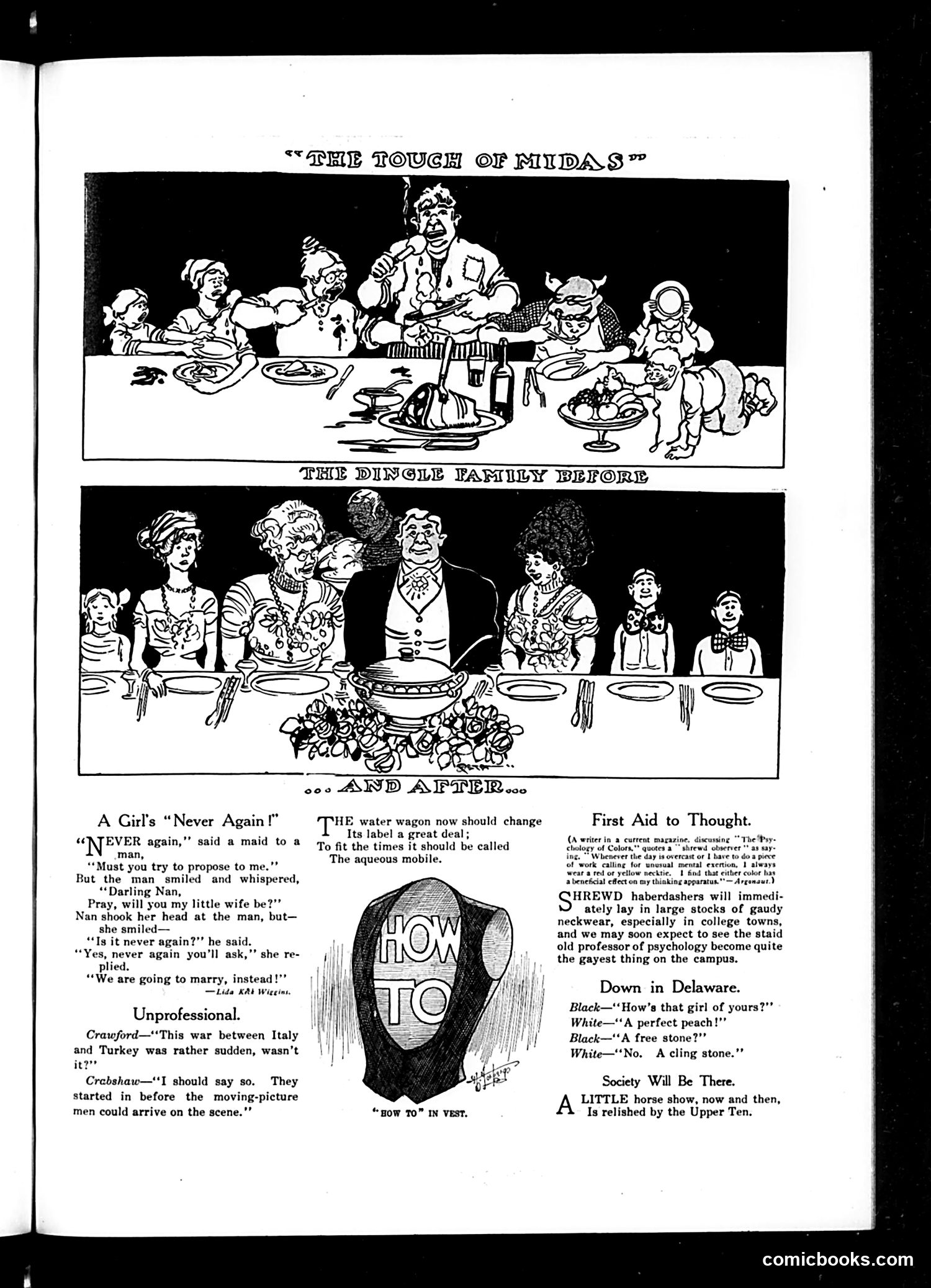
This **Judge** magazine page contains several satirical pieces mocking early 20th-century social conventions and contemporary absurdities: **Top panels**: "The Dingle Family Before and After" contrasts a chaotic family dinner with an orderly, refined one—likely satirizing the pretensions of social climbing or etiquette guides. **Main jokes**: - A romantic proposal sketch playing on repetitive courtship language - "Unprofessional" mocks how the Italy-Turkey war moved faster than film crews could document it—critiquing journalism's obsession with motion pictures as news - "First Aid to Thought" ridicules pseudoscientific claims that colored neckties improve mental performance, predicting colleges will adopt this absurd trend - "Down in Delaware" uses racial caricature stereotypes (unclear racist wordplay involving peaches) - "Society Will Be There" dismisses wealthy society's leisure pursuits as predictable The satire targets vanity, gullibility toward pseudo-science, and social pretension—typical Judge magazine fare mocking American middle and upper-class aspirations.
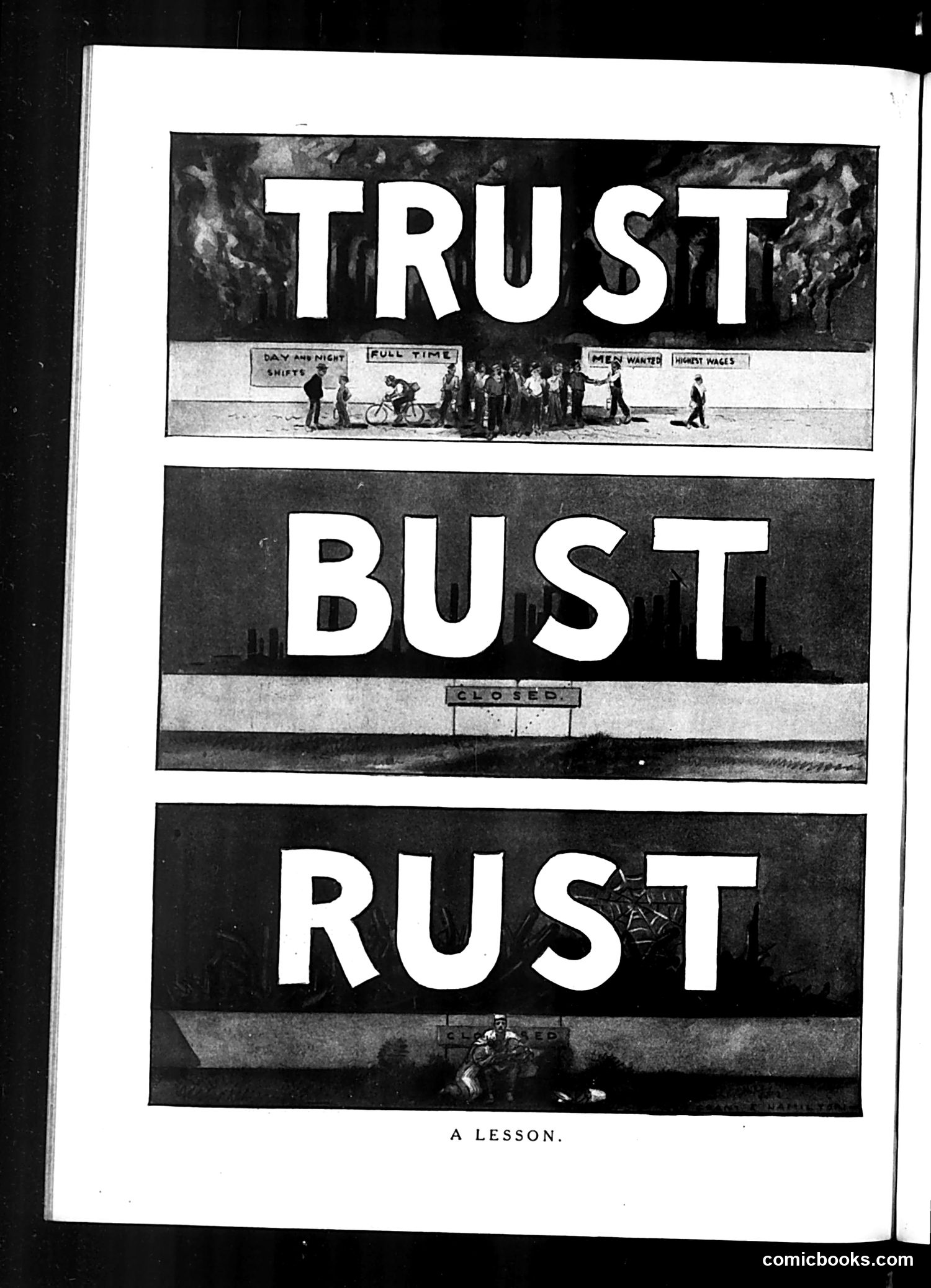
This three-panel Judge cartoon satirizes the consequences of trust-busting—the progressive era's aggressive antitrust policies targeting large corporations. **Panel 1 ("TRUST")**: Shows a thriving business with signs for "Day and Night Shifts," "Full Time," "Men Wanted," and "Honest Wages"—depicting a functioning monopoly providing employment. **Panel 2 ("BUST")**: The business is "Closed," illustrating the immediate shutdown following antitrust action. **Panel 3 ("RUST")**: Shows decay and deterioration, suggesting economic stagnation and job losses post-breakup. The caption "A Lesson" implies the cartoon's message: breaking up trusts, while politically popular with reformers, may harm workers and the economy more than help them. This reflects contemporary business-friendly criticism of aggressive antitrust enforcement during the Progressive Era.
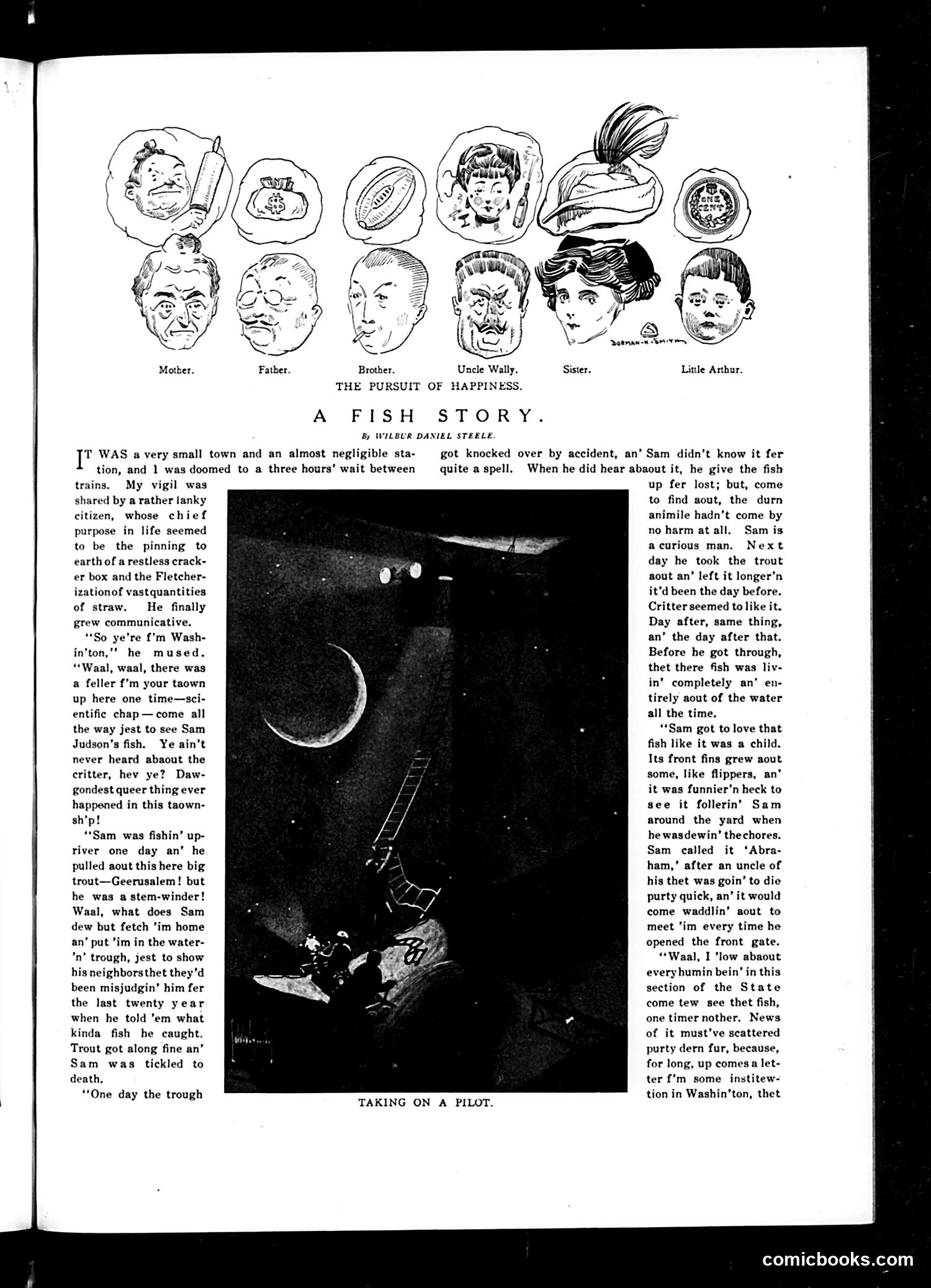
This page presents a fictional short story by Wilbur Daniel Steele, not a political cartoon. The top shows character sketches labeled "The Pursuit of Happiness" (Mother, Father, Brother, Uncle Wally, Sister, Little Arthur) and an illustration captioned "Taking on a Pilot." The story itself is a tall tale in rural American dialect about Sam Judson's extraordinary trout. A man relates how Sam caught a large trout, kept it in a water trough, and through repeated exposure to air, the fish gradually adapted to live completely out of water. It even developed flipper-like fins and followed Sam around like a pet dog. The story notes that news of this marvel spread so widely that a Washington institution (implied as scientific/governmental) sent someone to investigate. The humor relies on the absurdity of the premise and authentic rural vernacular speech patterns popular in early 20th-century American humor magazines.
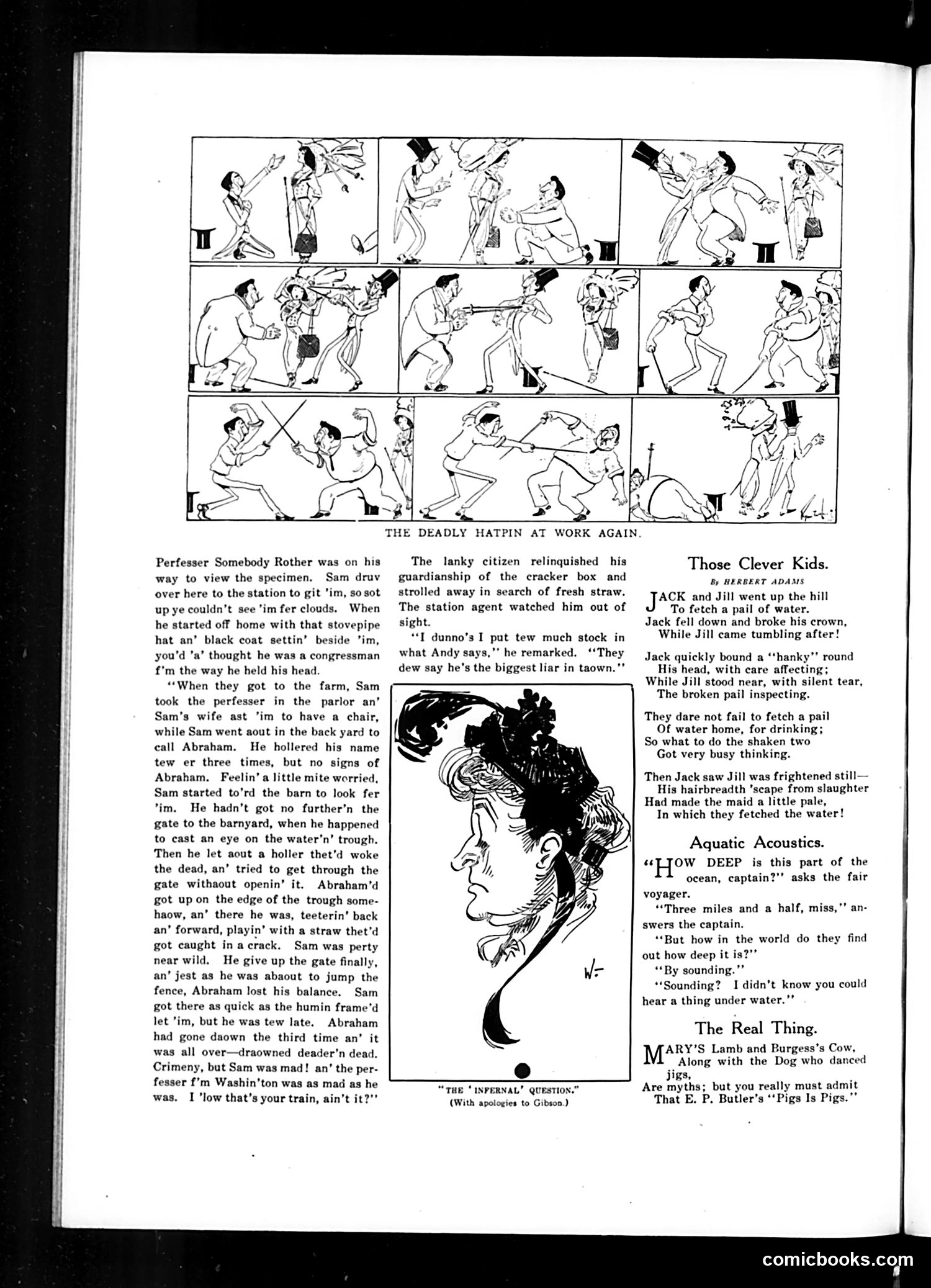
The top comic strip, "The Deadly Hatpin at Work Again," satirizes the early 1900s "hatpin menace"—a genuine social panic about women's long, sharp decorative hatpins that could injure people in crowded spaces. The cartoon shows men wearing top hats being struck by women's hatpins, depicting this as a humorous but real urban hazard that concerned authorities at the time. The illustrated profile labeled "The 'Infernal' Question" (credited to Gibson, likely Charles Dana Gibson) appears to be commentary on a contentious political or social issue, though the specific reference is unclear without additional context. The remaining content—poems about "Jack and Jill," jokes about ocean depth measurement, and a reference to E.P. Butler's "Pigs Is Pigs"—represents typical Judge magazine filler: light humor and children's verses alongside satire.
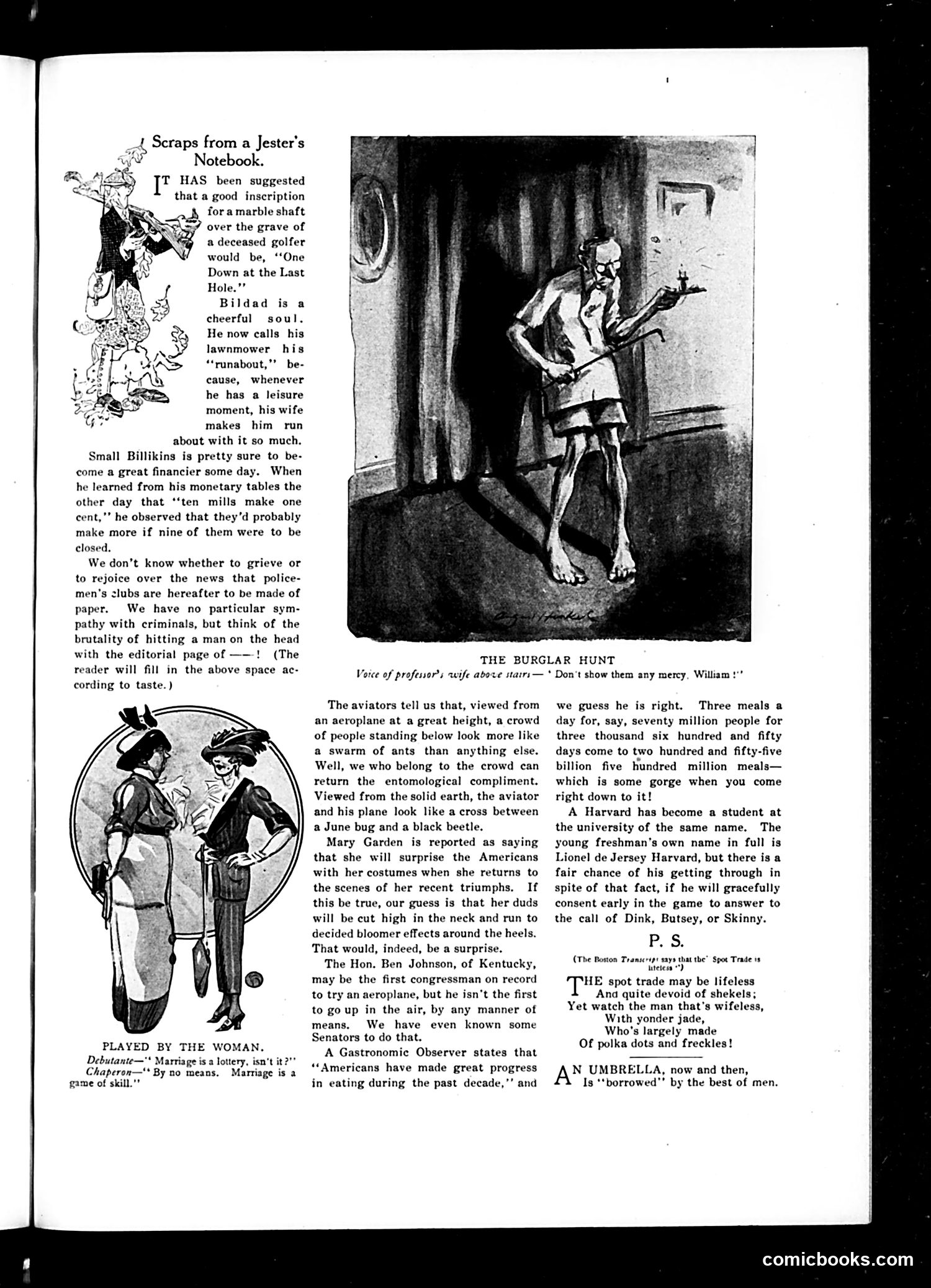
This page contains several brief satirical pieces typical of Judge's humor: **"The Burglar Hunt"** illustration shows a woman directing a man (presumably her husband) to confront an intruder. The caption parodies domestic dynamics—the wife aggressively commanding the husband to show the burglar "no mercy," satirizing how wives push reluctant husbands into dangerous situations for protection. **"Played by the Woman"** jokes about marriage: a debutante asks if marriage is a lottery; the chaperon corrects her—it's a "game of skill," implying women strategically manipulate men into matrimony. The remaining pieces are short quips mocking: - Aviators (viewing crowds like insects; planes resemble bugs) - Mary Garden's (an opera singer's) shocking costume choices - Congressional pomposity - America's excessive food consumption - A Harvard student unfortunate enough to be named "Harvard" - Borrowed umbrellas The tone throughout is lighthearted domestic satire, poking fun at marriage, masculine inadequacy, and contemporary figures.
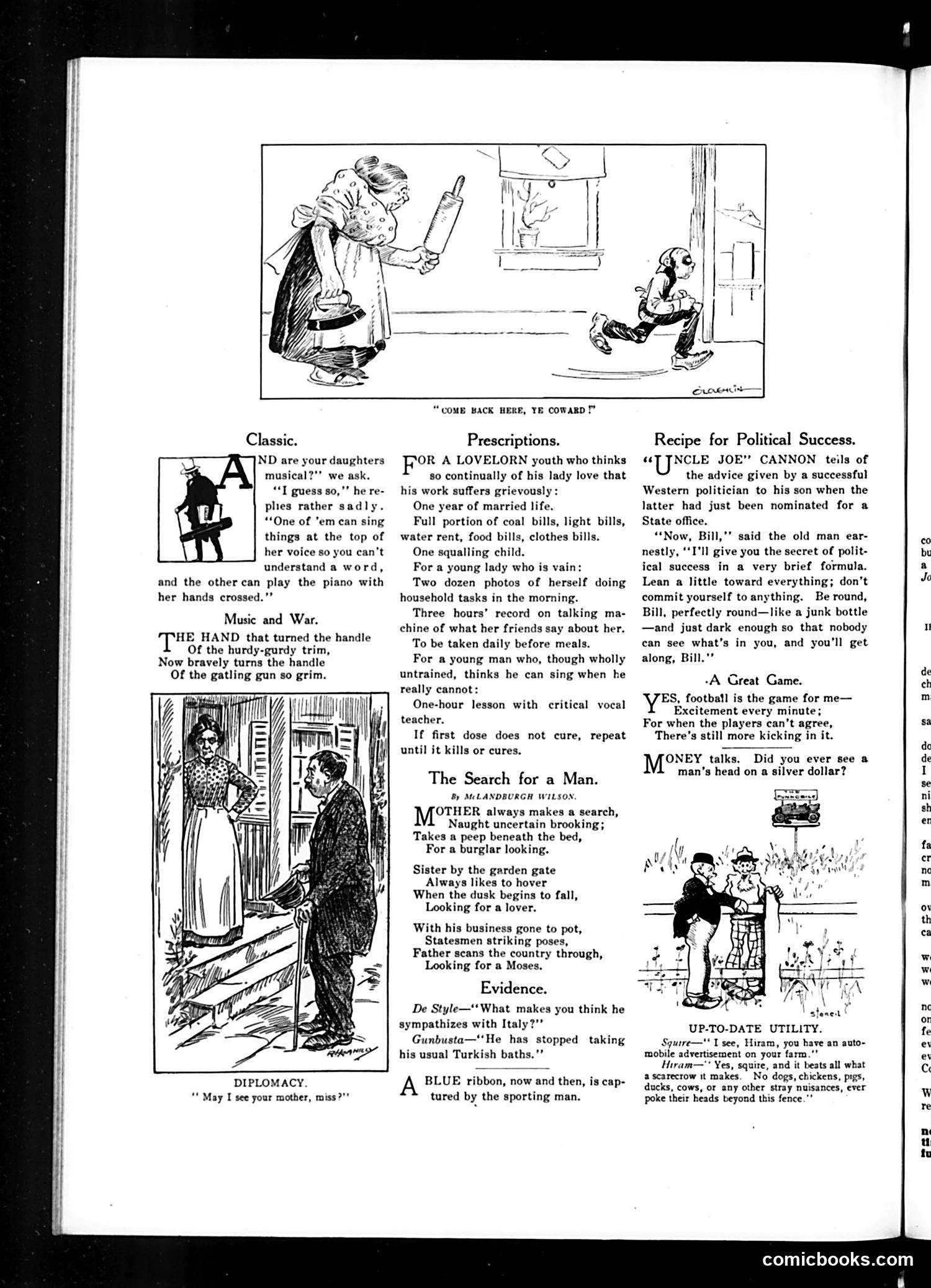
This page contains multiple unrelated humor pieces typical of early 20th-century satirical magazines: **Top cartoon**: A woman chases a child with a rolling pin, captioned "Come back here, ye coward!"—domestic humor about childhood mischief and parental discipline. **"Classic"**: Jokes about daughters' musical abilities—one sings loudly and unintelligibly, the other plays piano with crossed hands. Satirizes Victorian-era daughters' musical training. **"Music and War"**: Contrasts the hurdy-gurdy street musician (peacetime) with the machine-gun operator (wartime), reflecting early 20th-century militarism concerns. **"Recipe for Political Success"**: References "Uncle Joe" Cannon (likely Speaker Joseph Cannon), presenting cynical advice about political non-commitment and ambiguity—"be round like a junk bottle" so people can't see your true positions. **Other pieces**: Include dating advice ("Diplomacy"), medical "prescriptions" for various ailments, and short quips about football, money, and farm advertising. The page demonstrates Judge's mix of domestic satire, political commentary, and general humor.
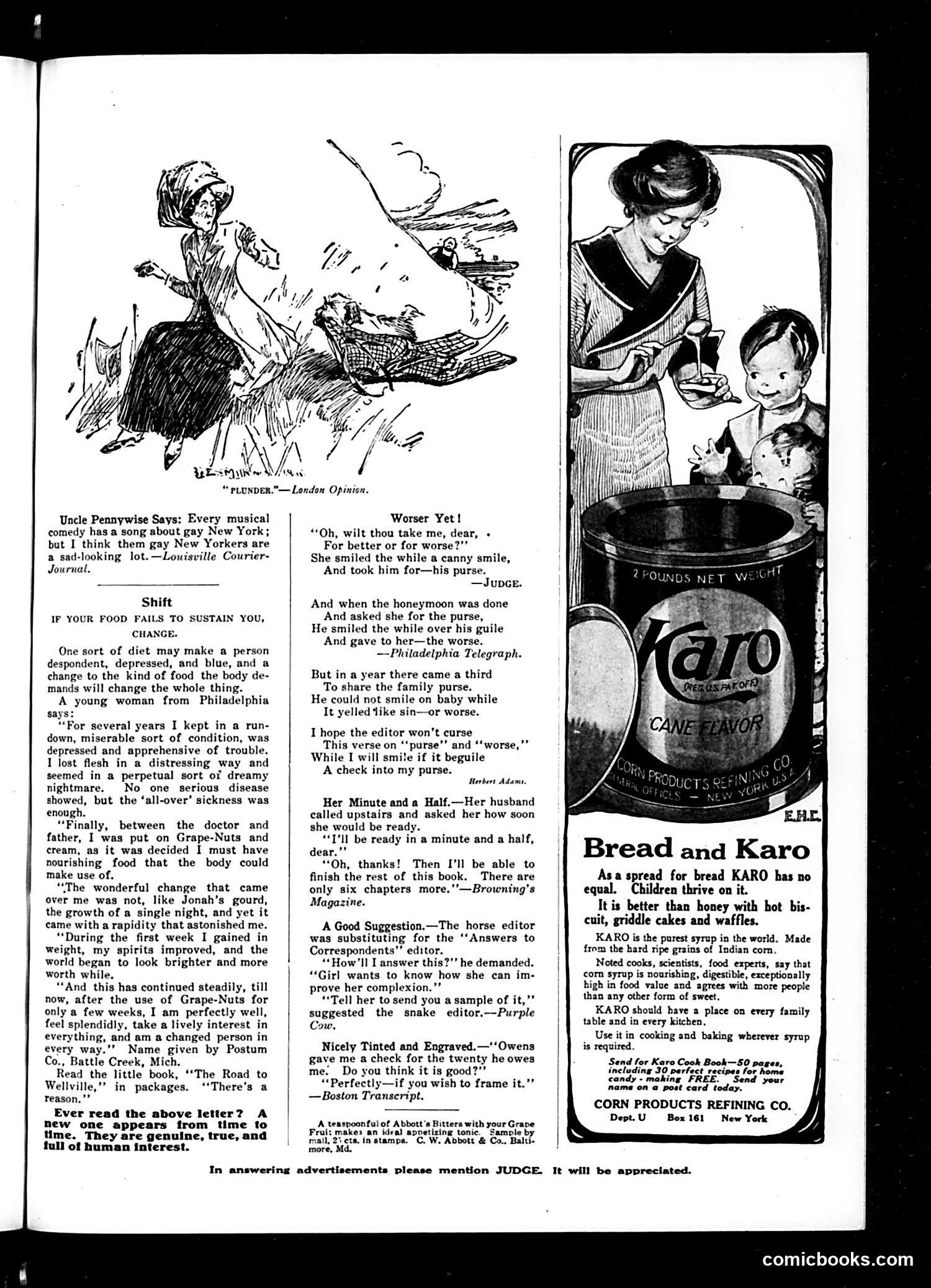
This page from *Judge* (a major American satirical magazine) contains multiple humorous items targeting early-20th-century social concerns: **"Plunder" cartoon** (top left): A satirical sketch of a woman in disarray, likely mocking frivolous or reckless behavior. **"Worser Yet" poems**: A series of jokes playing on marriage and money. The verses mock the transition from courtship romance to marital reality—a husband marries for love but gets financial demands; later a baby arrives, destroying any remaining marital bliss. The humor targets both women's perceived mercenary nature and the disillusionment of married life. **"Shift" advertorial**: A testimonial about dietary change curing depression, promoting Grape-Nuts cereal—typical early advertising mixing health claims with personal narratives. **Various short jokes**: Humorously cynical takes on romance, honesty, and relationships, reflecting period attitudes toward marriage and gender dynamics. The page is primarily satirical commentary on American middle-class marriage and courtship, combined with period advertising. The tone is consistently skeptical about romantic love's durability.
This is primarily an **advertising page** with interspersed humorous anecdotes rather than political cartoons. The ads showcase period products (Blatz beer, Pears' Soap, Velvet tobacco, Canadian whisky) typical of early 20th-century Judge magazine. The brief comic stories offer social satire on **marriage dynamics** and **everyday hypocrisy**: - "Reciprocity" jokes that wives must constantly tolerate husbands' faults - "Getting Him Used to It" depicts a fiancé reduced to a wallet on market trips - "Paying a Debt" satirizes petty revenge—a judge who fined someone for speeding gets nearly hit by a wrench from that person's airplane - "A True Story" mocks get-rich-quick claims: a man invested one dollar by telegraphing home for money The humor targets familiar domestic frustrations and small-town absurdities rather than major political events. The "Prosperous Farmer" celebrates mortgage freedom—reflecting agricultural themes relevant to the era. These are lightweight, folksy jokes emphasizing marital compromise, social climbing, and rural-versus-urban contrasts.
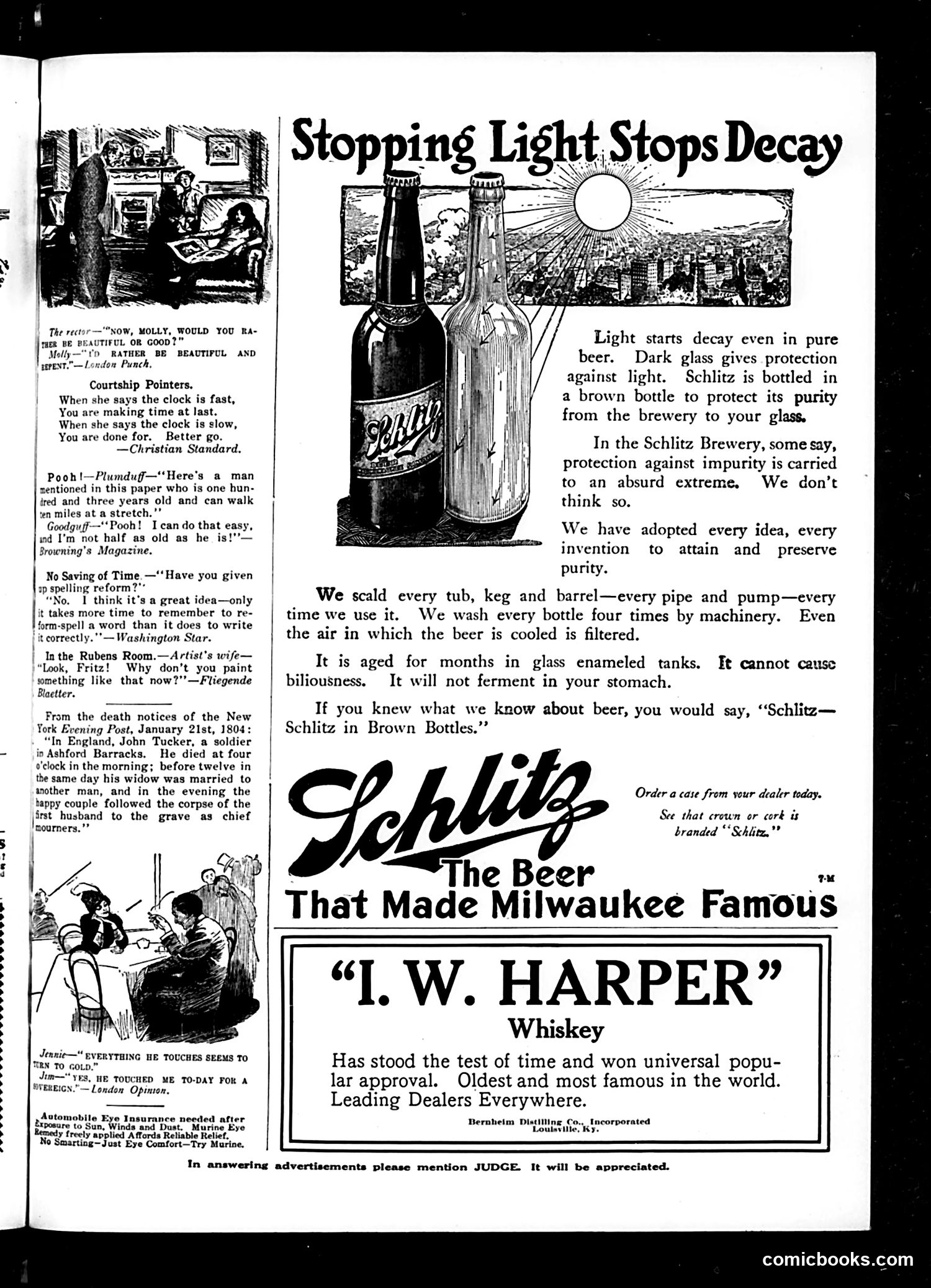
This page contains primarily **advertisements** rather than satirical cartoons. The dominant feature is a Schlitz beer advertisement, accompanied by smaller whiskey (I.W. Harper) advertising. The page also includes several brief **humor snippets** (jokes/witticisms): - "Courtship Pointers" about interpreting clock references during romantic encounters - A joke about an elderly man's walking ability - Observations on spelling reform and Rubens' painting style - A historical anecdote about rapid remarriage after a soldier's death **Historical context**: These ads and jokes reflect early 20th-century concerns—the brown bottle claim addresses genuine scientific knowledge about light damaging beer, while the humor pieces reflect period attitudes toward courtship, aging, and social conventions. The page demonstrates Judge's mixed format: satirical magazine content alongside paid advertising, with little connection between the two sections.
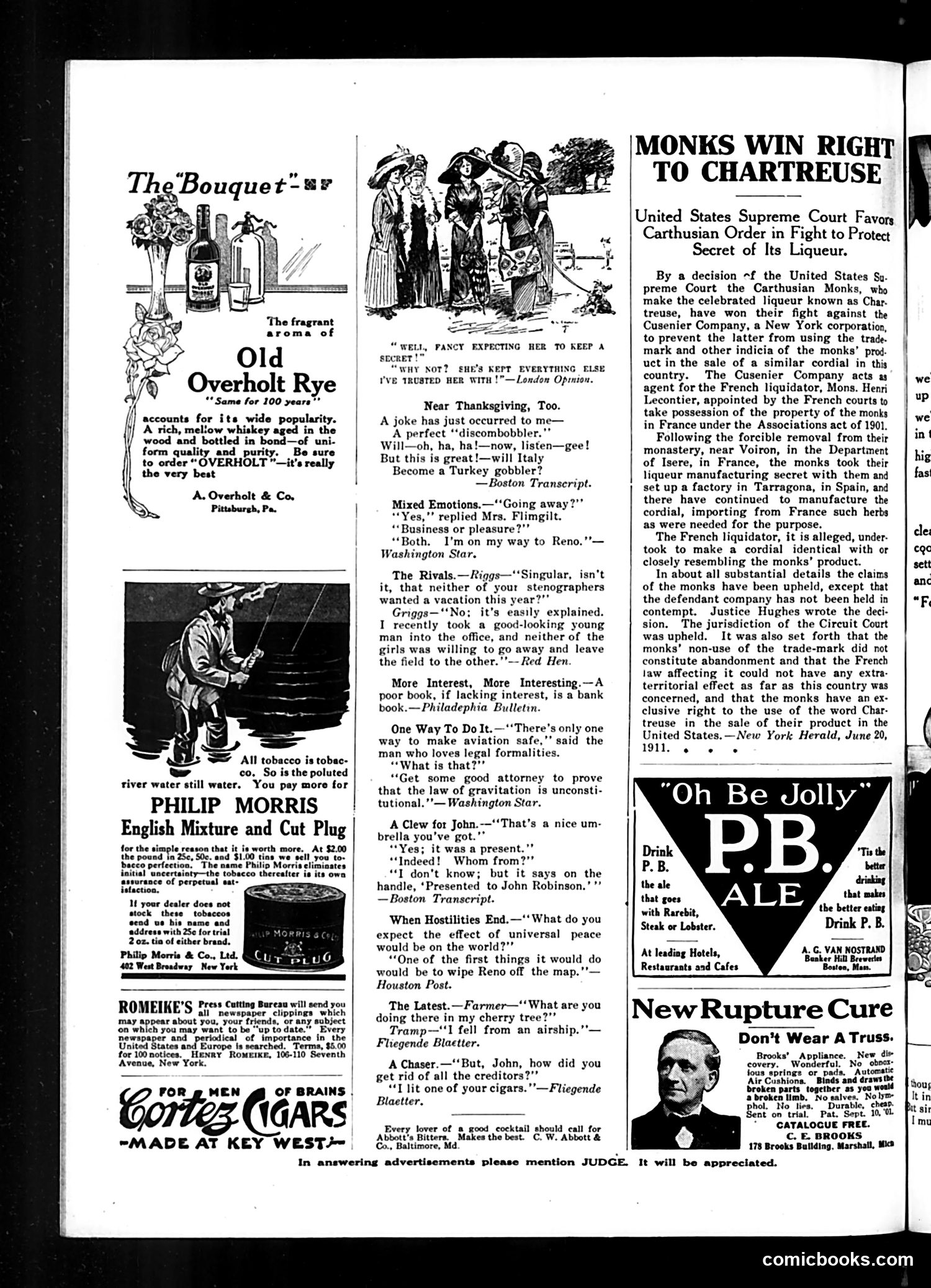
This page primarily features a major news story about the Carthusian monks' Supreme Court victory protecting their Chartreuse liqueur trademark against the Cusenier Company, a New York corporation attempting to market a similar product. Justice Hughes ruled that the monks retained exclusive rights to the "Chartreuse" name in the U.S., despite French seizure of their monastery in France under anticlerical laws. The satire here is subtle: Judge presents this as a triumph for the monks against both commercial exploitation and French governmental confiscation, reflecting early 20th-century American skepticism toward both unfettered capitalism and European antimonasticism. The remainder consists of period humor (short jokes about stenographers, aviation safety, and romance) and advertisements for whiskey, cigars, and other products typical of Judge's male-oriented readership. The content isn't overtly political satire but rather reflects general commercial and social attitudes of the era.
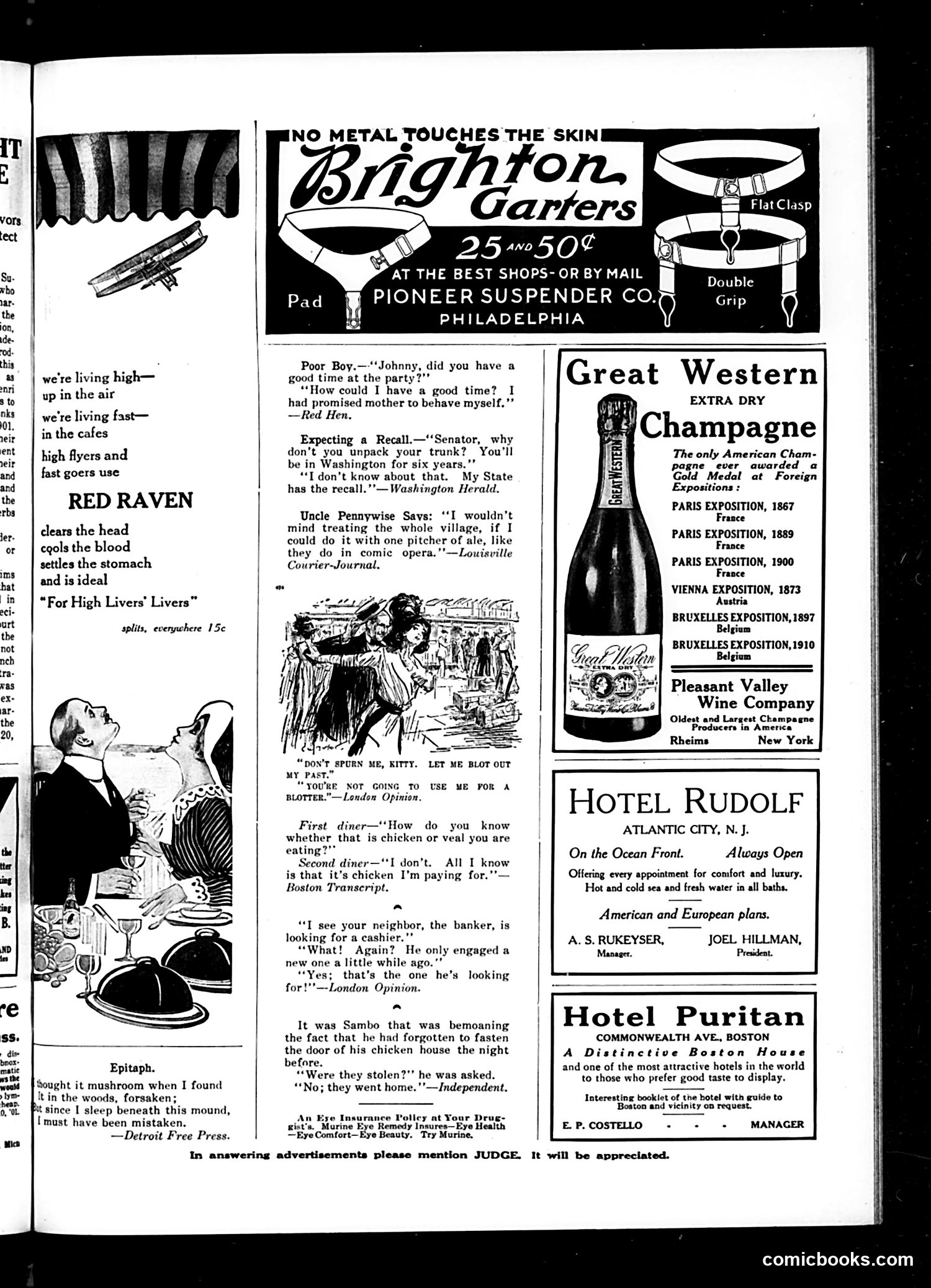
This page is primarily **advertising with light humor content**—typical of Judge's format. The main illustrated comic shows a **dinner scene satirizing class pretense**: a well-dressed man and woman at a fancy restaurant. The jokes below mock diners who deceive themselves about what they're eating and their financial status—paying for "chicken" while eating veal, or a banker repeatedly losing cashiers (implying embezzlement or scandal). The "Poor Boy," "Expecting a Recall," and "Uncle Pennywise" sections are brief **social humor**—mocking a child forced to behave at parties, jokes about political recall elections (likely early 1900s), and working-class attitudes toward treating villagers to drinks. The **Red Raven advertisement** promotes a patent medicine claiming to aid digestion for "high livers" (wealthy socialites). Remaining content is **hotel and champagne advertising**, exploiting aspirational messaging about luxury and European prestige. The page reflects Judge's dual appeal: satirizing upper-class excess while advertising luxury products to readers aspiring to that lifestyle.
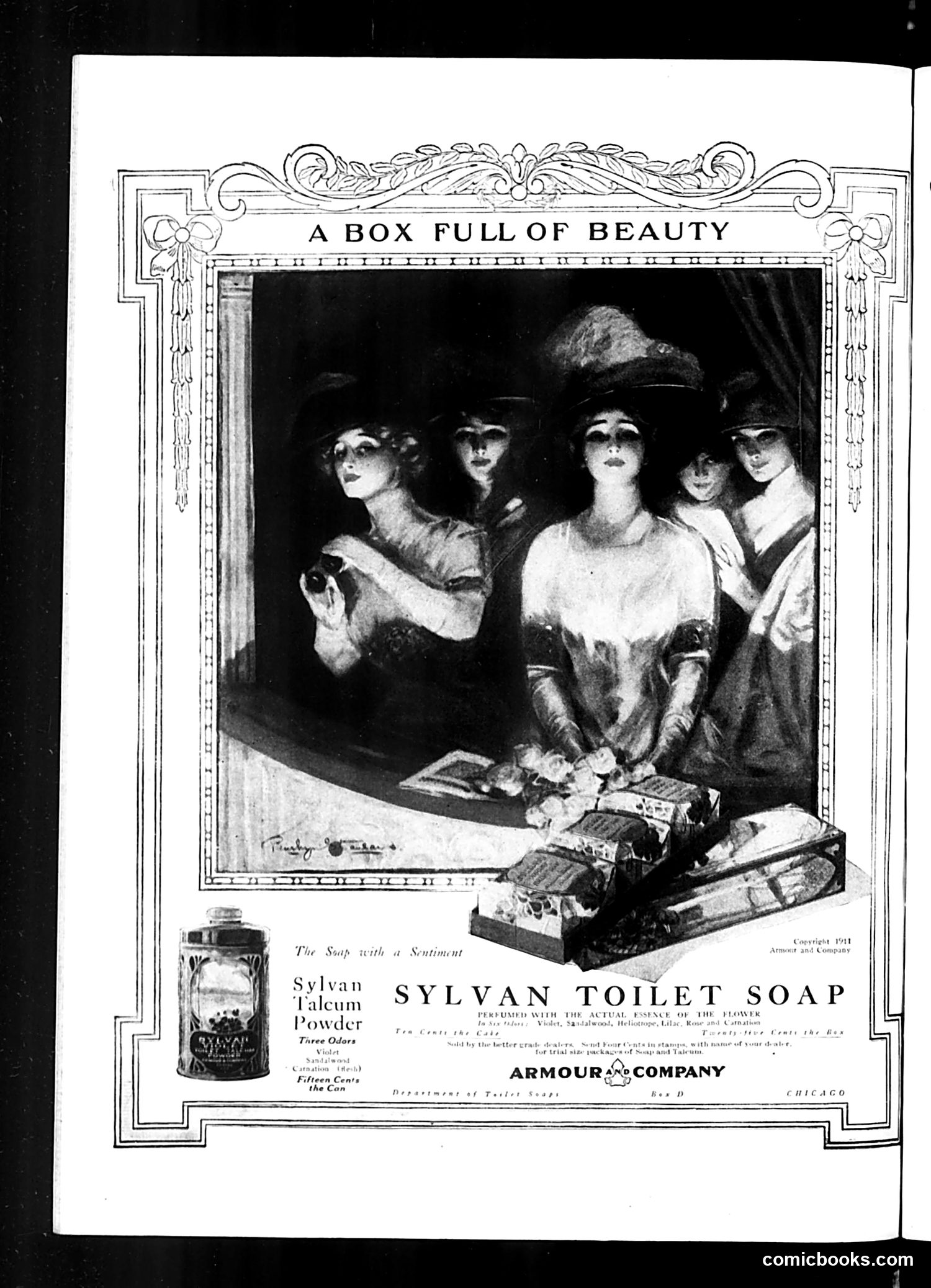
This is primarily a **product advertisement**, not political satire. It promotes Sylvan Toilet Soap by Armour and Company (Chicago), marketed circa 1913. The ad features five fashionable women in elaborate hats examining beauty products, with the tagline "A Box Full of Beauty." The image aims to associate the soap with elegance and feminine sophistication. The left sidebar shows Sylvan Talcum Powder packaging, listing scents like "Three Odors" and "Violet." The ad emphasizes that the soap contains "the actual essence of the flower" and claims it's "sold by the better retail dealers." This appears in *Judge*, a satirical magazine, but the page itself contains **no satire or political commentary**—it's straightforward consumer advertising typical of early-20th-century women's product marketing, targeting affluent female consumers through imagery of refinement and social status.