
Judge, 1911-10-28 · page 8 of 24
Judge — October 28, 1911 — page 8: what you’re looking at
What you’re looking at
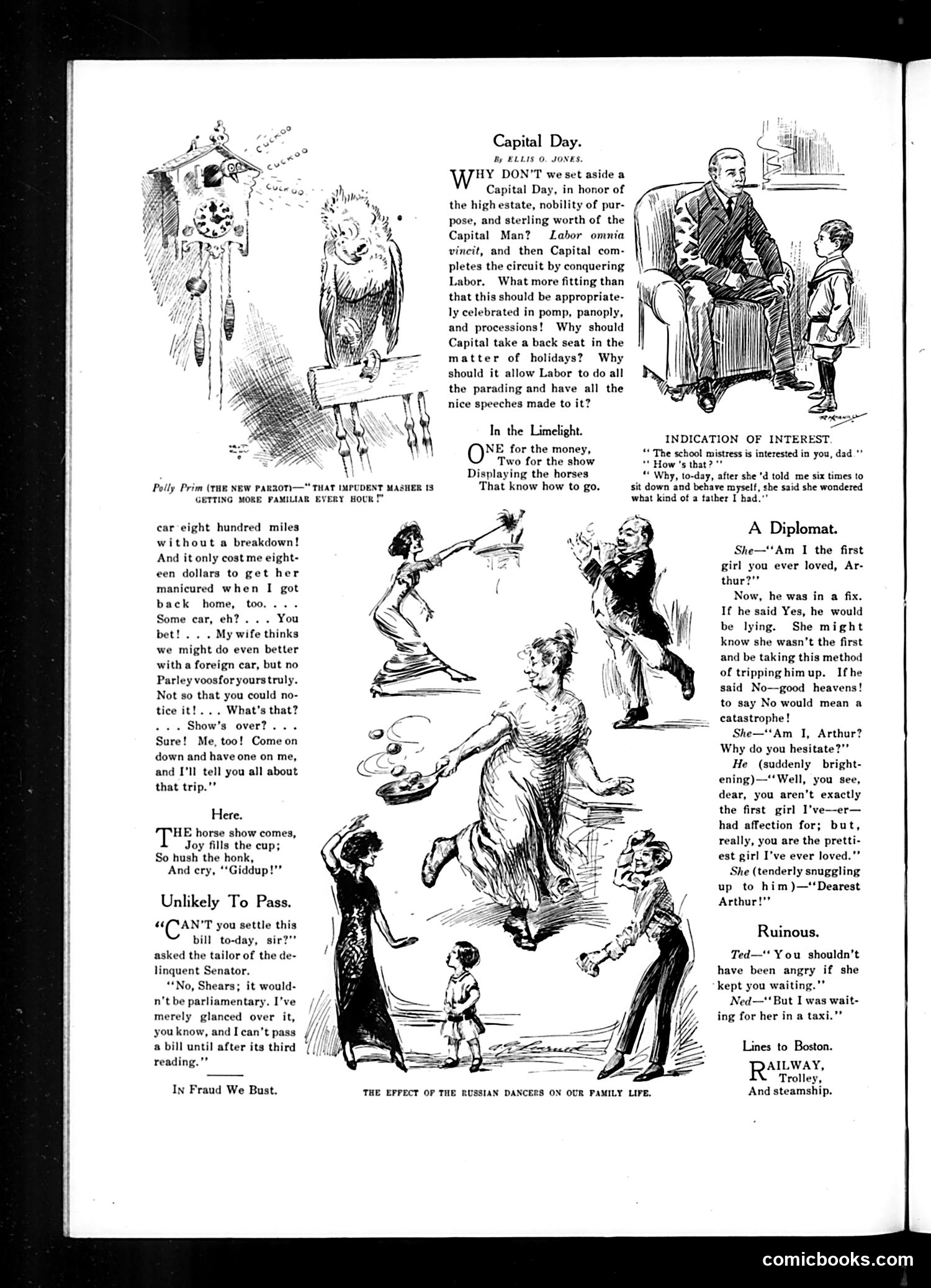
**Main Piece ("Capital Day")**: Ellis O. Jones ironically proposes a holiday honoring "Capital" (wealthy business interests) parallel to Labor Day. The satire mocks how capitalists dominated public celebration and political discourse—Labor had parades and speeches, yet Capital wielded actual power. The Latin phrase *Labor omnia vincit* ("Labor conquers all") is inverted: Capital, not Labor, truly dominates. **"The Effect of Russian Dancers"**: A large central cartoon depicts Russian ballet dancers causing chaos in American family life—children imitating their movements, adults distracted. This reflects early 1900s anxiety about exotic foreign influences (Russian Imperial Ballet tours were sensation events) corrupting traditional American domesticity. **Minor pieces**: Include humor about automobiles, horse shows, parliamentary procedure (a Senator's excuse for not paying bills), and romantic diplomacy—all typical Judge magazine light satire of the era.
📄 Transcribed text from this page (OCR, searchable)
Machine-transcribed from the original scan — historical spelling and the odd misread are preserved.
Capital Day. By ELLIS 0. JONES. HY DON'T we set aside a Capital Day, in honor of the high estate, nobility of pur- pose, and sterling worth of the Capital Man? Labor omnia vincit, and then Capital com- pletes the circuit by conquering Labor. What more fitting than that this should be appropriate- ly celebrated in pomp, panoply, and processions! Why should Capital take a back seat in the matter of holidays? Why should it allow Labor to do all the parading and have all the nice speeches made to it? In the Limelight. oo e INDICATION OF INTEREST. OXE for the money, “The school mistress is interested in you, dad * Two for the show “How's that?" Displaying the horses “ Why, to-day, after she 'd told me six times to Polly Prim (tH W PARROT)—“ THAT IMPUDENT MASHER 13 That know how to go. sit down and behave myself, she said she wondered. GETTING MORE PAMILIAR EVERY HOUR !” what kind of a tather I had."’ car eight hundred miles without a breakdown! And it only cost me eight- een dollars to get her manicured when I got back home, too... Some car, eh?. . . You bet! . . . My wife thinks we might do even better with a foreign car, but no Parley voosfor yours truly. Not so that you could no- tice it!. .. What's that? . Show's over? ... Sure! Me, too! Come on down and have one on me, and I'll tell you all about that trip.”’ Here. HE horse show comes, Joy fills the cup; So hush the honk, And ery, “Giddup!”” Unlikely To Pass. 46(7AN'T you settle this bill to-day, sir?’ asked the tailor of the de- linquent Senator. “*No, Shears; it would- n't be parliamentary. I've merely glanced over it, you know, and I can’t pass a bill until after its third reading.’’ In Fraud We Bust. THE EFFECT OF THE RUSSIAN DANCERS ON OUR PAMILY LIPE. A Diplomat. She—‘‘Am I the first girl you ever loved, Ar- thur?’” Now, he was in a fix. If he said Yes, he would be lying. She might know she wasn’t the first and be taking this method of trippinghimup. Ifhe said No—good heavens! to say No would mean a catastrophe! She—*Am I, Arthur? Why do you hesitate?"’ He (suddenly bright- ening)—‘‘Well, you see, dear, you aren’t exactly the first girl I've—er— had affection for; but, really, you are the pre est girl I've ever loved.”” She (tenderly snuggling up to him)—‘‘Dearest Arthur!’" Ruinous. Ted—* Y ou shouldn’t have been angry if she kept you waiting."” Ned—‘‘But I was wait- ing for her in a taxi.” Lines to Boston. AILWAY, And steamship. comicbooks.com