
A complete issue · 28 pages · 1911
Judge — August 26, 1911
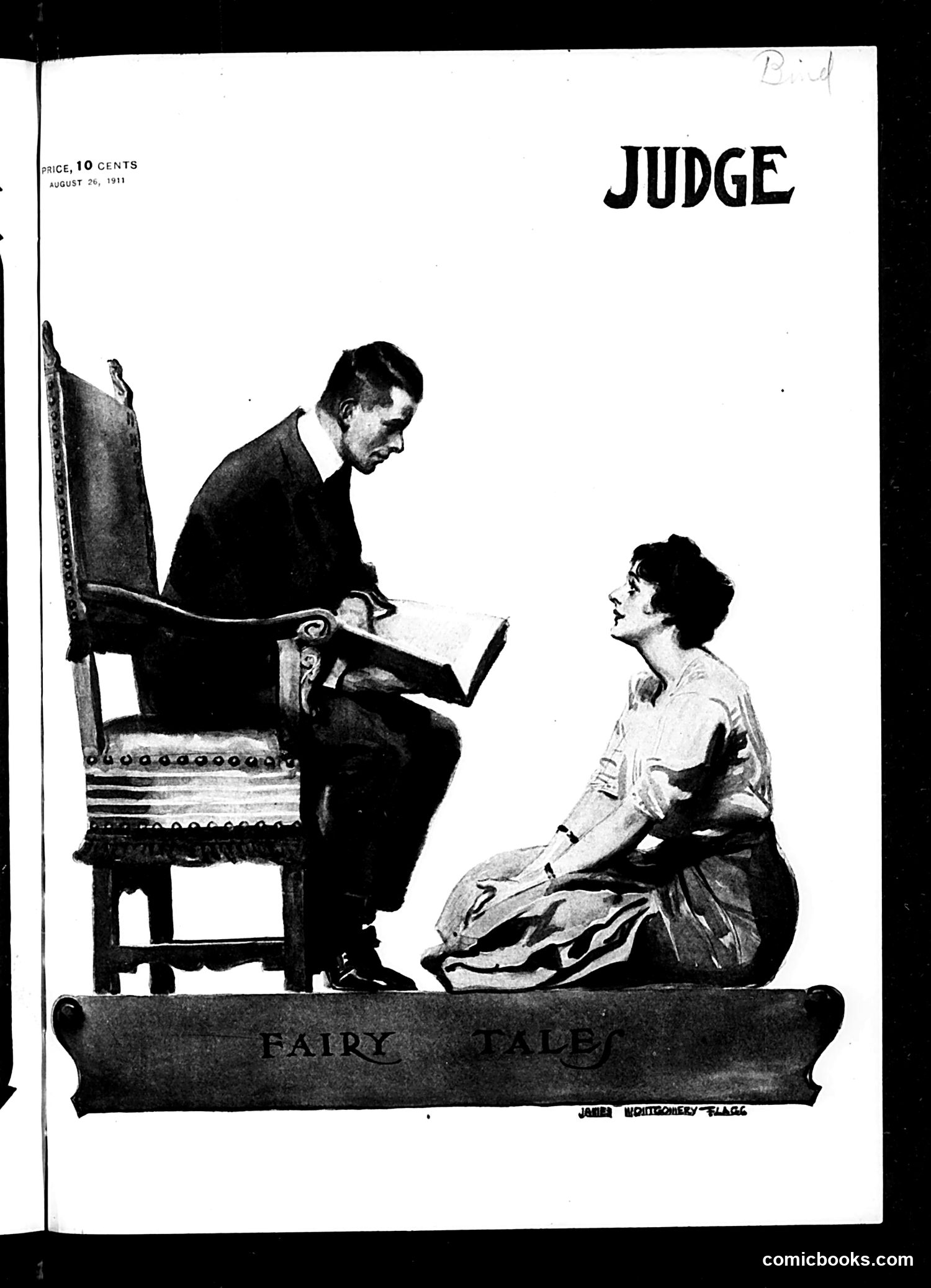
This illustration depicts a man seated in an ornate chair, appearing to read or tell a story to a woman sitting on the floor before him. The caption reads "FAIRY TALES," suggesting the man is recounting fanciful or false stories. The satire likely comments on someone in a position of authority deceiving or misleading the public with implausible claims. The woman's attentive but somewhat skeptical posture suggests she is listening to dubious narratives. Without additional context about specific 1911 political events, the exact target remains unclear, but the cartoon's theme—authority figures peddling false narratives to the gullible—was a common satirical subject in Judge magazine during this era.
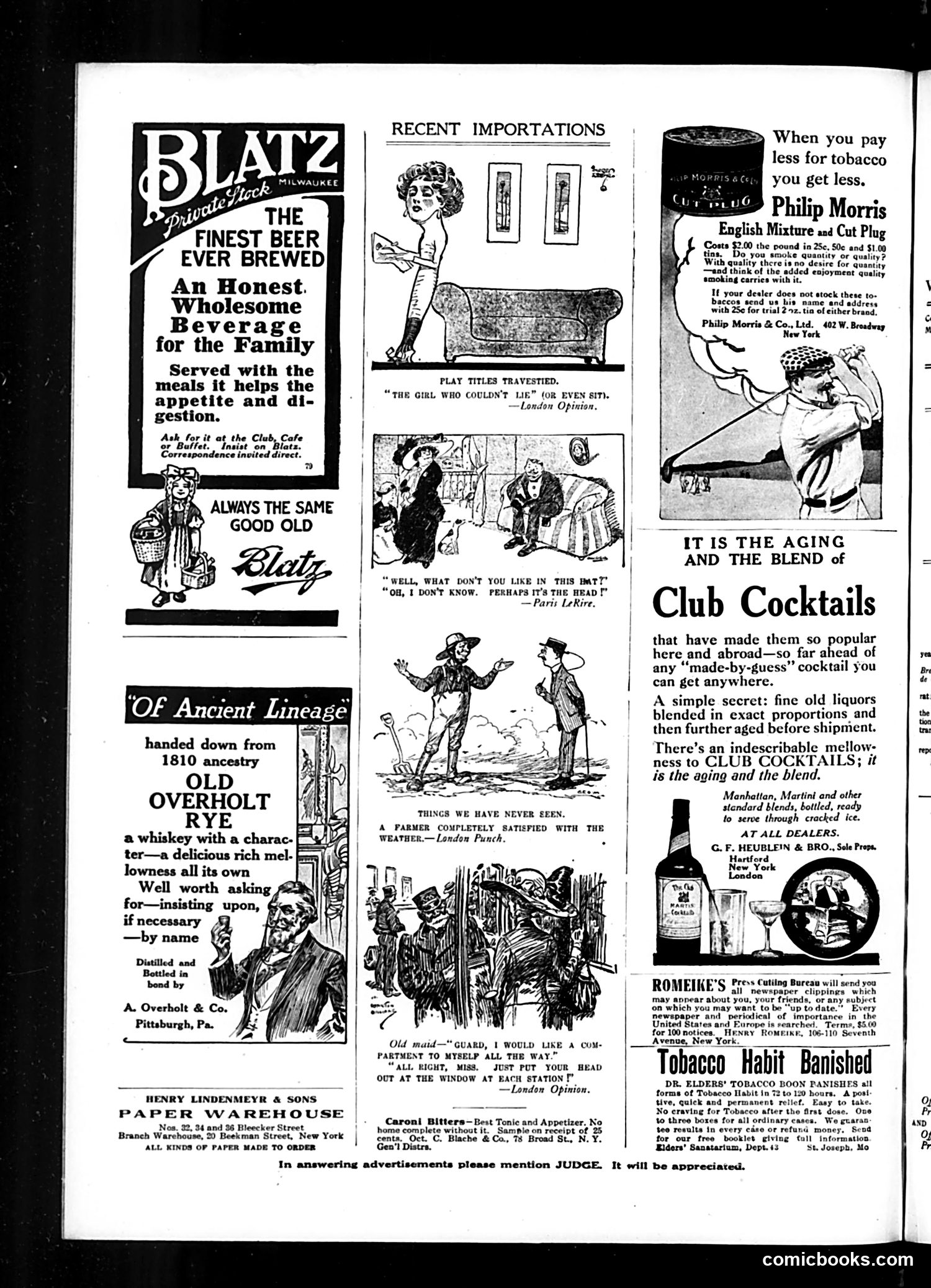
This page is **primarily advertising** with minimal editorial content. The advertisements promote alcohol and tobacco products typical of the 1920s era. The center section titled "FLAT TITLES TRAVESTIED" contains four cartoon vignettes that appear to be satirical takes on film titles, featuring domestic scenes with humorous captions. The cartoons mock popular movies through situations like a couple arguing about furniture ("Well, what don't you like in this flat?") and slapstick scenarios, though the specific film references are unclear without additional context. The surrounding advertisements promote Blatz beer, Old Overholt Rye whiskey, Philip Morris tobacco, Club Cocktails, and a tobacco cessation product—reflecting contemporary consumer culture and leisure activities of wealthy readers.
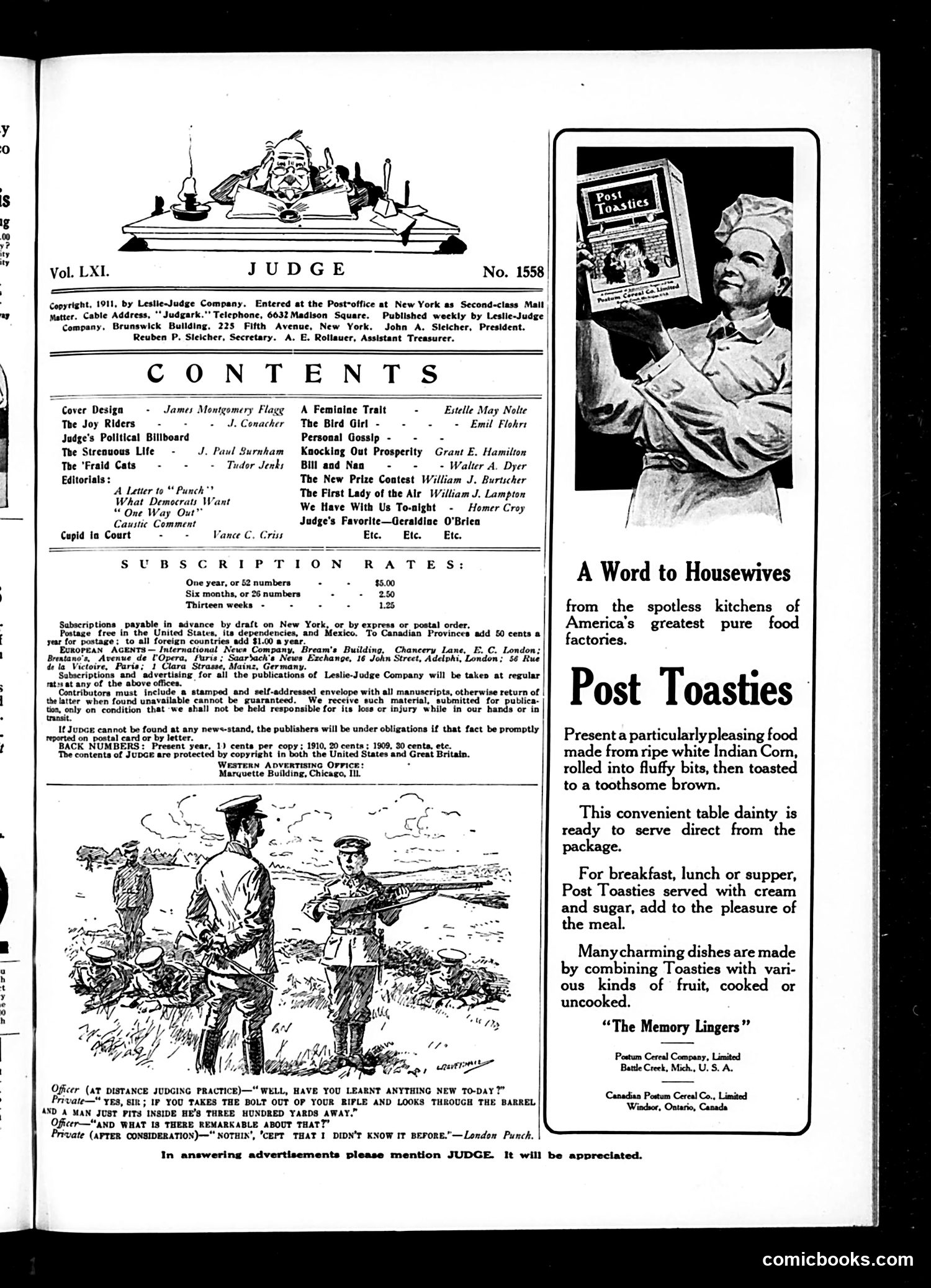
This page is primarily **advertising and table of contents** rather than political satire. The main cartoon shows three soldiers in what appears to be a WWI-era military scene, with a dialogue joke about a rifle bolt—a private asks an officer about something remarkable, the officer responds sarcastically about the bolt fitting inside the rifle barrel. The cartoon's humor relies on military incompetence or misunderstanding rather than political satire. Given the 1911 copyright date and soldiers' uniforms, this likely reflects early 20th-century American military culture. The dominant feature is a **Post Toasties cereal advertisement** featuring a housewife, representative of typical early 1900s consumer marketing targeting women as household managers.
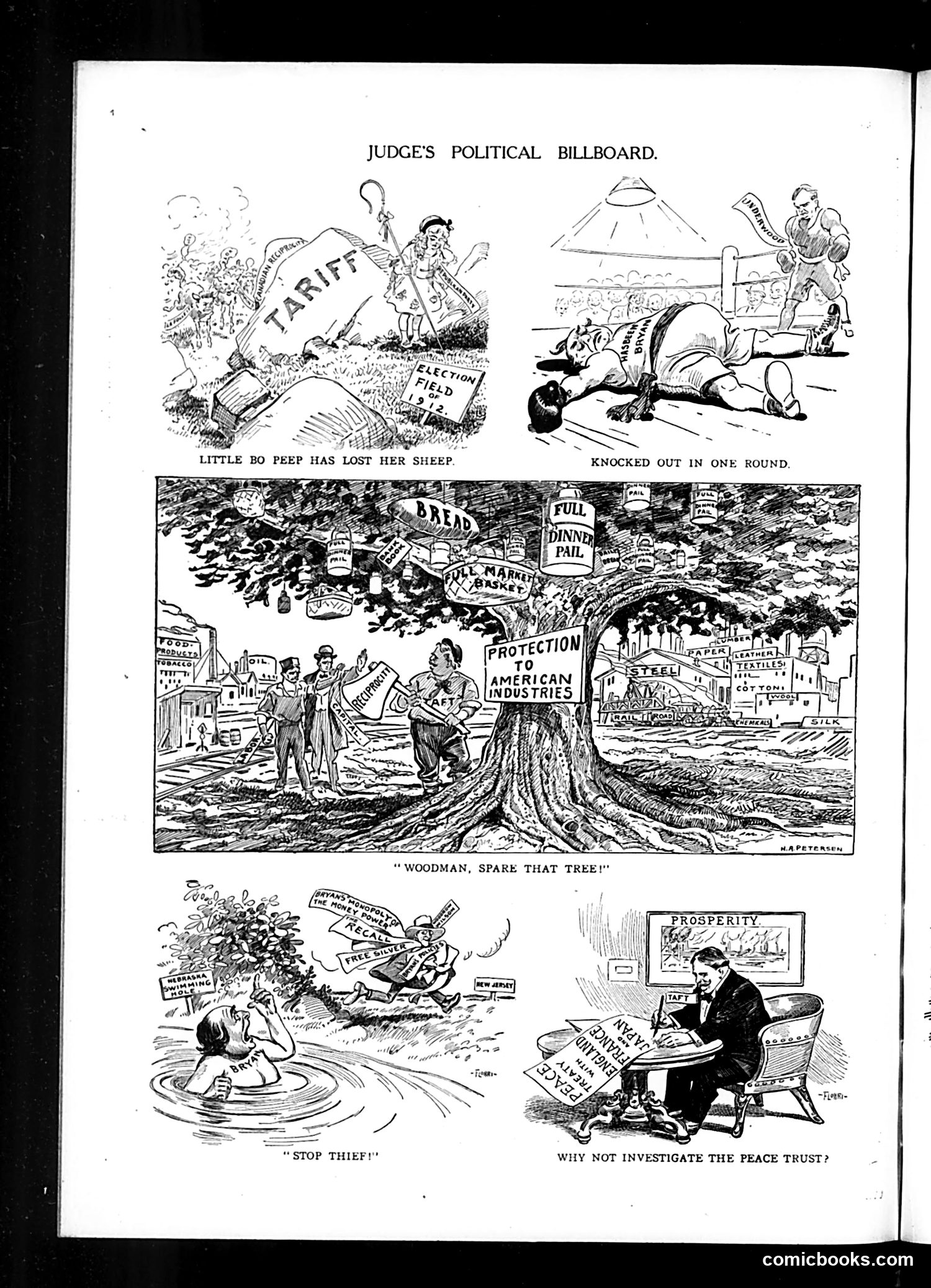
This page contains five political cartoons satirizing early 20th-century American politics: 1. **"Little Bo Peep Has Lost Her Sheep"**: A tariff (labeled "TARIFF") crushes voters in an "Election Field," suggesting protective tariffs harm ordinary citizens. 2. **"Knocked Out in One Round"**: Depicts a boxer defeated, likely referencing a political defeat or failed policy. 3. **"Woodman, Spare That Tree!"**: A massive tree labeled "Protection to American Industries" is being cut down by politicians while workers and factories suffer, satirizing the destruction caused by abandoning protective tariffs. 4. **"Stop Thief!"**: A figure drowns amid swirling chaos, symbolizing economic turmoil. 5. **"Why Not Investigate the Peace Trust?"**: Questions why government investigates industrial monopolies but ignores the "Peace Trust," suggesting political hypocrisy in enforcement.
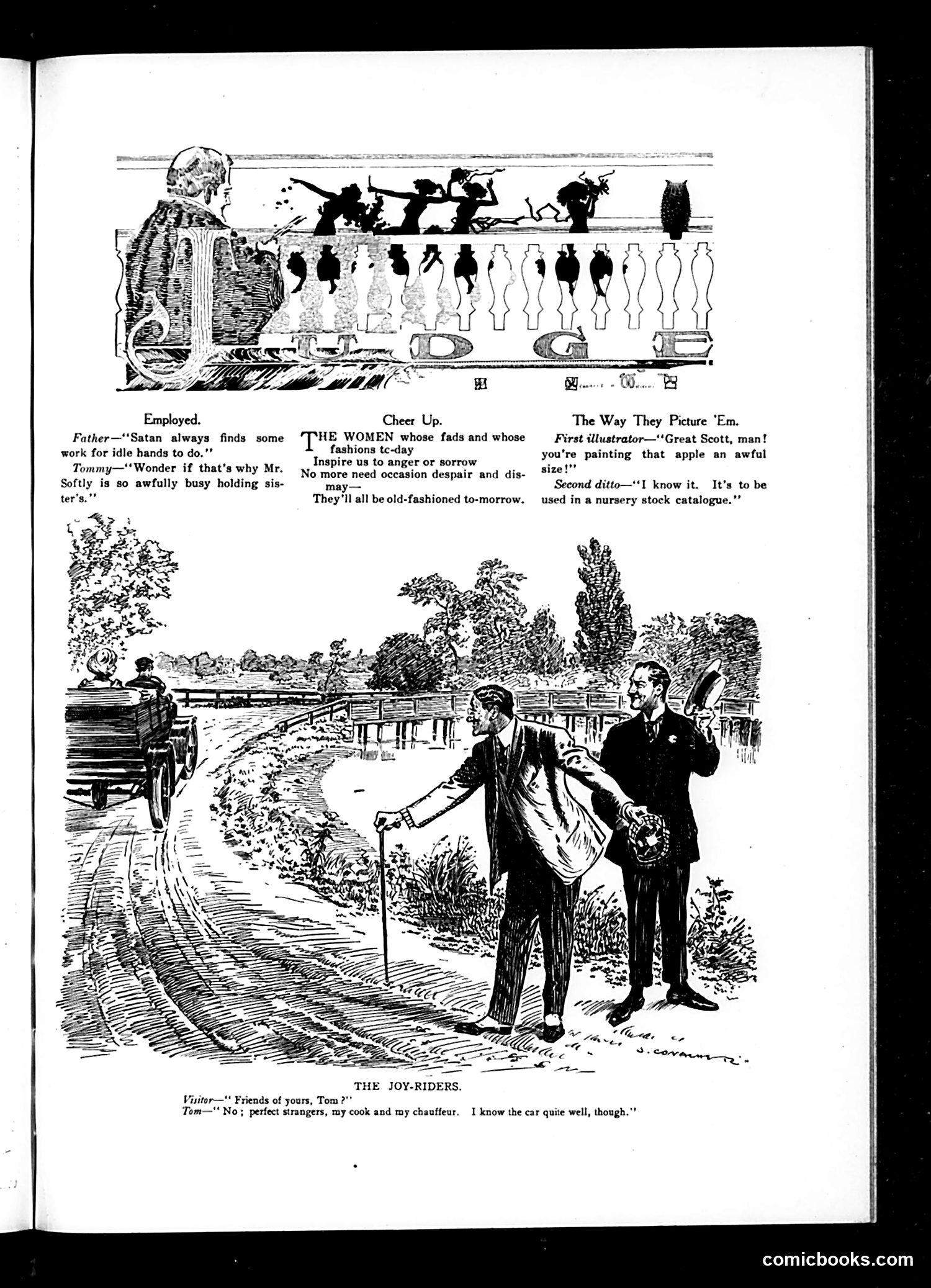
This page contains three separate satirical comics: **Top cartoon ("The Women Whose Fads"):** Mocks women's fashion trends as frivolous and cyclical, suggesting ladies' fashions change constantly between "sorrow" and "old-fashioned" styles. References a "nursery stock catalogue," implying women are catalogued like merchandise. **Bottom cartoon ("The Joy-Riders"):** Shows two men with a car and chauffeur. A visitor mistakes them for "perfect strangers," but Tom reveals they're actually his cook and chauffeur—suggesting the wealthy casually treat working-class employees as disposable companions for leisure activities. The joke satirizes class attitudes and automobile culture's novelty among the wealthy. Both comics reflect early 20th-century American anxieties about consumerism, class divisions, and changing social behavior.
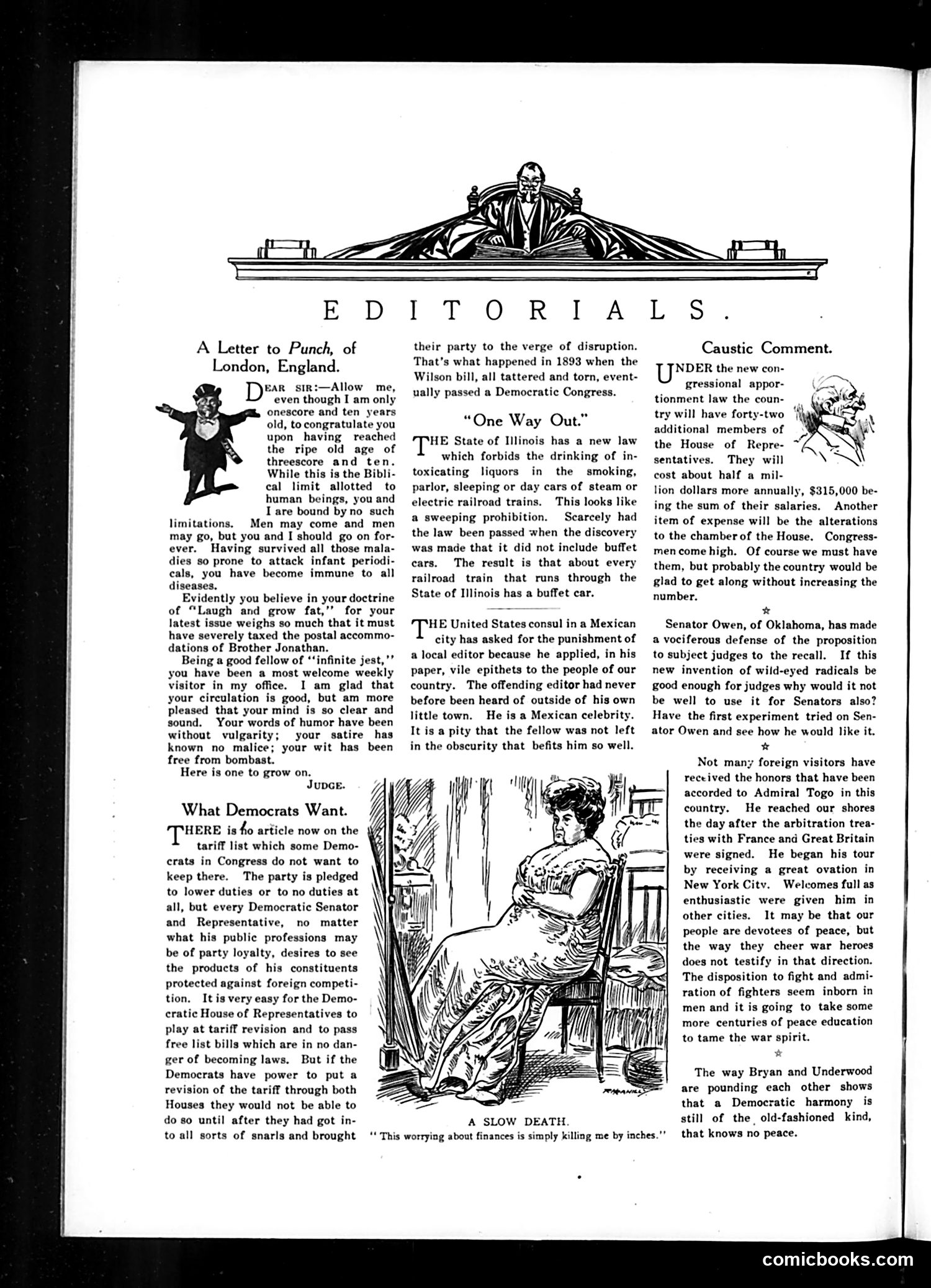
This page contains political editorials and satirical commentary from an early 20th-century American humor magazine. The main cartoon, "A Slow Death," depicts a woman worrying about finances, illustrating the editorial's point about financial anxiety. The editorials mock Democratic Party hypocrisy on tariffs—claiming to support free trade while protecting their constituents' industries—referencing the failed 1893 Wilson tariff bill. Another piece ridicules an Illinois prohibition law that accidentally exempted buffet cars from the drinking ban, making the law meaningless. "Caustic Comment" sarcastically criticizes congressional expansion (adding 42 representatives), noting the expense while accepting it as necessary. It also mocks Senator Owen's support for judicial recall, questioning why this "wild-eyed radical" idea shouldn't apply to senators too. The tone throughout is skeptical of political rhetoric and governmental inefficiency—typical of Judge's satirical approach to American politics and society.
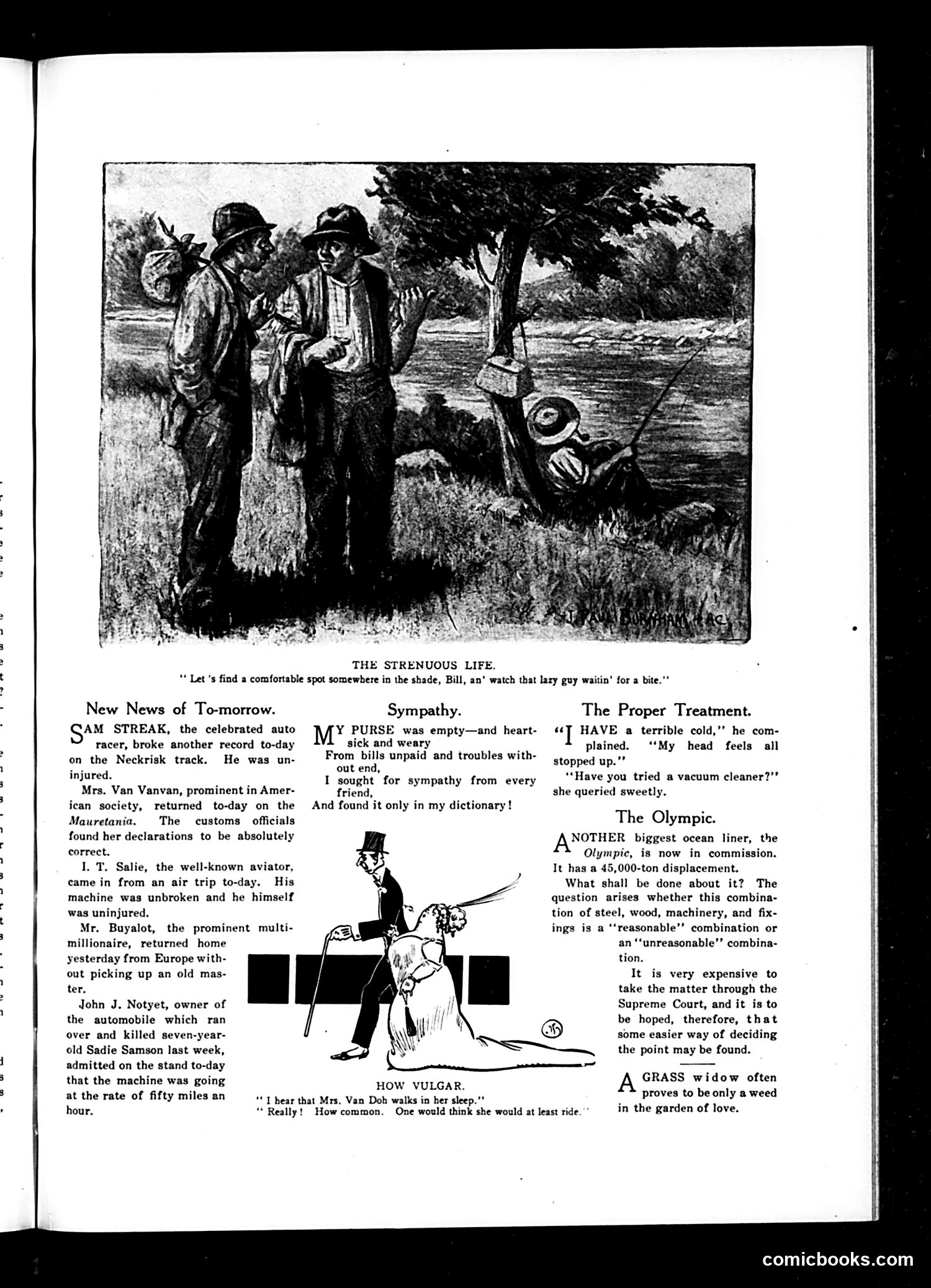
This page contains several brief satirical items mocking the era's wealthy elite and contemporary absurdities: **"The Strenuous Life"** cartoon depicts fishermen—the title likely references Theodore Roosevelt's famous phrase about vigorous living—ironically watching lazily while waiting for fish to bite. **"New News of To-morrow"** section includes society gossip: Sam Streak (auto racer), Mrs. Van Vanvan (society matron), aviator I.T. Salie, and millionaire Buyalot—all appearing in humorous, likely fabricated "news" items. The humor targets wealthy individuals' trivial pursuits and vanity. **"How Vulgar"** cartoon mocks Mrs. Van Doh, suggesting a sleeping woman who walks should at least ride (implying laziness or status-seeking behavior). Other items mock sympathy-seekers, suggest vacuum cleaners cure colds (absurd medical advice), and comment on the new Olympic ocean liner's legal liability. The satire throughout targets Gilded Age excess, social pretension, and contemporary anxieties about technology and wealth.
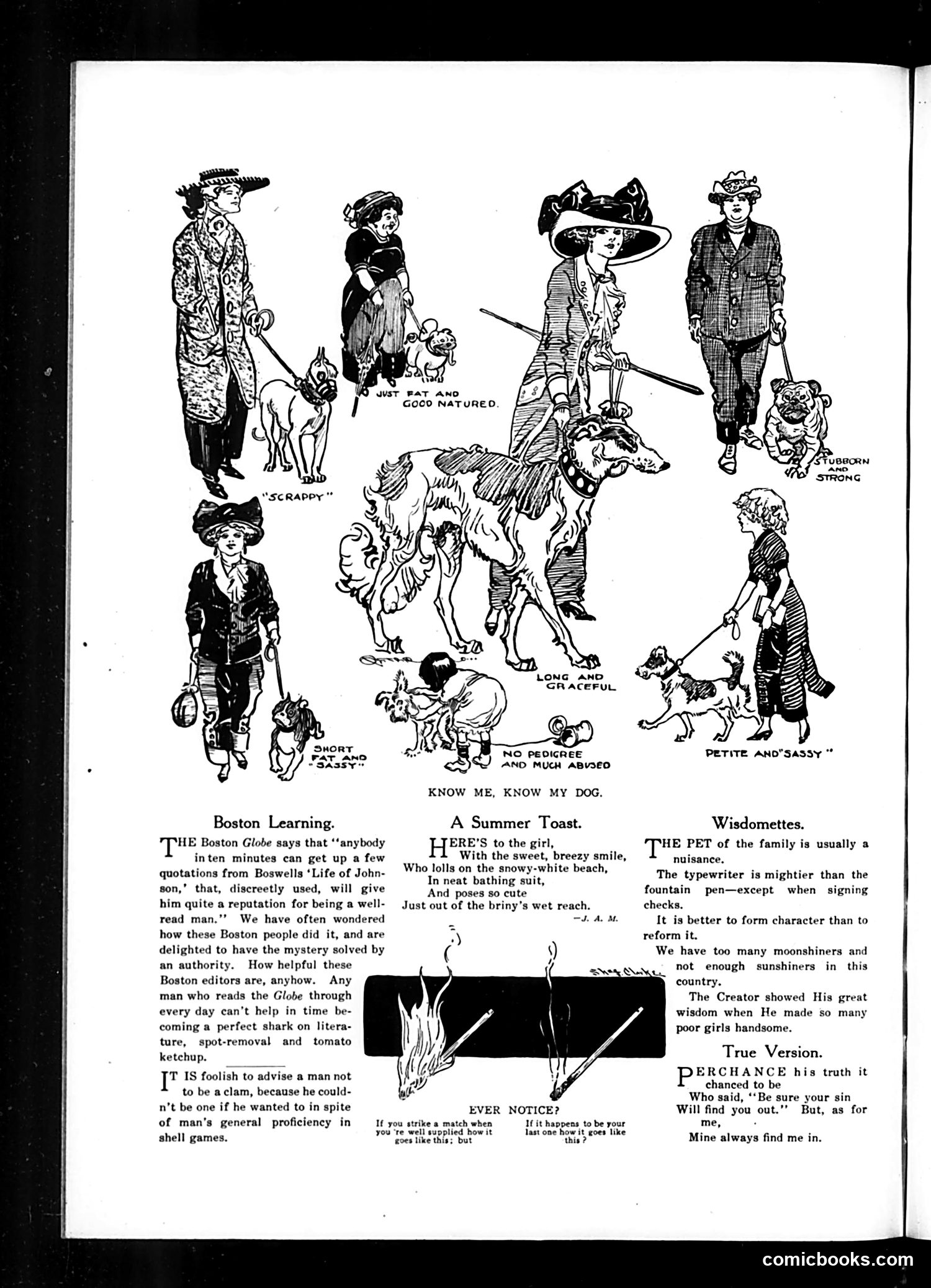
This page from *Judge* magazine combines several satirical pieces mocking contemporary American culture and attitudes. The top illustration, "Know Me, Know My Dog," depicts various women of different social classes walking dogs, each captioned with character types ("Scrappy," "Just Fat and Good Natured," etc.). The satire targets how people's pets supposedly reflect their owners' personalities and social status—a commentary on both pretension and class consciousness in early 20th-century society. The text sections are brief philosophical jabs: "Boston Learning" mocks the Boston Globe's suggestion that readers can gain a reputation for erudition by memorizing Boswell's Johnson biography. Other short pieces mock human nature—the foolishness of offering certain advice, observations about matches and beach-goers. "Wisdomettes" offers cynical observations about family pets, typewriters, and morality. "True Version" subverts the biblical saying about sin finding you out, suggesting the author's sins find him "in" (at home, or inward). Overall, the page targets social pretension, journalistic mediocrity, and human hypocrisy through light satire and observational humor typical of *Judge's* style.
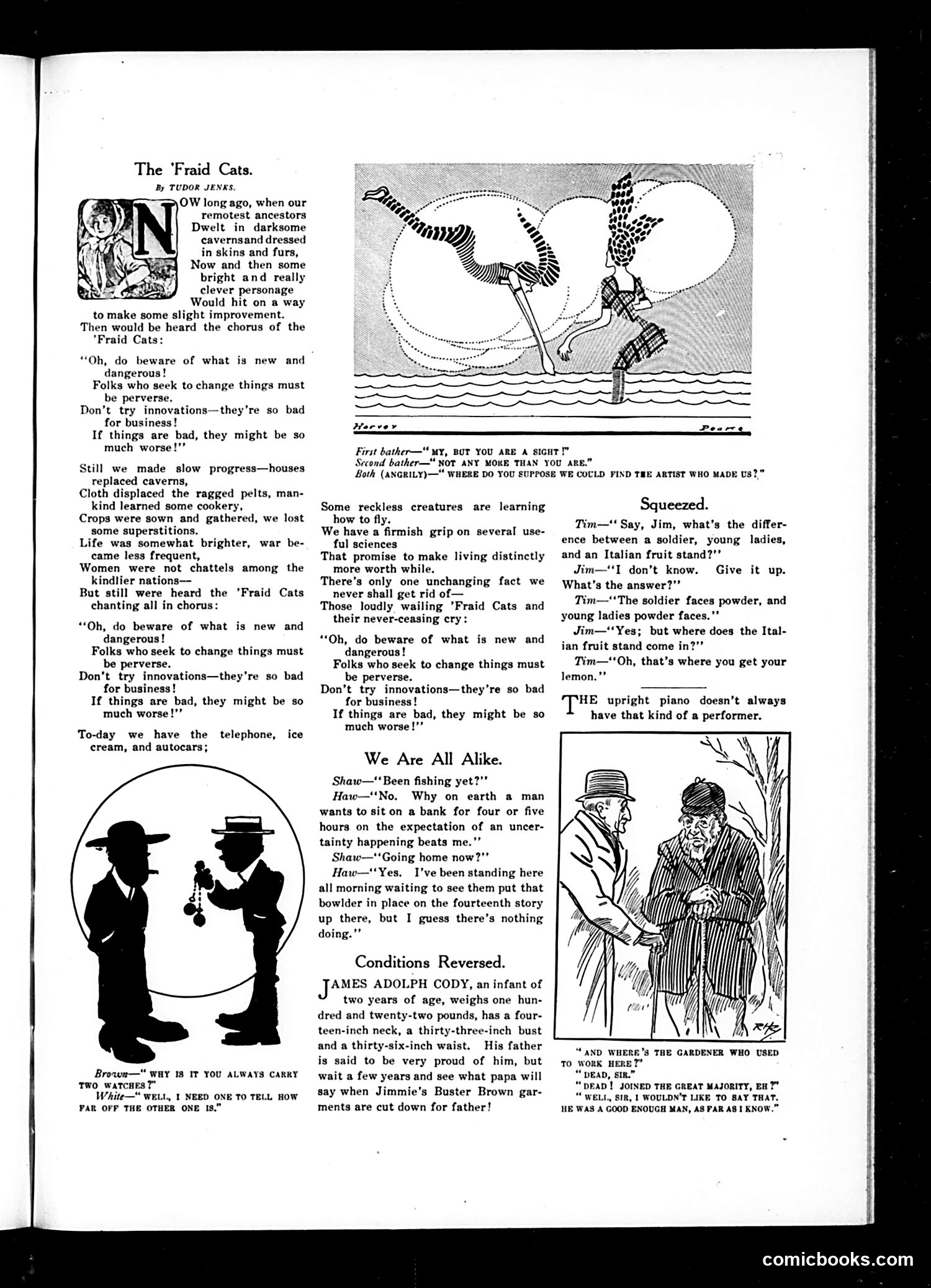
This page satirizes conservatives who reflexively oppose all change and innovation. The main piece, "The 'Fraid Cats" by Tudor Jenks, presents a recurring chorus of naysayers throughout human history, from cavemen to the modern era (telephone, ice cream, automobiles), always chanting warnings against "new and dangerous" ideas and innovations. The satire's point: progress has *always* happened despite these fearmongers, yet they never learn. Each generation produces the same predictable resistance. The piece mocks both the irrationality of blanket opposition to change and the self-serving claim that innovation is "bad for business." The secondary cartoons employ other humor styles (wordplay, absurdism) but aren't overtly political. They appear filler content typical of Judge magazine's satirical-humor format rather than social commentary with specific targets.
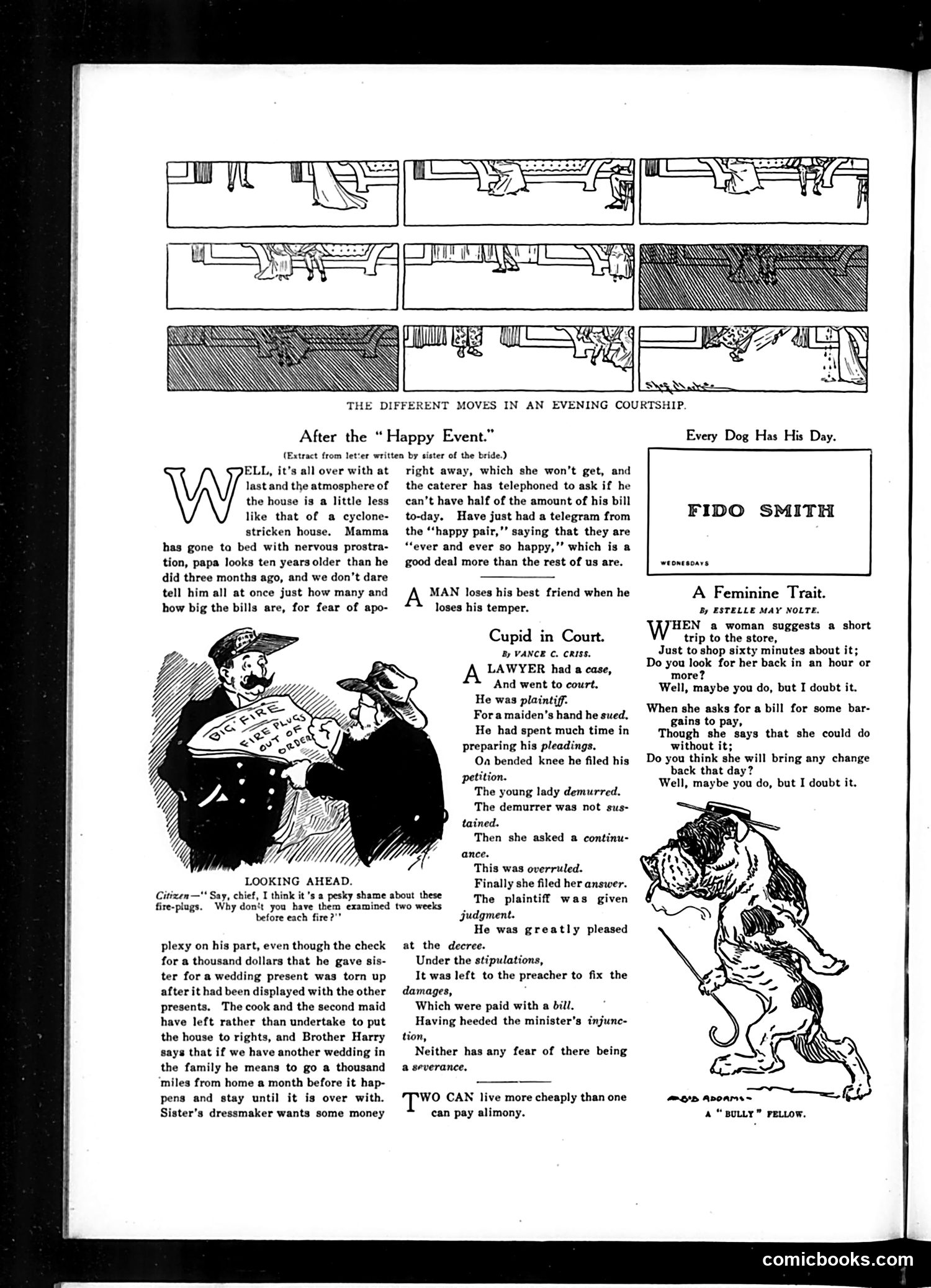
This page contains multiple satirical pieces on marriage and relationships, reflecting early 20th-century domestic humor: **"After the Happy Event"** mocks the financial and domestic chaos following a wedding. The extract presents the bride's sister's letter describing exhausted parents, departed servants, and unpaid bills—satirizing how expensive and disruptive weddings were, even for the wealthy. **"Cupid in Court"** is a clever legal pun where courtship is described using courtroom terminology (plaintiff, demurrer, stipulations). The joke plays on "court" meaning both legal proceedings and romantic pursuit, with marriage ending in the preacher "fixing damages" via a bill—suggesting wives are costly. **"A Feminine Trait"** mocks women's shopping habits, suggesting they claim short errands but take hours and don't return change—a common domestic stereotype of the era. Minor pieces include "Fido Smith" (a dog's name) and "A Bully Fellow" cartoon. The page reflects Judge's satirical focus on marriage's financial burden and gender stereotypes common to that period.
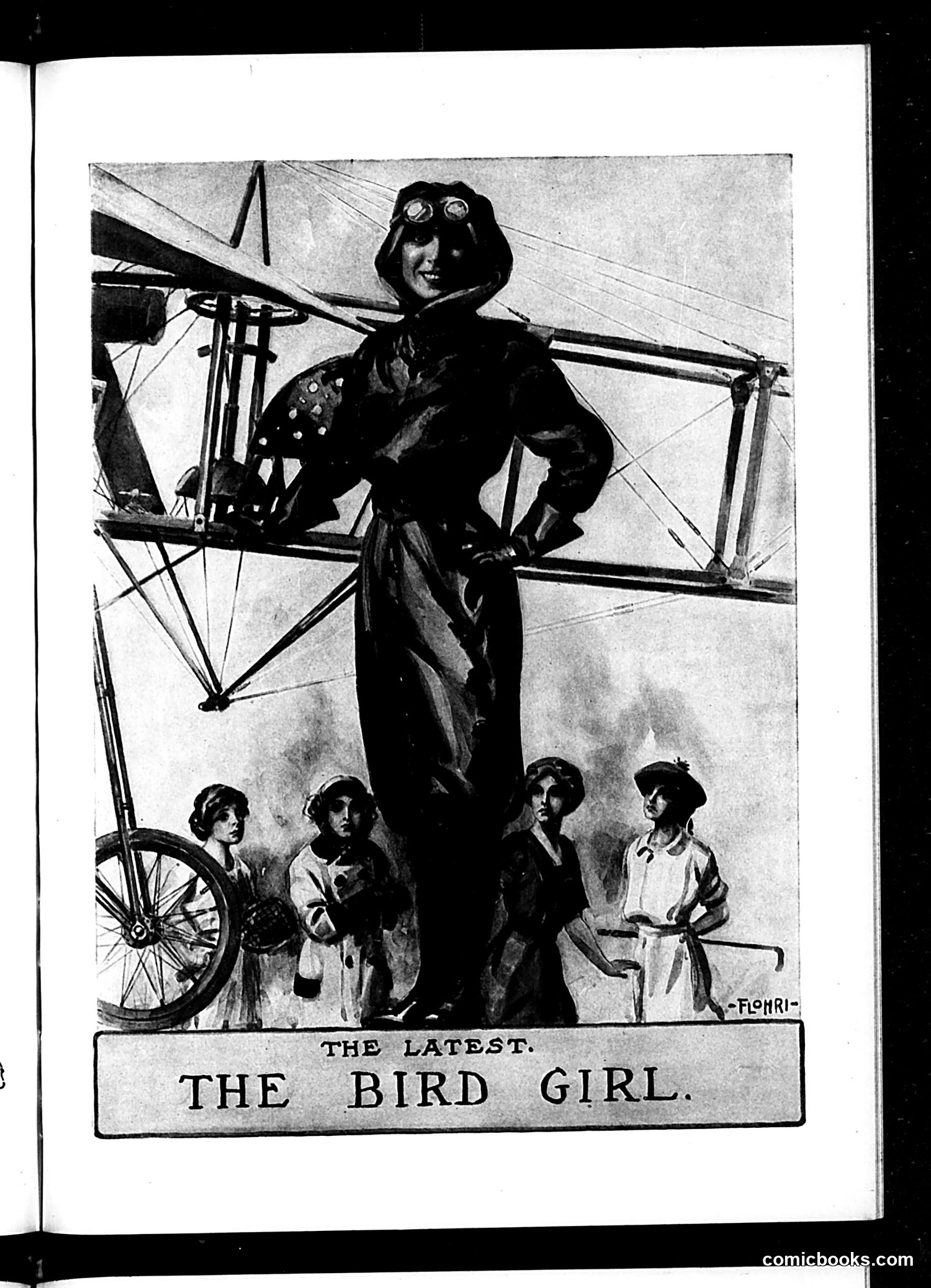
This illustration depicts "The Bird Girl," labeled as "the latest" fashion or novelty. A tall female figure wearing aviator goggles and a studded leather outfit stands elevated, holding what appears to be aircraft framework or wings. Below her stand four smaller figures—likely children—gazing upward in admiration or wonder. The satire appears to mock emerging early 20th-century fascinations: aviation's rapid development and the era's "New Woman" who defied traditional roles. The exaggerated scale and exotic costume suggest ridicule of both modern aviation enthusiasm and women adopting unconventional, masculine-coded pursuits like flying. The children's rapt attention implies concern about these "latest" trends influencing youth, making this social commentary on rapid technological and cultural change.
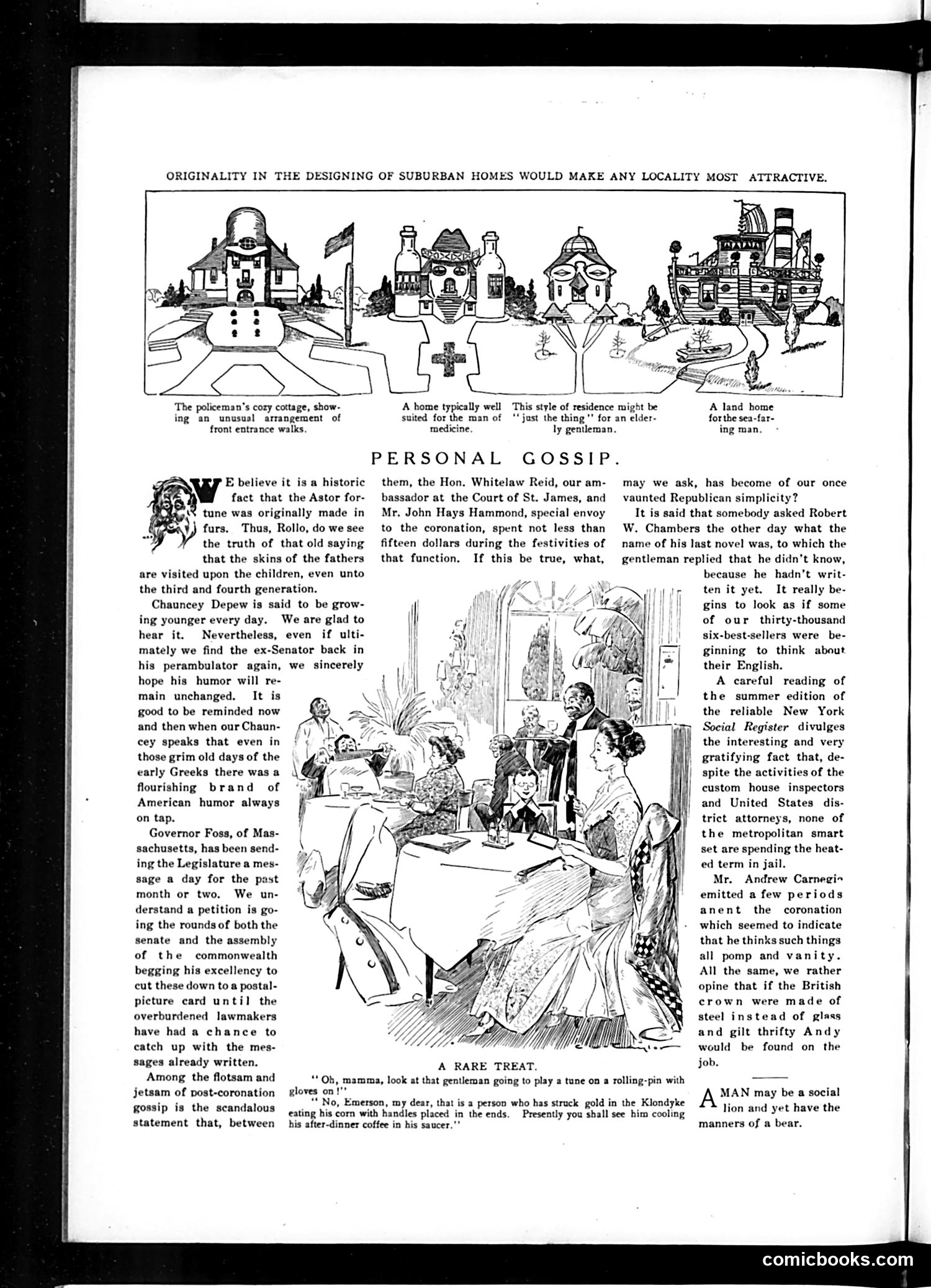
This page contains architectural satire and society gossip typical of Judge's humor circa the early 1900s. **Top Section:** Four whimsical suburban home designs mock pretentious American architectural trends. Each absurd structure (policeman's cottage with unusual walks, doctor's mansion, elderly gentleman's residence, sea captain's land-house) satirizes how wealthy Americans blindly copied European styles without originality. **"Personal Gossip" Section:** Satirizes wealthy elites and public figures: - References to **Ambassador Whitelaw Reid** and **John Hays Hammond** spending lavishly at coronation festivities, mocking Republican hypocrisy about "simplicity" - Jabs at **Chauncey Depew** (aging politician humorously getting younger) - **Andrew Carnegie's** coronation commentary criticized as hypocritical vanity - Mockery of prolific but forgetful novelist **Robert W. Chambers** - Social Register gossip about wealthy criminals escaping prosecution **Bottom Cartoon:** A woman mistakes a wealthy Klondike gold-striker eating corn with gold-handled implements for someone playing a tune on a rolling-pin—satirizing nouveau-riche absurdity and pretentious wealth displays.
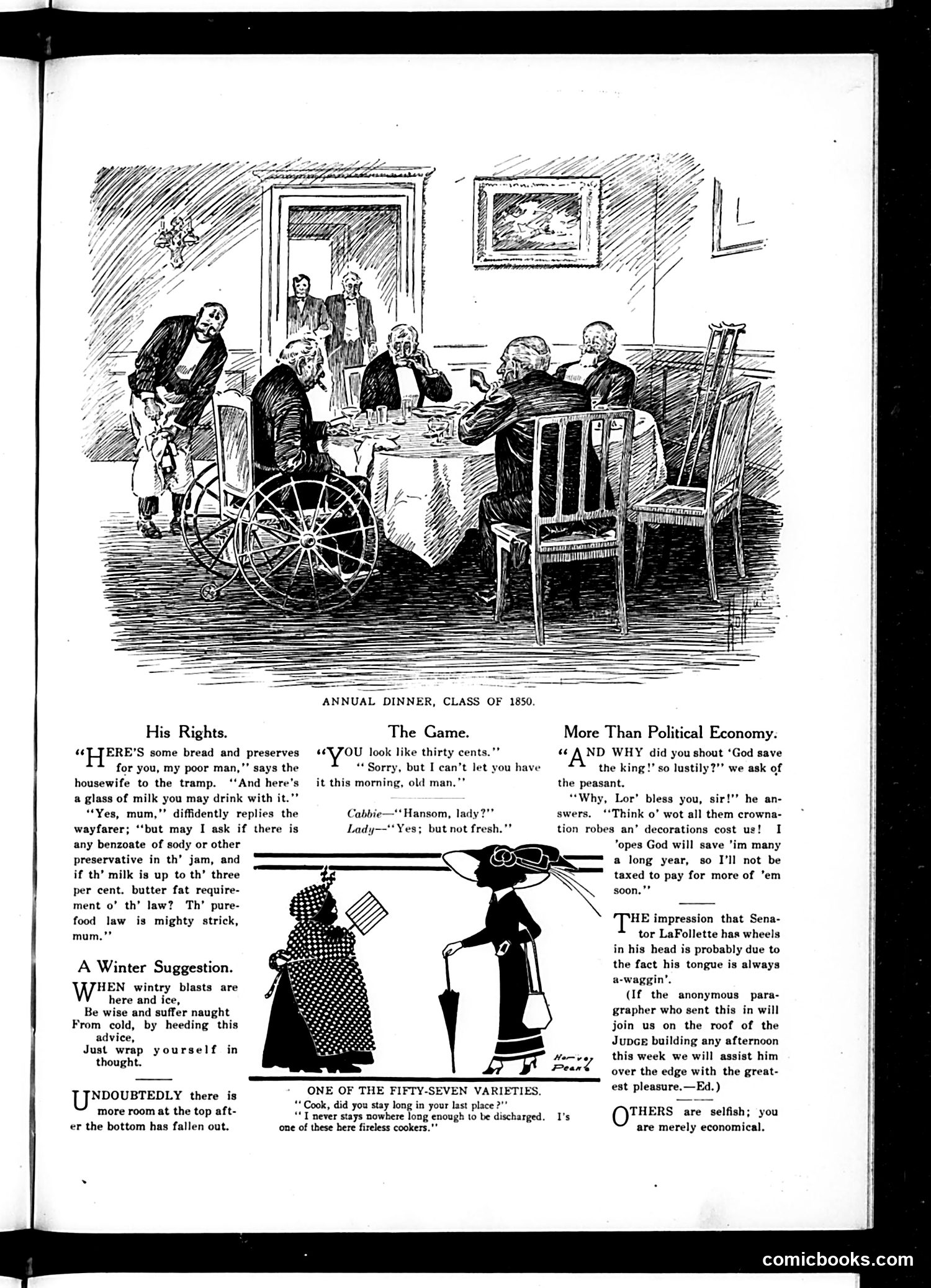
This satirical page from Judge (circa 1850, based on "Annual Dinner, Class of 1850") contains several disconnected humor pieces mocking contemporary social concerns: **"His Rights"** ridicules a tramp who, when offered charity by a housewife, pedantically questions whether the jam contains benzoate of soda and whether the milk meets legal butter-fat requirements. The joke: poor people anxiously citing food-purity laws while accepting charity—absurd pretension in desperation. **"The Game"** and **"One of the Fifty-Seven Varieties"** are brief dialogue jokes about haggling and job-hopping. **"More Than Political Economy"** satirizes a peasant's fervent patriotism, revealed to be self-interested: he cheers the king loudly hoping the monarch lives long so he won't be taxed for another coronation's expenses. **Senator LaFollette** reference mocks the Progressive politician's constant speechmaking ("tongue is always a-waggin'"), using a crude "wheels in his head" metaphor. The overall tone is cynical about human motivation—charity-seekers citing regulations, peasants feigning patriotism for tax relief, politicians as perpetual talkers.
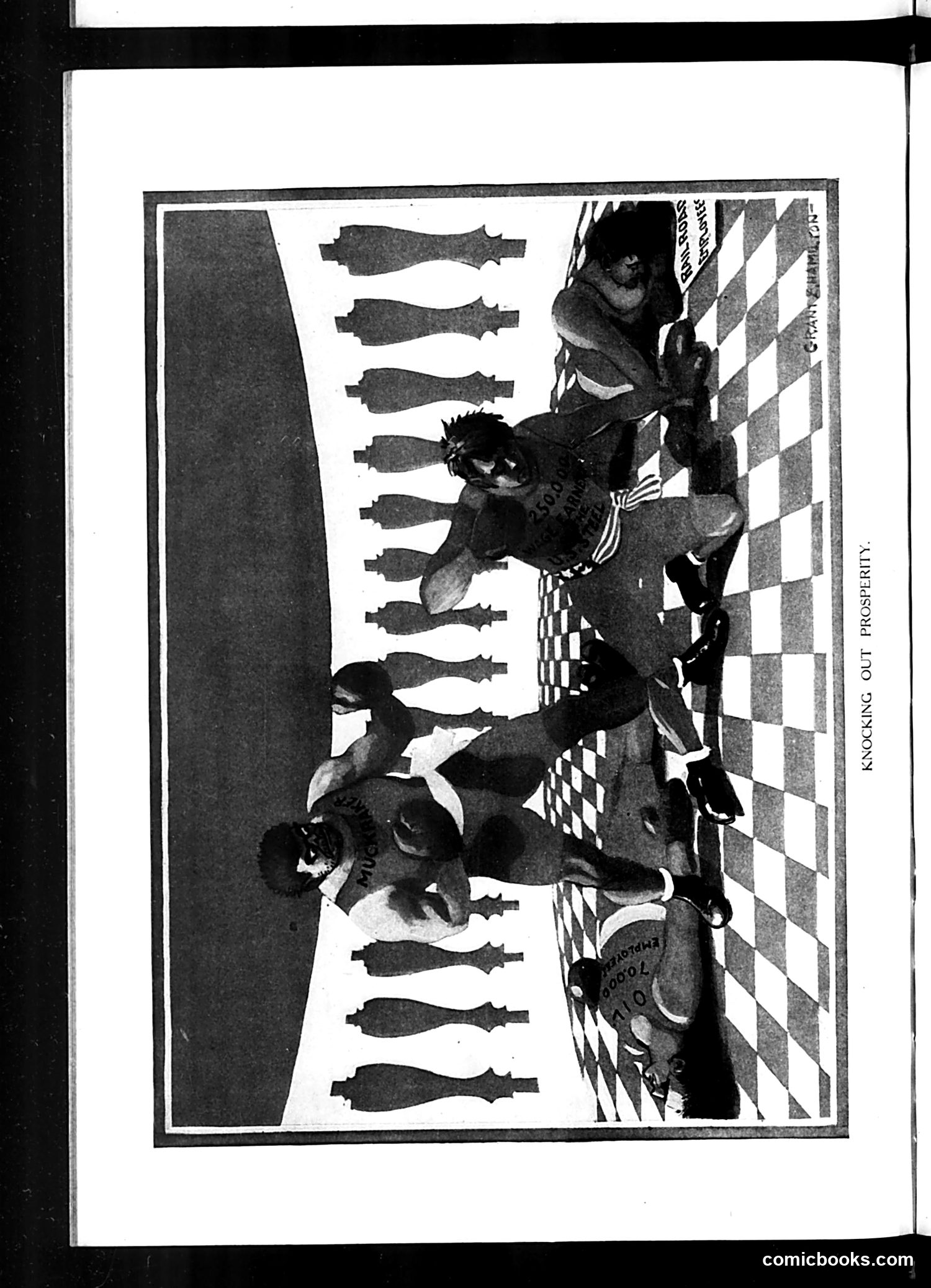
This cartoon depicts figures literally knocking out prosperity—represented by a large bag labeled "PROSPERITY"—using what appear to be bombs or ordnance shown on the left side of the image. The composition suggests political opposition or sabotage of economic conditions. The checkered pattern on the right and the American flag suggest nationalist themes. The figures' actions imply that certain political actors or policies are deliberately undermining the nation's economic well-being. Without clearer visibility of specific captions or identifiable figures, the precise political targets remain unclear, but the cartoon critiques policies or politicians perceived as deliberately harming American prosperity during what appears to be an interwar or early Cold War period based on Judge magazine's publication history.
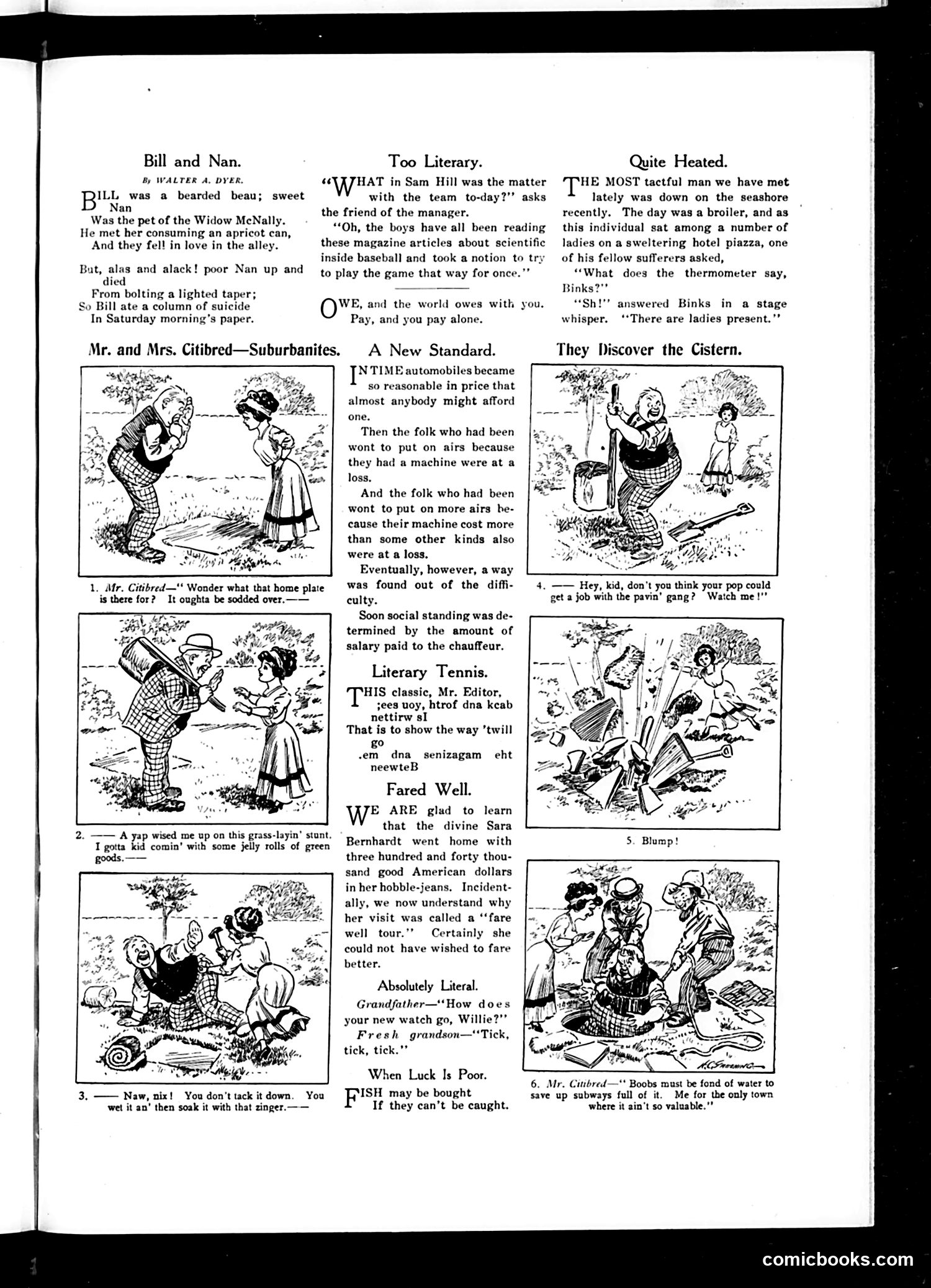
This page contains several brief humorous pieces typical of early 20th-century American satirical humor: **"Bill and Nan"** is a sentimental parody where a love story ends absurdly—the protagonist dies by consuming a newspaper column about suicide. **"Too Literary"** satirizes over-intellectualization: baseball players read scientific articles about "inside baseball" and play poorly, suggesting theory undermines practical skill. **"Quite Heated"** jokes about Victorian propriety: a tactful man avoids answering a lady's question about the thermometer's reading, treating factual discussion as improper in mixed company. **"Mr. and Mrs. Citibred"** (a 6-panel series) mocks newly wealthy suburbanites discovering a cistern on their property, hilariously mistaking it for various things and asking working-class advice about it. The remaining pieces—"A New Standard," "Literary Tennis," and others—offer brief social commentary on automobile status symbols, literary pretension, and similar contemporary concerns. The humor relies on class distinctions, malapropisms, and absurdist scenarios typical of Judge's satirical approach.
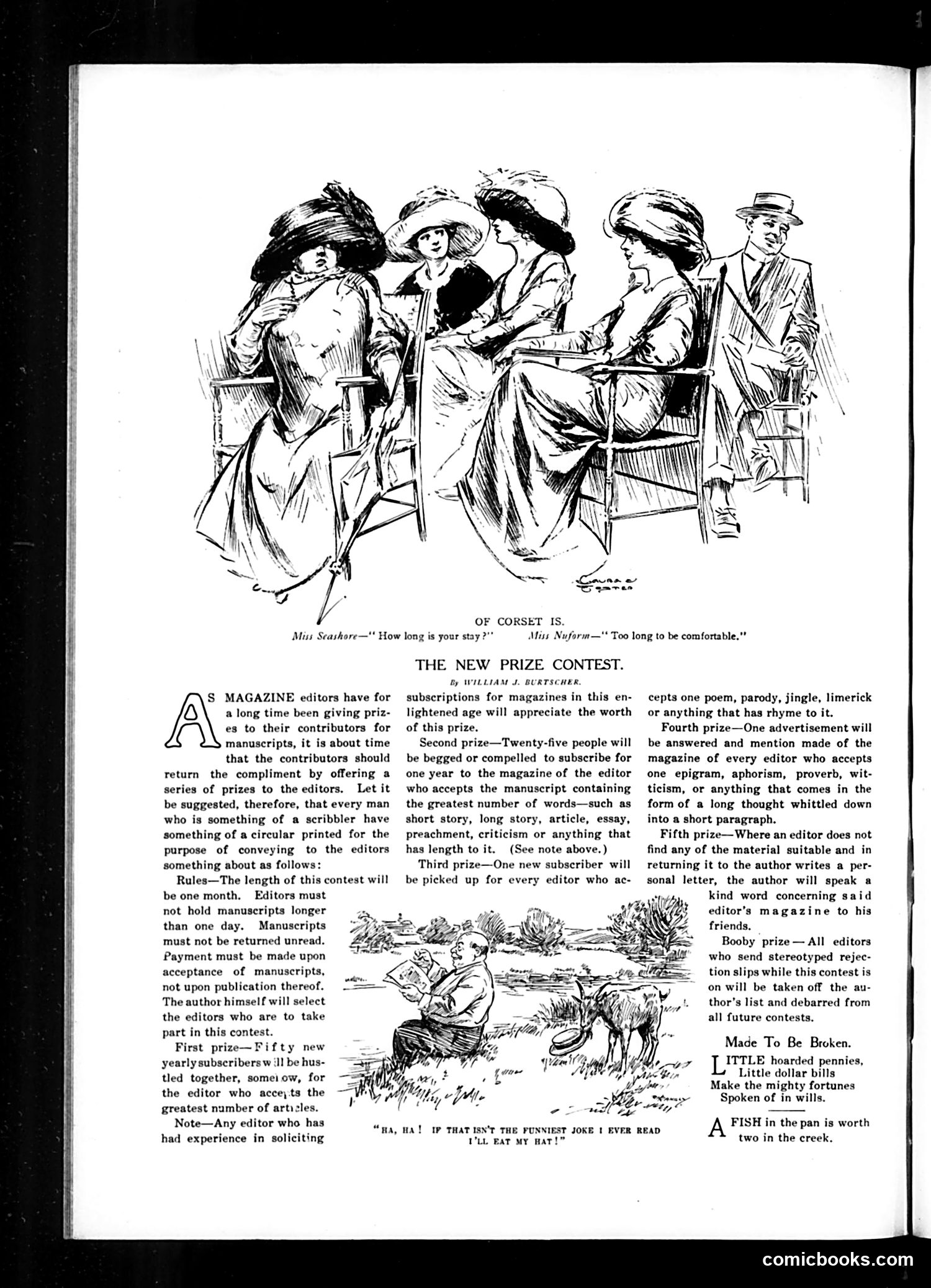
This page contains two distinct pieces of satire: **Top cartoon:** A social commentary on women's fashion, specifically corsets. Two women discuss their stays (corsets). Miss Seashore asks about duration; Miss Nuform replies hers are "too long to be comfortable"—a joke about both the physical discomfort of restrictive Victorian corsetry and the absurdity of enduring such garments. **Main article:** "The New Prize Contest" is satire directed at magazine editors. By 1900s standards, editors notoriously held manuscripts indefinitely without payment or response, while magazines offered contributors prize contests. The author proposes reversing this: editors should compete for prizes based on *how well they treat writers*—accepting manuscripts quickly, paying promptly, and avoiding form-rejection letters. The escalating prizes mock editorial stinginess: the "first prize" of fifty subscribers is presented as valuable compensation, revealing how little editors actually offered writers. The "booby prize" threatens editors using form rejections with blacklisting—satirizing their casual dismissal of aspiring authors. The satire exposes the exploitative relationship between early 20th-century magazine publishers and contributors.
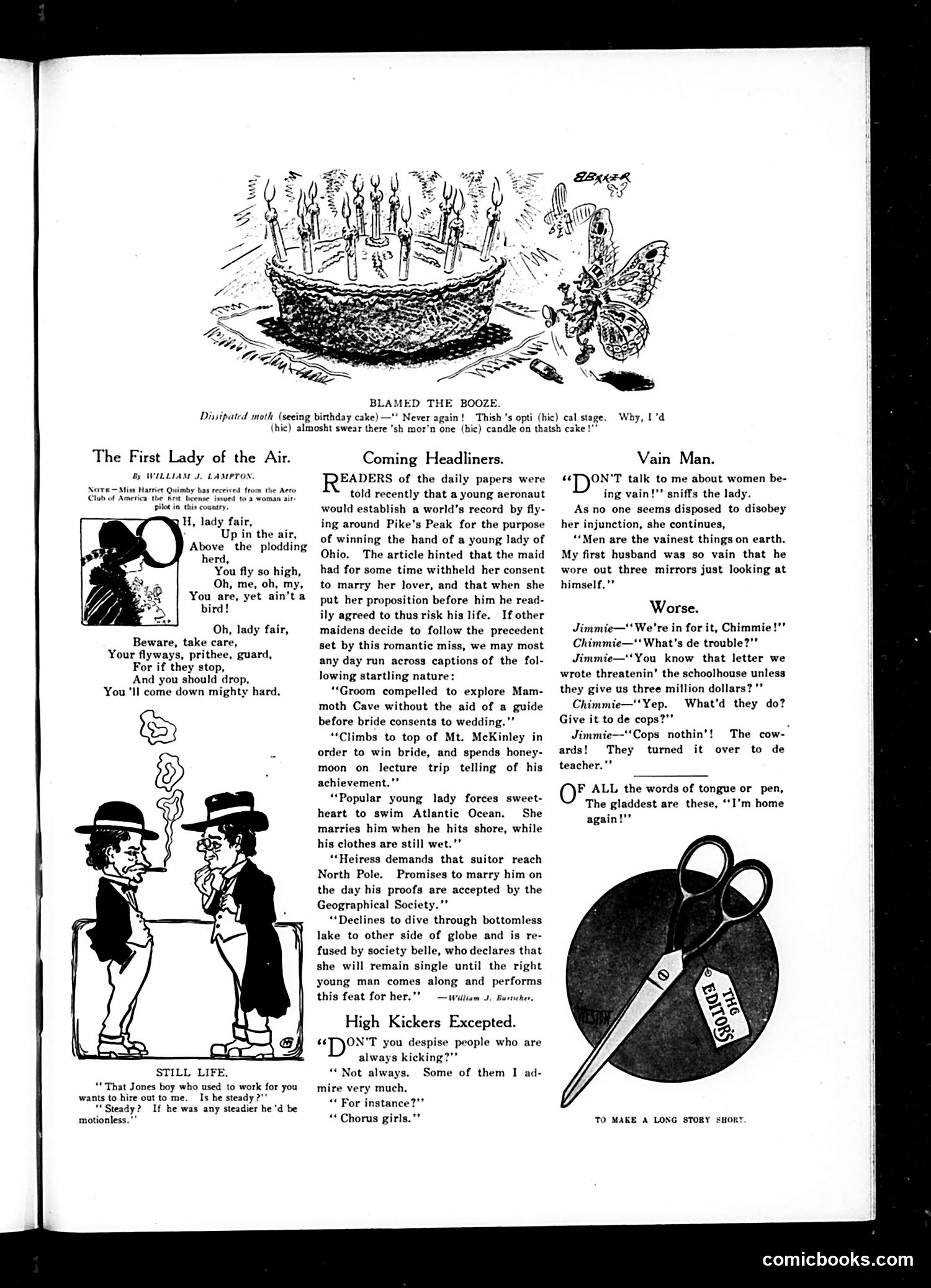
This page from *Judge* magazine contains several satirical pieces reflecting early 1900s social attitudes: **"The First Lady of the Air"** celebrates Harriet Quimby, who received the first woman pilot's license from the Aero Club of America. The poem humorously warns her about the dangers of aviation while acknowledging her achievement—the satire lies in treating flight as absurdly risky for a woman. **"Coming Headliners"** mocks romantic excess by imagining absurd stunts young men might perform to win ladies' hands (climbing Mt. McKinley, swimming the Atlantic), satirizing both courtship conventions and the era's sensationalized newspaper headlines. **"Still Life"** and other brief jokes use standard vaudeville-style humor about workplace steadiness, vanity, and domestic life. **"High Kickers Excepted"** contains a pun: "kicking" chorus girls are praised because they literally kick on stage—wordplay exploiting the double meaning. The overall tone reflects *Judge's* middle-class perspective: celebrating modern achievements (aviation) while mocking excessive romance, vanity, and social pretension through gentle satire.
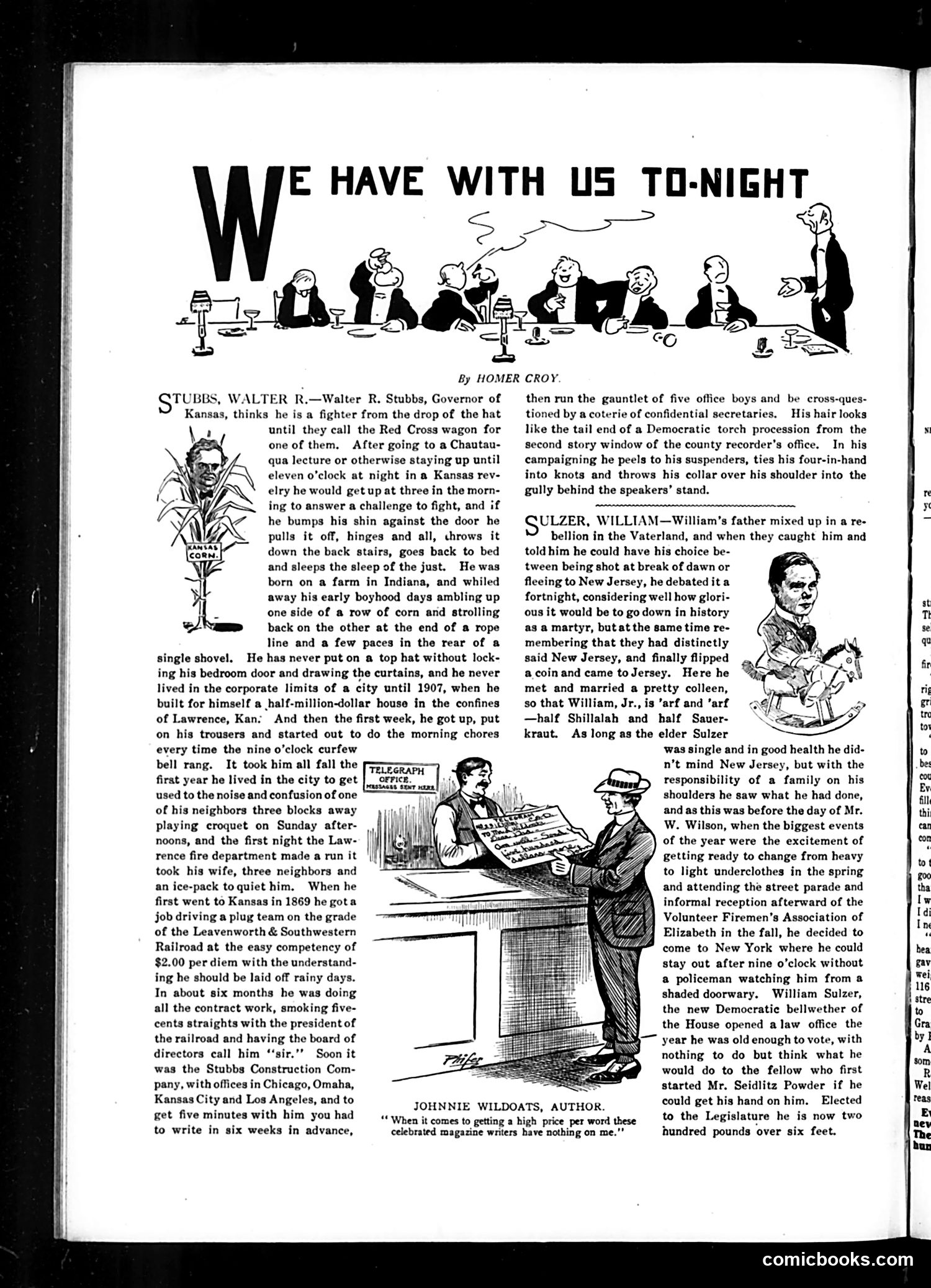
This page features **character sketches** by Homer Croy satirizing prominent political figures of the era (likely early 1900s). **Walter R. Stubbs** (Governor of Kansas) is mocked for being a performative tough guy—quick to fight over trivial matters yet easily spooked by urban noise, unable to adjust from his rural Indiana farm background despite building wealth through his construction company. The satire targets his crude, unsophisticated persona and exaggerated machismo. **William Sulzer's** entry ridicules his German-Irish immigrant heritage as an inherent contradiction ("'arf and 'arf—half Shillalah and half Sauerkraut"). His father supposedly chose fleeing to New Jersey over martyrdom, a humorous commentary on immigrant priorities. The top banner illustration depicts these figures at an informal gathering, suggesting this is from Judge's recurring feature introducing notable contemporaries through biographical caricature. The satire emphasizes class mobility, cultural assimilation struggles, and performative public personas—typical Judge magazine targets of the Progressive era.
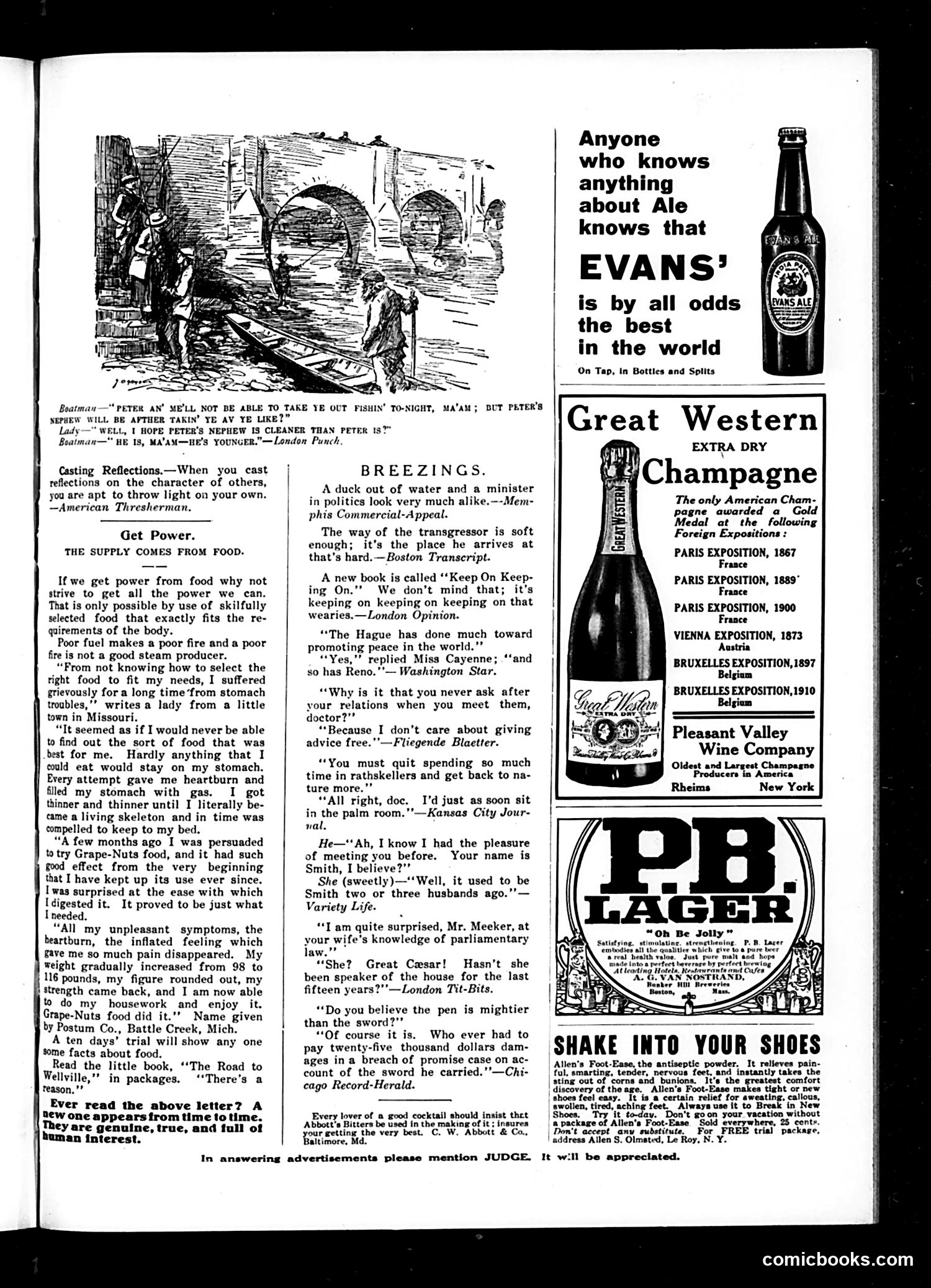
This page from *Judge* is primarily composed of advertisements and humorous short jokes (typical *Judge* filler content) rather than political cartoons. The main cartoon at top left depicts a boatman and lady discussing fishing plans, with a visual gag about the boatman's nephew being "cleaner" and "younger" than the boatman himself—a working-class humor joke about hygiene and age. Below are "Breezings"—brief satirical quips on various topics. Notable ones mock political ineffectiveness (The Hague's peace efforts), divorce culture (Reno competing with The Hague), marital dynamics, and parliamentary procedure. One joke uses "speaker of the house" as a domestic pun about a bossy wife. The page's bulk consists of advertisements for foods (Grape-Nuts), beverages (Evans' Ale, champagne, P.B. Lager), and medicinal products (Allen's Foot-Ease), reflecting early 1900s consumer culture marketing. The content reflects general social attitudes rather than specific political events—typical light satirical material meant to entertain *Judge*'s middle-class readership.
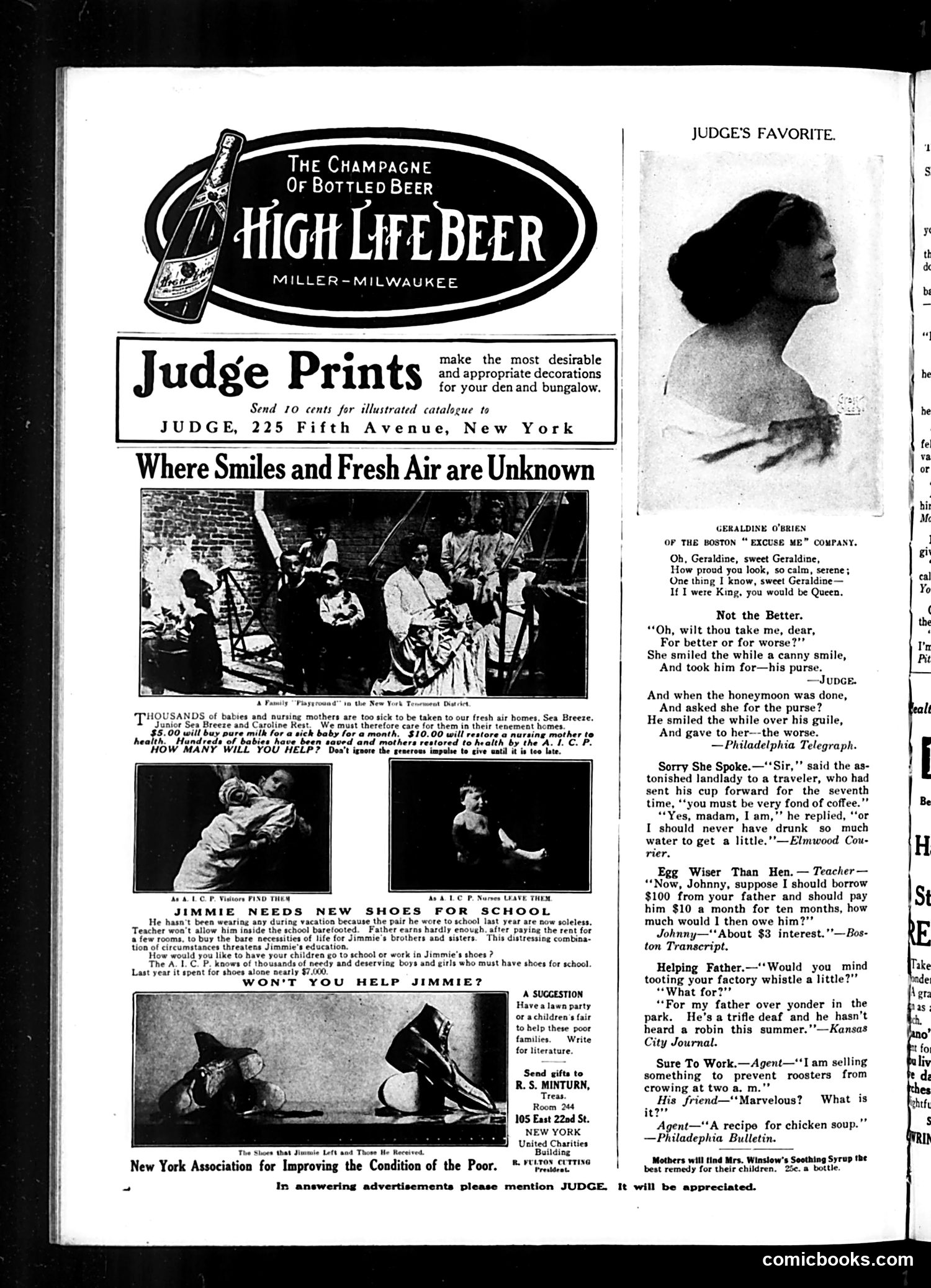
This page is primarily **charitable advertising and humor columns**, not political satire. **Main Content:** The page features appeals from the New York Association for Improving the Condition of the Poor, highlighting child poverty in tenement districts. One ad asks readers to help "Jimmie" buy school shoes ($7,000 was spent on shoes the previous year). Another promotes fresh-air programs for sick babies and mothers—reflecting Progressive Era charitable concerns about urban poverty and public health. **Right Column ("Judge's Favorite"):** Contains light humor pieces, including jokes about marriage, coffee, education, and farm life. One piece celebrates actress Geraldine O'Brien. The humor is gentle domestic comedy rather than political commentary. **Context for Modern Readers:** Early 1900s Judge magazine mixed satirical commentary with Progressive reformist content, reflecting the era's focus on urban poverty, child welfare, and charitable solutions to industrial society's problems.
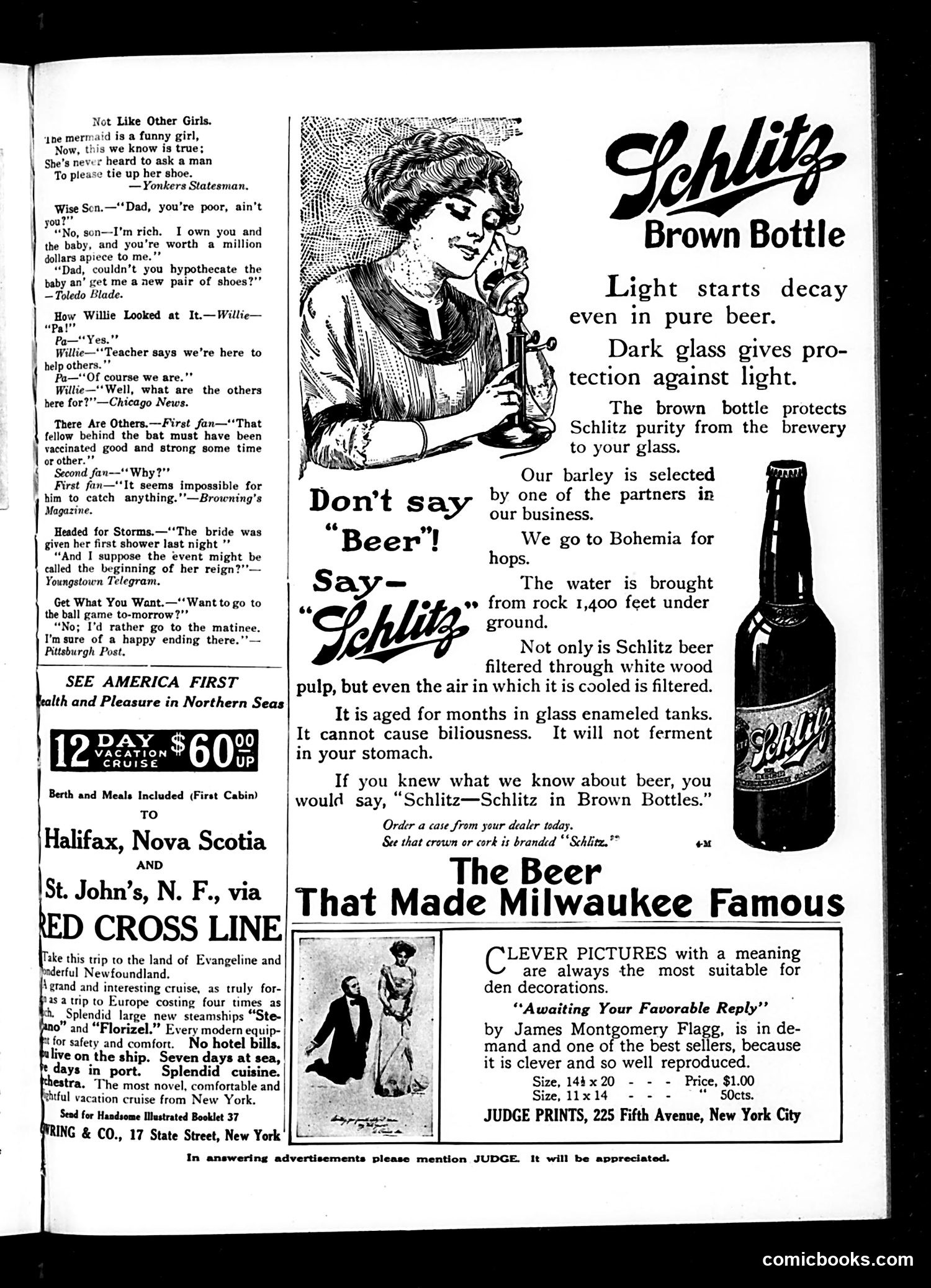
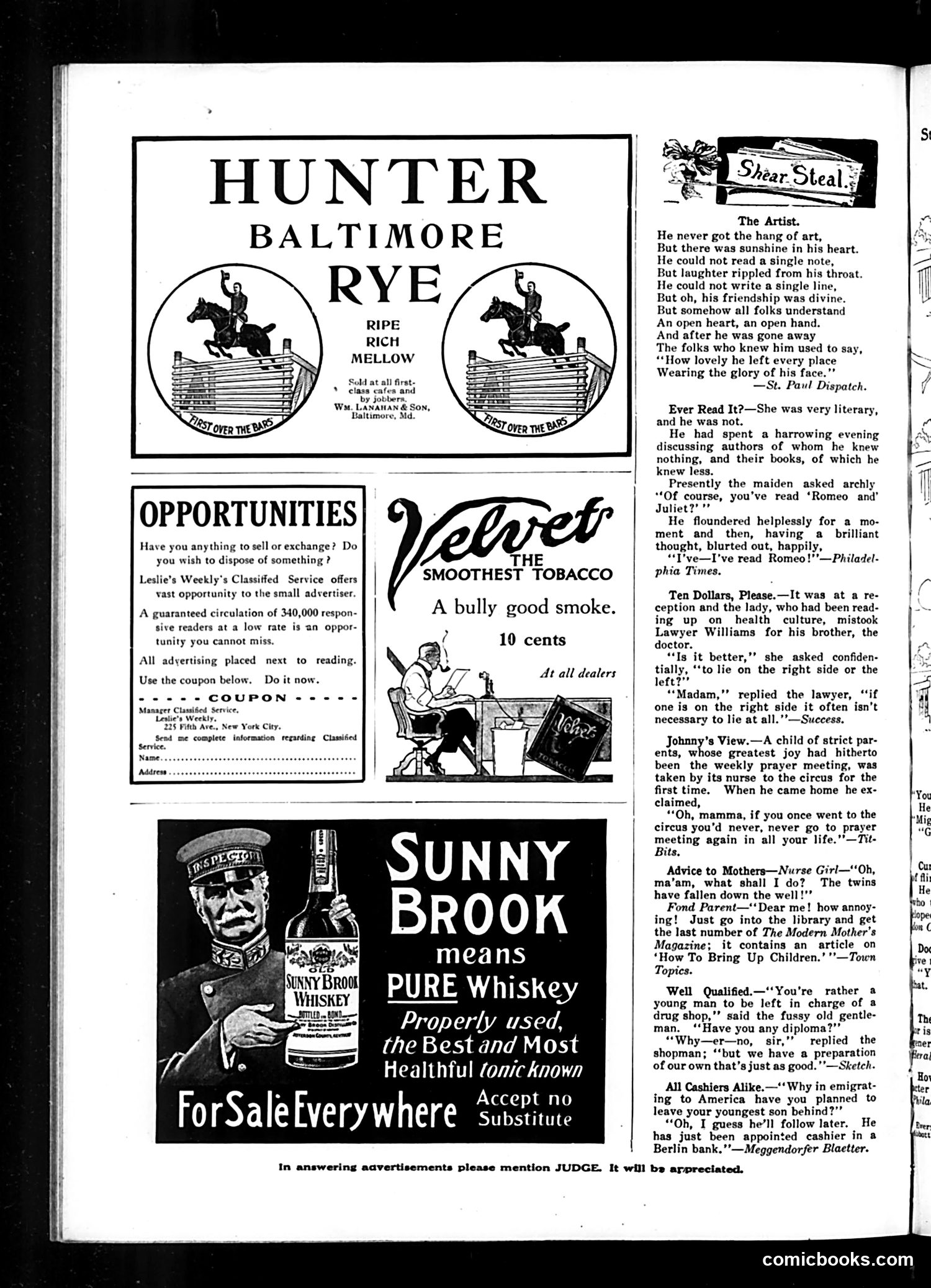
This page is primarily **advertisements and humor columns** rather than political cartoons. The content includes: **Advertisements:** - Hunter Baltimore Rye whiskey (top left) - Velvet tobacco (center) - Sunny Brook Pure Whiskey (bottom) - Leslie's Weekly classified service **Humor Columns (right side):** The "Shear Steal" section contains brief jokes and anecdotes typical of early 20th-century periodicals. These are gentle, non-political items: a touching tribute to an inarticulate but kind-hearted friend; literary misunderstandings; marriage/health advice humor; and jokes about children discovering circuses or employees proving unqualified. **Context for modern readers:** The page reflects pre-Prohibition attitudes toward alcohol advertising in mainstream publications, and the humor reflects period values—emphasis on social propriety, gender roles, and class distinctions. The jokes assume familiarity with contemporary publications like *The Modern Mother's Magazine*. This appears to be a filler/advertising page rather than satirical political content.
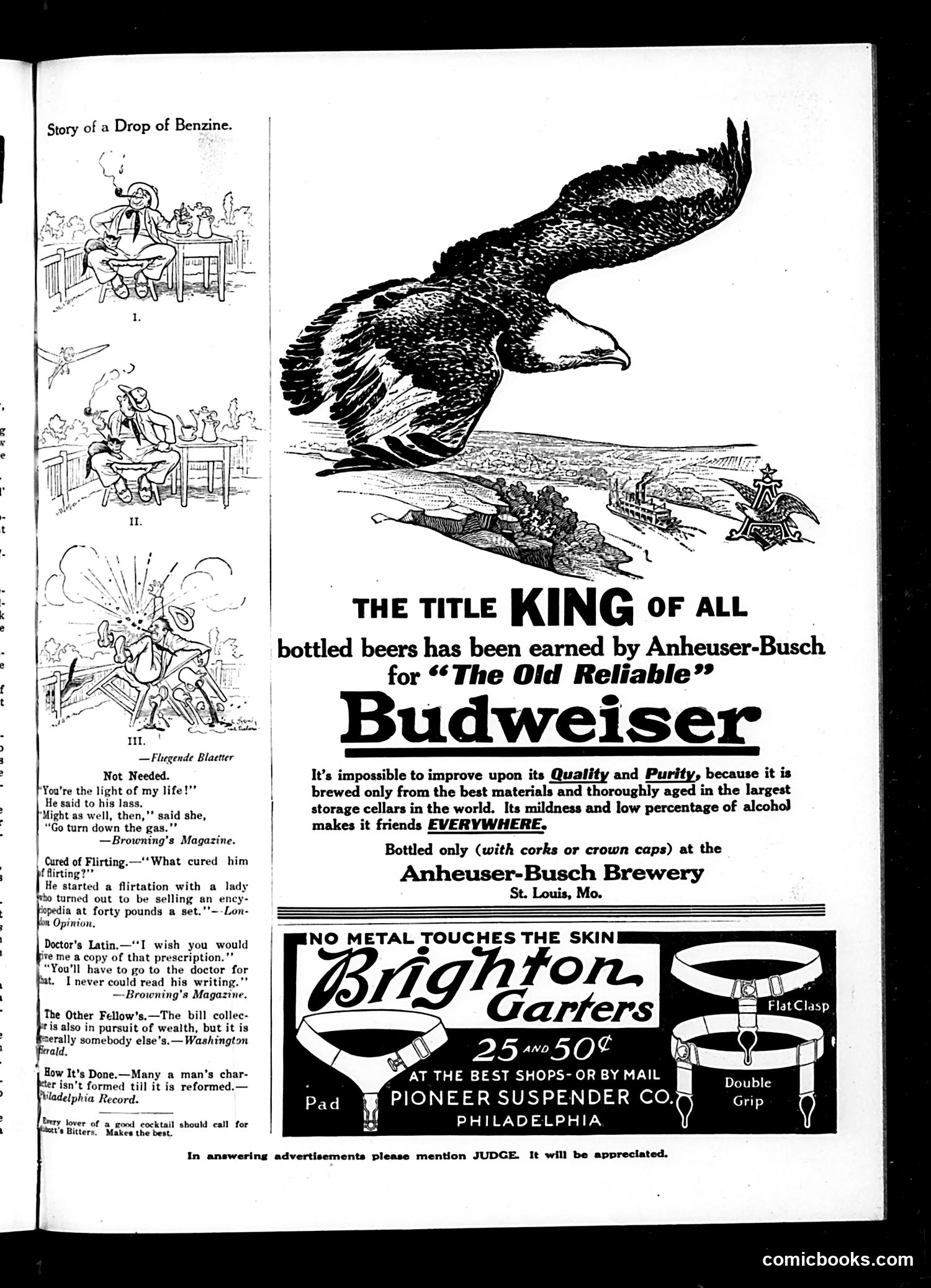
This page from *Judge* magazine consists primarily of **advertisements** rather than editorial satire. The left column contains brief **humorous one-liners** and anecdotes—typical filler content of the era—poking fun at common social situations: a woman rejecting a suitor's flattery, a man cured of flirting by an aggressive encyclopedia salesman, illegible doctor's handwriting, and bill collectors pursuing wealth. The dominant content is **two full-page advertisements**: 1. **Budweiser** (Anheuser-Busch) emphasizes quality, purity, and broad appeal ("makes it friends EVERYWHERE"), using patriotic imagery of an eagle with ships below—suggesting American strength and commerce. 2. **Brighton Garters** (suspenders) advertises men's accessories at 25-50¢, available at shops or by mail from Philadelphia. Both ads reflect early 20th-century consumer marketing: appeals to quality, national distribution, and mail-order convenience. The page shows how *Judge*, though satirical editorially, relied heavily on advertising revenue.
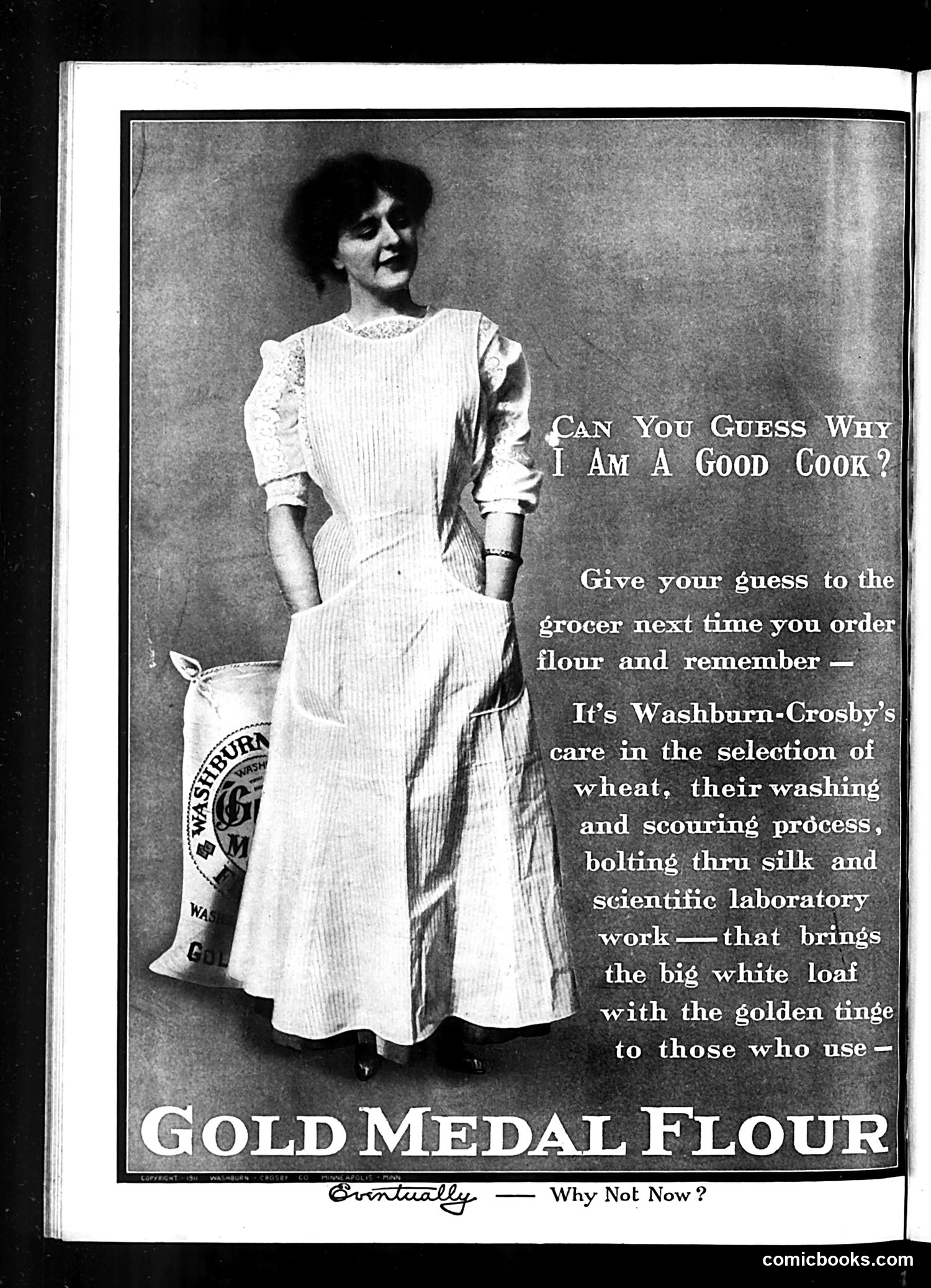
This is a **vintage advertisement**, not political satire. It promotes Gold Medal Flour by Washburn-Crosby Company (which later became General Mills). The ad features a woman in early 1900s attire posing with a flour sack, asking "Can You Guess Why I Am A Good Cook?" The answer: Gold Medal Flour's superior manufacturing process—careful wheat selection, washing, scouring, bolting through silk, and laboratory testing—produces superior bread with a "golden tinge." This reflects period advertising conventions: using an attractive woman as product endorser and emphasizing scientific/industrial processes as marks of quality. The tagline "Certainly—Why Not Now?" urges immediate purchase. There is no political satire present; it's straightforward commercial promotion typical of Judge magazine's advertising content.
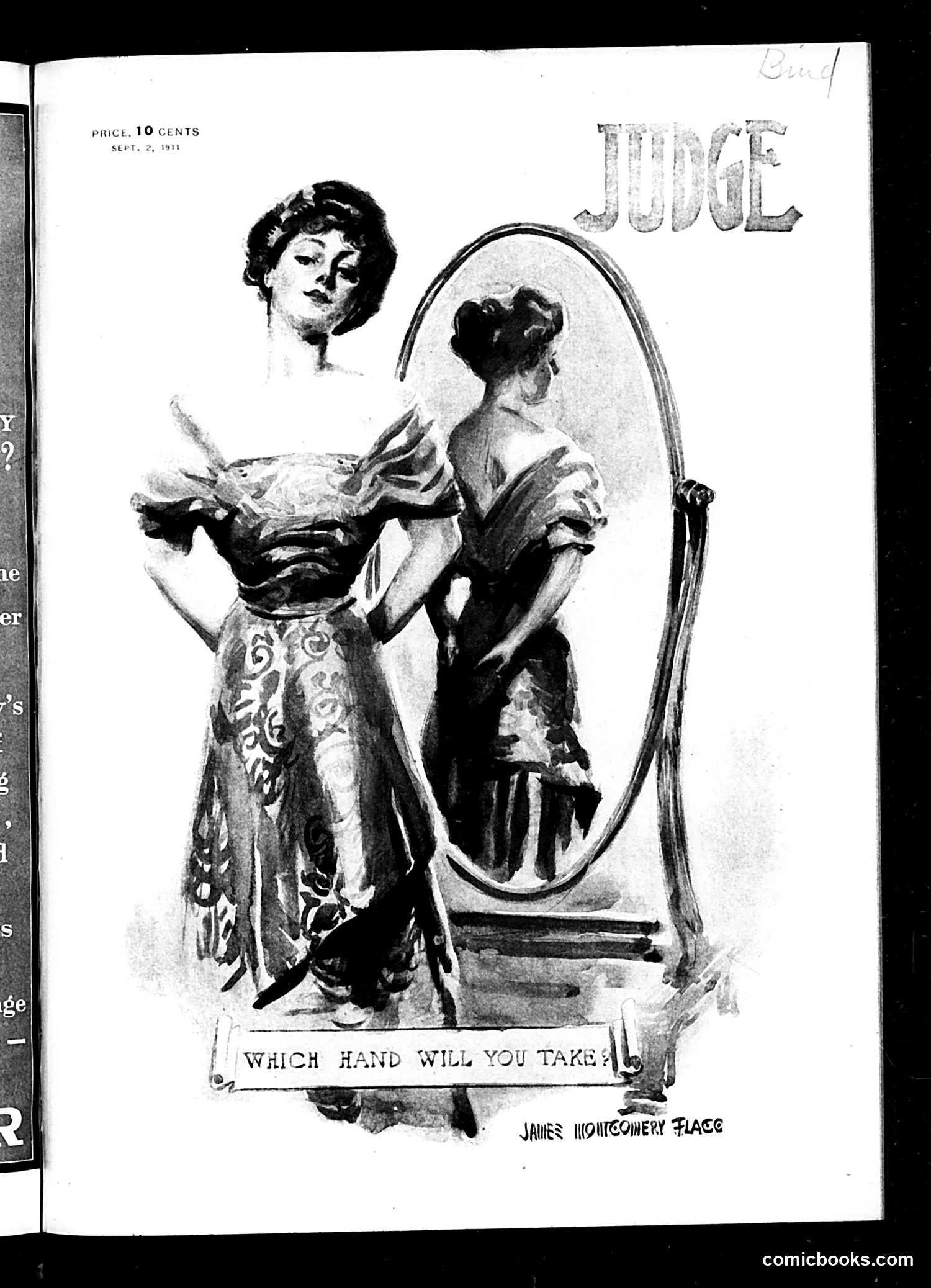
This is a Judge magazine cover from September 2, 1911, priced at 10 cents. The illustration shows a fashionable woman in an elegant dress looking at her reflection in a mirror, with the caption "Which Hand Will You Take?" The artwork is credited to James Montgomery Flagg, a prominent American illustrator of the era. The image appears to be a commentary on courtship or romantic choice—the woman's reflection presents two versions or choices, playing on contemporary anxieties about women's agency in selecting suitors. The satirical point likely mocks either women's indecision in matters of romance or perhaps social expectations about feminine choice during this period of changing gender roles in early 20th-century America.
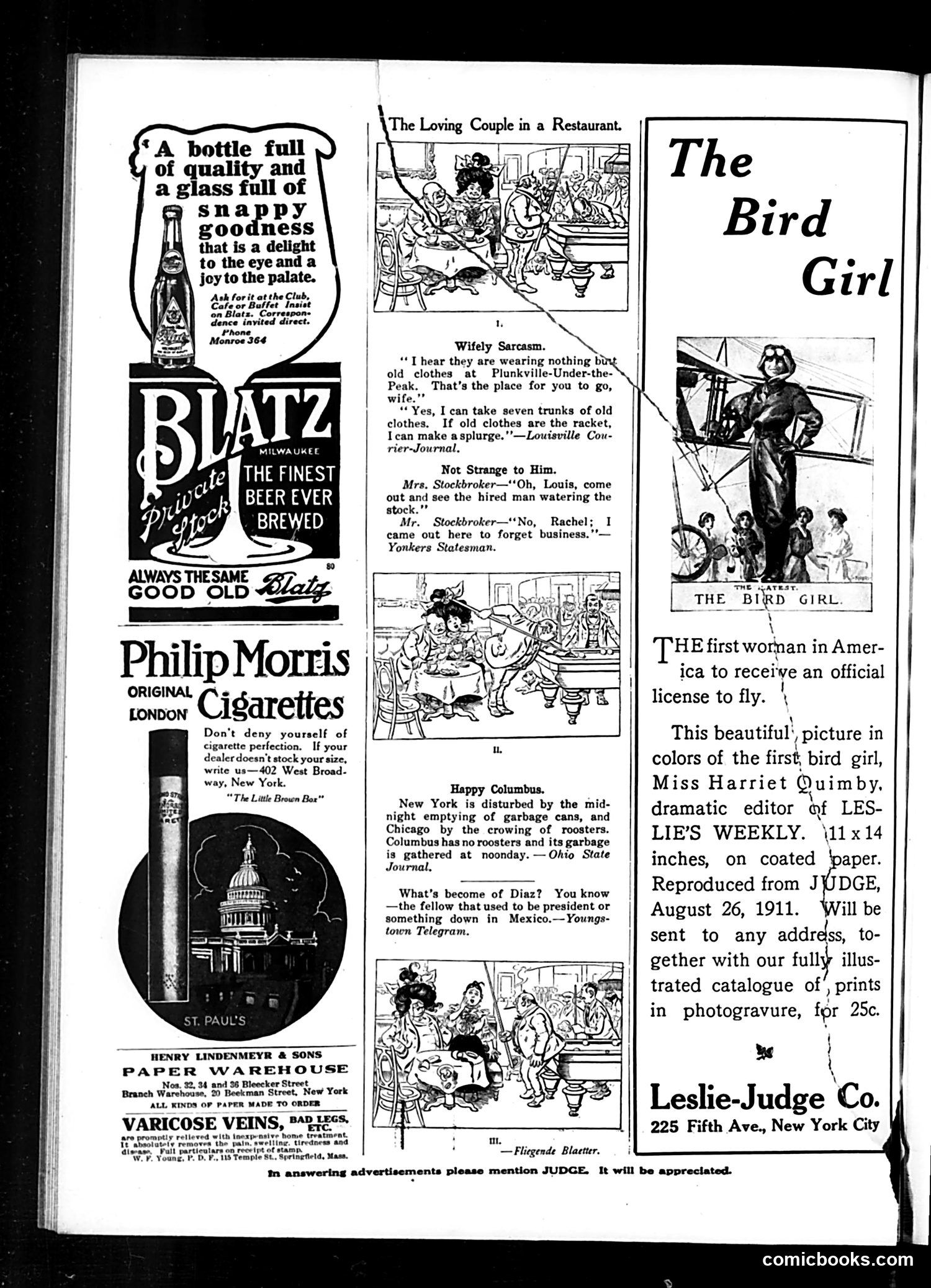
This page mixes advertisements with three brief satirical anecdotes and a feature promoting "The Bird Girl." **The cartoons/jokes** mock contemporary social concerns: one couple discusses women's fashion (wearing "nothing but old clothes"), another plays on stockbroker humor (confusing financial "stock" with livestock), and a third references Porfirio Díaz, the deposed Mexican president—suggesting Americans have already forgotten recent political upheaval. **The main feature** advertises a color print of **Harriet Quimby**, identified as "the first woman in America to receive an official license to fly." Her 1911 achievement was genuinely historic; the illustration shows her in flying gear. This represents early aviation's novelty and women's pioneering role in the field. **Advertisements** for Blatz beer, Philip Morris cigarettes, and paper products fill the margins—typical of Judge's revenue model. The page captures 1911 America: aviation as marvel, gender roles in flux, and Mexico as recent news.
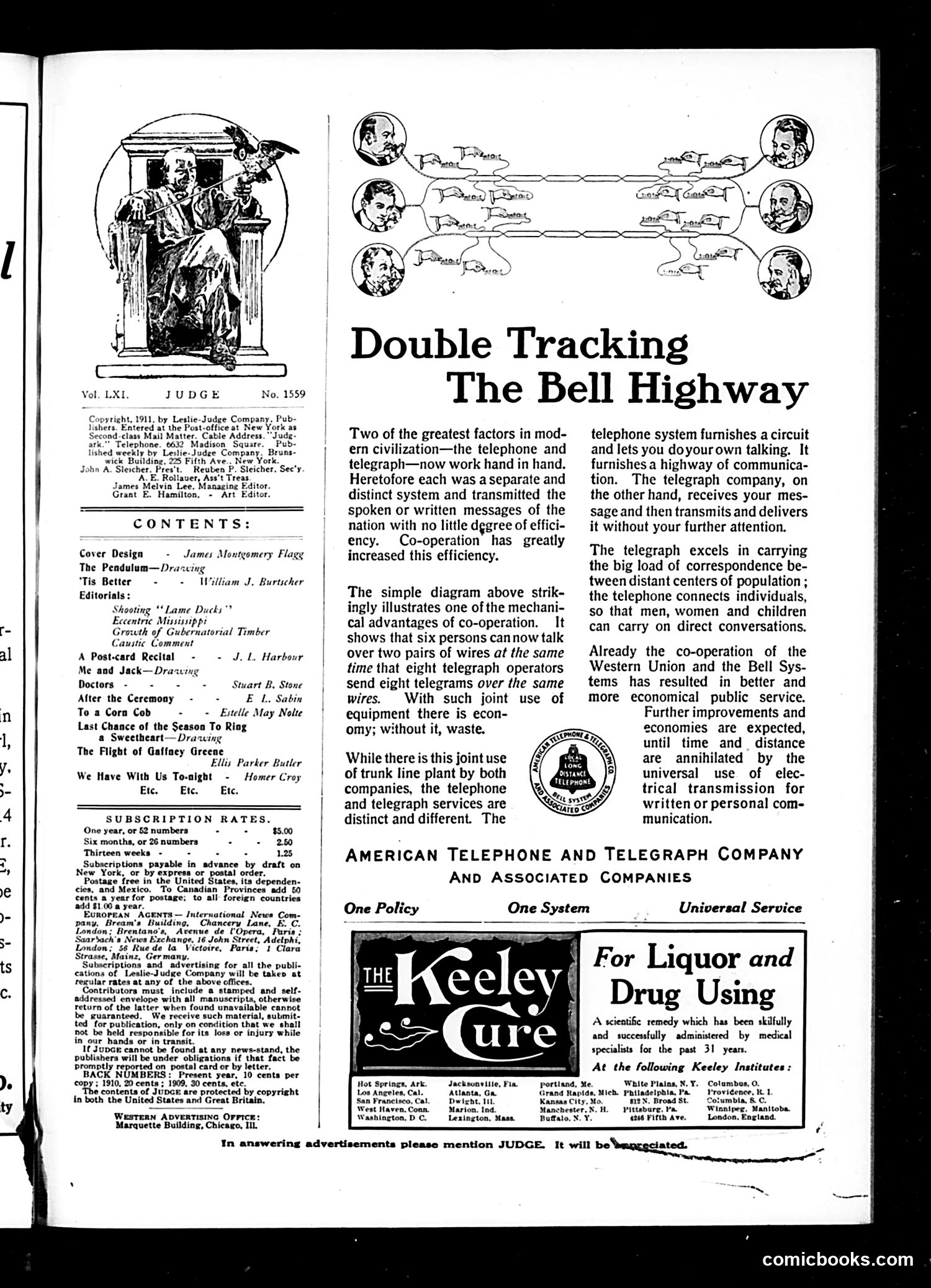
This is **not a political cartoon** but rather **corporate advertorial content** for the American Telephone and Telegraph Company (AT&T). The piece celebrates the business efficiency achieved when telephone and telegraph systems shared infrastructure ("double tracking"). The diagram illustrates how six people could simultaneously conduct phone conversations while eight telegraph operators sent messages over the same wires—demonstrating economic synergy through shared equipment. The text emphasizes that despite this infrastructure cooperation, the two services remained "distinct and different": telephones let users communicate directly; telegraphs required company intermediaries to transmit written messages. For modern readers: this represents early-20th-century corporate publicity celebrating infrastructure consolidation and promoting AT&T's expanding dominance in American communications. The magazine's inclusion suggests *Judge* accepted substantial advertising revenue from major corporations alongside satirical editorial content.
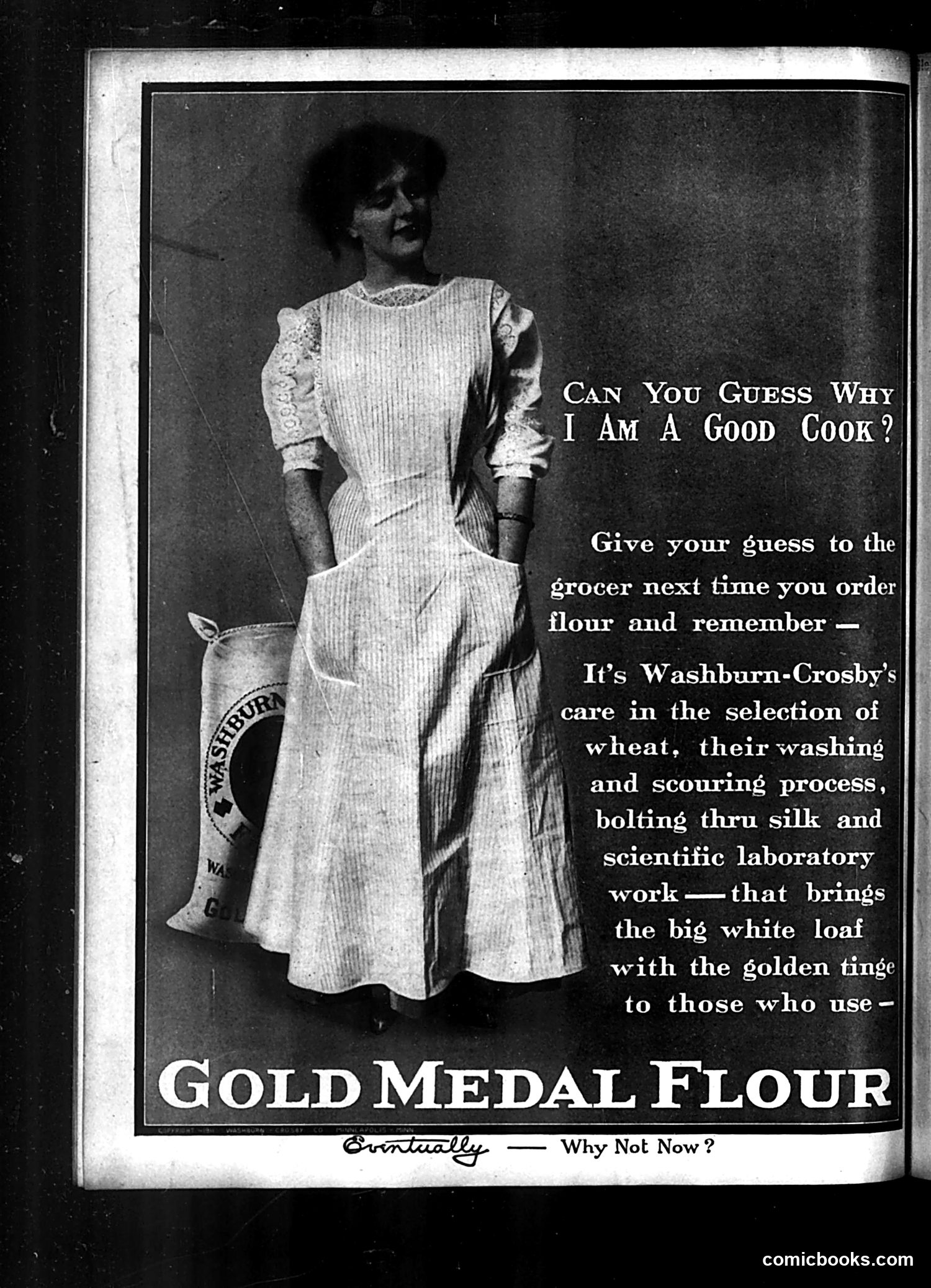
This is a **flour advertisement**, not satire or political commentary. It features a woman in Edwardian dress holding a sack of Washburn-Crosby flour, posed as though answering a riddle about her cooking skill. The "joke" is that her good cooking results from using Gold Medal Flour—the product's superior manufacturing process (wheat selection, washing, scouring, silk-bolting, laboratory testing) supposedly guarantees the "big white loaf with the golden tinge." This reflects early 1900s marketing conventions: advertising as entertainment placed in magazines like *Judge*, appealing to housewives by framing flour quality as the secret to domestic success. The phrase "Essentially—Why Not Now?" pressures immediate purchase. No political satire is present—this is purely commercial messaging using the magazine's space.