
Judge, 1911-08-26 · page 6 of 28
Judge — August 26, 1911 — page 6: what you’re looking at
What you’re looking at
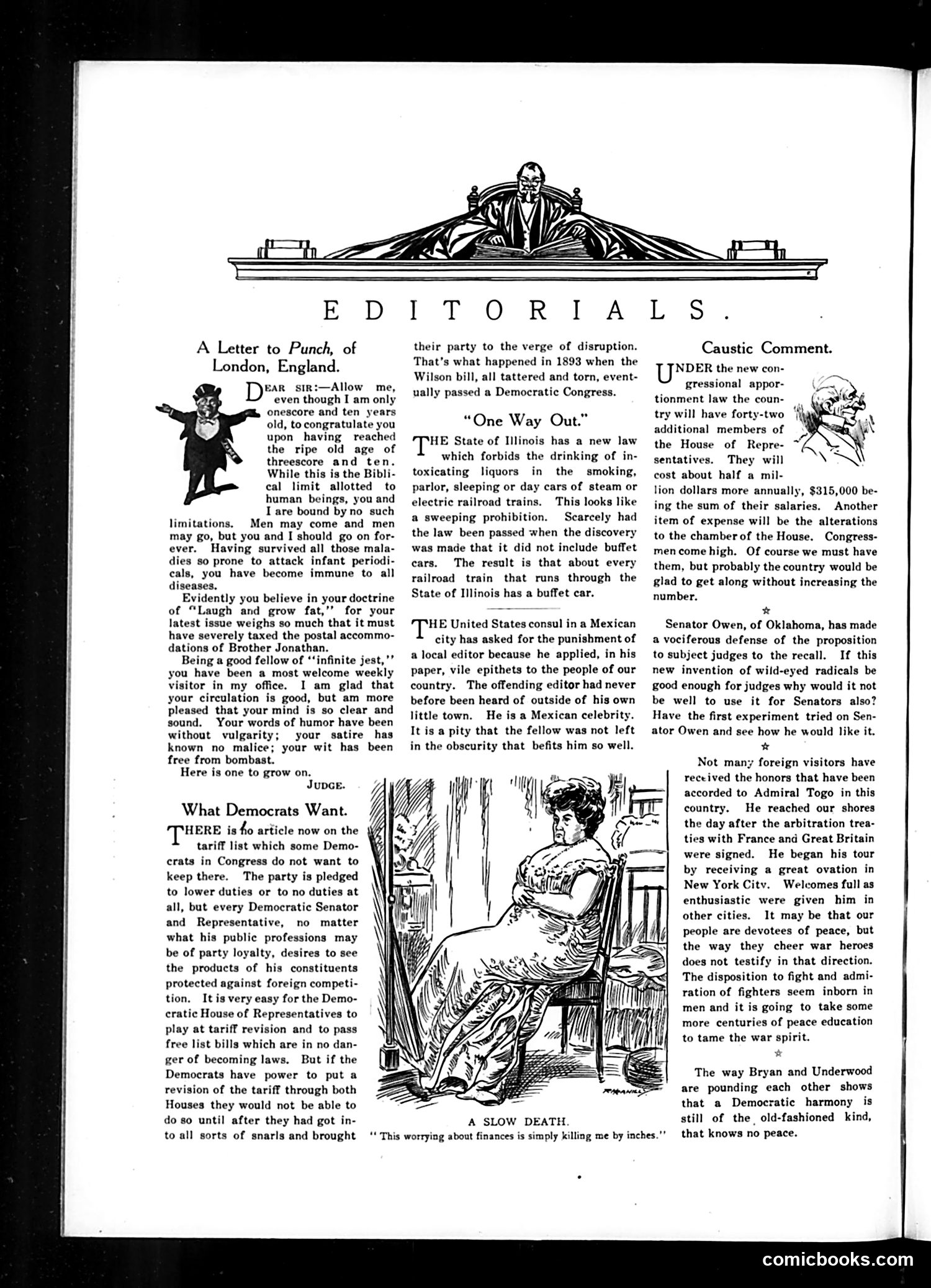
This page contains political editorials and satirical commentary from an early 20th-century American humor magazine. The main cartoon, "A Slow Death," depicts a woman worrying about finances, illustrating the editorial's point about financial anxiety. The editorials mock Democratic Party hypocrisy on tariffs—claiming to support free trade while protecting their constituents' industries—referencing the failed 1893 Wilson tariff bill. Another piece ridicules an Illinois prohibition law that accidentally exempted buffet cars from the drinking ban, making the law meaningless. "Caustic Comment" sarcastically criticizes congressional expansion (adding 42 representatives), noting the expense while accepting it as necessary. It also mocks Senator Owen's support for judicial recall, questioning why this "wild-eyed radical" idea shouldn't apply to senators too. The tone throughout is skeptical of political rhetoric and governmental inefficiency—typical of Judge's satirical approach to American politics and society.
📄 Transcribed text from this page (OCR, searchable)
Machine-transcribed from the original scan — historical spelling and the odd misread are preserved.
EDITORIA A Letter to Punch, of London, England. EAR SIR:—Allow me, even though I am only onescore and ten years old, to congratulate you upon having reached the ripe old age of threescore and ten. While this is the Bibli- cal limit allotted to human beings, you and I are bound by no such limitations. Men may come and men may go, but you and I should go on for- ever. Having survived all those mala- dies so prone to attack infant periodi- cals, you have become immune to all diseases, Evidently you believe in your doctrine of “Laugh and grow fat,’’ for your latest issue weighs so much that it must have severely taxed the postal accommo- dations of Brother Jonathan. Being a good fellow of “‘infinite jest,’” you have been a most welcome weekly visitor in my office. I am glad that your circulation is good, but am more pleased that your mind is so clear and sound. Your words of humor have been without vulgarity; your satire has known no malice; your wit has been free from bombast. Here is one to grow on. Jupce. What Democrats Want. crats in Congress do not want to keep there. The party is pledged \ to lower duties or to no duties at all, but every Democratic Senator and Representative, no matter what his public professions may be of party loyalty, desires to see the products of his constituents protected against foreign competi- tion. It is very easy for the Demo- cratic House of Representatives to play at tariff revision and to pass free list bills which are in no dan- ger of becoming laws. But if the Democrats have power to put a revision of the tariff through both Houses they would not be able to do so until after they had got in- to all sorts of snarls and brought YAV Ga WV THERE is fo article now on the U, & y tariff list which some Demo- i “ ws their party to the verge of disruption. That's what happened in 1893 when the Wilson bill, all tattered and torn, event- ually passed a Democratic Congress. “One Way Out.” HE State of Illinois has a new law which forbids the drinking of in- toxicating liquors in the smoking, parlor, sleeping or day cars of steam or electric railroad trains. This looks like a sweeping prohibition. Scarcely had the law been passed when the discovery was made that it did not include buffet cars. The result is that about every railroad train that runs through the State of Illinois has a buffet car. 'HE United States consul in a Mexican city has asked for the punishment of a local editor because he applied, in his paper, vile epithets to the people of our country. The offending editor had never before been heard of outside of his own little town. He is a Mexican celebrity. It is a pity that the fellow was not left in the obscurity that befits him so well. A SLOW DEATH. “This worrying about finances is simply killing me by inches."’ Caustic Comment. NDER the new con- gressional appor- tionment law the coun- try will have forty-two additional members of the House of Repre- sentatives. They will cost about half a mil- lion dollars more annually, $315,000 be- ing the sum of their salaries. Another item of expense will be the alterations to the chamber of the House. Congress- mencome high. Of course we must have them, but probably the country would be glad to get along without increasing the number. ® Senator Owen, of Oklahoma, has made a vociferous defense of the proposition to subject judges to the recall. If this new invention of wild-eyed radicals be good enough for judges why would it not be well to use it for Senators also? Have the first experiment tried on Sen- ator Owen and see how he would like it. * Not many foreign visitors have received the honors that have been accorded to Admiral Togo in this country. He reached our shores the day after the arbitration trea- ties with France and Great Britain were signed. He began his tour by receiving a great ovation in New York Citv. Welcomes full as enthusiastic were given him in other cities. It may be that our people are devotees of peace, but the way they cheer war heroes does not testify in that direction. The disposition to fight and admi- ration of fighters seem inborn in men and it is going to take some more centuries of peace education to tame the war spirit. * The way Bryan and Underwood are pounding each other shows that a Democratic harmony is still of the, old-fashioned kind, that knows no peace. comicbooks.com