
Judge, 1911-08-26 · page 18 of 28
Judge — August 26, 1911 — page 18: what you’re looking at
What you’re looking at
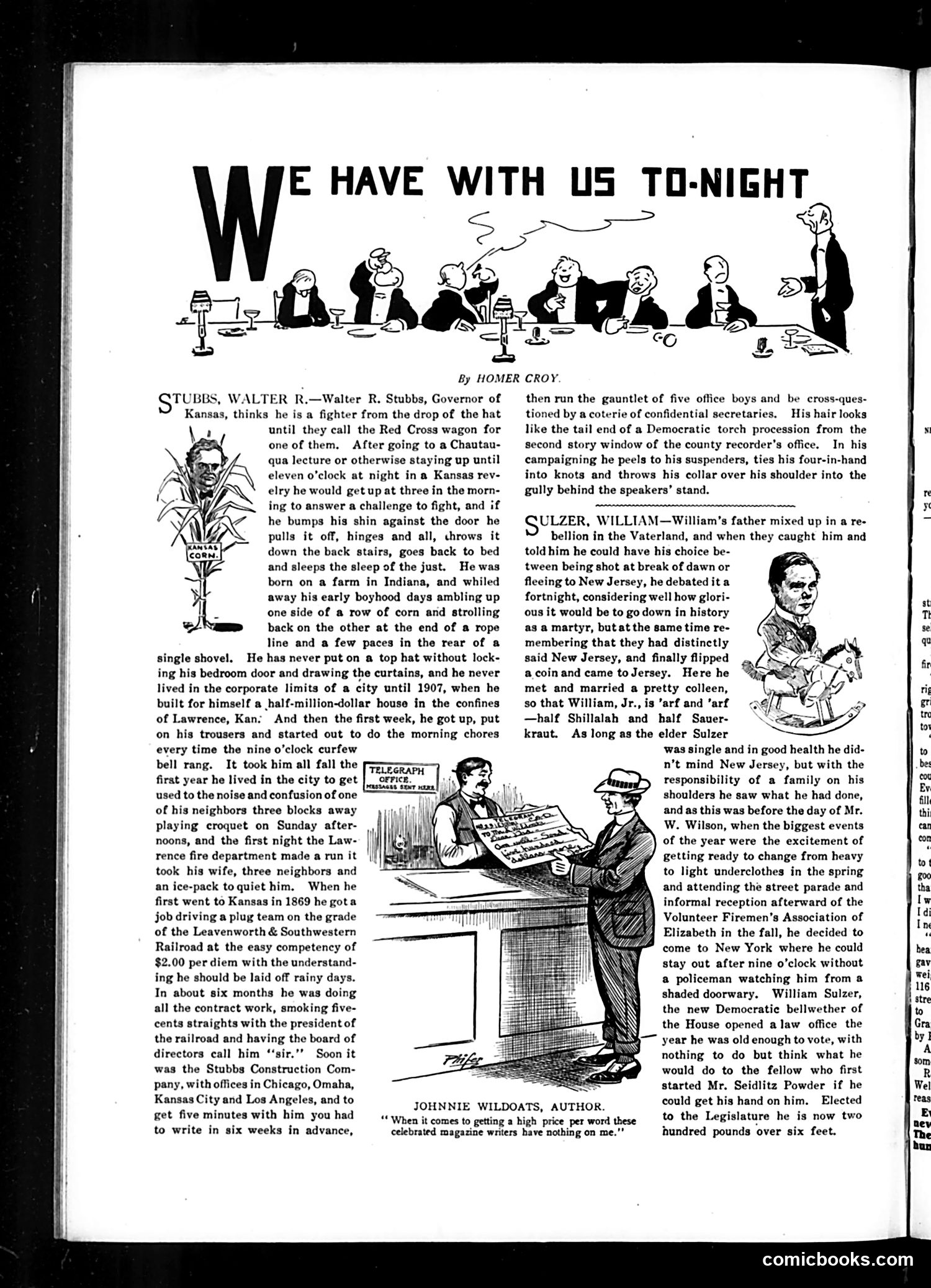
This page features **character sketches** by Homer Croy satirizing prominent political figures of the era (likely early 1900s). **Walter R. Stubbs** (Governor of Kansas) is mocked for being a performative tough guy—quick to fight over trivial matters yet easily spooked by urban noise, unable to adjust from his rural Indiana farm background despite building wealth through his construction company. The satire targets his crude, unsophisticated persona and exaggerated machismo. **William Sulzer's** entry ridicules his German-Irish immigrant heritage as an inherent contradiction ("'arf and 'arf—half Shillalah and half Sauerkraut"). His father supposedly chose fleeing to New Jersey over martyrdom, a humorous commentary on immigrant priorities. The top banner illustration depicts these figures at an informal gathering, suggesting this is from Judge's recurring feature introducing notable contemporaries through biographical caricature. The satire emphasizes class mobility, cultural assimilation struggles, and performative public personas—typical Judge magazine targets of the Progressive era.
📄 Transcribed text from this page (OCR, searchable)
Machine-transcribed from the original scan — historical spelling and the odd misread are preserved.
E HAVE WITH US TO-NIGHT By HOMER CROY. TUBBS, WALTER R.—Walter R. Stubbs, Governor of Kansas, thinks he is a fighter from the drop of the hat until they call the Red Cross wagon for one of them, After going to a Chautau- qua lecture or otherwise staying up until eleven o’clock at night in a Kansas rev- elry he would get up at three in the morn- ing to answer a challenge to fight, and if he bumps his shin against the door he pulls it off, hinges and all, chrows it down the back stairs, goes back to bed and sleeps the sleep of the just. He was born on a farm in Indiana, and whiled away his early boyhood days ambling up one side of a row of corn and strolling back on the other at the end of a rope line and a few paces in the rear of a single shovel. He has never put on a top hat without lock- ing his bedroom door and drawing the curtains, and he never lived in the corporate limits of a city until 1907, when he built for himself a half-million-dollar house in the confines of Lawrence, Kan: And then the first week, he got up, put on his trousers and started out to do the morning chores every time the nine o’clock curfew bell rang. It took him all fall the firat year he lived in the city to get used to the noise and confusion of one of his neighbors three blocks away playing croquet on Sunday after- noons, and the first night the Law- rence fire department made a run it took his wife, three neighbors and an ice-pack toquiet him. When he first went to Kansas in 1869 he gota job driving a plug team on the grade of the Leavenworth & Southwestern Railroad at the easy competency of $2.00 per diem with the understand- ing he should be laid off rainy days. In about six months he was doing all the contract work, smoking five- cents straights with the president of the railroad and having the board of directors call him ‘‘sir.’’ Soon it was the Stubbs Construction Com- pany, with offices in Chicago, Omaha, Kansas City and Los Angeles, and to get five minutes with him you had OFFICE. reastaes SY 1cnx3, JOHNNIE WILDOATS, AUTHOR. then run the gauntlet of five office boys and be cross-ques- tioned by a coterie of confidential secretaries. His hair looks like the tail end of a Democratic torch procession from the second story window of the county recorder’s office. In his campaigning he peels to his suspenders, ties his four-in-hand into knots and throws his collar over his shoulder into the gully behind the speakers’ stand. ULZER, WILLIAM—William’s father mixed up in a re- bellion in the Vaterland, and when they caught him and told him he could have his choice be- tween being shot at break of dawn or fleeing to New Jersey, he debated ita fortnight, considering well how glori- ous it would be to go down in history ag a martyr, but at the same time re- membering that they had distinctly said New Jersey, and finally flipped acoin and came toJersey. Here he met and married a pretty colleen, so that William, Jr., is ’arf and ‘arf —half Shillalah and half Sauer- kraut. As long as the elder Sulzer was single and in good health he did- n't mind New Jersey, but with the responsibility of a family on his shoulders he saw what he had done, and as this was before the day of Mr. W. Wilson, when the biggest events of the year were the excitement of getting ready to change from heavy to light underclothes in the spring and attending the street parade and informal reception afterward of the Volunteer Firemen’s Association of Elizabeth in the fall, he decided to come to New York where he could stay out after nine o’clock without a policeman watching him from a shaded doorwary. William Sulzer, the new Democratic bellwether of the House opened a law office the year he was old enough to vote, with nothing to do but think what he would do to the fellow who first started Mr. Seidlitz Powder if he could get his hand on him. Elected to the Legislature he is now two “When it comes to getting a high price per word these celebrated magazine writers have nothing on me."* hundred pounds over six feet. to write in six weeks in advance, comicbooks.com