
A complete issue · 25 pages · 1911
Judge — June 24, 1911
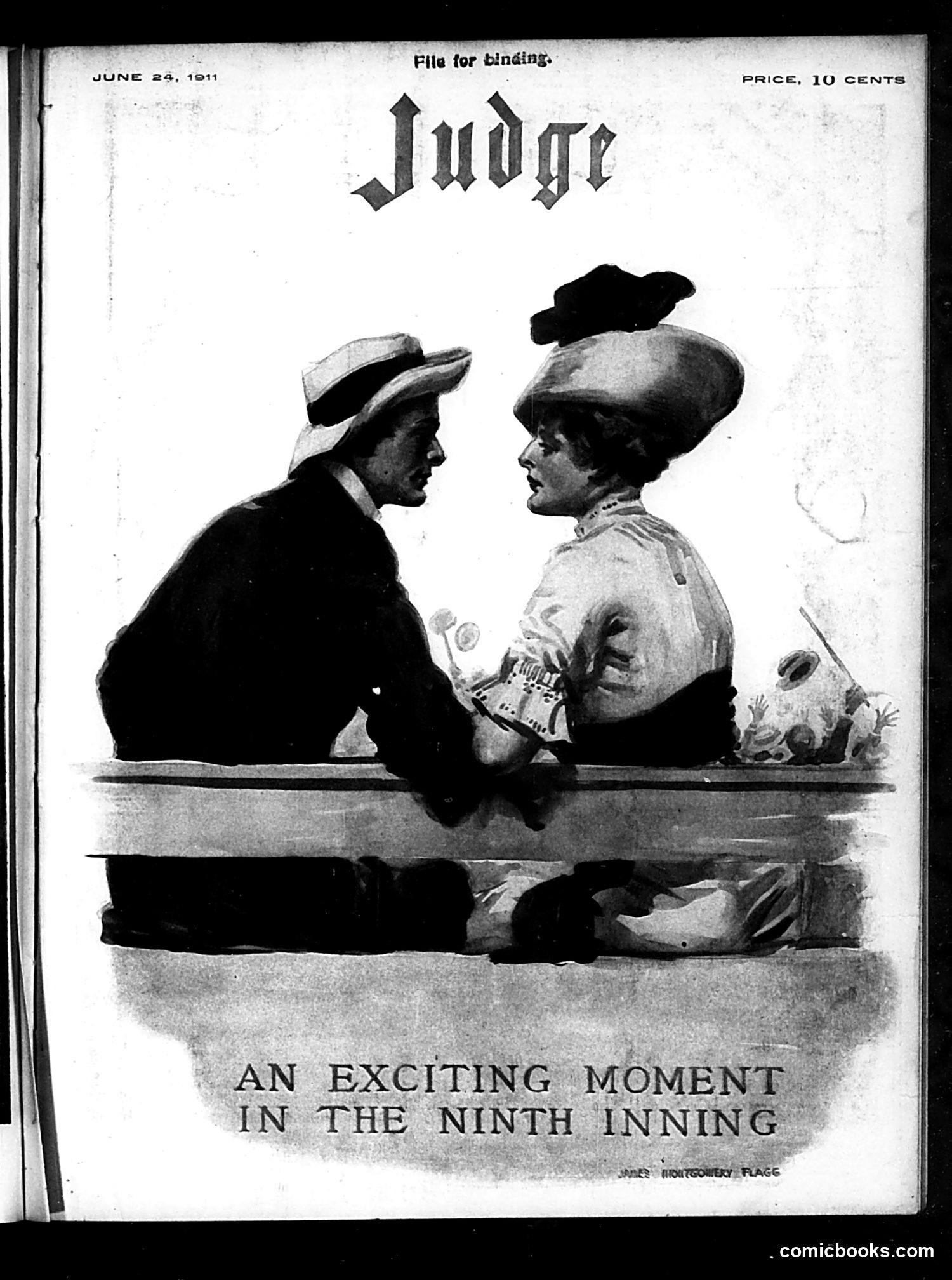
This June 24, 1911 *Judge* cover depicts two fashionably dressed women in conversation, seated together. The caption reads "An Exciting Moment in the Ninth Inning," connecting baseball terminology to what appears to be a social encounter. The satire likely mocks the superficiality of high society or the romanticization of chance meetings. The "ninth inning" metaphor suggests this casual moment is being treated with dramatic importance—as if a social interaction carries the same weight as a climactic baseball moment. The women's elaborate hats and formal attire emphasize class consciousness. Without additional context, the specific identities remain unclear, but the humor targets how the wealthy treated mundane social exchanges as major events worthy of breathless excitement.
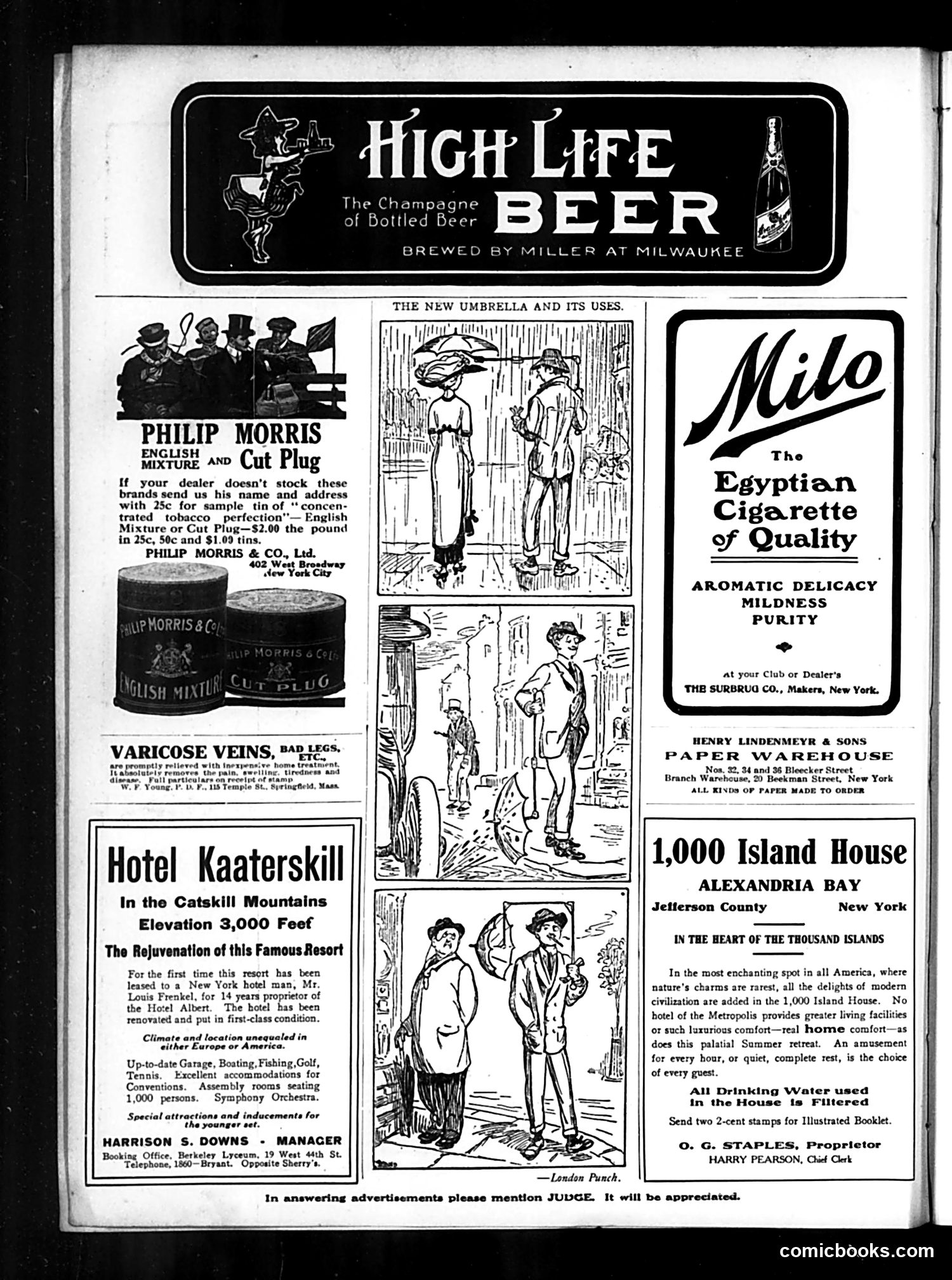
This page is **primarily advertising**, not political satire. It contains commercial notices for products including High Life Beer (brewed in Milwaukee), Philip Morris tobacco, Milo cigarettes, a paper warehouse, and resort hotels. The central cartoon titled "The New Umbrella and Its Uses" appears to be **social humor** rather than political commentary. The sequential illustrations show various people using umbrellas in exaggerated or unconventional ways during rain—likely gentle satire on human behavior and practical absurdity rather than addressing specific political events. The page reflects early 20th-century consumer culture, with Judge mixing paid advertisements among lighter entertainment content aimed at middle-class readers.
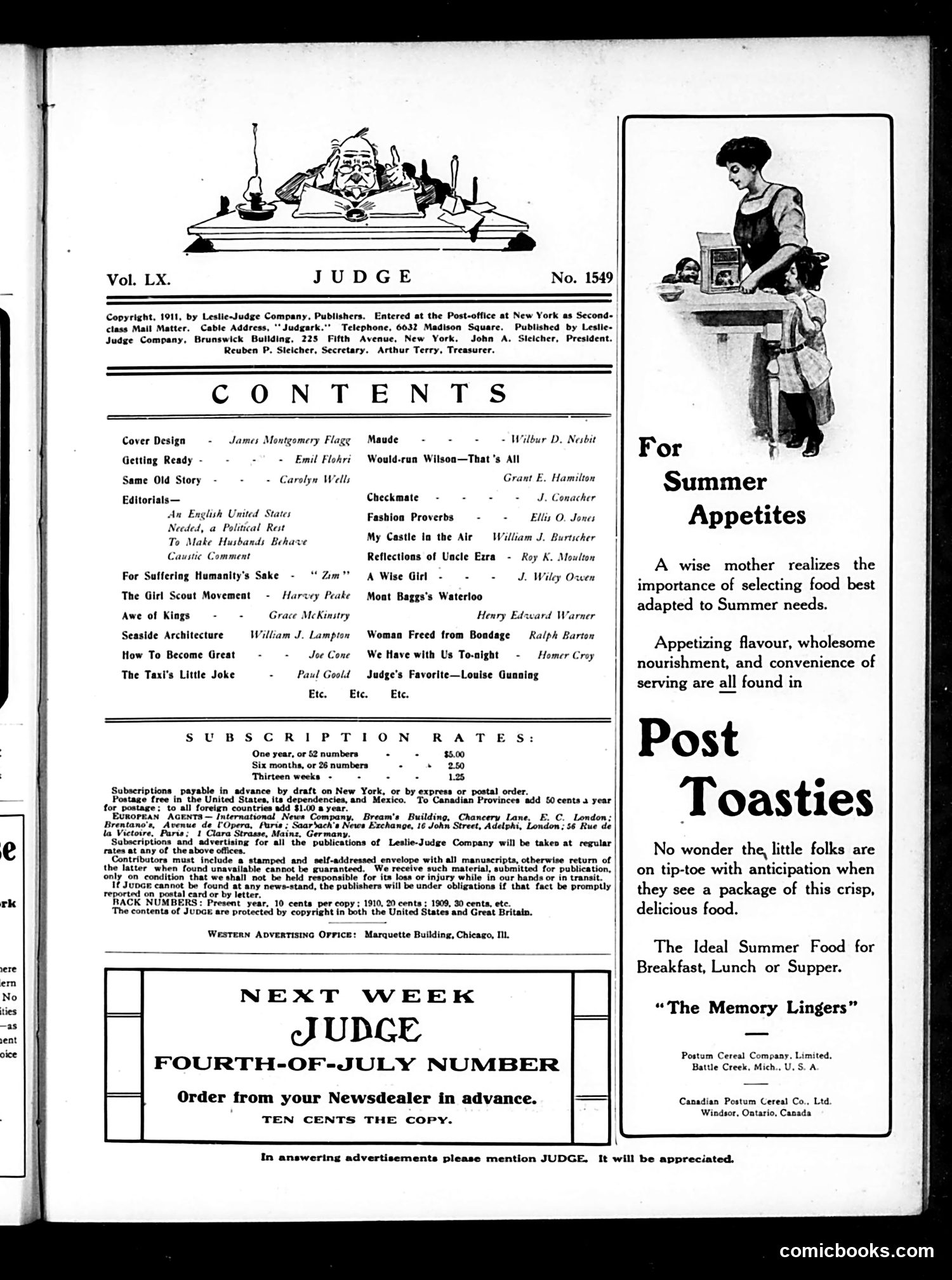
This Judge magazine page (Vol. LX, No. 1549, copyright 1911) is primarily a **contents/table of contents page with advertising**, not a political cartoon. The page lists articles by various authors and includes a **Postum Toasties cereal advertisement** on the right side featuring an illustration of a woman and text about "Summer Appetites." This ad emphasizes the product as ideal breakfast, lunch, or supper food with "The Memory Lingers" as a tagline. The left side contains subscription rates, publishing information, and a promotion for next week's Fourth-of-July special issue. **No significant political satire or caricature appears here.** The page functions primarily as administrative/advertising content typical of early 20th-century magazine layout.
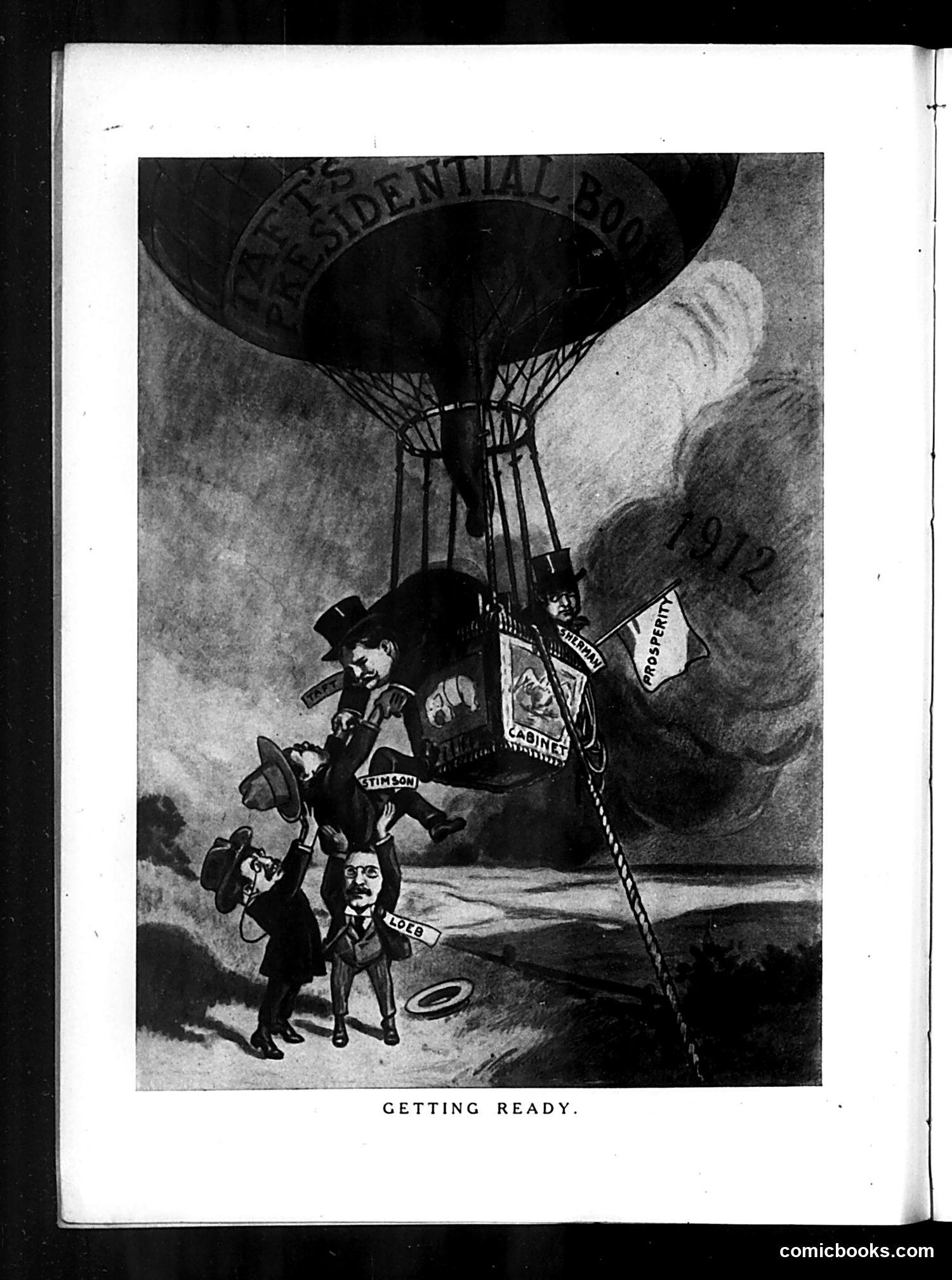
This appears to be a 1912 presidential election cartoon from *Judge* magazine, depicting candidates preparing for launch in a hot air balloon labeled "Presidential Boom." The figures below—appearing to be political candidates or party figures—are being hoisted into the basket marked with various campaign banners and labels. The satire mocks the frenzied, chaotic nature of presidential campaigns, comparing the election process to an uncertain hot air balloon journey. The cramped basket filled with competing figures suggests the crowded field of candidates, while the balloon itself represents the inflated rhetoric and insubstantial nature of campaign promises. The caption "Getting Ready" underscores the satirical commentary on campaign preparations as theatrical spectacle rather than serious governance.
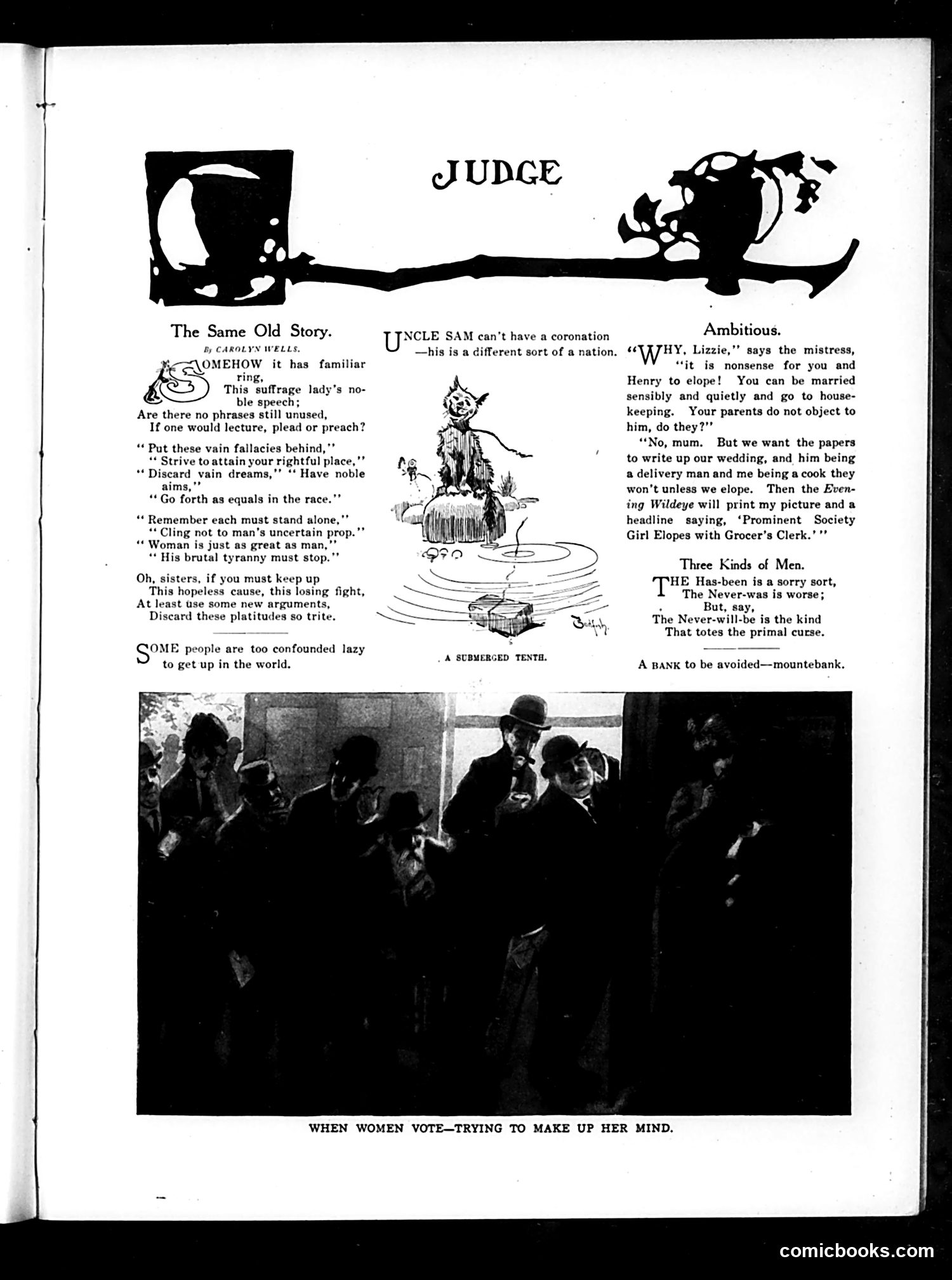
This page satirizes women's suffrage and female voters through multiple pieces: **"The Same Old Story"** mockingly presents arguments against women voting—that women are naturally indecisive, emotionally driven, and unsuited for political participation. **"Ambitious"** depicts a working-class woman (cook and delivery man's wife) wanting her wedding announced in a newspaper to gain social status, satirizing women's supposed vanity and social climbing. **"Three Kinds of Men"** is a sardonic poem about male relationship types. **The photograph** captioned "When Women Vote—Trying to Make Up Her Mind" shows a woman at a polling place, visually reinforcing the satirical message that women voters are confused and indecisive. The entire page mocks women's suffrage by portraying female voters as intellectually unfit, vain, and incapable of rational political decision-making—reflecting anti-suffrage propaganda common in early 20th-century America.
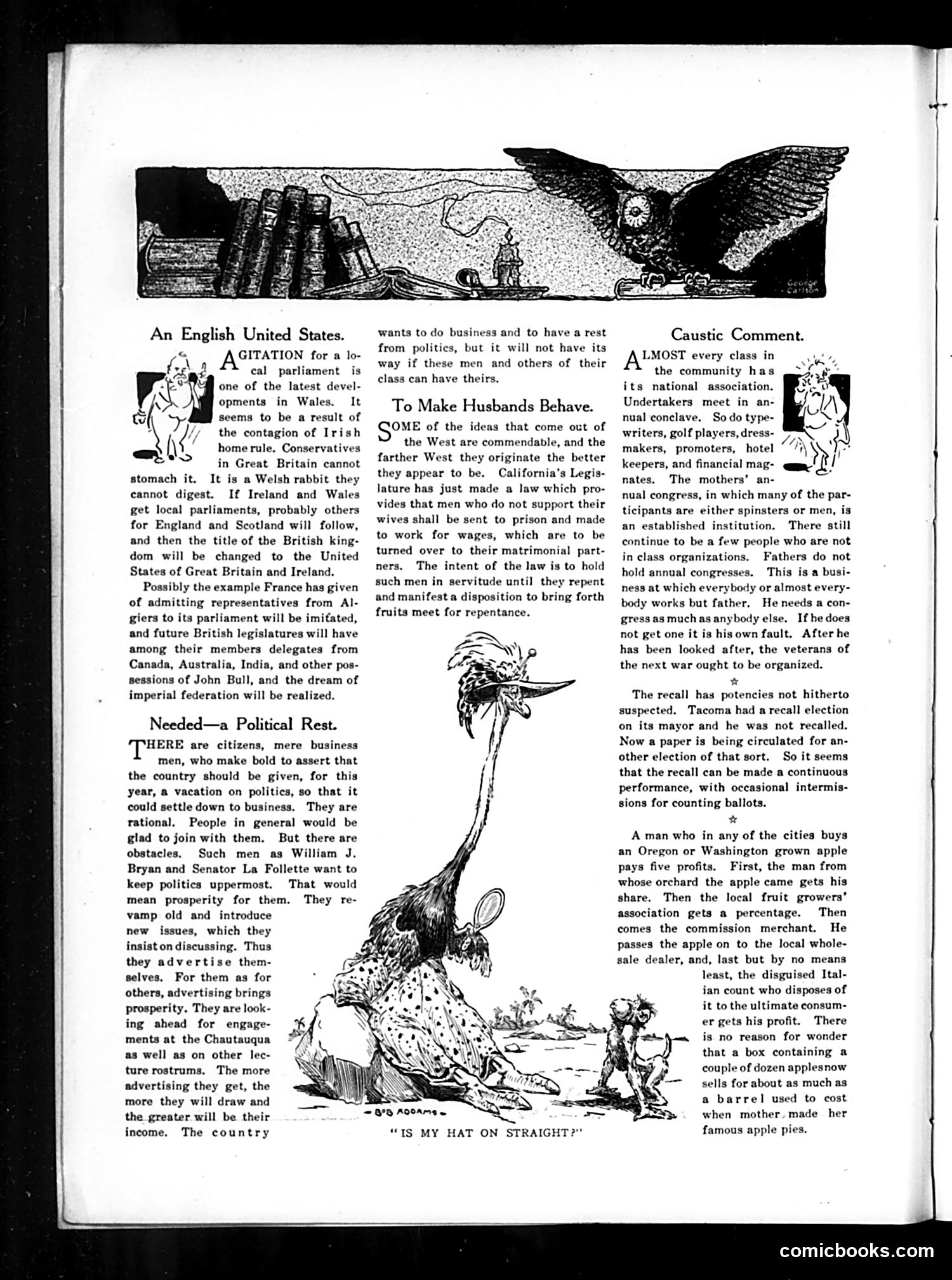
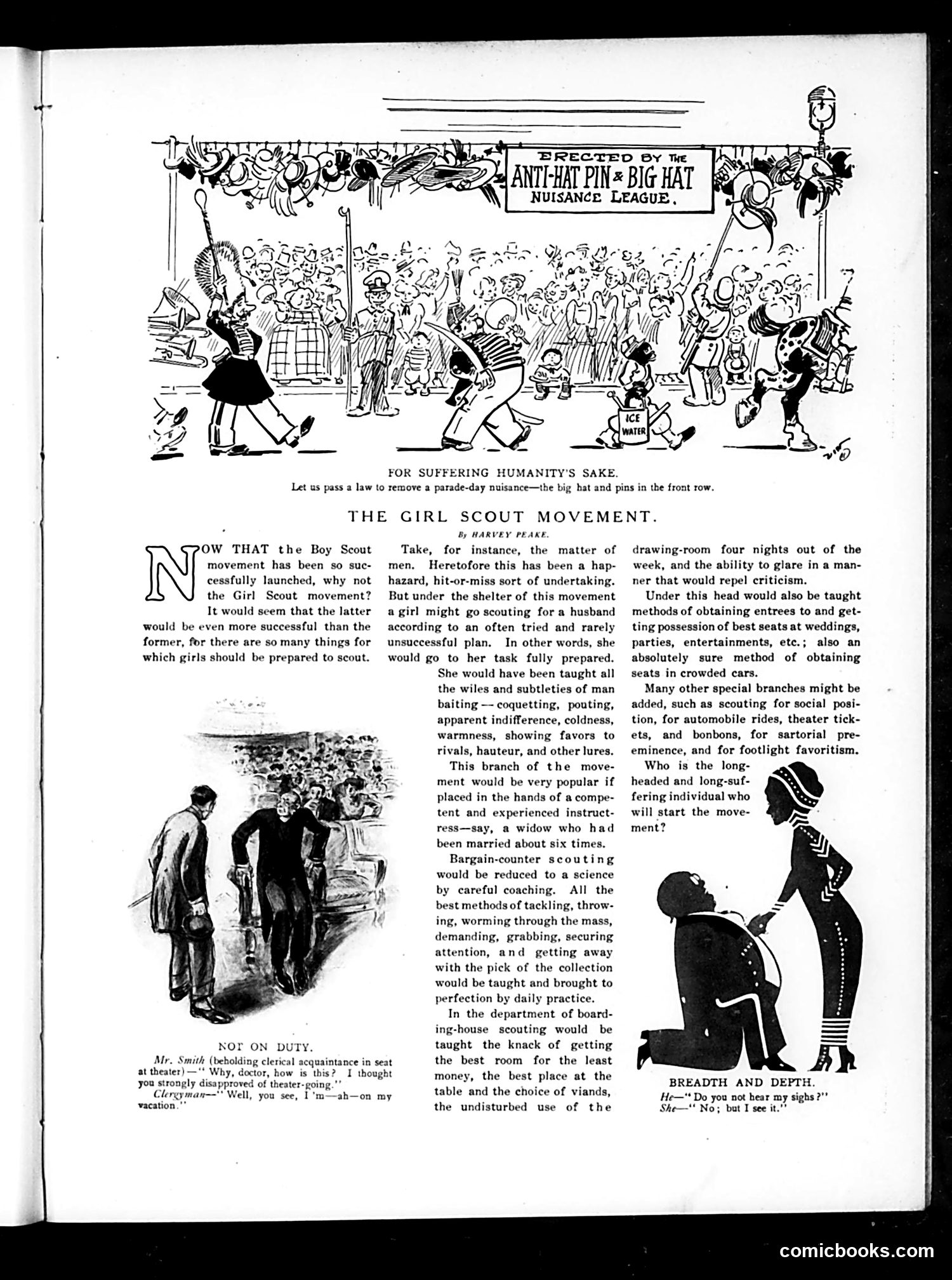
**Top Cartoon**: The "Anti-Hat Pin & Big Hat Nuisance League" satirizes a genuine public complaint of the era—women's elaborate hats adorned with long pins worn to theaters and public events, which obstructed other patrons' views. The cartoon advocates for legal prohibition of this fashion hazard. **Main Article "The Girl Scout Movement"** (by Harvey Peake): This is satirical social commentary on the newly-launched Girl Scout movement. Rather than praising it, the piece mockingly proposes a "Girl Scout" program teaching young women to hunt husbands using calculated feminine manipulation—coquetting, pouting, coldness, and other "wiles." It suggests instructors could be experienced widows and expands this to "scouting" for social position, theater tickets, and material goods. The satire critiques both dating/marriage customs and the emerging movement itself, suggesting women needed organized training in age-old male-hunting tactics. The accompanying sketches and final joke about a man's "sighs" reinforce themes of courtship as strategic performance.
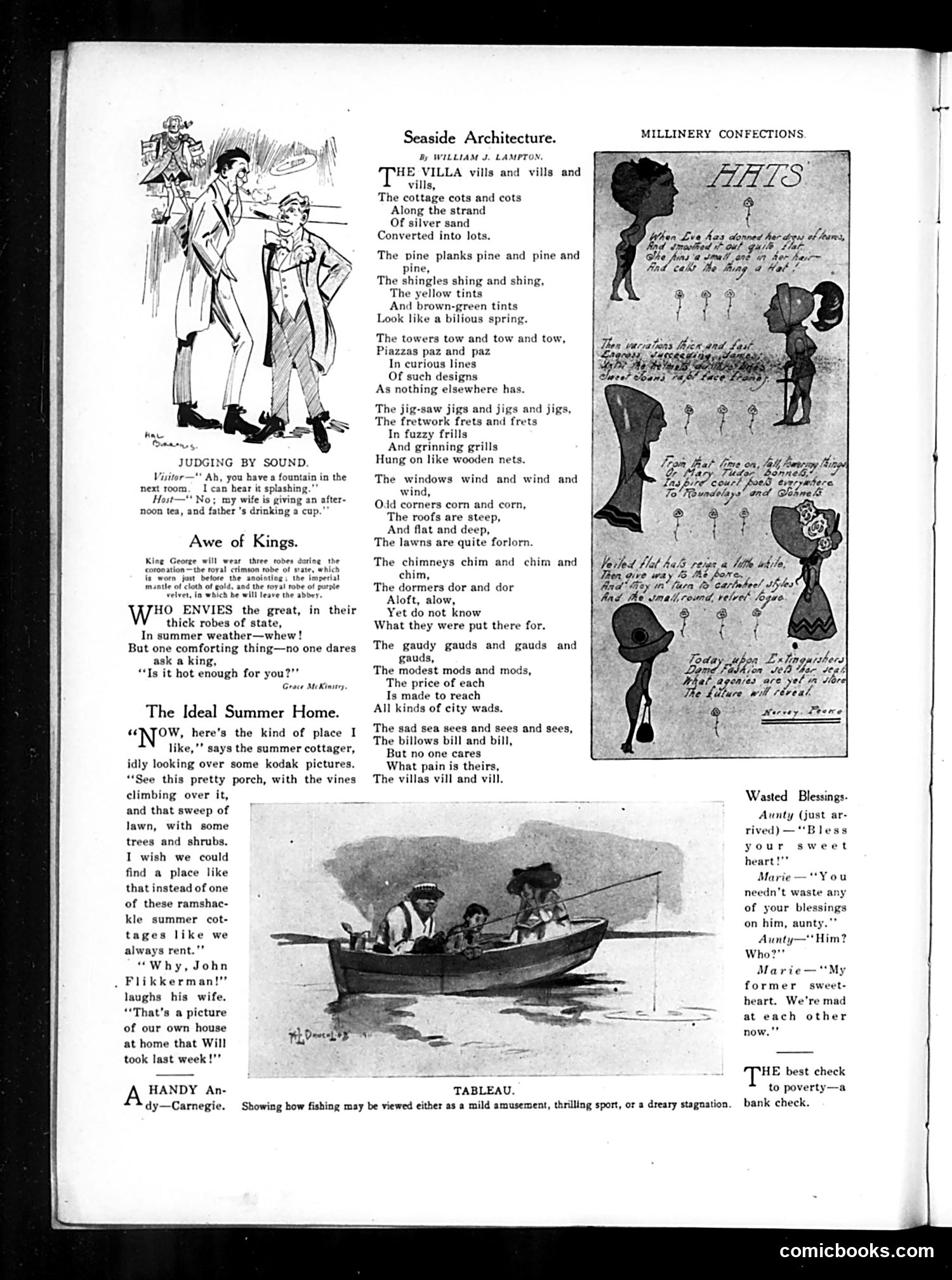
**"Judging by Sound"** is a domestic humor joke: a visitor mistakes a wife's loud tea-drinking for fountain splashing, satirizing women's social gatherings and gluttony. **"Awe of Kings"** mocks royal pageantry—even monarchs suffer summer heat in formal robes, yet no one dares ask a king the common complaint "Is it hot enough for you?" It's gentle satire on the absurd privileges and constraints of royalty. **"Seaside Architecture"** by Lampton ridicules gaudy resort development along the shore. The repetitive verse mocks the garish, poorly-designed cottages ("vills vill"), excessive ornamentation, and high prices charged to wealthy city dwellers ("city wads"). It's social criticism of overdeveloped coastal areas and architectural excess. **"The Ideal Summer Home"** humorously depicts a man criticizing ramshackle rental cottages while not recognizing a photograph of his own modest home—poking fun at romantic delusion and vanity. The **fishing tableau** shows how perspective changes leisure activities. The **millinery confections** section appears to be fashion illustration with handwritten captions (text too degraded to read clearly).
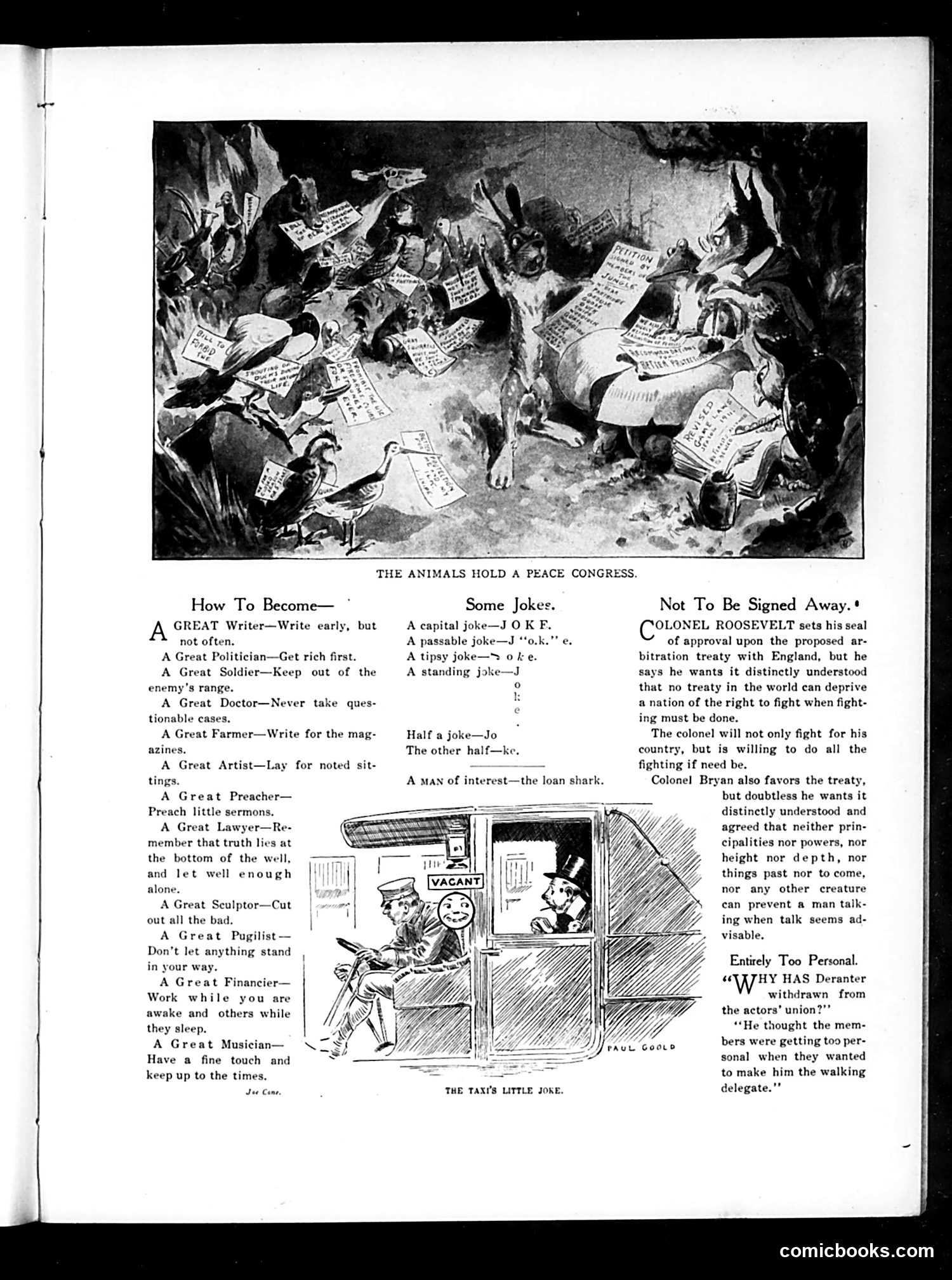
This page from *Judge* contains political satire targeting **Colonel Theodore Roosevelt** and **Colonel William Jennings Bryan** regarding an arbitration treaty with England. **"Not To Be Signed Away"** mocks Roosevelt's conditional support for the treaty. He approves it but insists it cannot prevent nations from fighting or restrict his own right to speak—essentially wanting the treaty's benefits while reserving unlimited freedom of action. The satire suggests Roosevelt wants peace on his own exceptional terms. **The reference to "Colonel Bryan"** implies Bryan also supports the treaty, but the joke suggests both men want the right to wage war if they deem it necessary—undercutting the treaty's purpose. The page also includes humor columns ("How To Become," "Some Jokes," and "The Taxi's Little Joke") offering cynical observations about success and human nature—typical *Judge* filler content mocking hypocrisy in American society and politics. The top illustration ("The Animals Hold a Peace Congress") appears to be editorial commentary on peace negotiations, though specific details are unclear from this reproduction.
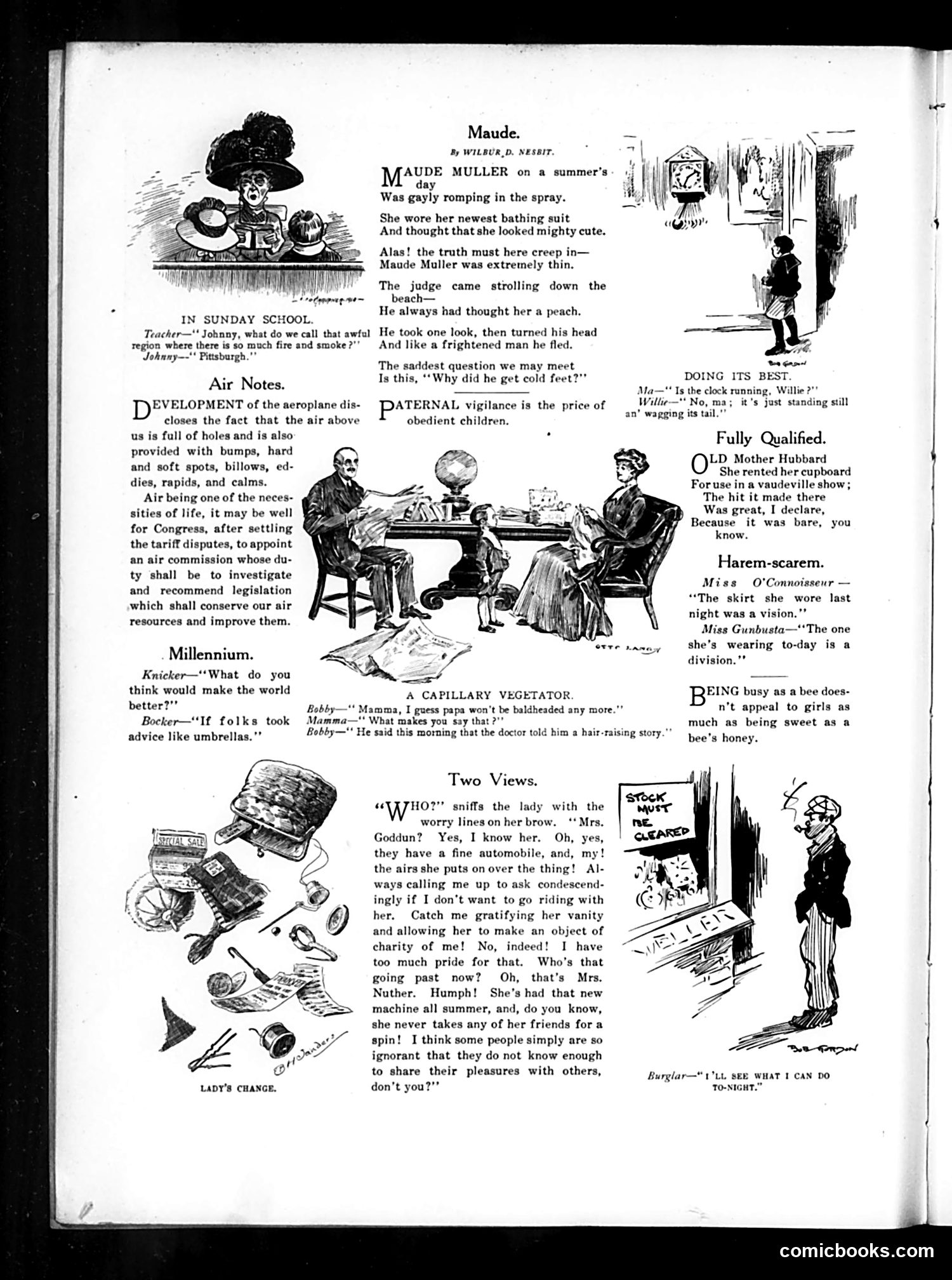
This page contains several unrelated satirical pieces typical of early 20th-century humor magazines: **"In Sunday School"** jokes that Pittsburgh's pollution makes it hellish—a pointed reference to the industrial city's notorious smog and industrial conditions. **"Air Notes"** proposes Congress appoint an "air commission" to regulate air quality, satirizing both Progressive-era regulatory impulses and the serious air pollution problem caused by industrialization. **"Maude"** is a poem mocking a thin woman's vanity at the beach—conventional body-shaming humor of the era. **"Two Views"** satirizes female hypocrisy: a woman criticizes her neighbor for showing off her automobile while simultaneously resenting not being invited for rides, exposing petty class anxiety among women. The remaining pieces are brief jokes about children, baldness, and a burglar—standard period fare with no deeper political content. The page reflects early 1900s concerns: industrial pollution, women's emerging consumer culture and automotive access, and class consciousness.
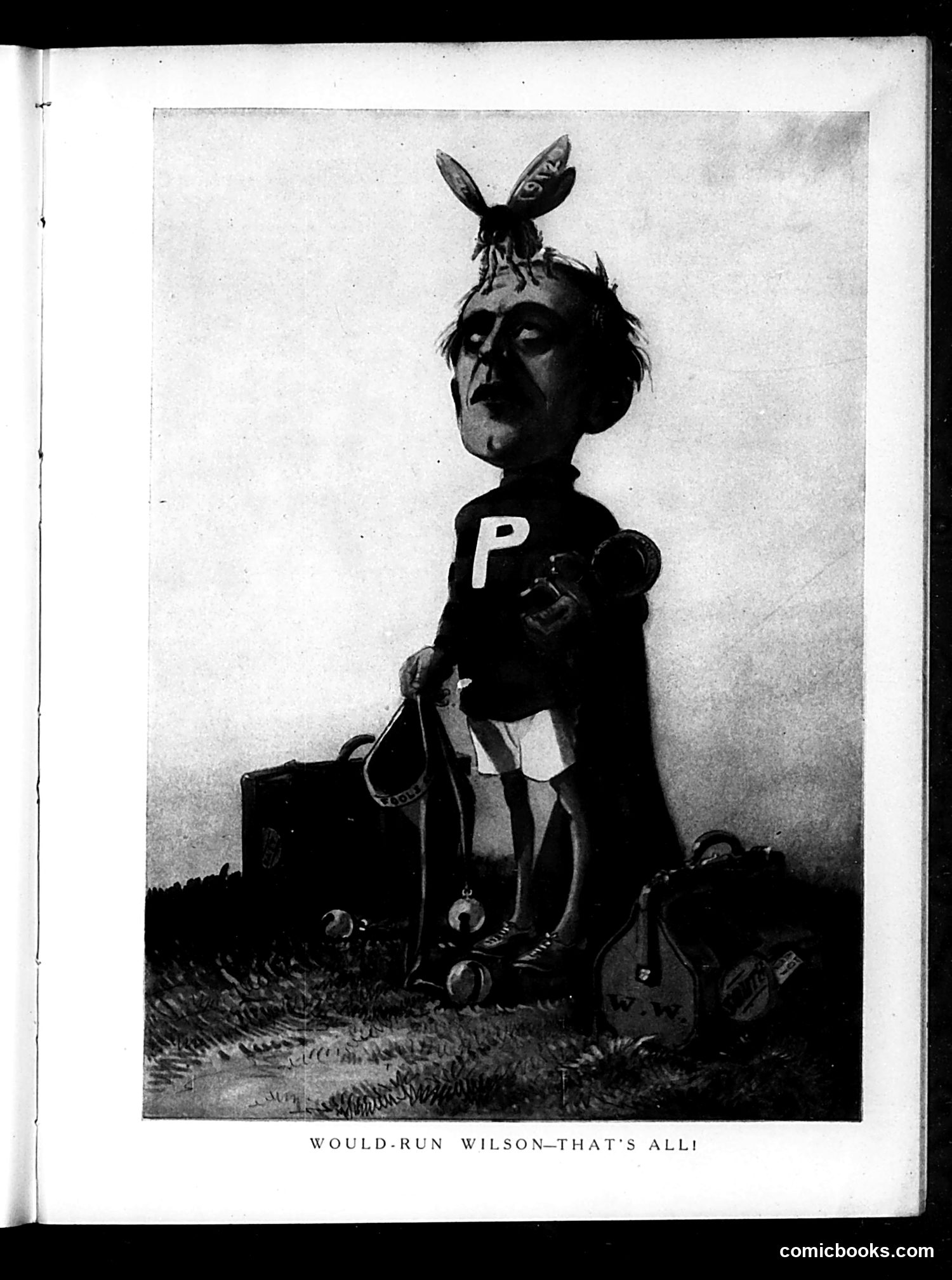
This political cartoon satirizes someone identified as "Would-Run Wilson"—likely referring to a politician considering a presidential campaign. The figure is depicted as an exaggerated caricature with an elongated head, wearing a "P" (presumably for "President"), standing amid luggage and travel gear. The absurd, grotesque styling suggests the cartoonist mocked this person's ambitions or candidacy as ridiculous or unserious. The caption's dismissive tone ("That's all!") implies the satirist is reducing the subject's qualifications or appeal to mere appearance and pretension. Without the publication date visible, the specific Wilson and election cycle remain unclear, though this mocking treatment of a would-be presidential candidate was common Judge magazine practice during the early 20th century.
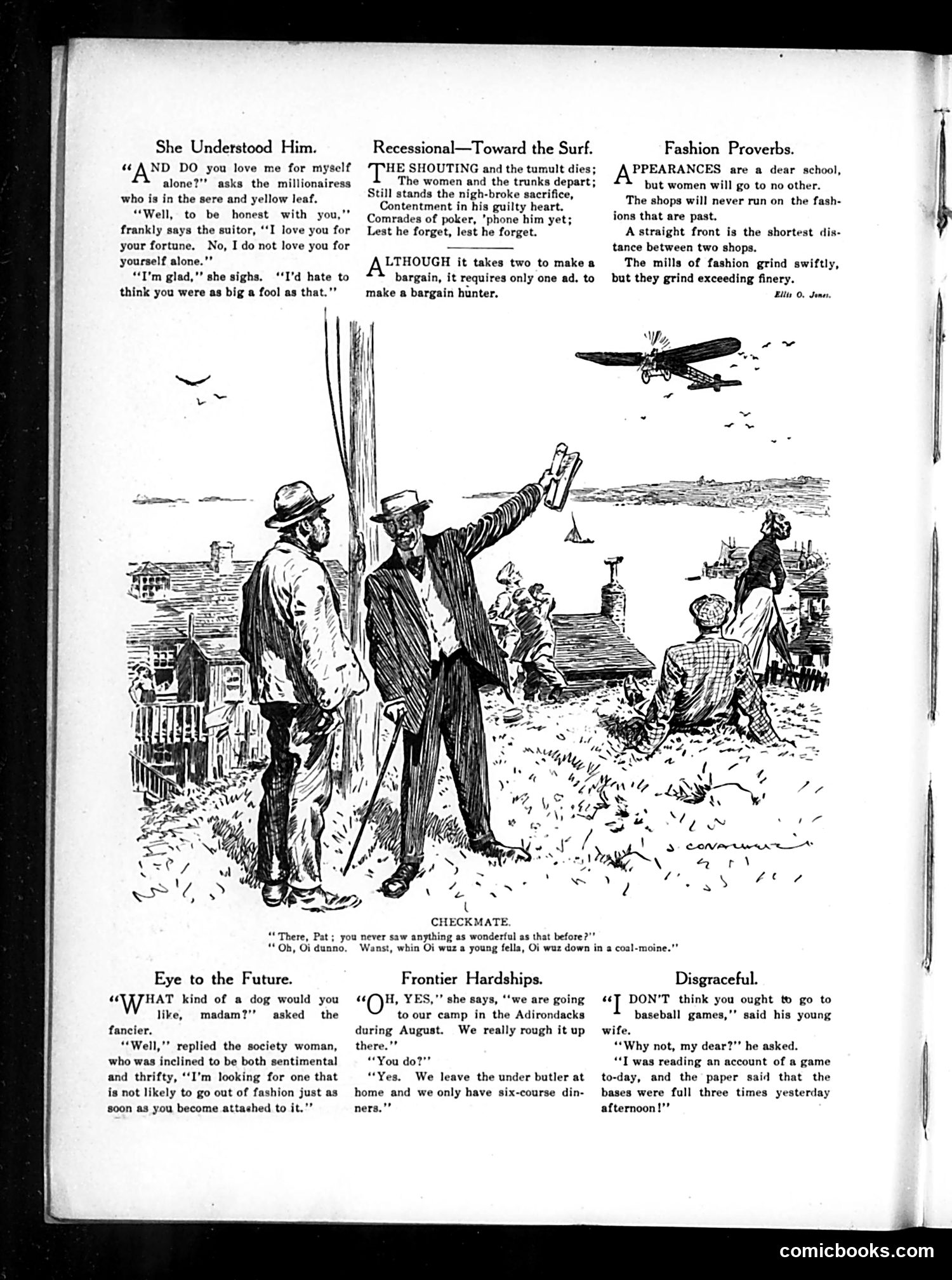
This page contains several satirical pieces mocking upper-class pretension and social hypocrisy circa early 1900s: **"She Understood Him"**: An elderly wealthy woman and her fortune-hunting suitor exchange brutal honesty—she appreciates his candor about marrying her money rather than loving her, calling him a "fool" if he claimed otherwise. The satire targets both mercenary courtship and the woman's cynical acceptance of it. **"Recessional—Toward the Surf"**: Appears to mock wealthy men's summer departures, with women and luggage leaving while men remain behind, "contentment in his guilty heart"—suggesting relief at escape from wives/social obligations. **"Fashion Proverbs"**: Mock aphorisms satirizing women's obsession with fashion as economically wasteful and psychologically controlling. **Central cartoon "Checkmate"**: Two working-class men discuss experiences; one references a coal mine, likely contrasting the wealthy's complaints with actual hardship. **"Frontier Hardships" and "Disgraceful"**: Mock wealthy "roughing it" at Adirondack camps (still employing servants, serving multi-course dinners) and a wife's naive concern about baseball players' "bases being full." The page consistently ridicules upper-class superficiality and self-deception.
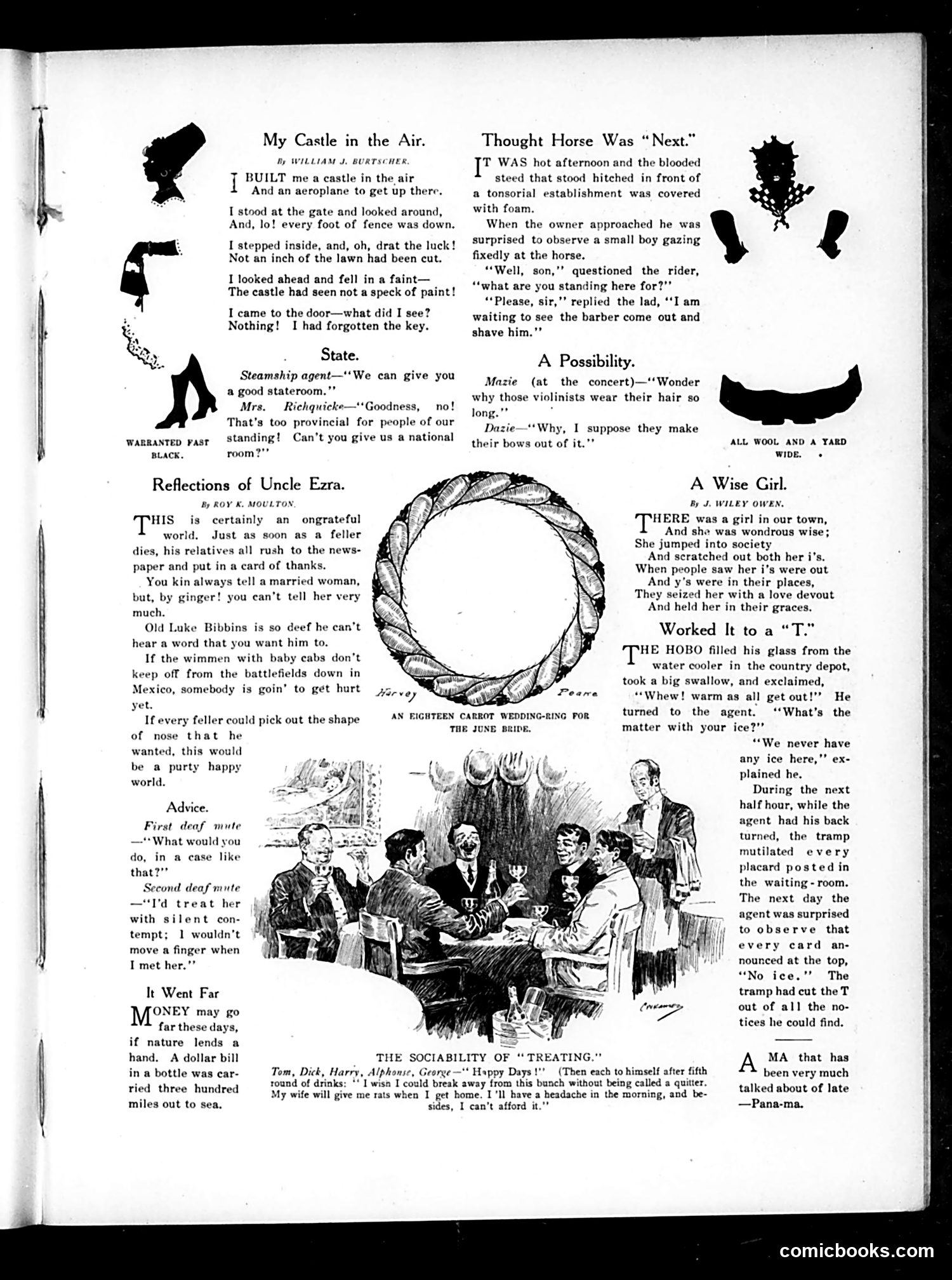
This page contains several brief humorous pieces typical of early 20th-century American satirical humor: **"My Castle in the Air"** satirizes unrealistic daydreaming—a man builds an imaginary dream home but discovers every detail is neglected or missing. **"Thought Horse Was 'Next'"** is a joke about a boy waiting for a barber to shave a horse, misunderstanding what "next" means in a barber shop queue. **"The Sociability of 'Treating'"** (bottom illustration) mocks social drinking culture: five men toast "Happy Days," but the caption reveals each secretly resents being trapped in the group, worried about hangovers, angry wives, and expense—yet none dare leave without appearing unsociable. **Other items** include Uncle Ezra's folksy observations about marriage and deaf-mute advice; wordplay about violinists' "bows"; and a hobo who cleverly vandalizes ice-shortage signs by removing the letter "T." The humor targets familiar social conventions: false optimism, misunderstanding, peer pressure, and working-class cunning. There are no identifiable political figures or specific dated events.
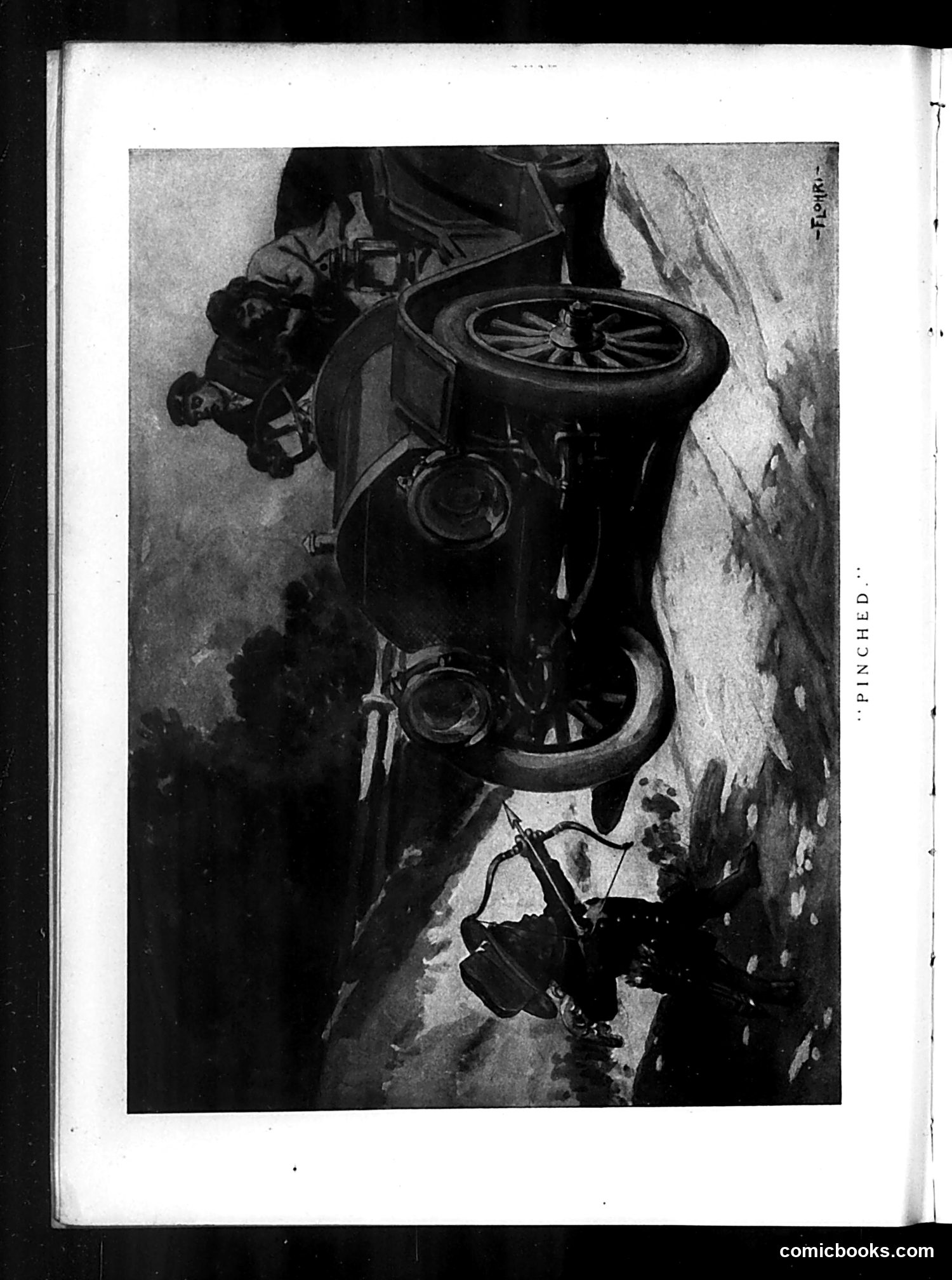
The OCR text provided is essentially unreadable—it consists only of scattered letters and marks without coherent content. The black and white photograph shows what appears to be a motorcycle or early motorized vehicle photographed at an angle, with a person visible and some deteriorating wall or surface in the background. The image is labeled "PINCHED" on the right margin. Without legible text from the original *Judge* magazine page, I cannot reliably identify the specific political or social satire intended, the figures referenced, or the historical context. To properly explain this cartoon's meaning to a modern reader, I would need clearer OCR text or readable original captions identifying the subject matter and satirical target.
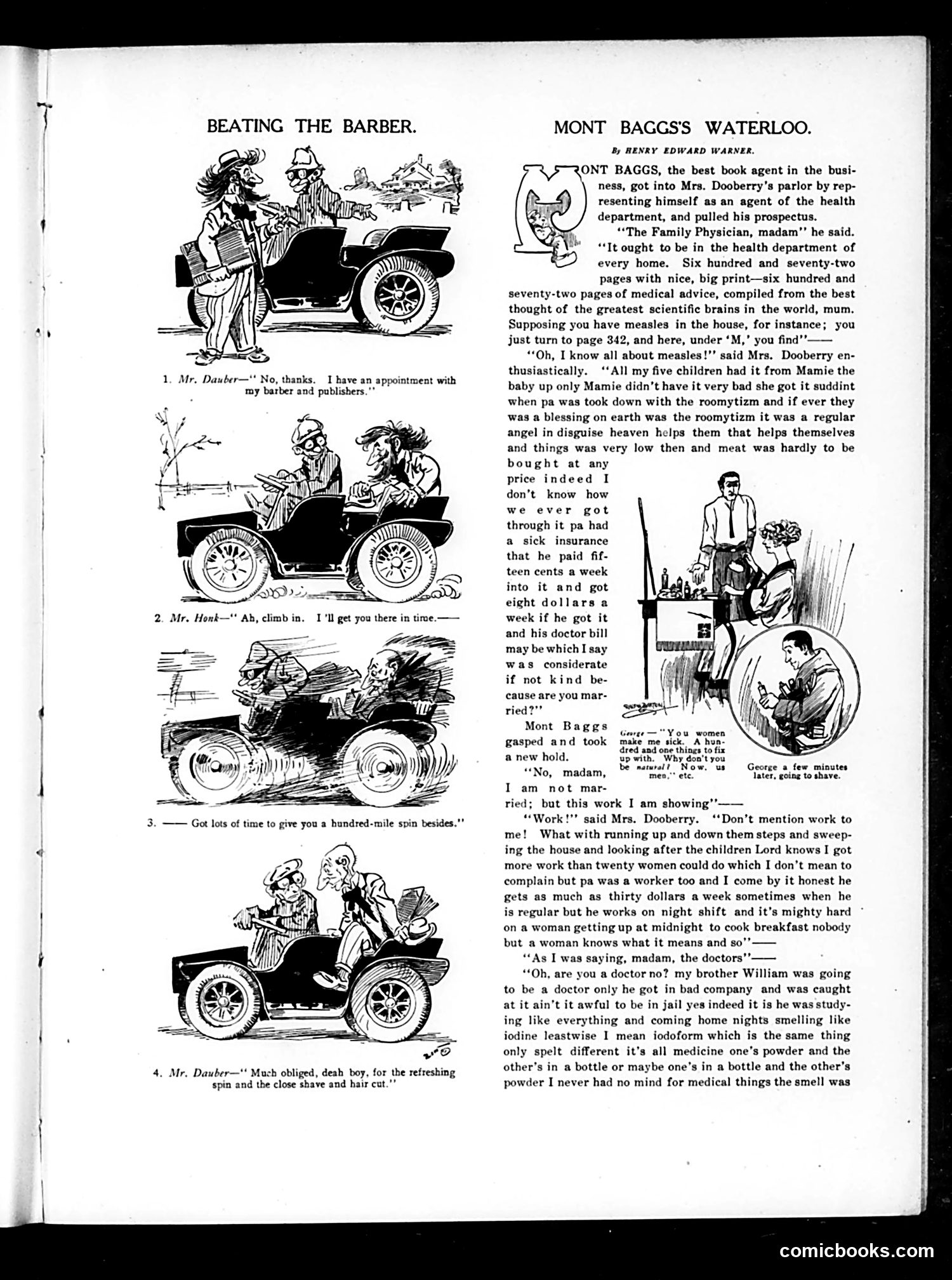
This page contains two separate satirical stories. **"Beating the Barber"** (left) shows a con artist named Mont Baggs attempting to sell a medical encyclopedia door-to-door by posing as a health department agent. He tries multiple evasions to avoid an appointment with his barber and publishers. **"Mont Baggs's Waterloo"** (right) depicts Baggs's comeuppance when he encounters Mrs. Dooberry, a relentlessly talkative woman who derails his sales pitch entirely. She launches into rambling monologues about her children's measles, her husband's "roomytizm" (rheumatism), medical insurance, her brother's jail time, and iodoform—completely overwhelming Baggs with her verbal onslaught. The satire targets both aggressive door-to-door salesmen (a common complaint in this era) and the stereotype of working-class women as garrulous complainers. The joke is that Baggs, a slick con artist, finally meets his match in an unstoppable talker who prevents him from delivering his rehearsed sales pitch.
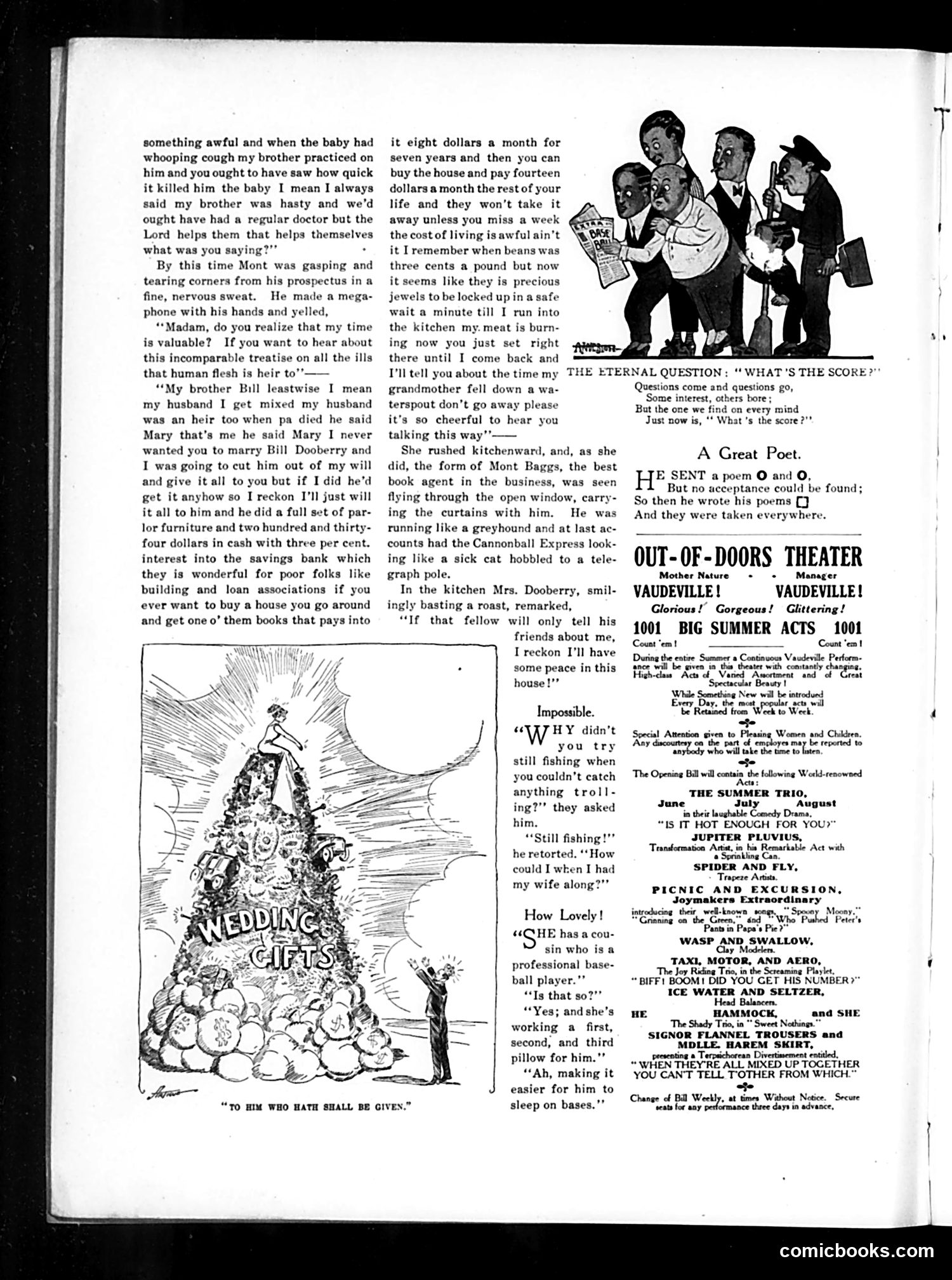
This Judge magazine page contains two satirical pieces: **"The Eternal Question" cartoon (top right):** Shows a book salesman (Mont Baggs) desperately trying to pitch an encyclopedic health treatise to a garrulous housewife. She monopolizes his time with rambling personal anecdotes about her brother, her late father-in-law, and financial advice about building-and-loan savings schemes. The joke: she talks so incessantly that the salesman literally escapes through the window, curtains in hand. The satire mocks both door-to-door salesmen and the stereotype of talkative, information-hungry housewives who trap visitors with unsolicited life stories. **"Wedding Gifts" illustration (lower left):** A decorative cartoon captioned "To him who hath shall be given," showing gifts piled beneath a couple. It satirizes the social convention where wealthy people receive expensive wedding gifts while poor people give modest ones—the wealthy get richer, the poor poorer. The remaining page content is primarily **vaudeville theater advertising** for the "Out-of-Doors Theater," promoting summer entertainment acts.
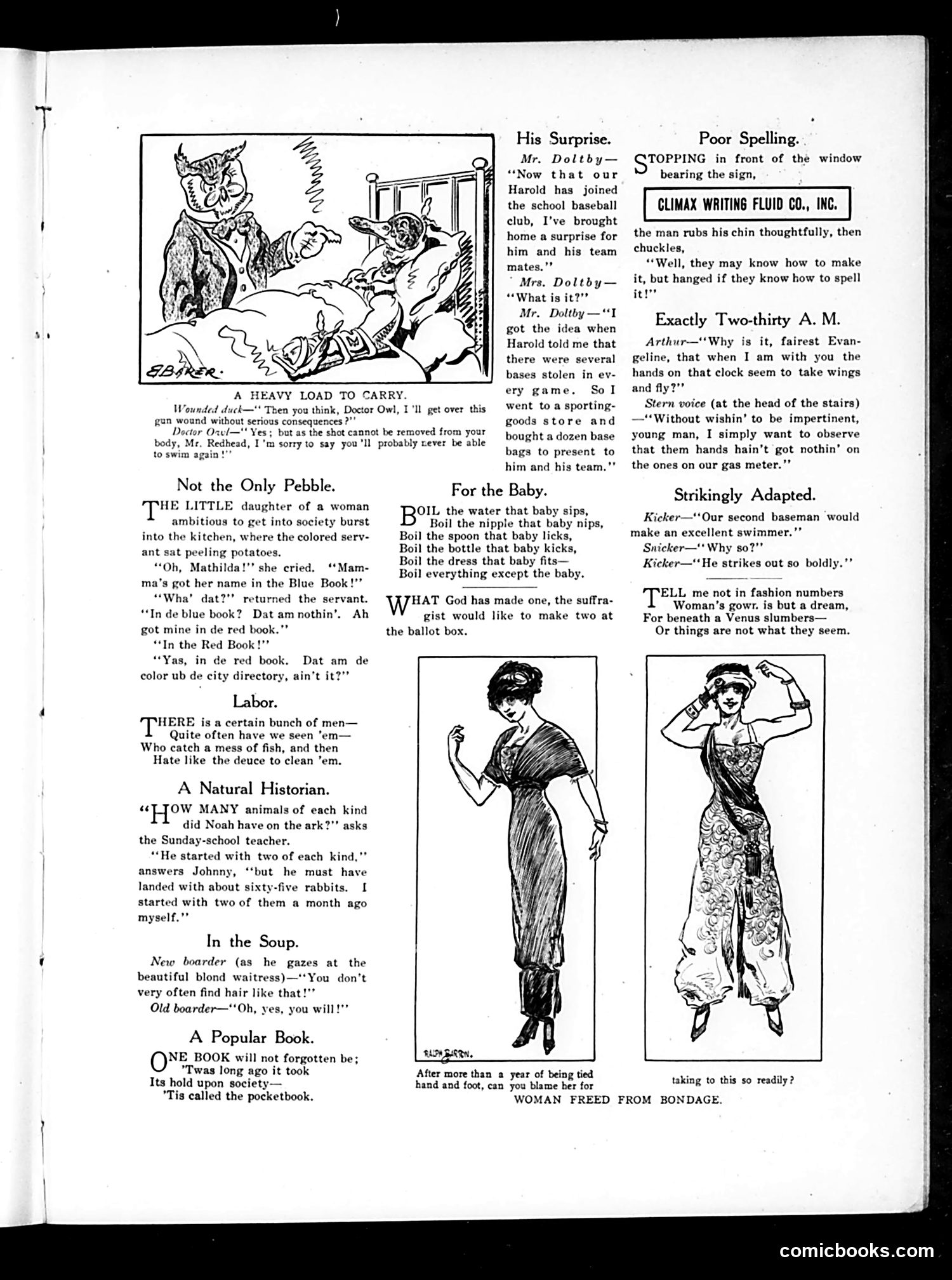
This page collects brief humorous sketches typical of early 20th-century American satirical magazines. Key items: **"His Surprise"** mocks a foolish father who, hearing baseballs "stolen" during games, buys literal base bags as gifts—misunderstanding sports terminology. **"Not the Only Pebble"** satirizes social climbing: a woman proudly appears in the "Blue Book" (a society register), but her servant retorts that she's in the "red book"—the city directory—deflating her pretension with class-based humor. **"Poor Spelling"** jokes about a writing fluid company's ironic misspelling on their own storefront sign. **"Woman Freed from Bondage"** (illustrations) references women's suffrage activism, showing a woman freed from restrictive corsetry—a visual metaphor for liberation that suffragists employed, though the caption skeptically suggests women want "two votes" at the ballot box, mocking feminist demands. Other items include light humor about rabbits breeding, impatient fish-cleaners, and a boarder's romantic misadventure. The tone is playfully cynical about human folly, social pretension, and contemporary social movements.
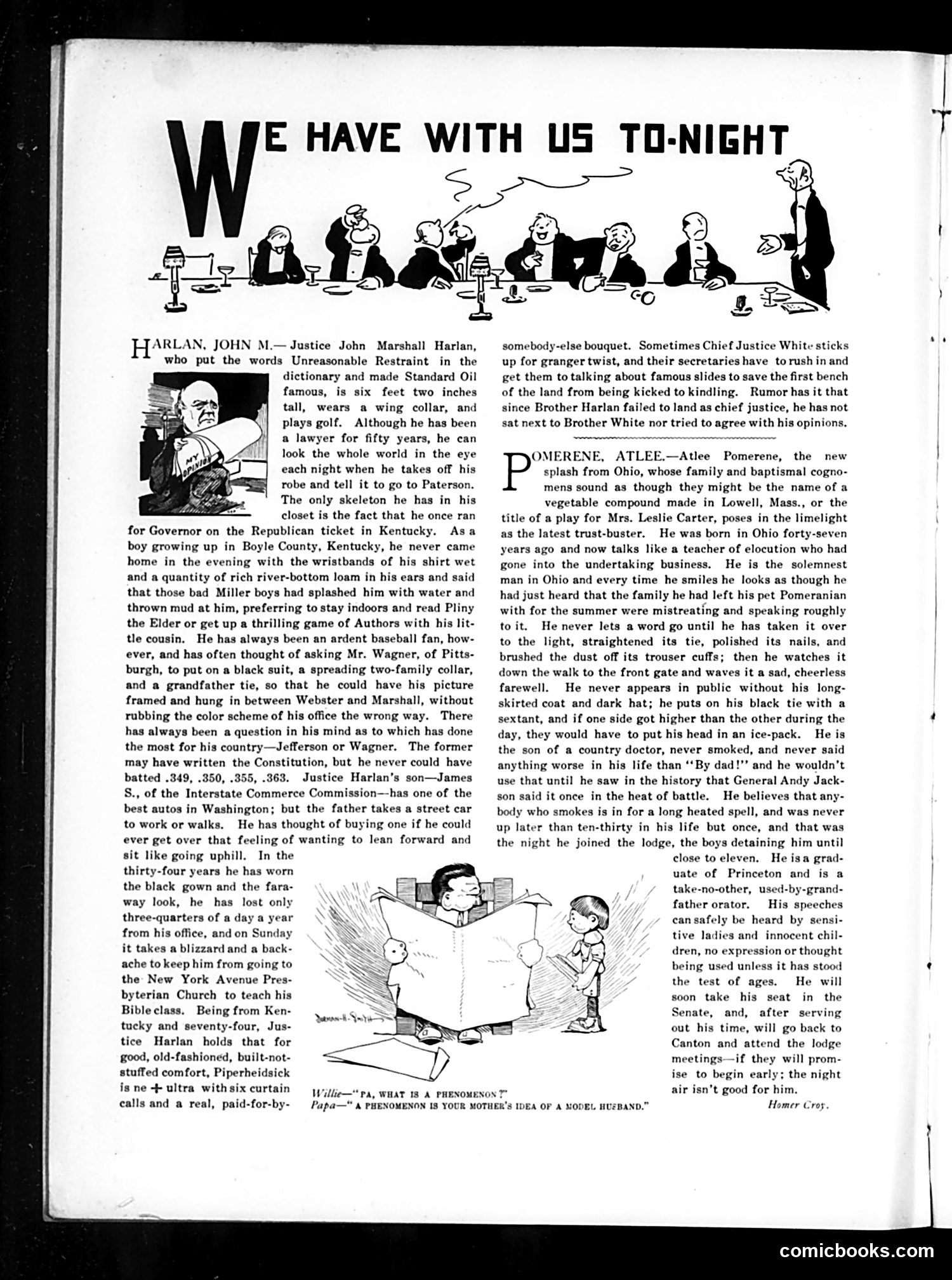
This page satirizes two prominent political figures through biographical sketches with accompanying illustrations. **Justice John Marshall Harlan** is portrayed as an austere, principled jurist who famously challenged Standard Oil in court. The satire mocks his extreme rectitude: he's so morally upright that he can "tell the whole world to go to Paterson" nightly, yet oddly obsesses over baseball statistics and Pittsburgh player Honus Wagner—comparing Wagner's batting average (.349-.363) favorably to Jefferson's constitutional contributions. The joke contrasts his dignified judicial role with his trivial sports enthusiasm. **Atlee Pomerene**, described as a new "trust-buster" from Ohio, is ridiculed for his affected solemnity and overwrought elocution. His name itself is mocked as sounding like a patent medicine. The satire suggests his theatrical gravity and meticulous word-choice are performative affectations masking emptiness. The cartoon header depicts men at a formal dinner—likely representing these and other Washington figures the magazine regularly satirized. The humor relies on readers' familiarity with these contemporary political personalities and their public personas.
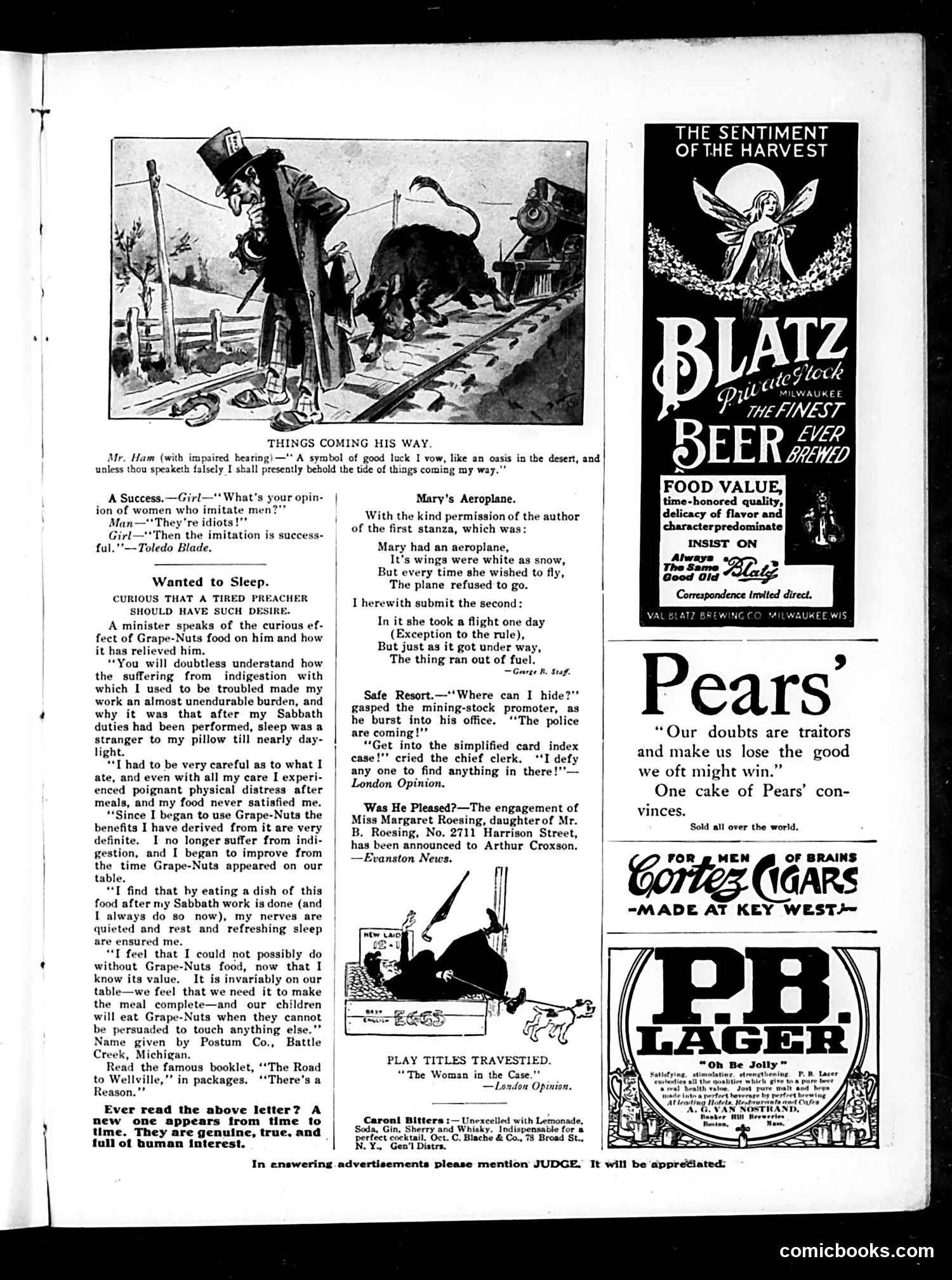
This page is primarily **advertising with scattered humor pieces**, typical of Judge's format. The main cartoon, "Things Coming His Way," shows a figure labeled "Mr. Ham" with impaired hearing—likely a visual pun on his name—standing on railroad tracks as a train approaches. The caption suggests he's misinterpreting an idiom about "things coming his way," creating dark comedic irony about his obliviousness to actual danger. The page includes typical early-20th-century satirical quips: a joke about women imitating men, a parody of Mary's Little Lamb reimagined with an unreliable airplane, and a jab at mining-stock promoters hiding from police in card files (referencing real financial fraud scandals). The bulk of the page features **testimonial advertising** for Grape-Nuts cereal (claiming to cure indigestion and insomnia), Blatz beer, Cortez cigars, and Pears' soap—all with pseudoscientific or vague health claims typical of the era. The humor is genteel and relies on wordplay rather than political commentary.
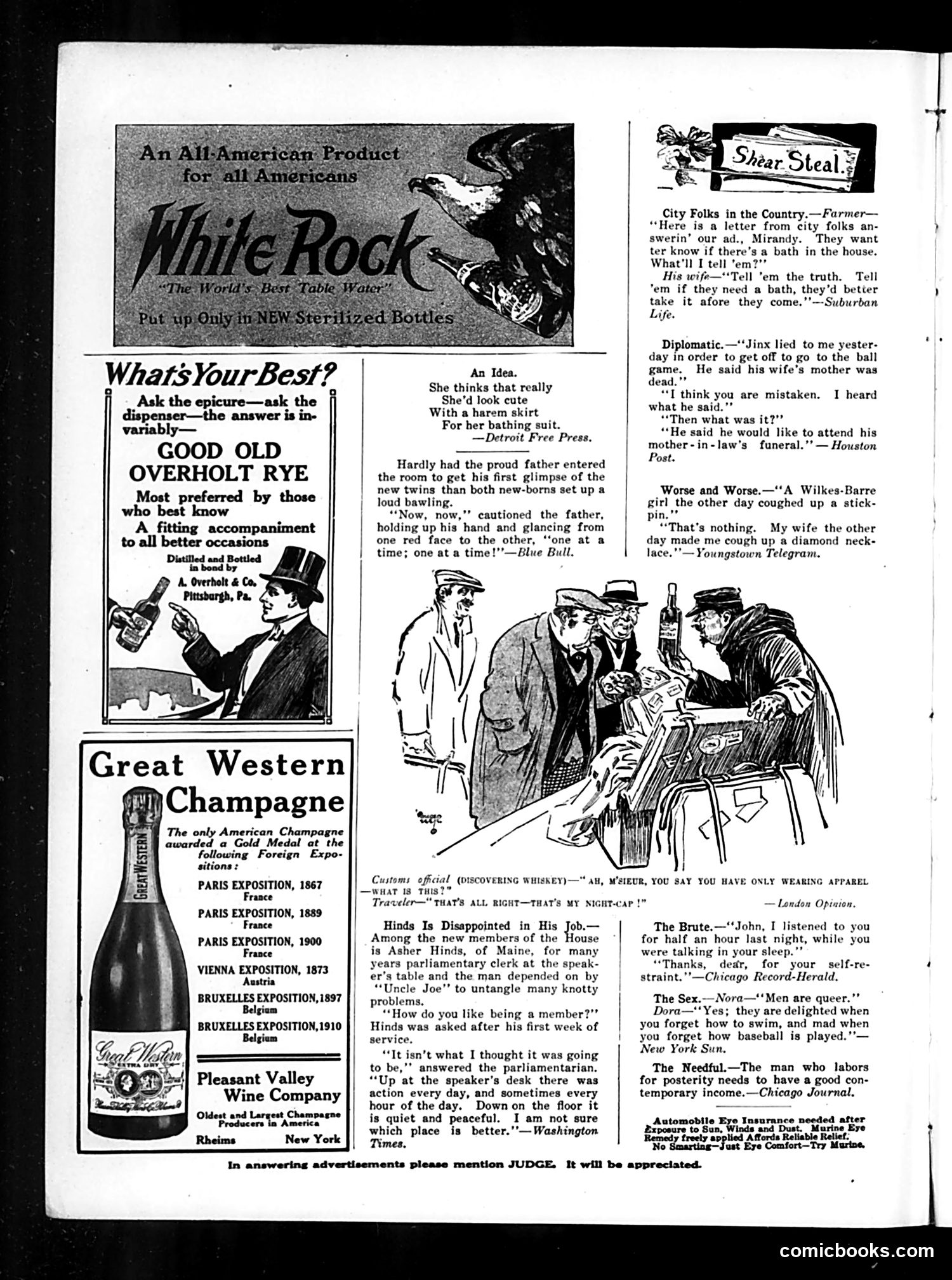
This page is primarily **advertising with satirical humor snippets**, typical of Judge's format. The main advertisements promote whiskey (Overholt Rye), champagne (Great Western), and wine, emphasizing their American quality and international awards. The scattered jokes target early 20th-century social anxieties: city people unfamiliar with rural life; parliamentary politics (referencing Asher Hinds, a Maine congressman new to the House); marital discord (wives extracting valuables from husbands); and gender stereotypes. One cartoon shows a customs official discovering whiskey smuggled as "wearing apparel"—mocking both smuggling and the formal language of bureaucracy. The humor is gentle domestic satire rather than hard political commentary. The page reflects concerns about urbanization, changing social roles, and the friction between tradition and modernity, wrapped in the era's characteristic gender-based and class-based humor. The emphasis on American-made luxury goods suggests nationalist sentiment in the pre-WWI period.
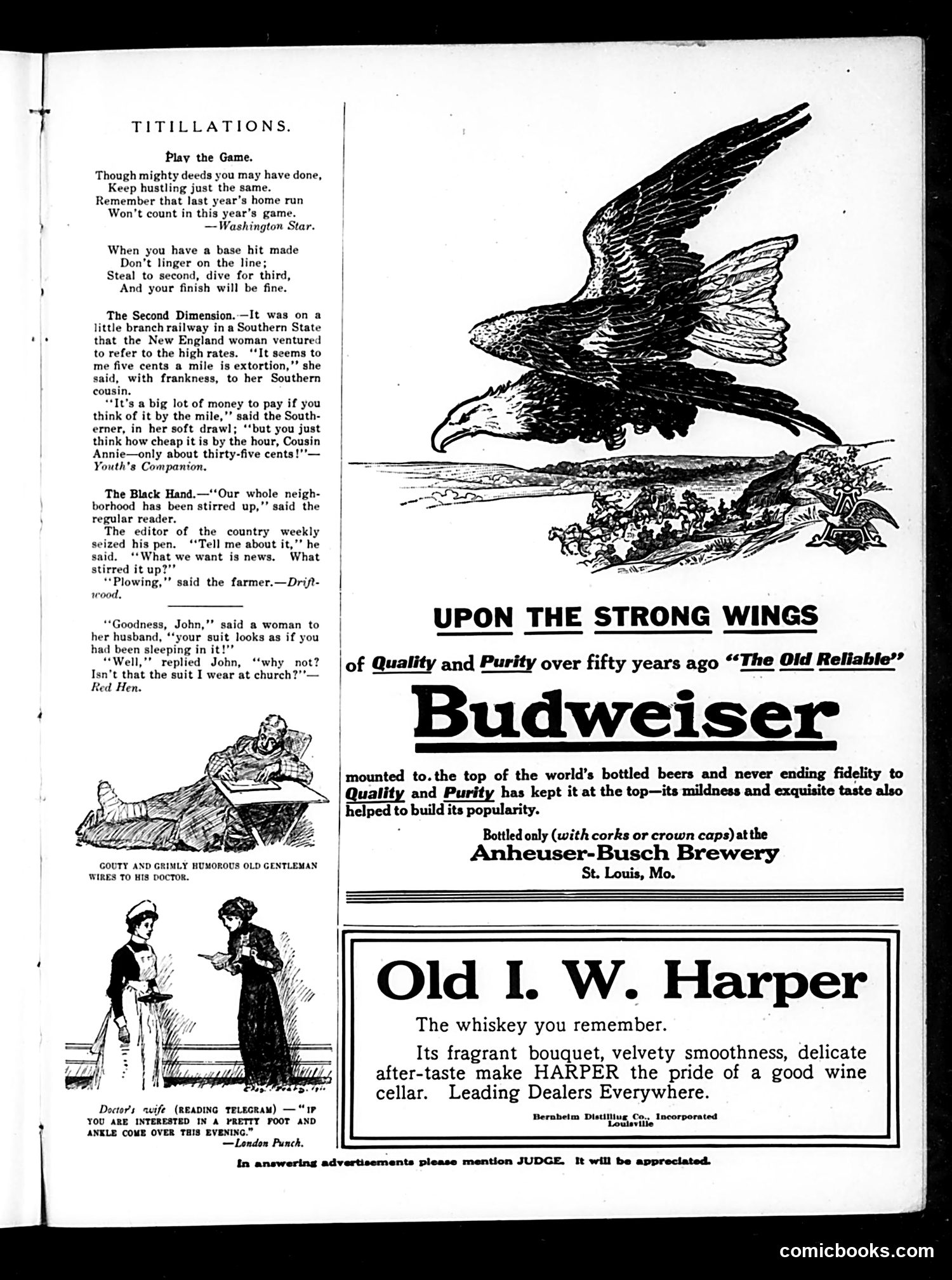
This page contains **short humorous anecdotes** ("Titillations") and **advertisements**, rather than political cartoons. The anecdotes use gentle satire on everyday life: - **"Play the Game"**: Sports metaphors about not resting on past accomplishments - **"The Second Dimension"**: A New England woman complains about high Southern railway rates; a Southerner deflects by reframing the cost per *hour* instead of per *mile*—absurdist logic that highlights regional differences - **"The Black Hand"**: A newspaper editor expects scandal; a farmer simply mentions plowing, subverting expectations - **The doctor/ankle telegram**: An elderly gentleman with gout misinterprets his doctor's wife's innocent telegram as flirtation The page primarily showcases **period advertisements** for Budweiser beer and I.W. Harper whiskey, using appeals to quality and tradition typical of early 20th-century marketing. The humor is mild, domestic, and relies on misunderstandings and social observations rather than political commentary.
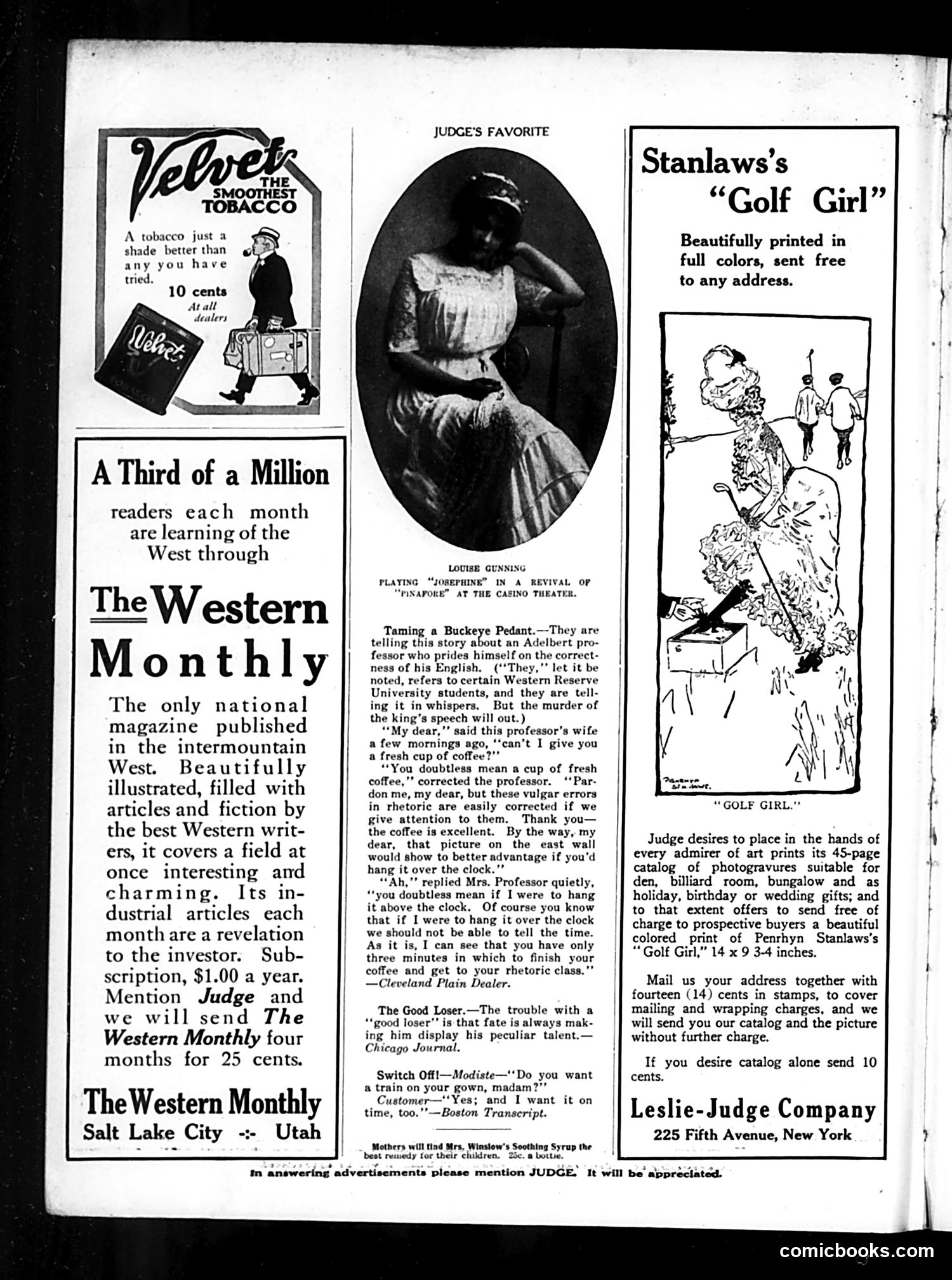
This is primarily an **advertising and humor page** from Judge magazine, not a political cartoon. **Main Content:** The center features a photograph of actress **Louise Gunning** in a revival of Gilbert & Sullivan's "HMS Pinafore" at the Casino Theater—presented as "Judge's Favorite." **Humor Pieces:** Three short jokes appear: 1. "Taming a Buckeye Pedant"—mocks a pedantic professor who over-corrects his wife's grammar, only to be outsmarted when she points out his illogical suggestion would obscure a clock 2. "The Good Loser"—brief quip about fate forcing people to demonstrate losing gracefully 3. "Switch Off!"—wordplay about a train (garment) arriving "on time" **Advertisements:** Include Velvet tobacco, The Western Monthly magazine, and Leslie-Judge Company's "Golf Girl" print by Penrhyn Stanlaws (a fashionable illustration for gentlemen's dens). The page reflects early 1900s American humor: grammar pedantry, domestic comedy, and puns were popular entertainments for Judge's educated, middle-class readership.
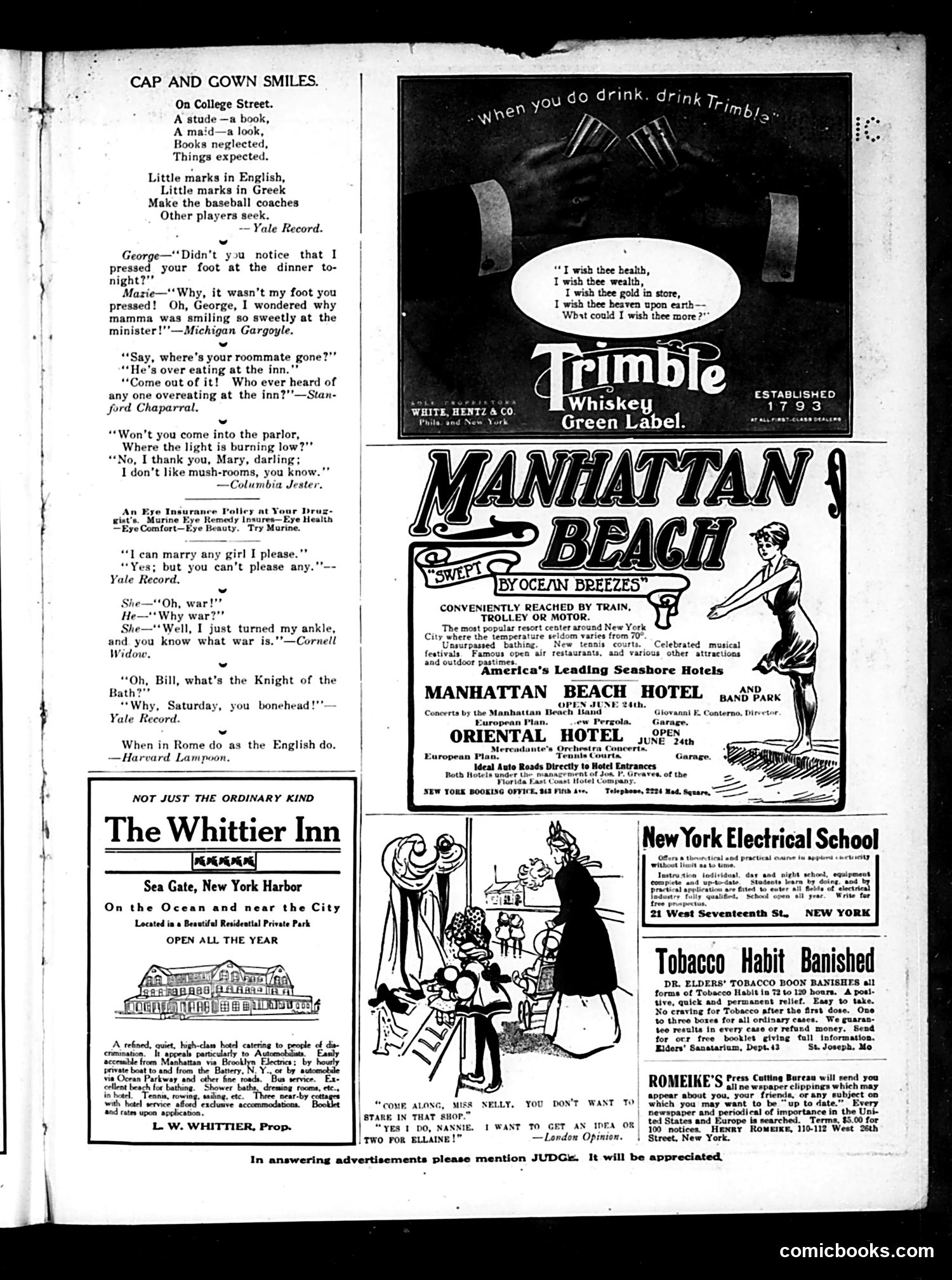
This page consists primarily of **advertisements and reprinted college humor** rather than original satirical cartoons. The upper left contains "Cap and Gown Smiles"—brief jokes collected from college publications (Yale Record, Michigan Gargoyle, Stanford Chaparral, etc.). These are gentle campus humor: a student pressing the wrong girl's foot at dinner, jokes about overeating at inns, and romantic mishaps. The humor reflects early 20th-century college social life—dating anxieties, pranks, and mild romantic confusion. The advertisements dominate the page, pitching: - **The Whittier Inn** (seaside resort) - **Manhattan Beach** hotels and attractions - **Trimble Whiskey** (with a period drinking toast) - **New York Electrical School** - **Tobacco Habit Banishment** (Dr. Elders' cure) - **Romeike's Press Clipping Bureau** The only cartoon image shows a woman gesturing while speaking to a man about shopping—captioned with a London Opinion joke about wanting "an idea or two for elaine," likely a pun on "L'Elaine" or similar. The page is essentially a **filler/advertising compilation** rather than satirical political content.
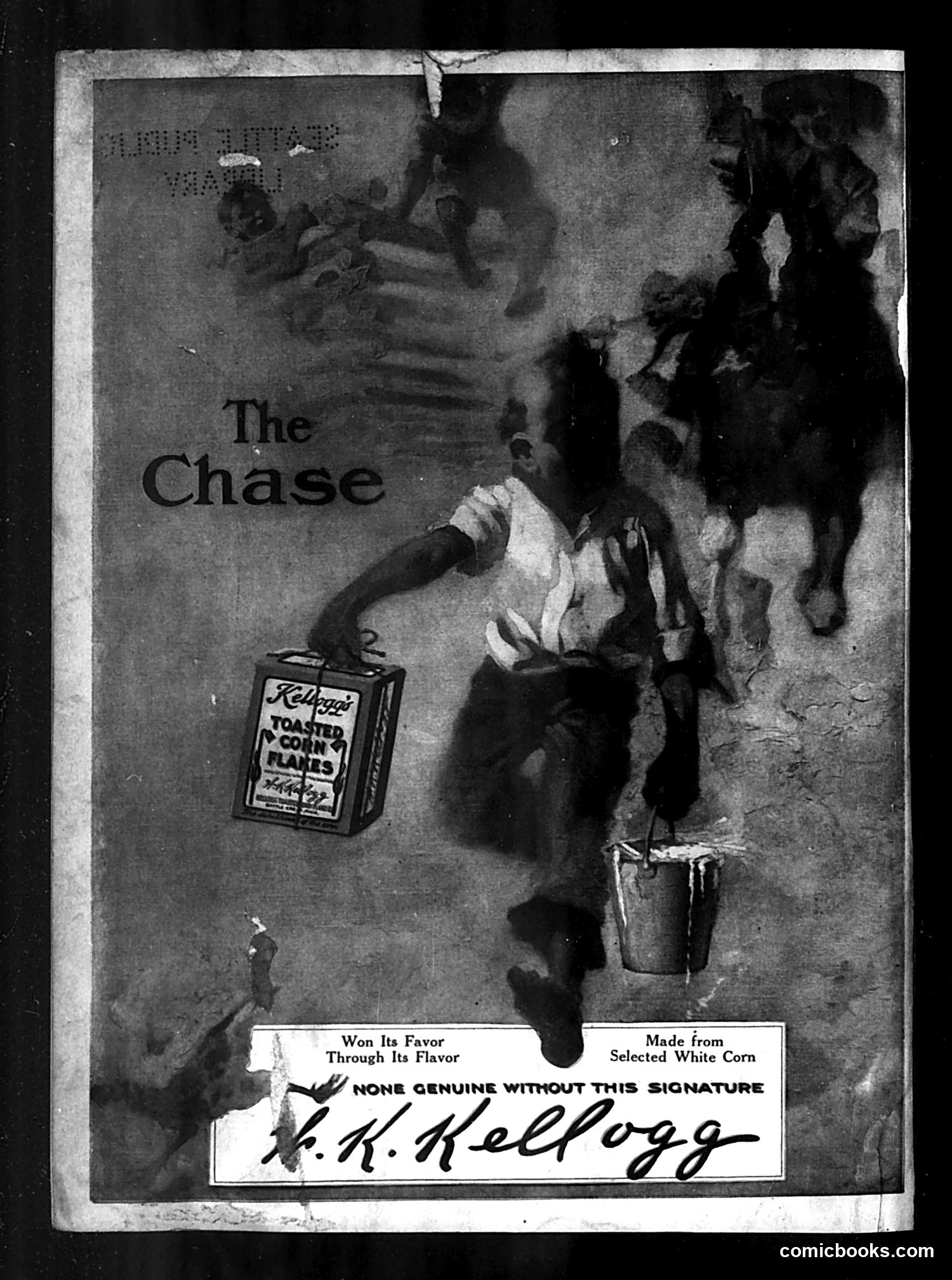
This appears to be a Kellogg's Corn Flakes advertisement rather than political satire. The page shows a dynamic scene of someone being chased while holding a box of Kellogg's cereal—the humor derives from the product's appeal being so strong that it's worth pursuing. The tagline "Won Its Favor Through Its Flavor" emphasizes consumer preference for the brand. The signature line "None Genuine Without This Signature" and "K.K. Kellogg" authenticates the product. The "chase" imagery suggests competitive marketplace excitement or consumer enthusiasm. This appears designed to make the cereal seem desirable and worth seeking out—a common early-20th-century advertising approach using action and humor rather than straightforward product claims.
I can see this is a page from *Judge* magazine (as indicated by the watermark), but the image is almost entirely black with very minimal visible content—mostly just noise, artifacts, and the edges of the page. There appear to be some faint geometric shapes or text elements, but they're too degraded to read or interpret with confidence. Without being able to discern the actual cartoon(s), captions, or illustrative content, I cannot identify the figures, political references, or satirical intent of this particular page. The OCR text provided only shows "comicbooks.com," which appears to be a modern watermark rather than original magazine content. A clearer image would be needed to provide accurate analysis.