
Judge, 1911-06-24 · page 18 of 25
Judge — June 24, 1911 — page 18: what you’re looking at
What you’re looking at
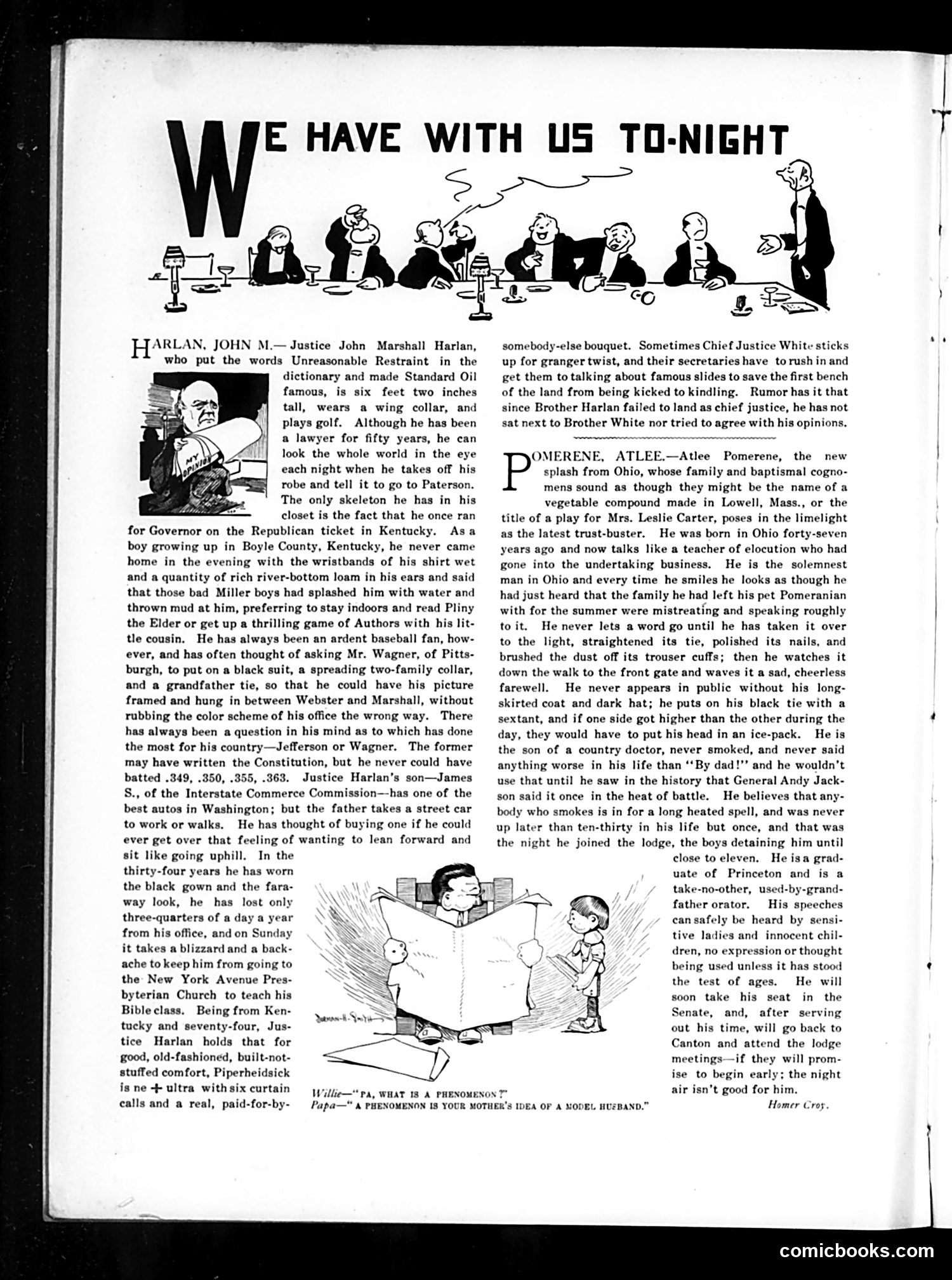
This page satirizes two prominent political figures through biographical sketches with accompanying illustrations. **Justice John Marshall Harlan** is portrayed as an austere, principled jurist who famously challenged Standard Oil in court. The satire mocks his extreme rectitude: he's so morally upright that he can "tell the whole world to go to Paterson" nightly, yet oddly obsesses over baseball statistics and Pittsburgh player Honus Wagner—comparing Wagner's batting average (.349-.363) favorably to Jefferson's constitutional contributions. The joke contrasts his dignified judicial role with his trivial sports enthusiasm. **Atlee Pomerene**, described as a new "trust-buster" from Ohio, is ridiculed for his affected solemnity and overwrought elocution. His name itself is mocked as sounding like a patent medicine. The satire suggests his theatrical gravity and meticulous word-choice are performative affectations masking emptiness. The cartoon header depicts men at a formal dinner—likely representing these and other Washington figures the magazine regularly satirized. The humor relies on readers' familiarity with these contemporary political personalities and their public personas.
📄 Transcribed text from this page (OCR, searchable)
Machine-transcribed from the original scan — historical spelling and the odd misread are preserved.
ARLAN, JOHN M,.— Justice John Marshall Harlan, who put the words Unreasonable Restraint in the dictionary and made Standard Oil famous, is six feet two inches tall, wears a wing collar, and plays golf. Although he has been a lawyer for fifty years, he can look the whole world in the eye each night when he takes off his robe and tell it to go to Paterson. The only skeleton he has in his closet is the fact that he once ran for Governor on the Republican ticket in Kentucky. Asa boy growing up in Boyle County, Kentucky, he never came home in the evening with the wristbands of his shirt wet and a quantity of rich river-bottom loam in his ears and said that those bad Miller boys had splashed him with water and thrown mud at him, preferring to stay indoors and read Pliny the Elder or get up a thrilling game of Authors with his lit- tle cousin. He has always been an ardent baseball fan, how- ever, and has often thought of asking Mr. Wagner, of Pitts- burgh, to put on a black suit, a spreading two-family collar, and a grandfather tie, so that he could have his picture framed and hung in between Webster and Marshall, without rubbing the color scheme of his office the wrong way. There has always been a question in his mind as to which has done the most for his country—Jefferson or Wagner. The former may have written the Constitution, but he never could have batted .349, .350, .355, .363. Justice Harlan’s son—James S., of the Interstate Commerce Commission—has one of the best autos in Washington; but the father takes a street car to work or walks. He has thought of buying one if he could ever get over that feeling of wanting to lean forward and sit like going uphill. In the thirty-four years he has worn the black gown and the fara- way look, he has lost only three-quarters of a day a year from his office, and on Sunday it takes a blizzard and a back- ache to keep him from going to the New York Avenue Pres- byterian Church to teach his Bibleclass. Being from Ken- tucky and seventy-four, Jus- tice Harlan holds that for good, old-fashioned, built-not- stuffed comfort, Piperheidsick is ne + ultra with six curtain calls and a real, paid-for-by- E HAVE WITH US TO-NIGHT Papa—" & PHENOMENON 18 YOUR MOTHER'S IDEA OP A NODEL HUZBAND.” somebody-else bouquet. Sometimes Chief Justice White sticks up for granger twist, and their secretaries have to rush in and get them to talking about famous slides to save the first bench of the land from being kicked to kindling. Rumor has it that since Brother Harlan failed to land as chief justice, he has not sat next to Brother White nor tried to agree with his opinions. OMERENE, ATLEE.—Atlee Pomerene, the new P splash from Ohio, whose family and baptismal cogno- mens sound as though they might be the name of a vegetable compound made in Lowell, Mass., or the title of a play for Mrs. Leslie Carter, poses in the limelight as the latest trust-buster. He was born in Ohio forty-seven years ago and now talks like a teacher of elocution who had gone into the undertaking business. He is the solemnest man in Ohio and every time he smiles he looks as though he had just heard that the family he had left his pet Pomeranian with for the summer were mistreating and speaking roughly to it. He never lets a word go until he has taken it over to the light, straightened its tie, polished its nails, and brushed the dust off its trouser cuffs; then he watches it down the walk to the front gate and waves it a sad, cheerless farewell. He never appears in public without his long- skirted coat and dark hat; he puts on his black tie with a sextant, and if one side got higher than the other during the day, they would have to put his head in an ice-pack. He is the son of a country doctor, never smoked, and never said anything worse in his life than ‘‘By dad!’ and he wouldn't use that until he saw in the history that General Andy Jack- son said it once in the heat of battle. He believes that any- body who smokes is in for a long heated spell, and was never up later than ten-thirty in his life but once, and that was the night he joined the lodge, the boys detaining him until close to eleven. He isa grad- uate of Princeton and is a take-no-other, used-by-grand- father orator. His speeches cansafely be heard by tive ladies and innocent chil- dren, no expression or thought being used unless it has stood the test of ages. He will soon take his seat in the Senate, and, after serving out his time, will go back to Canton and attend the lodge meetings—if they will prom- ise to begin early; the night air isn’t good for him. Homer Cros. sensi- comicbooks.com