
A complete issue · 24 pages · 1911
Judge — May 13, 1911
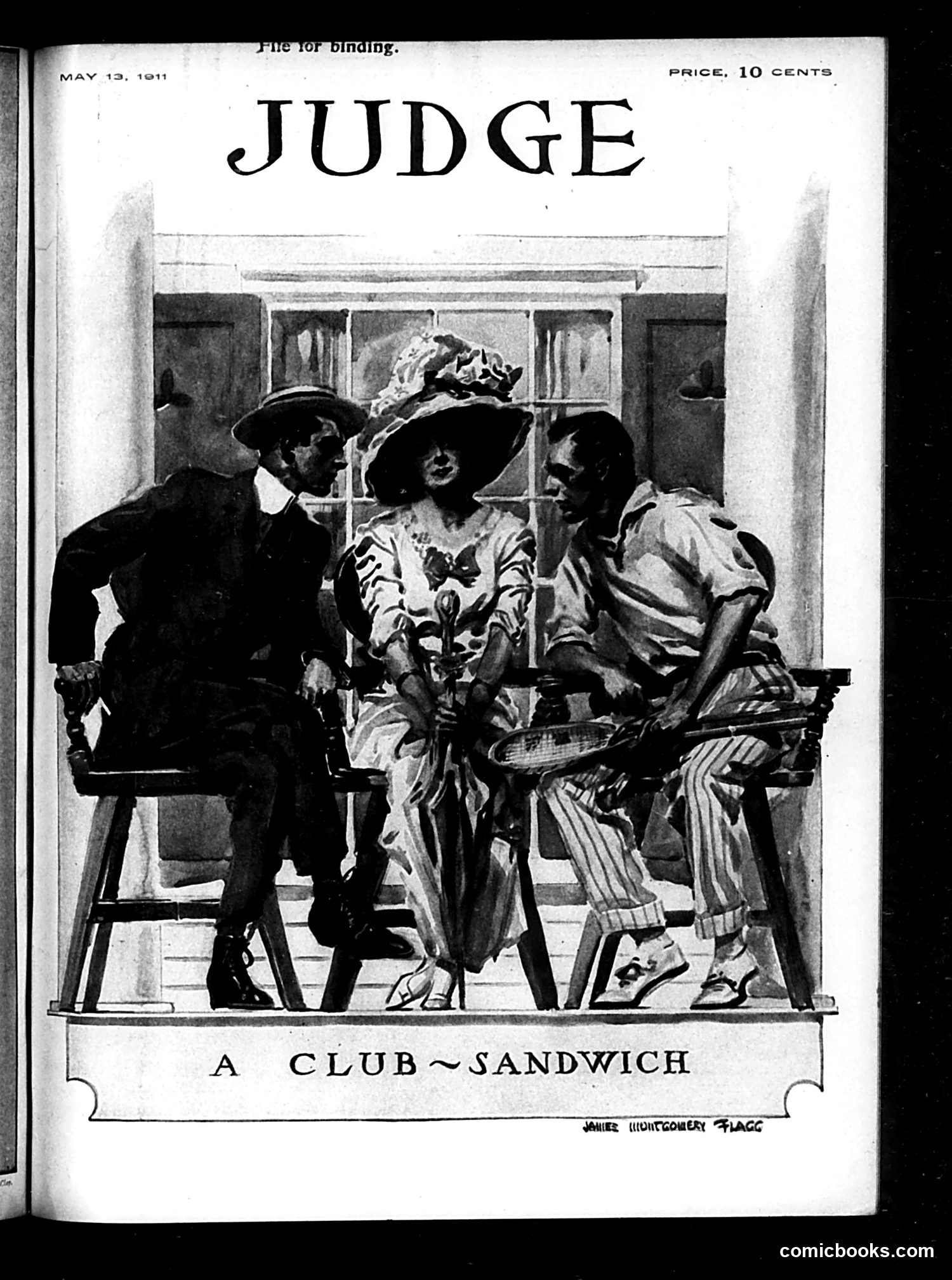
This cartoon depicts four figures seated together in what appears to be a social setting, likely a club or restaurant. The title "A Club Sandwich" is a visual pun—rather than the actual food, we see people literally sitting together at a "club." The specific identities of these figures remain unclear from the image alone. However, the cartoon likely satirizes some social or political gathering of 1911. The prominent woman in the center, wearing an elaborate hat, appears to be a key figure, possibly a socialite or public personality of the era. The humor plays on the double meaning of "club" (both the social venue and the food item), a common technique in Judge magazine's satirical humor. Without additional context, the precise political or social commentary cannot be definitively determined.
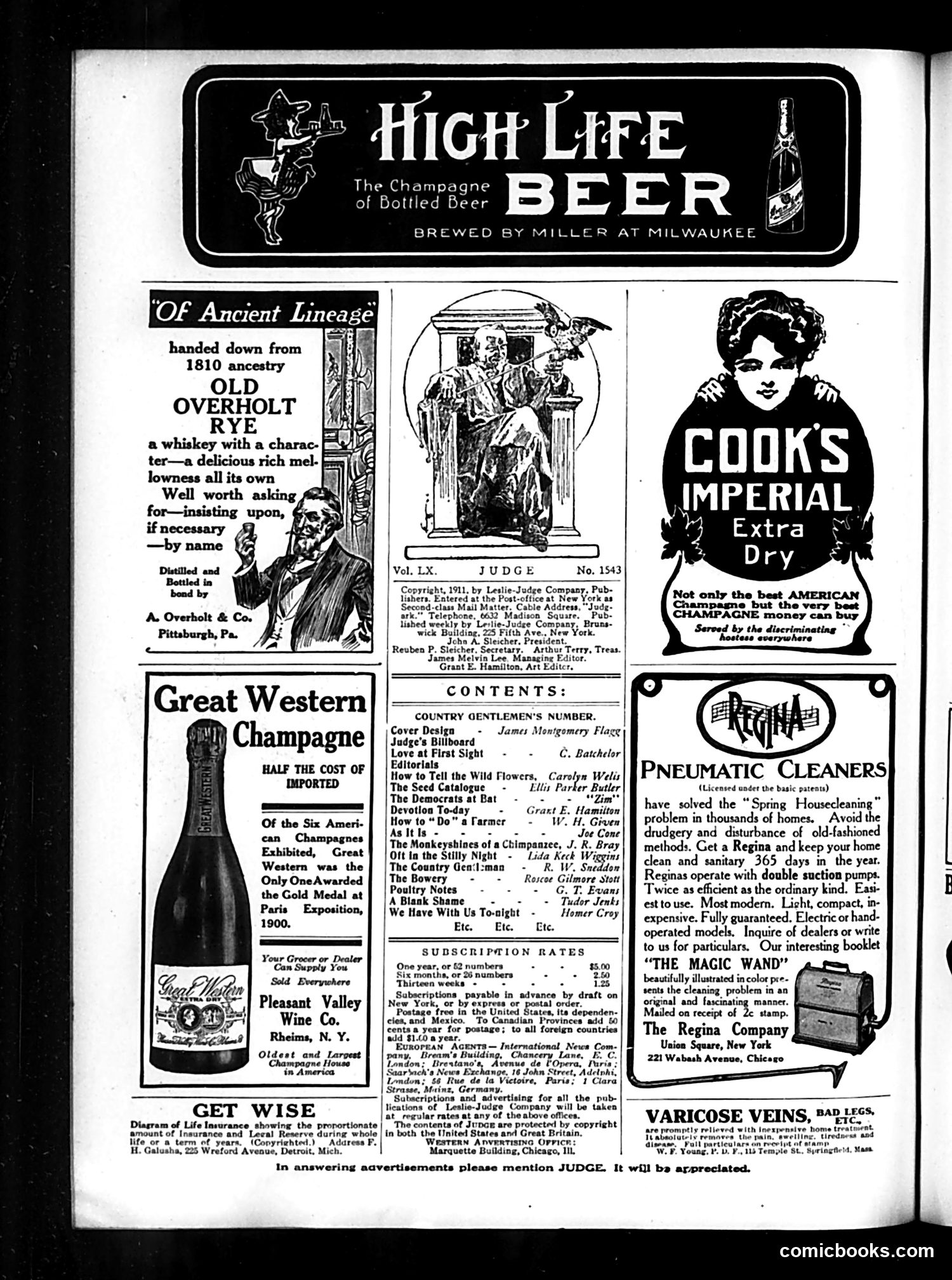
This page is primarily **advertising rather than political satire**. It contains several commercial ads for period products: - **High Life Beer** (top): Milwaukee-brewed beer marketed as "champagne of bottled beer" - **Old Overholt Rye** (left): Whiskey with claimed 1810 ancestry - **Cook's Imperial Extra Dry** (right): Champagne advertised as superior American product - **Great Western Champagne** (left): Another wine competing on cost - **Regina Pneumatic Cleaners** (right): Early vacuum cleaners using suction technology - **Varicose Veins treatment** (bottom right): Medical ad for home treatment The page's central feature is **Judge magazine's table of contents** showing "Country Gentleman's Number" with various article titles. The only satirical element appears minimal—this is essentially a commercial vehicle masquerading as editorial content, typical of early 20th-century magazines that relied heavily on advertising revenue.
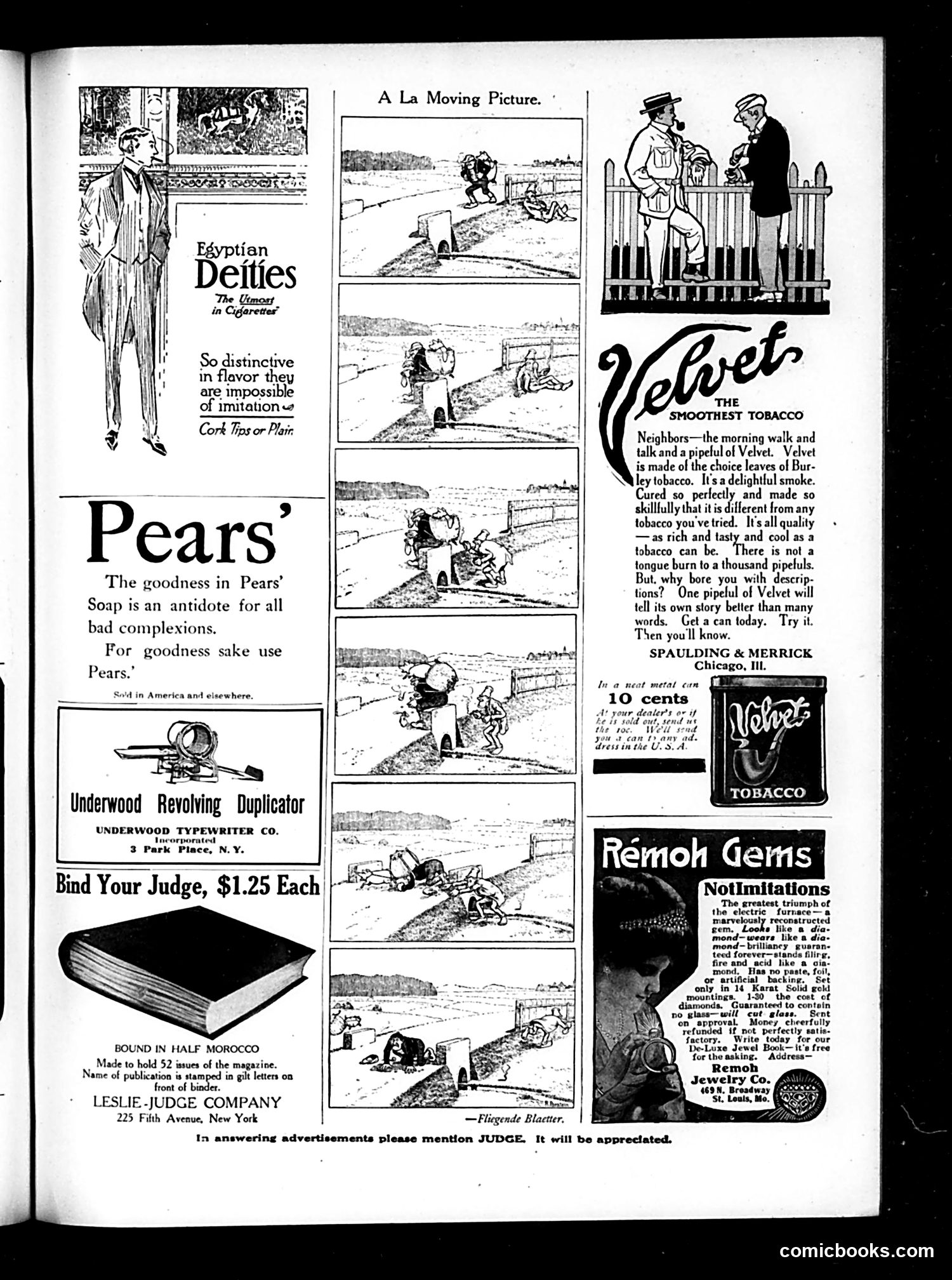
This page is **primarily advertisements** with one satirical cartoon titled "A La Moving Picture" in the center-right. The cartoon appears to mock early film comedy through a series of sequential panels showing slapstick action—likely referencing popular moving picture comedies of the era (early 1900s). The repeated scene of someone falling or being knocked down by what appears to be a pole or plank demonstrates the crude, repetitive humor typical of silent film comedies that Judge's readers would recognize. The surrounding ads—for Egyptian Deities cigarettes, Pears' Soap, Velvet Tobacco, typewriter duplicators, and jewelry—represent typical Judge magazine revenue sources. The satire gently mocks the formulaic, predictable nature of contemporary movie humor through repetition.
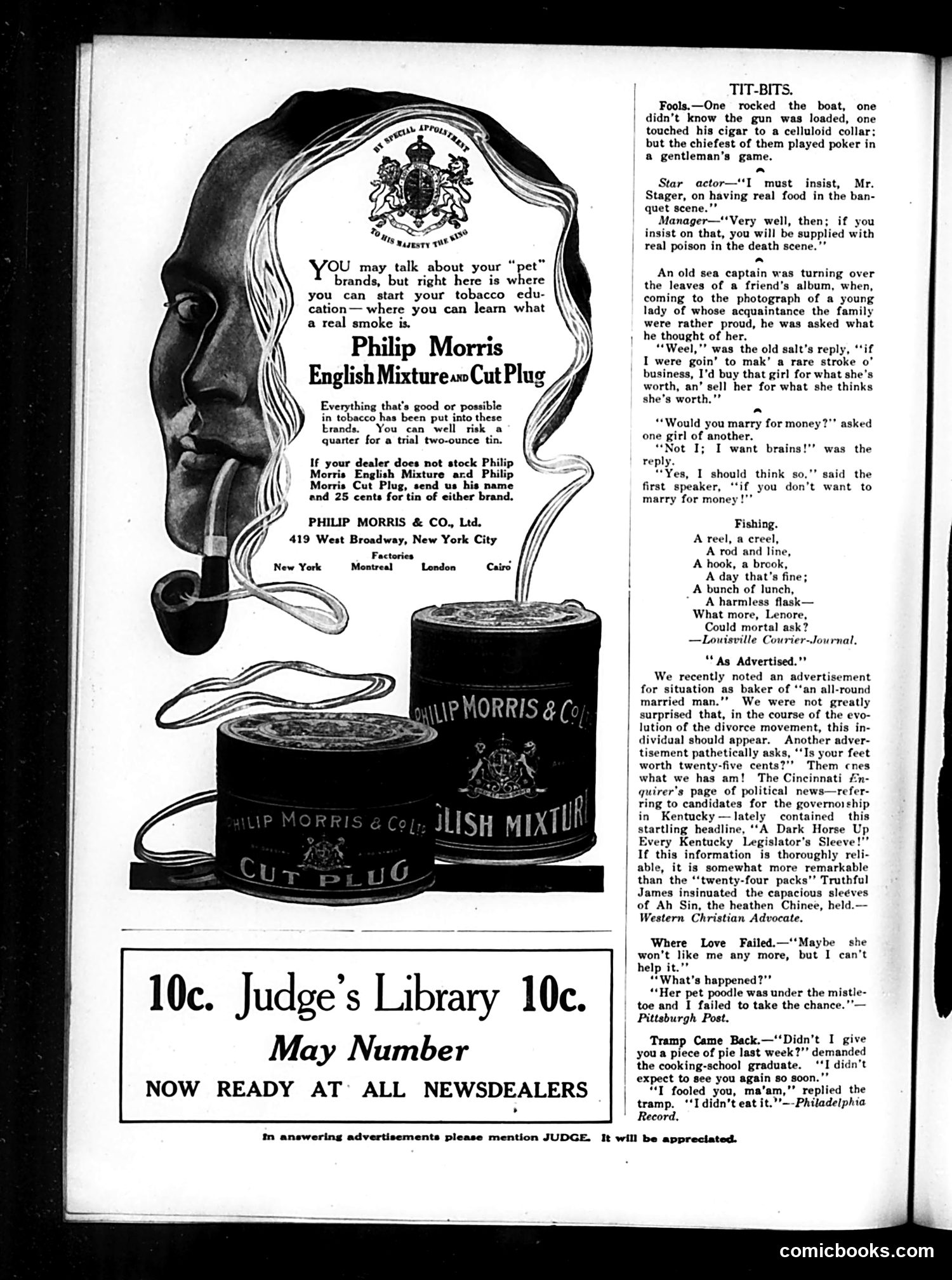
This page is primarily **advertising and miscellaneous content** rather than political satire. The dominant feature is a Philip Morris tobacco advertisement depicting a pipe smoker, emphasizing the brand's quality as an "English Mixture and Cut Plug." The right column contains **"Tit-Bits"**—brief, humorous anecdotes typical of Judge's filler content. These include light social humor about fools, star actors demanding authenticity in stage props, an old sea captain's romantic musings, and various witty one-liners about marriage and fishing. The only substantive political reference appears in a section titled **"As Advertised,"** which mocks political advertisements, including one Kentucky gubernatorial candidate—though specifics aren't clearly identified. The **Judge's Library advertisement** promotes the magazine's May issue at newsstands for 10 cents.
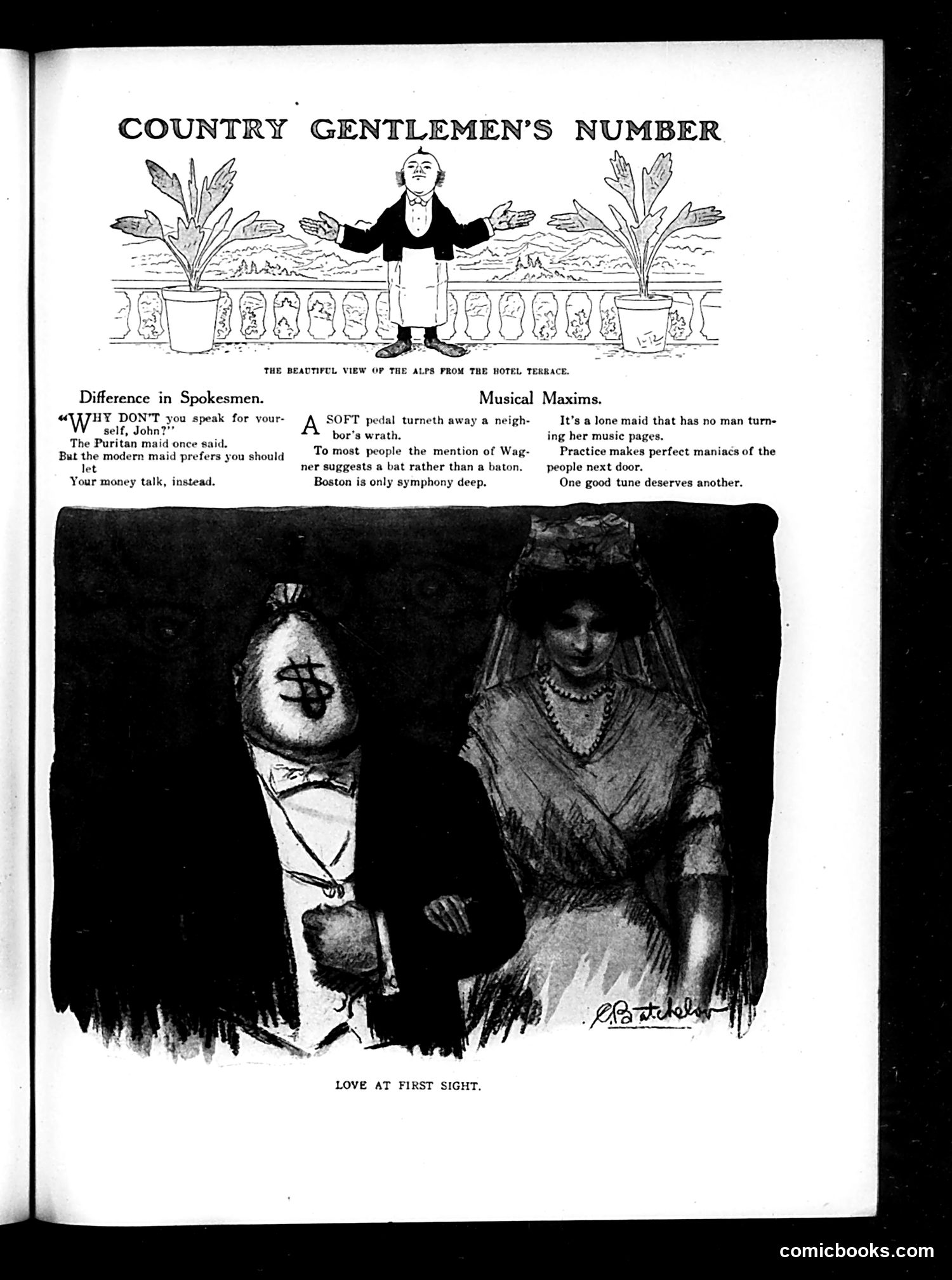
This Judge magazine page contains three satirical items: **Top cartoon**: "The Beautiful View of the Alps from the Hotel Terrace" shows a gentleman with arms spread wide, flanked by potted plants representing Alpine scenery—a joke about artificial, staged "views" at tourist hotels. **"Difference in Spokesmen"**: Mocks changing servant etiquette. Old-fashioned servants spoke politely; modern maids supposedly prefer letting "your money talk" instead—satirizing the declining formality and increasing materialism of domestic workers. **"Love at First Sight"**: The illustration depicts a wealthy man (marked with a dollar sign) meeting a woman, suggesting romance driven purely by financial motivation rather than genuine attraction—a commentary on mercenary courtship practices. **"Musical Maxims"**: Brief witticisms about music and social behavior, typical of Judge's aphoristic humor sections.
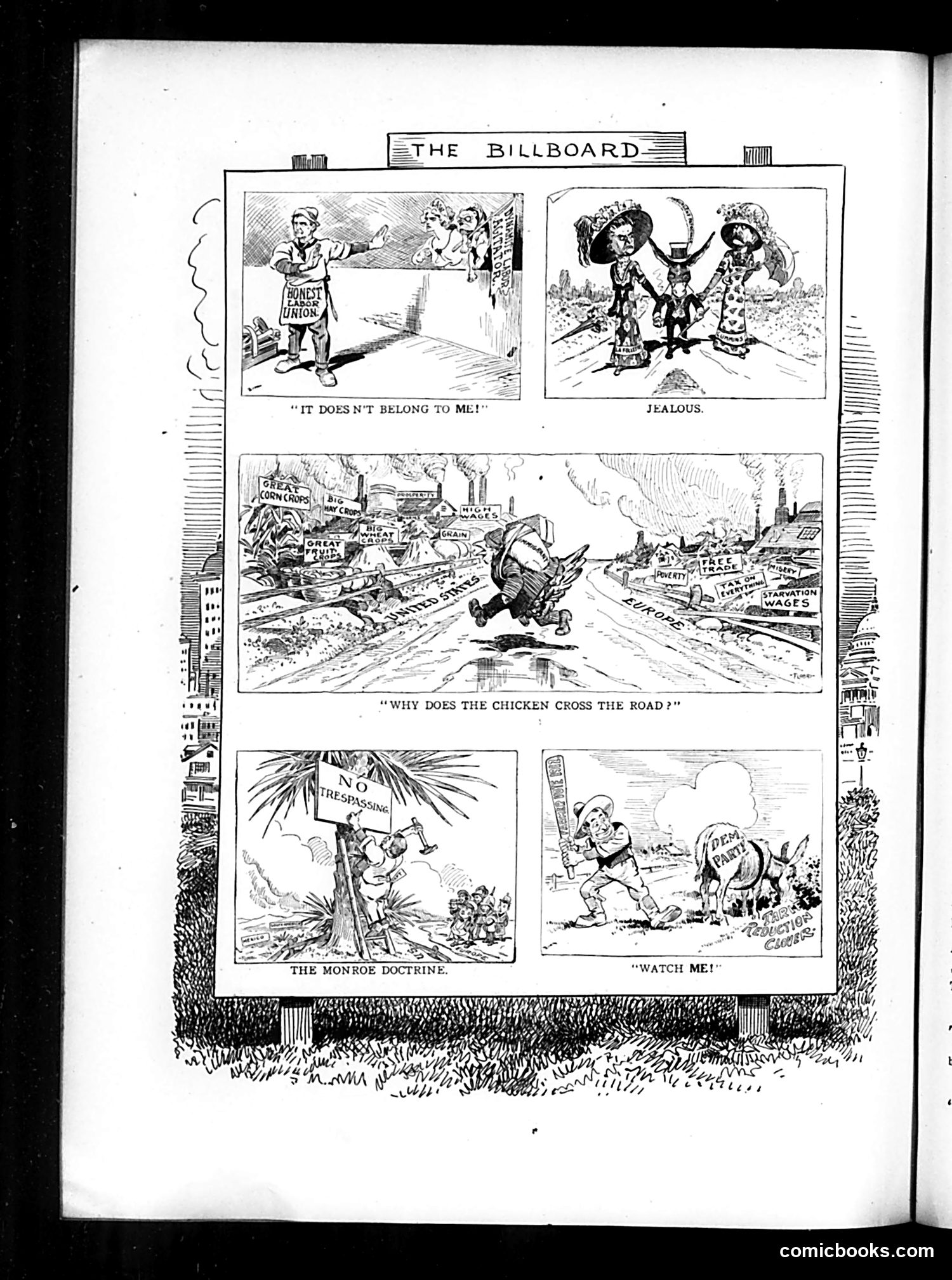
This page combines several political cartoons critiquing early 20th-century American issues: **Top panels**: "It Doesn't Belong to Me!" depicts labor union conflicts, while "Jealous" appears to reference international tensions or diplomatic disputes. **Central cartoon**: "Why Does the Chicken Cross the Road?" uses industrial imagery (factories, railroads labeled with economic concerns like "starvation wages") to satirize labor conditions and economic hardship—a dark twist on the famous joke. **Bottom panels**: "The Monroe Doctrine" shows someone clinging to a tree, suggesting the doctrine has become outdated or difficult to maintain. "Watch Me!" depicts what appears to be violent or aggressive action, possibly commenting on American interventionism. Overall, the page satirizes labor exploitation, industrial capitalism, and American foreign policy during a period of significant economic and social tension.
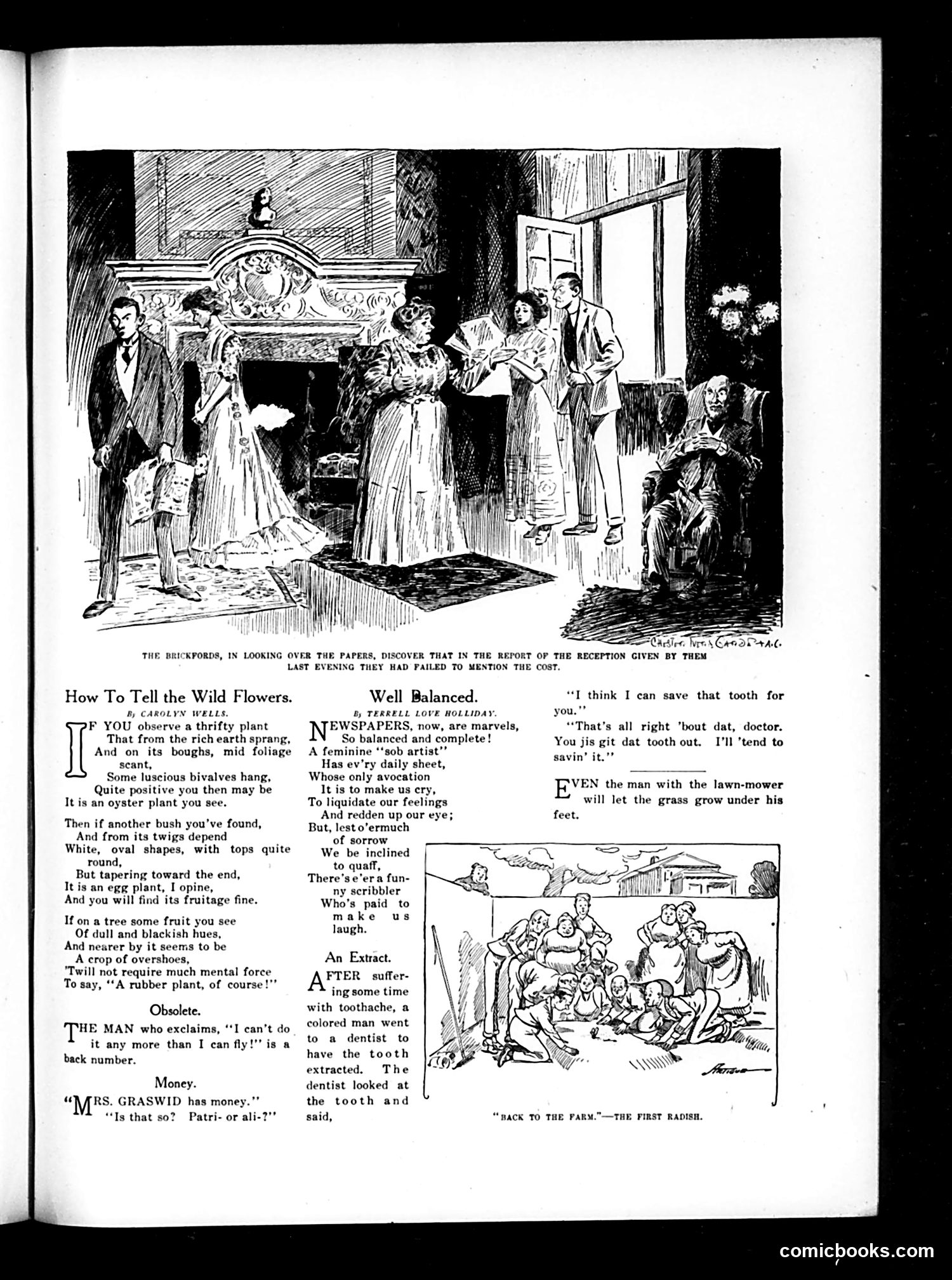
This page from Judge combines humor pieces targeting early 1900s American life: **Top cartoon:** "The Brickfords" discover their society reception announcement omitted the cost—satirizing upper-class pretension and the nouveau riche's anxiety about appearing vulgar by mentioning money. **"How to Tell the Wild Flowers"**: Wordplay humor parodying nature guides. "Oyster plant" (oysters on branches), "egg plant," and "rubber plant" are visual puns on actual plant names—light domestic comedy. **"Well Balanced"**: Critiques newspaper sensationalism, noting papers balance "sob artists" (tearjerking women's columnists) with humorous writers to manipulate reader emotions. **"An Extract"** (bottom): Dialect humor featuring a Black man at the dentist. The joke relies on period racial stereotypes—the patient plans to keep the extracted tooth rather than let the dentist dispose of it, played for crude comedic effect typical of the era. The page reflects Judge's mix of social satire, wordplay, and ethnic humor characteristic of early 20th-century American comedy magazines.
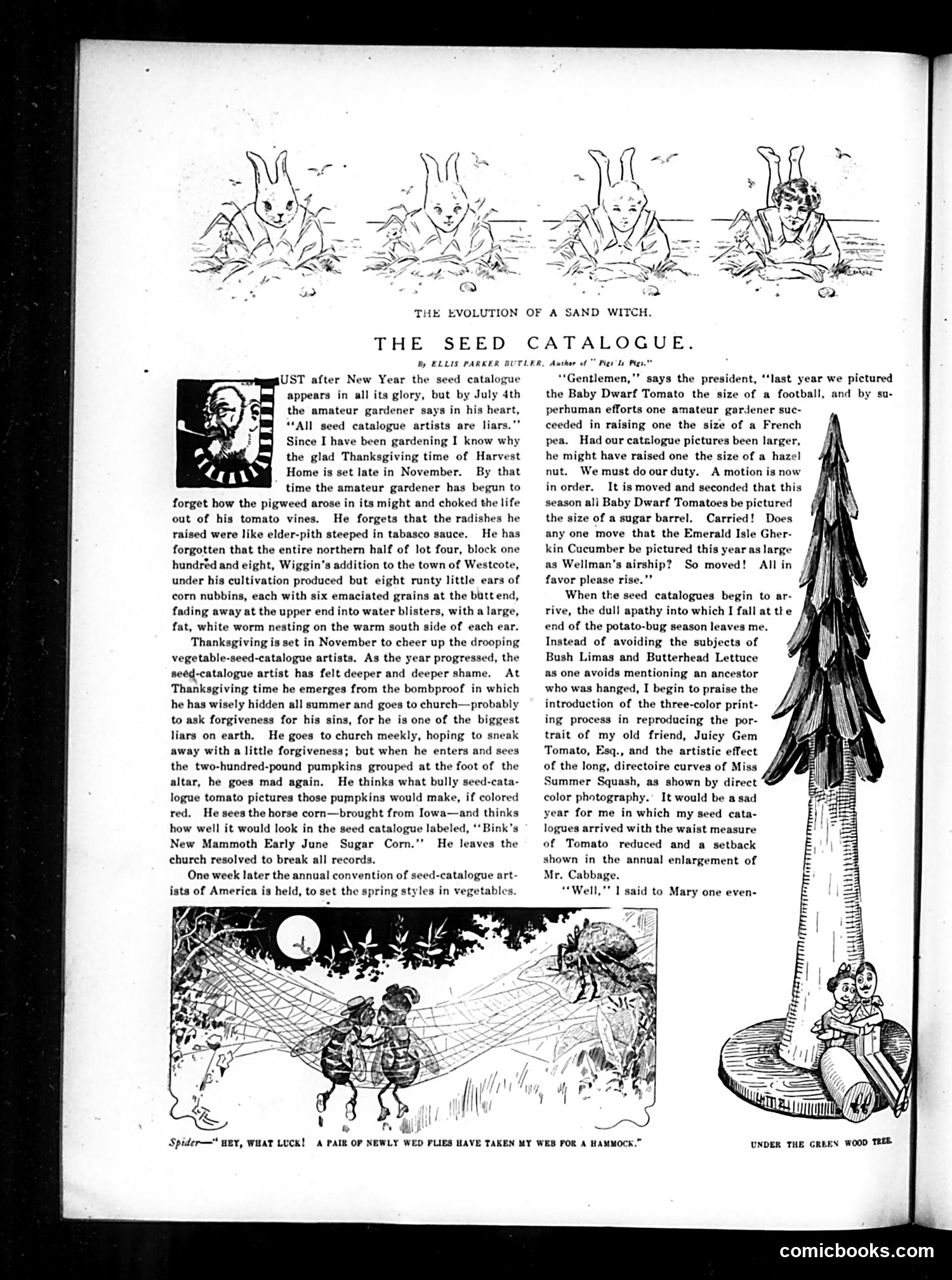
This Ellis Parker Butler story satirizes the seed catalogue industry's systematic dishonesty. The humor targets seed companies' misleading marketing practices: they publish wildly exaggerated pictures of vegetables that amateur gardeners can never actually grow, then intentionally enlarge images each year to maintain the deception. The narrative mocks both parties—catalogues artists are "liars" who hide in "bombproofs" from shame, while gardeners repeatedly fall for the scheme despite annual failures (tiny radishes, stunted corn, pigweed invasions). The cartoon shows seed-catalogue artists at their convention conspiring to make pictures even more unrealistic (picturing tomatoes "the size of a sugar barrel"). The spider cartoon below appears unrelated, likely another humorous filler. The satire reflects early 20th-century concerns about advertising fraud and consumer gullibility during an era of minimal regulation.
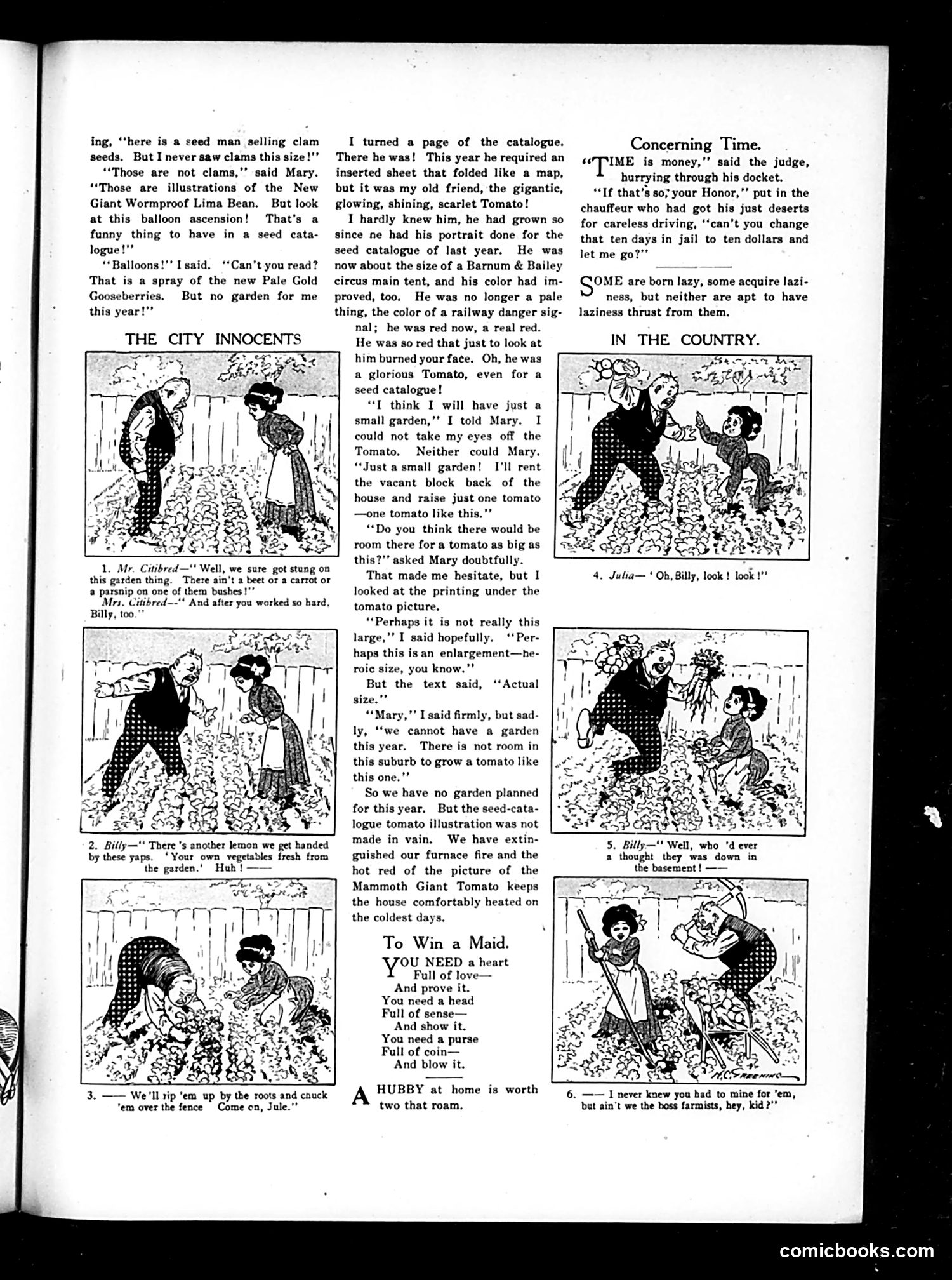
This page satirizes urban newcomers' naive attempts at gardening. The main narrative follows city dwellers who purchase seeds from exaggerated catalog claims—particularly an impossibly giant tomato advertised at "actual size." The six-panel comic strip "The City Innocents" depicts Mr. and Mrs. Citibred and Billy discovering their seed purchases are fraudulent: the promised vegetables never materialize. They're literally swindled by deceptive seed catalog marketing. The accompanying story amplifies this joke: a narrator becomes obsessed with a catalog's colossal tomato illustration, only realizing it cannot exist at that size. The satire targets both seed companies' misleading advertising and urban residents' gullibility about gardening—they're completely out of their element, believing promotional hyperbole literally. The humor relies on early 20th-century tension between city and country life, mocking city dwellers as "innocents" easily deceived by rural enterprise. The ironic conclusion—using the tomato picture's heat to warm their house—underscores their absurdity.
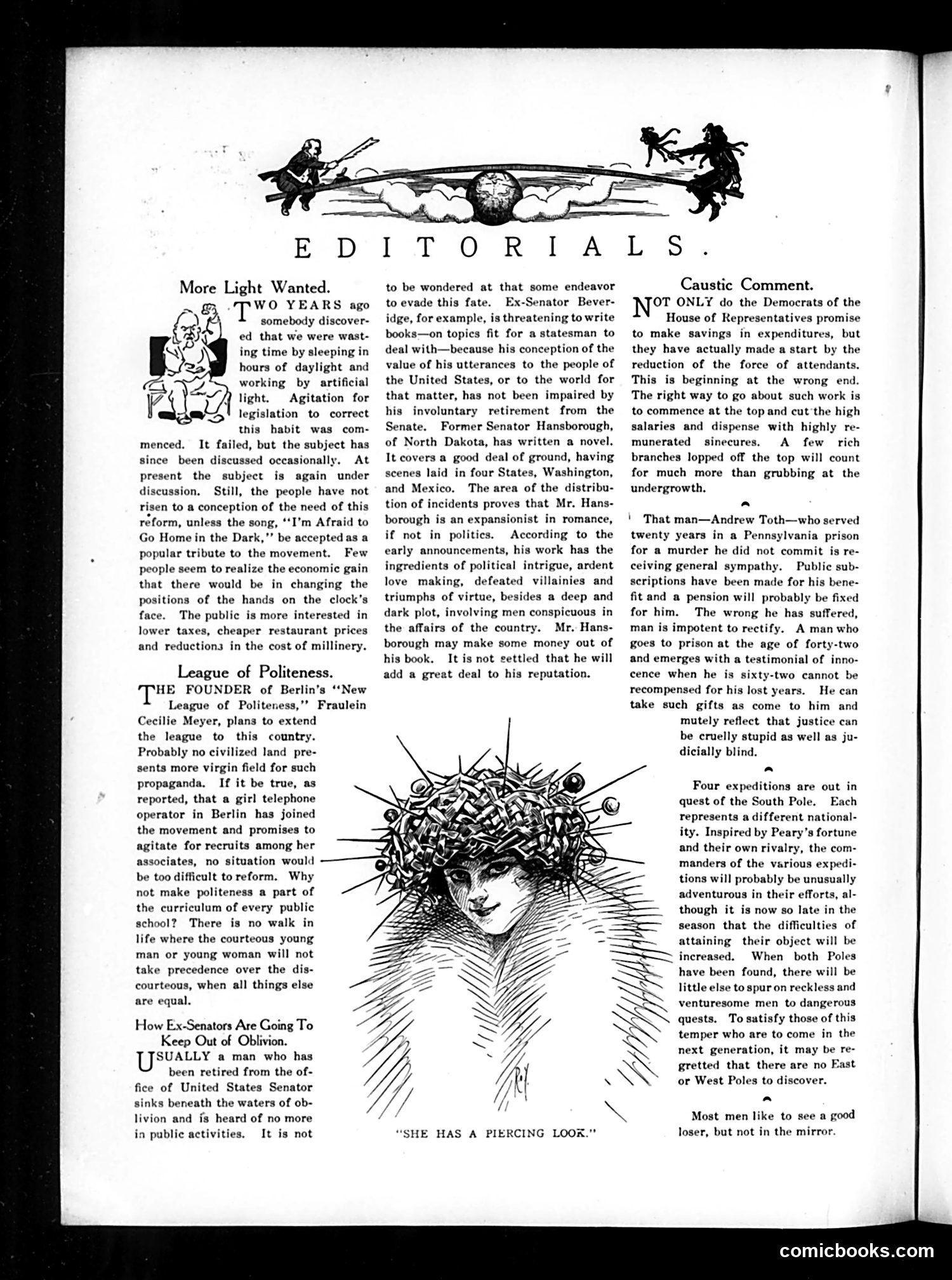
This page contains three editorial pieces satirizing early 20th-century American politics and social issues: 1. **"More Light Wanted"**: Critiques a two-year-old proposal to extend daylight hours by working longer under artificial light. The satire suggests this is economically misguided—people would simply benefit employers, not themselves. 2. **"League of Politeness"**: Mocks a Berlin-based "League of Politeness" founder's plan to export the movement to America. The cartoon questions whether teaching courtesy in schools can work when society itself lacks equality. 3. **"Caustic Comment"** and **"How Ex-Senators Keep Out of Oblivion"**: The central illustration shows a woman with wild, spiky hair labeled "She Has a Piercing Look." The text discusses politicians and prison reform, including Andrew Toth's case—a man imprisoned twenty years for murder who seeks compensation and a pension.
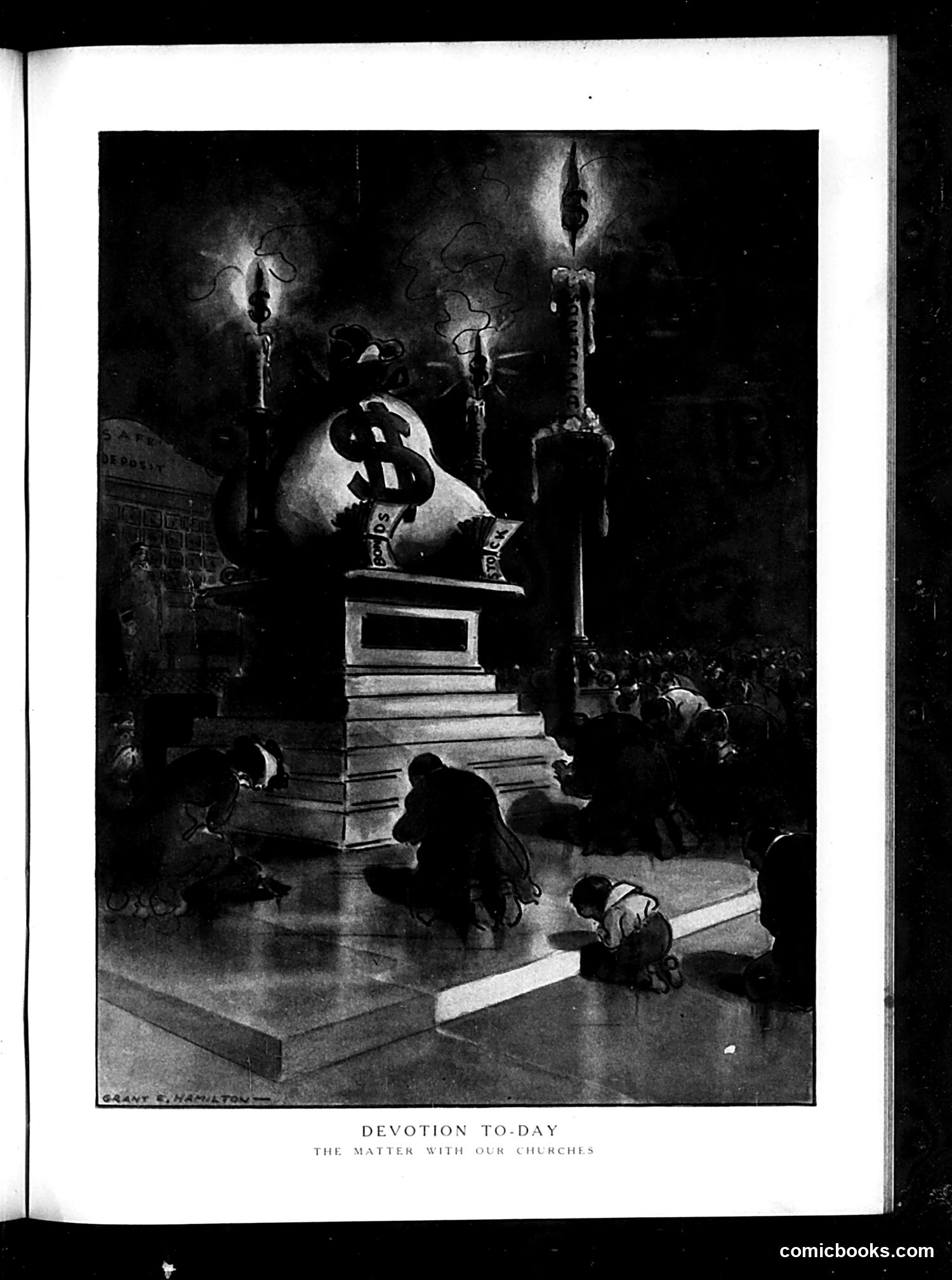
This satirical illustration critiques American churches for prioritizing wealth over spiritual devotion. The central image shows a large dollar sign ($) elevated on a pedestal like a religious idol, surrounded by burning candles and worshippers in supplicant poses—literally bowing before money rather than God. The composition inverts religious imagery: instead of congregants praying in a church, they kneel before monetary wealth. The title sarcastically labels this "devotion," suggesting that modern churches have abandoned spiritual values in favor of materialism and financial gain. The satire targets institutional hypocrisy—churches preaching moral virtue while functioning as money-focused institutions. This reflects early-20th-century criticisms of organized religion's accumulation of wealth and perceived distance from genuine faith and charity.
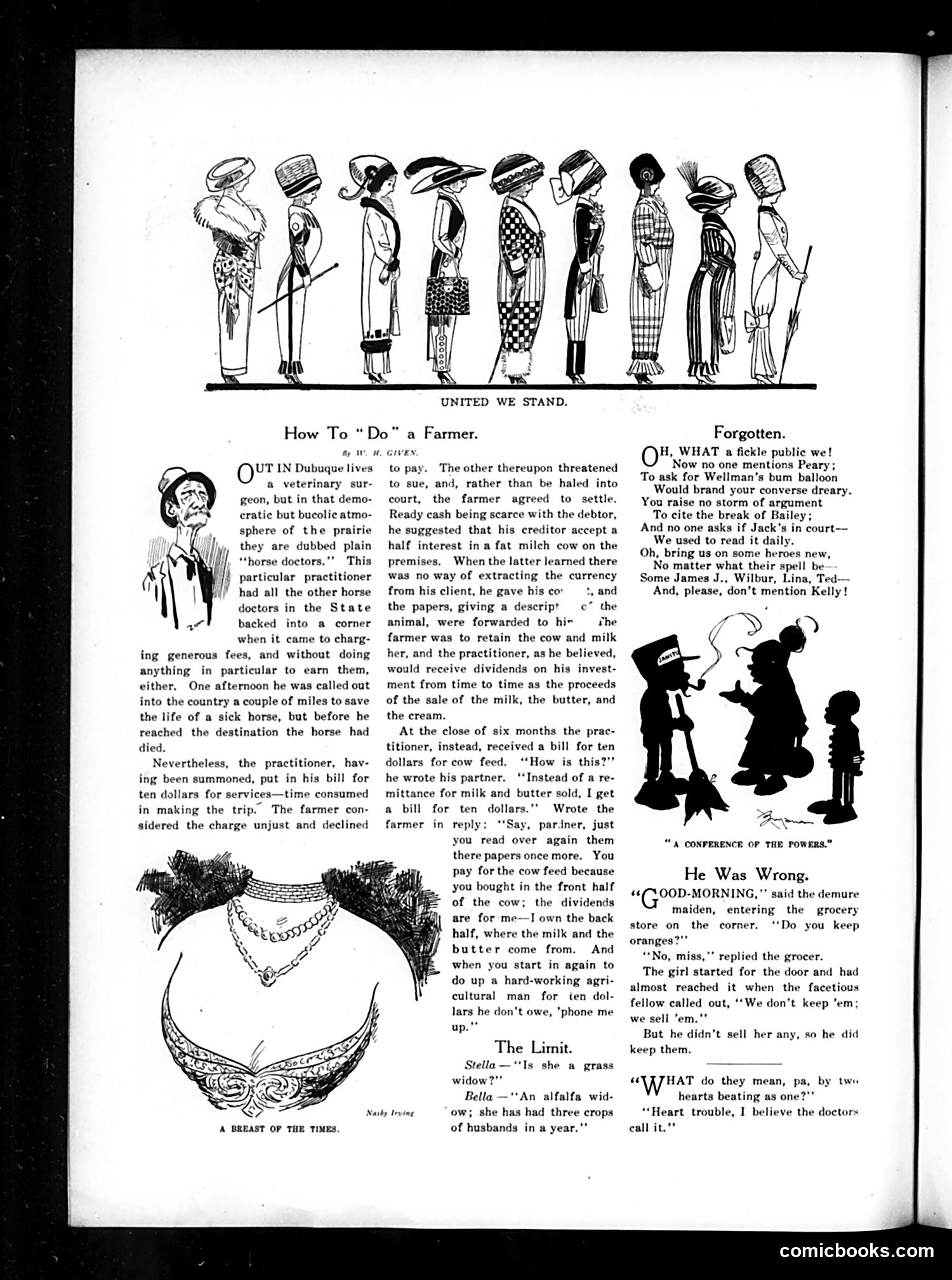
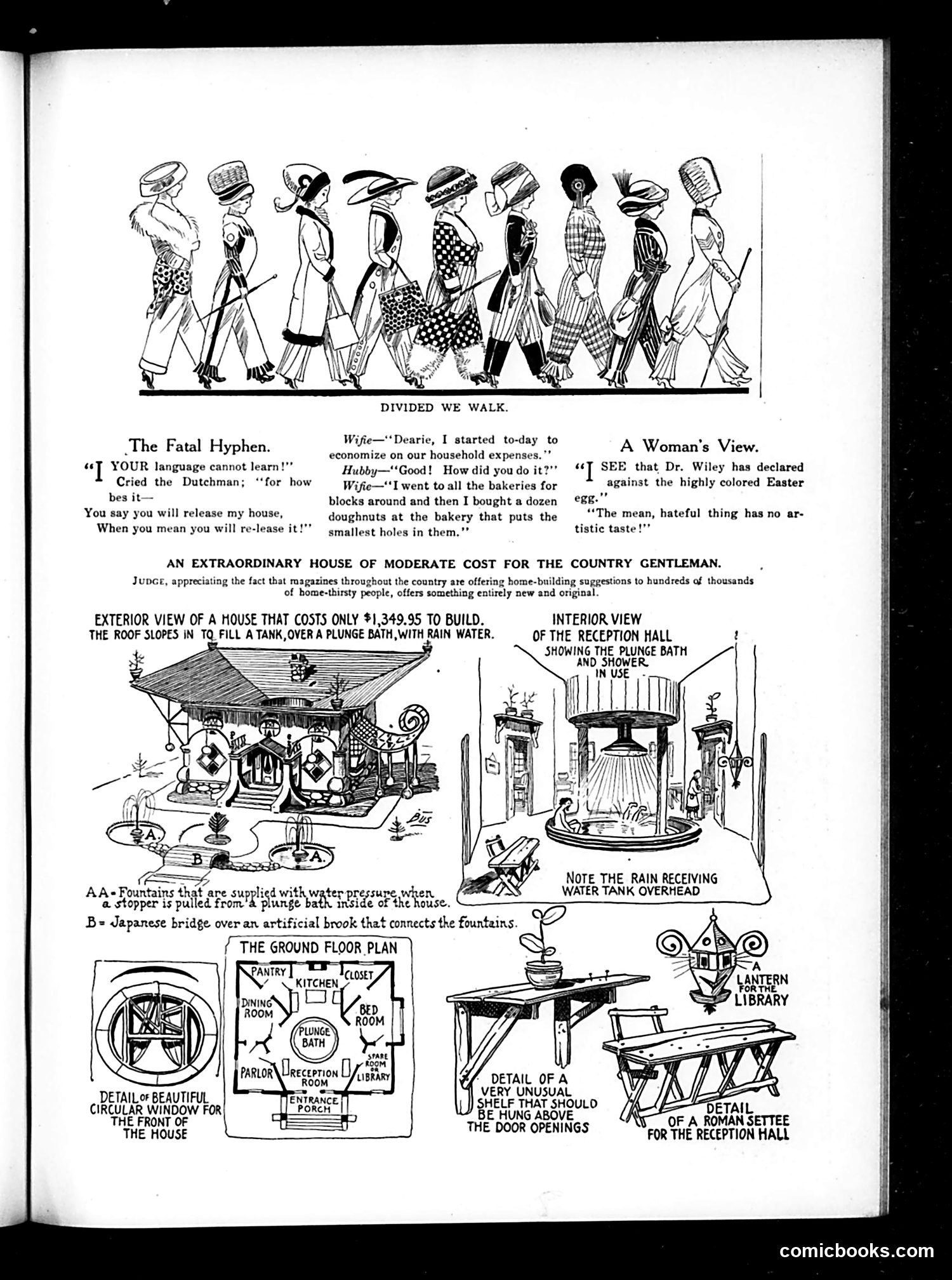
**"How To 'Do' a Farmer"** satirizes rural gullibility and shady professional practices. A veterinary "horse doctor" bills a farmer $10 for a house call where the horse died anyway. Unable to pay cash, the farmer offers half-interest in a milk cow. The practitioner expects milk profits but receives instead a feed bill—the farmer cleverly interprets their contract as giving the vet ownership of the cow's front half (which produces no milk) while he retains the profitable back half. The satire mocks both the unscrupulous professional's attempted exploitation and the farmer's cunning counter-exploitation. **Other brief items** include: "Forgotten," lamenting the public's short attention span for news celebrities (Peary, Wellman, Bailey, Jack); "He Was Wrong," a wordplay joke about a grocer's distinction between keeping and selling oranges; and marital humor about "alfalfa widows." The top illustration "United We Stand" shows various fashionable women's silhouettes, likely fashion satire. The fashion corset illustration "A Breast of the Times" parodies contemporary style trends.
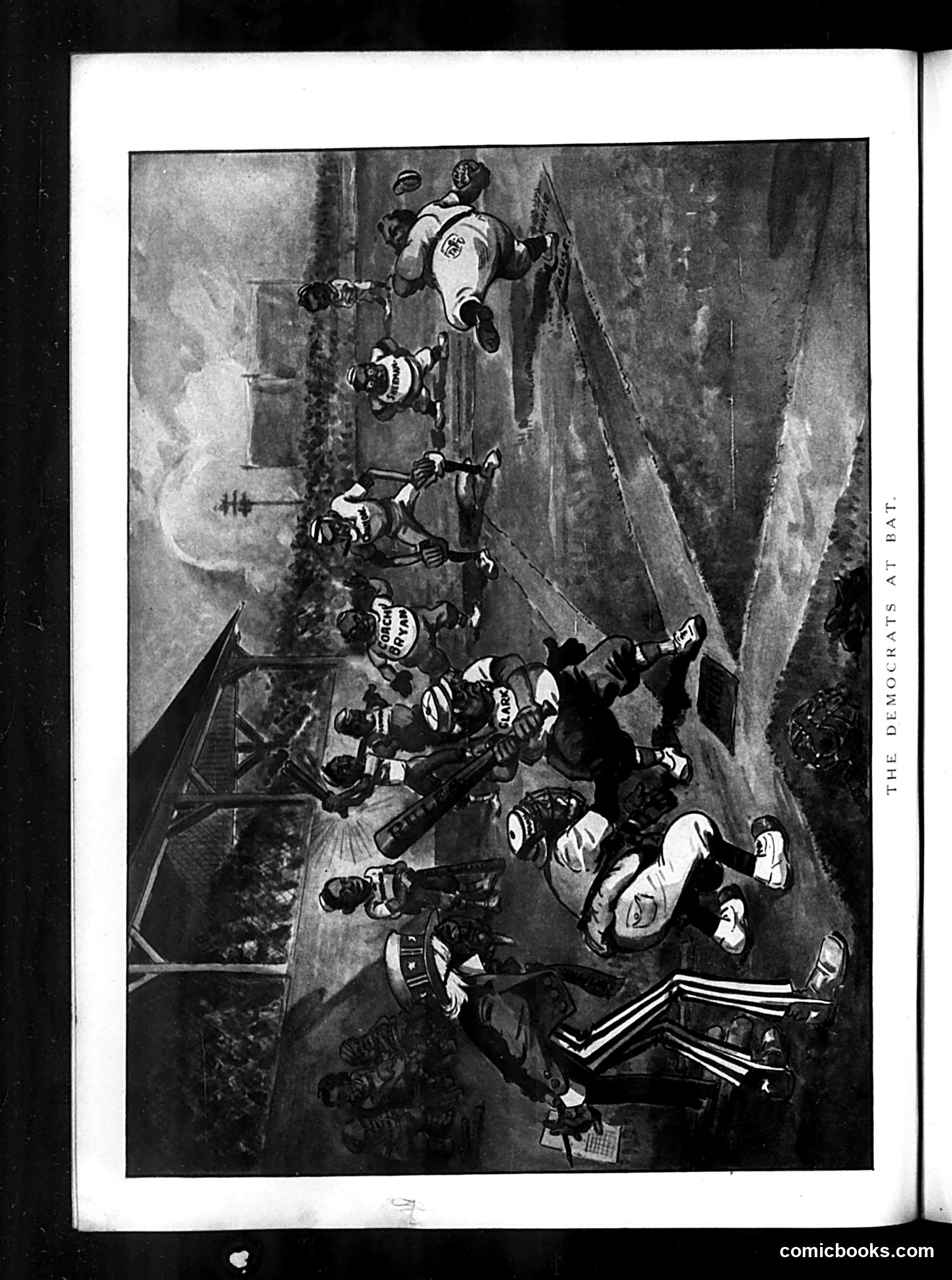
This political cartoon depicts a baseball game where the "Denourats" (Democrats, misspelled satirically) are batting. The image shows multiple Democratic figures as baseball players in period uniforms, positioned around a diamond with a large donkey (the Democratic Party symbol) as the pitcher. The satire appears to critique Democratic Party leadership or strategy during an election cycle—the baseball metaphor suggests they're "up to bat" politically. Without clearer identification of specific figures or visible dates, I cannot definitively name individual politicians caricatured here. The cartoon's humor relies on viewers recognizing prominent Democrats of its era, mocking their political positioning or performance. The deliberately misspelled "Denourats" emphasizes the satirical tone Judge magazine employed toward political opponents.
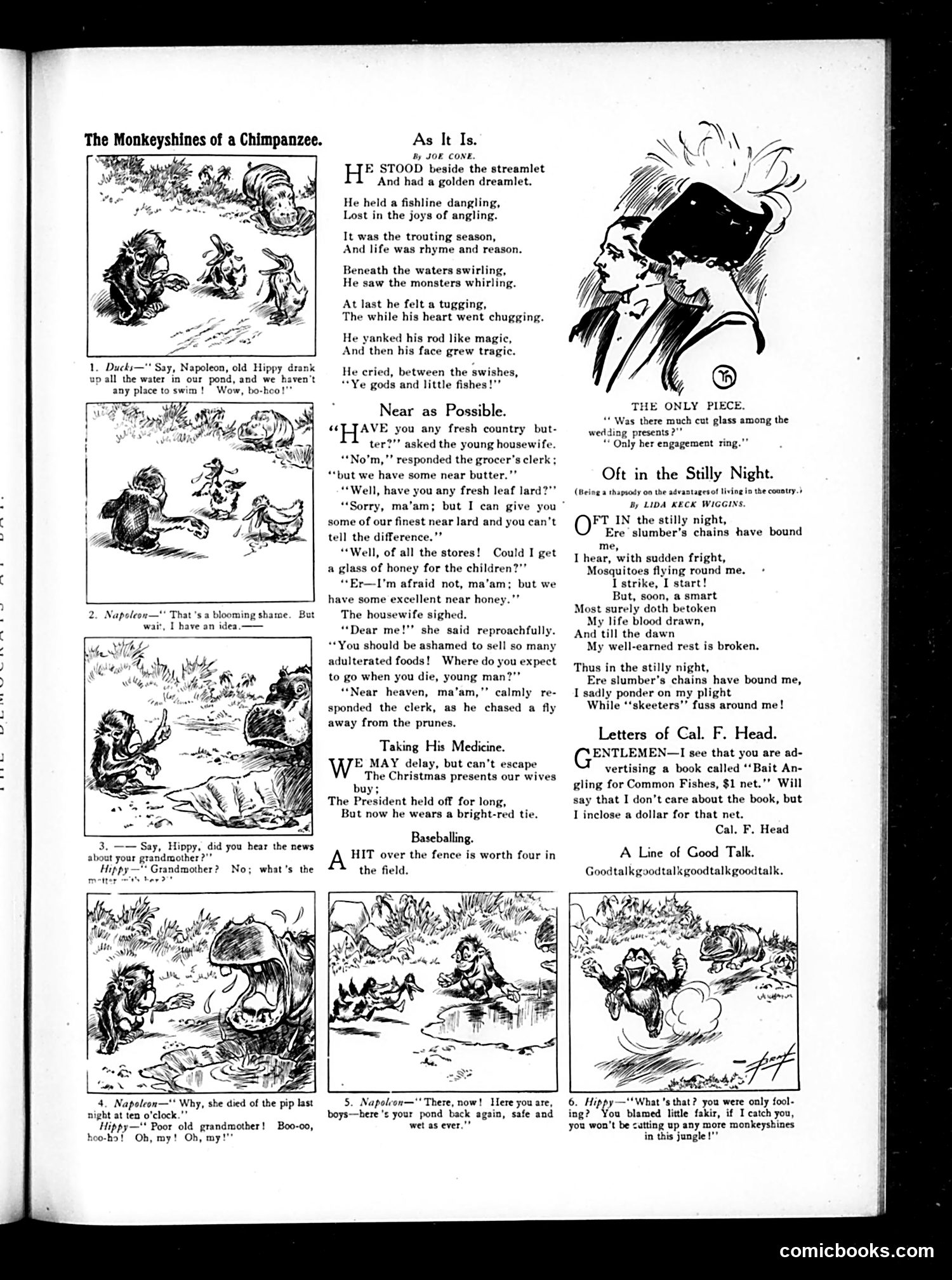
This page contains several unrelated comic sketches and short pieces typical of Judge magazine's satirical format. **The main comic strip** (top left) depicts animals—notably a chimpanzee named Hippy and a duck named Napoleon—in an anthropomorphic fable. The joke involves Napoleon consoling Hippy about a dried-up pond by spreading false rumors about Hippy's grandmother's death, then revealing it was a prank to distract him while secretly refilling the pond. The final panel shows Hippy threatening revenge on "little fakir" Napoleon. The satire appears to mock gullibility and deception through animal characters, a common Victorian-era device for social commentary. **Surrounding content** includes humorous prose pieces about grocery-store substitutes ("near butter," "near lard"), fishing mishaps, and complaints about mosquitoes in the countryside—typical middle-class domestic humor of the era. **References to the President** receiving Christmas gifts suggest this dates to the Theodore Roosevelt or William Taft era, though the specific reference is unclear without additional context.
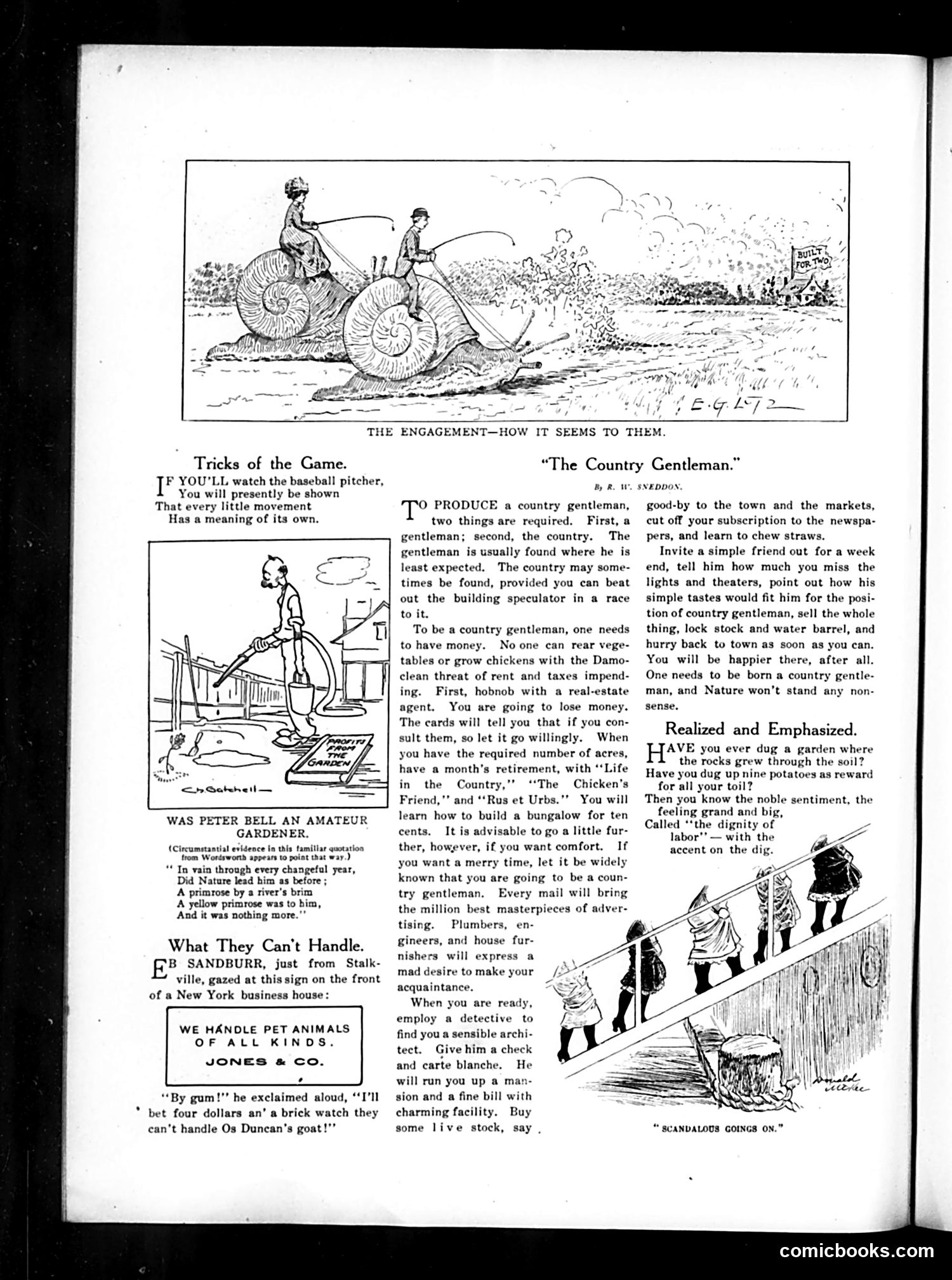
This page contains several satirical pieces mocking various aspects of American life: **"The Engagement"** (top cartoon): Two figures ride giant snails, satirizing the slowness of courtship or romantic pursuit. **"Tricks of the Game"** and **"Was Peter Bell an Amateur Gardener?"**: These mock baseball terminology and misinterpret Wordsworth's poetry, suggesting people read hidden meanings into ordinary things. **"What They Can't Handle"**: A rural character (Sandburr from "Stalkville") confidently bets that a pet store can't handle "Os Duncan's goat"—likely alluding to a stubborn, unmanageable animal, with the joke implying rural common sense versus urban business limitations. **"The Country Gentleman"**: The main satire. It ridicules wealthy urbanites who purchase country estates to play at being "gentleman farmers." The piece cynically explains how they'll lose money, be pestered by salesmen, hire architects and laborers, then eventually abandon the whole enterprise and return to town. Nature and breeding matter more than money. **"Realized and Emphasized"**: Mocks the romantic notion of agricultural labor.
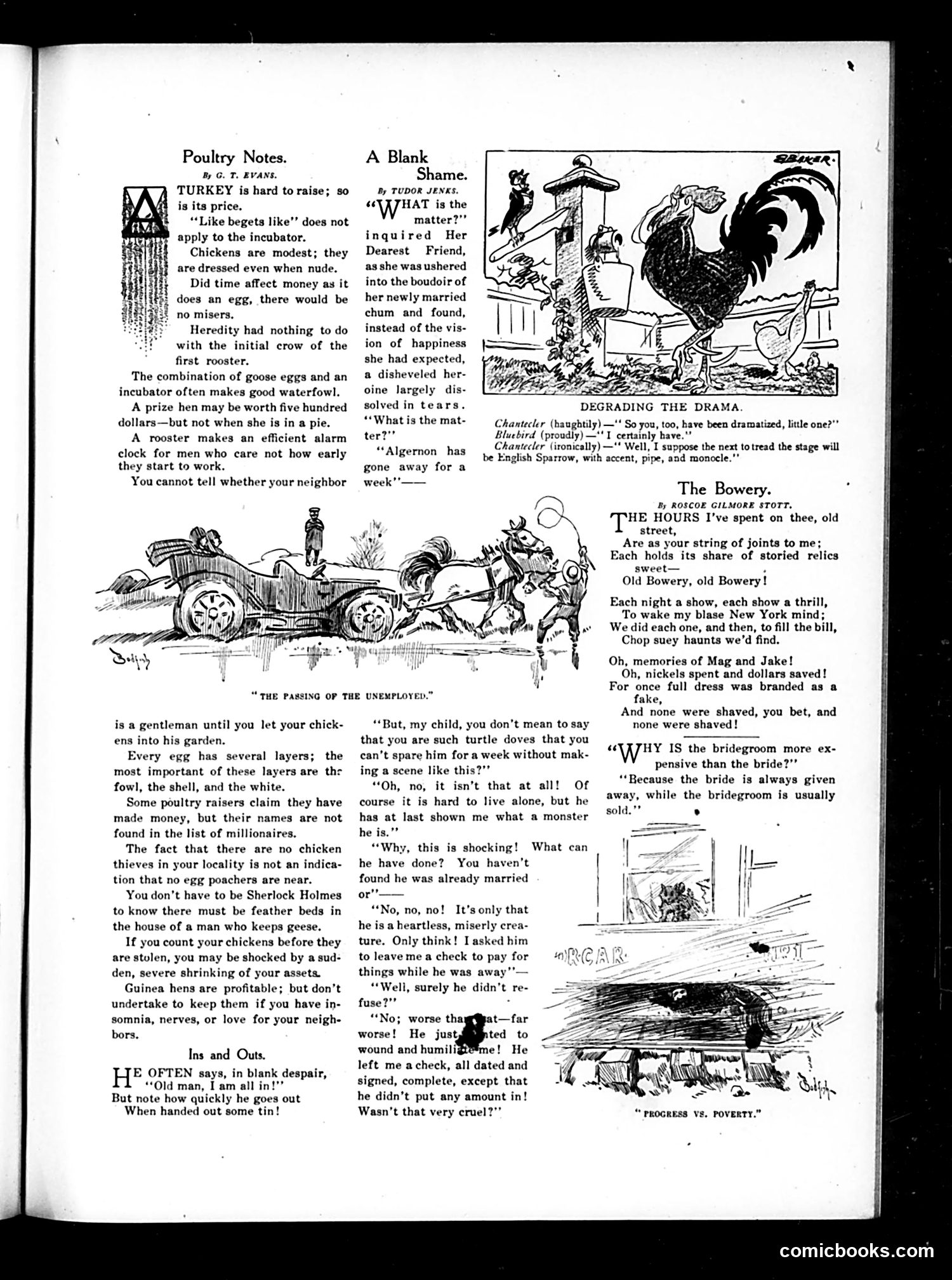
This page contains humor pieces mocking everyday American life around the early 1900s. **"Poultry Notes"** offers dry observations about raising chickens and turkeys—treating mundane farming facts as philosophical wisdom (e.g., "a prize hen may be worth five hundred dollars—but not when she is in a pie"). **"A Blank Shame"** satirizes newlywed entitlement: a bride is devastated her husband left for a week, revealing he's "heartless" because he gave her a blank check—signed and dated but with no amount filled in. The joke mocks both her materialism and his passive-aggressive miserliness. **"The Passing of the Unemployed"** cartoon depicts jobless men hitching rides on vehicles, suggesting desperation during economic hardship. **"The Bowery"** is nostalgic verse about New York's notorious slum entertainment district, celebrating cheap thrills and working-class memories. **"Progress vs. Poverty"** cartoon (bottom) appears to contrast wealth and destitution. The page reflects Judge's satirical focus on class anxiety, marital dynamics, and economic precarity in Gilded Age America.
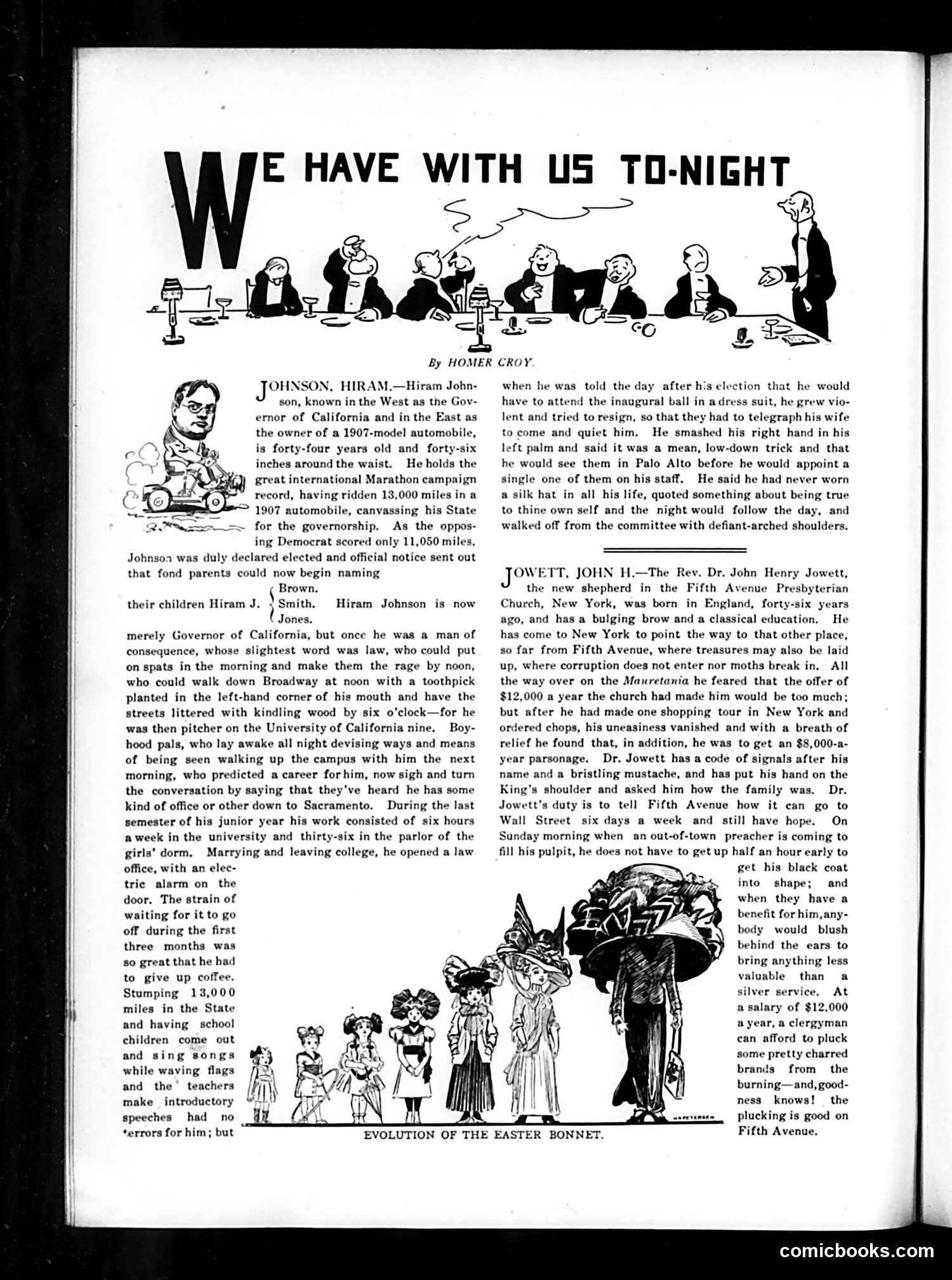
This page contains two satirical biographical sketches by Homer Croy mocking prominent public figures. **Hiram Johnson** (California Governor): The satire ridicules Johnson's recent election victory, won by campaigning 13,000 miles by automobile—outpacing his Democratic opponent's 11,050 miles. The joke portrays Johnson as a formerly consequential figure (once a college baseball pitcher) now reduced to political office. The punchline mocks his violent resistance to attending his own inaugural ball in formal dress, suggesting he's uncomfortable with the trappings of power he sought. **Dr. John Henry Jowett**: This sketch satirizes the newly-hired pastor of Fifth Avenue Presbyterian Church in New York. The humor targets his anxiety about accepting a $12,000 salary, which vanishes after a shopping spree in Manhattan. The satire suggests clergy are easily seduced by wealth and materialism despite spiritual principles—his job is helping wealthy Wall Street attendees maintain hope while pursuing profit. Both sketches employ ironic tone to critique American ambition and hypocrisy among the powerful.
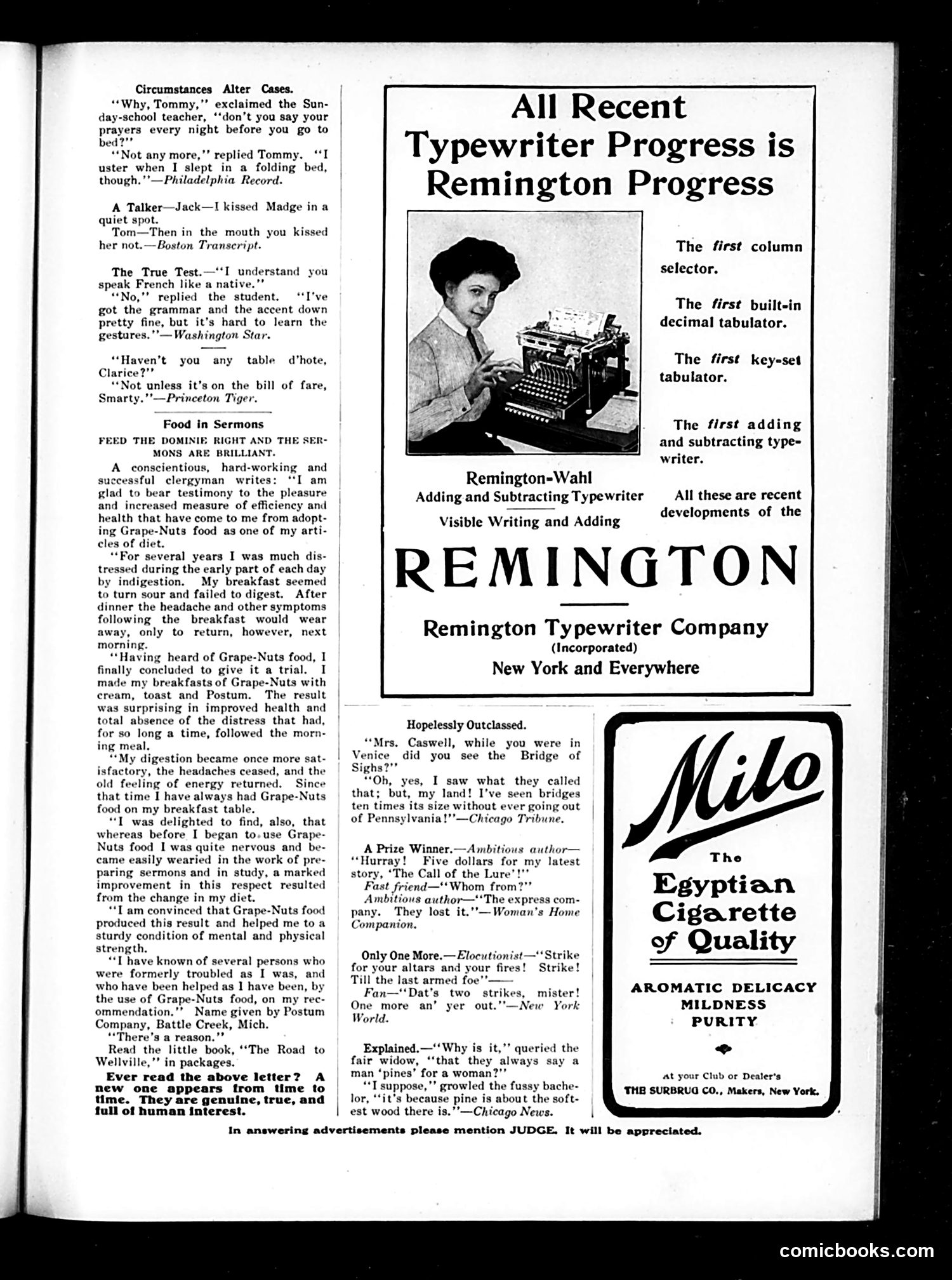
This page is primarily **advertising and light humor**, not political satire. The dominant content is a **Remington typewriter advertisement** claiming superiority through recent innovations: the first column selector, built-in decimal tabulator, key-set tabulator, and adding/subtracting capability. The ad features a woman at a typewriter. The page also includes **brief humorous anecdotes** with no political content—a Sunday school boy avoiding prayers, jokes about French accents and restaurant terminology, and a clergyman's testimonial about Grape-Nuts cereal improving his digestion and sermon-writing ability. A secondary ad promotes **Milo Egyptian Cigarettes** as a quality product. The scattered jokes ("Hopelessly Outclassed," "A Prize Winner") are generic period humor about travel, ambitious writers, and elocution—unrelated to current events or politics. **No political cartoons or meaningful satire appear on this page.** It represents typical early-20th-century magazine filler: product advertisements mixed with mild, timeless jokes.
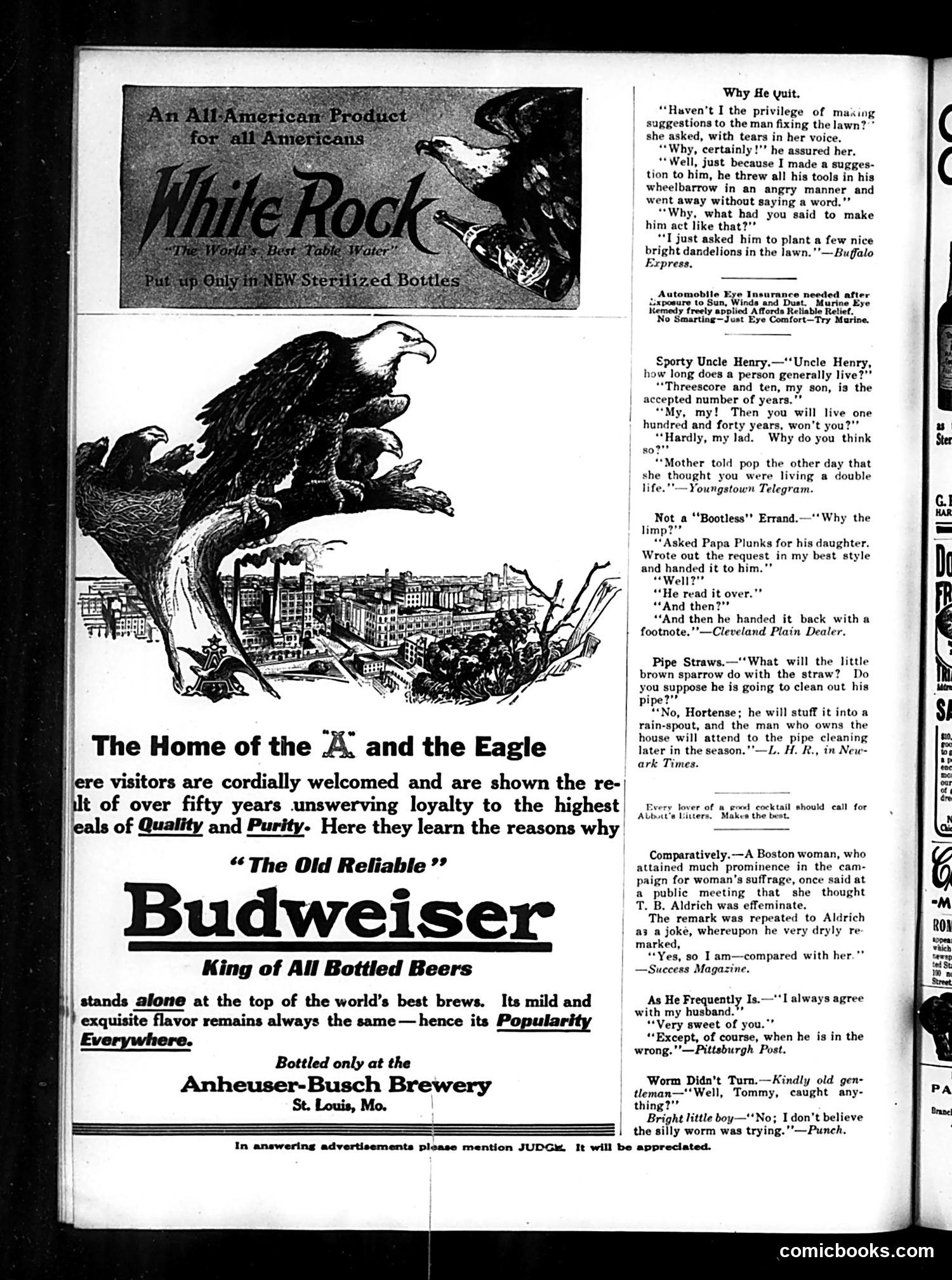
This page is primarily **advertising and humor anecdotes** rather than political satire. The dominant content is a large **Budweiser beer advertisement** featuring an eagle and cityscape, promoting "The Old Reliable" brand and the Anheuser-Busch Brewery. The right column contains brief **humorous short jokes** on domestic and social topics typical of early 20th-century American humor: a wife annoying a gardener with suggestions, an uncle's longevity, a rejected marriage proposal, and fishing mishaps. One anecdote references T.B. Aldrich (a literary figure) being called effeminate. These jokes reflect period attitudes about gender relations, with humor centered on nagging wives, marital disagreement, and children's innocence—common tropes in contemporary comedy publications. The page contains **no identifiable political cartoons or caricatures**. It's a standard Judge magazine page mixing advertising with light domestic humor aimed at middle-class readers.
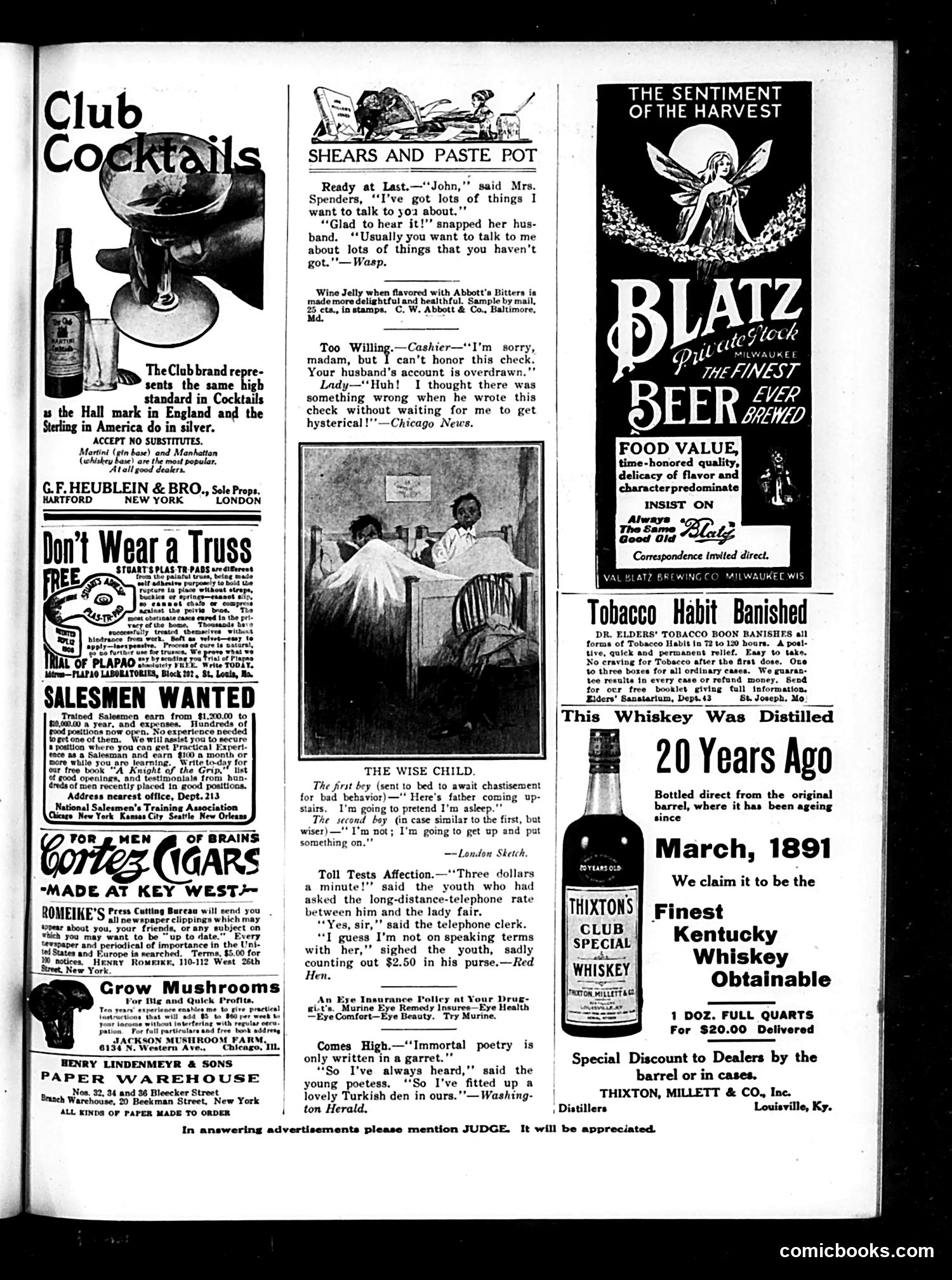
This page is primarily **advertising**, with some brief humorous anecdotes interspersed. The cartoons and jokes are minimal; instead, the page showcases period advertisements and comedy snippets. **Key Content:** - "Shears and Paste Pot" section contains short, marriage-themed jokes reflecting early 20th-century domestic humor (wives spending money, husbands avoiding emotional displays) - "The Wise Child" depicts two boys strategizing how to avoid parental punishment—the second boy's plan to dress before being spanked suggests corporal punishment was routine - Other jokes mock long-distance telephone costs, poverty-stricken poets, and gender dynamics **Advertisements include:** - Club brand cocktails (martinis and Manhattans) - Patent medical remedies (tobacco cessation, eye care, truss supports) - Blatz beer and Thixton's whiskey - Salesmen recruitment The humor reflects contemporary social anxieties: marital friction over finances, punishment of children, class aspirations, and emerging technologies (telephones). Nothing here constitutes political satire—it's genteel domestic comedy serving as filler between ads.
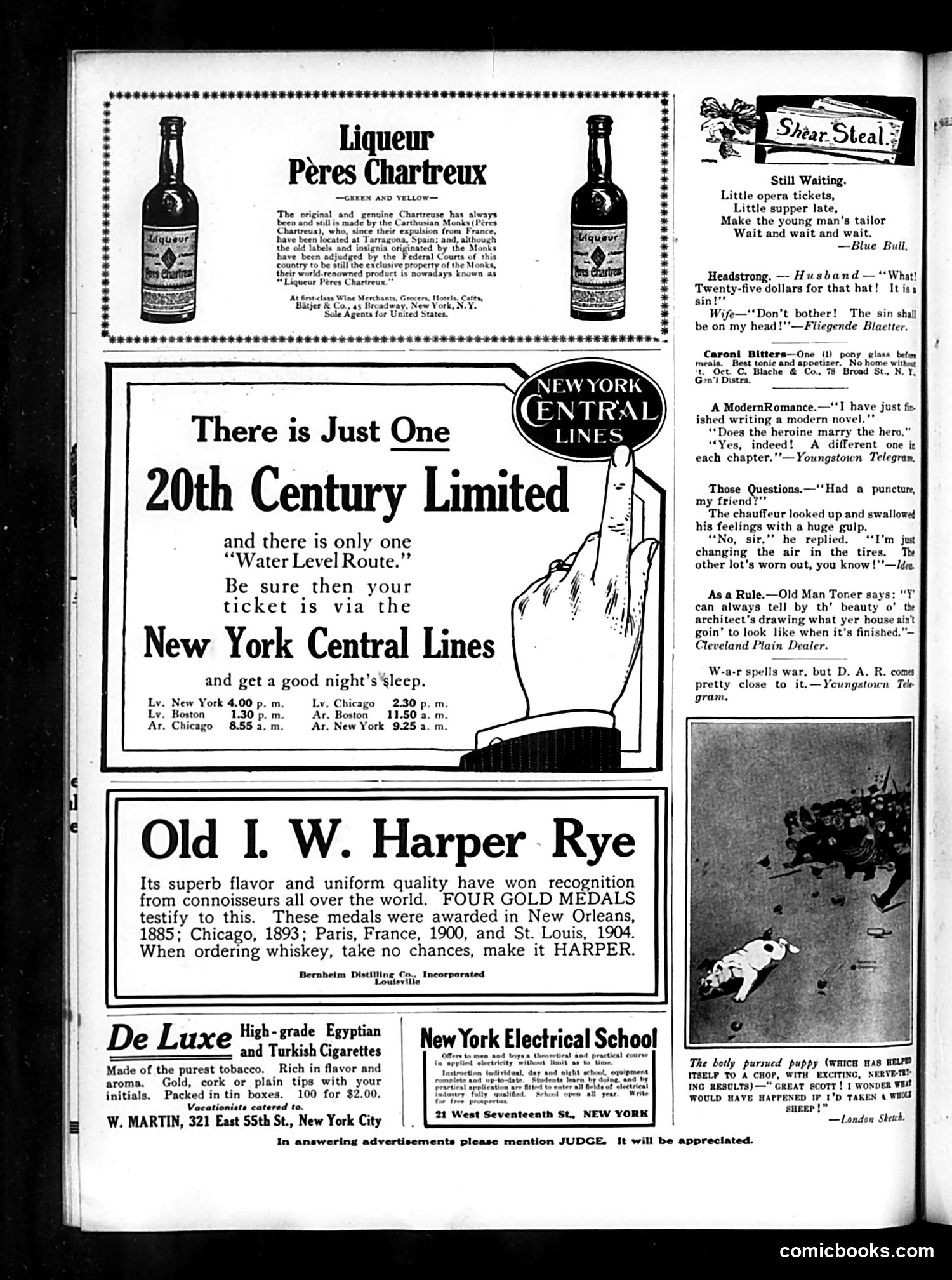
This is primarily an **advertising page** from Judge magazine, featuring multiple commercial ads rather than satirical content. The main advertisements include: - **Liqueur Péres Chartreux**: Liquor ad emphasizing the product's authenticity and French monastic origins - **New York Central Lines**: Railroad advertisement promoting the "20th Century Limited" train with a "Water Level Route" for comfortable overnight travel - **Old I. W. Harper Rye**: Whiskey ad highlighting four gold medals won at international expositions (1885-1904) - **De Luxe Cigarettes**: Turkish and Egyptian tobacco product - **New York Electrical School**: Trade school advertisement The page also includes a **small "Shear Steal" humor section** with brief jokes about opera tickets, modern romance, and a car chauffeur—typical light satirical filler of the era. At bottom is a cartoon captioned "London Sketch" showing a dog that stole food, making a pun about consequences. Overall, this reflects Judge's business model: quality satirical magazine with substantial advertising revenue supporting the publication.
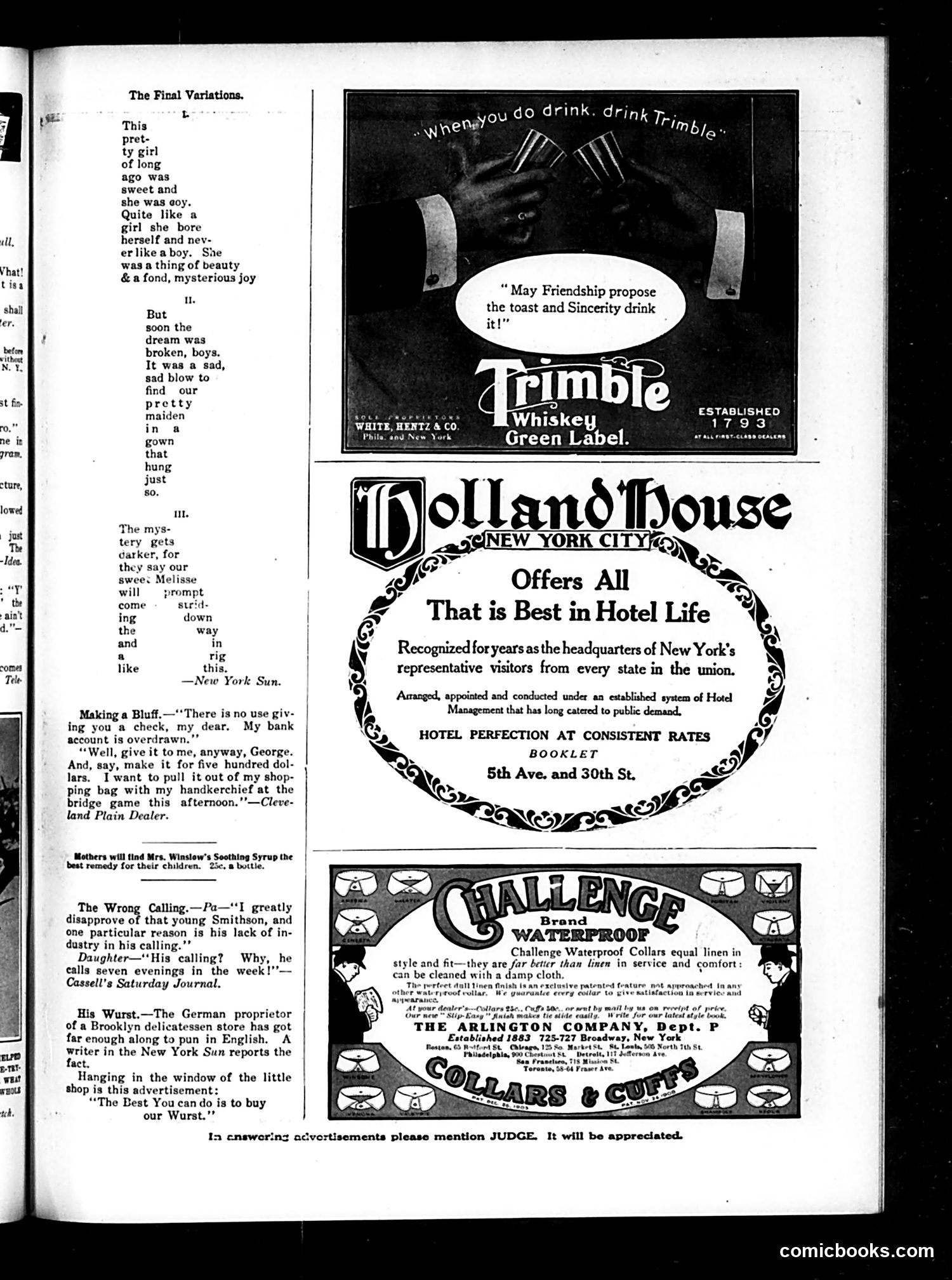
This page consists primarily of **advertisements** interspersed with brief humorous anecdotes. **The main cartoon** at top shows two hands toasting with the slogan "When you do drink, drink Trimble" whiskey, promoting a brand established in 1793. **The text pieces** are short jokes typical of early 20th-century humor magazines: - "The Final Variations" satirizes changing women's fashion—contrasting modest, feminine styles of "long ago" with contemporary looser-fitting garments that the writer considers unflattering. - "Making a Bluff" jokes about a wife requesting an overdrawn check to display ostentatiously at a bridge game for social appearances. - "The Wrong Calling" plays on the double meaning of "calling" (profession vs. social visiting). - "His Wurst" is a pun on a German delicatessen owner's English-language advertisement. The **remaining advertisements** promote the Holland House hotel in NYC, Challenge brand waterproof collars, and other products—standard commercial content typical of Judge's revenue model.
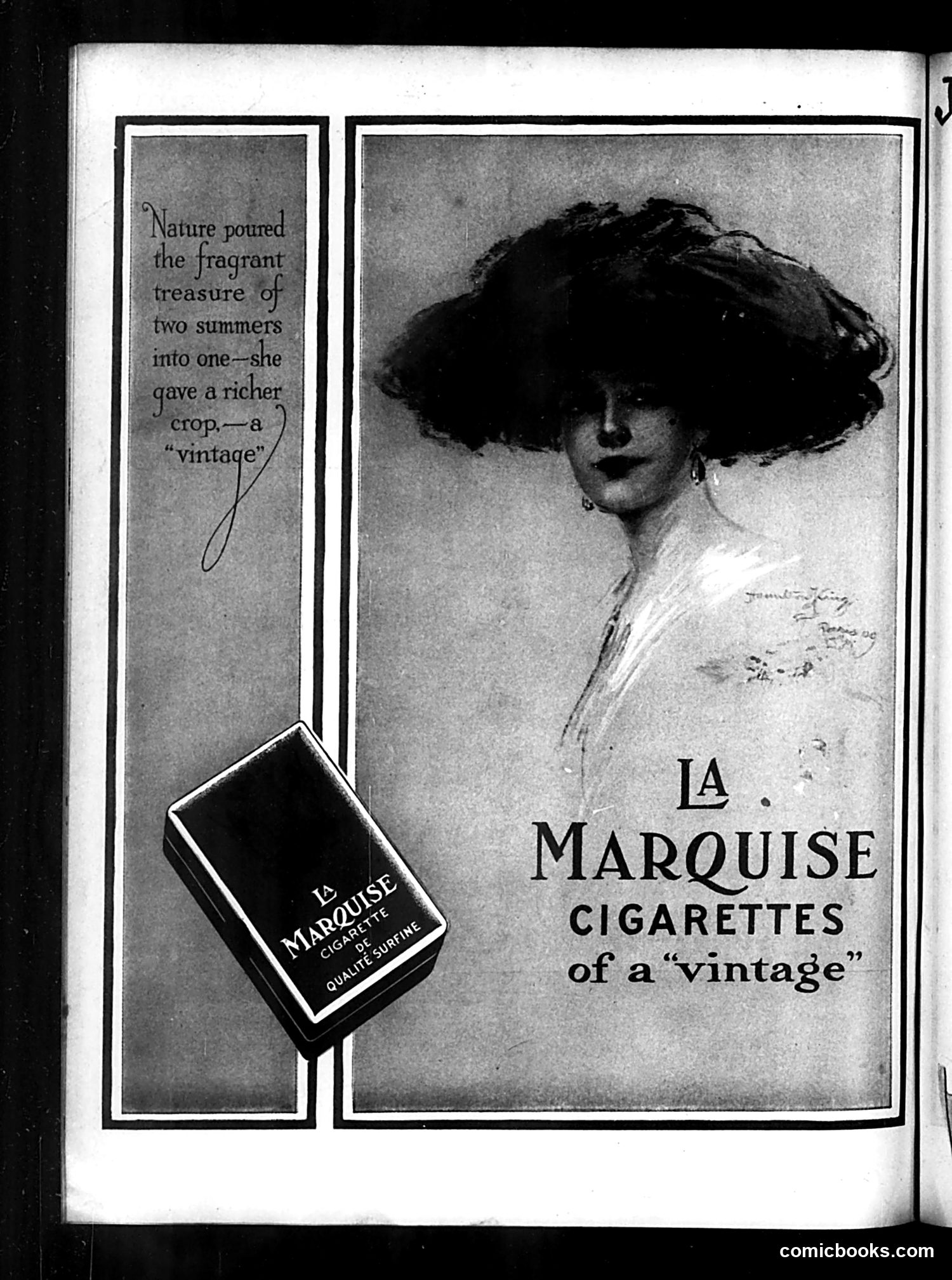
This is a **cigarette advertisement**, not a political cartoon. It features a fashionable woman in profile wearing an enormous, elaborate hat typical of early 20th-century haute couture. The ad uses the metaphor of "vintage" wine to market La Marquise cigarettes as a premium product of superior quality. The accompanying text claims: "Nature poured the fragrant treasure of two summers into one—she gave a richer crop—a 'vintage.'" This compares the cigarettes' quality to fine wine aging, suggesting luxury and refinement. The advertisement targets affluent consumers, particularly women, by associating the product with elegance and sophistication. The "Marquise" branding itself evokes French aristocratic prestige. This represents early 20th-century marketing strategies linking tobacco products to fashion and status.