
Judge, 1911-05-13 · page 8 of 24
Judge — May 13, 1911 — page 8: what you’re looking at
What you’re looking at
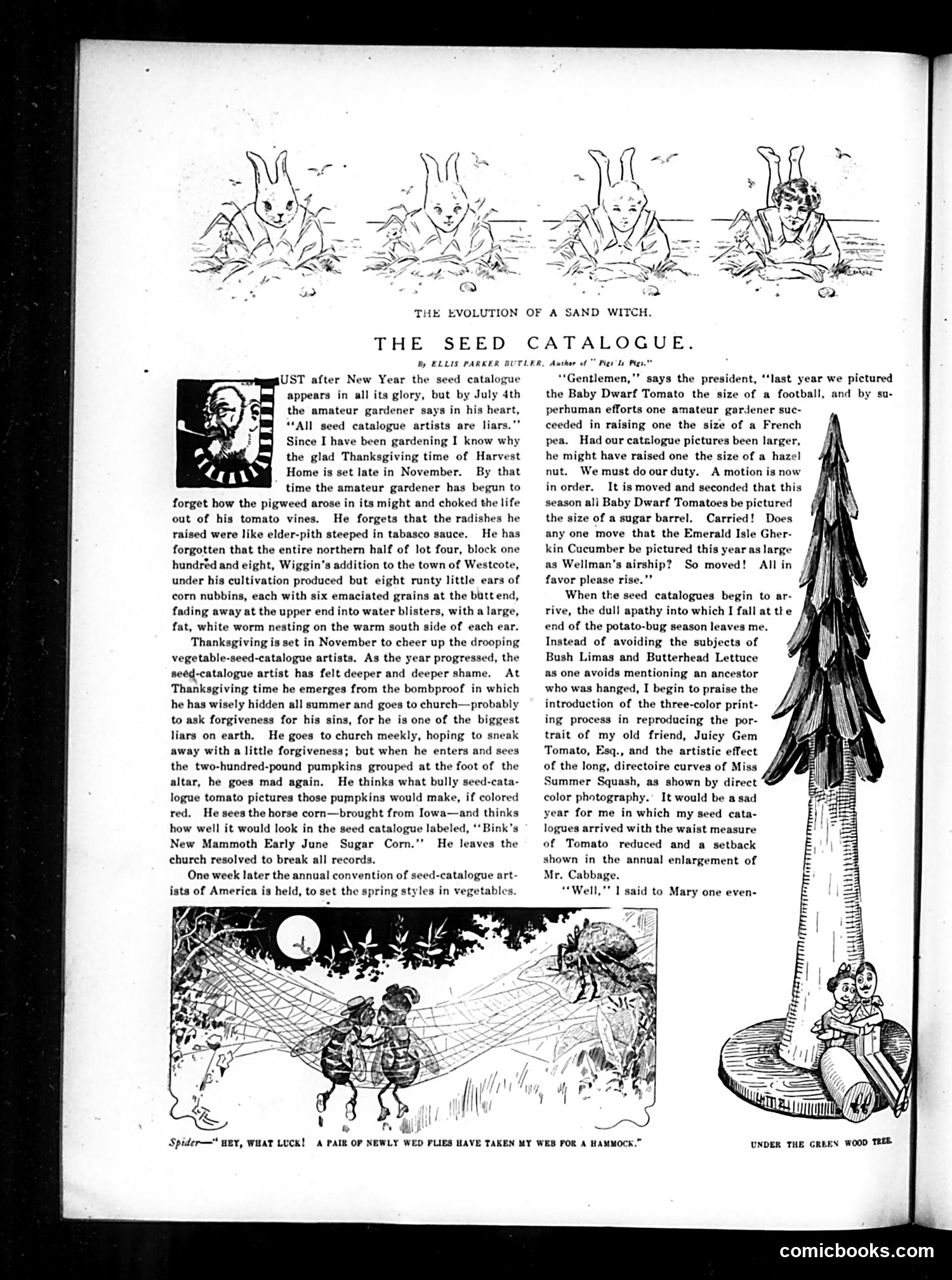
This Ellis Parker Butler story satirizes the seed catalogue industry's systematic dishonesty. The humor targets seed companies' misleading marketing practices: they publish wildly exaggerated pictures of vegetables that amateur gardeners can never actually grow, then intentionally enlarge images each year to maintain the deception. The narrative mocks both parties—catalogues artists are "liars" who hide in "bombproofs" from shame, while gardeners repeatedly fall for the scheme despite annual failures (tiny radishes, stunted corn, pigweed invasions). The cartoon shows seed-catalogue artists at their convention conspiring to make pictures even more unrealistic (picturing tomatoes "the size of a sugar barrel"). The spider cartoon below appears unrelated, likely another humorous filler. The satire reflects early 20th-century concerns about advertising fraud and consumer gullibility during an era of minimal regulation.
📄 Transcribed text from this page (OCR, searchable)
Machine-transcribed from the original scan — historical spelling and the odd misread are preserved.
THE EVOLUTION OF A SAND WITCH. THE SEED CATALOGUE. By ELLIS PARKER BUTLER, Author of “Pigs 'ls Ple” UST after New Year the seed catalogue appears in all its glory, but by July 4th the amateur gardener says in his heart, “All seed catalogue artists are liars."’ Since I have been gardening I know why the glad Thanksgiving time of Harvest Home is set late in November. By that time the amateur gardener has begun to forget how the pigweed arose in its might and choked the life out of his tomato vines. He forgets that the radishes he raised were like elder-pith steeped in tabasco sauce. He has forgotten that the entire northern half of lot four, block one hundréd and eight, Wiggin’s addition to the town of Westcote, under his cultivation produced but eight runty little ears of corn nubbins, each with six emaciated grains at the buttend, fading away at the upper end into water blisters, with a large, fat, white worm nesting on the warm south side of each ear. Thanksgiving is set in November to cheer up the drooping vegetable-seed-catalogue artists, As the year progressed, the seéd-catalogue artist has felt deeper and deeper shame. At Thanksgiving time he emerges from the bombproof in which he has wisely hidden all summer and goes to church—probably to ask forgiveness for his sins, for he is one of the biggest liars on earth. He goes to church meekly, hoping to sneak away with a little forgiveness; but when he enters and sees the two-hundred-pound pumpkins grouped at the foot of the altar, he goes mad again. He thinks what bully seed-cata- logue tomato pictures those pumpkins would make, if colored red. He sees the horse corn—brought from Iowa—and thinks how well it would look in the seed catalogue labeled, ‘‘Bink's New Mammoth Early June Sugar Corn."’ He leaves the church resolved to break all records. One week later the annual convention of seed-catalogue art- ists of America is held, to set the spring styles in vegetables. Spider—" wey, wuat Luck! A PAIR OP NEWLY WED PLIES HAVE TAKEN MY WEB FOR A HAMMOCK.” “‘Gentlemen,"’ says the president, ‘‘last year we pictured the Baby Dwarf Tomato the size of a football, and by su- perhuman efforts one amateur gardener suc- ceeded in raising one the size of a French pea. Had our catalogue pictures been larger, he might have raised one the size of a hazel nut. We must doourduty. A motion is now in order. It is moved and seconded that this season all Baby Dwarf Tomatoes be pictured the size of a sugar barrel. Carried! Does any one move that the Emerald Isle Gher- kin Cucumber be pictured this year as large as Wellman’s airship? So moved! All in favor please rise.”” When the seed catalogues begin to ar- rive, the dull apathy into which I fall at the end of the potato-bug season leaves me. Instead of avoiding the subjects of Bush Limas and Butterhead Lettuce as one avoids mentioning an ancestor who was hanged, I begin to praise the introduction of the three-color print- ing process in reproducing the por- trait of my old friend, Juicy Gem Tomato, Esq., and the artistic effect of the long, directoire curves of Miss Summer Squash, as shown by direct color photography. It would be a sad year for me in which my seed cata- logues arrived with the waist measure of Tomato reduced and a setback shown in the annual enlargement of Mr. Cabbage. “Well,"’ I said to Mary one even- UNDER THE GREEN WOOD TREE comicbooks.com