
A complete issue · 28 pages · 1911
Judge — May 6, 1911
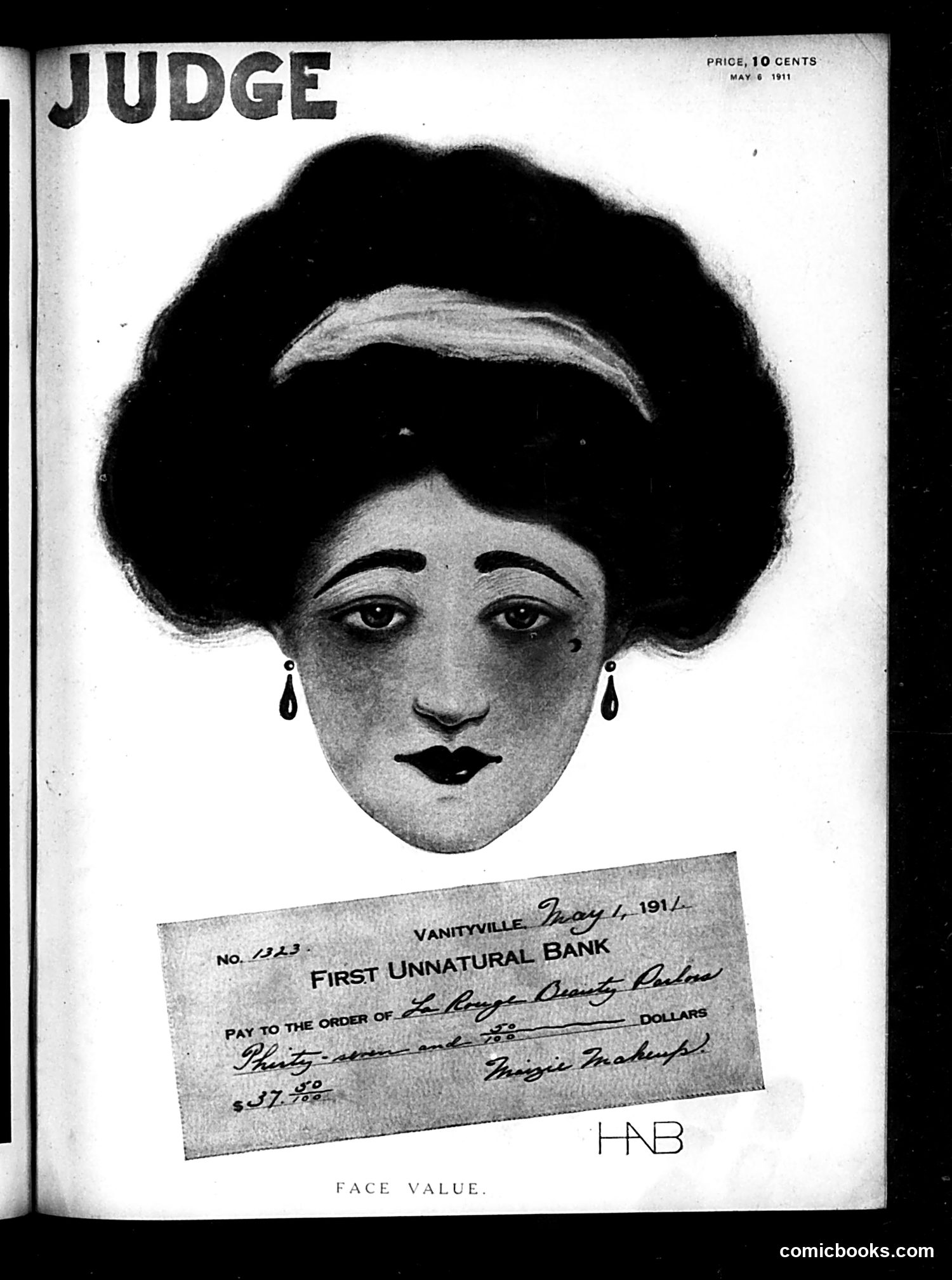
This satirical illustration mocks the concept of "face value"—a financial term meaning to accept something at its stated worth without scrutiny. The cartoon presents a woman's stylized portrait paired with a comically oversized check from the "First Unnatural Bank" of Vanityville, dated May 1, 1911. The satire appears to critique either: 1. Women's vanity and self-valuation in the marriage market 2. The absurdity of valuing a person (particularly women) by appearance alone 3. Potential financial/marital fraud schemes The exaggerated facial features, theatrical makeup, and the juxtaposition of human "face" with monetary "value" create the humorous paradox—suggesting that accepting anyone or anything purely at "face value" is foolish.
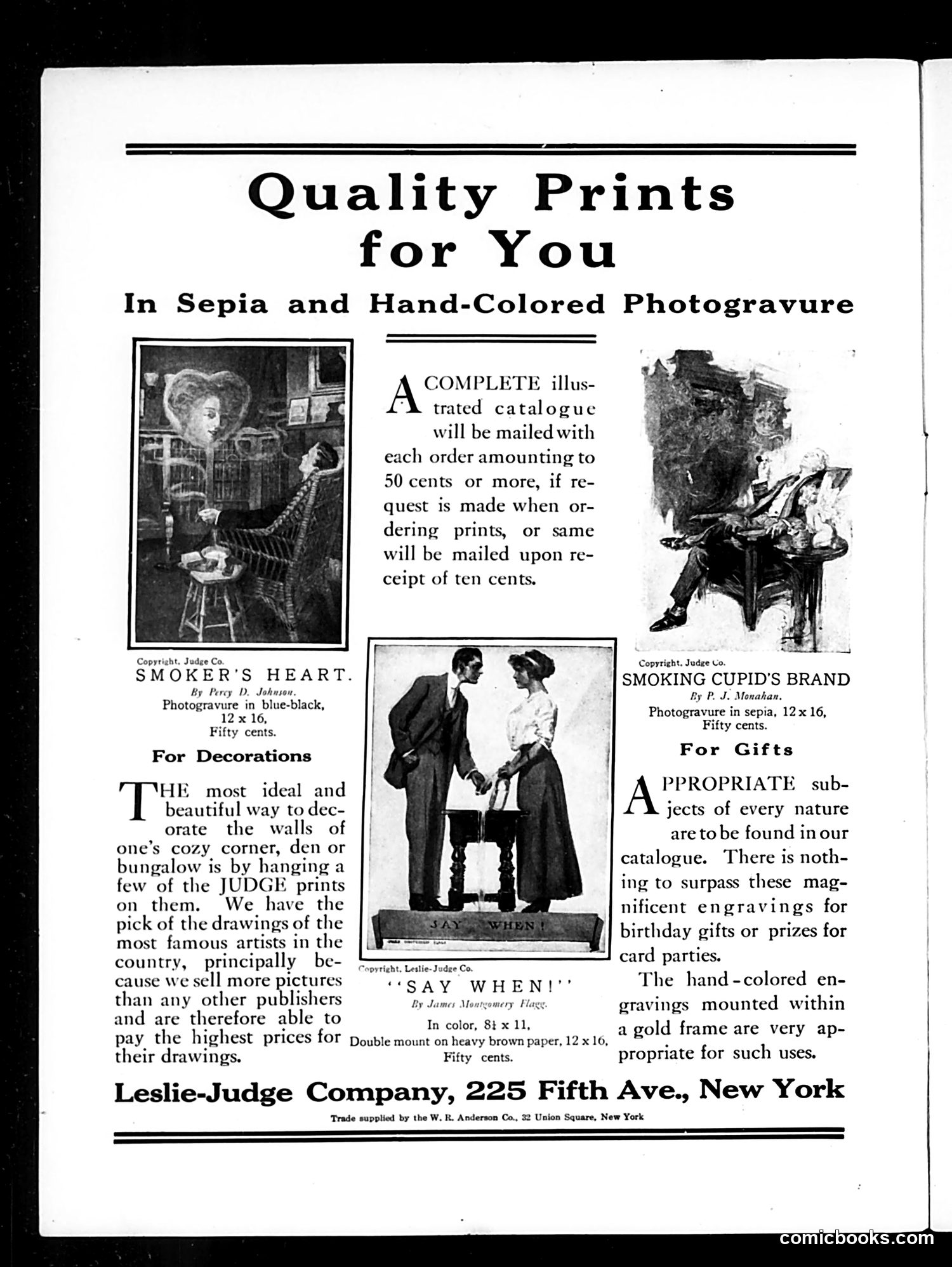
This is primarily an **advertisement page** for Leslie-Judge Company's print business, not political satire. The page sells quality photogravure prints in sepia and hand-colored formats. Three sample prints are displayed: 1. **"Smoker's Heart"** by Percy D. Johnson—a domestic scene showing a woman 2. **"Smoking Cupid's Brand"** by R.F. Standish—a cherub smoking 3. **"Say When!"** by James Montgomery Flagg—a man and woman at a table, appearing to discuss drinks The text emphasizes these prints' suitability for home decoration and gift-giving. There is no evident political satire or social commentary—this is commercial content promoting art reproductions, typical of Judge magazine's revenue model. The prints appear to reflect early 20th-century domestic and romantic themes popular for middle-class decoration.
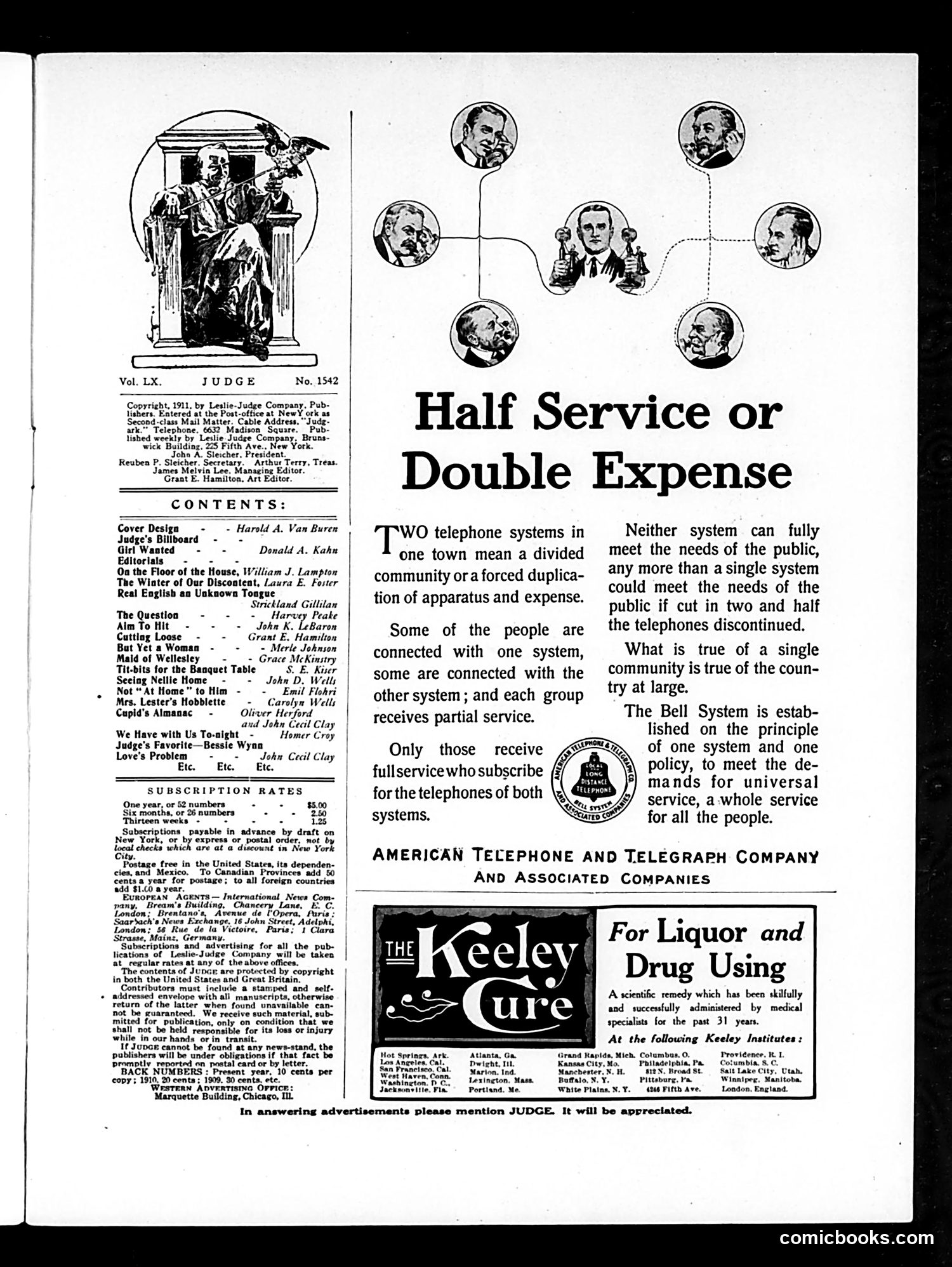
This page is primarily an **advertisement for the Bell Telephone System**, not political satire. The main article, "Half Service or Double Expense," argues against having two competing telephone systems in one town. It uses a diagram showing a central figure (representing the public) connected to multiple other figures, illustrating how divided service creates inefficiency. The argument is that Bell's "one system" approach—serving all people universally—is superior to fragmented competition. This reflects early 20th-century monopoly justifications common before antitrust concerns dominated American policy. The page includes other advertisements (for "The Keeley Cure" medical treatment) and **Judge magazine's contents listing**. There is no apparent political cartoon on this particular page.
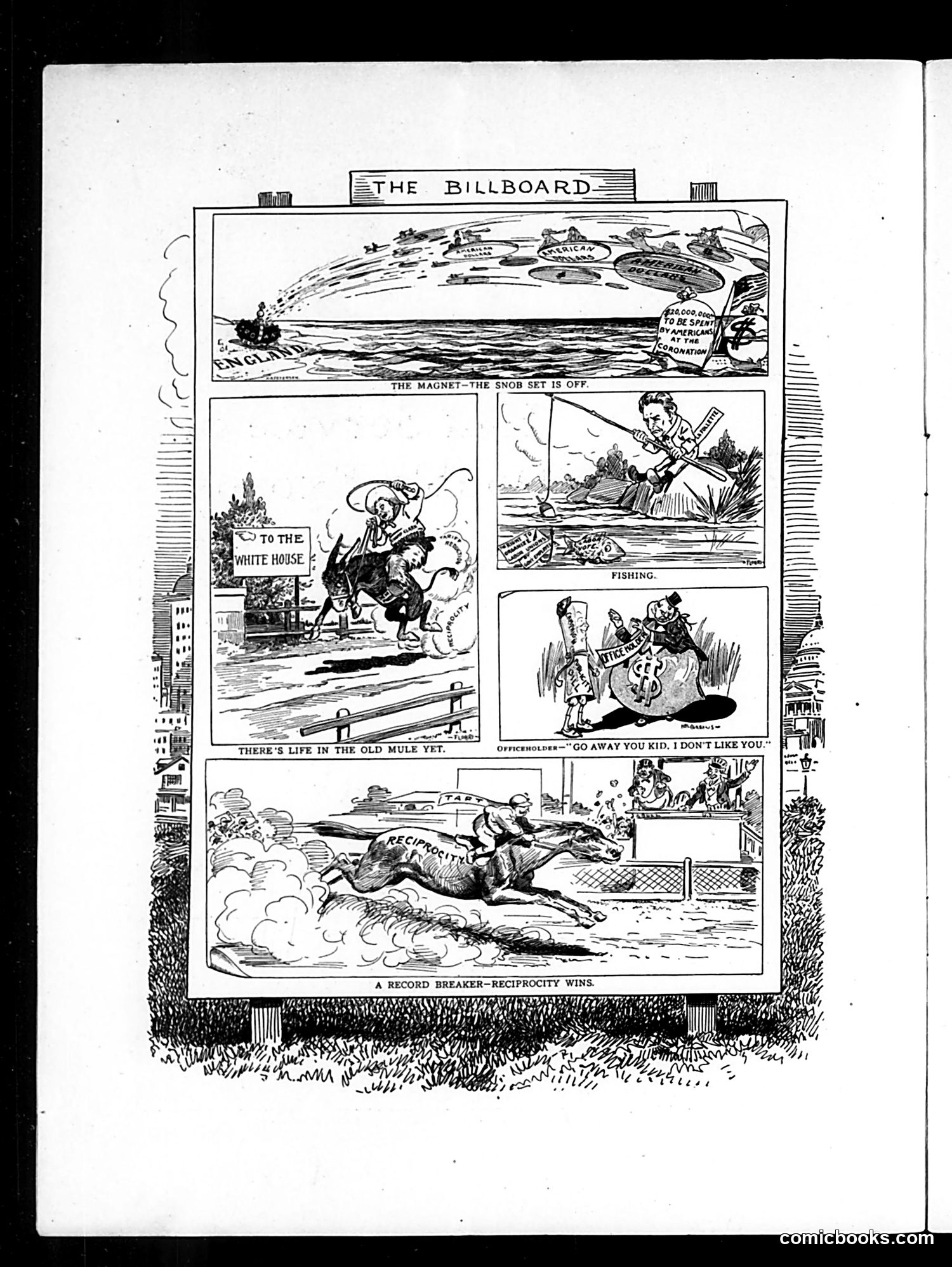
This satirical page from *Judge* magazine contains four distinct political cartoons: 1. **"The Magnet—The Snob Set Is Off"**: Shows wealthy figures being drawn toward something (likely a fashionable destination). 2. **"There's Life in the Old Mule Yet"**: A figure labeled "To the White House" depicts someone riding a mule, suggesting persistent political ambitions or a candidate refusing to fade from politics. 3. **"Fishing"**: A woman fishing, likely satirizing some contemporary leisure or social activity. 4. **"A Record Breaker—Reciprocity Wins"**: A horse race scene with "Reciprocity" winning, directly referencing the trade policy debate that dominated early 20th-century American politics—a major issue dividing Democrats and Republicans. The office-holder's dismissal ("Go Away You Kid, I Don't Like You") suggests political rejection or contempt for someone seeking favor.
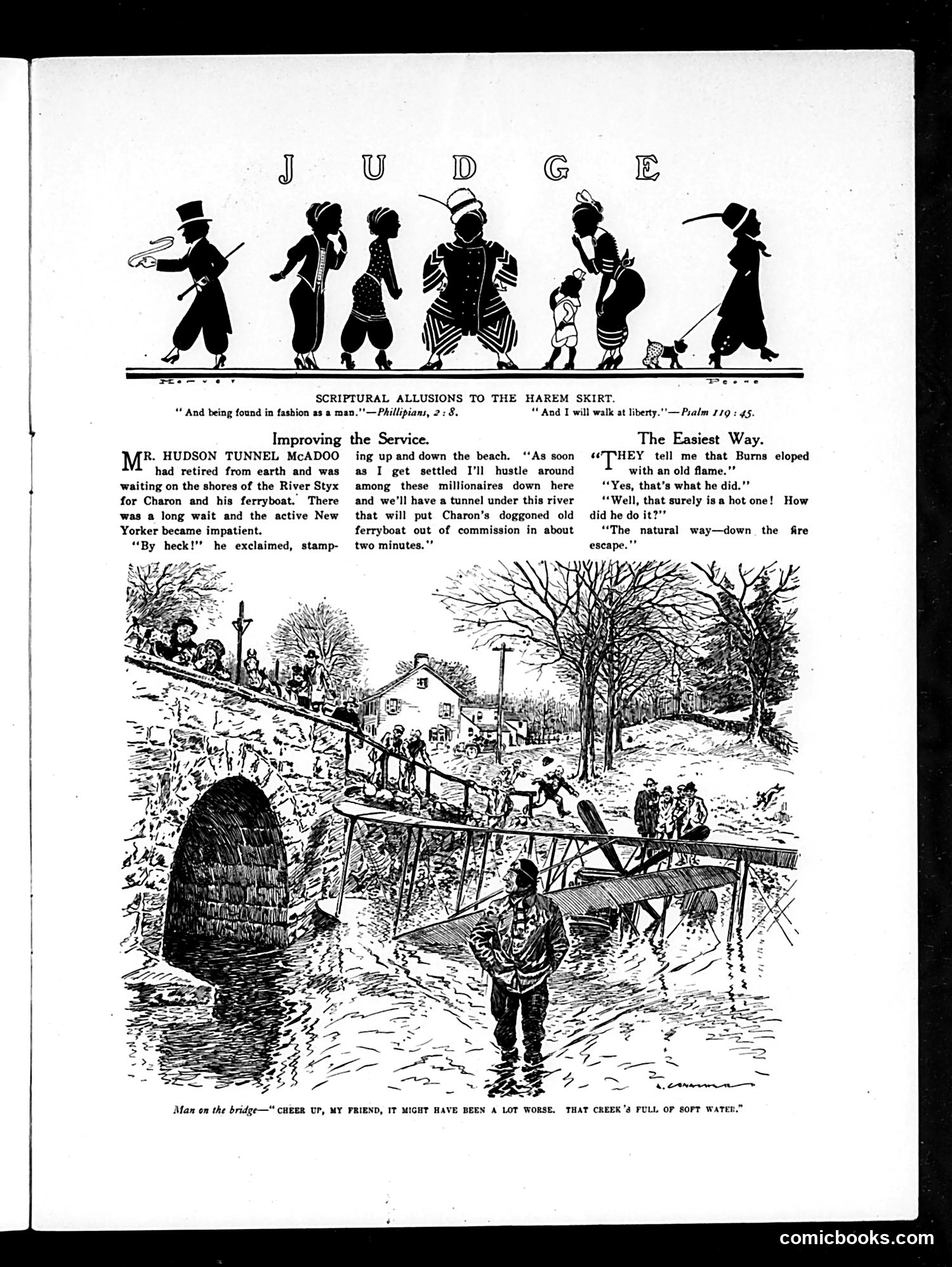
The page contains two separate satirical pieces from *Judge* magazine: **Top section ("JUDGE")**: A visual pun showing silhouetted figures representing the word "JUDGE," with a scriptural reference mocking the harem skirt fashion trend—likely early 1910s. The satire criticizes women's revealing clothing as immodest. **Bottom section**: Two humorous stories. "Improving the Service" mocks Hudson Tunnel MacDoo's impatience waiting by the River Styx for Charon's ferry. "The Easiest Way" jokes about someone's elopement via fire escape. The illustration depicts a rural scene with a bridge and creek, captioning a man's comment that the situation "might have been a lot worse. That creek's full of soft water"—apparently implying drowning would have been preferable to his current predicament. The humor relies on period-specific references and wordplay that require historical context.
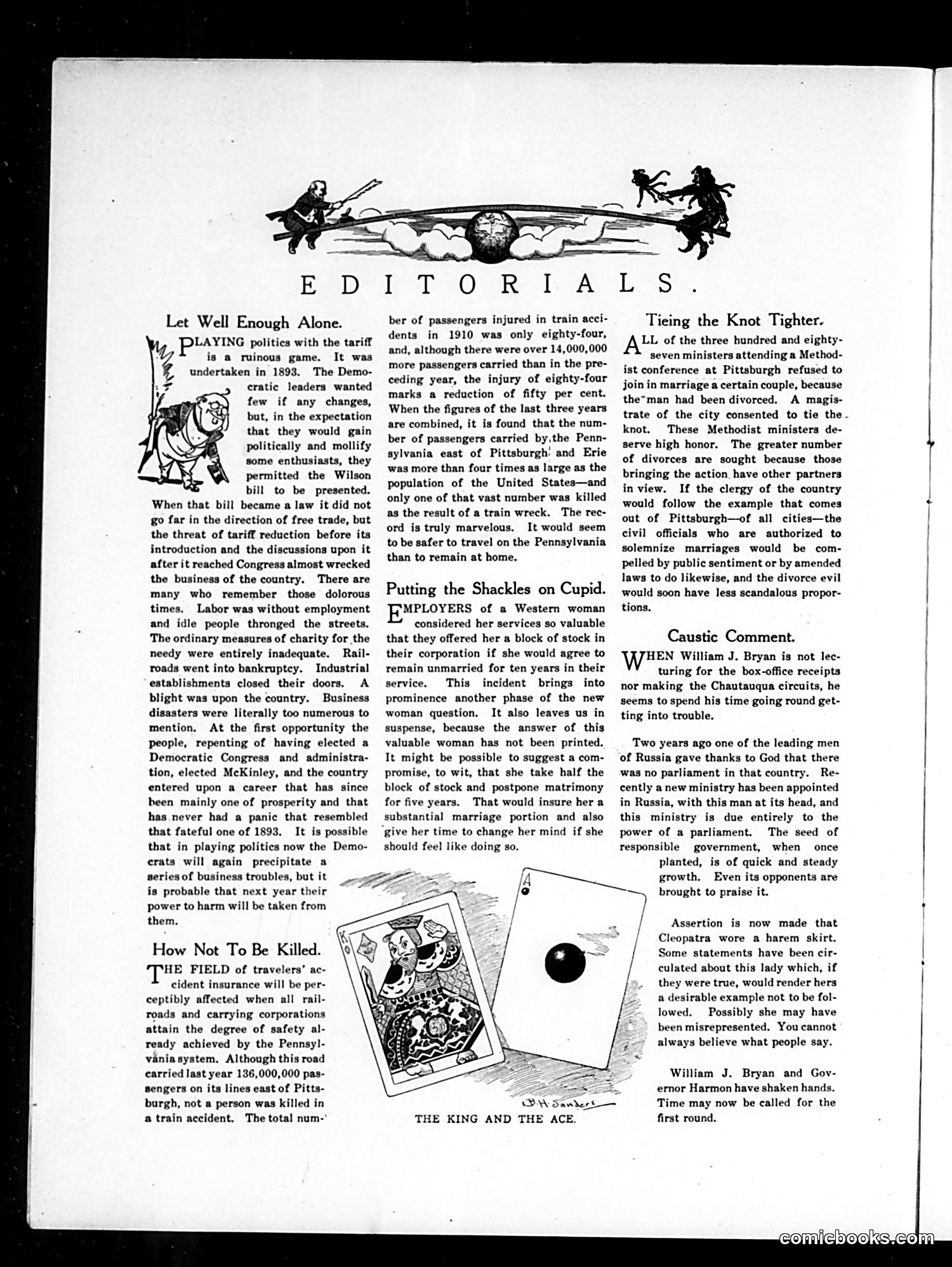
This editorial page from Judge contains three opinion pieces and one cartoon titled "The King and the Ace." **"Let Well Enough Alone"** warns against Democratic tariff manipulation, blaming the 1893 Wilson-Gorman Tariff for economic catastrophe. The piece argues that McKinley's Republican policies brought prosperity, implying Democrats should avoid similar political gambles. **"How Not To Be Killed"** praises the Pennsylvania Railroad's safety record—136 million passengers with only one fatality from train wreck in 1910. It's promotional content celebrating industrial achievement and suggesting rail travel safer than staying home. **"Putting the Shackles on Cupid"** satirizes an employer offering stock dividends to a female employee if she remains unmarried for ten years—a commentary on emerging "new woman" independence and corporate control over workers' personal lives. **"The King and the Ace"** cartoon (illustration unclear from image) apparently relates to William J. Bryan's political prospects, mentioned in the accompanying text about Bryan's lecture circuit activities.
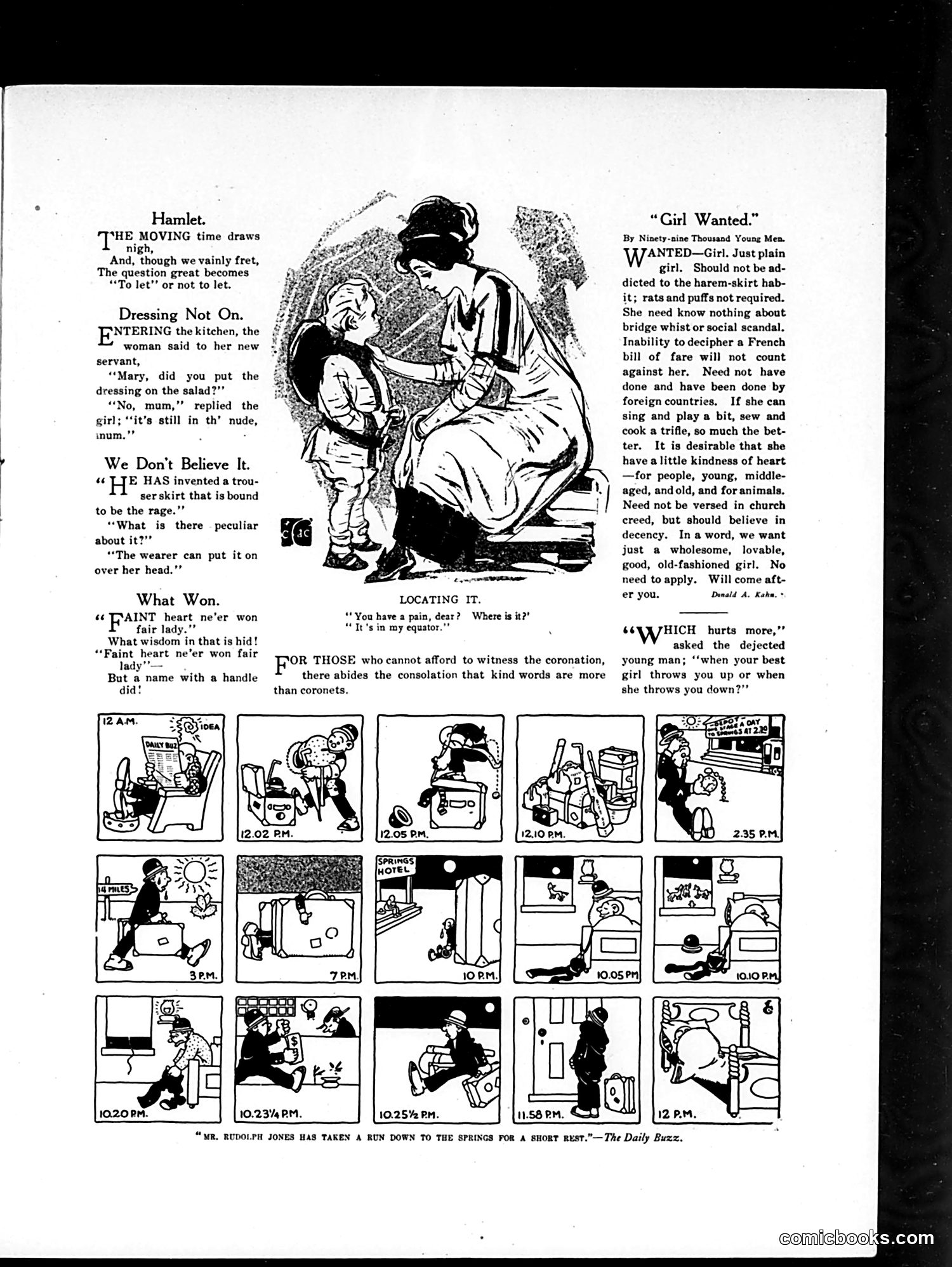
This page from **Judge** magazine contains humorous short pieces and a comic strip satirizing early 20th-century American life and social conventions. **Upper content** includes brief jokes about everyday situations: a servant misunderstanding "dressing" instructions, a supposedly revolutionary "trouser skirt" worn over the head, and wordplay about courtship ("a name with a handle" winning hearts—likely referencing social status or formal titles). **"Girl Wanted"** is a satirical classified ad supposedly from "Ninety-nine Thousand Young Men," mocking contemporary beauty standards and social expectations. It humorously lists what men supposedly want: plain appearance, domestic skills (sewing, cooking), but *not* fashionable affectations like "harem-skirt habit" or French sophistication. The tone gently mocks both shallow male preferences and the era's rigid gender roles. **The comic strip below** ("Mr. Rudolph Jones") appears to be a serialized domestic humor strip following a character through his daily activities at various times. Overall, the page reflects **Edwardian-era social satire**: critiquing fashion trends, gender roles, courtship customs, and servant-employer relationships through gentle mockery.
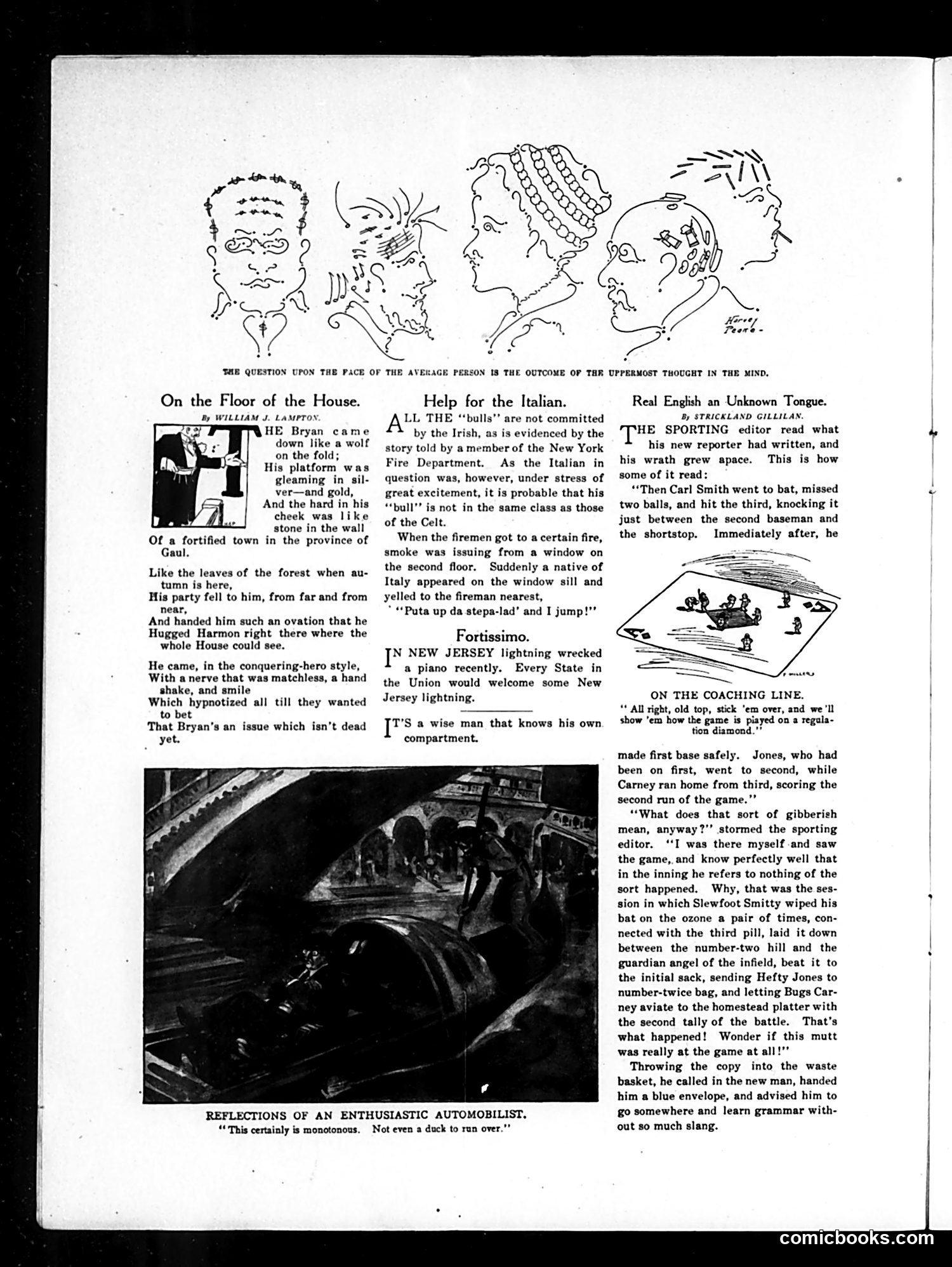
This page contains political and sports humor from early 20th-century America. **"On the Floor of the House"** is a poem about William Jennings Bryan, the Democratic politician known for his "Cross of Gold" speech. The verse mocks Bryan's dramatic entrance to Congress and his ability to energize his party, using grandiose language ("came down like a wolf on the fold") to satirize his theatrical political style. **"Real English an Unknown Tongue"** satirizes baseball reporting jargon. A sporting editor ridicules a new reporter's straightforward account of a baseball game, insisting the proper language requires bizarre slang ("wiped his bat on the ozone," "guardian angel of the infield"). The joke mocks how sportswriters had developed an incomprehensible specialized vocabulary, making simple plays sound absurdly complicated. The remaining brief items joke about Italian pronunciation, New Jersey weather, and an automobile driver bored by lack of obstacles—typical light satirical content of the era.
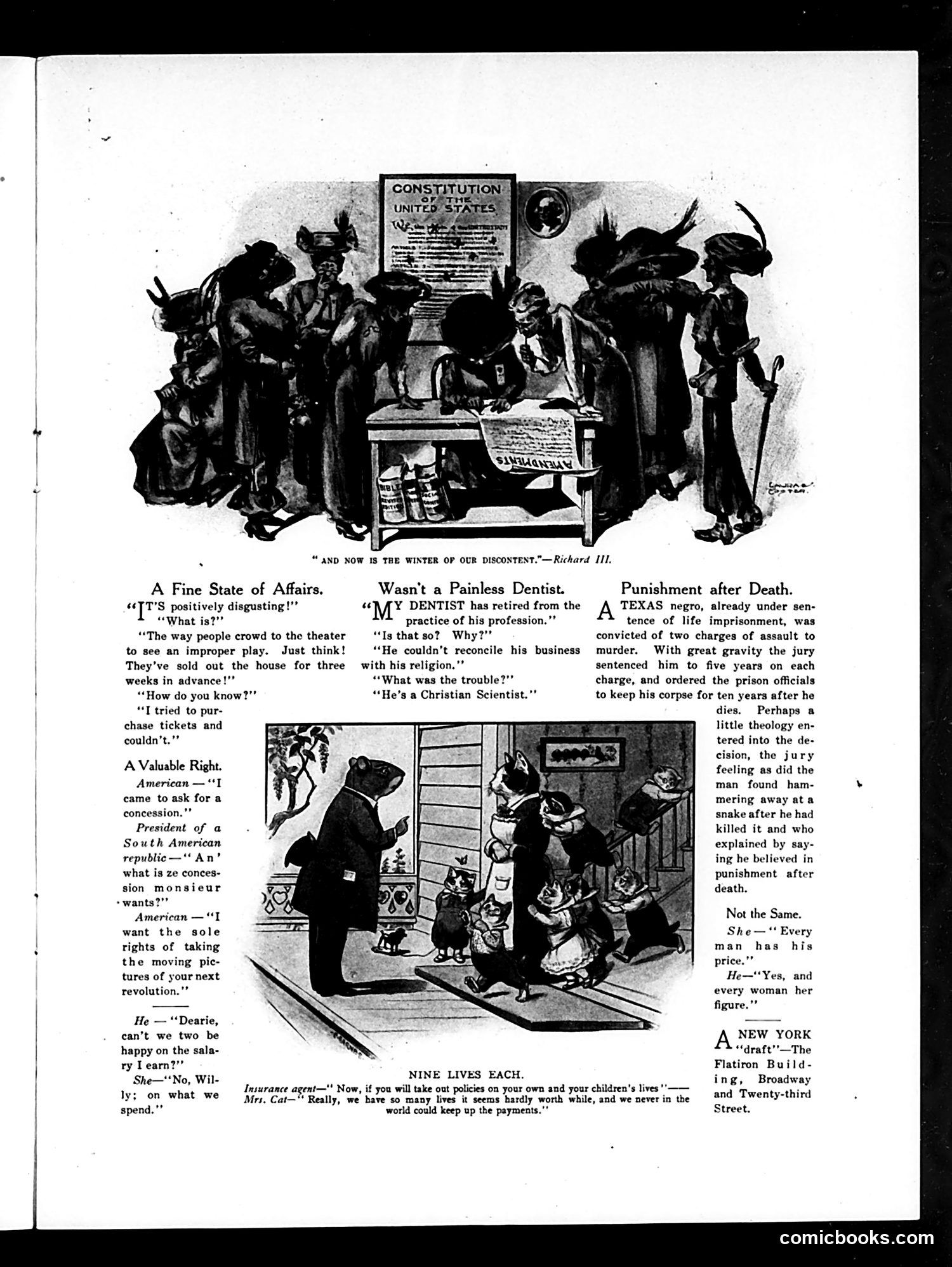
This page contains several short satirical pieces typical of early 20th-century American humor: **"A Fine State of Affairs"** mocks theater-goers' hypocrisy—they claim moral outrage at "improper plays" yet scramble to attend them. **"Wasn't a Painless Dentist"** jokes that a dentist retired because Christian Science beliefs (which reject medical treatment) conflicted with his profession—an ironic contradiction. **"A Valuable Right"** satirizes American business opportunism: an American investor seeks exclusive film rights to a South American nation's "next revolution," treating political instability as entertainment commodity. **"Nine Lives Each"** personifies cats discussing life insurance, playing on the folk belief that cats have nine lives—making insurance absurdly impractical. **"Punishment after Death"** darkly mocks a Texas court ordering a condemned prisoner's corpse preserved ten years post-execution, suggesting the jury believed in supernatural punishment. The remaining pieces are brief gender-based quips about economics and appearance—typical period humor.
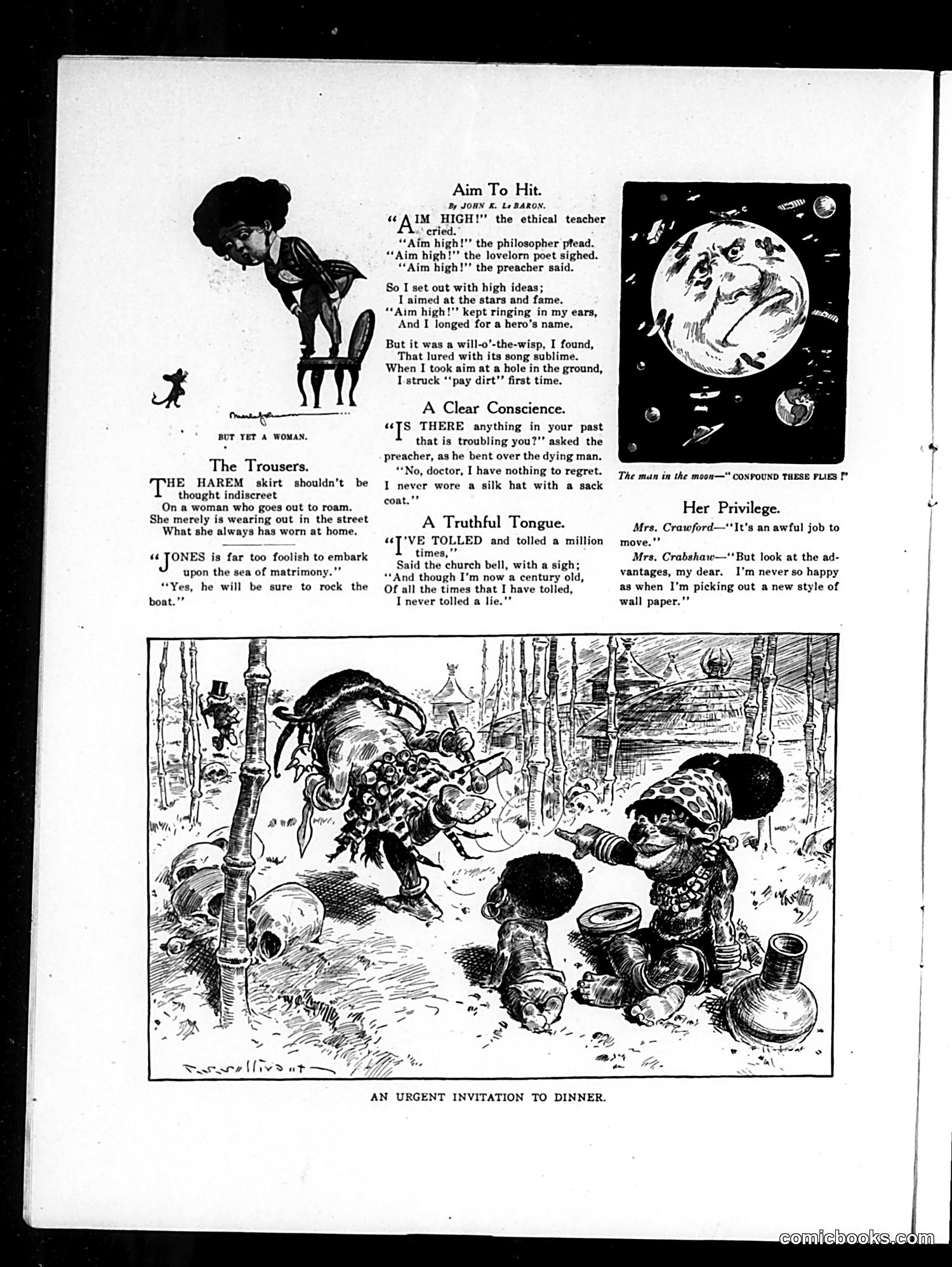
This page contains multiple brief satirical pieces typical of Judge's style: **"The Trousers"** mocks the "harem skirt" fashion controversy—a risqué garment of the era. The joke suggests women wearing revealing hemlines in public are simply displaying what they already wore at home, implying impropriety. **"Aim To Hit"** by John K. Le Baron uses aspirational language ("aim high") as ironic setup. The poem contrasts lofty ideals with practical success—only when aiming at "a hole in the ground" does the speaker strike "pay dirt," satirizing how grandiose ambitions often fail while humble pursuits succeed. **"A Clear Conscience"** presents dark humor: a dying man claims no regrets because he never committed the fashion faux pas of wearing a silk hat with a sack coat—suggesting fashion propriety matters more than actual morality. **"An Urgent Invitation to Dinner"** (large illustration) appears to show insects or creatures dining, with the caption suggesting forced socializing. **"Her Privilege"** jokes that wives enjoy moving house primarily for redecorating opportunities, mocking domestic consumerism. These pieces reflect early 20th-century concerns: fashion propriety, gender roles, and class anxieties.
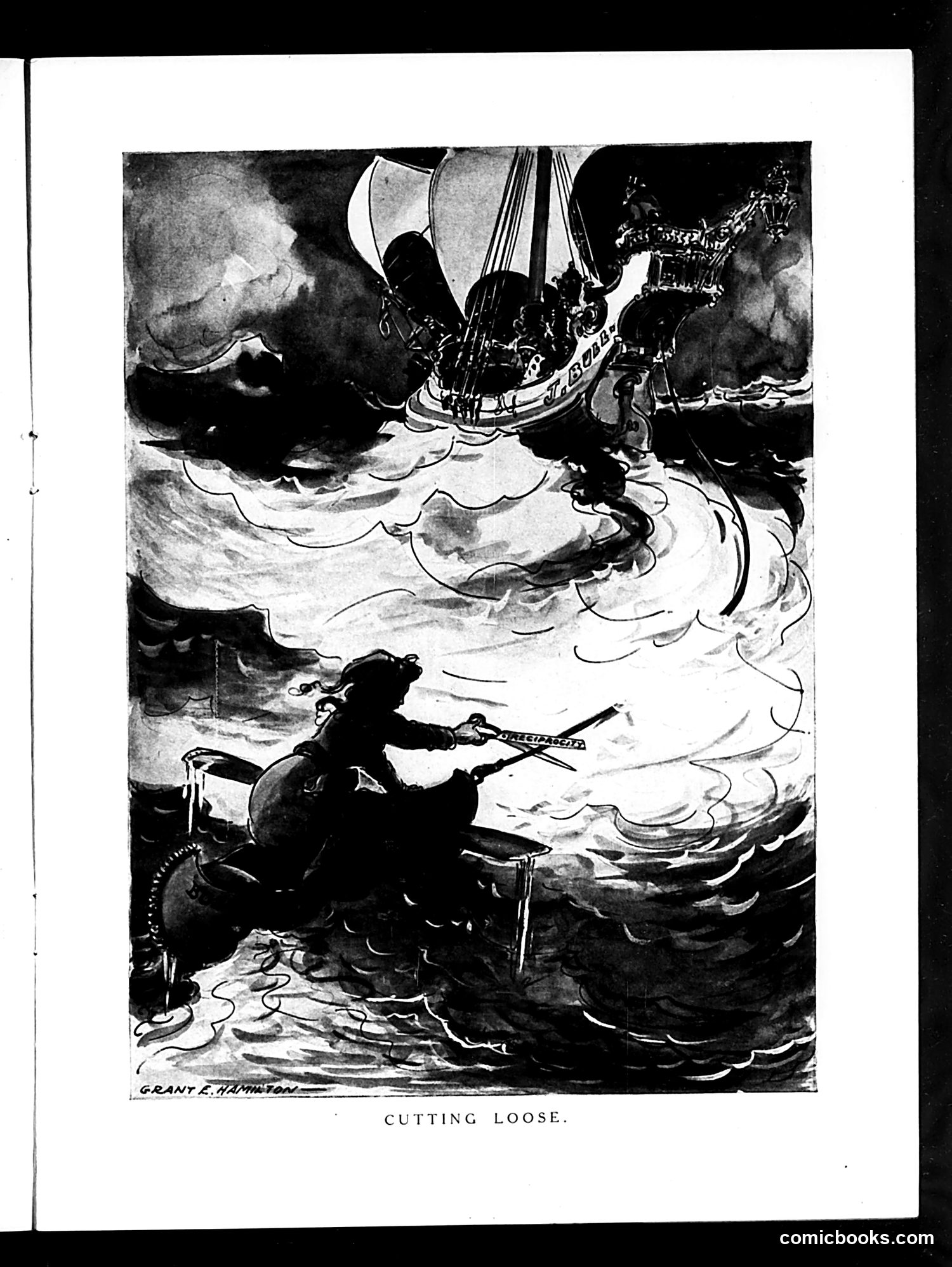
This political cartoon by Grant E. Hamilton depicts a figure wielding a sword or cutlass, cutting the rope or anchor line of a ship labeled "U.S. BOAT" (visible on the vessel). The ship is shown being set adrift in turbulent seas with dark, stormy clouds above. The satire appears to address American foreign policy or isolationism—the figure "cutting loose" represents severing ties or abandoning international commitments. The vessel represents America itself being cast adrift. Without additional context about the publication date, the specific historical moment is unclear, but the image criticizes what the cartoonist views as reckless abandonment of America's international position or naval power. The stormy waters suggest the dangers of such isolation.
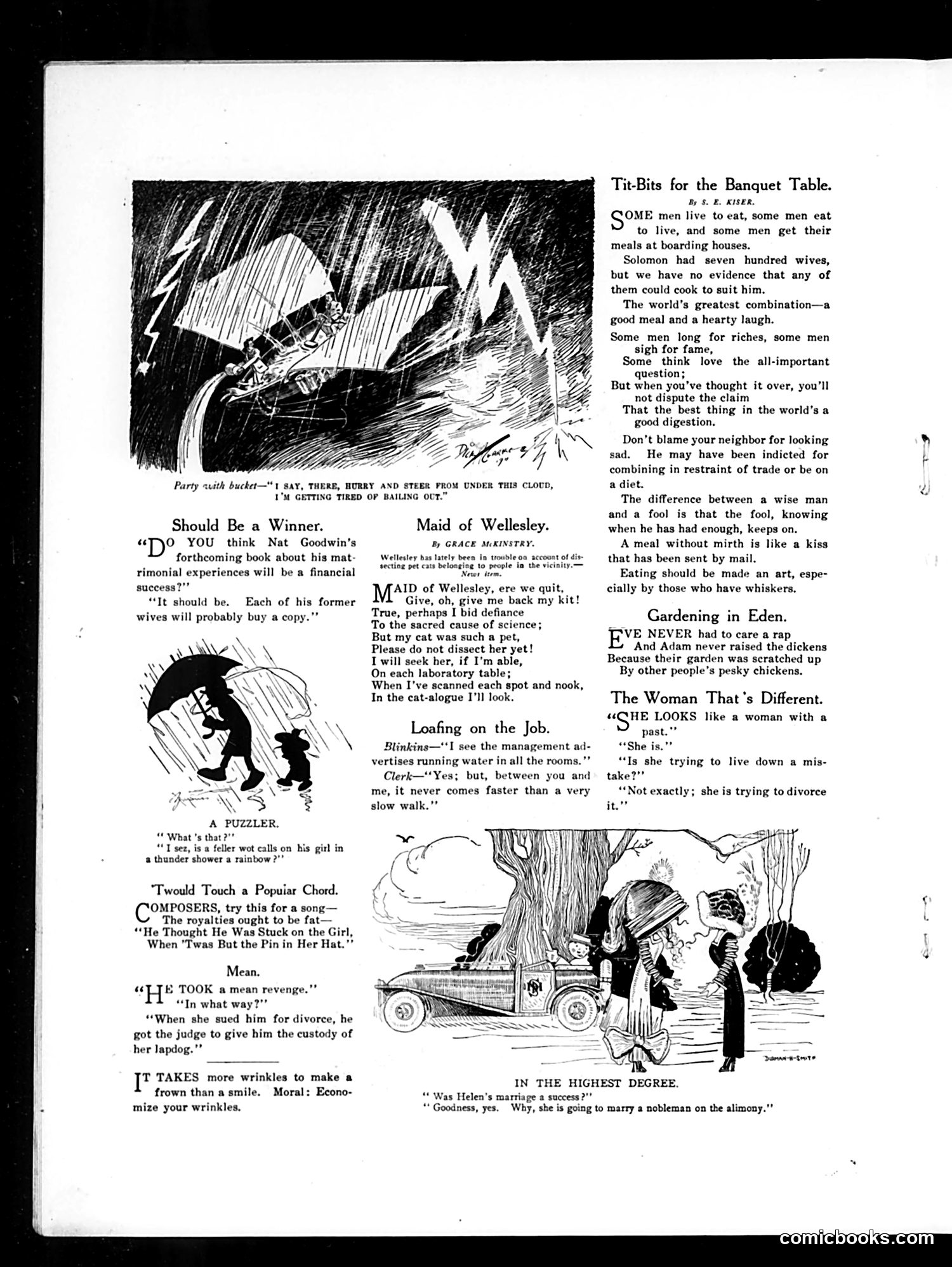
This page from *Judge* magazine contains brief satirical pieces and cartoons typical of early-20th-century American humor: **"Should Be a Winner"** jokes about actor Nat Goodwin's multiple marriages—his ex-wives will buy his memoir out of curiosity or spite. **"Mean" revenge** describes a divorce where the husband gains custody of the wife's prized lapdog, a petty but cutting victory. **"Maid of Wellesley"** references an actual scandal: Wellesley College students dissecting neighbors' pet cats for laboratory work. The poem humorously pleads for the cat's return, punning on "cat-alogue." **"Loafing on the Job"** mocks hotels advertising "running water" when it merely trickles slowly. **"In the Highest Degree"** satirizes women marrying wealthy men for alimony—Helen's first marriage "succeeded" because she'll marry a nobleman using divorce settlement funds. The cartoons use simple line-drawing styles common to period magazines. Overall, the humor targets marriage, infidelity, academic pretension, and class mobility—recurring themes in American satire.
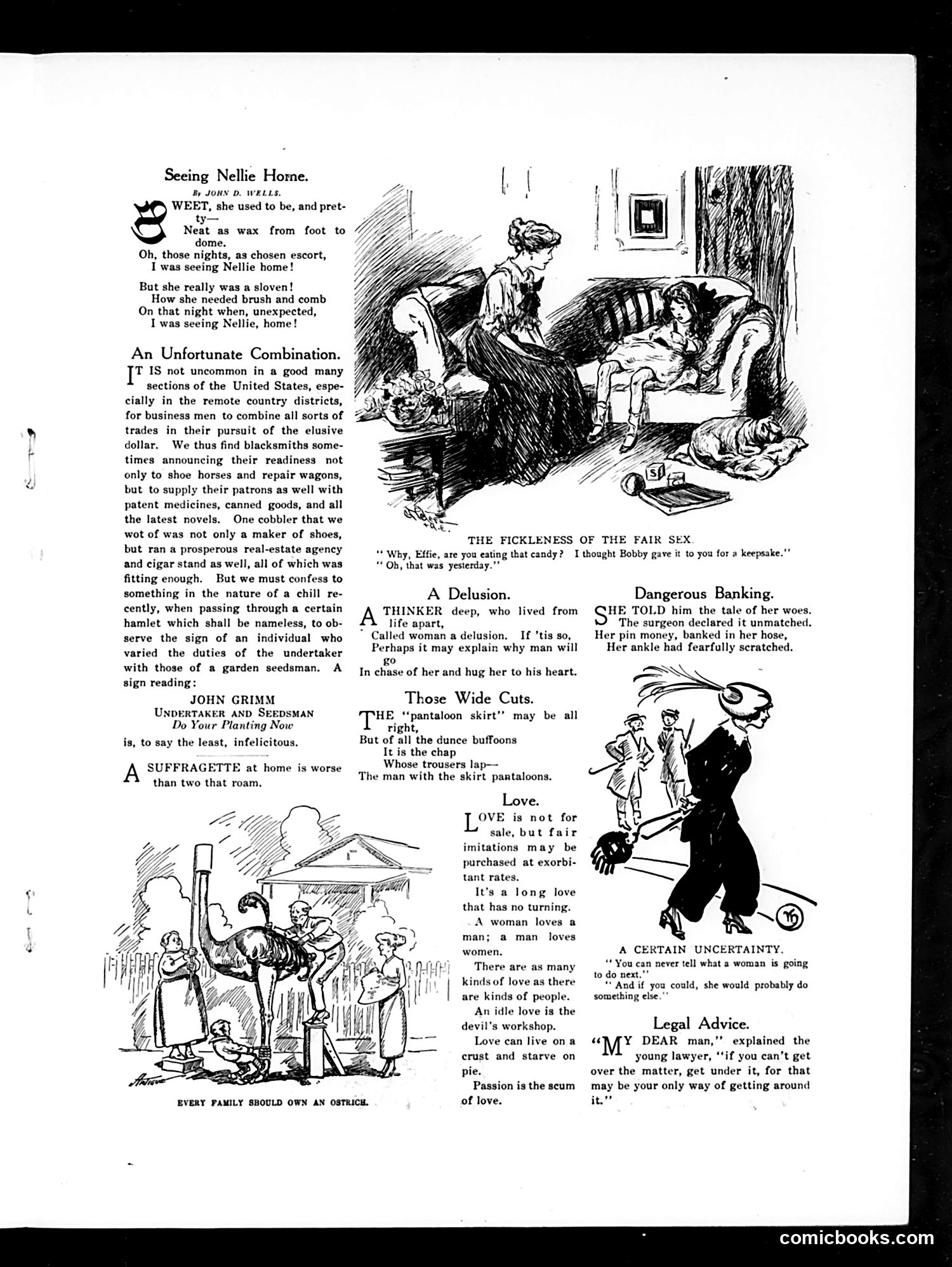
This Judge magazine page contains several satirical pieces and cartoons about gender relations and social absurdities circa early 20th century. **"Seeing Nellie Home"** is a poem about romantic disappointment—a man escorts an attractive woman home, only to discover she's slovenly and unkempt indoors, revealing her public facade. **"An Unfortunate Combination"** mocks rural business practices where one person combines unrelated trades. The humor peaks with a sign reading "UNDERTAKER AND SEEDSMAN / Do Your Planting Now"—a darkly comic double entendre suggesting corpse-planting. **Other pieces satirize contemporary concerns**: women's fashion (oversized "pantaloon skirts"), suffragettes (women demanding voting rights), and romantic fickleness. **"Dangerous Banking"** jokes that a woman hides her "pin money" (discretionary cash) in her hose, creating a physical injury—satirizing both women's financial dependence and their improvisation. The overall tone reflects early-20th-century attitudes: women are unpredictable, vain, and intellectually limited, yet financially resourceful within household constraints.
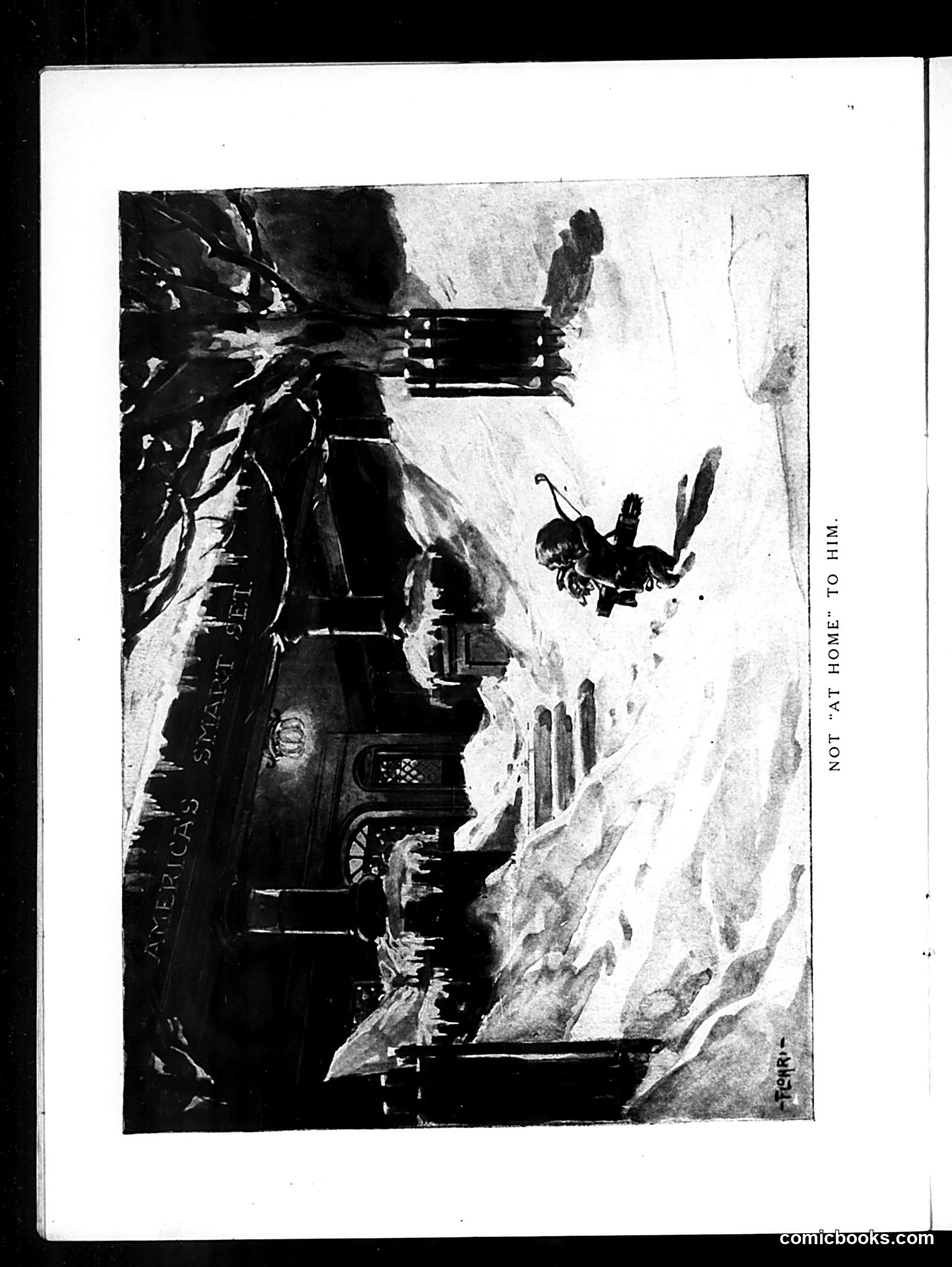
This Judge magazine cartoon depicts a domestic scene where a woman refuses entry to an unwelcome visitor. The text "AMERICAS SMART SET" appears on the left, suggesting this satirizes high society or wealthy circles. The phrase "Not 'At Home' to Him" refers to a Victorian-era social convention where people would claim to be unavailable to callers they wished to avoid—a polite but firm rejection. The cartoon appears to mock the pretensions and social exclusions of America's elite class, suggesting they routinely snub certain people or types through artificial social rituals. Without clearer OCR text, the specific identity of the rejected visitor remains unclear, though the satire targets aristocratic snobbery and class-based social gatekeeping.
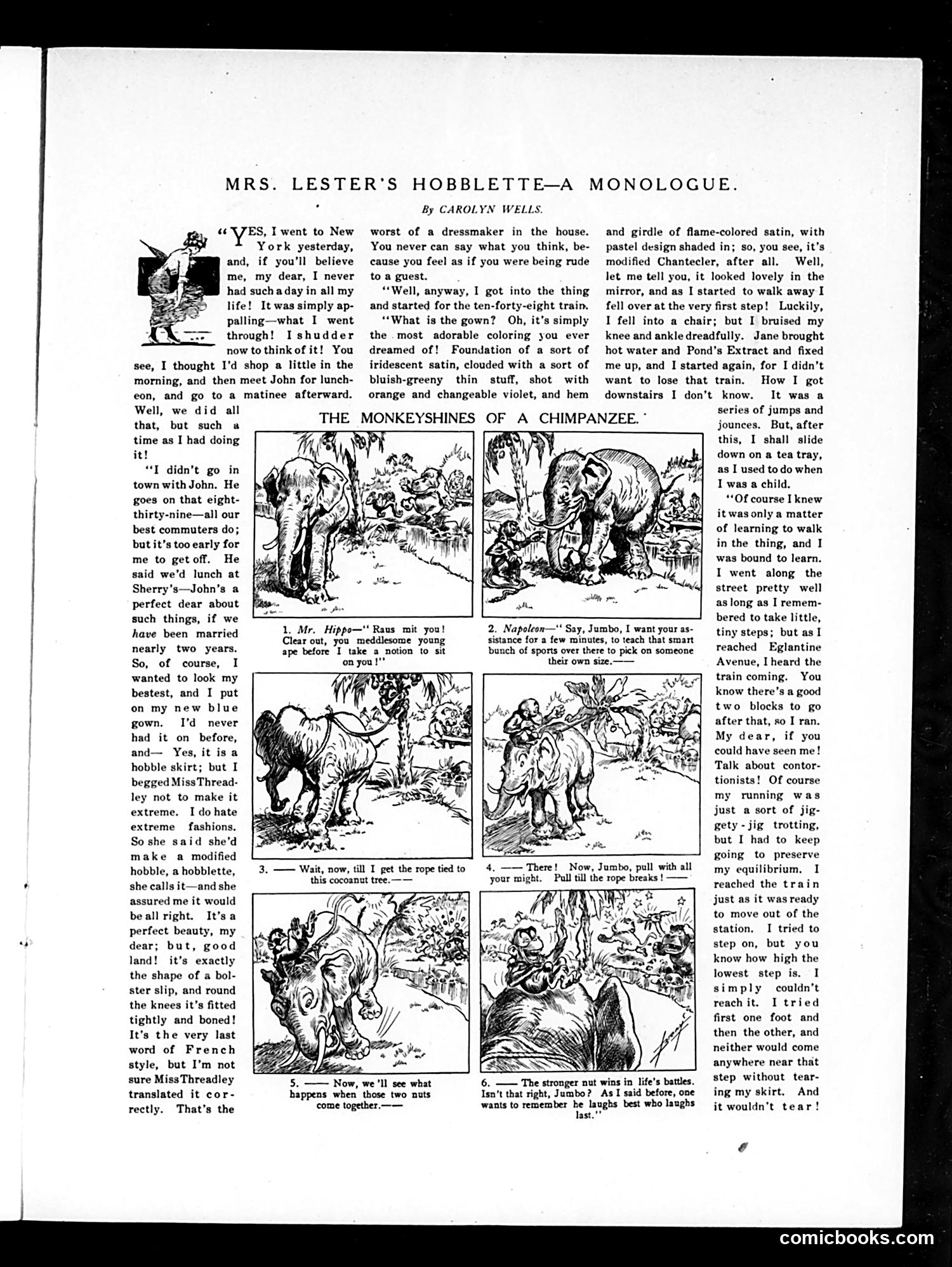
This page satirizes the **hobble skirt**, a restrictive women's fashion trend of the early 1910s that severely limited leg movement. The main text is a monologue by Mrs. Lester recounting her disastrous day wearing a "modified hobble" (a "hobblette"). She describes falling down stairs, struggling to walk, and being unable to board a train because she cannot lift her leg high enough to reach the step—all while maintaining polite society conventions. The accompanying comic strip, "The Monkeyshines of a Chimpanzee," shows animals (hippos, Napoleon the chimp, and Jumbo) in scenarios of physical constraint and struggle—a visual parallel mocking the absurdity of women hobbling about in restrictive garments. **The satire's point**: Fashion designers and society pressured women into impractical clothing that literally prevented normal functioning, yet women felt obligated to wear them. The comparison to animals fighting over constraints emphasizes how ridiculous these fashion demands were.
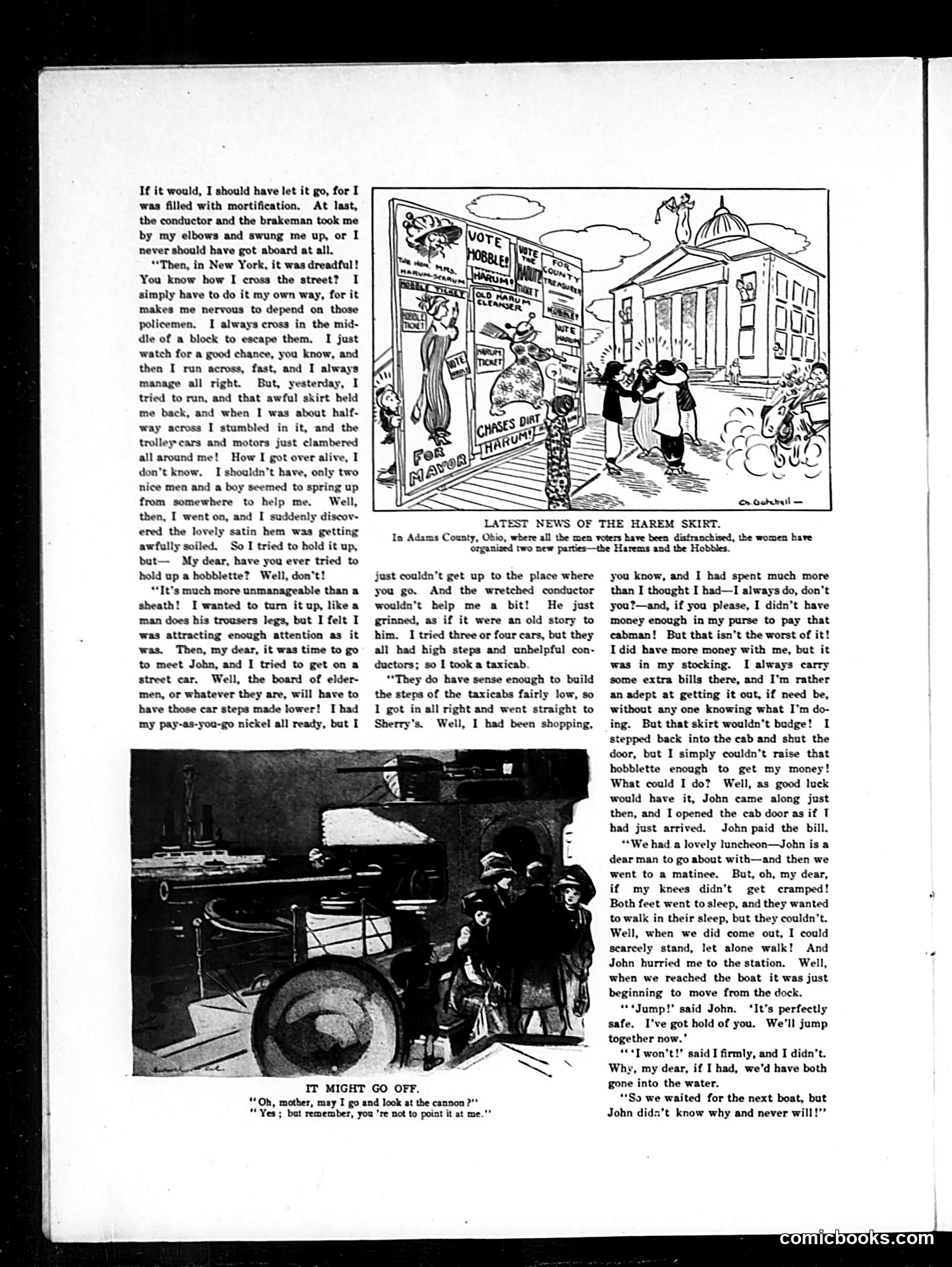
This page satirizes the "hobble skirt," a fashionable but restrictive women's garment popular in the early 1910s that severely limited leg movement. The main text is a woman's complaint about the impracticalities of wearing such a skirt in everyday life—crossing streets, boarding streetcars and taxicabs, retrieving money from her stocking, and nearly missing a boat. The satire targets both the absurdity of the fashion itself and women who slavishly follow trends despite obvious inconvenience. The header jokes that in Adams County, Ohio, women have formed political parties called "the Harems and the Hobbies"—equating restrictive skirts to harem confinement, suggesting the garment literally imprisons women. The small cartoon below depicts a child asking to examine a cannon, creating a pun on the fashion's "hobble" restriction versus actual danger. The piece mocks fashion's illogic while gently criticizing women's willingness to endure physical hardship for style.
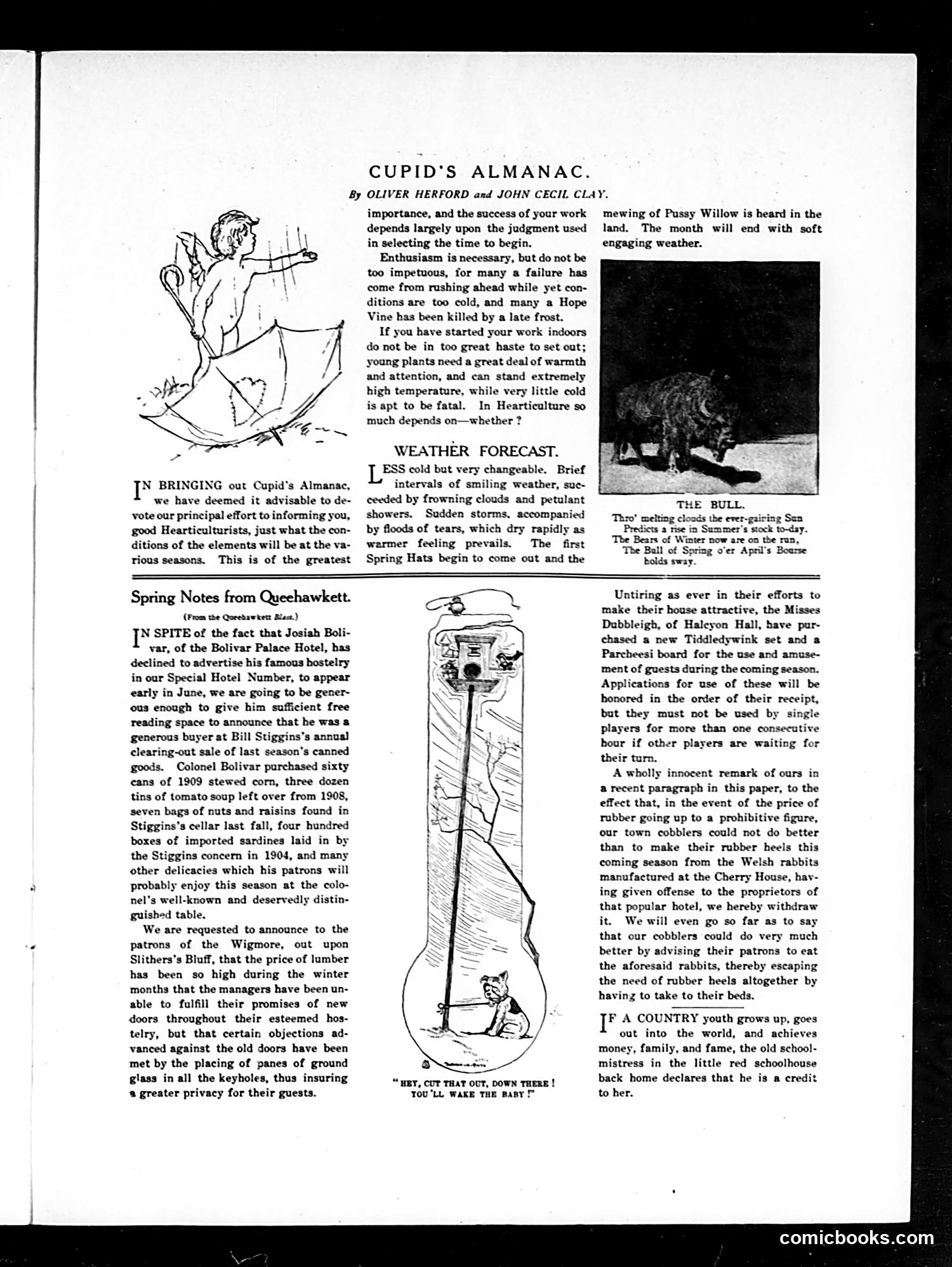
This page from Judge magazine features satirical spring gardening advice disguised as an "almanac" by humorists Oliver Herford and John Cecil Clay. The title puns on "Cupid" (love/romance) applied to horticulture ("Hearticulture"). The main cartoon shows Cupid as a gardener struggling with a large plant or vine, illustrating the article's theme: spring planting requires proper timing and care, not reckless haste—a metaphor for romantic relationships. The "Weather Forecast" humorously describes romantic ups and downs using meteorological language: "frowning clouds," "floods of tears," and "warmer feeling." Below, "Spring Notes from Quechawkett" satirizes small-town rural hotels through mock-serious announcements about Colonel Bolivar's bulk purchase of old canned goods, and the Wigmore's creative solution (ground glass in keyholes) to privacy complaints. The bottom cartoon shows someone shushing a noisy baby, illustrating the ongoing domestic humor. Throughout, Judge employs gentle satire of provincial American life and small-town hospitality.
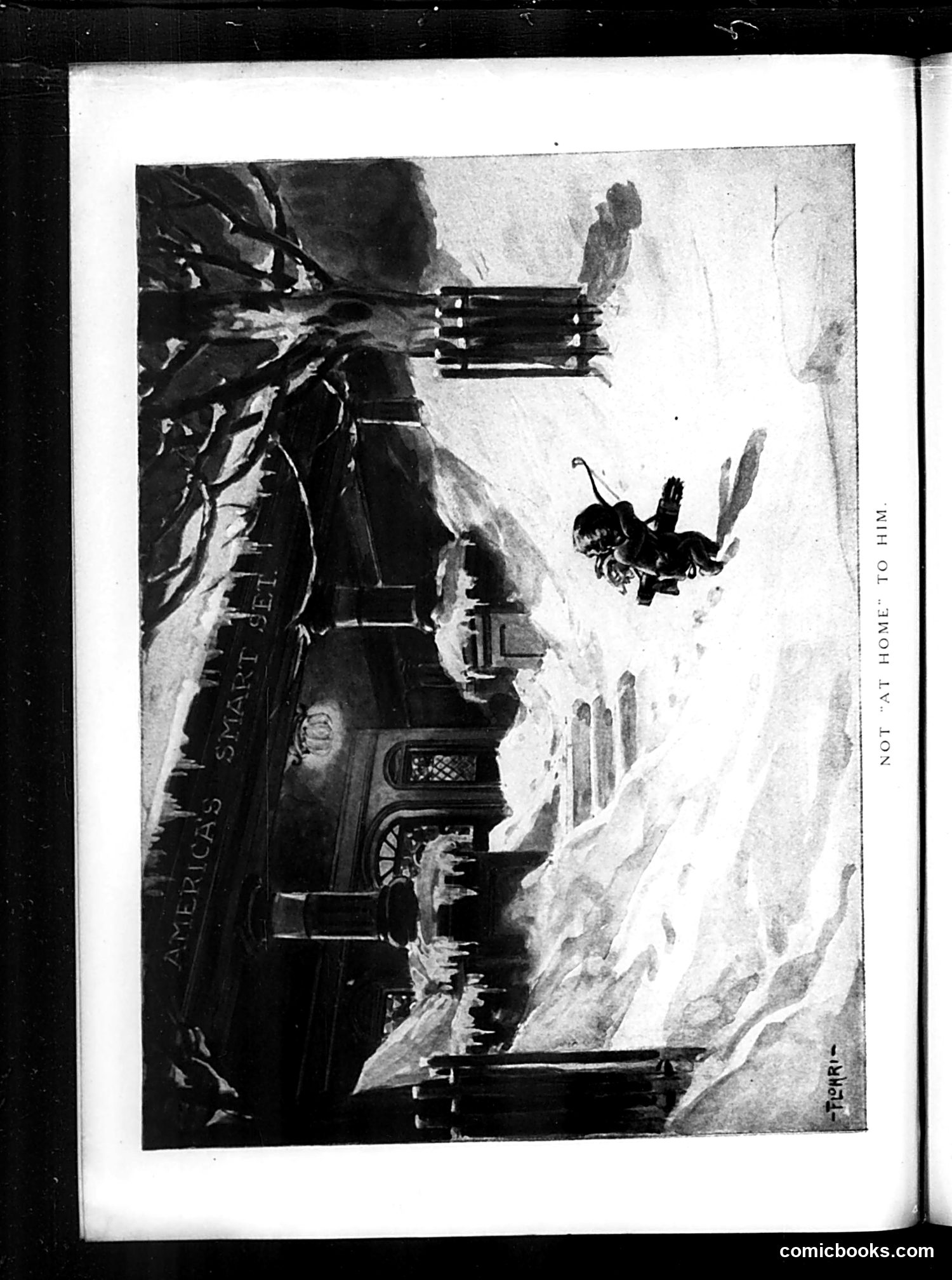
This Judge magazine cartoon depicts a wealthy homeowner refusing entry to an unwanted visitor. The figure at the door appears to be a caricatured laborer or working-class person, while the householder stands firmly in the doorway, literally and figuratively shutting them out. The title "NOT AT HOME TO HIM" suggests class-based social exclusion—a common satirical theme in Gilded Age American magazines. The cartoon likely critiques either wealthy indifference to labor issues, immigration concerns, or broader class divisions of the era. The visual metaphor of the closed door emphasizes social barriers between rich and poor. Without a visible date or clearer identifying details, the specific political context remains unclear, though the class commentary is evident.
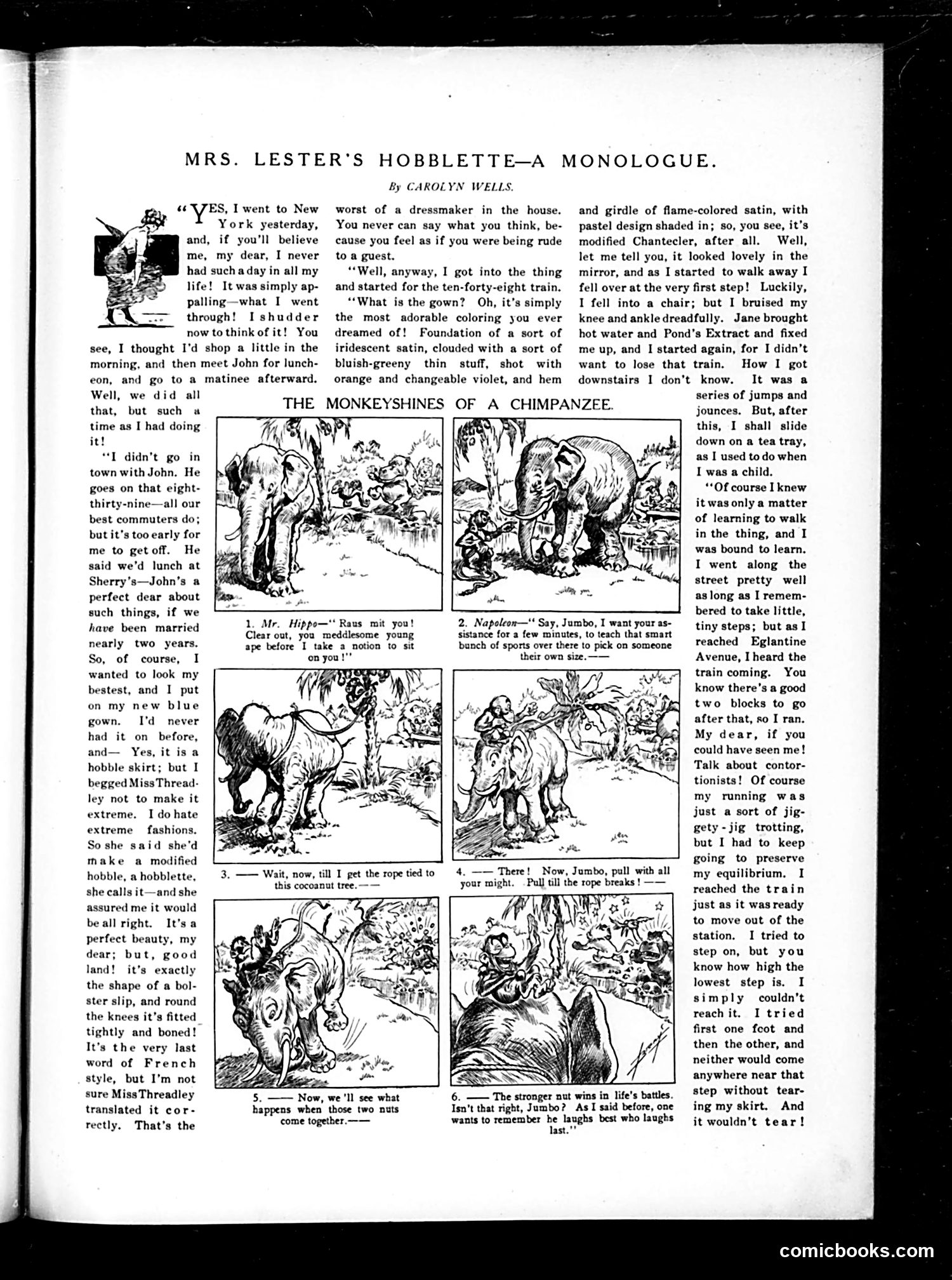
This page contains two distinct pieces. The main text is a humorous monologue by Carolyn Wells satirizing the "hobble skirt" craze—a fashionably restrictive women's garment popular in the 1910s that severely limited walking stride. Mrs. Lester describes comically struggling through her day in a "modified" version (a "hobblette"), unable to navigate stairs, run for trains, or move freely. The satire mocks both the impractical fashion and women's willingness to endure physical discomfort for style. The accompanying cartoon series features anthropomorphized animals (a hippopotamus, Napoleon-like chimp, and Jumbo the elephant) engaged in comedic scenarios involving pulling ropes and settling disputes. These appear to be standalone humorous animal vignettes unrelated to the monologue, typical of Judge magazine's satirical content.
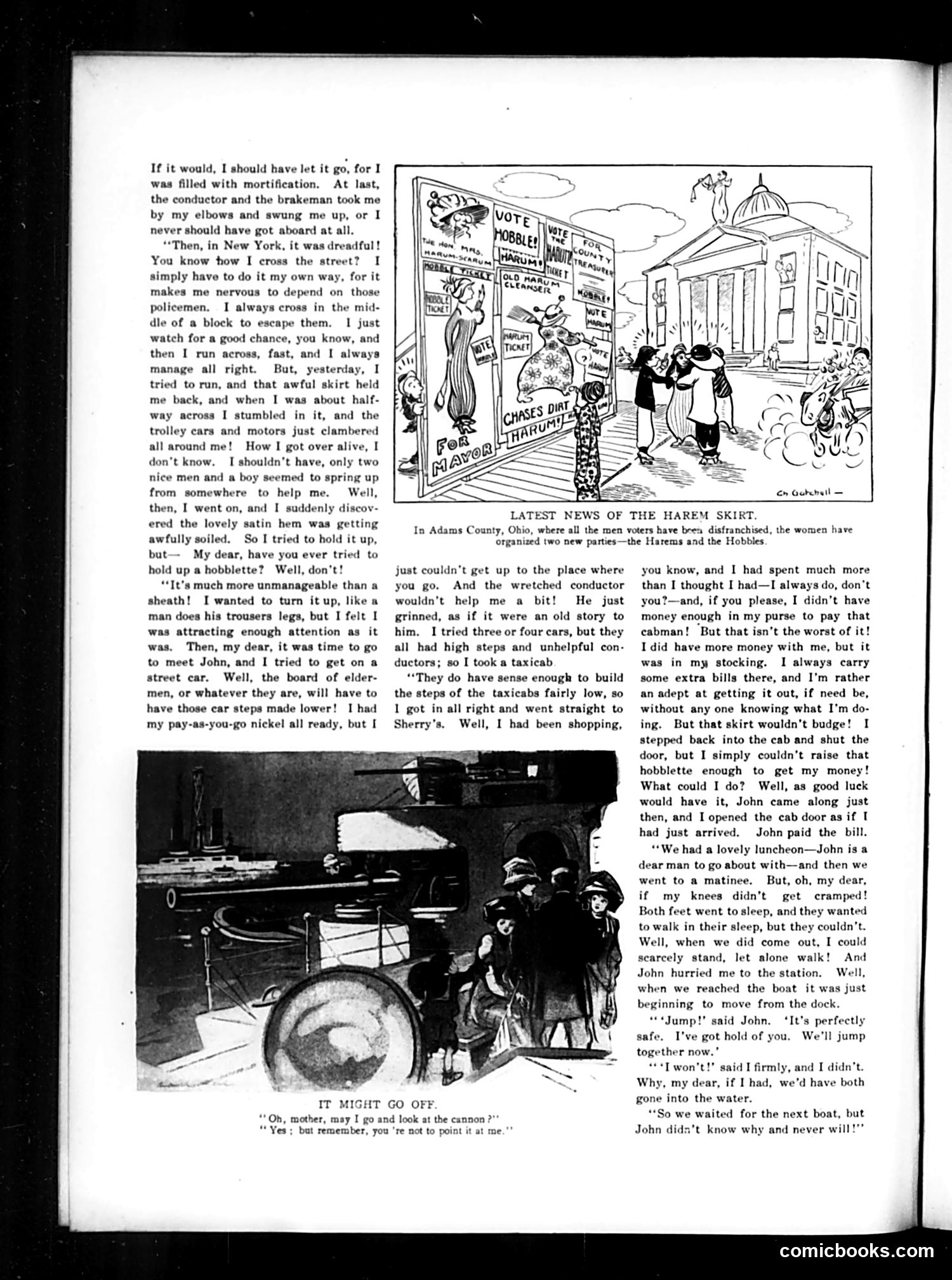
This Judge cartoon satirizes the "hobble skirt," a restrictive women's fashion of the early 1910s featuring a narrow hem that severely limited leg movement. The top cartoon depicts women voters organized into two new political parties—"the Harems and the Hobbles"—in Adams County, Ohio, where women had apparently gained voting rights. The accompanying text humorously catalogs the hobble skirt's impracticality: the wearer struggles boarding trolleys, nearly gets hit by traffic, cannot raise the skirt to retrieve money from her stocking, and cannot walk normally after sitting. The satire mocks both the absurd fashion trend and women's newly visible public participation in civic life, suggesting that women voters are as chaotic and problematic as this ridiculous garment. The joke relies on conflating fashion frivolity with female political agency, presenting both as sources of disorder.
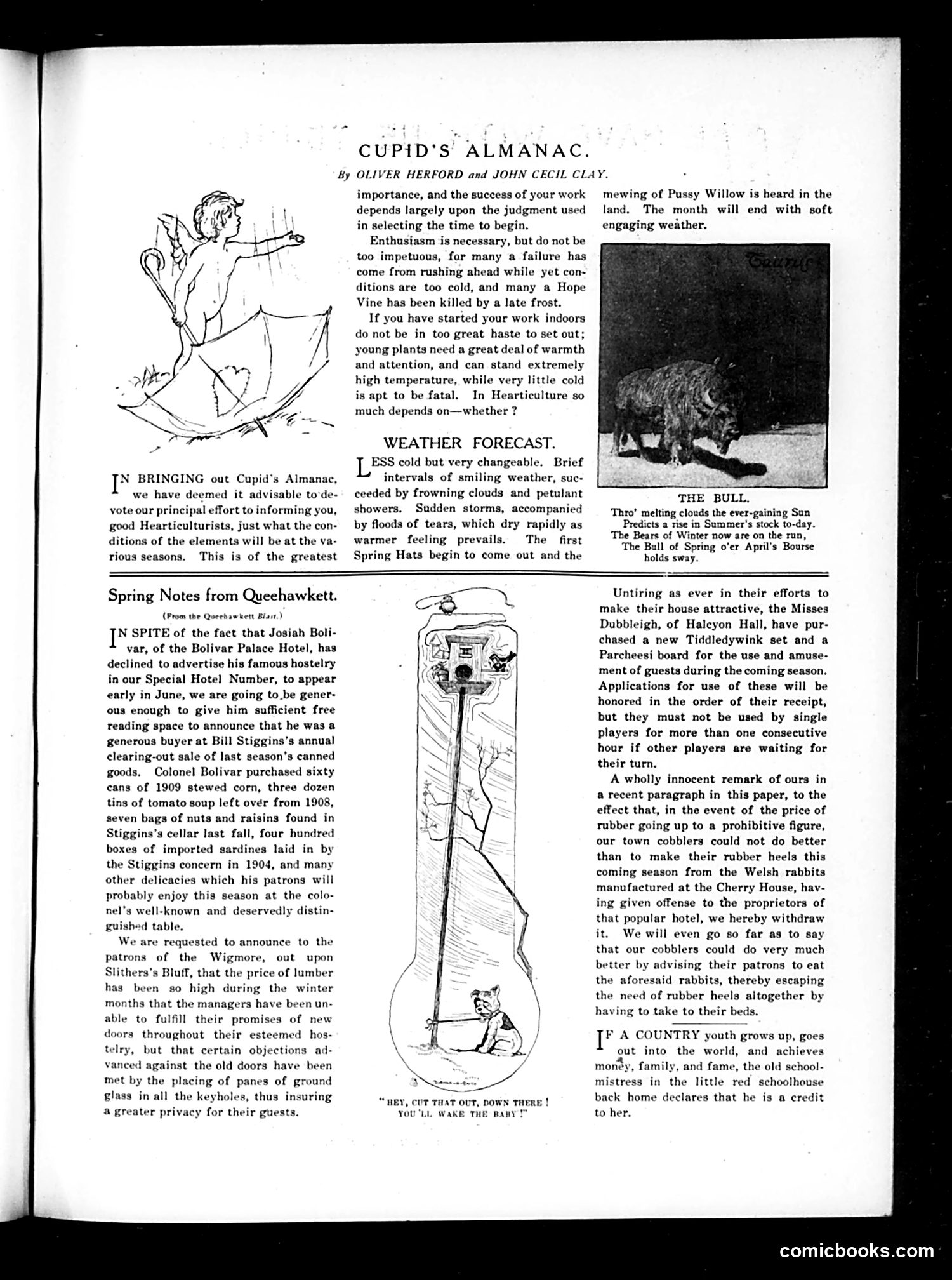
This page presents "Cupid's Almanac" by Oliver Herford and John Cecil Clay—a playful extended metaphor using horticultural language to discuss romance and relationships. The title's conceit treats love like spring gardening: timing matters, enthusiasm must be tempered, conditions must be right, and patience is essential. The "Weather Forecast" section continues the joke, describing emotional weather patterns using romantic imagery ("floods of tears," "warmer feeling"). The Spring Hats and "Pussy Willow" are double entendres typical of Judge's era humor. The secondary content mocks small-town hotel proprietors through fake advertisements, satirizing shabby establishments passing off stale inventory and cost-cutting measures (ground glass in keyholes for "privacy") as features. This targets both pretentious rural hotels and gullible tourists. The page blends horticultural instruction with romantic advice—a characteristically whimsical approach to both subjects common to Judge's satirical style.
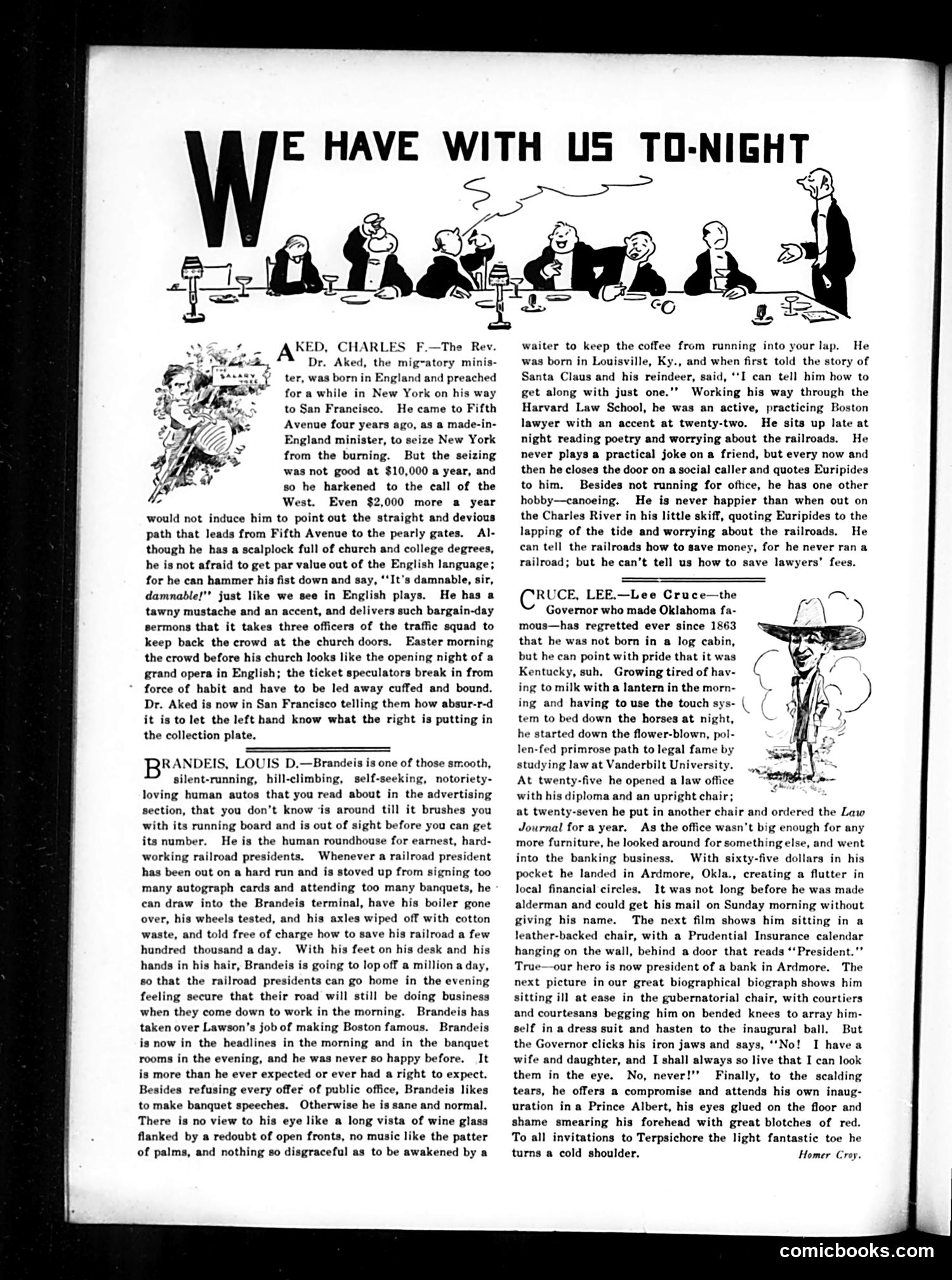
This page satirizes two prominent public figures through mock biographical sketches: **Rev. Dr. Charles Aked**: A British-born minister who came to New York's Fifth Avenue church, then moved to San Francisco for higher pay. Judge mocks his theatrical preaching style, affected English accent, and supposed obsession with collection plate donations—satirizing both his mercenary motivations and performative religiosity. **Louis Brandeis**: A Boston lawyer famous for advising railroad presidents on cost-cutting. Judge portrays him as a self-aggrandizing "human roundhouse" who enjoys banquet speeches and refuses public office while seeking notoriety. The satirist suggests Brandeis helps corporations save money while cultivating a cultured image (quoting Euripides, canoeing). Both sketches employ exaggerated metaphors and mock-laudatory tone to expose what Judge saw as hypocrisy: religious showmanship disguised as piety, and corporate lawyering dressed up as intellectual refinement.
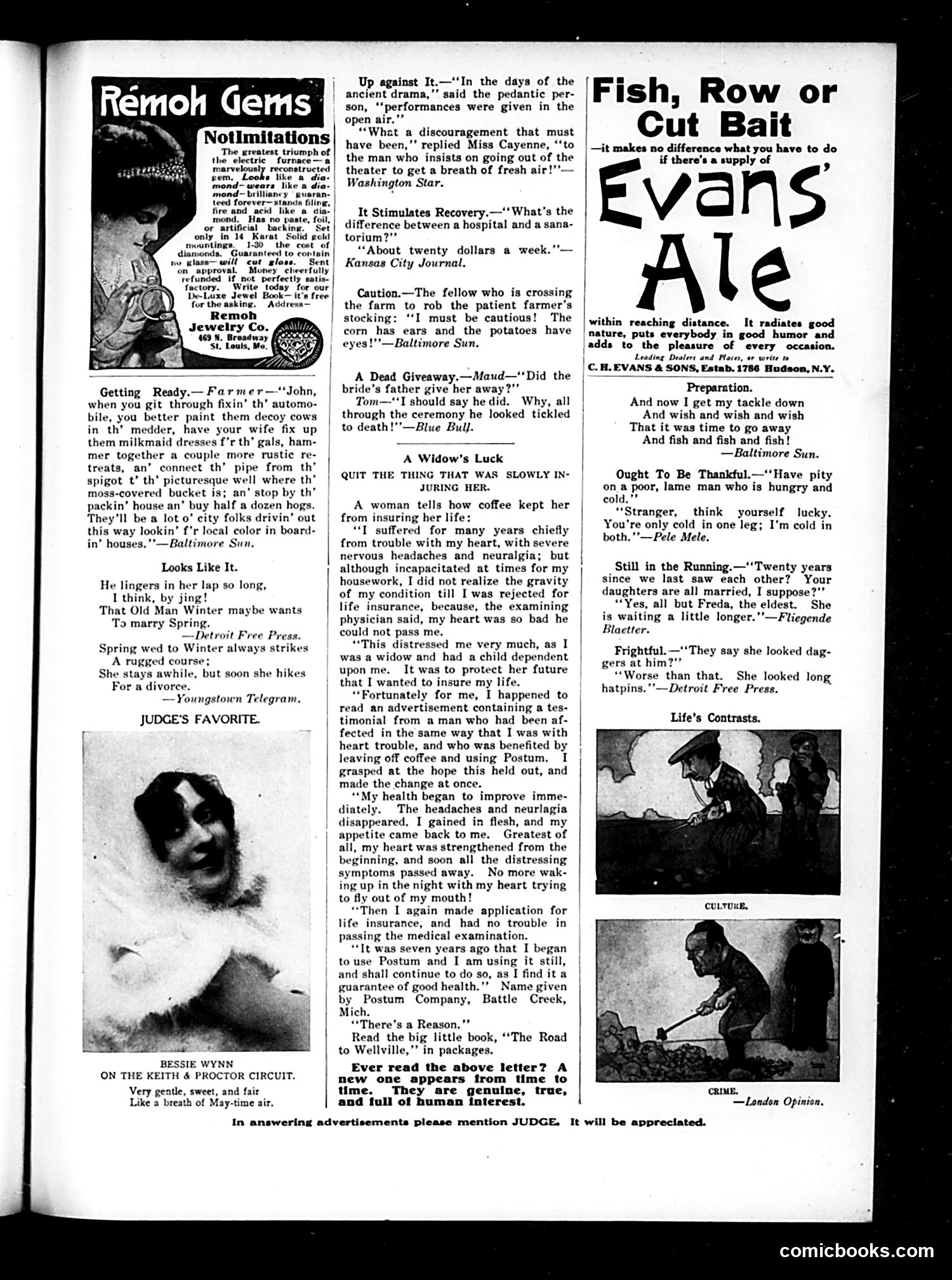
This page contains satirical short jokes and advertisements typical of early 20th-century humor magazines. The cartoons aren't political but rather social comedy: **"Getting Ready"** mocks rural tourism—a farmer prepares his property with artificial "local color" (painted cows, rustic props, fake wells) to attract city visitors seeking authentic countryside experiences. **"He Lingers in Her Lap"** uses extended personification: Spring and Winter as a married couple, with Winter reluctant to leave Spring in spring, suggesting their relationship is naturally incompatible. **Other brief jokes** target everyday absurdities: a theater-goer complaining about outdoor ancient drama when he seeks fresh air indoors; sanatoriums costing more than hospitals; a thief ironically worried about being caught while robbing, despite the farm's "watchful" corn and potatoes. The page also features **Rémoh Gems jewelry ads** and **Postum coffee testimonials**—period advertisements claiming coffee caused heart problems, solved by switching to caffeine-free Postum. The humor assumes readers recognize contemporary anxieties: rural authenticity commercialization, urban-rural cultural divides, and health-product marketing.
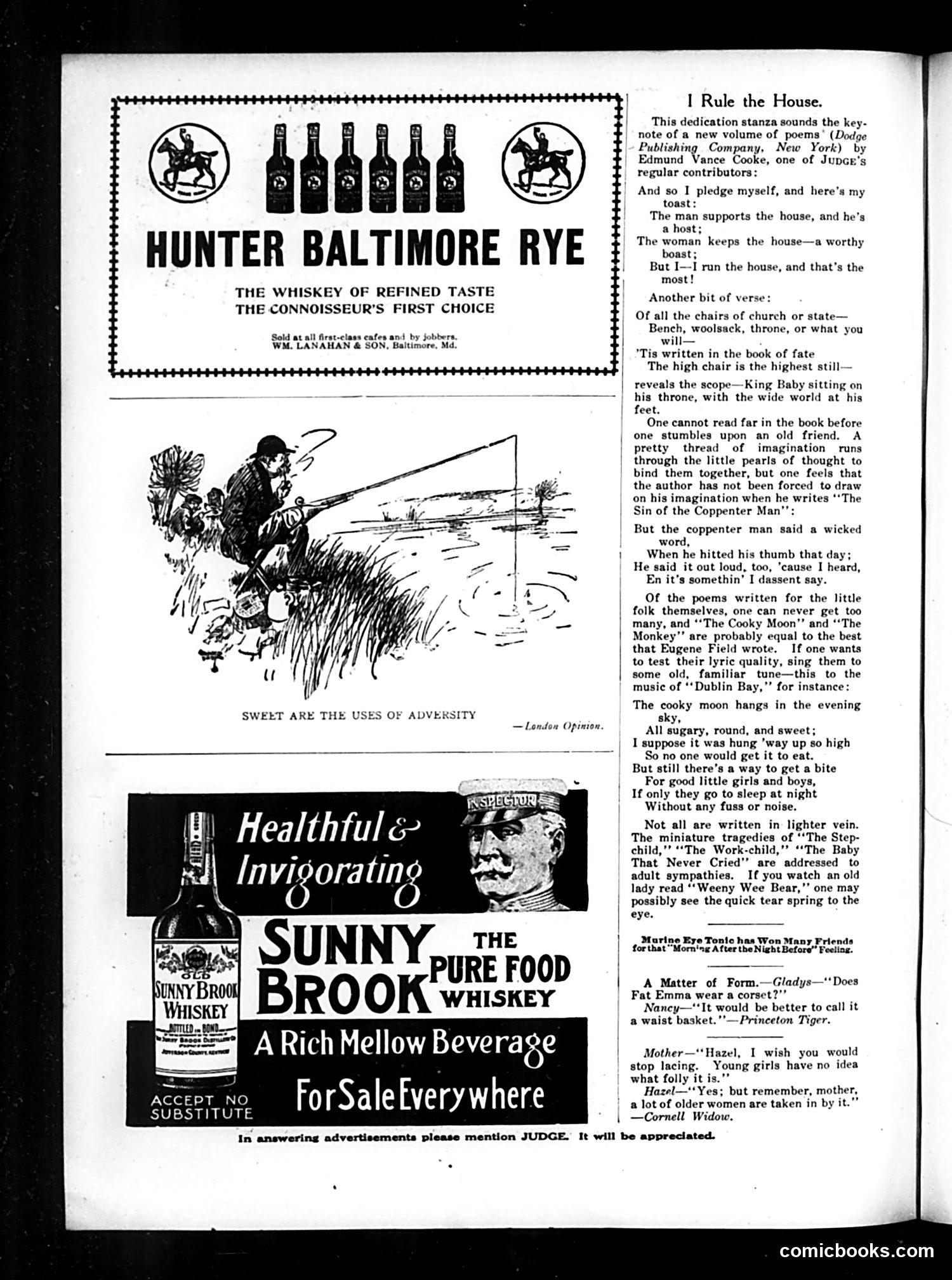
This page is primarily **advertisements for whiskey** interspersed with literary content, not political satire. The main cartoon shows a **fisherman** in a rustic scene with the caption "Sweet Are the Uses of Adversity" (a Shakespeare reference). It illustrates the romantic notion that hardship builds character—a gentle, nostalgic image rather than satire. The right column features **poetry excerpts** by Edmund Vance Cooke celebrating domestic hierarchy: the man "supports" the house, the woman "keeps" it, but "I run the house"—likely a child's perspective. Later poems address children's themes ("The Cooky Moon") and darker subjects like child labor ("The Work-child"). The advertisements dominate: **Hunter Baltimore Rye**, **Sunny Brook Whiskey**—marketed as "pure food" and "healthful & invigorating," language typical of pre-Prohibition alcohol advertising that made dubious health claims. The scattered jokes (about corsets, lacing) are light social humor, not political commentary. This appears to be a standard issue blending advertising revenue with literary content and mild humor—Judge's typical format of the era.
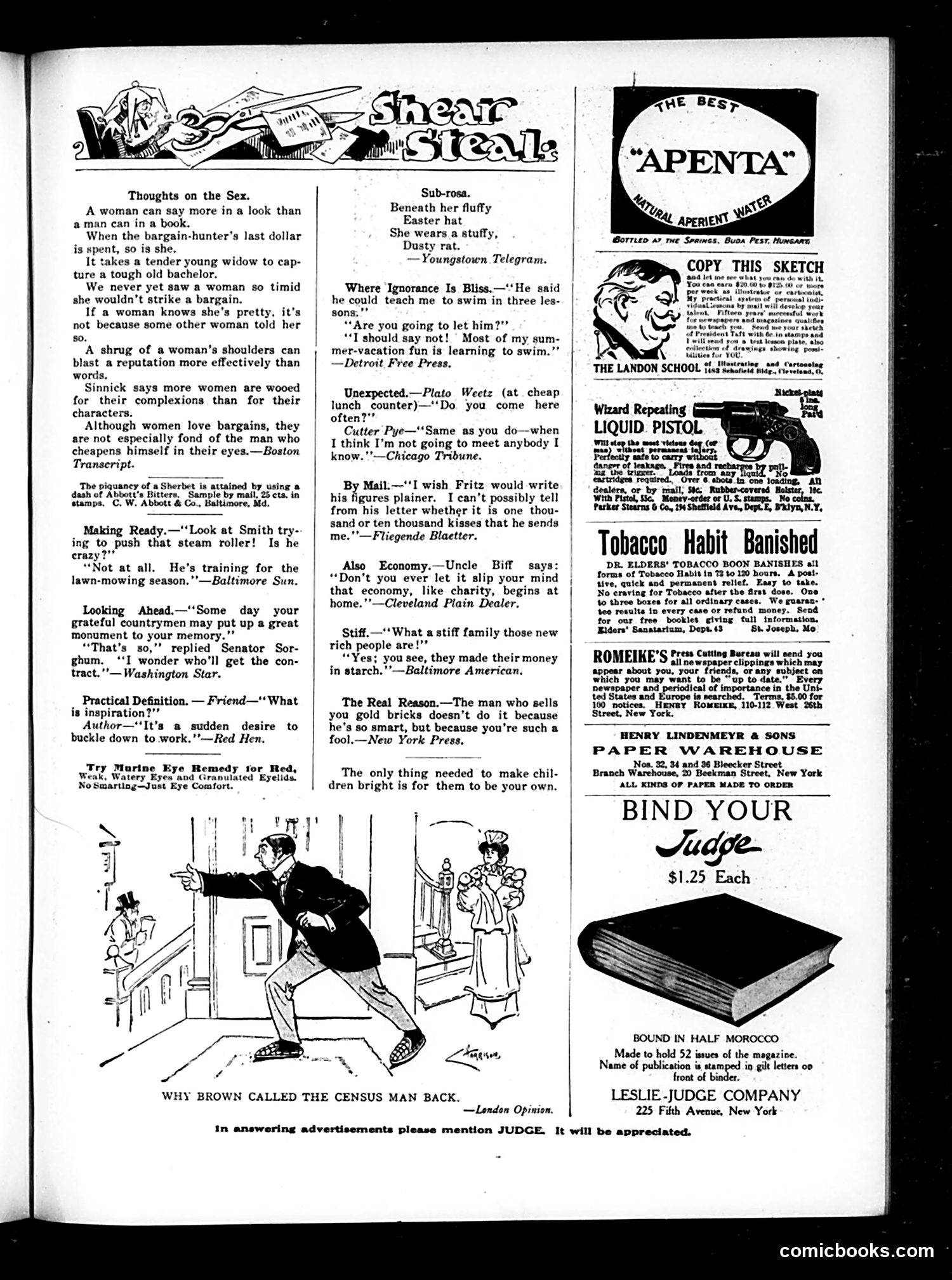
This page from Judge magazine contains primarily **satirical humor columns** and advertisements rather than political cartoons. The content focuses on **gender relations and social observations** typical of early 20th-century American humor. The "Thoughts on the Sex" section offers witty commentary on women's behavior—criticizing their bargain-hunting, their power to damage reputations, and their vanity. These pieces reflect the era's condescending attitudes toward women, treating them as objects of amusement. The cartoon at bottom ("Why Brown Called the Census Man Back") shows a man catching a woman in what appears to be a compromising position with another man—the joke being that the census man must return to verify the household count. It's a risqué innuendo typical of Judge's humor. The advertisements include tobacco cessation products, a press clipping bureau, and book-binding services—reflecting period commercial interests. Overall, this represents **early-1900s satirical magazine content**: gender-based humor, mild scandal jokes, and period advertising.
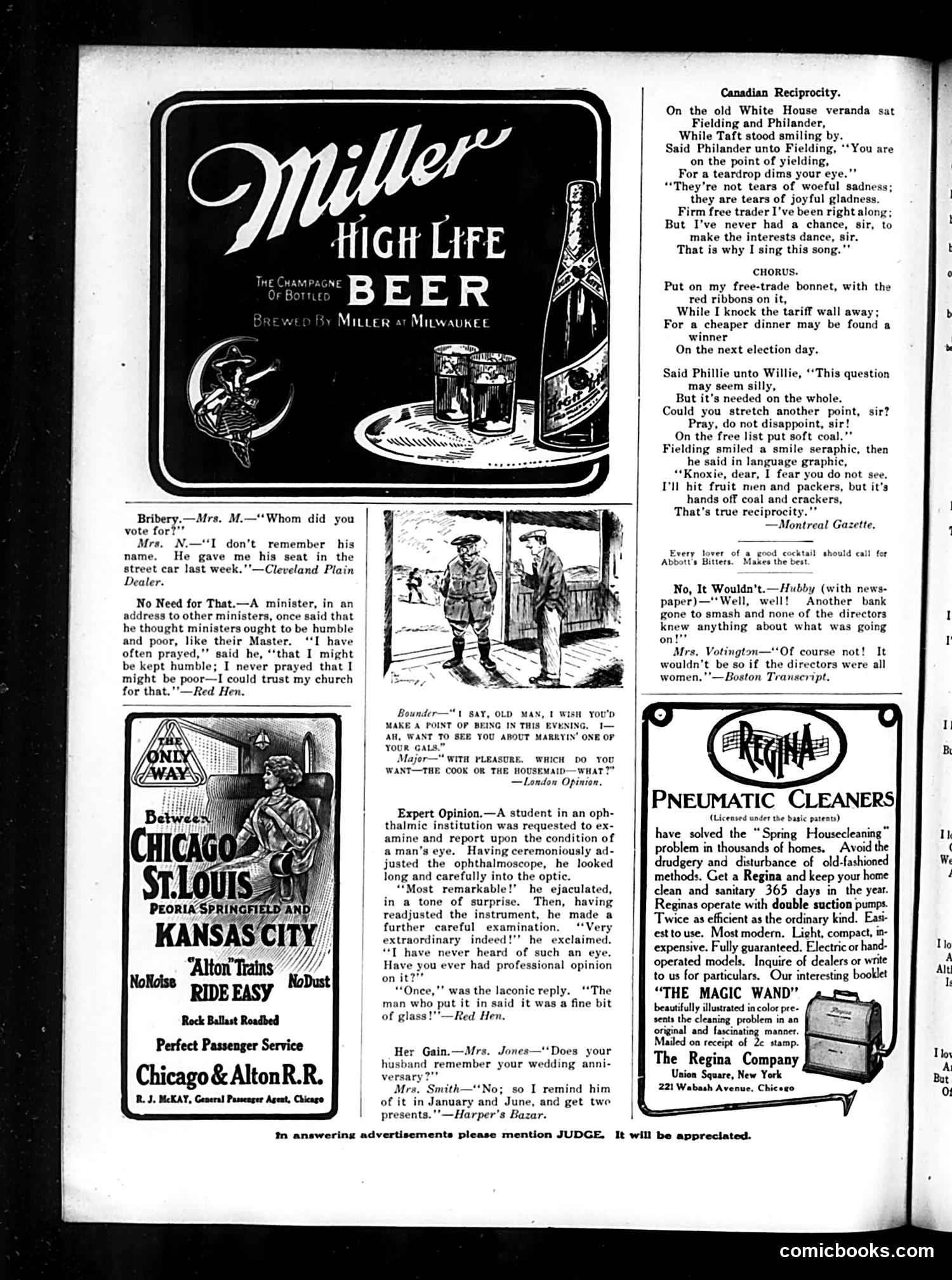
This page contains multiple short satirical pieces typical of Judge magazine's humor: **"Canadian Reciprocity"** is the primary political content—a poem-dialogue mocking trade negotiations between American President Taft, Canadian Minister Fielding, and Philander (likely Philander Knox, U.S. Secretary of State). The satire ridicules Fielding's sudden embrace of free trade, suggesting he'll compromise on tariffs to benefit Canadian interests while protecting certain industries like coal. The "teardrop" and "free-trade bonnet" language mock political flip-flopping on reciprocal trade agreements. The remaining items are brief joke pieces about everyday hypocrisy: a woman voting for someone solely because he gave up his seat; a minister praying to stay humble but not poor; an eye doctor discovering a glass eye; a wife reminding her husband of their anniversary twice yearly for double gifts. The advertisements (Miller Beer, Chicago & Alton Railroad, Regina vacuum cleaners) are typical period marketing. The humor targets political inconsistency, religious pretense, and marital dynamics—standard Judge fare of the era.
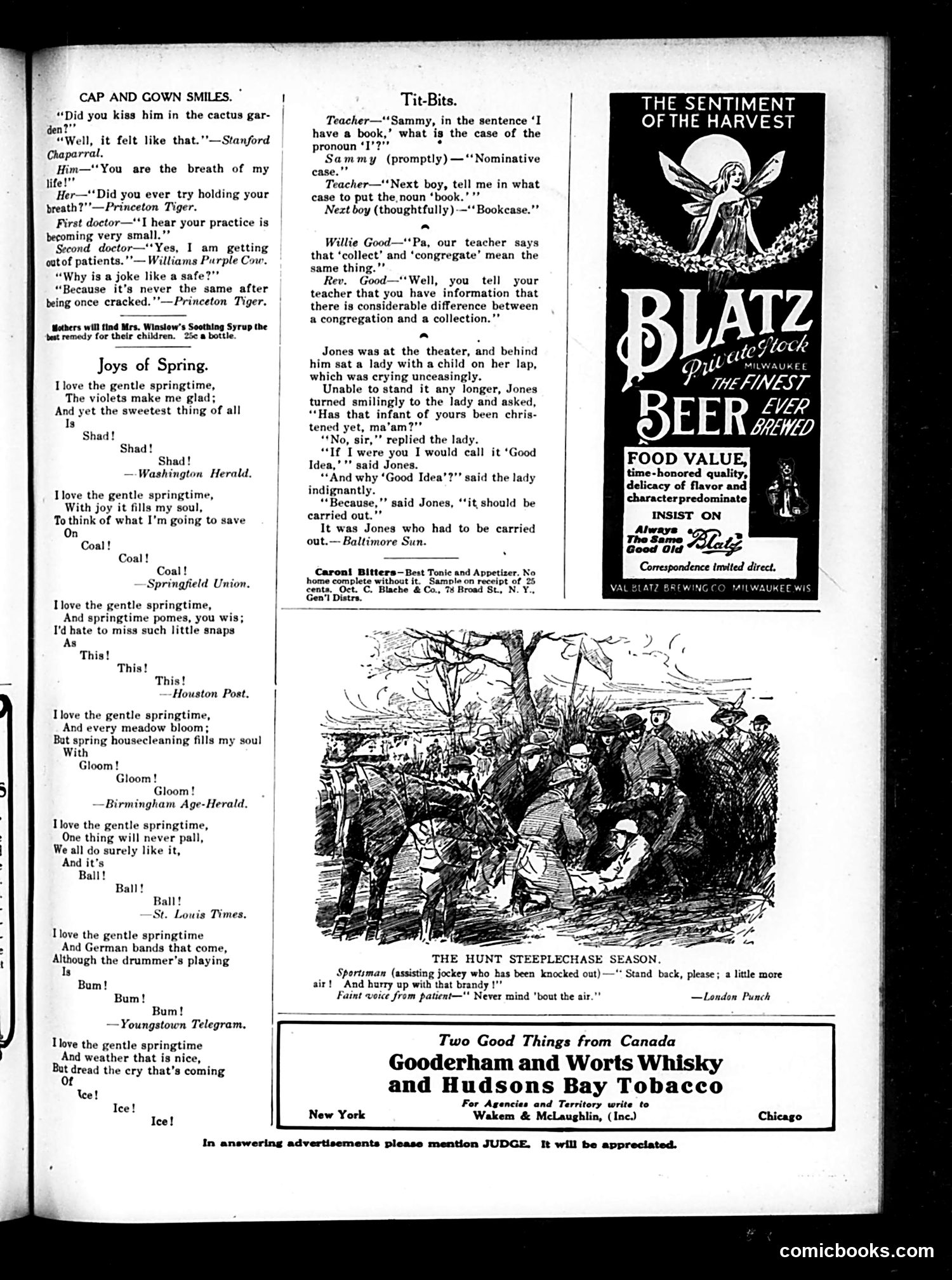
This page from *Judge* (a satirical American magazine) contains mostly **humor columns and jokes** rather than political cartoons. **Content overview:** - "Cap and Gown Smiles" section: brief one-liners from college humor magazines (Stanford, Princeton, Williams) - "Joys of Spring" poems: repeated structure mocking different newspapers' spring-themed verse, with punchlines about seasonal annoyances (shad fishing, coal costs, housecleaning, German bands, ice) - "Tit-Bits" section: schoolboy jokes and a theater anecdote about a crying baby **Social context:** These represent early 20th-century American humor—innocent wordplay, puns about childhood, and gentle domestic frustrations. The repeated "Joys of Spring" structure satirizes sentimental newspaper poetry by undercutting each verse with practical complaints. The page includes **period advertisements** for patent medicines (Mrs. Winslow's Soothing Syrup) and liquor, plus one sketch titled "The Hunt Steeplechase Season" showing horsemen. No significant political satire is evident on this particular page.
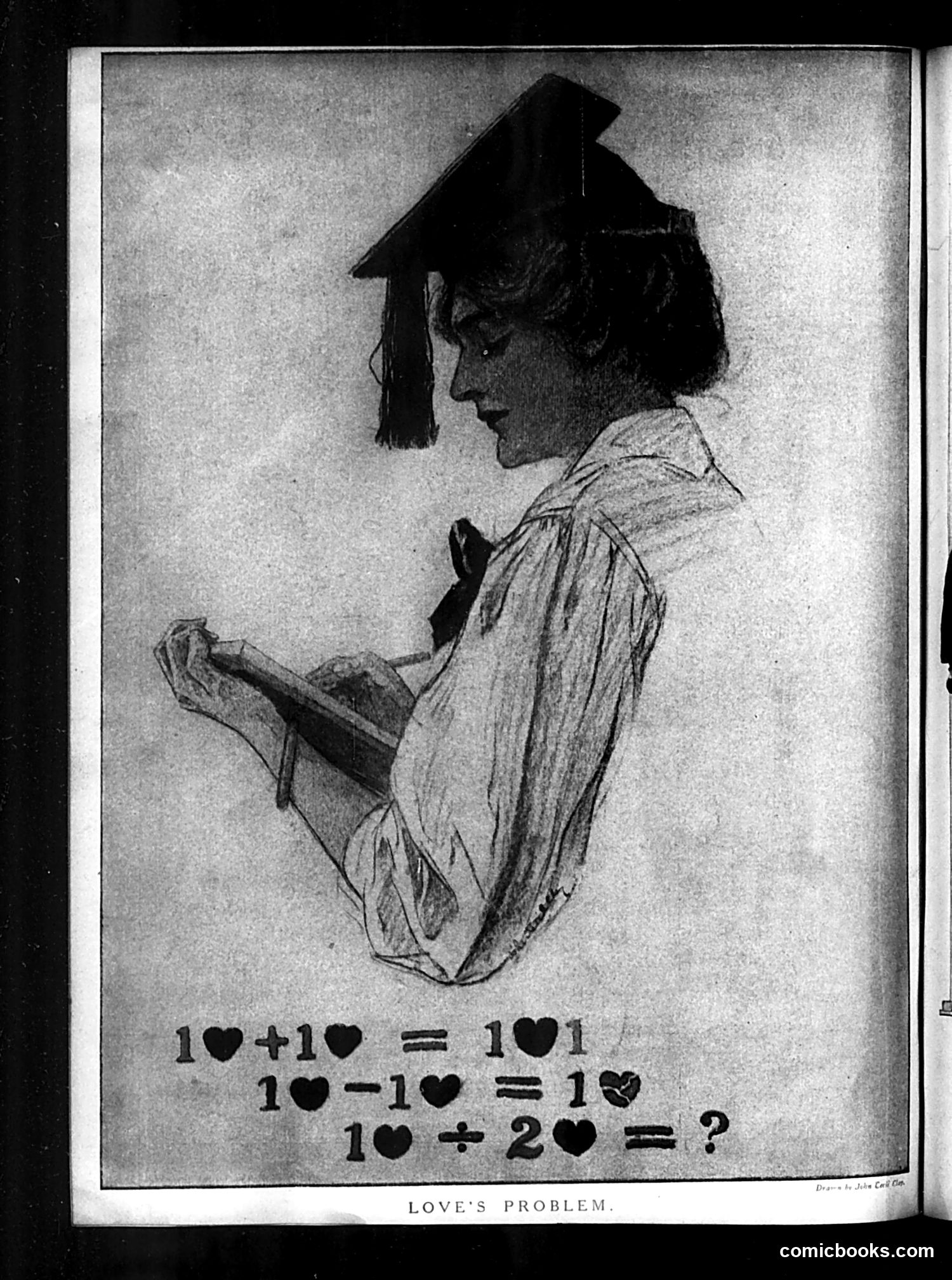
This cartoon presents a visual riddle combining romance with arithmetic. A young woman in classical dress holds a tablet displaying three equations using heart symbols as variables: - 1♥ + 1♥ = 1♡ (two loves become one) - 1♥ - 1♥ = 1♡ (subtracting love leaves love?) - 1♥ ÷ 2♥ = ? (dividing one love by two equals what?) The satire plays on the illogical nature of romantic feelings—emotions don't follow mathematical rules. The final unsolved equation suggests the impossibility of rational calculation in matters of the heart. This appears to be *Judge* magazine's lighthearted commentary on the contradictions and complications of love, presented as an unsolvable problem rather than a solvable equation.