
Judge, 1911-05-06 · page 22 of 28
Judge — May 6, 1911 — page 22: what you’re looking at
What you’re looking at
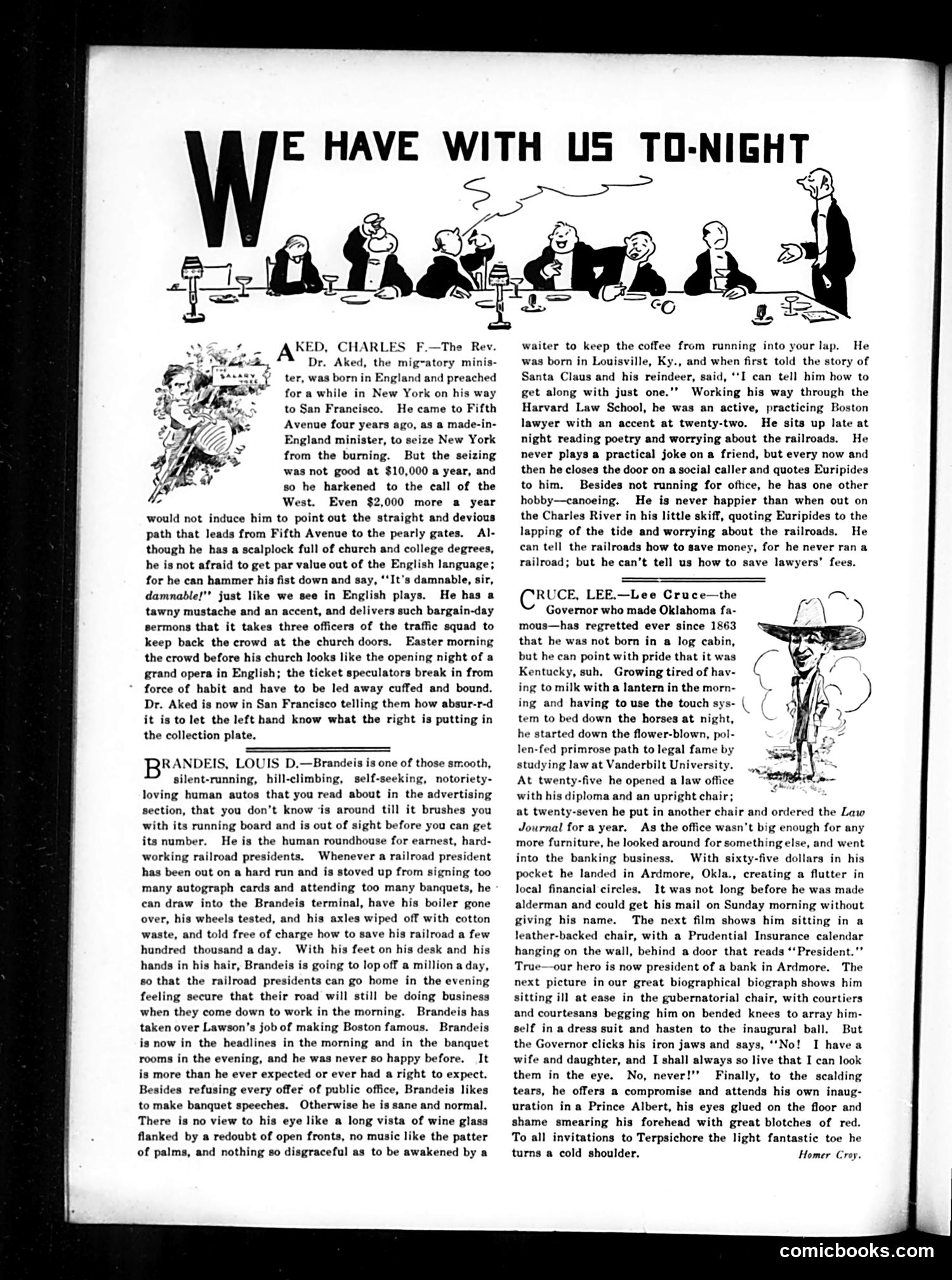
This page satirizes two prominent public figures through mock biographical sketches: **Rev. Dr. Charles Aked**: A British-born minister who came to New York's Fifth Avenue church, then moved to San Francisco for higher pay. Judge mocks his theatrical preaching style, affected English accent, and supposed obsession with collection plate donations—satirizing both his mercenary motivations and performative religiosity. **Louis Brandeis**: A Boston lawyer famous for advising railroad presidents on cost-cutting. Judge portrays him as a self-aggrandizing "human roundhouse" who enjoys banquet speeches and refuses public office while seeking notoriety. The satirist suggests Brandeis helps corporations save money while cultivating a cultured image (quoting Euripides, canoeing). Both sketches employ exaggerated metaphors and mock-laudatory tone to expose what Judge saw as hypocrisy: religious showmanship disguised as piety, and corporate lawyering dressed up as intellectual refinement.
📄 Transcribed text from this page (OCR, searchable)
Machine-transcribed from the original scan — historical spelling and the odd misread are preserved.
KED, CHARLES F.—The Rev. Dr. Aked, the mig~atory minis- ter, was born in England and preached for a while in New York on his way to San Francisco. He came to Fifth Avenue four years ago, as a made-in- England minister, to seize New York from the burning. But the seizing was not good at $10,000 a year, and so he harkened to the call of the West. Even $2,000 more a year would not induce him to point out the straight and devious path that leads from Fifth Avenue to the pearly gates. Al- though he has a scalplock full of church and college degrees, he is not afraid to get par value out of the English language; for he can hammer his fist down and say, ‘‘It’s damnable, sir, damnable!’ just like we see in English plays. He has a tawny mustache and an accent, and delivers such bargain-day sermons that it takes three officers of the traffic squad to keep back the crowd at the church doors. Easter morning the crowd before his church looks like the opening night of a grand opera in English; the ticket speculators break in from force of habit and have to be led away cuffed and bound. Dr. Aked is now in San Francisco telling them how absur-r-d it is to let the left hand know what the right is putting in the collection plate. RANDEIS, LOUIS D.—Brandeis is one of those smooth, silent-running, hill-climbing, self-seeking, notoriety- loving human autos that you read about in the advertising section, that you don’t know ‘is around till it brushes you with its running board and is out of sight before you can get its number. He is the human roundhouse for earnest, hard- working railroad presidents. Whenever a railroad president has been out on a hard run and is stoved up from signing too many autograph cards and attending too many banquets, he can draw into the Brandeis terminal, have his boiler gone over, his wheels tested, and his axles wiped off with cotton waste, and told free of charge how to save his railroad a few hundred thousand aday. With his feet on his desk and his hands in his hair, Brandeis is going to lop off a million a day, so that the railroad presidents can go home in the evening feeling secure that their road will still be doing business when they come down to work in the morning. Brandeis has taken over Lawson's job of making Boston famous. Brandeis is now in the headlines in the morning and in the banquet rooms in the evening, and he was never so happy before. It is more than he ever expected or ever had a right to expect. Besides refusing every offer of public office, Brandeis likes to make banquet speeches. Otherwise he is sane and normal There is no view to his eye like a long vista of wine glass flanked by a redoubt of open fronts, no music like the patter of palms, and nothing so disgraceful as to be awakened by a E HAVE WITH US TO-NIGHT & 7S waiter to keep the coffee from running into your lap. He was born in Louisville, Ky., and when first told the story of Santa Claus and his reindeer, said, ‘‘I can tell him how to get along with just one.’’ Working his way through the Harvard Law School, he was an active, practicing Boston lawyer with an accent at twenty-two. He sits up late at night reading poetry and worrying about the railroads. He never plays a practical joke on a friend, but every now and then he closes the door on a social caller and quotes Euripides to him. Besides not running for office, he has one other hobby—canoeing. He is never happier than when out on the Charles River in his little skiff, quoting Euripides to the lapping of the tide and worrying about the railroads. He can tell the railroads how to save money, for he never rana railroad; but he can’t tell us how to save lawyers’ fees. RUCE, LEE.—Lee Cruce—the Governor who made Oklahoma fa- mous—has regretted ever since 1863 that he was not born in a log cabin, but he can point with pride that it was Kentucky, suh, Growing tired of hav- ing to milk with a lantern in the morn- ing and having to use the touch sy tem to bed down the horses at night, he started down the flower-blown, pol- len-fed primrose path to legal fame by studying law at Vanderbilt University. At twenty-five he opened a law office with his diploma and an upright chair; at twenty-seven he put in another chair and ordered the Law Journal for a year. As the office wasn't big enough for any more furniture, he looked around for something else, and went into the banking business. With sixty-five dollars in his pocket he landed in Ardmore, Okla., creating a flutter in local financial circles. It was not long before he was made alderman and could get his mail on Sunday morning without giving his name. The next film shows him sitting in a leather-backed chair, with a Prudential Insurance calendar hanging on the wall, behind a door that reads ‘‘President."” True—our hero is now president of a bank in Ardmore. The next picture in our great biographical biograph shows him sitting ill at ease in the gubernatorial chair, with courtiers and courtesans begging him on bended knees to array him- self in adress suit and hasten to the inaugural ball. But the Governor clicks his iron jaws and says, ‘‘No! I havea wife and daughter, and I shall always so live that I can look them in the eye. No, never!’’ Finally, to the scalding tears, he offers a compromise and attends his own inaug- uration ina Prince Albert, his eyes glued on the floor and shame smearing his forehead with great blotches of red. To all invitations to Terpsichore the light fantastic toe he turns a cold shoulder. Homer Croy. comicbooks.com