
Judge, 1911-05-06 · page 24 of 28
Judge — May 6, 1911 — page 24: what you’re looking at
What you’re looking at
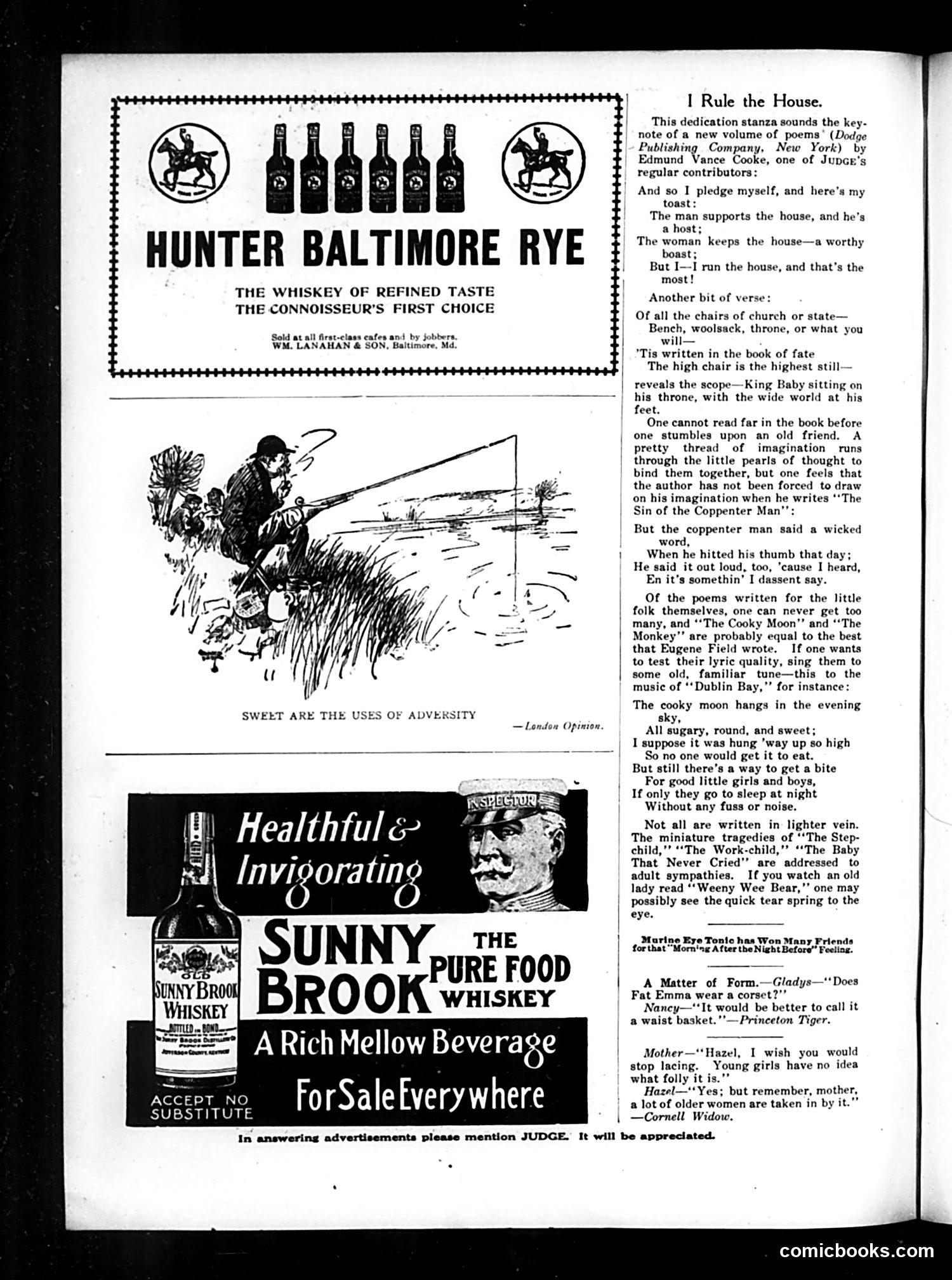
This page is primarily **advertisements for whiskey** interspersed with literary content, not political satire. The main cartoon shows a **fisherman** in a rustic scene with the caption "Sweet Are the Uses of Adversity" (a Shakespeare reference). It illustrates the romantic notion that hardship builds character—a gentle, nostalgic image rather than satire. The right column features **poetry excerpts** by Edmund Vance Cooke celebrating domestic hierarchy: the man "supports" the house, the woman "keeps" it, but "I run the house"—likely a child's perspective. Later poems address children's themes ("The Cooky Moon") and darker subjects like child labor ("The Work-child"). The advertisements dominate: **Hunter Baltimore Rye**, **Sunny Brook Whiskey**—marketed as "pure food" and "healthful & invigorating," language typical of pre-Prohibition alcohol advertising that made dubious health claims. The scattered jokes (about corsets, lacing) are light social humor, not political commentary. This appears to be a standard issue blending advertising revenue with literary content and mild humor—Judge's typical format of the era.
📄 Transcribed text from this page (OCR, searchable)
Machine-transcribed from the original scan — historical spelling and the odd misread are preserved.
I Rule the House. This dedication stanza sounds the key- note of a new volume of poems’ (Dodge Publishing Company, New York) by Edmund Vance Cooke, one of Jupce’s regular contributors: = = And so I pledge myself, and here's my toast: The man supports the house, and he’s a host; The woman keeps the house—a worthy boast; But I—I run the house, and that’s the . most! THE WHISKEY OF REFINED TASTE Another bit of verse: THE CONNOISSEUR'S FIRST CHOICE Of all the chairs of church or state— Bench, woolsack, throne, or what you Sold at all first-class cafes and by jobbers, will— = WM. LANAHAN & SON, Baltimore, Md. ° aimee 'Tis written in the book of fate The high chair is the highest still— reveals the scope—King Baby sitting on his throne, with the wide world at his feet. One cannot read far in the book before one stumbles upon an old friend. A pretty thread of imagination runs through the little pearls of thought to bind them together, but one feels that the author has not been forced to draw on his imagination when he writes ‘The Sin of the Coppenter Man’’: But the coppenter man said a wicked word, When he hitted his thumb that day; He said it out loud, too, ‘cause I heard, En it's somethin’ I dassent say. Of the poems written for the little folk themselves, one can never get too many, and ‘‘The Cooky Moon” and ‘The Monkey” are probably equal to the best that Eugene Field wrote. If one wants to test their lyric quality, sing them to some old, familiar tune—this to the music of ‘‘Dublin Bay,’’ for instance: The cooky moon hangs in the evening sky, All sugary, round, and sweet; I suppose it was hung ‘way up so high So no one would get it to eat. But still there’s a way to get a bite For good little girls and boys, If only they go to sleep at night Without any fuss or noise. Not all are written in lighter vein. The miniature tragedies of ‘The Step- child,’’ ‘The Work-child,’’ ‘‘The Baby That Never Cried’’ are addressed to adult sympathies. If you watch an old lady read ‘‘Weeny Wee Bear,’’ one may possibly see the quick tear spring to the eye. catering Eve Tonte has Won Many Friends that “Morn'ng After the Night Before” Feeling. PURE FOOD A Matter of Form.—Gladys—‘'Does WHISKEY Fat Emma wear a corset?” . Nancy—‘‘It would be better to call it a waist basket.’’— Princeton Tiger. A Rich Mellow Beverage | aother—'iaael, 1 wish you wold stop lacing. Young girls have no idea what folly it is.’" Hazel—*Yes; but remember, mother, acceor no For SaleEverywhere * fnet "Yea: but remember mth SUBSTITUTE y —Cornell Widow. In answering advertisements please mention JUDGE. It will be appreciated. comicbooks.com