
A complete issue · 24 pages · 1911
Judge — April 15, 1911
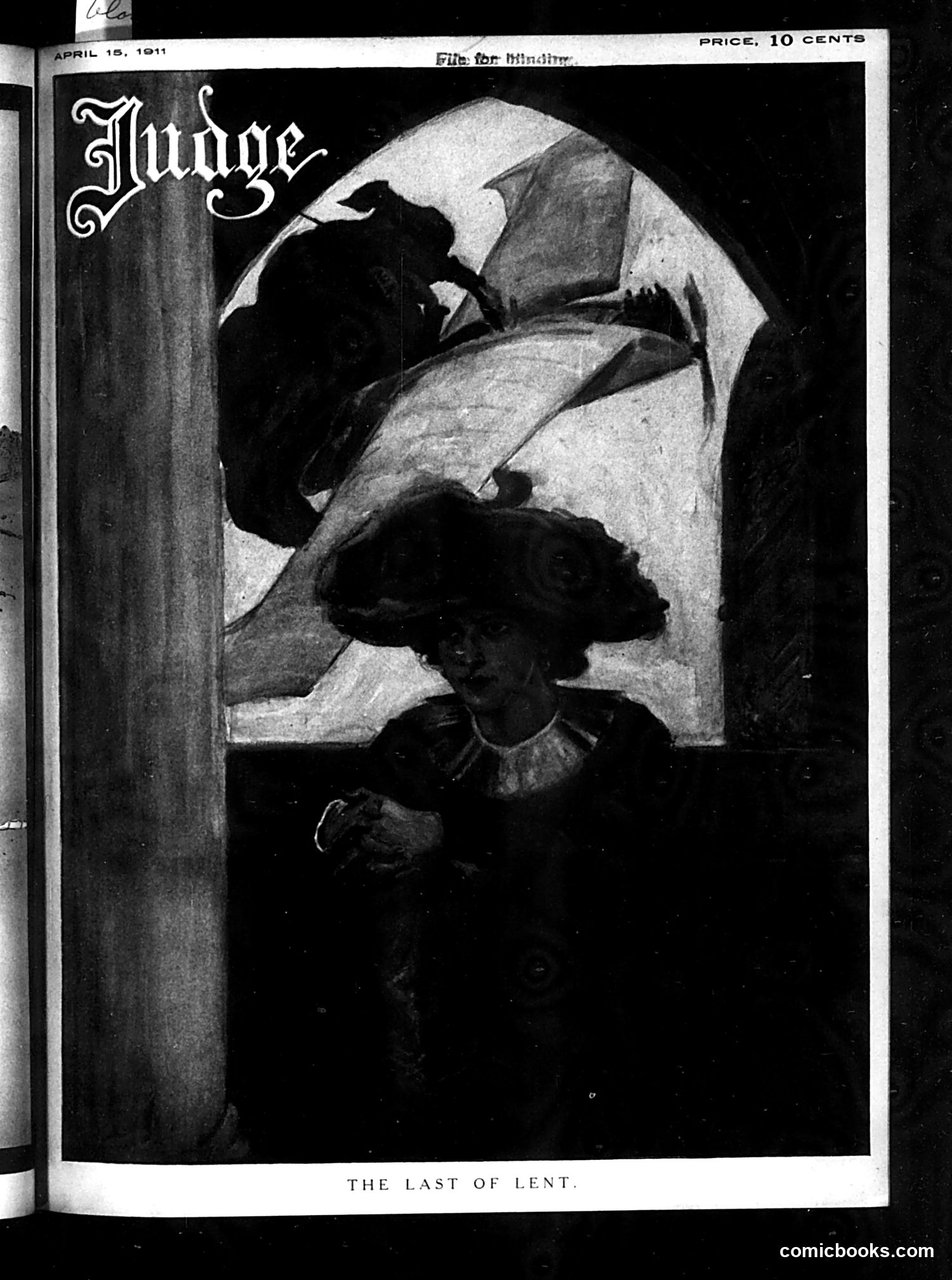
This illustration depicts a woman in fashionable Edwardian dress and a large feathered hat, appearing to indulge in a lavish meal—likely meat or rich food. The caption "The Last of Lent" is the satire's key. Lent, the Christian pre-Easter period of fasting and self-denial, traditionally forbade meat consumption on certain days. The cartoon satirizes the hypocrisy of wealthy society women who observed Lenten restrictions superficially for religious appearance, then immediately abandoned restraint once the period ended. The woman's elaborate hat, fine clothing, and eager consumption suggest she represents privileged Americans who treated religious observance as a social formality rather than genuine spiritual discipline. The satire mocks both hollow piety and excessive materialism among the upper class.
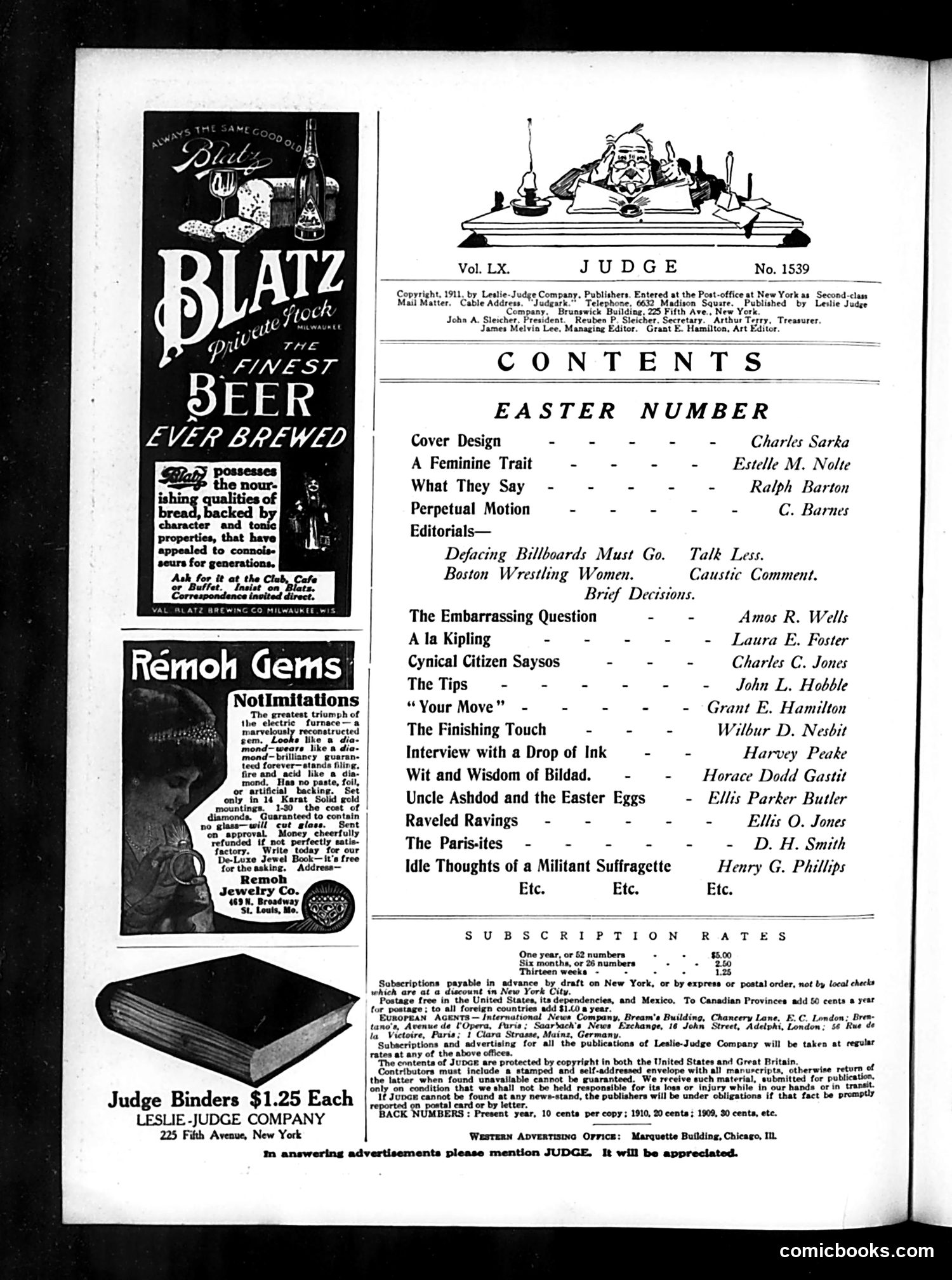
This is primarily a **contents page and advertising layout** for Judge magazine's Easter number (Vol. LX, No. 1539), rather than a political cartoon. The visible advertisements include: - **Blatz Beer** ("Private Stock"), promoting Milwaukee brewing - **Rémoh Gems** (jewelry/diamonds) - **Judge Binders** ($1.25) The contents list shows typical satirical pieces for 1911: "Delacing Billboards Must Go," "Boston Wrestling Women," and "Idle Thoughts of a Militant Suffragette"—indicating the magazine's focus on contemporary social issues like advertising regulation and women's suffrage activism. The subscription rates ($5.00 yearly) and publishing details anchor this as an early 20th-century American publication targeting educated readers with disposable income.
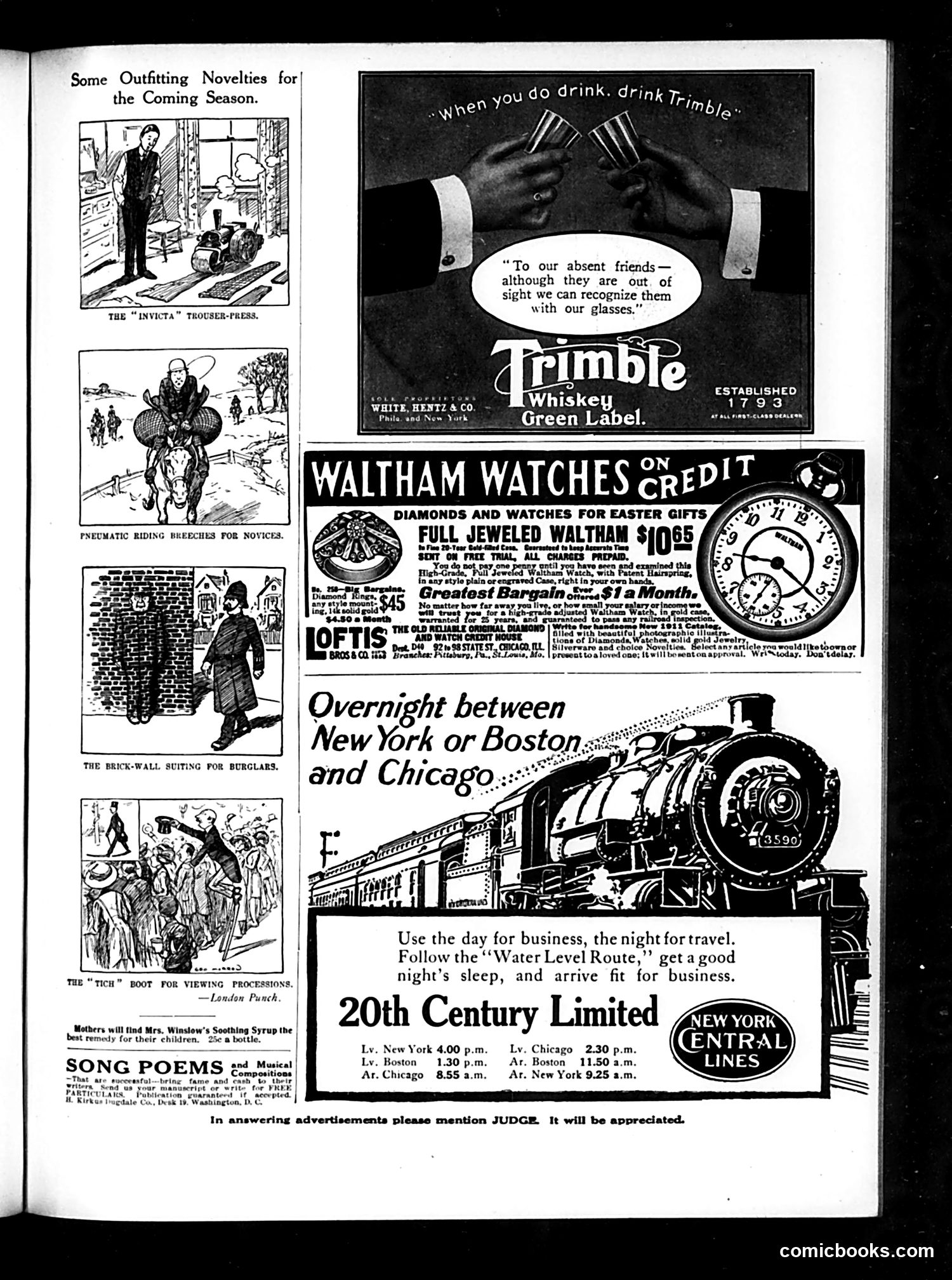
This page is primarily **advertising** with minimal satirical content. The main advertisements include: - **Trimble Whiskey**: Features two hands toasting with the slogan "when you do drink, drink Trimble," promoting a toast "to our absent friends." - **Waltham Watches**: Offers discounted jewelry and watches for Easter gifts, emphasizing affordability. - **20th Century Limited train**: Advertises overnight rail service between New York/Boston and Chicago, promoting efficient business travel. The left column contains small novelty illustrations titled "Some Outfitting Novelties for the Coming Season," showing practical items like trouser presses and riding breeches. A small notice mentions Mrs. Winslow's Soothing Syrup and Song Poems services. The page reflects early 20th-century consumer culture and commercial rail travel rather than political satire.
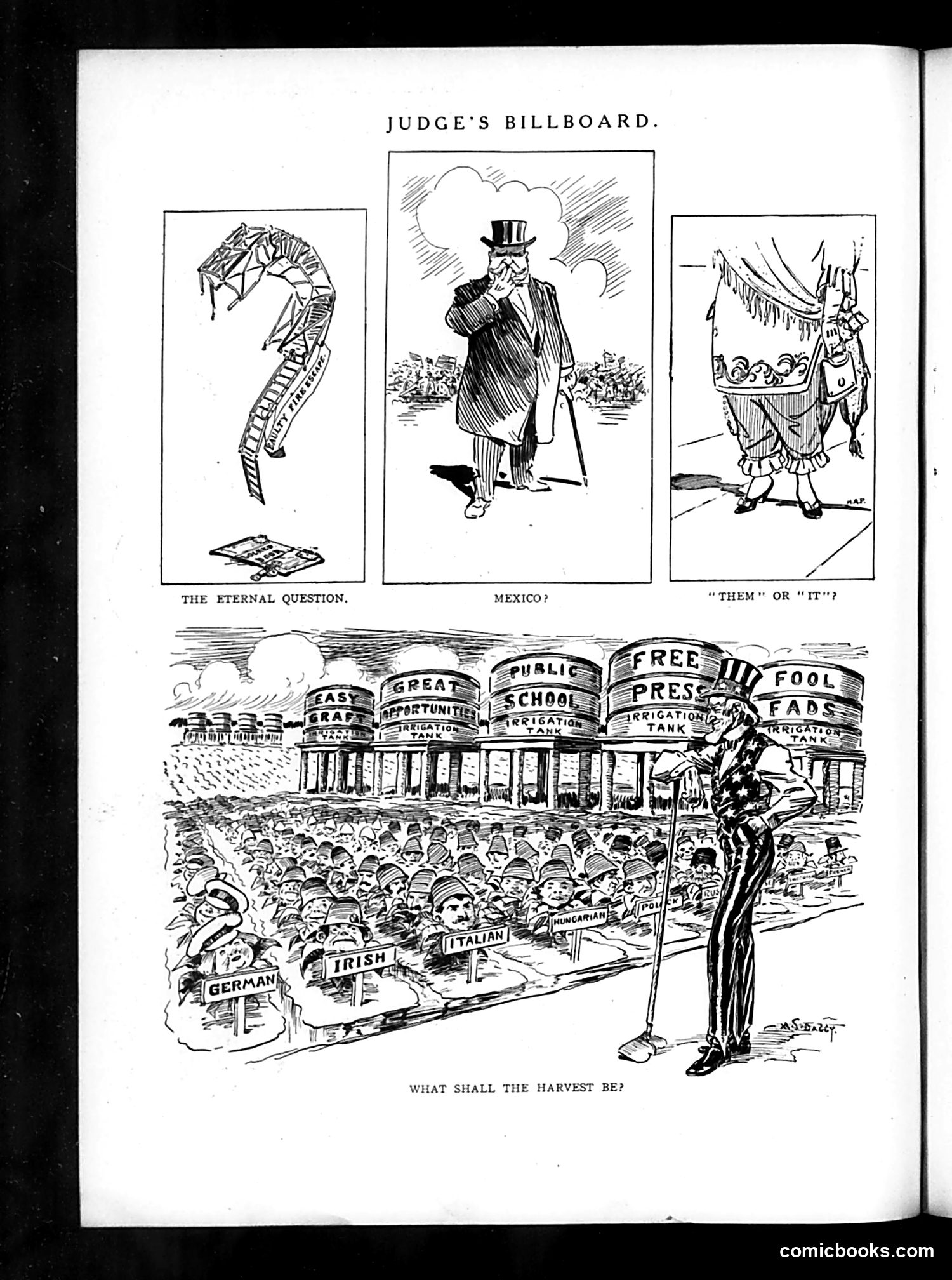
This page presents four editorial cartoons addressing American political concerns, likely from the early 1900s. **Top panels** critique judicial decisions through visual puns: "The Eternal Question" (a twisted question mark), "Mexico?" (a judge pondering Mexican policy), and "Them or It?" (ambiguous governance). **Bottom panel** ("What Shall the Harvest Be?") depicts a judge overseeing massive immigration. Tank-shaped structures labeled "Easy Graft," "Great Opportunities," "Public School," "Free Press," and "Fool Fads" loom above. Immigrants marked by nationality (German, Irish, Italian, Polish) stand below as a scarecrow figure judges the scene. The satire questions what America's future will be given unchecked immigration and corrupt institutions—suggesting these systems cannot adequately assimilate or serve such masses.
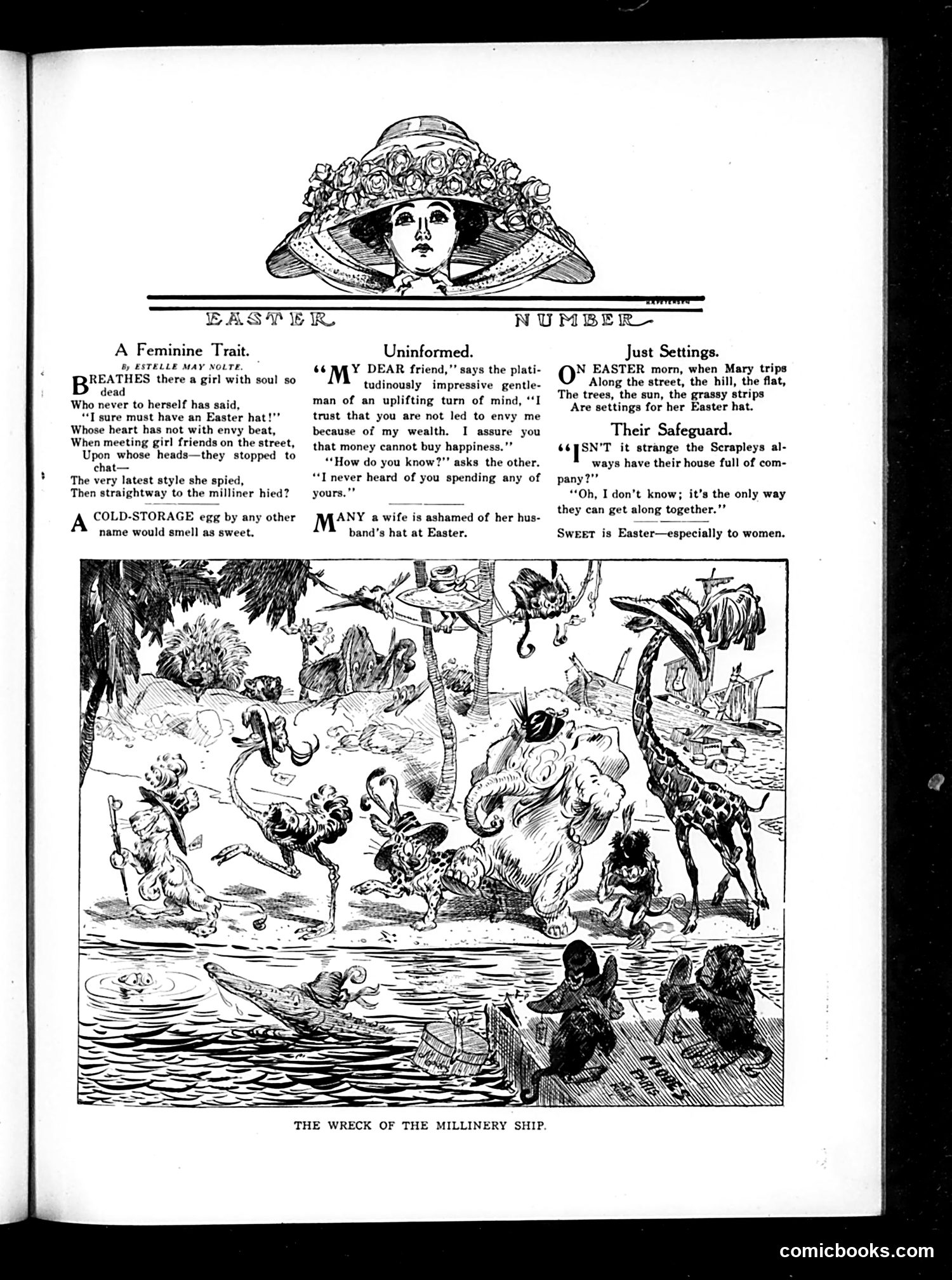
This is an Easter-themed issue of *Judge* magazine featuring fashion commentary and social satire. The upper sections contain humorous poetry and brief social observations about Easter customs, particularly women's elaborate Easter hats and fashions. The text pokes fun at the competitive nature of Easter dress—one section notes how wives feel ashamed of their husbands' hats at Easter, suggesting Easter was a major fashion showcase event. The large illustration titled "The Wreck of the Millinery Ship" depicts animals in chaos on a beach and in water, appearing to be a visual pun on the lavish, oversized Easter bonnets of the era. The "wreck" metaphorically represents the extravagant, impractical nature of the enormous hats fashionable women wore during this period—literally boat-sized constructions that were the subject of contemporary social ridicule.
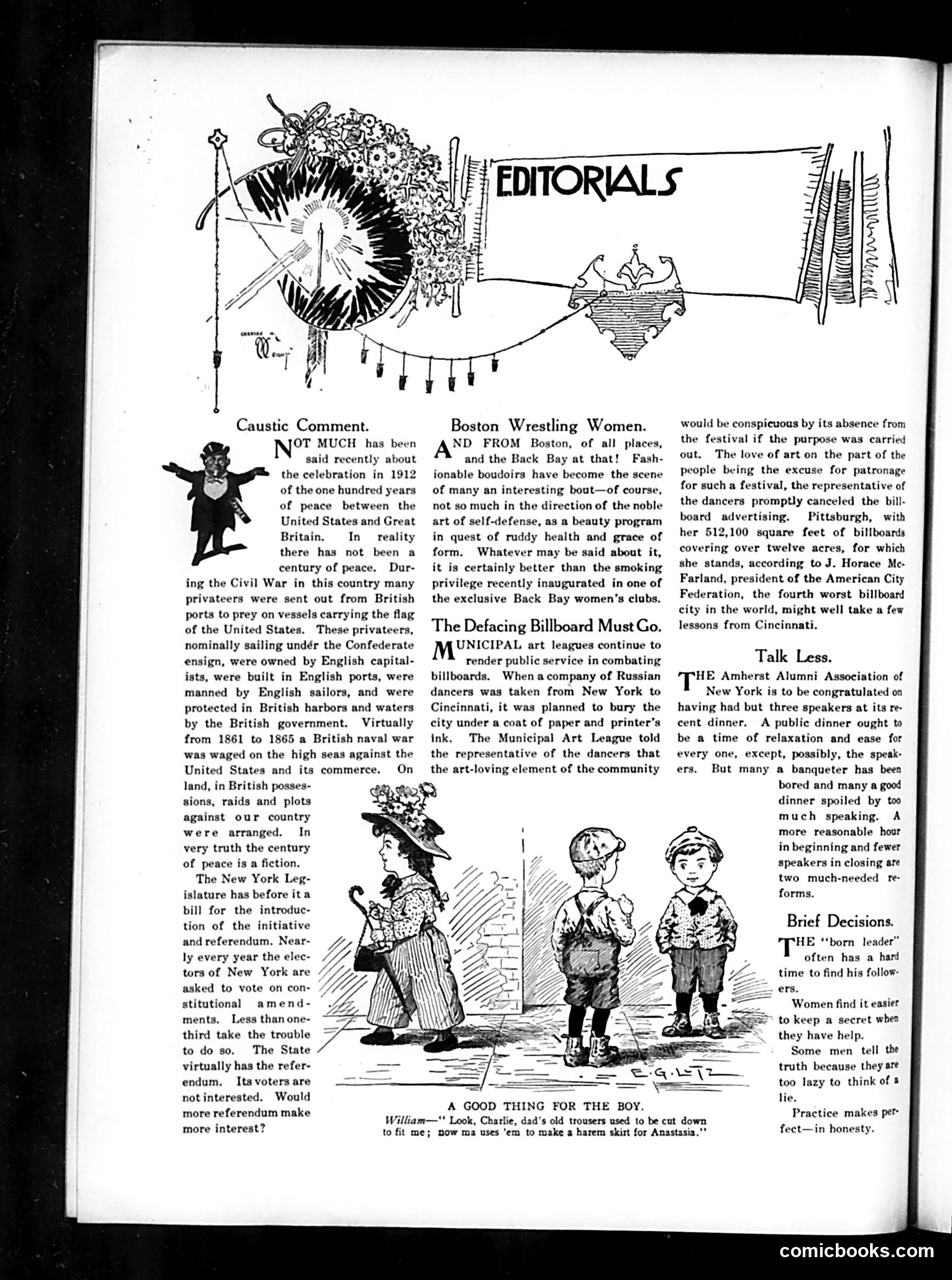
This page contains five satirical commentaries typical of early-1900s American political humor: **"Caustic Comment"** challenges the 1912 celebration of "100 years of peace" between the US and Britain, arguing it's fictional. The author cites Civil War-era British support for Confederate privateers that attacked American commerce—essentially British naval warfare against the Union from 1861-1865. **"Boston Wrestling Women"** mocks wealthy Boston women adopting wrestling for health and beauty, presented as more respectable than their recent adoption of smoking privileges in exclusive clubs. **"The Defacing Billboard Must Go"** praises Municipal Art Leagues fighting advertising billboards. It recounts how Cincinnati's art community successfully pressured Russian dancers' promoters to cancel billboard advertising, contrasting this with Pittsburgh's massive billboard problem. **"Talk Less"** humorously criticizes lengthy speeches at formal dinners, suggesting fewer speakers and earlier start times would improve the experience. **"A Good Thing for the Boy"** is a comic strip showing recycled clothing—old trousers repurposed first as children's wear, then as a "harem skirt" costume, reflecting contemporary fascination with exotic fashions.
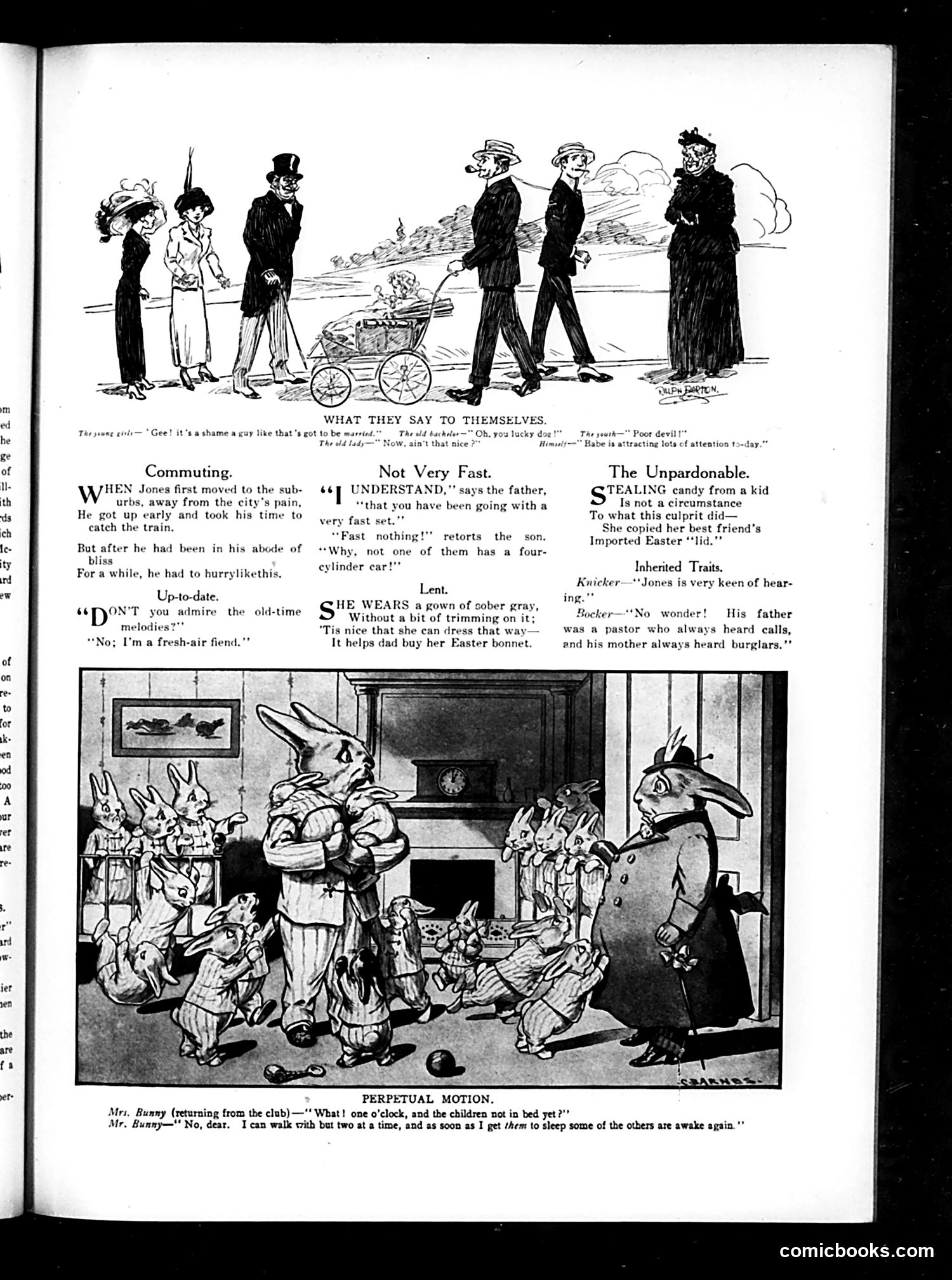
This page contains several brief satirical humor pieces typical of early 20th-century Judge magazine, targeting middle-class social anxieties: **"Commuting"** mocks the exhausting reality of suburban life—Jones moves to escape city stress but ends up frantically rushing to catch trains, suggesting the suburbs offered no actual relief. **"Up-to-date"** jokes about conflicting social pretenses: someone claims to admire old-fashioned melodies while also posing as a "fresh-air fiend" (health-conscious modern person). **"Not Very Fast"** satirizes wealth-obsession among the young: a father worries his son runs with "fast" people, but the son dismisses them as unsophisticated because they lack four-cylinder cars. **"Lent"** offers cynical commentary on religious observance—a woman wears plain clothes during Lent, but this "sacrifice" merely funds her expensive Easter bonnet, implying hollow piety masking materialism. **"Perpetual Motion"** (illustrated) depicts Mr. Bunny overwhelmed managing multiple children, unable to get them all asleep simultaneously. The humor targets consumerism, status-seeking, and the contradictions of respectable society.
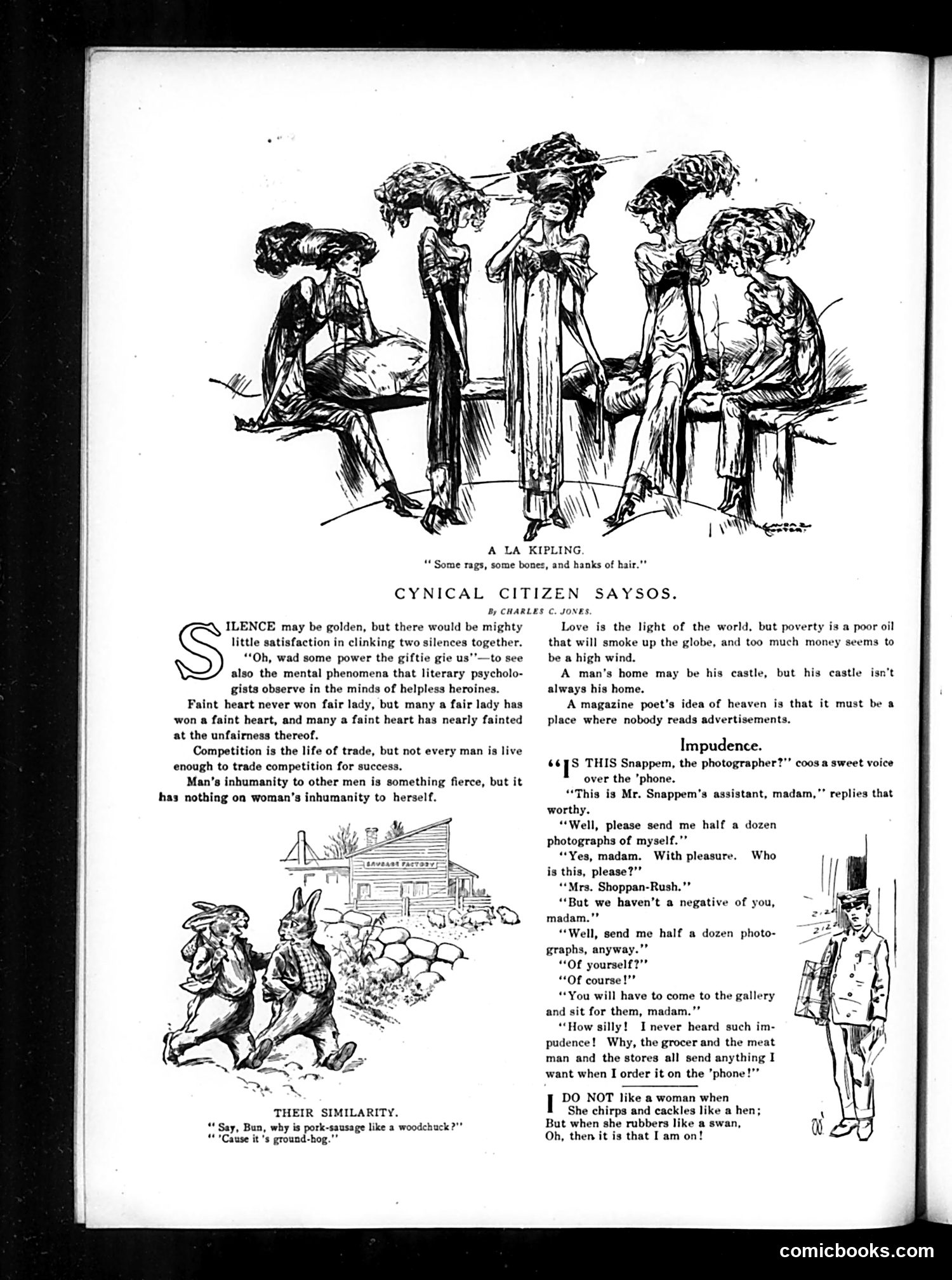
The page contains three satirical pieces typical of early 20th-century American humor: **Top cartoon ("À la Kipling"):** References Rudyard Kipling's quote about human detritus. The sketch shows fashionable women gathered around what appears to be a social gathering, satirizing the vanity and superficiality of high society. **"Cynical Citizen Saysos":** A collection of witty one-liners by Charles C. Jones mocking conventional wisdom about love, competition, and gender relations. Notable: "Man's inhumanity to other men is something fierce, but it has nothing on woman's inhumanity to herself"—reflecting period attitudes about women's supposed self-destructiveness. **"Impudence" anecdote:** A photographer's assistant refuses to send photographs of Mrs. "Shoppan-Rush" without her sitting for them, despite her expecting service-on-demand like grocers provide. The joke satirizes nouveau-riche entitlement and the absurdity of expecting photographers to produce images from nothing. **Bottom verse:** Crude gender commentary about women's vocalizations and behavior. The page reflects turn-of-century attitudes toward wealth, gender, and social pretension.
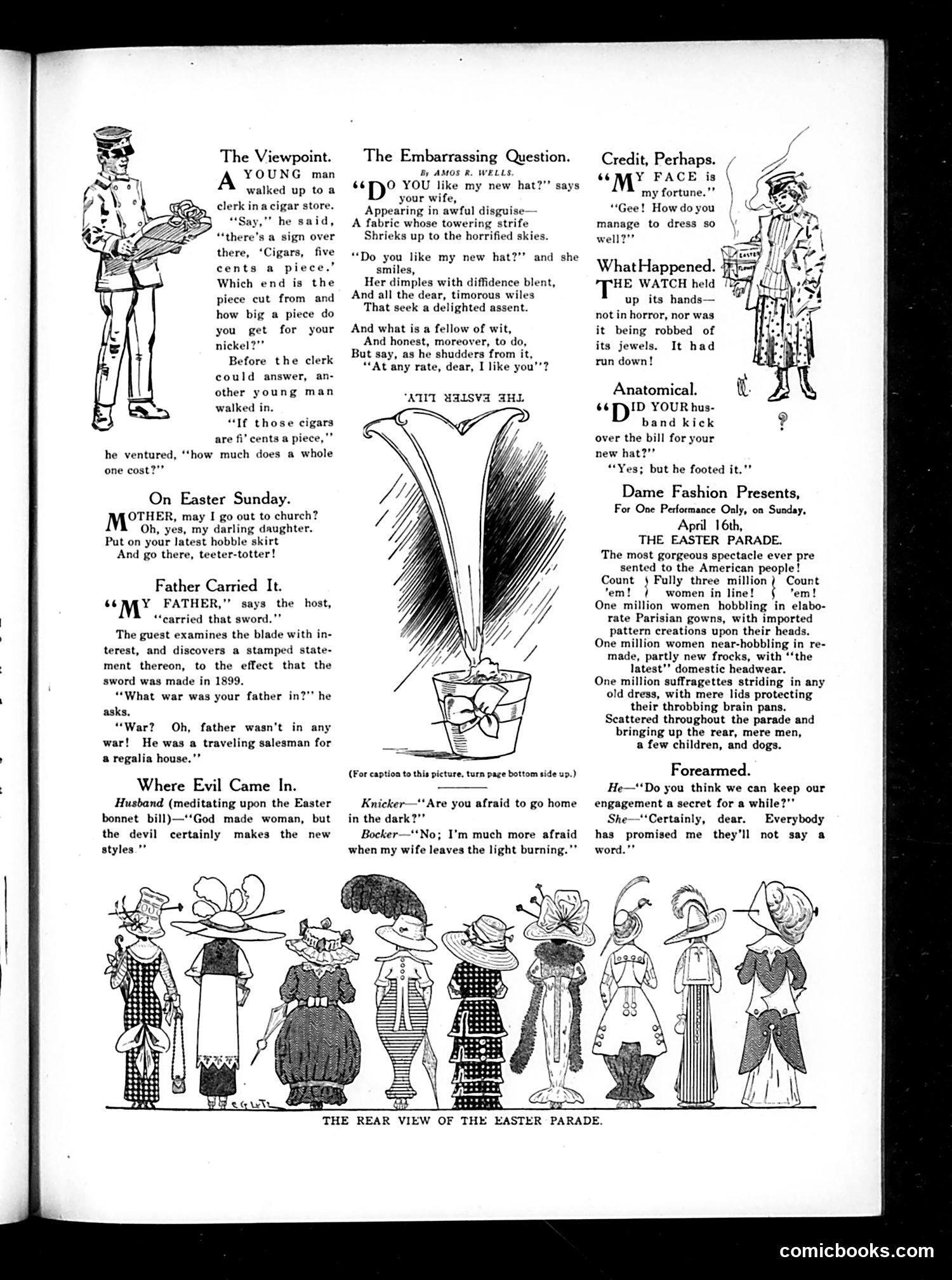
This page contains multiple short humorous pieces satirizing early 1900s American life: **"The Viewpoint"** mocks consumer confusion about pricing and value through absurdist questions about cigars. **"On Easter Sunday"** ridicules the fashionable "hobble skirt"—a restrictive garment so tight women could barely walk, requiring them to "teeter-totter" even to church. **"The Embarrassing Question"** explores marital diplomacy: a husband must praise his wife's objectively hideous new Easter hat despite his honest opinion, ultimately deflecting with "I like you." **"Dame Fashion Presents"** sarcastically describes the Easter Parade as a spectacle featuring three million women in expensive imported fashions, alongside "mere men, a few children, and dogs"—mocking both women's fashion obsession and the parade's frivolous excess. The recurring Easter bonnet theme reflects genuine social anxiety: extravagant women's hats symbolized wasteful spending and vanity, while also representing women's visible participation in public life. The humor targets both female fashion excess and male discomfort with female autonomy and spending power.
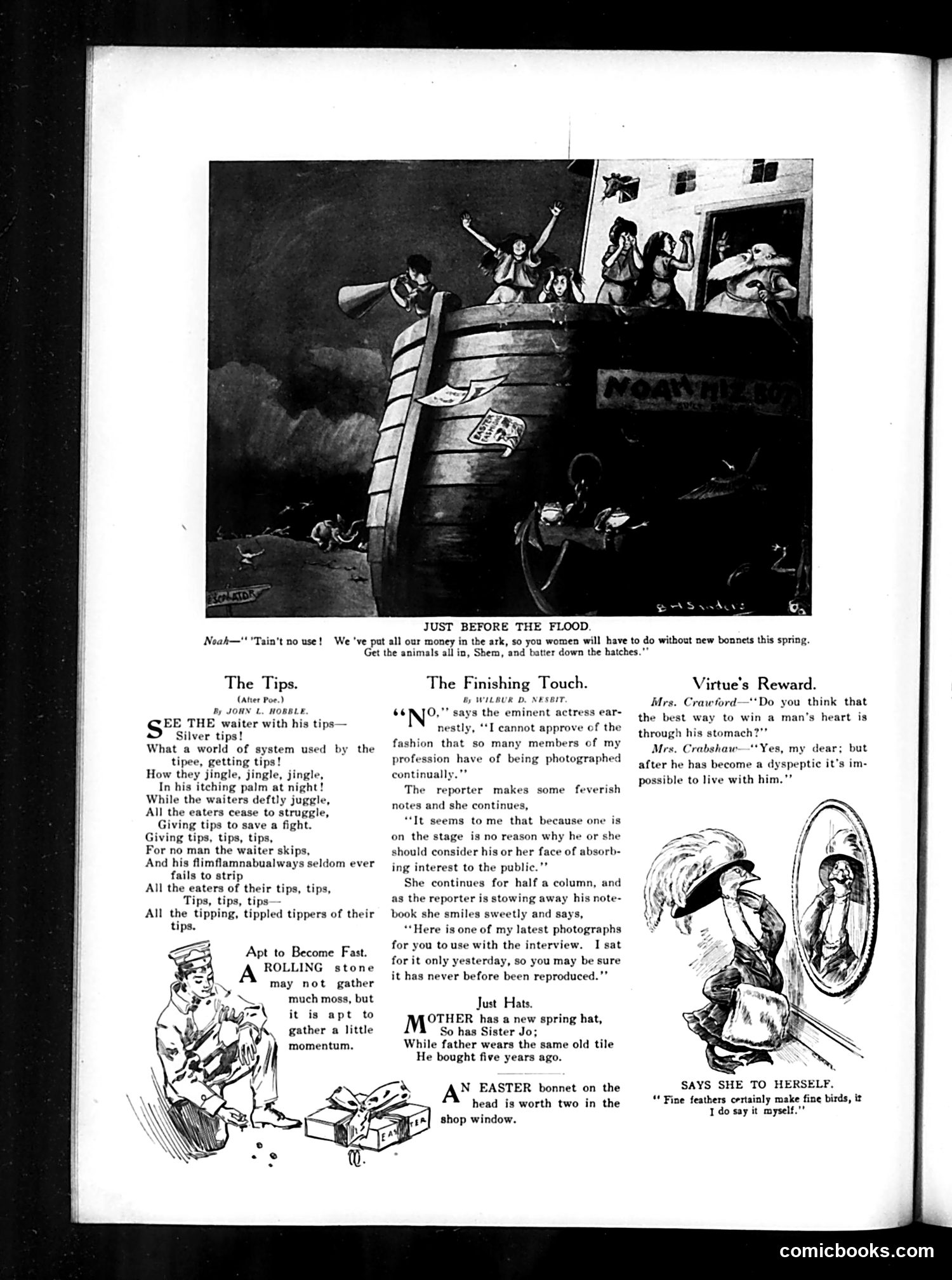
This page contains several satirical pieces typical of early 20th-century American humor: **"Just Before the Flood"** (top illustration) depicts Noah's Ark, with Noah telling his wife they can't afford new bonnets because their money is invested in the ark. The satire mocks contemporary consumer culture and gender economics—even during biblical catastrophe, women's fashion spending is a point of contention. **"The Tips"** is a poem by John L. Hobble satirizing the tipping system used by waiters. It critiques how tipping has become obligatory and systematized, forcing diners to pay extra to avoid poor service. **"The Finishing Touch"** by Wilbur D. Nesbit lampoons theatrical hypocrisy: an actress complains about colleagues being constantly photographed for publicity, then immediately offers her own latest photograph for publication—exposing the contradiction between stated principles and actual behavior. The remaining items are light verse about fashion and relationships, typical of the magazine's miscellaneous humor content. The page reflects concerns about commercialism, social obligation, and performative contradiction in Edwardian society.
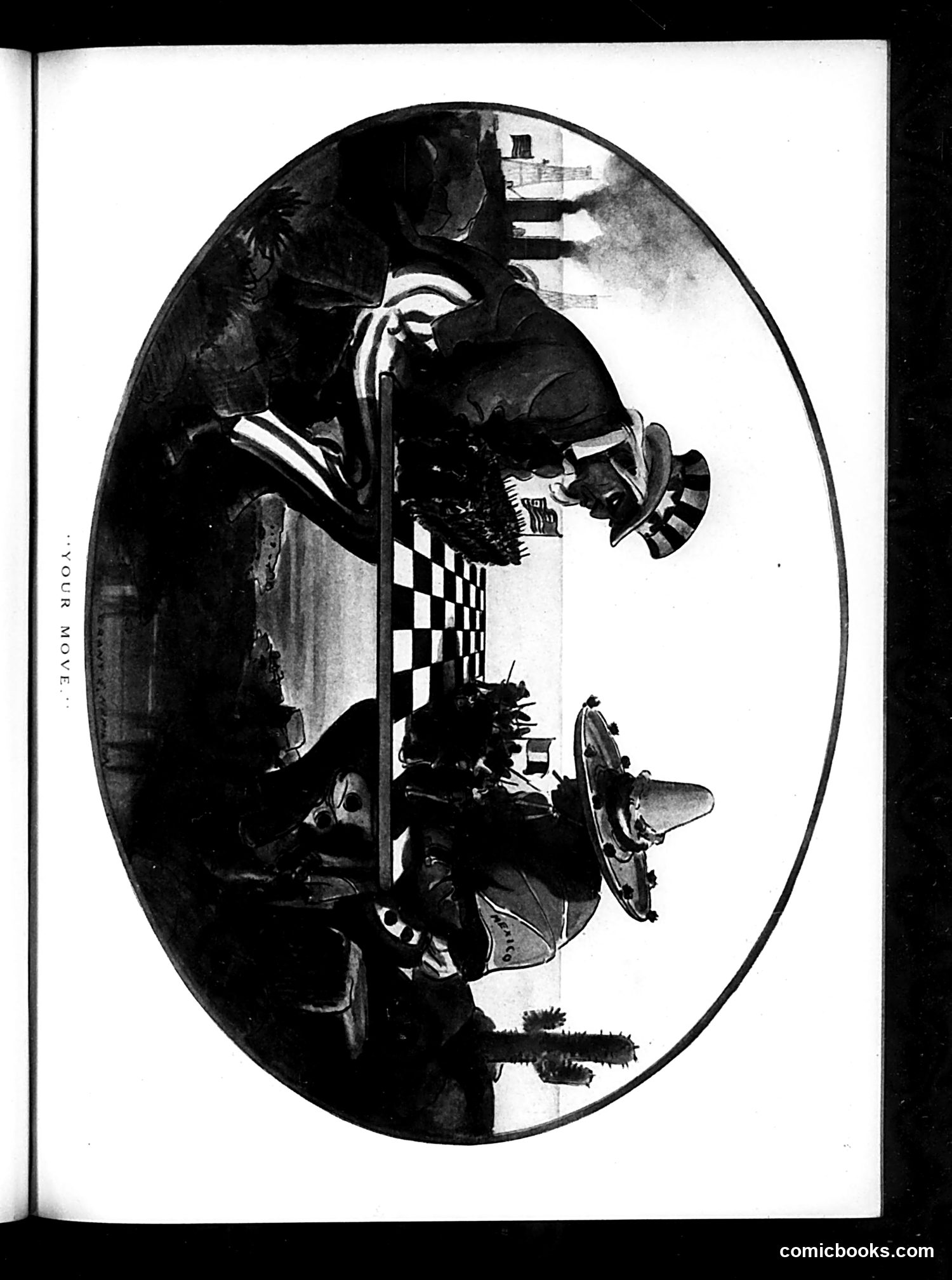
This page appears to be from Judge magazine and contains a single oval-framed illustration labeled "ROOM MIRROR" (visible on the left margin). The image shows what appears to be a distorted or grotesque reflection, rendered in stark black and white. The cartoon likely uses the "mirror" conceit as social satire—a common Judge magazine device where distorted reflections comment on human vanity, moral corruption, or societal flaws. The checkerboard pattern visible in the background and the exaggerated features suggest the figure's true nature is being "revealed" through the magical mirror trope popular in satirical cartooning. Without clearer text identifying specific figures or events, the precise political or social target remains unclear, though the grotesque imagery indicates criticism of someone or something contemporary to the publication.
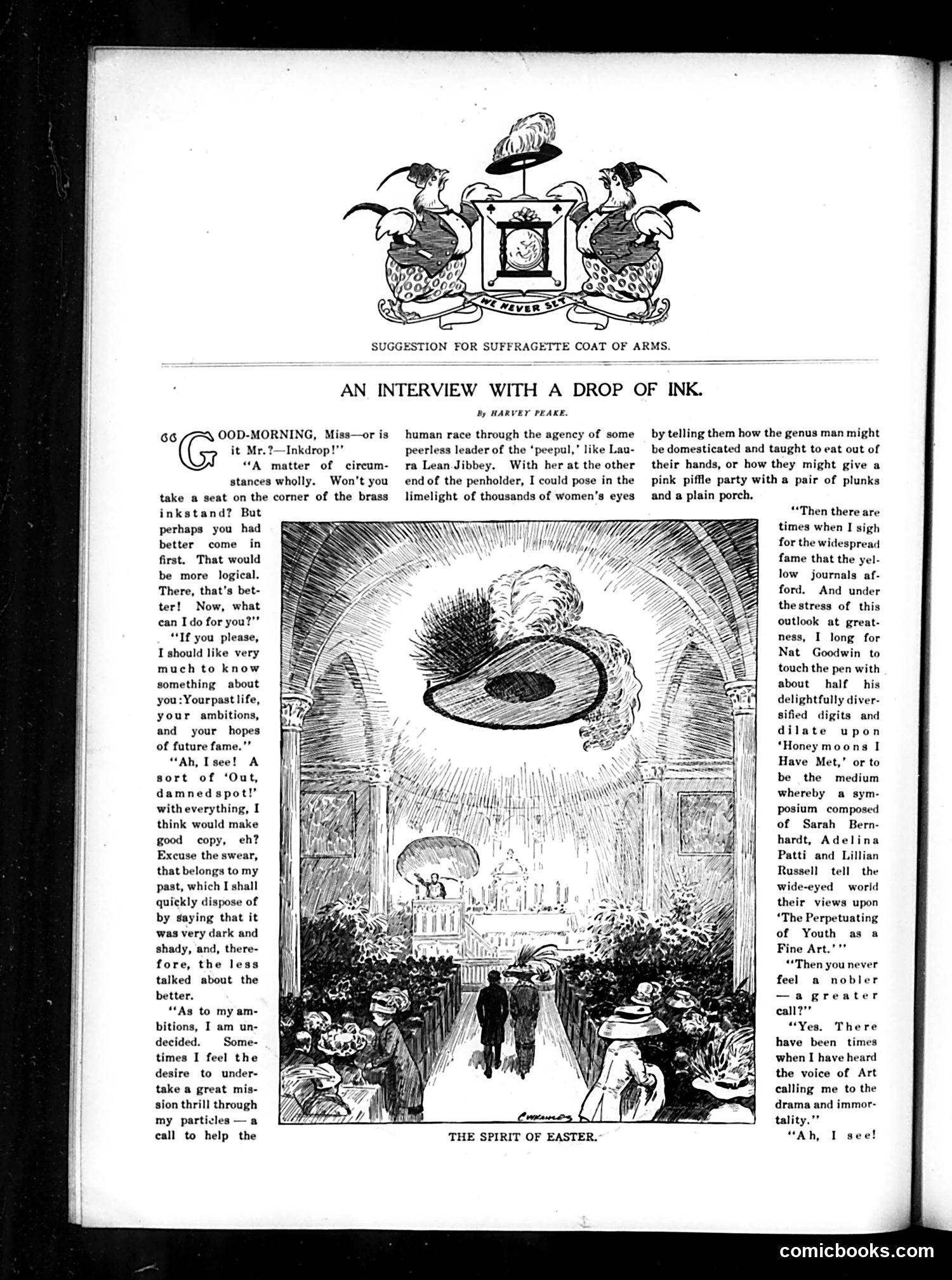
This is a satirical piece from *Judge* magazine titled "An Interview with a Drop of Ink." The humor centers on personifying ink as a character being interviewed about its ambitions and past. The satire targets early 20th-century women's suffrage and feminist movements. The ink drop mentions "Laura Lean Jibbey" (likely a fictional or obscure reference to a women's advocate) and jokes about how male ink might help women domesticate men or plan frivolous "pink piffle parties." The piece mocks suffragettes' serious political ambitions by reducing them to absurdist scenarios—suggesting ink's "noble calling" might be trivial journalism or romantic gossip pieces. The top image labeled "Suggestion for Suffragette Coat of Arms" (showing ornate heraldic designs) further ridicules women's suffrage activism by treating it as pompously self-important. The overall tone is dismissive toward women's political organizing, framing feminist aspirations as either grandiose or frivolous.
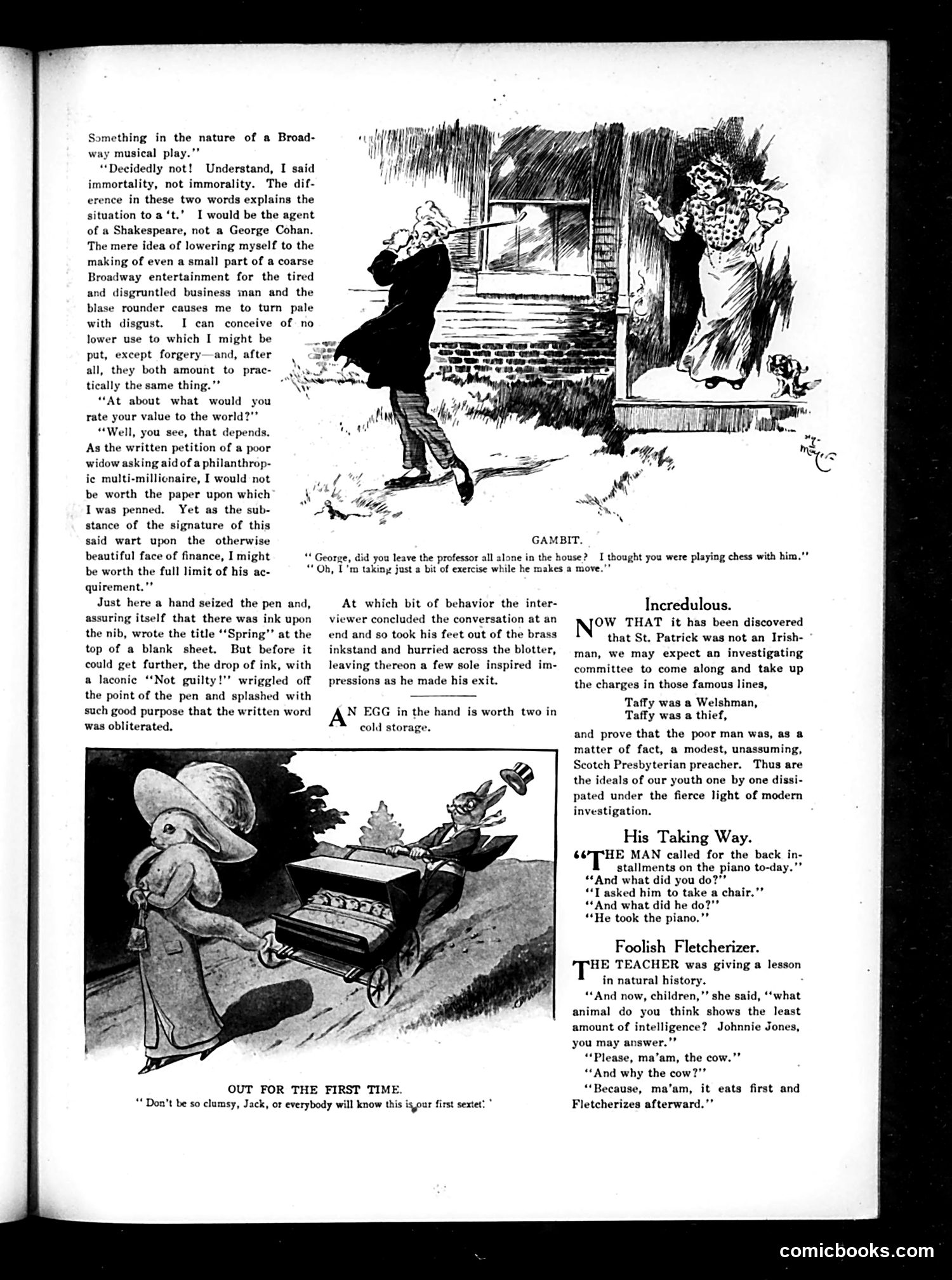
This page contains several brief humorous pieces typical of early 20th-century American satire: **"Gambit"** (top): A dialogue mocking pretentious intellectuals. A character insists he won't lower himself to write Broadway entertainment, claiming even "forgery" is preferable. The joke satirizes affectation and self-importance—he's revealed as worthless except as a signature on financial documents. **"Out for the First Time"** (bottom left): A cartoon showing a woman with a baby carriage, captioned about not being clumsy so "everybody will know this is your first sextet." The humor derives from the double meaning of "sextet" (musical group vs. group of six children), mocking large families and inexperienced parents. **"Incredulous"** and subsequent sections parody modern "investigation" debunking historical figures (St. Patrick), mock debt collection through furniture theft, and include a children's joke about cows not "fletcherizing" (chewing cud properly—referencing Horace Fletcher's chewing philosophy). The page is primarily comedic filler rather than focused political satire.
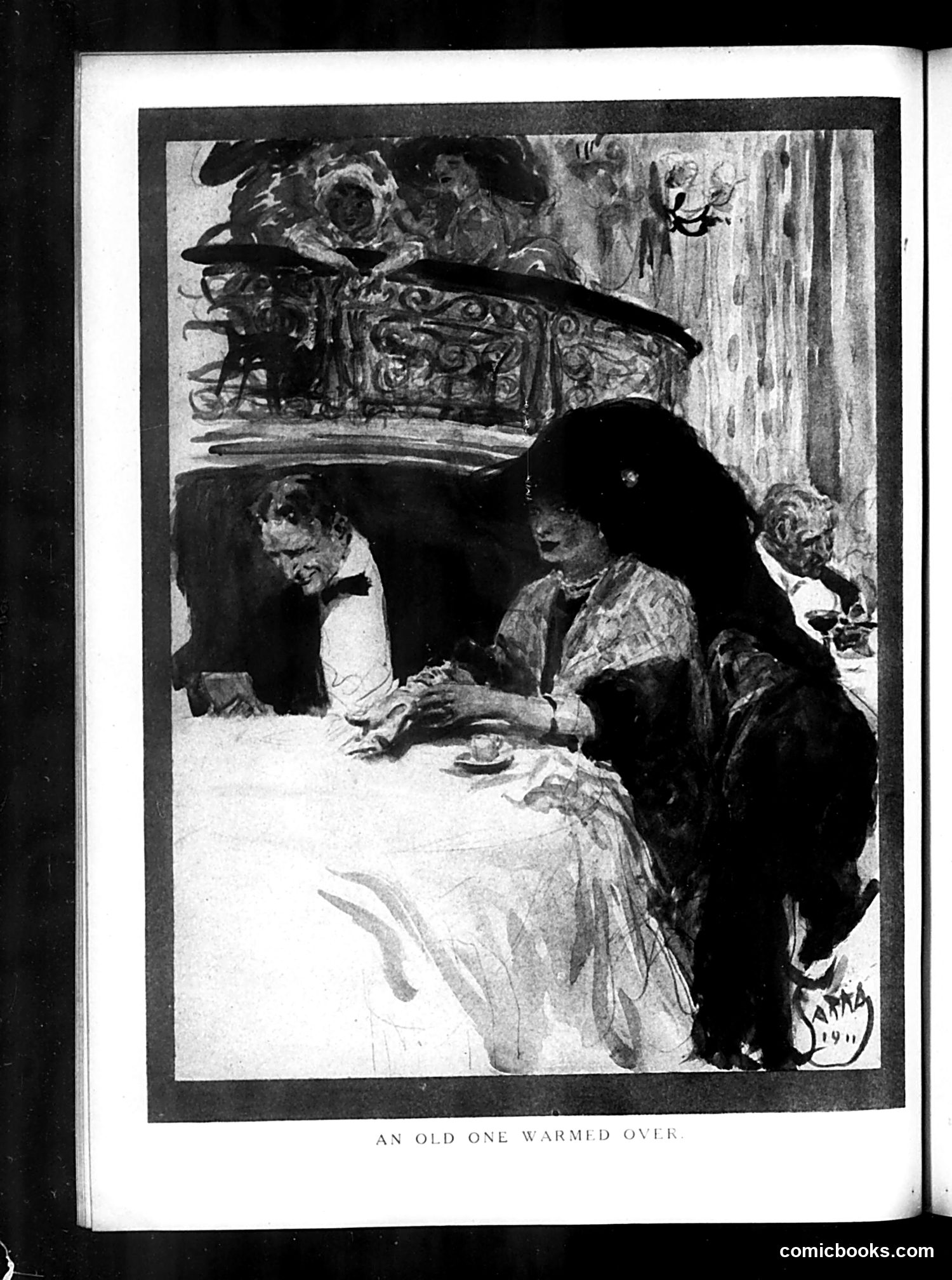
This cartoon satirizes an elderly man in formal attire (tuxedo and bow tie) seated with a woman at what appears to be a dining table. The title suggests the joke concerns recycled or reused material—likely a social or political commentary about an aging figure being "warmed over" for continued relevance or service. The ornate vessel or urn visible above suggests classical or institutional authority. The woman appears engaged in conversation, though her expression is unclear in this reproduction. Without clearer dating or additional context from the magazine, the specific target of this satire remains uncertain—it could reference a politician, public figure, or social trend of the period. The formal dining setting suggests commentary on elite society or politics.
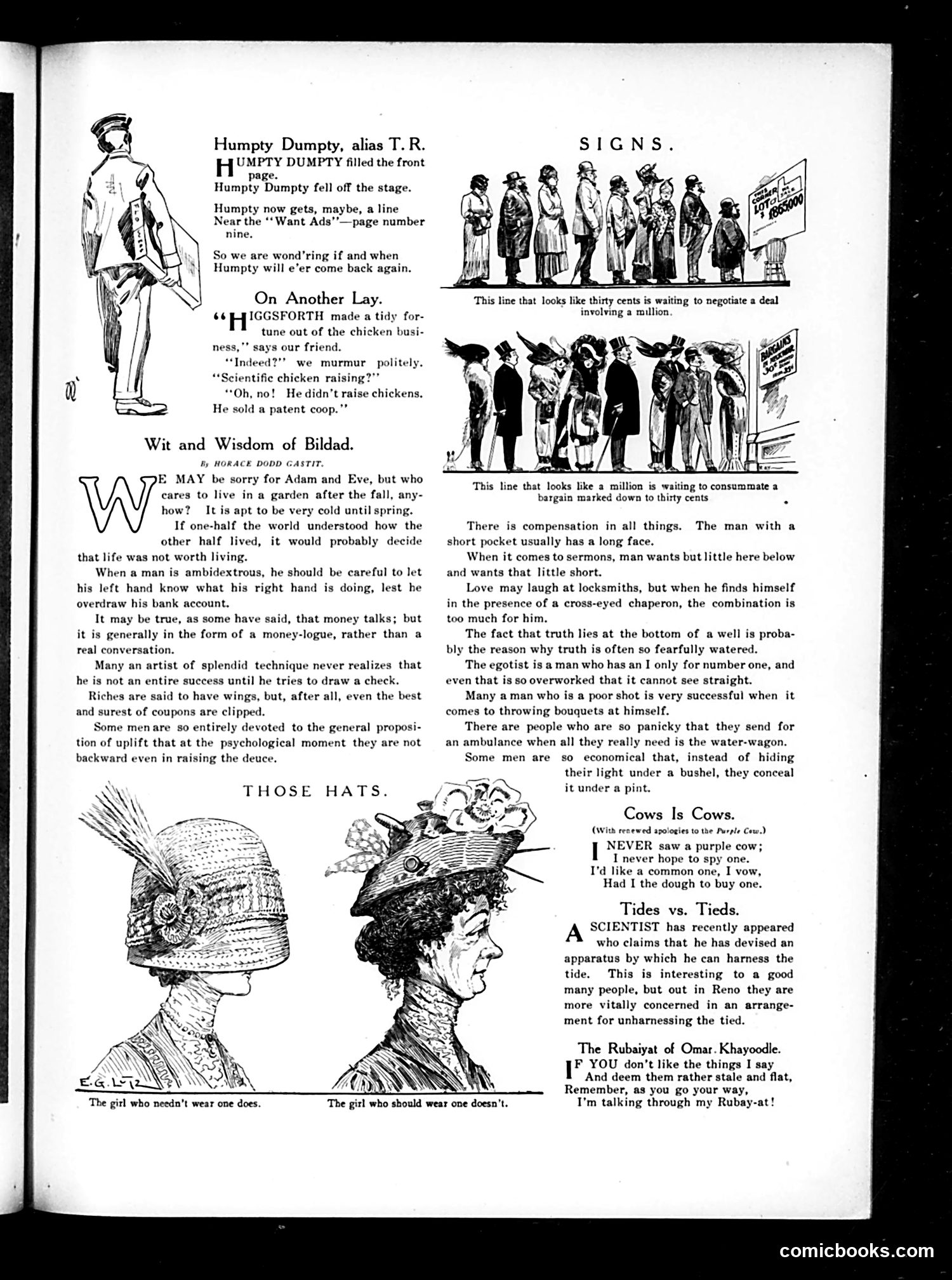
The primary cartoon mocks **Theodore Roosevelt** ("T.R."), comparing him to Humpty Dumpty who has "fallen off the stage." This references Roosevelt's political decline—likely after losing the 1912 presidential election when he split the Republican vote with his Progressive "Bull Moose" party, handing victory to Democrat Woodrow Wilson. The joke is that Roosevelt, once front-page news, now barely rates mention near the classified ads (page nine). The remaining content includes satirical quips on various social topics: wealth disparity, professional success, romantic obstacles, and scientific progress. A recurring theme mocks the contrast between appearance and reality—people who "look like a million" negotiating cheap deals, and vice versa. Minor pieces parody literary forms (the Rubaiyat) and social absurdities, with particular emphasis on economic anxieties and human pretension. The hat illustration contrasts women who should and shouldn't wear fashionable hats—likely social commentary on class performance and propriety.
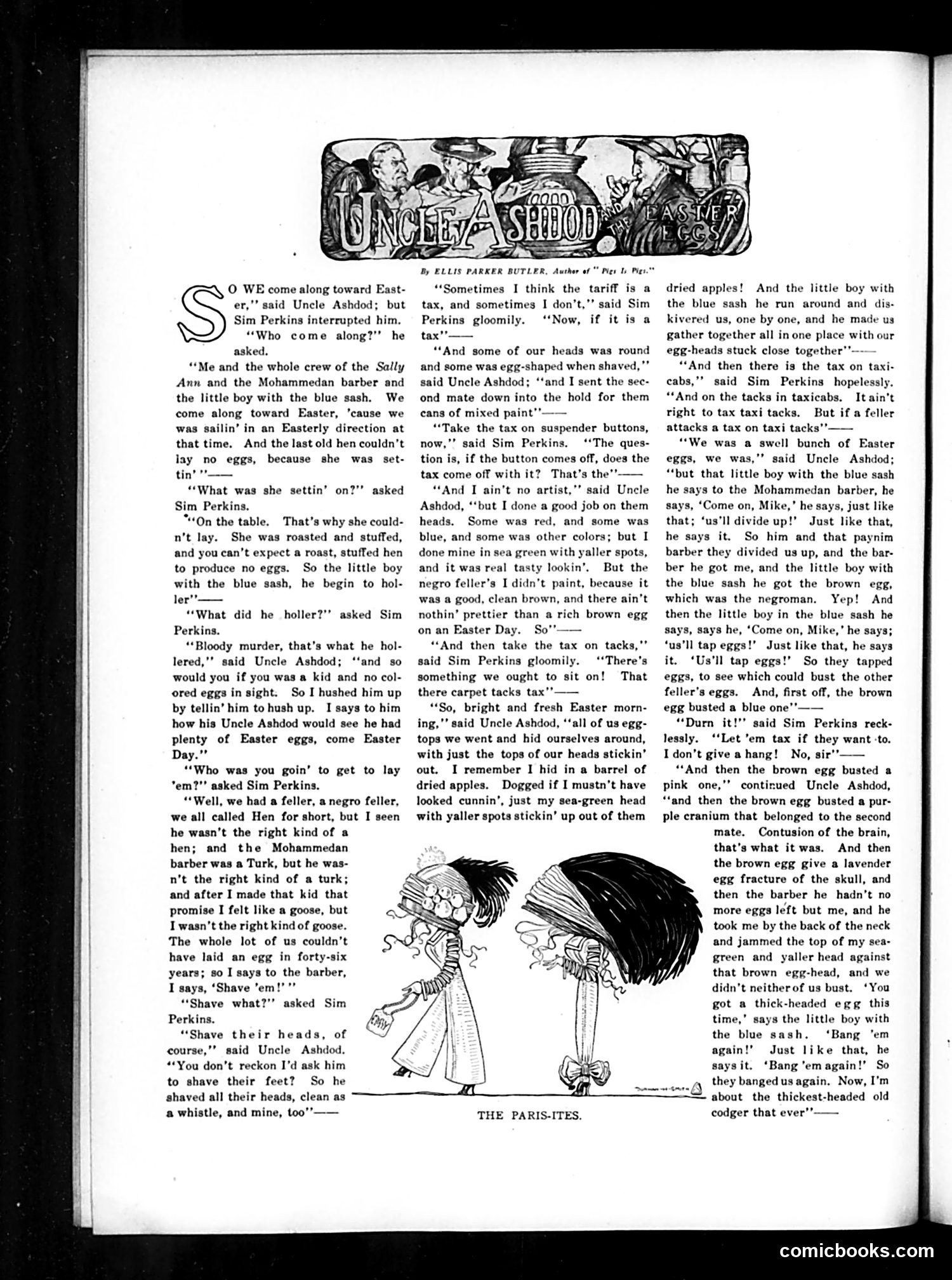
This story by Ellis Parker Butler uses whimsical humor to satirize American tariff policy. Uncle Ashdod's absurd tall tale—shaving men's heads, painting them like Easter eggs, and hiding them as an Easter egg hunt—serves as an extended metaphor for the complexity and perceived absurdity of protective tariffs. Sim Perkins repeatedly interrupts with grievances about specific taxes: on suspender buttons, tacks, and taxicabs. The joke is that tariffs create illogical situations (a button's tax shouldn't depend on whether it detaches; carpet tacks shouldn't be taxed separately when in taxicabs). The story ridicules how tariff policy had become so convoluted and broad that it seemed arbitrary and nonsensical—taxing individual components rather than addressing genuine economic concerns. The casual racism toward the "negro feller" and the Mohammedan barber reflects period attitudes but isn't the satire's focus; the tariff confusion is.
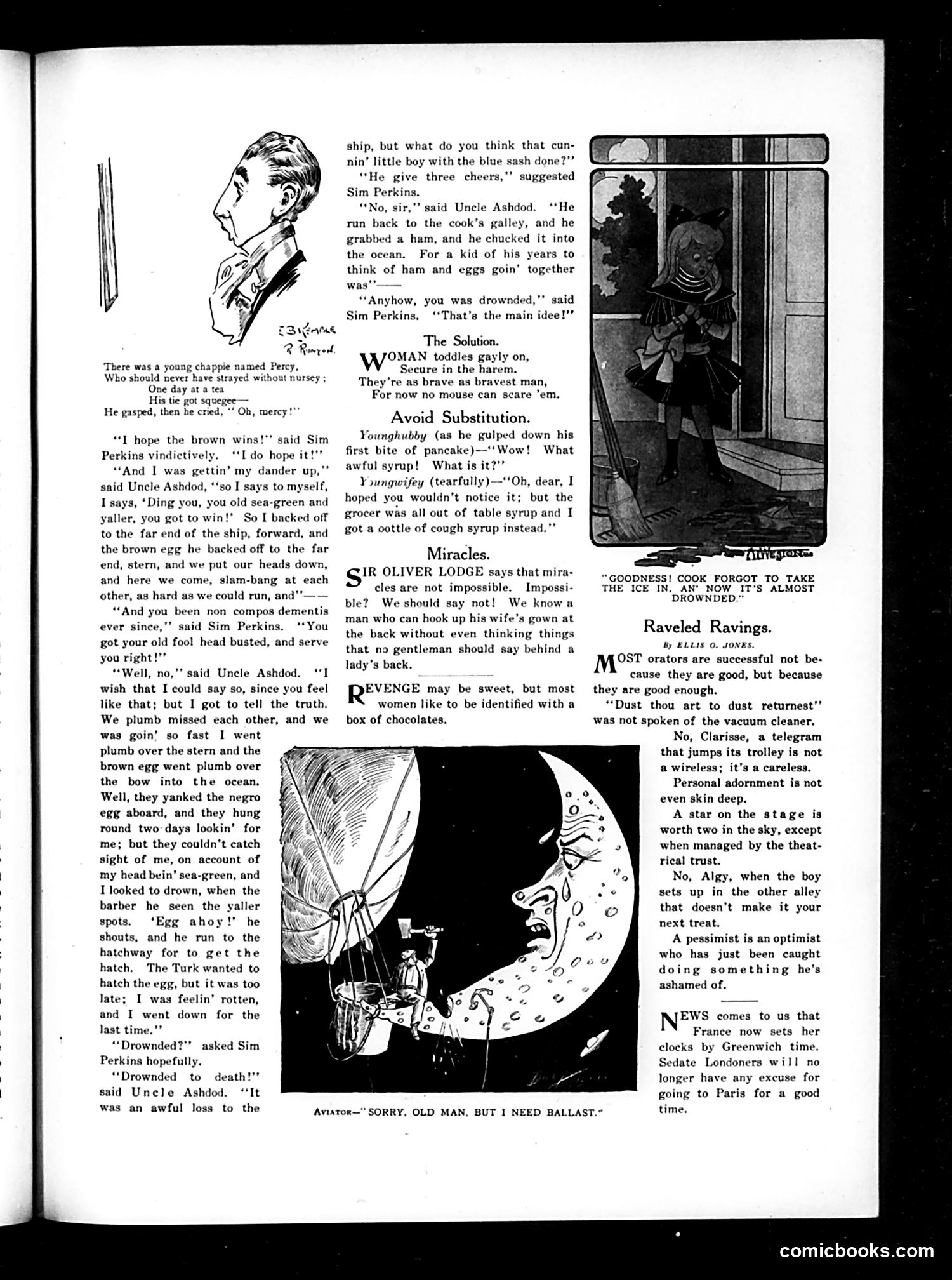
This page from *Judge* contains several humorous short pieces typical of early 20th-century American satirical magazines: **Main Story**: Uncle Ashdod recounts an absurd tall tale about a shipboard incident involving himself and a brown egg, ending with him being "drownded" but somehow surviving—a shaggy-dog story meant to parody sailors' exaggerated boasts. **Cartoons and Quips**: - "The Solution" satirizes women's suffrage by suggesting women are braver now that mice won't scare them (trivializing women's rights) - "Avoid Substitution" jokes about a wife substituting cough syrup for table syrup—domestic incompetence humor - "Miracles" presents Oliver Lodge's claims about impossibilities alongside a joke about men behaving decently around women - The aviator cartoon shows a pilot jettisoning weight (likely a woman) with the caption about needing ballast—casual misogyny **"Raveled Ravings"** offers aphoristic one-liners on oratory, vacuum cleaners, theater, and other topics. The overall tone reflects period attitudes: patronizing toward women, celebrating masculine bluster, and favoring wordplay over substance.
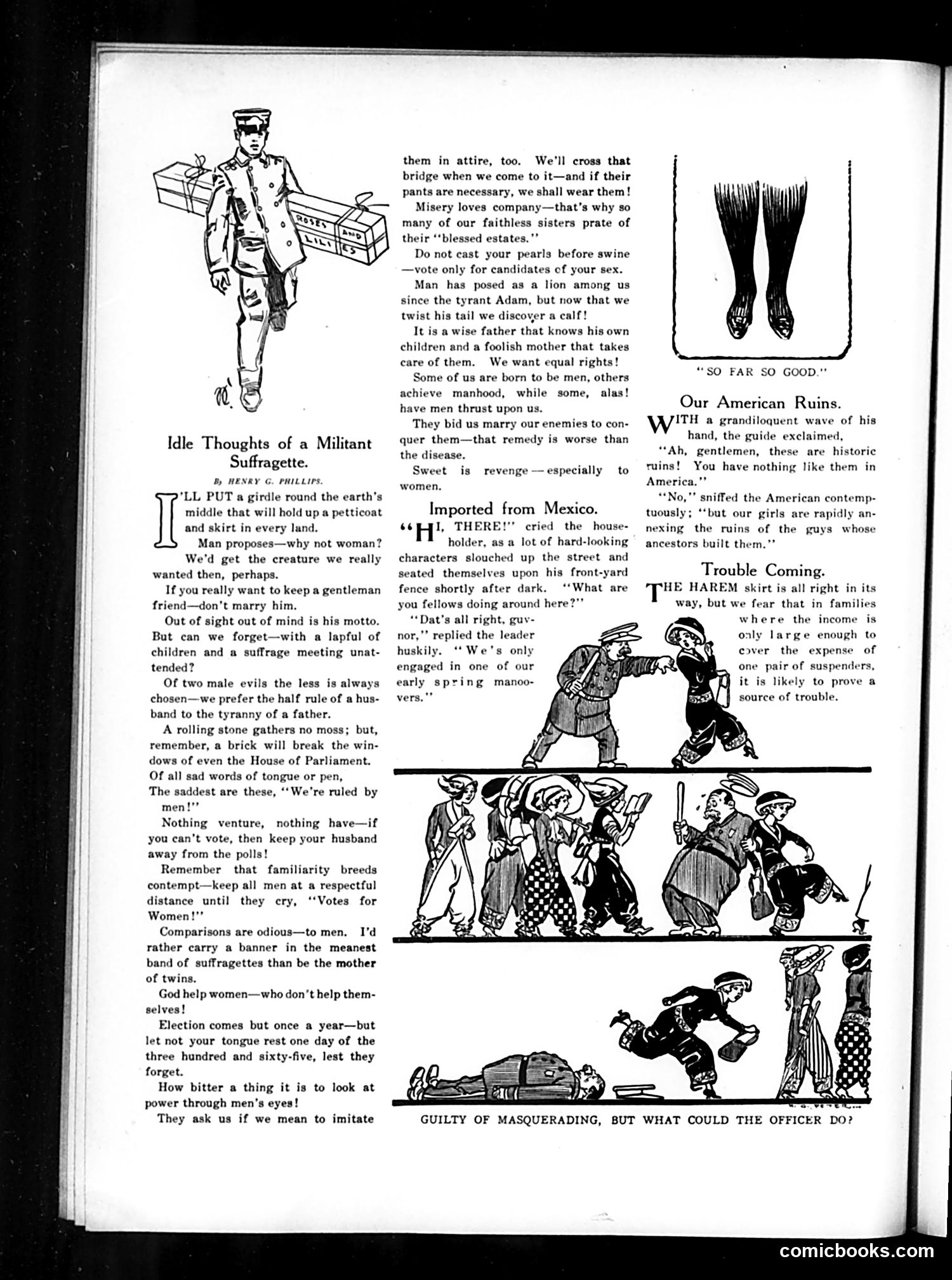
This page satirizes women's suffrage activism through multiple pieces: **"Idle Thoughts of a Militant Suffragette"** presents mock aphorisms from a female suffragist's perspective, mixing legitimate grievances (women lack voting rights, are ruled by men) with absurd threats (breaking Parliament windows with bricks, wearing pants). The satire suggests suffragettes are both justified and dangerously extreme—the author ridicules both their cause and their methods simultaneously. **"Imported from Mexico"** depicts suspicious-looking men trespassing on a homeowner's property, claiming "spring maneuvers." The caption questions what an officer could do—likely referencing contemporary concerns about Mexican immigration or border security, though the exact reference is unclear. **"Our American Ruins"** jokes that American girls are "annexing" ancient ruins—a mild jab at American tourism or cultural appropriation. **"Trouble Coming"** warns that harem skirts (a contemporary fashion) will create marital conflict in lower-income households where suspenders are shared. The overall tone is conservative, mocking progressive causes while presenting superficially witty arguments against women's political equality.
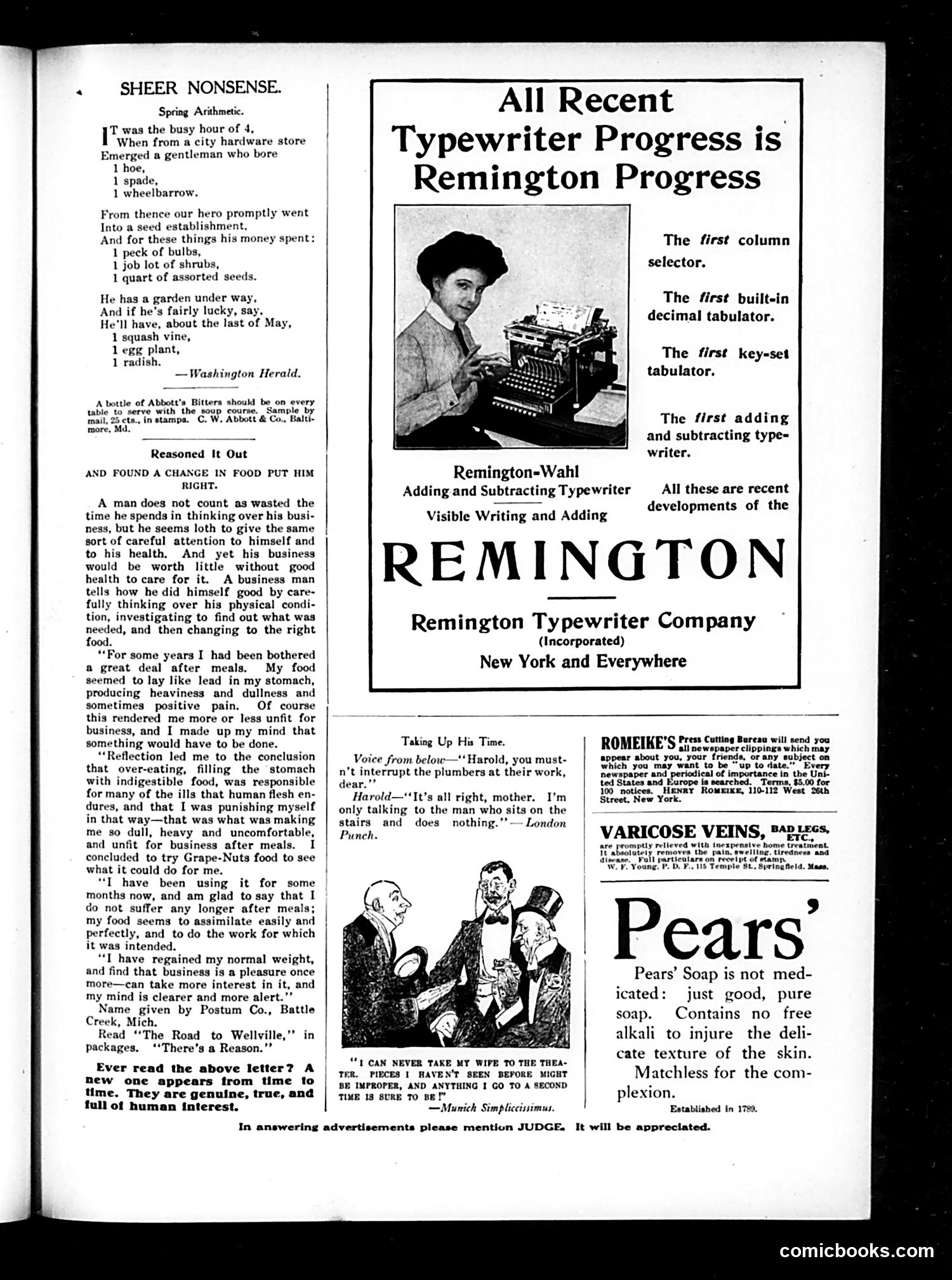
This page is primarily **advertising and humor content** rather than political satire. The main visual content is a **large Remington typewriter advertisement** featuring a photograph of a man at a typewriter, claiming Remington has achieved the "first" column selector, decimal tabulator, and adding/subtracting capabilities. Below that is a small cartoon labeled "Taking Up His Time" from *London Punch*, depicting a boy talking to a plumber sitting idle on stairs—a simple domestic humor joke about interrupting workers. The page also contains **several testimonial advertisements**: one for Grape-Nuts cereal (a common format in this era, presenting invented "genuine" customer letters), Abbott's Bitters, Pears' Soap, and various medical treatments. A brief poem titled "Spring Arithmetic" jokes about how a gardener buys many seeds and tools but harvests only three vegetables. The overall page reflects **early 20th-century advertising conventions**: testimonials, product claims, and light domestic humor alongside commercial pitches.
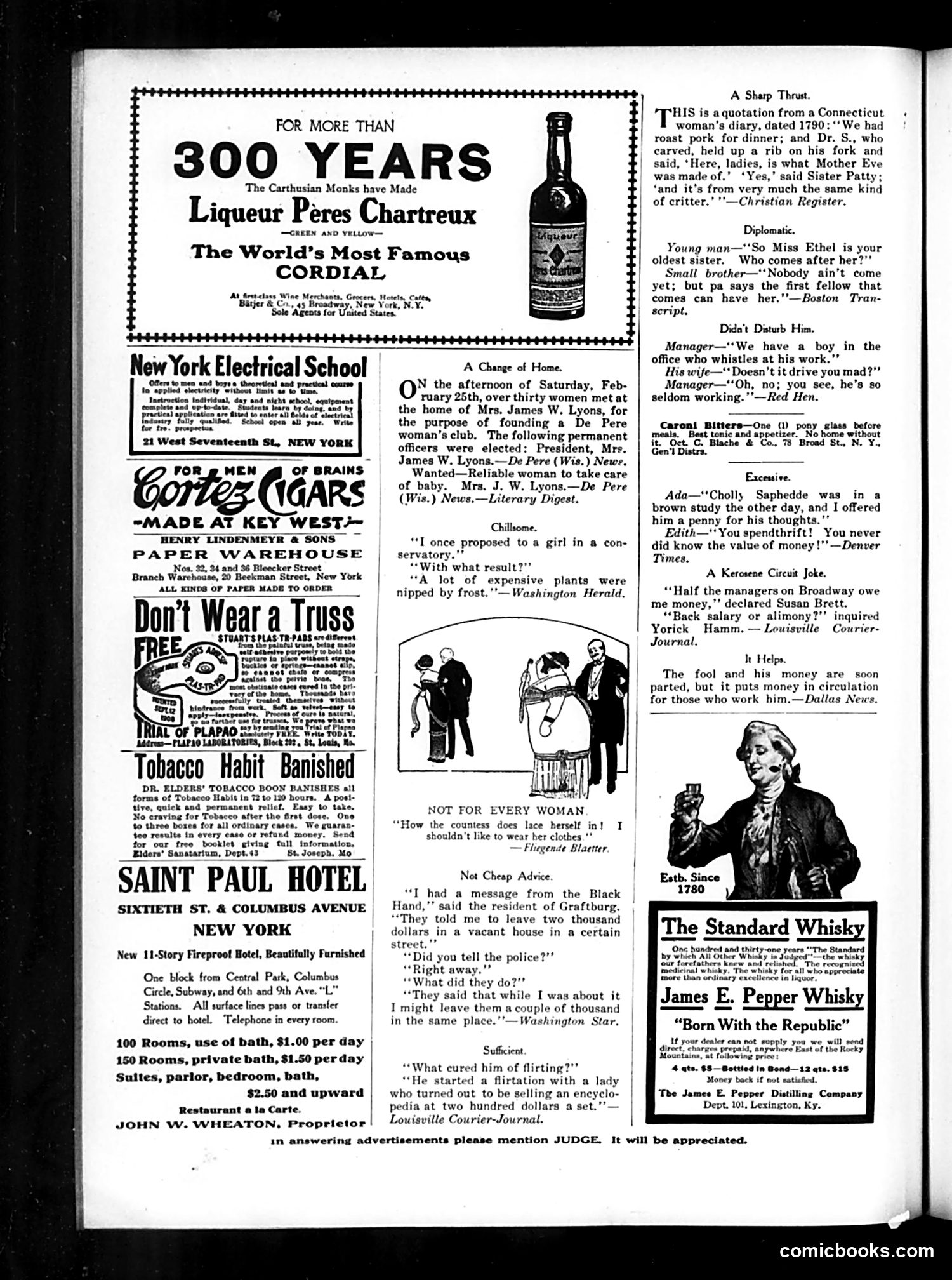
This page is primarily **advertising** for various products and services (liqueur, electrical school, cigars, hotel, truss, tobacco remedy, whiskey), with small humorous items and jokes scattered throughout—typical Judge magazine filler content. The **cartoon** (center) shows a well-dressed couple at what appears to be a social gathering, with other figures in the background. The caption reads: "NOT FOR EVERY WOMAN: 'How the countess does lace herself in! I shouldn't like to wear her clothes.'" This satirizes class pretension and fashion—mocking the idea that wealthy women's restrictive clothing is enviable rather than uncomfortable. The surrounding **jokes** mock everyday life: awkward proposals, flirtation, marital dynamics, and social climbing. One item humorously pairs a "woman wanted to care for baby" ad with the founder's name (Mrs. Lyons), suggesting ironic juxtaposition. The humor is gentle, domestic satire typical of early-20th-century American magazines.
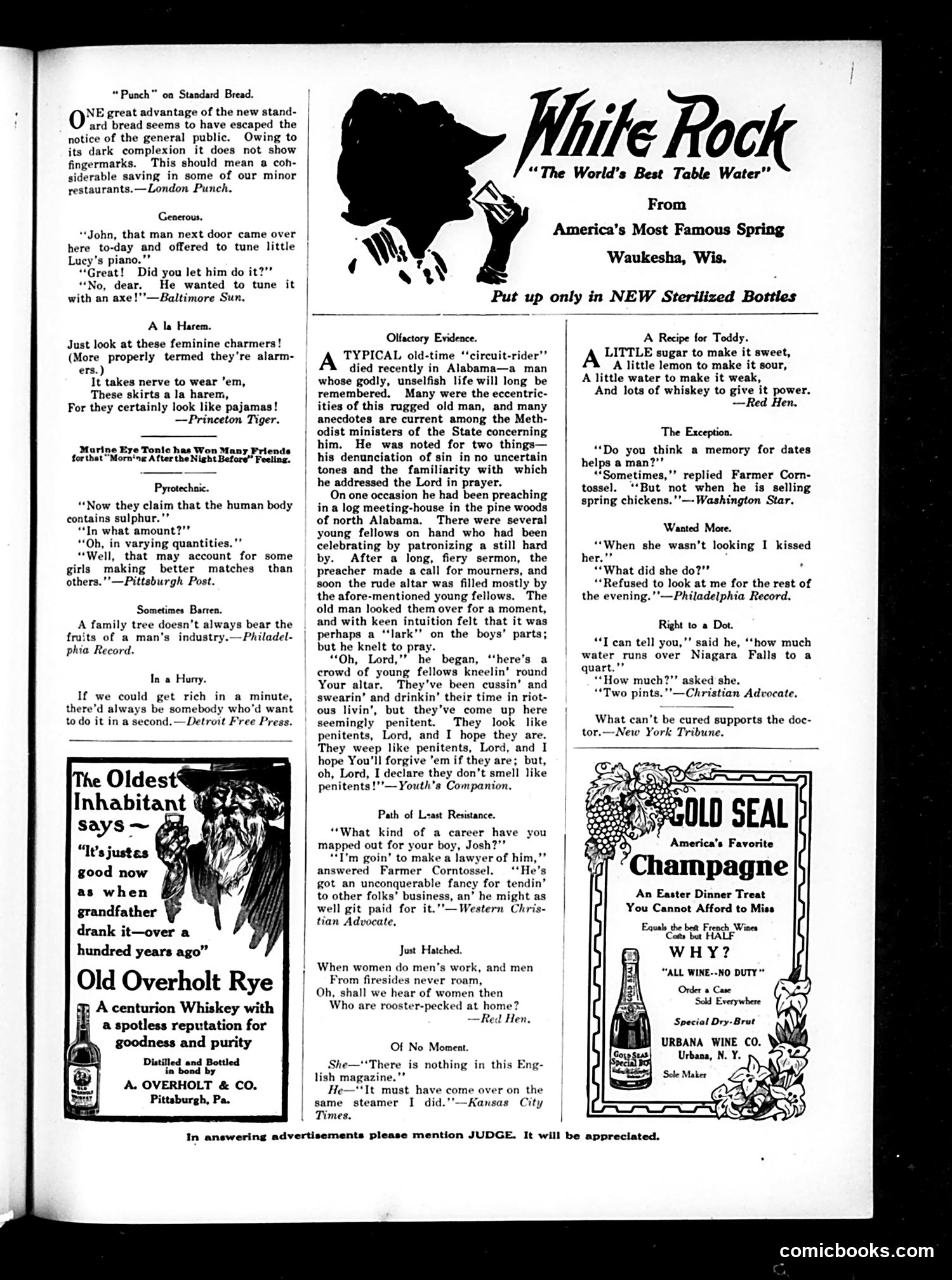
This page from *Judge* contains primarily **short humorous anecdotes and advertisements** rather than political cartoons. The content reflects early 20th-century American humor: **Notable humor items:** - A jab at standard dark bread for hiding fingermarks in "minor restaurants"—satirizing both the bread and cheap dining establishments - Multiple domestic/romantic jokes (the piano-tuning axe joke, the kiss rejection) - Rural/farmer dialect humor, including an extended anecdote about a Methodist circuit-preacher in Alabama who, during a revival, prays suspiciously about young penitents: "I declare they don't smell like penitents!"—implying they're drunk rather than genuinely repentant **Advertisements** dominate: White Rock water, Old Overholt Rye whiskey, and Cold Seal Champagne. The humor is genteel, domestic, and relies on wordplay and rural stereotypes typical of *Judge*'s era. No specific political figures or events are identifiable. The overall tone reflects middle-class American sensibilities and entertainment conventions of the period.
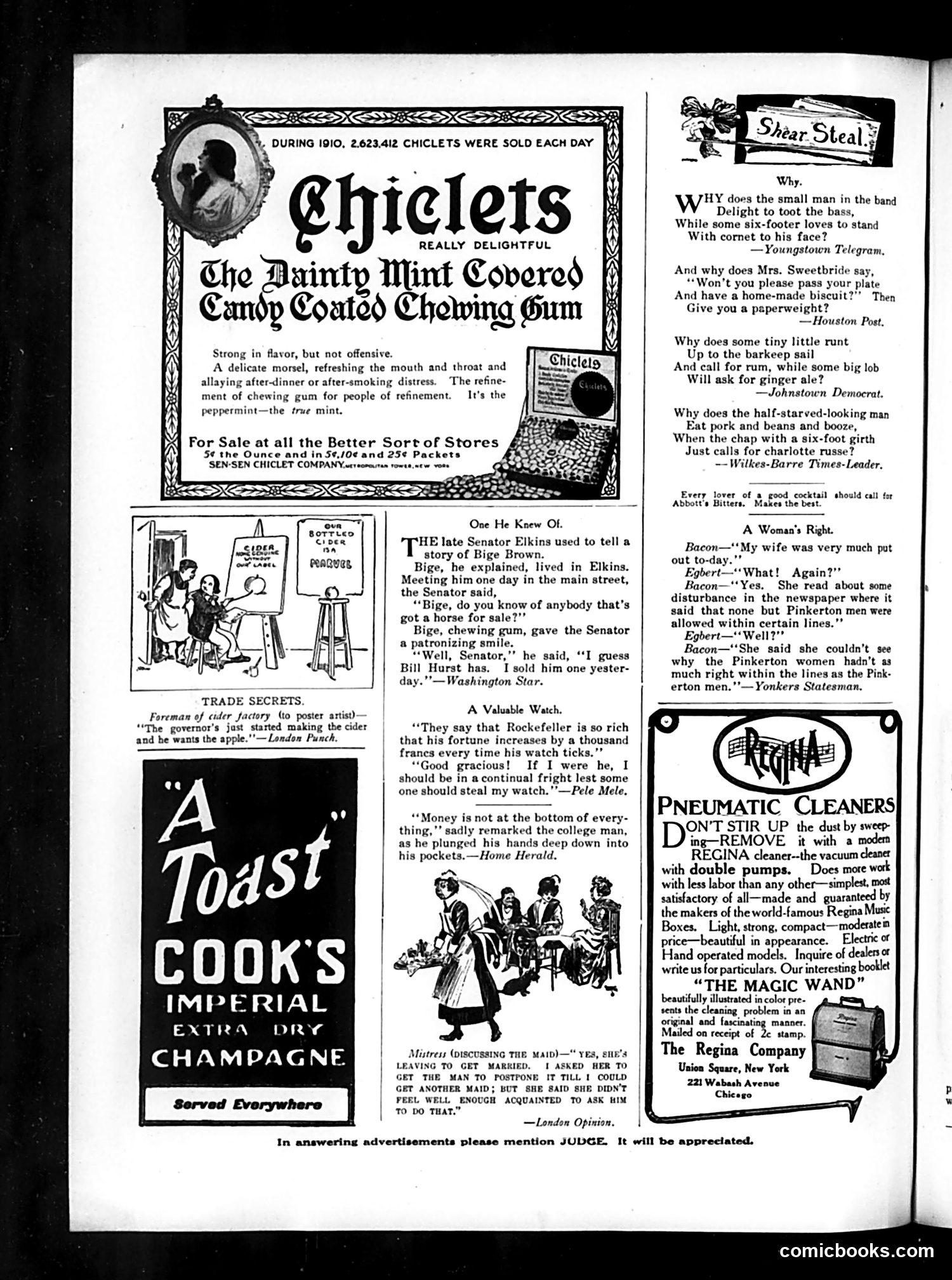
This page is primarily **advertising and humor filler** rather than political satire. The content includes: **Main Advertisement:** Chiclets chewing gum, marketed as refined mints for "people of refinement"—reflecting early 20th-century class-conscious marketing. **Humor Sections:** Short jokes and anecdotes, including: - "One He Knew Of"—a folksy story about Senator Elkins and a man named Bige Brown discussing a horse sale - "A Valuable Watch"—jokes about Rockefeller's wealth and money's true value - Domestic humor ("A Woman's Right") playing on wives' complaints and Pinkerton detective agency references **Other Ads:** Imperial champagne, Abbott's Bitters, Regina vacuum cleaners, and pneumatic cleaners. The page reflects **turn-of-the-century American attitudes**: class hierarchies, gender roles (wives as domestic managers), and emerging consumer culture. No major political figures or events are caricatured here.
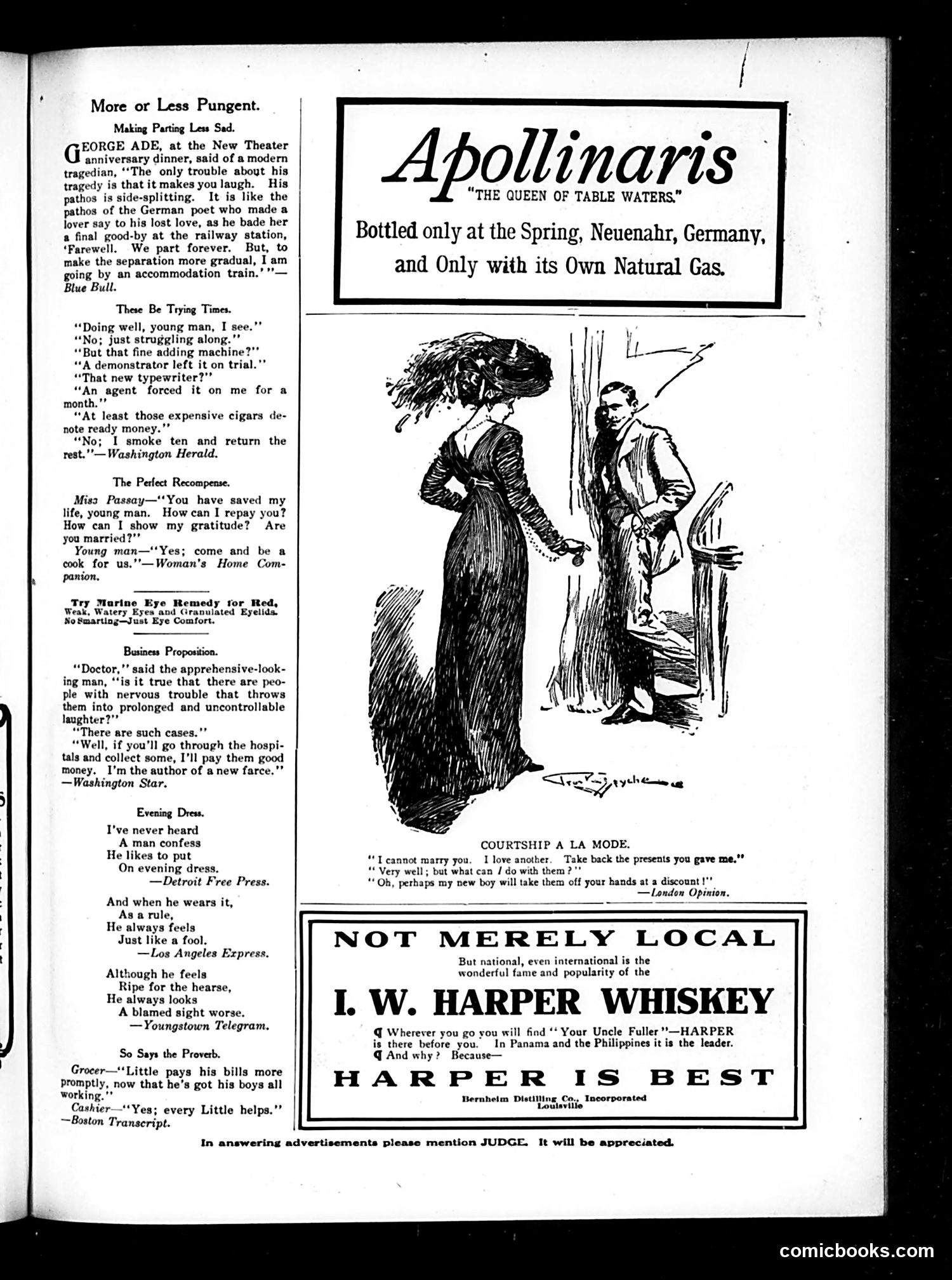
This page from *Judge* magazine (undated but appears early 20th century) contains primarily **short humorous anecdotes and advertisements** rather than political cartoons. The main cartoon depicts a courtship scene titled "Courtship à la Mode," showing a woman rejecting a suitor. The satire mocks modern romantic practices: she refuses him but demands he take back his gifts—then jokes that her "new boy" can sell them at a discount, suggesting she's already moved on to another suitor and treats courtship gifts as disposable commodities. This reflects contemporary anxieties about shifting gender dynamics and commercialization of romance. The text snippets are brief jokes about modern life: struggling businessmen, unwanted "trial" products left by salesmen, and a playwright seeking "nervous" patients for material. **Advertisements dominate:** Apollinaris mineral water and I.W. Harper Whiskey, emphasizing international fame and availability even in colonial outposts (Panama, Philippines), reflecting America's imperial expansion era. The satire is gentle social commentary rather than sharp political critique.
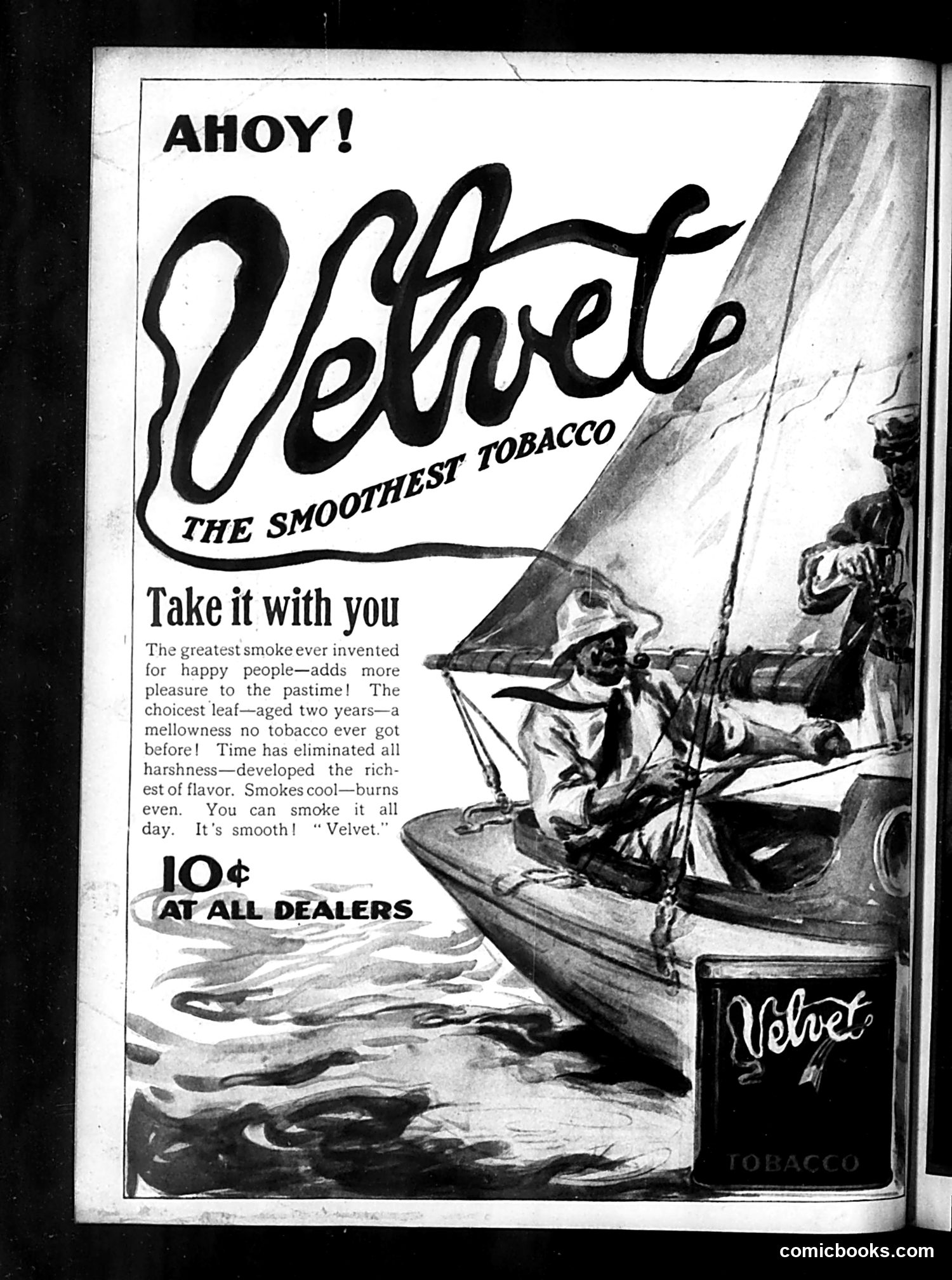
This is a straightforward **cigarette/tobacco advertisement**, not political satire. It promotes "Velvet" brand tobacco at 10 cents, positioned as "the smoothest tobacco" available. The image depicts sailors in a small sailboat, using the nautical scene to evoke leisure, adventure, and portability—the "Take it with you" tagline emphasizes the product's convenience for travel. The ad claims superiority through aging ("two years"), smoothness, coolness, and flavor. The casual leisure setting and "happy people" framing are typical early-20th-century marketing tactics. This reflects an era when tobacco advertising was unrestricted and made health/pleasure claims now recognized as false. The ad provides no satirical commentary—it's genuine period marketing.