
A complete issue · 24 pages · 1910
Judge — November 19, 1910
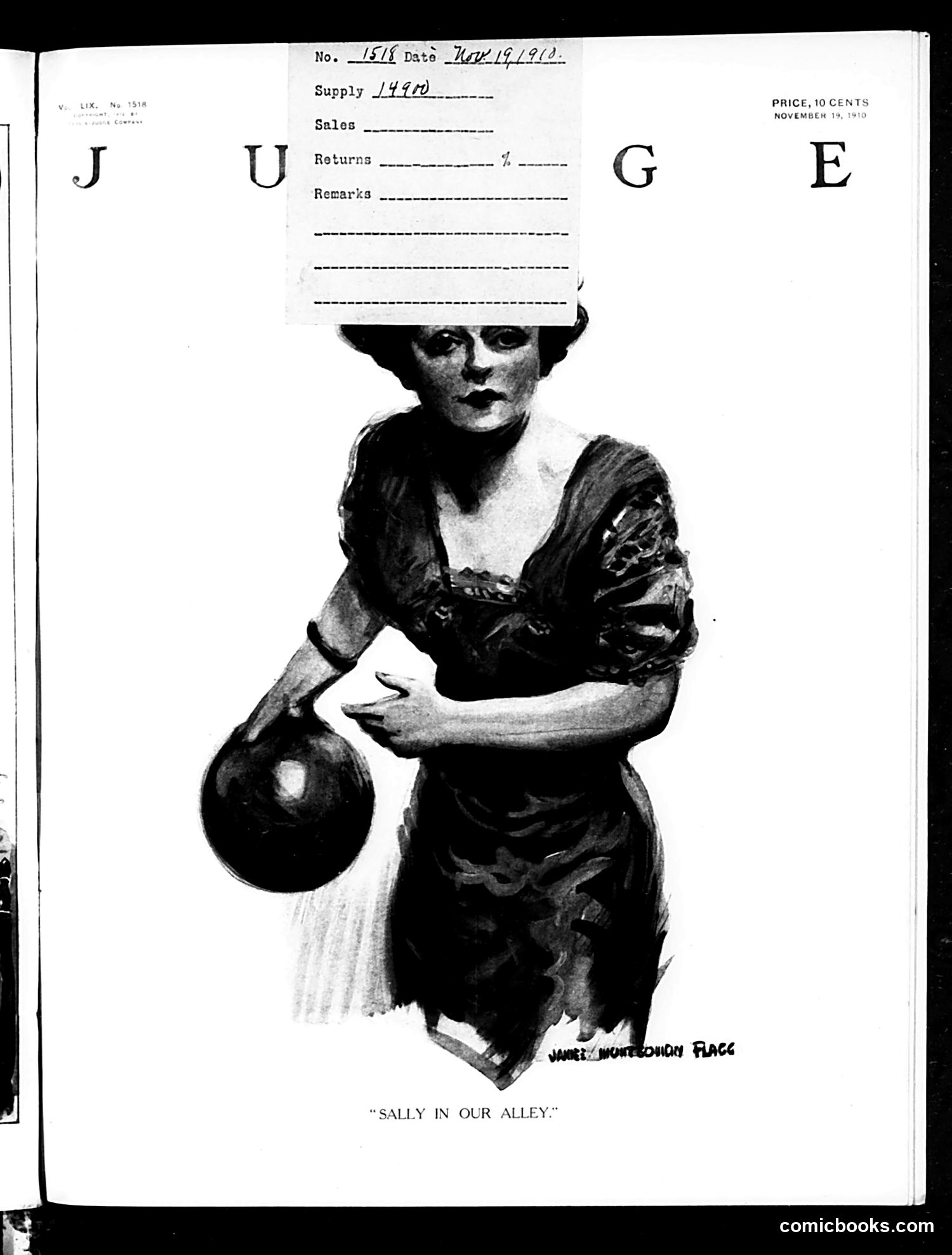
This Judge magazine page from November 19, 1910 features an illustration titled "Sally in Our Alley," credited to James Montgomery Flagg. The image shows a woman in working-class attire holding a bowling ball, drawn in a style that appears to reference popular entertainment of the era. The title likely references the 1894 comic opera "Sally in Our Alley," suggesting this may be theatrical commentary or satire. The bowling motif was a relatively modern leisure activity gaining popularity among urban working and middle-class populations in the early 1900s. Without additional context from the missing page content (supply, sales, returns, remarks sections are blank), the specific satirical point remains unclear. The image may comment on women's changing social roles or modern recreational trends.
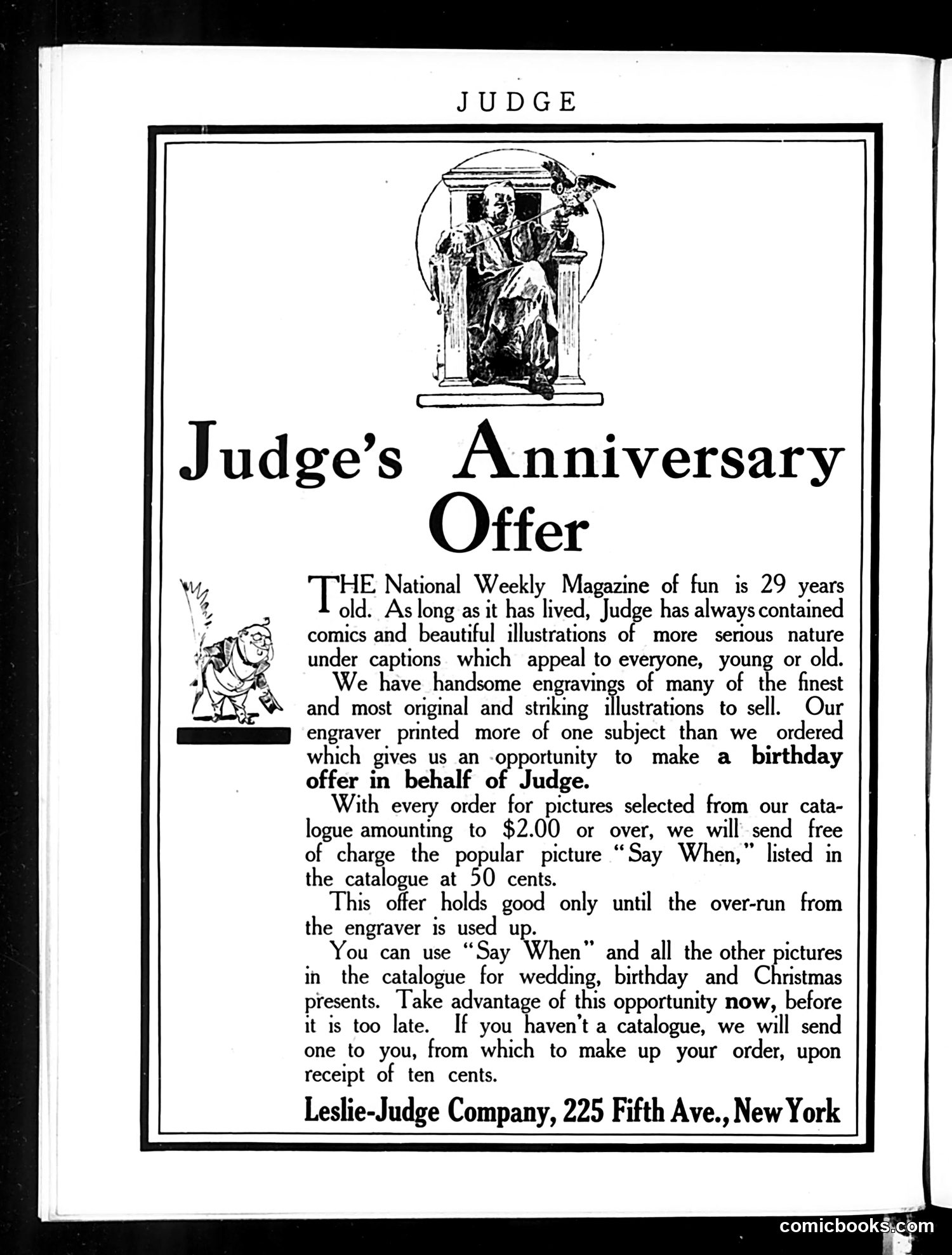
This page is primarily a **commercial advertisement** rather than political satire. It announces Judge magazine's 29th anniversary and promotes engravings available from the Leslie-Judge Company. The advertisement offers a free picture called "Say When" (valued at 50 cents) with orders over $2.00. The text emphasizes Judge's long history of publishing comics and illustrations with humorous captions appealing to all ages. The page includes decorative illustrations: a seated figure in classical robes (representing Justice or the magazine's authority) and a smaller cartoon character on the left side. These are generic emblems rather than caricatures of specific political figures. The offer encourages customers to purchase engravings for weddings, birthdays, and Christmas gifts, promoting Judge's illustrated catalogue.
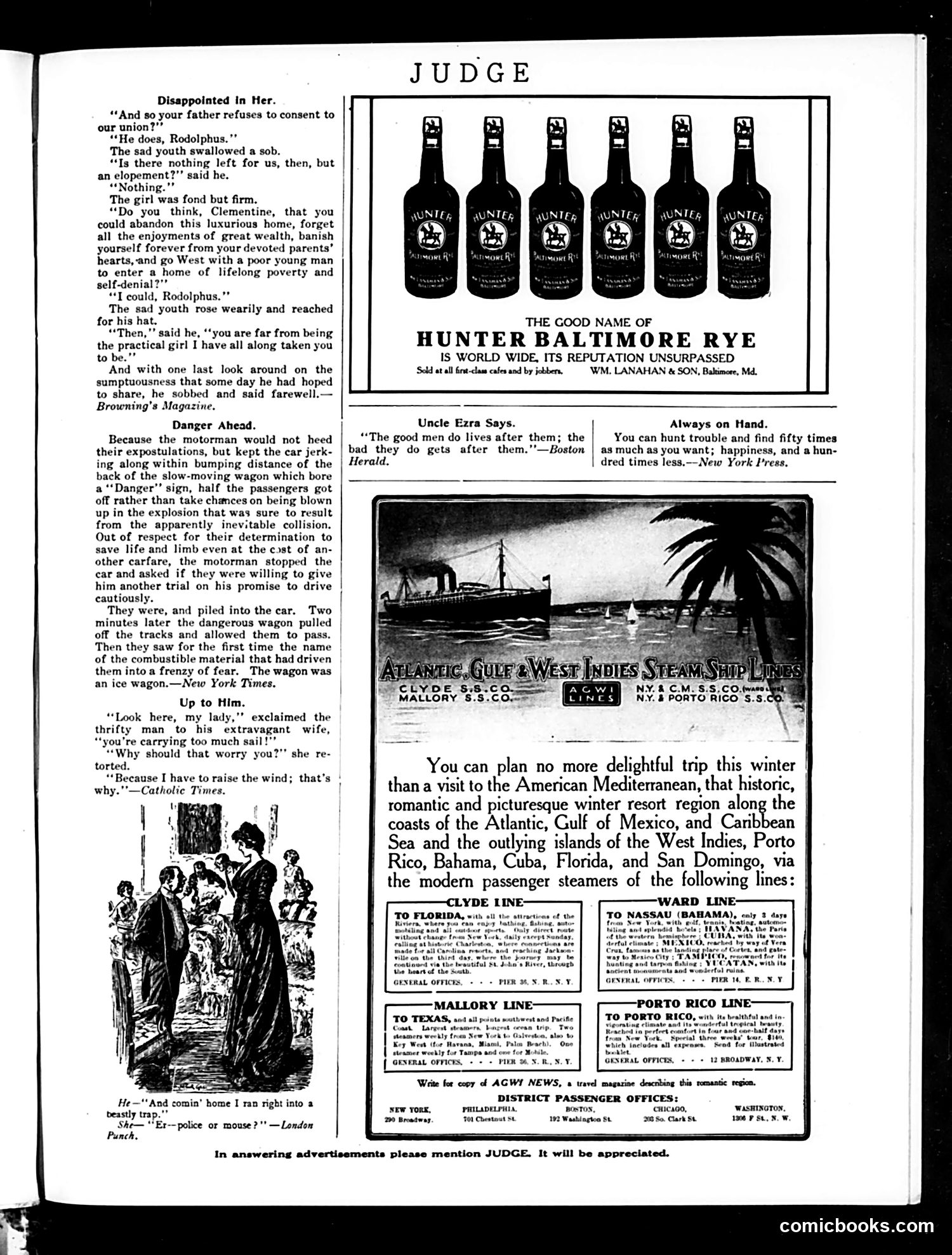
This page is primarily **advertising-driven**, featuring multiple commercial promotions rather than political satire. The dominant image showcases Hunter Baltimore Rye whiskey with six bottle illustrations and marketing copy emphasizing its "world wide" reputation. Below that, steamship line advertisements dominate—promoting Caribbean and Gulf cruises via the Clyde Line, Ward Line, and other carriers to destinations including Florida, Texas, Nassau, and Porto Rico. The left side contains brief humorous anecdotes with small illustrations, typical of Judge's filler content, but these appear to be general domestic humor rather than political commentary. **Overall assessment**: This is a commercial-heavy issue lacking significant satirical or political content. The page reflects early 20th-century magazine economics, where advertising revenue subsidized editorial material.
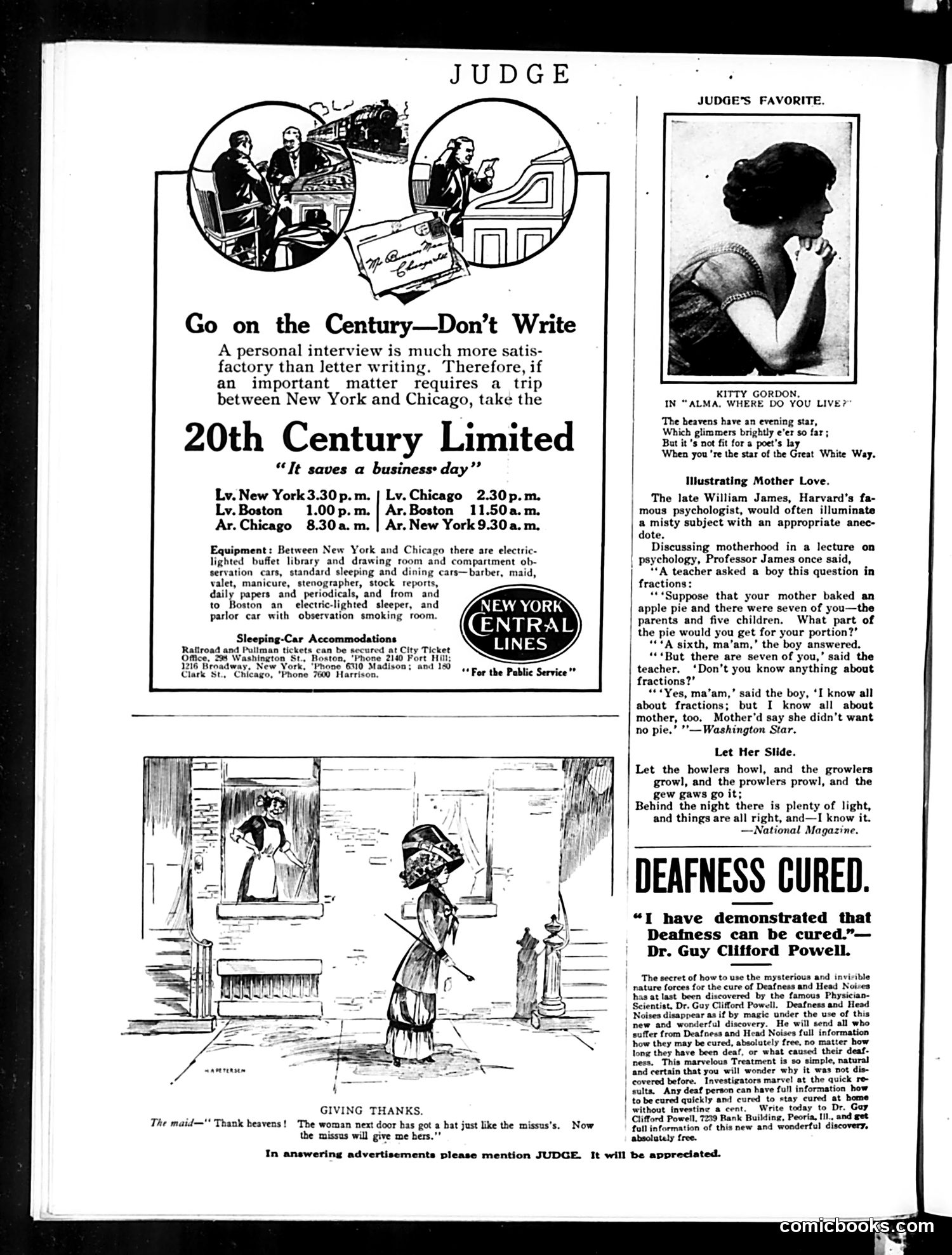
This page is primarily **advertising and filler content** rather than political satire. The main advertisement promotes the "20th Century Limited" railroad, emphasizing speed for business travel between New York and Chicago. The accompanying cartoon ("Giving Thanks") is a mild domestic joke: a maid thanks heaven that her neighbor's just-baked pie resembles the maid's own, so the neighbor will "give us hers." It's simple humor about household competition. The right column features unrelated items: a portrait of actress Kitty Gordon, a poem about nature, and a dubious medical advertisement claiming deafness can be cured. These represent typical Judge content—entertainment and questionable health claims mixed together. There is **no apparent political satire or social commentary** on this particular page.
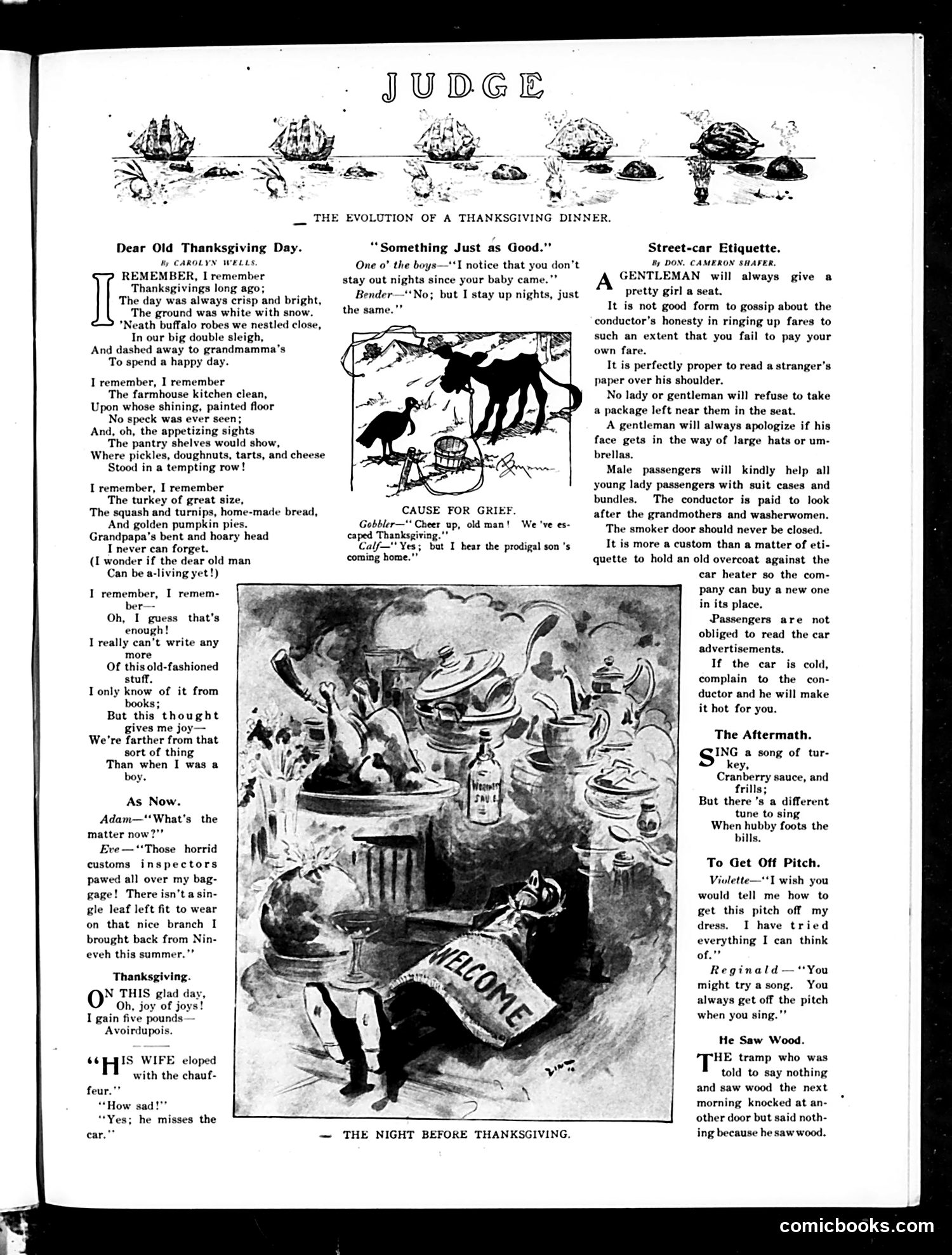
This page contains nostalgic and humorous Thanksgiving-themed content typical of early 20th-century Judge magazine. **"Dear Old Thanksgiving Day"** by Carolyn Wells is a sentimental poem recalling traditional Thanksgiving memories—farmhouse kitchens, homemade foods, family gatherings. **"The Night Before Thanksgiving"** cartoon depicts chaotic kitchen preparation, with exaggerated figures and turkeys in humorous disarray, capturing the frantic domestic scene before the holiday. The remaining sections—"Something Just as Good," "Street-car Etiquette," "The Aftermath," "To Get Off Pitch," and "He Saw Wood"—are brief humorous anecdotes about social behavior, manners, and domestic situations. These pieces satirize everyday American social conventions and family life rather than targeting specific political figures or events. The humor relies on relatability and gentle observation of contemporary domestic customs.
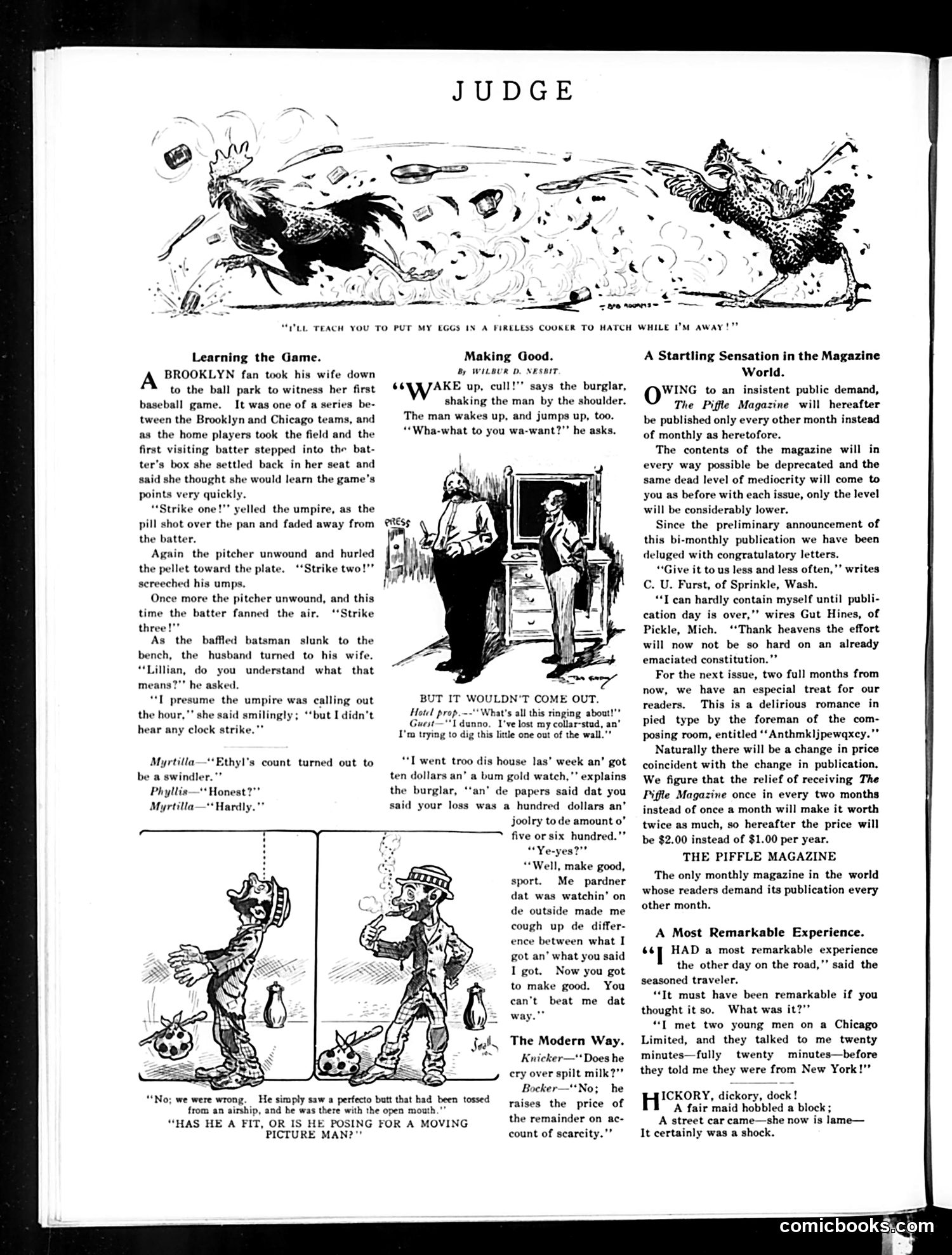
This page from Judge contains three satirical pieces mocking early 20th-century American life: **"Learning the Game"** jokes about a baseball neophyte's wife who misunderstands the umpire's strike calls as time announcements—satire of women unfamiliar with sports. **"Making Good"** presents a burglar demanding a victim compensate him for the difference between what he stole and what the victim claimed was lost—dark humor about dishonesty and criminal "business ethics." **"The Piffle Magazine" section** is self-satirical: Judge mockingly announces its fictional "Piffle Magazine" will publish *less* frequently while charging *more*, sarcastically celebrating reader complaints. This appears to be Judge poking fun at its own industry and the absurdity of magazine economics. The top cartoon shows two roosters fighting over eggs, illustrating domestic chaos. All content uses exaggeration and irony typical of Judge's satirical style, targeting contemporary social conventions and commercial practices.
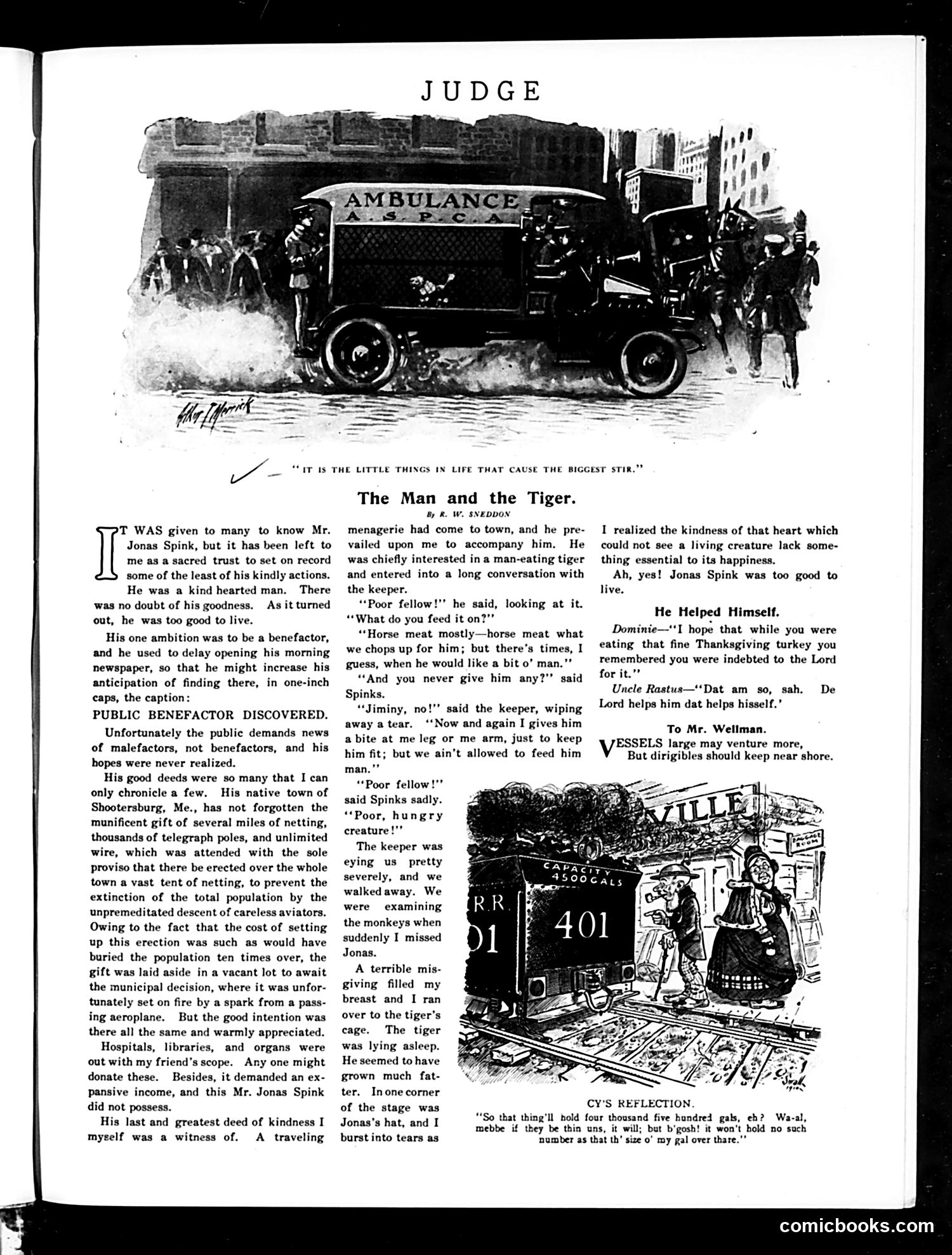
This page contains three distinct pieces of satirical humor: **"The Man and the Tiger"** (main story): A dark satire about Jonas Spink, a wealthy man desperate for public recognition as a benefactor. His comically failed schemes (a town-wide safety net that burns) reveal his vanity. The twist ending—he's eaten by a tiger while attempting his "kindest" act of feeding it human flesh—is pitch-black satire mocking performative charity and self-deluding philanthropy. **Top cartoon**: Shows an ambulance surrounded by crowds and commotion, illustrating the moral that "little things cause the biggest stir"—likely mocking sensationalism in news coverage. **Side cartoons**: Two brief pieces—one about gratitude ("Uncle Rastus"), another about a man's skepticism regarding vessel capacity—appear to be filler humor typical of Judge's satirical style. The overall tone mocks wealthy benefactors who seek public glory rather than genuine help, a common Progressive-era critique.
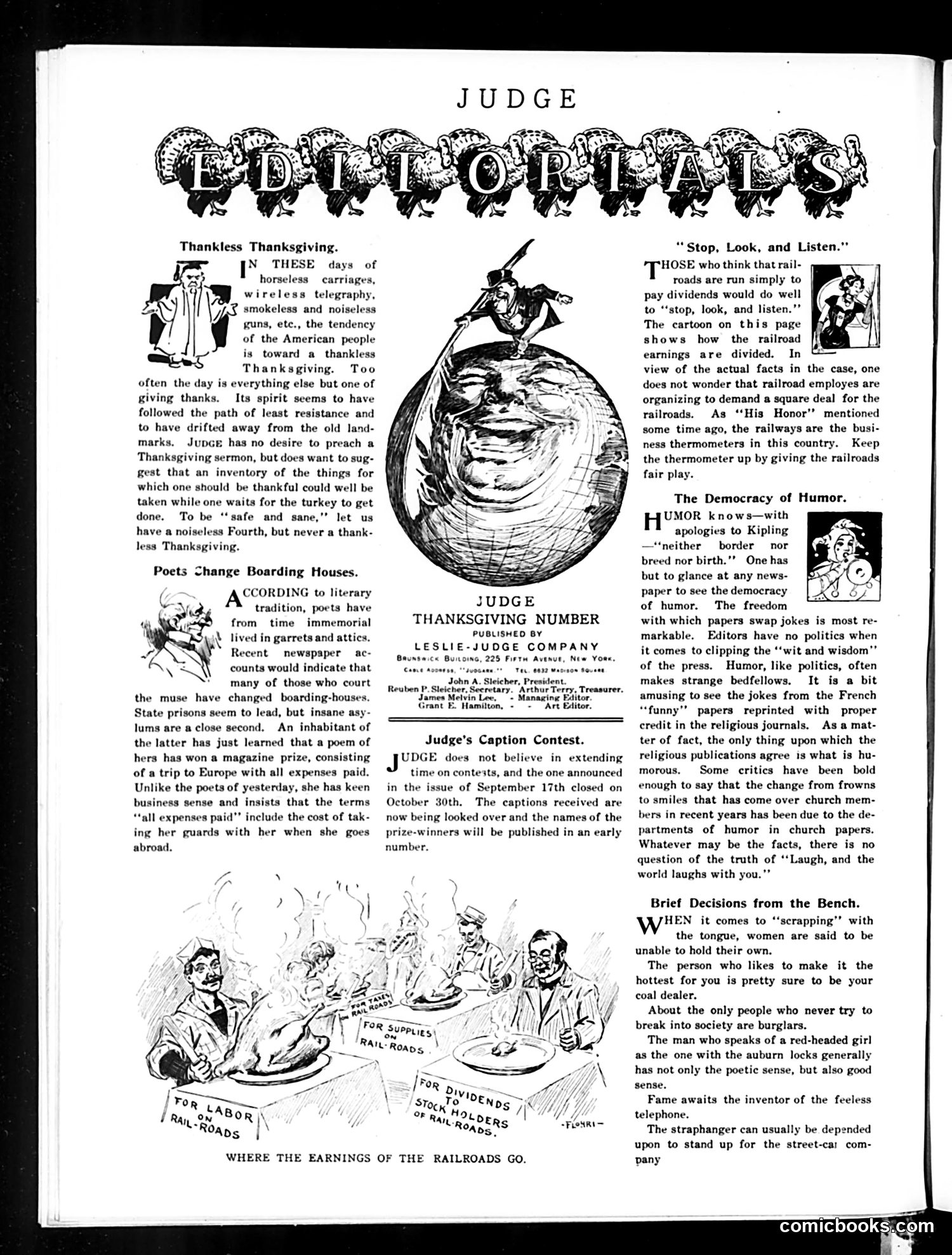
This is the Thanksgiving issue of **Judge**, a satirical American weekly. The main cartoon, "Where the Earnings of the Railroads Go," depicts railroad profits being divided among labor, dividends, supplies, and stockholders—satirizing the debate over fair distribution of railroad wealth. The accompanying editorial argues that railroad employees deserve equitable treatment and that railways serve as economic indicators ("business thermometers"). The page also includes commentary on contemporary trends: the disappearance of Bohemian poets from garrets (now in asylums and prisons), and praise for humor's democratic nature in newspapers. The "Thankless Thanksgiving" essay laments how modern Americans have lost the spiritual meaning of the holiday amid technological distractions like automobiles and wireless telegraphy. The cartoons and editorials reflect Progressive Era concerns about labor justice, corporate profits, and social change.
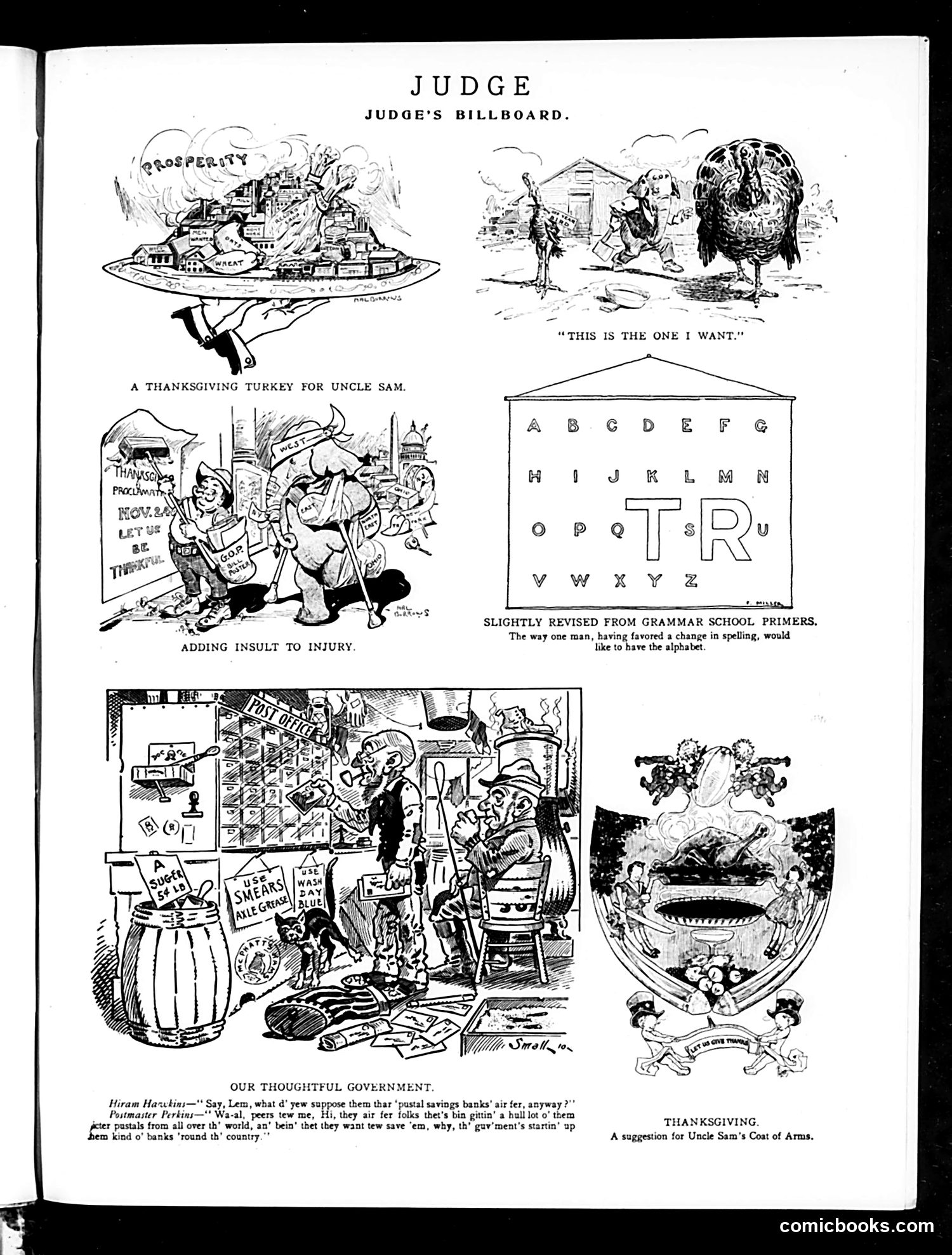
This page contains multiple political cartoons mocking American government and society circa early 1900s. **"A Thanksgiving Turkey for Uncle Sam"** ridicules protectionist tariff policies, depicting politicians as vultures fighting over Uncle Sam's resources while adding economic injury. **"Our Thoughtful Government"** satirizes the newly-established postal savings banks system through rural characters, suggesting the government created these banks merely as storage for junk mail rather than as legitimate financial institutions—a critique of government inefficiency and poor policymaking. **"Thanksgiving: A Suggestion for Uncle Sam's Coat of Arms"** proposes replacing the eagle with a shark or predatory creature, implying the U.S. government exploits its own citizens rather than protecting them. The alphabet cartoon parodies educational primers, suggesting someone's spelling reform proposals would absurdly alter fundamental institutions. Overall, Judge presents cynical views of American governance as incompetent, corrupt, and predatory toward ordinary citizens.
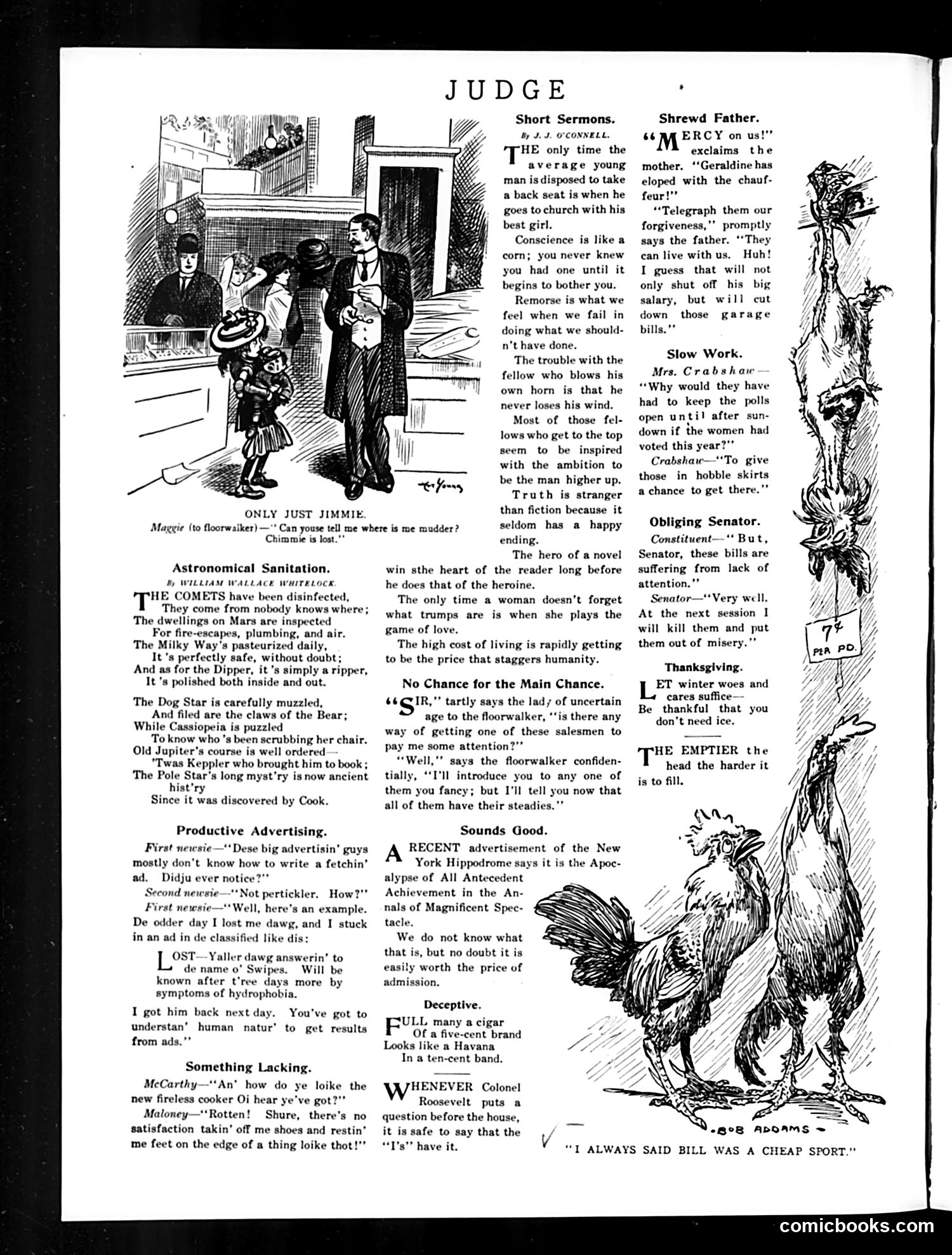
This page from *Judge* magazine contains multiple brief satirical pieces reflecting early 20th-century American humor and social commentary. **"Only Just Jimmie"** depicts working-class Irish immigrants ("Maggie," "Chimmie") in tenement life, using stereotypical dialect. **"Astronomical Sanitation"** satirizes the Progressive Era's obsession with public health reforms (sanitation, pasteurization, fire codes) by absurdly extending them to celestial bodies—mocking over-regulation. **"Productive Advertising"** and "Something Lacking"** are workplace/consumer humor about ineffective advertisements and the fireless cooker fad. **"Short Sermons"** offers conventional moral commentary on youth behavior and conscience. **"Shrewd Father"** jokes about a wealthy man's relief at losing household expenses when his daughter elopes with a chauffeur—satirizing class anxieties and domestic costs. **"Slow Work"** makes a dated reference to women's voting (likely post-1920 suffrage), implying women in restrictive "hobble skirts" slow polling procedures. The page reflects early 1900s preoccupations: class divisions, immigrant stereotypes, Progressive reforms, and emerging women's issues.
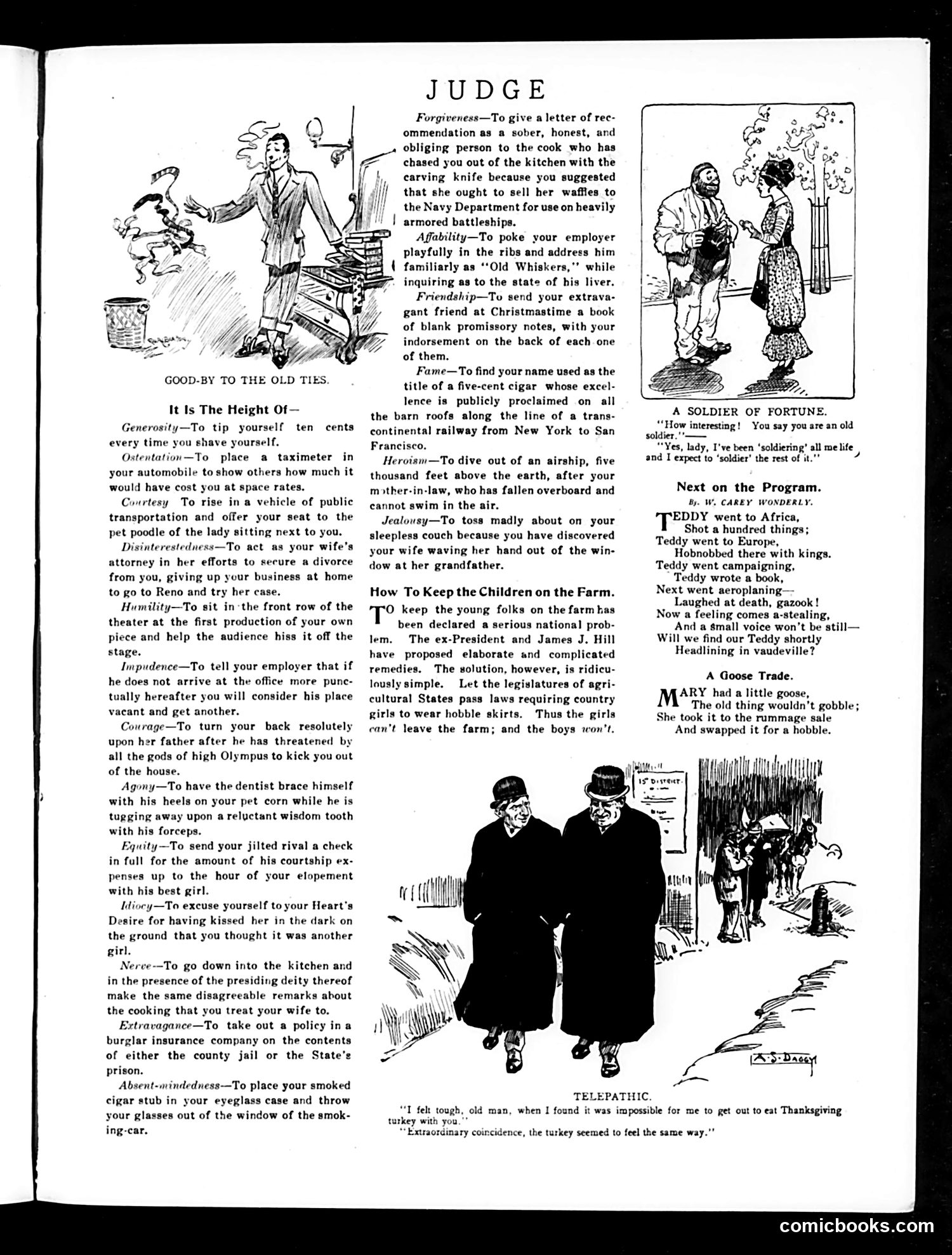
This page contains satirical humor typical of early 20th-century Judge magazine. The main content is "It Is The Height Of—," a list of humorous definitions that invert conventional virtues into absurdities. Each entry presents mock-serious takes on etiquette and morality: tipping oneself for shaving equals "Generosity"; offering your seat to a lady's pet poodle equals "Courtesy"; telling your boss he's unemployed equals "Impudence." The satire targets middle-class pretension and social hypocrisy. One entry mocks the Navy by suggesting waffles could arm battleships—contemporary military humor. The sidebar "How To Keep Children on the Farm" satirizes rural-urban migration anxieties by proposing hobble skirts (restrictive women's fashion) as a farm-retention strategy, suggesting both that girls couldn't leave and boys wouldn't want to. The cartoons show everyday social situations rendered absurd. Overall, the page satirizes American manners, gender relations, and social anxieties of the era through exaggeration and ironic inversion.
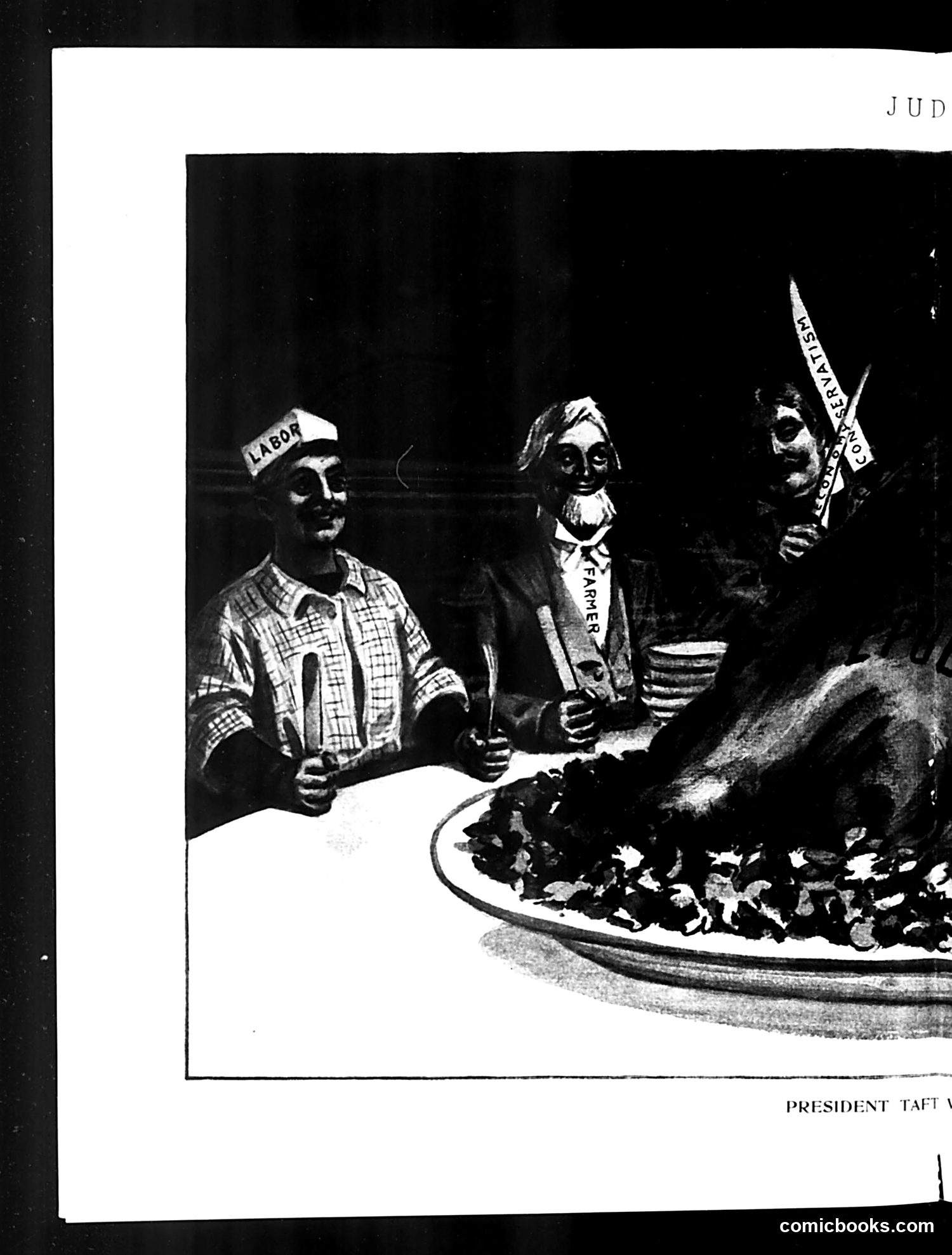
This *Judge* magazine cartoon satirizes labor disputes during President Taft's administration. Three figures wearing masks labeled "LABOR," "FARMER," and what appears to be another interest group confront a large roasted bird (likely representing prosperity or the American economy). The caption references "PRESIDENT TAFT," indicating this critiques his handling of labor and agricultural issues. The satire suggests these groups are metaphorically "carving up" or competing to divide the nation's resources. The masked figures emphasize how these interest groups hide their true intentions behind competing demands. The cartoon mocks the tension between labor movements, farming interests, and the administration during the Progressive Era, suggesting these factions were more interested in self-serving gains than national unity.
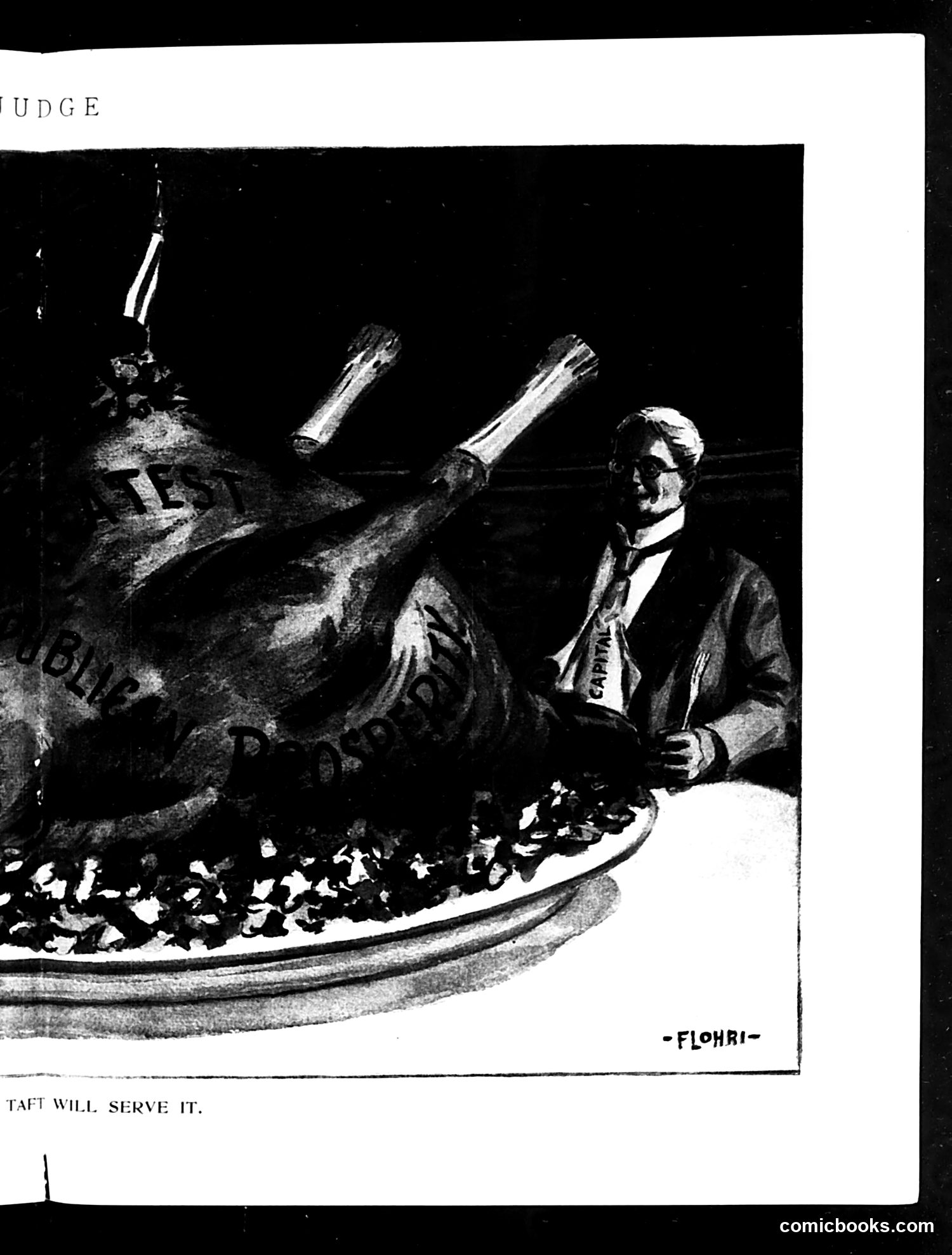
This political cartoon by Flohr depicts President William Howard Taft (identifiable by the signature and context) as a waiter serving champagne bottles to what appears to be a grotesque, demon-like figure labeled with partial text suggesting corporate or political interests (text partially obscured: "...BLI..." visible). The satire criticizes Taft's administration for serving the interests of wealthy corporations or special interests—depicted as a monstrous entity. The champagne and formal service imagery suggest Taft is catering to these powerful forces. This reflects Progressive Era critiques of Taft as insufficiently aggressive against corporate monopolies, contrasting with his predecessor Theodore Roosevelt's trust-busting reputation. The cartoon suggests the president is complicit in enriching destructive interests rather than protecting the public.
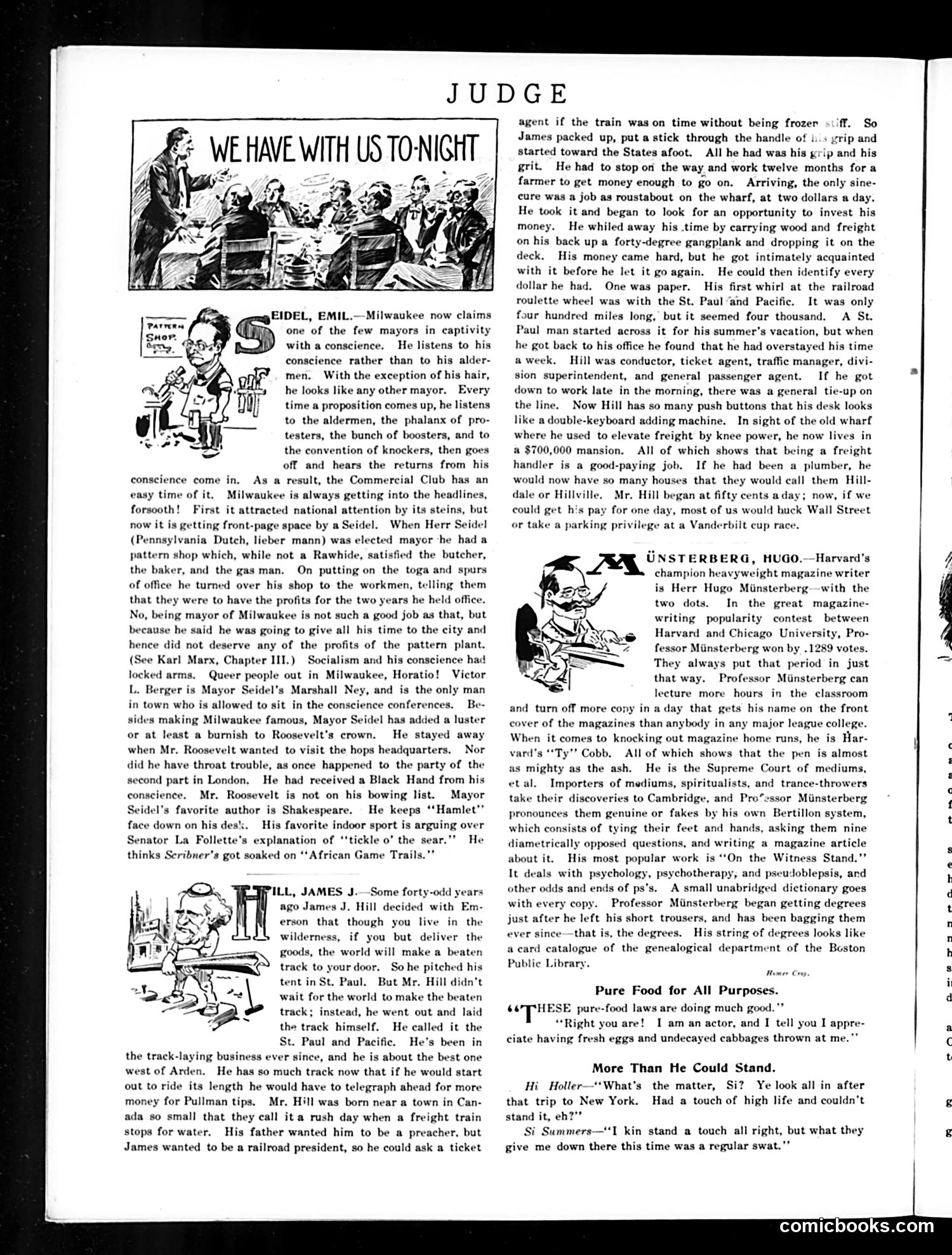
This page from Judge contains three character profiles presented as satirical "types": **Emil Seidel** (Milwaukee's mayor): Caricatured as a conscientious Socialist politician who genuinely listens to his conscience rather than corrupt aldermen. The satire is affectionate—Judge mocks his idealism while grudgingly admiring his integrity. References to Karl Marx and his refusal to profit from his pattern shop emphasize his socialist principles. Victor Berger is mentioned as his ally. **Hugo Munsterberg** (Harvard psychologist): Depicted as a prolific academic who wins magazine writing contests and produces self-help literature with dubious claims about psychology and spirituality. **James J. Hill** (railroad magnate): Presented as a self-made industrialist who built the St. Paul and Pacific railroad empire through relentless work, starting as a poor immigrant. The humor lies in his determination to ask ticket agents about train schedules—his childhood motivation. The cartoons use exaggerated caricatures and biographical anecdotes typical of Judge's irreverent approach to American public figures and social types of the era.
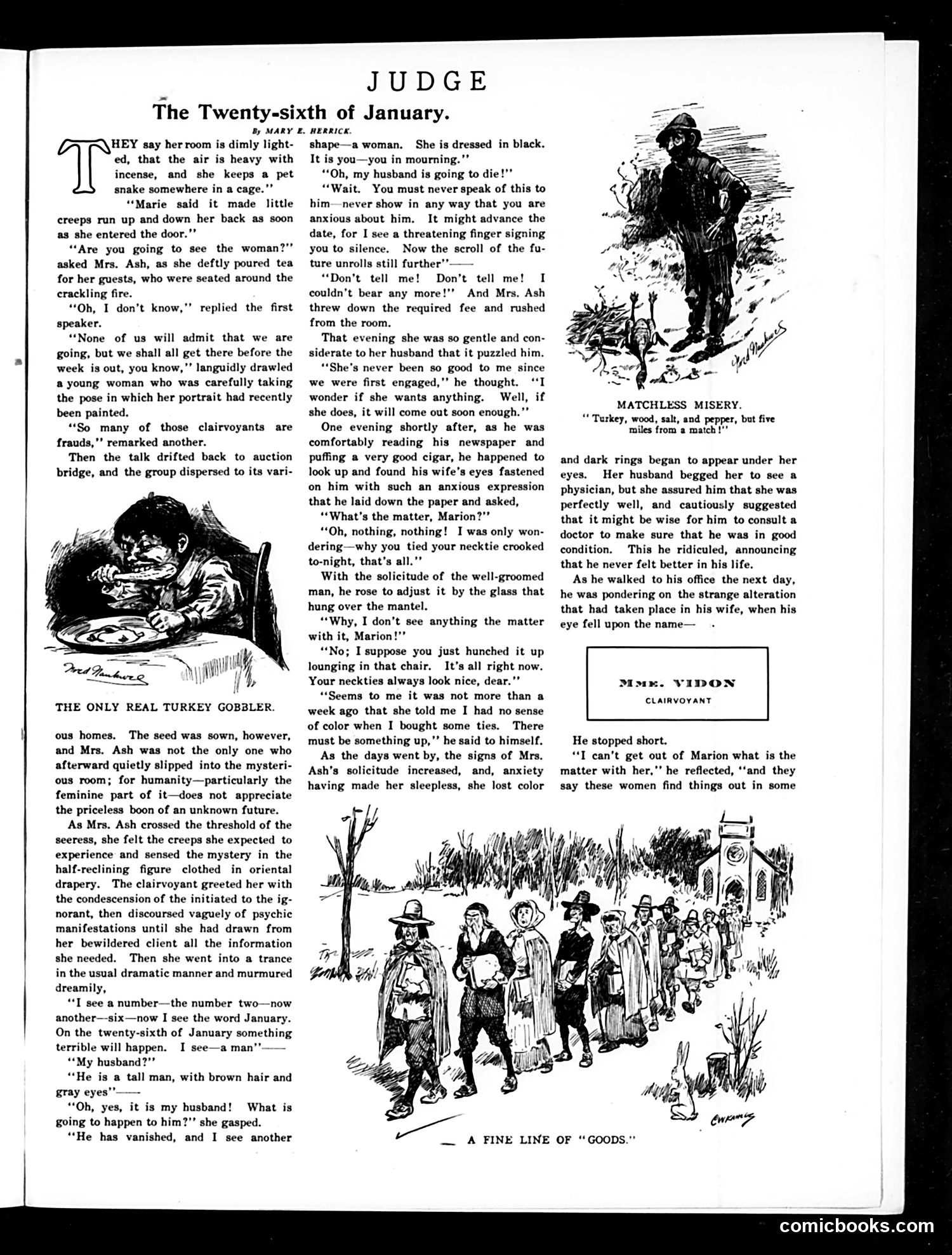
This story satirizes the credulity of upper-class women toward fortune tellers and spiritualism. Mrs. Ash visits a clairvoyant (labeled "Mrs. Vidon") who, using cold-reading techniques, extracts personal details from her client, then vaguely predicts her husband's "vanishing" on January 26th while she enters mourning. The satire works on two levels: first, mocking the clairvoyant's transparent fraud (the generic predictions, the theatrical "trance"), and second, ridiculing Mrs. Ash's gullibility and anxious obsession with the prediction. Her sudden excessive kindness to her husband puzzles him, particularly when she finds fault with his neckties—a reversal of her previous complaint about his taste—revealing her anxiety is warping her behavior. The accompanying cartoons mock related follies: the "turkey gobbler" references charlatans, while "A Fine Line of Goods" depicts a procession, likely representing victims streaming to fraudulent spiritualists. The piece critiques both female suggestibility and the thriving spiritualist movement.
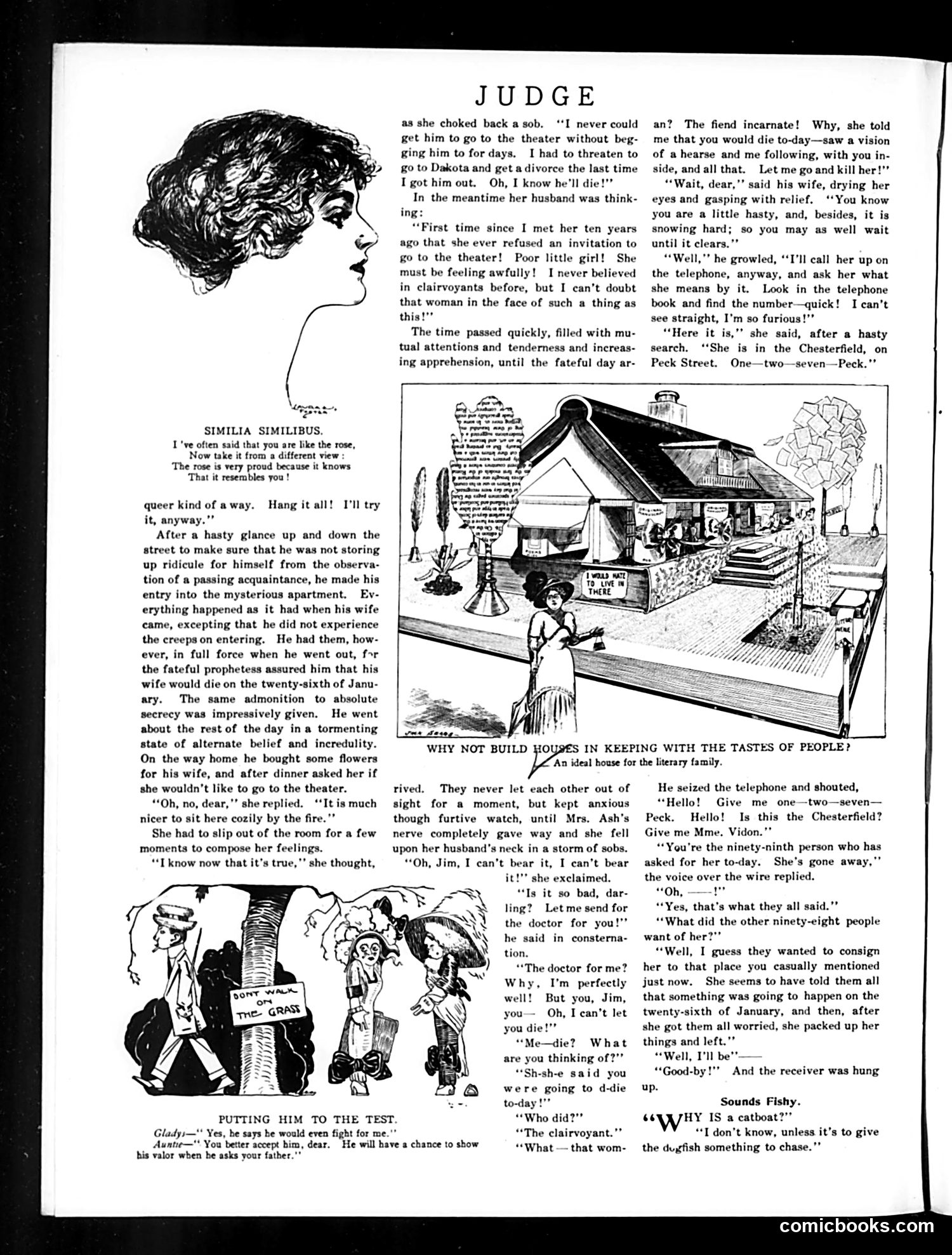
This page satirizes the credulity of people who consult clairvoyants and fortune-tellers. A husband and wife each separately visit a psychic who predicts one of them will die on January 26th. Neither tells the other, so both spend days in anxious tenderness, each believing *they* will die and the other will survive them. When the truth emerges—via a frantic phone call—the irony is complete: the prediction was entirely fabricated, yet it briefly transformed their relationship through mutual concern. The satire targets early 20th-century spiritualism fads and gullibility, showing how superstition creates emotional chaos. The secondary cartoons mock courtship rituals and literary pretension. Judge's social commentary here is straightforward: don't believe charlatans, and appreciate what you have before invented catastrophes.
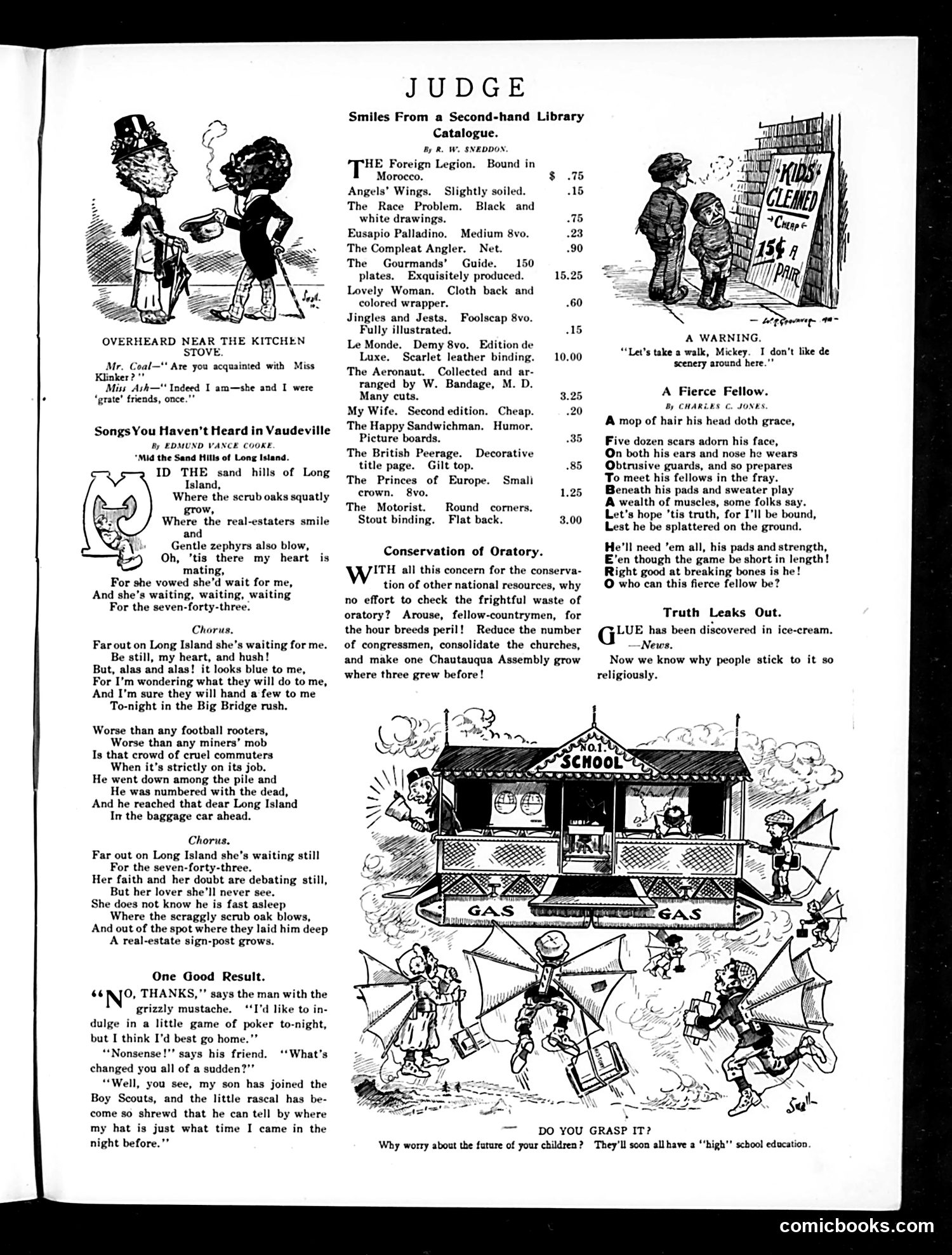
This page contains multiple satirical pieces typical of early 20th-century American humor: **"Overheard Near the Kitchen Stove"**: A pun-based joke where "Miss Klinker" and "Miss Ash" (personified coal-related objects) are "grate friends"—playing on heating-fuel terminology. **"Songs You Haven't Heard in Vaudeville"**: A darkly comic poem about Long Island commuter rail tragedy. It mocks the romantic fantasy of waiting on Long Island while satirizing the brutal reality of the "Big Bridge rush"—a deadly commuter crowd. The final verse reveals the lover dies in the rush and is shipped home in a baggage car, with a real-estate sign eventually marking his grave. This critiques both dangerous commuting conditions and aggressive real-estate development consuming the landscape. **Other pieces**: Include gentle humor about Boy Scouts catching a father sneaking home late, and a satirical "library catalog" making puns on book titles (e.g., "My Wife. Second edition. Cheap"). **The school building cartoon**: Depicts children playing around a gas-powered schoolhouse, likely commenting on new educational technology or infrastructure. The overall tone reflects Progressive Era concerns: urban crowding, industrial danger, and social change.
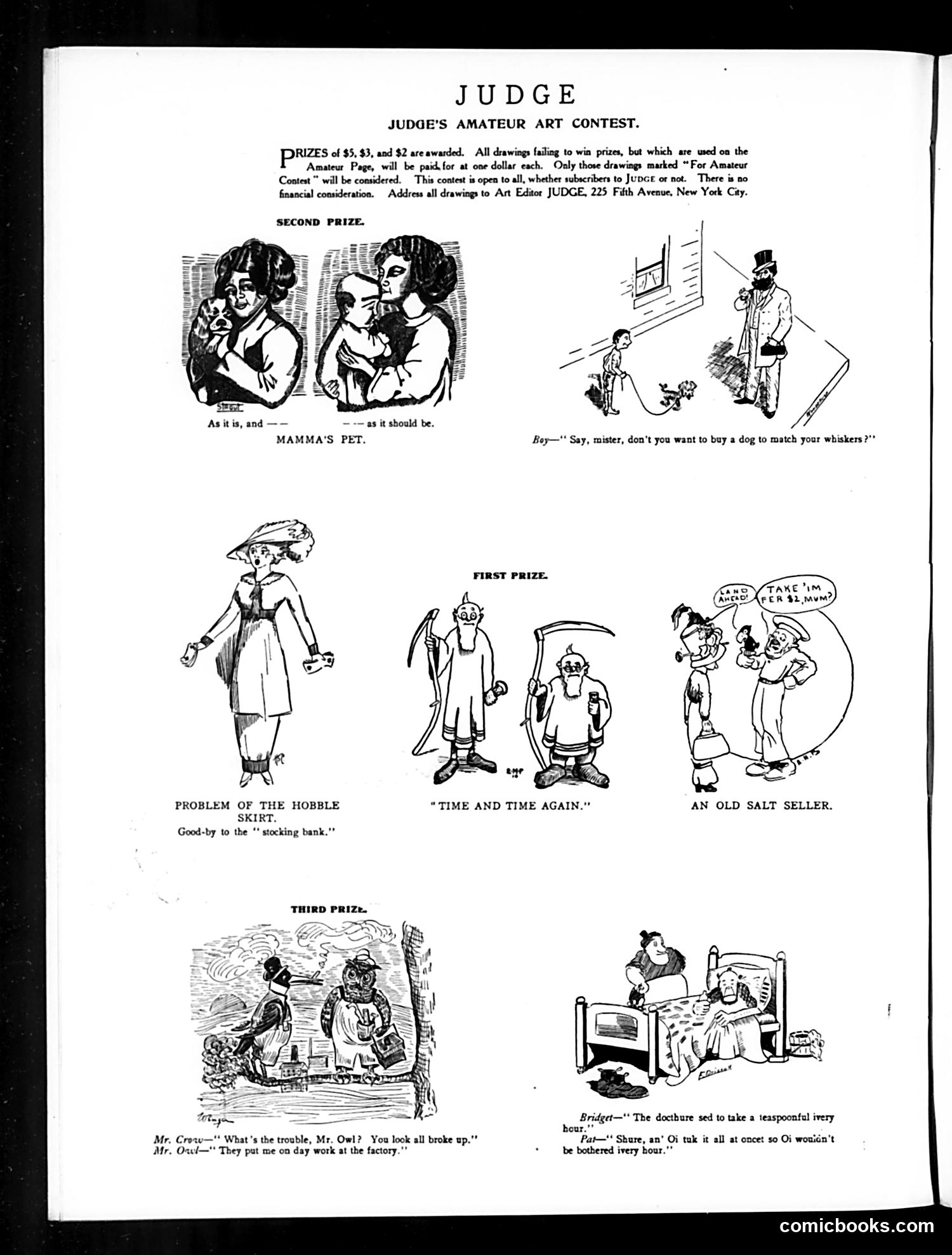
This page showcases winning entries from Judge's amateur art competition, offering monetary prizes ($5, $3, $2) for reader submissions. The cartoons represent early 20th-century social humor targeting contemporary concerns. "Mamma's Pet" satirizes indulgent parenting—contrasting an overly coddled child with how children "should be." "Problem of the Hobble Skirt" mocks the restrictive fashion trend by showing a woman awkwardly constrained. "Time and Time Again" depicts what appears to be a reaper figure, likely referencing death's inevitability. "An Old Salt Seller" jokes about a street vendor selling dogs to match customers' facial hair—absurdist humor. The Irish domestic servant (Bridget) misinterprets medical instructions, drinking an entire dose at once to avoid repeated doses—a common stereotype joke format of the era. These amateur submissions reflect period anxieties: fashion absurdities, parenting philosophies, mortality, and Irish immigrant humor typical of Judge's satirical approach.
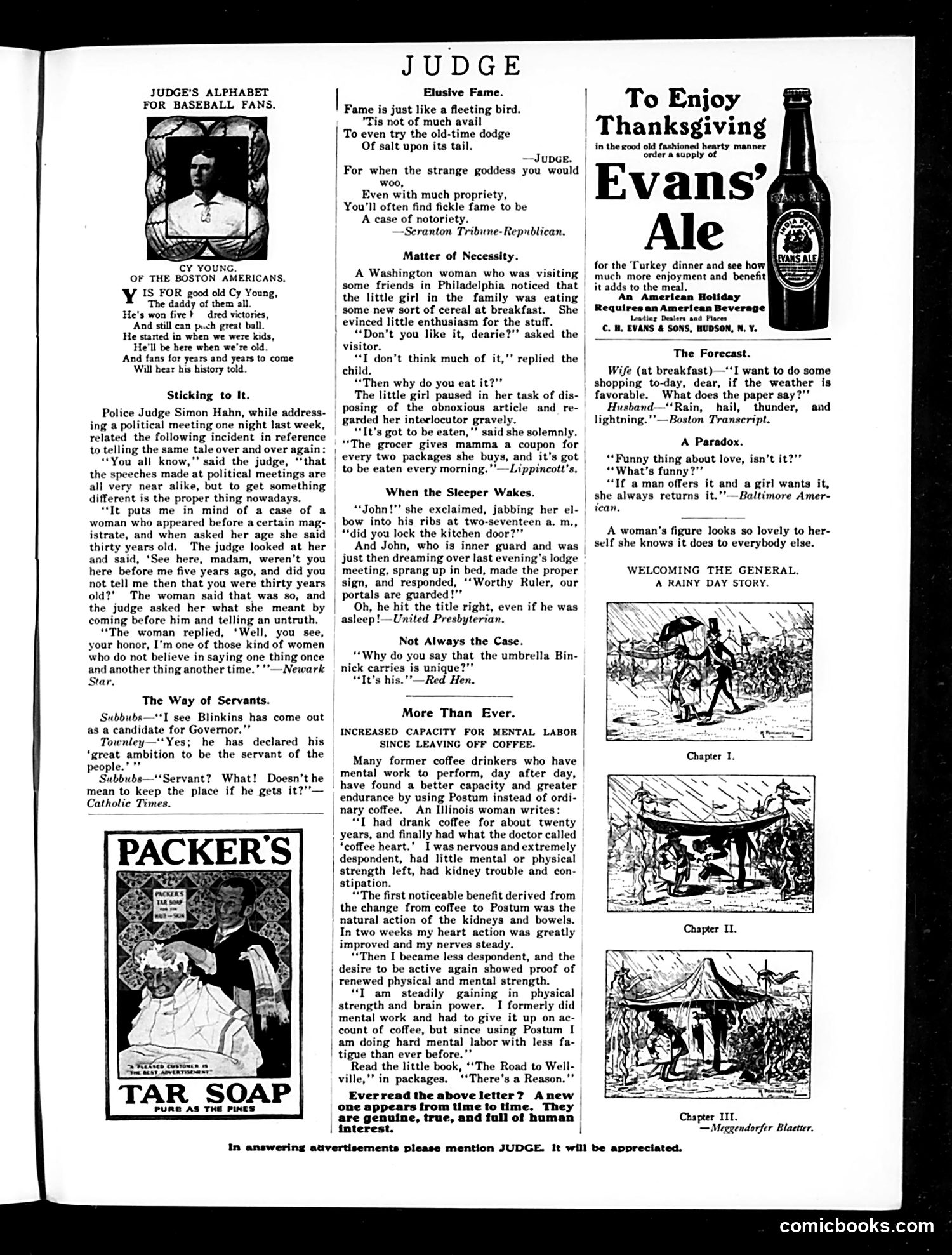
This page from *Judge* magazine (date unclear from image) contains several satirical pieces and advertisements typical of early 20th-century American humor: **"Cy Young" Baseball Tribute**: Celebrates the real baseball player Cy Young of the Boston Americans, known for his prolific winning record. This is straightforward fan appreciation rather than satire. **Political Anecdotes**: Multiple brief satirical pieces mock repetitive political speeches, servant-politicians who exploit their positions despite claiming public service, and everyday absurdities (a child forced to eat cereal because her mother collects grocer coupons for volume purchases). **"When the Sleeper Wakes"**: Humorous anecdote about a drowsy husband responding to his wife's security question with lodge fraternity terminology instead of actual reassurance—satire of men's distraction and ritualistic fraternal culture. **Postum Advertisement**: The page concludes with testimonial advertising Postum (caffeine-free coffee substitute) as superior to coffee for mental work and health—reflecting early 1900s health-consciousness and patent medicine culture. The overall tone reflects *Judge's* trademark gentle social satire targeting everyday foibles rather than hard political targets.
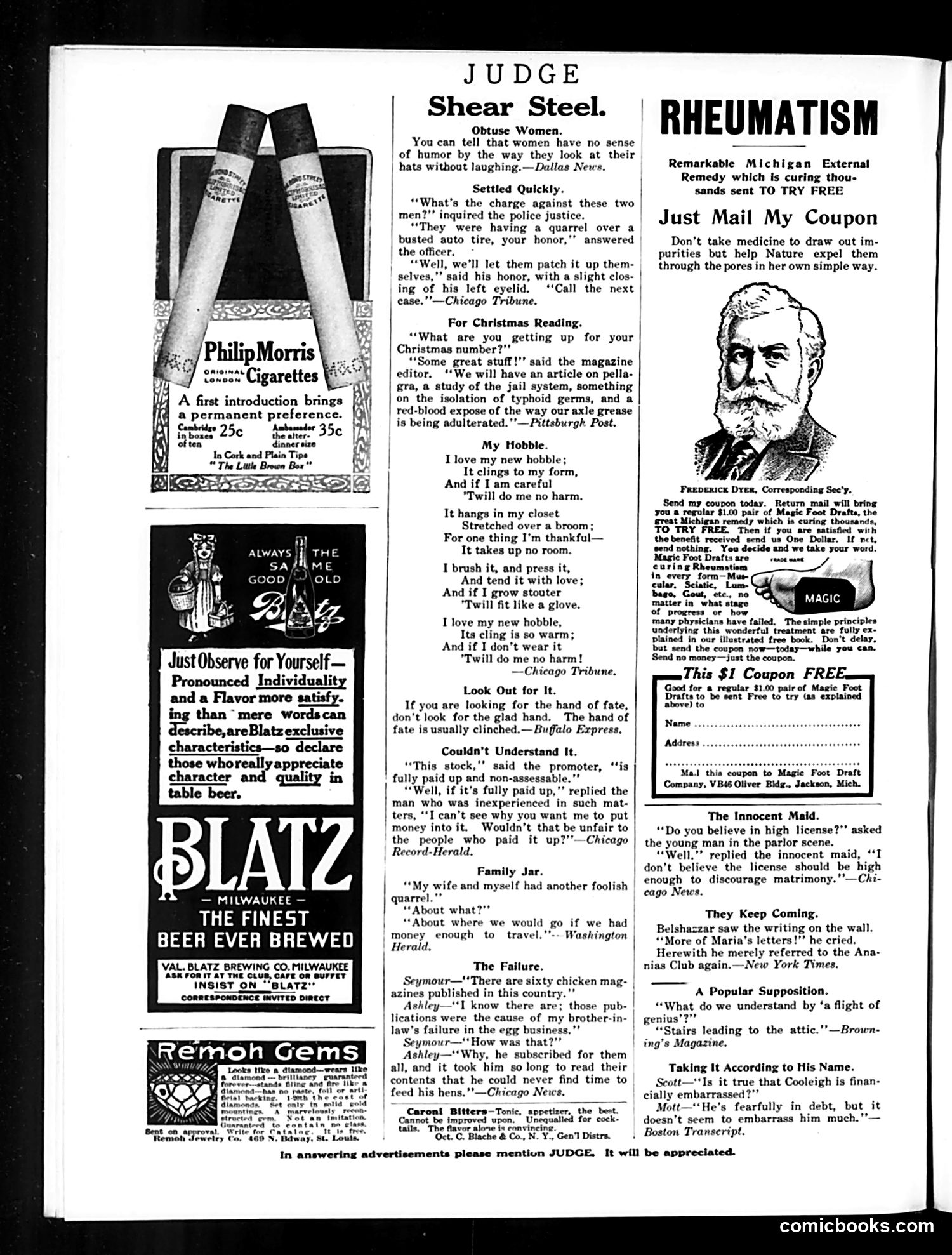
This is primarily an **advertising and humor section** from Judge magazine, a satirical publication. The page contains: **Main Content:** - Several brief humorous anecdotes under headings like "Shear Steel" and "Settled Quickly," typical of Judge's satirical format—short jokes poking fun at contemporary society - A poem about a "hobble" (likely referencing the hobble skirt, a restrictive women's fashion of the 1910s-1920s), humorously presented as something one hangs in a closet - Advertisements for Philip Morris cigarettes, Blatz beer, and a "Magic Foot Drafts" rheumatism remedy **The Satire:** The page mocks women's fashion sense, bureaucratic indifference, and contemporary magazine content (including sensationalism about disease). The "hobble" poem satirizes restrictive women's fashions by presenting the garment as a storage item rather than clothing. **Historical Context:** The advertising reflects early 20th-century concerns (rheumatism remedies, cigarettes), while the humor reflects Judge's role as a publication for educated, middle-class readers who appreciated gentle social commentary.
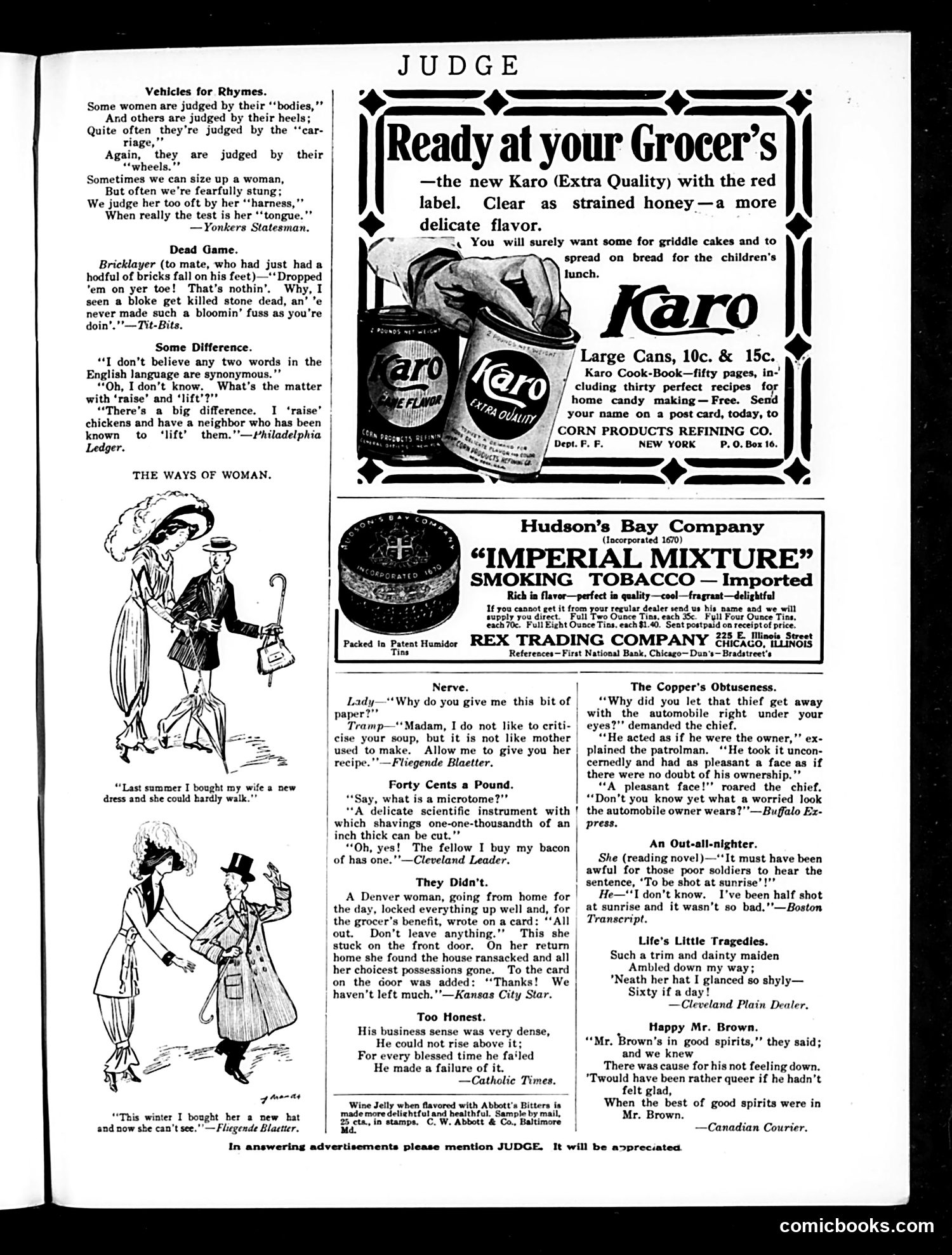
This page from *Judge* magazine combines humorous anecdotes with period advertisements. The left side features short satirical pieces about gender and class, typical of early 20th-century humor: **"The Ways of Woman"** cartoons mock wives through visual gags—a woman unable to walk in a new dress, unable to see in a new hat—playing on stereotypes about female vanity and impracticality. **The textual jokes** satirize working-class speech ("Bricklayer"), mock women's judgment and materialism ("judged by their cars," "harness"), and play on linguistic ambiguities ("raise" vs. "lift" chickens—the neighbor steals them). **The advertisements**—Karo syrup, Hudson's Bay tobacco, Abbott's Bitters—represent period consumer products pitched to middle-class households. Overall, the humor reflects early 1900s attitudes: patronizing toward women, class-conscious, and reliant on wordplay and domestic scenarios familiar to *Judge's* educated male readership.
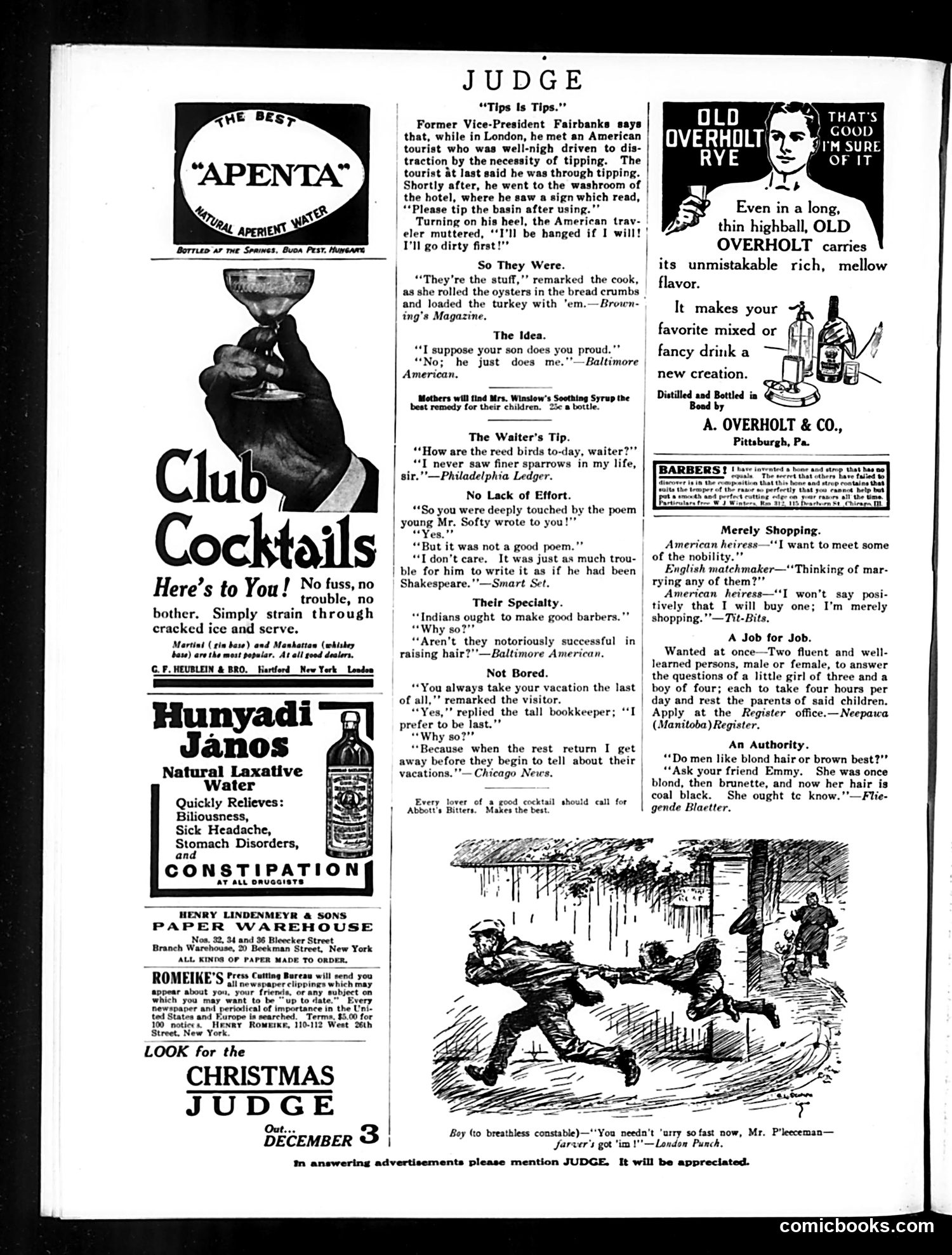
This page is primarily **advertisements and humor filler** from Judge magazine, a satirical weekly. The content consists of: **Advertisements** for cocktails, laxatives, paper goods, and whiskey—typical period products. **Short humor pieces** (the "Judge" section)—brief jokes playing on contemporary social anxieties: - American tourists struggling with British tipping etiquette - Class humor about servants and social pretension - Gender dynamics (American heiresses "shopping" for English nobility to marry) - Workplace absurdities **The cartoon** (bottom) depicts a constable chasing a boy who's fleeing, likely illustrating a London Punch joke about street mischief. The satire targets **Edwardian-era social conventions**: rigid class systems, transatlantic cultural friction, marriage markets, and workplace formality. The humor assumes readers recognize these social structures and find them ridiculous. This isn't political satire but rather **light social commentary**—the magazine's filler content designed for middle-class readers familiar with these scenarios.
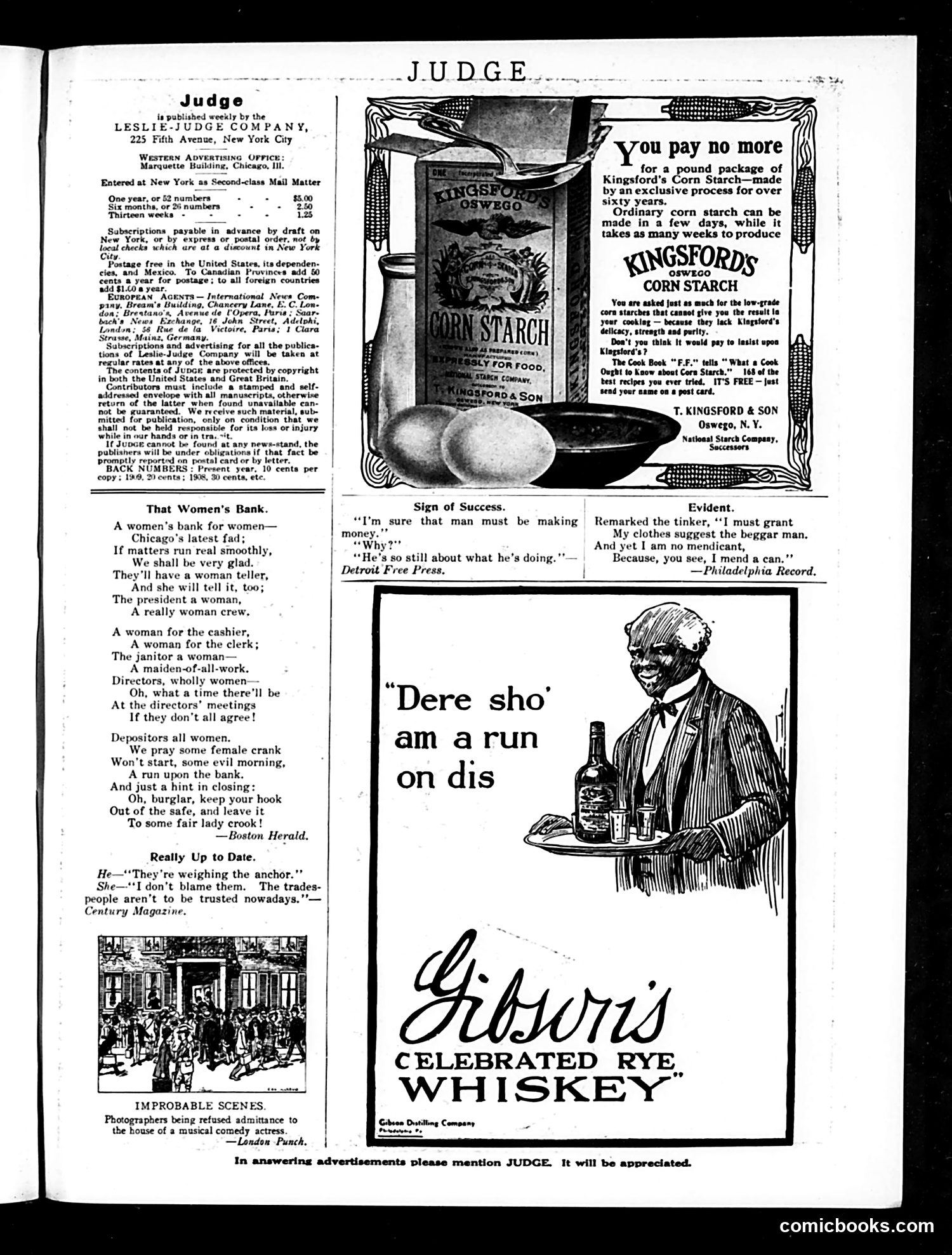
This page contains **mostly advertisements and miscellaneous editorial content** rather than political cartoons. **Key content:** The **Kingsford's Corn Starch ad** (top right) emphasizes the product's superiority and 60-year exclusivity—a pitch to quality-conscious housewives. The **Gibson's Whiskey ad** (bottom) features a man in shabby clothes with a bottle, using dialect ("Dere sho' am a run on dis") for comic effect. This likely plays on stereotypes common to early 1900s advertising. **Poetry and jokes** include "That Women's Bank" (satirizing Chicago's new women-only bank, humorously warning of potential chaos), and brief quips about modern life. The **"Improbable Scenes"** caption jokes about photographers being denied access to a musical actress's home—reflecting early 20th-century celebrity culture anxieties. **Overall:** This is a typical Judge page mixing advertising, light humor, and social commentary rather than sharp political satire. The tone is genteel and consumer-focused rather than investigative.
This appears to be an advertisement page rather than a political cartoon. The main image shows a stylized figure in formal attire (tuxedo with studs) holding what appears to be a product box labeled "ARCADIA PIPE MIXTURE" (visible on the right side). The figure is drawn in an exaggerated, cartoonish style typical of early 20th-century advertising. The text promotes this as a gift suggestion—"Just the Present from YOU to HIM!"—marketed through the Surburg Company. The price of $2.00 is mentioned, along with availability "at your dealer's" on Washington Street, New York. Rather than satire, this is straightforward commercial advertising using humor and caricature to sell tobacco pipe mixture to male consumers during an era when such products were heavily advertised in magazines like Judge.