
Judge, 1910-11-19 · page 14 of 24
Judge — November 19, 1910 — page 14: what you’re looking at
What you’re looking at
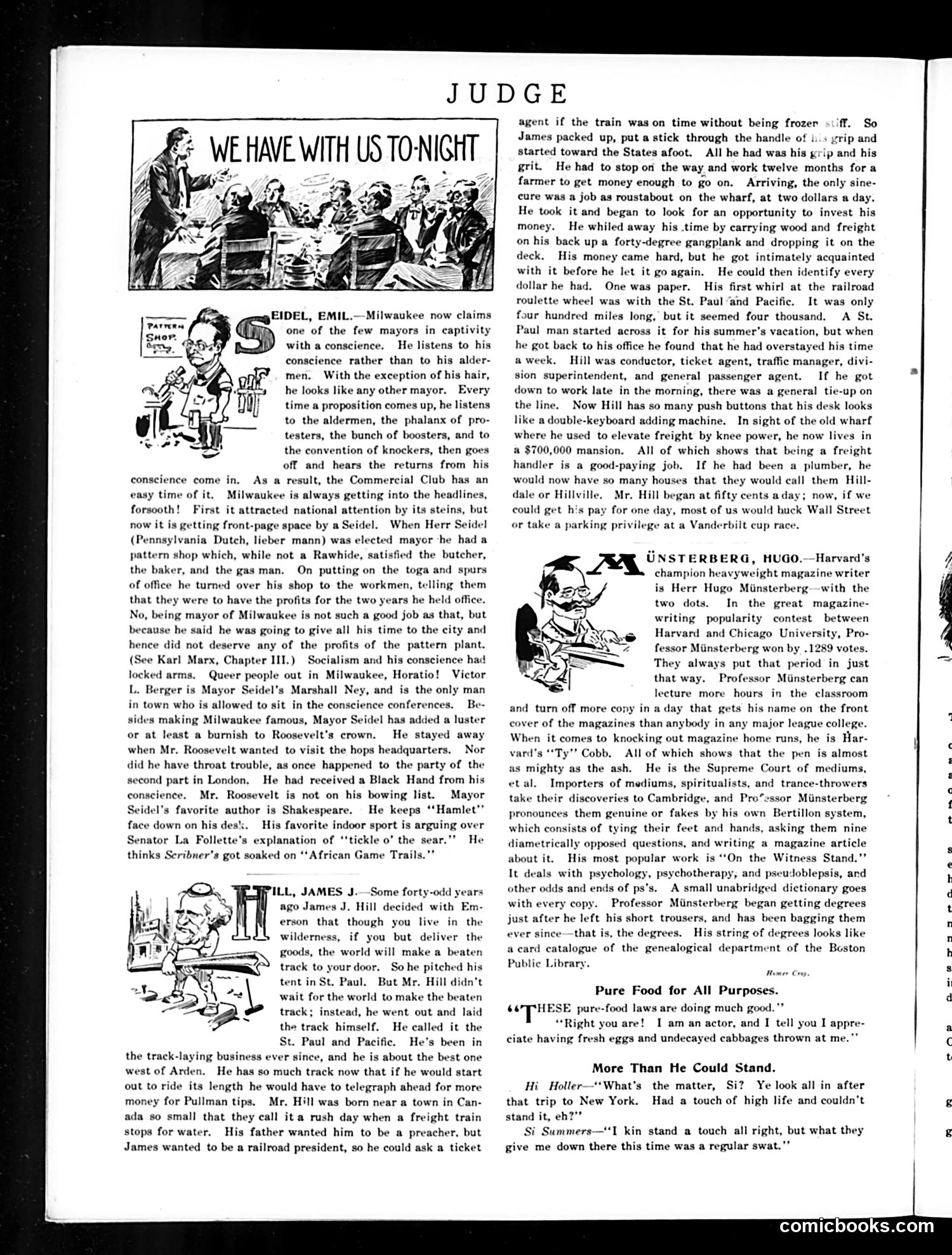
This page from Judge contains three character profiles presented as satirical "types": **Emil Seidel** (Milwaukee's mayor): Caricatured as a conscientious Socialist politician who genuinely listens to his conscience rather than corrupt aldermen. The satire is affectionate—Judge mocks his idealism while grudgingly admiring his integrity. References to Karl Marx and his refusal to profit from his pattern shop emphasize his socialist principles. Victor Berger is mentioned as his ally. **Hugo Munsterberg** (Harvard psychologist): Depicted as a prolific academic who wins magazine writing contests and produces self-help literature with dubious claims about psychology and spirituality. **James J. Hill** (railroad magnate): Presented as a self-made industrialist who built the St. Paul and Pacific railroad empire through relentless work, starting as a poor immigrant. The humor lies in his determination to ask ticket agents about train schedules—his childhood motivation. The cartoons use exaggerated caricatures and biographical anecdotes typical of Judge's irreverent approach to American public figures and social types of the era.
📄 Transcribed text from this page (OCR, searchable)
Machine-transcribed from the original scan — historical spelling and the odd misread are preserved.
JUDGE EIDEL, EMIL.—Milwaukee now claims one of the few mayors in captivity with a conscience. He listens to his conscience rather than to his alder- men. With the exception of his hair, he looks like any other mayor. Every time a proposition comes up, he listens to the aldermen, the phalanx of pro- testers, the bunch of boosters, and to the convention of knockers, then goes off and hears the returns from his conscience come in. As a result, the Commercial Club has an easy time of it. Milwaukee is always getting into the headlines, forsooth! First it attracted national attention by its steins, but now it is getting front-page space by a Seidel. When Herr Seidel (Pennsylvania Dutch, lieber mann) was elected mayor ‘he had a pattern shop which, while not a Rawhide, satisfied the butcher, the baker, and the gas man. On putting on the toga and spurs of office he turned over his shop to the workmen, telling them that they were to have the profits for the two years he held office. No, being mayor of Milwaukee is not such a good job as that, but because he said he was going to give all his time to the city and hence did not deserve any of the profits of the pattern plant. Karl Marx, Chapter III.) Socialism and his conscience had Queer people out in Milwaukee, Horatio! Victor L. Berger is Mayor Seidel’s Marshall Ney, and is the only man in town who is allowed to sit in the conscience conferences. Be- sides making Milwaukee famous, Mayor Seidel has added a luster or at least a burnish to Roosevelt's crown. He stayed away when Mr. Roosevelt wanted to visit the hops headquarters. Nor did he have throat trouble, as once happened to the party of the second part in London. He had received a Black Hand from his conscience. Mr. Roosevelt is not on his bowing list. Mayor Seidel's favorite author is Shakespeare. He keeps ‘‘Hamlet’’ face down on his de: His favorite indoor sport is arguing over Senator La Follette’s explanation of ‘‘tickle o’ the sear."" He thinks Scribner's got soaked on ‘‘African Game Trails."" ILL, JAMES J.-Some forty-odd years ago James J. Hill decided with Em- erson that though you live in the wilderness, if you but deliver the goods, the world will make a beaten track to yourdoor. So he pitched his tent in St. Paul. But Mr. Hill didn’t wait for the world to make the beaten track; instead, he went out and laid the track himself. He called it the St. Paul and Pacific. He’s been in the track-laying business ever since, and he is about the best one west of Arden. He has so much track now that if he would start out to ride its length he would have to telegraph ahead for more money for Pullman tips. Mr. Hill was born near a town in Can- ada so small that they call it a rush day when a freight train stops for water. His father wanted him to be a preacher, but James wanted to be a railroad president, so he could ask a ticket agent if the train was on time without being frozer =: iff. So James packed up, put a stick through the handle of i.s yrip and started toward the States afoot. All he had was his grip and his grit. He had to stop on the way and work twelve months for a farmer to get money enough to go on. Arriving, the only sine- cure was a job as roustabout on the wharf, at two dollars a day. He took it and began to look for an opportunity to invest his money. He whiled away his time by carrying wood and freight on his back up a forty-degree gangplank and dropping it on the deck. His money came hard, but he got intimately acquainted with it before he let it go again. He could then identify every dollar he had. One was paper. His first whirl at the railroad roulette wheel was with the St. Paul “and Pacific. It was only four hundred miles long, but it seemed four thousand. A St. Paul man started across it for his summer's vacation, but when he got back to his office he found that he had overstayed his time a week. Hill was conductor, ticket agent, traffic manager, divi- sion superintendent, and general passenger agent. If he got down to work late in the morning, there was a general tie-up on the line. Now Hill has so many push buttons that his desk looks like a double-keyboard adding machine. In sight of the old wharf where he used to elevate freight by knee power, he now li in & $700,000 mansion. All of which shows that being a freight handler is a good-paying job. If he had been a plumber, he would now have so many houses that they would call them Hill- dale or Hillville. Mr. Hill began at fifty cents aday; now, if we could get his pay for one day, most of us would buck Wall Street or take a parking privilege at a Vanderbilt cup race. STERBERG, HUGO.—Harvard’s champion heavyweight magazine writer is Herr Hugo Minsterberg-—with the two dots. In the great magazine- writing popularity contest between Harvard and Chicago University, Pro- fessor Minsterberg won by .1289 votes. They always put that period in just Professor Minsterberg can hours in the classroom that way. lecture more and turn off more copy in a day that gets his name on the front cover of the magazines than anybody in any major league college. When it comes to knocking out magazine home runs, he is Har- vard's ‘‘Ty’’ Cobb. All of which sho’ that the pen is almost as mighty as the ash. He is the Supreme Court of mediums, etal. Importers of mediums, spiritualists, and trance-throwers take their discoveries to Cambridge, and Pro’essor Miinsterberg pronounces them genuine or fakes by his own Bertillon system, which consists of tying their feet and hands, asking them nine diametrically opposed questions, and writing a magazine article about it, His most popular work is ‘On the Witness Stand.” It deals with psychology, psychotherapy, and pseudoblepsis, and other odds and ends of ps’s. A small unabridged dictionary goes with every copy. Professor Miinsterberg began getting degrees just after he left his short trousers, and has been bagging them ever since—that is, the degrees. His string of degrees looks like acard catalogue of the genealogical department of the Boston Public Library. Homer Cop. Pure Food for All Purposes. (OT HESE pare-food laws are doing much good.”* “Right you are! I am an actor, and I tell you I appre- ciate having fresh eggs and undecayed cabbages thrown at me."’ More Than He Could Stand. Hi Holler—‘What’s the matter, Si? Ye look all in after that trip to New York. Had a touch of high life and couldn't stand it, eh?”” Si Summers—“1 kin stand a touch all right, but what they give me down there this time was a regular swat."” comicbooks.com