
Judge, 1910-11-19 · page 5 of 24
Judge — November 19, 1910 — page 5: what you’re looking at
What you’re looking at
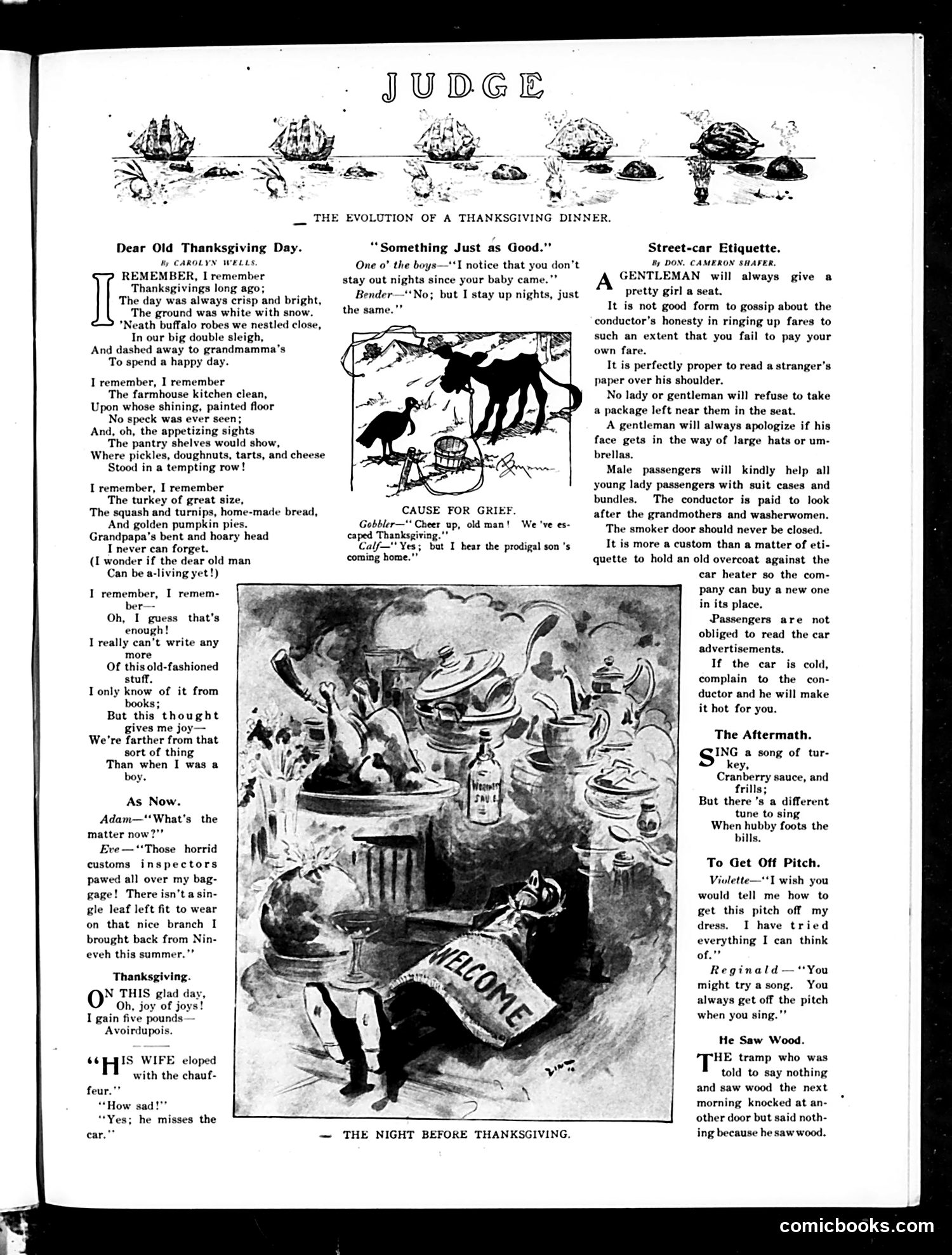
This page contains nostalgic and humorous Thanksgiving-themed content typical of early 20th-century Judge magazine. **"Dear Old Thanksgiving Day"** by Carolyn Wells is a sentimental poem recalling traditional Thanksgiving memories—farmhouse kitchens, homemade foods, family gatherings. **"The Night Before Thanksgiving"** cartoon depicts chaotic kitchen preparation, with exaggerated figures and turkeys in humorous disarray, capturing the frantic domestic scene before the holiday. The remaining sections—"Something Just as Good," "Street-car Etiquette," "The Aftermath," "To Get Off Pitch," and "He Saw Wood"—are brief humorous anecdotes about social behavior, manners, and domestic situations. These pieces satirize everyday American social conventions and family life rather than targeting specific political figures or events. The humor relies on relatability and gentle observation of contemporary domestic customs.
📄 Transcribed text from this page (OCR, searchable)
Machine-transcribed from the original scan — historical spelling and the odd misread are preserved.
Dear Old Thanksgiving Day. fy CAROLYN WELLS, REMEMBER, I remember Thanksgivings long ago; The day was always crisp and bright, The ground was white with snow. eath buffalo robes we nestled close, In our big double sleigh, And dashed away to grandmamma’s To spend a happy day. I remember, I remember The farmhouse kitchen clean, Upon whose shining, painted floor No speck was ever seen; And, oh, the appetizing sights The pantry shelves would show, Where pickles, doughnuts, tarts, and cheese Stood in a tempting row! I remember, I remember The turkey of great size, The squash and turnips, home-made bread, And golden pumpkin pies. Grandpapa’s bent and hoary head I never can forget. (I wonder if the dear old man Can be a-living yet!) I remember, I remem- ber— Oh, I guess enough! I really can’t write any that’s more Of this old-fashioned stuff. Tonly know of it from books ; But this thought gives me joy— We're farther from that sort of thing Than when I was a boy. As Now. Adam—‘‘What's the matter now?"" Eve —‘‘Those horrid customs inspectors pawed all over my bag- gage! There isn’t a sin- gle leaf left fit to wear on that nice branch I brought back from eveh this summer. Thanksgiving. N THIS glad day, Oh, joy of j I gain five pounds— Avoirdupois. oe IS WIFE eloped with the chauf- feur.”” “How sad!"" “Yes; he misses the car.” — THE NIGHT — THE EVOLUTION OF A THANKSGIVING DINNER. “Something Just as Good.” One 0” the boys—'I notice that you don’t stay out nights since your baby came."* Bender—*‘No; but I stay up nights, just the same. CAUSE FOR GRIEF. Gobbler—‘ Cheer up, old man! caped Thanksgiving.”* Calf— Yes; but I hear the prodigal son ’s coming home." We ‘ve es- Street-car Etiquette. fy DON. CAMERON SHAFER. A GENTLEMAN will always give a pretty girl a seat. It is not good form to gossip about the conductor's honesty in ringing up fares to such an extent that you fail to pay your own fare. It is perfectly proper to read a stranger's paper over his shoulder. No lady or gentleman will refuse to take a package left near them in the seat. A gentleman will always apologize if his face gets in the way of large hats or um- brellas. Male passengers will kindly help all young lady passengers with suit cases and bundles. The conductor is paid to look after the grandmothers and washerwomen. The smoker door should never be closed. It is more a custom than a matter of eti- quette to hold an old overcoat against the car heater so the com- pany can buy a new one in its place. Passengers are not obliged to read the car advertisements, If the car is cold, complain to the con- ductor and he will make it hot for you. The Aftermath. ING a song of tur- key, Cranberry sauce, and frills; But there 's a different tune to sing When hubby foots the bills. To Get Off Pitch. Vivlette—*I wish you would tell me how to get this pitch off my dress. I have tried everything I can think of.”” Reginald —“You might try asong. You always get off the pitch when you sing.’ He Saw Wood. TT HE tramp who was told to say nothing and saw wood the next morning knocked at an- other door but said noth- BEFORE THANKSGIVING. ing because he saw wood, comicbooks.com