
A complete issue · 16 pages · 1910
Judge — September 17, 1910
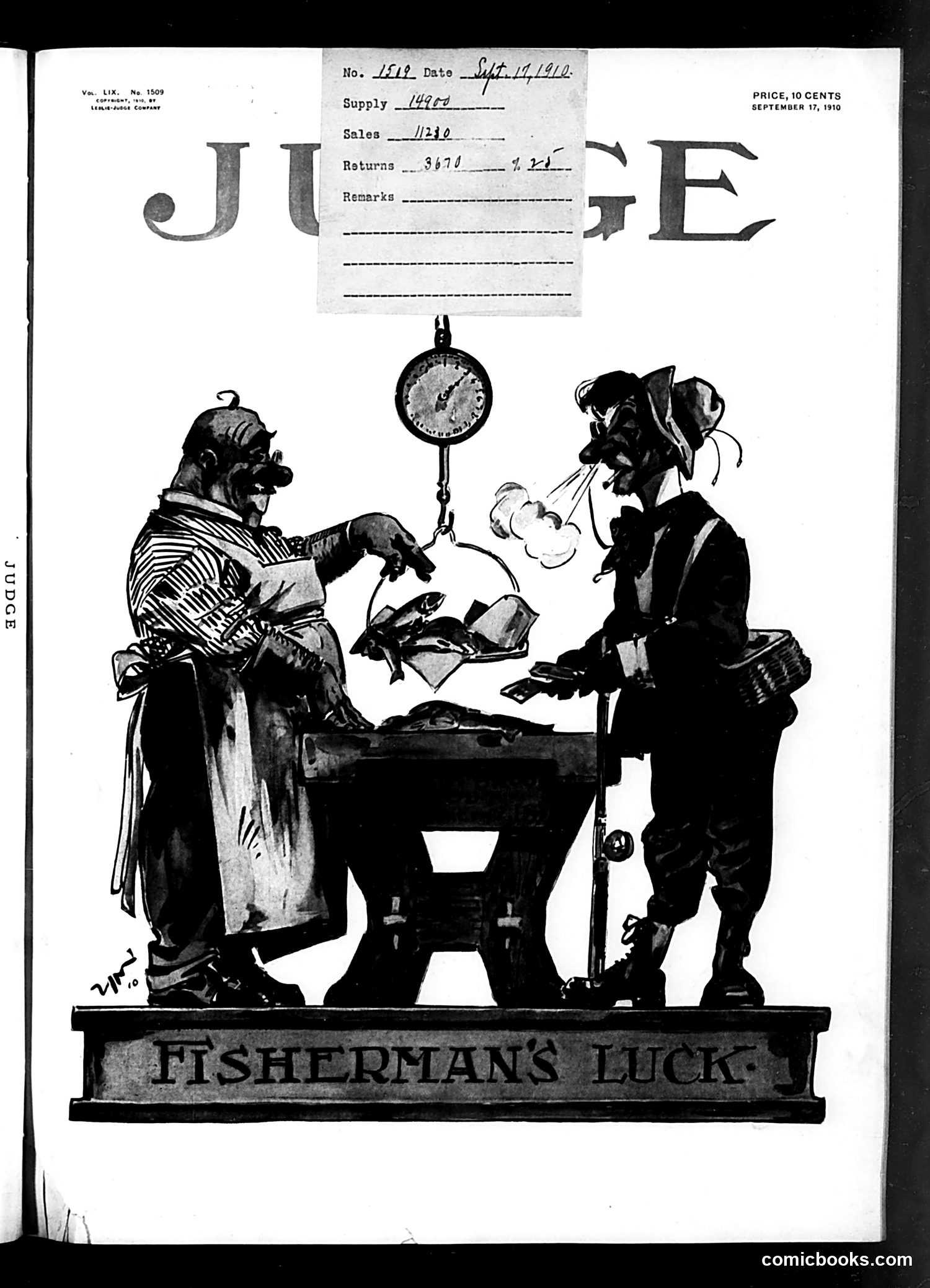
This cartoon depicts two caricatured figures (with exaggerated facial features characteristic of early 1900s satirical art) at a weighing scale, apparently trading or selling fish. The title "Fisherman's Luck" suggests this is political satire using fishing as metaphor. The supply/sales data at the top indicates this tracks some kind of commercial transaction or political exchange. Without clear identification of the specific figures, the cartoon likely comments on a contemporary political deal or backroom negotiation—possibly involving tariffs, trade policy, or political patronage common to Progressive Era satire. The weighing scale emphasizes the "balance" or fairness of the transaction being mocked. The crude caricatures suggest the figures are well-known public personalities, though their identities are unclear today without additional historical context.
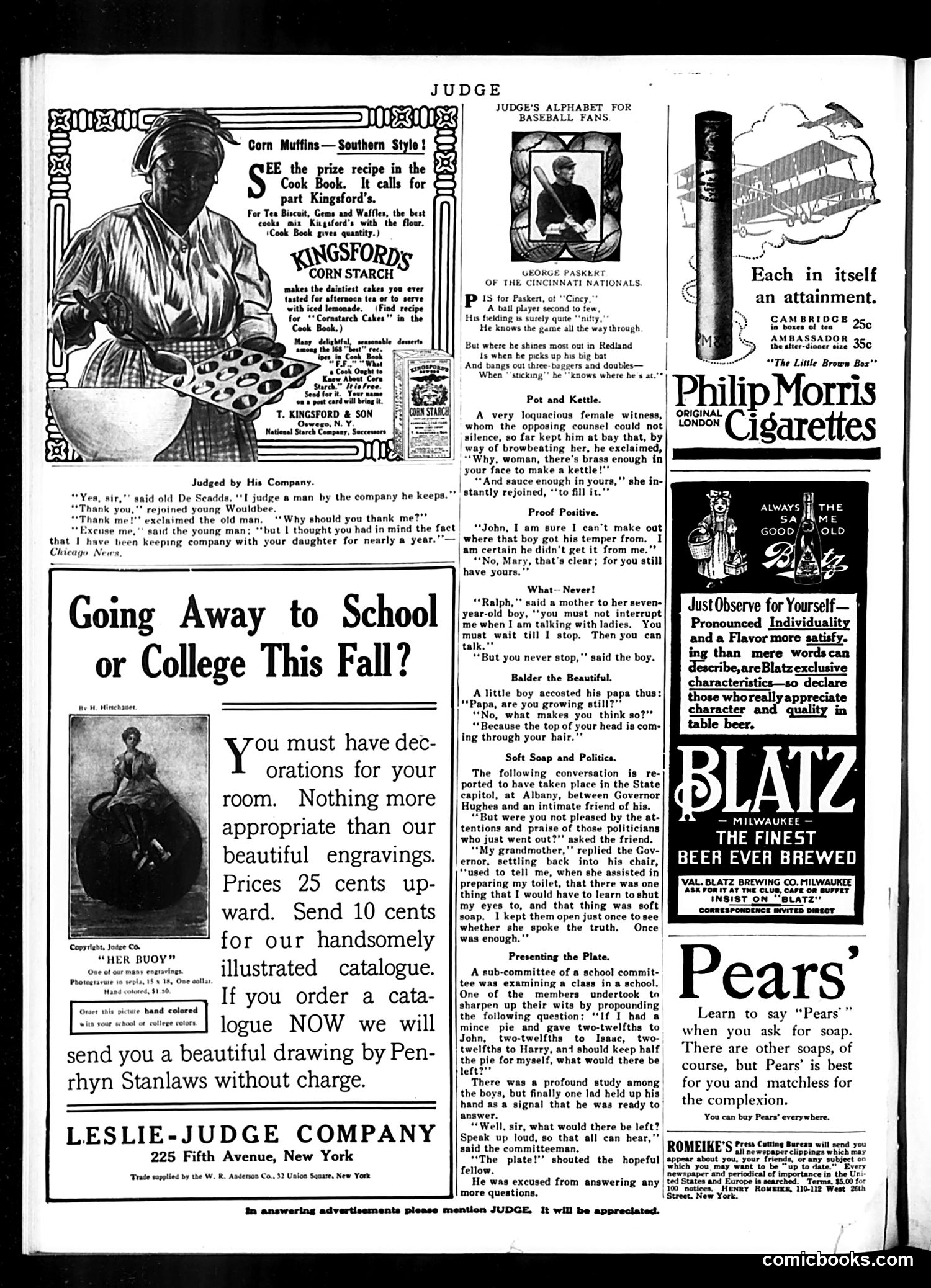
This page is primarily **advertising**, with minimal political satire. The main content includes: 1. **Kingsford's Corn Muffins ad** (left): A "Southern Style" recipe advertisement featuring a woman preparing baked goods—typical early 20th-century domestic advertising. 2. **"Judge's Alphabet for Baseball Fans"** (top right): A feature on Cincinnati Nationals player George Parker, reflecting baseball's popularity as American entertainment. 3. **School decorations ad** (center): Leslie-Judge Company soliciting orders for room engravings for students heading to college—a seasonal pitch. 4. **Humorous anecdotes** (center): Brief comedic stories about children, parents, and social situations. 5. **Product advertisements**: Philip Morris cigarettes, Blatz beer, and Pears' soap. The page lacks significant political commentary; it's a commercial issue balancing light humor with consumer goods targeted at middle-class readers.
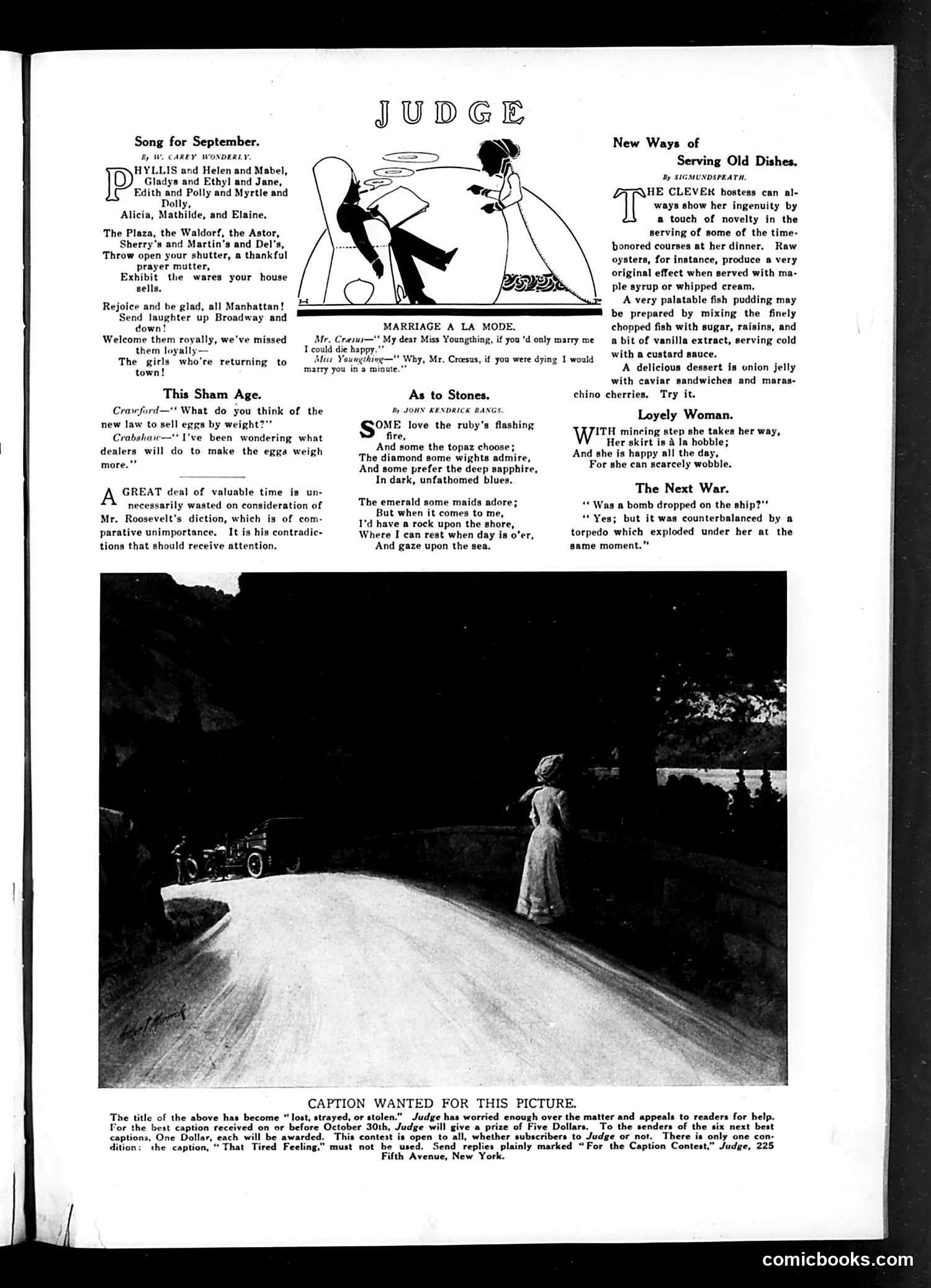
This page contains miscellaneous content rather than a unified political cartoon. The upper section features: - A song for September listing popular names and social venues - "Marriage à la Mode" — a small cartoon showing a man proposing to a woman, with dialogue about hastily marrying - "This Sham Age" — brief commentary on egg-selling regulations, likely satirizing Roosevelt-era bureaucratic expansion - Several poems and short pieces on social topics The large photograph at bottom shows a woman standing on a country road with a vintage automobile, captioned "Caption Wanted for This Picture." Judge announces a caption-writing contest offering prizes, inviting readers to submit humorous captions. The page primarily showcases light social satire typical of Judge's style—poking fun at modern conventions, relationships, and government regulation—rather than addressing specific major political events.
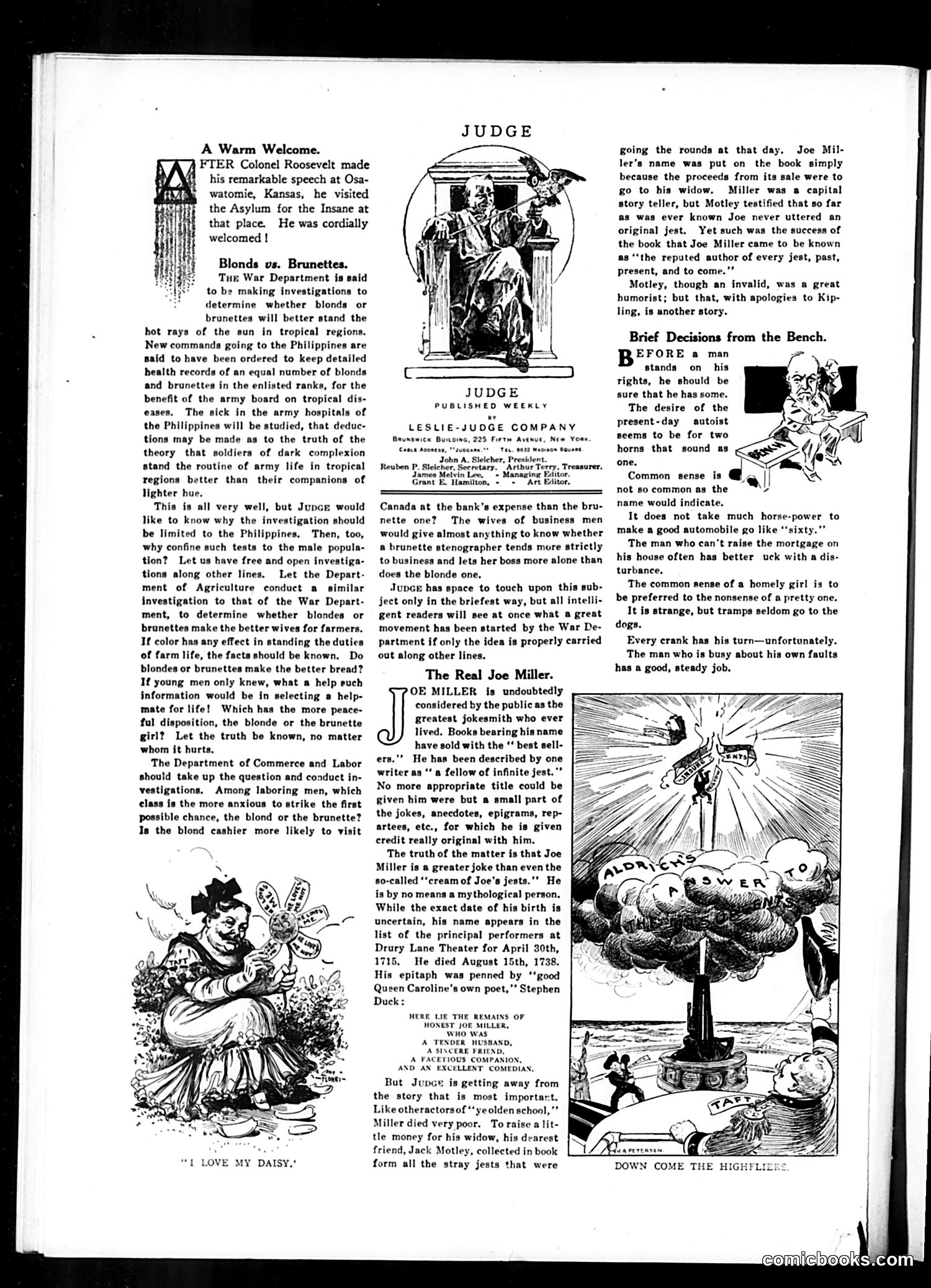
This page from Judge magazine focuses on **Joe Miller**, a legendary 18th-century English jester and wit. The main article celebrates Miller as "the greatest joksmith who ever lived," noting that countless jokes have been falsely attributed to him for centuries ("Joe Miller's jests"). The accompanying illustrations are period comedic woodcuts depicting Miller's buffoonery—typical of 17th-18th century jest literature. The page also contains several satirical editorial pieces, including "Brief Decisions from the Bench," which offers tongue-in-cheek social commentary on modern concerns: women in business, marriage dynamics, and class distinctions. The overall intent is to celebrate witty humor and comic tradition while gently mocking contemporary American social attitudes through the guise of judicial "rulings."
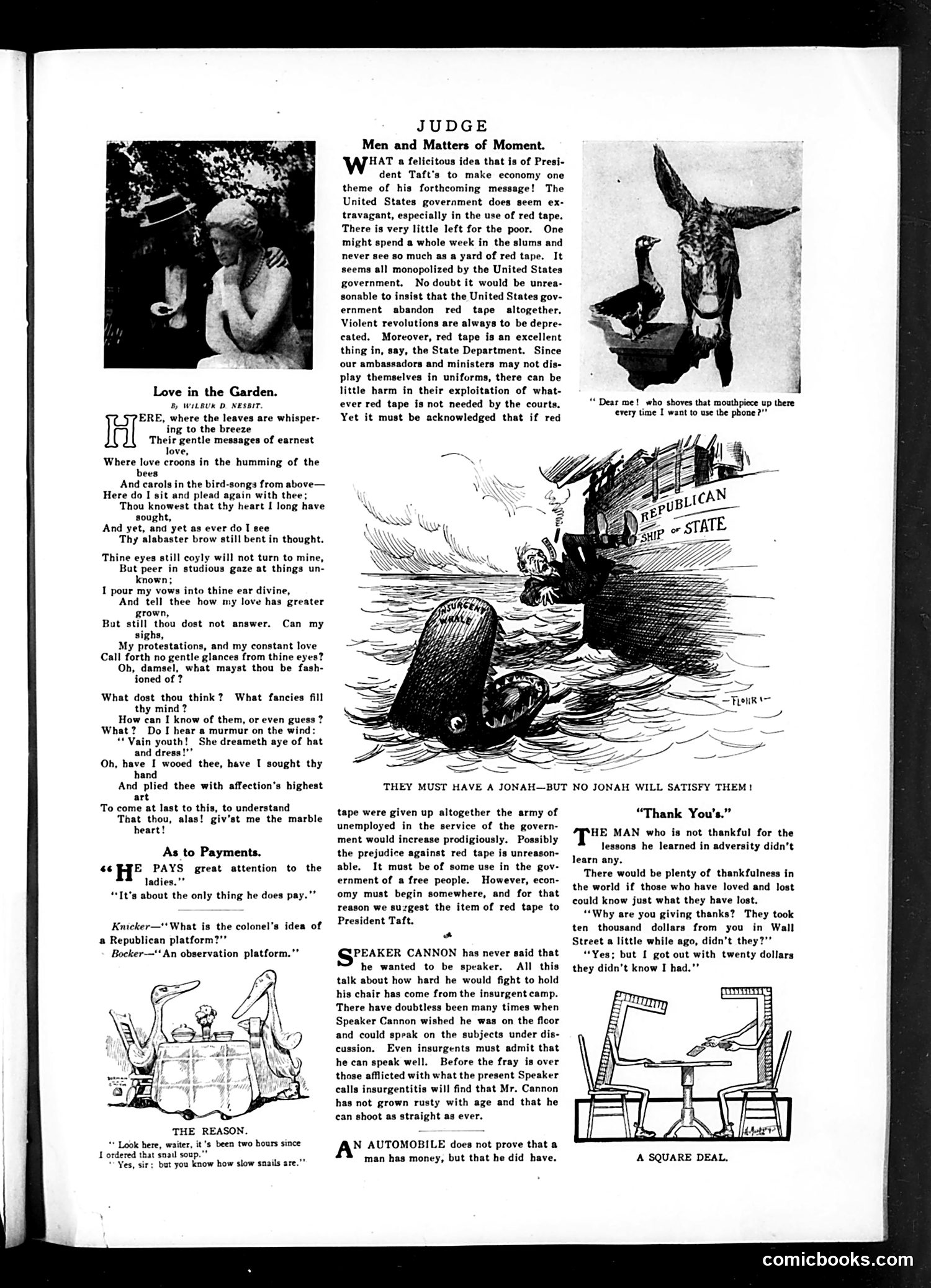
The main political cartoon depicts a ship labeled "Republican State" sinking, with a figure clinging to a log labeled "Prosperity." Another figure in the water cries "Dear me! who shoved that meatblock up there every time I wish to see the phone?" This satirizes Republican economic failures, likely during the Depression era. The cartoon suggests the GOP's claims of prosperity are hollow—the "meatblock" (possibly referring to corrupt patronage or false economic indicators) keeps appearing despite citizens' actual hardships. The page also contains humorous commentary on President Taft's proposed economy measures and red tape bureaucracy, and a joke about an automobile not proving wealth ("A Square Deal" cartoon). The satire targets Republican governance and economic mismanagement targeting working-class concerns.
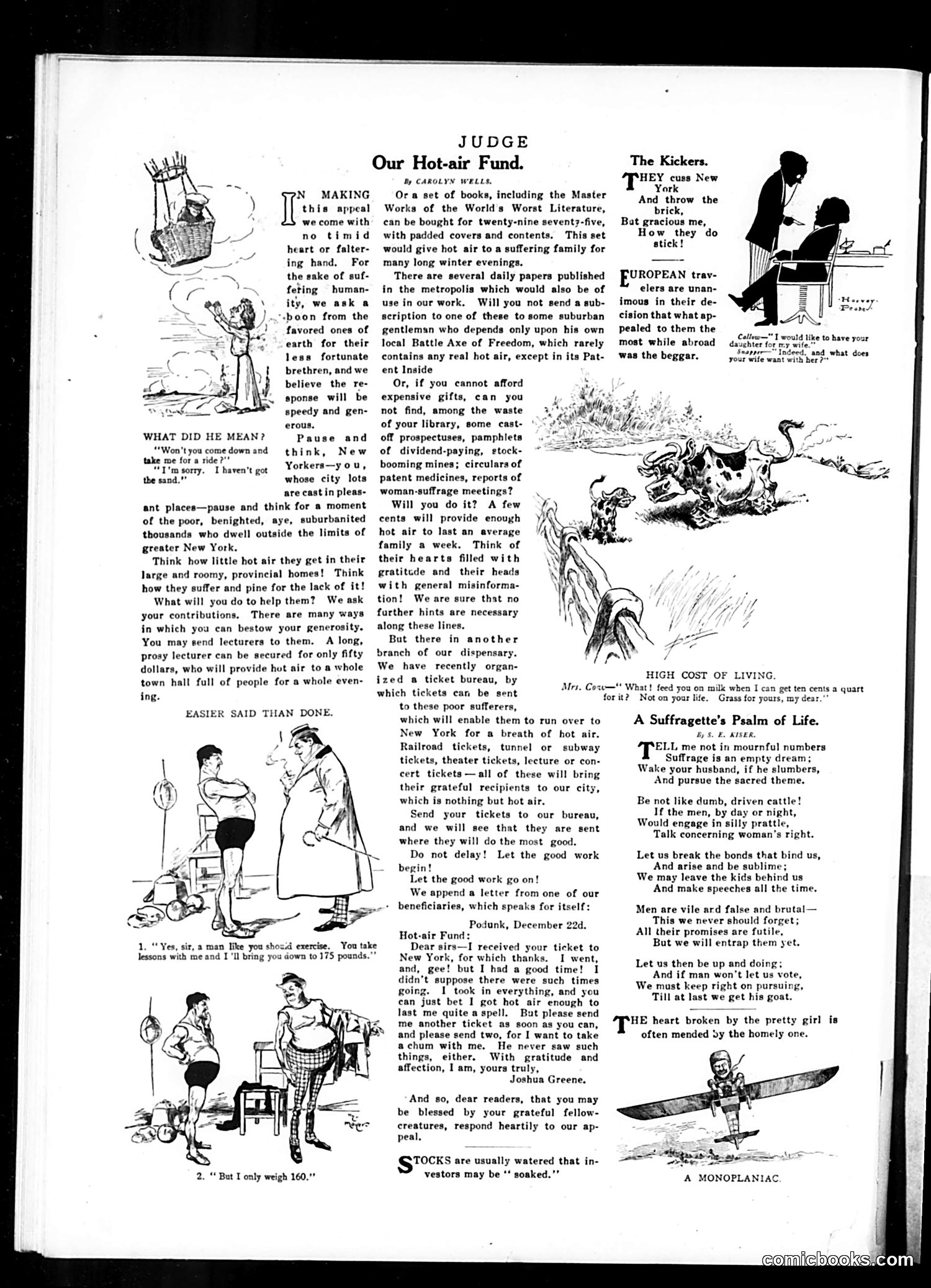
This Judge magazine page satirizes New York City's smugness and superiority over outlying areas. The "Hot-air Fund" is a mock charity appeal by Carolyn Wells, sarcastically urging wealthy Manhattan residents to help poor "suburbanites" suffering from lack of "hot air"—meaning pretentious talk, bombast, and self-important discourse. The satire targets New York's reputation for empty boasting and inflated rhetoric. The fake fund humorously suggests sending lecturers, worthless books, patent medicine circulars, and women's suffrage meeting reports as charitable gifts—all framed as valuable "hot air." The closing letter from Joshua Greene (a stereotypical rural name) innocently accepts tickets and gushes about his wonderful visit, perfectly embodying the mark the city seeks. The cartoons at bottom depict exercise humor unrelated to the main satire. Overall, this mocks both Manhattan's pretentiousness and suburban people's gullibility.
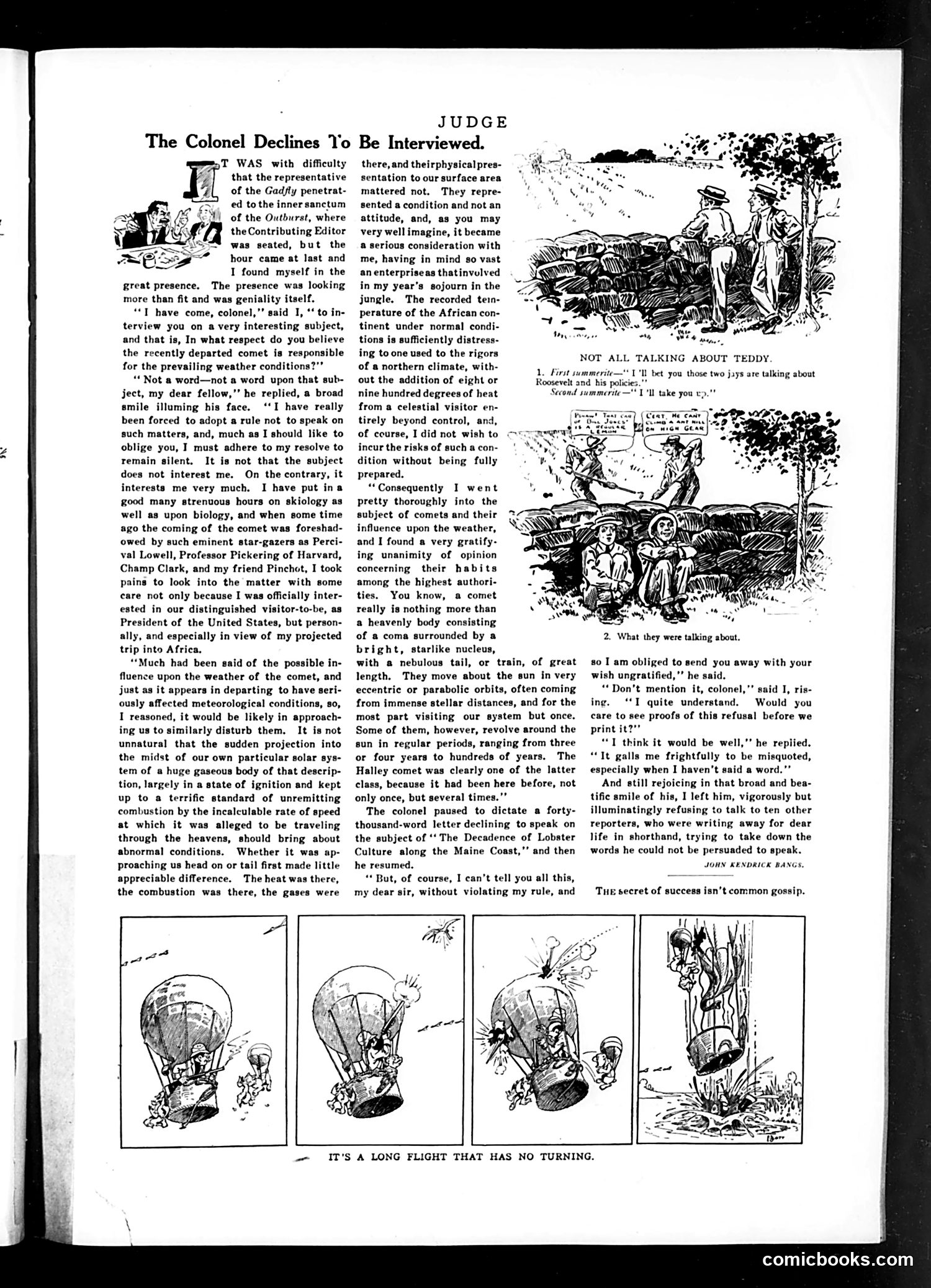
This Judge magazine piece satirizes Theodore Roosevelt's refusal to discuss the 1910 Halley's Comet and its purported effects on weather. The "Colonel" (Roosevelt, identifiable by his recent Africa trip mentioned in the text) has adopted a rule against speaking on the subject, despite his intense personal interest. The satire targets Roosevelt's characteristic verbosity and tendency to pontificate on every topic. By having him elaborate extensively *while claiming he won't discuss it*, the piece mocks his inability to stay silent. References to "Percival Lowell, Professor Pickering of Harvard, Champ Clark, and my friend Pinchot" ground the joke in actual contemporary figures debating comet science. The bottom comic strip showing a hot air balloon in various predicaments reinforces the joke: the comet discussion is itself a flight without landing—endless hot air from the famously talkative Roosevelt.
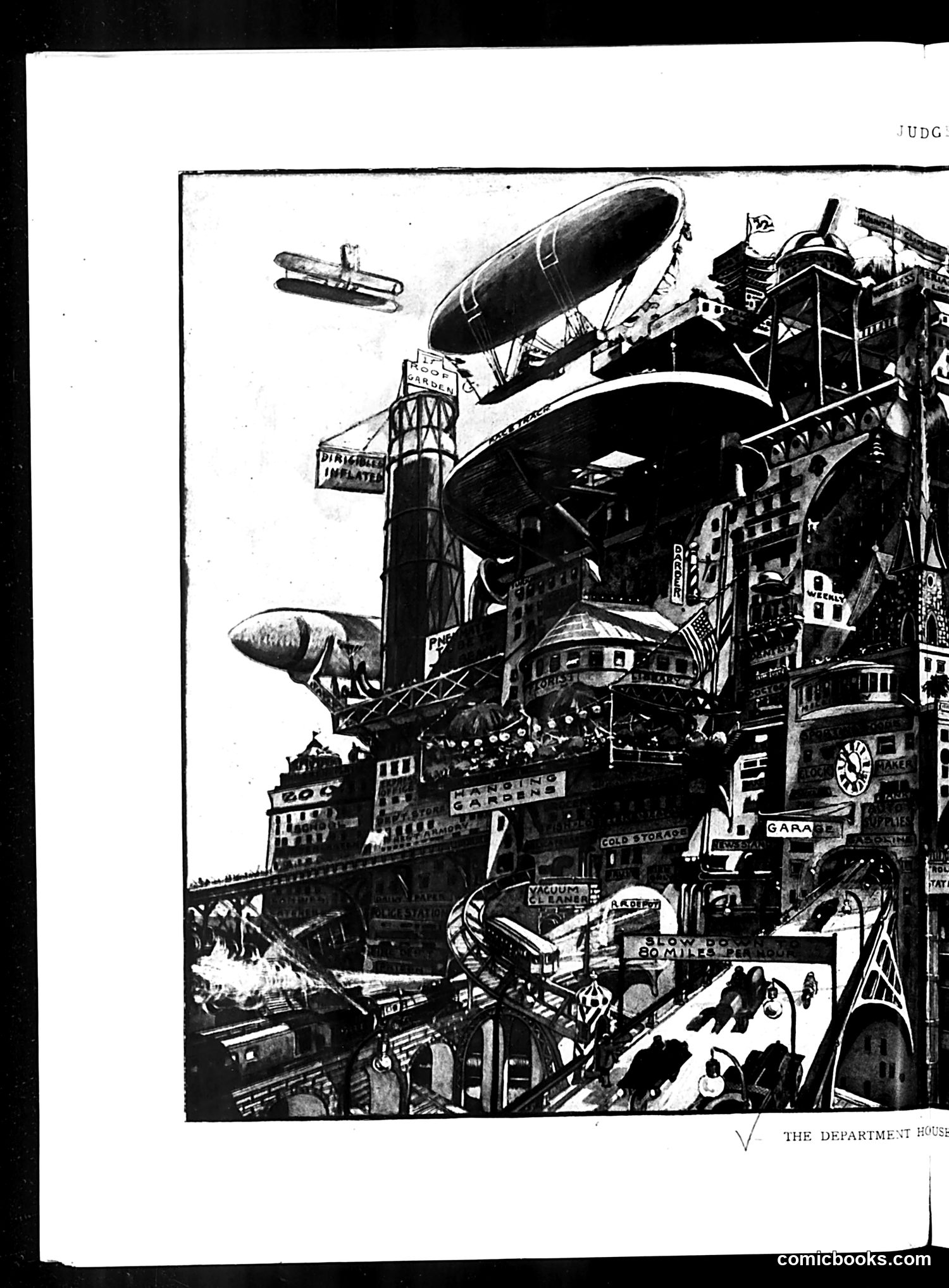
This is a futuristic satirical illustration titled "The Department House," showing an elaborate, densely packed cityscape with airships/dirigibles docked at towering structures. The cartoon appears to depict an imagined future government building or administrative complex. The satire likely critiques bureaucratic expansion and governmental bloat—common Judge magazine themes. The crowded, chaotic stacking of buildings, ships, and mechanical structures suggests mockery of governmental overreach and inefficiency. The airships and advanced technology place this as early 20th-century speculative satire about modernization. Without clearer text or identifying labels visible in the image, the specific political figures or events referenced remain unclear. The overall message appears to be humorous criticism of an unwieldy, oversized governmental apparatus.
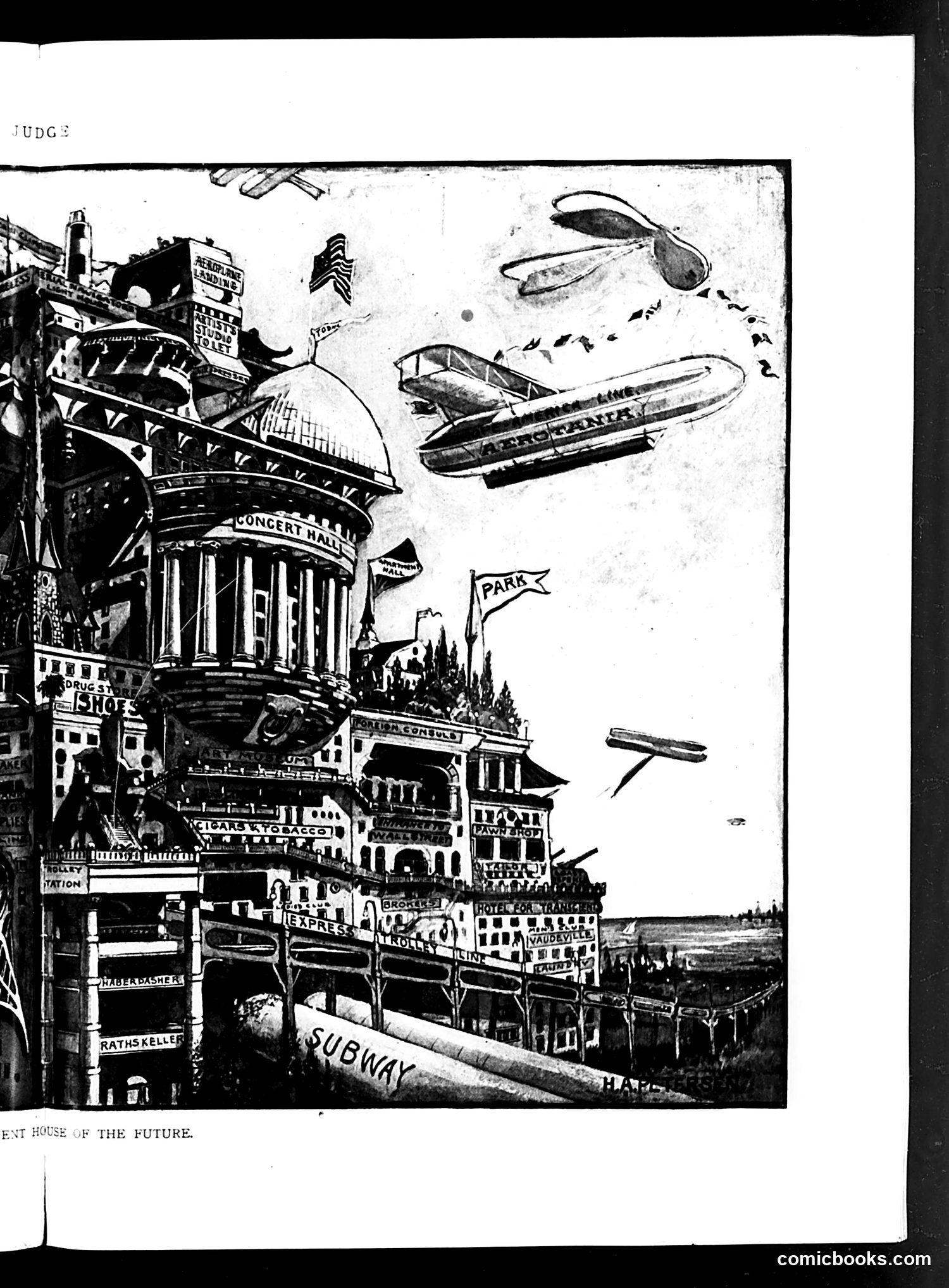
This futuristic satirical illustration depicts an elaborate, multi-story urban structure packed with commercial establishments and services—hotels, restaurants, shops, a subway entrance, and a concert hall. Flying vehicles and airships hover overhead, representing imagined aerial transportation. The satire appears to target early 20th-century visions of technological progress and urban development. Judge presents an increasingly crowded, commercialized vision of future city life where every vertical inch is monetized and packed with businesses. The chaotic stacking of commercial signage and services—combined with experimental aircraft in the sky—mocks both optimistic futurism and anxiety about unchecked urban growth, commercialization, and technological change transforming American life. The cartoon reflects contemporary debates about modernization and urbanism.
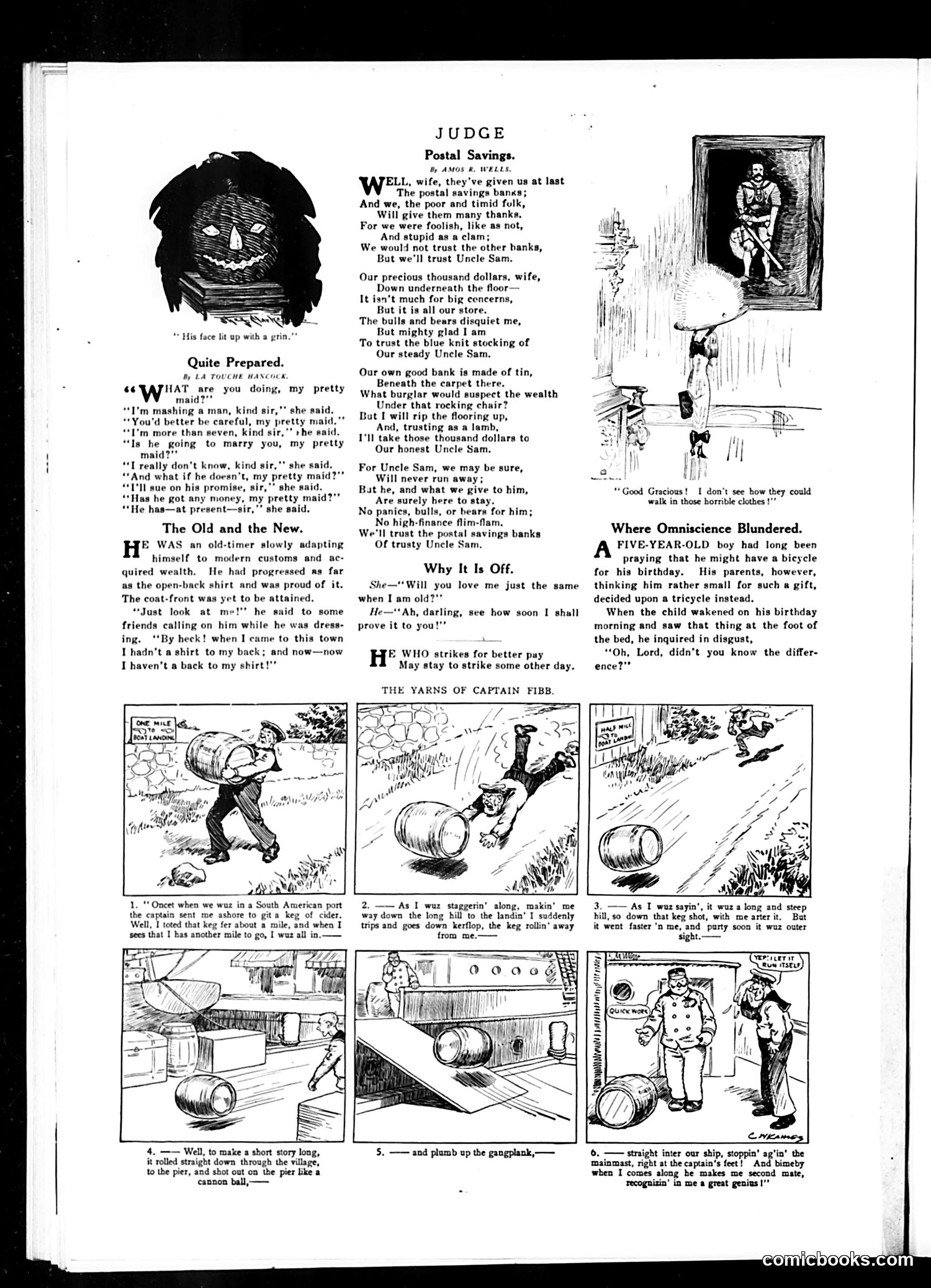
This Judge magazine page contains three satirical pieces reflecting early 20th-century American concerns: **"Postal Savings"** (poem): Celebrates the newly established postal savings system as a safe alternative for poor, distrustful working people. The satire mocks the irony that citizens who wouldn't trust conventional banks suddenly trust the government—keeping money "under the floor" and in "tin banks" before reluctantly depositing it with "Uncle Sam." It plays on class anxieties about wealth security and financial institutions. **"Quite Prepared"** and related sketches: Light comedic verses using nursery-rhyme structure to joke about courtship, marriage prospects, and modern fashion. The "Old and the New" mocks someone proudly wearing an open-backed shirt—having nothing but still boasting about it. **"Yarns of Captain Fibb"**: A six-panel comic strip where a barrel accidentally rolls downhill into a ship, and the captain inexplicably rewards the clumsy sailor. It's absurdist humor with no particular political message. The page reflects working-class and immigrant anxieties about American institutions and social mobility circa 1910s.
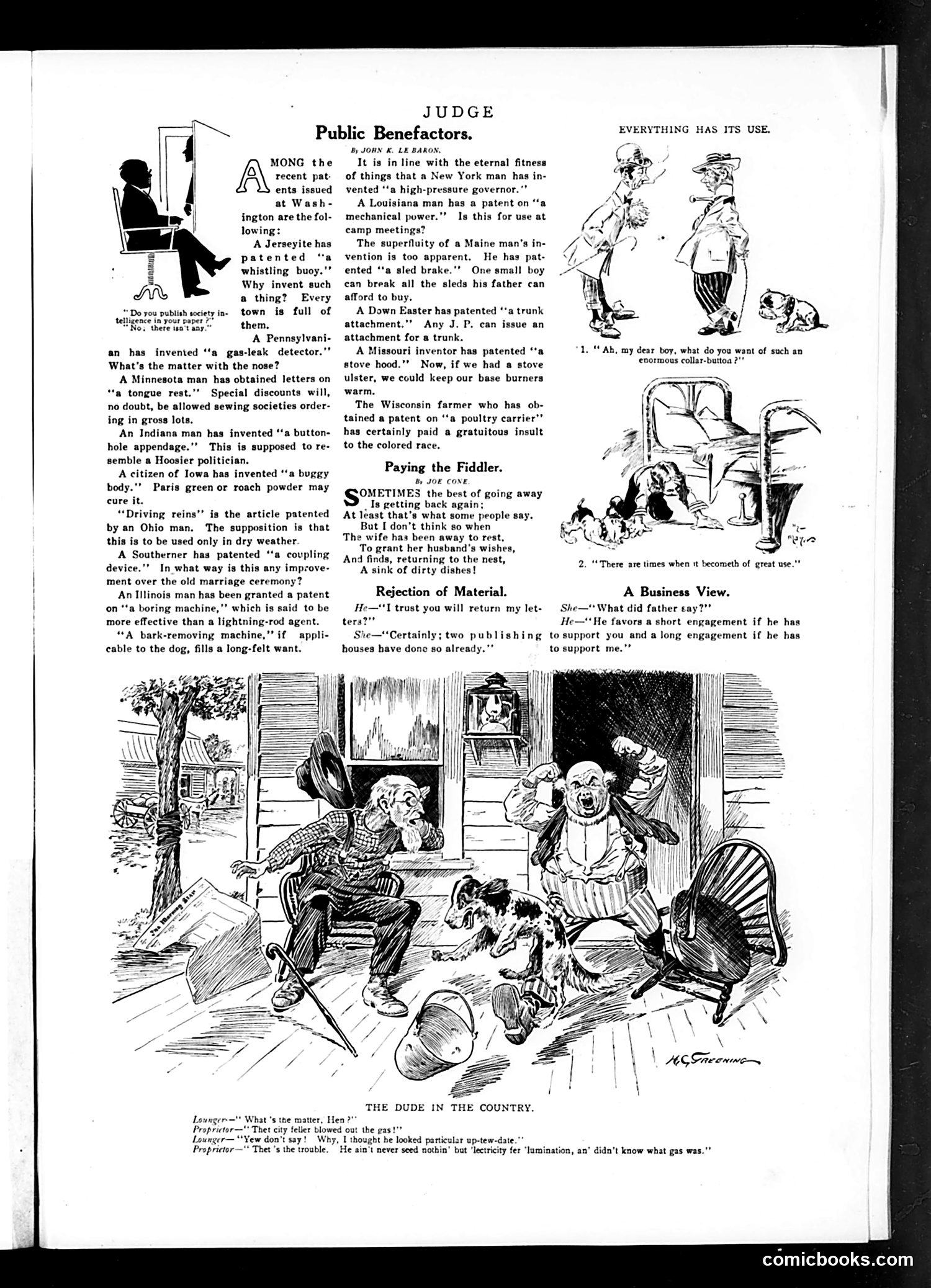
This page satirizes absurd patent applications through humor and social commentary. **"Public Benefactors"** mocks the U.S. Patent Office by listing ridiculous inventions—a "whistling buoy" (Jersey towns are full of them), a "gas-leak detector" (your nose works), a "tongue rest," and a "button-hole appendage" (compared to a Hoosier politician, implying stupidity). The satire suggests that not all inventions deserve patents, and some reflect regional stereotypes. **"The Dude in the Country"** depicts a city man blowing out the gas lamp thinking it's electricity—a joke about rural/urban knowledge gaps and the technological divide of the era. The farmer's skepticism about the "dude" turns ironic when the city visitor proves genuinely ignorant. The smaller cartoons and jokes (the couple's marriage discussion, the woman rejecting letters) are typical light humor for the era. Overall, the page ridicules both patent-granting authorities and the pretensions of various American inventors and regional types.
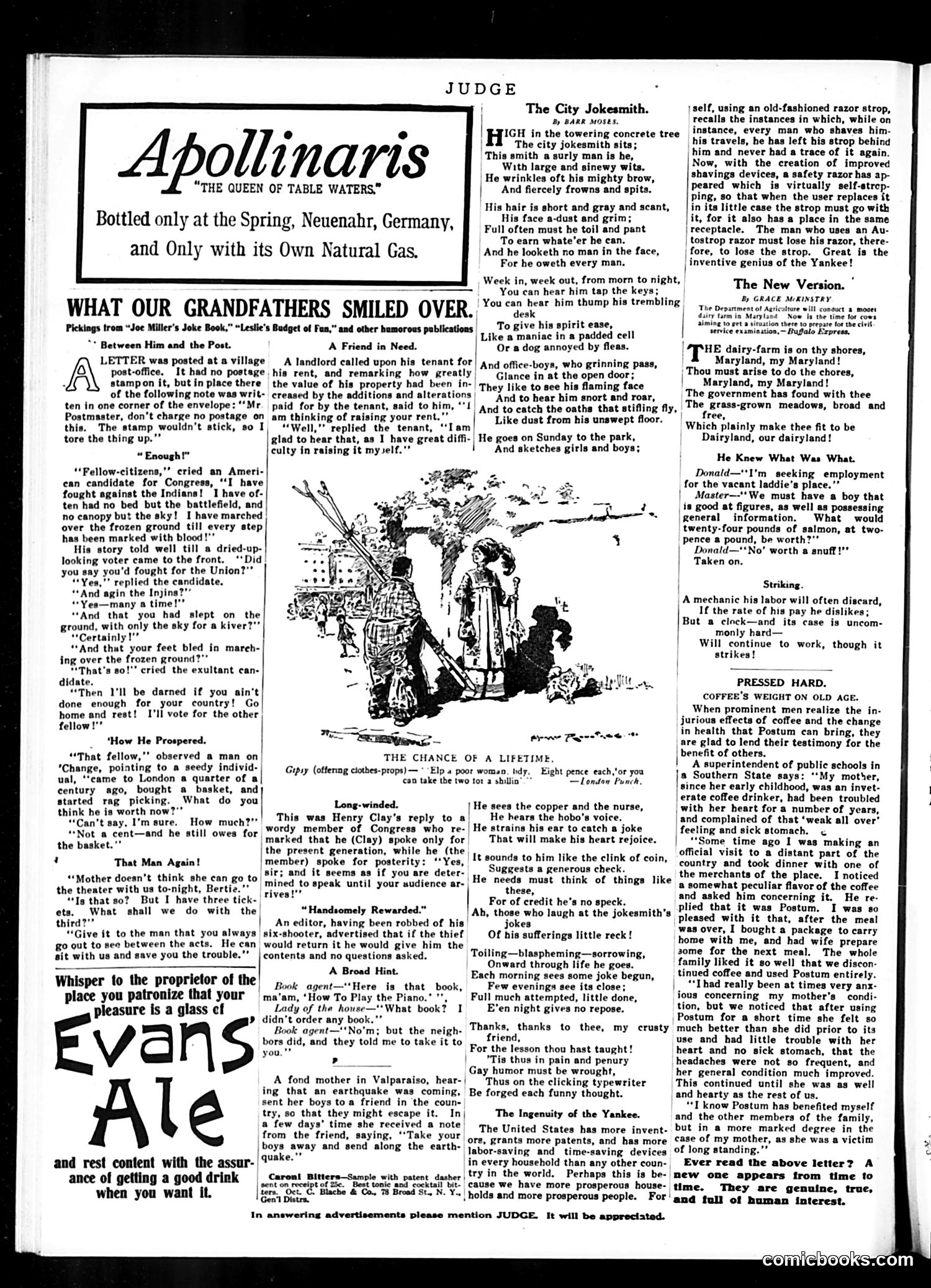
This page is primarily **advertising and filler content** rather than political satire. The dominant feature is an advertisement for Apollinaris mineral water from Germany. The page contains several sections of reprinted old jokes from "Joe Miller's Joke Book" and similar 19th-century humor collections—including a postal clerk joke, a congressman's campaign speech (mocked by a voter), and various anecdotes about landlords and tenants. These appear nostalgic and are not contemporary political commentary. There is a poem titled "The City Jokesmith" by Barr Moses, depicting a struggling cartoonist/joke writer working in an office building, presented somewhat sympathetically despite the difficult conditions. The cartoons themselves are minimal and unclear in reproduction. Without visible dates or clearer context, the specific political references remain ambiguous. This appears to be a typical Judge issue mixing advertisements, reprinted humor, and light social commentary rather than sharp political satire.
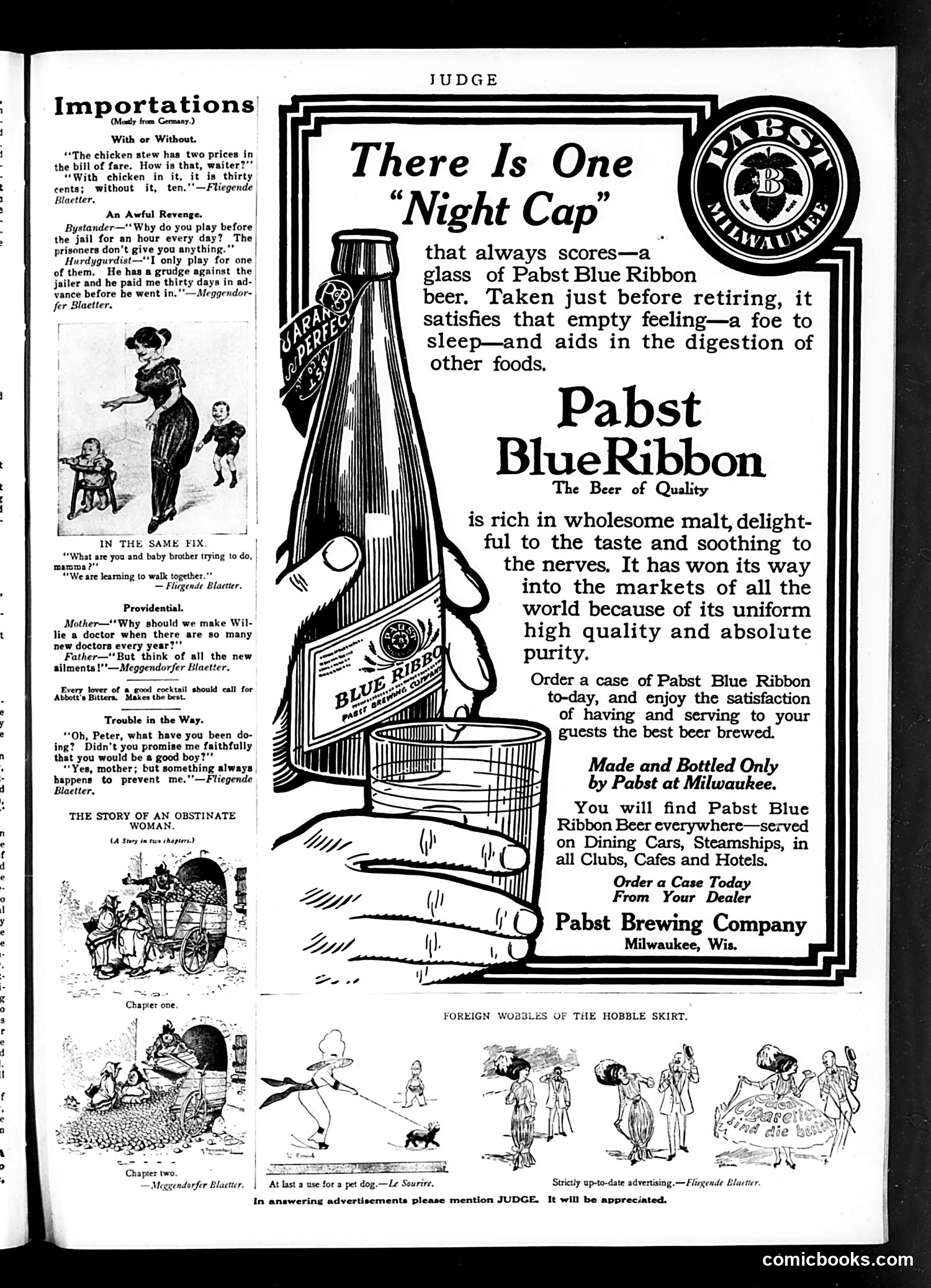
This page combines short humorous anecdotes (left column) with a full-page Pabst Blue Ribbon beer advertisement (right side). The left column reprints jokes from German humor magazines (*Fliegende Blätter*, *Meggendorfer Blätter*)—hence the "Importations (Mostly from Germany)" header. These are brief, gentle comedies of manners: a waiter's pricing scheme, a prisoner paying a hurdy-gurdy player to annoy the jailer, parents teaching a child to walk, and a father noting new ailments justify new doctors. They mock petty human foolishness. The advertisement itself (center-right) uses a large bottle illustration and claims Pabst Blue Ribbon as the ideal "night cap" before sleep, aiding digestion. It emphasizes the beer's "uniform high quality and absolute purity"—marketing language designed to reassure consumers in an era before modern food safety regulations. The small cartoons at the bottom appear to satirize contemporary trends, including "strictly up-to-date advertising." This reflects Judge's typical format: reprinting foreign humor while surrounding it with American advertising and commentary.
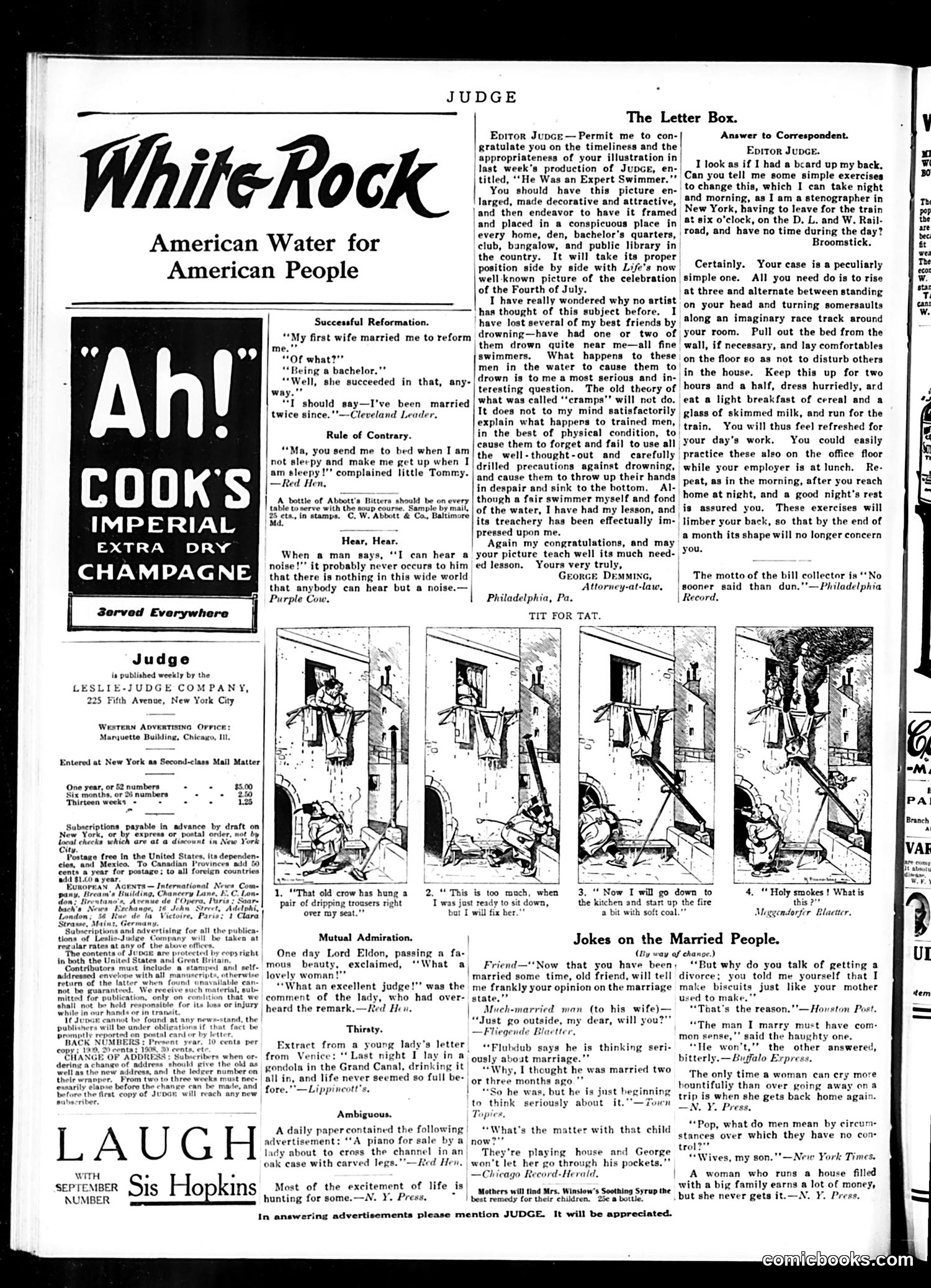
This page from the satirical magazine **Judge** contains advertisements and a letters section rather than a coherent political cartoon. The main visual content is a four-panel comic titled "TIT FOR TAT" showing someone repeatedly climbing down from a building via a rope, apparently practicing an escape—the joke presumably about repetitive, escalating domestic quarrels. The **letters section** includes reader correspondence praising an earlier Judge illustration about an "expert swimmer" drowning (apparently depicting the illogic of trained swimmers panicking in water). There's also humorous advice to a stenographer with posture problems, sarcastically suggesting extreme overnight exercises. **Context for modern readers**: This represents Judge's format as a weekly humor magazine mixing advertisements (notably "White Rock" champagne), reader letters, and satirical cartoons on social situations. The drowning illustration apparently addressed genuine contemporary confusion about why swimmers drowned—a serious topic treated humorously. The page reflects early-1900s middle-class concerns and Judge's typical approach to domestic life and physical culture.
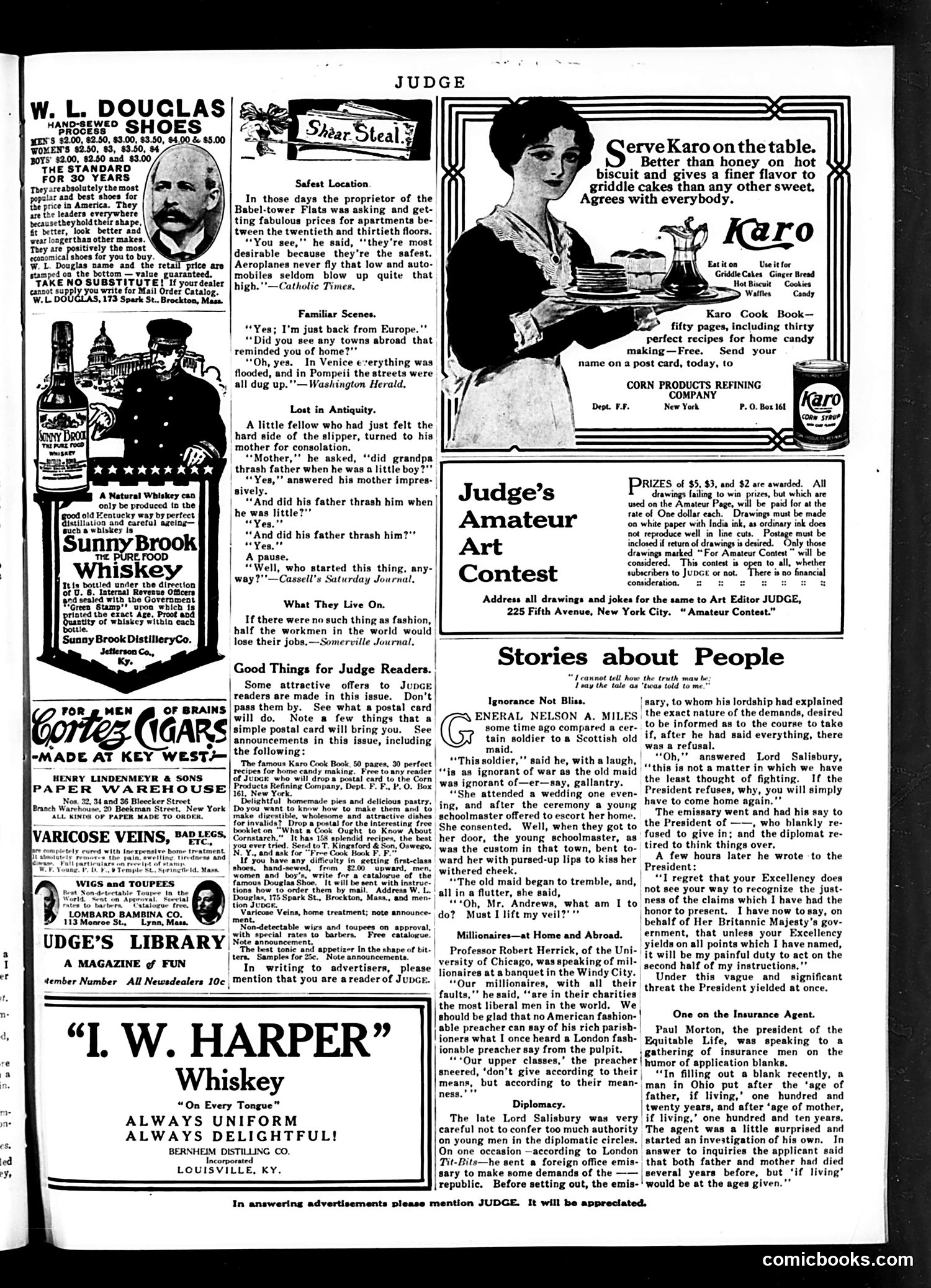
This is primarily an **advertising page** from Judge magazine, with some brief humorous items interspersed. The main content consists of product advertisements for early 20th-century goods: **W.L. Douglas shoes**, **Sunny Brook whiskey**, **Cortez cigars**, **Karo syrup**, and other consumer products. These ads use period marketing language emphasizing quality and value. The few editorial jokes scattered throughout reference contemporary concerns: **aeroplanes and automobiles** (still novel technologies causing public anxiety about safety), **Venice flooding** (connecting to current events), and **fashion's economic importance**. The page includes a notice for "**Judge's Amateur Art Contest**" inviting reader submissions. **No political figures or satire appear prominent here.** The page functions as a revenue-generating vehicle through advertisements rather than as a political or social commentary. Judge was primarily a humor and satire magazine, but this particular page prioritizes commercial content over editorial cartooning.
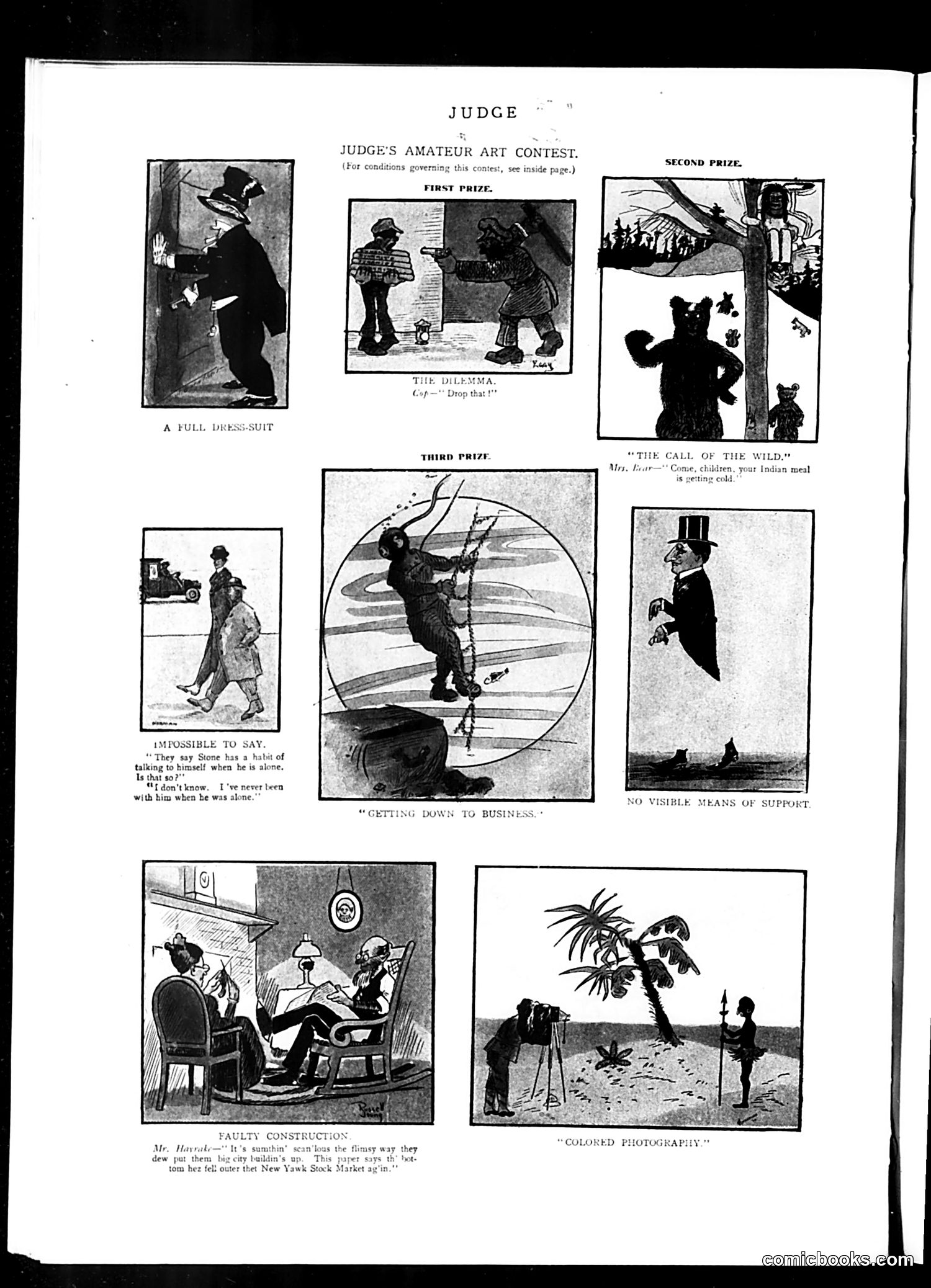
This page showcases winning entries from Judge magazine's amateur art competition. The satirical cartoons mock various social situations and character types common to early 20th-century American life. The entries include humorous scenarios: a man in formal dress, a policeman's dilemma about a suspect, bears representing "the call of the wild," a woman struggling with a talkative companion, a man defying gravity ("no visible means of support"), and scenes lampooning photography and social pretension. The humor relies on visual gags and wordplay rather than specific political figures. "Impossible to Say" jokes about a man named Stone who talks to himself—the punchline being you can't know his habits unless you're present, creating circular logic. These amateur submissions represent Judge's satirical approach: poking fun at everyday middle-class foibles, social awkwardness, and urban life rather than targeting particular politicians or dated events. The style is typical of early 1900s American humor magazines.