
Judge, 1910-09-17 · page 10 of 16
Judge — September 17, 1910 — page 10: what you’re looking at
What you’re looking at
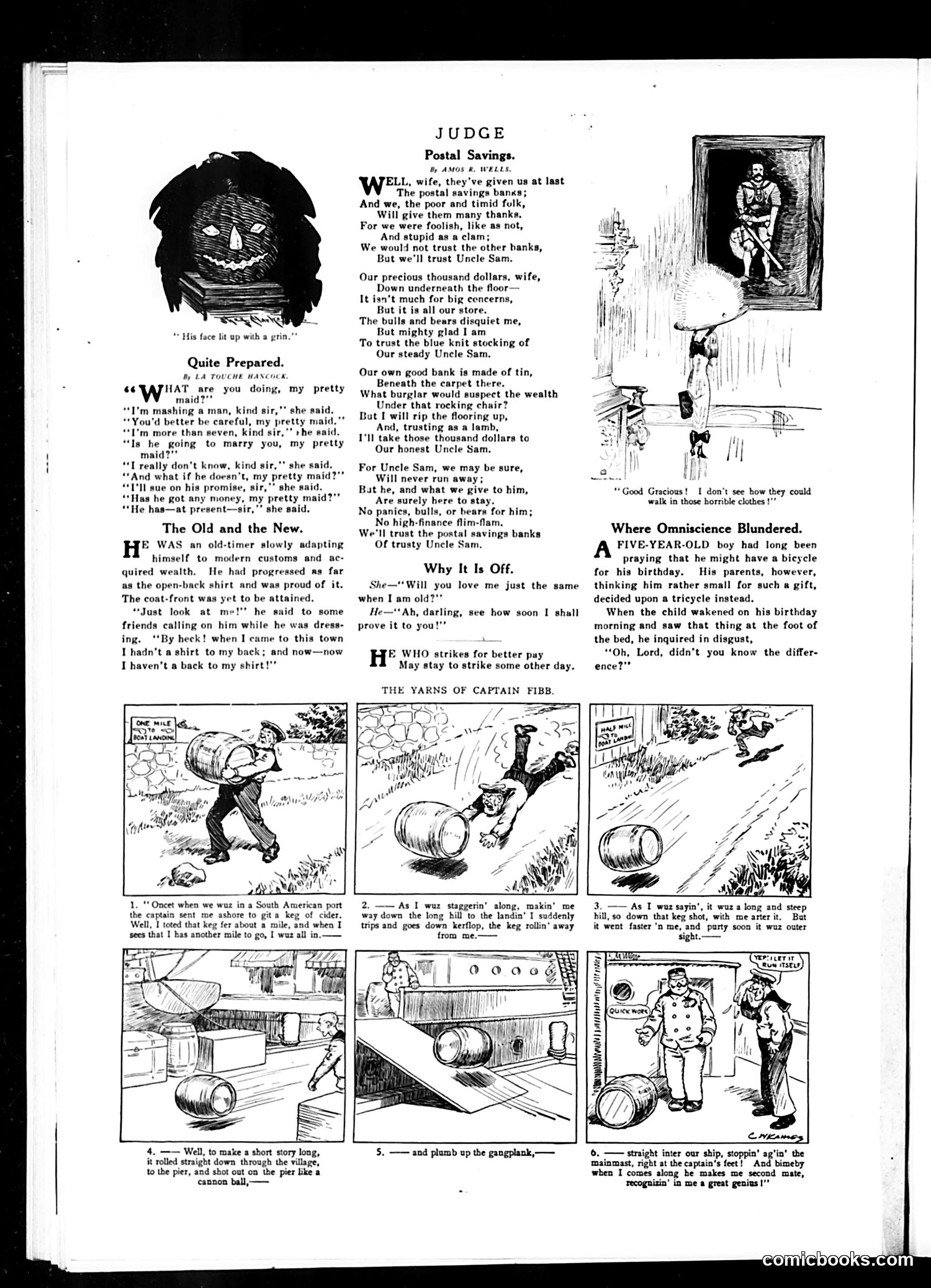
This Judge magazine page contains three satirical pieces reflecting early 20th-century American concerns: **"Postal Savings"** (poem): Celebrates the newly established postal savings system as a safe alternative for poor, distrustful working people. The satire mocks the irony that citizens who wouldn't trust conventional banks suddenly trust the government—keeping money "under the floor" and in "tin banks" before reluctantly depositing it with "Uncle Sam." It plays on class anxieties about wealth security and financial institutions. **"Quite Prepared"** and related sketches: Light comedic verses using nursery-rhyme structure to joke about courtship, marriage prospects, and modern fashion. The "Old and the New" mocks someone proudly wearing an open-backed shirt—having nothing but still boasting about it. **"Yarns of Captain Fibb"**: A six-panel comic strip where a barrel accidentally rolls downhill into a ship, and the captain inexplicably rewards the clumsy sailor. It's absurdist humor with no particular political message. The page reflects working-class and immigrant anxieties about American institutions and social mobility circa 1910s.
📄 Transcribed text from this page (OCR, searchable)
Machine-transcribed from the original scan — historical spelling and the odd misread are preserved.
“ His face lit up with a grin."* Quite Prepared. By LA TOUCHE HANCOCK HAT are you doing, my pretty maid?” “I'm mashing a man, kind sir, “You'd better be careful, my “I'm more than seven, kind sir,’ she said. “Is he going to marry you, my pretty ' maid? { “T really don’t know, kind sir," she said. “And what if he doesn’t, my pretty maid?” “T'IL sue on his promise, sir,” she said “Has he got any money, my’ pretty maid?” “He has—at present—sir,”” she said. The Old and the New. H E WAS an old-timer slowly adapting himself to modern customs and ac- quired wealth. He had progressed as far as the open-back shirt and was proud of it. The coat-front was yet to be attained. “Just look at me!’’ he said to some friends calling on him while he was dress- ing. ‘By heck! when I came to this town I hadn't a shirt to my back; and now—now I haven't a back to my shirt!"" : “ ** she said. pretty maid. JUDGE Postal Savings. by AMOS R. WELLS. ELL, wife, they've given us at last The postal savings banks; And we, the poor and timid folk, Will give them many thanks, For we were foolish, like as not, And stupid as a clam; We would not trust the other banks, But we'll trust Uncle Sam. Our precious thousand dollars, wife, Down underneath the floor— It isn’t much for big concerns, But it is all our store. The bulls and bears disquiet me, But mighty glad I am To trust the blue knit stocking of Our steady Uncle Sam. Our own good bank is made of tin, Beneath the carpet there. What burglar would suspect the wealth Under that rocking chair? But I will rip the flooring up, And, trusting as a lamb, I'll take those thousand dollars to Our honest Uncle Sam. For Uncle Sam, we may be sure, Will never run away; Bat he, and what we give to him, Are surely here to stay. No pani bulls, or bears for him; h-finance flim-flam, We'l nf trust the postal savings banks Of trusty Uncle Sam. Why It Is Off. She—Will you love me just the same when I am old?’ He—"Ah, darling, see how soon I shull prove it to you!" H THE YARNS OF CAPTAIN FIBB. WHO strikes for better pay May stay to strike some other day. =o iat Good Gracious! I don't see how they could walk in those horrible clothes !"* Where Omniscience Blundered. A FIVE-YEAR-OLD boy had long been praying that he might have a bicycle for his birthday. His parents, however, thinking him rather small for such a gift, decided upon a tricycle instead. When the child wakened on his birthday morning and saw that thing at the foot of the bed, he inquired in disgust, “Oh, Lord, didn’t you know the differ- ence?” 1.‘ Oncet when we wuz in a South American port the captain sent me ashore to git a keg of cider. Well, I toted that keg fer about a mile, sees that I has another mile to go, I wuz all in, — As I wuz staggerin’ along, makin’ me way down the long hill to the landin’ I suddenly trips and goes down kerflop, the keg rollin’ away from me.—— 4. —— Well, to make a short story long, it rolled straight down through the village, to the pier, and shot out on the pier like a cannon ball,— 5S. ——and plumb up the gangplank,— 6. — straight inter our ship, stoppin’ ag'in’ the As I wuz sayin’, it wuz a long and steep , so down that keg shot, with me arter it. Bat it went faster 'n me, and party soon it wuz outer sight. — mainmast, right at the captain's feet! And bimeby when I comes along he makes me second mate, recognizin’ in me a great genius!"