
Judge, 1910-09-17 · page 7 of 16
Judge — September 17, 1910 — page 7: what you’re looking at
What you’re looking at
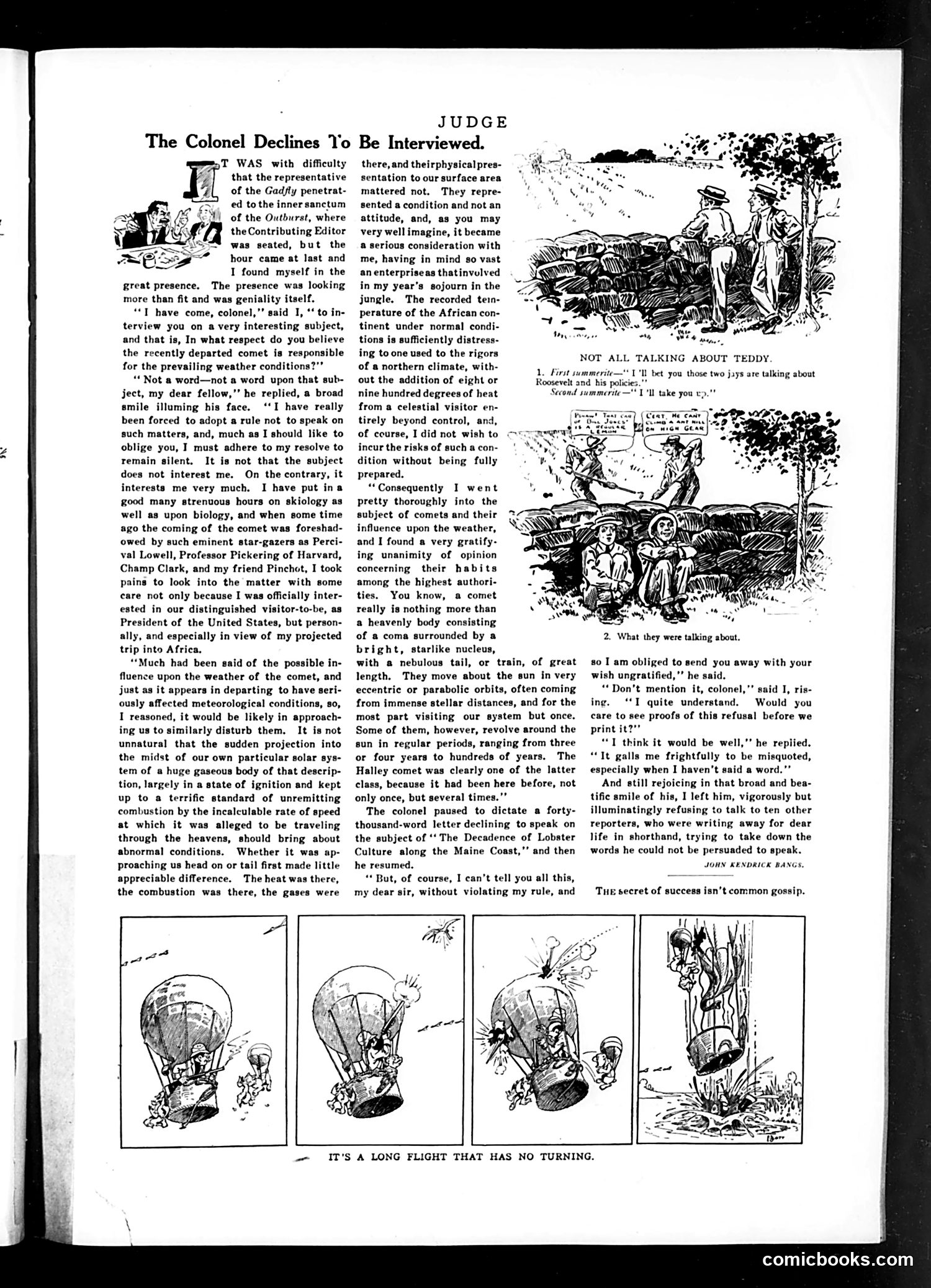
This Judge magazine piece satirizes Theodore Roosevelt's refusal to discuss the 1910 Halley's Comet and its purported effects on weather. The "Colonel" (Roosevelt, identifiable by his recent Africa trip mentioned in the text) has adopted a rule against speaking on the subject, despite his intense personal interest. The satire targets Roosevelt's characteristic verbosity and tendency to pontificate on every topic. By having him elaborate extensively *while claiming he won't discuss it*, the piece mocks his inability to stay silent. References to "Percival Lowell, Professor Pickering of Harvard, Champ Clark, and my friend Pinchot" ground the joke in actual contemporary figures debating comet science. The bottom comic strip showing a hot air balloon in various predicaments reinforces the joke: the comet discussion is itself a flight without landing—endless hot air from the famously talkative Roosevelt.
📄 Transcribed text from this page (OCR, searchable)
Machine-transcribed from the original scan — historical spelling and the odd misread are preserved.
JUDGE The Colonel Declines Yo Be Interviewed. T WAS with difficulty that the representative of the Gadjly penetrat- ed tothe inner sanctum of the Outburst, where the Contributing Editor was seated, but the hour came at last and I found myself in the The presence was looking more than fit and was geniality itself. “T have come, colonel,’’ said I, * to in- terview you on a very interesting subject, and that is, In what respect do you believe the recently departed comet is responsible for the prevailing weather conditions?”” “Not a word—not a word upon that sub- ject, my dear fellow,” he replied, a broad smile illuming his face. ‘I have really been forced to adopt a rule not to speak on such matters, and, much as I should like to oblige you, I must adhere to my resolve to remain silent. It is not that the subject does not interest me. On the contrary, it interests me very much. I have put ina good many strenuous hours on skiology as well as upon biology, and when some time ago the coming of the comet was foreshad- owed by such eminent star-gazers as Perci- val Lowell, Professor Pickering of Harvard, Champ Clark, and my friend Pinchot, I took pains to look into the matter with some care not only because I was officially inter- ested in our distinguished visitor-to-be, as President of the United States, but person- ally, and especially in view of my projected trip into Africa, “Much had been said of the possible in- fluence upon the weather of the comet, and just as it appears in departing to have seri- ously affected meteorological conditions, 80, I reasoned, it would be likely in approach- ing us to similarly disturb them. It is not unnatural that the sudden projection into the midst of our own particular solar sys- tem of a huge gaseous body of that descrip- tion, largely in a state of ignition and kept up to a terrific standard of unremitting combustion by the incalculable rate of speed at which it was alleged to be traveling through the heavens, should bring about abnormal conditions. Whether it was ap- proaching us head on or tail first made little appreciable difference. The heat was there, the combustion was there, the gases were great presence. there, and theirphysicalpres- sentation to our surface area mattered not. They repre- sented a condition and not an attitude, and, as you may very well imagine, it became erious consideration with me, having in mind so vast anenterpriseas thatinvulved in my year’s sojourn in the jungle. The recorded tein- perature of the African con- tinent under normal con tions is sufficiently distress- ing to one used to the rigors of a northern climate, with- out the addition of eight or nine hundred degrees of heat from a celestial visitor en- tirely beyond control, and, of course, I did not wish to incur the risks of such a con- dition without being fully prepared. “Consequently I went pretty thoroughly into the subject of comets and their influence upon the weather, and I found a very gratify- ing unanimity of opinion concerning their habits among the highest authori- ties. You know, a comet really is nothing more than a heavenly body consisting of a coma surrounded by a bright, starlike nucleus, with a nebulous tail, or train, of great length. They move about the sun in very eccentric or parabolic orbits, often coming from immense stellar distances, and for the most part visiting our system but once. Some of them, however, revolve around the sun in regular periods, ranging from three or four years to hundreds of years. The Halley comet was clearly one of the latter class, because it had been here before, not only once, but several times.’” The colonel paused to dictate a forty- thousand-word letter declining to speak on the subject of ‘‘ The Decadence of Lobster Culture along the Maine Coast,’ and then he resumed. “But, of course, I can’t tell you all this, my dear sir, without violating my rule, and 1. First summerite— Roosevelt and his polici Second summerite NOT ALL TALKING ABOUT TEDDY. I'll bet you those two jays are talking about 2. What they were talking about. so I am obliged to send you away with your wish ungratified,” “Don’t mention it, colonel,” said I, ris- ing. ‘I quite understand. Would you care to see proofs of this refusal before we print it?” “I think it would be well,"" he replied. “It galls me frightfully to be misquoted, especially when I haven't said a word.” And still rejoicing in that broad and bea- tific smile of his, I left him, vigorously but illuminatingly refusing to talk to ten other reporters, who were writing away for dear life in shorthand, trying to take down the words he could not be persuaded to apeak. JOHN KENDRICK BANGS. Tue secret of success isn’t common gossip. IT'S A LONG FLIGHT THAT HAS NO TURNING. comicbooks.com