
Judge, 1910-09-17 · page 4 of 16
Judge — September 17, 1910 — page 4: what you’re looking at
What you’re looking at
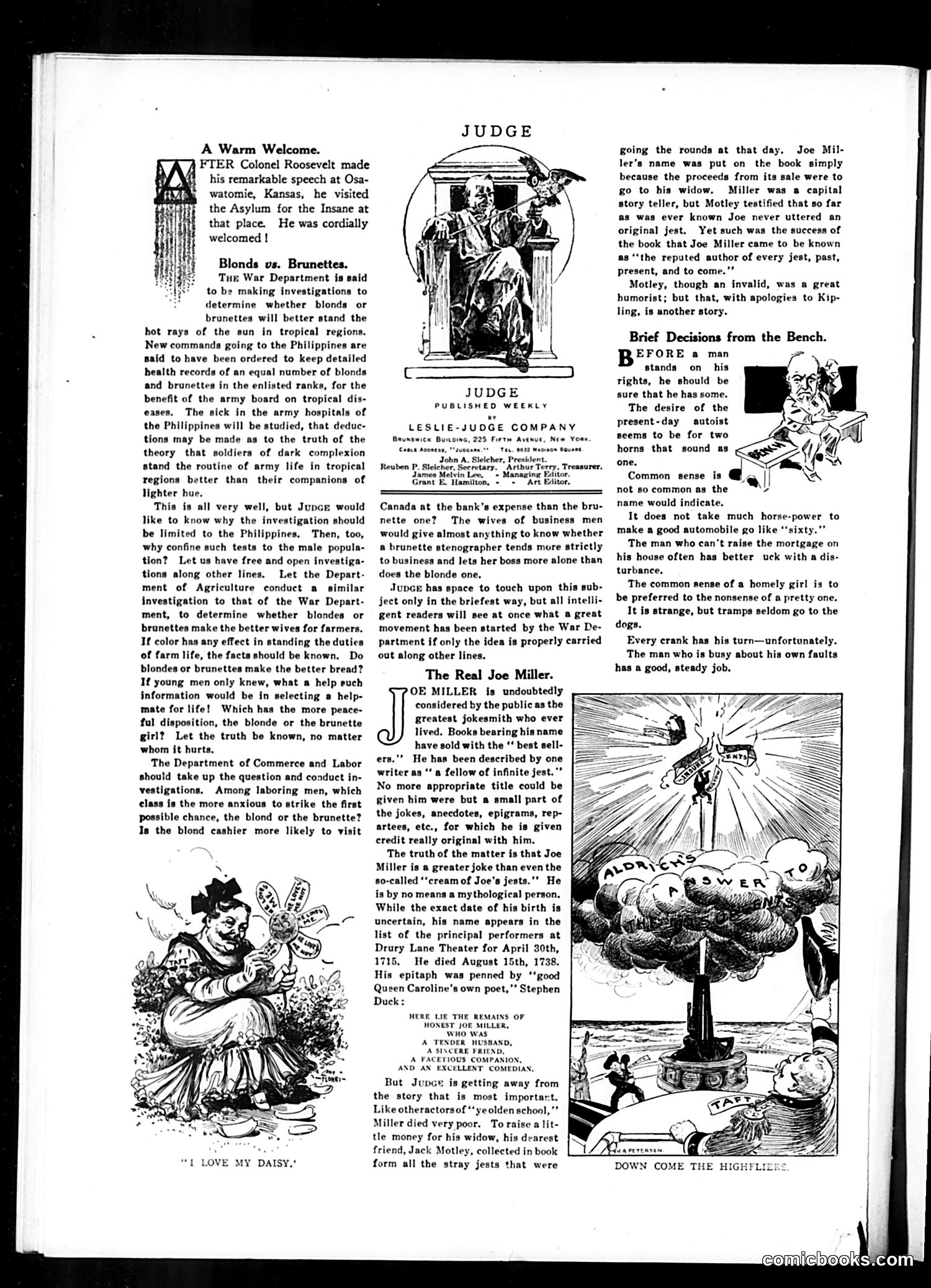
This page from Judge magazine focuses on **Joe Miller**, a legendary 18th-century English jester and wit. The main article celebrates Miller as "the greatest joksmith who ever lived," noting that countless jokes have been falsely attributed to him for centuries ("Joe Miller's jests"). The accompanying illustrations are period comedic woodcuts depicting Miller's buffoonery—typical of 17th-18th century jest literature. The page also contains several satirical editorial pieces, including "Brief Decisions from the Bench," which offers tongue-in-cheek social commentary on modern concerns: women in business, marriage dynamics, and class distinctions. The overall intent is to celebrate witty humor and comic tradition while gently mocking contemporary American social attitudes through the guise of judicial "rulings."
📄 Transcribed text from this page (OCR, searchable)
Machine-transcribed from the original scan — historical spelling and the odd misread are preserved.
A Warm Welcome. FTER Colonel Roosevelt made his remarkable speech at Osa- watomie, Kansas, he visited the Asylum for the Insane at that place. He was cordially welcomed ! Blonds vs. Brunettes. Tue War Department is said to be making investigations to determine whether blonds or brunettes will better stand the hot rays of the sun in tropical regions. New commands going to the Philippines are said to have been ordered to keep detailed health records of an equal number of blonds and brunettes in the enlisted ranks, for the benefit of the army board on tropical dis- eases. The sick in the army hospitals of the Philippines will be studied, that deduc- tions may be made as to the truth of the theory that soldiers of dark complexion stand the routine of army life in tropical regions better than their companions of lighter hue. This is all very well, but Jupce would like to know why the investigation should be limited to the Philippines. Then, too, why confine such tests to the male popula- tion? Let us have free and open investiga- tions along other lines. Let the Depart- ment of Agriculture conduct a similar investigation to that of the War Depart- ment, to determine whether blondes or brunettes make the better wives for farmers. If color has any effect in standing the duties of farm life, the facts should be known. Do blondes or brunettes make the better bread? If young men only knew, what a help euch information would be in selecting a help- mate for life! Which has the more peace- fal disposition, the blonde or the brunette girl? Let the truth be known, no matter whom it hurts, The Department of Commerce and Labor should take up the question and conduct in- vestigations. Among laboring men, which class is the more anxious to strike the first possible chance, the blond or the brunette? Is the blond cashier more likely to visit “I LOVE MY DAISY,’ PUBLISHED WEEKLY ey LESLIE-JUODGE COMPANY Beunswicn Bunoine, 225 Firtm Avent, New Yous. John A. Sleicher, Presilent. Reuben P. Sleicher, Secretary. "Arthur Terry, Treasurer. James Melvin Lee, > Managing Editor. Grant E. Hamilton, > - Art Editor. cance Aves Sevan Canada at the bank’s expense than the bru- nette one? The wives of business men would give almost anything to know whether a brunette stenographer tends more strictly to business and lets her boss more alone than does the blonde one. Jupce has space to touch upon this sub- ject only in the briefest way, but all intelli- gent readers will see at once what a great movement has been started by the War De- partment if only the idea is properly carried out along other lines. The Real Joe Miller. OE MILLER is undoubtedly considered by the public as the greatest jokesmith who ever lived, Books bearing his name have sold with the “‘ best sell- ers."’ He has been described by one writer as ‘‘ a fellow of infinite jest."’ No more appropriate title could be given him were but a small part of the jokes, anecdotes, epigrams, rep- artees, ete., for which he is given credit really original with him. The truth of the matter is that Joe Miller is a greater joke than even the alled ‘‘cream of Joe's jests."” He is by no means a mythological person. While the exact date of his birth is uncertain, his name appears in the list of the principal performers at Drury Lane Theater for April 30th, 1715. He died August 15th, 1738. His epitaph was penned by ‘‘good own poet,"’ Stephen WERE LIE THE REMAINS OF HONEST JOE MILLER, ‘WHO Was A TENDER HUSBAND, A SINCERE FRIEND, A FACETIOUS COMPANION, AND AN EXCELLENT COMEDIAN. But Jupce is getting away from the story that is most important. Like otheractorsof ‘ye olden school,”” Miller died very poor. To raise a lit- tle money for his widow, his dearest friend, Jack Motley, collected in book form all the stray jests that were going the rounds at that day. Joe Mil- ler’s name was put on the book simply because the proceeds from its sale were to go to his widow. Miller was a capital story teller, but Motley testified that so far as was ever known Joe never uttered an original jest. Yet such was the success of the book that Joe Miller came to be known “the reputed author of every jest, past, sent, and to come.’” Motley, though an invalid, was a great humorist; but that, with apologies to Kip- ling, is another story. Brief Decisions from the Bench. EFORE a man ~ stands on his rights, he should be sure that he has some. The desire of the present-day autoist seems to be for two horns that sound as one. Common sense is not so common as the name would indicate. It does not take much horse-power to make a good automobile go like “‘sixty.”” The man who can’t raise the mortgage on his house often has better uck with a dis- turbance. The common rense of a homely girl is to be preferred to the nonsense of a pretty one. It is strange, but tramps seldom go to the dogs. Every crank has his turn—unfortunately. The man who is busy about his own faults has a good, steady job. DOWN COME THE