
A complete issue · 16 pages · 1910
Judge — September 10, 1910
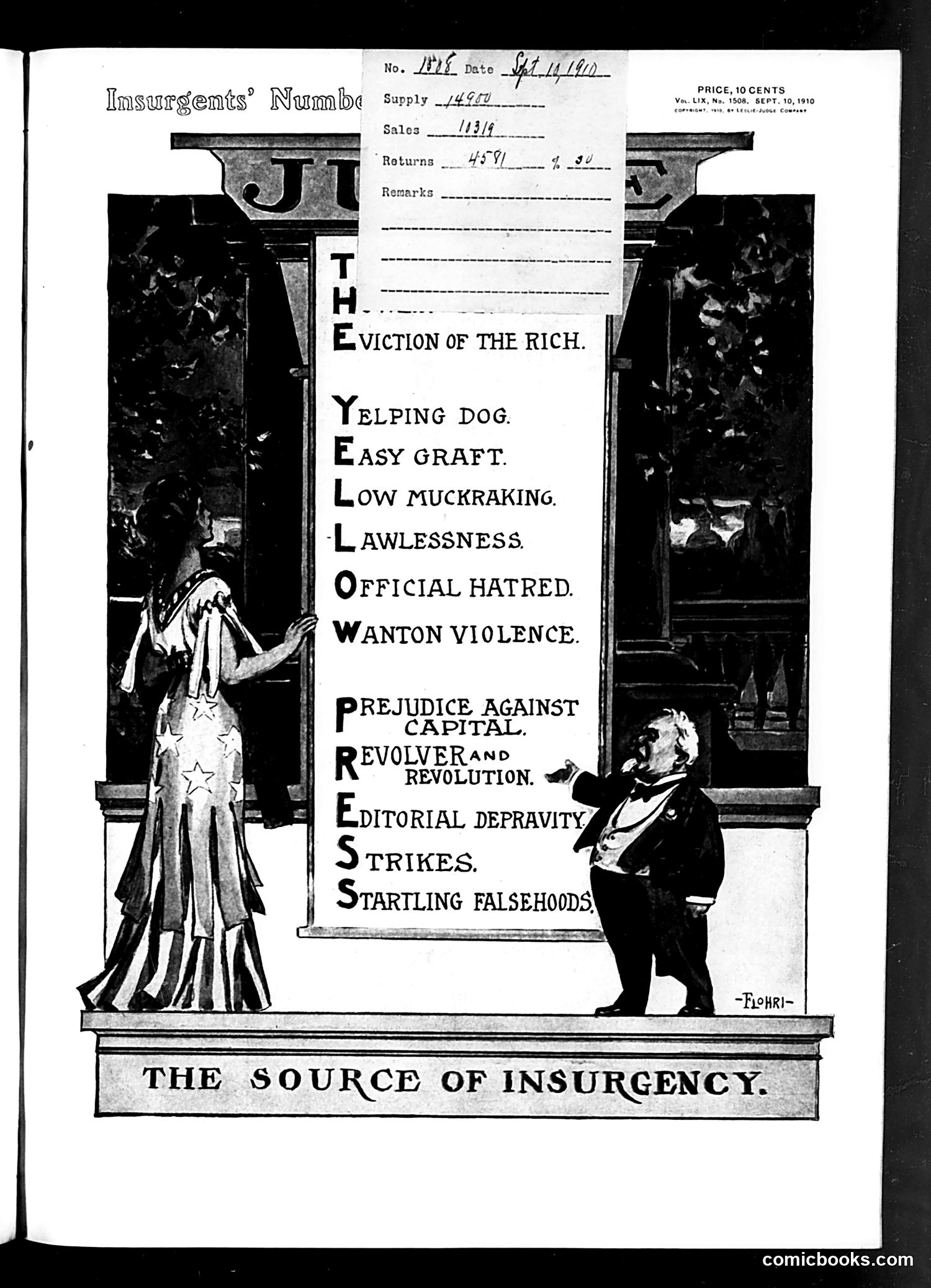
This political cartoon satirizes perceived causes of social unrest in early 20th-century America. Lady Liberty (left, in starred robe) and a wealthy capitalist (right) frame a list of grievances the cartoonist ironically attributes to "insurgency"—a term referencing progressive/radical movements challenging established power. The list reads as conservative propaganda: blamed causes include "Easy Graft," "Low Muckraking," "Lawlessness," "Official Hatred," and "Strikes." Rather than acknowledging legitimate labor grievances or corruption, the cartoon suggests insurgents are motivated by sensationalism and revolutionary ideology. The satire cuts both ways: Judge (a conservative publication) mocks progressive reformers while inadvertently documenting that wealthy elites blamed journalism, labor activism, and calls for reform—not their own wrongdoing—for social upheaval.
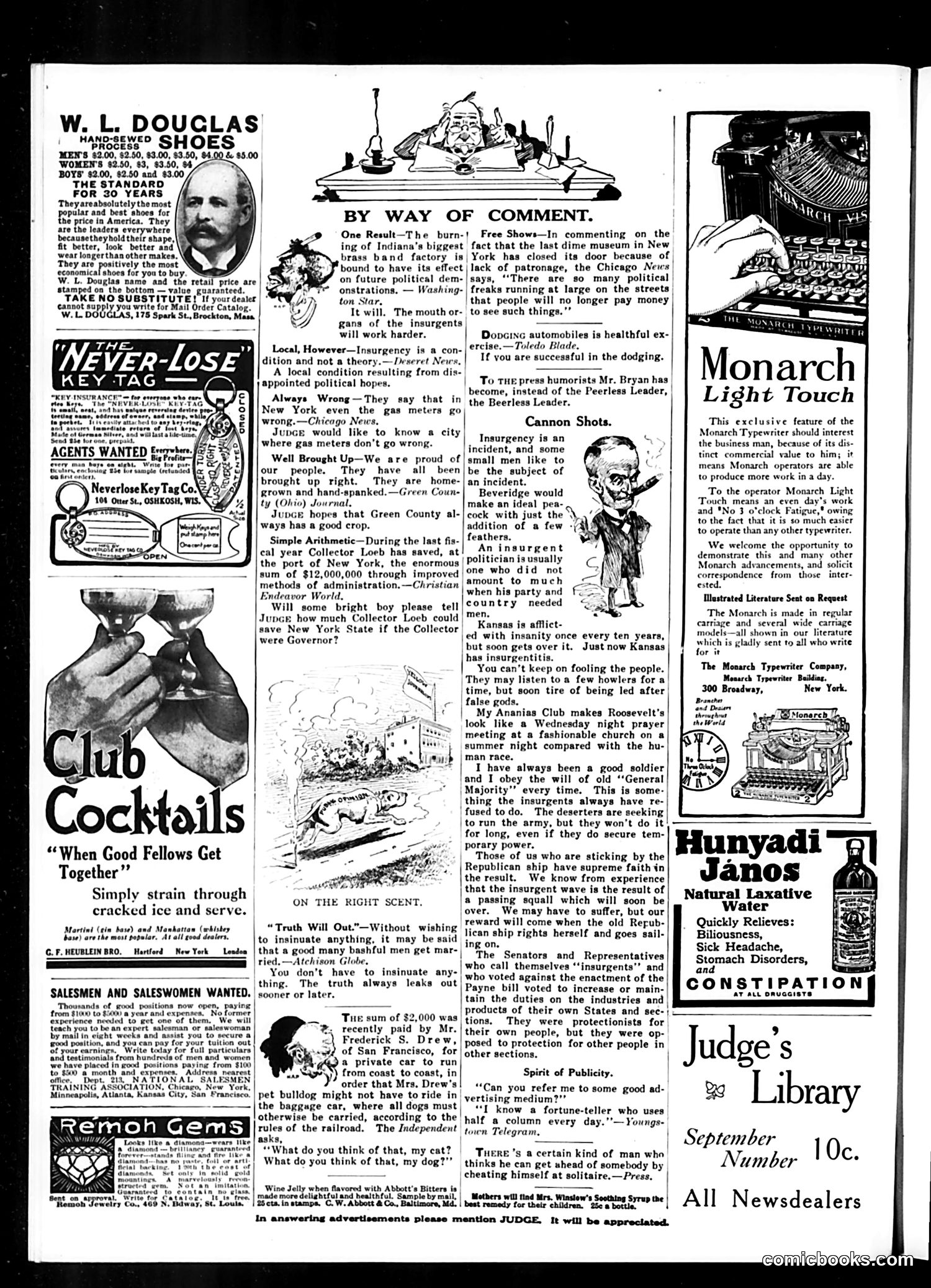
This page is primarily **advertisements and miscellaneous content** rather than political satire. The main items are: - **W.L. Douglas Shoes** ad (top left) featuring the shoe manufacturer - **"Never-Lose" Insurance** and **Club Cocktails** ads (left side) - **Monarch Typewriter** and **Hunyadi Janos Water** ads (right side) - **Judge's Library** (bottom right) The central section titled **"By Way of Comment"** contains brief satirical observations on various topics: insurance, politics, insurgency, and social matters—typical of Judge's editorial commentary. However, without clearer visual context or more legible specific references, the exact political targets remain unclear. The page represents Judge's mix of **advertising revenue** and **light satirical commentary** rather than focused political cartooning.
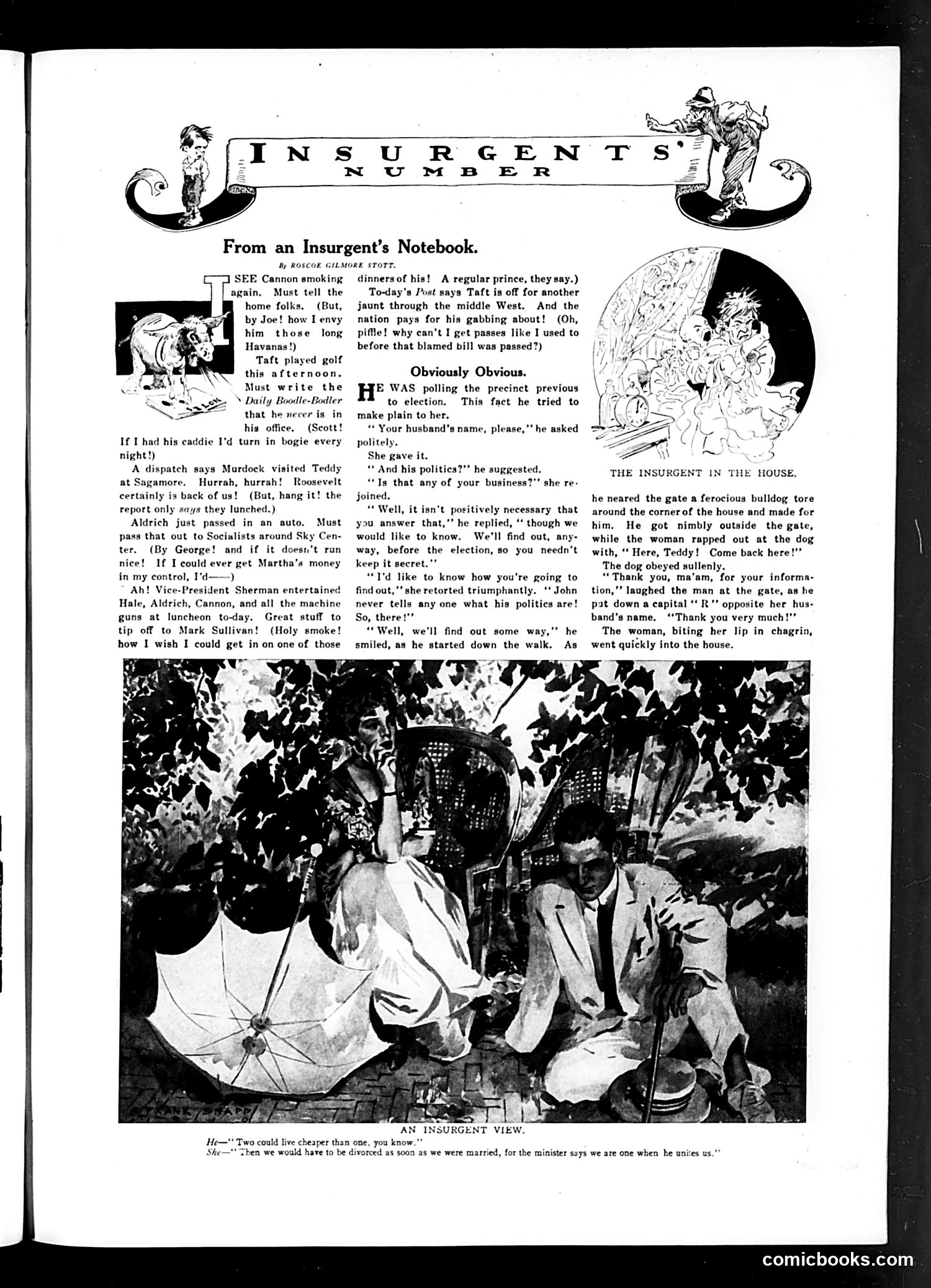
This page satirizes political insurgency and marital discord through interconnected sketches. The top section mocks various domestic complaints—a wife nagging about bills, a husband hiding from creditors, political arguments—equating household chaos with political rebellion. The central photograph captioned "An Insurgent View" shows a couple under umbrellas in heavy foliage, with dialogue suggesting they're considering divorce because "two could live cheaper than one." The satire implies that insurgents (likely referring to political dissidents of the era) use similar economic arguments to justify their rebellious positions. The humor equates personal marital "insurgency" with political insurgency, suggesting both emerge from petty grievances rather than principled conviction. The overall message appears skeptical of insurgent movements' legitimacy.
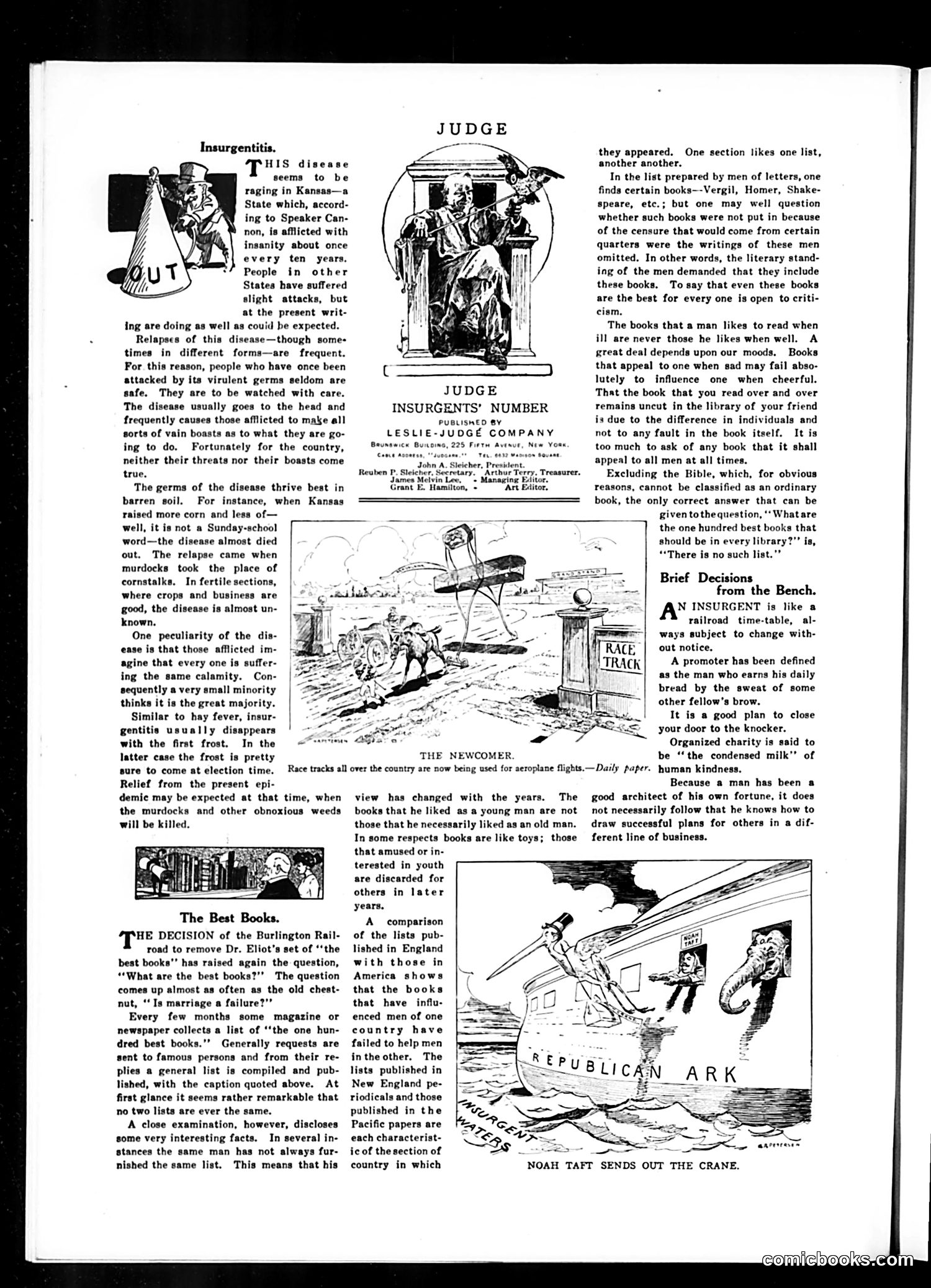
This page contains multiple satirical pieces commenting on early 20th-century American politics and society. **"Insurgentitis"** (left column) satirizes the Progressive/Insurgent movement within the Republican Party, comparing it to a disease afflicting Kansas and other states. The cartoon shows the "disease" as a political condition requiring careful monitoring. **"The Newcomer"** (center illustration) depicts a figure emerging from a crashed airplane, likely referencing the novelty and danger of early aviation. **"Noah Taft Sends Out the Crane"** (bottom) appears to be political satire involving the Republican Ark, likely mocking President William Howard Taft or Republican leadership during the Progressive Era split (circa 1909-1912). The page also includes "Brief Decisions from the Bench," offering humorous social commentary on contemporary life, and "The Best Books" section discussing literary preferences.
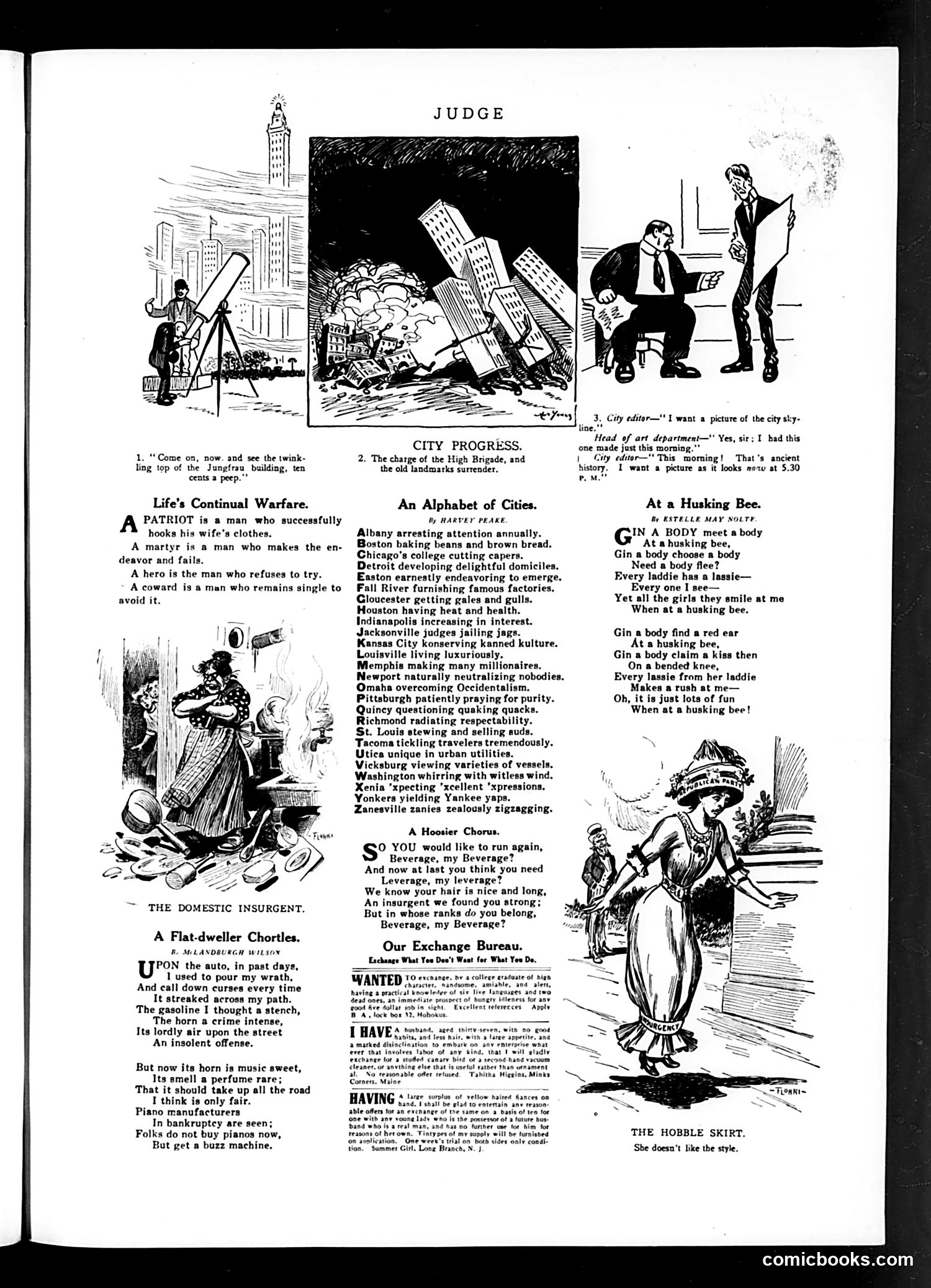
This page contains multiple satirical pieces and advertisements rather than a single cohesive cartoon. The top section titled "JUDGE" depicts three scenes: a city planner with telescope surveying destruction, building rubble, and a city editor requesting pictures—satirizing urban development and journalism's sensationalism. Below are poems and humorous pieces: "Life's Continual Warfare" mocks married life, "An Alphabet of Cities" jokes about American municipal stereotypes (Albany's attention to beans, Detroit's housing, etc.), and "At a Husking Bee" is a flirtation poem. "The Domestic Insurgent" cartoon shows a woman in conflict with a man, satirizing domestic disputes. Other sections include job-wanted and exchange ads, plus "The Hobble Skirt" cartoon mocking a then-fashionable tight skirt style. The page reflects early 20th-century American concerns: urban growth, gender relations, and fashion trends.
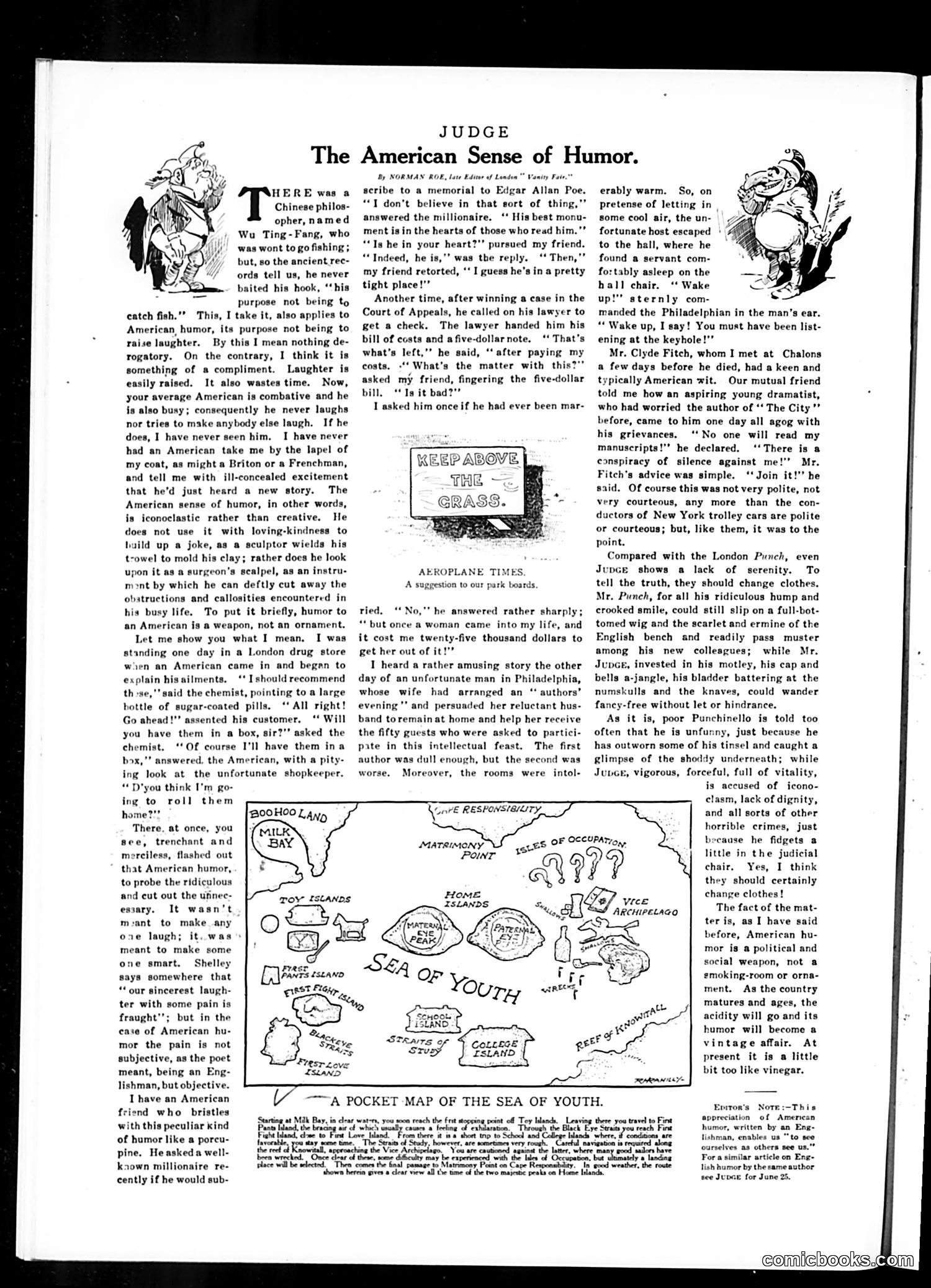
This essay by Norman Roe (former editor of *Vanity Fair*) defines American humor as fundamentally different from British or French humor. Rather than being creative and lighthearted, American humor is **iconoclastic and weaponized**—designed to cut away pretense and expose ridiculousness, often causing discomfort to the target. The author illustrates this through anecdotes: an American customer's cutting remark to a London pharmacist about carrying pills home; a friend's barbed joke to a millionaire about Edgar Allan Poe being "in a tight place" (his heart); another quip about a woman who cost $25,000 to remove from his life. The accompanying cartoons and "Pocket Map of the Sea of Youth" appear to satirize youthful follies and social absurdities. The point: American humor functions as social criticism and deflation of pretense, not entertainment—it's sharp, purposeful, and often uncomfortable by design.
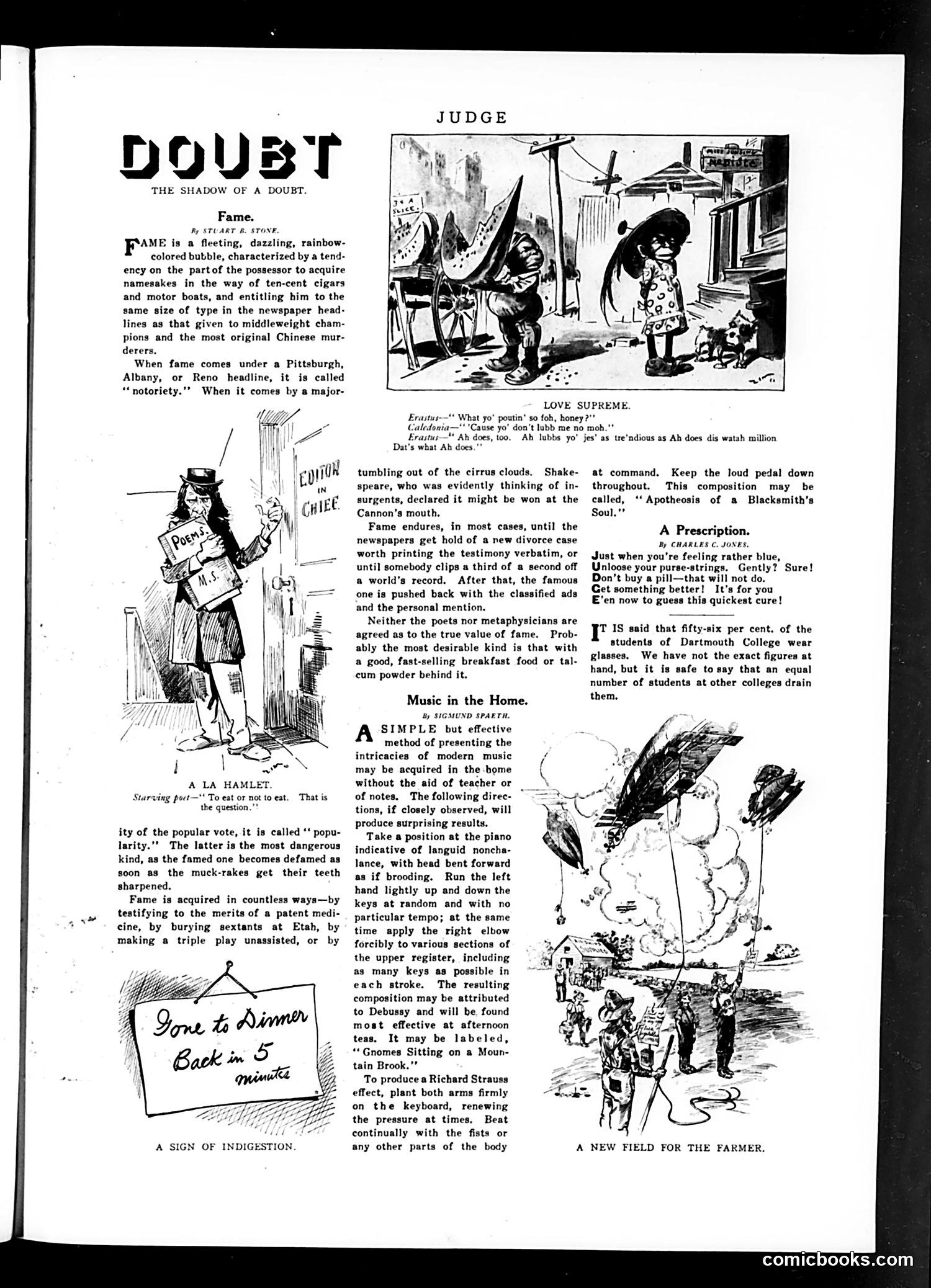
This page from the satirical magazine *Judge* contains several pieces of social commentary: **"Doubt: The Shadow of a Doubt"** satirizes the fleeting nature of fame in America. The essay notes that fame acquired through major vote victories ("popularity") is most dangerous because it quickly disappears once newspapers move to fresher scandals (divorces, broken records). The cartoons illustrate this: a starving poet contemplating survival, and various humorous scenarios showing how fame is manufactured or lost. **"Music in the Home"** mocks amateur "modern music" pretension—specifically contemporary composers like Debussy and Richard Strauss. It humorously instructs readers on how to fake sophisticated piano playing by randomly hitting keys and attributing the noise to famous composers, satirizing both amateur musicianship and the obscurity of modernist composition. **Minor pieces** include ethnic humor ("Love Supreme" with dialect) and a joke about eyeglass-wearing college students. The overall tone critiques American celebrity culture, artistic pretension, and media-driven notoriety.
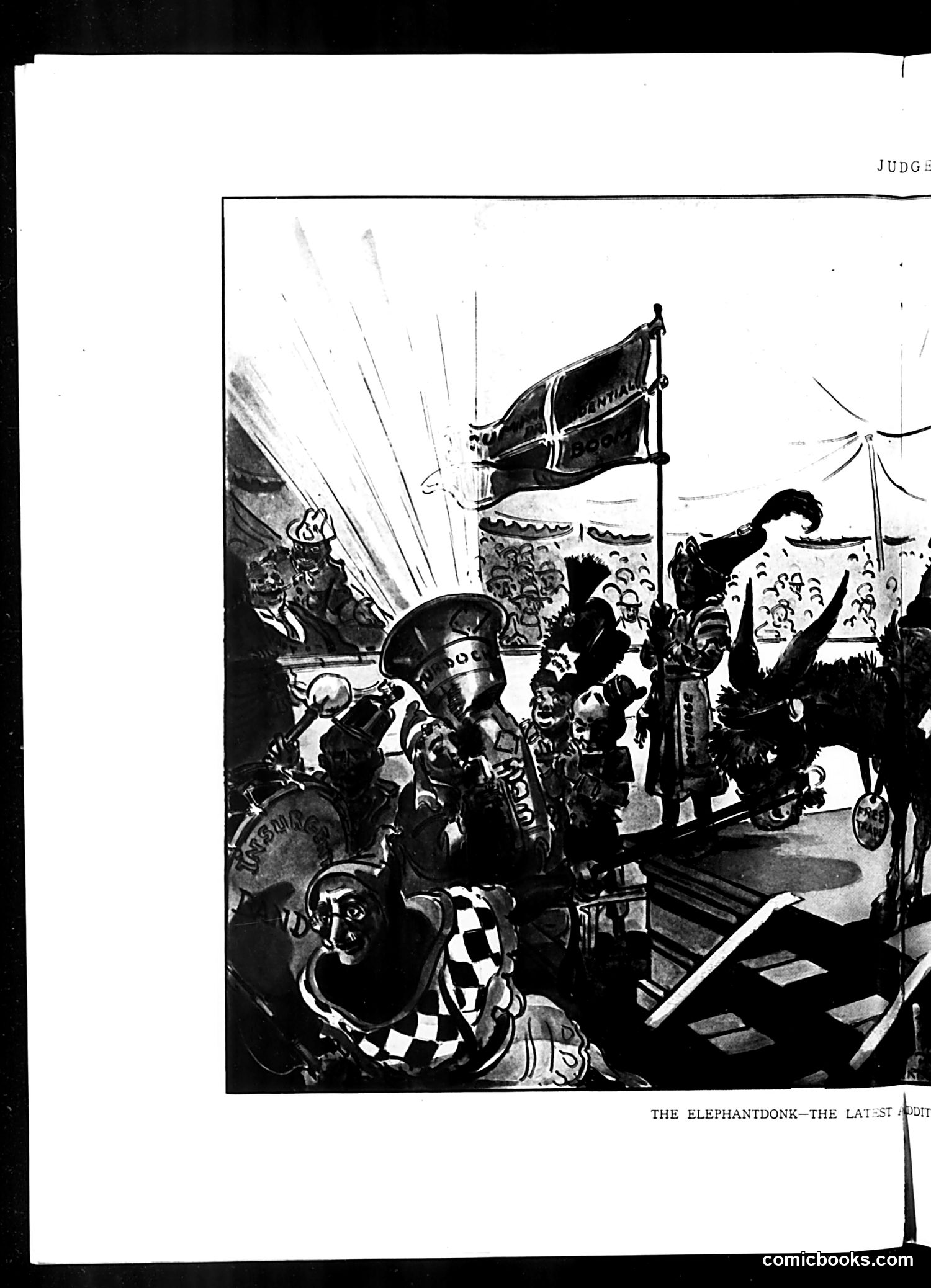
This political cartoon appears to depict a hybrid creature combining an elephant (Republican symbol) and a donkey (Democratic symbol), surrounded by a cheering crowd with flags and military regalia. The elaborate pageantry—with uniformed figures, banners, and radiating light effects—suggests celebration of this hybrid creation. The satire likely mocks either a political merger, compromise, or coalition between Republicans and Democrats. The grandiose presentation ironically elevates what might be viewed as an absurd or unnatural political combination. The crowds' enthusiasm suggests public approval or gullibility regarding this political development. Without a visible date, the specific historical moment remains unclear, though this reflects Judge magazine's typical commentary on American partisan politics through animal symbolism.
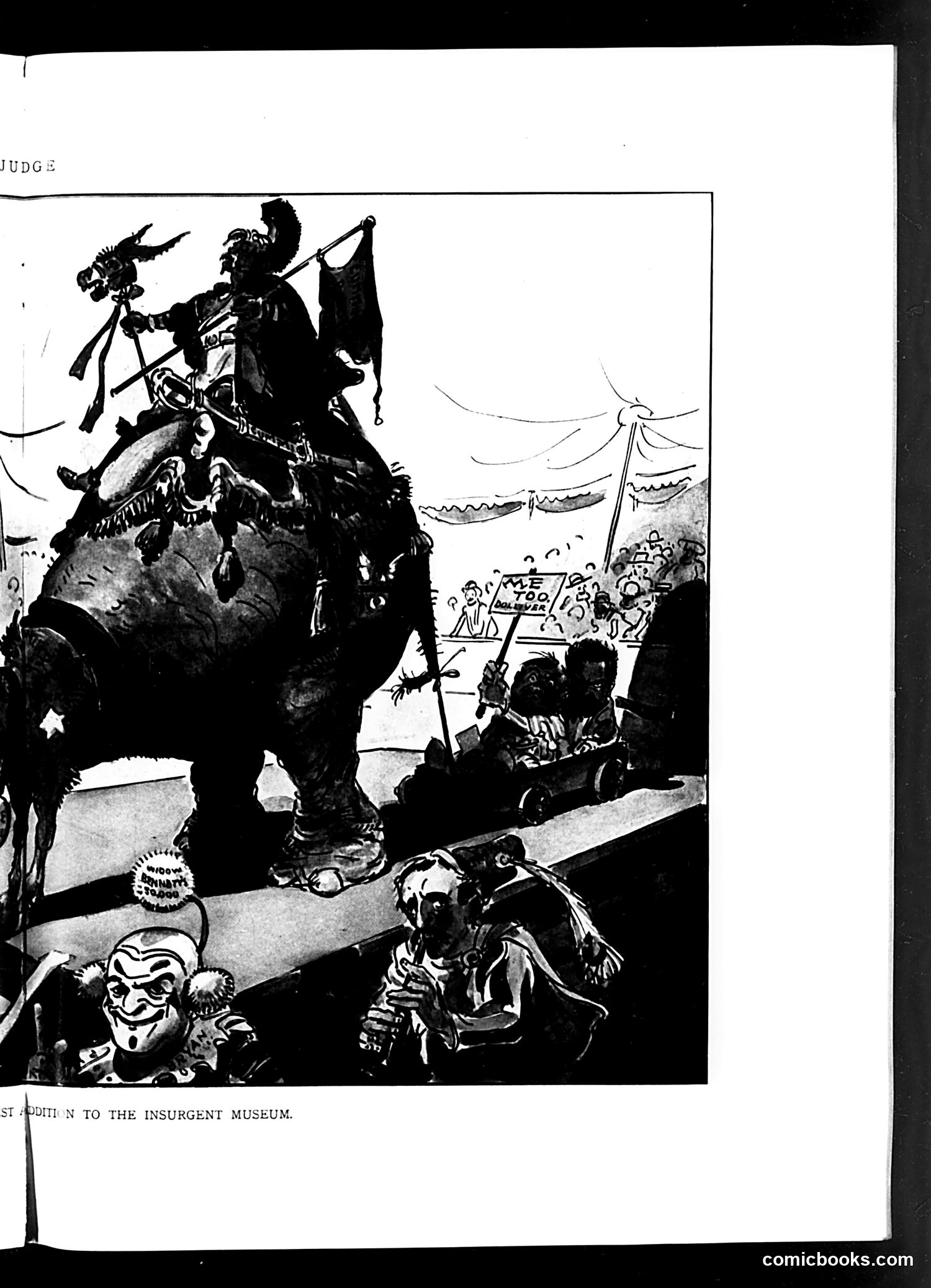
This appears to be a satirical illustration titled "Addition to the Insurgent Museum," depicting a grand ceremonial scene. A mounted military or political figure on an ornate elephant presides over what seems to be a circus or theatrical gathering, complete with spectators in tiered seating and figures in the foreground. The cartoon likely satirizes a significant political or military figure being treated with ceremonial grandeur, possibly mocking the glorification of insurgent or revolutionary leadership. The carnival-like atmosphere—with the elephant, crowds, and theatrical staging—suggests ironic commentary on how such figures are celebrated or memorialized. Without clearer dating or additional context, the specific historical event or political target remains unclear, though the "Insurgent Museum" reference suggests commentary on revolutionary movements or rebel commemorations popular during Judge magazine's publication era.
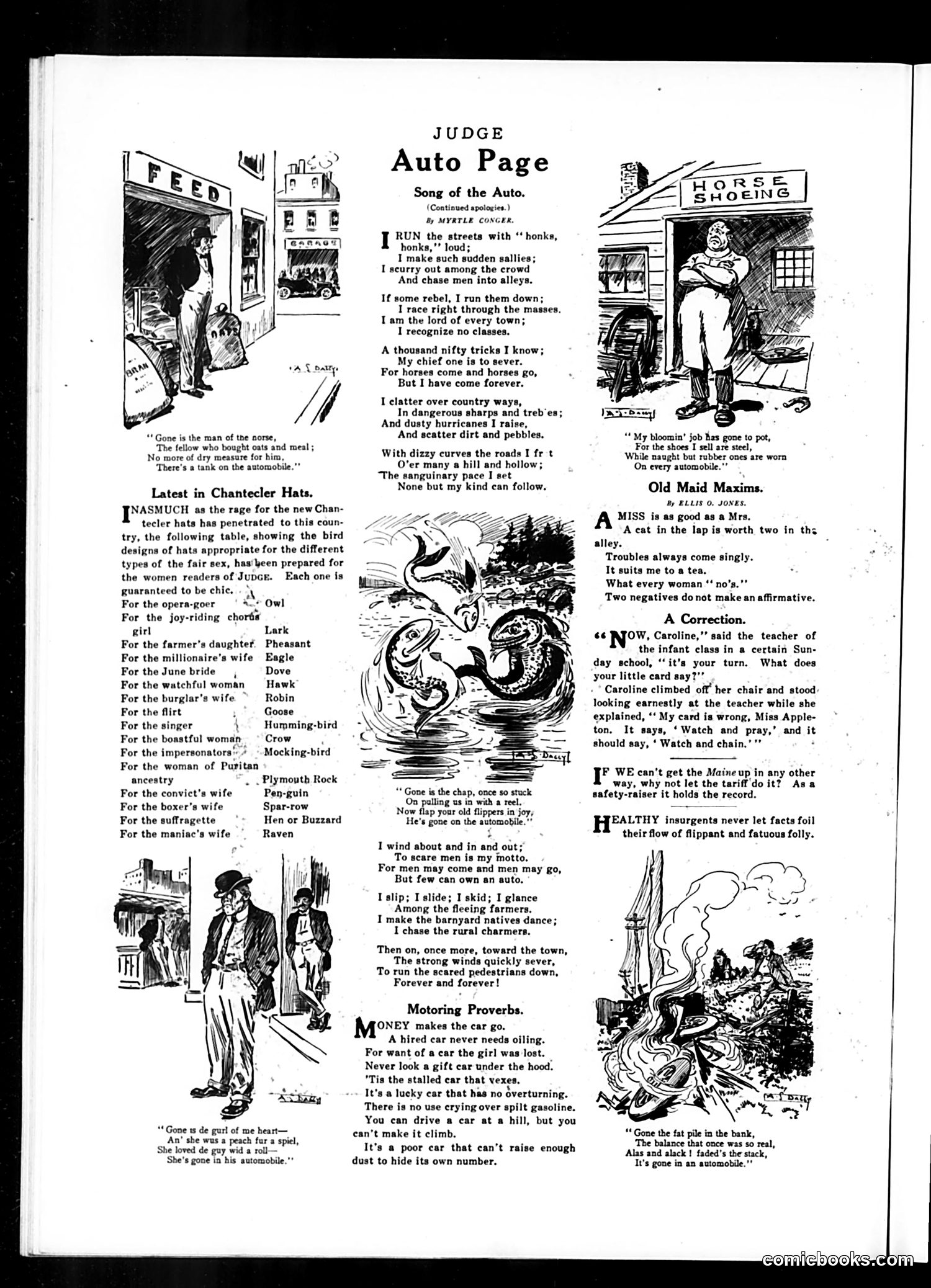
This page satirizes the automobile's rapid rise in early 20th-century America through poetry and humor. The main "Song of the Auto" personifies the car as an arrogant, dangerous force that has displaced horses and dominates public space—running down pedestrians, scattering farmers, and asserting dominance over traditional society ("the lord of every town"). The satirical "Chantecler Hats" table mocks the era's fashionable millinery by matching bird types to women's social roles, a period-appropriate joke about consumer culture and gender stereotypes. The "Motoring Proverbs" parody traditional sayings, replacing wisdom with automobile-related absurdities ("Money makes the car go," "There is no use crying over spilt gasoline"). Throughout, the cartoons and verse critique the automobile's chaotic social impact—danger to pedestrians, displacement of horse-related industries, and the car's status as a status symbol replacing older values. The overall tone is disapproving of modernization's disruptions while acknowledging the automobile's inevitable cultural dominance.
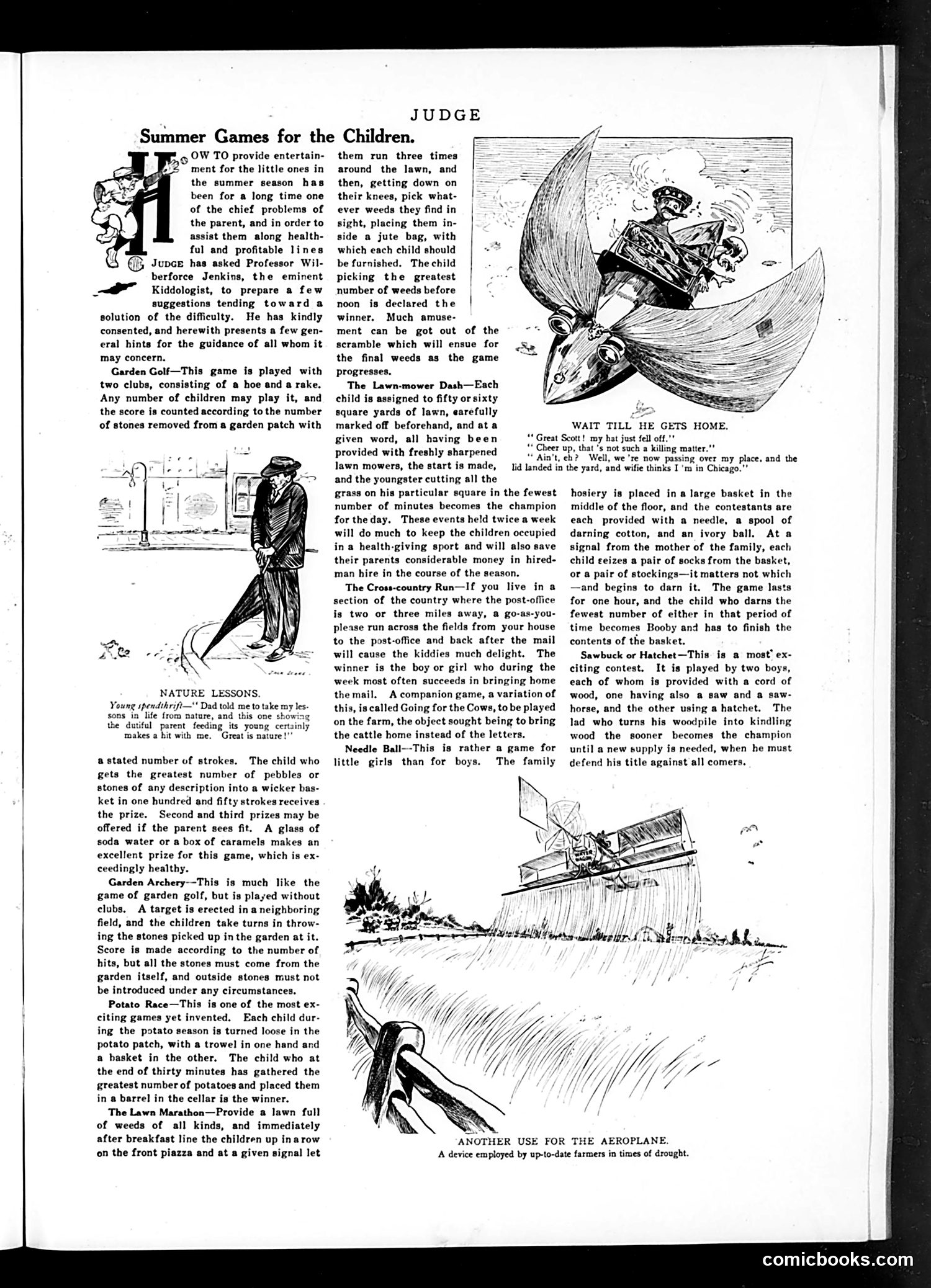
This article presents mock "summer games" disguised as wholesome children's activities, but each is actually unpaid child labor presented as entertainment. The satire targets parents seeking to occupy children while reducing household expenses. The "games" include: Garden Golf (removing stones), Potato Race (harvesting potatoes), Lawn Marathon (weeding), Lawn-mower Dash (mowing grass), and Cross-country Run (fetching mail). Each frames genuine farm or domestic work as sport, complete with "prizes." The accompanying "Nature Lessons" cartoon—showing a bird feeding its young—reinforces the satire: the child approves of nature's "dutiful parent feeding its young," unknowingly endorsing the logic Judge mocks: parents exploiting children's labor under the guise of healthy outdoor activity. The joke exposes the hypocrisy of middle-class parents simultaneously promoting child welfare while having children do unpaid work that saves "considerable money in hired-man hire."
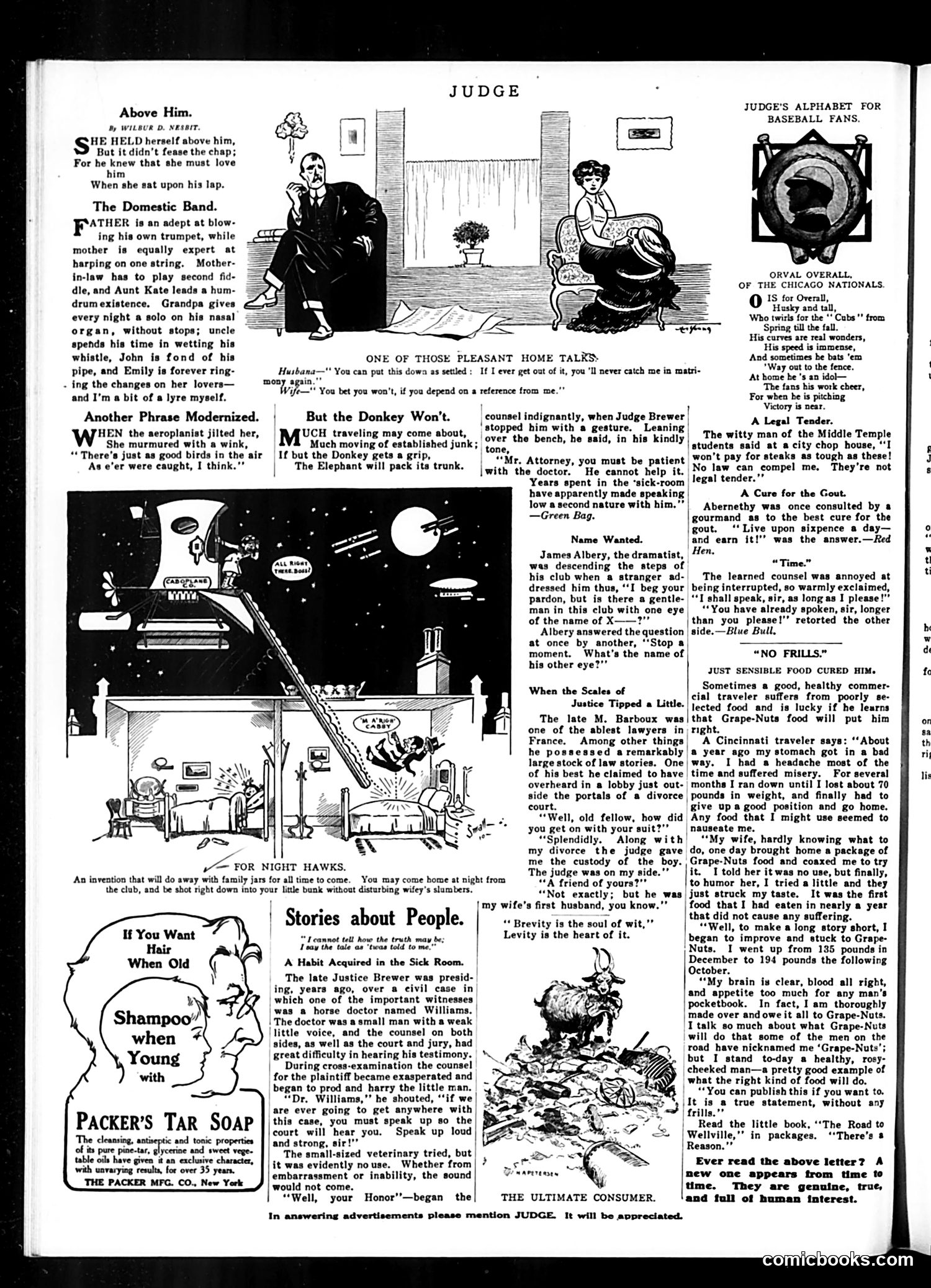
This page from the satirical magazine **Judge** contains mixed content typical of early 20th-century humor publications: **Main Cartoons & Humor:** - "Above Him" and "The Domestic Band" are light domestic humor poems mocking marriage dynamics - "One of Those Pleasant Home Talks" depicts a husband-wife argument about matrimony - "Another Phrase Modernized" jokes about women comparing romantic rejection to discarding old lovers—updated to reference the then-novel subject of aeroplanes - The "Donkey/Elephant" piece likely references U.S. political parties (Democratic donkey vs. Republican elephant), suggesting one party won't cooperate while the other will **"Judge's Alphabet for Baseball Fans"** profiles **Orval Overall**, a pitcher for the Chicago Cubs, treating baseball celebrities as notable public figures worthy of tribute. **Anecdotal humor sections** ("Stories about People") feature dry jokes about lawyers, doctors, and social etiquette—typical Judge fare satirizing professional and genteel society. **Advertising** for Parker's Tar Soap occupies the lower left. The page reflects **early 1900s concerns**: courtship, domestic life, politics, professional pomposity, and emerging sports celebrity culture.
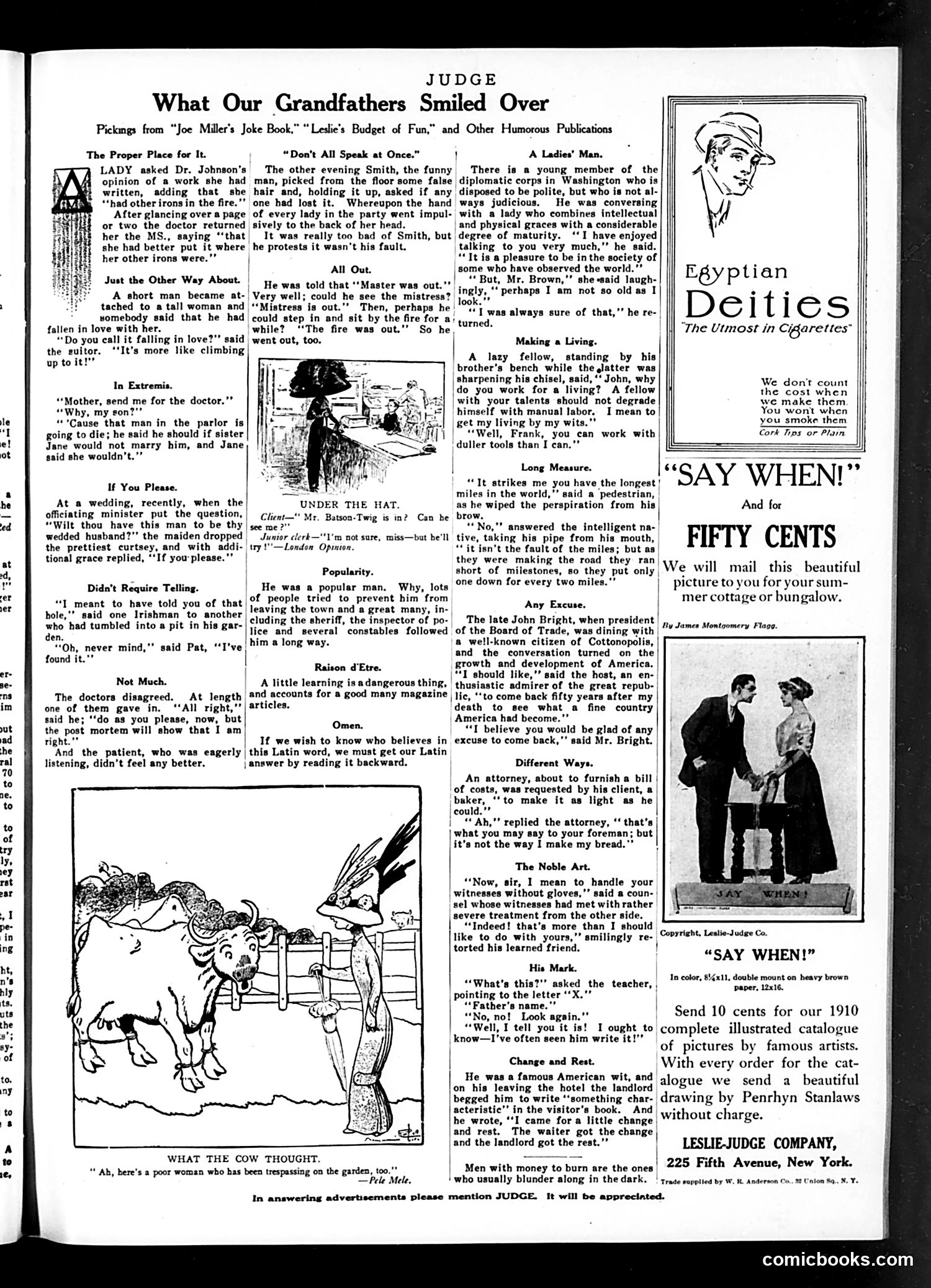
This page collects reprinted jokes from 19th-century humor publications, presented as nostalgic comedy ("What Our Grandfathers Smiled Over"). The jokes represent Victorian-era social humor with period-specific references: **Key themes:** - **Class and propriety**: Multiple jokes mock social pretension and awkward etiquette (the woman dropping a curtsey instead of answering "yes" at her own wedding; the diplomat's tactless compliment to an aging woman). - **Gender relations**: Several jokes play on courtship and marriage as transactions or traps ("falling in love" as literally climbing up to a tall woman; a man threatening suicide if refused). - **Working-class irony**: A lazy man claims he'll "live by his wits" while his industrious brother labors physically—implying con artists or parasites. - **Doctor/professional mockery**: Recurring skepticism toward authority figures. The cartoons (cow trespassing in a garden; man with false hair at a party) illustrate these written jokes visually. For modern readers, the humor requires understanding Victorian social structures, marriage customs, and class anxiety that shaped early 20th-century American comedy.
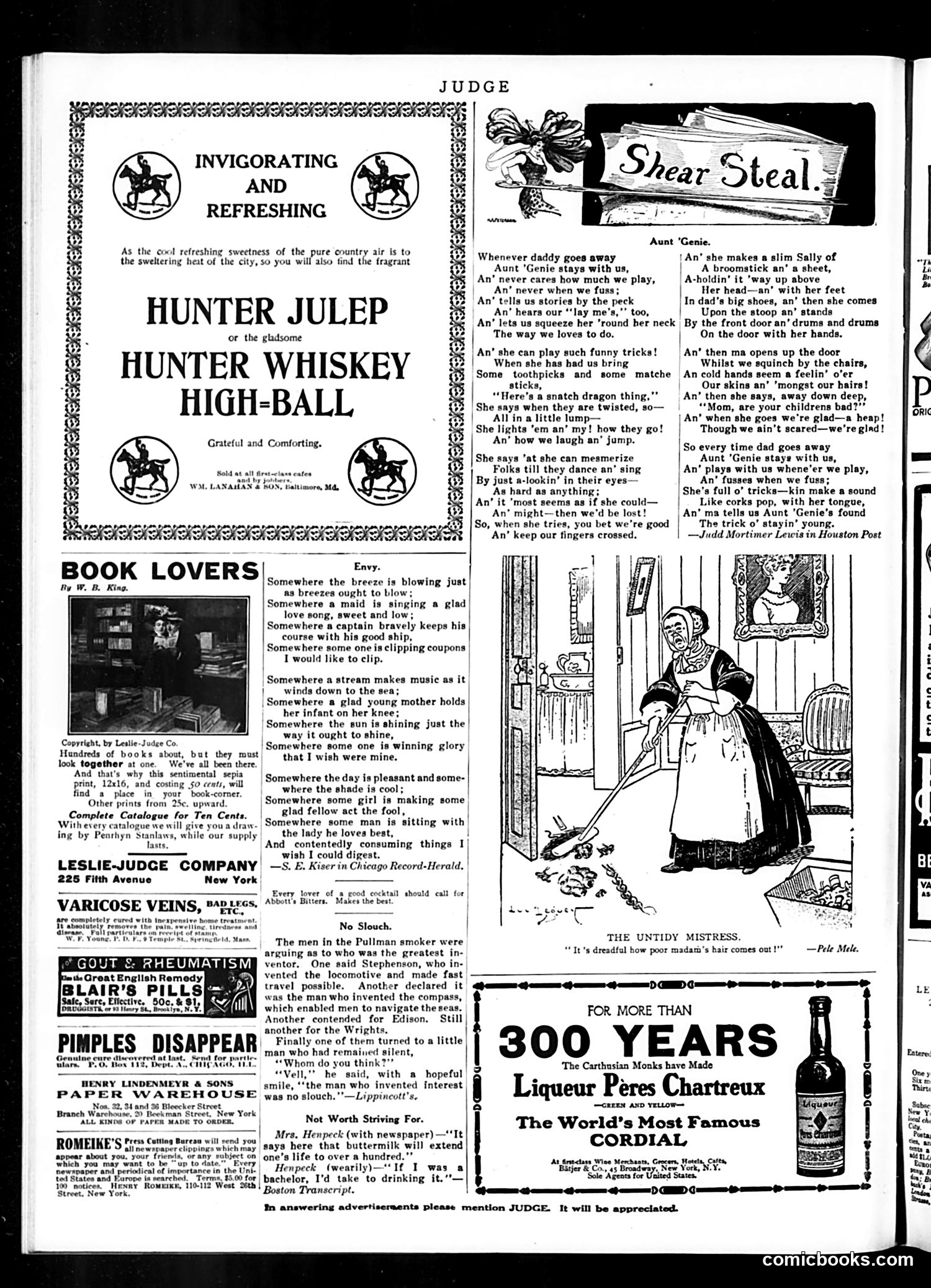
This page contains two distinct pieces of light satirical content typical of Judge magazine's era. **"Aunt 'Genie"** is a sentimental poem celebrating a beloved aunt figure who entertains children during their father's absences. The humor is gentle—depicting magic tricks, dragon-shaped matchstick games, and the aunt's mysterious ability to "mesmerize" and keep children obedient through playful mystique. It's nostalgic Americana, emphasizing the aunt's irreplaceable role in family life. **"Book Lovers"** by W.B. King shows a couple absorbed in reading together, accompanied by text praising domestic contentment through books. The accompanying poem "Envy" by S.E. Kiser uses ironic repetition ("Somewhere...") to express wistful longing for idealized life situations—a common satirical structure mocking both aspiration and discontent. Both pieces target sentimental middle-class domesticity and family values—the magazine's core audience. The satire is affectionate rather than biting, reflecting Judge's role as family-friendly satirical entertainment rather than sharp social critique.
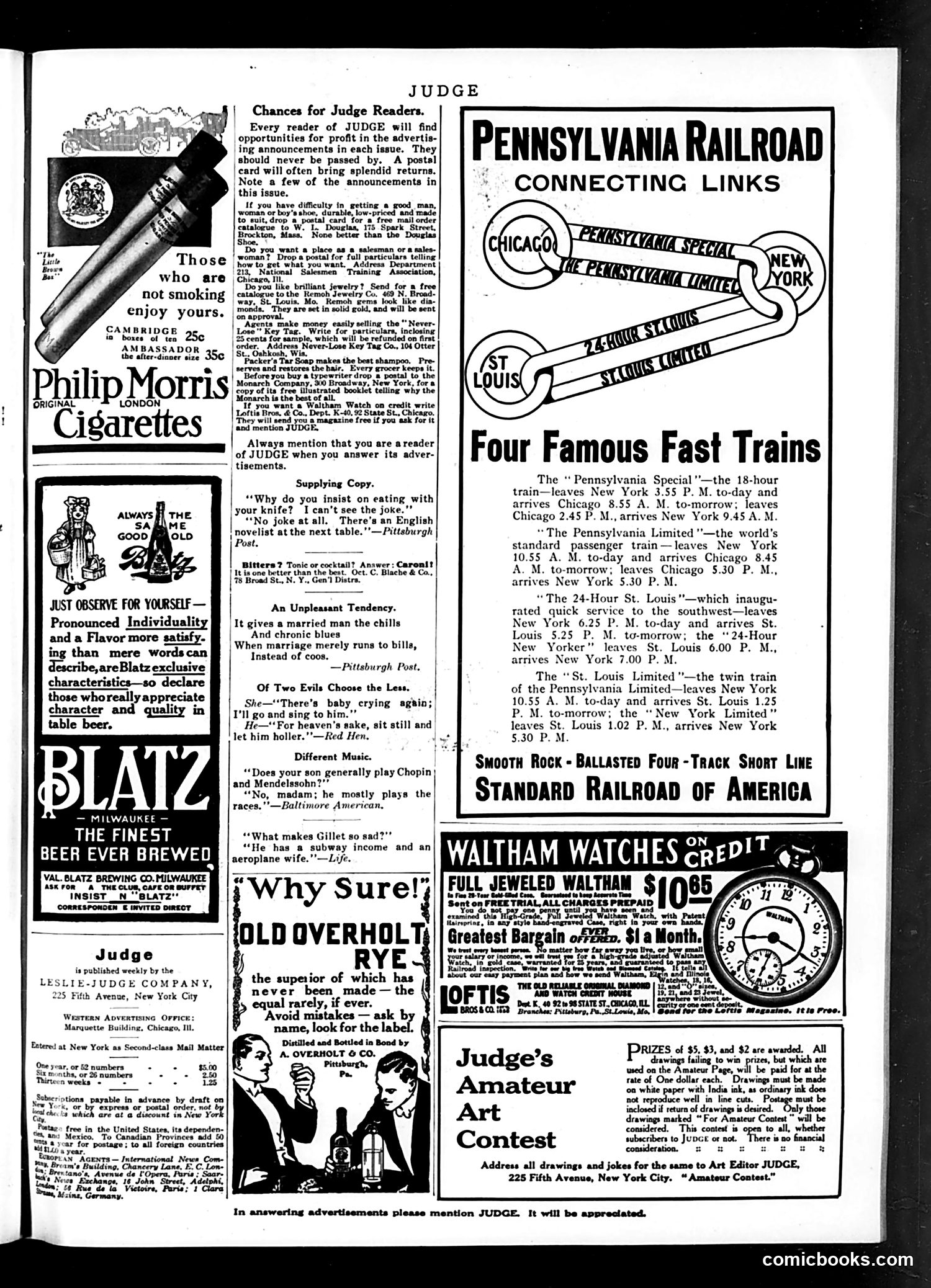
This page is primarily **advertising**, with minimal satirical cartoon content. The few brief jokes interspersed are genteel domestic humor typical of early 20th-century publications. The small comic vignettes include: - A married man's complaint about his wife's expenses ("subway income and an aeroplane wife") - A husband preventing his wife from singing to their baby, preferring the child cry - A reference to a man who plays "the races" rather than classical music These represent mild social commentary on marriage troubles and class aspirations rather than sharp political satire. The page's real content consists of advertisements for **Philip Morris cigarettes, Blatz beer, Waltham watches, Old Overholt whiskey, and Pennsylvania Railroad services**—representing luxury goods marketed to Judge's middle-to-upper-class readership. The magazine itself solicits readers to use advertiser coupons for profit opportunities, treating advertisements as genuine business services worthy of reader attention.
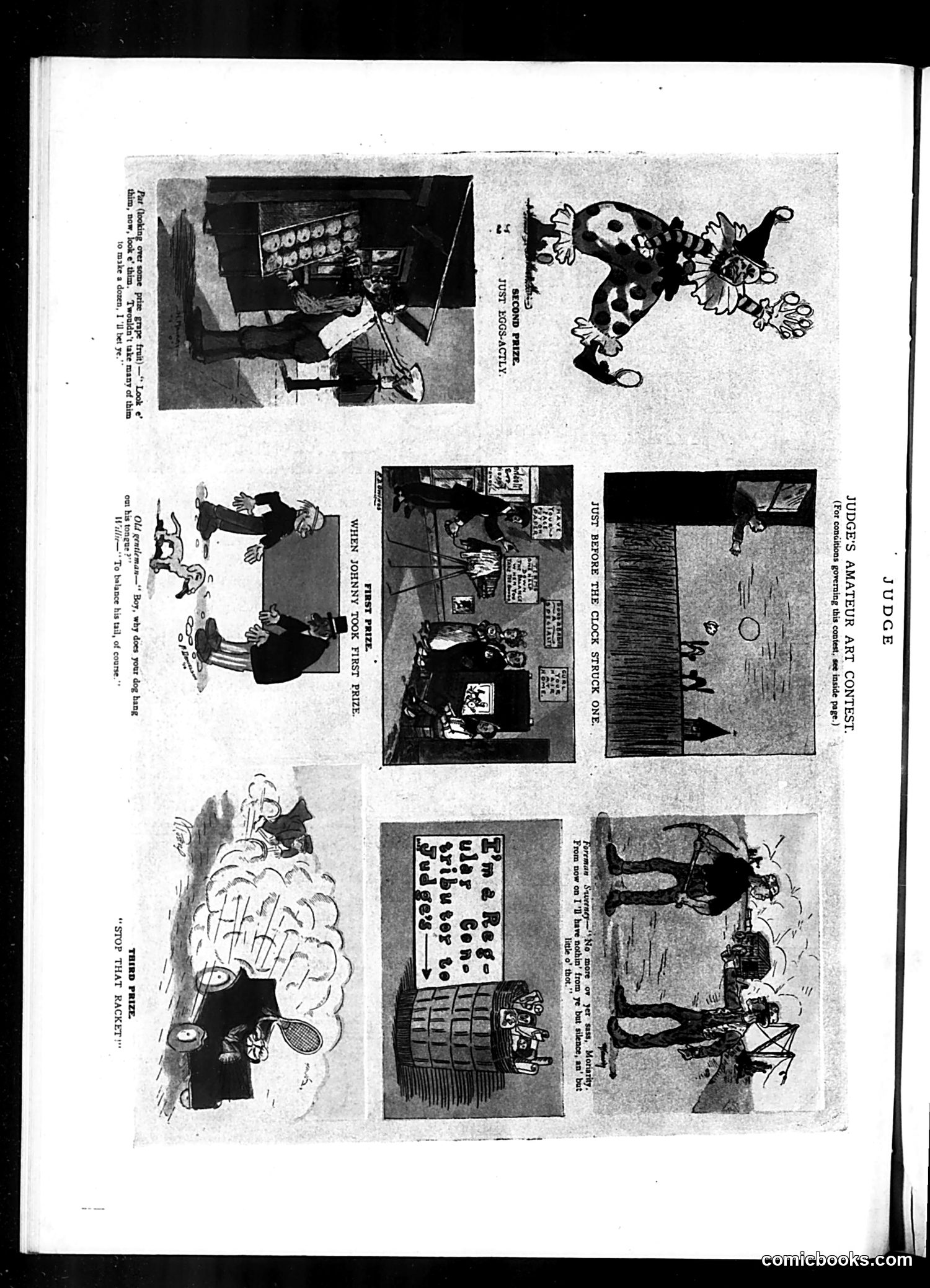
This page showcases **Judge's Amateur Art Contest**, featuring reader submissions and humorous captions. The content includes: **Main Elements:** - A "Prize Grapefruit" joke (top) mocking something small or inadequate - An exchange between an old gentleman and boy about why dogs hang their tongues out—a simple children's joke setup with a practical punchline ("to balance his tail") - A "Stop That Racket!" scene (labeled Third Prize), apparently depicting noise complaints or domestic disruption - Various cartoon submissions from amateur artists competing in the contest **The Satire:** Judge frequently published reader-submitted amateur artwork and jokes to mock the quality of public contributions while entertaining audiences with their earnest but often crude attempts at humor. This format allowed the magazine to simultaneously engage readers and gently ridicule their creative efforts—a form of gentle, participatory satire typical of Judge's editorial strategy. The page reflects early 20th-century American magazine culture and public taste in humor.