
Judge, 1910-09-10 · page 13 of 16
Judge — September 10, 1910 — page 13: what you’re looking at
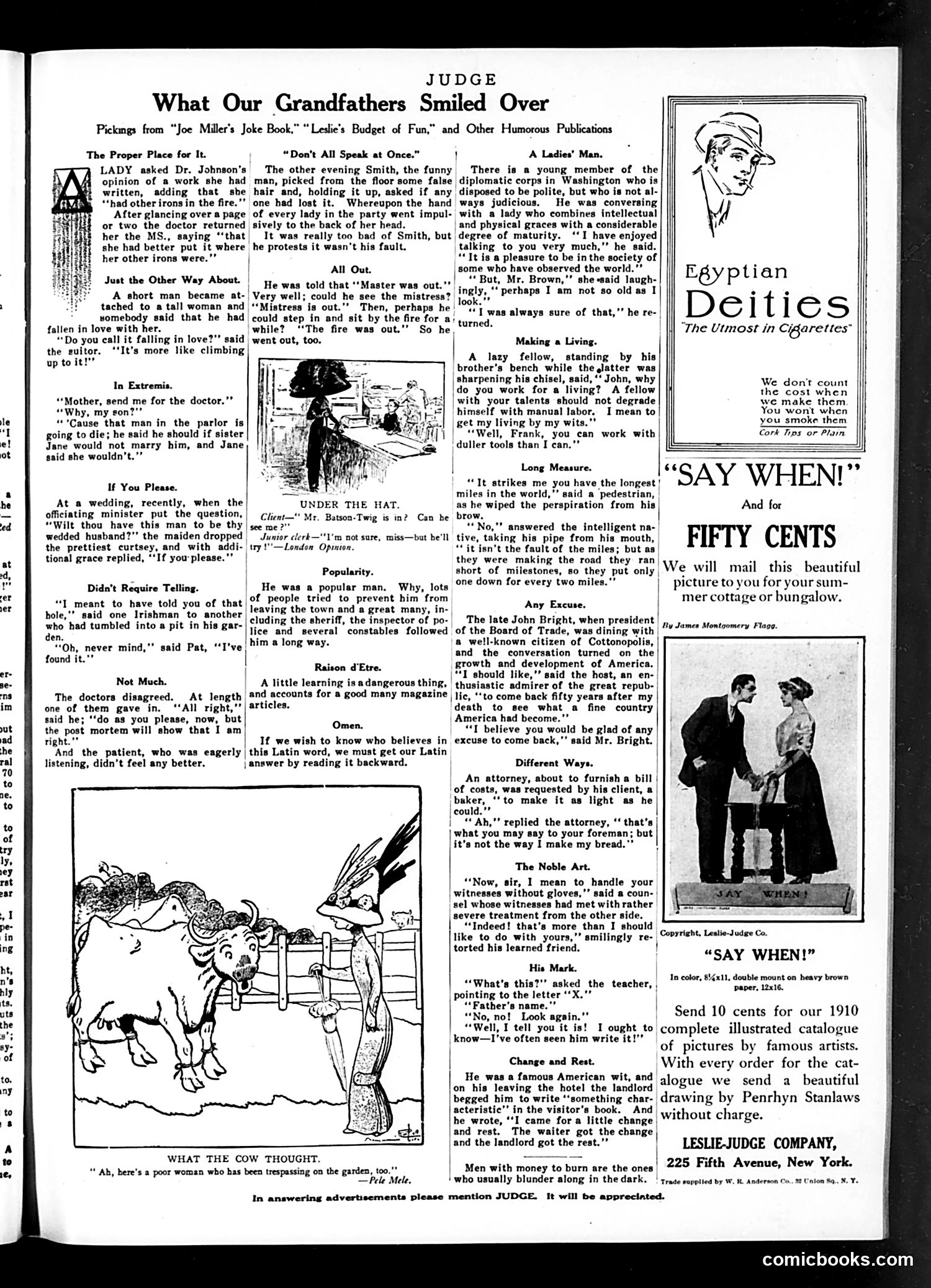
What you’re looking at
This page collects reprinted jokes from 19th-century humor publications, presented as nostalgic comedy ("What Our Grandfathers Smiled Over"). The jokes represent Victorian-era social humor with period-specific references: **Key themes:** - **Class and propriety**: Multiple jokes mock social pretension and awkward etiquette (the woman dropping a curtsey instead of answering "yes" at her own wedding; the diplomat's tactless compliment to an aging woman). - **Gender relations**: Several jokes play on courtship and marriage as transactions or traps ("falling in love" as literally climbing up to a tall woman; a man threatening suicide if refused). - **Working-class irony**: A lazy man claims he'll "live by his wits" while his industrious brother labors physically—implying con artists or parasites. - **Doctor/professional mockery**: Recurring skepticism toward authority figures. The cartoons (cow trespassing in a garden; man with false hair at a party) illustrate these written jokes visually. For modern readers, the humor requires understanding Victorian social structures, marriage customs, and class anxiety that shaped early 20th-century American comedy.
📄 Transcribed text from this page (OCR, searchable)
Machine-transcribed from the original scan — historical spelling and the odd misread are preserved.
JUDGE What Our Grandfathers Smiled Over Pickings from “Joe Miller's Joke Book,” “Leslie's Budget of Fun,” and Other Humorous Publications The Proper Place for It. “Don't All Speak at Once.” LADY asked Dr. Johnson’s The other evening Smith, the funny opinion of a work she had man, picked from the floor some false written, adding that she hair and, holding it up, asked if any “had other irons in the fire."’ one had lost it. Whereupon the hand After glancing over a page of every lady in the party went impul- or two the doctor returned sively to the back of her head. her the MS., saying ‘‘that It was really too bad of Smith, but she had better put it where he protests it wasn't his fault. her other irons were.’” | All Out. Just the Other Way About. je was told that ‘Master was out."? A short man became at-| Very well; could he see the mistress? tached to a tall woman and “Mistress is out.’’ Then, perhaps he somebody said that he had could step in and sit by the fire for fallen in love with her. while? ‘‘The fire was out.” So “Do you call it falling in love?” said | went out, too. the euitor. ‘‘It’s more like climbing up to it!"” a he In Extremis. “Mother, send me for the doctor.’* “Why, my son?’ “'Cause that man in the parlor is going to die; he said he should if sister Jane would not marry him, and Jane said she wouldn’t.”” If You Please. At a wedding, recently, when the officiating minister put the question, cy, “Wilt thou have this man to be thy | see me wedded husband?” the maiden dropped | Junior clerk—'"I'm not sure, miss—but he'll the prettiest curtsey, and with addi- try !"'—London Opinion. tional grace replied, “If you please.”” UNDER THE HAT. “Mr. Batson-Twig is in? Can he Popularity. He was a popular man, Why, lots Fi lof people tried to prevent him from weeny 22, bate Selesee of that jeaving the town and a great many, in- be’ i d tumbled into a pit in his gar.| cluding the sheriff, the inspector of po- i nto a pl 88™\ tice and several constables followed “Oh, never mind,” said Pat, ‘I've | him a long way. found it."” Didn't Require Telling. | Raison d'Etre. A little learning is adangerous thing, At length and accounts for a good many magazine Not Much. The doctors disagreed. J one of them gave in. ‘‘All right,’?| articles. said he; ‘do as you please, now, but o the post mortem will show that I am| men. right.”” If we wish to know who believes in ‘And the patient, who was eagerly | this Latin word, we must get our Latin listening, didn’t feel any better. | answer by reading it backward. WHAT THE COW THOUGHT. Ab, bere’ r woman who has been trespassing on the garden, too.” “Ee ene —Pele Mele. In answering advertisements please ! A Ladies’ There is a young member of the diplomatic corps in Washington who is disposed to be polite, but who is not al- ways judicious. He was conversing with a lady who combines intellectual and physical graces with a considerable degree of maturity. ‘‘I have enjoyed talking to you very much,” he said. “Tt is a pleasure to be inthe society of some who have observed the world.’” | “But, Mr. Brown,’ she-said laugh- ingly, “perhaps I am not so old as I “*[ was always sure of that,"” he re- " turned. | Making « Living. A. lazy fellow, standing by his brother's bench while the glatter was sharpening his chisel, 8: John, why |do you work for a living? A fellow |with your talents should not degrade himseif with manual labor. I mean to get my living by my wits.”* “Well, Frank, you can work with duller tools than I can."’ Long Measure. “It strikes me you have the longest miles in the world,’’ said a ‘pedestrian, as he wiped the perspiration from his brow. “*No,”* answered the intelligent na-/ tive, taking his pipe from his mouth, “it isn’t the fault of the miles; but as they were making the road they. ran short of milestones, so they put only one down for every two miles.”” Any Excuse. The late John Bright, when president of the Board of Trade, was dining with a well-known citizen of Cottonopolis, | and the conversation turned on the “T should lik id the host, an en- thusiastic admirer of the great repub- | lic, **to come back fifty years after my death to see what a fine country America had become."” “T believe you would be glad of any excuse to come back," said Mr. Bright. Different Ways. An attorney, about to furnish a bill of costs, was requested by his client, 2 baker, ‘to make it as light as he | could.”* | ‘Ab,’ replied the attorney, “ that’s what you may say to your foreman; but it’s not the way I make my bread.”* The Noble Art. “Now, sir, I mean to handle your sel whose witnesses had met with rather severe treatment from the other side. “Indeed! that’s more than I should like to do with yours,” smilingly re- torted his learned friend. His Mark. “(What's this?’’ asked the teacher, | pointing to the letter “*X."" ! I ought to know—I've often seen him write it!’’ Change and Rest. He was a famous American wit, and on his leaving the hotel the landlord begged him to write ‘‘something char- acteristic’ in the visitor's book. And he wrote, ‘‘I came fora little change and rest. The waiter got the change | and the landlord got the rest.’” | Men with money to burn are the ones Deities ‘The Utmost in Cigarettes” We don't count | the cost when we make them You wont when you smoke them Cork Tips or Plain "SAY WHEN!” And for FIFTY CENTS We will mail this beautiful pictu reto you for your sum- mer cottage or bungalow. By James Montoomery Flago. witnesses without gloves," said a coun- | Copyright, Leslie-Judge Co. “SAY WHEN!” In color, 84x11, double mount on heavy brown { paper, 12x16. | | Send 10 cents for our 1910 complete illustrated catalogue of pictures by famous artists. With every order for the cat- alogue we send a_ beautiful drawing by Penrhyn Stanlaws without charge. | LESLIE-JUDGE COMPANY, | 225 Fifth Avenue, New York. ‘who usually blunder along in the dark. | rratesuppited by W. R. Anderson Co. 28 Union Sa..¥. Ye mention JUDGE. It will be appreciated. comicbooks.com