
Judge, 1910-09-10 · page 4 of 16
Judge — September 10, 1910 — page 4: what you’re looking at
What you’re looking at
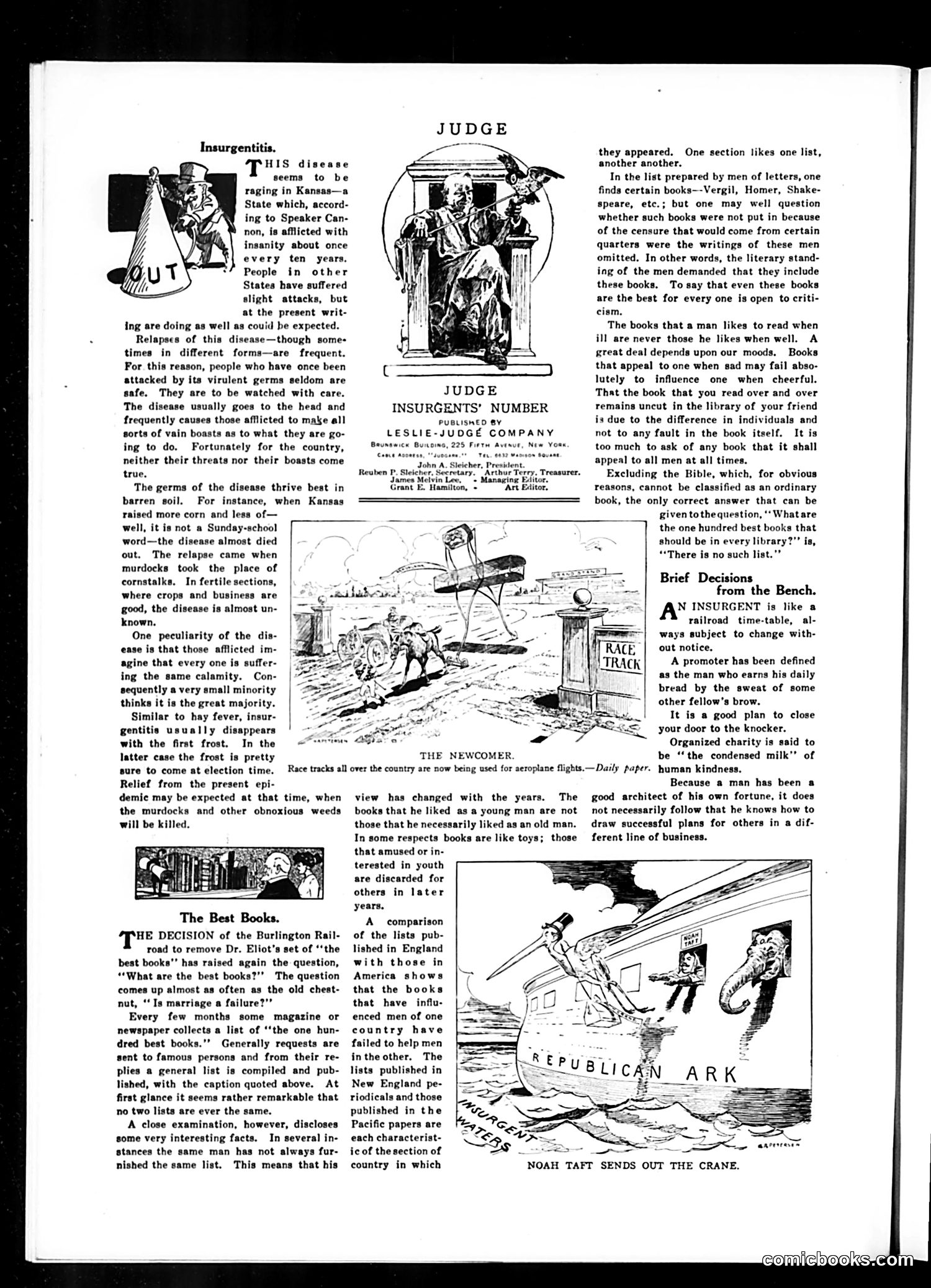
This page contains multiple satirical pieces commenting on early 20th-century American politics and society. **"Insurgentitis"** (left column) satirizes the Progressive/Insurgent movement within the Republican Party, comparing it to a disease afflicting Kansas and other states. The cartoon shows the "disease" as a political condition requiring careful monitoring. **"The Newcomer"** (center illustration) depicts a figure emerging from a crashed airplane, likely referencing the novelty and danger of early aviation. **"Noah Taft Sends Out the Crane"** (bottom) appears to be political satire involving the Republican Ark, likely mocking President William Howard Taft or Republican leadership during the Progressive Era split (circa 1909-1912). The page also includes "Brief Decisions from the Bench," offering humorous social commentary on contemporary life, and "The Best Books" section discussing literary preferences.
📄 Transcribed text from this page (OCR, searchable)
Machine-transcribed from the original scan — historical spelling and the odd misread are preserved.
Insurgentitis. HIS disease State which, accord- ing to Speaker Can- non, is afflicted with insanity about once every ten years, People in other States have suffered slight attacks, but at the present writ- ing are doing as well as couid be expected. Relapses of this disease—though some- times in different forms—are frequent. For this reason, people who have once been attacked by its virulent germs seldom are safe. They are to be watched with care. The disease usually goes to the head and frequently causes those afflicted to make all sorts of vain boasts as to what they are go- ing to do. Fortunately for the country, neither their threats nor their boasts come true, The germs of the disease thrive best in barren soil. For instance, when Kansas raised more corn and less of — well, it is not a Sunday-school word—the disease almost died out, The relapse came when murdocks took the place of cornstalks. In fertile sections, where crops and business are good, the disease is almost un- known. One peculiarity of the dis- ease is that those afflicted im- agine that every one is suffer- ing the same calamity. Con- sequently a very small minority thinks it is the great majority. Similar to hay fever, insur- gentitis usually disappears with the first frost. In the latter case the frost is pretty sure to come at election time. Relief from the present epi- demic may be expected at that time, when the murdocks and other obnoxious weeds will be killed. HE DECISION of the Burlington Rail- road to remove Dr. Elio’ et of “the best books’ has raised again the question, “What are the best books?’’ The question comes up almost as often as the old chest- nut, ‘Is marriage a failure?’ Every few months some magazine or newspaper collects a list of ‘the one hun- dred best books.’’ Generally requests are sent to famous persons and from their re- plies a general list is compiled and pub- lished, with the caption quoted above. At first glance it seems rather remarkable that no two lists are ever the same. A close examination, however, discloses some very interesting facts. In several in- stances the same man has not always fur- nished the same list. This means that his INSURGENTS’ NUMBER PUBLISHED BY LESLIE-JUDGE COMPANY nt. Arthur Terry, Treasurer. Managing Editor. ‘Art Editor. Reuben P. Sleie James Grant THE NEWCOMER. view has changed with the years. The books that he liked as a young man are not those that he necessarily liked as an old man. In some respects books are like toys; those that amused or in- terested in youth are discarded for others in later years, A comparison of the lists pub- lished in England with those in America shows that the books that have influ- enced men of one country have failed to help men intheother. The lists published in New England pe- riodicals and those published in the Pacific papers are each characte ic of the section of country in which they appeared. One section likes one list, another another. In the list prepared by men of letters, one finds certain books—-Vergil, Homer, Shake- Speare, etc.; but one may well question whether such books were not put in because of the censure that would come from certain quarters were the writings of these men omitted. In other words, the literary stand- ing of the men demanded that they include these books. To say that even these books are the best for every one is open to criti- cism. The books that a man likes to read when ill are never those he likes when well. A great deal depends upon our moods. Books that appeal to one when sad may fail abso- lutely to influence one when cheerful. That the book that you read over and over remains uncut in the library of your friend is due to the difference in individuals and not to any fault in the book itself. It is too much to ask of any book that it shall appeal to all men at all times. Excluding the Bible, which, for obvious reasons, cannot be classified as an ordinary book, the only correct answer that can be given tothe question, ‘*Whatare the one hundred best books that should be in every! “There is no such lis Brief Decisions from the Bench. N INSURGENT is like a railroad time-table, ways subject to change with- out notice. A promoter has been defined as the man who earns his daily bread by the sweat of some other fellow’s brow. It is @ good plan to close your door to the knocker. Organized charity is said to be ‘the condensed milk’ of Race tracks all over the country are now being used for aeroplane flights.—Daily paper. human kindness. Because a man has been a good architect of his own fortune, it does not neces: ly follow that he knows how to draw successful plans for others in a dif- ferent line of business. NOAH TAFT SENDS OUT THE CRANE.