
Judge, 1910-09-10 · page 6 of 16
Judge — September 10, 1910 — page 6: what you’re looking at
What you’re looking at
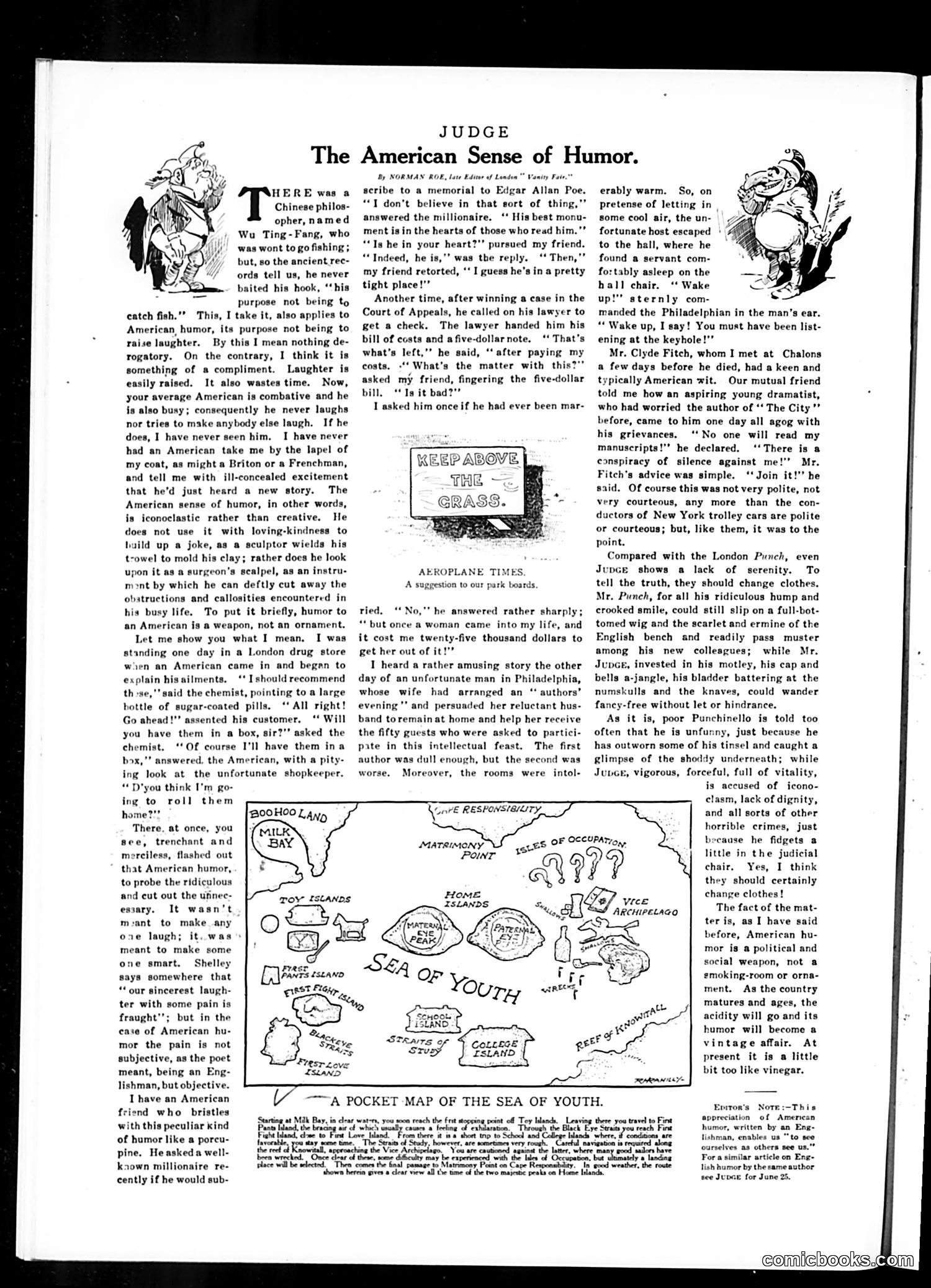
This essay by Norman Roe (former editor of *Vanity Fair*) defines American humor as fundamentally different from British or French humor. Rather than being creative and lighthearted, American humor is **iconoclastic and weaponized**—designed to cut away pretense and expose ridiculousness, often causing discomfort to the target. The author illustrates this through anecdotes: an American customer's cutting remark to a London pharmacist about carrying pills home; a friend's barbed joke to a millionaire about Edgar Allan Poe being "in a tight place" (his heart); another quip about a woman who cost $25,000 to remove from his life. The accompanying cartoons and "Pocket Map of the Sea of Youth" appear to satirize youthful follies and social absurdities. The point: American humor functions as social criticism and deflation of pretense, not entertainment—it's sharp, purposeful, and often uncomfortable by design.
📄 Transcribed text from this page (OCR, searchable)
Machine-transcribed from the original scan — historical spelling and the odd misread are preserved.
HERE was a Chinese philos- opher, named Wu Ting-Fang, who was wont togo fishing; but, so the ancient rec- ords tell us, he never baited his hook, ‘his purpose not being to catch fish.” This, I take it, also applies to American, humor, its purpose not being to raise laughter. By this I mean nothing de- rogatory. On the contrary, I think it is something of a compliment. Laughter is easily raised. It also wastes time. Now, your average American is combative and he is also busy; consequently he never laughs nor tries to make anybody else laugh. If he does, I have never seen him. I have never had an American take me by the lapel of my coat, as might a Briton or a Frenchman, and tell me with ill-concealed excitement that he’d just heard a new story. The American sense of humor, in other words, is iconoclastic rather than creative. He does not use it with loving-kindness to build up a joke, as a sculptor wields his trowel to mold his clay; rather does he look upon it as a surgeon's sealpel, as an instru- mont by which he can deftly cut away the obstructions and callosities encountered in his busy life. To put it briefly, humor to an American is a weapon, not an ornament. Let me show you what I mean, I was standing one day in a London drug store when an American came in and began to explain his ailments. ‘* Ishould recommend those,'’said the chemist, pointing to a large bottle of sugar-coated pills. ‘* All right! Go ahead!"? assented his customer. ‘* Will you have them in a box, sir?’ asked the chemist. ‘*Of course I'll have them ina box,’’ answered, the American, with a pi ing look at the unfortunate shopkeepe “D'you think I'm go- ing to roll them home?" There, at once, you see, trenchant and merciless, flashed out that American humor, to probe the ridiculous and cut out the ufinec- essary. It wasn't meant to make any one laugh; it. was meant to make some one smart. Shelley says somewhere that “our sincerest laugh- ter with some pain is fraught"; but in the case of American hu- mor the pain is not subjective, as the poet meant, being an Eng- lishman, but objective. T have an American friend who bristles with this peculiar kind of humor like a porcu- pine. He asked a well- kaown millionaire re- cently if he would sub- Pest PANTS LSLAND esr Love £SLAND uv Starting at Mik Bay, in clear wat-r, you save reach the Frit int off Toy Inlands. 2, 7. oe 9 mpeg pent of Tor kde Fight sand, clave to Fart Pants land, the bracing sir cf whic > Fst Love filand JUDGE American Sense of Humor. By NORMAN ROE, Late Editar of Londen" Vanity Fates scribe to a memorial to Edgar Allan Poe. “I don’t believe in that sort of thing,” answered the millionaire. ‘* His best monu- ment is in the hearts of those who read him."” “Is he in your heart?" pursued my friend. “Indeed, he is,” was the reply.‘ Then,"” my friend retorted, “* I guess he’s in a pretty tight place!” Another time, after winning a case in the Court of Appeals, he called on his lawyer to The lawyer handed him his bill of costs and afive-dollarnote. “ That's what's left,’" he said, “after paying my costs. “What's the matter with this?” asked my friend, fingering the five-dollar bill, “Is it bad?” I asked him once if he had ever been mar- get a check. EP ABOVE THE ~ AEROPLANE TIMES. A suggestion to our park boards. "he answered rather sharply; “but once a woman came into my life, and it cost me twenty-five thousand dollars to get her out of it!” I heard a rather amusing story the other day of an unfortunate man in Philadelphia, whose wife had arranged an ‘ authors’ evening '’ and persuaded her reluctant hus- band toremain at home and help her receive the fifty guests who were asked to partici- pate in this intellectual feast. The first author wa: enough, but the second was worse. Moreover, the rooms were intol- \eore RESPONSIGIUTY. MATRIMONY Powr ** HOME ISLANDS —~A POCKET MAP OF THE SEA OF YOUTH. fauoes & forking shown herein gives « clear view all the time of the two majesbe peaks oa Home I ues OF once A he act Eh Eye Sta you rach Fret ‘College blanch where, f codons are erably warm. So, on pretense of letting in some cool air, the un- fortunate host escaped + to the hall, where he found a servant com- fortably asleep on the hall chair. ‘* Wake up!’ sternly com- manded the Philadelphian in the man’s ear. “Wake up, I say! You must have been list- ening at the keyhole!"” Mr. Clyde Fitch, whom I met at Chalons a few days before he died, had a keen and typically American wit. Our mutual friend told me how an aspiring young dramatis who had worried the author of ‘‘ The City before, came to him one day all agog with his grievances. ‘‘No one will read my manuscripts!" he declared. ‘There is a conspiracy of silence against me!’ Mr. Fitch's advice was simple. ‘Join it!”’ he said. Of course this was not very polite, not very courteous, any more than the con- ductors of New York trolley cars are polite or courteous; but, like them, it was to the point. Compared with the London Punch, even shows a lack of serenity. To tell the truth, they should change clothes. Mr. Punch, for all his ridiculous hump and crooked smile, could still slip on a full-bot- tomed wig and the scarlet and ermine of the English bench and readily pass muster among his new colleagues; while Mr. JupGE, invested in his motley, his cap and bells a-jangle, his bladder battering at the numskulls and the knaves, could wander fancy-free without let or hindrance. As it is, poor Punchinello is told too often that he is unfunny, just because he has outworn some of his tinsel and caught a glimpse of the shoddy underneath; while Juvce, vigorous, forceful, full of vitality, is accused of icono- clasm, lack of dignity, and all sorts of other horrible crimes, just because he fidgets a little in the judicial Yes, I think should certainly change clothes! The fact of the mat- ter as I have said before, American hu- mor is a political and social weapon, not a emoking-room or orna- ment. As the country matures and ages, the acidity will go and its humor will become a vintage affair. At present it is a little bit too like vinegar. Eprtor's Note :-This appreciation of Amencan humor, written by an Eng- lishman, enables us “to see ourselves as others see us."* For a similar article on Eng- lish humor by the same author see Juvar for June 25. ving there you travel to Fint comichooks.com