
A complete issue · 16 pages · 1910
Judge — August 20, 1910
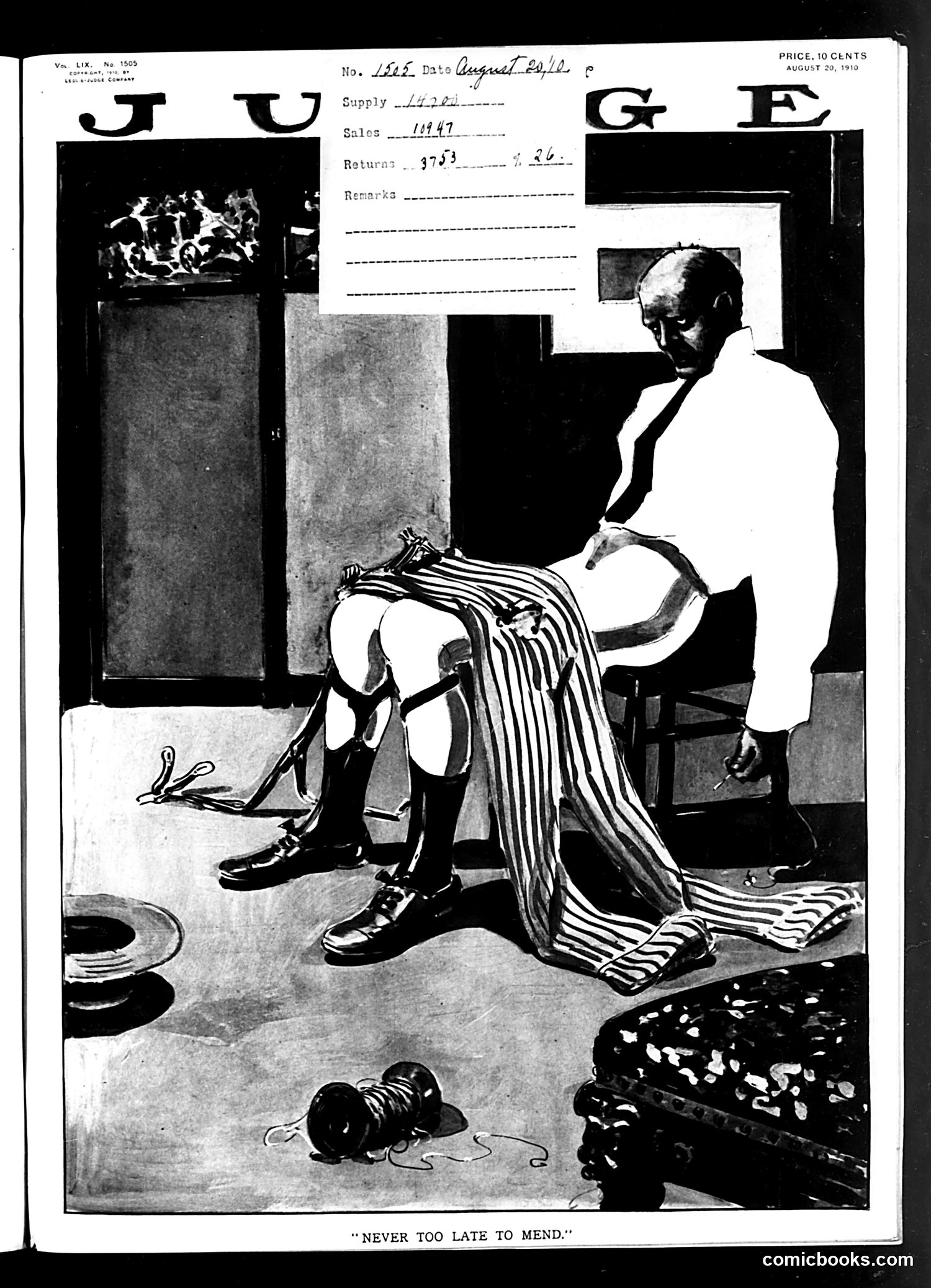
This Judge magazine page (August 20, 1910) depicts a domestic scene with satirical commentary on marital relations. The illustration shows a man in professional attire (appearing to be a doctor or similar authority figure based on his white coat) attending to a woman in a compromising position, with fabric and personal items scattered around. The caption "Never Too Late to Mend" suggests ironic commentary on marriage repair or domestic correction—likely satirizing contemporary attitudes about wives needing "correction" or husbands' remedial efforts within marriage. The visual details emphasize vulnerability and power imbalance typical of early 20th-century gender-based humor in satirical publications. The exact social/political reference remains unclear without additional context.
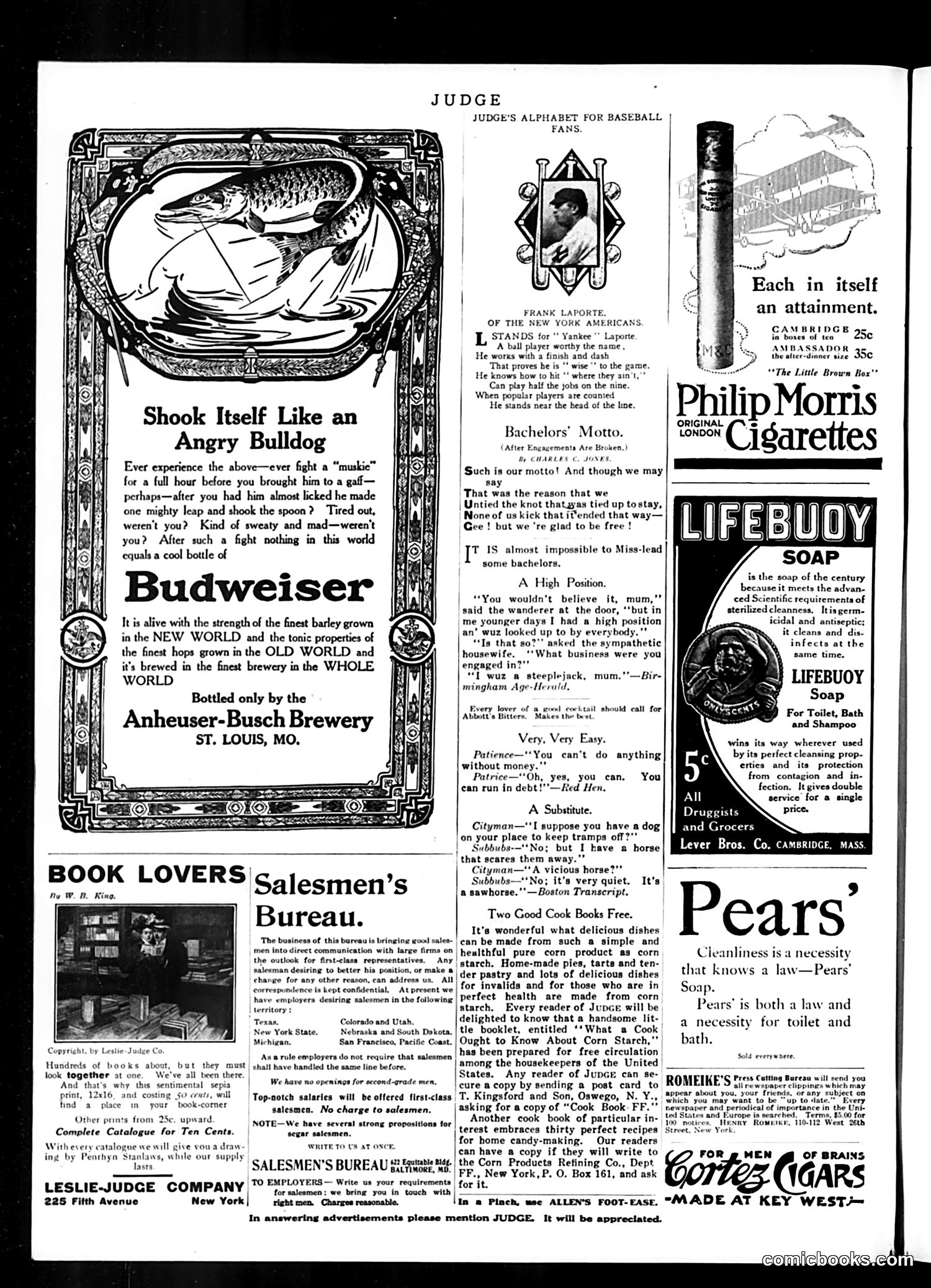
This page is primarily **advertising content** rather than political satire. It features multiple commercial advertisements including Budweiser beer, Philip Morris cigarettes, Lifebuoy soap, Pears' soap, and Cordes cigars. The only editorial content is "Judge's Alphabet for Baseball Fans" at top center, featuring **Frank LaRoche of the New York Americans**, a baseball player. The alphabet entry humorously describes a "L" entry about baseball terminology and player behavior. Below that are brief humorous dialogues labeled "Bachelors' Motto," "A High Position," "Very, Very Easy," "A Substitute," and "Two Good Cook Books Free"—light comic vignettes typical of Judge magazine's humor style. The page also includes a "Book Lovers" column about a Salesmen's Bureau, promoting employment services. This appears to be a typical early 20th-century magazine page blending editorial humor with paid advertising.
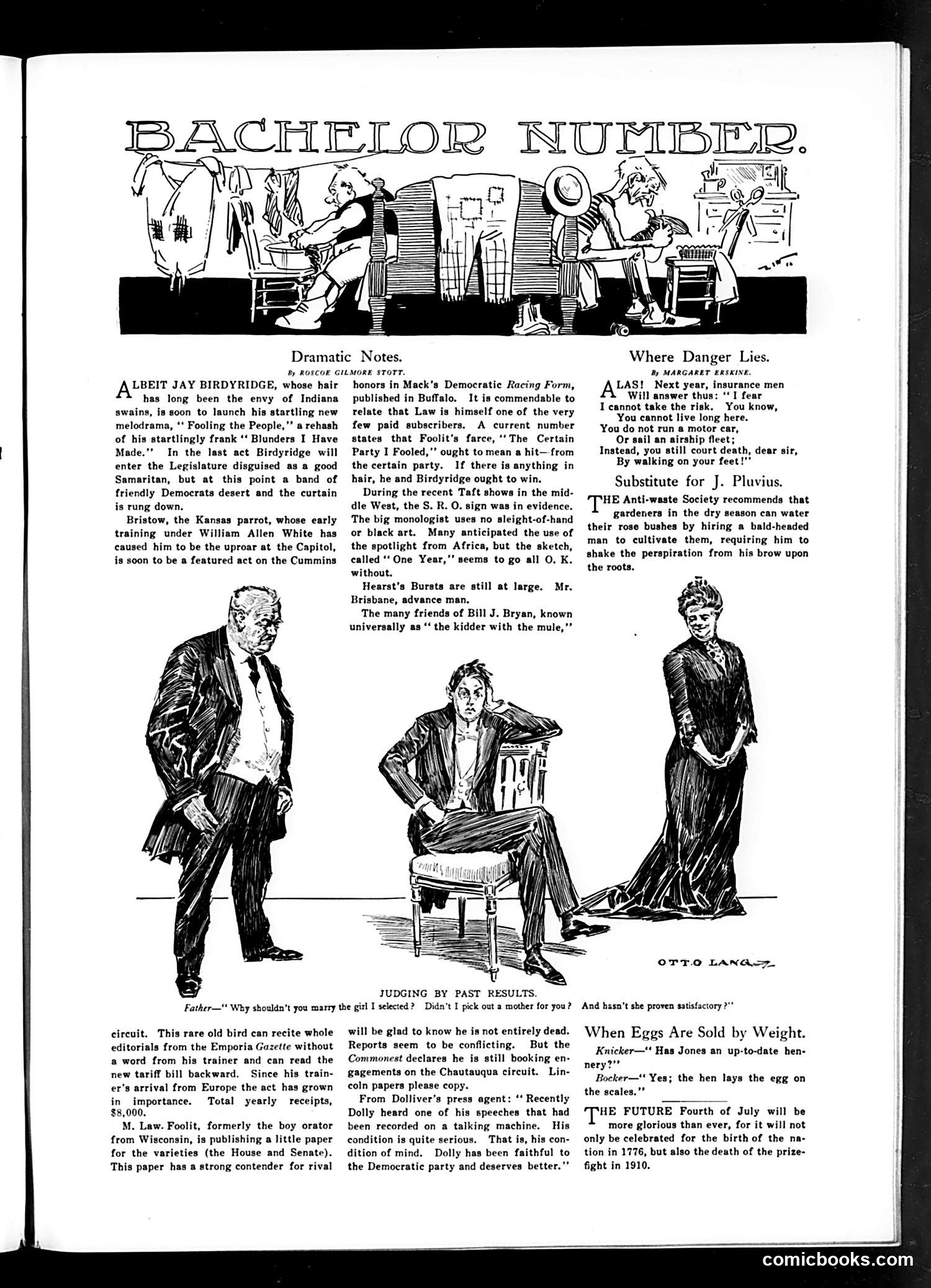
This page contains three distinct satirical pieces about early 1900s politics and social issues: **"Dramatic Notes"** mocks Albert Jay Birdyridge, an Indiana senator seeking the Democratic presidential nomination. The satire suggests he's an undistinguished politician relying on endorsements rather than merit. **"Where Danger Lies"** by Margaret Erskine warns against women drivers, humorously advising insurance men that automobiles are safer than trusting women at the wheel—a common anti-suffrage/anti-women's independence trope of the era. **"When Eggs Are Sold by Weight"** appears to joke about future absurdities, likely critiquing some proposed regulation. The central cartoon "Judging by Past Results" depicts a romantic dilemma, captioned with a father questioning why a suitor selected his daughter. The satire targets matrimonial logic and courtship customs.
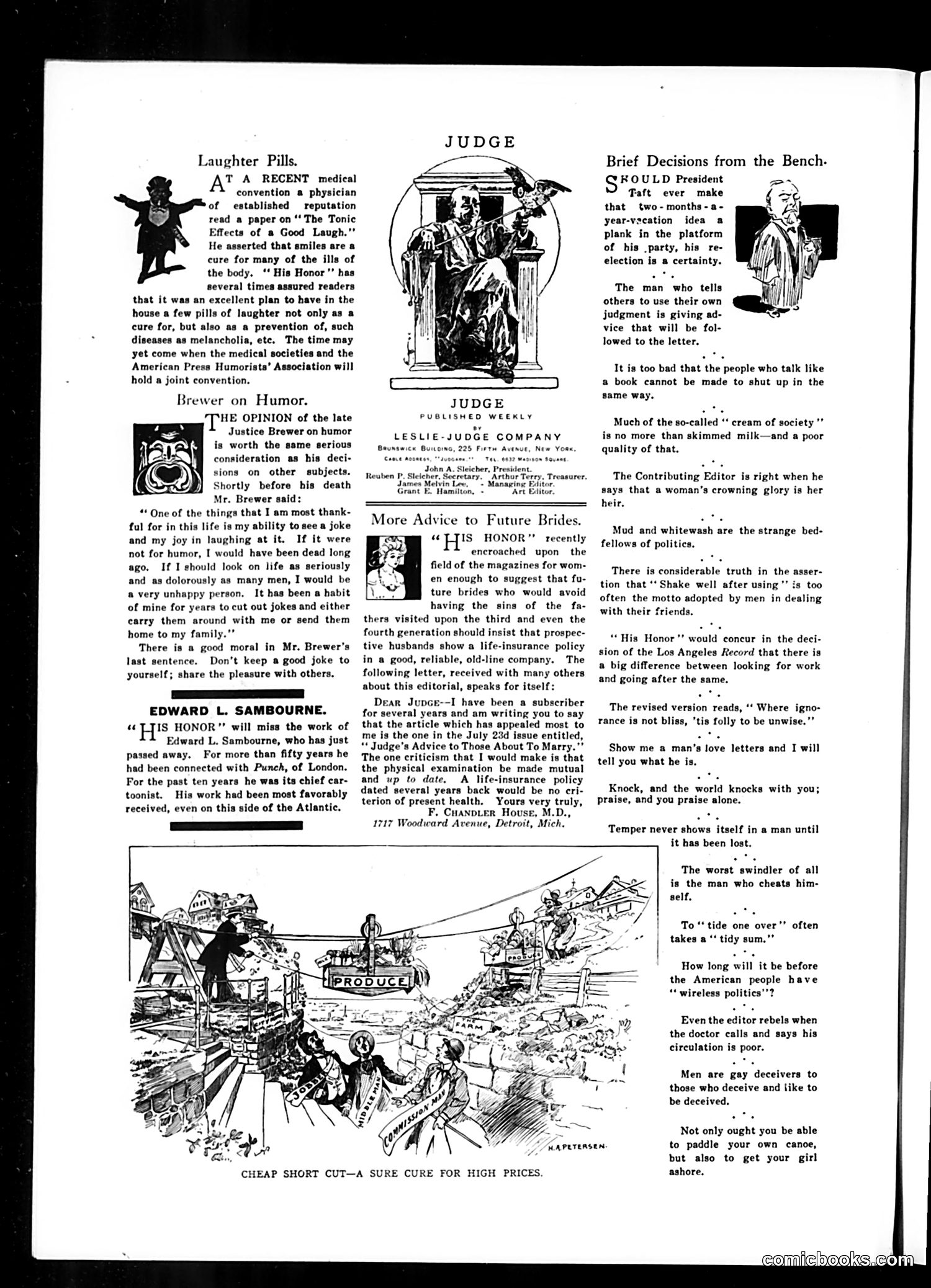
This page combines humor columns with a large political cartoon titled "CHEAP SHORT CUT—A SURE CURE FOR HIGH PRICES." The cartoon depicts what appears to be a produce market or agricultural distribution system with multiple figures operating machinery labeled "PRODUCE." The satire criticizes middlemen and inefficient distribution chains that artificially inflate consumer prices. By showing the convoluted process between farmers and consumers, the cartoonist argues that eliminating unnecessary intermediaries would lower prices. The surrounding text includes humorous aphorisms and editorial commentary typical of Judge's satirical format. Without clearer identification of specific contemporary figures or dated references in the visible text, the exact political context remains somewhat unclear, though the anti-monopoly sentiment reflects early 20th-century Progressive Era concerns about economic inefficiency and price-fixing.
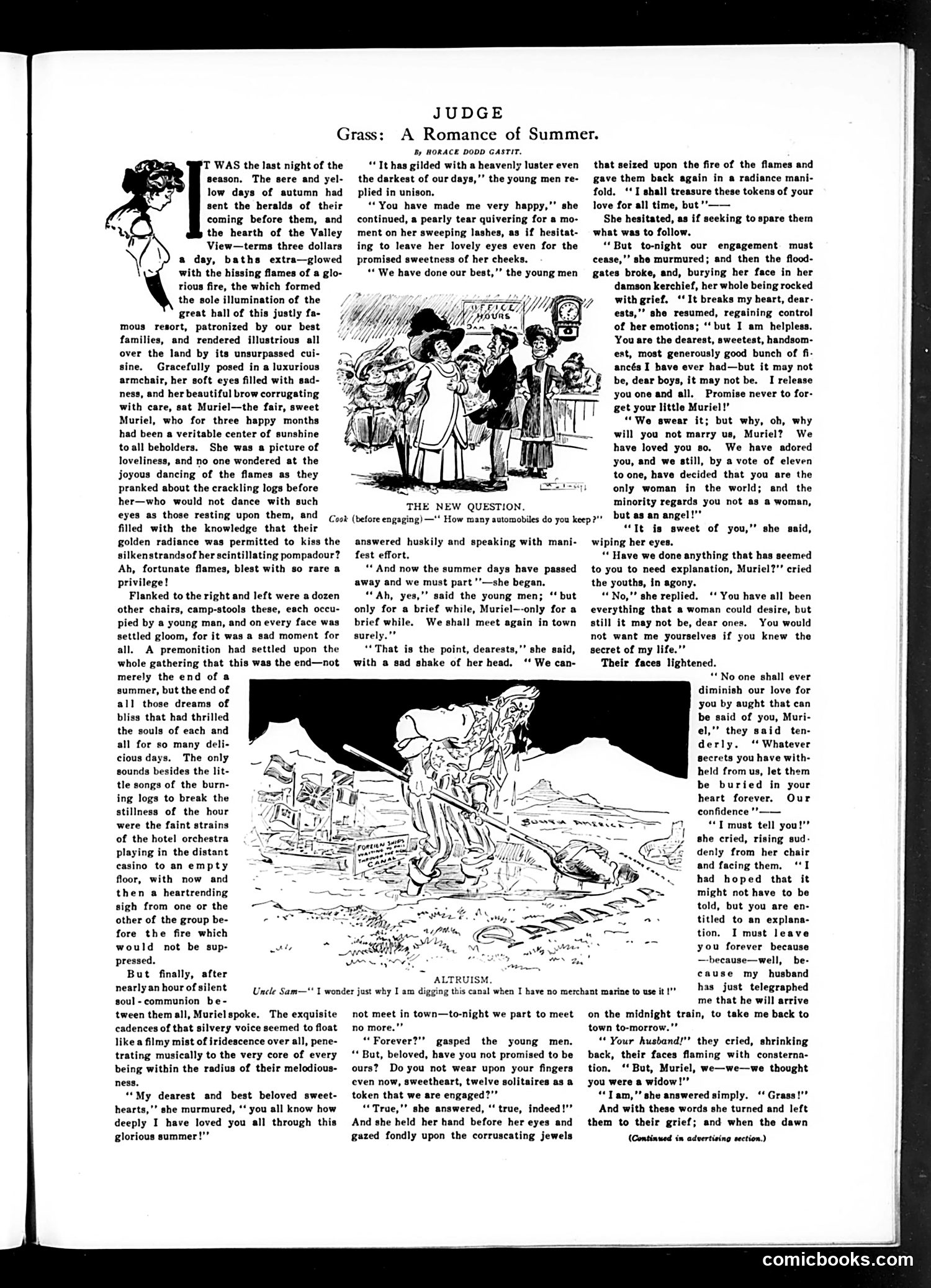
This page contains a serialized romantic story titled "Grass: A Romance of Summer" by Horace Dodd Gavitt, not a political cartoon. The narrative depicts young lovers at a summer gathering who must part ways—the woman, Muriel, must leave due to her husband's telegram summoning her home. The two illustrations show: (1) a social scene with multiple figures at what appears to be a hotel or resort gathering, and (2) a sentimental moment between the parting lovers. This is sentimental fiction typical of Judge magazine's entertainment content rather than political satire. The "satire" lies in the melodramatic, overwrought romantic dialogue and situations—gently mocking Victorian-era sentiment and relationship conventions through exaggeration.
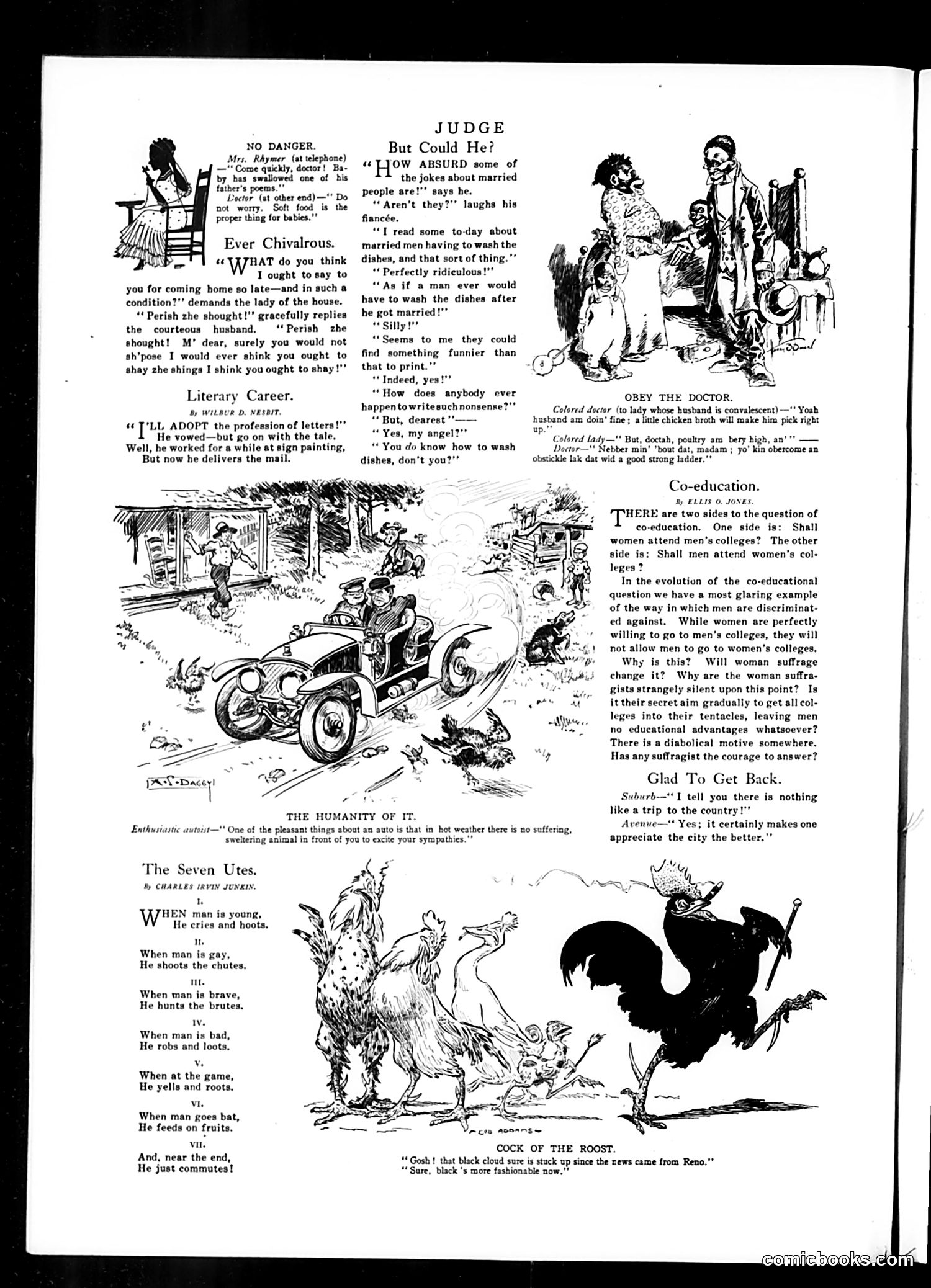
This page contains multiple satirical pieces reflecting early 20th-century American attitudes: **"Ever Chivalrous"** mocks chivalric excuses—a husband uses exaggerated speech impediments to avoid responsibility for household tasks, satirizing performative masculinity. **"Literary Career"** jokes about artistic pretension versus mundane reality: a would-be literary professional ends up delivering mail. **"Co-education"** argues men face discrimination in higher education—women attend men's colleges but exclude men from women's colleges. The author sarcastically suggests suffragists harbor "diabolical" motives to monopolize education. This reflects genuine contemporary debate about coeducational access. **"Obey the Doctor"** uses racist dialect humor typical of the era, depicting a Black couple where the wife cannot afford prescribed chicken broth. **"The Seven Utes"** presents an anthropological poem about male behavior stages, treating men as biological specimens. **"Cock of the Roost"** likely references recent divorce scandals from Reno, Nevada, then known for lenient divorce laws—the rooster's newfound "fashionability" implies shamelessness about scandalous marital dissolution.
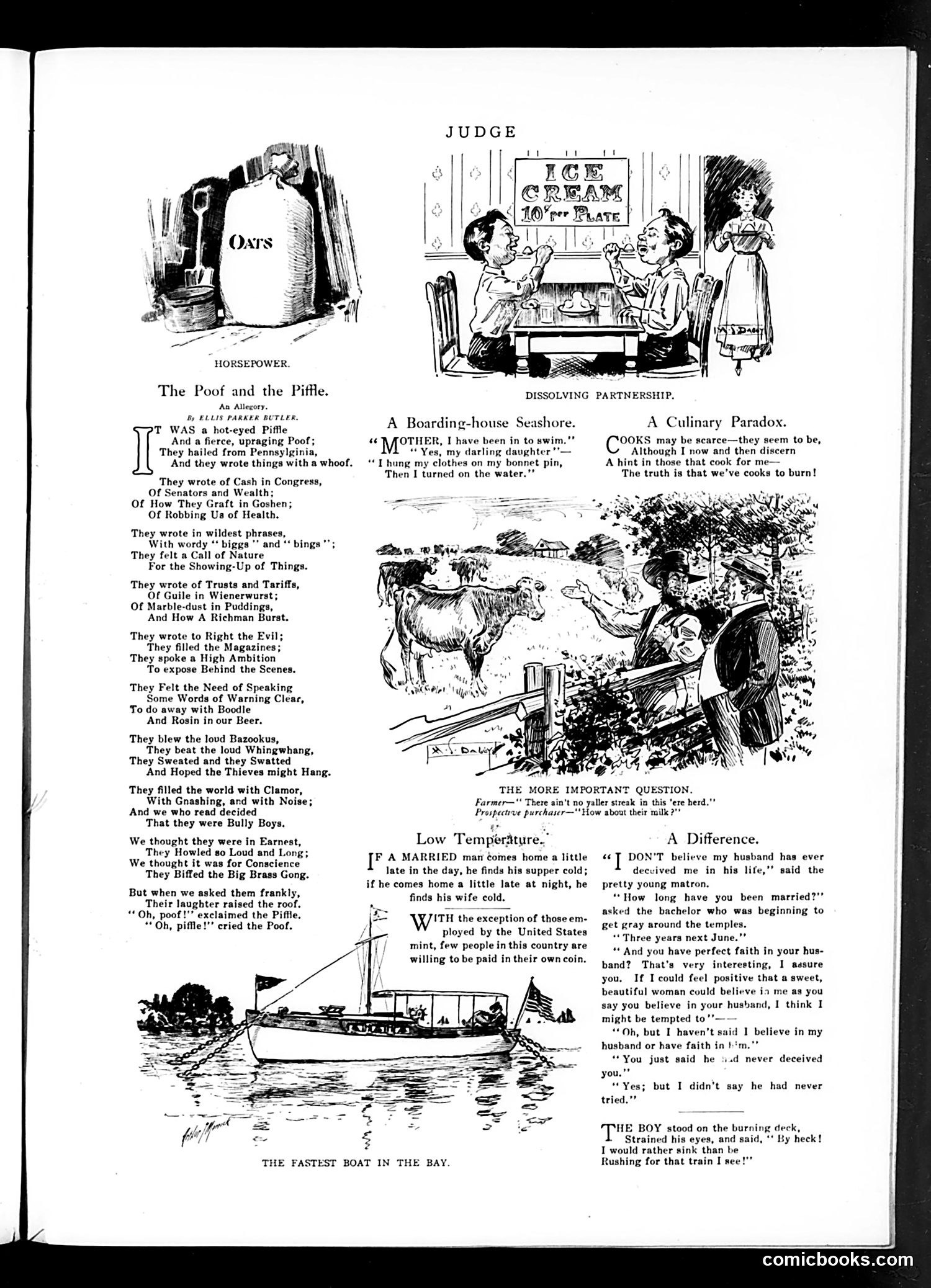
This page contains multiple unrelated satirical pieces typical of Judge magazine's format: **"The Poof and the Piffle"** (left): An allegory mocking muckraking journalists and crusading reformers. Ellis Parker Butler satirizes writers who dramatically expose corruption—graft in Congress, adulterated food, monopolies—with theatrical outrage ("They blew the loud Bazookus"), only to later laugh it off as mere entertainment ("poof!" "piffle!"). The satire suggests these crusaders weren't genuinely motivated by conscience but by the noise and attention such writing generated. **Other brief comedic sketches** populate the right side—wordplay about marriage, cooking, dairy farming, and a final joke about a boy prioritizing train travel over dramatic death. These are disconnected humor items rather than unified political commentary. The overall page reflects Judge's satirical approach: deflating pretension and exposing hypocrisy in American public discourse, particularly targeting self-righteous reformers who wielded outrage as performance rather than principle.
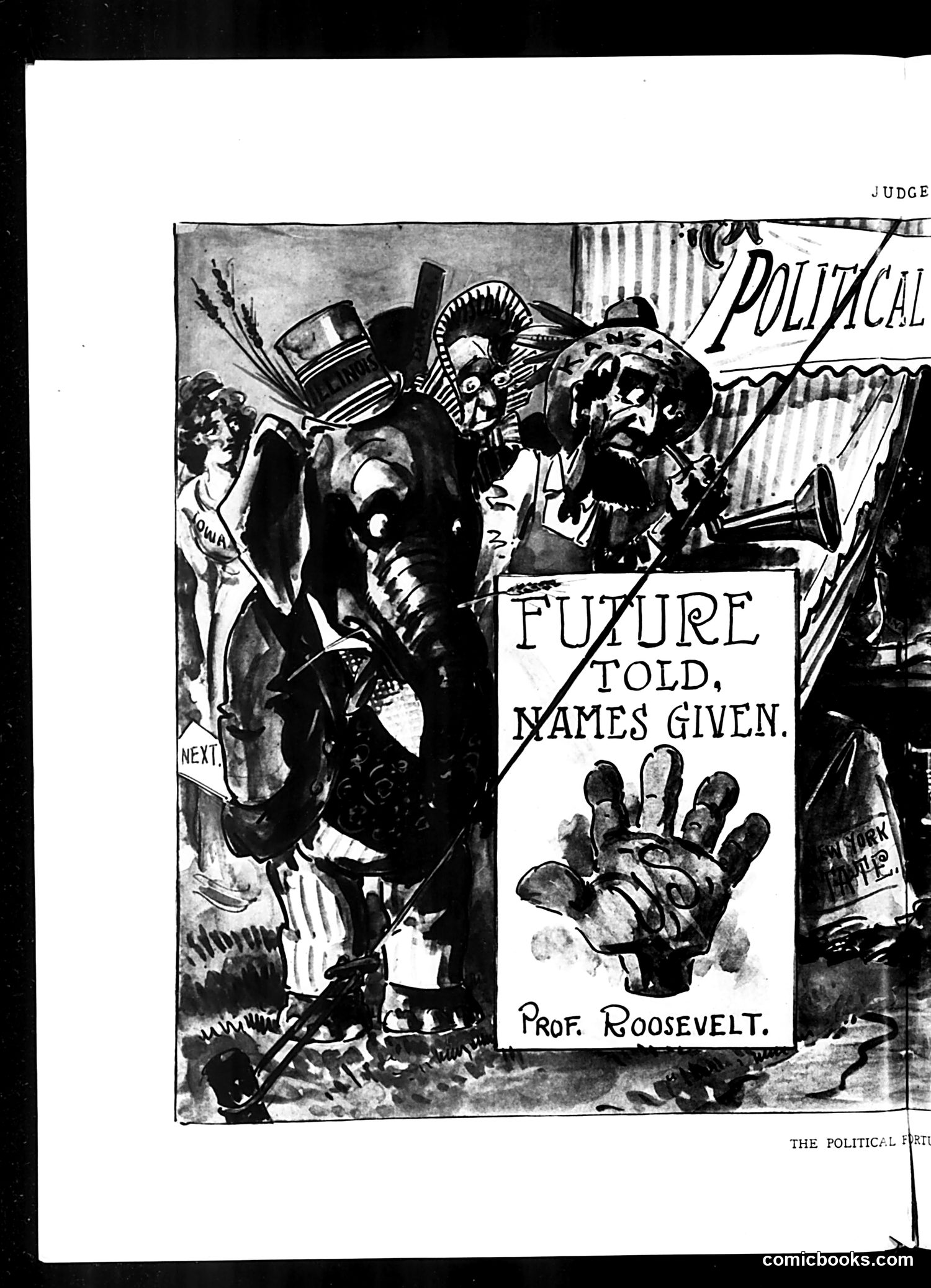
This is a satirical cartoon from *Judge* magazine mocking fortune-telling and politics. The central image shows a fortune teller's hand with text reading "FUTURE TOLD, NAMES GIVEN" attributed to "PROF. ROOSEVELT." The cartoon depicts a mystical/carnival scene with costumed figures in top hats and elaborate dress, suggesting political theater or deception. The satire implies that Roosevelt is presented as a charlatan fortune teller—someone making grand predictions about the future while revealing supposed insider information ("names given"). This appears to critique Roosevelt's political claims or pronouncements as mere carnival hucksterism rather than genuine insight. The theatrical costumes and carnival atmosphere reinforce the message that politics involves performance and false prophecy rather than substance.
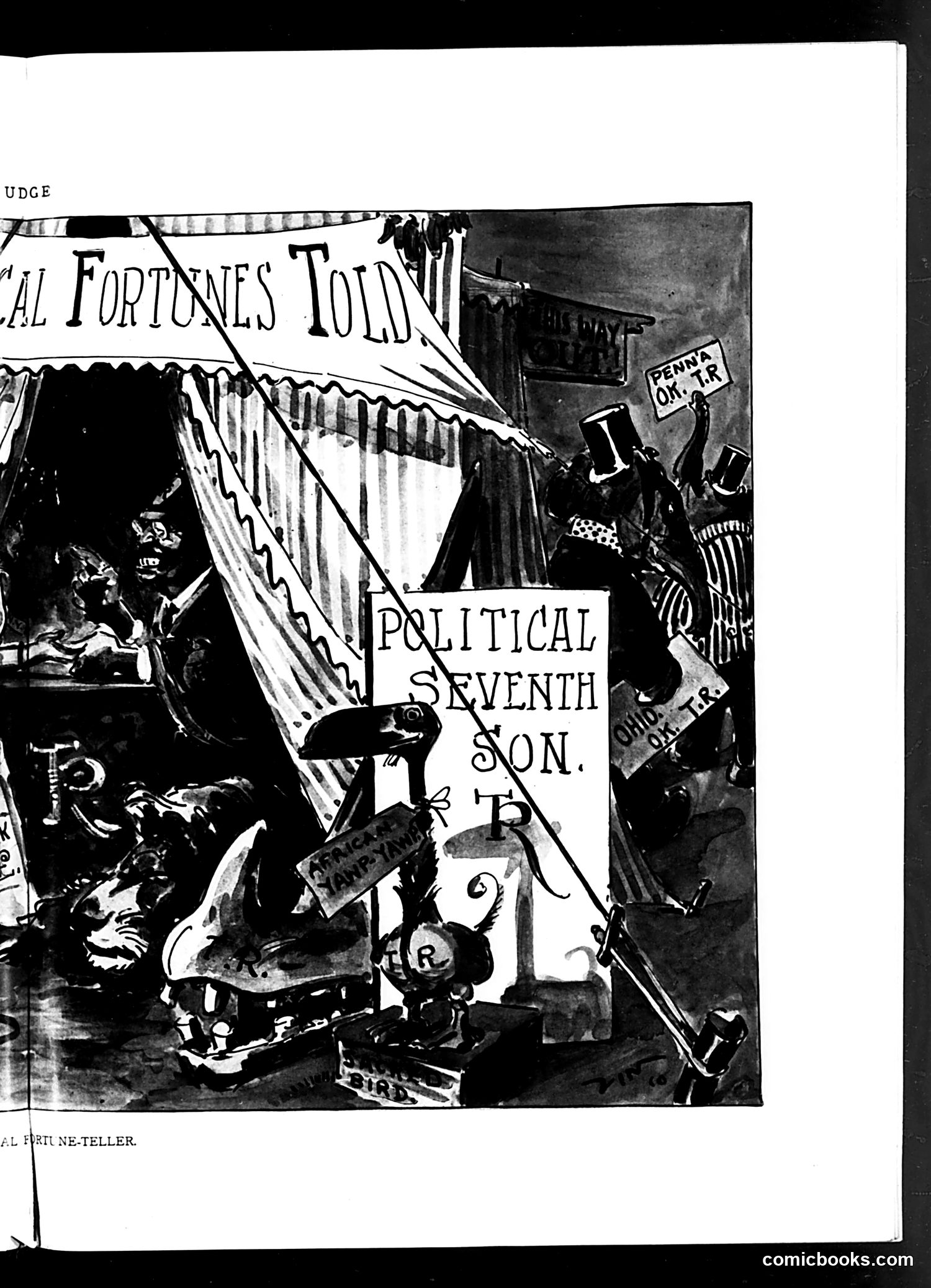
This political cartoon satirizes fortune-telling as a metaphor for political prediction. The central image shows a fortune-teller's tent labeled "Political Seventh Son" — referencing the folk belief that a seventh son possesses supernatural abilities. The tent displays signs reading "Pennsylvania O.K." and what appears to be campaign or political imagery, suggesting the cartoon comments on politicians' claims to predict electoral outcomes or public sentiment. The fortune-teller apparatus (crystal ball, mystical paraphernalia visible in the tent) mocks the dubious nature of political forecasting. The banner "All Fortunes Told" suggests politicians make sweeping, unfounded predictions. This appears to satirize either pre-election polling confidence or a specific politician's overconfident prognostications—likely referencing a contemporary 1890s-1900s political figure, though the specific individual remains unclear from the image alone.
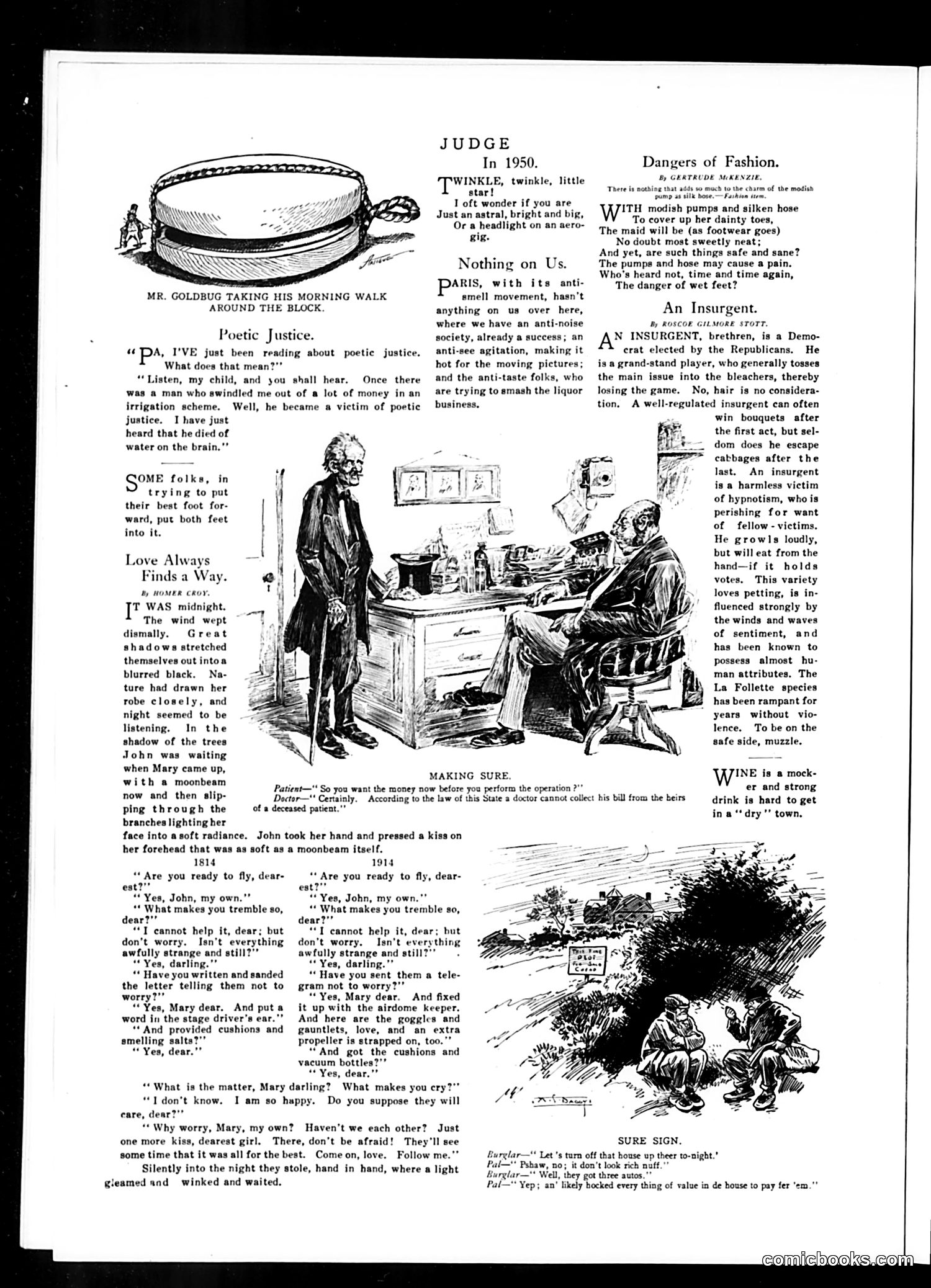
This 1950 page contains multiple satirical pieces typical of Judge's format: **"Mr. Goldburg Taking His Morning Walk"** depicts a portly man (likely representing wealth or financial interests) as an object of ridicule—his name suggests "gold bug," a term for those obsessed with monetary policy. **"Poetic Justice"** jokes that a swindler died of "water on the brain"—a darkly humorous punishment fitting his crime. **"Love Always Finds a Way"** satirizes the increasingly elaborate precautions young lovers take before eloping by airplane (a modern marvel at the time), with repeated reassurances and safety measures that parody excessive preparation. **"Making Sure"** mocks doctors demanding payment before surgery, highlighting era concerns about medical ethics. **"An Insurgent"** describes progressive Republicans as grandstanding hypocrites—political theater without substance, easily swayed by sentiment rather than principle. The page reflects 1950s anxieties: aviation safety, medical ethics, political inconsistency, and fashion trends.
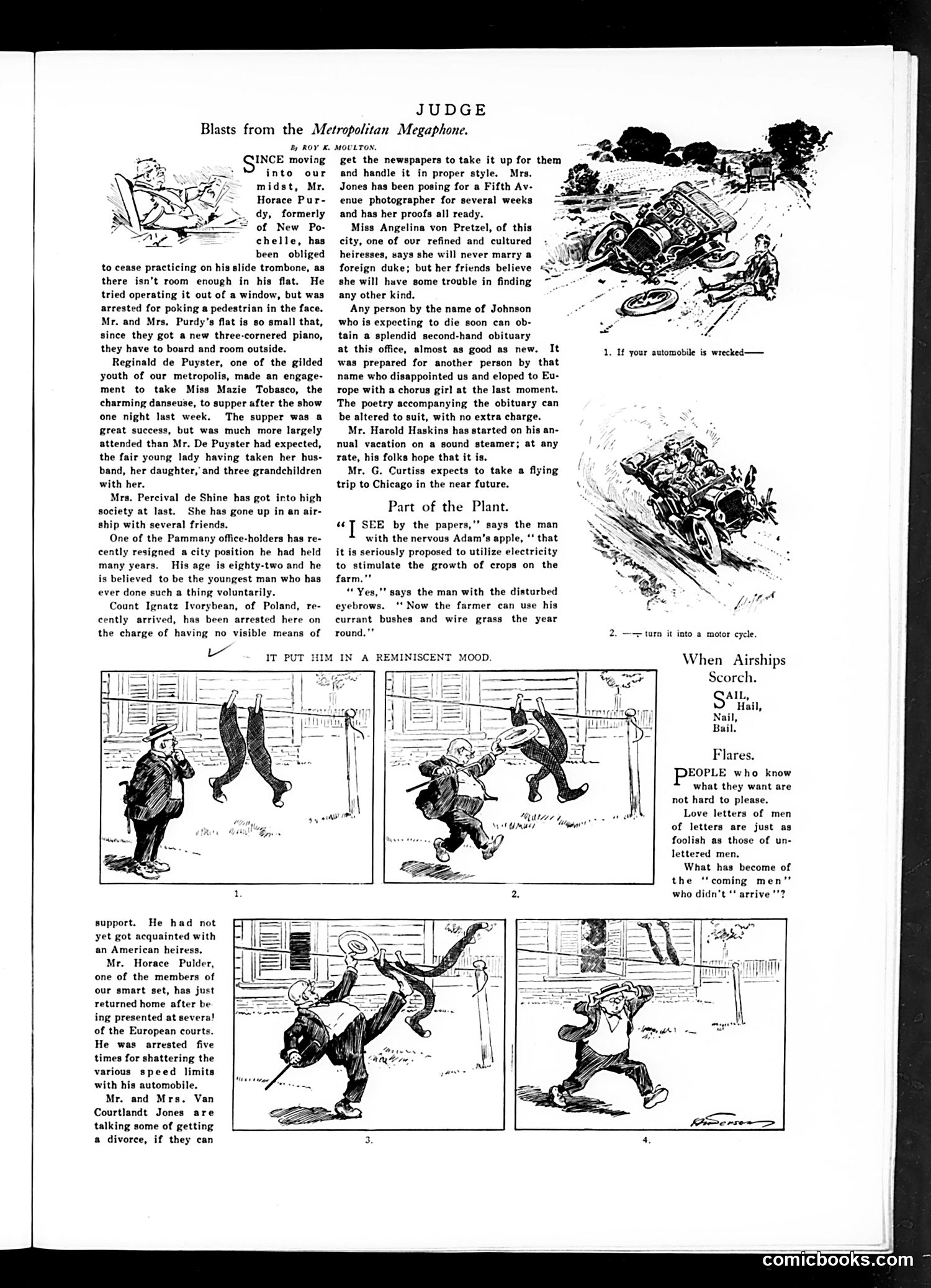
This page from Judge presents **"Blasts from the Metropolitan Megaphone,"** a humor column by Roy K. Moulton mocking New York City society types and urban life circa early 1900s. The satire targets wealthy pretension: A man can't play trombone in his tiny flat; a socialite takes her entire family to a supper date uninvited; an heiress refuses foreign dukes but worries she'll find no one else; a Tammany Hall politician voluntarily retires after 82 years (implying he's incompetent yet clung to power). The comic strip panels titled "IT PUT HIM IN A REMINISCENT MOOD" show slapstick humor—figures being hung upside-down, then twisted into absurd positions—typical Judge visual comedy. A final anecdote about farming involves circular logic: farmers could use electricity on "current bushes" and "wire grass" year-round (puns on electrical terminology). The overall effect ridicules urban vanity, corruption, and the absurdities of both high society and ordinary people's pretensions in metropolitan life.
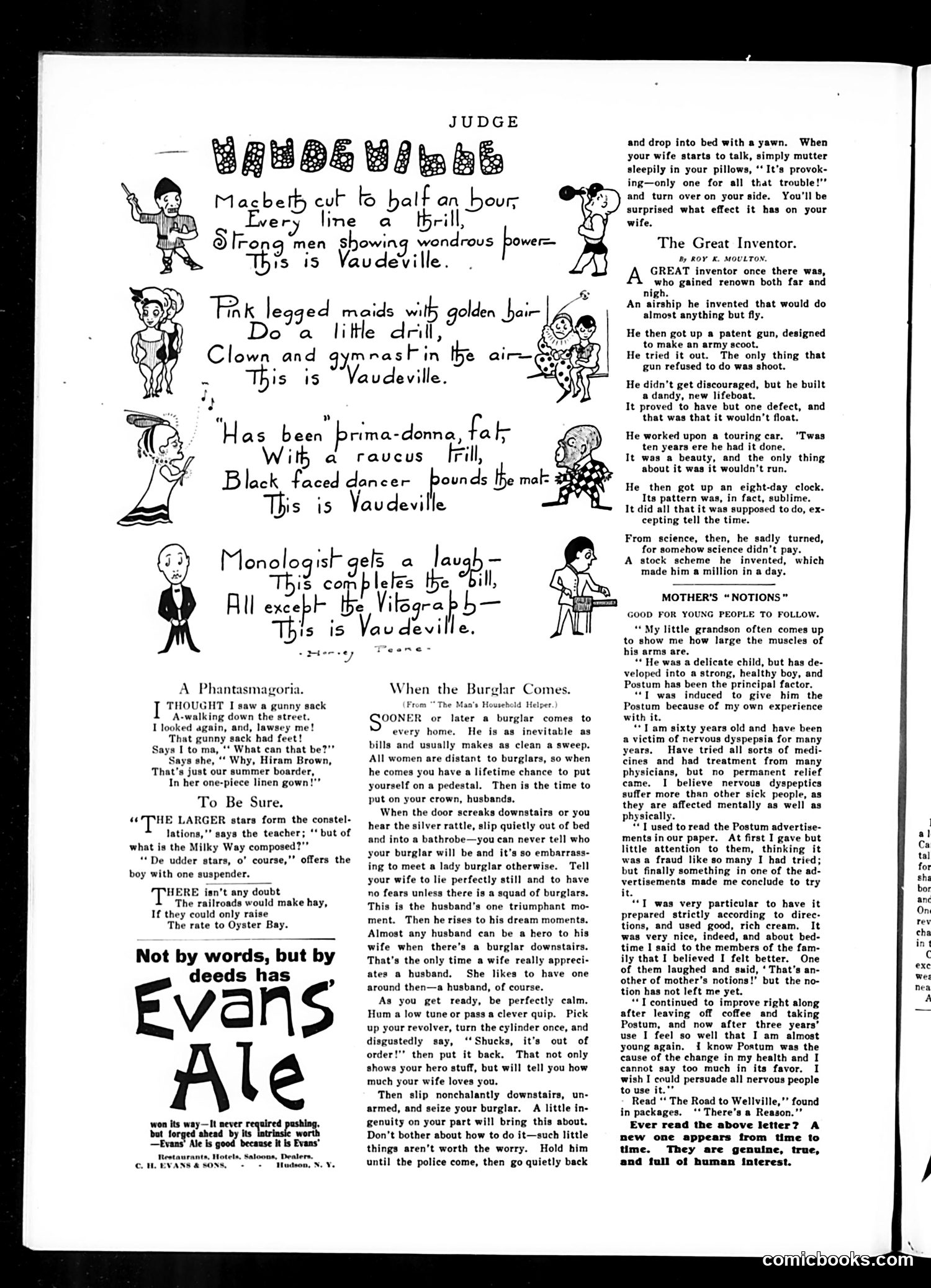
This page from the satirical magazine **Judge** contains several humor pieces mocking American life circa early 1900s. The top section, "Vaudeville," jokes about theatrical performances through exaggerated descriptions—Macbeth performed in one hour, dancers with absurd characteristics. It's satirizing vaudeville's low-brow entertainment and sensationalism. "A Phantasmagoria" mocks a woman's appearance in a one-piece bathing suit, suggesting she looks as shapeless as a "gunny sack." "When the Burglar Comes" humorously advises husbands on performing masculinity during home invasions—the satire targets men's need to appear heroic and the conditional respect wives show their husbands only in emergencies. "The Great Inventor" ridicules a prolific but incompetent inventor who creates things that fundamentally fail at their purpose (a gun that won't shoot, a lifeboat that won't float). This satirizes American obsession with invention and patent-seekers who lack practical sense. An **Evans' Ale advertisement** appears prominently, using contemporary advertising tropes.
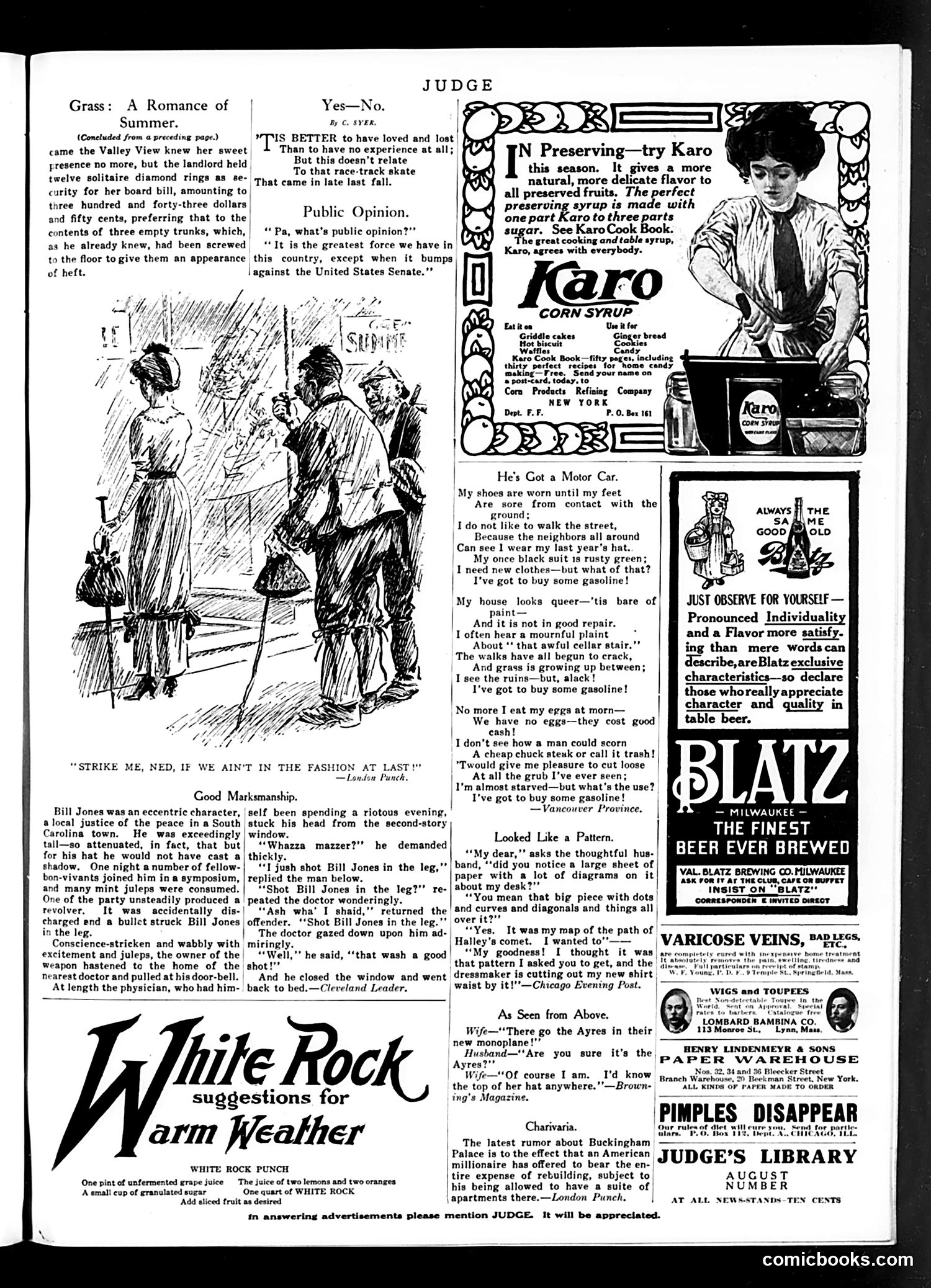
This page contains multiple satirical pieces typical of early 20th-century Judge magazine: **Main Cartoon ("Strike Me, Ned"):** Depicts working-class people in worn clothing discussing fashion. The satire mocks aspirational mimicry—poor people trying to adopt wealthy fashions despite obvious poverty, creating an absurd contrast. **"Public Opinion" Dialogue:** A parent-child exchange satirizing political powerlessness. The joke is that "public opinion" supposedly governs the country except when it conflicts with the U.S. Senate, suggesting senators ignore constituents' wishes. **"Good Marksmanship":** A humorous anecdote about a drunk man shooting a justice of the peace in the leg, then a doctor praising his accuracy. The satire targets the absurdity of valuing marksmanship over consequences. **"He's Got a Motor Car":** A poem mocking automobile obsession. A man neglects his house, family needs, and appearance—everything deteriorates—yet prioritizes buying gasoline. It satirizes the era's new car culture and misplaced priorities among middle-class Americans. The page is primarily satirical commentary on American social and consumer culture.
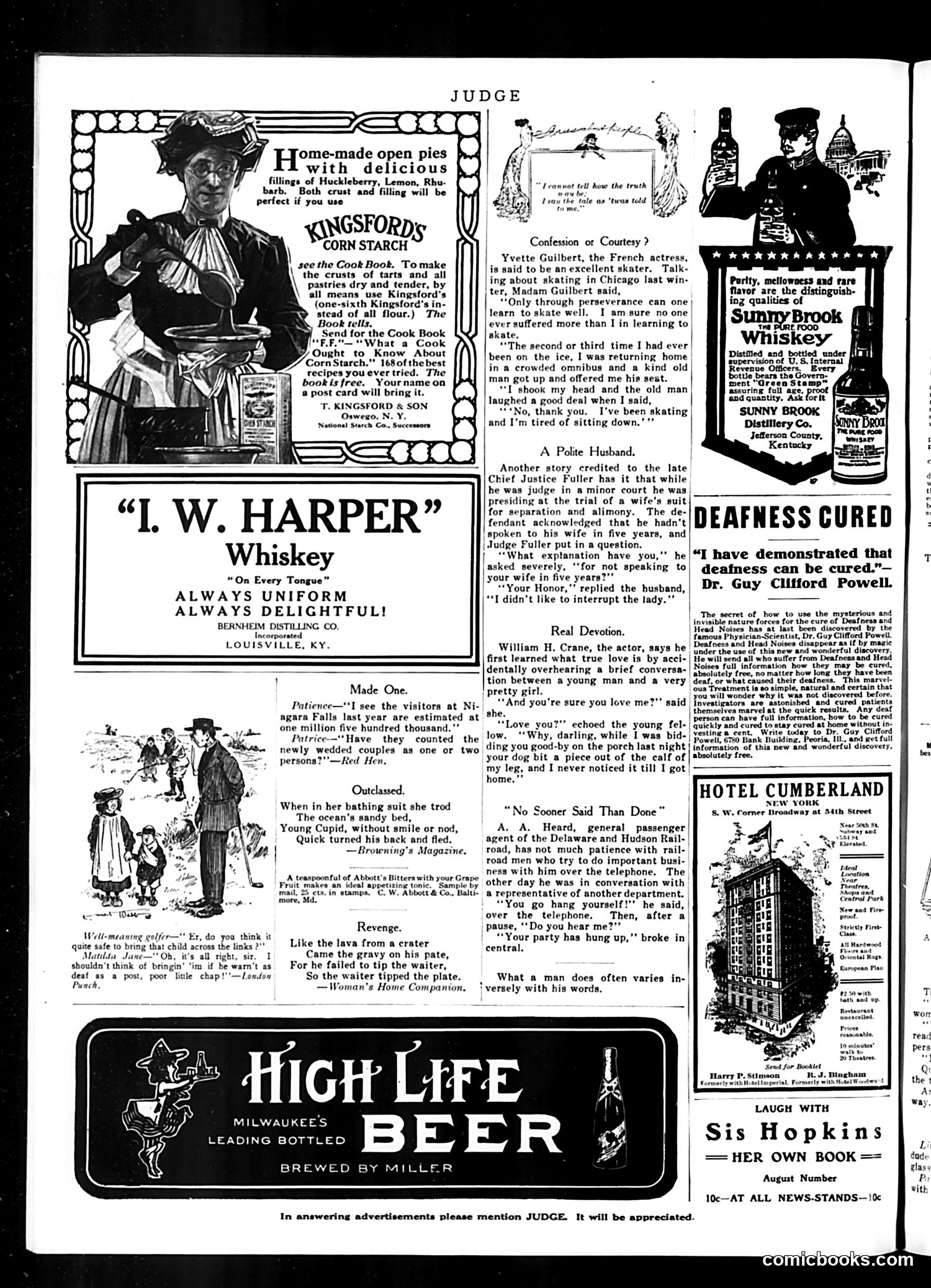
This is primarily an **advertising page** from Judge magazine featuring multiple unrelated advertisements and humorous anecdotes rather than political cartoons. The content includes: **Advertisements**: Kingsford's Corn Starch, I.W. Harper Whiskey, Sunny Brook Whiskey, High Life Beer, Hotel Cumberland, and a deafness cure. **Humor pieces**: Short anecdotes about social situations—including jokes about Niagara Falls visitors, a bathing woman, and notably, several stories attributed to real figures (Yvette Guilbert the French actress, Chief Justice Fuller, and actor William H. Crane). These sketches satirize Victorian manners: marital indifference, social courtesies, and romantic devotion. The "Confession or Courtesy" anecdote mocks husbands' silence toward wives as polite deference. The "Real Devotion" piece uses irony—a man proving love by ignoring a dog bite—to comment on romantic pretense. **No clear political satire** is visible; instead, the page reflects early 20th-century social humor targeting domestic relationships and etiquette.
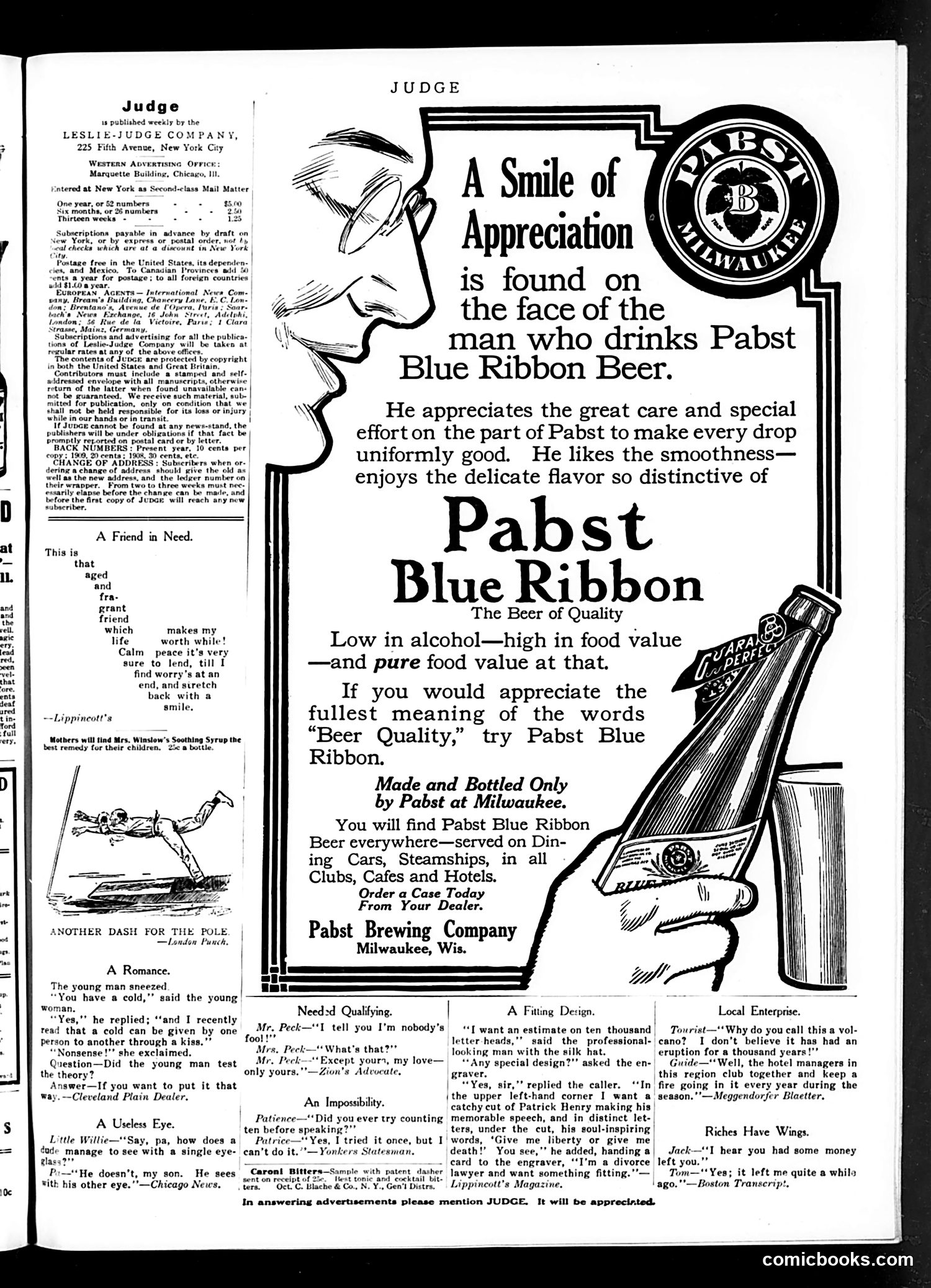
This page is primarily an **advertising spread** for Pabst Blue Ribbon Beer, occupying the right two-thirds of the layout. The ad features a large illustrated profile of a smiling man's face and a bottle of beer, promoting Pabst as "The Beer of Quality"—emphasizing its low alcohol content and "food value." The left side contains the magazine's masthead and several brief **comic anecdotes and jokes**, including wordplay pieces titled "A Friend in Need," "A Romance," and "An Impossibility." These are typical short-form humor pieces common to satirical magazines of this era. **For modern readers:** The page reflects early 20th-century magazine publishing, where editorial content and advertising were intermixed without clear separation. The beer advertisement's emphasis on "pure food value" and low alcohol reflects early 1900s health-consciousness marketing. The jokes are gentle, pun-based humor targeting middle-class audiences rather than pointed political satire.
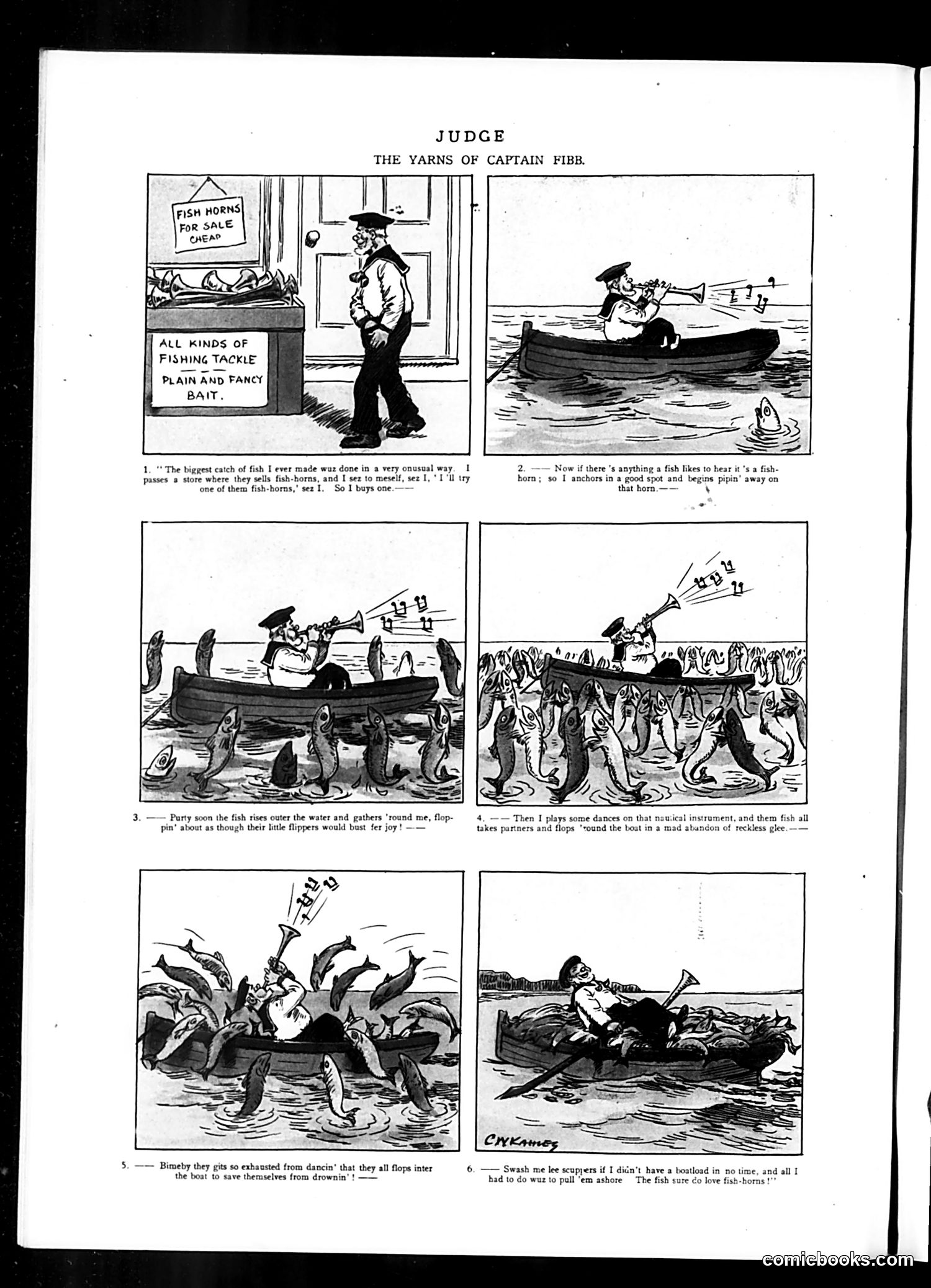
This is a humorous tall tale comic strip featuring an unreliable narrator—Captain Fibb—recounting an absurdly implausible fishing method to a gullible audience. The joke relies on escalating absurdity: he buys a fish-horn from a tackle shop, uses it as a musical instrument to attract fish, plays dances that cause the fish to exhaustedly leap into his boat of their own accord. The satire targets credulous listeners who accept obvious nonsense, and pokes fun at exaggerated fishing stories—a tradition of boastful, false anecdotes. The fish's humanized responses (dancing, getting tired, abandoning self-preservation) heighten the ridiculousness. The strip's title emphasizes this is mere yarn-spinning, making the humor accessible: recognizing the impossibility is the point. This represents *Judge* magazine's comedic style—gentle ridicule of common human foibles like tall-tale telling.