
Judge, 1910-08-20 · page 5 of 16
Judge — August 20, 1910 — page 5: what you’re looking at
What you’re looking at
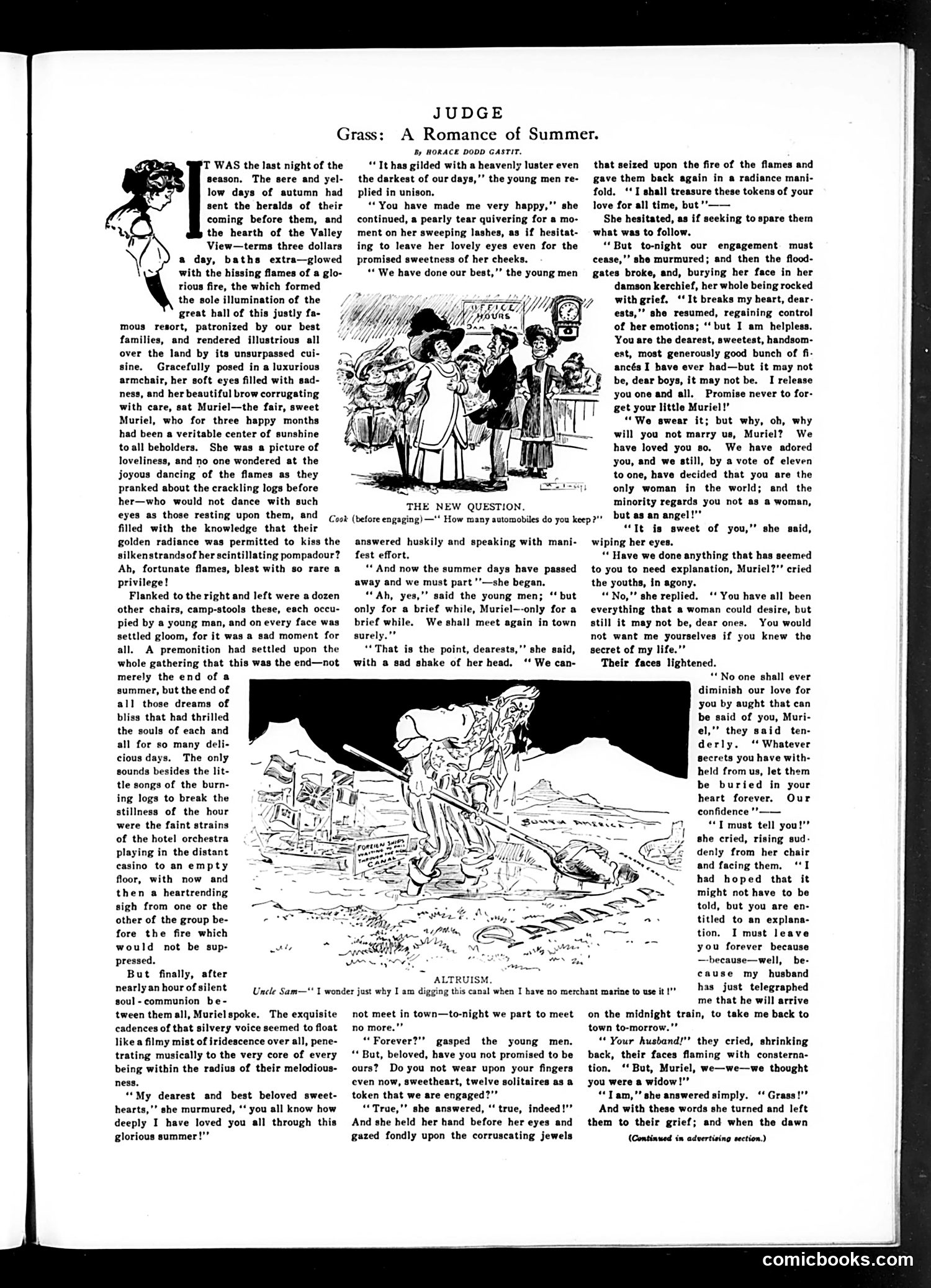
This page contains a serialized romantic story titled "Grass: A Romance of Summer" by Horace Dodd Gavitt, not a political cartoon. The narrative depicts young lovers at a summer gathering who must part ways—the woman, Muriel, must leave due to her husband's telegram summoning her home. The two illustrations show: (1) a social scene with multiple figures at what appears to be a hotel or resort gathering, and (2) a sentimental moment between the parting lovers. This is sentimental fiction typical of Judge magazine's entertainment content rather than political satire. The "satire" lies in the melodramatic, overwrought romantic dialogue and situations—gently mocking Victorian-era sentiment and relationship conventions through exaggeration.
📄 Transcribed text from this page (OCR, searchable)
Machine-transcribed from the original scan — historical spelling and the odd misread are preserved.
Grass: 'T WAS the last night of the season. The sere and yel- low days of autumn had sent the heralds of their coming before them, and the hearth of the Valley View—terms three dollars a day, baths extra—glowed with the hissing flames of a glo- tious fire, the which formed the sole illumination of the great hall of this justly fa- mous resort, patronized by our best families, and rendered illustrious all over the land by its unsurpassed cui- sine. Gracefully posed in a luxurious armchair, her soft eyes filled with sad- ness, and her beautiful brow corrugating with care, sat Muriel—the fair, sweet Muriel, who for three happy months had been a veritable center of sunshine toall beholders. She was a picture of loveliness, and no one wondered at the joyous dancing of the flames as they pranked about the crackling logs before her—who would not dance with such eyes as those resting upon them, and filled with the knowledge that their golden radiance was permitted to kiss the silkenstrandsof her scintillating pompadour? Ah, fortunate flames, blest with so rare a privilege! Flanked to the right and left were a dozen other chairs, camp-stools these, each occu- pied by a young man, and on every face was settled gloom, for it was a sad moment for all. A premonition had settled upon the whole gathering that this was the end—not merely the end of a summer, but the end of all those dreams of bliss that had thrilled the souls of each and all for so many deli- cious days. The only sounds besides the lit- tle songs of the burn- ing logs to break the stillness of the hour were the faint strains of the hotel orchestra playing in the distant casino to an empty floor, with now and then a heartrending sigh from one or the other of the group be- fore the fire which would not be sup- pressed. But finally, after nearly an hour of silent soul-communion be- tween them all, Murielspoke. The exquisite cadences of that silvery voice seemed to float like a filmy mist of iridescence over all, pene- trating musically to the very core of every being within the radius of their melodious- ness. “‘My dearest and best beloved sweet- hearts,’’ she murmured, *‘ you all know how deeply I have loved you all through this glorious summer!’’ JUDGE By RORACE DODD GasTIT. “ Ithas gilded with a heavenly luster even the darkest of our days,” the young men re- plied in unison, “You have made me very happy,’* she continued, a pearly tear quivering for a mo- ment on her sweeping lashes, as if hesitat- ing to leave her lovely eyes even for the promised sweetness of her cheeks. “We have done our best,” the young men THE NEW QUESTION, Cook (before engaging) —'* How many automobiles do you keep ?"’ answered huskily and speaking with mani- fest effort. “And now the summer days have passed away and we must part "’—she began. “Ah, yes,"” said the young men; “but only for a brief while, Muriel~-only for a brief while. We shall meet again in town surely.”” “That is the point, dearests, with a sad shake of her head, she said, * We can- ALTRUISM, Uncle Sam—"' 1 wonder just why I am digging this canal when I have no merchant marine to use it !"" not meet in town—to-night we part to meet no more."” “Forever?” gasped the young men. “* But, beloved, have you not promised to be ours? Do you not wear upon your fingers even now, sweetheart, twelve solitaires as a token that we are engaged?” “‘True,'’ she answered, ‘‘ true, indeed!’’ And she held her hand before her eyes and gazed fondly upon the corruscating jewels A Romance of Summer. that seized upon the fire of the flames and gave them back again in a radiance mani- fold. ‘‘I shall treasure these tokens of your love for all time, but "’—— She hesitated, as if seeking to spare them what was to follow. “But to-night our engagement must cease,’’ she murmured; and then the flood- gates broke, and, burying her face in her mson kerchief, her whole being rocked with grief. ‘‘It breaks my heart, dear- ests,"? she resumed, regaining control of her emotions; ‘‘ but I am helpless. You are the dearest, sweetest, handsom- est, most generously good bunch of fi- ancés I have ever had—but it may not be, dear boys, it may not be. I release you one and all. Promise never to for- get your little Muriel!’ “We swear it; but why, oh, why will you not marry us, Muriel? We have loved you so. We have adored you, and we still, by a vote of eleven to one, have decided that you are the only woman in the world; and the minority regards you not as a woman, but as an angel!”* “It is sweet of you,’ wiping her eyes. Have we done anything that has seemed to you to need explanation, Muriel?” cried the youths, in agony. “No,” she replied. ‘‘ You have all been everything that a woman could desire, but still it may not be, dear ones. You would not want me yourselves if you knew the secret of my life.”” Their faces lightened. ‘No one shall ever diminish our love for you by aught that can be said of you, Muri- el,” they said ten- derly. ‘“ Whatever secrets you have with- held from us, let them be buried in your heart forever. Our confidence '’—— “T must tell you!” she cried, rising sud- denly from her chair and facing them, “I had hoped that it might not have to be told, but you are en- titled to an explana- tion, I must leave you forever because —because—well, be- cause my husband has just telegraphed me that he will arrive on the midnight train, to take me back to town to-morrow.”” “* Your husband!"’ they cried, shrinking back, their faces flaming with consterna- tion. ‘But, Muriel, we—we—we thought you were a widow!”” Tam,’ she answered simply.‘ Grass!"" And with these words she turned and left them to their grief; and when the dawn (Continued in advertising section.) she said, comicbooks.com