
A complete issue · 16 pages · 1910
Judge — July 9, 1910
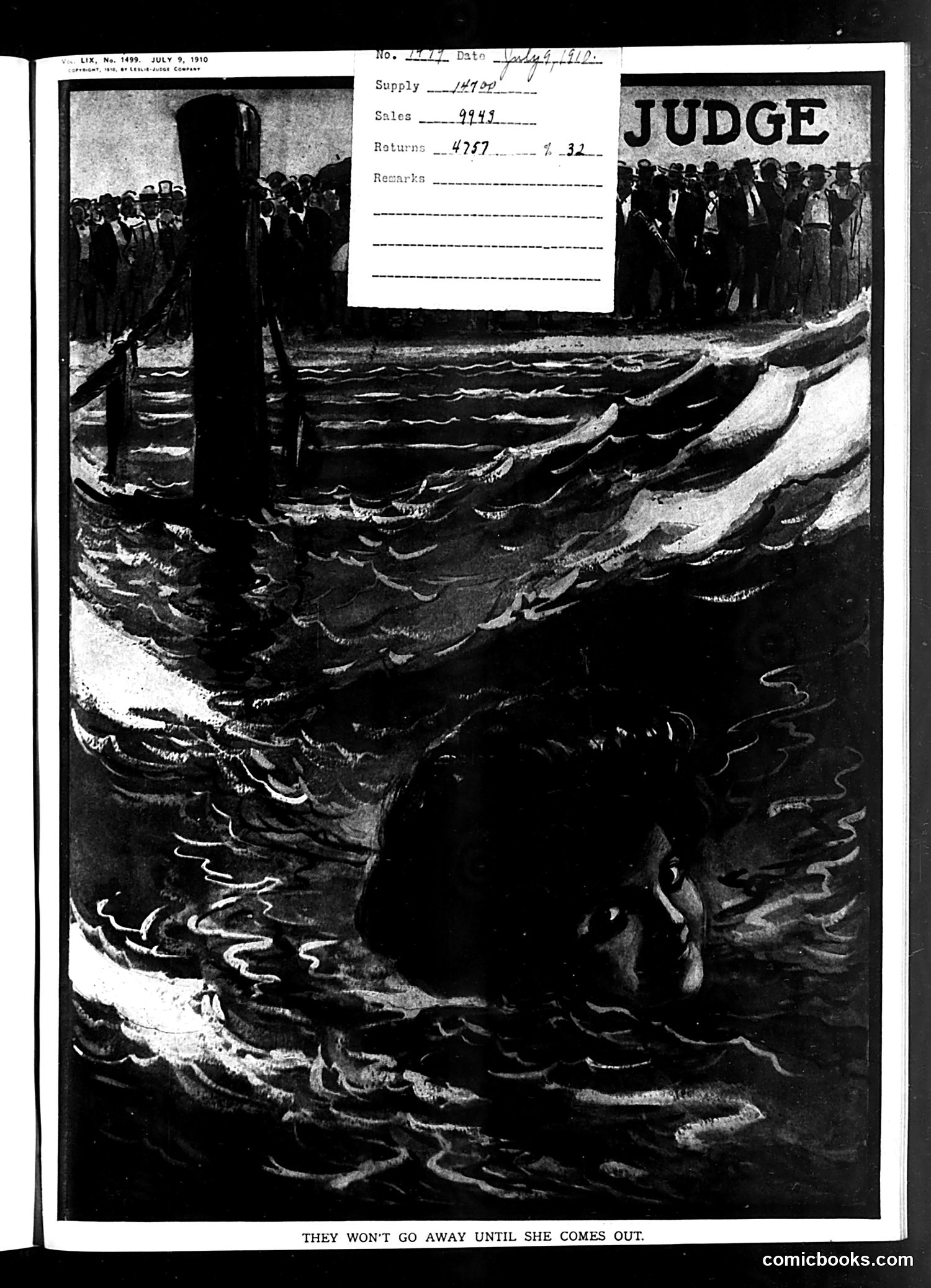
This page from Judge (dated July 9, 1910) features a political cartoon titled "They Won't Go Away Until She Comes Out." The image depicts a large female head emerging from turbulent water, observed by a crowd of men in the background near a pole. The cartoon appears to reference a contemporary scandal or controversy involving a prominent woman, though the specific identity isn't entirely clear from the image alone. The gathering crowd and the caption suggest public pressure or demand for someone's appearance or statement. The aquatic setting may indicate literal or metaphorical drowning in scandal. The satirical point seems to criticize public obsession with a female figure's actions or statements, with the impatient crowd unwilling to disperse until she addresses them—reflecting Judge magazine's typical commentary on social and political follies of the era.
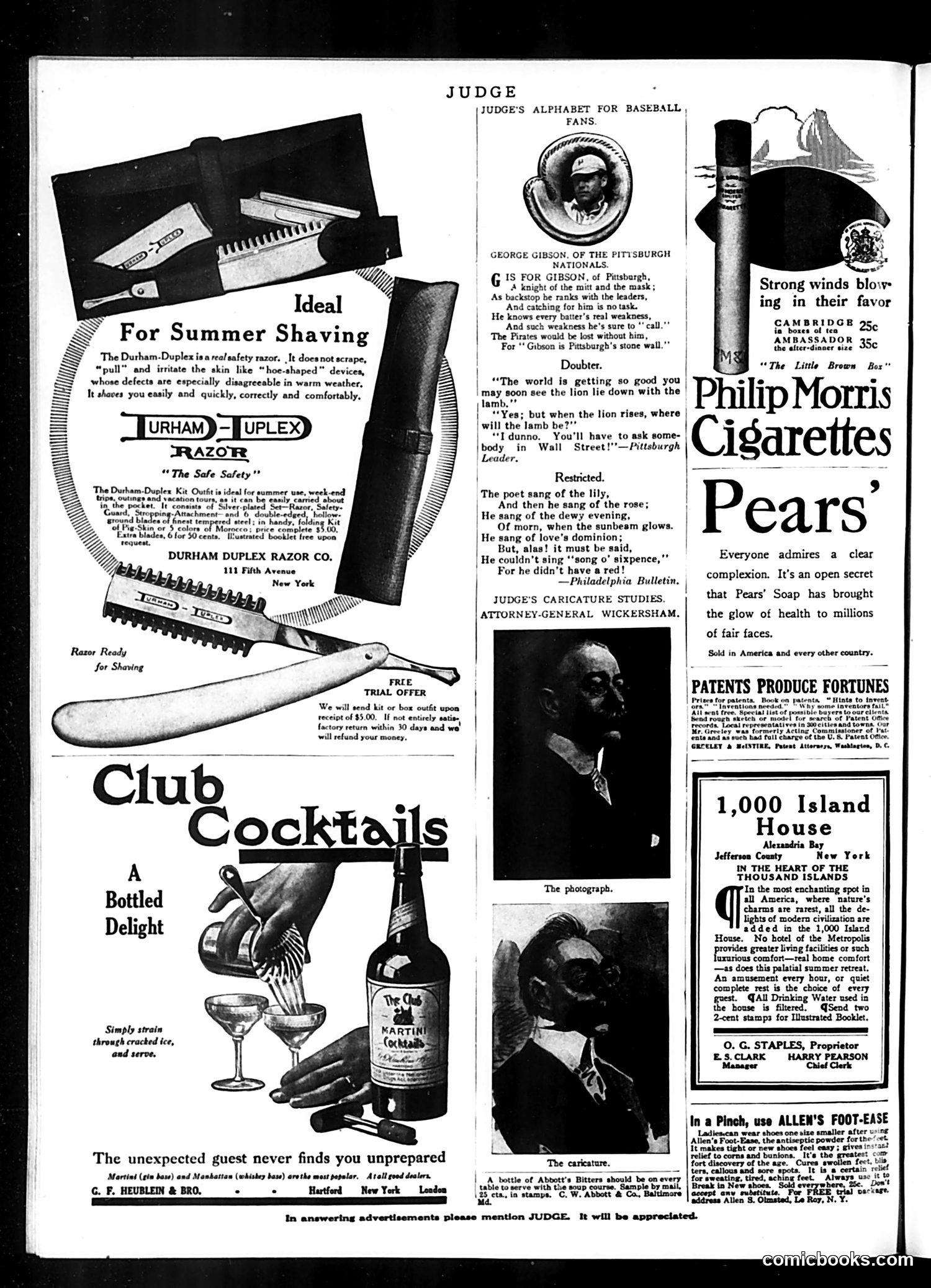
This page is primarily **advertising content** rather than political satire. The ads promote consumer products typical of the early 20th century: razors, cigars, soap, cocktail mixers, and vacation properties. The only satirical content appears to be **"Judge's Caricature Studies"** featuring Attorney-General Wickersham, shown in two photographs with accompanying verse mocking his appearance and legal record. The poems use wordplay about lions and lambs, likely criticizing his performance as Attorney-General, though the specific political references are unclear without additional historical context about Wickersham's tenure. The page demonstrates how Judge magazine intermingled advertising with brief satirical commentary on public figures.
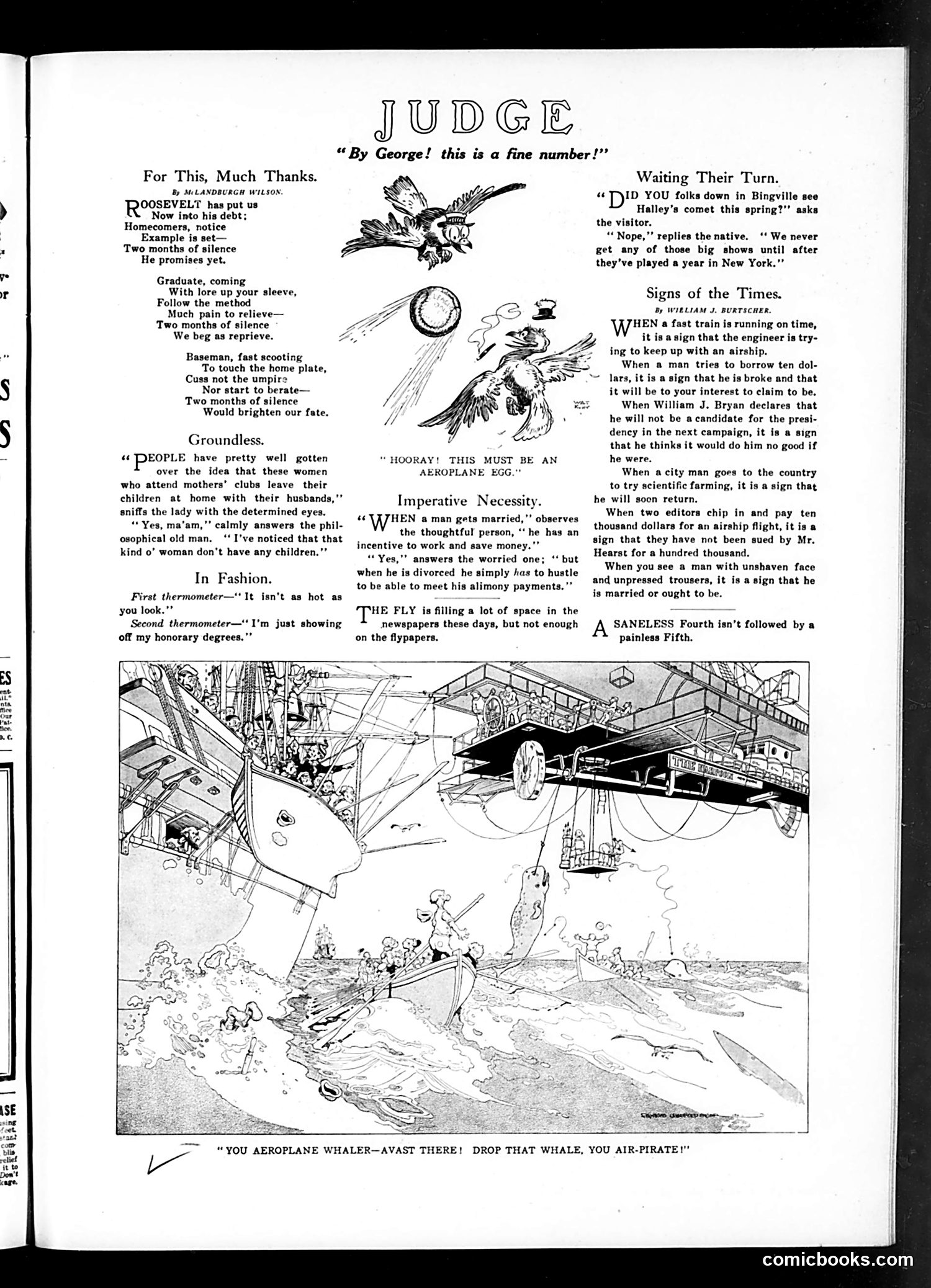
This page from the satirical magazine *Judge* features various humorous commentary typical of early 20th-century American humor. The main cartoon depicts an airplane dropping a whale onto ships below, with the caption "You Aeroplane Whaler—Avast There! Drop That Whale, You Air-Pirate!" This appears to be absurdist humor playing on the novelty of aviation technology, imagining aircraft engaged in whale hunting—combining modern aviation with traditional whaling to create an impossible, comical scenario. The smaller text pieces ("For This, Much Thanks," "Waiting Their Turn," "Signs of the Times") contain brief satirical observations about contemporary social issues—politics, marriage, and modern life—in the witty, pithy style characteristic of *Judge's* "short jokes" format. The overall tone is lighthearted social commentary rather than serious political critique.
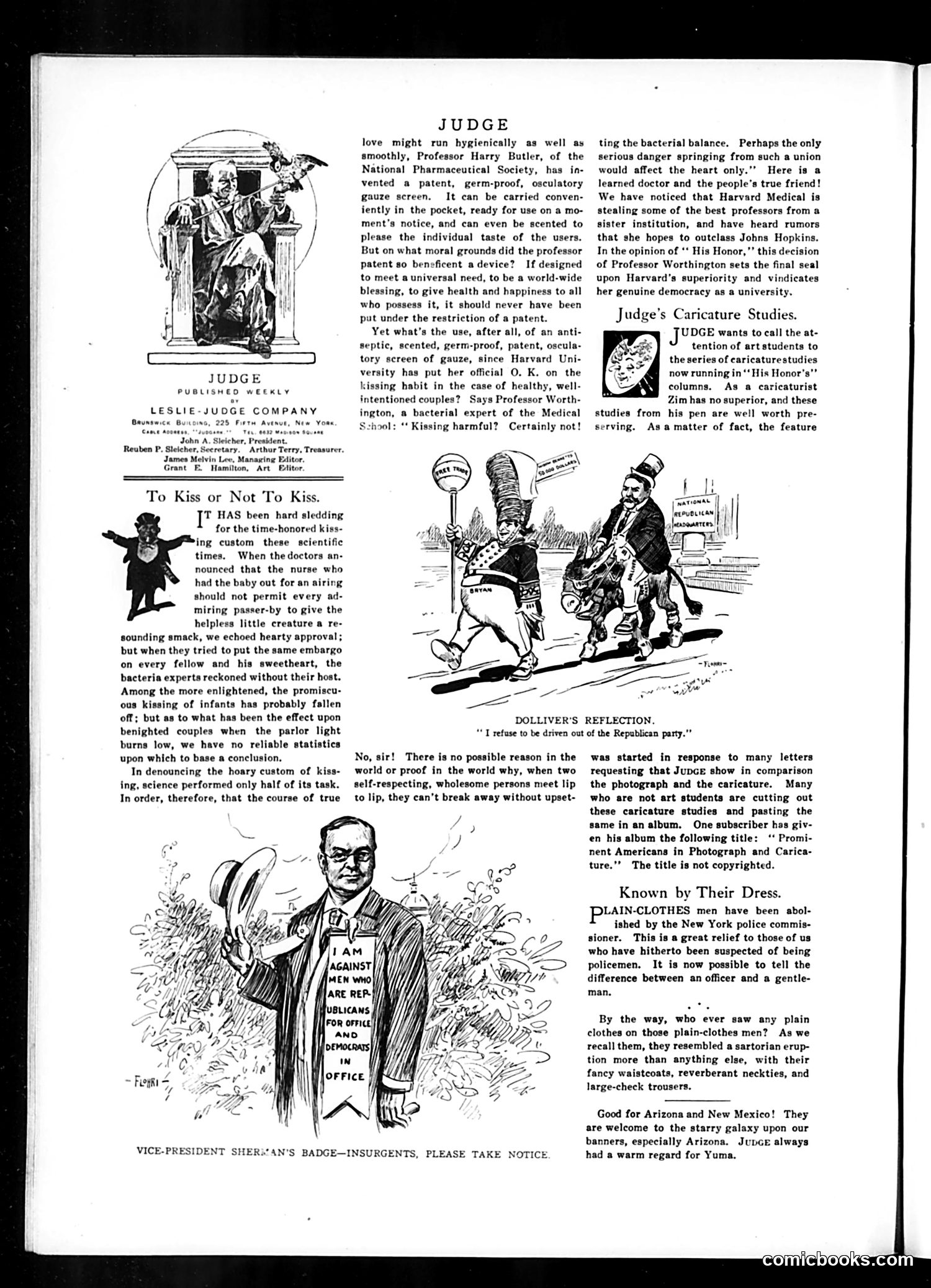
This page contains political satire from an unclear date. The main cartoon "Vice-President Shera'n's Badge—Insurgents, Please Take Notice" depicts a figure wearing a badge labeled with text about being "a genuine republican" and "holding office," surrounded by thorny vegetation. This appears to satirize Vice-President James Sherman's political position during the Progressive/"Insurgent" Republican split of the early 1900s. The other content includes discussions about kissing customs, caricature studies, and plain-clothes police identification. The "Dolliver's Reflection" cartoon references Republican party politics but lacks sufficient context for precise interpretation. The overall page blends political commentary with social satire typical of Judge's format.
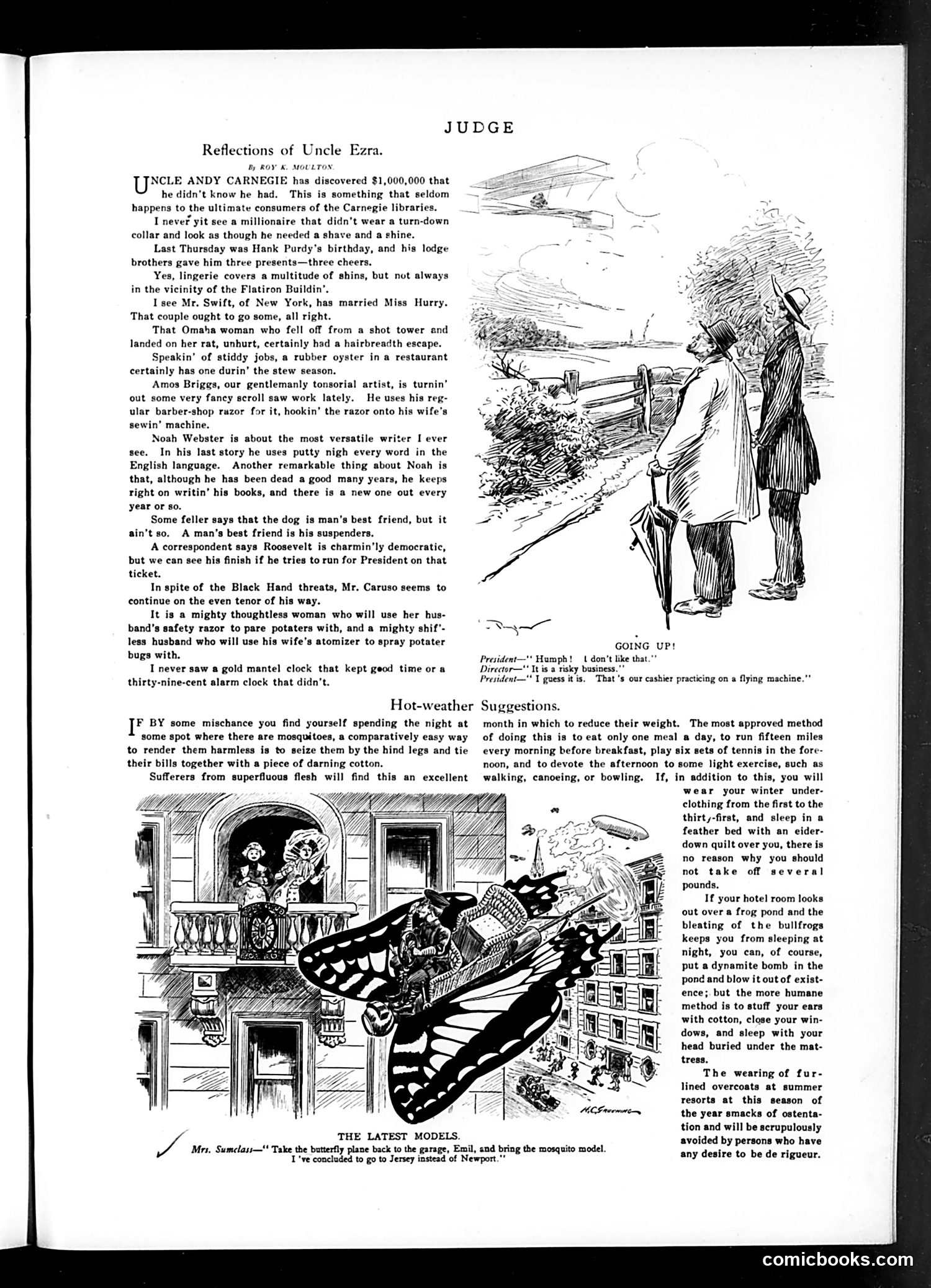
This page contains several satirical pieces. The main cartoon titled "Going Up!" depicts two men observing an airplane, with dialogue suggesting skepticism about early aviation—one calls it a "risky business" and another mentions "our cashier practicing on a flying machine." This reflects early-1900s skepticism toward aviation technology. "Reflections of Uncle Ezra" offers social commentary on contemporary figures like Noah Webster and references to Roosevelt's presidential ambitions, using folksy humor to critique modern life and pretension. The lower cartoon "The Latest Models" humorously depicts people using a motorized contraption in an urban setting, satirizing the novelty and awkwardness of emerging mechanical transportation. The "Hot-weather Suggestions" column provides practical (if tongue-in-cheek) advice for summer comfort, typical of Judge's mixed content approach.
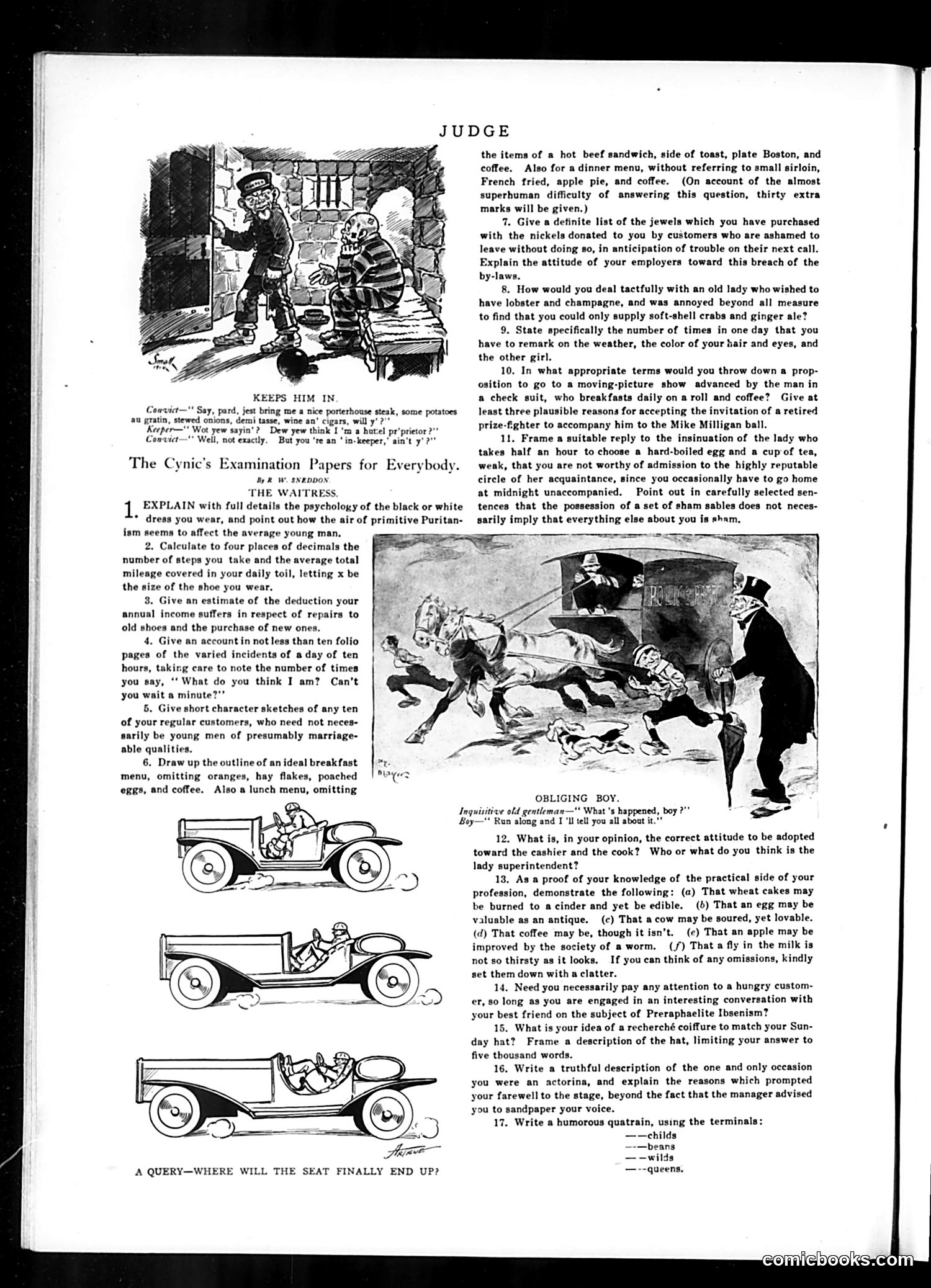
This page contains two distinct satirical pieces mocking working-class service positions in early 20th-century America. **"Keeps Him In"** (top): A convict requests restaurant service from his jailer, calling him an "inn-keeper" rather than a prison guard—satirizing the poor treatment and conditions in prisons, suggesting they're indistinguishable from low-quality hotels. **"The Cynic's Examination Papers for Everybody"** (main text): Mock exam questions targeting waitresses, using absurdist humor to highlight their difficult working conditions: low wages, constant foot traffic, verbal abuse from customers, unwanted advances, and social condescension. Questions about "nickels donated" reference the tipping culture exploiting service workers, while references to "sham sables" mock lower-class women's aspirations to appear wealthy. **"Obliging Boy"** (bottom right): A boy minimizes an accident to an inquiring gentleman—likely commenting on youthful deference or workplace hierarchy. The overall message critiques class exploitation and the indignities faced by service workers, using humor to expose systemic unfairness.
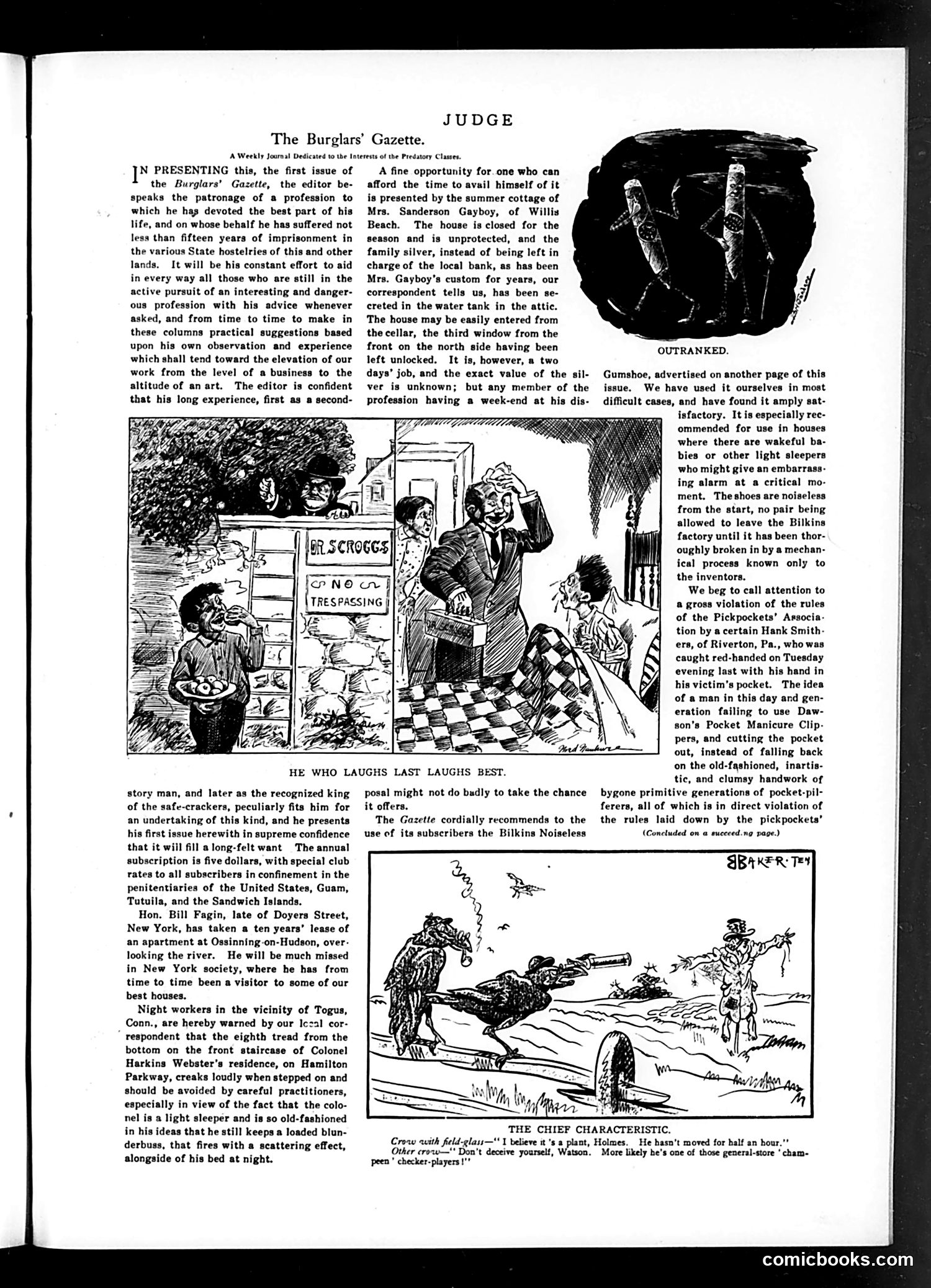
This is a satirical fake newspaper mimicking a trade journal for criminals. Judge magazine was mocking the criminal underworld by presenting burglary, pickpocketing, and safecracking as legitimate professions worthy of professional publications and advertising. The page includes: - **Editorial framing**: A former convict ("fifteen years of imprisonment") launching a publication to elevate burglary "from the level of a business to the altitude of an art" - **"Classified ads"**: Actual burglary opportunities (Mrs. Gayboy's unprotected cottage with silver in the attic), professional product endorsements (noiseless shoes, pocket clippers), and warnings about rule violations - **Cartoons**: "He Who Laughs Last Laughs Best" shows a burglar caught; "The Chief Characteristic" depicts a crow, suggesting criminal cunning The satire ridicules both criminal enterprise and—implicitly—legitimate business culture by using identical promotional language and structure. It's comedic social commentary about organized crime and professional standards.
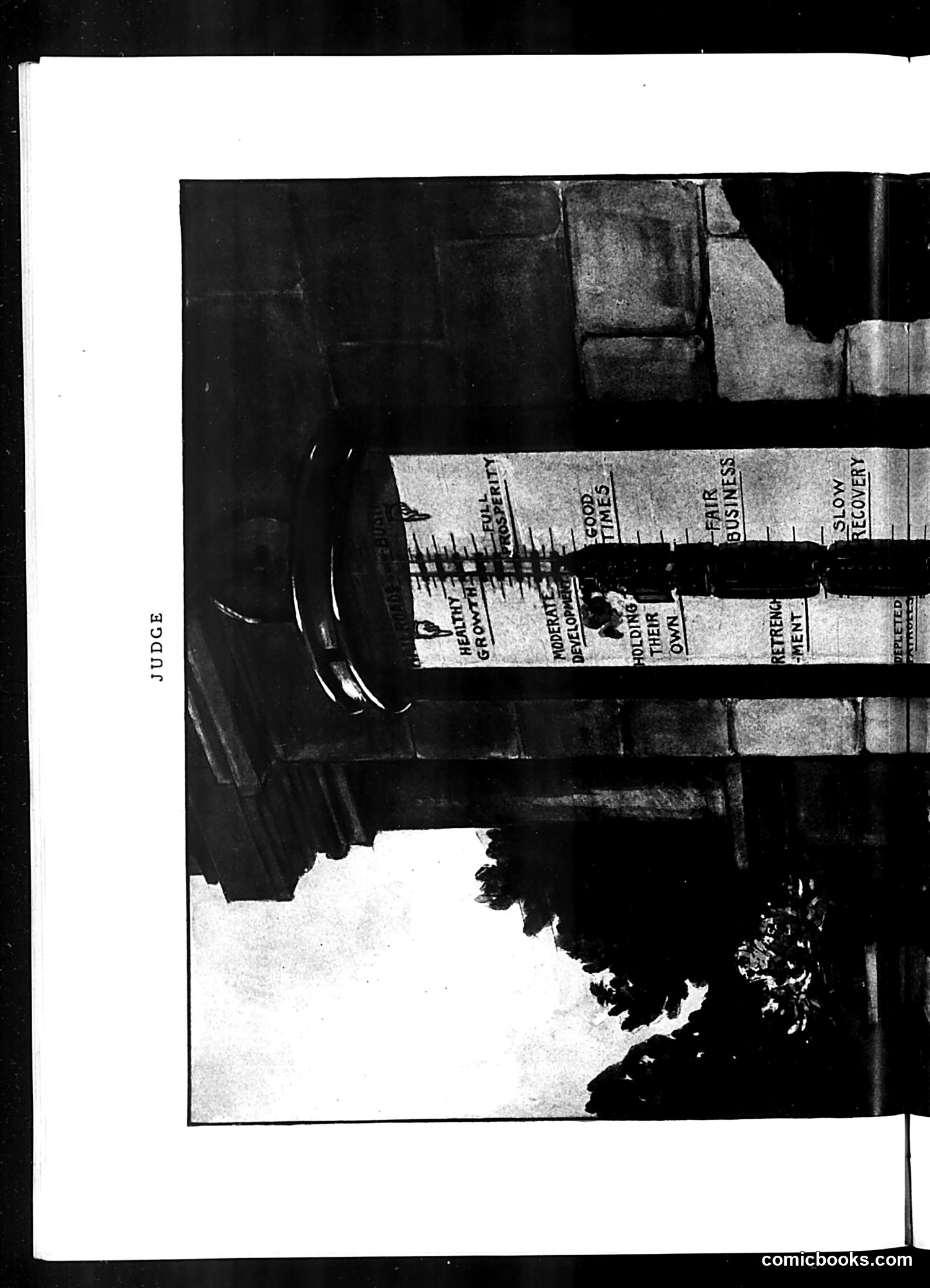
I can see this is a page from *Judge* magazine with the word "JUDGE" visible on the left margin. However, the image quality and orientation make it difficult to read the specific text clearly. I can discern what appears to be a horizontal strip or banner with multiple text segments, but the OCR text provided is largely illegible characters. Without being able to reliably read the cartoon's caption, dialogue, or clearly identify the figures depicted, I cannot accurately explain the satire or political/social references to a modern reader. To provide a meaningful analysis, I would need either a clearer image or legible OCR text identifying the subjects, date of publication, and the cartoon's content.
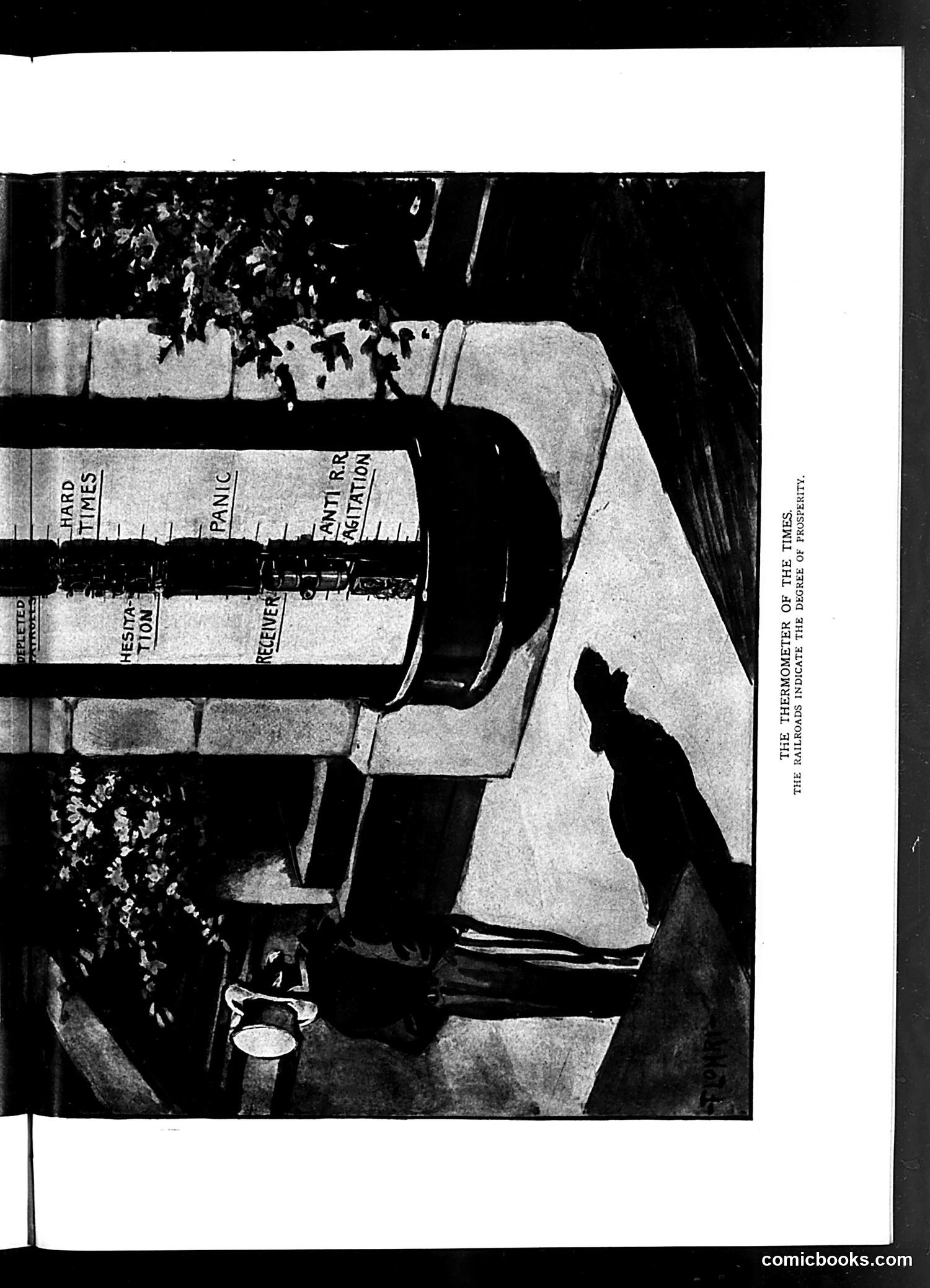
I can see this is a black and white photograph rather than a drawn cartoon. The image shows what appears to be barrels or containers labeled with text including "HARD TIMES," "PANIC," "RELIEF TOOL," and "CENTRAL R.R. PETITION." A silhouetted figure stands beside the barrels. The caption reads: "THE FASHIONER OF THE TIMES. THE RAILROADS DOUBLE ITS PROSPERITY." This appears to be political satire about railroad industry practices during an economic crisis period (likely referencing the Panic of 1893 or similar). The image suggests railroads were profiting from or exacerbating public hardship ("hard times," "panic"). However, the OCR text is largely corrupted, making precise interpretation difficult. The satirical point seems to criticize how railroad companies benefited financially while ordinary citizens suffered economically.
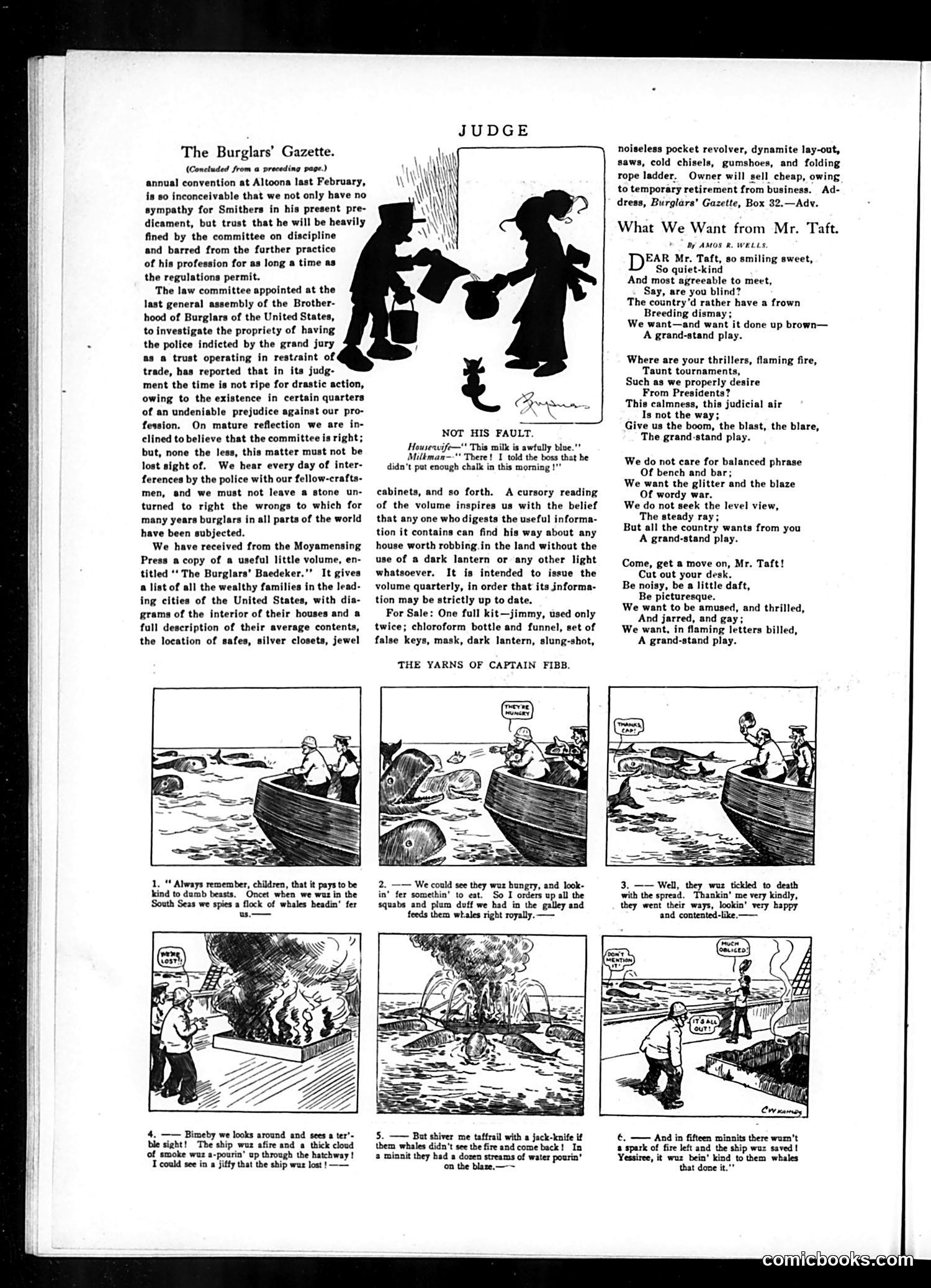
This *Judge* page contains political satire about President William Howard Taft (circa 1909-1913). **"What We Want from Mr. Taft"** is a poem mocking Taft's cautious, legalistic governing style. The satire argues that Americans prefer dramatic, flashy leadership ("grand-stand play," "boom," "blast," "blare") over Taft's measured, judicial approach. The piece criticizes his calm demeanor and desk work, demanding instead spectacle, noise, and theatrical politics—suggesting the public wants entertainment from their president, not thoughtful governance. The humor lies in openly admitting this shallow preference while framing it as national desire. The page also includes absurdist humor: "The Burglars' Gazette" satirizes professional organizations by treating criminals as a legitimate trade complaining about police "restraint of trade," and includes a fake advertisement selling burglary tools. This mocks business jargon applied to crime. Other comics ("Not His Fault," "Captain Fibb's Yarns") are unrelated jokes typical of the magazine's miscellaneous humor format.
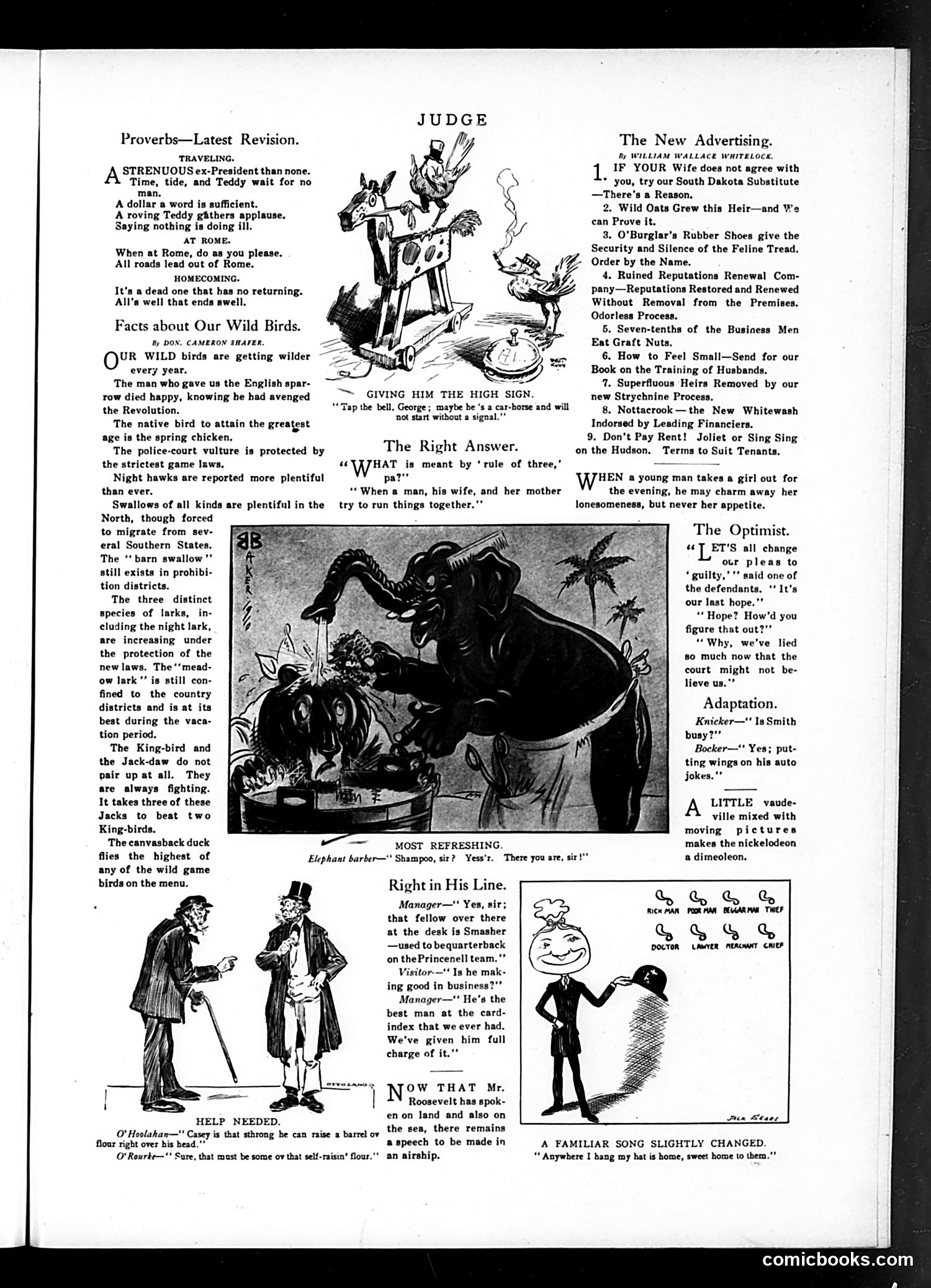
This is primarily a humor and satire page from Judge magazine, mixing jokes, advertisements, and comic observations. **Key Content:** The "Proverbs—Latest Revision" section mocks Theodore Roosevelt as a political figure, with repeated references to "Teddy" (the ex-President) in rewritten proverbs—suggesting his prominence and restless nature. Lines like "A roving Teddy gathers applause" and "Teddy wait for no man" satirize his constant public activity. **"The New Advertising"** parodies modern advertising absurdity, including dark jokes: item 7 references removing "superfluous heirs" via strychnine (poison), item 8 mentions financial corruption ("Whitewash"), and item 9 jokes about avoiding rent by going to prison (Joliet or Sing Sing). The cartoon illustrations depict various workplace and social scenarios with accompanying punchlines—typical Judge humor targeting business culture, class dynamics, and contemporary manners. The page reflects early 20th-century concerns: Roosevelt's political dominance, business corruption, and emerging consumer culture.
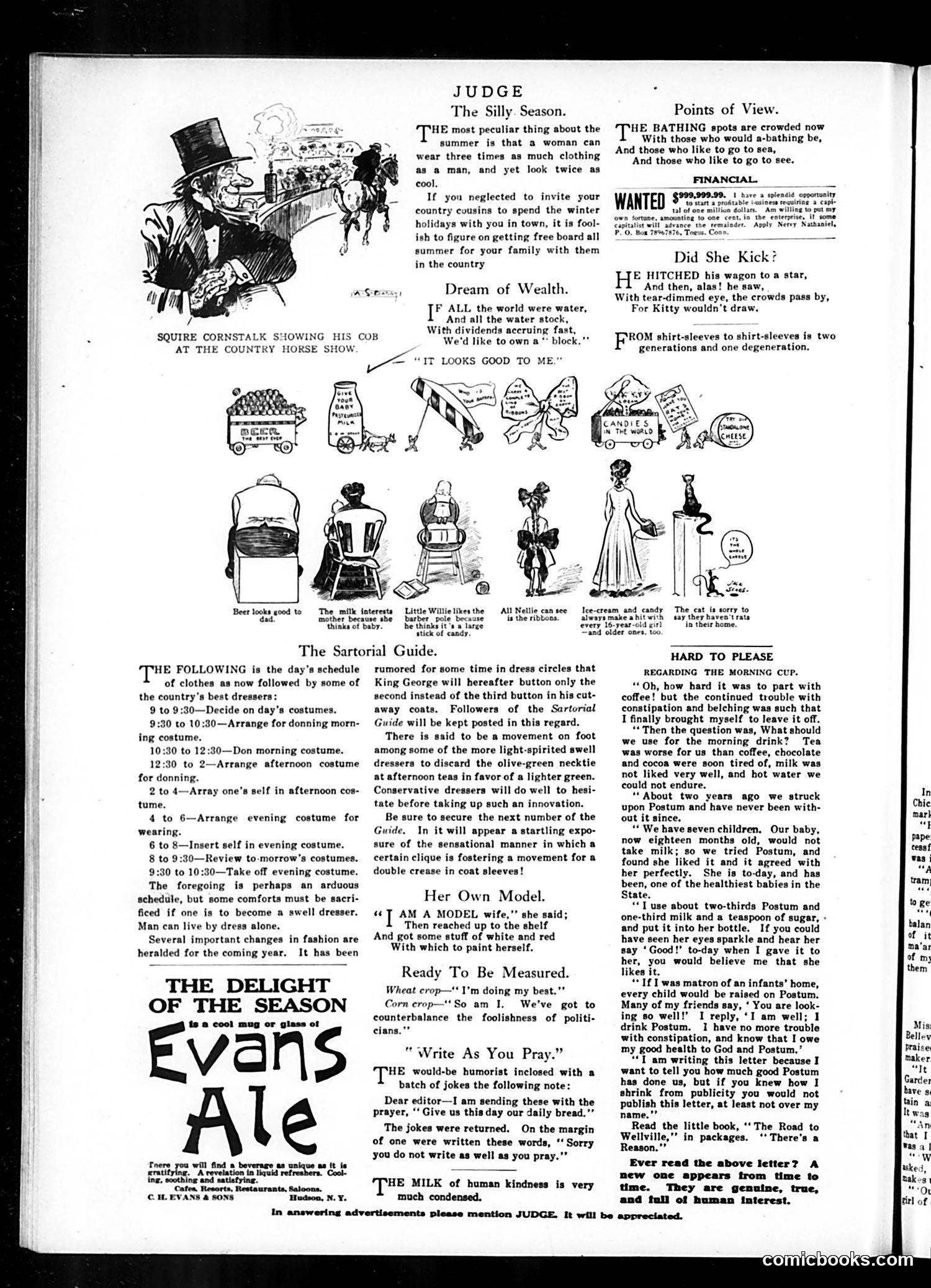
This page from Judge magazine (early 20th century) contains miscellaneous social satire rather than a single unified cartoon. **Main Cartoon**: "Squire Cornstalk Showing His Cob at the Country Horse Show" depicts a rural aristocrat proudly displaying his horse—likely satirizing the pretensions of country gentry who adopt genteel behaviors. **Running Jokes**: - "The Silly Season" mocks summer social conventions: women wearing excessive clothing while appearing cool, country relatives freeloading, and the absurd "Sartorial Guide" that ridicules wealthy people spending entire days deciding what to wear (with a joke about King George's button placement). - "Did She Kick?" plays on a man harnessing his ambitions ("hitched his wagon to a star") only to have his wife ("Kitty") refuse to cooperate—a domestic humor common to the era. **Advertisements**: Evans Ale occupies significant space, typical for Judge's revenue model. The page reflects Edwardian-era concerns: class anxiety, fashion obsession, agricultural uncertainty, and marital dynamics—all presented with light mockery rather than sharp political critique.
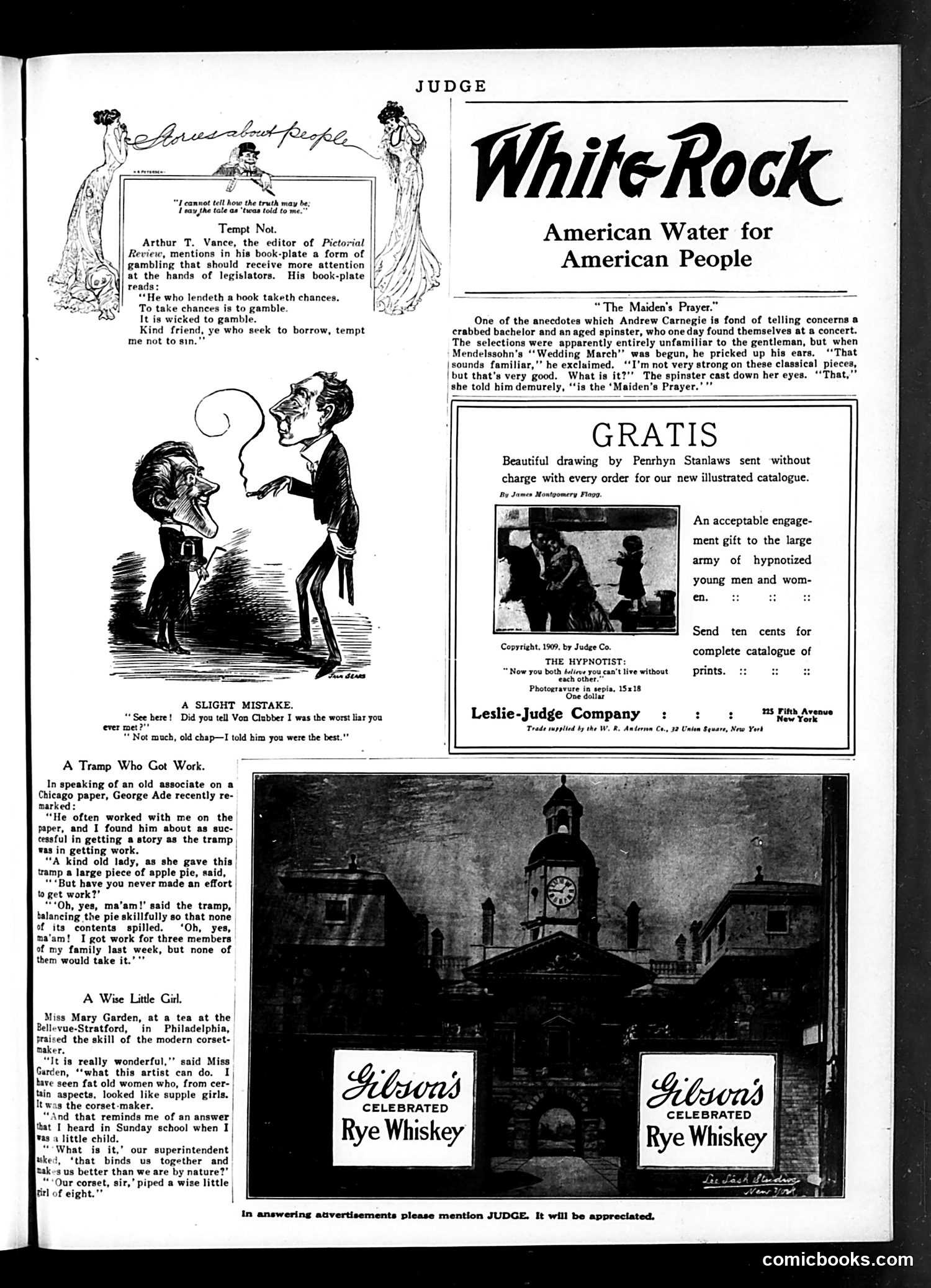
This page combines satirical commentary with advertisements typical of early 1900s magazines. **Main Cartoon ("A Slight Mistake"):** Two men discuss whether one called the other a liar. The joke plays on misunderstanding—one claims he said the opposite of what was actually said, creating absurdist humor about reputation and insults. **Supporting Anecdotes:** The page includes three humorous stories: - Editor Arthur T. Vance's book-plate about lending books as "gambling" - Andrew Carnegie's story about a bachelor mistaking Mendelssohn's "Wedding March" for the "Maiden's Prayer" (a mild sexual innuendo) - A tramp's ironic claim about finding work for family members who rejected it - A child's clever answer about corsets "binding us together" **Advertisements:** White Rock water, Gibson's Rye Whiskey, and Leslie-Judge Company prints occupy significant space, featuring period illustrations and photography. The humor relies on wordplay, misunderstandings, and gentle social commentary typical of Judge's satirical style—less political than observational about human nature and social pretension.
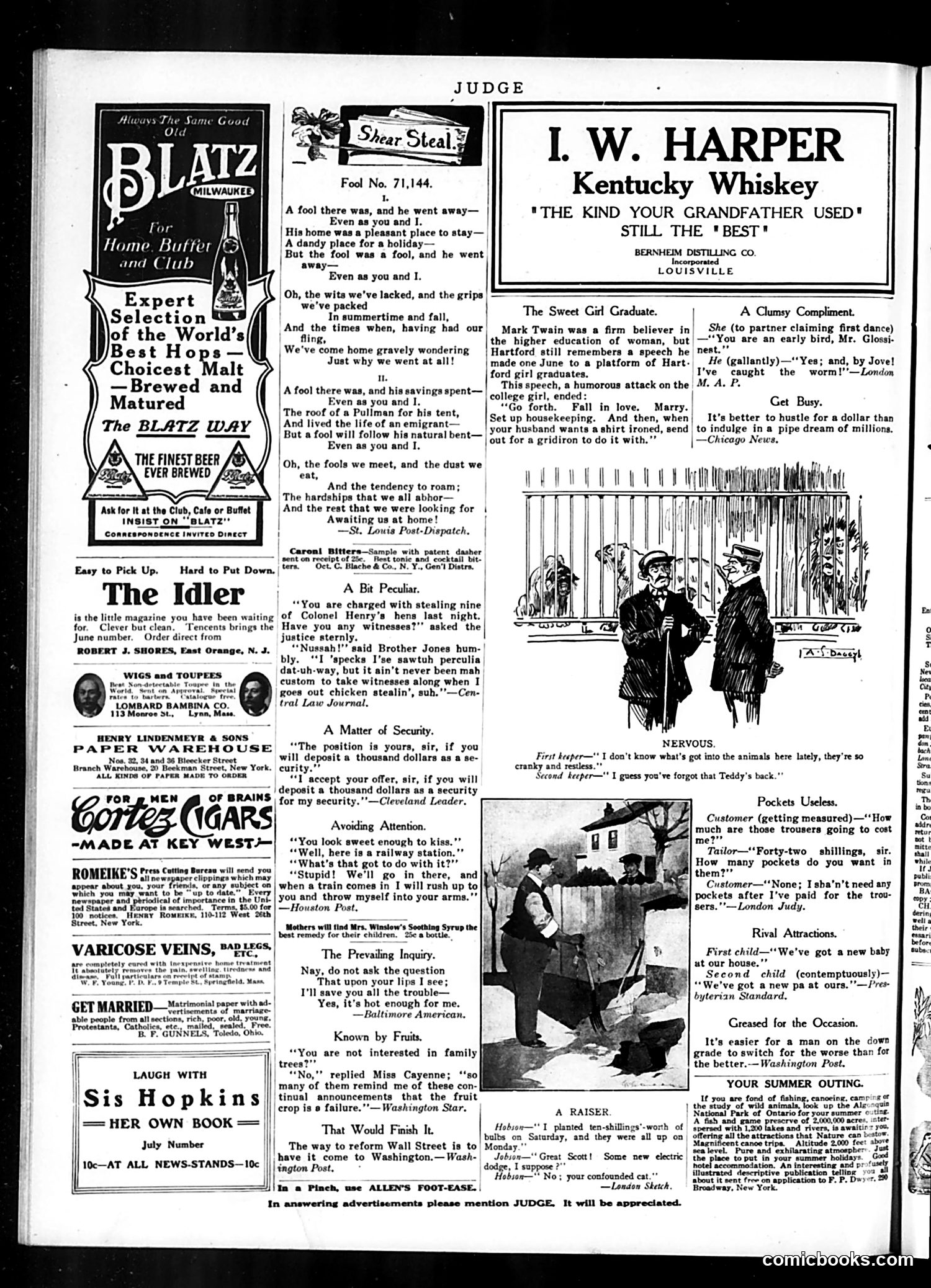
This page is primarily **advertisements and humor fillers**, typical of Judge magazine's format. The main satirical content is "Fool No. 71,144," a poem mocking wanderlust and restlessness. The poem, structured like Kipling's "The Ballad of the King's Jest," depicts a fool who abandons his comfortable home to travel, only to realize he preferred domestic life. It critiques the romantic notion of wandering—the "tendency to roam" and "hardships that we all abhor"—suggesting such adventurousness is foolish nostalgia rather than genuine improvement. The repeated refrain "Even as you and I" invites readers to recognize themselves in this foolishness. The remaining humor pieces are brief jokes about minor social situations: a man accused of theft without witnesses, a couple's romantic encounter, a tailor's business worries. These reflect early-20th-century middle-class anxieties around propriety, marriage, and employment. The advertisements (whiskey, cigars, wigs, paper warehouses) are period-typical. Overall, this reflects Judge's role as satirical entertainment for urban, educated audiences skeptical of romantic ideals.
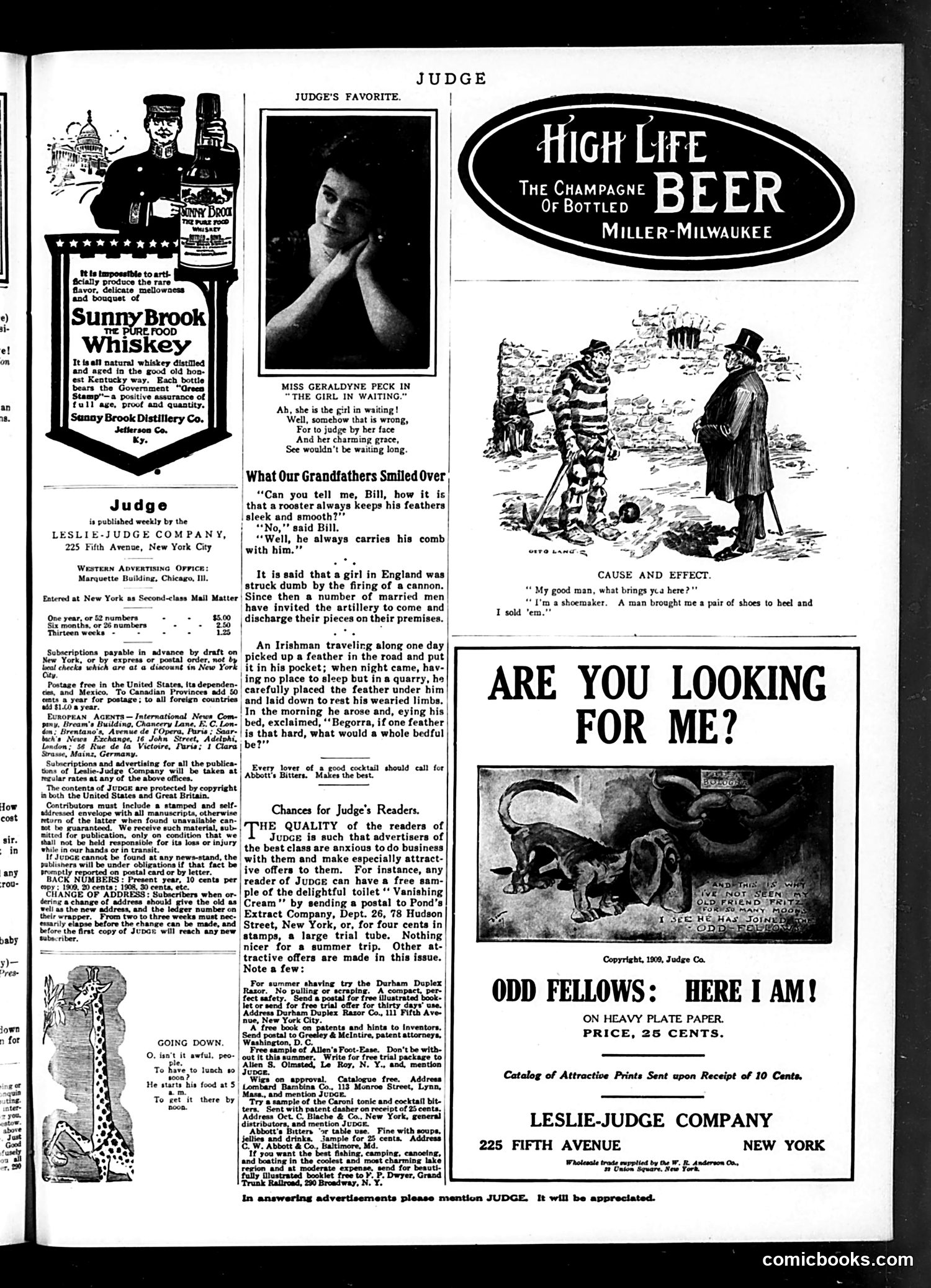
This page from Judge magazine (circa 1909) is primarily **advertising and filler content** rather than political satire. The main satirical elements are brief anecdotal jokes: 1. **"What Our Grandfathers Smiled Over"** presents old-fashioned humor about roosters and married men—likely poking fun at outdated, predictable jokes. 2. **The Irishman anecdote** plays on ethnic stereotyping (a common practice at the time), depicting supposed Irish naïveté through the story of a man shocked that a feather is uncomfortable as bedding. 3. **"Cause and Effect"** contains a mild joke about a shoemaker selling shoes. The page is dominated by **advertisements**—for Sunny Brook Whiskey, High Life Beer (Miller-Milwaukee), Abbott's Bitters, and various beauty products and razors. These ads reflect early 1900s consumer culture. **For modern readers**: This reveals how Judge balanced satirical commentary with commercial advertising, while period humor relied heavily on ethnic and gender stereotypes now considered offensive.
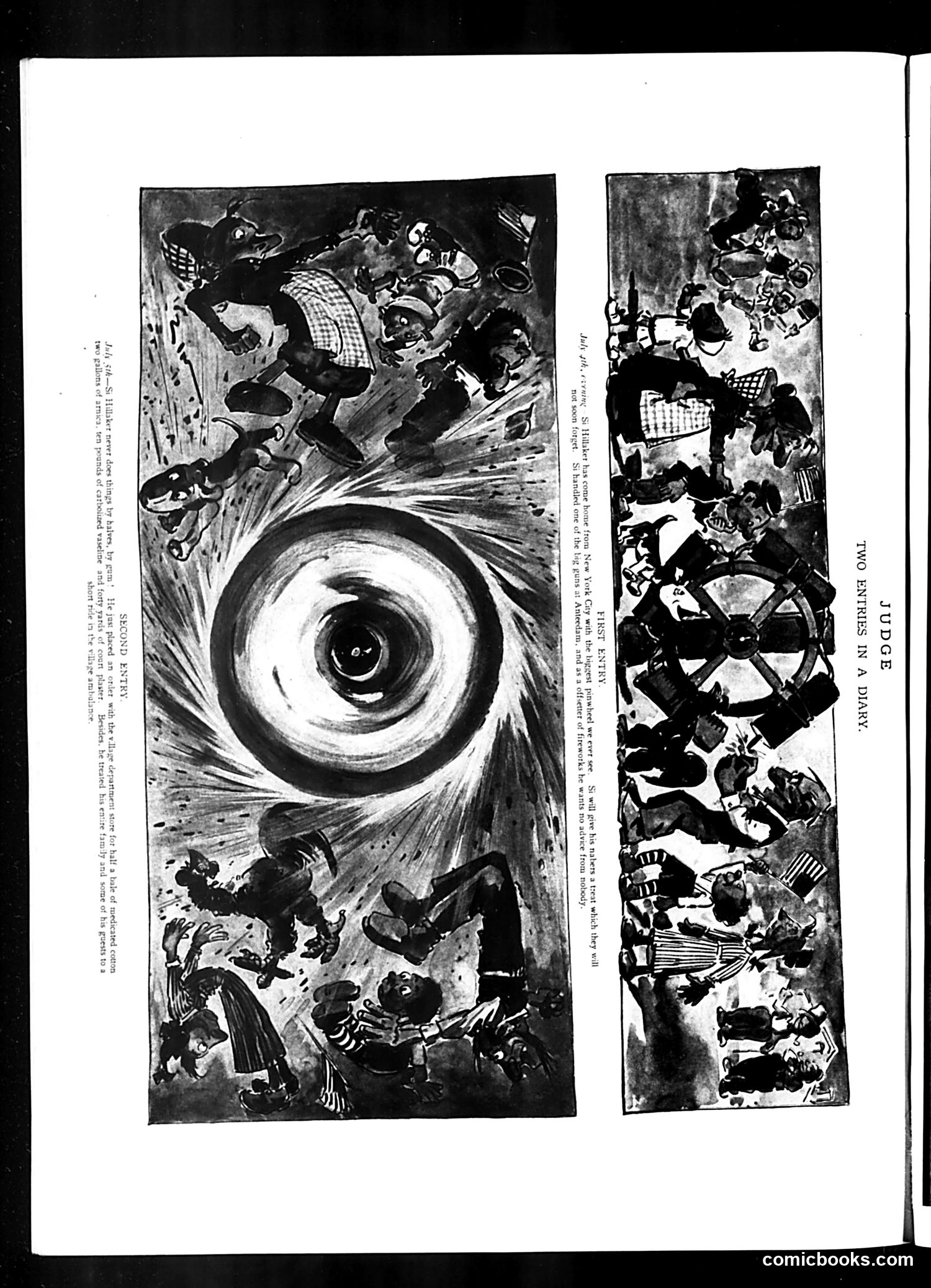
This page from *Judge* magazine presents a maritime satirical cartoon. The left image shows a ship's wheel at center with sailors being tossed about in chaos during a storm, surrounded by swirling spray and turbulent seas. The right panel depicts a narrower, vertical view of similar nautical chaos with figures and ship elements scattered vertically. The title "Two Carriers in a Gale" suggests this satirizes naval or political vessels navigating crisis. The exaggerated, chaotic compositions mock incompetent leadership during turbulent times. Without clearer OCR text identifying specific political figures or a visible date, the exact target remains uncertain—likely referencing either actual naval incidents or using maritime metaphors for political/economic instability. The cartoon's style is characteristic of early 20th-century American political satire.