
A complete issue · 16 pages · 1910
Judge — July 2, 1910
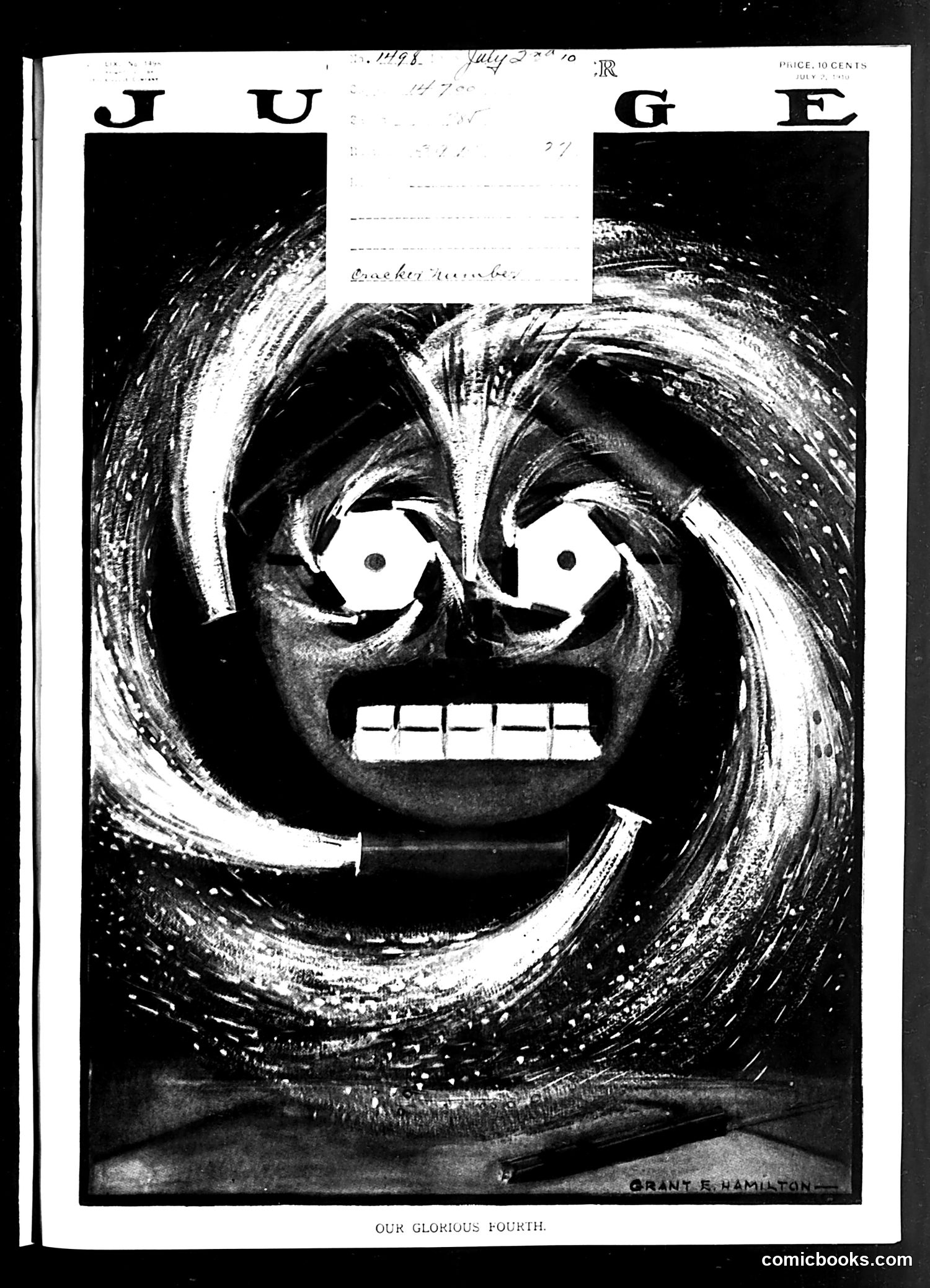
This Judge magazine cover, credited to Grant E. Hamilton, uses a grotesque caricatured face to satirize Fourth of July celebrations. The exaggerated features—bulging eyes, prominent teeth, wild hair—suggest mockery of American Independence Day festivities, likely critiquing how the holiday was actually celebrated. The title "Our Glorious Fourth" appears ironic given the unflattering imagery. Without the specific publication date visible in this image, the exact political target remains unclear, but Judge frequently used such caricatures to comment on American cultural practices or political figures associated with July Fourth events. The 10-cent price indicates this is from the late 19th or early 20th century, when Judge was prominent.
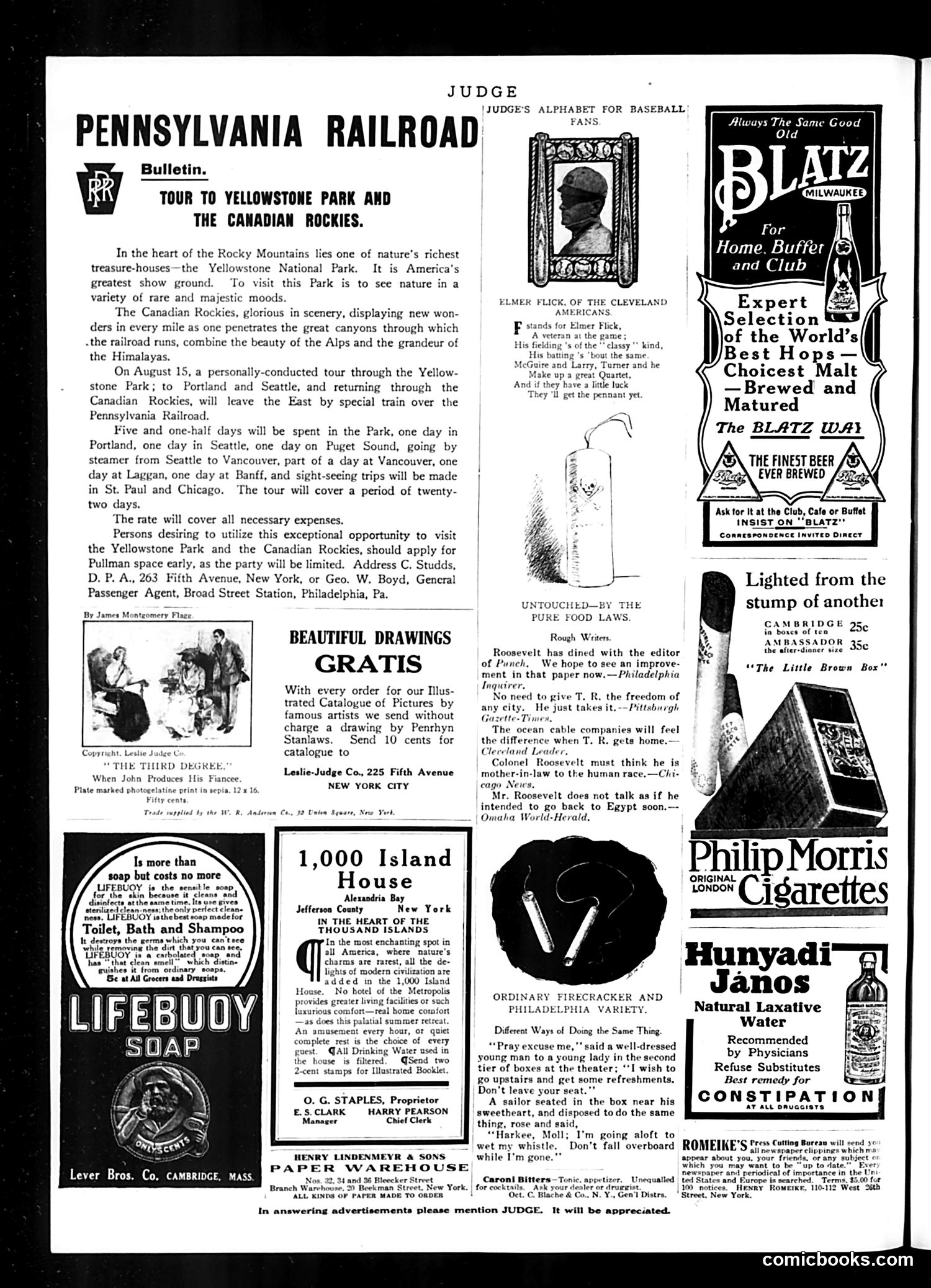
This page is primarily **advertising**, with one small editorial cartoon. The main content includes ads for Lifebuoy Soap, Philip Morris Cigarettes, Blatz beer, and other products typical of early 20th-century magazines. The only cartoon visible is titled "ORDINARY FIRECRACKER AND PHILADELPHIA VARIETY," depicting a firecracker labeled with "Different Ways of Doing the Same Thing." The joke appears to reference **Philadelphia's reputation for violence or crime**, suggesting the city's "firecracker" version is somehow more dangerous or destructive than a standard one—a dark comparison implying Philadelphia crime exceeded normal expectations. Without additional context, the specific incident referenced remains unclear.
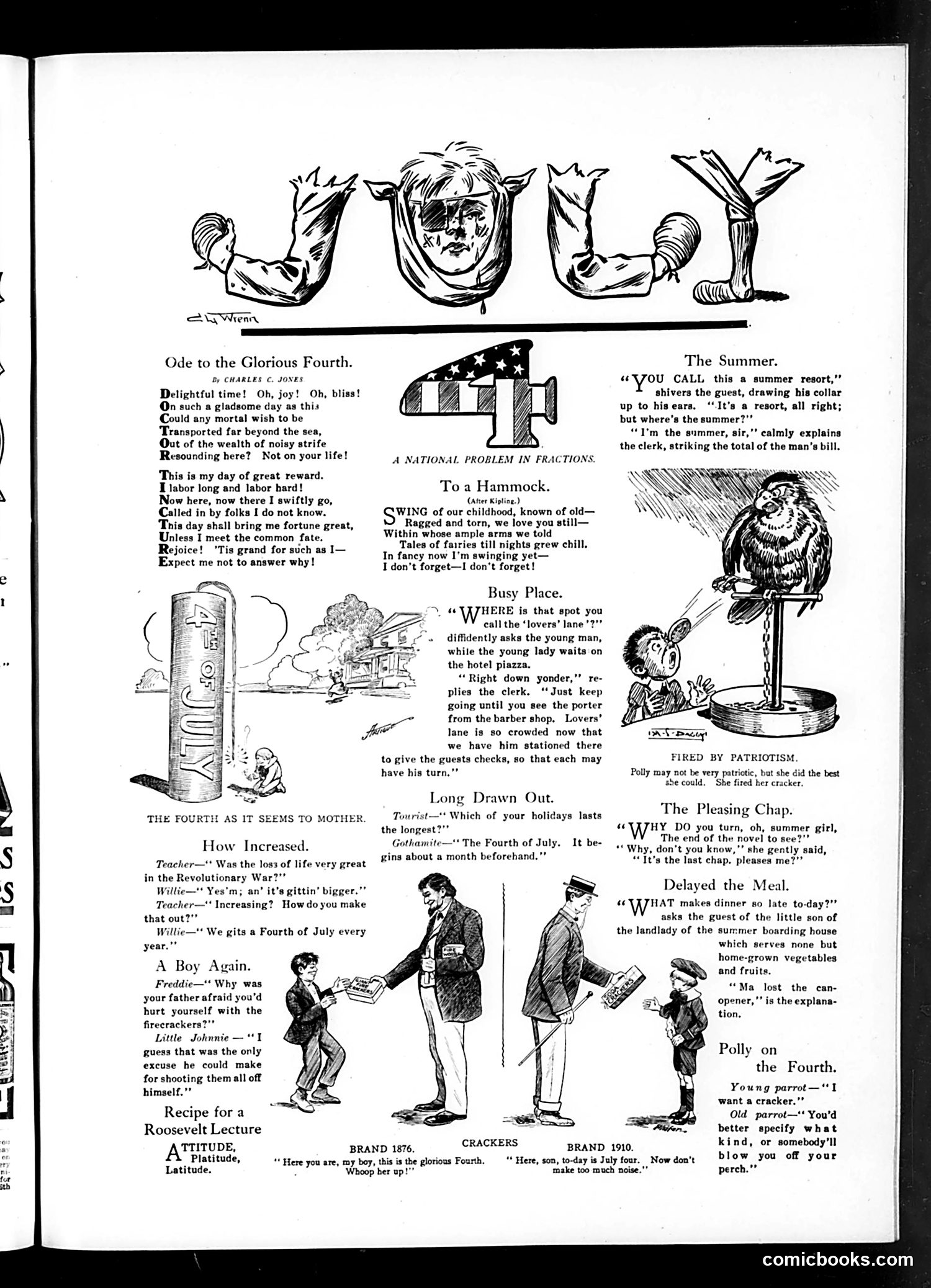
This page contains multiple humorous pieces about Fourth of July celebrations and summer activities, typical of Judge's light satirical content. **"A National Problem in Fractions"** appears to be the main political cartoon, depicting a patriotic shield with the numeral "4" and showing fractional portions—likely satirizing disputes over holiday observance or how Americans celebrate Independence Day inconsistently. The other pieces are mostly social humor: "Ode to the Glorious Fourth" celebrates holiday traditions, while items like "The Summer," "Busy Place," and "Crackers" mock summer resort culture, hotel congestion, and fireworks mishaps—common urban complaints of the era. A "Recipe for a Roosevelt Lecture" references Theodore Roosevelt, suggesting topical political content, though specifics remain unclear. Overall, this is primarily **lighthearted summer satire** rather than serious political commentary.
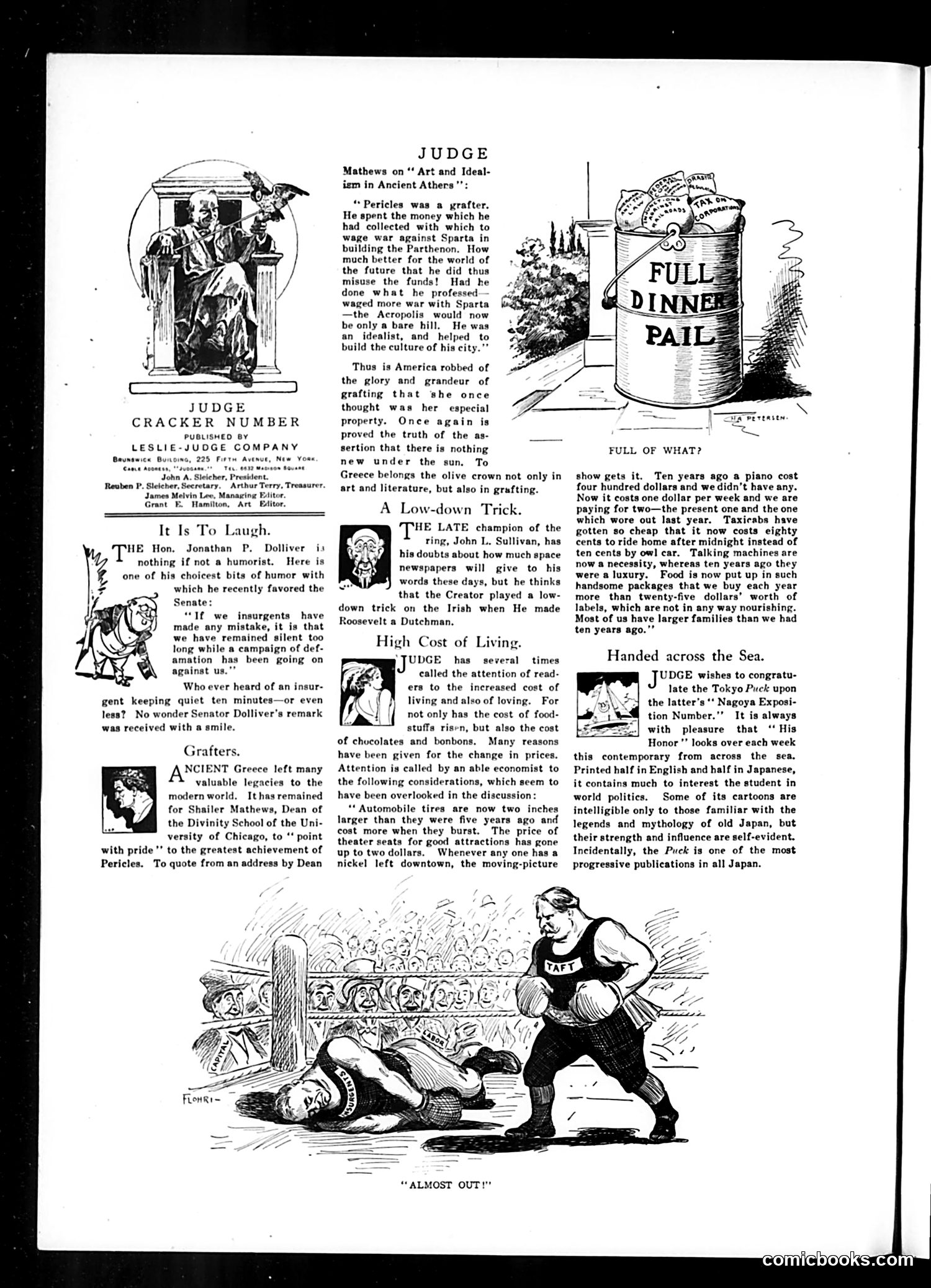
**Top Section - "Judge Cracker Number":** The article critiques American society for abandoning its cultural heritage. It references ancient Greece's Pericles, who spent war funds on the Acropolis, arguing America should similarly invest in culture rather than military spending. The "Full Dinner Pail" imagery references prosperity rhetoric. **Bottom Cartoon - "Almost Out!":** This appears to be a boxing match depicting "DAFT" (left) versus "RAFT" (right). The crowded stadium and dramatic positioning suggest a major sporting event metaphor for a political or social conflict. The title implies one side is nearly defeated, though the specific figures remain unclear without additional context. The overall page contrasts cultural criticism with satirical commentary on contemporary struggles.
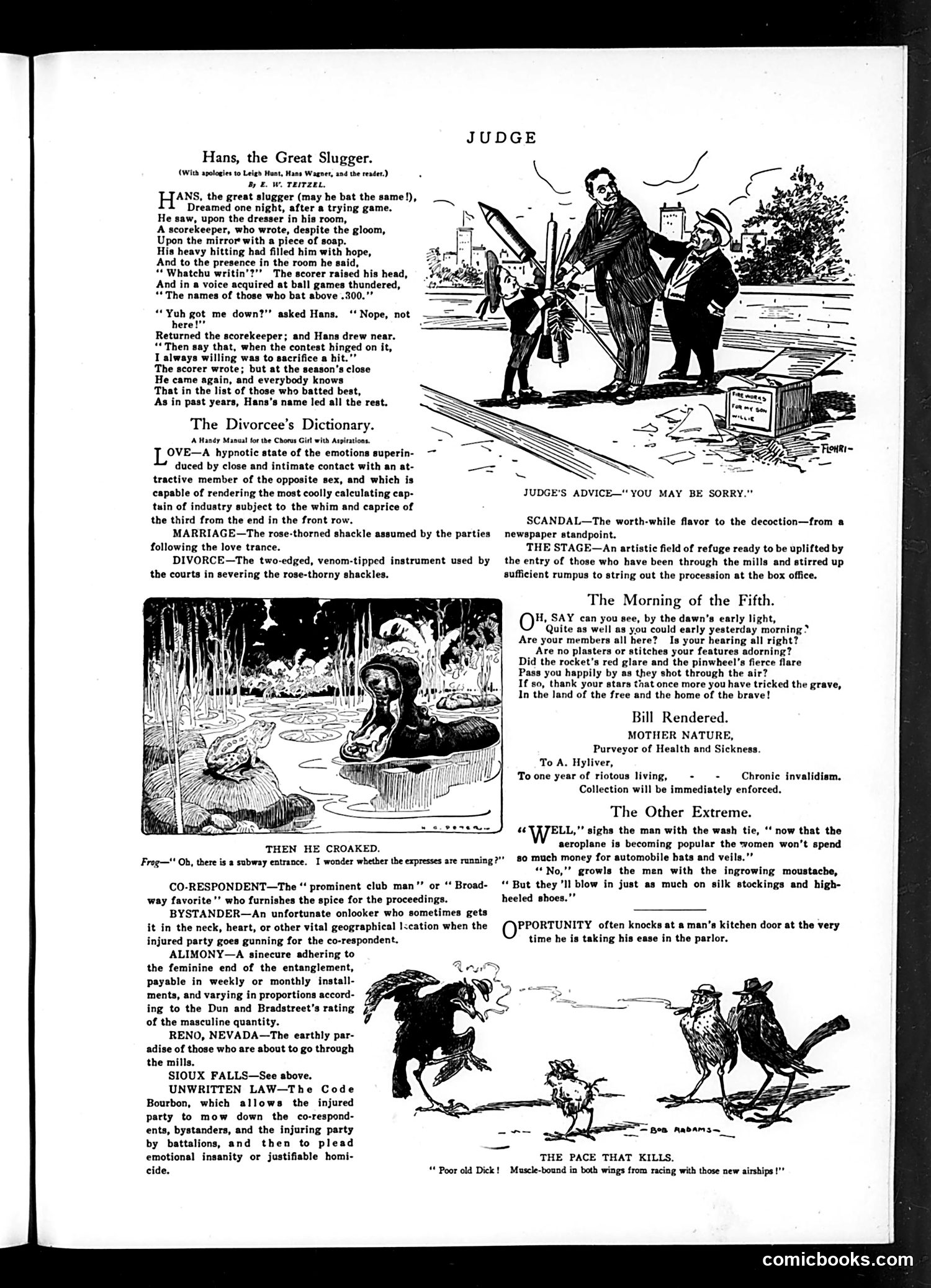
This page from *Judge* magazine contains several satirical pieces mocking contemporary social issues: **"Judge" (top cartoon):** A judge appears to scold someone, captioned "You may be sorry"—likely commentary on judicial leniency or courtroom absurdity. **Dictionary definitions** parody legal/social terms like "Love," "Marriage," and "Divorce" with cynical definitions reflecting period anxieties about marriage breakdown. **"Then He Croaked"** and other illustrated pieces appear to satirize contemporary scandals and social behaviors—possibly involving infidelity or moral hypocrisy, though specific references aren't entirely clear without fuller context. **"The Pace That Kills"** cartoon mocks what appears to be dangerous new transportation or social trends. Overall, the page reflects early-20th-century *Judge* magazine's characteristic approach: witty mockery of marital discord, legal absurdity, and modern social excess.
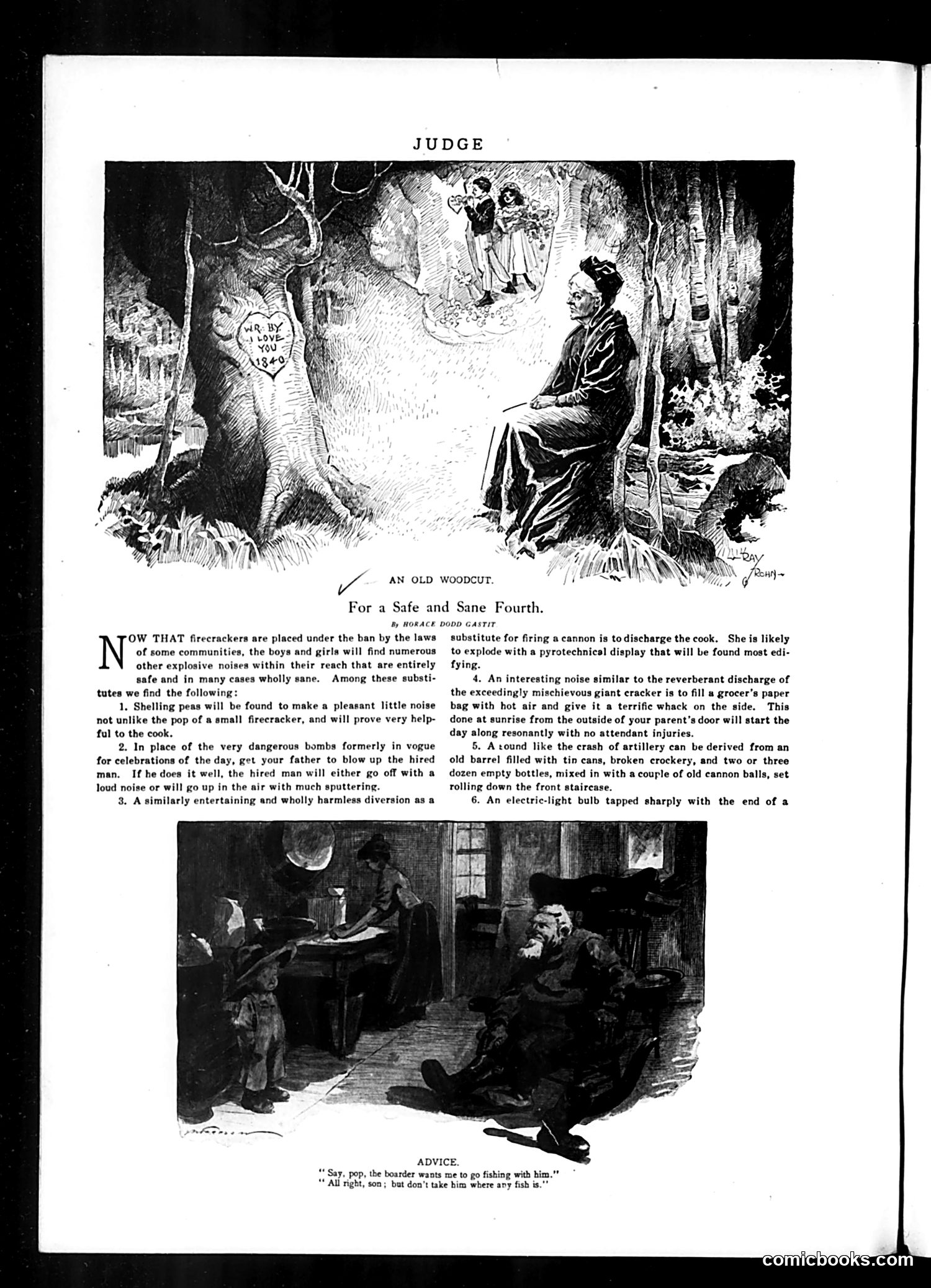
This 1910s-era piece satirizes safety campaigns against dangerous Fourth of July fireworks by proposing absurdly violent "alternatives." The humor works through dark irony: rather than safe substitutes, author Horace Dodd Gassit suggests explosions involving household servants and family members—firing "the hired man," having "the cook" explode, and rolling barrels down staircases. The accompanying cartoons show an older figure (likely representing authority/tradition) observing revelry, and a domestic scene with advice about fishing. The satire mocks both the earnestness of reformers promoting "sane" celebrations and class attitudes toward working-class employees as disposable objects of comedy. The piece reflects early 20th-century attitudes toward workplace safety and working-class labor as acceptable subjects for cruel humor.
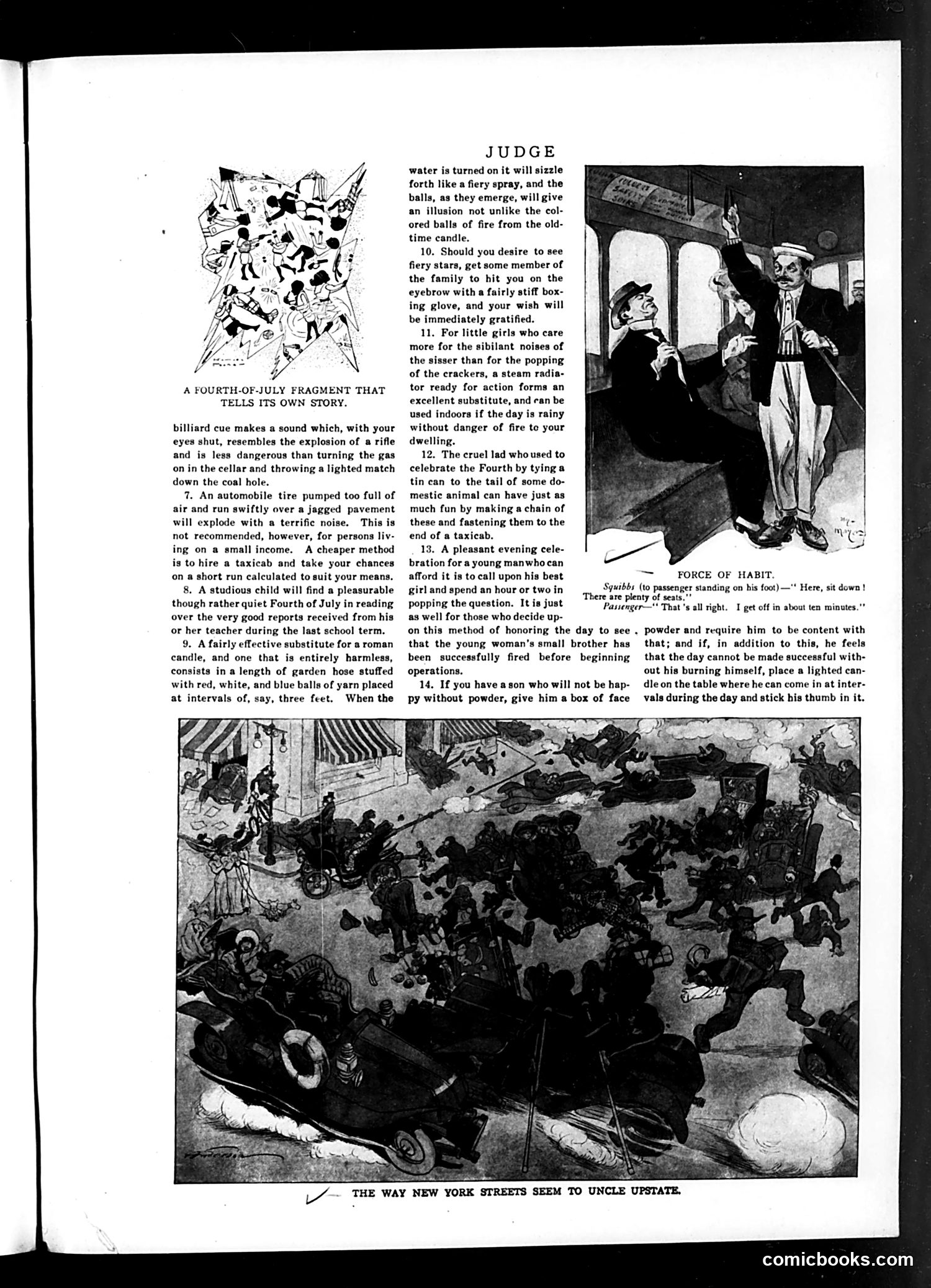
This page presents **Fourth of July safety tips disguised as humor**, satirizing dangerous holiday traditions circa early 1900s. The text mockingly suggests "safe alternatives" to fireworks—billiard cues mimicking rifle shots, overinflated car tires, garden hoses with yarn balls—while the final items reveal the satire: hitting children in the eyebrows to see "stars," tying cans to taxicabs instead of animals, and giving face powder to boys who want to play with explosives. The **"Force of Habit" cartoon** shows a subway passenger refusing a seat because he'll "get off in ten minutes"—mocking working-class commuters' stubborn habits. The large lower illustration, **"The Way New York Streets Seem to Uncle Upstate,"** depicts chaotic urban street scenes with vehicles and crowds, likely contrasting rural visitors' shock at Manhattan's frenetic pace and congestion compared to small-town life. The overall message: Judge uses exaggeration and irony to critique both reckless Fourth of July practices and urban absurdities.
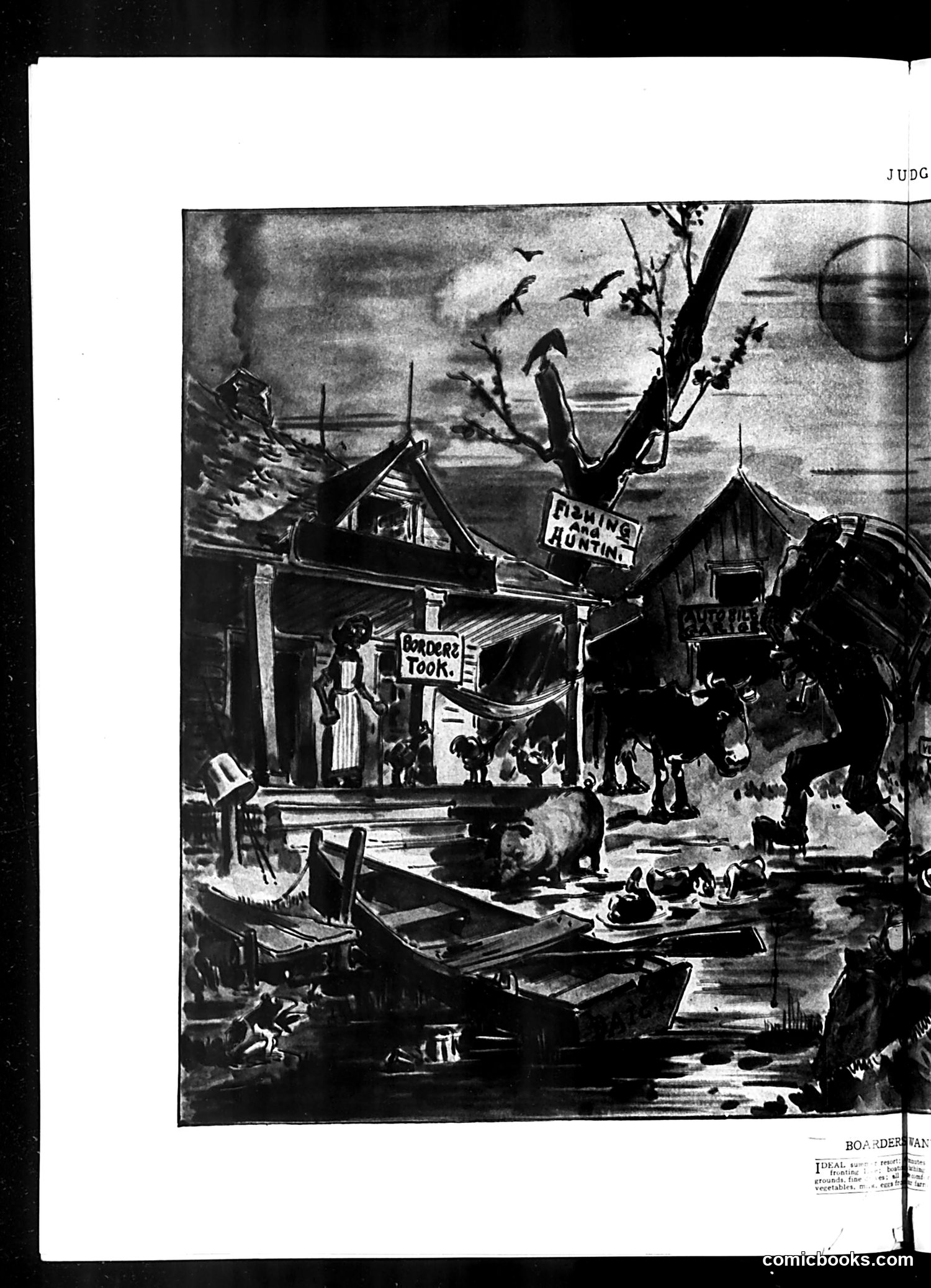
This appears to be a political cartoon from *Judge* magazine depicting a chaotic scene at what looks like a disreputable establishment or shantytown. The visible signs read "MURDER TOOK" and "BEYOND HORRORS," suggesting satirical commentary on crime or lawlessness in a specific location or institution. The scene shows numerous figures in apparent disorder—some armed, some fleeing—with birds circling overhead and a dead or dying animal in the foreground. The anarchic composition emphasizes chaos and violence. Without clearer identification of the signs or additional context, I cannot definitively state which specific political situation or location this critiques. The satire likely targets inadequate law enforcement, urban decay, or corrupt governance in a particular area, but the precise historical reference remains unclear from the visible elements alone.
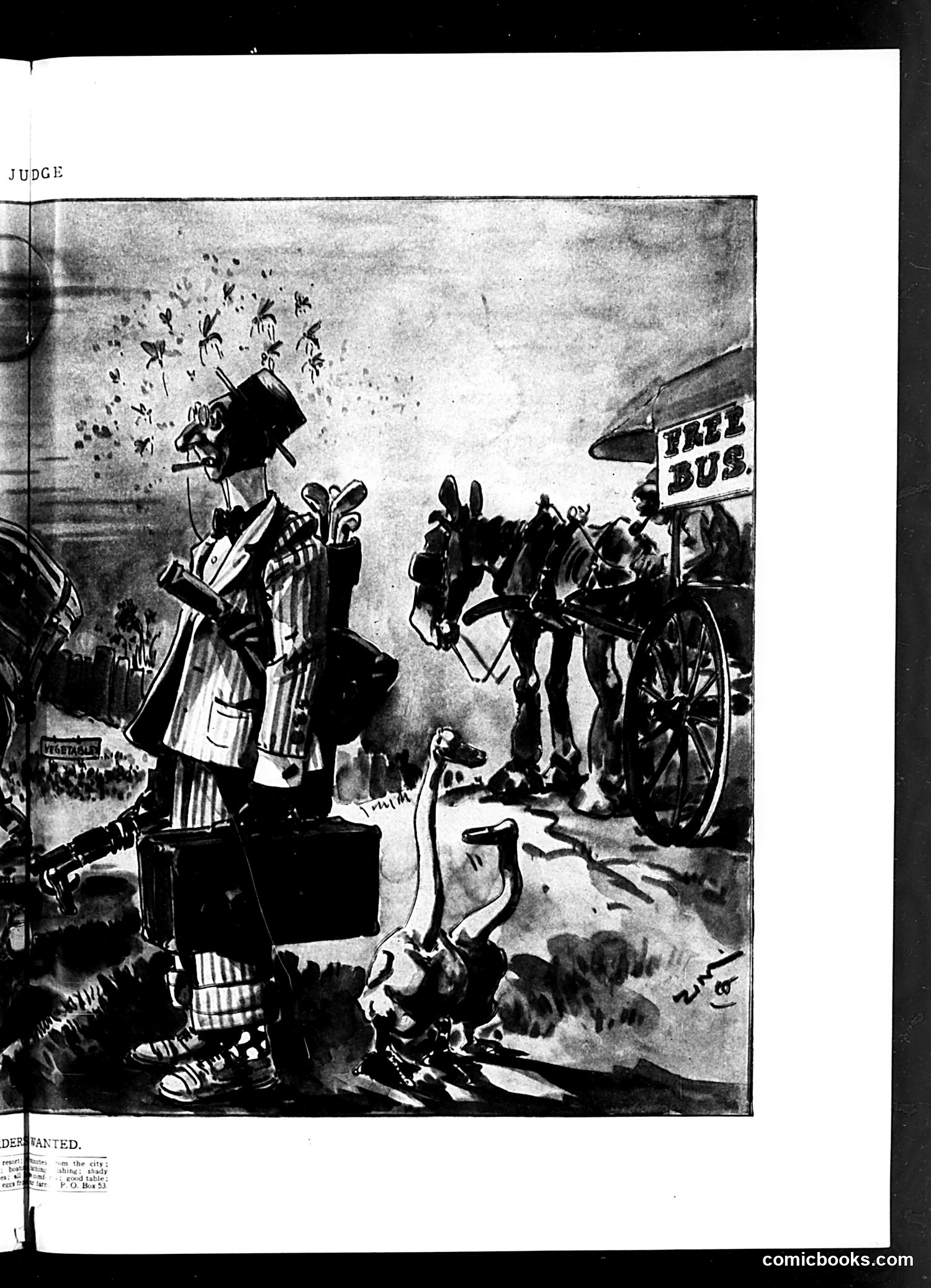
This Judge magazine cartoon depicts a judge figure (left) with an exploding head, spewing papers or documents into the air—suggesting his mind is overwhelmed or his decisions are chaotic. On the right, a "FREE BUS" sign is visible, likely referencing public transportation policy debates of the era. The cartoon appears to satirize judicial incompetence or corruption regarding transit regulation. The judge's erupting head suggests his rulings or administration are falling apart or creating disorder. The specific "FREE BUS" reference suggests this critiques a judicial decision affecting transportation services, possibly involving fare policies or public versus private transit control. Without the publication date visible, the precise historical context remains unclear, though this reflects common Progressive-era debates about public services and judicial competence.
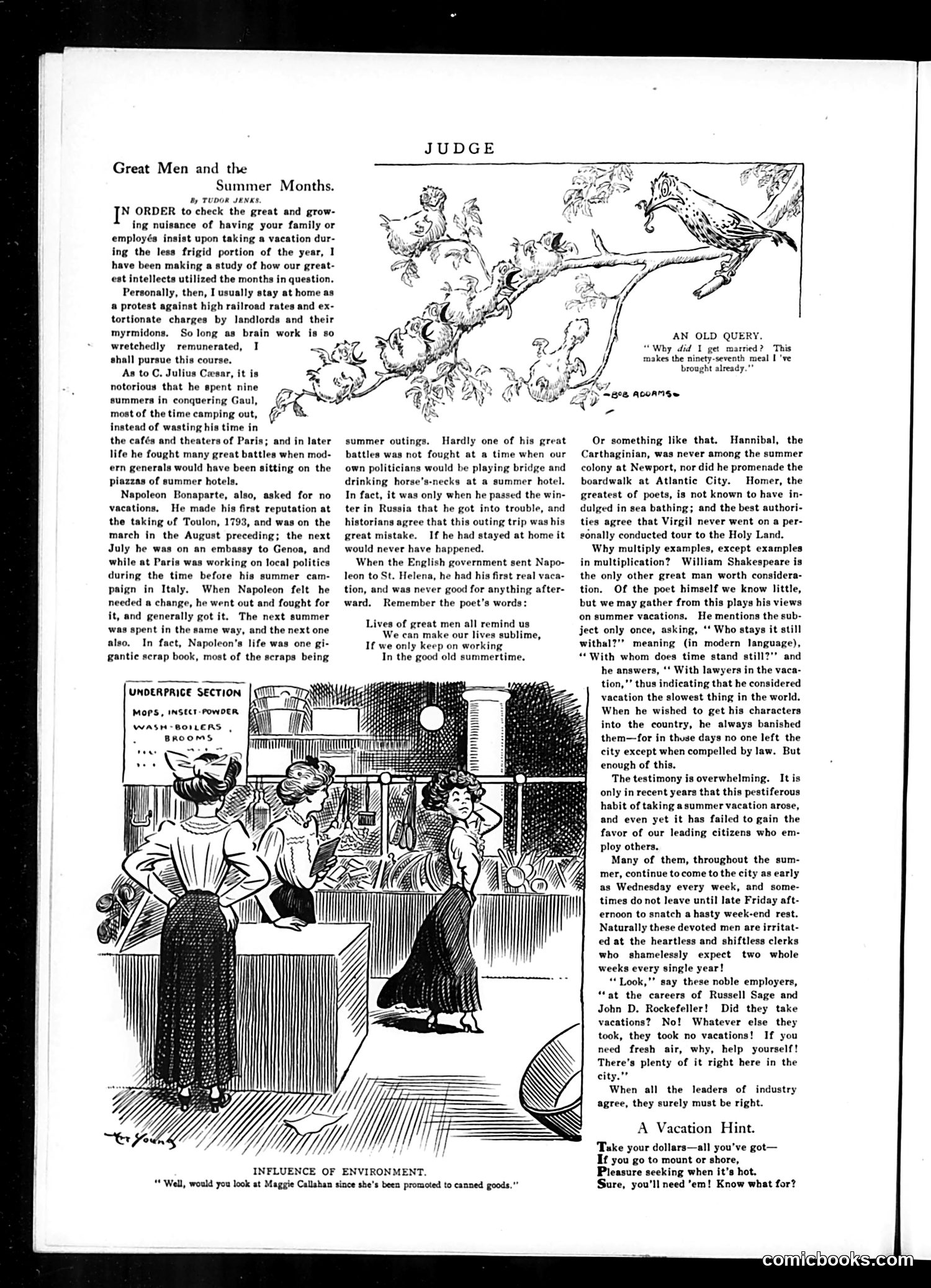
This article satirizes the growing expectation of summer vacations among workers and employees. Author Tudor Jenks argues that history's greatest figures—Julius Caesar, Napoleon Bonaparte, Homer, Hannibal, and Shakespeare—never took vacations. Instead, they worked through summer, achieving greatness through constant labor. The satire targets employers and the wealthy who resist granting time off to their workers. Jenks mockingly suggests vacations are a "pestiferous habit" that has failed to gain approval from "leading citizens who employ others." The historical examples are deliberately absurd (Napoleon "got into trouble" only during his winter Russian campaign, implying vacations cause failure). The accompanying cartoon "Influence of Environment" shows workers in an underprice section, likely mocking both labor conditions and class pretensions. The broader joke: wealthy employers cite history to deny workers rest while enjoying leisure themselves—a classic class-based hypocrisy Judge frequently lampooned.
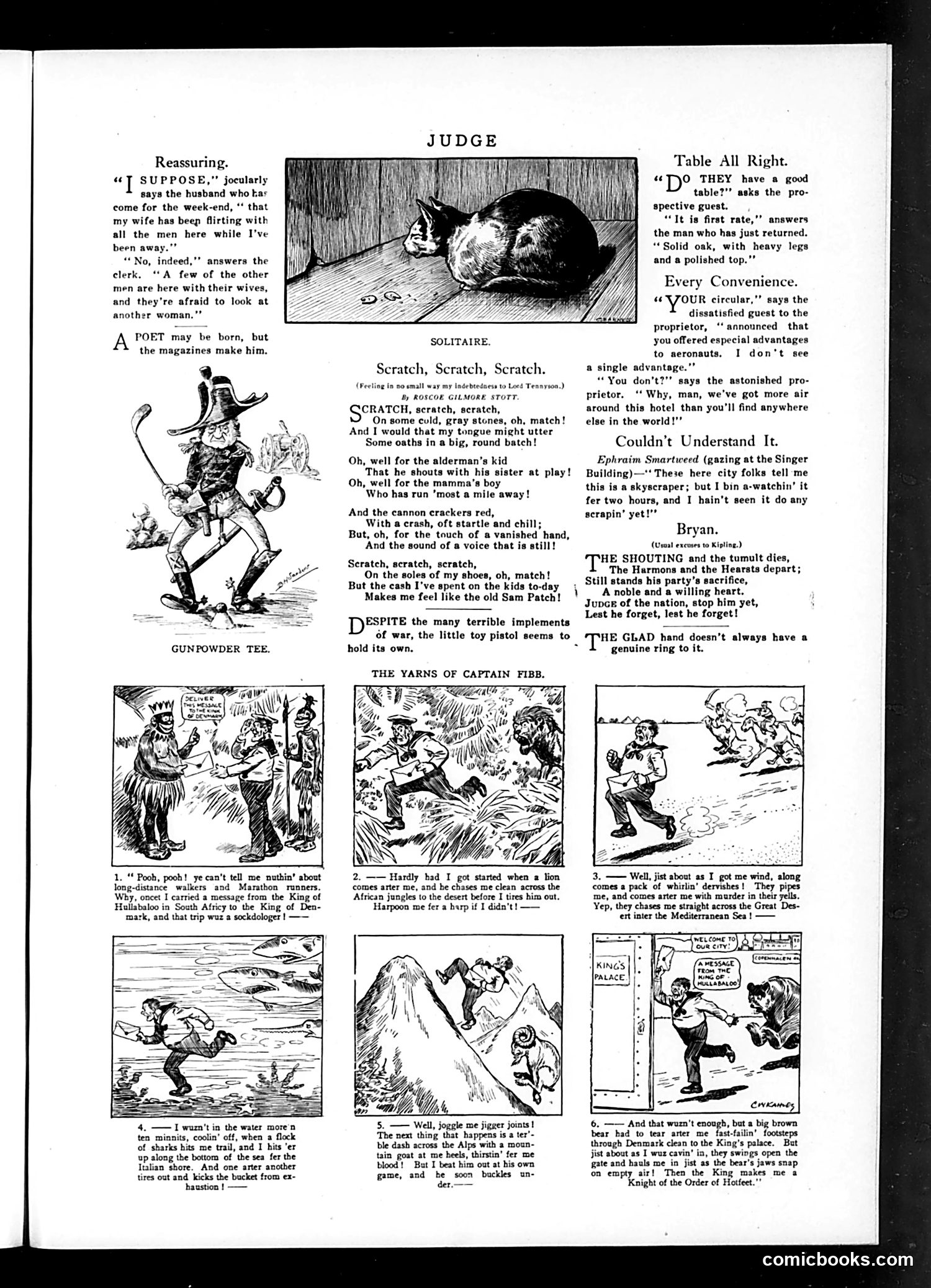
This page from **Judge** magazine contains several short satirical pieces mocking contemporary social conventions and figures: **"Reassuring"** jokes about wives flirting while husbands are away—the humor relies on the assumption that other men's *wives present* prevent any flirtation. **"Scratch, Scratch, Scratch"** is a parody poem about financial hardship, referencing "Sam Patch" (a famous 19th-century daredevil). The scratching represents both children's toy guns and the speaker's financial struggles. **The hotel jokes** mock hospitality advertising: one quips about a table being "solid oak" (deflating guests' expectations), another plays on "air" as a convenience for aeronauts. **"Captain Fibb's Yarns"** is tall-tale humor—exaggerated adventure stories (lions, sharks, mountains) that escalate absurdly. This was popular period entertainment. **The Bryan poem** likely references William Jennings Bryan's political defeat, portraying him as a noble sacrifice. The overall tone reflects early 1900s American humor: wordplay, sarcasm about commercialism, and satirizing both politicians and working-class pretension.
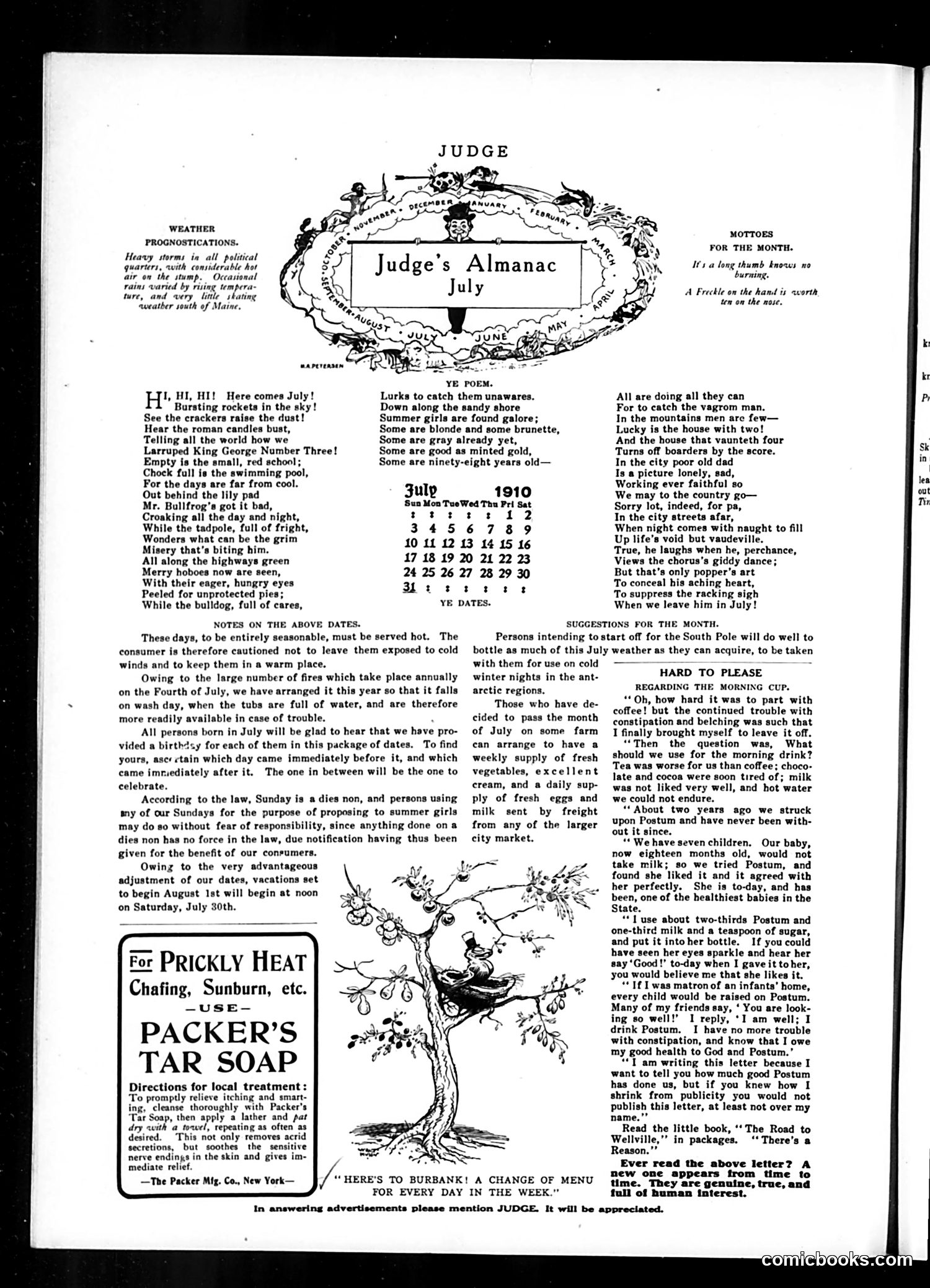
This is primarily an **almanac/calendar page for July 1910**, not a political cartoon. The content is largely lighthearted and seasonal rather than satirical. The page includes: - A **humorous poem** celebrating July's arrival, with references to Independence Day fireworks ("Larruped King George Number Three"—a joking reference to King George III and American independence) and typical summer activities - A **mock-serious calendar** with tongue-in-cheek "notes" joking about practical considerations (fires on the Fourth, wash day timing, legal implications of Sunday proposals) - **Seasonal observations** about summer weather, hoboes, bullfrogs, and summer girls - **Advertisements** for Packer's Tar Soap (treating heat rash) The satire is gentle and domestic rather than political—poking fun at summer conventions, holiday customs, and everyday life. The page's humor relies on wordplay and mild social commentary typical of Judge's light summer fare.
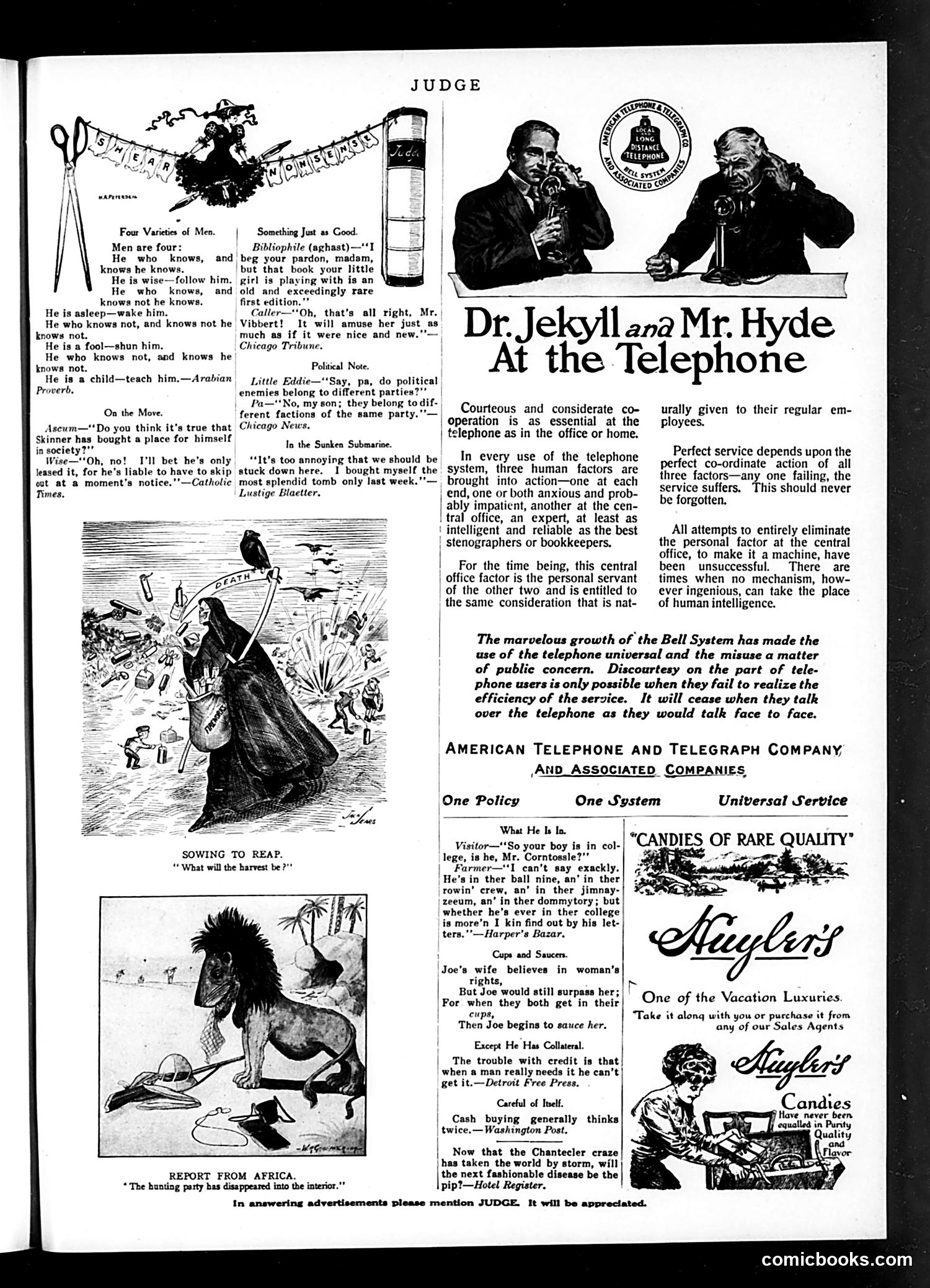
This page mixes satirical quotes, short jokes, and advertisements typical of early 20th-century Judge magazine. **The main feature** is a Bell Telephone Company advertisement titled "Dr. Jekyll and Mr. Hyde At the Telephone." The ad features two contrasting photographs of men—one composed, one agitated—to illustrate courteous versus discourteous telephone behavior. The lengthy text warns users that telephone operators deserve respect as "personal servants" and that rudeness undermines service efficiency. It's corporate messaging dressed as social commentary, urging callers to maintain face-to-face politeness even when unseen. **The cartoons and brief jokes** scattered throughout satirize contemporary social types: a man buying his way into society (but only renting), a mother unconcerned about damaging a rare book, political factionalism, and a farmer's son in college but nowhere to be found. **Bottom advertisements** promote Naylor's candies as "vacation luxuries." The page reflects early-20th-century concerns about modern technology's social etiquette and consumer behavior.
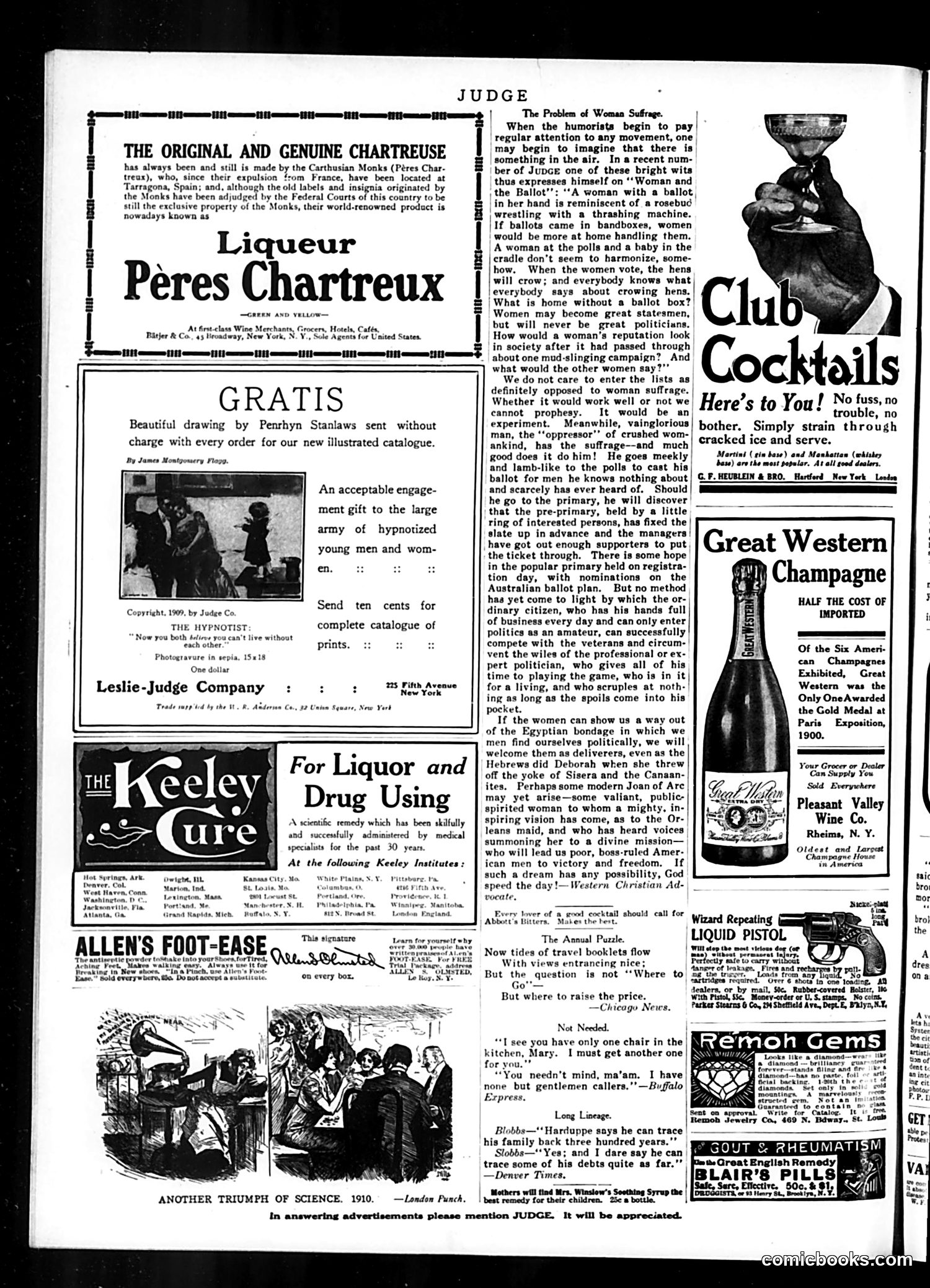
This page contains **Judge magazine's satirical commentary on women's suffrage** alongside period advertisements. The **main editorial piece** (center-right) mocks anti-suffrage arguments circulating in 1909-1910. It quotes a "bright wit" who claims women with ballots resemble "a rosebud wrestling with a thrashing machine"—suggesting women are too delicate for politics. The satire points out the hypocrisy: men claim the vote improves citizenship, yet men themselves vote ignorantly for candidates they've never heard of, easily manipulated by political machines and primaries. The **cartoon below** (credited to James Montgomery Flagg) depicts "The Hypnotist"—illustrating how both men and women are figuratively hypnotized into engagement/relationships, suggesting blind conformity to social expectations. **Context**: This reflects the pre-1920 suffrage debate. Judge here subtly undermines anti-suffrage logic by showing men's voting is equally flawed, making the case that denying women the vote based on competence is absurd. The page is otherwise filled with period advertisements (Chartreuse liqueur, foot powder, remedies) typical of the magazine's business model.
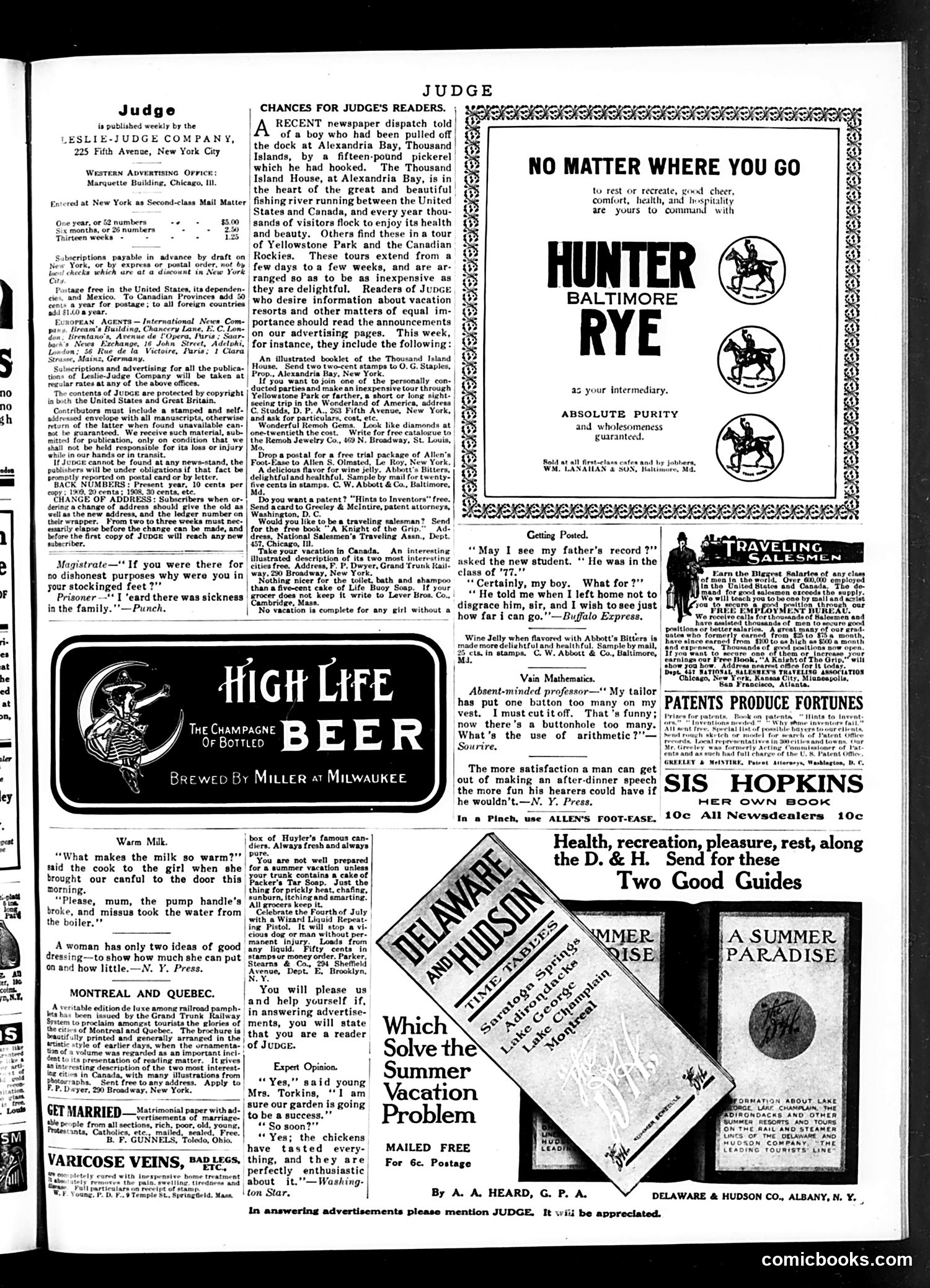
This page is primarily **advertising and editorial matter**, not a political cartoon. The main content consists of: 1. **Magazine masthead and subscription information** (left column) 2. **"Chances for Judge's Readers"** — an editorial section promoting vacation destinations and products advertised in the magazine, including the Thousand Islands, Yellowstone Park, and various consumer goods (jewelry, foot powder, patent services) 3. **Commercial advertisements** including: - Hunter Baltimore Rye whiskey - High Life Beer (brewed in Milwaukee) - Delaware & Hudson railroad's "Summer Paradise" guide - Patents and business services The page reflects early 20th-century American consumer culture and Judge's role as both satirical commentary and advertising vehicle. The small anecdote about a boy rescued by fishing guides at Alexandria Bay serves to promote tourism to that region. There are **no identifiable political figures or satirical cartoons** on this particular page—it's essentially a business/advertising page with editorial support material.
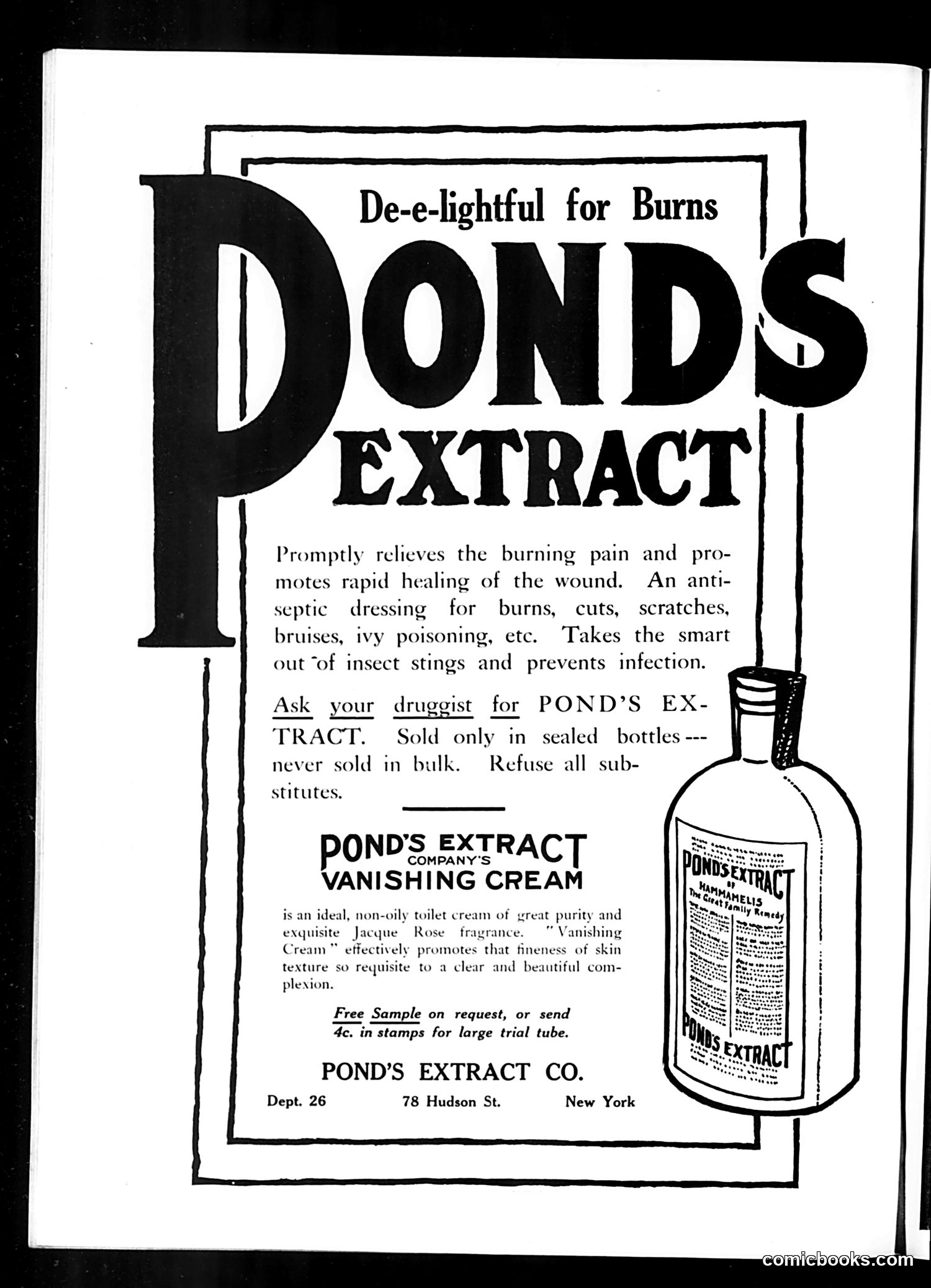
This page is primarily a **product advertisement**, not political satire or editorial cartooning. It promotes Pond's Extract products—a medicinal extract for burns and wounds, plus a vanishing cream for skincare. The only potential humor appears in the headline's pun: "De-e-lightful for Burns" (emphasizing "de-light") plays on the product's use for burn injuries. This mild wordplay was typical of early 20th-century advertising copy. The large "P" design is decorative branding. The bottle illustration shows the actual product packaging. There are no political figures, caricatures, or satirical commentary visible—this is straightforward commercial advertising from Judge magazine, which supplemented editorial content with paid advertisements.